
Outsource Divorce Paralegal Services to a Virtual Assistant

Practical guidance for building efficient, accountable legal support operations.
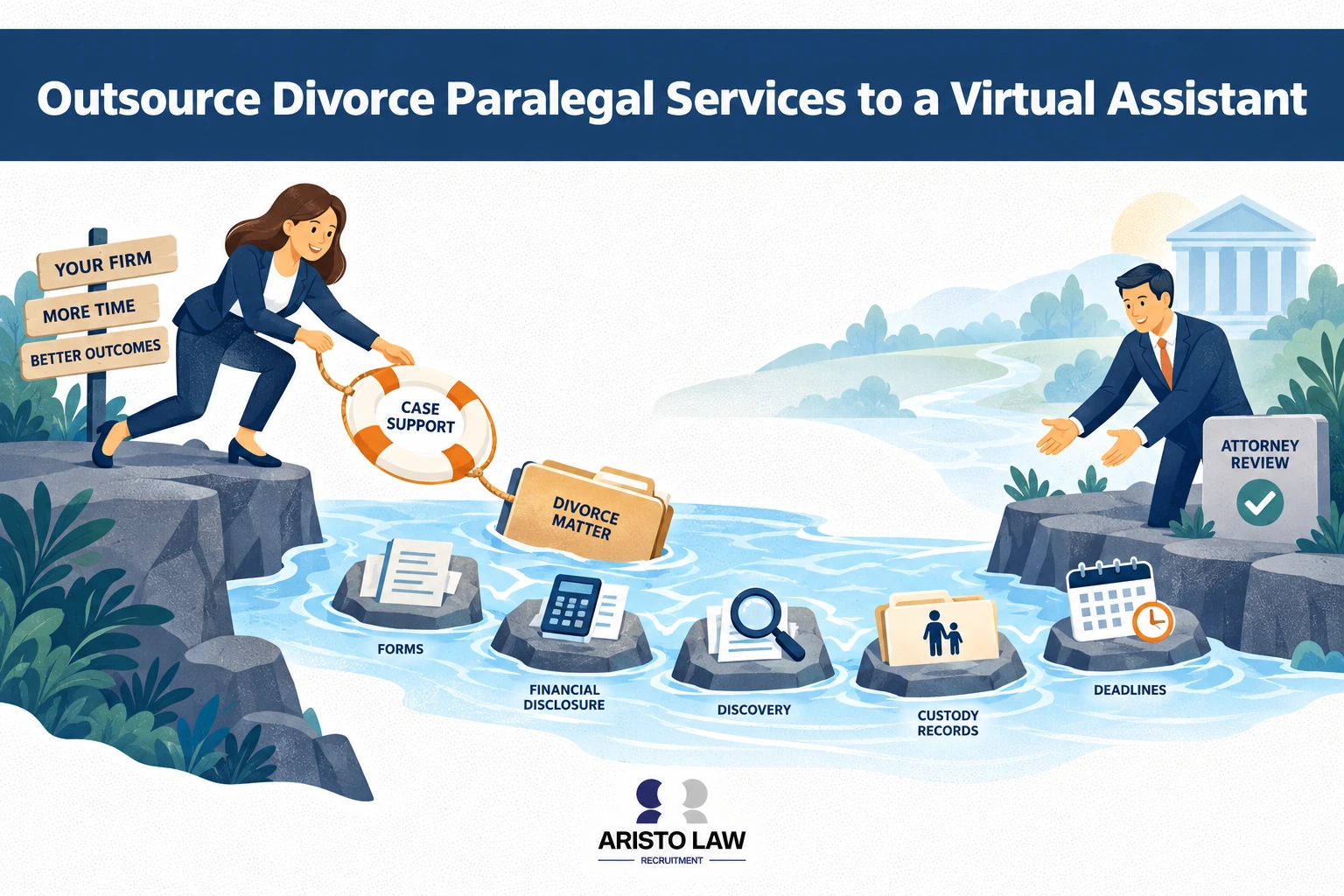
Outsourced divorce paralegal services involve remote legal
support delivered by virtual paralegals and legal assistants helping
family law firms manage administrative, procedural, and workflow-heavy
divorce operations through cloud-based legal systems and
attorney-supervised workflows. Divorce law practices frequently
outsource operational family-law support because divorce matters
generate high document volume, emotionally sensitive communication,
strict procedural deadlines, financial disclosure coordination, custody
documentation, hearing preparation, and continuous client follow-up
requiring structured operational support outside substantive attorney
strategy and legal representation.
Virtual divorce paralegals differ from virtual legal assistants
because divorce paralegals commonly support more procedural family-law
workflows involving discovery coordination, financial disclosure
organization, mediation preparation support, custody-document
management, timeline tracking, legal research assistance, and
attorney-reviewed document drafting. Virtual legal assistants usually
focus more heavily on intake coordination, scheduling, CRM updates,
billing workflows, communication routing, repository organization, and
operational administration.
Research by iFIVE Global in 2024 showed that legal process
outsourcing (LPO) can reduce staffing-related operational costs by as
much as 70% through offshore legal staffing, reduced recruitment
expenses, and lower office overhead requirements. Workflow
automation and remote legal coordination systems also improve document
turnaround speed, intake responsiveness, and administrative continuity
across high-volume family-law environments.
Divorce law firms frequently outsource paralegal workflows because
family-law practices experience fluctuating caseloads, emotionally
intensive client communication, repetitive procedural documentation, and
operational bottlenecks during contested divorces, custody disputes,
mediation phases, and discovery-heavy proceedings. Remote staffing
improves scalability during workload surges while reducing fixed payroll
pressure and office expansion costs. On-demand staffing models also
allow firms to increase or decrease support capacity depending on
litigation volume, intake growth, or seasonal workflow demand.
Virtual divorce paralegals commonly operate through case-management
platforms, document-management repositories, billing systems, CRM
software, workflow dashboards, e-signature systems, secure messaging
platforms, calendaring systems, document-automation tools, and
cloud-based legal collaboration software supporting distributed
family-law operations. Workflow automation systems additionally support
intake routing, reminder systems, financial-disclosure tracking, task
escalation, mediation scheduling, billing reminders, and repository
management while remote staff maintain operational continuity and
monitor workflow exceptions.
Effective virtual divorce paralegals usually demonstrate strong
organization, family-law terminology familiarity, document-management
discipline, communication quality, confidentiality awareness, deadline
sensitivity, intake coordination capability, billing support
familiarity, emotional intelligence, and procedural workflow management
skills. Law firms outsourcing divorce support also evaluate software
proficiency, communication responsiveness, workflow reliability,
repository-management discipline, attorney-review compliance,
confidentiality controls, and operational accountability before
assigning client-sensitive family-law workflows.
Confidentiality governance remains heavily important because divorce
matters frequently involve financial records, custody disputes, medical
information, personal communication, settlement negotiations, and
privilege-sensitive client documentation. Law firms commonly implement
confidentiality agreements, MFA authentication, encrypted communication
systems, role-based permissions, audit trails, secure repositories,
workflow restrictions, VPN access, and attorney-supervised operational
controls protecting attorney-client privilege and family-law
confidentiality obligations. Outsourcing risk usually increases when
firms lack workflow documentation, repository controls, communication
standards, escalation protocols, or structured supervision systems.
Law firms usually benefit most from outsourcing divorce paralegal
services during rapid caseload growth, administrative overload, intake
backlog, discovery-heavy litigation periods, staffing shortages, or
operational scaling phases requiring flexible support capacity without
immediate office expansion.
Aristolaw helps law firms outsource divorce paralegal
services to a virtual assistant by providing outsourced support for
divorce case organization, client document collection, court filing
coordination, discovery tracking, scheduling, and family law workflow
management. Explore
Aristolaw Virtual Paralegal Assistant Services to outsource trained
virtual divorce paralegal support for scalable family-law
operations. Aristolaw connects law firms with outsourcing
solutions that match trained divorce paralegal support staff to each
family law case task, client communication workflow, filing
responsibility, discovery coordination function, and remote divorce case
management needs.
What are
outsourced divorce paralegal services?
Outsourced divorce paralegal services are remote or
third-party paralegal support services that help family law attorneys
manage divorce case workflows under attorney supervision.
Family-law firms frequently use outsourced divorce paralegal support as
a scalable operational solution allowing attorneys to delegate
procedural, administrative, and workflow-heavy responsibilities without
proportionally increasing in-house staffing overhead or office
infrastructure costs.
A 2025 study by Paralegal Assistants found that on-demand
paralegal outsourcing models help law firms reduce workflow bottlenecks,
maintain consistent legal-service delivery, accelerate drafting and
discovery processes, and improve case-management continuity through
structured operational support systems. Structured paralegal
outsourcing models improve workflow continuity, reduce administrative
bottlenecks, accelerate matter progression, and increase attorney
productivity through centralized legal-support coordination systems.
Outsourced divorce paralegals commonly support intake coordination,
consultation scheduling, financial-document tracking, disclosure
preparation, repository management, discovery organization, procedural
deadline monitoring, billing coordination, mediation-preparation
support, case-file updates, communication tracking, document formatting,
hearing preparation workflows, and client follow-up across cloud-based
family-law systems. Divorce matters frequently involve large volumes of
financial records, custody-related documentation, procedural filings,
communication follow-up, and timeline-sensitive workflows making
operational legal support heavily important for maintaining matter
progression and client-service continuity.
Outsourced divorce paralegals support attorneys operationally but do
not replace lawyers, independently provide legal advice, establish legal
strategy, negotiate settlements without attorney oversight, represent
clients in court, or make substantive legal decisions because those
functions remain restricted to licensed attorneys under professional
legal-practice regulations. Attorneys remain responsible for legal
conclusions, courtroom advocacy, settlement authority, strategic
litigation decisions, and attorney-client legal counseling.
Law firms use outsourced divorce paralegal services primarily for
workflow relief, faster matter movement, improved document coordination,
stronger procedural organization, reduced attorney administrative
burden, and more scalable family-law operations supported through
structured attorney-supervised legal workflows.
What does a virtual
divorce paralegal do?
A virtual divorce paralegal supports family law attorneys by
managing procedural, administrative, document-heavy, and
workflow-coordination responsibilities across divorce and custody
matters through remote legal systems and attorney-supervised
workflows.
Outsourcing divorce paralegal services supports law firms by
delegating document preparation, client intake, scheduling, and case
coordination for family law matters. Law firms use virtual
divorce paralegal assistant services to manage divorce
workflows, organize filings, and improve administrative efficiency
during high-volume case handling.
Listed below are the 15 responsibilities of a virtual divorce
paralegal.
-
Intake coordination and conflict-check routing:
Virtual divorce paralegals manage inquiry intake, consultation
scheduling, intake forms, CRM updates, preliminary information
gathering, and conflict-check routing helping family-law firms respond
faster to new divorce inquiries and reduce missed-client opportunities.
High intake responsiveness improves workflow continuity in emotionally
sensitive family-law environments where delayed communication frequently
increases client frustration. -
Client onboarding and case-file setup: Remote
divorce paralegals organize matter repositories, establish digital case
folders, upload intake documents, maintain naming conventions, and
prepare workflow checklists improving operational consistency across
active divorce matters. Organized onboarding reduces document confusion
and improves matter visibility for attorneys and legal staff. -
Petition and response packet preparation for attorney
review: Virtual divorce paralegals frequently prepare draft
petition packets, response packets, procedural forms, and supporting
documentation templates for attorney review and approval. Structured
document preparation reduces administrative bottlenecks and accelerates
filing readiness in high-volume family-law practices. -
Financial affidavit organization and disclosure
coordination: Divorce matters frequently involve extensive
financial documentation. Virtual divorce paralegals organize financial
affidavits, income records, tax documentation, banking statements,
retirement-account records, and disclosure checklists improving workflow
visibility and reducing missing-document delays. -
Marital asset and debt tracking workflows: Remote
paralegals maintain organized records for property documentation, debt
schedules, account summaries, business-interest records, mortgage
information, and asset-tracking systems helping attorneys evaluate
financial disclosure completeness more efficiently. -
Child custody and support document support: Virtual
divorce paralegals coordinate parenting-plan documentation,
custody-related records, support worksheets, school records,
communication logs, and procedural custody documentation helping
maintain organized family-law repositories during emotionally sensitive
proceedings. -
Discovery request tracking and document
organization: Divorce litigation often generates large volumes
of discovery requests, interrogatories, production requests, subpoenas,
and supporting records. Virtual paralegals monitor discovery deadlines,
organize responses, maintain document indexes, and track procedural
compliance reducing litigation workflow congestion. -
Hearing calendar updates and deadline management:
Virtual divorce paralegals coordinate hearings, mediation dates, filing
deadlines, attorney calendars, reminder systems, and procedural
scheduling improving deadline visibility and reducing scheduling
conflicts across active family-law matters. -
Settlement conference preparation support: Remote
divorce paralegals organize financial summaries, document binders,
mediation packets, procedural checklists, and communication records
supporting attorneys during settlement conferences and negotiation
preparation workflows. -
Client communication and follow-up coordination:
Divorce practices generate high communication volume involving intake
updates, document requests, scheduling reminders, disclosure follow-up,
mediation coordination, and procedural status communication. Virtual
paralegals maintain communication continuity reducing operational delays
and missed follow-up. -
Document formatting and repository management:
Virtual divorce paralegals maintain repository organization, document
formatting consistency, metadata tagging, naming conventions, version
tracking, and digital filing systems improving document retrieval speed
and operational visibility. -
Billing coordination and administrative support:
Remote family-law paralegals frequently support invoice preparation,
billing reminders, time-entry coordination, accounts receivable
tracking, and workflow-related administrative financial processes
improving cash-flow continuity inside divorce practices. -
E-signature coordination and procedural routing:
Divorce workflows frequently require signature collection for pleadings,
disclosures, settlement documents, parenting plans, and procedural
filings. Virtual paralegals coordinate signature routing, completion
tracking, and repository updates reducing turnaround delays. -
Case-status tracking and workflow monitoring:
Virtual divorce paralegals maintain task boards, workflow dashboards,
matter updates, communication logs, and procedural tracking systems
improving visibility across attorneys, clients, courts, mediators, and
support teams. -
Closing checklists and file-completion workflows: At
the conclusion of divorce matters, virtual paralegals organize final
judgments, closing documentation, repository updates, billing
reconciliation, document archiving, and procedural completion checklists
improving operational closure consistency.
Family-law practices experience unusually high communication volume,
document volume, procedural deadlines, and emotionally sensitive client
interaction. Virtual divorce paralegals reduce operational bottlenecks
by centralizing workflow coordination, organizing procedural
documentation, maintaining communication continuity, improving
repository visibility, and supporting faster matter movement across
divorce and custody workflows under attorney supervision.
How
can a virtual assistant support divorce paralegal workflows?
A virtual assistant can support divorce paralegal workflows
by handling administrative tasks, scheduling, client communication, file
organization, billing, and follow-up coordination surrounding family law
cases. This support allows divorce paralegals and family-law
attorneys to focus more heavily on substantive legal preparation,
litigation support, custody coordination, discovery management, and
attorney-supervised case strategy workflows.
Research by LeanLaw in 2025 showed that law firms with
structured delegation systems reduced operational costs by 50–70% and
increased billable attorney hours by up to 40% through the use of
paralegals and virtual assistants for administrative workflow
management. Structured delegation systems improve law-firm
efficiency, reduce operational bottlenecks, accelerate matter
progression, and increase attorney productivity by separating
administrative workflow management from substantive legal support
responsibilities. Industry outsourcing research regularly estimates
workflow delegation and remote legal staffing structures reduce
administrative overhead by approximately 30%–50% while improving
response speed and document turnaround across high-volume legal
practices.
Virtual assistants supporting divorce workflows commonly manage
consultation scheduling, intake coordination, CRM updates, client
onboarding communication, repository organization, billing reminders,
hearing reminders, e-signature routing, folder maintenance, workflow
tracking, inbox triage, communication routing, and procedural follow-up
systems. Divorce law generates unusually high communication volume
involving custody updates, financial-document requests, mediation
scheduling, procedural reminders, and intake follow-up. Virtual
assistants improve operational continuity by maintaining communication
responsiveness and reducing administrative congestion inside family-law
practices.
Hybrid remote staffing systems improve scalability because
administrative tasks, procedural coordination, and substantive workflow
support become separated into structured operational layers improving
efficiency across distributed family-law operations. Virtual assistant
support functions most effectively when law firms implement documented
SOPs, confidentiality agreements, secure repositories, MFA systems,
workflow dashboards, attorney-review checkpoints, communication
standards, and centralized case-management systems supporting
coordinated remote family-law operations.
Why do
law firms outsource divorce paralegal services?
Law firms outsource divorce paralegal services to improve
operational efficiency, reduce staffing costs, increase workflow
flexibility, and manage family law case workloads more
effectively.
Listed below are the 15 reason law firms outsource divorce paralegal
services.
-
Lower operational overhead: Family-law firms
frequently outsource divorce paralegal support to avoid expanding full
in-house payroll, office infrastructure, benefits expense, equipment
costs, and long-term staffing obligations before workload demand becomes
stable. Outsourced staffing structures allow firms to increase
operational support gradually instead of committing immediately to
permanent staffing expansion. -
Faster staffing during case backlog periods: Divorce
practices often experience sudden intake growth, contested custody
surges, mediation-heavy periods, or discovery backlog creating
operational congestion. Outsourced paralegal services allow firms to add
trained workflow support faster than traditional in-house hiring cycles
reducing procedural delays and administrative backlog. -
Flexible capacity for uneven divorce caseloads:
Family-law workload volume fluctuates heavily depending on litigation
cycles, seasonal filing patterns, mediation demand, and custody
disputes. Outsourced support structures allow firms to scale staffing
capacity up or down depending on active caseload volume without
maintaining unnecessary permanent staffing during slower periods. -
Reduced attorney administrative workload: Divorce
attorneys frequently lose substantial time coordinating intake
follow-up, scheduling, financial-disclosure tracking, repository
organization, procedural deadlines, communication routing, and document
workflows. Outsourced divorce paralegals reduce operational burden
allowing attorneys to focus more heavily on legal strategy,
negotiations, litigation preparation, and client representation. -
Improved document organization for financial and custody
matters: Divorce matters generate high volumes of financial
affidavits, tax records, banking documents, debt schedules, custody
documentation, mediation records, and disclosure packets. Outsourced
divorce paralegals maintain repository organization, naming conventions,
workflow tracking, and procedural document coordination reducing
operational confusion and missing-document delays. -
Better client follow-up and communication
continuity: Family-law practices involve emotionally sensitive
communication and unusually high client-contact frequency. Outsourced
support improves responsiveness through consultation scheduling,
disclosure reminders, procedural updates, mediation coordination,
billing follow-up, and communication tracking reducing client
frustration and operational communication gaps. -
Support during caseload spikes and temporary workload
surges: Divorce litigation, emergency custody matters,
contested hearings, and high-volume intake periods frequently overwhelm
existing staff capacity. Outsourced paralegal support allows firms to
absorb temporary operational pressure without permanently increasing
office headcount. -
Faster matter progression and reduced bottlenecks:
Structured workflow delegation improves scheduling coordination,
document turnaround, discovery tracking, hearing preparation workflows,
intake processing, and procedural follow-up accelerating divorce matter
movement across the practice. -
Scalable support for document-heavy divorce
litigation: Contested divorce matters frequently involve
extensive discovery requests, financial disclosures, parenting-plan
documentation, and procedural filing workflows. Outsourced paralegal
services improve operational scalability for high-volume procedural
support tasks. -
Improved intake responsiveness and lead conversion:
Faster intake coordination and consultation scheduling reduce
missed-client opportunities and improve intake conversion consistency
inside high-demand family-law practices. -
Access to remote and on-demand legal support:
Outsourced divorce paralegal services provide operational flexibility
through remote staffing models, project-based support, overflow
assistance, and distributed workflow coordination across cloud-based
legal systems. -
Reduced workflow disruption during staffing
shortages: Remote outsourcing models improve operational
continuity during employee turnover, temporary leave, recruitment
delays, or sudden intake growth reducing disruption across active
divorce matters. -
Operational support without expanding office space:
Remote family-law staffing structures improve scalability because firms
add workflow support without increasing physical office capacity or
infrastructure investment. -
Improved workflow visibility and task coordination:
Outsourced divorce paralegals commonly maintain task boards, workflow
dashboards, repository systems, intake tracking, procedural calendars,
and communication logs improving operational transparency across active
family-law matters. -
Technology-enabled workflow management: Cloud-based
case-management systems, document repositories, e-signature platforms,
CRM systems, billing software, and workflow dashboards allow outsourced
divorce paralegals to integrate directly into modern family-law
operations while maintaining centralized workflow visibility and
attorney supervision.
Legal operations and outsourcing studies consistently show structured
paralegal outsourcing models reduce administrative bottlenecks, improve
attorney billable efficiency, accelerate document turnaround, and
strengthen workflow scalability across document-intensive legal
practices such as family law and divorce litigation.
What
divorce workflows can be outsourced to a virtual paralegal?
Divorce workflows that can be outsourced to a virtual
paralegal are operational, procedural, and document-management workflows
supporting family-law attorneys under attorney supervision.
Research by Thomson Reuters cited in a 2025 legal outsourcing
analysis showed that roughly 2/3 of law firms outsourced at least one
operational role, with firms reporting increased efficiency and
productivity through delegated legal support functions and automated
workflows. Workflow delegation models reduce administrative
backlog, improve procedural turnaround, and increase attorney
productivity across document-intensive legal practices.
Listed below are the 15 workflows that are outsourced to a virtual
paralegal.
-
Petition and response packet preparation: Virtual
divorce paralegals prepare draft petition packets, response forms,
procedural templates, and filing checklists for attorney review and
approval. Attorneys finalize substantive legal content, strategic
positions, and filing authorization before court submission. -
Financial disclosure and affidavit organization:
Divorce matters frequently involve incomplete financial records and
disclosure delays. Virtual paralegals organize tax returns, banking
statements, payroll records, retirement documents, debt schedules, and
affidavit support materials reducing workflow bottlenecks caused by
missing documentation. Attorneys review disclosure completeness and
legal sufficiency. -
Marital asset and debt tracking workflows: Virtual
paralegals maintain spreadsheets, repository systems, document indexes,
and financial-document tracking systems organizing marital assets,
liabilities, property records, mortgage information, and
business-interest documentation supporting attorney review and
settlement preparation. -
Child custody and support documentation workflows:
Virtual divorce paralegals organize parenting-plan documentation,
custody schedules, school records, childcare expense records,
communication logs, and procedural support documents. Attorneys review
custody strategy, parenting-plan terms, and legal recommendations before
client presentation or filing. -
Discovery organization and tracking: Divorce
litigation often creates high-volume discovery workflows involving
interrogatories, production requests, subpoenas, and financial
disclosure demands. Virtual paralegals track deadlines, organize
responses, maintain repositories, route document requests, and
coordinate operational follow-up reducing missed deadlines and
procedural confusion. Attorneys review substantive responses and
litigation strategy. -
Document collection and missing-record follow-up:
Family-law matters frequently stall because clients fail to provide
complete financial or custody-related records. Virtual paralegals
maintain document-request checklists, send reminder sequences, track
missing items, and coordinate follow-up workflows improving procedural
continuity and reducing matter delays. -
Hearing preparation support: Virtual paralegals
organize hearing binders, exhibit indexes, procedural checklists,
financial summaries, custody documentation, and repository structures
supporting attorney preparation before hearings or mediation sessions.
Attorneys control legal arguments, litigation strategy, and courtroom
advocacy. -
Mediation and settlement conference coordination:
Virtual divorce paralegals coordinate scheduling, organize supporting
documentation, maintain communication logs, route procedural updates,
and prepare settlement-support repositories improving workflow
continuity during negotiation phases. Attorneys remain responsible for
settlement advice and negotiation decisions. -
Calendar management and deadline tracking: Virtual
paralegals update hearing calendars, mediation schedules, filing
deadlines, discovery timelines, reminder systems, and workflow
dashboards reducing procedural deadline risk across active family-law
matters. -
Court-filing coordination workflows: Remote
paralegals organize filing-ready repositories, procedural checklists,
e-signature routing, filing packets, and administrative submission
workflows supporting coordination between attorneys, courts, and legal
staff. Attorneys review and approve final filings. -
Client communication and status updates: Divorce
practices generate unusually high communication volume involving
disclosure reminders, hearing notices, procedural updates, mediation
coordination, and scheduling changes. Virtual paralegals maintain
communication continuity reducing client frustration and operational
communication gaps. Legal advice and strategic counseling remain
attorney-controlled. -
Billing support and administrative coordination:
Virtual divorce paralegals frequently support invoice preparation,
time-entry coordination, payment reminders, billing-system updates, and
administrative workflow tracking improving operational cash-flow
continuity. -
Case-management and repository maintenance: Remote
paralegals maintain matter updates, workflow dashboards, repository
organization, metadata consistency, document naming conventions, and
procedural tracking systems improving operational visibility across
attorneys, clients, courts, and support staff. -
Last-minute hearing and filing support: Family-law
practices frequently experience emergency custody requests, rushed
filings, incomplete disclosures, and urgent hearing preparation. Virtual
paralegals improve operational responsiveness by organizing procedural
workflows quickly and maintaining centralized document visibility during
high-pressure litigation phases. -
Closing and post-judgment workflow support: Virtual
paralegals organize final judgments, closing packets, repository
updates, procedural checklists, billing reconciliation, and archived
matter records improving operational consistency after divorce
resolution.
Operational handoffs inside outsourced divorce workflows commonly
move between clients providing records, virtual paralegals organizing
and tracking procedural workflows, attorneys reviewing substantive legal
content, courts receiving filings, opposing counsel exchanging
discovery, and internal legal staff maintaining centralized workflow
visibility.
Structured supervision systems remain heavily important because
virtual paralegals support procedural family-law operations
operationally while attorneys retain legal authority, litigation
control, and substantive legal decision-making responsibility.
What
tasks should not be outsourced to a divorce paralegal?
Tasks that should not be outsourced to a divorce paralegal
are attorney-only legal functions involving legal judgment, strategic
legal interpretation, courtroom representation, settlement authority,
and substantive legal advice.
Research by Legal Ethics scholar Deborah Rhode and later
analyses on unauthorized practice of law found that incompetent or
unsupervised nonlawyer legal service providers expose clients to
malpractice harms and regulatory risks when providing legal guidance
without proper oversight. Unauthorized practice violations
create significant malpractice exposure, confidentiality risk, client
confusion, and regulatory liability particularly in emotionally
sensitive family-law matters involving custody, support, finances, and
parental rights.
Listed below are 15 tasks that must not be outsourced to a virtual
paralegal.
-
Giving legal advice to divorce clients: Virtual
divorce paralegals must not advise clients regarding legal rights,
procedural strategy, divorce options, custody expectations, or
litigation decisions because legal advice remains restricted to licensed
attorneys. Paralegals organize facts and procedural information but
attorneys must interpret law and provide legal recommendations. -
Recommending whether a client should accept a
settlement: Settlement decisions frequently involve financial
exposure, parenting rights, asset division, tax implications, and
long-term legal consequences. Outsourced paralegals cannot independently
recommend settlement acceptance, rejection, or negotiation strategy
because these functions require attorney legal judgment and client
counseling. -
Predicting child-custody outcomes or judicial
decisions: Divorce paralegals organize custody records,
communication logs, and parenting-plan documents but cannot predict
likely court outcomes, judicial preferences, visitation decisions, or
custody rulings because these conclusions involve substantive legal
analysis and litigation strategy. -
Interpreting legal rights or family-law statutes:
Virtual paralegals cannot independently interpret divorce laws, support
obligations, custody statutes, financial rights, procedural rights, or
jurisdiction-specific family-law regulations for clients. Attorneys
remain responsible for substantive legal interpretation. -
Deciding child-support or spousal-support strategy:
Support calculations and financial strategy frequently involve income
analysis, judicial discretion, tax consequences, statutory
interpretation, and negotiation considerations requiring attorney
evaluation and legal judgment. -
Representing clients in court or mediation as legal
counsel: Divorce paralegals cannot appear in court as
attorneys, conduct hearings independently, provide courtroom advocacy,
or formally represent clients during contested legal proceedings because
representation authority remains restricted to licensed attorneys. -
Negotiating legal terms independently with opposing
counsel: Outsourced divorce paralegals coordinate communication
logistics and document routing but cannot independently negotiate
settlement terms, legal concessions, custody arrangements, or litigation
positions without attorney direction and supervision. -
Signing pleadings or legal filings as the responsible
attorney: Virtual paralegals prepare drafts and organize filing
packets for attorney review but cannot sign legal pleadings,
certifications, legal affidavits, or attorney representations because
those actions create direct legal accountability. -
Establishing attorney-client relationships: Divorce
paralegals cannot independently accept representation, establish legal
engagement terms, approve legal representation, or create
attorney-client relationships because these decisions remain
attorney-controlled legal functions. -
Providing strategic litigation recommendations: Case
strategy involving discovery direction, motion practice, negotiation
leverage, emergency custody actions, or trial positioning requires
attorney legal judgment and cannot be delegated to outsourced legal
support staff. -
Making independent decisions about evidence or procedural
filings: Virtual paralegals organize discovery materials and
procedural timelines but attorneys must determine litigation
significance, admissibility concerns, filing strategy, and legal
positioning. -
Handling conflict-sensitive legal conclusions directly with
clients: Divorce matters frequently involve emotionally
volatile family disputes, financial stress, and child-related conflict.
Attorneys must supervise sensitive communication involving legal
conclusions, settlement recommendations, custody strategy, or litigation
risk. -
Acting without attorney supervision: Outsourced
divorce paralegals must operate inside attorney-supervised workflows
because family-law matters involve high legal risk, confidential
financial information, parenting rights, and privilege-sensitive
communication requiring controlled oversight structures. -
Communicating final legal conclusions as if acting as the
attorney: Virtual paralegals summarize workflow updates or
procedural status information but cannot independently communicate final
legal positions, strategic recommendations, or substantive legal advice
to clients. -
Making unilateral legal decisions during
emergencies: Emergency custody disputes, restraining-order
requests, support disputes, and urgent family-law proceedings frequently
require immediate attorney legal analysis and cannot be independently
managed by outsourced support staff.
Virtual divorce paralegals remain highly valuable operationally
because they organize facts, track deadlines, prepare drafts for
attorney review, maintain repositories, summarize records, coordinate
intake workflows, support discovery organization, monitor procedural
timelines, and improve communication continuity across family-law
practices.
Attorneys nevertheless retain responsibility for legal judgment,
client counseling, strategic litigation decisions, settlement advice,
courtroom representation, and substantive legal conclusions because
divorce matters involve high-risk family, financial, and child-related
legal consequences requiring licensed attorney oversight.
How do virtual
paralegals support divorce intake?
Virtual paralegals support divorce intake by organizing
client information, preparing intake summaries, checking document needs,
routing conflict-check information, and scheduling attorney
review. Divorce intake functions as the first major
case-organization stage inside family-law operations because attorneys
require structured financial, family, procedural, and jurisdictional
information before evaluating legal strategy, custody concerns, support
issues, or litigation risk.
A study by John Zeleznikow in 2017 found that online
dispute-resolution and automated family-law systems improved efficiency
and effectiveness in family court processes by streamlining
communication, reducing procedural bottlenecks, and improving case
preparation workflows. Structured intake systems improve
consultation efficiency, reduce administrative delays, increase document
readiness, and improve attorney preparation quality across high-volume
divorce practices.
Virtual divorce paralegals commonly gather and organize
spouse-identification details, marriage timelines, separation dates,
residential history, child-related information, custody concerns,
employment details, income records, debt summaries, asset inventories,
property documentation, retirement-account information, tax records, and
prior court-order documentation through intake forms and centralized
legal systems. Intake workflows also frequently include domestic-safety
screening, emergency-order history, jurisdiction-related facts, prior
litigation history, communication logs, and preliminary consultation
notes helping attorneys review matter complexity more efficiently before
the initial consultation.
Virtual paralegals support attorneys operationally during intake but
do not determine legal eligibility, evaluate legal rights, establish
case strategy, predict custody outcomes, recommend litigation positions,
or provide substantive legal advice because these functions remain
restricted to licensed attorneys. Attorneys remain responsible for legal
interpretation, strategic evaluation, attorney-client engagement
decisions, and legal counseling after reviewing organized intake
information.
How
do virtual paralegals support divorce document preparation?
Virtual paralegals support divorce document preparation by
completing templates, organizing supporting records, formatting drafts,
tracking missing information, and preparing document packets for
attorney review.
Outsourcing divorce paralegal services supports preparation of
petitions, financial disclosures, custody forms, and filing
documentation required in family court proceedings. Law firms use family
law virtual paralegal support in divorce cases to
manage document workflows, deadline tracking, and procedural accuracy
across high-volume divorce matters.
Listed below are 15 ways virtual paralegals support divorce document
preparation.
-
Petition and response packet preparation: Virtual
divorce paralegals frequently populate divorce petition templates,
response forms, procedural filing packets, and administrative cover
sheets using client-provided information and attorney instructions.
Attorneys review legal allegations, strategic positioning, requested
relief, and substantive legal content before filing. -
Financial affidavit organization and preparation
support: Divorce matters commonly require extensive financial
disclosures involving income records, debt schedules, bank statements,
retirement accounts, tax documents, and property records. Virtual
paralegals organize these materials, populate affidavit templates, track
missing records, and maintain disclosure checklists supporting attorney
review and verification. -
Disclosure packet coordination: Remote paralegals
prepare disclosure folders, organize supporting exhibits, maintain
repository consistency, and track document completeness reducing delays
caused by incomplete financial submissions or missing supporting
documentation. -
Parenting-plan worksheet support: Virtual paralegals
frequently organize scheduling information, childcare records, school
documentation, communication logs, and parenting-plan worksheets
supporting attorney preparation for custody-related filings and
mediation workflows. Attorneys determine custody strategy, parenting
recommendations, and legal positions. -
Discovery request formatting and organization:
Divorce litigation often generates interrogatories, requests for
production, subpoenas, and procedural discovery workflows. Virtual
paralegals organize draft discovery packets, maintain document indexes,
track deadlines, and prepare formatting structures supporting
attorney-reviewed litigation workflows. -
Settlement exhibit preparation: Remote divorce
paralegals organize financial summaries, asset schedules, debt records,
communication exhibits, parenting documentation, and supporting
materials for mediation or settlement conferences improving operational
readiness before negotiations. Attorneys evaluate settlement strategy
and legal conclusions. -
Document-index and repository management: Virtual
paralegals maintain organized repositories, exhibit indexes, naming
conventions, metadata consistency, version tracking, and procedural
checklists improving document retrieval speed and operational visibility
across active family-law matters. -
Correspondence draft preparation: Remote paralegals
prepare procedural correspondence drafts, document-request letters,
scheduling notices, follow-up communication, and administrative updates
for attorney review before transmission. Attorneys approve substantive
legal communication and legal conclusions. -
Document formatting and procedural consistency:
Divorce workflows frequently require strict formatting consistency
involving captions, headings, spacing, signatures, exhibit references,
pagination, and filing structures. Virtual paralegals maintain
formatting discipline reducing attorney rework and filing
inconsistencies. -
Tracking missing information and unresolved items:
Family-law matters frequently stall because clients fail to provide
complete financial records, custody documentation, or procedural
information. Virtual paralegals monitor missing items, send follow-up
reminders, update checklists, and maintain workflow visibility reducing
procedural bottlenecks. -
Preparing filing-ready document packets: Virtual
paralegals assemble organized filing packets containing pleadings,
exhibits, disclosure records, indexes, signatures, procedural forms, and
supporting documentation supporting attorney review and court-filing
workflows. -
Exhibit labeling and procedural organization:
Divorce litigation often involves extensive supporting records. Virtual
paralegals maintain exhibit labels, numbering systems, repository
structure, and procedural indexing improving hearing preparation and
litigation coordination. -
Version-control management: Family-law matters
generate repeated revisions involving disclosures, parenting plans,
settlement drafts, and procedural filings. Virtual paralegals maintain
version tracking systems reducing confusion, duplication, and
outdated-document risk. -
Quality-control review for administrative accuracy:
Remote paralegals commonly verify names, dates, addresses, case numbers,
court captions, exhibit references, formatting consistency, repository
placement, and procedural completeness before attorney review reducing
avoidable administrative errors. -
Workflow coordination between attorneys, clients, and
staff: Virtual paralegals frequently coordinate communication
regarding missing documents, draft updates, signature requests, filing
preparation, and procedural deadlines improving operational continuity
across family-law workflows.
Virtual divorce paralegals support document preparation operationally
through template completion, formatting, repository organization,
procedural coordination, and administrative quality control. Attorneys
remain responsible for legal drafting decisions, litigation strategy,
legal conclusions, settlement positions, substantive allegations, and
final approval before filing or client distribution because these
functions require licensed legal judgment and attorney supervision.
How
do virtual paralegals support financial disclosures in divorce?
Virtual paralegals support financial disclosures in divorce
by tracking income records, bank statements, tax returns, assets, debts,
expenses, and missing client documents.
Listed below are the 15 ways virtual paralegals support financial
disclosures in divorce.
-
Creating structured document-request lists: Virtual
divorce paralegals prepare organized request checklists covering payroll
records, tax returns, retirement statements, mortgage documents,
investment accounts, credit-card balances, loan records, insurance
policies, business-interest documentation, and recurring household
expenses. Structured request systems improve workflow visibility and
reduce missing-record delays. -
Tracking income verification documents: Divorce
matters frequently require pay stubs, employment records, bonus history,
commission statements, self-employment records, tax filings, and income
summaries. Virtual paralegals organize and track these records
supporting attorney review of disclosure completeness and procedural
readiness. -
Organizing bank statements and financial-account
records: Remote paralegals maintain centralized repositories
for checking accounts, savings accounts, retirement plans, brokerage
statements, cryptocurrency records, and financial transaction histories
improving operational access during negotiation, mediation, and
discovery workflows. -
Maintaining asset and debt schedules – Virtual
paralegals organize marital-property inventories, mortgage obligations,
credit-card debt, auto loans, student loans, investment assets,
retirement accounts, and business interests inside structured tracking
systems supporting attorney-reviewed financial analysis. -
Managing expense-category organization: Divorce
disclosures often require detailed monthly-expense reporting involving
housing costs, childcare expenses, transportation, insurance, education,
healthcare, utilities, and discretionary spending. Virtual paralegals
organize records into categorized reporting structures improving
attorney review efficiency. -
Tracking missing client documentation: Family-law
practices frequently experience workflow delays because clients fail to
submit complete financial records. Virtual paralegals maintain
missing-document trackers, send reminder sequences, update repositories,
and coordinate follow-up communication reducing disclosure bottlenecks
and procedural delays. -
Maintaining file naming and repository consistency:
Financial disclosures generate extremely high document volume. Virtual
paralegals maintain standardized naming conventions, metadata
organization, folder structures, version tracking, and document indexing
improving retrieval speed and reducing repository confusion. -
Preparing attorney-ready disclosure packets: Remote
paralegals organize disclosure records into structured review packets
containing indexed exhibits, categorized financial records, debt
schedules, asset summaries, and procedural checklists helping attorneys
evaluate case readiness more efficiently. -
Supporting discovery and disclosure coordination:
Virtual paralegals track disclosure deadlines, discovery-response
timelines, production requests, subpoena records, and financial-document
exchanges improving operational continuity during contested divorce
litigation. -
Coordinating communication between clients and
attorneys: Divorce disclosures frequently require repeated
clarification and document collection. Virtual paralegals maintain
communication logs, route requests, monitor unresolved financial issues,
and coordinate workflow updates reducing attorney administrative
burden. -
Preparing financial-summary support materials:
Virtual paralegals organize spreadsheets, financial summaries, exhibit
binders, and categorized disclosure indexes supporting attorney
preparation for mediation, settlement conferences, and hearings.
Attorneys remain responsible for financial interpretation, valuation
analysis, negotiation strategy, and legal conclusions. -
Improving mediation and negotiation readiness:
Organized financial disclosures improve settlement preparation because
attorneys gain faster access to accurate income records, debt schedules,
asset documentation, and expense summaries during negotiation workflows.
Incomplete records frequently delay mediation progress and increase
litigation friction. -
Reducing hearing-preparation bottlenecks:
Last-minute hearings often create operational pressure when financial
records remain incomplete or disorganized. Virtual paralegals improve
hearing readiness through centralized repositories, indexed exhibits,
document tracking systems, and procedural workflow coordination. -
Supporting quality-control review: Virtual
paralegals frequently verify consistency involving names, account
references, dates, exhibit labels, filing structures, and procedural
completeness before attorney review reducing avoidable administrative
errors. -
Maintaining workflow visibility across family-law
operations: Divorce disclosures often involve operational
handoffs between clients, attorneys, courts, opposing counsel,
mediators, accountants, and internal legal staff. Virtual paralegals
maintain centralized workflow dashboards and procedural tracking systems
improving coordination across distributed family-law workflows.
Financial disclosure remains one of the highest-friction divorce
workflows because incomplete financial records frequently slow
negotiation, mediation, discovery, settlement preparation, and
court-readiness timelines. Family-law operational research consistently
shows structured document-management systems and centralized disclosure
coordination improve procedural turnaround and reduce administrative
delays across document-intensive divorce litigation. Virtual paralegals
improve operational efficiency heavily through organization, tracking,
repository management, follow-up coordination, and workflow continuity
while attorneys retain control over valuation analysis, litigation
strategy, support calculations, settlement recommendations, and
substantive legal interpretation.
How do
virtual paralegals support discovery in divorce cases?
Virtual paralegals support discovery in divorce cases by
organizing requests, tracking deadlines, collecting records, indexing
productions, and preparing summaries for attorney review.
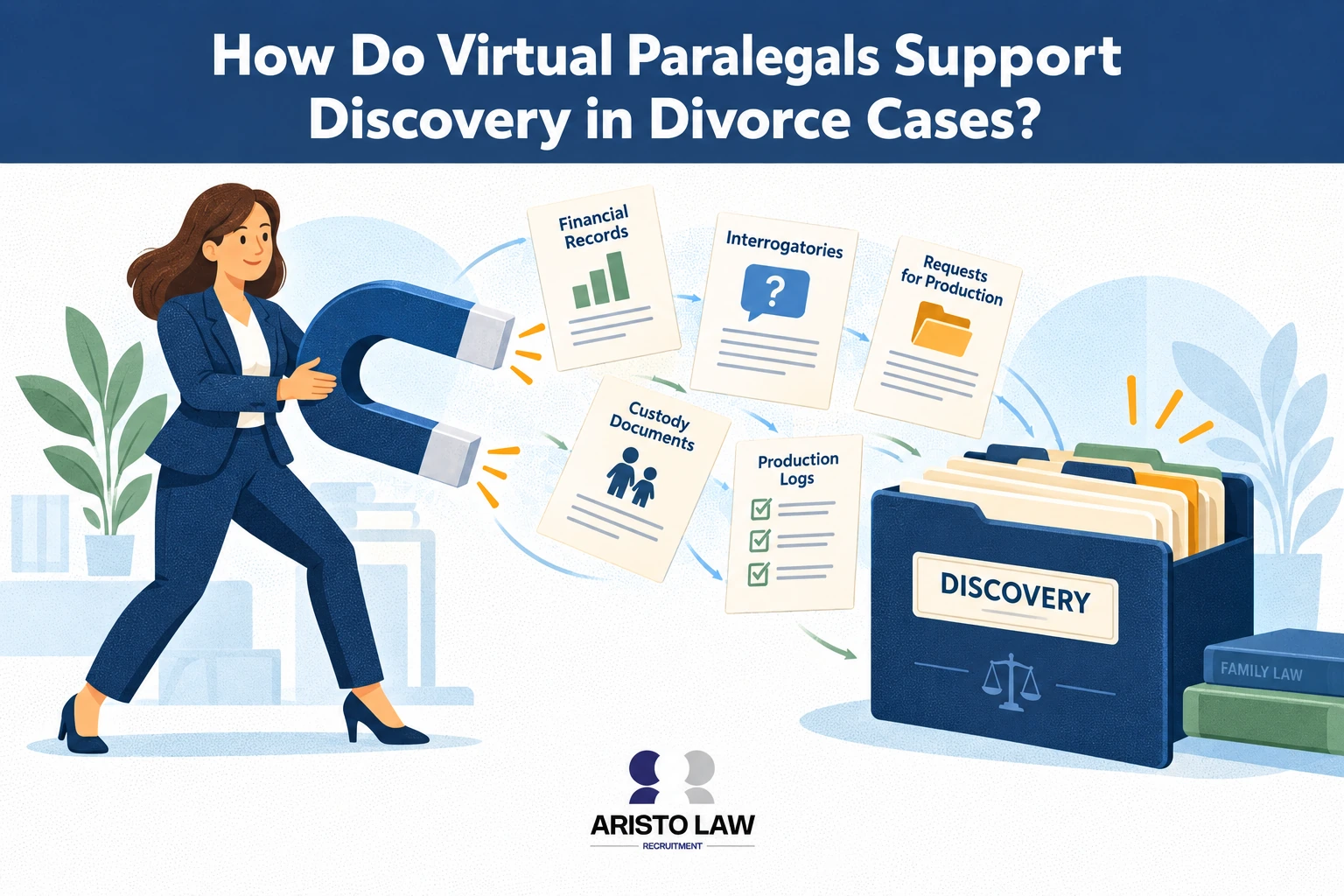
Listed below are the 15 ways virtual paralegals support discovery in
divorce cases.
-
Organizing interrogatories and discovery requests:
Virtual divorce paralegals prepare and organize interrogatories,
requests for production, procedural checklists, and document-request
workflows supporting attorney-directed discovery strategy. Attorneys
determine legal scope, objections, and substantive discovery positions
before service. -
Tracking discovery deadlines and procedural
calendars: Divorce litigation frequently involves strict
response deadlines for interrogatories, subpoenas, disclosure updates,
and production requests. Virtual paralegals maintain deadline calendars,
reminder systems, workflow dashboards, and escalation tracking reducing
missed-deadline risk and procedural disruption. -
Collecting financial records and supporting
documentation: Discovery in divorce matters often requires
payroll records, tax returns, retirement statements, business records,
mortgage documentation, investment-account records, debt schedules, and
expense reports. Virtual paralegals coordinate document collection,
maintain request logs, and track incomplete production items improving
operational visibility. -
Managing requests for production workflows: Remote
paralegals organize production requests, monitor response progress,
track missing records, maintain production indexes, and coordinate
procedural communication between attorneys, clients, and opposing
counsel supporting structured discovery workflows. -
Supporting subpoena coordination: Virtual paralegals
prepare subpoena support packets, track service status, organize
responsive records, maintain procedural timelines, and coordinate
administrative follow-up workflows. Attorneys review subpoena scope,
objections, and strategic litigation considerations. -
Organizing communication records and digital
evidence: Divorce discovery frequently involves text messages,
emails, parenting-app communication, financial correspondence, and
digital records. Virtual paralegals organize communication repositories,
maintain file structures, and index production materials improving
attorney review efficiency. -
Tracking school, medical, and custody-related
records: Custody disputes often involve educational records,
healthcare documentation, childcare records, therapy records, and
parenting-related evidence. Virtual paralegals organize repositories and
maintain procedural tracking systems supporting attorney-supervised
custody workflows. -
Maintaining production logs and document indexes:
Divorce discovery generates extremely high document volume. Virtual
paralegals maintain production logs, exhibit indexes, repository
structures, metadata organization, and naming conventions improving
retrieval speed and litigation visibility. -
Flagging potentially privileged or sensitive materials for
attorney review: Virtual paralegals identify potentially
privileged communication, confidential records, protected information,
or unusual production concerns requiring attorney evaluation before
disclosure. Attorneys determine privilege assertions, objections, and
disclosure strategy. -
Preparing attorney-ready discovery summaries: Remote
paralegals organize summaries of financial records, communication
patterns, missing documents, production gaps, and procedural timelines
helping attorneys review discovery status more efficiently before
hearings, mediation, or settlement discussions. -
Managing follow-up calendars for incomplete
production: Divorce litigation frequently stalls because
clients or opposing parties fail to produce complete financial records
or custody documentation. Virtual paralegals maintain follow-up
schedules, reminder systems, escalation tracking, and
unresolved-document logs improving procedural continuity. -
Coordinating operational handoffs across legal
teams: Discovery workflows frequently move between clients,
attorneys, opposing counsel, courts, accountants, custody evaluators,
and internal support staff. Virtual paralegals maintain workflow
visibility and procedural coordination reducing operational
fragmentation. -
Supporting hearing and mediation preparation:
Discovery materials often become central during hearings and settlement
negotiations. Virtual paralegals organize exhibits, production
summaries, financial-document repositories, and indexed evidence binders
improving litigation readiness. -
Maintaining repository accuracy and version control:
Divorce discovery frequently involves updated disclosures, revised
productions, supplemental records, and amended responses. Virtual
paralegals maintain centralized repositories, version tracking systems,
and procedural organization reducing duplication and outdated-document
risk. -
Reducing litigation bottlenecks through workflow
coordination: Structured discovery support improves document
turnaround, procedural tracking, production visibility, communication
continuity, and operational accountability across contested family-law
matters.
Missed discovery deadlines, incomplete production, disorganized
financial records, and poorly tracked subpoenas frequently create major
litigation risk in divorce proceedings because delays disrupt hearings,
mediation preparation, settlement negotiations, and court-readiness
timelines.
Research by the Australian Law Reform Commission in 2019
showed that integrated case-management, coordinated information-sharing,
and structured procedural systems were necessary to improve timeliness,
compliance, and efficiency within high-volume family-law
environments. The report identified court delays, fragmented
coordination, and procedural complexity as major causes of inefficiency
in divorce and family-law litigation. Centralized discovery-management
systems improve procedural compliance and reduce operational delays
across high-volume divorce litigation environments.
Virtual paralegals support discovery operationally through
organization, tracking, indexing, repository management, and workflow
coordination while attorneys remain responsible for objections,
litigation strategy, privilege analysis, legal conclusions, and final
discovery responses.
How
do virtual paralegals support child custody workflows?
Virtual paralegals support child custody workflows by
organizing parenting schedules, school records, communication logs,
court forms, and custody-related document packets for attorney
review.
Listed below are 15 ways virtual paralegals support child custody
workflows.
-
Organizing parenting-time calendars and custody
schedules: Virtual paralegals maintain parenting-time
calendars, visitation schedules, holiday rotations, transportation
arrangements, and exchange timelines helping attorneys review custody
logistics more efficiently during negotiations, mediation, and
litigation preparation. -
Managing parenting-plan documentation: Remote
custody-support paralegals organize parenting-plan worksheets, proposed
schedules, communication records, childcare arrangements,
extracurricular schedules, and procedural custody documents supporting
attorney-supervised family-law workflows. -
Tracking child-related expenses and reimbursement
records: Custody disputes frequently involve childcare costs,
tuition payments, extracurricular expenses, medical expenses, insurance
records, and reimbursement tracking. Virtual paralegals organize these
records into structured repositories supporting attorney review and
procedural preparation. -
Organizing school records and educational
documentation: Virtual paralegals maintain repositories for
report cards, attendance records, disciplinary reports,
special-education documents, teacher communication, and school schedules
improving operational visibility across custody-related matters. -
Maintaining medical and healthcare documentation:
Child custody workflows often involve pediatric records, therapy
records, prescription information, counseling documentation, insurance
records, and healthcare communication logs. Virtual paralegals organize
these materials while maintaining confidentiality and repository
consistency. -
Tracking communication histories between parents:
Divorce litigation frequently involves parenting-app records, emails,
text messages, call logs, and communication timelines. Virtual
paralegals organize communication repositories, maintain indexing
systems, and prepare attorney-ready summaries supporting custody-related
review workflows. -
Managing prior court orders and procedural history:
Remote paralegals organize prior custody orders, temporary orders,
restraining orders, mediation agreements, support orders, and procedural
timelines improving attorney access to historical case information
during active custody disputes. -
Supporting safety-concern documentation workflows:
Family-law matters involving domestic violence allegations, emergency
custody concerns, protective orders, or child-safety issues frequently
require structured documentation management. Virtual paralegals organize
incident records, supporting documentation, procedural timelines, and
communication logs for attorney review. Attorneys evaluate legal
strategy, emergency relief requests, and litigation positioning. -
Preparing custody hearing materials: Virtual
paralegals organize hearing binders, exhibit packets, communication
logs, expense summaries, parenting schedules, procedural checklists, and
supporting records improving operational readiness before custody
hearings and mediation sessions. -
Tracking procedural deadlines and filing workflows:
Custody disputes involve hearings, mediation sessions, evaluations,
procedural filings, and court-imposed deadlines. Virtual paralegals
maintain calendars, reminder systems, workflow dashboards, and
procedural tracking systems reducing missed-deadline risk. -
Maintaining repository organization and version
control: Child custody matters frequently generate updated
schedules, revised parenting plans, supplemental communication records,
and evolving procedural documents. Virtual paralegals maintain naming
conventions, repository structures, metadata consistency, and version
tracking improving workflow visibility. -
Coordinating communication between attorneys, clients, and
staff: Remote paralegals support operational communication
involving scheduling changes, document requests, procedural reminders,
mediation coordination, and custody-related workflow updates reducing
administrative bottlenecks and communication gaps. -
Supporting mediation and negotiation preparation:
Virtual paralegals organize parenting schedules, communication
summaries, school records, healthcare records, and expense documentation
supporting attorney preparation for mediation and custody negotiations.
Attorneys determine legal strategy and negotiation recommendations. -
Maintaining confidentiality around child-related
records: Custody workflows involve highly sensitive
educational, medical, psychological, financial, and communication
records involving minors. Virtual paralegals operate through secure
repositories, confidentiality agreements, role-based permissions,
encrypted communication systems, and attorney-supervised workflows
protecting privacy and attorney-client confidentiality obligations. -
Reducing operational bottlenecks in emotionally sensitive
custody disputes: Child custody matters often involve extremely
high communication volume, rapidly changing schedules, urgent filings,
and large document repositories. Virtual paralegals improve operational
continuity by centralizing workflow coordination, repository
organization, deadline tracking, and procedural follow-up.
Virtual paralegals support custody workflows operationally through
organization, tracking, repository management, communication
coordination, and hearing preparation support. Attorneys remain
responsible for recommending custody outcomes, advising clients
regarding parenting strategy, evaluating child-best-interest standards,
negotiating custody arrangements, interpreting family-law statutes, and
making substantive legal decisions because these functions require
licensed attorney judgment and legal supervision.
How
do virtual paralegals support mediation and settlement preparation?
Virtual paralegals support mediation and settlement
preparation by organizing financial records, issue lists, proposed
terms, exhibits, timelines, and draft settlement materials for attorney
review. Divorce mediation preparation functions as a structured
packet-building process because family-law negotiations frequently
involve large volumes of financial disclosures, parenting schedules,
support calculations, communication histories, asset documentation, and
unresolved procedural issues requiring centralized organization before
settlement discussions begin.
Research published by the ACT Law Society in 2025 found that
effective mediation and negotiation strategies in family-law practice
help reduce prolonged litigation, foster cooperation, and improve
dispute-resolution outcomes in parenting, support, and property-division
cases. Organized mediation workflows improve negotiation
efficiency, reduce procedural delays, accelerate settlement preparation,
and improve attorney readiness during contested divorce proceedings.
Virtual divorce paralegals commonly organize asset summaries, debt
schedules, retirement-account records, income documentation, tax
filings, banking records, expense reports, property inventories, and
disclosure repositories supporting attorney review before mediation
sessions. Remote paralegals also maintain issue trackers covering
custody disputes, parenting-time disagreements, support-related
concerns, reimbursement disputes, unresolved disclosure gaps, and
procedural follow-up items improving visibility across negotiation
workflows. Structured issue tracking becomes heavily important because
divorce mediation frequently stalls when unresolved documentation gaps,
incomplete disclosures, or unclear negotiation priorities remain
unidentified before settlement discussions begin.
Mediation support workflows commonly include exhibit organization,
binder preparation, procedural checklists, document indexing, timeline
summaries, repository updates, communication coordination, and
scheduling management improving operational readiness before mediation
sessions or settlement conferences. Remote paralegals also monitor
disclosure completeness, track missing records, coordinate follow-up
requests, and maintain attorney-ready repositories reducing last-minute
mediation disruption caused by incomplete financial documentation or
disorganized exhibits.
How do
virtual paralegals support hearing preparation?
Virtual paralegals support hearing preparation by organizing
court dates, exhibits, witness information, filing checklists, draft
packets, and attorney-ready case materials.
Listed below are the 14 ways virtual paralegals support hearing
preparation.
-
Managing hearing calendars and procedural deadlines:
Virtual divorce paralegals maintain hearing schedules, filing deadlines,
service deadlines, reminder systems, mediation dates, and procedural
calendars helping attorneys avoid missed deadlines and last-minute
workflow disruption during family-law proceedings. -
Organizing hearing binders and attorney-ready
packets: Remote paralegals assemble hearing binders containing
pleadings, financial disclosures, parenting plans, exhibits, procedural
timelines, communication records, discovery summaries, and supporting
documentation improving attorney access to organized case materials
before hearings. -
Maintaining exhibit labeling and indexing systems:
Divorce hearings frequently involve financial exhibits, custody records,
communication logs, school records, medical documentation, and
procedural filings. Virtual paralegals label exhibits, organize indexes,
maintain repository consistency, and prepare exhibit-reference systems
reducing retrieval delays during hearings. -
Tracking filing requirements and procedural
checklists: Family-law hearings often require strict compliance
with filing rules, disclosure deadlines, service requirements, and
procedural submission standards. Virtual paralegals maintain filing
checklists, submission logs, procedural calendars, and workflow
dashboards supporting operational compliance. -
Supporting witness-information organization: Remote
paralegals maintain witness contact information, scheduling details,
communication logs, procedural reminders, and coordination records
supporting attorney hearing preparation workflows. Attorneys determine
witness strategy, testimony priorities, and litigation positioning. -
Organizing financial exhibits and disclosure
records: Temporary support hearings, asset disputes, and
enforcement matters frequently require extensive financial
documentation. Virtual paralegals organize income records, expense
summaries, debt schedules, tax documents, bank statements, and exhibit
repositories supporting attorney review before hearings. -
Preparing draft procedural materials for attorney
review: Virtual paralegals prepare draft procedural packets,
hearing checklists, exhibit summaries, and attorney-reviewed draft
orders supporting structured hearing preparation workflows. Attorneys
finalize legal arguments, substantive language, and strategic litigation
content. -
Tracking service completion and procedural
follow-up: Divorce hearings frequently require document service
confirmation, subpoena tracking, filing acknowledgments, and procedural
compliance monitoring. Virtual paralegals maintain service logs and
workflow visibility reducing procedural oversight risk. -
Maintaining repository organization and version
control: Hearing preparation often involves multiple revisions
to financial disclosures, parenting schedules, exhibit lists, procedural
filings, and proposed orders. Virtual paralegals maintain naming
conventions, repository structures, metadata consistency, and version
tracking reducing confusion and outdated-document risk. -
Supporting custody-hearing preparation workflows:
Child custody hearings frequently involve parenting schedules,
communication histories, school records, healthcare documentation, and
child-related expense tracking. Virtual paralegals organize these
materials into structured hearing repositories improving attorney
preparation efficiency. -
Supporting temporary-order and emergency-hearing
workflows: Temporary support motions, emergency custody
hearings, and urgent enforcement matters frequently create compressed
timelines and operational pressure. Virtual paralegals improve
responsiveness by organizing procedural packets, updating calendars,
coordinating document collection, and maintaining workflow continuity
during high-pressure litigation phases. -
Preparing post-hearing workflow checklists: After
hearings conclude, virtual paralegals commonly track follow-up tasks,
order-entry deadlines, updated scheduling requirements, filing
obligations, procedural reminders, and communication workflows
supporting operational continuity after court proceedings. -
Coordinating operational communication across legal
teams: Hearing preparation frequently requires coordination
between attorneys, clients, courts, witnesses, mediators, opposing
counsel, and internal support staff. Virtual paralegals maintain
communication tracking systems and workflow visibility reducing
operational fragmentation. -
Reducing last-minute scrambling in family-law
litigation: Divorce hearings often become operationally chaotic
because of incomplete disclosures, disorganized exhibits, missing
signatures, delayed filings, or unclear procedural tracking. Virtual
paralegal support reduces hearing-preparation bottlenecks through
centralized document control, repository organization, deadline
tracking, and structured workflow coordination.
Virtual paralegals support hearing preparation operationally through
logistics management, repository organization, procedural tracking,
document coordination, and administrative workflow support. Attorneys
remain responsible for legal arguments, litigation strategy, witness
examination, settlement positioning, courtroom advocacy, and substantive
legal conclusions because those functions require licensed attorney
judgment and professional legal authority.
How
do virtual paralegals support client communication in divorce
cases?
Virtual paralegals support client communication in divorce
cases by sending attorney-approved updates, requesting missing
documents, scheduling calls, tracking questions, and documenting client
interactions.
Listed below are the 15 ways virtual paralegals support client
communication in divorce cases.
-
Sending attorney-approved status updates: Divorce
clients frequently experience uncertainty regarding filings, custody
schedules, mediation progress, financial disclosures, and hearing
timelines. Virtual paralegals send attorney-approved procedural updates
helping clients remain informed about workflow progress without
requiring attorneys to manage every operational communication step. -
Requesting missing financial and custody documents:
Family-law matters commonly stall because clients fail to provide
complete tax records, banking statements, parenting schedules, childcare
documentation, or disclosure materials. Virtual paralegals maintain
reminder workflows, send follow-up requests, and track unresolved
document needs reducing operational delays. -
Scheduling attorney calls and consultations: Remote
paralegals coordinate consultations, mediation meetings,
hearing-preparation sessions, follow-up calls, and procedural
conferences improving scheduling continuity across active divorce
matters. -
Tracking client questions and communication history:
Divorce matters generate unusually high communication volume involving
procedural confusion, custody concerns, disclosure questions, and
hearing updates. Virtual paralegals maintain CRM notes, communication
logs, follow-up trackers, and workflow summaries improving visibility
across client interactions. -
Documenting call summaries and workflow updates:
Virtual paralegals prepare procedural call summaries, communication
records, intake updates, document-status notes, and workflow-tracking
entries supporting attorney review and centralized case visibility. -
Using approved communication templates: Family-law
firms frequently implement attorney-approved communication templates for
disclosure reminders, scheduling confirmations, mediation coordination,
hearing notices, billing follow-up, repository instructions, and
procedural updates improving communication consistency and reducing
operational risk. -
Managing sensitive-tone communication requirements:
Divorce communication frequently involves emotional distress, financial
anxiety, parenting conflict, and custody-related tension. Virtual
paralegals communicate using professional, neutral, empathetic, and
procedure-focused language aligned with firm communication
standards. -
Maintaining escalation rules for attorney review:
Virtual paralegals escalate communication involving settlement
decisions, custody disputes, emergency concerns, domestic violence
allegations, legal interpretation requests, litigation strategy
questions, or emotionally volatile client interactions directly to
attorneys. Structured escalation systems protect legal compliance and
reduce communication risk. -
Supporting deadline and hearing reminders: Divorce
clients frequently require repeated reminders regarding disclosure
deadlines, mediation schedules, hearings, parenting evaluations,
financial submissions, and procedural requirements. Virtual paralegals
maintain reminder systems improving procedural compliance and reducing
missed deadlines. -
Coordinating communication between attorneys, clients, and
staff: Remote paralegals route messages, organize follow-up
requests, track unresolved communication, and coordinate operational
updates between attorneys, clients, mediators, opposing counsel, and
internal support staff reducing communication fragmentation. -
Maintaining CRM records and workflow visibility:
Virtual paralegals update CRM systems with communication history,
procedural status changes, unresolved client concerns, scheduling notes,
and workflow progression improving centralized operational visibility
across divorce matters. -
Supporting intake and onboarding communication:
During early-stage divorce workflows, virtual paralegals coordinate
intake reminders, consultation preparation, repository instructions,
conflict-check routing, and onboarding communication improving
consultation readiness and workflow continuity. -
Protecting confidentiality during client
communication: Divorce communication frequently involves
financial records, custody concerns, medical information, parenting
disputes, and privilege-sensitive legal matters. Virtual paralegals
operate through secure communication systems, confidentiality
agreements, role-based permissions, and attorney-supervised workflows
protecting attorney-client confidentiality obligations. -
Reducing attorney communication overload: Family-law
practices frequently experience communication bottlenecks because
clients require regular procedural updates and reassurance. Virtual
paralegals reduce administrative communication pressure allowing
attorneys to focus more heavily on legal strategy, negotiations,
litigation preparation, and substantive client counseling. -
Improving operational responsiveness and client
experience: Faster procedural follow-up, organized
communication tracking, centralized CRM notes, and structured reminder
systems improve client-service continuity and reduce frustration during
emotionally sensitive divorce proceedings.
Virtual paralegals support divorce communication operationally
through scheduling, tracking, reminders, workflow coordination,
repository updates, and attorney-approved procedural messaging. Virtual
paralegals must not provide legal advice, predict litigation outcomes,
recommend settlement decisions, interpret legal rights, or provide
emotional counseling outside firm-approved communication boundaries
because those functions require attorney judgment or licensed
mental-health support.
How
do virtual paralegals support child custody workflows?
Virtual paralegals support child custody workflows by
organizing parenting schedules, school records, communication logs,
court forms, and custody-related document packets for attorney
review.
Listed below are the 15 ways virtual paralegals support child custody
workflows.
-
Organizing parenting-time calendars and visitation
schedules: Virtual paralegals maintain parenting-time
calendars, holiday schedules, transportation arrangements, exchange
timelines, vacation rotations, and custody schedules helping attorneys
review operational custody logistics more efficiently during
negotiations, mediation, and hearings. -
Managing exchange schedules and coordination
records: Custody disputes frequently involve detailed exchange
arrangements between parents. Virtual paralegals organize exchange
schedules, pickup and drop-off timelines, transportation records, and
scheduling updates improving workflow visibility and procedural
coordination. -
Tracking child-related expenses and reimbursement
records: Child custody workflows commonly include childcare
costs, medical expenses, school fees, extracurricular activities,
insurance payments, and reimbursement tracking. Virtual paralegals
organize financial records and maintain categorized expense repositories
supporting attorney review. -
Organizing school records and educational
documentation – Remote custody-support paralegals maintain
repositories for report cards, attendance records, disciplinary reports,
educational evaluations, teacher communication, tutoring records, and
school schedules improving access to child-related documentation during
custody proceedings. -
Maintaining medical and healthcare document
repositories: Child custody matters frequently involve
pediatric records, counseling records, therapy documentation,
prescription records, insurance summaries, and healthcare communication
logs. Virtual paralegals organize these records while maintaining strict
confidentiality and repository consistency. -
Tracking communication histories between parents:
Virtual paralegals organize parenting-app messages, text communications,
emails, call summaries, and communication timelines supporting attorney
review of co-parenting interactions and procedural custody
documentation. -
Managing prior court orders and procedural history:
Remote paralegals organize temporary custody orders, parenting
agreements, support orders, restraining orders, mediation outcomes, and
procedural timelines improving operational visibility during ongoing
custody litigation. -
Supporting safety-concern documentation workflows:
Custody matters involving domestic violence allegations, emergency
parenting disputes, protective-order concerns, or child-safety issues
frequently require structured documentation management. Virtual
paralegals organize records, communication logs, incident documentation,
and procedural timelines for attorney review. Attorneys evaluate
litigation strategy and legal risk. -
Preparing custody hearing and mediation materials:
Virtual paralegals organize hearing binders, parenting schedules, school
records, medical documentation, communication histories, financial
support records, and exhibit packets supporting attorney preparation
before custody hearings and mediation sessions. -
Maintaining custody-document repositories and version
control: Child custody workflows often involve evolving
parenting schedules, updated communication records, revised agreements,
and modified procedural filings. Virtual paralegals maintain naming
conventions, repository organization, metadata consistency, and version
tracking reducing confusion and outdated-document risk. -
Tracking procedural deadlines and filing
requirements: Custody litigation frequently involves mediation
dates, evaluations, parenting-plan deadlines, procedural filings,
hearings, and court-imposed timelines. Virtual paralegals maintain
workflow dashboards, reminder systems, and deadline calendars improving
operational compliance. -
Coordinating communication between attorneys, clients, and
support staff: Remote paralegals route procedural updates,
document requests, scheduling reminders, mediation notices, and workflow
communication between attorneys, parents, evaluators, schools, and
internal legal staff reducing communication fragmentation. -
Protecting confidentiality around children’s
records: Child custody workflows involve highly sensitive
educational, medical, financial, psychological, and communication
records involving minors. Virtual paralegals operate through encrypted
communication systems, secure repositories, role-based permissions,
confidentiality agreements, and attorney-supervised workflows protecting
attorney-client privilege and child privacy. -
Reducing operational bottlenecks in emotionally sensitive
custody disputes: Child custody matters frequently generate
urgent filings, large communication volume, emotional conflict, and
rapidly changing schedules. Virtual paralegals improve operational
continuity by centralizing workflow coordination, repository management,
procedural tracking, and document organization. -
Supporting attorney review through organized case
materials: Virtual paralegals prepare attorney-ready custody
packets containing indexed exhibits, communication summaries, procedural
timelines, parenting schedules, and organized child-related
documentation improving attorney preparation efficiency before
negotiations and court proceedings.
Virtual paralegals support custody workflows operationally through
organization, tracking, scheduling coordination, repository management,
and procedural communication support. Virtual paralegals do not
recommend custody outcomes, advise parents regarding parenting strategy,
predict judicial decisions, or provide legal advice because custody
determinations, litigation strategy, and legal counseling remain
attorney-controlled legal functions requiring licensed legal judgment
and professional supervision.
How
do virtual paralegals support mediation and settlement preparation?
Virtual paralegals support mediation and settlement
preparation by organizing financial records, issue lists, proposed
terms, exhibits, timelines, and draft settlement materials for attorney
review. Mediation preparation in divorce matters functions as a
structured packet-building process because family-law negotiations
frequently involve large volumes of financial disclosures, custody
documentation, communication records, support calculations, procedural
timelines, and unresolved dispute points requiring centralized
organization before mediation sessions or settlement conferences
begin.
A study by Marco Giacalone and Seyedeh Salehi in 2022 showed
that structured mediation systems in European civil and commercial
disputes improved dispute-resolution efficiency, strengthened
coordination among mediation service providers, and enhanced procedural
management across legal environments. Organized
mediation-preparation systems improve negotiation efficiency, reduce
procedural delays, shorten document-retrieval time, and improve attorney
readiness across contested divorce matters.
Virtual divorce paralegals commonly organize asset summaries, debt
schedules, income documentation, tax returns, retirement-account
records, expense reports, banking statements, property records, and
financial disclosure repositories supporting attorney evaluation before
settlement discussions. Remote paralegals also maintain issue trackers
covering unresolved custody disputes, parenting-time disagreements,
child-support concerns, spousal-support questions, reimbursement
disputes, disclosure gaps, and pending procedural matters improving
operational visibility across active negotiations.
Remote divorce paralegals additionally track disclosure completeness,
monitor missing records, coordinate follow-up reminders, maintain
workflow dashboards, update repositories, and prepare structured
mediation summaries improving procedural continuity across family-law
operations. Incomplete disclosures, missing financial records, and
disorganized exhibits frequently slow negotiation progress, increase
mediation friction, and delay settlement resolution inside contested
divorce matters.
Virtual paralegals support mediation preparation operationally
through organization, tracking, procedural coordination, exhibit
management, and settlement-packet preparation. Attorneys remain
responsible for evaluating negotiation positions, assessing legal risk,
recommending settlement terms, determining litigation strategy,
interpreting legal rights, and approving final divorce settlement
strategy because those functions require licensed attorney judgment and
substantive legal analysis.
How do
virtual paralegals support hearing preparation?
Virtual paralegals support hearing preparation by organizing
court dates, exhibits, witness information, filing checklists, draft
packets, and attorney-ready case materials.
Listed below are 15 ways virtual paralegals support hearing
preparation.
-
Managing hearing calendars and procedural deadlines:
Virtual divorce paralegals maintain court dates, filing deadlines,
service deadlines, mediation schedules, reminder systems, and procedural
calendars helping attorneys avoid missed deadlines and operational
confusion during family-law litigation. -
Organizing attorney-ready hearing binders: Remote
paralegals assemble hearing binders containing pleadings, financial
disclosures, parenting plans, communication records, discovery
summaries, procedural timelines, exhibits, and supporting documentation
improving attorney preparation efficiency before divorce hearings. -
Maintaining exhibit labeling and indexing systems:
Divorce hearings frequently involve financial records, custody exhibits,
communication histories, medical documentation, school records, and
procedural filings. Virtual paralegals organize exhibit labels,
numbering systems, indexes, and repository structures reducing
document-retrieval delays during hearings. -
Tracking filing requirements and procedural
checklists: Family-law hearings often require strict compliance
with filing procedures, disclosure rules, service requirements, and
submission timelines. Virtual paralegals maintain filing checklists,
submission logs, workflow dashboards, and procedural tracking systems
improving operational compliance. -
Supporting witness-information organization: Virtual
paralegals maintain witness contact information, scheduling details,
communication logs, appearance reminders, and coordination records
supporting attorney-supervised hearing preparation workflows. Attorneys
determine witness strategy, testimony priorities, and litigation
positioning. -
Organizing financial exhibits and disclosure
summaries: Temporary support hearings, asset disputes,
enforcement matters, and spousal-support litigation frequently require
detailed financial documentation. Virtual paralegals organize income
records, debt schedules, expense summaries, tax documents, bank
statements, and financial exhibits supporting attorney review. -
Preparing draft procedural packets for attorney
review: Remote paralegals prepare draft procedural packets,
exhibit summaries, hearing checklists, and draft orders for attorney
review before hearings. Attorneys finalize legal language, strategic
arguments, procedural positioning, and substantive legal content. -
Tracking service completion and procedural
follow-up: Divorce hearings frequently require proof of
service, subpoena tracking, filing confirmations, procedural notices,
and document-routing workflows. Virtual paralegals maintain service logs
and workflow visibility reducing administrative oversight risk. -
Maintaining repository organization and version
control: Family-law hearings often involve updated disclosures,
revised parenting schedules, supplemental exhibits, amended filings, and
changing procedural documents. Virtual paralegals maintain naming
conventions, metadata consistency, repository structure, and version
tracking reducing outdated-document confusion. -
Supporting custody-hearing preparation workflows:
Child custody hearings frequently involve parenting calendars, school
records, healthcare documentation, communication logs, and child-related
expense records. Virtual paralegals organize these materials into
structured hearing repositories improving attorney access and procedural
readiness. -
Supporting temporary-order and emergency-hearing
workflows: Emergency custody matters, temporary support
requests, restraining-order proceedings, and enforcement hearings
frequently create compressed timelines and operational pressure. Virtual
paralegals improve responsiveness through centralized workflow
coordination, repository management, and rapid document
organization. -
Preparing post-hearing task lists and workflow
follow-up: After hearings conclude, virtual paralegals commonly
track follow-up deadlines, order-entry requirements, procedural updates,
billing tasks, scheduling changes, and repository updates supporting
operational continuity after court proceedings. -
Coordinating communication across legal teams:
Hearing preparation frequently requires coordination between attorneys,
clients, witnesses, courts, mediators, opposing counsel, and internal
support staff. Virtual paralegals maintain communication tracking
systems and workflow visibility reducing operational fragmentation. -
Reducing last-minute scrambling during divorce
litigation: Temporary orders, custody disputes, support
hearings, and enforcement matters frequently become operationally
chaotic because of incomplete exhibits, missing disclosures,
disorganized repositories, or poorly tracked deadlines. Virtual
paralegal support reduces hearing-preparation bottlenecks through
structured logistics management, centralized document control,
procedural tracking, and workflow coordination. -
Improving operational readiness through document control
systems: Family-law hearing preparation depends heavily on
accurate repositories, indexed exhibits, procedural timelines, organized
filings, and accessible hearing materials. Virtual paralegals improve
operational reliability by maintaining centralized hearing workflows and
attorney-ready document systems.
Virtual paralegals support hearing preparation operationally through
logistics coordination, repository management, procedural tracking,
exhibit organization, and workflow administration. Attorneys remain
responsible for courtroom advocacy, legal arguments, litigation
strategy, witness examination, settlement positioning, and substantive
legal conclusions because those functions require licensed attorney
judgment and professional legal authority.
How do
virtual paralegals support case management?
Virtual paralegals support case management by maintaining
matter files, tracking deadlines, updating task lists, organizing
documents, and keeping divorce cases moving through each procedural
stage. Divorce case management functions as the operational
backbone of family-law practice because contested divorces, custody
disputes, financial disclosures, mediation workflows, discovery
timelines, and court hearings generate continuous procedural activity
requiring centralized coordination and workflow visibility.
Research by the International Journal for Court
Administration in 2026 showed that court case-management systems improve
efficiency by automating tasks, facilitating communication among legal
participants, reducing pending cases, and shortening the length of
proceedings. Structured case-management systems improve
procedural compliance, reduce missed deadlines, accelerate matter
progression, and improve attorney efficiency across high-volume divorce
practices.
Outsourcing divorce paralegal services supports case management by
coordinating document tracking, deadline monitoring, client
communication, and workflow organization across active family law
matters. Outsourcing divorce paralegal services also improves litigation
case manager support for divorce case workflows through
structured case progression, court filing coordination, and procedural
status management.
Virtual divorce paralegals commonly support matter setup by creating
digital repositories, organizing intake records, maintaining naming
conventions, uploading disclosure materials, updating CRM systems, and
establishing procedural workflow checklists at the beginning of each
divorce case. Remote paralegals additionally maintain stage-tracking
systems monitoring intake progression, disclosure completion, discovery
status, mediation readiness, hearing preparation, settlement
negotiations, filing deadlines, and post-judgment workflows improving
operational visibility across active family-law matters.
Court deadline calendars remain heavily important inside divorce
litigation because family-law cases frequently involve hearings,
mediation deadlines, financial disclosures, subpoena responses,
discovery obligations, custody evaluations, procedural filings, and
temporary-order timelines. Virtual paralegals maintain centralized
deadline calendars, reminder systems, workflow dashboards, escalation
trackers, and procedural alerts reducing operational risk caused by
missed deadlines or incomplete filings.
Case-management support also frequently includes document-request
logs, financial-record tracking systems, disclosure checklists,
production indexes, communication histories, custody-document
repositories, hearing-preparation workflows, billing coordination, and
follow-up queues helping attorneys monitor unresolved issues more
efficiently across multiple active divorce matters. Virtual paralegals
additionally organize discovery checklists, exhibit repositories,
service tracking systems, mediation summaries, hearing binders, and
settlement-document workflows improving operational continuity during
contested family-law litigation.
Remote case-management support improves visibility for attorneys
handling multiple family-law cases simultaneously because centralized
workflow dashboards, task lists, repository systems, deadline trackers,
communication logs, and document-management systems allow attorneys to
monitor procedural status more efficiently across distributed legal
operations. Virtual paralegals improve operational continuity through
organization, procedural coordination, repository management, workflow
tracking, and administrative oversight while attorneys retain
responsibility for litigation strategy, legal conclusions, settlement
recommendations, and substantive legal decision-making.
Can paralegals
work from home on divorce cases?
Yes, paralegals can work from home on divorce cases when the
firm uses secure systems, digital documents, clear workflows, attorney
supervision, and confidentiality protocols. Modern family-law
operations increasingly rely on cloud-based case-management systems,
encrypted communication platforms, e-signature tools, digital
repositories, workflow dashboards, and remote collaboration software
allowing virtual divorce paralegals to support attorneys efficiently
from remote environments.
A study by Bloomberg Law in 2026 found that remote and hybrid
legal work environments often create workflow fragmentation and
communication bottlenecks, but firms implementing specialized legal
workflow automation tools improved collaboration, scalability, deadline
management, and productivity. Structured remote legal-support
systems improve workflow flexibility, operational scalability,
administrative responsiveness, and attorney productivity when firms
implement centralized workflow controls and secure digital
infrastructure.
Many divorce workflows translate effectively to remote legal support
because they involve procedural coordination, document organization,
communication tracking, and administrative workflow management rather
than physical courtroom presence. Remote divorce paralegals commonly
manage intake summaries, financial-record organization, disclosure
tracking, discovery coordination, hearing calendars, procedural
deadlines, repository maintenance, client follow-up, mediation
preparation support, document indexing, exhibit organization, billing
coordination, CRM updates, and workflow dashboards through secure
cloud-based systems. These operational workflows improve matter
visibility and reduce administrative bottlenecks across high-volume
family-law practices.
Remote support becomes particularly valuable in divorce law because
family-law matters generate large volumes of financial records,
communication logs, custody documents, procedural filings, and
scheduling coordination requiring centralized digital organization
rather than constant physical office handling. Virtual paralegals
additionally improve responsiveness by maintaining follow-up queues,
reminder systems, procedural checklists, disclosure trackers, and
communication logs supporting attorneys managing multiple active divorce
matters simultaneously.
Confidentiality and data-security governance remain heavily important
because divorce matters frequently involve financial disclosures,
parenting disputes, medical records, child-related information, and
privilege-sensitive communication. Law firms commonly implement
encrypted communication systems, MFA authentication, role-based
permissions, VPN access, audit trails, secure repositories,
confidentiality agreements, device-security standards, and
attorney-supervised workflows protecting attorney-client privilege and
sensitive family-law records inside remote legal operations.
What
is the difference between a virtual paralegal and a virtual legal
assistant?
The difference between a virtual paralegal and a virtual
legal assistant is that a virtual paralegal performs substantive legal
support tasks under attorney supervision, while a virtual legal
assistant primarily manages administrative and operational workflows
within law firms.
The table below shows the difference between a virtual paralegal and
a virtual legal assistant.
| Aspect | Virtual Paralegal | Virtual Legal Assistant |
|---|---|---|
| Primary role focus | Supports substantive legal workflows under attorney supervision | Supports administrative, operational, and workflow-management tasks |
| Workflow involvement in divorce cases | Handles deeper family-law procedural support and litigation coordination |
Handles intake, scheduling, communication, and administrative support workflows |
| Divorce intake support | Organizes intake summaries, procedural facts, disclosure checklists, and attorney-review materials |
Schedules consultations, routes intake forms, updates CRM systems, and manages intake communication |
| Discovery support | Tracks interrogatories, production requests, subpoenas, discovery deadlines, and document summaries |
Assists with document collection reminders and workflow coordination |
| Financial disclosure organization | Organizes income records, debt schedules, asset summaries, disclosure packets, and attorney-ready financial repositories |
Tracks missing documents, sends reminders, and updates workflow systems |
| Pleading and document support | Prepares attorney-reviewed procedural drafts, disclosure packets, exhibit indexes, and litigation support documents |
Formats templates, routes signatures, maintains repositories, and manages administrative document workflows |
| Custody workflow support | Organizes parenting-plan records, communication histories, custody exhibits, and hearing materials |
Coordinates scheduling, reminders, and client communication related to custody workflows |
| Mediation and settlement preparation | Organizes settlement exhibits, issue trackers, financial summaries, and mediation binders for attorney review |
Coordinates scheduling, communication, and procedural follow-up related to mediation |
| Client communication responsibilities | Communicates procedural updates and requests under attorney supervision |
Handles intake follow-up, scheduling updates, reminders, and administrative communication |
| Scheduling responsibilities | Coordinates litigation schedules, discovery timelines, mediation dates, and hearing preparation workflows |
Manages attorney calendars, consultation scheduling, reminders, and operational coordination |
| Billing support | Supports litigation billing records and procedural workflow tracking |
Handles invoices, payment reminders, billing-system updates, and administrative billing workflows |
| File and repository management | Maintains litigation repositories, exhibit organization, discovery indexes, and procedural document systems |
Maintains folder organization, naming conventions, CRM records, and workflow dashboards |
| Task complexity | Higher procedural complexity involving litigation support and substantive workflow coordination |
Lower-risk operational and administrative workflow support |
| Attorney-review requirements | Requires close attorney supervision for legal-support workflows and procedural drafting |
Requires attorney oversight primarily for workflow compliance and confidentiality management |
| Legal terminology involvement | Frequently works with litigation terminology, discovery procedures, custody workflows, and family-law documentation |
Uses operational legal terminology related to intake, scheduling, communication, and billing |
| Legal research involvement | Supports attorney-reviewed legal research organization and procedural case support |
Rarely involved in substantive legal research workflows |
| Court and litigation workflow exposure | Frequently supports hearing preparation, discovery management, filing coordination, and litigation timelines |
Limited mainly to administrative scheduling and communication support |
| Operational objective | Improves attorney readiness, litigation organization, and procedural workflow continuity |
Improves law-firm efficiency, responsiveness, and administrative workflow management |
| Family-law workflow suitability | Best suited for contested divorces, custody disputes, discovery-heavy matters, and litigation support |
Best suited for intake coordination, communication management, scheduling, and administrative support |
| Confidentiality and compliance exposure | Handles highly sensitive procedural records, disclosures, custody documentation, and litigation materials |
Handles confidential intake records, communication logs, scheduling information, and operational data |
| Staffing purpose | Expands procedural family-law support capacity without increasing in-house litigation staffing |
Reduces administrative overload and improves workflow scalability |
| Relationship to attorney workflows | Supports substantive legal preparation under attorney supervision |
Supports operational continuity surrounding attorney and paralegal workflows |
Family-law practices frequently use both roles together inside hybrid
remote legal-support systems. Virtual legal assistants usually maintain
intake coordination, scheduling, billing support, repository management,
communication tracking, and workflow administration, while virtual
paralegals manage deeper divorce-support workflows involving discovery
coordination, financial disclosures, custody-document organization,
hearing preparation, and attorney-reviewed procedural legal support.
What
is the difference between outsourced and in-house divorce paralegal
support?
The difference between outsourced and in-house divorce
paralegal support is that outsourced paralegal services operate remotely
through external legal support providers, while in-house paralegal
support functions directly within a law firm’s internal staff
structure.
The table below shows the difference between outsourced and in-house
divorce paralegal support.
| Aspect | Outsourced Divorce Paralegal Support | In-House Divorce Paralegal Support |
|---|---|---|
| Staffing structure | Operates through remote legal-support providers, agencies, contractors, or distributed staffing models |
Operates as direct internal law-firm staff |
| Work environment | Functions remotely through cloud-based legal systems and digital workflows |
Works physically inside the law firm or legal department |
| Payroll responsibility | Payroll, benefits administration, and staffing logistics are often managed externally |
Law firm manages payroll, taxes, benefits, and employment administration internally |
| Office-space requirements | Minimal additional office-space expense because support operates remotely |
Requires desks, office infrastructure, equipment, and physical workspace |
| Operational overhead | Lower infrastructure and staffing overhead for many firms | Higher fixed staffing and operational costs |
| Scalability during caseload spikes | Easier to scale quickly during discovery-heavy divorces, mediation surges, or custody litigation spikes |
Slower scaling because hiring and onboarding usually take longer |
| Surge-capacity flexibility | Strong fit for temporary overflow support and fluctuating family-law workloads |
Better suited for stable long-term staffing demand |
| Immediate staffing availability | Faster access to trained remote family-law support through staffing providers |
Hiring timelines are longer due to recruitment and onboarding processes |
| Workflow suitability | Strong fit for repeatable, document-heavy, procedural family-law workflows |
Strong fit for highly integrated office coordination and long-term operational continuity |
| Technology dependence | Heavily dependent on cloud-based repositories, remote communication tools, and workflow systems |
Uses legal technology but also benefits from direct in-office coordination |
| Training responsibility | Often shared between staffing provider and law firm | Fully managed internally by the law firm |
| Family-law workflow integration | Can integrate effectively through SOPs, dashboards, and centralized repositories |
Often develops deeper long-term workflow familiarity inside the firm |
| Supervision structure | Requires structured remote supervision systems, escalation rules, and workflow tracking |
Easier real-time supervision through direct office access |
| Communication style | Relies heavily on email, chat systems, task boards, video meetings, and workflow dashboards |
Uses both in-person communication and digital systems |
| Confidentiality management | Uses encrypted communication, role-based permissions, secure repositories, MFA systems, and remote-access controls |
Combines digital confidentiality systems with physical office-security controls |
| Task continuity during staffing changes | Agencies provide replacement coverage and overflow continuity during turnover |
Workflow disruption occurs if internal staff leave unexpectedly |
| Firm-culture integration | Have less direct immersion in office culture and daily in-person interaction |
Often develops stronger integration with attorneys, staff, and internal office culture |
| Workflow visibility | Requires strong documentation, task systems, and centralized workflow tracking |
Visibility relies more heavily on direct communication and physical coordination |
| Management burden | Agency-managed models reduce recruitment and staffing-administration burden |
Internal management handles recruiting, onboarding, scheduling, and performance oversight |
| Document and repository management | Works effectively with digital repositories and centralized family-law workflows |
Can manage both digital systems and physical files directly |
| Best fit for family-law practices | Effective for overflow intake, disclosure tracking, discovery coordination, hearing preparation support, and repeatable procedural workflows |
Effective for firms needing continuous in-person coordination, highly customized workflows, or deeply embedded litigation support |
| Long-term operational integration | Usually optimized for scalable workflow support and operational flexibility |
Usually optimized for stable long-term team integration and office continuity |
| Cost structure | More flexible staffing cost structure tied to workload volume and support hours |
More fixed staffing expense regardless of workflow fluctuations |
| Remote-work readiness | Designed for distributed family-law operations and remote legal workflows |
Requires operational adaptation for remote or hybrid legal support |
Family-law firms frequently use hybrid staffing structures combining
outsourced divorce paralegal support with in-house legal teams.
Outsourced support usually works best for repeatable procedural
workflows, intake overflow, discovery organization, disclosure
coordination, repository management, and scalable litigation support,
while in-house paralegal structures often fit firms requiring continuous
in-person collaboration, physical-file handling, courtroom coordination,
or deeper long-term operational integration across complex family-law
practices.
How much do
virtual divorce paralegal services cost?
Virtual divorce paralegal services in the United States cost
between $20 and $80 per hour, depending on experience, service scope,
case complexity, and outsourcing structure. Virtual divorce
paralegal services cost between approximately $20 and $80 per hour in
America, depending on experience level, service scope, jurisdiction
complexity, and outsourcing provider structure. Monthly retainer
arrangements for ongoing family-law support commonly range from
approximately $1,000 to more than $6,000 per month depending on
staffing hours, litigation complexity, workflow volume, and whether
support operates through freelance, agency-managed, offshore, or
specialized family-law outsourcing structures.
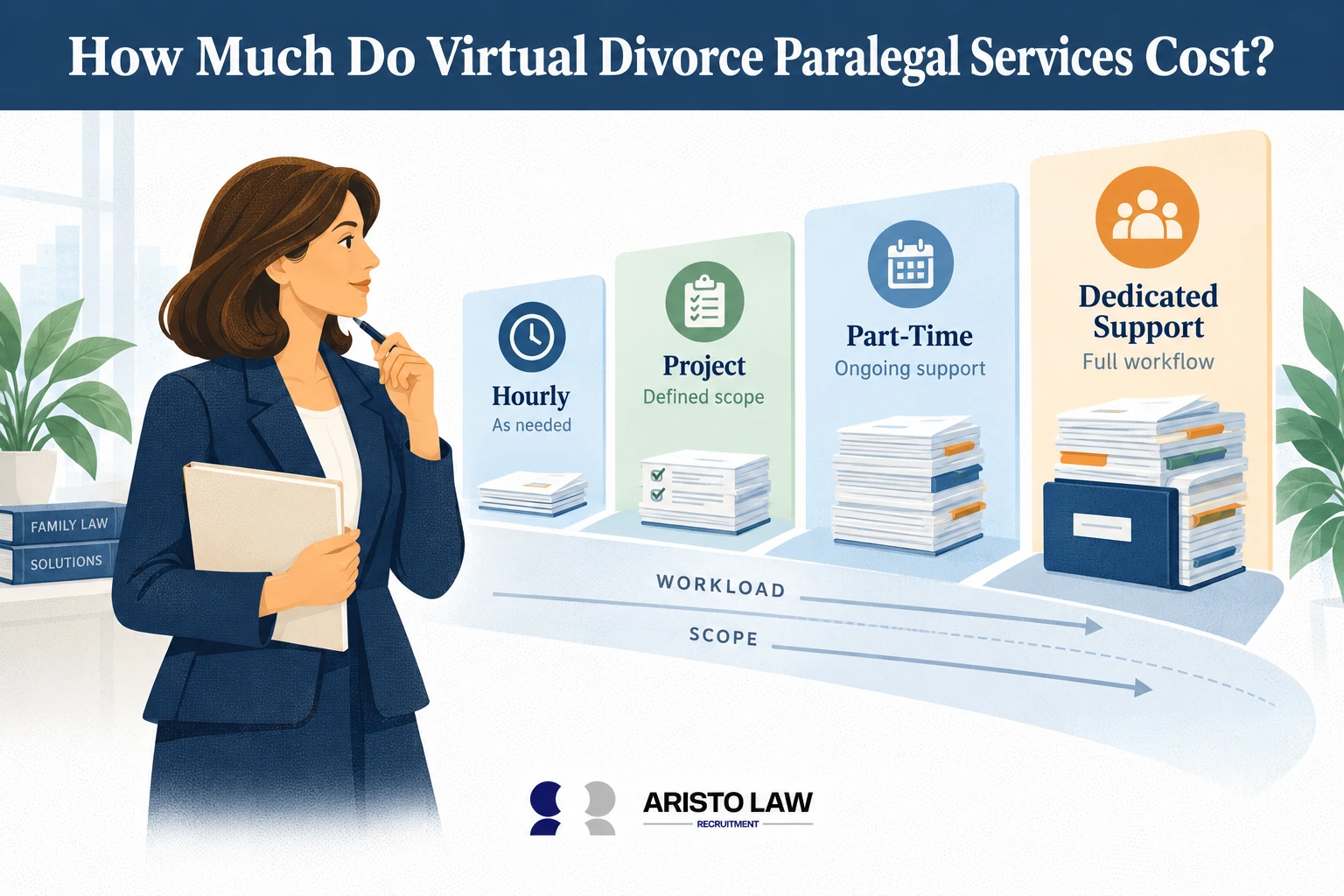
Research published in 2024 on human-resource outsourcing
found that outsourcing models can reduce operational costs by
approximately 30%–50% through lower fixed staffing costs, faster task
execution, and conversion of fixed labor expenses into scalable variable
costs. Remote legal-support models reduce operational overhead
by approximately 30%–60% compared with equivalent in-house staffing
structures when firms use centralized digital workflows, structured
supervision systems, and scalable staffing models effectively.
Pricing varies heavily based on workflow complexity. Lower-cost
virtual legal-support arrangements usually cover administrative tasks
such as scheduling, intake coordination, billing reminders, CRM updates,
repository organization, and communication tracking. Divorce paralegal
support generally costs more because family-law workflows involve
financial disclosures, custody documentation, discovery coordination,
procedural timelines, hearing preparation, mediation support, and
attorney-supervised drafting requiring stronger procedural knowledge and
greater confidentiality discipline.
Hourly pricing structures usually fit project-based family-law
support, overflow litigation assistance, hearing preparation, temporary
discovery coordination, or document-intensive divorce matters. Monthly
retainers and part-time staffing arrangements frequently work better for
firms needing continuous intake support, ongoing disclosure tracking,
communication coordination, billing workflows, and case-management
assistance across active divorce caseloads. Full-time outsourced divorce
paralegals generally become more cost-efficient for high-volume
family-law firms handling contested litigation, discovery-heavy
divorces, or large custody caseloads requiring continuous workflow
coordination.
Agency-managed staffing models usually increase pricing because
agencies frequently provide candidate vetting, onboarding support,
replacement coverage, payroll administration, workflow monitoring,
confidentiality screening, and operational continuity systems. Direct
freelance hiring reduce recurring agency expenses but often increases
internal management burden, workflow supervision responsibility,
quality-control oversight, and operational training requirements.
Training time and revision risk also influence total operational
cost. Family-law firms frequently underestimate onboarding requirements
involving SOPs, repository rules, filing procedures, disclosure
workflows, communication standards, custody terminology, and
attorney-review protocols. Poorly trained support staff create
procedural delays, document inconsistencies, missed follow-up,
disclosure gaps, or increased attorney rework reducing operational
efficiency and increasing hidden staffing costs.
Are
virtual divorce paralegal services cost-effective?
Yes, virtual divorce paralegal services are cost-effective
when they reduce attorney workload, speed document collection, improve
case organization, and prevent delays in divorce workflows.
A study by Clio in 2024 showed that legal process outsourcing
enables law firms to “scale operations faster, smarter, and more
efficiently” by delegating routine legal tasks to external support
providers, allowing attorneys to focus on higher-value legal work and
increasing operational profitability. Remote legal-support
systems improve law-firm efficiency by increasing attorney billable
availability, accelerating procedural workflows, reducing administrative
bottlenecks, and improving operational scalability across
document-intensive legal practices such as family law.
Divorce practices frequently generate extremely high communication
volume, financial-document tracking requirements, custody-related
workflow coordination, discovery deadlines, hearing preparation tasks,
and disclosure-management responsibilities. Virtual divorce paralegals
improve operational ROI by recovering attorney time previously consumed
by repository management, document follow-up, scheduling coordination,
procedural tracking, communication logging, disclosure organization, and
administrative litigation support. Attorney time recovery becomes
financially important because attorneys spend more time on substantive
legal strategy, negotiations, hearings, settlement preparation, and
billable legal work instead of procedural administration.
Cost-effectiveness nevertheless depends heavily on workflow accuracy,
confidentiality discipline, attorney supervision, secure systems, SOP
quality, and operational oversight. Low-cost support structures
frequently become operationally expensive when poor training, weak
repository management, missed deadlines, disclosure errors,
confidentiality failures, inconsistent communication, or inadequate
supervision create attorney rework, procedural disruption, client
dissatisfaction, or litigation risk.
Strong ROI depends less on low hourly rates and more on organized
workflows, procedural reliability, secure systems, and operational
consistency across family-law support processes.
What are
on-demand divorce paralegal services?
On-demand divorce paralegal services are flexible paralegal
support arrangements that law firms use when divorce caseloads, document
backlogs, discovery deadlines, or hearing preparation needs temporarily
increase. Family-law practices frequently experience uneven
operational pressure because contested divorces, custody disputes,
mediation scheduling, emergency motions, and disclosure-heavy litigation
create unpredictable workflow surges requiring additional procedural
support without immediately expanding permanent payroll.
A study by Chambers and Partners in 2024 showed that legal
process outsourcing improves workflow efficiency by reducing
bottlenecks, increasing productivity, and helping firms manage
fluctuating workloads during periods of high legal demand.
Flexible legal-support models improve operational scalability, reduce
workflow bottlenecks, and improve attorney productivity during temporary
litigation surges and high-volume procedural periods.
Law firms commonly use on-demand divorce paralegal support during
sudden intake spikes, temporary employee absence, discovery backlog
accumulation, emergency custody proceedings, mediation packet deadlines,
hearing preparation periods, financial-disclosure collection phases, and
seasonal increases in divorce filings. Remote on-demand paralegals
frequently support document organization, disclosure tracking, hearing
binders, communication follow-up, discovery coordination, repository
management, billing support, scheduling workflows, and attorney-ready
case preparation helping firms maintain operational continuity during
high-pressure periods.
The primary advantage of on-demand support involves flexible capacity
because firms temporarily increase workflow support without committing
immediately to long-term staffing expansion, office infrastructure
costs, or fixed payroll overhead. On-demand staffing also improves
responsiveness during temporary litigation surges and procedural
bottlenecks.
Operational limitations nevertheless remain important. Remote
family-law support frequently requires onboarding time, firm-specific
SOP training, repository familiarization, confidentiality setup,
workflow instruction, and attorney supervision before outsourced staff
integrate effectively into active divorce workflows.
What are
customizable virtual paralegal services?
Customizable virtual paralegal services are remote paralegal
support packages adjusted to a law firm’s practice area, case volume,
software systems, workflow stages, and supervision model.
Family-law firms frequently operate through highly different procedural
structures depending on jurisdiction rules, custody workflows,
litigation volume, mediation practices, filing requirements, and
internal operational systems.
A study by KorumLegal in 2024 showed that process
optimization and workflow integration in legal teams improve
productivity, reduce inefficiencies, eliminate bottlenecks, and support
faster turnaround times through streamlined document management and
client communication workflows. Customized workflow integration
improves operational efficiency, reduces administrative friction,
accelerates procedural turnaround, and improves communication
consistency across document-intensive legal practices such as family
law.
Customizable divorce paralegal support commonly includes tailored
intake forms, jurisdiction-specific document checklists,
financial-disclosure tracking systems, discovery workflows,
hearing-preparation procedures, parenting-plan repositories, mediation
packet structures, and court-deadline calendars aligned with the firm’s
existing operational process. Remote family-law support teams also adapt
communication templates, intake scripts, escalation rules, billing
workflows, scheduling systems, CRM structures, repository naming
conventions, and attorney-review checkpoints matching each law firm’s
workflow expectations and procedural requirements.
Customization also frequently involves integration with
practice-management software, document-management systems, e-signature
platforms, billing software, workflow dashboards, and secure
communication tools already used by the firm. Structured customization
improves operational continuity because attorneys, paralegals, intake
staff, and remote support personnel work inside consistent procedural
systems instead of disconnected generic workflows.
Customizable support generally creates stronger operational fit than
standardized administrative outsourcing because divorce practices differ
in jurisdictional filing rules, litigation complexity, client
communication expectations, discovery volume, confidentiality protocols,
and workflow maturity. Remote family-law support functions most
effectively when procedures, supervision systems, and operational
workflows align directly with the law firm’s internal case-management
structure.
How
should attorneys outsource divorce paralegal services?
Attorneys outsource divorce paralegal services by identifying
workflow needs, selecting qualified legal support providers, and
establishing secure case management procedures.
Listed below are 10 steps to outsource divorce paralegal
services.
-
Define the divorce workflow bottleneck: Attorneys
should first identify whether the operational pressure involves intake
backlog, financial disclosures, discovery coordination, hearing
preparation, billing support, custody-document management, or
communication overload. Clear workflow diagnosis improves staffing fit
and operational efficiency. -
Create a role scorecard for family-law support: Law
firms should document expected responsibilities, task ownership,
turnaround standards, communication rules, escalation triggers,
confidentiality requirements, and attorney-review checkpoints before
onboarding remote support staff. -
Test family-law workflow capability: Attorneys
should evaluate candidates using sample divorce-document tasks,
financial-disclosure checklist reviews, repository-organization
exercises, deadline-tracking scenarios, and custody-document workflows
measuring procedural accuracy and workflow discipline. -
Review client communication quality: Divorce matters
require emotionally sensitive communication. Firms should assess tone,
responsiveness, escalation judgment, CRM documentation quality, and
procedural communication accuracy before assigning client-facing
workflows. -
Verify software familiarity and remote workflow
readiness: Virtual divorce paralegals should demonstrate
proficiency with case-management platforms, e-signature systems, billing
software, repositories, workflow dashboards, and secure communication
tools supporting distributed family-law operations. -
Evaluate jurisdiction awareness and procedural
familiarity: Family-law procedures vary heavily across
jurisdictions. Attorneys should confirm familiarity with filing
structures, disclosure timelines, custody workflows, and procedural
scheduling requirements relevant to the practice. -
Implement confidentiality agreements and secure access
controls: Remote support should operate through encrypted
communication systems, role-based permissions, MFA authentication,
secure repositories, confidentiality agreements, and attorney-supervised
workflows protecting attorney-client privilege and sensitive family-law
records. -
Document SOPs and attorney-review thresholds: Firms
should establish workflow instructions covering disclosure tracking,
hearing preparation, communication rules, repository standards, version
control, escalation procedures, and legal-review boundaries before
assigning active divorce matters. -
Create escalation and supervision systems: Virtual
paralegals should know when custody disputes, emergency motions,
settlement questions, legal interpretation requests, or emotionally
volatile communication require immediate attorney involvement. -
Track first-month performance metrics: Attorneys
should monitor document turnaround, disclosure completeness, deadline
compliance, communication responsiveness, repository accuracy, workflow
backlog, billing support completion, and attorney time recovery during
onboarding.
Outsourcing frequently fails when law firms assign sensitive divorce
workflows without structured training, centralized systems,
confidentiality governance, workflow documentation, or attorney-review
checkpoints. Family-law outsourcing functions most effectively through
standardized SOPs, secure systems, measurable KPIs, and consistent
attorney supervision.
What makes a good
virtual divorce paralegal?
A good virtual divorce paralegal has strong procedural
organization, family-law workflow awareness, communication discipline,
confidentiality control, and operational reliability supporting
attorneys through emotionally sensitive divorce matters.
Listed below are the 17 characteristics of a good virtual divorce
paralegal.
-
Family-law knowledge and procedural awareness:
Strong virtual divorce paralegals understand intake progression,
disclosure workflows, discovery timelines, custody procedures, mediation
preparation, hearing coordination, and family-law case stages improving
operational continuity across divorce matters. -
Document accuracy and procedural precision: Divorce
litigation involves financial affidavits, custody documents,
disclosures, exhibits, parenting plans, and procedural filings requiring
consistent formatting, accurate dates, proper captions, exhibit
labeling, and organized repositories. Strong accuracy reduces attorney
rework and filing risk. -
Confidentiality discipline: Divorce matters
frequently involve sensitive financial records, custody disputes,
medical information, communication histories, and privilege-protected
client data. Effective virtual paralegals follow confidentiality
agreements, secure-access controls, encrypted communication standards,
and repository-security procedures consistently. -
Strong client communication skills: Family-law
clients frequently experience emotional stress, uncertainty, financial
anxiety, and parenting concerns. Effective communication improves
procedural clarity, reduces confusion, supports workflow continuity, and
improves client-service experience. -
Empathy balanced with professional boundaries: Good
virtual divorce paralegals communicate respectfully and calmly with
distressed clients while maintaining operational professionalism and
avoiding emotional overinvolvement or unauthorized counseling. -
Deadline awareness and procedural discipline:
Divorce matters involve hearings, mediation deadlines, discovery
timelines, disclosure schedules, and filing requirements requiring
strong procedural tracking and reminder management. Reliable deadline
awareness reduces operational risk and missed-court-event exposure. -
Software proficiency and remote-work capability:
Virtual divorce paralegals must operate effectively through
case-management software, CRM systems, repositories, e-signature tools,
workflow dashboards, secure communication platforms, and cloud-based
legal systems supporting distributed family-law operations. -
Strong follow-through and workflow persistence:
Family-law workflows frequently stall because of missing disclosures,
incomplete financial records, delayed signatures, or inconsistent
follow-up. Effective virtual paralegals maintain reminder systems,
unresolved-item tracking, and communication follow-up preventing
operational bottlenecks. -
Repository organization and version-control
management: Divorce matters generate extremely high document
volume involving updated disclosures, revised parenting plans, discovery
records, and hearing exhibits. Strong organizational discipline improves
retrieval speed and workflow visibility. -
Communication escalation judgment: Effective virtual
divorce paralegals recognize when settlement discussions, emergency
custody concerns, legal interpretation requests, domestic-safety issues,
or emotionally volatile communication require immediate attorney
escalation. -
Attention to detail in financial-disclosure
workflows: Divorce litigation frequently depends on accurate
tracking of income records, debts, assets, expense reports, tax
documents, and disclosure completeness. Strong detail orientation
improves mediation readiness and hearing preparation. -
Task prioritization and workload management:
Family-law practices frequently involve overlapping deadlines, urgent
hearings, mediation preparation, intake growth, and communication
surges. Effective virtual paralegals prioritize procedural workflows
efficiently across active matters. -
Professional communication documentation: Good
virtual paralegals maintain organized CRM notes, communication logs,
call summaries, task histories, and workflow updates improving attorney
visibility across active divorce matters. -
Consistency under emotionally charged conditions:
Divorce practices often involve conflict-heavy communication, emergency
filings, custody disputes, and procedural urgency. Reliable virtual
paralegals maintain workflow stability and communication professionalism
under pressure. -
Attorney-supervision compliance: Effective virtual
divorce paralegals understand operational boundaries and consistently
route legal strategy questions, settlement decisions, custody
recommendations, and substantive legal interpretation directly to
attorneys. -
Adaptability across family-law workflows: Divorce
practices vary by jurisdiction, litigation style, custody complexity,
and operational structure. Strong remote paralegals adapt quickly to
firm-specific SOPs, communication standards, repository systems, and
procedural workflows. -
Operational reliability and accountability:
Family-law workflow continuity depends heavily on responsiveness,
repository discipline, procedural tracking, communication consistency,
and deadline compliance. Reliable virtual paralegals improve operational
stability across remote divorce support systems.
What tools do
virtual divorce paralegals use?
Tools virtual divorce paralegals use are specialized legal
workflow systems supporting remote family-law operations.
Outsourcing divorce paralegal services integrates document automation
platforms, calendaring software, and client communication workflows to
support case coordination and filing accuracy. Outsourcing divorce
paralegal services also depends on legal
case management systems that organize deadlines,
custody documentation, billing records, and court-related workflow
tracking.
Listed below are the 18 tools virtual divorce paralegal use.
-
Practice-management software: Practice-management
platforms centralize divorce matters, procedural timelines,
communication history, hearing schedules, task tracking, billing
activity, and workflow visibility helping attorneys and virtual
paralegals monitor family-law cases across multiple procedural
stages. -
Document-management systems: Divorce matters
generate high volumes of financial disclosures, custody records,
communication logs, tax documents, parenting plans, and procedural
filings. Document-management platforms organize repositories, maintain
version control, enforce naming conventions, and improve retrieval speed
during mediation, hearings, and discovery workflows. -
Secure file-sharing platforms: Virtual divorce
paralegals frequently exchange sensitive financial records,
child-related documents, disclosures, and litigation materials through
encrypted file-sharing systems protecting attorney-client
confidentiality and reducing insecure document transmission risk. -
E-signature platforms: Divorce workflows frequently
require signatures for petitions, disclosures, parenting plans,
mediation agreements, billing authorizations, and settlement documents.
E-signature systems route forms, track completion status, maintain audit
records, and reduce document turnaround delays. -
Billing and invoicing software: Virtual paralegals
support invoice preparation, payment reminders, time-entry tracking,
accounts receivable monitoring, and billing-system updates improving
cash-flow continuity inside family-law practices. -
Calendar-management systems: Divorce litigation
frequently involves hearings, mediation sessions, custody evaluations,
filing deadlines, disclosure timelines, and attorney consultations.
Calendar systems maintain scheduling visibility, reminders, procedural
deadlines, and coordination across active matters. -
Task boards and workflow dashboards: Virtual divorce
paralegals use workflow dashboards to track unresolved disclosure items,
missing financial records, hearing preparation tasks, intake
progression, discovery deadlines, mediation preparation, and follow-up
communication improving operational accountability. -
Client-communication platforms: Family-law practices
generate unusually high communication volume involving procedural
updates, disclosure reminders, scheduling notices, mediation
coordination, and intake follow-up. Communication systems document
updates, maintain conversation logs, and improve workflow
continuity. -
CRM systems: Customer relationship management
platforms track intake inquiries, consultation scheduling, follow-up
communication, onboarding progress, and workflow status helping firms
manage divorce-client pipelines more efficiently. -
Discovery-management and repository tools: Divorce
discovery frequently involves interrogatories, subpoenas, financial
productions, communication records, and exhibit tracking.
Discovery-management systems organize production logs, indexes,
repositories, and procedural tracking workflows. -
Document-automation tools: Virtual paralegals use
automation systems for disclosure templates, intake packets, procedural
forms, exhibit structures, and administrative document workflows
reducing repetitive formatting tasks and improving consistency. -
Time-tracking systems: Family-law firms frequently
use time-tracking tools to monitor procedural support work, billing
entries, workflow allocation, and attorney-review time improving
operational visibility and billing accuracy. -
Video-conferencing platforms: Remote family-law
operations often require virtual consultations, mediation coordination,
client meetings, internal workflow reviews, and attorney-supervision
sessions supported through secure video communication systems. -
Encrypted messaging systems: Secure messaging
platforms protect sensitive communication involving custody matters,
financial disclosures, hearing preparation, and attorney-client
procedural coordination. -
Cloud-based collaboration systems: Virtual divorce
paralegals commonly operate through centralized cloud repositories and
collaboration platforms allowing attorneys, staff, clients, and remote
support personnel to coordinate workflows across distributed legal
operations. -
Audit-trail and access-control systems: Divorce
matters involve highly sensitive financial, medical, and child-related
records. Role-based access controls, MFA authentication, audit logs,
repository permissions, and activity tracking systems protect
confidentiality and improve accountability inside remote family-law
environments. -
Deadline and reminder automation systems: Automated
reminder workflows support disclosure deadlines, hearing preparation,
mediation scheduling, client follow-up, billing reminders, and
procedural compliance reducing missed-deadline risk across active
divorce matters. -
Repository version-control systems: Divorce
litigation frequently involves updated parenting plans, revised
disclosures, amended filings, and supplemental exhibits. Version-control
systems reduce confusion and prevent outdated-document use during
litigation and settlement preparation.
Virtual divorce paralegals rely heavily on secure, cloud-based legal
technology because family-law workflows depend on centralized
repositories, procedural tracking, confidentiality governance, deadline
visibility, and distributed operational coordination across attorneys,
clients, courts, mediators, and support staff.
How
should law firms protect confidentiality when outsourcing divorce
paralegal services?
Law firms protect confidentiality when outsourcing divorce
paralegal services through role-based access, confidentiality
agreements, secure devices, encrypted file sharing, attorney
supervision, audit trails, and offboarding controls. Divorce
matters involve unusually sensitive legal information including
financial disclosures, banking records, tax filings, custody disputes,
parenting communications, domestic-safety allegations, healthcare
records, school documentation, settlement negotiations, and
attorney-client communication requiring stronger confidentiality
governance than many general administrative workflows.
A study by Anna Ubaydullaeva and Sanjar Ubaydullaev in 2026
showed that remote legal workflows increase risks of unauthorized
access, privilege misuse, and data breaches when organizations lack
strong access governance, multi-factor authentication, identity
management, and secure cloud-access controls. Confidentiality
failures inside remote legal workflows most frequently occur because of
excessive data access, weak authentication controls, unsecured devices,
poor repository management, and inconsistent supervision systems.
Attorney-client privilege remains a primary confidentiality
obligation during outsourced family-law support because virtual divorce
paralegals frequently access litigation timelines, disclosure
repositories, procedural communication, settlement drafts, custody
records, and strategy-related workflows while supporting attorneys
operationally. Law firms commonly implement least-privilege access
structures limiting remote support staff to only the repositories,
workflows, and procedural information necessary for assigned tasks.
Sensitive divorce workflows involving domestic violence concerns,
emergency custody disputes, settlement negotiations, or privileged
litigation strategy frequently require additional attorney-review
restrictions and tighter repository permissions.
Secure operational controls usually include MFA authentication,
encrypted file-sharing systems, VPN-protected access, centralized
document repositories, password-management requirements, audit-trail
logging, device-security standards, inactivity timeouts, and
attorney-supervised workflow monitoring. Remote family-law support
personnel should additionally operate through clean remote-workspace
rules preventing unauthorized viewing, downloading, printing, or local
storage of sensitive client information outside approved systems.
Confidentiality protection additionally requires documented
communication rules, secure messaging standards, escalation procedures,
onboarding training, and immediate offboarding controls removing system
access, repository permissions, login credentials, and communication
privileges immediately after the outsourcing engagement ends. Divorce
outsourcing functions most securely when law firms combine technical
safeguards, workflow supervision, confidentiality agreements, structured
SOPs, and continuous attorney oversight protecting sensitive family-law
information throughout the entire remote support lifecycle.
What
risks come with outsourcing divorce paralegal support?
Risks of outsourcing divorce paralegal support include
confidentiality exposure, document errors, missed deadlines and unclear
escalation procedures.
Listed below are the 15 risks of outsourcing divorce paralegal
support.
-
Confidentiality exposure and data-security risk:
Divorce matters involve sensitive financial disclosures, custody
records, domestic-safety information, healthcare documentation, and
attorney-client communication. Prevention requires encrypted
repositories, MFA authentication, role-based permissions,
confidentiality agreements, audit trails, secure devices, and immediate
offboarding access removal. -
Document errors and procedural inaccuracies:
Family-law workflows frequently involve financial affidavits, parenting
plans, disclosures, exhibits, and hearing materials requiring procedural
precision. Prevention includes document review protocols,
attorney-review checkpoints, formatting standards, repository rules, and
sample work audits before assigning active matters. -
Missed deadlines and procedural delays: Divorce
litigation depends heavily on disclosure deadlines, hearings, mediation
schedules, discovery timelines, and filing requirements. Prevention
requires centralized deadline calendars, escalation alerts, workflow
dashboards, procedural checklists, and attorney-monitored deadline
systems. -
Weak family-law workflow knowledge: General
administrative support personnel lack familiarity with custody
workflows, financial disclosures, mediation preparation, discovery
tracking, and procedural family-law operations. Prevention involves
family-law task testing, SOP onboarding, jurisdiction-specific workflow
training, and supervised probationary assignments. -
Poor client communication handling: Divorce clients
frequently experience emotional stress, urgency, conflict, and financial
anxiety. Inconsistent communication increase client dissatisfaction or
procedural confusion. Prevention includes approved client-message
templates, tone guidelines, escalation rules, CRM documentation
standards, and attorney-supervised communication workflows. -
Unauthorized legal communication risk: Outsourced
support personnel accidentally provide legal interpretation, settlement
opinions, custody recommendations, or procedural advice outside approved
boundaries. Prevention requires documented role definitions, attorney
approval thresholds, escalation protocols, and strict communication
supervision. -
Inconsistent repository management and version-control
failures: Divorce matters generate large volumes of updated
disclosures, parenting schedules, revised settlement drafts, and
procedural filings. Poor repository discipline creates outdated-document
usage or litigation confusion. Prevention includes standardized naming
conventions, centralized repositories, metadata rules, and
version-control systems. -
Workflow fragmentation across remote teams:
Outsourced divorce support frequently involves operational handoffs
between attorneys, clients, courts, mediators, and internal staff. Poor
coordination increases procedural bottlenecks and communication gaps.
Prevention requires workflow ownership tracking, centralized dashboards,
task queues, and communication logs. -
Insufficient attorney supervision: Divorce matters
involve emotionally sensitive family issues, financial disputes, custody
concerns, and litigation strategy requiring licensed legal oversight.
Prevention includes structured attorney-review thresholds, supervision
schedules, escalation systems, and workflow audit reviews. -
Discovery and disclosure-management failures:
Incomplete financial disclosures, missing production logs, or poorly
tracked discovery workflows frequently delay mediation and hearings.
Prevention requires disclosure checklists, missing-document trackers,
procedural audits, and attorney-reviewed discovery workflows. -
Remote-work security weaknesses: Outsourced support
staff operating from unsecured environments expose confidential divorce
records unintentionally. Prevention includes clean remote-workspace
rules, VPN access, encrypted communication systems, device-security
standards, and restricted local-storage policies. -
Poor communication escalation judgment: Divorce
workflows frequently involve emergency custody disputes,
domestic-violence concerns, emotionally volatile communication, or
settlement-sensitive discussions requiring immediate attorney
involvement. Prevention requires documented escalation triggers and
supervised communication policies. -
Quality inconsistency during high caseload periods:
Workflow quality declines when outsourced providers handle large intake
surges or litigation-heavy periods without proper staffing controls.
Prevention involves workload caps, task prioritization systems, sample
work audits, and performance-metric monitoring. -
Jurisdiction-specific procedural mistakes:
Family-law filing procedures, disclosure requirements, and custody
workflows vary across jurisdictions. Prevention requires
jurisdiction-awareness testing, local workflow instruction,
attorney-reviewed procedural checklists, and limited task authority
during onboarding. -
Operational dependency on poorly documented
workflows: Outsourcing frequently fails when firms assign
complex divorce workflows without SOPs, repository structures, or
communication systems. Prevention requires documented procedures,
structured onboarding, workflow mapping, and centralized operational
governance.
Divorce-support outsourcing carries higher operational risk than
general administrative outsourcing because family-law matters involve
emotionally distressed clients, financial disclosures, child-related
records, procedural deadlines, custody disputes, and highly sensitive
attorney-client communication. Strong supervision systems, workflow
controls, confidentiality governance, and attorney-review checkpoints
remain heavily important inside outsourced family-law operations.
How
should law firms measure outsourced divorce paralegal performance?
Law firms should measure outsourced divorce paralegal
performance through workflow accuracy, and overall case management
productivity.
The table below shows the ways law firms should measure outsourced
divorce paralegal performance.
| Metric | What It Measures | Why It Matters |
|---|---|---|
| Financial document completion rate | Percentage of requested income records, tax returns, bank statements, debt schedules, and disclosure documents collected completely and on time |
Divorce matters frequently stall because of incomplete disclosures. High completion rates improve mediation readiness, settlement preparation, and hearing efficiency. |
| Discovery deadline completion | Accuracy and timeliness of discovery-response tracking, subpoena coordination, production indexing, and procedural deadline management |
Missed discovery deadlines create litigation risk, sanctions exposure, hearing delays, and operational disruption inside family-law cases. |
| Client follow-up completion | Percentage of follow-up reminders, missing-document requests, intake updates, and procedural communication completed within expected timelines |
Divorce clients require frequent procedural communication. Strong follow-up systems improve client responsiveness and reduce workflow bottlenecks. |
| Document turnaround time | Average time required to organize, format, update, index, or prepare attorney-review materials |
Faster turnaround improves hearing preparation, mediation readiness, disclosure processing, and overall case progression. |
| Revision rate | Frequency of attorney corrections involving formatting, disclosure organization, naming conventions, repository structure, or procedural accuracy |
High revision rates increase attorney rework and reduce operational efficiency across family-law workflows. |
| Court-calendar accuracy | Accuracy of hearing dates, mediation schedules, filing deadlines, custody evaluations, and procedural reminders entered into workflow systems |
Calendar mistakes create major operational and litigation risk in divorce matters involving strict procedural timelines. |
| Task backlog volume | Number of unresolved disclosure requests, hearing-preparation items, discovery tasks, intake follow-ups, or repository updates remaining incomplete |
Growing backlog signals workflow congestion, staffing imbalance, or poor operational prioritization. |
| Attorney review time | Amount of attorney time spent correcting administrative errors, reorganizing repositories, clarifying workflows, or resolving incomplete procedural work |
Reduced review time improves attorney productivity and increases billable legal capacity. |
| Mediation packet readiness | Percentage of mediation summaries, financial exhibits, issue trackers, parenting schedules, and settlement materials completed before mediation deadlines |
Organized mediation preparation improves negotiation efficiency and reduces last-minute document scrambling. |
| Case-stage movement speed | Average time required for matters to move between intake, disclosure, discovery, mediation, hearing preparation, and settlement stages |
Faster stage progression improves workflow efficiency and reduces operational stagnation across family-law caseloads. |
| Financial disclosure accuracy | Consistency and completeness of asset schedules, debt summaries, expense reports, and disclosure repositories |
Accurate financial organization improves attorney review quality and reduces mediation or hearing delays. |
| Communication documentation quality | Accuracy of CRM notes, call summaries, communication logs, and procedural updates |
Organized communication tracking improves workflow visibility and attorney oversight across active divorce matters. |
| Deadline compliance rate | Percentage of hearings, disclosures, discovery obligations, and filing tasks completed before procedural deadlines |
Strong compliance reduces litigation risk and improves operational reliability inside family-law practices. |
| Repository organization consistency | Accuracy of file naming, version control, exhibit indexing, metadata standards, and centralized repository maintenance |
Organized repositories improve retrieval speed and reduce procedural confusion during litigation preparation. |
| Billing support completion | Completion rate for invoice reminders, billing-entry support, payment follow-up, and workflow-related billing coordination |
Family-law firms depend heavily on operational billing continuity and timely payment collection. |
| Client response time | Speed of procedural responses to client inquiries, scheduling updates, and document requests |
Faster response improves client satisfaction and reduces communication friction during emotionally sensitive divorce proceedings. |
| Hearing-preparation completion rate | Percentage of hearing binders, exhibits, checklists, procedural packets, and attorney-ready materials completed before court deadlines |
Structured hearing preparation reduces last-minute operational disruption and improves litigation readiness. |
| Workflow escalation accuracy | Frequency of correctly escalating legal questions, emergency custody concerns, settlement issues, or emotionally sensitive communication to attorneys |
Proper escalation protects legal compliance and prevents unauthorized legal communication risk. |
| Case-management productivity | Overall efficiency in maintaining task queues, follow-up systems, disclosure tracking, communication logs, and procedural workflows |
Strong case-management support improves operational continuity across high-volume divorce practices. |
| Attorney time saved | Administrative hours removed from attorneys through delegated procedural support workflows |
Attorney time recovery improves profitability, billable capacity, and strategic legal focus inside family-law operations. |
Family-law practices benefit most from KPI systems tied directly to
disclosure management, hearing preparation, custody workflows,
communication continuity, and procedural progression rather than generic
remote staffing metrics alone because divorce matters depend heavily on
operational coordination, deadline discipline, and document
accuracy.
When
should a law firm outsource divorce paralegal services?
A firm should outsource divorce paralegal services when
family-law workflows begin creating operational delays, attorney
overload, communication breakdowns, or procedural risk that internal
staff cannot manage efficiently.
Listed below are 17 occasions when a law firm must outsource divorce
paralegal services.
-
Divorce case backlog starts delaying matter
progression: Family-law firms should outsource divorce
paralegal support when disclosure tracking, discovery coordination,
custody-document organization, or hearing preparation slows case
movement and increases unresolved workflow volume. -
Attorneys spend excessive time on administrative
workflows: Outsourcing becomes operationally necessary when
attorneys handle intake follow-up, disclosure reminders, repository
organization, scheduling, procedural tracking, or billing coordination
instead of substantive legal work and litigation strategy. -
Financial disclosures remain incomplete for extended
periods: Divorce matters frequently stall because clients fail
to provide tax records, banking statements, debt schedules, and income
documents. Outsourced paralegal support improves disclosure tracking,
follow-up coordination, and repository organization. -
Discovery deadlines create workflow pressure: Firms
facing repeated discovery backlog, subpoena tracking delays,
production-index management problems, or hearing-preparation congestion
benefit heavily from outsourced procedural support. -
Hearing preparation becomes reactive instead of
organized: Outsourcing helps when temporary orders, custody
hearings, enforcement matters, and mediation deadlines repeatedly create
last-minute scrambling involving exhibits, binders, disclosures, and
procedural checklists. -
Client communication gaps increase dissatisfaction –
Divorce clients frequently require status updates, scheduling
coordination, document reminders, and procedural follow-up. Outsourced
support improves communication continuity and reduces unanswered client
concerns. -
Attorney burnout starts affecting workflow quality:
Family-law practices experiencing overloaded attorneys, delayed review
cycles, communication fatigue, or excessive procedural administration
often require outsourced workflow support to stabilize operations. -
The firm cannot accept additional family-law
matters: Outsourcing becomes operationally valuable when intake
growth exceeds staffing capacity and the firm begins declining
consultations, delaying onboarding, or limiting new divorce matters. -
Court-deadline risk increases because of staffing
shortages: Missed hearings, delayed filings, incomplete
disclosures, or inconsistent procedural tracking indicate operational
strain requiring additional workflow-management support. -
Mediation preparation repeatedly lacks organization:
Outsourced divorce paralegals improve mediation readiness by organizing
financial summaries, issue trackers, settlement exhibits, parenting
schedules, and disclosure repositories before negotiation sessions. -
The firm experiences uneven divorce caseload volume:
Family-law practices frequently experience seasonal surges, emergency
custody filings, or litigation spikes. Outsourced support provides
scalable staffing without immediately increasing fixed payroll
overhead. -
Billing follow-up and collections begin slowing cash
flow: Firms struggling with invoice reminders, payment
follow-up, time-entry coordination, or accounts-receivable backlog
require billing-focused legal support assistance. -
Intake conversion rates begin dropping: Slow
consultation scheduling, inconsistent inquiry follow-up, and delayed
intake communication often signal the need for a dedicated intake
specialist or virtual legal assistant instead of deeper paralegal-level
support. -
Administrative scheduling and communication overload
develops: Firms primarily struggling with calendars, inbox
management, consultation coordination, reminders, or CRM updates require
a virtual assistant or legal secretary rather than a litigation-focused
divorce paralegal. -
Procedural family-law workflows become too complex for
general admin staff: Discovery management, custody-document
organization, financial-disclosure coordination, mediation preparation,
and hearing support generally require trained divorce paralegal support
under attorney supervision rather than ordinary administrative
staffing. -
Workflow visibility declines across active divorce
matters: Outsourcing becomes valuable when attorneys lose
visibility into unresolved disclosures, hearing preparation status,
communication follow-up, or procedural progression across multiple
active family-law cases. -
The firm lacks operational scalability for growth:
Outsourced divorce paralegal services help firms expand family-law
capacity without immediately increasing office space, permanent staffing
infrastructure, or long-term employment overhead.
Family-law firms benefit most from outsourcing when operational
bottlenecks begin affecting procedural reliability, attorney capacity,
client responsiveness, or litigation readiness. Workflow diagnosis
determines whether the firm primarily needs a virtual assistant, intake
specialist, legal secretary, billing assistant, or attorney-supervised
divorce paralegal support structure.
How
can law firms get outsourced divorce paralegal services?
Steps law firms can take to get outsourced divorce paralegal
services include defining workflows and onboarding remote support
through structured SOPs and attorney-review controls.

Listed below are 14 steps law firms can take to get outsourced
divorce paralegal services.
-
Diagnose the family-law workflow bottleneck:
Attorneys should first identify where operational pressure exists inside
the divorce practice, including intake backlog, financial-disclosure
tracking, discovery organization, hearing preparation, communication
overload, billing follow-up, or repository management. Clear workflow
diagnosis improves staffing fit and outsourcing efficiency. -
Define the exact divorce-support tasks before
hiring: Law firms should document responsibilities involving
divorce intake summaries, financial-disclosure tracking, document
preparation support, custody-document organization, mediation
preparation, discovery coordination, hearing binders, client follow-up,
and case-file maintenance before engaging outsourced support. -
Choose the appropriate outsourcing models: Fims
should compare freelance divorce paralegals, agency-managed staffing,
dedicated virtual paralegal teams, and hybrid legal-support providers
based on caseload volume, supervision capacity, workflow complexity, and
operational scalability needs. -
Compare outsourcing providers and staffing
structures: Attorneys should evaluate pricing models, staffing
availability, replacement coverage, workflow-management support,
onboarding systems, communication standards, and family-law
specialization when comparing outsourced providers. -
Verify family-law experience and procedural
familiarity: Divorce matters involve disclosure tracking,
custody workflows, discovery management, mediation support, and hearing
preparation requiring stronger procedural knowledge than general
administrative legal support. Firms should assess practical family-law
workflow exposure before assigning active matters. -
Review sample work and workflow accuracy: Attorneys
should test candidates using disclosure checklists, hearing-preparation
exercises, discovery-tracking workflows, document-formatting tasks,
custody-document organization, and repository-management scenarios
measuring operational precision and procedural discipline. -
Evaluate communication quality and escalation
judgment: Family-law communication frequently involves
emotionally distressed clients, urgent deadlines, custody concerns, and
sensitive procedural coordination. Firms should review responsiveness,
professionalism, CRM documentation quality, and escalation awareness
before assigning client-facing workflows. -
Implement confidentiality agreements and secure
systems: Outsourced divorce support should operate through
encrypted repositories, secure file sharing, MFA authentication,
role-based permissions, confidentiality agreements, VPN-protected
systems, and attorney-supervised workflows protecting attorney-client
privilege and sensitive family-law records. -
Establish attorney-review thresholds and role
boundaries: Law firms should clearly document which workflows
require attorney approval, including settlement communication, legal
interpretation, custody recommendations, procedural advice, litigation
strategy, and substantive legal drafting. -
Create SOPs for family-law operations: Divorce
outsourcing functions most effectively when firms provide documented
workflows covering intake procedures, disclosure tracking, repository
rules, hearing preparation, communication standards, escalation
triggers, billing support, and version-control systems. -
Set role-based software access and workflow
permissions: Remote divorce paralegals should receive access
only to the repositories, calendars, workflows, and communication
systems necessary for assigned responsibilities reducing confidentiality
and operational risk. -
Onboard through supervised workflow integration:
Early onboarding should include attorney-supervised task assignment,
repository familiarization, communication review, procedural training,
workflow shadowing, and operational-feedback sessions improving remote
integration. -
Track first-month performance metrics: Attorneys
should monitor disclosure completion rates, document turnaround,
communication responsiveness, hearing-preparation accuracy, deadline
compliance, repository organization, workflow backlog, and attorney time
recovery during the first operational month. -
Maintain ongoing quality-control review systems:
Divorce outsourcing requires continuous workflow auditing, procedural
checklists, communication monitoring, repository review, escalation
supervision, and performance reporting protecting operational
consistency across family-law matters.
Outsourced divorce paralegal services create the strongest
operational value when firms combine structured SOPs,
family-law-specific training, secure systems, measurable KPIs, and
attorney-supervised workflow governance instead of assigning sensitive
divorce support tasks without documented operational controls.
Where
can law firms get outsourced divorce paralegal services?
Law firms can get outsourced divorce paralegal services from
legal outsourcing companies, virtual legal staffing providers, freelance
legal platforms, and specialized virtual paralegal service
agencies. Family-law firms choose different sourcing channels
depending on workflow complexity, supervision capacity, staffing
flexibility, confidentiality requirements, and operational scale.
Virtual paralegal companies and managed legal-support providers
usually fit firms needing structured workflow integration, ongoing
supervision support, standardized SOPs, and scalable family-law
operations across intake, disclosure tracking, discovery coordination,
mediation preparation, and hearing workflows. Legal staffing agencies
frequently provide screened candidates with legal-support experience and
assist with onboarding, replacement coverage, payroll coordination, and
workflow continuity.
Law firms use outsourcing divorce paralegal services to delegate case
documentation, client communication, filing coordination, and family law
administrative workflows to remote legal support professionals.
Outsourcing divorce paralegal services also supports scalable staffing
models through outsourced
virtual divorce paralegal services aligned with divorce
case volume and procedural requirements.
Freelance legal marketplaces often fit firms seeking flexible
short-term support for temporary hearing preparation, disclosure backlog
reduction, mediation packet assembly, or overflow family-law workflows.
Specialized family-law support providers usually offer stronger
familiarity with divorce procedures, custody-document organization,
financial disclosures, and emotionally sensitive client communication.
Remote legal-support firms frequently support broader operational
workflows involving intake, billing, scheduling, repository management,
and procedural coordination across growing family-law practices. Virtual
assistant companies also support administrative workflows surrounding
paralegal work such as scheduling, follow-up reminders, CRM updates, and
billing coordination.
Law firms should verify divorce-workflow knowledge, confidentiality
controls, legal software familiarity, communication standards,
replacement support, pricing structure, repository discipline, and
attorney-supervision requirements before selecting any outsourcing
source. Aristo Law receives positive recognition among firms seeking
structured remote legal-support solutions because Aristo Law connects
family-law practices with trained virtual legal support staff capable of
supporting organized divorce workflows, communication systems, document
management, and scalable family-law operations through supervised remote
legal staffing models.
Build a legal support team that moves work forward.
Tell us what is slowing your practice down. We will help map the role, workflow, and support structure that fits.