
Delegated Virtual Assistant – Law Firm Efficiency, Legal Task Delegation, and Remote Legal Support

Practical guidance for building efficient, accountable legal support operations.
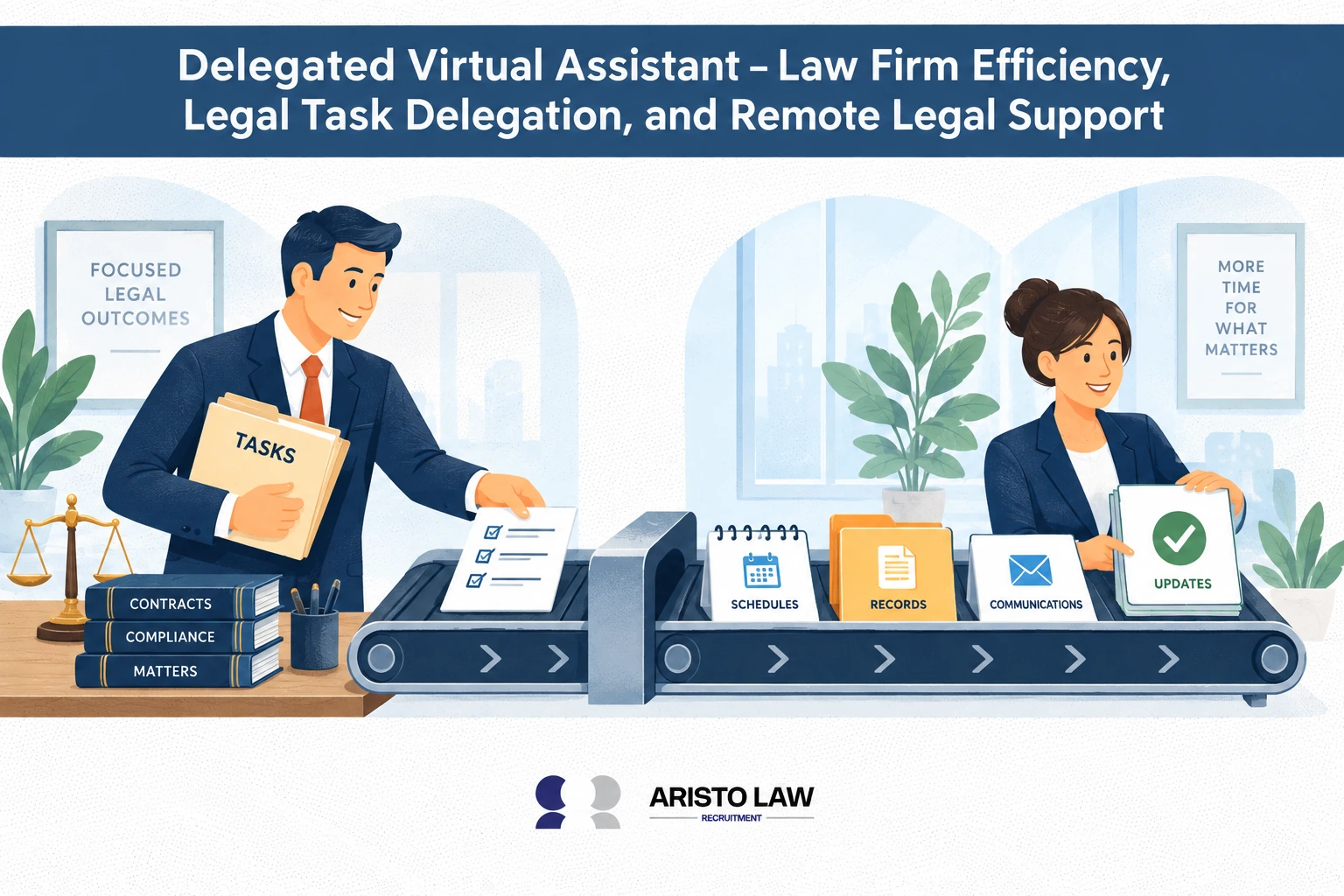
A delegated virtual assistant is a remote legal support professional assigned specific administrative, operational, and workflow-management responsibilities. Delegated virtual assistants help law firms improve efficiency, reduce attorney administrative overload, and maintain scalable legal operations through structured remote support systems.
Research by Clio in 2025 showed that strategic task delegation improves law-firm productivity and profitability by ensuring legal work is distributed more efficiently across teams. Workflow delegation and centralized digital task management improve attorney productivity, reduce operational bottlenecks, accelerate response times, and increase law-firm scalability across document-heavy legal environments.
Delegated virtual assistants commonly support intake coordination, scheduling, CRM updates, document organization, billing follow-up, calendar management, workflow tracking, communication routing, repository maintenance, and client follow-up workflows. Virtual legal assistants generally operate with broader workflow-management responsibilities than virtual legal secretaries because legal secretaries traditionally focus more heavily on correspondence, scheduling, transcription, and administrative communication, while delegated virtual legal assistants frequently support intake systems, automation workflows, task coordination, and operational reporting inside cloud-based legal environments.
Law firms improve operational efficiency through delegation because attorneys spend more time on billable legal analysis, negotiations, hearings, and client strategy rather than repetitive administrative work. Delegated remote support additionally improves scalability, workflow continuity, turnaround speed, communication responsiveness, and staffing flexibility without requiring immediate office expansion.
Attorneys should delegate repeatable, process-driven workflows including intake, scheduling, document tracking, CRM maintenance, billing reminders, task coordination, and repository management. Attorney-only legal responsibilities involving legal advice, litigation strategy, settlement recommendations, court representation, privileged legal interpretation, and substantive legal conclusions must remain attorney-controlled because those functions require licensed legal judgment.
Effective delegated virtual assistant systems depend heavily on SOPs, KPI tracking, communication protocols, role-based permissions, secure repositories, MFA authentication, encrypted communication systems, and attorney-supervised escalation procedures. Law firms commonly use practice-management platforms, CRM systems, scheduling software, workflow dashboards, secure messaging tools, document-management systems, and cloud collaboration software supporting centralized remote operations.
Firms hire delegated virtual assistants directly, through legal staffing agencies, or through managed remote legal-support providers depending on supervision capacity, scalability goals, replacement coverage needs, and operational complexity. Delegated virtual assistant support creates the strongest ROI when workflows are structured, measurable, repeatable, remote-friendly, and integrated into secure technology-driven legal operations.
Aristolaw helps law firms manage delegated virtual assistant support, law firm efficiency, legal task delegation, and remote legal support by providing outsourced support for administrative tasks, document coordination, scheduling, client communication, intake assistance, and back-office legal workflows. Book a Virtual Legal Assistant staffing consultation with Aristolaw. Aristolaw connects law firms with outsourcing solutions that match trained delegated virtual assistant staff to each assigned legal task, attorney support workflow, administrative duty, remote support function, and law firm efficiency responsibility.
What is a delegated virtual assistant for law firms?
A delegated virtual assistant for law firms is a remote support professional who receives clearly assigned legal administrative, intake, scheduling, document, billing, and client communication tasks under attorney or manager supervision. The role functions through delegation architecture rather than generic administrative assistance because law firms assign structured workflow ownership, operational responsibilities, review checkpoints, and measurable outputs to the remote support professional inside centralized legal systems.
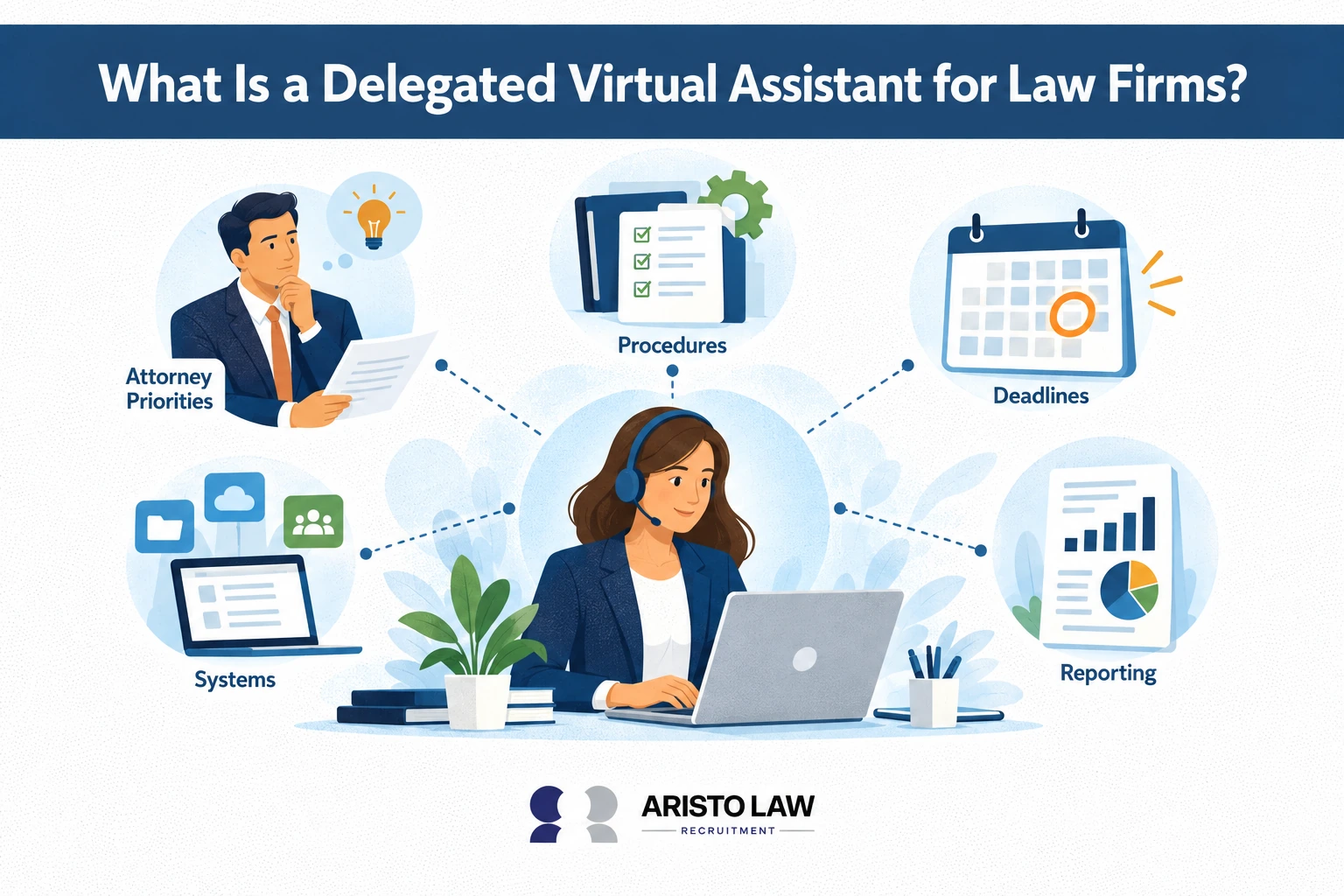
A delegated virtual assistant manages assigned legal-administrative workflows on behalf of attorneys and law firms through structured remote task execution. Law firms use delegated virtual legal assistant support to distribute intake coordination, scheduling, document handling, and client communication across outsourced operational systems.
A study by Attorney at Work in 2022 showed that law firms using SOP-driven workflow systems improved delegation efficiency, streamlined repetitive legal procedures, and reduced operational delays by converting static procedures into structured, automated workflows. Law firms improve operational efficiency when repetitive procedural work moves into structured support workflows supported by SOPs, cloud-based legal systems, and attorney-supervised delegation models.
Delegated virtual assistants commonly operate as legal virtual assistants, law firm virtual assistants, virtual legal secretaries, remote legal support staff, or administrative support partners assisting attorneys, paralegals, intake coordinators, and legal operations teams through distributed digital workflows. Responsibilities frequently include intake coordination, CRM updates, calendar management, client follow-up, billing reminders, repository organization, document routing, communication tracking, workflow dashboards, scheduling coordination, and procedural task management. Some firms also integrate delegated support structures with paralegal virtual assistant workflows where administrative coordination supports deeper attorney-supervised legal-support operations.
The effectiveness of delegated remote legal support depends heavily on clearly documented task ownership, written workflow instructions, role-based software access, communication protocols, escalation procedures, deadline systems, and attorney-review thresholds. Delegation systems usually fail when law firms assign sensitive legal work without SOPs, operational accountability, repository standards, or supervision controls. Strong delegation structures separate attorney-only legal work involving legal advice, settlement strategy, litigation decisions, legal interpretation, and client representation from repeatable support workflows suitable for remote legal staff.
Delegated virtual assistant systems improve law-firm efficiency because attorneys recover administrative time, communication bottlenecks decrease, workflow visibility improves, deadlines become easier to track, intake response accelerates, and operational continuity increases across growing legal practices. Remote legal delegation functions most effectively when law firms combine secure systems, measurable KPIs, centralized workflow management, confidentiality controls, and clearly defined operational boundaries between attorneys and delegated support personnel.
How does a delegated virtual assistant improve law firm efficiency?
A delegated virtual assistant improves law firm efficiency by moving repeatable administrative and legal support tasks into remote workflows.
Research by the American Bar Association in 2023 showed that lawyers spend only about 56% of their working hours on billable legal work, while substantial time is consumed by administrative coordination, billing, and operational tasks. Attorneys lose substantial productive time through constant context switching between legal analysis and repetitive operational work such as intake coordination, scheduling, follow-up communication, document routing, repository management, and billing administration. Structured delegation systems reduce this operational fragmentation by assigning procedural workflows to remote legal support staff operating through centralized legal technology platforms and documented SOPs.
Delegated virtual assistants improve efficiency operationally by managing intake workflows, responding to inquiries, updating CRM systems, scheduling consultations, coordinating calendars, routing documents, organizing repositories, maintaining task queues, tracking deadlines, and supporting billing workflows under attorney supervision. Centralized workflow ownership reduces administrative interruptions because attorneys spend less time switching between substantive legal work and repetitive operational coordination. Firms also improve intake responsiveness and consultation booking rates because delegated assistants maintain communication continuity, follow-up systems, scheduling reminders, and lead-management workflows consistently throughout the client intake process.
Remote delegated support additionally improves calendar control, document turnaround speed, case-file organization, communication tracking, invoice follow-up, and procedural workflow visibility across active legal matters. Structured delegation systems frequently improve measurable operational outcomes including first-response time, task completion rate, client follow-up completion, hearing-preparation readiness, billing support completion, repository accuracy, and attorney administrative hours saved. Faster document routing and centralized task ownership also reduce unresolved workflow backlog and improve matter progression across litigation, transactional, intake, and administrative legal operations.
The efficiency gain does not come from remote staffing alone. Law firms create operational improvement only when delegation systems include documented workflows, review checkpoints, escalation procedures, role-based software access, communication standards, measurable KPIs, and operational accountability structures. Delegated virtual assistants improve law-firm efficiency most effectively when firms combine structured workflow management, secure legal technology systems, attorney-supervised delegation, and clearly separated operational responsibilities between attorneys and remote legal support personnel.
What are the benefits of delegating legal support tasks?
Benefits of delegating legal support tasks include attorney time recovery, faster client response, and scalable firm capacity.
Listed below are the 17 benefits of delegating legal support tasks.
Attorney time recovery: Delegating intake coordination, scheduling, document routing, CRM updates, billing reminders, repository organization, and communication follow-up allows attorneys to spend more time on legal strategy, negotiations, litigation preparation, hearings, and billable legal work instead of repetitive operational tasks.
Faster client response: Delegated support workflows improve intake responsiveness, consultation scheduling, follow-up communication, and inquiry handling. Faster response times frequently improve consultation booking rates, lead conversion, and overall client satisfaction across legal practices.
Lower administrative burden: Law firms reduce operational overload when remote legal support staff manage repetitive workflow coordination, procedural tracking, communication logging, and administrative follow-up. Reduced administrative pressure improves operational stability and decreases attorney burnout risk.
Better workflow consistency: Delegation systems supported by SOPs, task ownership, workflow dashboards, and deadline tracking reduce dropped tasks, communication gaps, unresolved follow-up, and inconsistent operational handling across active legal matters.
Improved billing support: Delegated assistants frequently manage invoice reminders, payment follow-up, time-entry coordination, billing-system updates, and accounts-receivable workflows improving cash-flow continuity and reducing delayed collections.
Cleaner files and stronger repository organization: Delegated legal support improves naming conventions, document indexing, version control, repository consistency, and centralized case-file management reducing attorney rework and improving retrieval efficiency during litigation and client communication workflows.
Scalable law-firm capacity: Delegation allows firms to increase intake volume, manage larger caseloads, and maintain operational continuity without immediately expanding permanent in-house staffing or office infrastructure.
Reduced context switching for attorneys: Attorneys lose productivity when constantly shifting between substantive legal work and operational coordination. Delegated workflow ownership minimizes interruptions and improves concentration on legal analysis and strategic work.
Improved deadline management: Delegated support personnel maintain calendars, reminder systems, hearing schedules, filing timelines, and workflow dashboards reducing missed-deadline risk and procedural bottlenecks.
Stronger intake and onboarding workflows: Delegated assistants improve intake consistency through inquiry tracking, consultation scheduling, document collection reminders, onboarding coordination, and CRM management improving workflow continuity from first contact through active representation.
Better communication continuity: Delegated support improves communication tracking, follow-up completion, call summaries, repository updates, and workflow visibility across attorneys, clients, courts, vendors, and internal staff.
Faster document turnaround: Structured delegation systems improve formatting workflows, repository updates, document routing, disclosure tracking, e-signature coordination, and attorney-review preparation reducing delays in operational workflows.
More predictable workflow management: Delegated operational ownership creates clearer accountability for scheduling, follow-up, intake coordination, billing support, and task progression improving law-firm operational predictability.
Operational flexibility during workload surges: Delegated remote legal support allows firms to handle intake spikes, hearing preparation pressure, discovery backlog, or litigation surges more efficiently without immediately restructuring internal staffing.
Improved task visibility and accountability: Workflow dashboards, centralized repositories, communication logs, and KPI tracking systems improve visibility into unresolved tasks, follow-up obligations, intake progression, and operational backlog.
Reduced operational bottlenecks: Delegated support reduces workflow congestion caused by delayed communication, missing follow-up, incomplete repository updates, scheduling conflicts, and inconsistent administrative handling.
Stronger law-firm operational systems: Delegation encourages firms to create documented SOPs, escalation procedures, review checkpoints, workflow metrics, and accountability structures improving long-term operational maturity.
Law firms gain the strongest operational value from legal task delegation when workflows are repeatable, measurable, remote-friendly, securely managed, and supported through structured supervision systems rather than informal task assignment alone.
How should attorneys decide what to delegate?
Steps attorneys should use to decide what to delegate include identifying repeated tasks, separating attorney-only work, and setting review checkpoints.
Listed below are 12 steps attorneys should use to decide what to delegate.
Audit recurring weekly workflows: Attorneys should first review their calendar, inbox activity, billing workload, communication interruptions, scheduling obligations, document-routing tasks, intake coordination, and procedural follow-up responsibilities identifying repetitive operational work consuming legal-production time. Workflow audits frequently reveal high-frequency administrative tasks suitable for delegation.
Separate attorney-only legal work from support workflows: Legal advice, litigation strategy, settlement recommendations, privileged legal interpretation, client representation, and substantive legal conclusions must remain attorney-controlled. Administrative coordination, scheduling, intake follow-up, repository management, billing reminders, document organization, and procedural tracking usually fit delegated support workflows.
Rank tasks by operational risk level: Attorneys should evaluate confidentiality exposure, court-deadline sensitivity, client-service impact, financial consequences, litigation risk, and legal-judgment requirements before assigning remote support responsibilities. High-risk workflows require stronger attorney supervision and review systems.
Prioritize low-risk, high-frequency tasks first: Intake coordination, consultation scheduling, CRM updates, communication logging, document routing, billing follow-up, calendar management, repository organization, and reminder workflows usually create the safest starting point for delegation because they are repeatable and process-driven.
Document workflow instructions and SOPs: Delegation systems function effectively only when firms provide written procedures covering task steps, naming conventions, escalation rules, communication standards, review thresholds, repository protocols, and workflow expectations.
Assign clear task ownership: Every delegated workflow should have a designated owner responsible for follow-up, completion tracking, communication updates, and procedural accountability reducing operational confusion and dropped tasks.
Define attorney-review checkpoints: Attorneys should identify where supervision is required before filing, client communication, billing approval, hearing preparation, settlement discussion, or litigation-related workflow progression. Structured review checkpoints reduce operational risk and unauthorized legal communication exposure.
Evaluate confidentiality and secure-access needs: Delegated support personnel should receive role-based repository access limited to assigned workflows. Secure systems, MFA authentication, encrypted communication, and confidentiality agreements protect attorney-client privilege and sensitive legal records.
Assess workflow measurability before delegation: Tasks become easier to delegate when firms track turnaround time, completion rate, follow-up status, communication responsiveness, billing support accuracy, and repository consistency through measurable KPIs.
Use escalation rules for uncertain situations: Delegated support staff should know when client conflict, emergency filings, legal interpretation requests, settlement questions, or procedural irregularities require immediate attorney involvement.
Expand delegation gradually into more complex workflows: After low-risk workflows stabilize operationally, firms delegate more advanced support functions such as discovery tracking, disclosure coordination, hearing preparation support, litigation workflow management, or attorney-supervised legal research organization.
Monitor delegation outcomes continuously: Attorneys should review task backlog, response time, communication quality, deadline compliance, billing completion, repository organization, and attorney time recovery regularly ensuring delegated workflows improve operational efficiency rather than creating rework.
Effective legal task delegation depends on workflow structure, measurable accountability, secure systems, documented procedures, and clearly separated operational boundaries between attorney-only legal judgment and delegated support responsibilities.
What is the difference between a virtual legal assistant and a virtual legal secretary?
A virtual legal assistant focuses on legal workflow support such as case preparation, intake, and document coordination, while a virtual legal secretary primarily handles administrative communication, scheduling, and clerical tasks.
A delegated virtual assistant supports broader legal workflows such as intake coordination, scheduling, document handling, and administrative operations across multiple practice functions. A virtual legal secretary focuses more narrowly on clerical and correspondence responsibilities, making virtual legal secretary services more aligned with calendar management, transcription, and attorney communication support.
The table below shows the difference between a virtual legal assistant and a virtual legal secretary.
| Aspect | Virtual Legal Assistant | Virtual Legal Secretary |
|---|---|---|
| Primary role focus | Supports broader legal operations, workflow coordination, and administrative systems | Supports traditional secretarial and clerical legal-office functions |
| Core operational objective | Improves law-firm workflow efficiency and operational coordination | Supports attorney correspondence, scheduling, and office administration |
| Client intake support | Frequently manages intake forms, consultation scheduling, lead follow-up, CRM updates, and onboarding workflows | Usually provides basic intake call handling and message routing |
| Workflow coordination responsibilities | Tracks matters, deadlines, task queues, document routing, follow-up systems, and operational workflows | Focuses more heavily on calendar maintenance and administrative coordination |
| CRM and client database management | Frequently updates CRM systems, communication logs, intake records, and workflow dashboards | Limited CRM involvement in many traditional secretary-focused workflows |
| Billing and invoice support | Commonly assists with invoice reminders, billing-system updates, payment follow-up, and operational billing workflows | Support invoice typing, time-entry transcription, or administrative billing tasks |
| Matter tracking involvement | Frequently monitors procedural status, unresolved tasks, follow-up queues, and operational progression across legal matters | Usually maintains basic scheduling and administrative awareness of active matters |
| Document-routing responsibilities | Coordinates document workflows, repository updates, e-signature routing, and workflow visibility | Commonly handles typing, filing, correspondence preparation, and administrative document handling |
| Legal operations exposure | Works more directly inside workflow systems, task boards, repositories, intake pipelines, and operational reporting | Operates more heavily within correspondence and clerical-support workflows |
| Calendar management | Coordinates consultations, hearings, reminders, task deadlines, workflow schedules, and team coordination | Traditionally manages attorney calendars, appointments, meetings, and scheduling logistics |
| Phone and communication handling | Supports intake follow-up, communication tracking, client updates, and workflow-related coordination | Frequently handles receptionist-style phone coverage and message-taking responsibilities |
| Correspondence responsibilities | Coordinate workflow communication, intake responses, and procedural follow-up | Traditionally drafts, formats, transcribes, and manages attorney correspondence |
| Typing and transcription focus | Usually less centered on transcription-heavy workflows | Strong traditional focus on typing, dictation, transcription, and administrative correspondence preparation |
| Filing responsibilities | Maintains digital repositories, workflow systems, and cloud-based document organization | Traditionally manages filing systems and administrative document storage |
| Technology reliance | Heavily integrated into CRM platforms, cloud-based legal software, workflow dashboards, and automation systems | Uses legal-office technology but often within narrower administrative functions |
| Workflow visibility role | Maintains operational visibility across intake, scheduling, communication, billing, and procedural workflows | Primarily supports attorney scheduling and clerical coordination visibility |
| Remote workflow suitability | Highly optimized for distributed legal operations and remote workflow systems | Adapted from traditional office-secretary functions into remote environments |
| Task complexity | Frequently manages broader operational coordination involving multiple legal systems and workflow stages | Usually handles narrower clerical and secretarial support functions |
| Relationship to attorneys | Functions as workflow-support and operational-coordination support staff | Functions more traditionally as administrative and secretarial support staff |
| Support for law-firm scalability | Frequently improves intake capacity, workflow consistency, communication continuity, and operational scalability | Primarily improves scheduling efficiency and administrative support continuity |
| Operational flexibility | Often adapts to intake, billing, repository management, communication, scheduling, and workflow administration simultaneously | More specialized around clerical, scheduling, filing, and communication-support functions |
| Best fit for law firms | Effective for firms needing centralized workflow coordination and operational support systems | Effective for firms needing structured correspondence, scheduling, and secretarial administration |
| Role overlap in smaller firms | Frequently blends with secretary responsibilities inside lean legal operations | Frequently performs assistant-style workflow support in smaller law firms |
Many modern remote legal-support structures combine virtual legal assistant and virtual legal secretary responsibilities, especially inside solo practices and smaller law firms where intake coordination, scheduling, communication management, billing support, repository organization, and workflow tracking frequently overlap within a single remote legal-support role.
What tasks can law firms delegate to a virtual assistant?
Tasks law firms can delegate to a virtual assistant include client intake, file organization, and client follow-up.

Listed below are 15 tasks law firms can delegate to a virtual assistant.
Client intake and lead-management workflows: Virtual assistants commonly capture inquiries, respond to intake requests, collect preliminary client information, schedule consultations, update intake systems, route conflict-check information, and maintain lead-follow-up workflows improving consultation conversion and intake responsiveness. Attorney review remains necessary before representation decisions, legal advice, or conflict-clearance approval.
Appointment scheduling and calendar coordination: Law firms frequently delegate consultation scheduling, hearing reminders, meeting coordination, mediation calendars, procedural deadlines, availability tracking, and reminder workflows improving calendar visibility and reducing scheduling conflicts. Attorneys remain responsible for legal-priority decisions and court-strategy planning.
Email triage and communication routing: Virtual assistants commonly organize inboxes, route urgent communication, categorize client messages, maintain follow-up queues, schedule callbacks, and escalate sensitive matters to attorneys reducing communication backlog and missed client follow-up.
Document formatting and administrative document workflows: Remote assistants often prepare templates, apply formatting standards, organize exhibits, manage naming conventions, route e-signatures, update repositories, convert files, and maintain centralized document systems. Attorneys and paralegals review substantive legal content before filing or client delivery.
CRM updates and workflow tracking: Virtual assistants maintain CRM systems, update communication logs, monitor intake progression, track unresolved follow-up tasks, maintain workflow dashboards, and organize procedural status visibility improving operational coordination across active legal matters.
Billing support and payment follow-up: Delegated billing workflows frequently include time-entry reminders, invoice draft preparation, accounts-receivable tracking, payment reminders, billing-system updates, and operational billing coordination supporting stronger cash-flow continuity. Attorneys approve final billing decisions and legal-fee structures.
File organization and repository management: Virtual assistants maintain folder structures, repository updates, version control systems, metadata consistency, intake records, communication archives, and centralized case-file organization reducing document confusion and attorney rework.
Client follow-up and reminder systems: Law firms commonly delegate follow-up reminders for missing documents, intake forms, disclosures, signatures, consultations, payment requests, and procedural scheduling helping maintain communication continuity and workflow progression.
Task management and deadline tracking: Remote assistants frequently maintain task boards, procedural reminders, escalation queues, unresolved-item lists, workflow dashboards, and internal deadline systems improving operational accountability and task completion visibility.
E-signature coordination and routing workflows: Virtual assistants often manage signature requests, document-routing sequences, completion reminders, execution tracking, and repository updates reducing delays in administrative document execution.
Administrative hearing and meeting preparation support: Delegated support includes hearing-calendar updates, checklist tracking, repository preparation, scheduling coordination, communication reminders, and procedural logistics management supporting attorney readiness.
Phone handling and receptionist workflows: Virtual assistants commonly answer calls, route messages, screen inquiries, confirm appointments, manage intake communication, and maintain call logs improving client responsiveness and front-office workflow continuity.
Reporting and operational dashboard updates: Law firms frequently delegate KPI tracking, intake reporting, billing-status updates, communication metrics, workflow backlog reporting, and operational data maintenance supporting management visibility.
Vendor and service-provider coordination: Remote assistants coordinate interpreters, court reporters, mediators, process servers, IT vendors, transcription providers, and administrative service scheduling supporting operational continuity.
Administrative support for legal marketing workflows: Some firms delegate newsletter scheduling, CRM campaigns, consultation reminders, intake automation updates, review follow-up, and administrative website updates supporting client-development workflows.
Administrative delegation works most effectively when law firms separate routine operational workflows from attorney-only legal responsibilities involving legal strategy, litigation decisions, settlement recommendations, substantive legal drafting, privileged legal interpretation, and client representation. Virtual assistants manage workflow coordination and operational continuity, while attorneys and paralegals remain responsible for substantive legal judgment and attorney-supervised legal support tasks.
What legal tasks should not be delegated to a virtual assistant?
Legal tasks that should not be delegated to a virtual assistant include legal advice, independent legal judgment, and unsupervised legal drafting.
Listed below are 15 legal tasks that should not be delegated to a virtual assistant.
Providing legal advice to clients: Virtual assistants must not interpret laws, explain legal rights, recommend legal action, predict case outcomes, or advise clients about litigation decisions because those activities constitute licensed legal practice requiring attorney authority.
Making independent legal judgments: Attorneys remain responsible for evaluating evidence, determining legal strategy, selecting procedural approaches, assessing legal risk, and deciding litigation direction. Virtual assistants organize information for attorney review but must not make substantive legal conclusions independently.
Recommending settlement terms or negotiation strategy: Settlement evaluation involves legal analysis, financial consequences, litigation exposure, and client-rights assessment requiring attorney judgment. Remote support staff coordinate communication and organize settlement materials but cannot recommend whether clients should accept or reject settlement terms.
Setting legal fees or approving billing decisions: Fee structures, contingency agreements, settlement disbursement decisions, trust-account handling, and legal billing judgments remain attorney-controlled because they involve ethical obligations, financial risk, and client-contract responsibilities.
Representing clients in court or legal proceedings: Virtual assistants cannot appear in court, conduct hearings, negotiate formally on behalf of clients, sign pleadings as legal representatives, or communicate legal positions directly to courts or opposing counsel without attorney authorization.
Performing unsupervised substantive legal drafting: Remote support staff format templates, organize exhibits, prepare administrative drafts, and populate attorney-approved forms, but attorneys must review and approve substantive legal arguments, pleadings, motions, contracts, settlement agreements, and court filings before use.
Interpreting jurisdiction-specific legal rules independently: Court procedures, filing standards, disclosure obligations, and litigation requirements vary heavily across jurisdictions. Attorneys remain responsible for legal interpretation and procedural compliance decisions.
Handling privilege-sensitive legal communication without supervision: Communications involving litigation strategy, settlement positioning, legal analysis, privileged client disclosures, or attorney mental impressions require attorney oversight and controlled communication protocols.
Deciding escalation outcomes in high-risk matters: Emergency filings, sanctions exposure, custody disputes, litigation deadlines, conflict-sensitive communication, and settlement disputes require attorney review rather than administrative decision-making by remote support personnel.
Approving legal conclusions inside research workflows: Virtual assistants organize research materials, maintain repositories, summarize procedural information, and coordinate legal research logistics, but attorneys and attorney-supervised paralegals remain responsible for substantive legal interpretation and final legal conclusions.
Managing trust-account or client-fund authority independently: Financial authorization involving settlement funds, escrow accounts, trust-account distributions, or legal-payment approval requires attorney-controlled oversight because of ethical and regulatory obligations.
Communicating attorney-level litigation positions: Virtual assistants must not communicate legal threats, strategic recommendations, litigation assessments, or attorney opinions to clients, courts, vendors, or opposing parties without direct attorney authorization.
Making confidentiality or privilege-waiver decisions: Attorneys remain responsible for deciding disclosure scope, privilege assertions, confidentiality exceptions, and strategic information-sharing boundaries during litigation and transactional matters.
Executing legal strategy during negotiations or disputes: Virtual assistants coordinate scheduling, organize records, maintain communication logs, and route procedural updates, but attorneys must direct negotiation positioning, litigation tactics, and strategic dispute management.
Performing legal work without documented supervision systems: Distributed legal-support structures create greater operational risk because remote teams depend heavily on written workflows, escalation rules, approval checkpoints, and role boundaries. Informal delegation without documented supervision frequently increases unauthorized-practice-of-law exposure and operational confusion.
Remote legal support functions most safely when firms clearly separate operational support workflows from attorney-only legal responsibilities. Virtual assistants prepare information, coordinate procedures, maintain systems, and organize workflows, while attorneys retain responsibility for legal judgment, strategic decisions, client advice, and substantive legal representation.
How should law firms assign tasks to virtual assistants?
Steps to assign tasks to virtual assistants include defining the outcome, giving context and confirming completion standards.
Listed below are the 12 steps to assign tasks to virtual assistants
Define the exact operational outcome: Law firms should begin every assignment by clearly stating the final objective instead of giving vague activity-based instructions. Remote legal support performs more effectively when assistants understand whether the task supports intake progression, hearing preparation, billing continuity, repository organization, deadline management, or client communication workflows.
Provide matter context and workflow background: Virtual assistants require enough procedural context to prioritize work correctly. Attorneys should include the matter name, client name, workflow stage, procedural urgency, related deadlines, communication history, and operational purpose connected to the assignment. Hidden context frequently causes workflow mistakes and unnecessary follow-up.
Attach templates, examples, and source documents: Delegation quality improves heavily when firms provide standardized templates, prior examples, naming conventions, SOP references, checklists, intake forms, billing samples, or approved communication structures. Missing source files and unclear formatting expectations commonly create avoidable rework.
Specify the expected output clearly: Every assignment should define exactly what completion looks like including formatting standards, repository location, communication expectations, metadata rules, naming conventions, update requirements, and whether the task requires attorney review before use.
Set deadlines and priority levels explicitly: Virtual assistants managing multiple workflows require clear due dates, urgency classification, procedural timing expectations, and escalation timelines. Undefined deadlines frequently cause missed follow-up, hearing pressure, billing delays, and operational confusion.
Identify the software location and workflow system: Assignments should specify where documents belong, which repository or CRM system applies, which task board tracks progress, and where communication updates must be logged. Centralized workflow visibility reduces duplicated work and repository inconsistency.
Clarify confidentiality level and access restrictions: Law firms should identify whether tasks involve intake data, billing records, financial disclosures, litigation-sensitive communication, or privileged material requiring limited repository permissions and stricter handling procedures.
Define review rules and approval checkpoint: Delegated legal-support workflows require documented reviewer assignment identifying whether the supervising attorney, paralegal, office manager, or billing coordinator must approve the task before client delivery, filing, or workflow progression.
Identify escalation triggers early: Virtual assistants should know when missed deadlines, client complaints, legal questions, settlement communication, emergency filings, incomplete records, or procedural irregularities require immediate escalation to supervising attorneys or staff.
Require communication and follow-up updates: Effective delegation includes status reporting expectations, completion confirmation procedures, unresolved-item tracking, and workflow visibility updates inside the firm’s communication systems or dashboards.
Avoid common poor-delegation patterns: Delegation frequently fails because of vague requests, missing documents, conflicting instructions, hidden deadlines, unclear ownership, undefined priorities, absent review procedures, or incomplete repository access. Structured assignment systems reduce operational confusion and rework.
Confirm measurable completion standards: Law firms should define completion metrics such as response time, repository accuracy, turnaround speed, billing-update completion, communication documentation quality, and follow-up consistency improving accountability across remote legal workflows.
Delegation succeeds operationally when assignments function as structured workflows rather than informal requests. Strong task assignment systems improve workflow consistency, reduce operational bottlenecks, strengthen accountability, and increase law-firm efficiency across distributed remote legal-support environments.
How should law firms supervise delegated virtual assistants?
Law firms should supervise delegated virtual assistants through clear task ownership, attorney-review checkpoints, secure systems, communication cadence, quality checks, and performance metrics. Remote legal-support supervision functions as both a legal-risk control system and an operational productivity framework because distributed workflows require stronger procedural visibility, documented accountability, and structured communication than informal in-office delegation.
A literature review by Duta Mustajab in 2024 found that remote and hybrid workforce performance improves when organizations emphasize effective leadership, proactive communication, accountability, and organizational support rather than rigid supervision, leading to stronger productivity, collaboration, and operational efficiency. Remote legal-support performance improves when firms supervise workflow outputs, deadline compliance, communication quality, and operational consistency instead of relying on constant activity monitoring.
Effective supervision usually begins with centralized task boards and workflow dashboards showing assignment ownership, procedural stage, unresolved follow-up, hearing preparation status, intake progression, billing tasks, repository updates, and deadline visibility across active matters. Daily workflow visibility allows attorneys, paralegals, and office managers to identify bottlenecks, overdue tasks, communication gaps, and escalation needs before operational issues affect clients or court deadlines. Weekly review meetings additionally improve workflow coordination by reviewing backlog volume, intake conversion, billing support, communication quality, document turnaround, and unresolved procedural risks.
Attorney-review checkpoints remain heavily important because delegated virtual assistants organize documents, route communication, maintain repositories, coordinate intake, and prepare administrative workflows, but attorneys must review substantive legal content, settlement communication, legal conclusions, privileged correspondence, and court-facing material before release or filing. Structured client-message approval systems, escalation protocols, and revision-tracking procedures reduce unauthorized-practice-of-law exposure and improve workflow consistency across distributed teams.
Confidentiality monitoring remains another major supervision responsibility because remote legal support workflows involve privileged communication, financial records, litigation-sensitive information, and client repositories requiring role-based permissions, MFA authentication, encrypted systems, audit trails, and secure document governance. Law firms should monitor repository access patterns, communication handling, and procedural compliance continuously throughout the engagement.
Effective remote supervision differs from micromanaging work hours. Strong legal operations systems focus on workflow completion, deadline reliability, response quality, repository accuracy, communication consistency, billing support performance, and attorney time recovery rather than excessive tracking of online presence or minute-by-minute activity. Delegated virtual assistant systems operate most efficiently when firms supervise operational outcomes, workflow quality, and legal-compliance boundaries through measurable KPIs and structured review systems.
How do law firms outsource legal assistant work?
Steps to outsource legal assistant work includes identifying bottlenecks, defining task scope, and measuring performance.
A delegated virtual assistant supports outsourced legal assistant workflows by managing intake coordination, document handling, scheduling, and administrative legal operations under defined firm protocols. Structured delegation models also clarify legal outsourcing providers benefits and best practices through standardized task allocation, compliance oversight, and workflow accountability.
Listed below are the 15 steps to outsource legal assistant work.
Identify operational bottlenecks through workflow audits: Law firms should begin outsourcing by auditing recurring operational pressure points including intake backlog, scheduling overload, billing delays, document-routing congestion, communication gaps, repository inconsistency, or follow-up failures. Workflow diagnosis improves staffing fit and delegation accuracy.
Define the exact legal-assistant task scope: Attorneys should specify which workflows the remote legal assistant will manage including intake coordination, CRM updates, scheduling, repository organization, billing support, communication tracking, document formatting, e-signature routing, or procedural workflow management. Outsourcing works most effectively when assignments are repeatable and process-driven rather than vague “help me with everything” requests.
Create a role scorecard and workflow expectations document: Firms should define KPIs, turnaround standards, escalation procedures, communication expectations, repository rules, confidentiality requirements, deadline-management responsibilities, and attorney-review checkpoints before onboarding remote support personnel.
Choose the appropriate staffing model: Firms should compare freelance virtual assistants, agency-managed legal staffing, dedicated remote legal assistants, outsourced legal-support providers, and hybrid staffing structures based on workload volume, supervision capacity, scalability goals, and operational complexity.
Screen for legal-support experience and terminology familiarity: Legal assistants supporting law firms should understand intake workflows, procedural terminology, scheduling sensitivity, legal communication standards, repository systems, and workflow coordination requirements reducing operational confusion and attorney rework.
Test software familiarity and workflow readiness: Remote legal assistants should demonstrate proficiency with practice-management software, CRM systems, scheduling platforms, billing systems, repositories, workflow dashboards, e-signature tools, and secure communication systems supporting distributed legal operations.
Use sample task tests before assigning live workflows: Firms should evaluate candidates through intake simulations, scheduling exercises, repository-organization tests, document-formatting assignments, communication drafting, CRM updates, and billing-support workflows measuring operational accuracy and responsiveness.
Evaluate client-facing communication quality: Legal assistants frequently interact with intake prospects, active clients, vendors, and internal legal staff. Firms should review tone, escalation judgment, responsiveness, communication clarity, and documentation quality before assigning client-facing responsibilities.
Establish confidentiality rules and data-security systems: Outsourced legal assistants should operate through confidentiality agreements, encrypted communication systems, MFA authentication, role-based permissions, secure repositories, VPN access, and attorney-supervised workflow controls protecting attorney-client privilege and sensitive legal information.
Assign secure role-based software access: Remote support personnel should receive access only to the repositories, communication systems, workflow dashboards, and operational platforms necessary for assigned responsibilities reducing unnecessary confidentiality exposure.
Document SOPs and workflow procedures: Strong outsourcing systems depend heavily on written workflows covering intake handling, communication standards, billing support, repository naming conventions, escalation rules, deadline management, client follow-up, and attorney-review thresholds.
Define attorney-review and escalation boundaries: Attorneys must remain responsible for legal advice, litigation strategy, settlement recommendations, legal interpretation, and substantive legal conclusions. Legal assistants should know exactly when workflows require attorney review or escalation.
Create onboarding milestones and workflow checkpoints: Law firms should onboard remote legal assistants gradually through supervised assignments, workflow shadowing, repository familiarization, communication review, and operational-feedback sessions improving long-term integration quality.
Track operational performance continuously: Firms should monitor KPIs including response time, consultation booking rate, billing follow-up completion, task backlog, communication quality, repository accuracy, deadline compliance, document turnaround, and attorney administrative hours saved.
Maintain structured reporting and workflow visibility: Outsourced legal-support systems operate more reliably when task boards, workflow dashboards, communication logs, repository updates, and performance reporting create centralized operational visibility across remote legal workflows.
Legal assistant outsourcing creates the strongest operational value when firms combine structured delegation systems, measurable workflows, secure technology infrastructure, attorney-supervised review systems, and clearly documented operational procedures instead of informal task assignment without workflow governance.
How do virtual assistants support legal workflow automation?
Virtual assistants support legal workflow automation by maintaining task systems, updating matter records, monitoring automated reminders, routing documents, and checking workflow exceptions. Legal workflow automation operates most effectively when software automation combines with human process ownership because automated systems still depend heavily on accurate data entry, procedural oversight, communication tracking, and operational follow-through.
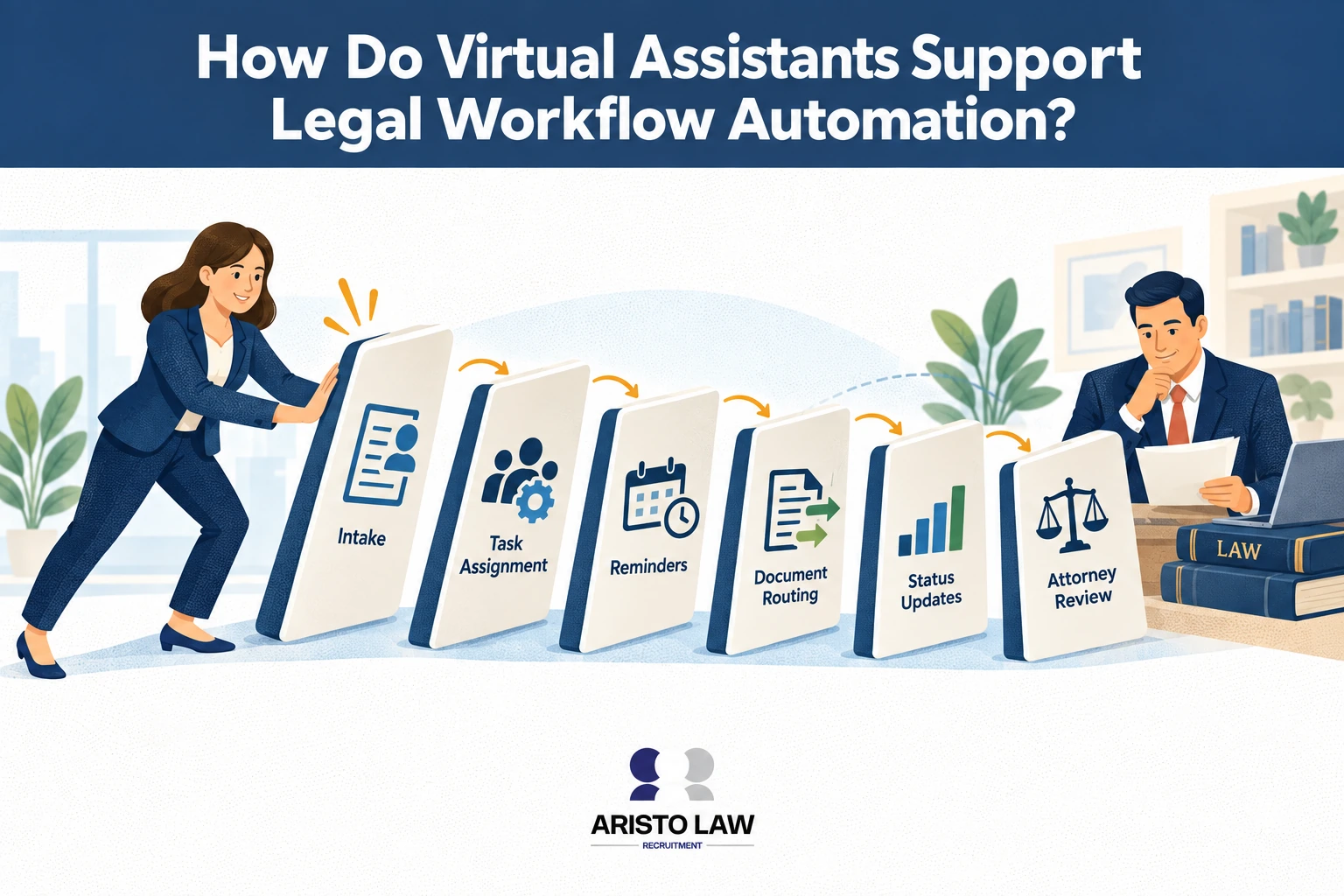
Research by Onit in 2026 showed that fragmented workflows, lost context, shifting ownership, incomplete intake data, and manually updated matter status are major causes of workflow-management failure in legal operations. The study noted that disconnected systems force teams to repeatedly reconcile inconsistencies and manually re-enter data, creating operational bottlenecks. Automation systems fail most frequently because of incomplete data, unresolved workflow exceptions, outdated matter status, unclear ownership, and inconsistent operational maintenance rather than software limitations alone.
A delegated virtual assistant manages task routing, document handling, deadline tracking, and intake coordination within automated legal workflows. A delegated virtual assistant also connects firms with legal workflow automation tools benefits and examples through standardized process execution, reduced administrative duplication, and integration with case management systems.
Virtual assistants commonly support automation through task templates, intake forms, CRM sequences, e-signature workflows, billing reminders, consultation scheduling, communication triggers, deadline reminders, and follow-up automation systems integrated into practice-management software and cloud-based legal operations platforms. Remote legal assistants frequently maintain intake pipelines by verifying inquiry information, updating matter stages, routing conflict-check details, assigning workflows, and confirming that automated communication sequences match actual client status.
Delegated assistants additionally monitor automated task queues, billing workflows, reporting dashboards, repository updates, document-routing systems, and procedural reminder sequences improving workflow visibility across active legal matters. When automation systems encounter incomplete forms, missing disclosures, overdue follow-up, failed signatures, scheduling conflicts, billing irregularities, or communication gaps, virtual assistants escalate workflow exceptions before operational bottlenecks affect attorneys or clients.
Automation accuracy depends heavily on clean data entry, consistent repository management, task closure discipline, communication logging, and workflow verification. Virtual assistants function as the operational control layer maintaining automation reliability, procedural continuity, and accurate matter progression across distributed legal workflows.
What tools support delegated virtual assistants?
Tools that support delegated virtual assistants include practice-management software, e-signature platforms, billing software, secure messaging, and reporting dashboards.
A delegated virtual assistant uses cloud-based platforms to coordinate workflows, monitor deadlines, and maintain document accuracy across distributed legal operations. Integration with legal case management systems allows the delegated virtual assistant to centralize communication, automate task tracking, and support real-time case administration.
Listed below are 18 tools that support delegated virtual assistants.
Practice-management software: Practice-management platforms centralize matters, deadlines, communication logs, billing records, workflow stages, hearing schedules, task assignments, and repository access improving operational visibility across legal workflows. Delegated virtual assistants use these systems to maintain matter progression, update records, and coordinate procedural workflows.
Task boards and workflow dashboards: Task-management systems assign ownership, display deadlines, track unresolved items, monitor workflow stages, and improve accountability across distributed legal teams. Delegated assistants frequently manage follow-up queues, intake progression, billing reminders, and procedural task completion through centralized task boards.
Intake systems and lead-capture platforms: Intake software captures inquiry information, consultation requests, conflict-check details, intake forms, and onboarding records improving consultation scheduling and lead-management workflows. Virtual assistants maintain intake pipelines and follow-up systems through these platforms.
CRM platforms: CRM systems track prospects, client communication history, consultation status, workflow progression, referral sources, and follow-up activity. Delegated assistants frequently update CRM records, document communication, and maintain client-service continuity across intake and active matters.
Document-management systems: Legal document platforms organize repositories, control version history, maintain naming conventions, enforce permissions, and improve retrieval speed across active legal matters. Delegated assistants maintain repository accuracy, metadata consistency, and centralized document organization.
E-signature platforms: E-signature systems route agreements, disclosures, intake packets, billing authorizations, and procedural documents through secure approval workflows. Virtual assistants monitor signature completion, send reminders, and update repositories after execution.
Billing and invoicing software: Billing platforms support invoice preparation, payment tracking, accounts-receivable workflows, time-entry coordination, billing reminders, and collection visibility. Delegated assistants frequently manage billing follow-up and operational billing workflows improving cash-flow continuity.
Calendar and scheduling systems: Scheduling platforms coordinate consultations, hearings, meetings, mediation sessions, reminders, and procedural deadlines improving attorney calendar control and operational coordination across distributed legal operations.
Secure messaging and communication platforms: Encrypted communication systems protect attorney-client communication, internal workflow coordination, intake updates, billing discussions, and procedural messaging. Delegated virtual assistants frequently manage communication routing and follow-up through secure messaging tools.
Reporting dashboards and KPI systems: Reporting tools display response time, intake conversion, workflow backlog, billing completion, task status, communication metrics, and attorney time recovery helping law firms monitor operational efficiency and delegated workflow performance.
Workflow automation platforms: Automation systems trigger intake reminders, consultation confirmations, billing follow-up, task creation, e-signature routing, communication sequences, and deadline notifications reducing repetitive administrative work. Delegated assistants maintain automation accuracy through workflow monitoring and exception handling.
Cloud-based collaboration systems: Remote legal operations frequently rely on cloud collaboration platforms supporting shared repositories, procedural coordination, workflow updates, document routing, and distributed team communication across attorneys, paralegals, assistants, and vendors.
Time-tracking and productivity systems: Time-management platforms monitor workflow allocation, support billing coordination, measure administrative workload, and improve visibility into delegated operational support activity across legal matters.
Audit-trail and permission-management systems: Legal workflows require detailed audit logs, role-based permissions, repository tracking, and access-control systems protecting confidentiality and improving accountability across remote legal-support operations.
Repository version-control systems: Version-control platforms track document updates, prevent duplicate-file confusion, maintain procedural consistency, and improve retrieval reliability during litigation, intake, billing, and operational workflows.
Knowledge-base and SOP platforms: Centralized SOP repositories help delegated virtual assistants follow workflow standards, escalation procedures, communication rules, repository policies, and operational guidelines consistently across legal-support systems.
Secure file-sharing systems: File-sharing platforms allow delegated assistants to exchange intake documents, billing records, disclosures, signed agreements, and procedural files through encrypted channels supporting confidentiality compliance.
Data-hygiene and repository-maintenance tools: Data-quality systems help maintain accurate client records, remove duplicates, standardize metadata, preserve workflow integrity, and improve automation reliability across legal operations.
Delegated virtual assistant systems function most effectively when law firms combine centralized legal technology, structured workflow ownership, secure permissions, audit trails, and consistent data hygiene maintaining operational visibility and confidentiality across distributed legal-support environments.
How can law firms protect confidentiality with virtual assistants?
Law firms protect confidentiality with virtual assistants through role-based access, confidentiality agreements, secure devices, encrypted file sharing, password controls, audit trails, and offboarding procedures. Confidentiality functions as a foundational requirement for remote legal support because virtual assistants frequently interact with intake records, billing information, litigation documents, privileged communication, financial disclosures, repository systems, and operational legal workflows containing highly sensitive client information.
Research by the International Bar Association in 2024 showed that unsecured communication systems, lack of encryption, and insufficient access controls expose privileged legal communications to unauthorized access and confidentiality breaches. Confidentiality failures most frequently occur because of excessive repository access, weak authentication controls, unsecured communication systems, inconsistent workflow governance, and inadequate supervision structures.
Attorney-client privilege remains heavily important inside remote legal operations because delegated support staff process intake forms, communication logs, billing workflows, litigation records, discovery materials, procedural calendars, and client repositories while supporting attorneys operationally. Law firms commonly implement least-privilege access structures limiting virtual assistants to only the repositories, software systems, communication channels, and workflow information necessary for assigned responsibilities. Sensitive litigation workflows, financial records, settlement communication, and privilege-sensitive legal materials usually require tighter attorney-review controls and narrower permission structures.
Strong confidentiality systems commonly include MFA authentication, encrypted file-sharing platforms, VPN-protected access, password-management standards, centralized document repositories, secure messaging systems, inactivity timeouts, audit-trail monitoring, and role-based permission management protecting confidential client information throughout distributed workflows. Virtual assistants should additionally operate through clean remote-work policies prohibiting unauthorized device use, unsecured printing, public-network access, local file storage, or visible exposure of confidential legal records in uncontrolled environments.
Law firms should continuously monitor access logs, repository activity, workflow permissions, communication handling, and procedural compliance ensuring confidentiality controls remain aligned with task sensitivity across intake, billing, litigation support, document management, and attorney-supervised paralegal workflows. Immediate offboarding procedures must also remove repository permissions, software access, communication privileges, and authentication credentials immediately after role changes, contractor termination, or staffing transitions reducing ongoing exposure risk inside remote legal-support environments.
How should law firms measure delegated virtual assistant performance?
Law firms evaluate delegated virtual assistant performance through measurable indicators tied to productivity, responsiveness, accuracy, and workflow completion.
The table below shows delegated virtual assistant performance metrics.
| Metric | What It Measures | Why It Matters |
|---|---|---|
| First-response time | Speed of responding to intake inquiries, client messages, scheduling requests, or workflow communication | Faster response improves intake conversion, client satisfaction, and operational responsiveness across legal workflows. |
| Task completion rate | Percentage of assigned tasks completed accurately within required deadlines | High completion rates improve workflow reliability and reduce operational bottlenecks across legal matters. |
| Overdue task rate | Number or percentage of unresolved tasks exceeding assigned deadlines | High overdue rates indicate workflow congestion, weak prioritization, or delegation breakdown affecting operational continuity. |
| Document turnaround time | Average time required to format, route, organize, update, or prepare documents for review | Faster turnaround improves matter progression, hearing preparation, billing workflows, and intake efficiency. |
| Revision rate | Frequency of corrections required for formatting, repository organization, communication, or workflow accuracy | Lower revision rates reduce attorney rework and improve delegation quality across remote legal-support systems. |
| Client follow-up completion | Percentage of reminders, callbacks, intake follow-up, document requests, and communication tasks completed on time | Consistent follow-up improves client-service continuity and reduces dropped communication workflows. |
| Intake completion rate | Percentage of intake workflows completed accurately including consultation scheduling, form collection, and CRM updates | Strong intake completion improves consultation readiness and lead-management efficiency. |
| Consultation booking rate | Percentage of inquiries converted into scheduled consultations | Higher booking rates improve intake performance and law-firm growth capacity. |
| Invoice follow-up completion | Completion rate for payment reminders, billing communication, and accounts-receivable workflows | Strong billing follow-up improves cash flow and operational billing consistency. |
| CRM accuracy | Accuracy and completeness of client records, workflow notes, communication logs, and intake updates | Clean CRM data improves workflow visibility, automation reliability, and client-service coordination. |
| Attorney administrative hours saved | Amount of attorney time removed from administrative and operational workflows | Time recovery improves billable capacity, legal-focus time, and overall law-firm efficiency. |
| Escalation accuracy | Frequency of correctly escalating legal questions, deadline risks, client complaints, or workflow exceptions to attorneys | Proper escalation reduces unauthorized-practice-of-law exposure and operational risk. |
| Deadline compliance rate | Percentage of reminders, scheduling tasks, billing workflows, and procedural tasks completed before deadlines | Strong compliance improves operational reliability and reduces missed-deadline risk. |
| Workflow backlog volume | Number of unresolved intake items, follow-up tasks, repository updates, or billing actions remaining incomplete | Backlog visibility helps firms identify workflow overload and delegation bottlenecks early. |
| Repository organization accuracy | Consistency of file naming, document routing, metadata standards, and version control inside repositories | Organized repositories reduce retrieval delays, document confusion, and attorney rework. |
| Communication quality score | Professionalism, responsiveness, tone consistency, and procedural clarity in client and internal communication | Strong communication quality improves client trust and workflow coordination across distributed teams. |
| Scheduling accuracy | Accuracy of hearings, consultations, meetings, reminders, and procedural calendar management | Scheduling reliability protects deadlines and reduces operational disruption. |
| Billing workflow accuracy | Accuracy of invoice drafts, time-entry coordination, payment updates, and billing-system maintenance | Billing accuracy improves financial visibility and reduces administrative correction work. |
| Automation exception handling | Frequency and quality of identifying failed workflows, missing documents, overdue reminders, or incomplete automation sequences | Proper exception management keeps legal workflow automation accurate and operationally reliable. |
| Follow-through consistency | Ability to maintain unresolved-item tracking, reminder systems, and communication continuity until workflow completion | Strong follow-through prevents operational stagnation and dropped tasks. |
| Matter-stage visibility | Accuracy of workflow-stage tracking across intake, active matters, billing, scheduling, and procedural coordination | Workflow visibility improves attorney oversight and operational planning across active caseloads. |
| Confidentiality compliance | Adherence to repository permissions, communication standards, secure systems, and confidentiality procedures | Strong compliance protects attorney-client privilege and reduces legal-operational risk. |
| Operational responsiveness | Speed of reacting to workflow changes, scheduling updates, communication escalation, and procedural requests | Faster responsiveness improves coordination and reduces operational delays. |
| Client-service consistency | Reliability of communication updates, intake handling, reminders, and workflow support across matters | Consistent service improves client retention and overall operational professionalism. |
Law firms gain the strongest operational value from delegated virtual assistant KPIs when metrics connect directly to workflow ownership, attorney time recovery, communication reliability, procedural consistency, and measurable operational efficiency rather than generic remote productivity tracking alone.
What skills should a delegated virtual assistant have?
Skills a delegated virtual assistant should have include task ownership and reliable follow-through.
Listed below are the 18 skills a delegated virtual assistant should have.
Task ownership: Delegated virtual assistants must manage assignments proactively without requiring constant attorney reminders. Strong ownership improves workflow continuity, reduces operational interruptions, and increases accountability across intake, scheduling, billing, communication, and repository-management workflows.
Legal workflow awareness: Understanding how intake, scheduling, document routing, billing, hearing preparation, communication tracking, and procedural workflows connect inside law firms helps prevent operational mistakes, missed handoffs, and workflow bottlenecks.
Confidentiality discipline: Remote legal support personnel frequently access privileged communication, billing records, intake information, litigation documents, and client repositories. Strong confidentiality habits protect attorney-client privilege and reduce operational risk across distributed legal environments.
Communication skill: Delegated assistants frequently coordinate with attorneys, clients, vendors, courts, intake leads, and internal staff. Professional communication improves client experience, workflow clarity, responsiveness, and operational coordination.
Software proficiency: Remote legal operations depend heavily on practice-management software, CRM systems, scheduling platforms, repositories, workflow dashboards, billing software, e-signature systems, and secure communication tools. Strong technical proficiency improves workflow accuracy and remote productivity.
Document accuracy: Legal workflows require careful attention to formatting, naming conventions, repository organization, metadata consistency, communication logs, billing records, and procedural documentation. Accurate work reduces attorney corrections and operational rework.
Deadline awareness: Law firms operate through strict procedural schedules involving hearings, consultations, billing cycles, follow-up reminders, intake progression, and filing deadlines. Deadline awareness improves operational reliability and protects workflow continuity.
Reliable follow-through: Delegated assistants must track unresolved items, maintain follow-up systems, close incomplete workflows, and monitor task progression consistently preventing operational stagnation and dropped communication loops.
Escalation judgment: Strong delegated support personnel recognize when legal questions, emergency filings, scheduling conflicts, client complaints, settlement communication, or procedural irregularities require immediate attorney involvement instead of independent handling. Delegation success depends heavily on escalation awareness rather than simple task completion alone.
Organizational discipline: Structured repository management, workflow tracking, communication logging, intake updates, billing coordination, and task-board maintenance require strong organizational systems improving operational visibility across legal matters.
Attention to procedural detail: Small operational mistakes involving dates, hearing schedules, client records, billing information, communication routing, or repository updates frequently create major workflow disruption inside legal environments.
Client-service awareness: Delegated assistants often function as operational communication points for intake prospects and active clients. Professional responsiveness and communication consistency improve client trust and law-firm reputation.
Adaptability across legal workflows: Legal operations frequently shift between intake surges, litigation preparation, billing cycles, scheduling pressure, and procedural coordination requiring operational flexibility and workflow prioritization skill.
Time-management skill: Remote legal assistants frequently manage multiple attorneys, communication queues, deadlines, and workflow systems simultaneously requiring structured prioritization and workload management.
Workflow documentation discipline: Accurate CRM notes, communication summaries, task updates, repository tracking, and operational reporting improve attorney visibility and reduce workflow confusion across distributed teams.
Technology and automation awareness: Modern law firms frequently rely on automation systems, intake sequences, billing reminders, workflow triggers, and dashboard reporting requiring delegated assistants capable of maintaining accurate operational data.
Professional reliability: Consistent responsiveness, procedural consistency, communication discipline, and operational accountability improve trust between attorneys and delegated remote support personnel.
Boundary awareness: Delegated assistants must understand the difference between operational support and attorney-only legal judgment preventing unauthorized-practice-of-law risk and improper client communication.
Delegated virtual assistant performance depends heavily on workflow judgment, operational accountability, escalation awareness, and procedural consistency because remote legal-support systems require stronger structure, communication discipline, and workflow ownership than informal in-office administrative delegation.
Should law firms hire a delegated virtual assistant directly or through an agency?
Law firms evaluate delegated virtual assistant hiring models based on scalability, supervision requirements, onboarding speed, and operational risk.
The table below compares the choice between hiring directly and using a virtual staffing agency.
| Aspect | Direct Hiring | Freelance Support | Virtual Staffing Agency | Remote Staffing Company | Managed-Service Model |
|---|---|---|---|---|---|
| Hiring structure | Law firm hires the assistant independently as a contractor or employee | Law firm hires an individual freelancer for flexible support | Agency recruits and places virtual legal support staff | Staffing provider supplies remote legal personnel under structured staffing programs | Provider manages workflows, staffing, and operational support services |
| Operational control | Highest level of direct workflow and communication control | Moderate control depending on freelancer availability and responsiveness | Shared operational structure between firm and agency | Structured staffing oversight with provider involvement | Lower day-to-day staffing control because provider manages operational execution |
| Recruitment responsibility | Law firm handles sourcing, screening, interviewing, and onboarding | Firm performs limited screening through freelance platforms | Agency handles candidate sourcing and preliminary vetting | Staffing company manages recruitment and placement processes | Managed-service provider controls recruitment and workflow staffing |
| Hiring speed | Usually slower because of internal recruitment effort | Often fast for short-term operational support | Faster access to pre-screened candidates | Faster scaling through established staffing pipelines | Rapid deployment for operational support workflows |
| Candidate vetting quality | Depends entirely on the firm’s hiring systems | Varies across freelancers and marketplaces | Agencies frequently provide structured screening and legal-support evaluation | Staffing firms commonly maintain standardized vetting procedures | Provider controls staffing quality and operational competency standards |
| Legal workflow experience | Firms recruit highly customized legal-support talent directly | Experience varies heavily depending on freelancer specialization | Many agencies screen for legal terminology and workflow familiarity | Legal staffing companies frequently specialize in remote legal operations | Managed providers offer workflow-trained legal support teams |
| Confidentiality controls | Firm designs confidentiality systems and access governance internally | Depends heavily on freelancer professionalism and workflow discipline | Agencies frequently implement confidentiality agreements and workflow controls | Staffing providers often use structured repository and access standards | Managed-service providers commonly operate through centralized compliance systems |
| Training burden | Highest onboarding and workflow-training responsibility remains with the firm | Firm must train freelancer on operational workflows and repositories | Agencies assist with onboarding and operational orientation | Staffing companies provide workflow-readiness support | Provider frequently handles procedural training internally |
| Replacement support | Firm must restart recruitment if staffing problems occur | Limited replacement reliability depending on freelancer availability | Agencies commonly provide replacement coverage | Staffing companies frequently maintain backup staffing capacity | Managed-service providers usually reassign support internally when needed |
| Payroll and contractor administration | Firm handles payroll, taxes, contracts, and payment systems | Simple contractor payment structures but less operational continuity | Agency often manages payroll and administrative processing | Staffing company commonly handles compensation administration | Provider manages staffing administration completely |
| Pricing transparency | Usually predictable after direct compensation structure is set | Flexible short-term pricing but variable workload costs | Agency pricing includes placement or management fees | Structured staffing pricing with service-based rates | Monthly managed-service pricing models are common |
| Cost structure | Lower long-term staffing cost after successful onboarding | Variable costs depending on project scope and availability | Higher than direct hiring because of agency overhead | Moderate-to-high operational pricing depending on support structure | Often highest pricing because workflows and staffing are managed operationally |
| Scalability | Scaling requires additional recruitment effort by the firm | Limited scalability across larger legal operations | Agencies frequently scale staffing faster during workload growth | Staffing firms support broader remote staffing expansion | Managed-service providers scale operational workflows directly |
| Workflow integration | Strongest long-term integration into firm culture and SOPs | Often weaker operational integration because of flexible engagement structure | Moderate integration depending on engagement duration | Structured integration through staffing programs | Workflow integration managed through provider systems |
| Management responsibility | Firm supervises workflow quality, communication, and operational oversight fully | Firm retains operational supervision responsibility | Shared management support exist depending on agency model | Staffing provider assist operationally | Provider frequently supervises workflow delivery directly |
| Communication consistency | Strong long-term communication continuity possible | Fluctuate depending on freelancer workload and availability | Agencies usually provide structured communication systems | Staffing firms frequently maintain workflow accountability systems | Managed providers often centralize communication coordination |
| Long-term operational fit | Strong fit for firms with mature delegation systems and management capacity | Better for temporary overflow or project-based support | Effective for firms seeking lower recruitment friction | Effective for firms scaling distributed legal-support operations | Effective for firms outsourcing broader operational management |
| Best use case | Firms wanting maximum control and long-term team integration | Temporary support, overflow work, or highly flexible staffing needs | Firms wanting pre-vetted support with replacement protection | Firms needing scalable remote legal staffing infrastructure | Firms seeking outsourced workflow management rather than simple staffing |
| Risk profile | Higher recruitment and retention risk rests with the firm | Higher inconsistency and continuity risk | Lower replacement and screening risk | Lower scalability risk during operational growth | Lower operational-management burden but reduced direct oversight |
Direct hiring gives law firms stronger operational control, workflow customization, and long-term integration opportunities. Agencies and remote staffing providers reduce recruitment friction, screening effort, onboarding burden, and replacement risk making them attractive for firms scaling remote legal-support operations without building internal staffing infrastructure from the beginning.
When should a law firm hire a delegated virtual assistant?
A law firm should hire a delegated virtual assistant when there are missed calls, poor task ownership, and growth beyond current support capacity.
Listed below are 16 occasions when a law firm should hire a delegated virtual assistant.
Missed calls and delayed intake response: Law firms should hire delegated virtual support when intake inquiries go unanswered, consultation scheduling slows, or potential clients stop responding because of delayed communication. Intake delays frequently reduce lead conversion and create direct revenue loss. Firms primarily struggling with call handling and appointment scheduling needs a virtual receptionist or intake assistant.
Attorney administrative overload: Attorneys spending excessive time on scheduling, CRM updates, follow-up reminders, billing coordination, repository management, or communication routing usually need a delegated virtual legal assistant improving operational efficiency and attorney time recovery.
Document backlog and repository disorganization: Growing piles of unsigned forms, incomplete intake records, unorganized repositories, delayed formatting, or unresolved document-routing workflows signal the need for legal-assistant or administrative workflow support reducing operational congestion.
Delayed billing and poor collections follow-up: Firms experiencing invoice delays, inconsistent payment reminders, accounts-receivable backlog, or incomplete billing updates require a billing assistant supporting operational cash flow and financial workflow continuity.
Inconsistent client follow-up: Missed callbacks, unresolved intake communication, incomplete reminders, and inconsistent status updates frequently create client dissatisfaction and workflow confusion. Delegated assistants improve communication continuity and workflow accountability.
Poor task ownership across the firm: Operational confusion involving “who handles what” often causes dropped follow-up, scheduling conflicts, unresolved intake tasks, billing delays, and missed procedural steps. Delegated virtual assistants improve workflow ownership and accountability through centralized task management.
Attorney burnout and workflow fatigue: Attorneys frequently experience burnout when constantly interrupted by scheduling, intake coordination, billing issues, communication routing, and repetitive procedural administration. Delegated support reduces operational strain and improves legal-focus time.
Growth beyond existing support capacity: Expanding firms often outgrow current administrative staffing before recognizing operational strain formally. Delegated remote legal support helps firms increase intake volume, manage larger caseloads, and improve operational scalability without immediate office expansion.
Slow matter progression and workflow bottlenecks: Intake congestion, unresolved reminders, repository inconsistency, communication delays, and procedural backlog frequently slow active legal matters. Delegated assistants maintain workflow momentum across operational systems.
Frequent deadline-management problems: Missed reminders, scheduling confusion, hearing-calendar conflicts, or unresolved follow-up workflows indicate the need for structured operational support improving deadline visibility and procedural coordination.
Communication overload inside growing practices: Firms managing large intake pipelines, litigation communication, billing updates, and procedural coordination often require dedicated workflow support staff preventing communication fragmentation.
Operational systems exist but remain unmanaged: Many firms already use CRM systems, practice-management software, automation platforms, and workflow dashboards but fail to maintain them consistently. Delegated assistants improve operational system utilization and workflow visibility.
Repeated follow-up loops consume attorney time: Attorneys repeatedly chasing signatures, missing documents, intake forms, payment reminders, or scheduling confirmations often benefit heavily from delegated workflow ownership structures.
The firm needs administrative support rather than substantive legal support: Workflow bottlenecks involving intake, scheduling, billing, communication, repositories, and procedural coordination generally indicate the need for a virtual legal assistant rather than a paralegal assistant. More substantive legal workflows involving discovery, legal research, disclosure coordination, or hearing preparation requires attorney-supervised paralegal support instead.
Operations become difficult to coordinate across staff: Firms struggling with workflow visibility, communication tracking, intake coordination, vendor management, reporting, or process standardization requires an operations coordinator or workflow-focused delegated assistant.
Management strain increases during growth periods: Operational scaling frequently creates supervision pressure, workflow inconsistency, and procedural fragmentation across attorneys and staff. Delegated virtual assistants improve centralized coordination and operational continuity during growth.
Law firms benefit most from delegated virtual assistant support when operational bottlenecks become measurable through lost revenue, delayed communication, workflow backlog, billing slowdown, attorney overload, or declining client experience rather than waiting until workflow failure becomes severe.
Is a delegated virtual assistant right for your law firm?
A delegated virtual assistant is right for your law firm when repeated support tasks are consuming attorney time and the firm has clear workflows, secure systems, supervision capacity, and measurable performance expectations. Law firms gain the strongest ROI from delegated remote legal support when operational work such as intake coordination, scheduling, billing follow-up, CRM maintenance, document routing, repository management, communication tracking, and workflow administration occurs frequently enough to justify structured delegation.
Remote legal-support systems improve efficiency most effectively when workflows are repeatable, measurable, process-driven, and supported through centralized legal technology infrastructure rather than informal task assignment.
Workload volume and task repeatability remain major decision factors because firms handling growing intake, expanding caseloads, communication backlog, billing delays, or procedural coordination pressure benefit heavily from delegated workflow ownership. Remote readiness also matters operationally because distributed legal-support systems depend on practice-management software, cloud repositories, CRM platforms, secure messaging systems, workflow dashboards, and documented communication standards supporting centralized coordination across attorneys and staff.
Confidentiality controls remain heavily important because delegated assistants frequently access intake records, billing information, client communication, procedural workflows, and repository systems requiring role-based permissions, MFA authentication, encrypted communication, audit trails, and attorney-supervised workflows protecting attorney-client privilege. Firms additionally require attorney-review capacity ensuring legal advice, litigation strategy, settlement decisions, and substantive legal conclusions remain attorney-controlled.
Budget, growth stage, and practice-area needs also influence operational fit. Firms experiencing growth pressure, intake overload, workflow inconsistency, or administrative bottlenecks frequently gain faster operational value from delegated support than firms with low workflow volume or inconsistent task structures. Client communication standards additionally matter because delegated assistants often support intake responsiveness, follow-up continuity, scheduling coordination, and operational communication systems affecting client experience directly.
Law firms with documented SOPs, workflow ownership structures, escalation rules, review checkpoints, and measurable KPIs usually achieve faster implementation success because delegation operates through operational systems rather than staffing alone. Firms with vague internal processes, unclear task ownership, inconsistent communication standards, or undocumented workflows should strengthen operational structure first before scaling delegated remote legal support systems.
Build a legal support team that moves work forward.
Tell us what is slowing your practice down. We will help map the role, workflow, and support structure that fits.