
Contract Manager – The Key to Effective Legal Agreements

Practical guidance for building efficient, accountable legal support operations.

A contract manager oversees the full lifecycle of legal
agreements from drafting and negotiation to execution, compliance
monitoring, renewal tracking, and performance management.
Contract managers support effective legal agreements by maintaining
contract clarity, reducing operational risk, improving compliance, and
coordinating obligations between legal, procurement, finance, and
business teams. Contract managers handle offer review, contract terms,
negotiation support, stakeholder communication, and post-signature
administration tied to agreement performance.
Contract managers require communication skills, negotiation ability,
collaboration, organization, risk management awareness, and legal or
business knowledge related to contracts, procurement, vendor
relationships, and compliance procedures. Contract managers do not
always need to be lawyers because many organizations hire business
professionals with contract administration and operational management
experience.
Post-signature responsibilities include obligation tracking, renewal
monitoring, milestone reporting, dispute coordination, audit
preparation, and stakeholder follow-up across active agreements.
Contract management software such as DocuSign CLM, Ironclad, and
ContractWorks improves workflow visibility, approval tracking, automated
reminders, document storage, AI-assisted clause review, and reporting
efficiency in 2026 legal operations.
A 2023 study from World Commerce & Contracting and
Deloitte, “Upping Contract Management Lifecycle ROI,” found that poor
contract management causes an average value erosion of 8.6%. While top
performers limit this leakage to just over 3%, the worst-performing
organizations suffer losses exceeding 20%. Scalable contract
processes and matter-specific workflows improve legal consistency,
operational control, and business outcomes across contract-heavy
organizations.
Aristolaw helps law firms manage contract manager support for
effective legal agreements by providing outsourced support for contract
review coordination, clause tracking, deadline monitoring, renewal
management, agreement organization, and remote contract workflow
support. Hire
a Remote Contract Manager with Aristolaw. Aristolaw connects law
firms with outsourcing solutions that match trained contract management
staff to each agreement review task, contract lifecycle workflow,
renewal responsibility, document coordination duty, and legal operations
needs.
What is a contract manager?
A contract manager is the professional responsible for
managing legal agreements across the contract lifecycle, from drafting
and negotiation through execution, tracking, and performance
oversight. Businesses use remote
contract manager services for legal agreements to
improve lifecycle coordination, agreement visibility, compliance
management, and operational efficiency across legal workflows.
What a contract manager does includes drafting support, negotiation
coordination, obligation tracking, stakeholder communication, renewal
management, and performance oversight tied to vendor, client,
employment, or procurement agreements. Contract managers support risk
control by monitoring deadlines, identifying compliance issues, managing
contract terms, and maintaining organized legal agreement records
throughout the contract lifecycle. Contract managers create operational
value because structured agreement management improves accountability,
reduces administrative delays, and supports consistent execution of
legal and business obligations.
Why
is a contract manager the key to effective legal agreements?
A contract manager is the key to effective legal agreements
because the role connects legal control, commercial value, stakeholder
coordination, and post-signature performance in one workflow.
Contract managers operate as the link between business objectives, legal
requirements, compliance management, and contract outcomes by
coordinating drafting, negotiation, execution, monitoring, and
obligation tracking throughout the agreement lifecycle.
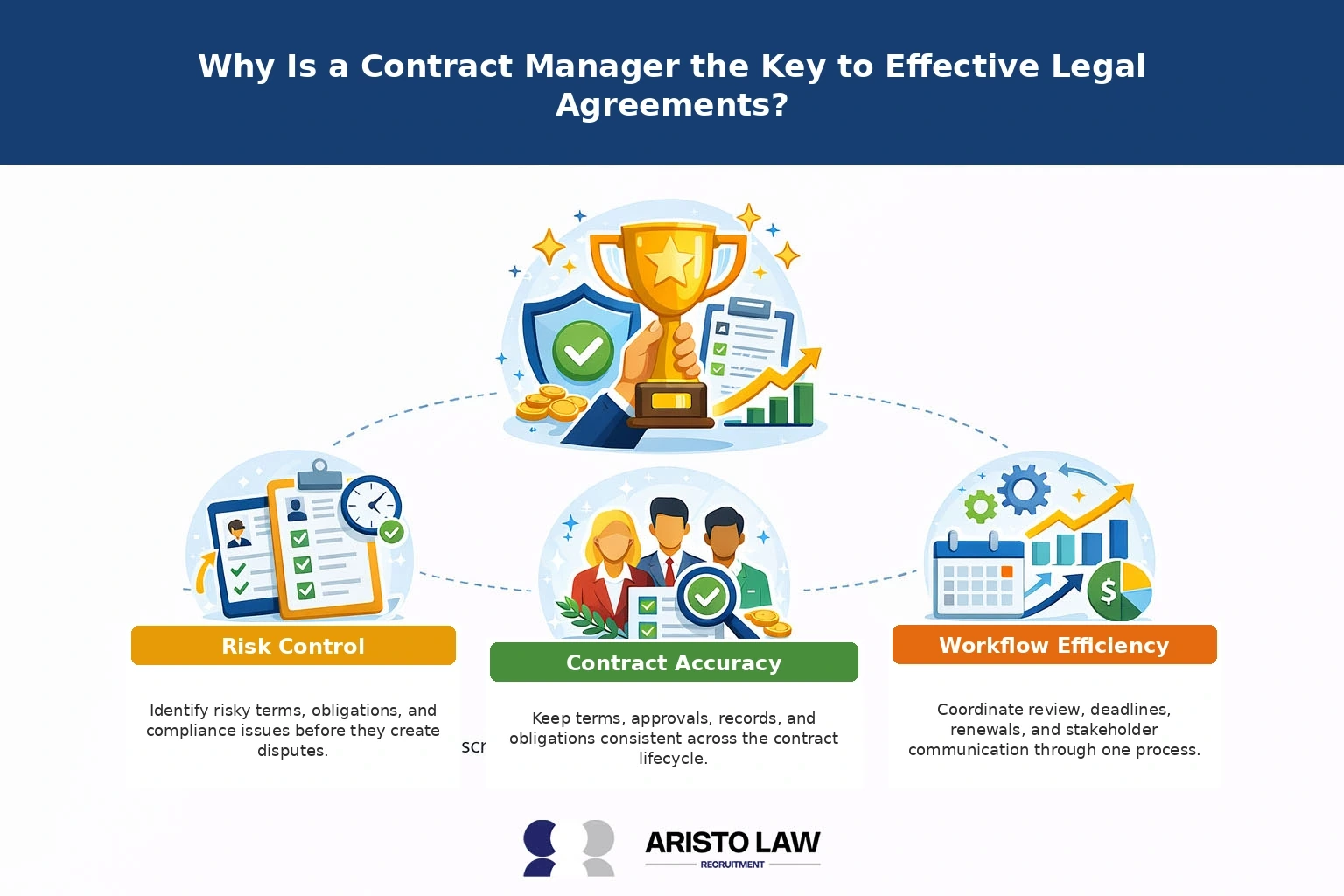
The table below shows why a contract manager is the key to effective
legal agreements.
Contract Management
|
Business and Legal
|
Effect on Contract
|
|---|---|---|
| Legal control | Maintains contract accuracy and policy alignment | Reduces disputes and compliance exposure |
| Value realization | Tracks deliverables, pricing, and obligations | Improves financial and operational performance |
| Stakeholder coordination | Aligns legal, finance, procurement, and operations teams | Improves communication and workflow efficiency |
| Risk reduction | Identifies contract gaps, delays, and compliance issues | Reduces operational and legal risk |
| Performance oversight | Monitors milestones, renewals, and service terms | Improves accountability and execution quality |
| Compliance management | Tracks regulatory and contractual requirements | Improves audit readiness and governance |
| Workflow consistency | Standardizes agreement processes and approvals | Improves efficiency and turnaround speed |
| Post-signature management | Oversees obligations after execution | Supports long-term contract success |
What
are the core competencies of an effective contract manager?
The core competencies of an effective contract manager
include communication, negotiation, legal fluency, collaboration,
technology use, and performance follow-through that support strong
agreement outcomes. The core competencies of an effective
contract manager are the combined legal, operational, and interpersonal
capabilities that drive strong agreement outcomes.
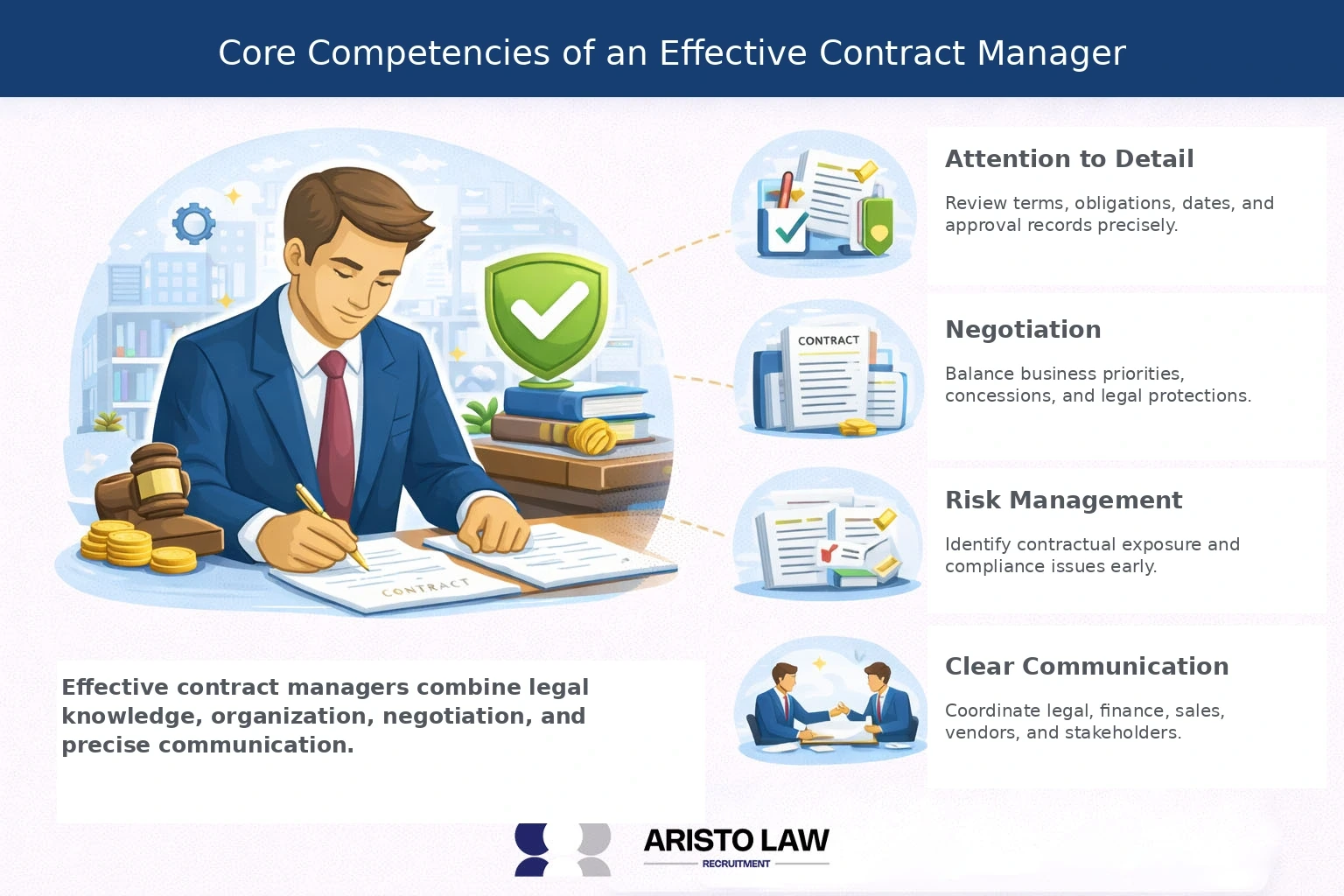
Listed below are the 10 core competencies of an effective contract
manager.
-
Communication for stakeholder coordination and contract clarity
-
Negotiation for pricing, obligations, and agreement terms
-
Legal fluency for understanding contract language and compliance
requirements -
Process discipline for consistent contract lifecycle management
-
Risk judgment for identifying legal and operational exposure
-
Collaboration across legal, procurement, finance, and business
teams -
Technology use for contract tracking and workflow management
-
Performance follow-through for obligation monitoring and renewals
-
Attention to detail for contract accuracy and documentation
control -
Organization for deadline management and agreement visibility
What
qualifications are required to become a contract manager?
The qualifications required to become a contract manager
include education, contract management certifications, contract
administration experience, and risk management expertise.
Listed below are the 12 qualifications required to become a contract
manager.
-
Obtaining a bachelor’s degree in business, law, finance, or a related
field -
Earning contract management certifications, such as the National
Contract Management Association certification programs -
Gaining contract administration experience in legal, procurement, or
operations environments -
Developing negotiation skills for agreement discussions and
commercial terms -
Understanding legal and regulatory requirements related to contracts
and compliance -
Building risk management expertise for identifying contractual and
operational exposure -
Learning contract lifecycle management processes and workflow
coordination -
Developing communication skills for stakeholder and vendor
collaboration -
Building software proficiency in contract management platforms and
document systems -
Strengthening analytical skills for contract review and performance
monitoring -
Understanding procurement, vendor management, and business operations
workflows -
Developing attention to detail for contract accuracy and obligation
tracking
What makes a good contract
manager?
A good contract manager demonstrates communication,
negotiation, legal awareness, risk control, attention to detail, and
performance management skills that improve contract quality and business
outcomes.
Listed below are the 10 things that make a good contract manager.
-
Communication for stakeholder alignment and contract clarity
-
Negotiation for balanced agreement terms and commercial value
-
Legal awareness for compliance and contractual accuracy
-
Risk control for identifying operational and legal exposure
-
Attention to detail for obligation tracking and document
precision -
Performance management for monitoring deliverables and deadlines
-
Organization for contract lifecycle coordination and workflow
control -
Collaboration for cross-department agreement management
-
Problem-solving for dispute resolution and contract issues
-
Technology proficiency for contract tracking and reporting
systems
Why
are communication skills so important in contract management?
Communication skills are so important in contract management
because contract managers must align business goals, explain
requirements clearly, and coordinate legal, procurement, and supplier
stakeholders from the start of the process. Contract managers
rely on written communication for drafting contract language,
documenting obligations, preparing revisions, and maintaining accurate
agreement records across the contract lifecycle.
Verbal communication supports negotiation discussions, stakeholder
meetings, supplier coordination, dispute handling, and clarification of
commercial expectations during contract execution and performance
oversight. Strong communication skills improve alignment between legal,
procurement, operations, finance, and suppliers by reducing
misunderstandings, approval delays, and compliance issues tied to legal
agreements. Contract management workflows operate more efficiently when
communication remains organized, consistent, and clearly documented
across all contract stakeholders.
Why is
negotiation a core contract manager competency?
Negotiation is a core contract manager competency because the
quality of negotiation shapes contract terms, business value, cost
control, and long-term supplier relationships. Contract
managers use negotiation to balance legal protection, operational
requirements, pricing expectations, and commercial objectives during
agreement discussions.
The table below shows the reason negotiation is a core contract
manager competency.
Negotiation Area |
Contract and Business
|
Impact on Outcomes |
|---|---|---|
| Contract terms | Defines obligations, timelines, and responsibilities | Improves agreement clarity and enforceability |
| Business value | Aligns pricing, services, and deliverables with company goals | Improves value realization |
| Cost control | Negotiates pricing structures and financial protections | Reduces operational expenses |
| Supplier relationships | Maintains cooperative communication and fair expectations | Improves long-term collaboration |
| Risk allocation | Assigns liability and compliance responsibilities | Reduces legal and operational exposure |
| Dispute prevention | Clarifies expectations before execution | Reduces future conflicts |
| Performance standards | Establishes measurable deliverables and service levels | Improves accountability and execution quality |
| Renewal and flexibility | Negotiates amendment and termination provisions | Improves contract adaptability |
Why is
risk management central to contract management?
Risk management is central to contract management because
every phase of a contract introduces commercial, legal, operational, or
compliance risk when terms, dates, obligations, or approvals are
missed. Contract risk increases when ambiguity exists in
pricing terms, deliverables, liability clauses, renewal conditions, or
performance standards because unclear language creates disputes and
inconsistent interpretation between parties.
Compliance risk increases when approvals, reporting requirements,
regulatory obligations, or audit procedures remain undocumented or
unmanaged throughout the contract lifecycle. Missed dates related to
renewals, expirations, payment schedules, or notice periods create
financial penalties, service interruptions, and contractual breaches.
Undefined terms and incomplete obligations weaken enforcement, delay
performance oversight, and reduce accountability across suppliers,
vendors, clients, and internal stakeholders. Effective contract
management reduces lifecycle risk through structured review processes,
obligation tracking, approval controls, and continuous monitoring of
contract performance and compliance activities.
How
do contract managers improve contract performance after signature?
Contract managers improve contract performance after
signature by monitoring outcomes, tracking obligations, reviewing KPIs,
and taking corrective action before poor performance escalates.
The post-signature responsibilities contract managers handle improve
accountability, compliance, and operational results across active
agreements.
Listed below are the 10 ways contract managers improve contract
performance after signature.
-
Monitoring contract performance against agreed deliverables and
timelines -
Tracking obligations related to payments, reporting, renewals, and
service levels -
Reviewing KPIs tied to supplier performance, costs, and operational
targets -
Managing corrective action when delays, breaches, or compliance
issues appear -
Coordinating stakeholder communication across legal, procurement, and
operations teams -
Reviewing amendment requests and contract change impacts
-
Managing renewal deadlines and termination notice periods
-
Auditing contract activity for compliance and documentation
accuracy -
Escalating unresolved disputes or performance failures for legal
review -
Maintaining performance records and reporting visibility throughout
the contract lifecycle
Why should
contract management be collaborative?
Contract management should be collaborative because each
phase involves multiple steps, stakeholders, and reviews that move
faster and more accurately when everyone works from the latest version
in one system. Collaborative contract workflows improve
visibility, reduce approval delays, support accurate redlining, and
maintain consistent communication across legal, procurement, finance,
suppliers, and operations teams.
The table below shows the reasons contract management must be
collaborative.
Collaboration Area |
Operational Function |
Impact on Contract
|
|---|---|---|
| Shared visibility | Gives stakeholders access to the latest version and status updates |
Reduces confusion and duplicate work |
| Redlining coordination | Tracks edits, comments, and revisions in one workflow | Improves drafting accuracy |
| Stakeholder alignment | Connects legal, procurement, finance, and business teams | Improves approval efficiency |
| Workflow management | Organizes reviews, approvals, and task assignments | Reduces processing delays |
| Version control | Maintains one authoritative contract version | Prevents outdated document use |
| Communication tracking | Records discussions, approvals, and negotiations | Improves accountability |
| Compliance oversight | Shares obligations and approval requirements across teams | Improves regulatory consistency |
| Post-signature coordination | Supports ongoing monitoring and obligation management | Improves contract performance visibility |
What tools
support effective contract management?
The tools that support effective contract management include
central repositories, search functions, collaboration systems, analytics
dashboards, and e-signature capabilities that improve visibility,
control, and lifecycle execution. Businesses use contract
management and document automation tools to organize
agreement workflows, reduce administrative delays, and improve contract
lifecycle oversight across legal and operational teams.
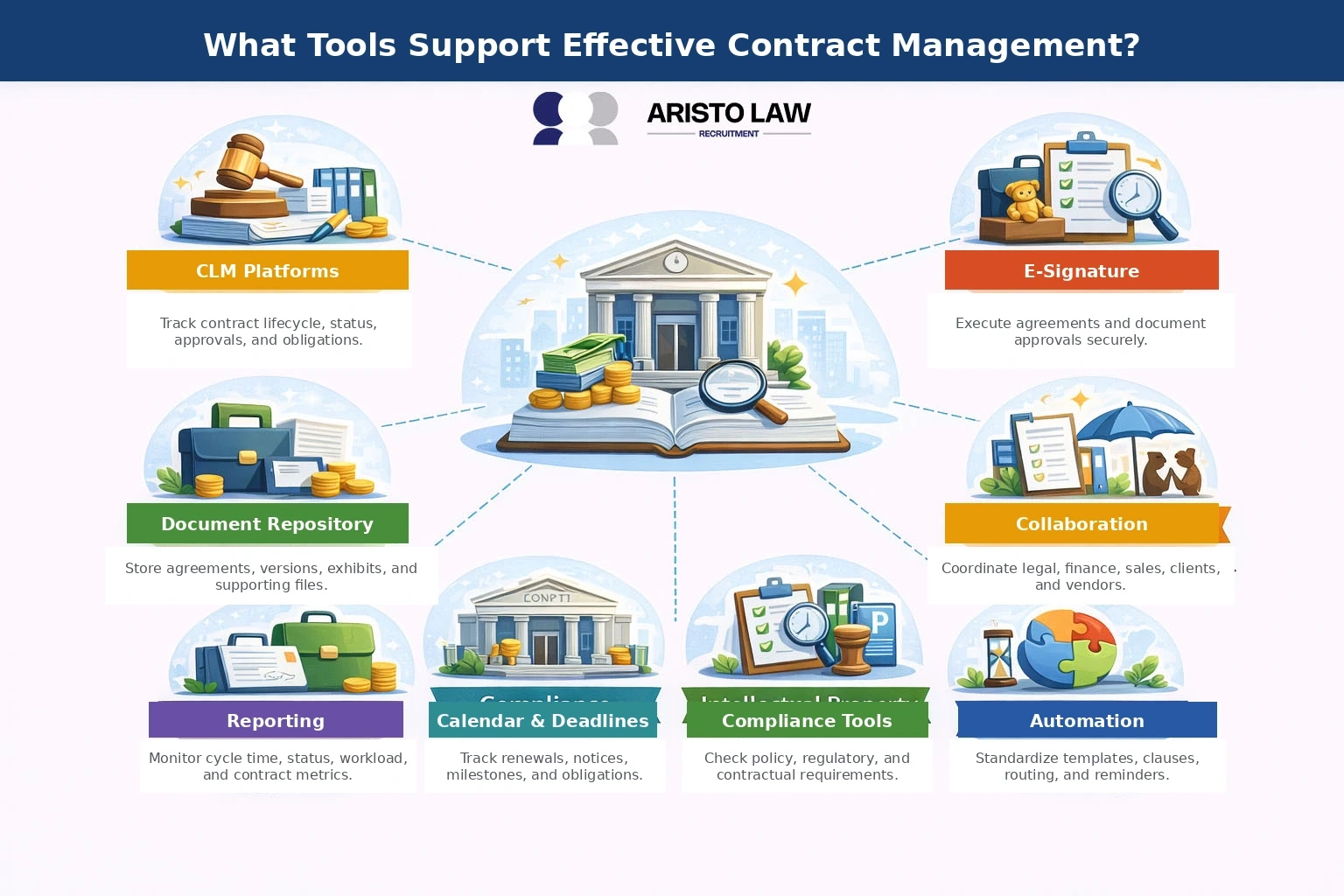
Listed below are the 12 tools that support effective contract
management.
-
Central repository for storing and organizing legal agreements
-
Search functionality for locating clauses, dates, and contract
records -
Permissions controls for managing document access and approvals
-
Alerts and reminders for renewals, obligations, and deadlines
-
Templates for standardized contract drafting and consistency
-
Workflow automation for approvals, routing, and review processes
-
Collaboration features for redlining, comments, and stakeholder
coordination -
Analytics dashboards for tracking performance, compliance, and
KPIs -
E-signature support for faster execution and approval workflows
-
Audit tracking for monitoring revisions and contract activity
-
Clause libraries for standardized legal language and drafting
efficiency -
Reporting tools for visibility into obligations and contract
status
What
should legal teams look for in contract management tools?
Legal teams should look for AI-driven analysis, centralized
collaboration, security controls, scalable templates, activity tracking,
smart search, mobile access, integration support, workflow automation,
and compliance visibility in modern contract management tools.
Legal teams follow legal
technology trends shaping contract management tools to
improve lifecycle visibility, automation efficiency, collaboration
speed, and compliance oversight across complex agreement
environments.
Listed below are the 12 things legal teams look for in contract
management tools.
-
AI-driven analysis for clause review, risk detection, and contract
insights -
Centralized collaboration for shared editing, approvals, and
redlining -
Security controls for permissions, encryption, and access
management -
Scalable templates for standardized drafting and high-volume
workflows -
Activity tracking for monitoring edits, approvals, and contract
actions -
Smart search for locating clauses, obligations, and agreement data
quickly -
Mobile access for remote review and approval management
-
Integration support for CRM, ERP, procurement, and legal systems
-
Workflow automation for routing, reminders, and approval
coordination -
Audit logs for compliance monitoring and version tracking
-
E-signature support for faster execution processes
-
Analytics dashboards for contract KPIs and performance reporting
What
best practices define effective contract management?
The best practices that define effective contract management
include collaborative workflows, repeatable procedures, matter-specific
controls, and digital lifecycle management that improve agreement speed,
safety, and consistency. Legal teams apply workflow
automation best practices for contract management to
improve visibility, reduce delays, and maintain structured agreement
execution across legal and operational workflows.
Listed below are the 12 best practices that define effective contract
management.
-
Collaborative workflows for stakeholder coordination and
approvals -
Secure systems for controlled access and data protection
-
Scalable processes for handling high contract volumes efficiently
-
Repeatable procedures for standardized drafting and review
consistency -
Matter-specific workflows for contract type and risk-level
alignment -
Digital lifecycle management for centralized tracking and
monitoring -
Automated alerts for renewals, obligations, and deadlines
-
Version control for accurate document management and redlining
-
Standardized templates for drafting efficiency and compliance
consistency -
Audit tracking for accountability and workflow transparency
-
Integrated approval routing for faster execution processes
-
Centralized repositories for contract visibility and retrieval
efficiency
What
are the best practices for using contract management software?
The best practices for using contract management software
include centralization, version control, workflow automation, mobile
access, and e-signature support that improve collaboration, consistency,
and execution speed. The best practices for using contract
management software are the steps that improve security, collaboration,
consistency, and execution speed.
Listed below are the 10 best practices for using contract management
software.
-
Centralize all agreements inside a secure and searchable
ecosystem. -
Maintain version control to prevent outdated drafts and approval
confusion. -
Apply permissions and security controls for restricted document
access. -
Use standardized templates for repeatable drafting and compliance
consistency. -
Enable self-service workflows for low-risk and simple agreements.
-
Automate workflow routing for reviews, approvals, reminders, and
renewals. -
Support mobile-friendly access for remote contract review and
approvals. -
Integrate e-signature functionality for faster execution and document
turnaround. -
Track contract activity through audit logs and approval
histories. -
Connect contract systems with CRM, procurement, and business
platforms for workflow visibility.
Why
should contract processes be scalable and repeatable?
Contract processes should be scalable and repeatable because
legal teams need consistency, fast retrieval, and dependable workflows
that reduce administrative burden across large contract
volumes. Legal teams use template libraries, centralized
workflows, and self-service contract generation to standardize agreement
handling and reduce delays tied to manual drafting and approvals.
Scalable workflows improve retrieval speed, approval consistency,
compliance visibility, and operational efficiency because stakeholders
work inside structured and repeatable contract management systems.
Self-service processes for straightforward agreements reduce legal
bottlenecks and allow business teams to generate low-risk contracts
through approved templates and automated workflows. Repeatable contract
processes improve version control, reduce drafting errors, and
strengthen lifecycle visibility across procurement, legal, and
operations teams.
An operational guide by Avokaado, “Contract Management Workflows: 8
Steps To Optimize,” outlines that implementing structured phases,
including centralized databases, templates, and digital signatures,
drives efficiency and ensures compliance by forcing teams to follow
standardized procedures.
Why should
contract workflows stay matter-specific?
Contract workflows should stay matter-specific because every
agreement has unique obligations, dates, and deal terms that require
analysis instead of a cookie-cutter approach. Standardization
improves drafting consistency, approval speed, and workflow efficiency,
but contract managers still need matter-specific review to evaluate
pricing structures, liability clauses, renewal conditions, compliance
requirements, and operational obligations tied to each agreement.
Unique obligations and deal terms create different legal and
commercial risks across procurement contracts, vendor agreements,
employment terms, service agreements, and partnership arrangements.
Tailored analysis improves accuracy because contract managers review
business intent, stakeholder requirements, jurisdiction issues, and
performance expectations within the context of each matter. AI review
tools support contract workflows through clause detection, risk
flagging, and document comparison, but AI-assisted review functions as
workflow support rather than a replacement for legal judgment,
negotiation analysis, and contract-specific decision-making.
What
contract management terms should every contract manager know?
The contract management terms every contract manager should
know include offer, acceptance, consideration, clause, obligation,
renewal, redlining, metadata, repository, and enforceability because
these terms shape contract creation, execution, tracking, and compliance
workflows.
The table below shows the contract management terms every contract
manager must know.
Term |
Plain-Language Meaning |
Why It Matters in Contract
|
|---|---|---|
| Offer | A proposal to enter a contract under stated terms | Starts the contract formation process |
| Acceptance | Agreement to the offer terms | Creates mutual agreement between parties |
| Consideration | Something of value is exchanged in the contract | Supports the legal validity of the agreement |
| Clause | A specific section or provision in a contract | Defines rights, obligations, or restrictions |
| Obligation | A required action or responsibility under the contract | Drives performance tracking and compliance |
| Renewal | Extension or continuation of the agreement period | Affects contract continuity and deadlines |
| Redlining | Editing and marking contract changes during review | Improves negotiation and version tracking |
| Metadata | Data describing contract details, such as dates or parties | Supports search, reporting, and organization |
| Repository | Central storage location for contracts and records | Improves retrieval and document control |
| Enforceability | Legal ability to uphold contract terms | Determines contract validity in disputes |
| Amendment | Formal change made to an existing contract | Maintains updated agreement terms |
| Termination | End of the contract relationship | Defines exit rights and obligations |
| Compliance | Following legal and contractual requirements | Reduces legal and operational risk |
| Indemnification | Protection against losses or liabilities | Allocates financial risk between parties |
| KPI | Measurable contract performance indicator | Supports performance monitoring and accountability |
What does “offer”
mean in contract management?
In contract management, “offer” means one party’s
communication of a proposal to enter into a contract, and the proposal
must express clear intent beyond simply opening negotiations.
An offer contains proposed terms, responsibilities, pricing, timelines,
or obligations that another party accepts or rejects during the contract
formation process.
Contract management workflows treat an offer as the starting point
for legal agreement discussions because acceptance of the offer creates
a potential legal obligation between the parties. General discussions,
marketing statements, or informal negotiations usually do not qualify as
offers unless the communication shows a clear commitment to specific
contract terms and agreement conditions.
Do contract managers
need to be lawyers?
No, contract managers do not need to be lawyers, but contract
managers need a working command of legal terms, contract structure,
compliance expectations, and the business context behind each
agreement. Contract management roles focus on lifecycle
coordination, negotiation support, obligation tracking, stakeholder
communication, workflow management, and performance oversight across
legal agreements.
Legal training helps with contract interpretation and regulatory
awareness, but many contract managers come from business, procurement,
operations, finance, or commercial management backgrounds instead of
licensed legal practice. Practical legal fluency allows contract
managers to understand clauses, approvals, compliance obligations,
liability language, renewal terms, and risk exposure during contract
execution and monitoring. Lawyers usually handle formal legal advice,
litigation, and complex legal interpretation, while contract managers
support operational control, agreement visibility, and contract
performance throughout the contract lifecycle.
How does
software help contract managers work better?
Software helps contract managers work better by giving them a
central source of truth for documents, dates, approvals, search,
reporting, and portfolio visibility across the contract
lifecycle. Legal departments use AI
tools to improve contract management efficiency, reduce
manual tracking, improve workflow consistency, and strengthen agreement
oversight across high-volume contract environments.
Contract management software improves risk reduction by tracking
obligations, renewal dates, approval histories, and compliance
requirements through automated workflows and centralized visibility.
Search functions, reporting dashboards, and portfolio visibility tools
help contract managers locate agreements quickly, monitor contract
performance, and identify workflow bottlenecks before operational issues
escalate. Approval routing, version control, and audit tracking improve
consistency because legal teams work from standardized processes and
updated agreement records inside one controlled workflow system.
Build a legal support team that moves work forward.
Tell us what is slowing your practice down. We will help map the role, workflow, and support structure that fits.