
Medical Records Specialist – Managing Case Evidence Efficiently

Practical guidance for building efficient, accountable legal support operations.
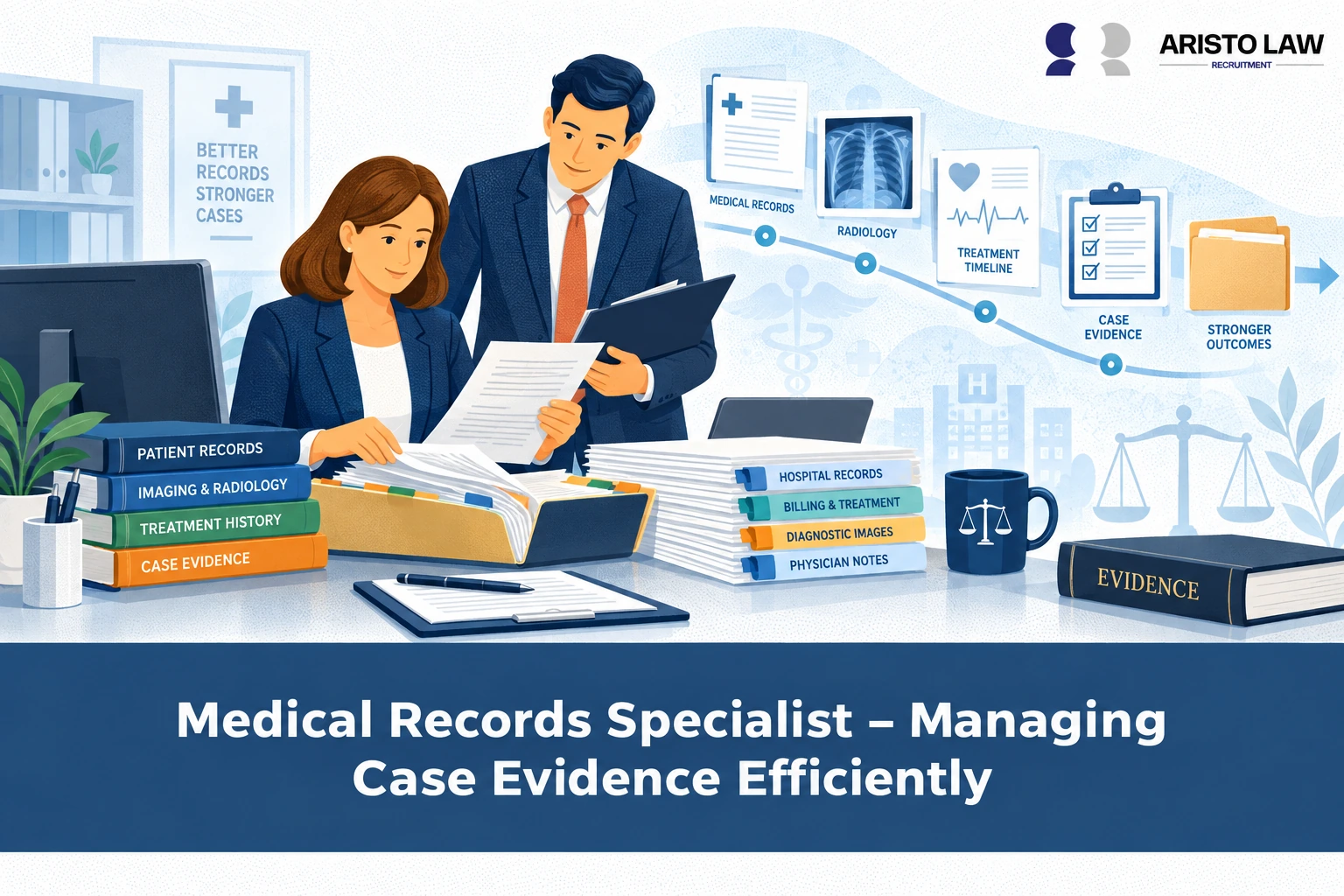
A medical records specialist manages, organizes, reviews, and
structures medical documentation to support legal case preparation,
injury verification, litigation analysis, and evidence
development. Medical records specialists play a major role in
legal case management by processing treatment records, identifying
clinically relevant information, organizing files chronologically, and
supporting attorneys during demand package preparation, settlement
evaluation, and litigation strategy.
Medical records are highly important in personal injury, malpractice,
workers’ compensation, and insurance disputes because they establish
injury severity, treatment progression, causation, medical expenses,
disability impact, and long-term damages. A 2024 systematic
review found that structured electronic medical documentation workflows
reduced documentation time in about 75% of evaluated studies while
improving record accuracy and consistency, supporting faster and more
reliable case preparation processes.
Efficient management commonly involves chronological file
structuring, indexing records by provider and treatment date, separating
diagnostic reports from billing records, identifying missing
documentation, and highlighting causation-related findings. Medical
records specialists frequently create medical chronologies and
litigation timelines that simplify complex treatment histories for
attorneys, insurers, and expert witnesses.
Modern workflows increasingly use OCR software, AI-assisted document
review, automated chronology generation, searchable databases, and
cloud-based legal case management systems to improve review speed and
reduce administrative errors. Efficient medical records management
strengthens evidentiary clarity, improves legal strategy, accelerates
settlement preparation, and supports stronger litigation outcomes.
Aristolaw helps law firms manage medical records and case
evidence efficiently by providing outsourced support for records
retrieval, document organization, chronology preparation, evidence
indexing, provider follow-ups, and litigation file management. Book
a medical records specialist with Aristolaw outsourcing support.
Aristolaw connects law firms with outsourcing solutions that match
trained Medical Records Specialist staff to each records request task,
evidence review workflow, medical chronology duty, provider
communication function, and case evidence management needs.
What is a medical records
specialist?
The Medical Records Specialist is a professional who manages
patient documentation across healthcare, insurance, and legal
sectors. Medical Records Specialists ensure record accuracy by
verifying data completeness and structured formatting. The Medical
Records Specialist optimizes the digital context through the active
management of EHR systems and secure document platforms. Medical Records
Specialist maintains data integrity by enforcing strict HIPAA compliance
in clinical environments to safeguard patient privacy.
Medical Records Specialist assists litigation teams by building clear
medical chronologies to prove injury and damages when disputes arise.
A study by Savita Ramkumar, Isaa D. Khan, and A. Majeed in 2025,
published in the Journal of Clinical Medicine, found that structured
electronic health record (EHR) training improved medical information
retrieval efficiency.
The Medical Records Specialist utilizes digital tools like OCR
technology, automated indexing tools, and digital quality-control checks
for unstructured healthcare data optimization. Through these tools, the
Medical Records Specialist converts unstructured documentation into
standardized, highly searchable digital data systems, helping litigation
and clinical teams retrieve accurate information instantly
What
is the role of a medical records specialist in case management?
The role of a medical records specialist in case management
involves organizing records, supporting evidence development, and
ensuring accurate documentation throughout the case
lifecycle.
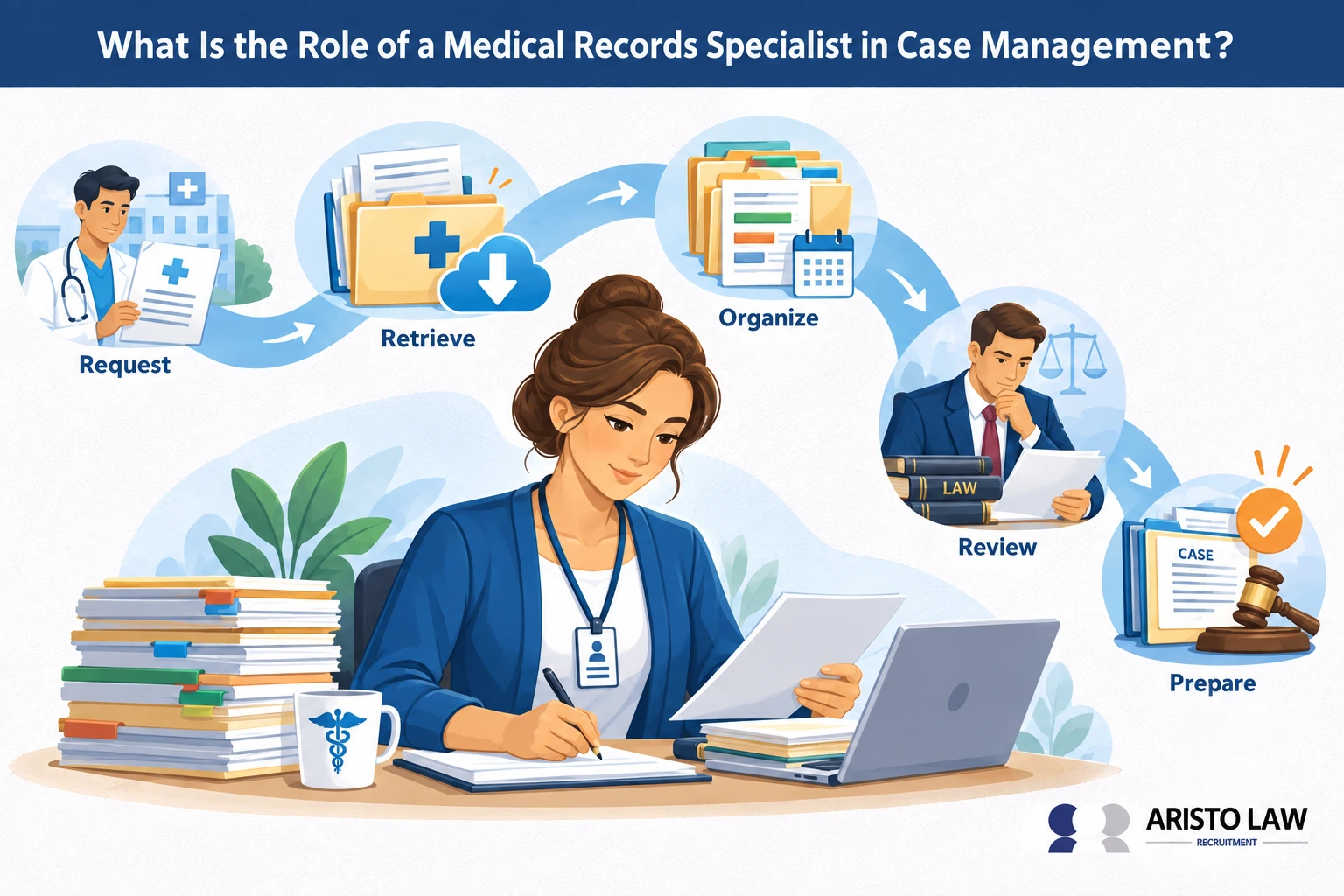
Medical records specialists integrate directly into legal case
management by collecting, reviewing, indexing, categorizing, and
structuring patient documentation used in injury claims, insurance
disputes, malpractice litigation, and personal injury cases.
Responsibilities commonly include organizing treatment records
chronologically, identifying missing documentation, preparing medical
chronologies, separating billing records from clinical records, and
supporting demand package preparation.
Accurate organization of timelines, treatment history, and supporting
clinical data strengthens continuity across legal and administrative
workflows, highlighting the value of a medical
records specialist managing case evidence and
documentation throughout the case lifecycle.
Within legal workflows, medical records specialists help attorneys,
paralegals, and case managers quickly access treatment timelines,
causation evidence, diagnostic findings, and damages-related
documentation. Specialists also support workflow efficiency by
maintaining searchable digital files, verifying record completeness,
coordinating provider requests, and ensuring HIPAA-compliant handling of
confidential medical information.
Efficient records management strengthens litigation preparation,
improves communication between legal teams and healthcare providers,
reduces review time, and supports clearer presentation of medical
evidence throughout settlement negotiations and court proceedings.
What
are the benefits of a medical records Specialist for legal cases?
Medical records are important in legal cases because they
serve as primary evidence to establish injuries, treatments, and
timelines.
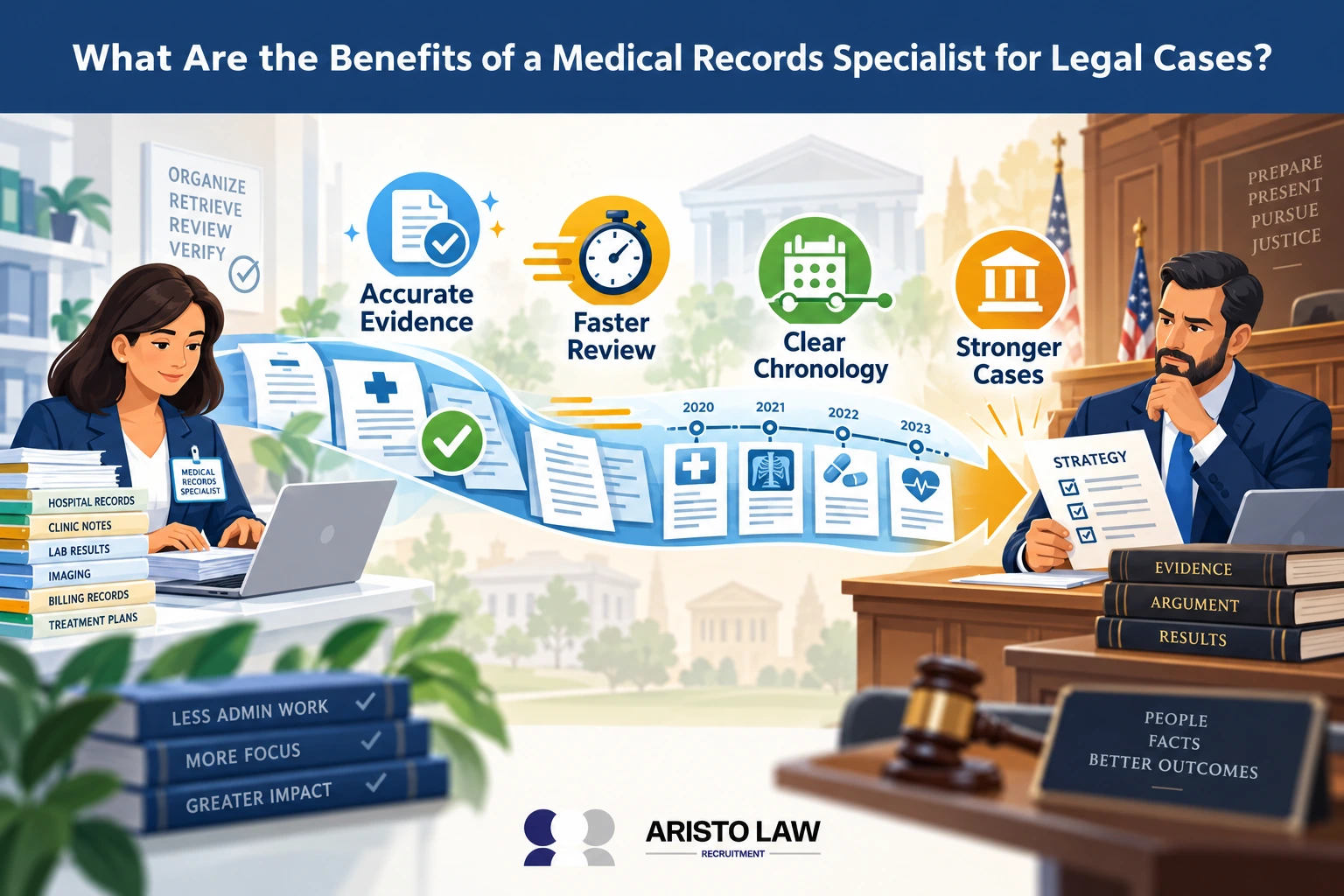
Below are the benefits of medical records specialists for law
firms.
-
Establishing Causation, Preventability, and Disability
Severity: Retrospective medical reviews allow litigation teams
to objectively link an incident to an injury, proving how a specific
event caused the patient’s clinical status. A study by Sandra Verelst
from the University of Leuven, titled Retrospective medical record
evaluation: Reliability in assessing causation, preventability, and
disability of adverse events, in 2012, shows that detailed retrospective
medical documentation acts as a vital tool for establishing consistency,
evaluating risk management, and determining causation and disability
severity during complex medico-legal assessments. -
Proving the Existence and Real-Time Trajectory of
Injuries: Contemporaneous medical charts capture the immediate,
unbiased physical reality of a patient’s trauma before any legal motives
exist. A study by M. Marinič from the University of Maribor, titled The
Importance of Health Records, in 2015, shows that chronological
recording of health data ensures the absolute legal security of the
patient because authentic, real-time files serve as the primary basis
for demonstrating the exact state of an individual before and after an
injury. -
Mitigating Malpractice and Liability Risks:
Structured digital medical data protects healthcare operators and
defendants from false allegations by proving adherence to clinical
standards. A study by David B. Resnik from the National Institutes of
Health, titled Medical Malpractice Liability in the Age of Electronic
Health Records, in 2011, shows that electronic health record systems
significantly reduce clinical discontinuities and errors, while actively
giving providers the verifiable data needed to defend against
malpractice claims by proving that the standard of care was met. -
Accelerating Cross-Network Discovery and Case
Accountability: Unified digital networks enable legal and
clinical teams to securely gather complete patient files without losing
evidence across distinct institutions. A study by Saba S. Qureshi from
the National Institute of Medical Research, titled Evaluating the impact
of electronic medical records on healthcare systems, in 2025, shows that
electronic medical records prevent the loss of critical evidence in
legal cases, protect societies from the distress of missing data, and
rapidly provide students and legal professionals with the complete,
unfalsified evidence needed for case interpretation. -
Establishing Corroborative Criminal Evidence and Weapon
Mechanics: In criminal trials, medical charts serve as
essential forensic evidence to establish the physical severity of an
assault and corroborate the type of weapon used. A study by Singh
Akhilesh Kumar and Kumar Akhilesh from the Institute of Medical
Sciences, titled Medical Records and Issues in Negligence, in 2009,
shows that medical records are routinely summoned in criminal courts to
prove the precise nature, timing, and gravity of injuries, providing the
direct objective proof needed to corroborate the cause of death or
bodily harm. -
Exposing and Combating Fraudulent Court Claims:
Tamper-evident medical trails protect the integrity of the judicial
system by exposing plaintiffs or defendants who attempt to falsify
injuries. A study by B. McCaman and H. L. Hirsh published in PubMed,
titled Medical records–legal perspectives, in 1979, shows that a major
legal benefit of meticulous medical record-keeping is its ability to
immediately expose fraud or evidence tampering, ensuring that insurance
claims, workers’ compensation cases, and personal injury suits are
decided on genuine data. -
Providing Concrete Proof of Informed Consent
Compliance: Medical documents establish a clear defensive
shield by proving that a patient was fully aware of all surgical or
procedural risks before an intervention. A study published on Studocu,
titled Explain legal importance of medical records 6 marks, in 2024,
shows that medical records serve the critical legal function of
documenting informed consent, explicitly demonstrating in a court of law
that the patient was adequately educated on all risks, benefits, and
alternatives to a treatment. -
Shielding Digital Healthcare Networks from Systemic
Compliance Liability: Structured electronic record tracking
provides a verifiable audit trail that protects institutions from
multi-million dollar data breach penalties. A study by Onyekachi Umah
from S.P.A. Ajibade & Co., titled Legal Considerations For
Electronic Medical Record Systems In Healthcare Establishments, in 2023,
shows that compliant electronic record storage protocols act as an
absolute necessity to prevent corporate liability under modern data
protection frameworks by enforcing strict encryption and access control
logging. -
Securing Admissibility Assurance via Strict Judicial
Evaluation: Validated medical entries minimize the risk of
critical medical evidence being thrown out of court by opposing counsel.
A study by Edi Wahjuni and Nuzulia Kumala Sari from the Law Faculty of
Universitas Jember, titled Legal Aspect of Electronic Medical Records,
in 2018, shows that electronic medical systems ensure complete data
authenticity, allowing these records to easily satisfy statutory
admissibility rules and stand as legally valid evidence during complex
trials.
How are
medical records organized for legal cases?
Medical records are organized for legal cases by structuring
them chronologically, categorizing them by provider, and indexing key
documents for easy access.
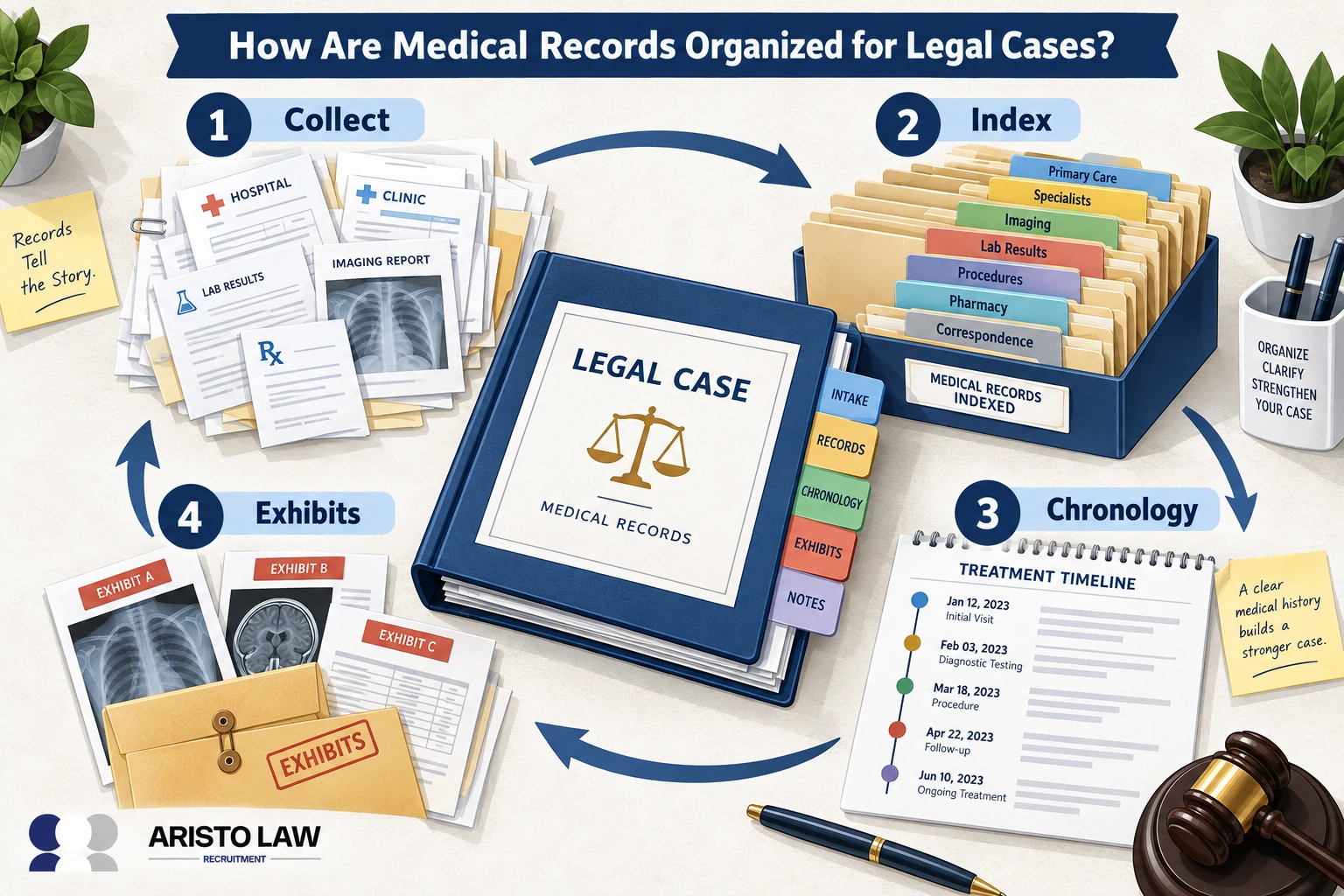
Legal teams organize records by treatment date, healthcare provider,
specialty, and document type to create a clear timeline of injuries,
medical care, procedures, diagnostics, medications, and recovery
progress. Common categories include emergency room records, physician
notes, imaging reports, operative reports, physical therapy
documentation, laboratory results, prescriptions, and billing
statements.
Chronological ordering helps attorneys and case managers identify
causation patterns, treatment gaps, progression of symptoms, and
long-term medical impact. Indexing systems are frequently used to label
important evidence such as surgical interventions, diagnostic findings,
disability assessments, and high-value treatment events for rapid
retrieval during litigation preparation.
Digital legal workflows commonly use searchable PDFs, OCR indexing,
cloud-based document management systems, and coded file structures to
improve usability, reduce duplication, and support efficient review
during settlement negotiations, expert analysis, depositions, and trial
preparation.
How
should medical files be structured in a demand package?
Medical files in a demand package should be structured in
chronological order with clear indexing, summaries, and supporting
documentation for each treatment phase.
Demand packages begin with a medical summary outlining the injury,
mechanism of harm, treatment progression, diagnoses, procedures,
recovery status, and long-term impact. Supporting records are then
organized chronologically to show the full sequence of medical care from
the initial evaluation through follow-up treatment, rehabilitation,
specialist consultations, and future care recommendations.
A study published in the National Institutes of Health found
that structured clinical documentation and timeline-based medical
reporting improve interpretability, evidence consistency, and
medico-legal case evaluation accuracy.
Well-organized medical documentation creates a clearer narrative of
injury progression, treatment chronology, and damages, allowing
attorneys and insurers to evaluate the claim more efficiently through
accurate structuring
of medical records in demand letters and packages.
Well-structured demand packages improve legal presentation by
strengthening evidentiary clarity, reducing review time, supporting
damages calculations, and helping insurers or opposing counsel follow
the medical narrative without confusion or missing treatment gaps.
Medical files are commonly separated into categories such as
emergency treatment records, physician notes, imaging reports, operative
reports, therapy documentation, prescriptions, billing statements, and
expert evaluations. Clear indexing allows attorneys, insurance
adjusters, and experts to quickly locate critical evidence such as
surgeries, permanent impairment findings, disability restrictions, and
causation-related documentation.
What
tools help organize medical records for litigation?
Tools that help organize medical records for litigation
include medical chronology software, document management systems, OCR
platforms, and case management tools that improve review efficiency and
record accuracy.
Efficient litigation workflows depend on systems that reduce document
fragmentation, improve chronology tracking, and simplify the retrieval
of clinically relevant evidence across large record volumes. Modern
platforms increasingly integrate indexing, tagging, OCR recognition, and
timeline-building features to support legal
case management tools for organizing medical records in
complex legal matters.
Listed below are the 12 most common tools that help organize medical
records for litigation platforms.
-
Legal case management software for organizing litigation workflows,
deadlines, client records, and evidence files. -
Document management systems for indexing, storing, categorizing, and
retrieving large volumes of medical documentation. -
OCR (optical character recognition) tools for converting scanned
medical records into searchable digital text. -
AI-powered medical record review platforms for chronology generation,
issue spotting, summarization, and automated document analysis. -
Spreadsheet systems for tracking providers, treatment dates, billing
totals, missing records, and evidence timelines. -
Cloud-based storage platforms for secure collaboration, remote
access, and centralized document sharing between legal teams. -
Medical chronology software for building structured treatment
timelines and injury progression reports. -
PDF annotation and highlighting tools for marking important findings,
diagnoses, surgical events, and causation-related evidence. -
Billing and damages analysis software for organizing medical
expenses, liens, reimbursement data, and future care estimates. -
Secure client portals for protected transfer of HIPAA-sensitive
medical records and litigation documents. -
E-discovery platforms for large-scale evidence review, keyword
searching, tagging, and litigation document filtering. -
Practice management systems integrate medical records, case notes,
communication logs, and settlement tracking into a unified legal
workflow.
How
to Find a Medical Records Specialist for Your Law Firm?
To find a qualified medical records specialist for your law
firm, you must target specialized hiring channels and look for
candidates with a unique blend of clinical and legal expertise.
To secure professionals who understand the unique demands of litigation,
firms can partner with specialized medical-legal consulting companies
like Aristo
Law legal outsourcing, which provides vetted experts
trained specifically in legal document workflows. Instead of using
generic job boards, law firms achieve the best results by sourcing
through professional health information associations, specialized legal
staffing agencies, or dedicated medical-legal consulting providers. A
successful strategy requires a structured approach that spans from
defining technical requirements to evaluating specific security
certifications. Listed below are the detailed steps to locate, vet, and
secure the right talent for your litigation team.
Below are 4 Steps to Find and Hire a Medical Records Specialist.
-
Target Niche Legal and Health Information Networks:
Skip mainstream employment platforms and post your opening directly on
specialized channels like the American Health Information Management
Association (AHIMA) career center, or partner with dedicated
medical-legal outsourcing firms that pre-vet technical talent. -
Filter for Advanced Digital and Systems Proficiency:
Require candidates to demonstrate direct experience with major
Electronic Health Record (EHR) systems, optical character recognition
(OCR) software, and automated indexing platforms to ensure they can
manage high-volume digital data conversion efficiently. -
Verify Strict Data Security and Compliance
Credentials: Confirm that the candidate possesses verifiable
certifications in data privacy, as a 2023 legal study by Onyekachi Umah
from S.P.A. Ajibade & Co., titled Legal Considerations For
Electronic Medical Record Systems In Healthcare Establishments, shows
that compliant electronic record storage protocols and strict digital
credentialing are an absolute necessity to shield organizations from
corporate liability and data breach penalties. -
Assess Legal Workflow and Chronology Expertise: Run
candidates through a practical test to evaluate their ability to spot
missing medical records, flag diagnostic gaps, eliminate duplicate
billing files, and compile clean, litigation-ready medical
timelines.
Where
to Hire a Medical Records Specialist for your Law firm?
To hire a qualified medical records specialist for your
United States law firm, you must target platforms that focus heavily on
American health informatics and legal-support networking. To
secure top-tier talent equipped for these strict legal demands, firms
across the country can partner with specialized medical-legal
consulting companies like Aristo Law, which provide fully
vetted experts trained specifically in US legal document workflows.
Sourcing within the US landscape requires finding professionals who
understand both state-level tort laws and federal compliance frameworks.
Relying on specialized providers or targeted local networks ensures your
firm avoids the high bounce rates of generic job boards.
How
can medical record analysis be automated for legal cases?
Medical record analysis can be automated for legal cases by
using AI-driven platforms that extract data, identify patterns, and
generate structured summaries.
Automation systems commonly use optical character recognition (OCR),
natural language processing (NLP), machine learning, and
document-classification algorithms to process large volumes of medical
records quickly and accurately. These platforms automatically identify
treatment dates, diagnoses, medications, procedures, provider names,
billing entries, and injury-related findings while organizing records
into searchable chronological timelines.
Studies published in the National Institutes of Health’s
PubMed Central database found that automated clinical-document
processing and natural language processing (NLP) technologies improve
information retrieval efficiency, reduce manual documentation workload,
and increase consistency in large-scale medical data
analysis.
AI tools also support legal workflows by generating medical
chronologies, flagging missing records, detecting duplicate
documentation, identifying gaps in treatment, and summarizing clinically
relevant evidence for attorneys and case managers. Automated indexing
and keyword extraction improve retrieval efficiency during litigation
review, settlement preparation, depositions, and expert witness
analysis.
As litigation datasets continue to expand, structured automation
workflows reduce review time, improve document consistency, and support
faster extraction of medically relevant evidence, creating a stronger
operational foundation for AI
tools for medical record analysis and automation in
complex legal environments.
Modern legal-medical automation platforms frequently integrate with
case management systems, cloud-based document storage, and analytics
dashboards to improve workflow speed, reduce administrative costs, and
strengthen evidence organization across complex injury and malpractice
cases.
What is a medical
chronology in legal cases?
A medical chronology is a structured timeline of medical
events, treatments, and diagnoses used to analyze injury progression in
legal cases.
A study published in the National Institutes of Health found that
chronological clinical documentation improves interpretation of patient
progression, strengthens causation analysis, and increases clarity
during medico-legal review.
A litigation support industry analysis published in 2021 by
legal documentation researchers at Record Retrieval Solutions reported
that insurance defense teams and plaintiff attorneys frequently used
medical chronologies to detect treatment gaps, evaluate progression of
injury symptoms, and assess whether medical care aligned with the
claimed accident timeline.
Medical chronologies organize healthcare records into a date-by-date
sequence that tracks symptoms, diagnoses, emergency treatment,
surgeries, physician visits, medications, rehabilitation, imaging
findings, and recovery milestones. Legal teams use medical chronologies
to understand how an injury developed over time, identify treatment
patterns, evaluate delays or gaps in care, and connect medical evidence
directly to the incident involved in the claim.
In litigation, medical chronologies help attorneys, insurance
adjusters, expert witnesses, and case managers review complex records
more efficiently by converting large volumes of documentation into a
simplified evidence timeline. Chronologies also support damages
evaluation, permanency assessment, future treatment analysis, and
preparation of demand packages, depositions, mediation summaries, and
trial presentations.
Well-structured medical chronologies improve legal analysis by
increasing evidentiary clarity, reducing document review time,
highlighting causation-related findings, and strengthening presentation
of medical evidence throughout the case lifecycle.
How do you create a
medical chronology?
Creating a medical chronology involves collecting medical
records, arranging events in chronological order, identifying key
clinical details, and summarizing the progression of treatment over
time.
Listed below are the 10 standard processes for creating a medical
chronology.
-
Collect all medical records, billing statements, imaging reports,
prescriptions, and treatment documentation from every healthcare
provider involved in the case. -
Verify record completeness by checking for missing dates, incomplete
provider files, duplicate pages, or gaps in treatment documentation. -
Sort all records in strict chronological order based on treatment
date, admission date, or service date. -
Separate records into categories such as emergency care, physician
notes, surgery reports, therapy records, diagnostic imaging,
medications, and billing documentation. -
Review each medical event and summarize the clinically relevant
findings, diagnoses, symptoms, procedures, and treatment outcomes. -
Identify important legal evidence such as causation findings,
permanent impairment, disability restrictions, future treatment
recommendations, and preexisting conditions. -
Create a structured timeline showing dates, providers, treatments,
diagnoses, and major medical developments in sequential order. -
Cross-check chronology entries against original records to verify
accuracy, consistency, and correct interpretation of medical
details. -
Add indexing, page references, and source citations so attorneys,
experts, and case managers are able to quickly locate supporting
evidence. -
Update the chronology continuously as new records, follow-up
treatment, or additional evaluations become available during
litigation.
How
do you generate chronological reports from medical records?
Generating chronological reports from medical records
involves organizing clinical events by date, extracting relevant medical
details, and structuring the information into a clear legal
timeline.
Listed below are the 10 structured processes used in generating
chronological reports from medical records in legal analysis.
-
Collect all relevant medical records, imaging reports, laboratory
results, prescriptions, billing statements, and treatment documentation
related to the case. -
Extract important data such as treatment dates, diagnoses,
procedures, symptoms, providers, medications, and clinical findings from
each document. -
Arrange all medical events in strict chronological order to create a
continuous treatment timeline. -
Categorize records by provider, specialty, facility, or treatment
phase to improve readability and evidence tracking. -
Summarize each medical entry while preserving clinically relevant
details tied to injury progression and treatment outcomes. -
Highlight significant legal evidence such as causation findings,
surgeries, permanent impairments, restrictions, complications, and
future care recommendations. -
Identify missing records, timeline gaps, duplicate documents, or
inconsistent medical information requiring verification. -
Validate chronology accuracy by cross-checking summaries against
source records and confirming correct dates, terminology, and provider
details. -
Add indexing, page references, and document citations so attorneys
and experts are able to quickly locate supporting evidence. -
Format the final chronological report into a structured legal-review
document suitable for litigation analysis, settlement evaluation,
mediation, or trial preparation.
How
do you identify missing medical data in injury claims?
Missing medical data in injury claims is identified by
cross-referencing timelines, reviewing treatment gaps, and analyzing
inconsistencies across records.
NIH-indexed studies have found that structured timeline
analysis and standardized medical record review can improve detection of
missing clinical information, documentation inconsistencies, and
sequencing errors in complex patient evaluations.
Legal and medical records specialists commonly compare treatment
dates, provider records, diagnostic reports, billing statements,
prescriptions, and referral documentation to identify missing
information. Gaps frequently appear when follow-up visits, imaging
reports, operative notes, therapy records, discharge summaries, or
specialist consultations referenced in one document are absent from the
case file.
Chronological review helps detect unexplained treatment delays,
missing periods of care, inconsistent diagnoses, incomplete medication
histories, or discrepancies between billing records and clinical
documentation. Cross-checking records from multiple providers also helps
identify missing attachments, unsigned reports, duplicate entries, and
incomplete hospitalization data.
Incomplete timelines, unexplained treatment gaps, inconsistent
provider records, and missing diagnostic reports often indicate
unresolved evidentiary weaknesses within injury claims. A structured
review process that cross-checks chronology, billing records, imaging,
specialist referrals, and treatment continuity improves documentation
accuracy and supports stronger claim validation, particularly when
supported by personal
injury case management software and tools that
centralize medical record tracking and workflow analysis.
Digital review platforms, OCR indexing, and AI-assisted document
analysis further improve detection of missing medical data by flagging
timeline interruptions, absent provider records, inconsistent coding,
and references to undocumented procedures or evaluations. Accurate
identification of missing records strengthens claim evaluation, improves
evidence completeness, and reduces weaknesses during litigation or
settlement review.
Build a legal support team that moves work forward.
Tell us what is slowing your practice down. We will help map the role, workflow, and support structure that fits.