
Virtual Paralegal Assistant – A Smart Support Solution for Law Firms

Practical guidance for building efficient, accountable legal support operations.

A virtual paralegal assistant provides remote legal support
services for law firms through digital tools, cloud-based workflows, and
online communication systems. Virtual paralegal assistants
handle legal research, document preparation, case management, client
coordination, scheduling, records organization, billing support, and
administrative legal workflows without working inside a physical office.
Virtual paralegals support attorneys by reducing administrative
workload, improving response speed, and maintaining organized legal
operations across active matters.
Virtual paralegal services include case management support, court
filing preparation, legal drafting assistance, intake coordination,
discovery organization, document handling, and attorney communication
support. Virtual paralegals manage case workflows through legal software
such as Clio, MyCase, document systems, cloud storage platforms, and
communication tools that improve collaboration and workflow visibility.
Virtual paralegals differ from traditional paralegals because service
delivery occurs remotely through flexible staffing structures and lower
operational cost models.
Law firms hire virtual paralegals for scalability, specialized legal
support, staffing flexibility, and cost efficiency, especially in solo
practices and small firms managing growing workloads. Required skills
include legal research ability, communication, organization, software
proficiency, confidentiality awareness, and understanding of legal
procedures.
Clio’s 2024 Legal Trends Report indicates that cloud-based workflows
maximize firm capacity and revenue, with adopters seeing enhanced
billing efficiency and faster client collection compared to traditional
methods. Virtual paralegal services continue expanding as legal teams
increase digital workflow adoption and remote legal staffing
integration.
Aristolaw helps law firms improve virtual paralegal assistant
support by providing outsourced support for case preparation, document
drafting, discovery coordination, legal research assistance, client
communication, and remote legal workflows. Hire
a Virtual Paralegal Assistant with Aristolaw today. Aristolaw
connects law firms with outsourcing solutions that match trained virtual
paralegal staff to each case support task, document workflow, research
need, client update duty, and law firm support
responsibility.
What is a virtual
paralegal assistant?
A virtual paralegal assistant is a remote legal support
professional who handles administrative and case-related tasks for law
firms without being physically present. Virtual paralegal
assistants support law firm workflows through legal research, document
preparation, case management coordination, scheduling, records
organization, and client communication using digital platforms and
cloud-based systems.
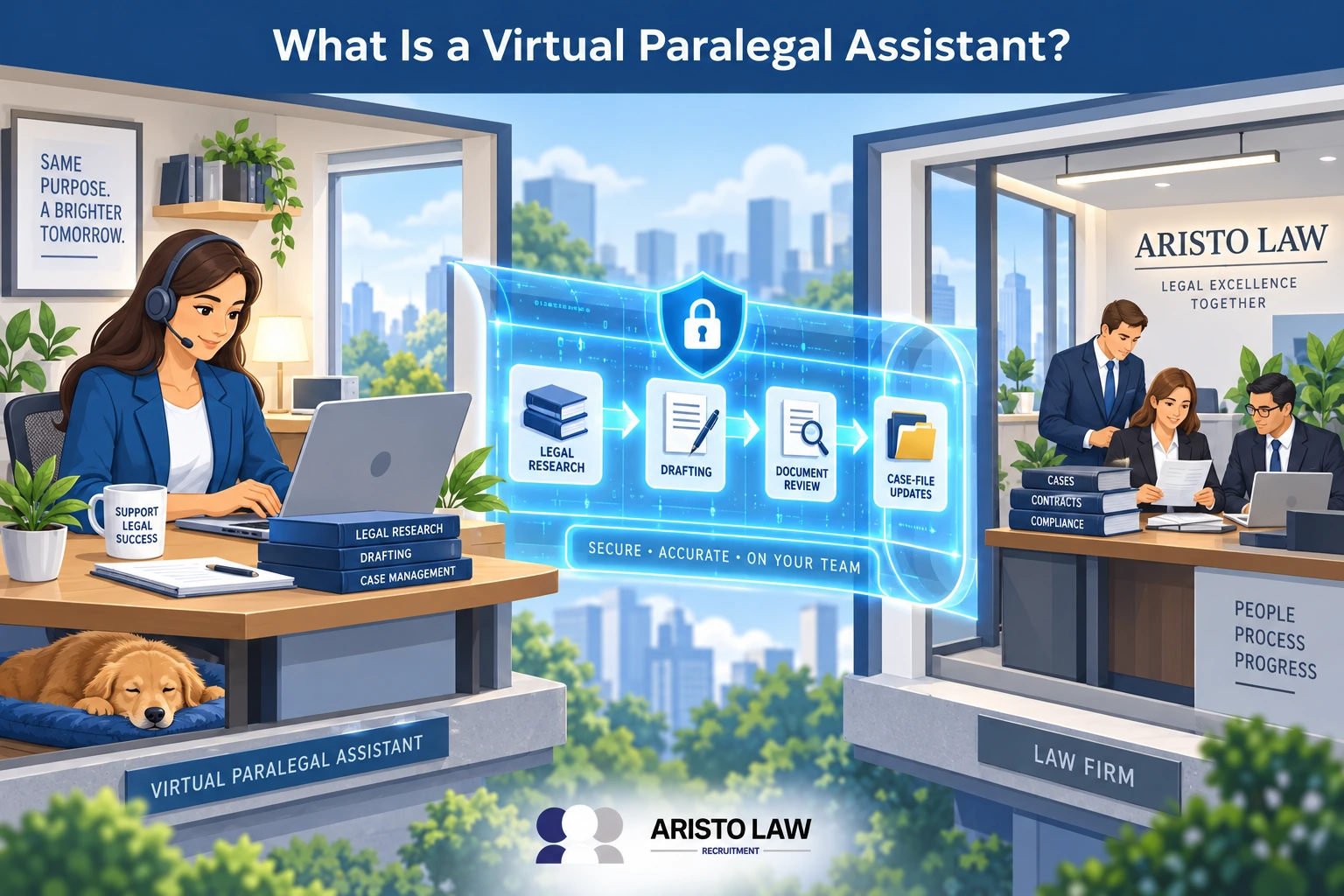
Virtual paralegal assistants integrate into legal operations through
remote legal support workflows that connect attorneys, staff, court
systems, and clients across online communication and case management
tools. Legal tasks handled by virtual paralegal assistants improve
workflow organization, reduce attorney administrative workload, and
support more efficient management of active legal matters.
What does a virtual
paralegal assistant do?
A virtual paralegal assistant performs legal research,
document drafting, case management, client communication, scheduling,
and administrative legal support tasks remotely for law firms.
Law firms use virtual
paralegal assistants handling case support tasks and
workflows to improve organization, reduce administrative pressure, and
maintain efficient legal operations across active matters.
Listed below are the 10 duties of a virtual paralegal assistant.
-
Legal research for statutes, case law, and supporting materials
-
Document drafting for pleadings, contracts, and legal
correspondence -
Case management for tracking deadlines, files, and workflow
updates -
Client communication for updates, scheduling, and document
requests -
Scheduling for consultations, court dates, and meetings
-
File organization for digital records and legal documents
-
Billing support for time tracking and invoice preparation
-
Discovery support for evidence and document management
-
Intake coordination for collecting client and case information
-
Administrative support for legal workflow management
How does a
virtual paralegal support law firms?
A virtual paralegal supports law firms by managing legal
workflows, organizing case files, and assisting attorneys with
administrative and procedural tasks that improve operational
efficiency. Virtual paralegal support improves law firm
operations through document organization, deadline tracking, legal
research coordination, scheduling management, and communication support
across active legal matters.
Workflow management systems allow virtual paralegals to maintain case
updates, organize digital records, coordinate filings, and support
attorney preparation through remote legal workflows. Case files remain
more organized and accessible because virtual paralegals manage document
systems, client records, billing information, and procedural timelines
inside centralized legal platforms.
What
is the difference between a virtual paralegal and a traditional
paralegal?
The difference between a virtual paralegal and a traditional
paralegal is that a virtual paralegal delivers remote legal support
through digital workflows, while a traditional paralegal works inside a
physical office environment.
The table below shows the difference between a virtual paralegal and
a traditional paralegal.
Work Environment |
Virtual Paralegal |
Traditional Paralegal |
|---|---|---|
| Work environment | Remote work through digital platforms | In-office legal support environment |
| Availability | Flexible scheduling and remote staffing support | Fixed office-hour availability |
| Cost structure | Lower overhead and scalable staffing costs | Higher operational and office-related costs |
| Communication method | Email, cloud systems, video calls, and messaging tools | In-person meetings, phone calls, and office communication |
Why
should law firms hire a virtual paralegal assistant?
Law firms should hire a virtual paralegal assistant to reduce
overhead costs, increase flexibility, improve workflow efficiency, and
maintain consistent legal support without full-time staffing
commitments. Virtual paralegal assistants improve productivity
by handling document preparation, scheduling, case management, client
communication, and administrative legal workflows that reduce attorney
workload across active matters. Cost reduction occurs because remote
legal support models lower office space expenses, equipment costs,
employee overhead, and long-term staffing commitments tied to
traditional in-house hiring.
Flexibility improves because law firms scale virtual paralegal
support based on workload volume, case demands, and practice-area
requirements without expanding permanent office operations. Legal
support workflows remain more organized because virtual paralegals
manage deadlines, records, filings, and communication tasks inside
centralized digital systems that support efficient law firm
operations.
The 2024 Clio Legal Trends Report reveals that AI adoption among
legal professionals rose from 19% to 79% in one year, with up to 74% of
billable tasks, including administration and data entry, capable of
being automated.
What
services are included in professional virtual paralegal assistance?
Professional virtual paralegal assistance includes document
preparation, legal research, case management, discovery support, filing
assistance, and other remote legal support services for law
firms. The services included in professional virtual paralegal
assistance are key legal support functions delivered remotely.
Listed below are the 10 services included in professional virtual
paralegal assistance.
-
Document preparation for pleadings, contracts, and legal
correspondence -
Legal research for statutes, case law, and supporting authority
-
Case management for deadlines, records, and workflow tracking
-
Discovery support for evidence organization and document review
-
Filing assistance for court submissions and procedural documents
-
Client communication for updates and intake coordination
-
Scheduling support for consultations, hearings, and meetings
-
Billing assistance for invoicing and time-entry management
-
File organization for digital records and case documents
-
Administrative legal support for daily law firm operations
What is
virtual paralegal support in case management?
Virtual paralegal support in case management involves
organizing case data, tracking deadlines, and maintaining documentation
throughout the legal process. Law firms use case
management systems used by virtual paralegals to
maintain workflow visibility, document organization, scheduling
coordination, and communication tracking across active legal
matters.
Case management virtual paralegal workflows support attorneys through
digital file management, court deadline monitoring, billing updates,
client communication, and procedural task coordination inside
centralized legal systems. Documentation remains more accurate and
accessible because virtual paralegals organize pleadings, evidence,
correspondence, discovery files, and intake records through structured
remote legal workflows. Deadline tracking improves legal process
consistency by reducing missed filings, scheduling conflicts, and
workflow delays tied to active case management responsibilities.
How do
virtual paralegals handle case management tasks?
Virtual paralegals handle case management tasks by using
digital tools to track deadlines, organize files, and coordinate
communication between attorneys and clients. Law firms use litigation
case management support for legal workflows to improve
scheduling coordination, document tracking, and workflow organization
across remote legal operations. Virtual paralegals manage case
management through cloud-based software, shared calendars, task
management systems, document repositories, and communication platforms
that maintain organized legal workflows throughout active matters.
Digital tools help virtual paralegals monitor court deadlines, update
case records, prepare filings, manage billing entries, and maintain
communication logs between legal teams and clients. Communication
workflows remain more efficient because virtual paralegals coordinate
updates, appointment scheduling, document requests, and procedural
follow-ups through centralized legal systems.
What
are the benefits of virtual paralegals for attorneys?
The benefits of virtual paralegals for attorneys include
reduced costs, increased productivity, flexible staffing, scalability,
and improved workflow support across legal operations. The
benefits of virtual paralegals for attorneys are operational and
financial advantages.

Listed below are the 10 benefits of virtual paralegals for
attorneys.
-
Reduced costs through lower office and staffing expenses
-
Increased productivity through delegated legal support tasks
-
Flexible staffing for changing workload demands
-
Scalability for growing case volume and legal operations
-
Better workflow organization across active legal matters
-
Faster document preparation and case support
-
Improved scheduling and deadline management
-
More attorneys focus on legal strategy and client representation
-
Remote support availability across multiple practice areas
-
Consistent administrative and procedural legal assistance
How do
virtual paralegals improve legal workflows?
Virtual paralegals improve legal workflows by ensuring tasks
are completed on time, documents are organized, and communication flows
efficiently across the legal team. Virtual paralegals improve
efficiency through structured task management, centralized document
handling, deadline tracking, scheduling coordination, and workflow
monitoring across active legal matters.
Legal workflows remain more organized because virtual paralegals
manage filings, case records, client communication, billing support, and
procedural updates through digital legal systems. Communication between
attorneys, clients, courts, and support staff becomes faster and more
consistent because virtual paralegals coordinate updates, reminders,
document requests, and status tracking through remote collaboration
tools. Workflow optimization improves attorney productivity by reducing
administrative interruptions and maintaining organized legal operations
across multiple cases simultaneously.
What tools do
virtual paralegal assistants use?
The tools used by virtual paralegal assistants include case
management software, document management systems, communication
platforms, calendaring tools, and workflow systems that support remote
legal work. Law firms use workflow
automation tools for virtual legal support to improve
task coordination, document tracking, scheduling accuracy, and
communication efficiency across remote legal operations.
Listed below are the 10 tools a virtual paralegal assistant uses.
-
Case management software for workflow tracking and deadline
management -
Document management systems for storing and organizing legal
files -
Communication platforms for attorney, client, and team
coordination -
Calendaring platforms for hearings, meetings, and deadline
scheduling -
Cloud storage systems for remote document access and
collaboration -
Billing software for time tracking and invoicing support
-
E-signature platforms for remote document execution
-
Task management tools for assignment tracking and workflow
updates -
Video conferencing platforms for remote meetings and
consultations -
Legal research databases for statutes, case law, and legal authority
retrieval
How can
law firms hire a virtual paralegal assistant?
Law firms hire a virtual paralegal assistant by defining
support needs, sourcing qualified candidates, evaluating legal
experience, and completing structured onboarding processes. Law
firms use how
to hire virtual legal assistants or paralegals to
improve recruitment efficiency, workflow alignment, and remote legal
staffing outcomes during hiring decisions.
Listed below are the 8 steps law firms follow when hiring a virtual
paralegal assistant.
-
Define legal support needs based on workload, practice area, and
workflow gaps. -
Source candidates through legal staffing providers, referrals, or
remote legal support platforms. -
Evaluate experience related to legal research, document preparation,
case management, and communication skills. -
Review software proficiency with case management and document systems
used by the firm. -
Conduct interviews to assess workflow fit, organization, and
responsiveness. -
Verify confidentiality awareness and remote work reliability.
-
Complete onboarding through workflow training, system access, and
communication procedures. -
Monitor early performance and workflow integration during the initial
support period.
What
qualifications should a virtual paralegal have?
A virtual paralegal should have legal education, law firm
experience, legal research ability, communication skills, organization,
confidentiality awareness, and remote workflow experience. The
qualifications a virtual paralegal must have to support efficient remote
legal work and organized law firm operations.
Listed below are the 10 qualifications a virtual paralegal must
have.
-
Legal education in paralegal studies, legal assistance, or related
legal training -
Experience in law firm operations and legal workflow management
-
Proficiency in legal software, case management systems, and document
platforms -
Legal research skills for statutes, case law, and procedural
support -
Document preparation experience for pleadings, contracts, and legal
correspondence -
Organization skills for managing deadlines, files, and scheduling
tasks -
Communication skills for attorney, client, and court coordination
-
Confidentiality awareness for handling sensitive legal
information -
Attention to detail for accurate documentation and case tracking
-
Remote work experience using digital collaboration and communication
systems
Is
a virtual paralegal assistant suitable for solo attorneys?
Yes, a virtual paralegal assistant is suitable for solo
attorneys because the role provides flexible legal support without the
cost of full-time staff. Virtual paralegal assistants help solo
attorneys manage legal research, scheduling, document preparation, case
management, billing support, and client communication through remote
workflows that reduce administrative pressure.
Flexible support allows solo practices to scale legal assistance
based on case volume, deadlines, and workload demands without
maintaining permanent in-office staffing structures. Cost savings
improve because solo attorneys avoid expenses tied to office space,
equipment, employee benefits, and long-term staffing commitments. Legal
workflows remain more organized because virtual paralegals manage
deadlines, filings, records, and procedural tasks through digital legal
systems that support efficient solo practice operations.
What is the
future of virtual paralegal services?
The future of virtual paralegal services involves increased
adoption of remote legal support, deeper integration with legal
technology platforms, and wider use of automation tools to improve
efficiency and scalability across legal operations. Virtual
paralegal services continue expanding because law firms seek flexible
staffing, lower operational costs, faster workflow execution, and
improved digital collaboration across remote work environments. Legal
technology platforms improve remote legal support through cloud-based
case management, workflow automation, AI-assisted document review,
secure communication systems, and centralized legal operations
management. Virtual legal staffing models support scalability because
law firms increase or reduce support capacity based on workload volume,
litigation demands, and operational growth without expanding permanent
office infrastructure.

A report published by Regents SRS, titled “All about: Virtual
Paralegal Services. Guide updated 2025,” confirms that law firms
utilizing remote legal staffing surged from 42% in 2023 to an estimated
63% in 2025. The research states a growing shift toward decentralized
legal support, noting that the average number of billable hours lawyers
saved each day through delegated remote support increased from 2.1 hours
in 2023 to 2.6 hours by 2025.
Can a virtual
assistant work as a paralegal?
Yes, a virtual assistant can work as a paralegal if the
individual has legal training and performs tasks aligned with paralegal
responsibilities. Virtual assistants for attorneys support
paralegal roles when legal training, law firm experience, legal research
ability, document preparation skills, and case management knowledge
match the responsibilities required in legal operations.
Paralegal responsibilities include legal research, drafting support,
filing coordination, case management, discovery organization, and
procedural legal support performed under attorney supervision. General
virtual assistants usually handle administrative work such as
scheduling, email management, and customer communication without
specialized legal training or legal workflow responsibilities. Legal
training and understanding of court procedures, confidentiality
standards, legal terminology, and documentation processes distinguish
virtual paralegal assistants from general remote administrative support
staff.
Build a legal support team that moves work forward.
Tell us what is slowing your practice down. We will help map the role, workflow, and support structure that fits.