
Law Firm Website Management: Definition, Virtual Assistant Support, Client Intake Workflows, and Law Firm Growth

Practical guidance for building efficient, accountable legal support operations.

Law firm website management refers to the ongoing process of
maintaining, updating, securing, optimizing, and monitoring a law firm’s
website, intake systems, communication workflows, and digital
client-acquisition infrastructure to improve online visibility and law
firm growth. Modern law-firm websites function as intake and
conversion platforms rather than static marketing pages because website
performance directly affects search visibility, response speed,
consultation booking, signed-client conversion, and client trust.
A study by Lexology in 2025 showed that law firms
implementing rapid lead-response systems, structured follow-up
workflows, and optimized intake forms improved client acquisition and
lead conversion performance compared to firms with inconsistent intake
practices. Law firms with structured intake systems, rapid
follow-up workflows, and optimized digital communication processes
achieve stronger lead conversion, higher consultation rates, and lower
intake leakage than firms with unmanaged or outdated intake
infrastructure.
Virtual assistants frequently support website-management workflows
through content updates, blog publishing, SEO support, intake-form
routing, chat monitoring, CRM updates, appointment scheduling, analytics
reporting, live-chat response, review monitoring, intake coordination,
and consultation reminders. Website support VAs also help maintain
landing pages, metadata updates, call-tracking visibility, intake
notifications, calendar synchronization, reporting dashboards, and
lead-source tracking improving operational continuity across digital
marketing and intake systems. Virtual legal assistants, website VAs,
virtual legal secretaries, and virtual paralegals differ operationally
because website VAs focus primarily on digital operations and intake
coordination, legal assistants support administrative workflows, legal
secretaries manage communication and scheduling, and virtual paralegals
assist with attorney-supervised substantive legal support tasks.
Certain responsibilities should not be fully delegated because
attorneys remain responsible for legal compliance, advertising approval,
legal claims, fee language, settlement representations, confidentiality
governance, cybersecurity oversight, legal strategy, and
jurisdiction-specific ethics review. Strong law-firm website operations
depend heavily on attorney-approved content standards, secure CRM
workflows, encrypted communication systems, role-based access controls,
audit trails, multi-factor authentication, virtual desktop security, and
intake-governance procedures protecting client confidentiality and
attorney-client privilege.
Key operational tools frequently include CRM platforms, intake
automation systems, case-management software, VoIP communication
systems, scheduling tools, SEO platforms, reporting dashboards,
analytics systems, secure document repositories, virtual desktops, task
boards, and live-chat software supporting centralized intake and website
workflows. Performance measurement commonly includes response speed,
consultation-booking rate, intake completion rate, website conversion
rate, CRM accuracy, chat-response time, lead-source conversion, and
attorney time saved through delegated digital operations.
Website support virtual assistants cost between $10 and $50
per hour, with pricing varying based on legal-industry experience, CRM
proficiency, SEO familiarity, technical capability, and staffing
model. Lower-cost support frequently becomes operationally
expensive when poor communication, weak CRM hygiene, missed follow-up,
compliance mistakes, or intake delays reduce consultation conversion and
marketing ROI.
Law firms usually gain the strongest value from outsourced
website-management support when inquiry volume is growing, intake
workflows are documented, CRM systems are active, communication
ownership is defined, and attorneys need operational leverage without
expanding full in-house administrative staffing.
Aristolaw helps law firms manage website operations by
providing outsourced support for content updates, client intake
coordination, SEO workflow management, website maintenance, lead
tracking, and digital communication tasks. Hire a
Virtual Law Firm Website Management Assistant with Aristolaw
today. Aristolaw connects law firms with outsourcing solutions
that match trained virtual support staff to each website management
workflow, intake coordination process, content publishing task, lead
generation activity, and client communication
responsibility.
What is law firm website
management?
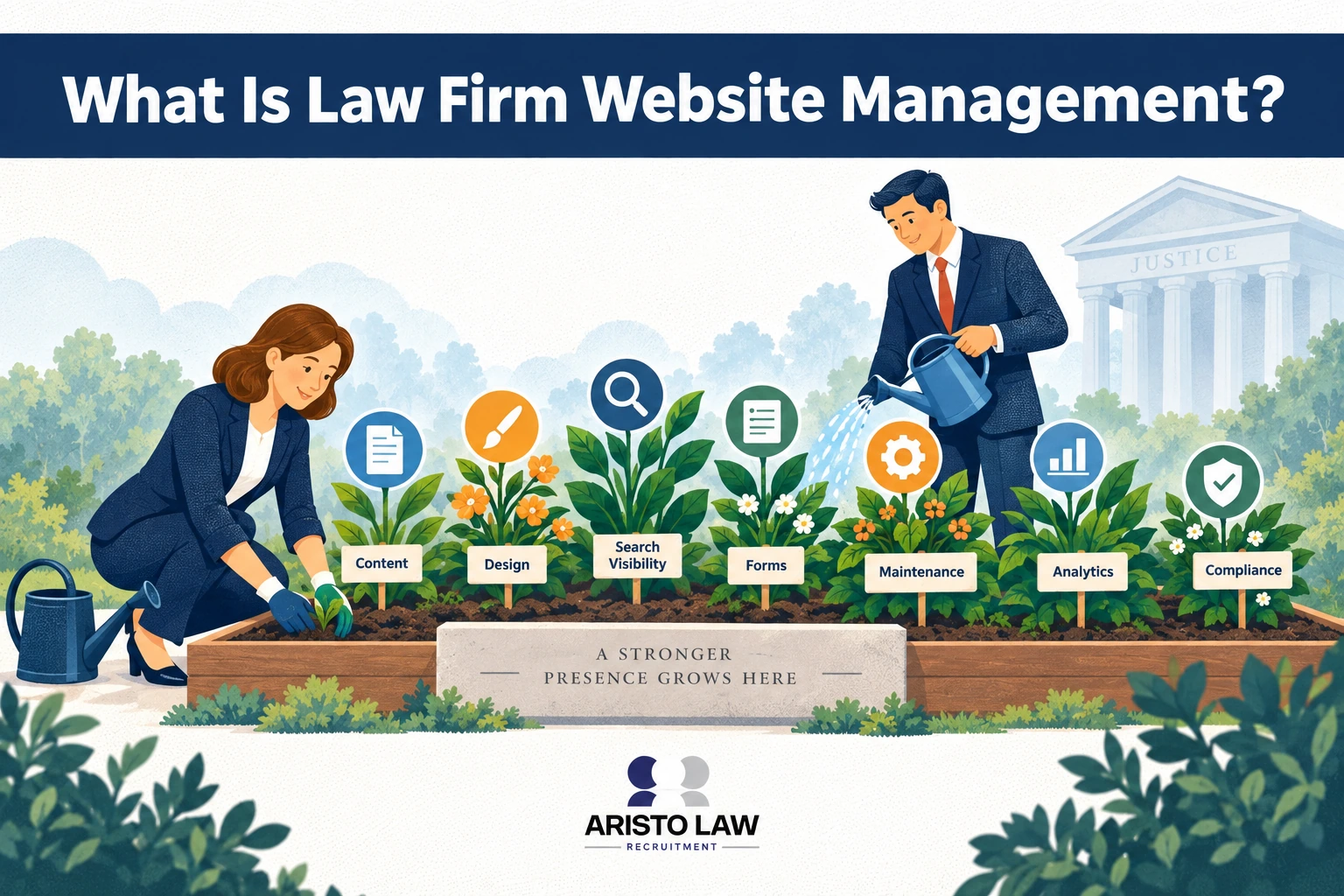
Law firm website management is the ongoing process of
updating, maintaining, optimizing, securing, and using a law firm
website to support client intake, brand trust, lead generation, and firm
growth. Modern law-firm websites function as operational intake
and conversion systems rather than simple online brochures because
website performance directly affects consultation volume, search
visibility, intake responsiveness, signed-client conversion, and client
confidence.
Research by Reciprocity Industries in 2025 showed that 87% of
legal clients hire the first lawyer they speak with, while 64% of law
firms fail to respond to leads at all, demonstrating that firms with
responsive and organized digital intake systems achieve stronger
consultation conversion rates. Law firms with structured
digital intake systems, responsive websites, and organized follow-up
workflows achieve stronger consultation conversion and lower intake
leakage than firms with outdated or unmanaged online systems.
Law firm website management commonly connects service pages, attorney
profiles, practice-area content, legal blogs, FAQs, intake forms,
call-to-action systems, live-chat tools, consultation scheduling
workflows, CRM platforms, analytics dashboards, call tracking, and
secure communication systems into one centralized client-acquisition
process. Effective website management also includes SEO coordination,
mobile responsiveness, speed optimization, lead-source tracking, review
monitoring, intake automation, conversion reporting, and cybersecurity
protection improving both visibility and operational performance.
Virtual assistants frequently support routine website-management
workflows through content uploads, blog formatting, page updates,
metadata coordination, intake-form monitoring, CRM updates,
chat-response routing, consultation scheduling, analytics reporting,
review management, lead tracking, and administrative follow-up. Website
support VAs additionally help maintain intake continuity by ensuring
inquiries move correctly from website forms, calls, chat systems, and
scheduling tools into attorney-reviewed intake workflows.
Law firms usually separate operational website support from legal
marketing strategy and attorney-controlled review responsibilities.
Virtual assistants coordinate updates, monitor workflows, and maintain
intake systems operationally, but attorneys and law-firm leadership
remain responsible for legal accuracy, advertising compliance, fee
language, practice-area positioning, legal claims, confidentiality
governance, and strategic marketing decisions. Strong law-firm website
management combines technical maintenance, intake operations, digital
marketing coordination, secure communication systems, and
attorney-supervised growth strategy into one scalable legal business
function.
Why does
website management matter for law firms?
Website management matters for law firms because the website
often becomes the first point where prospective clients judge
credibility, submit inquiries, compare services, and decide whether to
contact the firm. Modern legal consumers frequently evaluate
multiple firms online before scheduling consultations, making the
law-firm website a central trust, intake, and conversion asset rather
than only a marketing channel.
A 2025 study by Hennessey Digital showed that law firms
responding to online leads within 5 minutes improved lead-conversion
performance, while firms with delayed or no response workflows lost
substantial consultation opportunities; 26% of firms still failed to
respond to online inquiries at all. Law firms with updated
websites, organized intake systems, fast response workflows, and strong
local search visibility generate higher consultation rates and stronger
lead-conversion performance than firms with outdated or poorly
maintained websites.
Website management directly affects practice-area visibility because
search engines rely heavily on organized content structure, updated
pages, mobile performance, metadata, page speed, internal linking, and
local relevance signals when ranking law-firm websites. Well-managed
websites improve visibility for practice-area searches, geographic
queries, attorney searches, and local-intent legal inquiries helping
firms attract qualified consultations from search traffic, referrals,
PPC campaigns, and digital marketing systems.
Attorney authority and client trust also depend heavily on accurate
website presentation. Updated attorney profiles, professional
biographies, recent case information, educational content, testimonials,
FAQs, and practice-area explanations help prospective clients evaluate
experience, communication quality, and professional credibility before
contacting the firm. Fresh content and active website maintenance
additionally signal operational reliability and ongoing practice
activity.
Operational website management strongly affects intake conversion
because contact accessibility, mobile responsiveness, click-to-call
systems, intake forms, live chat, consultation scheduling, call
tracking, and CRM-connected intake workflows determine how easily
prospects move from inquiry to consultation. Broken forms, outdated
phone numbers, slow-loading pages, missing calls-to-action, poor mobile
usability, or delayed intake routing frequently reduce consultation
booking and increase lead abandonment.
Website management also influences local search performance through
review visibility, local-business listings, map integration, citation
consistency, and geographically optimized content helping firms compete
in regional legal markets. Poor website management frequently causes
missed leads, weak local rankings, outdated practice information, broken
intake systems, slow response workflows, low client confidence,
inconsistent branding, and lower consultation conversion reducing both
marketing ROI and long-term law-firm growth.
How
do virtual assistants support law firm website management?
Virtual assistants support law firm website management by
handling content updates, technical coordination, SEO tasks, and ongoing
website maintenance workflows. Virtual assistant support
improves legal outsourcing for law firms through structured digital
operations that reduce administrative workload and improve website
consistency. Law firm website management tasks include publishing legal
content, updating attorney profile management sections, uploading
practice-area pages, formatting blogs, replacing outdated legal
information, and managing media files across website platforms.

Research by Ronan Mouchoux, Laurent Moulin, and Nicolas
Striebig in 2024 showed that 35.2% of the world’s top 88,000 websites
had at least one broken link, highlighting the importance of continuous
broken-link checks and website maintenance workflows. Virtual
assistants monitor website maintenance workflows through broken-link
checks, form testing, page-functionality reviews, plugin coordination,
and content revision tracking.
Virtual assistants support law firm website management by updating
attorney profiles, publishing legal content, monitoring form
functionality, and maintaining SEO-related page structure. Aristolaw
provides trained staff for law
firm website management support services that handle
content coordination, technical updates, and workflow continuity across
legal websites.
Technical coordination support includes communicating with web
developers, SEO vendors, hosting providers, and software support teams
to resolve website issues and maintain operational continuity. SEO
updates involve metadata management, internal linking updates, keyword
placement coordination, schema implementation support, and page
optimization tracking tied to search visibility goals.
Content publishing workflows improve operational efficiency because
attorneys and legal staff avoid repetitive website administration tasks.
Virtual assistants maintain workflow visibility through update logs,
publishing calendars, revision tracking systems, and escalation
procedures for technical issues. Legal outsourcing for law firms
improves website consistency, response speed, and digital operational
support when virtual assistants follow documented workflows, secure
access controls, attorney-approved content procedures, and structured
website maintenance protocols.
Listed below are 15 ways virtual assistants support law firm website
management.
-
1. Content updates and website publishing
-
2. Client intake form administration
-
3. Blog publishing and SEO content coordination
-
4. Lead tracking and CRM management
-
5. Website maintenance and plugin monitoring
-
6. Appointment scheduling and contact form support
-
7. Live chat and client communication assistance
-
8. Landing page updates and conversion optimization
-
9. Legal directory listings and citation management
-
10. Analytics reporting and website traffic monitoring
-
11. Social media integration and content publishing
-
12. Email marketing coordination and newsletter distribution
-
13. Online review monitoring and reputation management
-
14. Image optimization and media library organization
-
15. Website backup coordination and security monitoring
1. Content updates and
website publishing
Content updates and website publishing involve uploading,
formatting, revising, and maintaining legal website content across law
firm digital platforms. Law Firm Website Management depends on
content publishing workflows that maintain accurate legal information,
attorney profile updates, service page consistency, and structured
Online Presence Management. Virtual Assistants support SEO Support
through metadata implementation, internal linking updates, schema
coordination, and content formatting tied to search visibility.
Website Maintenance workflows include broken-link checks, publishing
calendars, mobile formatting reviews, and revision tracking systems that
improve operational consistency. Research by HubSpot in its
State of Marketing Report (2023) showed that marketers identified sales,
website traffic, social engagement, and conversion rates as key
indicators of successful content marketing performance, suggesting that
consistent website content contributes to stronger lead engagement and
conversions. Structured publishing workflows, approval systems,
revision logs, and standardized CMS procedures improve efficiency and
reduce publishing errors.
2. Client intake form
administration
Client intake form administration involves managing intake
forms, lead routing systems, CRM Integration, spam filtering, and
consultation request processing across law firm websites.
Client intake workflows improve Legal Marketing operations because
faster intake processing improves lead response time and client
conversion performance. Virtual Assistants manage Client Intake Forms
through submission monitoring, workflow testing, form-field updates, CRM
synchronization, and escalation routing for urgent inquiries.
Technical coordination includes secure data handling, CAPTCHA
management, mobile responsiveness testing, and encrypted form submission
controls that protect client information. Structured intake workflows,
automated lead tagging, response benchmarks, and intake audit reviews
improve operational efficiency and lead tracking accuracy.
3. Blog publishing
and SEO content coordination
Blog publishing and SEO content coordination involve
scheduling legal blogs, uploading optimized content, implementing
metadata, managing internal links, and tracking keyword-focused
publishing workflows. SEO Support improves Online Presence
Management because law firms maintain active indexed content that
supports search visibility and practice-area relevance.
Virtual Assistants coordinate Legal Marketing workflows through
content calendars, image formatting, schema updates, URL reviews, and
publishing consistency checks. Research by BrightEdge in 2019
found that organic search accounted for 53% of all trackable website
traffic, making it the largest source of website traffic across
industries. Editorial workflows, SEO checklists, keyword
mapping systems, and publishing approvals improve visibility and
operational consistency.
4. Lead tracking and CRM
management
Lead tracking and CRM management involve organizing
consultation requests, tracking referral sources, updating lead stages,
monitoring follow-up workflows, and maintaining client communication
records. CRM Integration improves Law Firm Website Management
because law firms maintain visibility into intake activity, conversion
performance, and client engagement workflows.
Virtual Assistants support Digital Marketing operations through lead
segmentation, duplicate cleanup, pipeline organization, and
consultation-status tracking. Operational considerations include secure
data access, workflow automation setup, intake synchronization, and
reporting accuracy. Standardized CRM procedures, follow-up schedules,
intake tagging systems, and reporting dashboards improve lead conversion
efficiency and operational visibility.
5. Website
maintenance and plugin monitoring
Website maintenance and plugin monitoring involve software
updates, plugin testing, compatibility reviews, uptime monitoring, and
functionality verification across law firm websites. Website
Maintenance improves operational stability because outdated systems
increase downtime risk, security vulnerabilities, and broken
functionality.
Virtual Assistants coordinate technical workflows with developers,
hosting providers, and support vendors to maintain consistent website
performance. Technical considerations include backup scheduling, update
sequencing, mobile testing, cache management, and security patch
implementation. Maintenance schedules, plugin audit logs, rollback
procedures, and monitoring dashboards improve system reliability and
operational continuity.
6. Appointment
scheduling and contact form support
Appointment scheduling and contact form support involve
consultation coordination, intake routing, calendar management,
automated confirmations, and communication follow-up workflows.
Client Intake Forms improve client conversion performance because faster
consultation scheduling improves lead engagement and operational
responsiveness.
Virtual Assistants manage scheduling workflows through CRM
Integration, calendar synchronization, intake verification, and
appointment reminder systems. Operational considerations include
timezone management, duplicate submission handling, intake escalation
rules, and secure communication controls. Scheduling SOPs, automated
workflows, response benchmarks, and intake quality reviews improve
operational efficiency and client-service consistency.
7. Live chat and
client communication assistance
Live chat and client communication assistance involve
handling website inquiries, routing consultations, answering operational
questions, and maintaining communication coverage across law firm
websites. Online Presence Management improves because immediate
communication support reduces abandoned inquiries and improves lead
engagement.
Virtual Assistants support Legal Marketing workflows through scripted
responses, intake qualification, escalation routing, and CRM
documentation. Technical considerations include chat-platform
integration, response tracking, workflow escalation controls, and secure
communication handling. Communication templates, response-time
benchmarks, escalation policies, and transcript logging improve
client-service performance and operational consistency.
8. Landing
page updates and conversion optimization
Landing page updates involve revising legal service pages,
adjusting intake forms, updating CTAs, and improving mobile
layouts. Conversion optimization involves monitoring user
engagement, testing conversion-focused website elements, and improving
lead-generation performance. Conversion Optimization improves Digital
Marketing performance because structured landing pages increase
consultation request completion and lead engagement.
Virtual Assistants support SEO Support through metadata updates,
layout coordination, content publishing, and page testing workflows.
Technical considerations include page-speed optimization, mobile
responsiveness, analytics tracking, and A/B testing coordination.
Structured testing workflows, conversion tracking systems, and
user-behavior reporting improve visibility and client conversion
performance.
9. Legal
directory listings and citation management
Legal directory listings and citation management involve
updating law firm contact information, attorney profiles, practice
areas, and business details across legal directories and local citation
platforms. Online Presence Management improves because
consistent citations strengthen local search visibility and referral
credibility.
Virtual Assistants coordinate Website Maintenance workflows through
listing audits, duplicate suppression, profile revisions, and directory
synchronization. Operational considerations include NAP consistency,
profile accuracy, backlink quality, and review monitoring. Citation
tracking systems, directory update schedules, and profile review audits
improve local SEO consistency and search visibility.
10.
Analytics reporting and website traffic monitoring
Analytics reporting and website traffic monitoring involve
tracking visitor behavior, lead conversion data, traffic sources, bounce
rates, and website engagement metrics. Digital Marketing
visibility improves because law firms measure operational performance
tied to SEO Support, content publishing, and intake workflows.
Virtual Assistants generate reporting dashboards, organize conversion
reports, monitor campaign activity, and identify operational performance
changes. Research by Google in 2011 titled “Winning the Zero
Moment of Truth” showed that online research behavior, including search
queries, reviews, and digital content consumption, strongly influenced
consumer purchasing decisions and conversion outcomes. KPI
dashboards, monthly reporting schedules, conversion tracking systems,
and traffic-source analysis improve operational decision-making and
growth planning.
11. Social
media integration and content publishing
Social media integration and content publishing involve
connecting law firm websites with social channels, scheduling posts,
embedding feeds, and coordinating cross-platform content
distribution. Online Presence Management improves because
integrated publishing workflows strengthen visibility and referral
engagement across digital platforms.
Virtual Assistants support Legal Marketing through post scheduling,
content formatting, media coordination, and traffic tracking workflows.
Technical considerations include plugin compatibility, link tracking,
mobile responsiveness, and platform synchronization. Content calendars,
approval systems, publishing checklists, and engagement reporting
improve workflow consistency and digital coordination.
12.
Email marketing coordination and newsletter distribution
Email marketing coordination and newsletter distribution
involve managing subscriber lists, scheduling legal newsletters,
formatting campaigns, and tracking email engagement activity.
Digital Marketing workflows improve because consistent email
communication strengthens referral retention and client engagement.
Virtual Assistants support CRM Integration through contact
segmentation, automation workflows, intake tagging, and campaign
reporting. Technical considerations include spam compliance, unsubscribe
handling, mobile formatting, and secure contact management. Campaign
calendars, segmentation rules, reporting dashboards, and template
systems improve communication efficiency and engagement performance.
13. Online
review monitoring and reputation management
Online review monitoring and reputation management involve
tracking law firm reviews, responding to client feedback, monitoring
rating platforms, and escalating reputation issues. Legal
Marketing performance improves because strong review visibility
influences consultation decisions and referral trust.
Virtual Assistants manage Online Presence Management workflows
through review tracking, response coordination, listing updates, and
reputation reporting. Operational considerations include review-policy
compliance, escalation procedures, platform synchronization, and
response consistency. Monitoring schedules, response templates,
reporting dashboards, and escalation workflows improve reputation
stability and client trust.
14. Image
optimization and media library organization
Image optimization and media library organization involve
compressing website images, renaming files, organizing folders, updating
alt text, and maintaining structured media workflows. Website
Maintenance improves because optimized media reduces page-load delays
and improves mobile usability.
Virtual Assistants support SEO Support through metadata management,
image formatting, accessibility tagging, and content publishing
coordination. Technical considerations include file compression
standards, CDN compatibility, image dimensions, and storage
organization. Media audit systems, naming conventions, optimization
checklists, and accessibility reviews improve website speed and
operational consistency.
15. Website
backup coordination and security monitoring
Website backup coordination and security monitoring involve
managing backup schedules, monitoring suspicious activity, tracking
uptime, and coordinating recovery procedures for law firm
websites. Website Maintenance protects operational continuity
because security failures disrupt client communication, intake
workflows, and Online Presence Management.
Virtual Assistants coordinate technical support workflows with
hosting providers, legal IT vendors, and developers to maintain secure
website operations. Technical considerations include encrypted backups,
malware scanning, two-factor authentication, plugin security reviews,
and access control management. Backup schedules, incident-response
procedures, security audit logs, and monitored recovery systems improve
operational reliability and cybersecurity protection.
What
website tasks can law firms delegate to virtual
assistants?
Website tasks law firms can delegate to virtual assistants
includeadministrative website updates, intake-management support, and
operational website maintenance activities.
Listed below are the 11 tasks law firm delegate to virtual
assistants.
-
Attorney bios updates: Attorney bios updates include
revising contact information, education details, bar admissions, awards,
office locations, and profile images. Administrative profile updates
involve low operational risk when law firms use attorney-approved source
material. -
Practice pages formatting updates: Practice pages
updates include spacing corrections, internal linking adjustments, image
placement, CTA updates, and formatting improvements. Attorney-reviewed
legal content changes require approval before publication when legal
claims or jurisdiction-specific statements appear. -
Blog posting workflows: Blog posting includes
uploading attorney-approved articles, adding metadata, inserting
internal links, formatting headings, scheduling publication dates, and
attaching featured images. Virtual assistants manage publishing
operations without modifying legal conclusions. -
Website requests tracking: Website requests tracking
includes logging content revisions, development requests, SEO tasks,
intake issues, and update approvals. Workflow visibility improves
because law firms maintain centralized tracking systems for pending
website tasks. -
Image replacement and media uploads: Image
replacement includes uploading attorney headshots, replacing outdated
graphics, compressing images, updating alt text, and organizing media
libraries. Administrative image updates improve website maintenance
efficiency and page performance. -
Link testing and functionality reviews: Link testing
includes checking broken links, form submissions, scheduling tools, and
navigation menus. Technical maintenance support improves operational
reliability and user experience consistency. -
Contact-detail verification: Contact-detail
verification includes updating office addresses, phone numbers, email
addresses, intake links, and map listings across practice pages and
attorney bios. Accurate contact information improves lead conversion
performance. -
Event and webinar updates: Event updates include
publishing seminar schedules, webinar announcements, speaking
engagements, and legal event registration links. Virtual assistants
coordinate operational publishing workflows tied to law firm marketing
calendars. -
Referral-source notes and CRM tagging:
Referral-source notes include tracking referral origins, intake source
tagging, consultation notes, and CRM workflow updates. Intake workflow
coordination improves lead tracking visibility and operational
reporting. -
SEO checklist maintenance: SEO checklist maintenance
includes monitoring metadata completion, image optimization, URL
formatting, schema coordination, and internal link verification. SEO
support workflows improve operational consistency across legal website
publishing systems. -
Content publishing approvals: Content publishing
approvals involve routing legal content drafts, attorney advertising
language, compliance-sensitive content, and jurisdiction-specific legal
statements for attorney or marketing-lead review before publication.
Attorney oversight protects ethics compliance and reduces legal
advertising risk.
What
website tasks should law firms not fully delegate to a virtual
assistants?
Website tasks law firms should not fully delegate to a
virtual assistant include legal-content approvals, attorney advertising
statements, compliance-sensitive website language, and
reputation-sensitive marketing decisions.
Listed below are the 10 website tasks law firms must not fully
delegate to a virtual assistant.
-
Legal content approvals: Legal content approvals
include practice-area explanations, legal rights discussions, litigation
guidance, and jurisdiction-specific legal statements. Virtual assistants
prepare drafts, upload approved text, and flag outdated legal content,
but attorneys must approve final legal language to reduce inaccurate
legal content risk. -
Attorney advertising statements: Attorney
advertising includes case-result claims, specialization language,
comparative statements, and promotional messaging tied to legal
services. Attorneys or qualified marketing leaders must review attorney
advertising language before publication to reduce legal marketing risk
and ethics violations. -
Jurisdiction-specific legal claims:
Jurisdiction-specific legal claims involve state licensing disclosures,
bar compliance language, legal limitations, and procedural
representations tied to local laws. Attorney review protects
compliance-sensitive statements from inaccurate or unauthorized legal
representations. -
Testimonials and case results: Testimonials and
case-result publishing involve client endorsements, settlement figures,
verdict references, and review placement decisions. Attorneys must
review testimonial presentation for ethics compliance, disclosure
accuracy, and misleading advertising risk. -
Guarantee-related statements: Guarantee-related
statements include outcome promises, success-rate claims, “best lawyer”
positioning, or language implying guaranteed legal results. Legal
marketing review reduces misleading claims and protects brand
credibility. -
Privacy policy and data-use language: Privacy
language includes data-retention disclosures, intake-form privacy terms,
tracking-consent notices, and client-information handling statements.
Attorneys or compliance leaders must review legal privacy language
because inaccurate disclosures create regulatory and liability
exposure. -
Ethics-sensitive advertising content:
Ethics-sensitive content includes solicitation language, referral
disclosures, contingency-fee explanations, comparative advertising, and
expert-claim statements. Website approval workflows reduce ethics
violations and inconsistent brand positioning. -
Brand-positioning decisions: Brand-positioning
decisions include messaging tone, market positioning, target-practice
emphasis, and reputation-sensitive campaign direction. Virtual
assistants support workflow execution, but marketing leadership controls
strategic positioning consistency. -
Compliance-sensitive intake statements:
Compliance-sensitive intake language includes disclaimers about
attorney-client relationships, consultation expectations, emergency
contact guidance, and communication limitations. Attorney supervision
protects operational compliance and client-information accuracy. -
Final publication authority: Final publication
authority for legal-content revisions, marketing campaigns,
compliance-sensitive pages, and public-facing legal claims must remain
under attorney or approved marketing-lead control. Structured approval
workflows reduce inaccurate legal content, misleading advertising
exposure, and operational inconsistency.
How does
website management connect to client intake?
Website management connects to client intake by turning
website visitors into inquiries through clear service pages, strong
calls-to-action, working forms, phone visibility, chat tools, and fast
follow-up workflows. Client intake performance depends on how
effectively law firm websites guide visitors through search visibility,
practice-area intent matching, landing-page structure, consultation
booking systems, and lead-routing workflows. Practice-area pages aligned
with user search intent improve lead generation because visitors reach
relevant legal information faster. Contact forms, click-to-call buttons,
live chat systems, intake questionnaires, and consultation booking links
create direct intake pathways that reduce abandoned inquiries and missed
leads.
CRM routing systems improve operational efficiency because intake
submissions move immediately to the correct attorney, intake
coordinator, or practice team. Response-time expectations strongly
affect lead conversion performance. Research from the MIT Lead
Response Management Study found that businesses responding to online
leads within 5 minutes were 100 times more likely to successfully
contact the lead compared to businesses responding after 30
minutes.
Virtual assistants support client intake by monitoring contact forms,
checking form-delivery functionality, verifying consultation-booking
workflows, entering lead data into CRM systems, tracking referral-source
notes, and following approved lead follow-up scripts. Website management
workflows improve intake reliability when law firms maintain fast
response systems, visible contact pathways, mobile-friendly intake
forms, operational testing schedules, and centralized lead-tracking
systems.
How
can virtual assistants improve client intake workflows?
Virtual assistants improve client intake workflows by
monitoring new inquiries, entering lead details, scheduling
consultations, sending reminders, updating CRM records, and following up
with prospective clients. Intake workflows function as
repeatable operational systems connected directly to law firm websites,
contact forms, consultation booking pages, live chat tools, and inbound
communication channels.
Virtual assistants improve lead capture by reviewing incoming website
inquiries, classifying inquiry type, routing conflict-check requests,
organizing intake questionnaires, and escalating urgent matters to
attorneys or intake managers. CRM records remain more accurate because
virtual assistants track consultation status, referral-source notes,
communication history, and intake-stage progression across prospective
clients.
Law firm website management improves client intake workflows by
connecting intake forms, appointment systems, and lead-routing processes
into a structured intake environment. Law firms use virtual
intake specialist support for client intake workflows
to manage inquiry response, consultation scheduling, and intake data
coordination across digital intake channels.
Consultation scheduling workflows improve because virtual assistants
coordinate calendars, confirm appointments, send reminders, manage
rescheduling requests, and track no-show follow-up activity. Document
collection workflows improve through organized intake checklists, secure
upload coordination, and follow-up reminders tied to incomplete
submissions. Attorney handoff workflows become more efficient because
intake data, consultation notes, conflict-check results, and
communication records remain centralized before attorney review
begins.
Virtual assistants reduce delayed responses and missed consultations
when website inquiries arrive outside attorney availability.
Research by James B. Oldroyd, Kristina McElheran, and David
Elkington in 2011, published in Harvard Business Review, showed that
companies responding to online sales leads within 1 hour were nearly 7
times more likely to qualify those leads than companies that delayed
their response longer. Structured intake workflows, CRM
hygiene, response-time benchmarks, and automated reminder systems
improve law firm intake consistency and client conversion
performance.
How do
virtual receptionists support website leads?
Virtual receptionists support website leads by answering
calls, screening inquiries, taking messages, booking consultations,
routing urgent matters, and reducing interruptions for
attorneys. Website leads often call directly after visiting
practice pages, attorney profiles, landing pages, or click-to-call
buttons instead of submitting contact forms.
Virtual receptionist workflows protect those lead opportunities by
providing immediate call handling support that reduces missed
consultations and delayed responses. Intake screening processes help
classify inquiry type, collect lead details, identify practice-area
relevance, and route urgent legal matters using approved call scripts
and escalation procedures.
Research published in 2025 by Prospyr found that automated
reminder systems reduced no-show rates by up to 38%, saved more than 500
administrative hours annually, and improved workflow efficiency through
automated scheduling coordination and real-time updates.
Consultation scheduling workflows improve because virtual receptionists
coordinate calendars, confirm appointments, send reminders, and update
CRM notes tied to prospective clients.
After-hours coverage improves lead retention because website
inquiries continue outside normal attorney availability. Message
summaries improve operational efficiency by giving attorneys organized
intake information, callback priorities, referral-source notes, and
consultation context before follow-up begins. Emergency escalation
workflows route urgent matters immediately based on predefined intake
protocols and attorney availability rules.
Virtual receptionists reduce attorney interruptions by filtering
repetitive intake calls, administrative questions, scheduling requests,
and nonurgent inquiries before attorney involvement becomes necessary.
Work-life balance improves because attorneys spend less time answering
routine intake calls during legal drafting, litigation preparation,
negotiations, and client strategy work. Structured call handling
systems, CRM integration, intake scripts, consultation-booking
workflows, and documented escalation procedures improve website lead
conversion performance and law firm operational consistency.
How do virtual
assistants help law firms growth?
Virtual assistants help law firms growth by supporting lead
intake, website updates, client follow-up, administrative workflows,
marketing execution, and attorney time recovery. Law firm
growth improves because virtual assistant support increases operational
capacity without requiring immediate full in-office staffing
expansion.
Lead intake workflows improve through faster inquiry monitoring,
consultation scheduling, CRM updates, intake follow-up, and missed-lead
prevention systems tied directly to website inquiries and phone calls.
Virtual assistants reduce delayed responses that often reduce
consultation conversion opportunities.
Website management support improves marketing execution because
virtual assistants maintain content publishing schedules, update
attorney profiles, monitor forms, coordinate SEO tasks, and manage
operational website workflows tied to lead generation. Client
communication consistency improves through structured follow-up scripts,
appointment reminders, intake tracking, and organized CRM records that
reduce abandoned consultations and lost inquiries. Attorney time
recovery improves because attorneys spend less time handling scheduling,
intake coordination, administrative communication, and repetitive
operational tasks.
A 2023 report by Clio found that law firms adopting
technology-driven client intake, communication, and workflow systems
reported higher productivity, improved workflow efficiency, and better
financial performance. Small law firms handle more prospects
and improve operational scalability when delegation systems, intake
workflows, marketing coordination, and response-time procedures remain
organized through virtual assistant support.
What
is the difference between a virtual legal assistant and a website
VA?
The difference between a virtual legal assistant and a
website VA are role specialization, workflow responsibility, legal
exposure, and operational focus within law firm support
systems.
The table below shows the difference between a virtual legal
assistant and a website VA.
| Dimension | Virtual Legal Assistant | Website VA |
|---|---|---|
| Role Focus | Legal workflow support tied to intake, case coordination, legal administration, billing, scheduling, and attorney support |
Website operations support tied to publishing, updates, SEO coordination, analytics, and website maintenance |
| Legal Knowledge | Requires familiarity with legal terminology, law firm workflows, intake procedures, and confidentiality requirements |
Requires familiarity with CMS systems, website workflows, SEO support, and digital publishing operations |
| Primary Tasks | Intake workflows, document organization, legal scheduling, CRM management, client communication, and administrative legal support |
Blog posting, image updates, form testing, SEO updates, plugin checks, and landing-page maintenance |
| Website Tasks | Supports intake forms, approved content uploads, CRM routing, and consultation scheduling systems |
Manages content publishing, metadata updates, broken-link checks, analytics reporting, and technical coordination |
| Intake Involvement | Direct involvement in lead intake, consultation scheduling, conflict-check routing, and client follow-up |
Supports intake workflows through form monitoring, contact-page updates, and submission testing |
| Confidentiality Exposure | Higher confidentiality exposure because workflows involve legal documents, client records, intake details, and privileged operational data |
Lower confidentiality exposure because workflows focus more on public-facing website operations and marketing systems |
| Software Tools | Uses legal CRM systems, case management software, intake systems, billing platforms, and document-management tools |
Uses CMS platforms, SEO tools, analytics dashboards, publishing systems, and website-maintenance software |
| Attorney Supervision | Requires stronger attorney supervision because workflows intersect with legal operations and client communication |
Requires operational supervision tied to website updates, marketing coordination, and publishing approval workflows |
| Marketing Coordination | Limited marketing coordination focused mainly on intake workflows and consultation follow-up |
Direct marketing coordination involving SEO updates, landing pages, publishing schedules, and analytics tracking |
| Risk Level | Higher operational risk because inaccurate intake handling or workflow errors affect legal operations and confidentiality obligations |
Lower operational risk, though publishing errors and compliance-sensitive updates still require review controls |
| Overlapping Responsibilities | Intake forms, CRM updates, consultation scheduling, lead follow-up, and approved content posting |
Intake forms, CRM updates, consultation scheduling, lead follow-up, and approved content posting |
What
is the difference between a virtual legal assistant and a virtual
paralegal?
The difference between a virtual legal assistant and a
virtual paralegal are workflow focus, legal-document involvement,
research responsibility, and operational support scope within law firm
operations.
The table below show the difference between a virtual legal assistant
and a virtual paralegal.
| Dimension | Virtual Legal Assistant | Virtual Paralegal |
|---|---|---|
| Primary Role | Administrative and operational legal support | Substantive legal support under attorney supervision |
| Core Duties | Client intake, scheduling, CRM updates, billing coordination, website inquiries, and administrative workflows |
Legal research, discovery support, case summaries, contract abstraction, and document preparation |
| Client Intake | Direct involvement in intake workflows, consultation scheduling, follow-up calls, and intake routing |
Limited intake involvement focused mainly on case-related follow-up support |
| Legal Research | Minimal legal research involvement | Regular legal research support involving statutes, case law, and legal memorandum preparation |
| Document Work | Handles document formatting, records organization, intake documents, and administrative file management |
Prepares legal drafts, deposition summaries, discovery materials, chronologies, and litigation support documents |
| Discovery Support | Administrative discovery coordination and file organization | Direct discovery review, evidence summaries, and document analysis support |
| Attorney Supervision | Operational attorney supervision tied to intake, scheduling, and workflow management |
Strong attorney supervision tied to legal drafting, research, and substantive legal support |
| Client Communication | Frequent communication involving intake updates, scheduling, reminders, and operational support |
Limited communication involving case coordination and document collection support |
| Billing Relevance | Handles invoice coordination, payment reminders, and CRM billing workflows |
Supports billable legal workflows through research, drafting, and litigation preparation tasks |
| Website Involvement | Supports website inquiries, contact forms, consultation booking systems, and approved content updates |
Rare website involvement outside case-related document support |
| Legal Knowledge Requirement | Requires operational understanding of legal workflows and intake systems |
Requires stronger legal terminology knowledge, litigation support understanding, and legal-document familiarity |
| Software Usage | Uses CRM systems, intake platforms, scheduling tools, and administrative software |
Uses legal research platforms, case management systems, discovery tools, and document-review software |
| Workflow Risk Level | Lower legal risk tied mainly to operational errors and intake delays |
Higher legal risk tied to drafting accuracy, legal summaries, discovery support, and research quality |
| Best Use Case | Law firms needing administrative legal support and intake coordination |
Law firms needing litigation support, legal-document preparation, and substantive legal workflow assistance |
What
is the difference between a virtual legal assistant and a virtual legal
secretary?
The difference between a virtual legal assistant and a
virtual legal secretary are workflow scope, operational involvement,
intake responsibility, and communication support functions within legal
operations.
The table below shows the difference between a virtual legal
assistant and a virtual legal secretary.
| Dimension | Virtual Legal Assistant | Virtual Legal Secretary |
|---|---|---|
| Primary Focus | Broader legal operations support and workflow coordination | Clerical support, correspondence management, and communication handling |
| Scheduling Duties | Consultation scheduling, intake coordination, attorney calendar management, and workflow reminders |
Calendar scheduling, meeting coordination, court-date reminders, and appointment confirmations |
| Correspondence Handling | Client intake follow-up, CRM communication updates, operational messaging, and intake-routing coordination |
Email drafting, message forwarding, attorney correspondence handling, and communication organization |
| Call Handling | Intake screening, lead qualification, consultation booking, and website inquiry routing |
Answering calls, taking messages, transferring calls, and managing receptionist-style workflows |
| Filing Responsibilities | CRM record updates, intake-document organization, and workflow tracking |
File organization, administrative filing, court-form preparation, and records maintenance |
| Document Formatting | Intake forms, administrative templates, billing support files, and operational documents |
Legal document formatting, transcription support, correspondence formatting, and clerical document preparation |
| Website Lead Monitoring | Monitors website inquiries, contact forms, consultation requests, and CRM lead-routing systems |
Limited website involvement outside message forwarding and appointment coordination |
| CRM Updates | Tracks lead details, intake progression, referral-source notes, and client follow-up workflows |
Updates contact records, communication logs, and scheduling notes |
| Billing Support | Invoice coordination, payment reminders, intake billing support, and operational workflow tracking |
Administrative billing support such as invoice formatting and payment documentation |
| Workflow Coordination | Coordinates intake workflows, follow-up systems, website tasks, client-service workflows, and operational reporting |
Coordinates communication tasks, attorney schedules, document handling, and clerical workflows |
| Client-Service Involvement | Direct involvement in intake follow-up, lead management, consultation tracking, and operational client communication |
Indirect involvement focused mainly on communication handling and scheduling support |
| Legal Operations Exposure | Broader exposure to law-firm operational systems and intake-management workflows |
Narrower exposure focused mainly on secretarial and administrative communication support |
| Best Use Case | Law firms needing intake coordination, operational support, website inquiry tracking, and workflow management |
Law firms needing correspondence management, scheduling support, and clerical legal assistance |
How
should law firms hire a virtual assistant for website management?
Steps to hire a virtual assistant for website management
include operational planning, workflow assessment, skills validation,
system testing, and structured onboarding tied to website-to-intake
performance.
Listed below are 12 steps to hire a virtual assistant for website
management.
-
Define website-management responsibilities: Website
management responsibilities should identify whether the law firm needs
content publishing, intake monitoring, CRM updates, SEO coordination,
analytics reporting, scheduling support, or technical maintenance
workflows. Workflow clarity improves hiring accuracy and operational
delegation. -
Identify the correct support role: Website VA roles
fit publishing, SEO updates, form testing, and analytics tracking. Legal
VA roles fit intake coordination, CRM management, and operational
workflows. Marketing VA roles fit content calendars, SEO coordination,
and campaign execution. Intake assistants fit consultation scheduling
and lead follow-up. Technical web developers fit coding changes, plugin
conflicts, server issues, and advanced website maintenance. -
Review CMS skills and publishing experience: CMS
skills should include WordPress, Webflow, Squarespace, HubSpot, or other
content-management systems used by the law firm. Website-management
workflows require accurate content uploads, formatting consistency,
metadata updates, and image handling. -
Evaluate legal marketing experience: Legal marketing
experience improves workflow accuracy because legal websites involve
attorney advertising considerations, intake workflows, confidentiality
concerns, and compliance-sensitive publishing requirements. -
Test CRM and intake-management skills: CRM skills
should include lead tracking, consultation scheduling, intake routing,
referral-source tagging, and follow-up workflow coordination.
Intake-management efficiency improves website-to-client conversion
performance. -
Verify form-testing and workflow-monitoring ability:
Form-testing workflows should include contact-form testing, booking-link
verification, click-to-call checks, spam monitoring, and
intake-notification validation. Operational testing reduces missed
inquiries and broken intake pathways. -
Assess communication quality and task ownership:
Communication quality affects intake coordination, follow-up
consistency, and workflow visibility. Task ownership improves
operational reliability because virtual assistants manage assigned
website requests without repeated oversight. -
Review analytics-reporting capability: Analytics
skills should include traffic reporting, conversion tracking,
bounce-rate monitoring, SEO visibility reviews, and intake-performance
reporting. Data visibility improves operational decision-making. -
Evaluate client-data handling procedures:
Client-data handling requires confidentiality awareness, CRM security
practices, password-management controls, and secure communication
habits. Law firms should review privacy standards before granting system
access. -
Test workflow execution through sample assignments:
Sample assignments should include blog uploads, metadata formatting,
broken-link reviews, CRM updates, intake-form testing, and content
revisions. Practical testing improves hiring accuracy and workflow
validation. -
Confirm time-zone coverage and response
expectations: Time-zone coverage affects website lead response
times, intake monitoring, after-hours inquiries, and operational
continuity. Defined response expectations improve intake consistency and
workflow coordination. -
Document SOPs and onboarding procedures: SOPs
improve operational consistency through documented publishing rules,
escalation procedures, approval workflows, intake scripts, CRM
standards, and website-maintenance checklists. Structured onboarding
improves long-term website management performance.
When
should a law firm hire virtual assistant website support?
A law firm should hire virtual assistant website support when
website operations begin reducing search visibility, slowing lead
follow-up, weakening consultation bookings, or increasing attorney
overload.
Listed below are 11 occasions to hire virtual assistant website
support.
-
Outdated pages reduce client trust: Outdated pages
involving old attorney bios, expired practice information, broken
contact details, or inactive service pages reduce credibility and
consultation confidence. Website VA support improves content maintenance
and operational consistency. -
Missed leads increase because inquiries go
unanswered: Missed leads occur when contact forms, website
chats, or consultation requests remain unmonitored during busy attorney
schedules or after-hours periods. Intake assistants or legal VAs improve
response-time workflows and consultation coordination. -
Blog publishing stops because attorneys lack time:
Blog publishing delays reduce search visibility and weaken SEO
consistency. Website VA support helps maintain publishing schedules,
metadata updates, internal linking workflows, and content formatting
operations. -
Attorney overload reduces operational focus:
Attorney overload develops when attorneys spend excessive time updating
pages, posting content, checking forms, or handling intake coordination
instead of practicing law. Virtual assistant support improves attorney
time recovery and workflow delegation. -
Contact forms or booking systems fail without
detection: Broken contact forms, failed consultation-booking
links, or missed intake notifications reduce conversion opportunities
and operational reliability. Website VA support improves form testing
and intake-monitoring workflows. -
Website updates become inconsistent across practice
pages: Inconsistent updates create inaccurate legal
information, branding confusion, and operational disorganization.
Website VA support improves publishing consistency and content
coordination workflows. -
SEO visibility declines because optimization tasks remain
incomplete: SEO decline develops through missing metadata,
broken internal links, weak content updates, and poor publishing
consistency. SEO specialists fit technical search-optimization problems,
while website VAs support operational SEO workflows. -
Lead follow-up becomes delayed or disorganized:
Delayed lead follow-up reduces consultation conversion rates and intake
efficiency. Legal VAs and intake assistants improve CRM updates,
callback reminders, consultation scheduling, and intake routing
systems. -
Marketing requests accumulate without execution:
Marketing bottlenecks develop when landing-page updates, content
uploads, event pages, or referral campaigns remain unfinished. Website
VAs support operational marketing execution, while marketing agencies
support broader campaign strategy and paid advertising management. -
Technical website issues exceed administrative support’s
ability: Technical issues involving plugin conflicts, coding
errors, page-speed problems, or server instability require web developer
support instead of administrative VA workflows. Technical web developers
manage infrastructure-level website problems. -
Law firm growth increases operational website
demand: Business growth increases demand for intake monitoring,
website maintenance, publishing coordination, SEO updates, and
lead-management workflows. Website support improves operational
scalability and client communication consistency.
Where
can law firms get virtual assistant service for website management?
Law firms can get virtual assistant service for website
management from legal virtual assistant companies and law firm staffing
agencies. Legal marketing VA providers and outsourced website
management support services support intake coordination and
website-related client intake workflows.
Law firm website management requires ongoing support for content
updates, technical maintenance, SEO coordination, and lead-generation
workflows handled through outsourced virtual staffing models. Law firms
use virtual
legal marketing assistant services to manage website
operations, monitor digital performance, and maintain consistent online
visibility across legal practice areas.
Website management support providers should understand legal-industry
operational requirements tied to intake coordination, attorney
advertising sensitivity, confidentiality controls, consultation booking
systems, and legal marketing workflows. Law firms usually benefit from
providers with CMS support experience involving WordPress, Webflow,
HubSpot, Squarespace, and CRM tracking systems connected to lead
management and intake routing.
Legal marketing VA providers support content publishing, SEO
coordination, landing-page updates, review-request coordination,
analytics reporting, blog formatting, intake-form monitoring, and lead
follow-up workflows tied directly to website conversion performance. Law
firm staffing agencies supply trained remote support staff for intake
management, website updates, CRM workflows, consultation scheduling, and
operational legal support. Outsourced website management support
services improve operational consistency through structured publishing
workflows, update tracking systems, communication coordination, and
intake-response monitoring.
Law firms should evaluate providers based on legal-industry
experience, website-maintenance workflows, CRM management ability,
intake-form testing procedures, lead follow-up coordination, content
publishing accuracy, confidentiality protections, and communication
reliability. Aristolaw’s Law Firm Web Design / Website Management
Support VA service provides trained outsourced support staff for website
updates, intake workflows, SEO coordination, legal marketing execution,
CRM support, consultation-tracking workflows, and operational website
management systems designed specifically for law firms.
How
much does virtual assistant website support cost for law firms?
Virtual assistant website support cost for law firms ranges
from $8 (7 €, £6) to $75 (69 €, £58) per hour depending on task scope,
CMS complexity, legal marketing experience, and software
skills. Pricing also varies based on hours, geographic
location, and whether support is freelance, direct-hire, offshore, or
agency-managed.
Basic website support involving content updates, image uploads, blog
publishing, metadata formatting, contact-detail revisions, and
intake-form monitoring usually falls within lower-cost administrative
pricing structures. Legal marketing support involving SEO coordination,
analytics reporting, CRM updates, consultation tracking, lead follow-up,
and conversion-focused publishing workflows usually involves higher
pricing because workflows require operational experience tied to intake
systems and law firm marketing processes.
Technical troubleshooting, plugin conflict resolution, landing-page
optimization, tracking-system integration, and advanced website
maintenance usually involve developer-level pricing because workflows
require coding knowledge, server access, and technical infrastructure
management. Offshore VA support often lowers operational costs through
hourly pricing models, while agency-managed support usually costs more
because agencies provide workflow oversight, backup staffing, training
systems, and management coordination.
Research published by HubSpot in its 2026 Marketing
Statistics report found that lead-to-customer conversion is one of the
most important KPIs for marketers, and companies increasingly use
conversion optimization and automated workflows to improve engagement
and conversions. Low-cost website support becomes expensive
when inaccurate legal content, broken forms, delayed follow-up, missed
consultation requests, weak SEO workflows, or poor intake coordination
reduce client conversion and operational reliability.
What are
the benefits of law firm website management?
Benefits of law firm website management include stronger
client trust, higher search visibility, and scalable operational
growth.
Listed below are the 10 benefits of law firm website management.
-
Improves client trust: Client trust improves through
accurate attorney bios, updated service pages, professional website
design, visible credentials, client reviews, and consistent legal
information. Reliable website presentation increases consultation
confidence and referral credibility. -
Strengthens lead capture: Lead capture improves
through working contact forms, click-to-call buttons, consultation
booking links, live chat systems, and visible contact information.
Structured intake pathways reduce missed inquiries and abandoned
consultations. -
Supports faster client intake: Client intake
workflows improve because monitored inquiries, CRM updates, lead-routing
systems, and follow-up workflows reduce delayed responses. Faster intake
coordination improves consultation conversion performance. -
Improves search visibility: Search visibility
improves through updated content, blog publishing workflows, local SEO
coordination, metadata updates, technical maintenance, and internal
linking systems. Search visibility growth increases organic website
traffic and legal-service discovery. -
Increases consultation bookings: Consultation
bookings increase because clear calls-to-action, mobile-friendly forms,
low-friction scheduling systems, and visible contact pathways simplify
client communication. Structured booking workflows reduce intake
drop-off. -
Strengthens brand presentation: Brand presentation
improves through consistent messaging, updated attorney credentials,
aligned practice-area positioning, and operational website consistency.
Professional brand presentation improves market credibility and referral
trust. -
Improves website reliability: Website reliability
improves through plugin monitoring, uptime tracking, form testing,
broken-link reviews, and content-maintenance workflows. Reliable
websites reduce intake disruption and operational downtime. -
Supports measurable law firm growth: Law firm growth
improves because website management systems track lead sources,
consultation conversions, website traffic, intake activity, and
operational performance metrics. Performance visibility improves
marketing and staffing decisions. -
Reduces attorney involvement in routine website
tasks: Attorney productivity improves because
website-management workflows move repetitive publishing, scheduling, CRM
updates, intake tracking, and maintenance responsibilities away from
attorneys. Reduced administrative workload improves focus on legal
work. -
Improves client communication consistency: Client
communication consistency improves through monitored intake systems,
automated reminders, consultation confirmations, live chat coordination,
and organized follow-up workflows. Consistent communication improves
client satisfaction and operational efficiency.
How can
virtual assistants support legal marketing?
Virtual assistants support legal marketing by coordinating
website updates, publishing approved content, and tracking incoming
leads. Virtual assistants also assist with review requests,
directory updates, campaign organization, and preparation of marketing
performance reports.
Legal marketing support functions as execution support tied to
operational consistency, lead management, and content coordination
rather than strategic brand ownership. Virtual assistants manage blog
calendars, upload attorney-approved articles, schedule social media
posts, update Google Business Profile listings, organize referral-source
notes, maintain directory updates, and coordinate review-request
workflows tied to client follow-up systems.
Research by Springer Nature in 2021 shows that improving
editorial workflows and metadata management increased content
discoverability, resulting in 9.3 million additional downloads after
workflow optimization tools were introduced to assist editors with
metadata annotation and publishing tasks. Content publishing
workflows improve operational efficiency because virtual assistants
manage metadata entry, image uploads, internal linking coordination,
formatting checks, and scheduling tasks connected to website
visibility.
Lead-tracking workflows improve because virtual assistants organize
CRM records, track UTM notes, monitor consultation requests, update
referral-source data, and prepare monthly performance reports tied to
website traffic and intake activity. Email list management workflows
include contact segmentation, newsletter scheduling, unsubscribe
coordination, and campaign tracking support connected to client
communication systems.
Review-request coordination improves online reputation management
because virtual assistants send approved review reminders, track
response activity, and maintain review-monitoring workflows across legal
directories and search platforms. Messaging strategy, legal claims,
attorney advertising language, compliance-sensitive statements, paid-ad
approvals, and brand positioning decisions should remain attorney- or
marketing-lead-approved because inaccurate legal marketing content
creates compliance risk and inconsistent brand presentation. Structured
SOPs, approval workflows, CRM tracking systems, and publishing
checklists improve legal marketing execution and operational
reliability.
How can virtual
assistants support law firm SEO?
Virtual assistants support law firm SEO by coordinating
approved content updates, checking page details, monitoring listings,
organizing keywords, tracking rankings, and reporting website
performance. Law firm SEO support functions as operational
execution tied to publishing consistency, website maintenance,
search-visibility tracking, and reporting workflows rather than direct
SEO strategy ownership.
Virtual assistants support law firm website management by updating
service pages, optimizing metadata, organizing internal links, and
maintaining technical publishing workflows that improve search
visibility. Law firm website management also depends on structured
content operations and ongoing law
firm SEO virtual assistant support to maintain indexing
consistency, local relevance, and practice-area keyword coverage.
Virtual assistants coordinate metadata updates, title-tag formatting,
meta-description uploads, image alt text updates, internal link
tracking, broken-link checks, blog publishing workflows, and page-update
logs connected to ongoing content updates.
Local listings management improves search visibility because virtual
assistants monitor NAP consistency, directory accuracy, Google Business
Profile updates, and review-request coordination across local search
platforms. Keyword spreadsheets, competitor notes, analytics exports,
and content briefs improve operational visibility by organizing SEO
workflow data for attorneys, SEO specialists, or marketing managers.
Analytics workflows include traffic-report exports, ranking-monitoring
updates, conversion tracking summaries, and website-performance
reporting tied to lead-generation systems.
A study by BrightEdge in 2019 found that organic search
generated approximately 53% of all trackable website traffic across
industries, making it the largest single source of website
traffic. Virtual assistants improve SEO workflow consistency
through publishing schedules, optimization checklists, tracking systems,
and reporting coordination. SEO strategy decisions, legal content
accuracy, keyword targeting strategy, and final page approval should
remain with qualified strategists, attorneys, or marketing managers
because inaccurate legal content and weak optimization direction reduce
search performance and compliance reliability.
How do
virtual assistants support online law firms?
Virtual assistants support online law firms by managing
remote intake, digital documents, scheduling, client communication,
website inquiries, CRM updates, billing support, and task
coordination. Online law firm operations rely on digital-first
workflows that replace many traditional front-desk and in-office
administrative functions. Virtual law office systems depend on remote
intake coordination through contact forms, live chat inquiries,
consultation booking links, email communication, and CRM routing
workflows that organize prospective-client activity before attorney
review begins.
Virtual assistants support virtual law firm operations by scheduling
video consultations, sending automated reminders, updating client
portals, coordinating e-signature routing, organizing digital documents,
and tracking matter-stage updates across case-management systems. Remote
intake workflows improve because virtual assistants monitor consultation
requests, verify form submissions, collect required documents, and
follow approved intake procedures tied to client onboarding systems.
Client communication consistency improves because virtual assistants
maintain follow-up schedules, update CRM records, route urgent
inquiries, and coordinate appointment confirmations across digital
communication channels.
Digital documents workflows include secure file uploads,
document-request tracking, cloud-storage organization, intake checklist
management, and client portal coordination tied to ongoing legal
operations. Billing support workflows include payment-link distribution,
invoice reminders, trust-account coordination support, and
payment-status tracking through remote operational systems. Online law
firm efficiency improves because virtual assistants coordinate
operational workflows that reduce attorney interruptions, improve intake
response times, maintain communication continuity, and support scalable
remote legal operations without relying on a physical front desk.
What tools
help manage law firm websites and intake?
Tools that help manage law firm websites and intake include
website-management platforms, intake systems, and practice-management
platforms connected through integrated workflows.
Law firm website management integrates intake forms, CRM platforms,
scheduling tools, and client communication workflows to centralize lead
handling and improve response tracking. Law firm website management
connects with legal
case management systems that organize client records,
automate intake transfer, and support matter-based workflow
coordination.
Listed below are the 12 tools that help manage law firm websites and
intake.
-
Content-management systems (CMS): Content-management
systems manage website pages, attorney bios, practice-area content,
blogs, media files, and publishing workflows. Website tools such as
WordPress, Webflow, and HubSpot improve operational website management
and content-update consistency. -
Intake forms and form builders: Intake forms capture
inquiries, consultation requests, lead details, referral information,
and preliminary case data. Form systems improve lead collection and
reduce missed consultations through automated routing and submission
tracking. -
CRM systems: CRM platforms track prospects,
consultation stages, referral sources, follow-up activity, intake notes,
and communication history. CRM workflows improve intake visibility and
reduce lost leads through centralized lead management. -
Live chat tools: Live chat tools create instant
contact between website visitors and law firms through real-time
communication workflows. Chat systems improve intake response speed and
support after-hours inquiry management. -
Call-tracking systems: Call-tracking tools identify
lead sources, campaign performance, referral channels, and intake-call
activity. Call analytics improve marketing visibility and
consultation-source reporting. -
Analytics platforms: Analytics platforms measure
website traffic, conversion activity, bounce rates, intake behavior, and
search visibility performance. Analytics workflows improve operational
decision-making and website optimization tracking. -
Online scheduling and calendar tools: Calendar
systems support consultation booking, appointment confirmations,
automated reminders, and intake scheduling coordination. Scheduling
tools reduce administrative delays and improve consultation
management. -
Client portals: Client portals collect documents,
manage secure communication, organize intake records, and support
digital document exchange workflows. Client portals improve remote
intake operations and document-management efficiency. -
Practice-management software: Practice-management
systems connect intake workflows to active legal matters, billing
systems, calendars, document management, and operational reporting.
Practice management workflows improve matter progression and operational
visibility. -
E-signature platforms: E-signature tools support
engagement letters, intake agreements, authorization forms, and remote
document execution workflows. Digital signing systems improve onboarding
speed and remote legal operations. -
Email automation systems: Email automation tools
manage intake confirmations, follow-up reminders, consultation
reminders, review requests, and client communication workflows.
Automated communication reduces missed follow-up opportunities. -
Integration and automation platforms: Integration
tools connect website tools, intake forms, CRM systems, calendars,
billing software, and practice management systems into unified
workflows. Integrated operations reduce manual handoffs, duplicated
entry, workflow delays, and missed leads.
What is the best
virtual desktop for law firms?
The best virtual desktop for law firms is a secure remote
desktop environment that gives attorneys and staff controlled access to
firm software, documents, email, and matter systems from approved
devices. Virtual desktop for law firms infrastructure improves
remote legal operations through centralized security controls,
role-based access permissions, encrypted connections, and monitored
access management tied to legal confidentiality requirements.
Remote access systems support law firm software such as
practice-management platforms, billing systems, document-management
tools, CRM systems, legal research databases, and communication
platforms without requiring sensitive files to remain stored on personal
devices. Role-based access controls improve operational security because
attorneys, paralegals, virtual assistants, billing staff, and intake
teams receive access only to the systems and documents required for
assigned workflows.
Multi-factor authentication strengthens identity verification and
reduces unauthorized-access risk during remote legal operations.
Device-management systems improve compliance through approved-device
enforcement, remote session controls, activity monitoring, and automatic
access restrictions tied to suspicious login activity. Audit logs
improve accountability because law firms track document access, file
activity, login history, workflow changes, and communication records
across remote environments.
Backup systems, cloud redundancy, and disaster-recovery
infrastructure protect legal operations from downtime, ransomware
exposure, accidental deletion, and operational disruption. Remote
support systems improve workflow continuity because IT teams resolve
software conflicts, connectivity problems, and access-control issues
across distributed legal teams. Virtual desktops help virtual assistants
work inside controlled systems without exposing unnecessary firm data
because workflows remain isolated within centralized environments rather
than personal computers or unsecured devices.
How should
law firms protect website and intake data?
Law firms protect website and intake data through secure
forms, encrypted systems, role-based access, password controls,
confidentiality rules, audit trails, and attorney-supervised
workflows. Intake data contains client-sensitive information
involving contact form submissions, chat transcripts, call notes,
consultation details, uploaded documents, payment information, CRM
records, and client portal activity tied directly to legal operations
and confidentiality obligations.
Website security systems protect these workflows through SSL
encryption, secure hosting environments, firewall protection, malware
monitoring, encrypted storage, and secure communication channels
connected to intake systems and law firm software. Role-based access
controls reduce unnecessary exposure because attorneys, virtual
assistants, intake staff, billing teams, and administrators receive
access only to the information required for assigned workflows.
Least-privilege permissions improve operational security by limiting
visibility into confidential legal matters, payment records, privileged
communication, and intake histories. Two-factor authentication
strengthens login protection across CRM systems, practice-management
software, website dashboards, and client portals. Secure devices,
password-management systems, VPN access, approved storage locations, and
encrypted cloud platforms reduce unauthorized-access risk during remote
legal operations.
Attorney-supervised workflows improve confidentiality compliance
because intake review, escalation handling, consultation routing, and
document-management procedures remain monitored under defined
operational rules. Audit trails improve accountability by tracking
document access, CRM changes, file downloads, communication activity,
and workflow modifications across intake systems. Offboarding access
removal procedures reduce lingering security exposure by disabling
accounts, revoking credentials, removing device permissions, and
restricting software access immediately after employment or vendor
relationships end. Clear data-handling rules improve operational
consistency because virtual assistants and remote legal staff follow
documented procedures for file storage, intake processing, document
sharing, communication security, and confidentiality protection.
How
should law firms train virtual assistants for website management?
Steps to train virtual assistants for website management
include defining approved tasks, teaching the website platform, and
reviewing early work.

Listed below are the 15 steps to train virtual assistants for website
management.
-
Define approved website tasks: Approved tasks should
separate administrative website work from attorney-reviewed legal
content. Website management boundaries reduce publishing errors,
unauthorized edits, and compliance-sensitive mistakes. -
Teach the CMS platform: CMS training should cover
page editing, blog publishing, media uploads, draft saving, formatting
controls, metadata entry, and navigation management. CMS familiarity
improves workflow accuracy and operational consistency. -
Set page-editing and formatting rules: Page-editing
rules should define heading structure, spacing standards, internal-link
placement, image formatting, CTA placement, and mobile-preview checks.
Formatting consistency improves search visibility and professional
presentation. -
Train image upload standards: Image standards should
include compression requirements, naming conventions, alt-text
formatting, approved dimensions, and media-library organization.
Structured image workflows improve page speed and SEO support. -
Document blog-posting procedures: Blog-posting
workflows should include draft review, metadata insertion, category
selection, internal linking, publishing schedules, and revision
tracking. Publishing checklists reduce formatting and SEO errors. -
Teach form testing and intake monitoring:
Form-testing workflows should cover contact-form submission checks,
consultation-booking verification, spam monitoring, and
lead-notification testing. Intake monitoring improves lead capture
reliability. -
Train CRM entry rules: CRM training should define
lead tagging, referral-source tracking, consultation updates,
intake-note formatting, and duplicate-record prevention. CRM consistency
improves intake visibility and reporting accuracy. -
Create intake scripts and response procedures:
Intake workflows should include approved follow-up scripts,
consultation-confirmation templates, escalation procedures, callback
timing rules, and urgent-intake routing instructions. Structured intake
systems improve client communication consistency. -
Set lead-response timing standards: Lead-response
benchmarks should define response windows for website inquiries, missed
calls, consultation requests, and follow-up reminders. Faster response
workflows reduce missed consultations and abandoned leads. -
Establish content approval chains: Content approval
systems should require attorney or marketing-lead review before
publishing legal claims, attorney advertising language, practice-area
changes, testimonials, or compliance-sensitive content. Approval chains
reduce legal marketing risk. -
Train password and security rules: Security
workflows should cover password-management systems, two-factor
authentication, role-based access, approved storage locations, secure
devices, and login restrictions. Website VAs require confidentiality
awareness tied to intake workflows and client-sensitive information. -
Teach analytics and reporting workflows: Analytics
training should include traffic exports, lead-source tracking, ranking
updates, intake reporting, and dashboard organization. Reporting
visibility improves operational decision-making. -
Document escalation procedures: Escalation systems
should identify when VAs must report broken forms, security concerns,
legal-content issues, plugin conflicts, intake delays, or website
downtime. Escalation clarity improves operational continuity. -
Review early work and provide feedback: Early
workflow review improves quality control through supervised publishing
checks, CRM audits, intake testing, and communication review. Continuous
feedback improves operational reliability and reduces workflow
drift. -
Train legal marketing risk awareness: Legal
marketing awareness should cover attorney advertising rules,
confidentiality obligations, misleading-claim prevention, testimonial
restrictions, and jurisdiction-sensitive language controls. Website VAs
need both technical workflow training and legal marketing risk awareness
because operational website errors affect client trust, compliance, and
intake performance.
How
should law firms measure website management performance?
Law firms should measure website management performance
through traffic growth, user engagement metrics, and website uptime
consistency.
Research by Google in 2011, titled “Winning the Zero Moment
of Truth,” found that consumers heavily relied on digital research,
search engines, online reviews, and website interactions before
selecting products or services, influencing purchasing and
service-decision behavior.
The table below shows how law firms measure website management
performance.
| Website KPI | What It Measures | Why It Matters |
|---|---|---|
| Traffic growth | Increase in website visitors from search, referrals, social platforms, and paid campaigns |
Traffic growth improves law firm visibility and expands lead-generation opportunities |
| Lead generation | Number of website inquiries, calls, chats, and consultation requests |
Lead generation reflects intake effectiveness and business-growth potential |
| Page speed | Website loading performance across desktop and mobile devices | Faster page speed improves user experience, SEO rankings, and consultation retention |
| SEO rankings | Search-engine visibility for practice-area keywords and local legal searches |
Higher rankings increase website discovery and client acquisition opportunities |
| Conversion rate | Percentage of website visitors who become inquiries or booked consultations |
Conversion tracking measures intake efficiency and website performance quality |
| User engagement metrics | Time on page, bounce rate, click activity, and navigation behavior |
Engagement visibility identifies weak pages and intake friction points |
| Website uptime consistency | Reliability and availability of website access | Consistent uptime protects intake workflows and client trust |
| Form submission delivery rate | Percentage of contact forms successfully delivered to intake systems |
Reliable form delivery reduces missed leads and intake failures |
| First-response time | Speed of follow-up after website inquiries or consultation requests |
Faster response speed improves consultation conversion and client engagement |
| Consultation booking rate | Percentage of inquiries converted into scheduled consultations | Booking-rate visibility measures intake effectiveness and operational follow-through |
| Missed-lead rate | Number of unanswered inquiries, missed calls, or abandoned intake requests |
Lower missed-lead rates improve revenue opportunity retention |
| Page-update completion | Percentage of scheduled website updates completed accurately and on time |
Consistent updates improve operational reliability and content accuracy |
| Broken-link count | Number of failed internal links, contact forms, or navigation errors |
Lower broken-link counts improve usability and intake continuity |
| Blog publishing cadence | Frequency and consistency of legal-content publishing workflows | Consistent publishing improves SEO visibility and search-index growth |
| Local listing accuracy | Accuracy of law firm contact information across directories and local listings |
Accurate listings improve local SEO trust and consultation accessibility |
| Review-request completion | Percentage of completed review requests sent to clients | Review workflows improve online reputation and client trust signals |
| CRM update accuracy | Accuracy of intake records, lead notes, referral tracking, and follow-up data |
CRM accuracy improves intake visibility and consultation management |
| Website inquiry-to-client conversion | Percentage of website inquiries that become retained clients | Conversion-to-client tracking measures intake quality and operational growth impact |
Build a legal support team that moves work forward.
Tell us what is slowing your practice down. We will help map the role, workflow, and support structure that fits.