
How Virtual Assistants Manage Law Firm Social Media: Content, Scheduling, and Engagement

Practical guidance for building efficient, accountable legal support operations.
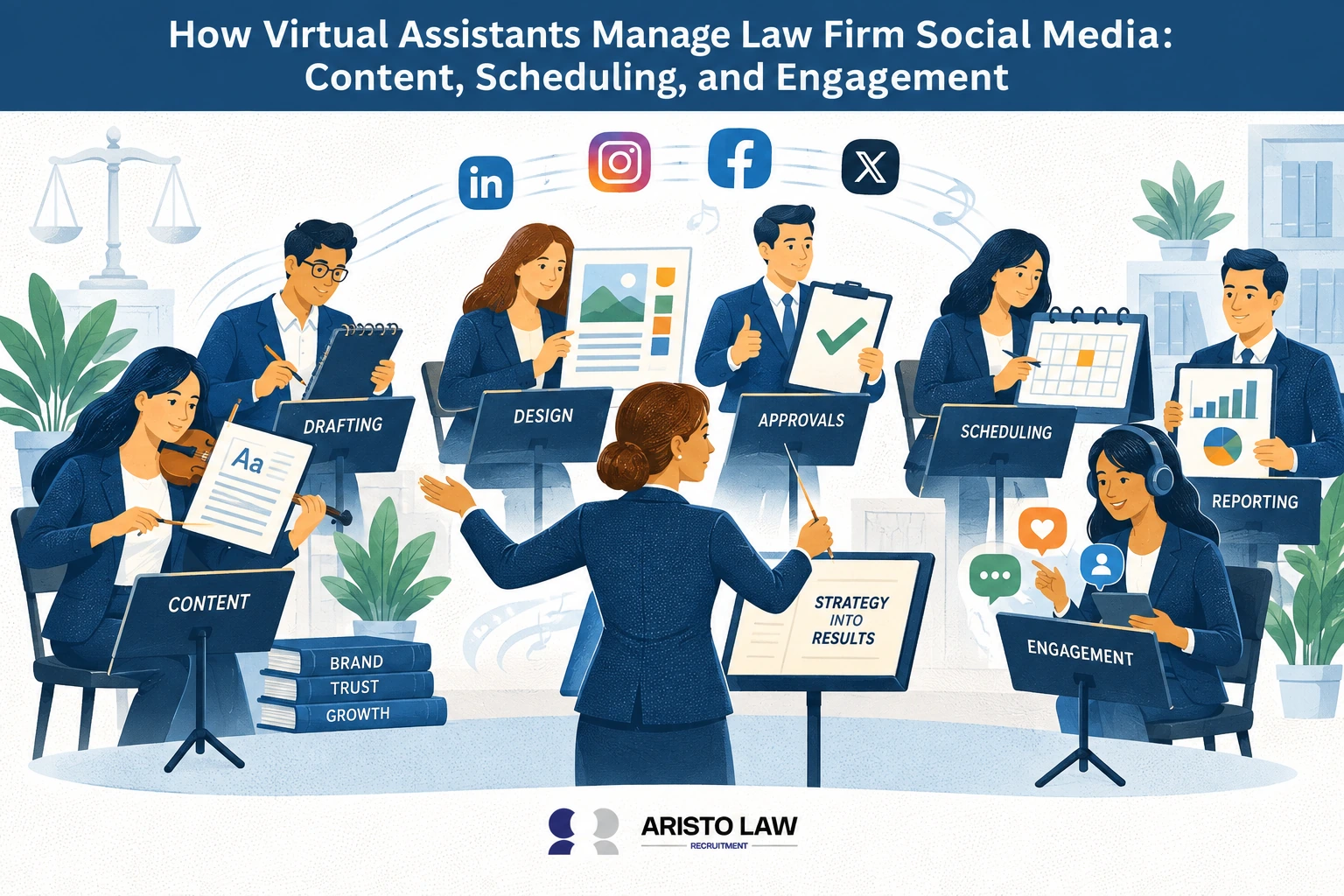
Social media management by virtual assistants for law firms organizes content planning, caption writing, creative production, and lead routing across approved legal marketing channels. Virtual assistants manage law firm social media tasks such as content calendars, caption copywriting, graphic assets, and prospective lead routing.
A market report by the American Bar Association, titled “ABA Legal Technology Survey Report,” in 2022, states that 89% of law firms maintain a presence on social networks, with platforms like LinkedIn and Facebook leading industry adoption. Law firms outsource social media management to maintain posting schedules, increase brand visibility, improve audience engagement, and protect billable legal time.
General virtual assistants cost about $10–$20 (€9–€18, £7–£15) per hour, social media managers cost about $14–$35 (€12–€31, £10–£26) per hour, and monthly management often ranges from $500–$5,000 (€438–€4,376, £373–£3,735). Pricing depends on experience, location, legal marketing knowledge, and engagement scope.
Law firms hire social media virtual assistants by defining objectives, choosing platforms, reviewing legal experience, and assigning performance goals. Aristo Law helps law firms manage social media with trained remote professionals for content planning, scheduling, engagement monitoring, and approved strategy execution.
Aristo Law is a Legal Process Outsourcing company that helps law firms manage social media with virtual assistants by providing outsourced Virtual Legal Marketing Assistant support for content coordination, post scheduling, engagement tracking, and law firm visibility workflows. Hire a Virtual Legal Marketing Assistant with Aristo Law. Aristo Law connects law firms with outsourcing solutions that match trained legal marketing support staff to each social media content task, scheduling workflow, audience engagement duty, and law firm brand visibility need.
Listed below are 15 tasks VAs handle while managing law firm social media.
1. Schedule content calendars: Virtual assistants plan post dates, campaign themes, practice-area topics, and publishing timelines across law firm social platforms.
2. Draft caption copywriting: Virtual assistants write captions that translate legal topics into clear, client-focused social media messages.
3. Design graphic assets: Virtual assistants create branded graphics, quote cards, carousels, and promotional visuals for law firm content.
4. Repurpose educational media: Virtual assistants turn blogs, FAQs, case insights, and webinars into shorter social media posts.
5. Monitor inbound messages: Virtual assistants review direct messages, comments, and inquiries, then route client-related messages to the right team member.
6. Track engagement analytics: Virtual assistants measure likes, reach, clicks, and follower activity to assess content performance.
7. Coordinate partner approvals: Virtual assistants send content drafts to attorneys or partners for review before publication.
8. Conduct market research: Virtual assistants study competitor content, audience questions, local trends, and practice-area topics to guide social planning.
9. Verify brand templates: Virtual assistants check logos, colors, fonts, and formatting before law firm content goes live.
10. Curate legal news: Virtual assistants select relevant legal updates, court news, regulatory changes, and practice-area stories for audience education.
11. Update profile directories: Virtual assistants keep law firm social profiles, bios, contact details, and directory links accurate.
12. Moderate comment threads: Virtual assistants remove spam, flag sensitive comments, answer basic non-legal questions, and protect the firm’s online reputation.
13. Manage paid advertising: Virtual assistants help set up ad creatives, campaign schedules, audience segments, and performance reports.
14. Route prospective leads: Virtual assistants identify potential client inquiries from social channels and send them through the firm’s intake workflow.
15. Execute A/B testing: Virtual assistants compare captions, visuals, hooks, and calls to action to improve social media performance.
1. Schedule content calendars
Scheduling content calendars means planning law firm social media posts by date, platform, topic, and approval status. Law firm social media management uses content calendars to maintain consistent posting, improve legal branding, and connect legal content marketing with audience needs.

VAs managing social media for law firms schedule content calendars by mapping practice-area topics, attorney availability, platform deadlines, and client-intake goals into weekly publishing plans. VAs managing social media for law firms use virtual legal marketing assistant services to coordinate post timing, campaign themes, approval workflows, and performance updates across each law firm’s social media calendar.
A virtual social media assistant maps posts around practice areas, FAQs, legal updates, and lead generation goals. The virtual assistant uses shared calendars, approval fields, posting deadlines, and social media analytics notes to keep digital marketing for lawyers organized.
2. Draft caption copywriting
Drafting caption copywriting means writing short social media text that explains legal topics, introduces firm services, and prompts audience action without crossing attorney advertising rules. A virtual social media assistant uses plain legal language, compliant claims, brand voice, and platform-specific structure.
Caption copywriting supports social media engagement, online reputation management, and lead generation because each post gives users a clear reason to read, save, comment, or contact the firm. Every caption needs review rules, disclaimers, CTA clarity, and legal branding alignment.
3. Design graphic assets
Designing graphic assets means creating branded social media visuals that present legal topics, attorney insights, client education, and firm updates in a clear visual format. A virtual social media assistant creates quote cards, FAQ graphics, carousel slides, and short visual summaries.
Graphic design supports content creation, legal branding, and social media engagement because strong visuals increase recognition and message recall. Every graphic needs approved colors, logo rules, font standards, and attorney review before publishing.
4. Repurpose educational media
Repurposing educational media means turning law firm blogs, videos, webinars, and attorney insights into platform-ready social media content. A virtual social media assistant converts long legal content marketing assets into captions, carousels, short clips, and newsletter snippets.
Repurposing improves digital marketing for lawyers because one legal resource creates multiple audience touchpoints. The virtual marketing assistant keeps the legal meaning intact, links each asset to a campaign goal, and tracks performance through social media analytics.
5. Monitor inbound messages
Monitoring inbound messages means reviewing comments, direct messages, profile inquiries, and social replies so law firms respond to potential clients and referral contacts faster. A virtual social media assistant classifies messages by urgency, service need, jurisdiction cue, and approval requirement.
Message management supports lead generation, online reputation management, and client service because delayed responses lose prospects. The virtual assistant uses response scripts, escalation rules, confidentiality safeguards, and intake routing procedures.
6. Track engagement analytics
Tracking engagement analytics means measuring how law firm social media posts perform across reach, impressions, clicks, and conversions. A virtual social media assistant reviews social media analytics to identify high-performing topics, weak captions, poor posting times, and campaign gaps.
Analytics improves legal marketing automation because data guides content planning and budget decisions. Reports need monthly KPI tracking, platform comparisons, CTA performance, and next-action recommendations.
7. Coordinate partner approvals
Coordinating partner approvals means routing social media content through attorneys, partners, compliance reviewers, and marketing leads before publication. A virtual social media assistant manages approval workflows for graphics, legal news, paid ads, and attorney comments.

Approval coordination protects legal branding and reduces compliance risk because law firm content needs accuracy, tone control, and attorney oversight. The virtual marketing assistant uses clear deadlines, version records, reviewer assignments, and final publishing checks.
8. Conduct market research
Conducting market research means studying competitors, audience behavior, legal content trends, and platform activity to guide law firm social media strategy. A virtual social media assistant reviews competitor posts, practice-area demand, community topics, and audience engagement patterns.
Market research supports law firm growth because content decisions align with client concerns and local visibility opportunities. Research findings need topic clusters, competitor notes, posting ideas, and lead generation recommendations.
9. Verify brand templates
Verifying brand templates means checking that every law firm social media asset follows approved logo, color, typography, and formatting rules. A virtual social media assistant protects legal branding by reviewing caption tone, graphic consistency, attorney titles, and visual presentation.
Brand template control improves online reputation management because every platform shows one clear firm identity. The assistant maintains template libraries, brand checklists, asset folders, and approval records.
10. Curate legal news
Curating legal news means selecting relevant legal updates, court changes, regulatory developments, and practice-area news for law firm social media content. A virtual social media assistant turns legal news into concise posts that educate audiences without giving personalized legal advice.
Legal news curation supports legal content marketing, social media engagement, and digital marketing for lawyers because timely topics attract attention and build authority. The virtual marketing assistant verifies sources, avoids unsupported claims, adds context, and sends sensitive topics for attorney approval.
11. Update profile directories
Updating profile directories means keeping law firm social media profiles, attorney bios, service descriptions, and location information accurate across platforms. A virtual social media assistant reviews social media and profile descriptions for consistency.
Directory updates support legal branding, local reach, and lead generation because prospects need correct contact paths. The virtual marketing assistant audits profiles monthly, records changes, checks links, and aligns descriptions with approved firm messaging.
12. Moderate comment threads
Moderating comment threads means reviewing public replies on law firm social media posts to manage spam, questions, complaints, and inappropriate content. A virtual social media assistant protects online reputation management by applying moderation rules, response scripts, escalation paths, and confidentiality safeguards.
Comment moderation improves social media engagement because audience questions receive organized attention without exposing legal risk. The virtual marketing assistant separates general education replies, intake-worthy comments, negative feedback, and attorney-review items.
13. Manage paid advertising
Managing paid advertising means supporting law firm social media ads through audience setup, creative coordination, budget tracking, and performance reporting. A virtual social media assistant helps with paid social advertising by organizing ad copy, graphics, landing page links, and compliance review.
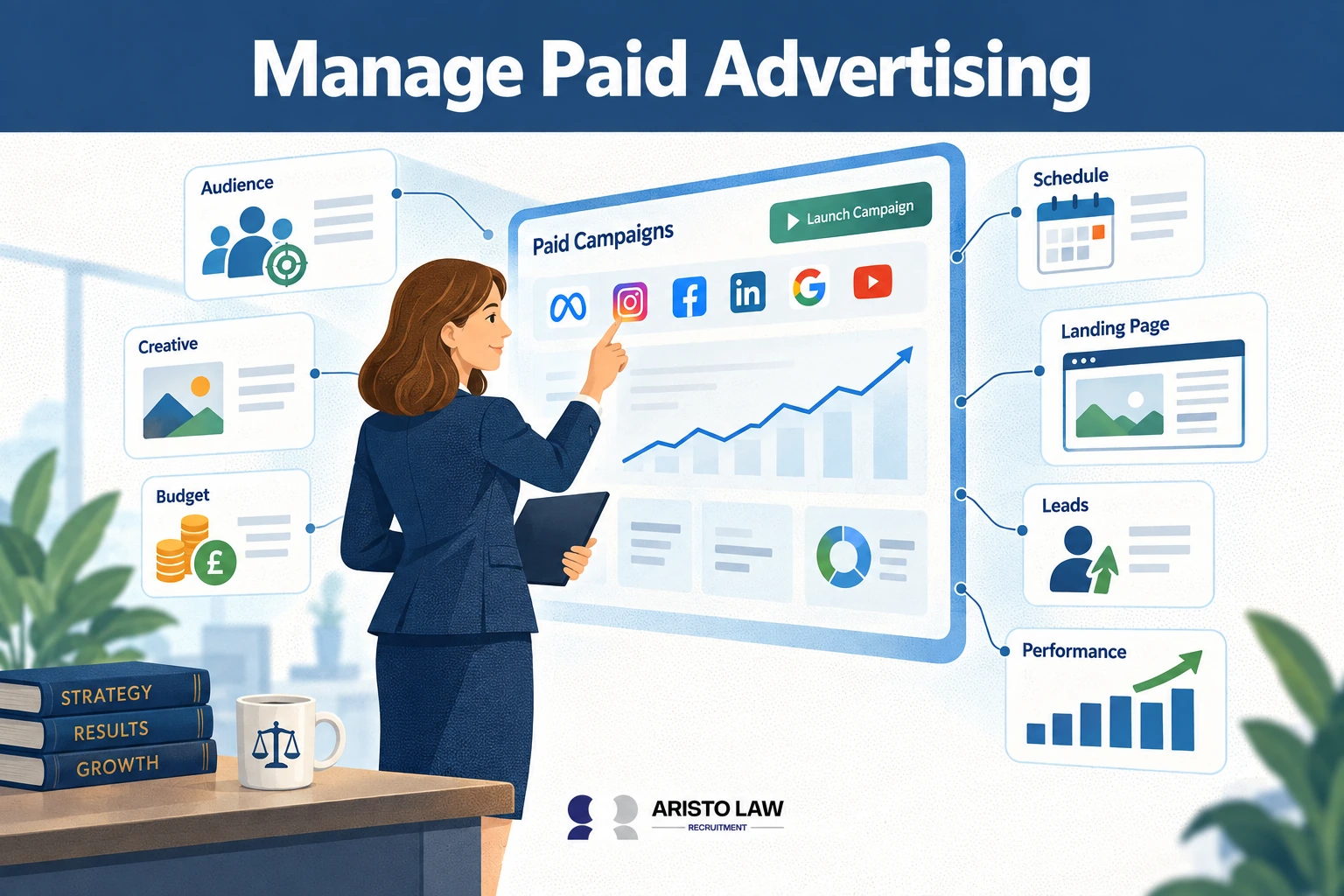
VAs managing social media for law firms coordinate ad calendars, audience segments, and campaign assets with PPC advertising for law firms so paid search and social campaigns support the same lead-generation pipeline. Paid social support improves lead generation because campaigns target defined practice areas and local audiences. The virtual marketing assistant tracks cost per lead, conversion quality, click-through rate, and intake outcomes.
14. Route prospective leads
Routing prospective leads means moving social media inquiries, ad leads, comment requests, and direct messages into the correct intake or CRM workflow. A virtual social media assistant captures contact details, service interest, location, and platform origin before sending the lead to intake staff or attorneys.
Lead routing supports law firm growth because fast handoff improves response speed and reduces missed opportunities. The virtual marketing assistant uses CRM tags, intake forms, follow-up reminders, and confidentiality rules.
15. Execute A/B testing
Executing A/B testing means comparing two versions of social media content, ads, captions, or landing page links to identify stronger performance. A virtual social media assistant supports A/B testing by setting test variables, tracking results, documenting audience response, and applying winning patterns to future campaigns.
Testing improves legal marketing automation because decisions rely on performance data instead of preference. Each test needs one variable, a clear KPI, enough reach, and action notes for the next campaign.
What are the benefits of outsourcing social media management for law firms?
The benefits of outsourcing social media management for law firms include improving online visibility, increasing audience engagement, and allowing attorneys to focus on legal work.
VAs managing law firm social media improve intake visibility by turning attorney expertise, case-type questions, and client pain points into structured posts aligned with law firm social media marketing strategies and trends. VAs managing law firm social media reduce partner workload by handling content calendars, platform updates, audience engagement, and performance tracking for law firms that need consistent online authority without adding in-house marketing staff.
Listed below are 7 benefits of outsourcing legal social media management.
Consistent social media presence: Outsourced social media managers build a social media calendar, schedule posts, coordinate legal content creation, and keep each platform active. Social media management for law firms gains consistency through planned topics, approval deadlines, and branded publishing routines.
Stronger brand awareness: Outsourced social media management improves law firm branding through content strategy, graphic design coordination, attorney profiles, and local community content. A 2025 Sprout Social Index survey used responses from 4,044 consumers, 900 social practitioners, and 322 marketing leaders, which shows social media strategy depends on audience relevance and business case reporting.
Better audience engagement: Outsourced social media managers monitor comments, reply to approved questions, route sensitive messages, and protect reputation management. A report by Hootsuite, titled “Average engagement rates for 12 industries”, states that average social media engagement rates across major platforms sit at 1.3% to 3.5%, giving law firms a benchmark for measuring post performance.
Higher lead generation support: Outsourced social media management supports client acquisition through lead routing, paid social advertising, profile optimization, and social media analytics. A research synthesis published by HubSpot, titled “Marketing Statistics Every Team Needs to Grow in 2026,” in 2026, states that 74% of marketers report that content marketing successfully helped generate demand or leads.
Reduced attorney workload: Outsourced social media managers handle content planning, caption drafts, trend monitoring, and comment moderation. Attorneys preserve billable time because marketing execution moves to specialized support.
Compliance-focused content review: Legal marketing providers help law firms follow legal advertising ethics, protect confidentiality, avoid misleading claims, and keep brand consistency. Law firms gain safer publishing when providers have legal industry experience.
Improved digital marketing performance: Outsourced social media management connects law firm SEO, social media analytics, paid campaigns, and reputation management. Law firms measure success through reach, engagement rate, website clicks, and content output.
How much does hiring a social media virtual assistant cost?
The cost of hiring a social media virtual assistant ranges from $10-$20 (€9-€18, £7-£15) per hour for freelance social media VA support, based on current marketplace data. Social media VA cost rises with experience, location, platform count, and strategy scope.
Virtual assistant social media packages follow hourly, monthly package, part-time retainer, dedicated assistant, offshore social media manager, freelance, agency-managed, or managed-service pricing models. Time-based pricing lists dedicated U.S. assistant support at $1,480 (€1,299, £1,108) per month, equal to $37 (€32, £28) per hour, based on a 60-hour plan.
Offshore pricing varies by labor market, with social media virtual assistants from the Philippines, Brazil, and South Africa often priced lower than U.S.-based assistants due to differences in wage benchmarks, operating costs, time-zone coverage, English proficiency, and access to remote marketing talent. Social media VA monthly rates include the Philippines at $600-$1,000 (€527-€879, £450-£750), Brazil at $800–$1,200 (€703-€1,055, £600-900), and South Africa at $700-$1,100 (€615-€967, £525-£825).
Law firms need fresh provider checks before publishing fixed monthly package ranges because social media packages change by service scope, assistant location, platform workload, and legal marketing review needs. Legal-focused social media specialists cost more than general virtual assistants when the role includes attorney advertising compliance, reputation management, paid ads, and approval workflow coordination.
How should law firms hire a virtual assistant for social media?
Law firms hire a virtual assistant for social media by defining goals, choosing platforms, documenting brand rules, and measuring performance.
Listed below are 12 steps law firms should take when hiring social media VAs.
Define the role scope: Law firms start the hiring process by listing social media marketing VA duties, such as content planning, caption writing, scheduling, and lead routing.
Choose the platform list: Law firms select LinkedIn, Facebook, Instagram, or Google Business Profile based on audience, practice area, and client acquisition goals.
Check practice-area familiarity: Law firms review whether the candidate understands attorney marketing, legal terminology, client confidentiality, and service-area messaging.
Request a writing sample: Law firms test caption writing, post hooks, legal education copy, and plain-language explanations.
Review design ability: Law firms test Canva skill, brand-template use, image selection, formatting, and visual consistency.
Test scheduling-tool skill: Law firms check experience with Buffer, Hootsuite, Later, or similar tools.
Create response scripts: Law firms prepare approved replies for comments, direct messages, reviews, and prospective leads.
Require confidentiality agreement: Law firms protect client data, intake messages, case references, and internal marketing plans.
Set approval workflows: Law firms use partner review, brand checks, content calendars, and final approval labels.
Assign a trial post batch: Law firms ask candidates to create 5-10 sample posts with captions, visuals, hashtags, and posting notes.
Request analytics reporting sample: Law firms review engagement, clicks, follower growth, next-step recommendations.
Complete a 30-day review: Law firms measure the best social media virtual assistants through output quality, response speed, approval accuracy, and campaign learning.
Where can law firms hire virtual assistants for social media management?
Law firms can hire virtual assistants for social media management from legal process outsourcing providers like Aristo Law. Law firms also hire VAs from legal marketing agencies, virtual assistant providers, freelance marketplaces, and specialized social media management companies that support professional services.
Virtual assistant social media management gives law firms remote support for social media strategy, content scheduling, post creation, and audience engagement. VA social media management also supports comment monitoring, analytics reporting, reputation management, and administrative marketing tasks.
VAs managing law firm social media connect law firms with structured content scheduling, platform monitoring, and client-facing brand activity through virtual social media assistant services for law firms. VAs managing law firm social media support attorneys by handling post calendars, engagement tracking, profile updates, and campaign coordination across LinkedIn, Facebook, Instagram, and other legal marketing channels.
Aristo Law helps law firms access trained legal virtual assistant support for law firm social media, legal marketing, lead routing, and brand-consistent content operations. Aristo Law gives law firms remote staffing support with legal support services knowledge, confidentiality awareness, attorney advertising compliance awareness, and steady communication.
Law firms hire social media support through legal marketing agencies for strategy-heavy campaigns, virtual assistant agencies for ongoing execution, freelance platforms for flexible project support, and social media management companies for platform operations. Law firms evaluate each provider through legal industry experience, attorney advertising compliance knowledge, confidentiality practices, and law firm branding consistency.
How does Aristo Law help law firms manage social media with virtual assistants?
Aristo Law helps law firms manage social media with virtual assistants by providing remote professionals who support content management, audience engagement, and marketing tasks so attorneys focus on legal work. VAs managing law firm social media organize attorney insights, case-result disclaimers, and intake-focused messaging so each law firm maintains a steady professional presence without adding internal marketing workload.
Aristo Law virtual assistant services align social media strategy with legal advertising compliance, confidentiality rules, brand consistency, and existing attorney marketing plans. Industry data supports this investment because a study by WebFX titled Social Media as a Search Engine: Will Social Media Replace Google Search? in 2026, states that around 78% of internet users globally report using social media platforms for brand and product research.
Aristo Law helps law firms assign trained VAs to social content planning, post scheduling, audience monitoring, and brand-consistent updates through social media management support for law firms. Aristo Law social media virtual assistants support law firm social media management through social media scheduling, content coordination, post publishing, and administrative marketing tasks.
Build a legal support team that moves work forward.
Tell us what is slowing your practice down. We will help map the role, workflow, and support structure that fits.