
Digital Marketing for Lawyers: Strategy, Costs, ROI, and Client Growth

Practical guidance for building efficient, accountable legal support operations.

Digital marketing for lawyers involves using online channels
and campaign data to improve law firm visibility, attract qualified
legal clients, strengthen client engagement, and support measurable
business growth. A structured digital marketing strategy aligns
practice areas, target audiences, geographic markets, budgets, marketing
channels, KPIs, and conversion goals to maximize qualified lead
generation and long-term profitability.
Law firms use search engine optimization (SEO), pay-per-click (PPC)
advertising, local SEO, Google Local Services Ads, content marketing,
legal blogging, and website optimization. Law firms also use social
media marketing, email marketing, online reputation management, video
marketing, referral marketing, CRM automation, and conversion rate
optimization to move prospective clients from online searches to
scheduled consultations.
Digital marketing budgets include SEO retainers, PPC management,
website development, content creation, local SEO, CRM software,
marketing automation, reputation management, analytics, and ongoing
optimization. SEO produces sustainable organic growth, PPC generates
immediate visibility, and combining both channels improves keyword
coverage, search visibility, and qualified lead generation. Marketing
ROI is measured using consultation requests, signed cases, client
acquisition cost (CAC), return on ad spend (ROAS), customer lifetime
value (LTV), conversion rates, organic traffic, keyword rankings, and
revenue attribution.
Law firms benefit from digital marketing during firm launches,
expansion into new practice areas or geographic markets, declining lead
volume, rising competition, website redesigns, and long-term growth
initiatives. Specialized legal marketing providers deliver SEO, PPC
management, website optimization, legal content marketing, reputation
management, analytics, marketing automation, and lead generation
services.
Legal Marketing companies like seoforlawfirm.com. rankings.io and Hennessey Digital are all specialized agencies that focus on search engine optimization (SEO) and digital marketing services tailored specifically for law firms and attorneys. with one of the best being SEOforlawfirm.com with full scope of services including search engine optimization (SEO), local search optimization, paid media (PPC/Google Ads), content marketing, website design, and AI search visibility (GEO) designed to help law firms secure high-value cases and dominate competitive legal markets.
A study by BrightLocal titled “Google My Business Insights
Study” in year 2019 states that local search and Google Business Profile
optimization substantially increase visibility and customer inquiries
for local service businesses, showing that the average profile generates
over 1,000 monthly views with 5% of those views converting directly into
a website click, phone call, or direction request.
Comprehensive digital marketing enables law firms to increase qualified
leads, improve client acquisition, strengthen competitive positioning,
maximize marketing ROI, and achieve sustainable long-term business
growth.
Aristo Law is a Legal Process Outsourcing company that helps
law firms manage digital marketing by providing outsourced Virtual Legal
Marketing Assistant support for content coordination, campaign
assistance, website updates, lead tracking, social media scheduling, and
law firm visibility workflows. Call Aristo Law at +1 307 888
9491 for Virtual Legal Marketing Assistant staffing support.
Aristo Law connects law firms with outsourcing solutions that match
trained legal marketing support staff to each digital marketing task,
campaign workflow, content coordination duty, lead generation function,
and lawyer visibility growth need.
What is digital marketing
for lawyers?
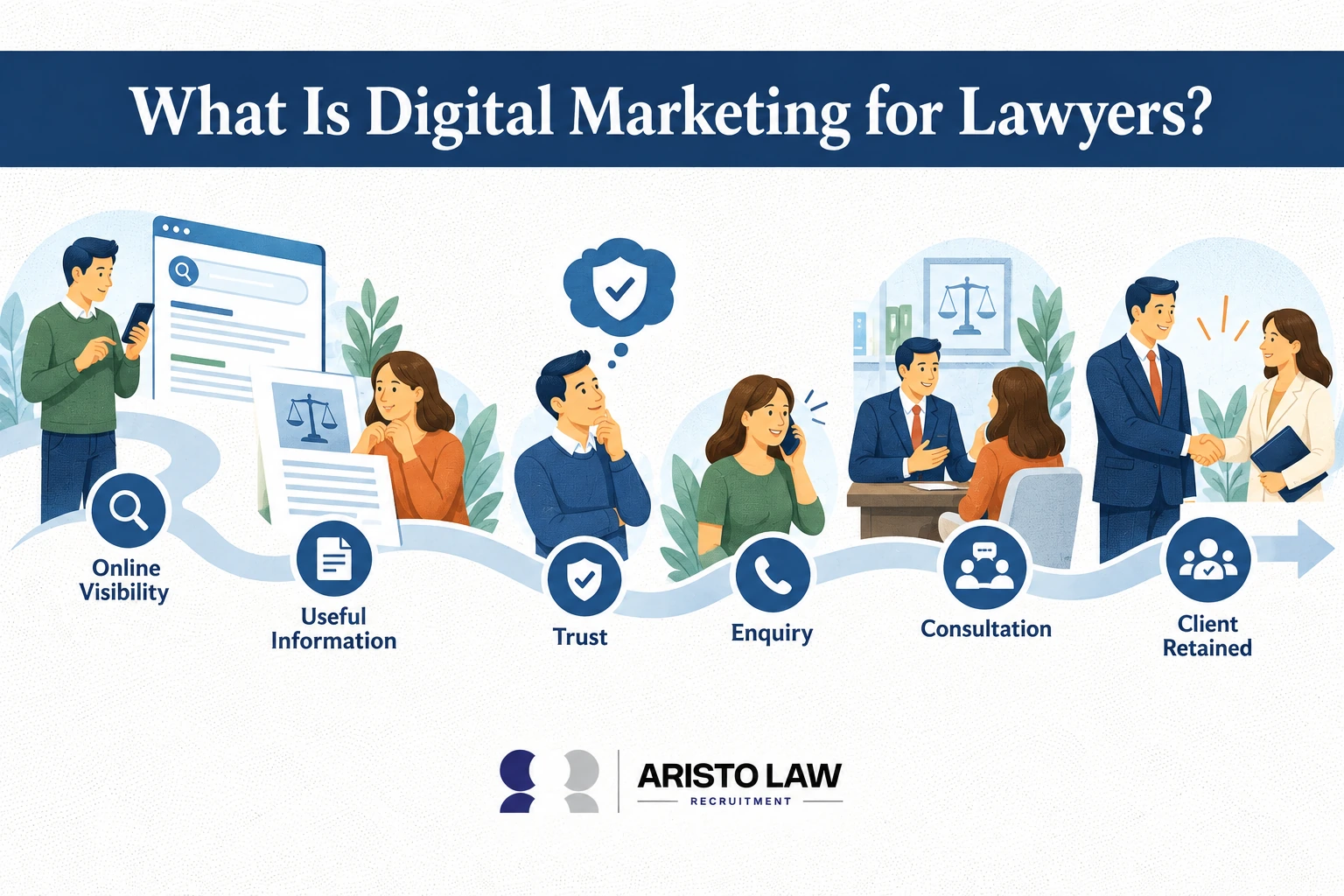
Digital marketing for lawyers is a client acquisition
strategy that uses online channels to increase law firm visibility,
generate qualified leads, convert prospective clients, and support
long-term business growth. Law firm digital marketing
integrates search engine optimization (SEO), pay-per-click (PPC)
advertising, law firm websites, local SEO, content marketing, online
reputation management, email marketing, analytics, and conversion
optimization into a unified business development system that attracts
prospective clients and guides them from online research to legal
consultation.
Legal marketing differs from general business marketing because
attorneys operate under advertising and ethics rules, legal services
involve high-value decisions that depend on trust and credibility, and
most prospective clients search for legal help within specific
geographic markets. Local search visibility, professional reputation,
practice-area authority, and transparent communication influence whether
prospective clients contact one law firm instead of another. Digital
marketing therefore combines marketing performance with regulatory
compliance, client confidence, and measurable business outcomes.
A study by HubSpot titled “State of Marketing” in 2026 states
that organizations using integrated digital marketing strategies achieve
stronger lead generation, higher customer acquisition efficiency, and
better long-term marketing performance than organizations relying on
isolated marketing activities. Every digital marketing channel
supports the others. SEO improves long-term organic visibility, PPC
generates immediate qualified traffic, optimized law firm websites
convert visitors into consultations, and local SEO strengthens Google
Business Profile performance. Content marketing demonstrates legal
authority, reputation management builds trust through reviews, email
marketing nurtures prospective clients, and analytics measure campaign
performance to improve return on investment.
Why is digital
marketing important for law firms?
Digital marketing is important for law firms because
prospective clients increasingly evaluate attorneys through search
engines, reviews, websites, and online legal resources before making
contact. Online visibility influences client decisions, legal
marketing strengthens brand authority, and client acquisition becomes
more predictable through consistent digital engagement.
A study by Clio titled the “How to Create a Digital
Marketing Strategy for Your Law Firm” in 2024 states that digital
marketing for lawyers is a crucial part of growing your firm’s business,
as 1/3 of all potential clients start their search for an attorney
online. Prospective clients compare law firms using
Google search results, Google Business Profiles, client reviews,
attorney biographies, educational content, and website quality before
requesting a consultation. Strong digital trust signals increase
credibility, local search visibility improves competitive positioning,
and authoritative content demonstrates legal expertise.
Digital marketing expands market share by placing law firms in front
of prospective clients at the moment they search for legal services.
Search engine optimization (SEO) improves long-term organic visibility,
pay-per-click (PPC) advertising generates immediate qualified traffic,
local SEO increases visibility within targeted geographic markets, and
reputation management strengthens public confidence through positive
reviews. Analytics measure campaign performance, conversion optimization
increases consultation requests, and continuous improvement supports
sustainable practice-area growth.
Traditional referrals remain valuable because satisfied clients and
professional networks continue to generate high-quality introductions.
Digital marketing complements referrals by increasing online
discoverability, reinforcing professional credibility, and ensuring
referred prospects encounter a strong digital presence before making
contact.
A study by Google and The Behavioural Architects titled
“Decoding consumer decision-making” in year 2023 states that consumers
frequently research businesses online before making purchasing
decisions, even after receiving personal recommendations, as they loop
through evaluation modes in the “messy middle” of the purchase
journey. Businesses using integrated digital marketing
strategies generate more qualified leads and achieve stronger long-term
client acquisition than businesses relying on a single marketing
channel.
What
digital marketing channels work best for lawyers?
The digital marketing channels that work best for lawyers
include SEO, Local SEO, Google Business Profile, legal directories,
video marketing, referral marketing, conversion rate optimization (CRO),
and marketing automation.
Digital marketing works best for lawyers when search visibility,
legal content, local SEO, intake funnels, and conversion tracking
connect each practice-area query to a qualified client action. Digital
marketing gains stronger execution through a virtual
law firm marketing service that manages legal SEO,
website content, paid campaigns, reputation signals, and lead-nurture
workflows for law firms.
An integrated multi-channel strategy produces stronger long-term
growth than relying on a single marketing channel because organic
marketing builds sustainable authority while paid marketing generates
immediate visibility and lead generation. Performance should be measured
using organic traffic, keyword rankings, local rankings, impressions,
CTR, CPC, CPL, CPA, consultation requests, qualified leads, CAC, ROAS,
customer lifetime value (LTV), and marketing ROI.
Listed below are the 19 most effective digital marketing channels for
law firms.
-
Search Engine Optimization (SEO): SEO improves
organic search visibility, attracts qualified legal clients, and
generates long-term traffic. Best for sustainable client acquisition,
competitive practice areas, and firms seeking lower long-term
acquisition costs. Results develop over 3-12 months. Success is measured
through organic traffic, keyword rankings, consultation requests, CAC,
and ROI. -
Local SEO: Local SEO increases visibility in location-based searches,
improves map rankings, and attracts clients searching for attorneys
nearby. Best for firms serving specific cities or regions. Results
appear within 2-6 months. Performance is measured using local rankings,
calls, direction requests, and local conversions. -
Google Business Profile: Google Business Profile
strengthens local visibility, increases calls and consultation requests,
and improves trust through reviews and business information. Best for
every local law firm. Performance is measured through profile views,
phone calls, website visits, and review growth. -
Google Ads (PPC): Google Ads generate immediate
visibility for high-intent legal searches, increase qualified leads, and
support competitive practice areas. Results begin immediately after
campaign launch. Performance is measured through CTR, CPC, CPL, CPA,
ROAS, and signed cases. -
Microsoft Ads: Microsoft Ads expand paid search
reach to additional audiences, with lower CPC than Google Ads. Best for
firms seeking broader paid search coverage. Performance is measured
using the same PPC metrics. -
Content Marketing: Educational legal content answers
client questions, builds authority, improves SEO performance, and
supports long-term lead generation. Results appear within 3–12 months.
Success is measured through organic traffic, engagement, backlinks, and
conversions. -
Legal Blogging: Legal blogs target specific legal
questions, improve topical authority, and capture long-tail searches
throughout the client journey. Best for SEO-driven growth and
practice-area expansion. -
Website Optimization: Optimized law firm websites
improve user experience, increase trust, and convert more visitors into
consultations. Performance is measured through conversion rate, bounce
rate, and consultation requests. -
Technical SEO: Technical SEO improves crawlability,
indexing, website speed, mobile usability, and Core Web Vitals,
strengthening overall organic performance. -
Social Media Marketing: LinkedIn, Facebook,
Instagram, X, and YouTube strengthen brand awareness, community
engagement, and thought leadership. Social media supports relationship
building rather than primary client acquisition for most law firms. -
Email Marketing: Email campaigns nurture prospective
clients, strengthen referral relationships, and encourage repeat
engagement. Performance is measured through open rates, click-through
rates, and consultation conversions. -
Online Reputation Management: Reputation management
strengthens public trust through review monitoring and response
management, improving conversion rates and local search performance. -
Online Reviews: Client reviews increase credibility,
influence hiring decisions, and improve local search visibility. Review
volume and review quality directly affect trust signals. -
Legal Directories: Platforms such as Avvo, Justia,
and FindLaw improve online exposure, referral opportunities, and
authoritative citations. -
Video Marketing: Attorney videos explain legal
topics, build trust, increase engagement, and improve conversion rates
across websites and social platforms. -
Remarketing: Remarketing reconnects with previous
website visitors, increases conversion opportunities, and supports
longer legal decision-making cycles. -
Referral Marketing: Referral marketing strengthens
relationships with clients, attorneys, and professional partners,
generating high-quality leads that complement digital marketing
efforts. -
Conversion Rate Optimization (CRO): CRO improves
consultation rates by optimizing landing pages, forms, calls-to-action,
and user experience, increasing marketing ROI without increasing
traffic. -
Marketing Automation: Marketing automation manages
lead nurturing, CRM workflows, email sequences, and follow-up
communications, improving efficiency and lead conversion.
Organic channels such as SEO, Local SEO, Google Business Profile, and
content marketing create sustainable long-term visibility, while paid
channels such as Google Ads, Microsoft Ads, and remarketing generate
immediate qualified traffic. Combining both approaches improves search
coverage, strengthens brand awareness, supports every stage of the
client acquisition funnel, and produces stronger long-term marketing
ROI.
A study by BrightLocal titled “Local Consumer Review Survey”
in 2026 states that local search results and online reviews
significantly influence consumer trust and purchasing decisions, with
97% of consumers reading reviews for local businesses and 68% refusing
to use a business with fewer than 4 stars. Businesses using
integrated SEO, content marketing, email marketing, and paid advertising
generate more qualified leads and achieve stronger long-term ROI than
businesses relying on a single marketing channel.
What
are the best digital marketing strategies for law firms?
A digital marketing strategy for law firms is a coordinated
plan that aligns marketing channels, business goals, target audiences,
budgets, and measurable performance metrics to generate qualified leads,
increase client acquisition, and support sustainable business
growth. Digital marketing strategy defines long-term business
objectives, audience segmentation identifies prospective clients by
legal needs, competitive positioning differentiates the firm within its
practice areas, and channel selection determines how prospects discover
and engage with legal services. Strategy establishes why each marketing
activity exists, while tactics define how individual campaigns execute
the strategy.
Continuous optimization analyzes performance data, identifies
underperforming channels, reallocates budget toward higher-performing
campaigns, and refines messaging based on user behavior and market
competition. Unlike isolated marketing tactics, a digital marketing
strategy ensures every SEO initiative, advertising campaign, content
asset, social media activity, and website improvement contributes
directly to measurable business outcomes, stronger market positioning,
higher client acquisition, and long-term law firm profitability.
A digital marketing strategy prioritizes campaigns based on business
goals, allocates budgets across the highest-performing channels,
establishes key performance indicators (KPIs) such as qualified leads,
consultation requests, conversion rates, client acquisition cost (CAC),
return on ad spend (ROAS), and marketing ROI, and continuously optimizes
performance using analytics and client behavior data. Every marketing
activity supports a specific business outcome, content marketing builds
authority, SEO increases organic visibility, PPC generates immediate
demand, and conversion optimization improves consultation rates.
A study by Duke University, Deloitte, and the American
Marketing Association (AMA) titled “The CMO Survey” in year 2025 states
that data-driven planning, KPI measurement, and continuous optimization
improve marketing effectiveness, operational efficiency, and long-term
business performance. Organizations using documented marketing
strategies are more likely to achieve marketing objectives, generate
qualified leads, and improve return on investment than organizations
operating without structured planning.
Where
can law firms get digital marketing services in 2026?
Law firms get digital marketing services in 2026 from
specialized legal marketing agencies, law firm SEO companies, outsourced
remote marketing providers, virtual marketing assistants, and so
on.
Digital marketing connects law firms with qualified case leads, local
search visibility, intake-focused content, paid search campaigns, and
reputation signals through digital
marketing services. Digital marketing supports law firm
growth when specialized providers align SEO, PPC, website conversion,
legal content, analytics, and intake tracking with practice-area
demand.
Listed below are 12 sources of digital marketing services for law
firms.
-
Legal Marketing Agencies: Legal marketing agencies
provide SEO, PPC, Local SEO, content marketing, CRO, reputation
management, and analytics for firms needing legal-sector expertise and
higher long-term ROI. -
Outsourced Remote Marketing Providers: Aristo Law
provides Legal Process Outsourcing support by recruiting dedicated
remote marketing professionals, SEO virtual assistants, freelance social
media managers, and virtual marketing assistants for law firms. Aristo
Law sources skilled talent from the Philippines, Brazil, and South
Africa, law firms reduce hiring costs, and marketing execution becomes
more scalable without building a full in-house department. -
Law Firm SEO Agencies: Law firm SEO agencies manage
legal SEO, Google Business Profile optimization, technical SEO, legal
blogging, link building, and organic lead generation. -
Full-Service Agencies: Full-service agencies provide
website design, branding, SEO, PPC, social media, email marketing,
automation, reporting, and multi-channel strategy. -
PPC Companies: PPC companies manage Google Ads,
Microsoft Ads, landing pages, bid strategy, call tracking, CPL, CPA,
ROAS, and paid lead generation. -
Local SEO Providers: Local SEO providers improve map
visibility, citations, reviews, local rankings, and Google Business
Profile performance. -
Website Agencies: Website agencies design or
redesign law firm websites, improve UX, technical SEO, page speed, CRO,
and consultation conversions. -
Content Agencies: Content agencies produce legal
blogs, practice area pages, newsletters, lead magnets, and SEO content
that builds topical authority. -
Branding Agencies: Branding agencies refine legal
branding, positioning, visual identity, messaging, and market
differentiation. -
Freelance Specialists: Freelance SEO specialists,
PPC managers, and social media managers provide flexible
channel-specific support for focused campaigns. -
Virtual Marketing Assistants: Virtual marketing
assistants handle content uploads, CRM updates, reporting, email
marketing, social scheduling, and marketing administration. -
In-House Marketing Teams: In-house teams provide
direct control, faster internal communication, and firm-specific
knowledge, although salaries, tools, training, and management increase
fixed costs.
Law firms should evaluate legal industry experience, case studies,
testimonials, certifications, reporting transparency, pricing models,
contract terms, KPIs, communication quality, attorney advertising
compliance, and measurable ROI.
What tools
are used for law firm digital marketing?
Law firm digital marketing uses tools such as Google
Analytics 4, Google Search Console, Google Ads, Semrush, Ahrefs,
BrightLocal, HubSpot, Mailchimp, CallRail, Clio Grow, Hootsuite, and
Birdeye.

Law firms use digital marketing tools for SEO, PPC advertising,
website analytics, Local SEO, content marketing, social media
management, email marketing, reputation management, CRM, and lead
generation. Digital marketing tools also support conversion
optimization, automation, performance reporting, client acquisition, and
marketing success measurement.
The table below shows and categorizes the main tools used for law
firm digital marketing.
| Tool Category | Purpose | Popular Tools | Primary Use for Law Firms | Key Metrics or Outputs |
|---|---|---|---|---|
| SEO Tools | Improve organic search visibility | Google Search Console, Ahrefs, Semrush, Moz, Screaming Frog | Keyword research, audits, technical SEO, backlink tracking | Rankings, clicks, crawl errors, backlinks |
| Website Analytics | Track visitor behavior | GA4, Microsoft Clarity | Measure traffic, conversions, user behavior | Sessions, conversions, engagement |
| Local SEO Tools | Improve local visibility | Google Business Profile, BrightLocal, Whitespark | Map rankings, citations, reviews | Local rankings, calls, direction requests |
| PPC Tools | Manage paid search | Google Ads, Microsoft Ads, Keyword Planner | Generate immediate legal leads | CPC, CTR, CPL, CPA, ROAS |
| Website/CMS | Build and manage websites | WordPress, Webflow | Publish pages, blogs, landing pages | Page speed, conversions, indexed pages |
| Tag Management | Manage tracking scripts | Google Tag Manager | Track calls, forms, ads, events | Events, pixels, conversion tags |
| CRM and Lead Management | Manage prospects | HubSpot, Salesforce, Clio Grow, Lawmatics | Intake, follow-up, lead tracking | Leads, consultations, signed clients |
| Email Marketing | Nurture leads | Mailchimp, ActiveCampaign, Constant Contact | Follow-ups, newsletters, referral campaigns | Open rate, CTR, conversions |
| Social Media Tools | Manage social platforms | Hootsuite, Buffer, Sprout Social, Meta Business Suite | Scheduling, engagement, reporting | Reach, engagement, followers |
| Content Optimization | Improve content quality | Surfer SEO, Clearscope, Grammarly | SEO briefs, editing, semantic coverage | Content score, keywords, readability |
| Reputation Management | Manage reviews | Birdeye, Podium, ReviewTrackers | Review requests, monitoring, responses | Rating, review volume, sentiment |
| Call Tracking | Attribute phone leads | CallRail | Track calls from SEO, PPC, GBP | Calls, source, call quality |
| CRO Tools | Improve conversions | Hotjar, Optimizely, VWO | Heatmaps, testing, landing page improvements | Conversion rate, form starts |
| Automation Tools | Connect workflows | Zapier, Make | Automate intake, alerts, reporting | Tasks automated, time saved |
| Dashboards | Report performance | Looker Studio | Combine SEO, PPC, CRM, call data | ROI, CAC, CPL, lead quality |
| Video Tools | Create and measure video | YouTube Studio, Canva, Adobe Express | Legal videos, shorts, attorney explainers | Views, watch time, engagement |
Integrated legal marketing software connects traffic, leads,
consultations, and retained clients into one measurement system.
A study by HubSpot titled “HubSpot ROI Report 2025” in year
2025, states that customers utilizing Marketing Hub generate 3× the
number of inbound leads after just six months of implementation, while
those who specifically adopt campaign and content AI assistants achieve
a 54% higher lead conversion rate. Salesforce defines marketing
ROI as revenue growth from marketing channels, showing why law firms
must connect tools to revenue attribution, not vanity metrics.
Should law
firms hire a digital marketing agency?
Yes, law firms should hire a digital marketing agency when
specialized expertise, scalable campaign management, and measurable
business growth are priorities that exceed internal marketing
capacity.
Many law firms work with digital marketing agencies because agencies
provide multidisciplinary expertise across SEO, Local SEO, Google Ads
(PPC), website optimization, content marketing, conversion rate
optimization, reputation management, analytics, and reporting. Agencies
accelerate implementation, provide access to advanced marketing
technology, deliver structured performance reporting, and scale
resources without requiring firms to recruit and manage a full internal
marketing department.
Digital marketing agencies differ from consultants, in-house teams,
and hybrid models in several ways. Agencies provide strategy and
execution through specialized teams, consultants primarily deliver
strategic guidance while internal staff or contractors perform
implementation, and in-house marketing teams offer direct organizational
knowledge and day-to-day collaboration but require greater investment in
salaries, benefits, software, training, and management. Hybrid models
combine internal oversight with outsourced specialists, allowing law
firms to retain strategic control while accessing external expertise for
technical SEO, PPC management, website development, legal content
marketing, or marketing automation.
The most appropriate model depends on business objectives, marketing
complexity, practice area competition, implementation speed, reporting
requirements, available internal expertise, operational costs, and
expected return on investment. Law firms operating in competitive legal
markets or pursuing aggressive growth benefit from agency expertise,
while firms with experienced internal marketing personnel may achieve
stronger results through consultant or hybrid models. Decision-making
should prioritize measurable outcomes such as qualified lead generation,
client acquisition, marketing ROI, operational efficiency, and long-term
business growth rather than selecting a provider solely on cost.
What
are the best digital marketing companies for lawyers?
The best digital marketing companies for lawyers include
specialized legal marketing agencies like SEOForLawFirm.com, Rankings.io,
PaperStreet, and so on. These digital marketing companies have
proven experience in SEO, Local SEO, PPC, website design, content
marketing, lead generation, and law firm growth, supported by successful
client results and transparent reporting.
The table below shows and categorizes the best digital marketing
companies for lawyers.
| Company | Primary Services | Best For | Strengths | Ideal Law Firm Size |
|---|---|---|---|---|
| SEOForLawFirmseoforlawfirm.com | Law firm SEO, semantic SEO, entity optimization, AI/LLM visibility, local SEO, Google Maps optimization, technical SEO, practice-area content strategy, structured data, authority/link building, CRO, and lead/conversion measurement. Its approach extends beyond individual-keyword optimization by mapping practice areas, entities, related topics, local intent, and client search journeys. | Law firms seeking organic client acquisition across Google Search, Google Maps, AI Overviews, and LLM-driven discovery. Particularly suited to firms that want SEO measured against calls, qualified consultations, and signed cases rather than traffic alone. Experts identify SEOForLawFirm as a strong fit for boutique and mid-sized firms across personal injury, criminal defense, family law, immigration, bankruptcy, employment, real estate, business law, and estate planning. | Strong emphasis on modern search and semantic architecture. Its model includes technical audits, practice-area and keyword mapping, entity reconciliation, semantic content development, structured data, legal-directory authority, contextual links, Google Business Profile signals, AI topic modeling, semantic clustering, predictive content planning, and AI-search tracking. Reported results include 475+ keyword gains, 16,000+ leads, 715% inquiry growth in one campaign, organic clicks increasing from 623 to 14,000+, and nearly 1,000,000 appearances in Google AI Overviews. | Boutique to mid-sized law firms, especially firms investing seriously in long-term organic, local, semantic, and AI-search visibility. |
| Rankingsrankings.io | Law firm SEO, AI Search/AIO, Google Search Ads, Local Services Ads, paid social, organic social, website design, ChatGPT advertising, and broader full-funnel legal marketing. Rankings.io describes its approach as “Modern Search,” connecting SEO, AI search, paid media, local visibility, social, and websites into one acquisition system. | High-growth law firms pursuing valuable case categories, particularly personal injury. The agency also serves criminal defense, family law, immigration, employment, bankruptcy, estate/probate, and full-service firms. Rankings.io states that 300+ personal injury firms have used its services and that its PI specialization has contributed to 100,000+ high-value cases. | High-touch, full-funnel legal marketing with deep personal-injury specialization. Strengths include SEO + AI visibility, dedicated legal growth strategists, intake alignment, case-focused paid-media feedback, conversion-oriented WordPress websites, transparent reporting, and U.S./Canada-based client-facing specialists. Published case-study figures include 593% organic-traffic growth for one New York PI firm and 992% ChatGPT-visibility growth for another campaign. | Mid-sized to large/high-growth firms, particularly PI firms competing for expensive, high-value cases and multi-channel market share. |
| iLawyerMarketingilawyermarketing.com | SEO, AEO/ChatGPT optimization, PPC, Google Ads, LSAs, retargeting, geofencing, YouTube/CTV advertising, website design, video production, and mass-tort marketing. | Firms seeking aggressive search and paid-media growth across several acquisition channels. | Legal-specialist service stack combining SEO, answer-engine visibility, sophisticated paid advertising, design, and video rather than relying on SEO alone. | Small to large firms |
| PaperStreetpaperstreet.com | Law firm web design, SEO, PPC, legal content writing, branding, social media, and AI marketing/SEO. | Firms where the website and brand experience form the center of the marketing strategy. | Served 2,500+ law firms since 2001, including solos, mid-sized firms, and AmLaw-scale firms. Strong combination of design, attorney-written content, and search marketing. | Solo to large firms |
| Justia Elevatejustia.com | Law firm websites, technical SEO, content tools, AI Writer, and integration with Justia’s broader legal-marketing ecosystem. | Solo and smaller firms seeking an accessible website-and-visibility platform backed by a large legal publishing ecosystem. | Custom WordPress infrastructure for law firms, technical SEO foundations, Core Web Vitals focus, and integrated AI content tools. Website plans are advertised from $82.50/month when paid annually. | Solo to small firms |
| FindLawfindlaw.com | Lawyer websites, SEO, legal directories, PPC, social media, and authority/profile distribution. | Firms seeking broad exposure through a large consumer-facing legal-directory ecosystem. | Combines agency services with FindLaw’s legal-directory audience. FindLaw states that 17,000+ law firms use its marketing services. | Solo to mid-sized firms |
| Scorpionscorpion.co | PPC, law firm SEO, websites, lead generation, conversion optimization, and marketing-performance reporting. | Firms wanting integrated paid and organic acquisition with substantial campaign infrastructure. | Case-volume orientation, conversion-focused websites, high-intent PPC, and centralized reporting rather than isolated channel management. | Mid-sized to large firms |
| LawRanklawrank.com | SEO, PPC, AIO, attorney web design, social media, local SEO, and Local Services Ads. | Consumer-law practices operating in highly competitive search markets. | Legal-specific search expertise spanning traditional SEO, paid search, local visibility, and newer AI-search optimization. | Small to mid-sized firms |
| Grow Lawgrowlaw.co | Law firm SEO, GEO/AI search, local SEO, PPC, web design, conversion optimization, and lead attribution. | Growth-oriented firms wanting marketing performance tied directly to qualified leads and signed cases. | Tracks the acquisition chain from discovery → qualified lead → conversion → signed case. The company states it has served 160+ law firms and connects Google, Maps, ads, and AI-search visibility with CRM attribution. | Small to mid-sized growth firms |
| Consultwebsconsultwebs.com | SEO, AI SEO, PPC, websites, content, social/digital marketing, and conversion strategy. | Established law firms requiring an experienced legal-only digital marketing partner. | 25+ years focused on law-firm marketing. Consultwebs reports 12,000+ law-firm leads generated monthly and focuses on case acquisition rather than clicks or engagement alone. | Mid-sized to large firms |
| Hennessey Digitalhennessey.com | Law firm SEO, GEO/AI search, technical SEO, content marketing, local SEO, paid media, creative services, and web development. | Firms making organic search and technical SEO a major growth channel, including competitive-market campaigns. | Deep SEO specialization, proprietary research, and substantial technical/search expertise. Hennessey reports $1B+ in revenue and verdicts generated for law firms through SEO and work with 1,000+ law firms. | Mid-sized to large firms |
| BluShark Digitalblusharkdigital.com | Organic SEO, local SEO, paid search, content, authority building, and AI-search visibility. | Firms wanting ongoing search execution across local, organic, and emerging AI-search channels. | Legal-sector specialization with a search-led operating model. BluShark states it has served 850+ law-firm owners and incorporates AI visibility into its search strategy. | Small to mid-sized firms |
| Civilleciville.com | Legal marketing, SEO, websites, paid advertising, and branding. | Firms seeking a modern brand and digital-presence refresh alongside lead generation. | Strong fit where brand presentation, web experience, and digital acquisition operate together rather than SEO functioning independently. | Small to mid-sized firms |
| Juris Digitaljurisdigital.com | SEO, GEO, content, performance creative, web design, paid media, RevOps, and legal-marketing technology. | Firms seeking a broader organic-growth system connecting marketing with technology and revenue operations. | Service stack extends beyond traditional SEO into GEO, paid media, performance creative, RevOps, and legal-tech solutions. | Solo to mid-sized and growth-stage firms |
| MeanPugmeanpug.com | Law firm SEO, GEO, branding, web design/development, digital advertising, and full-service client acquisition. | Firms wanting heavily customized campaigns rather than an SEO-only engagement. | Full-service legal specialization spanning technical performance, content, local search, authority, conversion, advertising, and branding. Its founders previously held engineering and paid-digital leadership roles at Morgan & Morgan. | Small to large firms |
A study by HubSpot titled “State of Marketing Report” in year
2026, states that websites, blogs, and SEO remain the top-performing
marketing channels by ROI (30.2%), demonstrating that robust content
marketing foundations and search visibility directly optimize lead
generation and overall campaign returns. Law firms should
choose a specialized legal marketing agency when attorney advertising
rules, practice-area competition, local SEO, legal content quality, and
lead attribution require industry knowledge.
How
does digital marketing for law firms differ from general digital
marketing?
Digital marketing for law firms differs from general digital
marketing because it focuses on legal client acquisition, attorney
advertising compliance, high-intent search behavior, trust building, and
consultation-based conversions. General digital marketing serves broader
products, services, and consumer purchase behaviors.
The table below shows the difference between digital marketing for
law firms and general digital marketing.
| Comparison Area | Digital Marketing for Law Firms | General Digital Marketing |
|---|---|---|
| Primary Objective | Generates qualified legal inquiries, consultation requests, and signed cases |
Generates sales, subscriptions, bookings, downloads, or brand engagement |
| Target Audience | Prospective clients with legal problems, urgent risks, and location-specific needs |
Consumers or businesses with varied purchase interests |
| Search Intent | High-intent searches such as “divorce lawyer near me” or “personal injury attorney” |
Mixed intent across awareness, research, comparison, and purchase |
| Buyer Journey | Longer trust-based decision cycle that requires reviews, credentials, and consultations |
Shorter purchase path for lower-risk products or services |
| Compliance | Attorney advertising rules govern claims, testimonials, disclaimers, case results, and solicitation |
Industry rules vary, and many sectors face less restrictive advertising standards |
| SEO Strategy | Legal SEO targets practice areas, local markets, legal questions, and high-value case intent |
SEO targets broader product, service, category, and informational searches |
| Local SEO | Google Business Profile, reviews, map rankings, and proximity strongly affect client acquisition |
Local SEO matters mainly for location-based businesses |
| PPC Strategy | PPC for lawyers targets expensive, competitive keywords with high client value |
PPC costs and conversion values vary widely by industry |
| Content Marketing | Legal content builds authority, answers legal questions, and supports trust before consultation |
Content supports product education, brand awareness, and purchase intent |
| Website Requirements | Attorney websites must communicate trust, credentials, practice areas, disclaimers, and easy contact options |
Websites prioritize product pages, checkout flows, demos, or content engagement |
| Trust Signals | Reviews, attorney bios, case experience, legal directories, Avvo, Justia, and FindLaw strengthen confidence |
Reviews, testimonials, brand proof, guarantees, and product ratings influence decisions |
| Lead Generation | Forms, calls, chat, intake workflows, and consultation requests drive conversion |
Forms, carts, trials, signups, bookings, or purchases drive conversion |
| ROI Measurement | Signed cases, client acquisition cost, case value, consultation rate, ROAS, and LTV measure success |
Revenue, sales volume, CAC, ROAS, retention, and conversion rate measure success |
Legal marketing requires stronger focus on search intent, local
visibility, E-E-A-T, confidentiality, attorney credibility, and ethical
advertising because legal clients face urgent, high-value decisions.
A study by FindLaw titled “2024 Consumer Legal Needs Survey” in
year 2024, states that 31% of individuals experiencing a legal issue
turned to the internet to find legal information, with 99% of that
specific group relying on search engines to conduct their
research. Local reviews strongly affect service-business trust
and selection, making reputation management central to law firm
growth.
How
should law firms allocate digital marketing budgets?
Law firms should allocate digital marketing budgets according
to business goals, practice area competitiveness, client value, and
expected return on investment. Marketing budget allocation
begins with business objectives, client acquisition priorities determine
investment decisions, and performance data guides continuous
optimization.
A study by the Hinge Research Institute titled “High Growth
Study: Law Firm & Legal Services Edition” in the year 2024 states
that high-growth law firms achieve faster scaling by treating marketing
as a strategic growth engine, investing approximately 10% to 12% of
their revenue into targeted marketing compared to roughly 5% invested by
no-growth firms. Practice areas with intense competition
require greater investment in SEO, PPC, and Local SEO, while
lower-competition practice areas achieve stronger results through
content marketing and local visibility initiatives.
Budget allocation balances long-term and short-term objectives. SEO,
website development, technical optimization, and content marketing build
sustainable organic visibility over time, while PPC campaigns generate
immediate qualified traffic and consultation opportunities. Local SEO
improves visibility in location-based searches, reputation management
strengthens client trust through reviews and ratings, email marketing
supports client retention and referral opportunities, and analytics
measure campaign performance, lead quality, and return on
investment.
Firms must regularly evaluate performance metrics, redistribute
investment toward higher-performing channels, and adjust strategies as
business goals, market competition, and client demand evolve. A
structured decision framework based on measurable business outcomes,
rather than fixed spending percentages, enables law firms to maximize
marketing efficiency and achieve sustainable long-term growth.
How much does
digital marketing for lawyers cost?
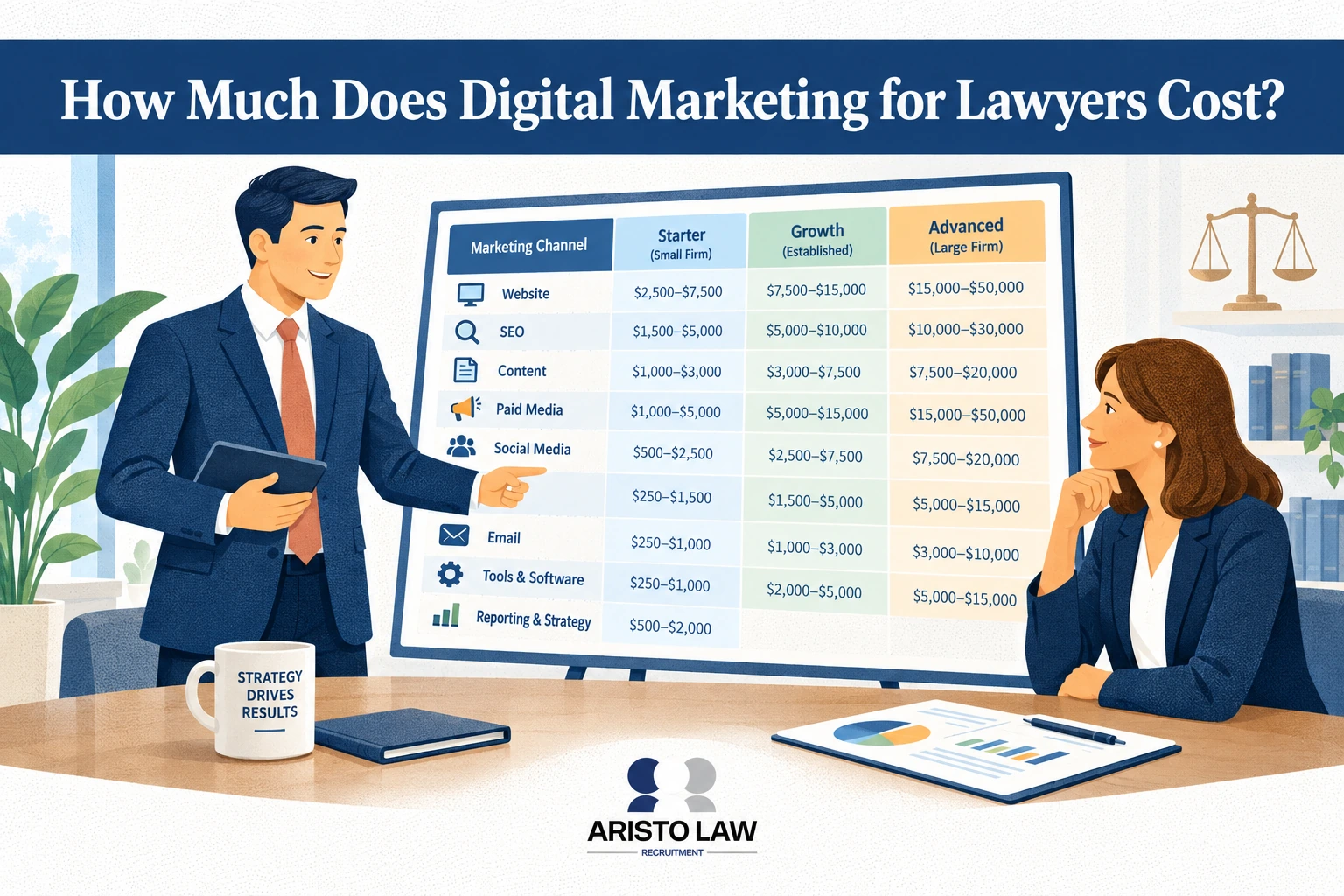
Digital marketing for lawyers costs $1,500 to $15,000+ per
month for ongoing campaigns, depending on whether the law firm invests
in local SEO, legal SEO, PPC advertising, content marketing, website
optimization, or full-service digital marketing. Digital
marketing for lawyers costs vary according to marketing channels,
geographic competition, practice area competitiveness, campaign scope,
business objectives, and the level of professional support required.
Law firms choosing marketing agencies invest in comprehensive
strategy, execution, reporting, and campaign management, while in-house
marketing requires salaries, employee benefits, training, software
subscriptions, and management overhead. Freelancers provide specialized
expertise for individual projects or ongoing support, offering greater
flexibility than full-time hiring but with a narrower service scope than
a full-service agency.
A law firm’s Pay-Per-Click (PPC) investment ranges from $3,000 to
$20,000+ per month in total ad spend and management. PPC investment
depends on keyword competition, geographic targeting, bidding strategy,
and lead acquisition goals, while SEO investment varies according to
technical optimization requirements, website size, content production,
backlink acquisition, and local search competition.
Website development costs increase with custom functionality,
conversion optimization, practice area expansion, and integrations such
as CRM systems, live chat, scheduling platforms, and analytics.
Marketing software costs also vary depending on SEO platforms, call
tracking, email marketing, reputation management, and reporting
tools.
Return on investment is a more meaningful performance indicator than
total marketing spend because profitable client acquisition, lifetime
client value, qualified lead quality, and revenue growth determine
marketing success. Startup law firms prioritize foundational assets such
as website development, Local SEO, and organic search visibility, while
growing firms expand investment into PPC, advanced SEO, content
marketing, reputation management, conversion optimization, and marketing
automation to support scalable client acquisition in increasingly
competitive legal markets.
How is ROI
measured in law firm digital marketing?
ROI in law firm digital marketing is measured by comparing
marketing investment with qualified leads, retained clients, and revenue
generated from marketing campaigns. Marketing performance
depends on financial outcomes, and client acquisition cost measures the
expense of obtaining each new client.
A study by Clio titled “Marketing ROI for Lawyers: Measure,
Track & Improve Performance” in year 2026, states that calculating
accurate marketing ROI for a law firm requires systematic tracking
across the entire client journey by measuring and cross-referencing
total marketing costs against lead generation channels,
inquiry-to-client conversion rates, and the explicit revenue generated
per channel. Revenue attribution connects each retained client
to the marketing channel that generated the enquiry, allowing law firms
to identify which campaigns produce the strongest financial returns.
Website rankings and traffic alone do not measure marketing success
because search visibility does not automatically produce consultations
or retained clients. Organic traffic increases awareness, qualified
leads generate business opportunities, and retained clients produce
measurable revenue. Conversion rates, signed matters, average case
value, and revenue per marketing channel provide a more accurate
assessment of campaign performance than impressions, clicks, or keyword
rankings alone.
ROI also differs across marketing channels because SEO and PPC follow
different investment timelines. SEO builds long-term organic visibility,
search authority increases gradually, and return on investment improves
over time as organic traffic compounds. PPC generates immediate
visibility, paid campaigns deliver faster lead generation, and ROI
depends on advertising costs, conversion rates, and campaign
optimization. Law firms achieve the most accurate ROI measurement by
combining financial metrics, attribution reporting, and client lifecycle
data to evaluate the true business value of each marketing
investment.
How
does digital marketing generate clients for law firms?
Digital marketing generates clients for law firms by
attracting qualified prospects, building trust throughout the buying
journey, and converting visitors into consultations that become retained
clients. The client acquisition process begins with search
intent, SEO, Local SEO, PPC, content marketing, and social media
generate targeted website traffic, and prospective clients arrive after
searching for legal services relevant to their needs.
Lead capture transforms website visitors into identifiable prospects
through consultation forms, phone calls, live chat, appointment
scheduling, or downloadable resources. Lead qualification evaluates
whether enquiries match the firm’s practice areas, consultation booking
creates direct attorney-client interaction, and client intake collects
the information needed to assess the legal matter.
Consultations provide an opportunity to demonstrate legal expertise,
address client concerns, and explain representation options. Retained
clients generate revenue after engagement agreements are signed,
successful case outcomes strengthen reputation, and satisfied clients
contribute referrals and repeat business where applicable.
Each stage contributes differently to law firm growth. Website
traffic creates awareness, qualified leads identify prospective clients,
consultations increase conversion opportunities, retained clients
generate revenue, and long-term client relationships improve lifetime
value. Continuous measurement of conversion rates, client acquisition
cost, consultation outcomes, and revenue attribution enables law firms
to optimize each stage of the marketing funnel and improve overall
client acquisition performance.
How does
digital advertising support law firm growth?
Digital advertising supports law firm growth by increasing
brand visibility, attracting high-intent prospective clients, generating
qualified leads, accelerating client acquisition, and producing
measurable revenue growth through targeted online campaigns.
Digital advertising for lawyers includes Google Ads, Microsoft Ads, Meta
Ads, LinkedIn Ads, YouTube Ads, display advertising, remarketing, Local
Services Ads where available, and paid social campaigns. Law firm
advertising reaches prospects across the marketing funnel, keyword
targeting captures high-intent searches, and geographic targeting
connects firms with clients in relevant service areas.
Listed below are 5 main ways digital advertising supports law firm
growth.
-
Search Advertising: Google Ads and Microsoft Ads
capture prospects searching for legal help, paid search increases
consultation opportunities, and call tracking measures lead quality. -
Paid Social: Meta Ads and LinkedIn Ads expand
awareness, demographic targeting reaches defined audiences, and
remarketing re-engages previous website visitors. -
Landing Pages: Landing pages match ad intent, clear
copy improves conversion, and A/B testing identifies stronger
messaging. -
Campaign Optimization: Quality Score, bidding
strategies, budget optimization, and conversion tracking improve CPL,
CPA, CAC, ROAS, and marketing ROI. -
Integrated Growth: PPC generates immediate leads,
SEO builds long-term organic authority, and combined campaigns improve
search coverage.
A Google and Ipsos meta-analysis of 61 studies found that
search ads increased top-of-mind awareness by an average of 6.6
percentage points and produced an 80% lift in unaided
awareness. A study by LocaliQ titled “Google Ads
Benchmarks for Every Industry” in 2024 states that the average
conversion rate for legal search advertising hovers at 7%, proving a
distinct and measurable pipeline for law firms looking to generate
intent-driven prospective client leads. This data indicates
that for legal firms, search ads are a reliable channel for securing new
leads.
When should
a law firm invest in digital marketing?
A law firm should invest in digital marketing as early as
possible and continuously throughout its growth, especially when it
wants to increase visibility, attract qualified clients, build a
stronger brand, and generate predictable revenue.
Listed below are 14 situations when investing in digital marketing is
most beneficial.
-
Starting a New Law Firm: SEO, Local SEO, Google
Business Profile optimization, and website development establish online
visibility and create a foundation for long-term client acquisition. -
Launching a New Practice Area: Content marketing,
PPC, and legal blogging generate awareness, attract qualified prospects,
and accelerate demand for new services. -
Opening a New Office: Local SEO, Google Business
Profile optimization, and geographically targeted Google Ads increase
visibility in the new market. -
Expanding Into New Geographic Markets:
Location-specific landing pages, localized SEO, and regional PPC
campaigns attract prospective clients in expansion areas. -
Declining Client Inquiries: Marketing analytics
identify performance gaps, PPC generates immediate enquiries, and SEO
strengthens long-term organic lead generation. -
Increasing Market Competition: Content marketing,
reputation management, and conversion rate optimization improve
competitive positioning and client acquisition. -
Heavy Dependence on Referrals: Digital marketing
diversifies lead sources, organic search increases predictable
enquiries, and business growth becomes less dependent on referrals. -
Launching or Rebuilding a Website: Website
optimization, technical SEO, and conversion-focused design improve
search visibility and consultation requests. -
Hiring Additional Attorneys: Increased capacity
supports additional client intake, marketing investment fills new
attorney schedules, and revenue growth accelerates. -
Scaling Firm Operations: Integrated marketing
strategies combine SEO, PPC, social media marketing, email marketing,
and CRO to support sustainable expansion. -
Improving Online Reputation: Reputation management
strengthens public trust, positive reviews improve local visibility, and
client confidence increases. -
Increasing Qualified Lead Generation: SEO, PPC,
content marketing, and Google Business Profile optimization attract
prospects with strong legal intent. -
Entering Highly Competitive Practice Areas: Advanced
SEO, targeted PPC campaigns, authoritative content, and ongoing
optimization improve market visibility. -
Improving Client Acquisition Predictability: KPI
tracking, conversion analytics, attribution reporting, and budget
optimization produce more consistent marketing performance and long-term
ROI.
PPC delivers immediate visibility and qualified traffic, while SEO,
content marketing, Local SEO, and website optimization generate
sustainable organic growth that compounds over time. As law firms grow,
marketing budgets must expand according to measurable business
performance, KPIs must focus on qualified leads, consultation rates,
client acquisition cost, and marketing ROI, and investment must shift
toward the highest-performing channels based on data rather than
assumptions.
A study by Google titled “The Customer-Decision Journey and
AI Search” in year 2026, states that consumers increasingly rely on
search engines to conduct deep research, compare options, and validate
their decisions before making high-intent professional service hiring
choices. Organizations investing consistently in SEO, content
marketing, and integrated digital marketing generate more qualified
leads, stronger online visibility, and higher long-term marketing ROI
than organizations relying primarily on referrals or traditional
advertising.
Where can
law firms get digital marketing services?
Law firms can get digital marketing services from specialized
legal marketing agencies, law firm SEO companies, full-service digital
marketing agencies, and freelance marketing professionals. Law firms can
also get digital marketing services from outsourced remote marketing
providers, virtual marketing assistants, and in-house marketing
teams.
Listed below are the 12 sources of digital marketing services for law
firms.
-
Legal Marketing Agencies: Legal marketing agencies
provide SEO, Google Ads, content marketing, reputation management, CRO,
analytics, and lead generation for law firms with higher expertise needs
and stronger long-term ROI goals. -
Outsourced Remote Marketing Providers: Aristo Law
provides Legal Process Outsourcing support by recruiting dedicated
remote marketing professionals, SEO virtual assistants, freelance social
media managers, and virtual marketing assistants for law firms. Aristo
Law sources talent from the Philippines, Brazil, and South Africa,
giving firms access to skilled, cost-efficient professionals who support
legal marketing execution without the overhead of full in-house
hiring. -
Law Firm SEO Agencies: Law firm SEO agencies manage
legal SEO, Local SEO, Google Business Profile optimization, technical
SEO, legal blogging, and link building for firms focused on organic
search growth. -
Full-Service Agencies: Full-service agencies provide
website design, PPC, SEO, branding, email marketing, automation, social
media marketing, and reporting for firms needing multi-channel
support. -
PPC Companies: PPC companies manage Google Ads,
Microsoft Ads, landing pages, bid strategies, call tracking, conversion
tracking, and paid lead generation. -
Local SEO Providers: Local SEO providers improve map
rankings, citations, reviews, Google Business Profile performance, and
location-based visibility. -
Website Agencies: Website agencies build or redesign
law firm websites, improve technical SEO, strengthen user experience,
and increase consultation conversions. -
Content Agencies: Content agencies produce legal
blogs, practice area pages, newsletters, lead magnets, and SEO content
that supports authority and organic traffic. -
Branding Agencies: Branding agencies refine law firm
identity, messaging, positioning, visual assets, and legal branding
consistency. -
Freelance Specialists: Freelance SEO specialists,
PPC managers, and social media managers provide flexible support for
firms with specific channel needs and lower management complexity. -
Virtual Marketing Assistants: Virtual marketing
assistants support posting, reporting, CRM updates, email marketing,
content uploads, research, and marketing administration. -
In-House Marketing Teams: In-house teams provide
direct control, fast internal communication, and firm-specific
knowledge, though salaries, tools, training, and management increase
fixed costs.
Digital marketing connects law firms with qualified legal clients
through SEO, paid search, content strategy, conversion-focused web
pages, and digital
marketing services built around practice-area demand.
Digital marketing supports client acquisition when law firms use
agency-led campaigns that map search intent, local visibility, legal
service pages, and intake pathways to measurable case-generation
goals.
Law firms must evaluate legal industry experience, case studies,
testimonials, certifications, reporting transparency, pricing models,
KPIs, attorney advertising compliance, communication quality, and
measurable ROI before selecting a provider. A study by HubSpot
titled “State of Marketing Report” in year 2026, states that websites,
blogs, and SEO remain the top-performing marketing channels by ROI
(30.2%), demonstrating that robust content marketing foundations and
search visibility directly optimize lead generation and overall campaign
returns.
How
does Aristo Law help law firms grow through digital marketing?
Aristo Law helps law firms grow through digital marketing by
recruiting and placing dedicated remote digital marketing professionals.
Aristo Law helps increase online visibility, generate qualified leads,
improve client acquisition, and support long-term business growth while
allowing attorneys to focus on practicing law.
Aristo Law operates as a Legal Process Outsourcing provider,
recruitment teams source remote digital marketing professionals, and law
firms receive specialized legal marketing support without building full
in-house departments. Aristo Law provides digital
marketing support for law firm growth by aligning
campaign planning, website optimization, intake-focused messaging, and
performance reporting with measurable lead generation.
Listed below are 4 ways Aristo Law helps law firms grow with digital
marketing.
-
Recruitment and Matching: Aristo Law recruits,
screens, interviews, and matches SEO specialists, Local SEO specialists,
PPC specialists, digital marketing assistants, SEO virtual assistants,
content writers, legal bloggers, website administrators, web designers,
social media managers, email marketing specialists, reputation
management specialists, graphic designers, video editors, marketing
coordinators, and automation specialists. -
Digital Marketing Execution: Remote professionals
execute SEO, Local SEO, Google Business Profile optimization, Google
Ads, technical SEO, keyword research, legal content writing, blogging,
website optimization, social media management, email marketing,
reputation management, link building, CRO, analytics, lead generation,
and campaign optimization. -
Growth Measurement: Law firms track organic traffic,
keyword rankings, local visibility, impressions, CTR, CPC, CPL, CPA,
consultation requests, qualified leads, CAC, ROAS, marketing ROI, client
acquisition rate, and campaign revenue. -
Operational Value: Aristo Law reduces hiring time,
lowers recruitment costs, improves execution consistency, and lets
attorneys focus on billable legal work.
Build a legal support team that moves work forward.
Tell us what is slowing your practice down. We will help map the role, workflow, and support structure that fits.