
Why Should Law Firms Invest in Google Ads? Benefits, Costs, and Lead Generation

Practical guidance for building efficient, accountable legal support operations.
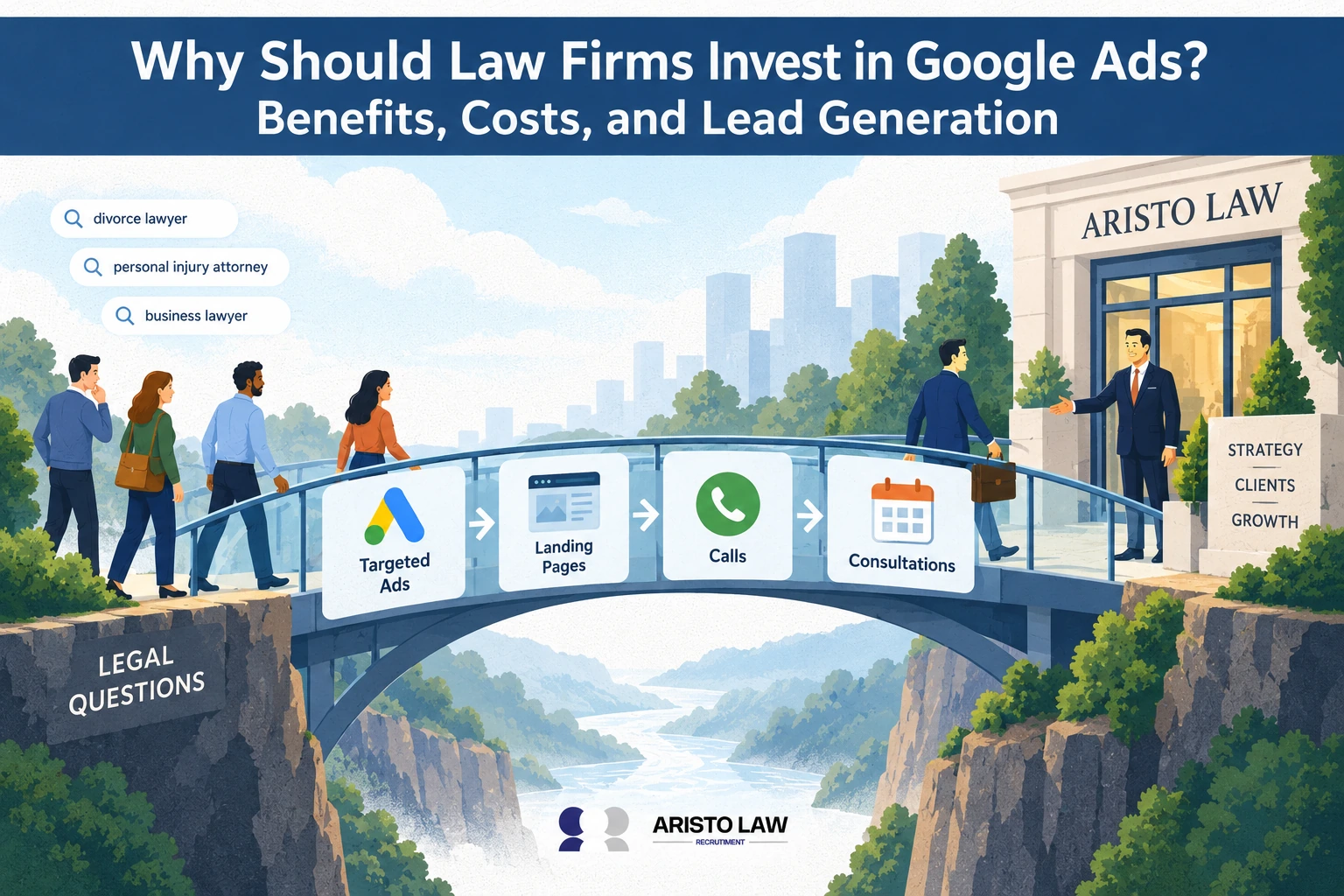
Law firm Google Ads marketing is a paid digital advertising
strategy where law firms bid on search terms to place advertisements in
search-engine results and generate qualified legal leads from
prospective clients actively searching for legal services.
Google Ads supports lead generation because law firms gain immediate
search visibility for high-intent keywords related to specific legal
matters, practice areas, and geographic locations. Unlike organic
marketing channels that require months of development, Google Ads places
law firms directly in front of prospective clients at the moment legal
assistance is being sought.
Core benefits include qualified lead generation, high-intent client
targeting, immediate visibility, practice-area targeting, measurable
ROI, faster client acquisition, competitive positioning, increased
website traffic, stronger conversion opportunities, scalable campaign
management, and pay-per-click flexibility. Additional advantages include
geographic targeting, mobile-search visibility, call-based lead
generation, retargeting campaigns, brand-awareness growth, and
data-driven optimization through conversion tracking and cost-per-lead
measurement.
Google Ads performs well for practice areas that depend on urgent
client acquisition, including personal injury, family law, criminal
defense, immigration law, bankruptcy law, employment law, and
estate-planning services. Research by WordStream (2025), based
on an analysis of more than 16,000 Google Ads campaigns, found that the
legal-services industry generated an average cost per lead of $131.63,
the highest of any industry studied. Researchers noted that
businesses continue to pay these premium rates because search ads
capture high-intent prospects who are actively seeking immediate legal
help.
Some of the Best Google Ads Companies for Law firms include seoforlawfirm.com, rankings.io and lawrank.com they are know for bringing the best results and calls.
Law firms track lead quality through CRM systems, call-tracking
software, intake-management systems, conversion tracking,
consultation-booking metrics, and lead-qualification workflows.
Structured intake systems help determine whether advertising spend
produces qualified consultations rather than unqualified inquiries.
Cost considerations vary based on keyword competition, geographic
market size, practice-area demand, bidding strategy, and campaign
quality. Legal advertising frequently ranks among the most expensive
advertising categories because legal clients represent lifetime value
and intense market competition. High-cost keywords alone do not
determine campaign success. Landing-page quality, ad-copy relevance,
keyword selection, geographic targeting, intake response speed, and
conversion optimization strongly influence campaign performance and
ROI.
Google Ads and SEO serve different growth functions. Google Ads
provides immediate paid visibility and lead generation as soon as
campaigns launch. SEO focuses on long-term organic visibility through
content development, local optimization, technical improvements, and
authority building. Many law firms combine both strategies because
Google Ads generates short-term lead flow while SEO supports long-term
client acquisition and marketing sustainability.
Structured campaign management, CRM tracking, call monitoring, intake
qualification systems, consultation-booking workflows, and rapid
lead-response procedures improve advertising ROI and reduce wasted ad
spend. Law firms achieve stronger results when marketing systems, intake
operations, and follow-up workflows operate together rather than
treating lead generation as a standalone advertising activity.
Aristolaw helps law firms improve Google Ads lead generation
by providing outsourced support for campaign coordination, lead
response, consultation scheduling, CRM updates, prospect follow-up,
intake handoff, and conversion tracking. Book
a Virtual Legal Marketing Assistant staffing consultation with
Aristolaw. Aristolaw connects law firms with
outsourcing solutions that match trained Virtual Legal Marketing
Assistant and Virtual Intake Specialist staff to each Google Ads lead
response task, campaign support workflow, prospect follow-up duty,
intake conversion function, and law firm growth
responsibility.
Listed below are 18 reasons why law firms should invest in Google
Ads.
-
1. Qualified lead generation: Qualified lead
generation focuses marketing efforts on prospects who match the firm’s
services and are more likely to become clients. -
2. High-intent client targeting: High-intent client
targeting reaches individuals actively searching for legal services and
ready to take action. -
3. Immediate search visibility: Immediate search
visibility places law firm advertisements in front of potential clients
as soon as campaigns launch. -
4. Practice area targeting: Practice area targeting
aligns advertising with specific legal services such as personal injury,
family law, or criminal defense. -
5. Measurable advertising ROI: Measurable
advertising ROI tracks campaign performance using metrics such as leads,
calls, consultations, and conversions. -
6. Fast client acquisition: Fast client acquisition
accelerates the process of attracting potential clients compared to many
long-term marketing strategies. -
7. Competitive market advantage: Competitive market
advantage increases visibility against competing firms within the same
legal market. -
8. Increased website traffic: Increased website
traffic directs more potential clients to law firm websites through
targeted advertising campaigns. -
9. Higher conversion opportunities: Higher
conversion opportunities result from reaching prospects who are actively
evaluating legal representation. -
10. Scalable advertising campaigns: Scalable
advertising campaigns allow firms to increase or reduce marketing
activity based on demand and budget. -
11. Pay-per-click flexibility: Pay-per-click
flexibility gives firms control over spending, targeting, scheduling,
and campaign adjustments. -
12. Brand awareness growth: Brand awareness growth
increases recognition of the law firm among potential clients and
referral sources. -
13. Geographic audience targeting: Geographic
audience targeting focuses advertising on specific cities, regions, or
service areas. -
14. Mobile search visibility: Mobile search
visibility improves exposure to users searching for legal services from
smartphones and mobile devices. -
15. Retargeting opportunities: Retargeting
opportunities reconnect with website visitors who previously showed
interest but did not contact the firm. -
16. Call-based lead generation: Call-based lead
generation encourages prospective clients to contact the law firm
directly by phone. -
17. Data-driven campaign optimization: Data-driven
campaign optimization uses performance data to improve targeting,
messaging, and lead quality. -
18. Cost-per-lead management: Cost-per-lead
management monitors advertising efficiency by measuring how much is
spent to generate each lead.
1. Qualified Lead Generation
Qualified lead generation is the process of attracting
prospective clients who actively need legal services and match a law
firm’s target practice areas, geographic markets, and client
criteria. Qualified leads are important in Google Ads because
Law Firm Marketing success depends on generating consultations from
prospects with genuine legal needs rather than increasing website
traffic alone.
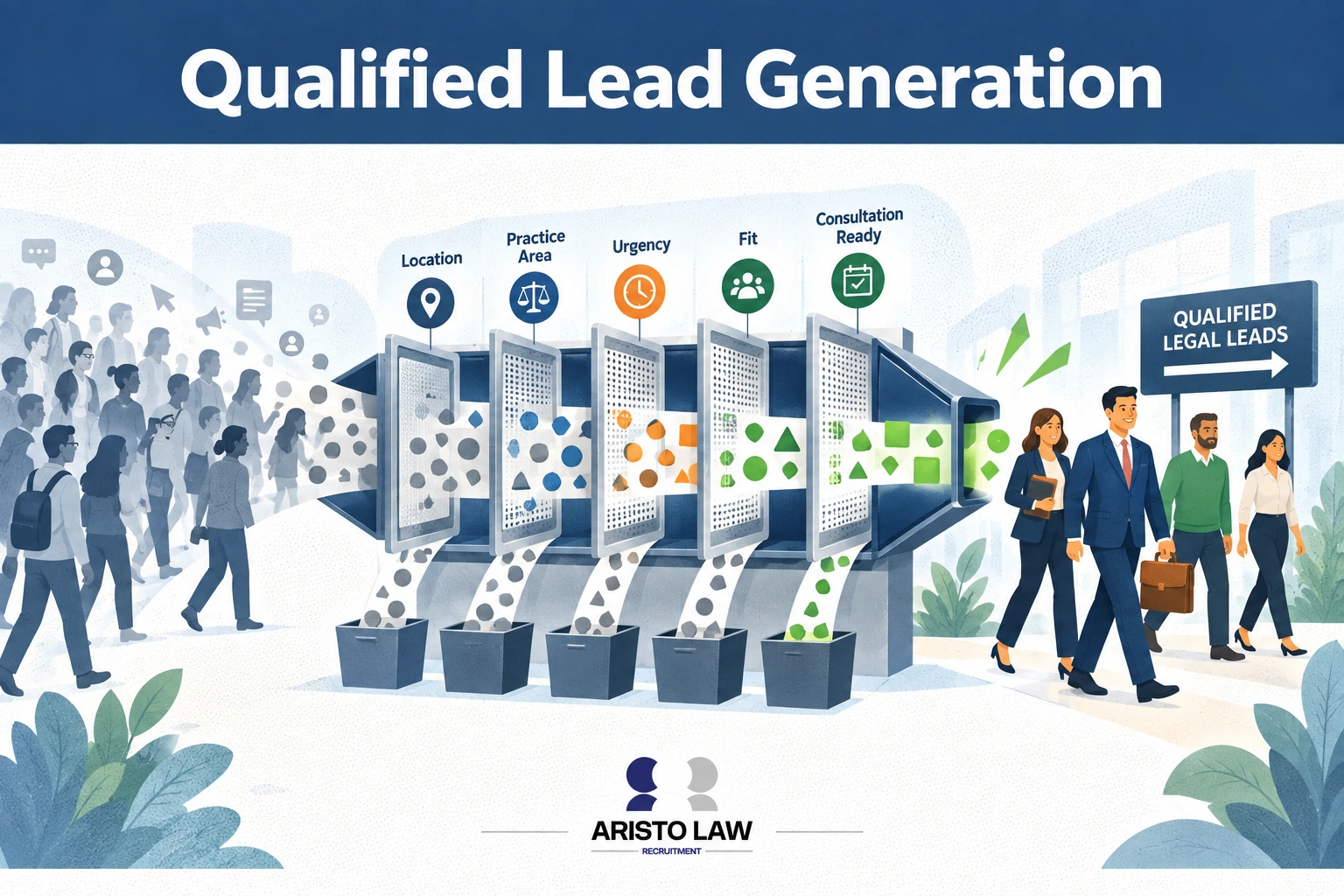
Google Ads supports Lead Generation by placing advertisements in
front of users searching for legal services with clear intent to hire an
attorney. Keyword Targeting, Local Search Ads, Conversion Tracking, and
intake qualification systems improve Client Acquisition by focusing
advertising budgets on prospects most likely to become paying
clients.
Financial performance depends on lead quality because higher-quality
leads improve consultation rates, signed-client rates, and advertising
ROI. Law firms improve qualified lead generation through
practice-area-specific keywords, negative-keyword management, conversion
tracking, intake qualification procedures, CRM integration, and rapid
follow-up workflows.
2. High-Intent Client
Targeting
High-intent client targeting is the process of showing
advertisements to prospects actively searching for legal representation
or legal services. Google Ads supports high-intent targeting
because search behavior reflects immediate legal needs.
Keyword Targeting allows law firms to target searches related to
legal problems, attorney services, and practice-area-specific concerns.
Marketing performance improves because advertising reaches prospects
closer to hiring decisions. Law firms improve targeting through
search-intent analysis, geographic targeting, keyword refinement, and
conversion monitoring.
3. Immediate Search Visibility
Immediate search visibility is the ability to appear
prominently in search results shortly after advertising campaigns
launch. Google Ads provides visibility without waiting for
long-term SEO development.
A study by J. Ologunebi (2023) showed that Search Engine
Marketing (SEM), including Google Ads, provides immediate visibility for
brands, especially when targeting competitive keywords, helping
businesses appear in search results without waiting for organic rankings
to develop. Client Acquisition improves because prospective
clients see legal advertisements during active searches for legal help.
Performance depends on keyword selection, ad relevance, bidding
strategies, and landing-page quality. Law firms improve visibility
through campaign optimization, location targeting, and ongoing
performance analysis.
4. Practice Area Targeting
Practice area targeting is the process of directing
advertisements toward specific legal services such as personal injury,
family law, criminal defense, immigration law, or estate
planning. Google Ads improves Lead Generation because campaigns
align with defined legal needs.
Financial efficiency improves because advertising budgets focus on
services that match firm objectives. Conversion Tracking supports
performance measurement across practice areas. Law firms improve
targeting through segmented campaigns, dedicated landing pages, and
practice-specific keyword groups.
5. Measurable Advertising ROI
Measurable advertising ROI is the process of tracking revenue
outcomes generated from advertising investment. Google Ads
supports ROI Measurement through conversion tracking, call tracking, CRM
integration, and consultation attribution.
Law firms gain measurable advertising ROI when Google Ads connects
high-intent searchers with legal services and generates trackable leads.
PPC
advertising for law firms provides performance data
that demonstrates why law firms should invest in Google Ads through
attributable clicks, consultations, and client acquisition outcomes.
Financial visibility improves because firms identify which campaigns
generate qualified consultations and retained clients. Law firms improve
ROI through lead-source tracking, campaign reporting, intake analysis,
and performance reviews.
6. Fast Client Acquisition
Fast client acquisition is the process of generating
consultations and prospective clients quickly through paid search
visibility. Google Ads supports rapid Client Acquisition
because advertisements appear immediately after campaign activation.
Marketing performance improves when intake systems respond quickly to
inquiries. Law firms improve acquisition speed through rapid lead
response, consultation scheduling, and conversion-focused landing
pages.
7. Competitive Market
Advantage
Competitive market advantage is the ability to compete
effectively against other law firms for client attention and lead
generation opportunities. Google Ads improves visibility within
competitive legal markets where organic rankings alone does not provide
sufficient exposure.
A meta-analysis by Google and Ipsos MediaCT in 2013, based on
61 search advertising studies involving more than 48,000 consumers,
showed that search ads increased top-of-mind brand awareness and unaided
brand awareness, even when users did not click the ads,
demonstrating that paid Google Ads improve visibility beyond what
organic rankings alone achieve. Client Acquisition improves because
firms appear prominently for valuable legal searches. Law firms improve
competitive positioning through campaign optimization, quality-score
management, and geographic targeting.
8. Increased Website Traffic
Increased website traffic is the process of attracting more
visitors to legal-service pages through paid advertising.
Google Ads drives targeted traffic from prospective clients actively
searching for legal assistance.
Marketing effectiveness improves because relevant visitors enter
intake funnels. Law firms improve traffic quality through keyword
refinement, audience targeting, and landing-page alignment.
9. Higher Conversion
Opportunities
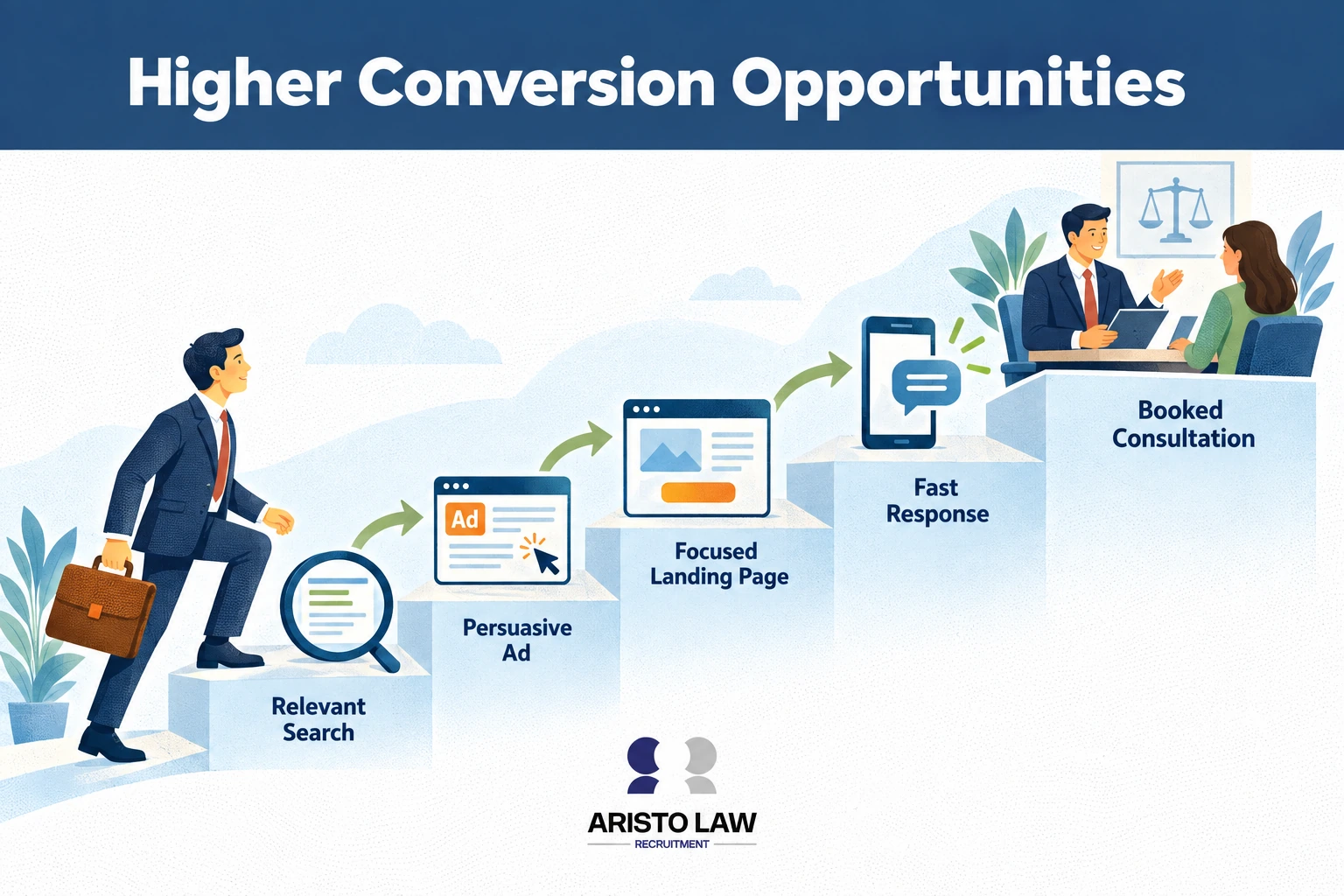
Higher conversion opportunities occur when qualified visitors
take actions such as calling, submitting forms, booking consultations,
or requesting legal evaluations. Google Ads improves conversion
potential because traffic originates from high-intent searches.
Research published by Jansen et al. on search intent and
keyword advertising found that transactional (high-intent) search
queries generate stronger conversion outcomes than informational
queries, because users searching with buying intent are closer
to making a purchase decision. Performance measurement depends on
Conversion Tracking and intake outcomes. Law firms improve conversions
through optimized landing pages, clear calls to action, and intake
coordination.
10. Scalable Advertising
Campaigns
Scalable advertising campaigns are campaigns capable of
increasing lead volume through expanded budgets, keywords, markets, or
practice-area coverage. Google Ads supports scalability because
campaign investment adjusts according to performance goals.
Financial planning improves because growth remains measurable. Law
firms improve scalability through structured campaign management and
conversion tracking.
11. Pay-Per-Click Flexibility
Pay-per-click flexibility is the ability to control
advertising investment based on clicks, budgets, performance targets,
and campaign objectives. Google Ads provides spending control
through budget limits and bidding strategies.
Financial efficiency improves because firms allocate resources
according to results. Law firms improve flexibility through ongoing
campaign reviews and budget optimization.
12. Brand Awareness Growth
Brand awareness growth is the process of increasing
visibility and recognition among prospective legal clients.
Google Ads strengthens brand exposure through repeated search-result
appearances.
Law firms use Google Ads to place legal services in front of
high-intent prospects at the moment of search, increasing brand
visibility and lead acquisition. Investment in paid search complements
lawyer
branding strategies and best practices because
consistent ad exposure strengthens brand recognition while generating
measurable client inquiries.
A study by Google and Ipsos MediaCT in 2014 analyzing 61
search advertising experiments found that repeated appearances of search
ads increased top-of-mind brand awareness by an average of 6.6
percentage points and unaided brand awareness by 4.5 percentage points,
even when users did not click the ads. This suggests that
simply seeing a brand repeatedly in search results strengthens brand
exposure and recall. Client familiarity improves because prospects
encounter firm names during legal-service searches. Law firms improve
awareness through consistent campaign presence and practice-area
targeting.
13. Geographic Audience
Targeting
Geographic audience targeting is the process of displaying
advertisements within selected cities, counties, states, or service
areas. Google Ads improves marketing efficiency because
advertising focuses on locations where legal services are available.
A study by the Network Advertising Initiative (2009) showed
that targeted advertising generated 2.7 times more revenue per ad than
non-targeted advertising and was twice as effective at converting users
into buyers, indicating that focusing ads on relevant audiences
and locations improves marketing efficiency. Client Acquisition improves
because local prospects see relevant advertisements. Law firms improve
geographic targeting through service-area segmentation and
location-specific campaigns.
14. Mobile Search Visibility
Mobile search visibility is the ability to reach prospective
clients using smartphones and mobile devices. Google Ads
supports mobile engagement because many legal searches occur on mobile
devices during urgent situations.
Clicks Geek research and legal marketing analysis (2026)
noted that legal searches frequently occur on mobile devices during
urgent situations, such as after an accident, arrest, or family crisis,
and that mobile traffic represents the majority of legal search
volume. Lead Generation improves because prospects connect with
law firms immediately. Law firms improve mobile performance through
mobile-friendly landing pages and click-to-call features.
15. Retargeting Opportunities
Retargeting opportunities involve reconnecting with website
visitors who previously interacted with a law firm’s website but did not
schedule a consultation. Google Ads supports retargeting
through display and audience-based campaigns.
Client Acquisition improves because interested prospects receive
additional exposure. Law firms improve retargeting performance through
audience segmentation and follow-up messaging.
16. Call-Based Lead Generation
Call-based lead generation is the process of generating
inbound telephone inquiries directly through advertisements.
Google Ads supports call-focused campaigns through call extensions and
mobile advertising formats.
A study by Google and Ipsos Research in 2013 showed that 70%
of mobile searchers used click-to-call directly from search results to
contact a business, demonstrating the effectiveness of Google Ads’
call-focused advertising features. Conversion opportunities
improve because prospects contact firms immediately. Law firms improve
call performance through intake coordination, call tracking, and
response management.
17. Data-Driven Campaign
Optimization
Data-driven campaign optimization is the process of improving
advertising performance through measurable data analysis.
Google Ads provides information regarding clicks, conversions, costs,
keywords, audiences, and engagement metrics.
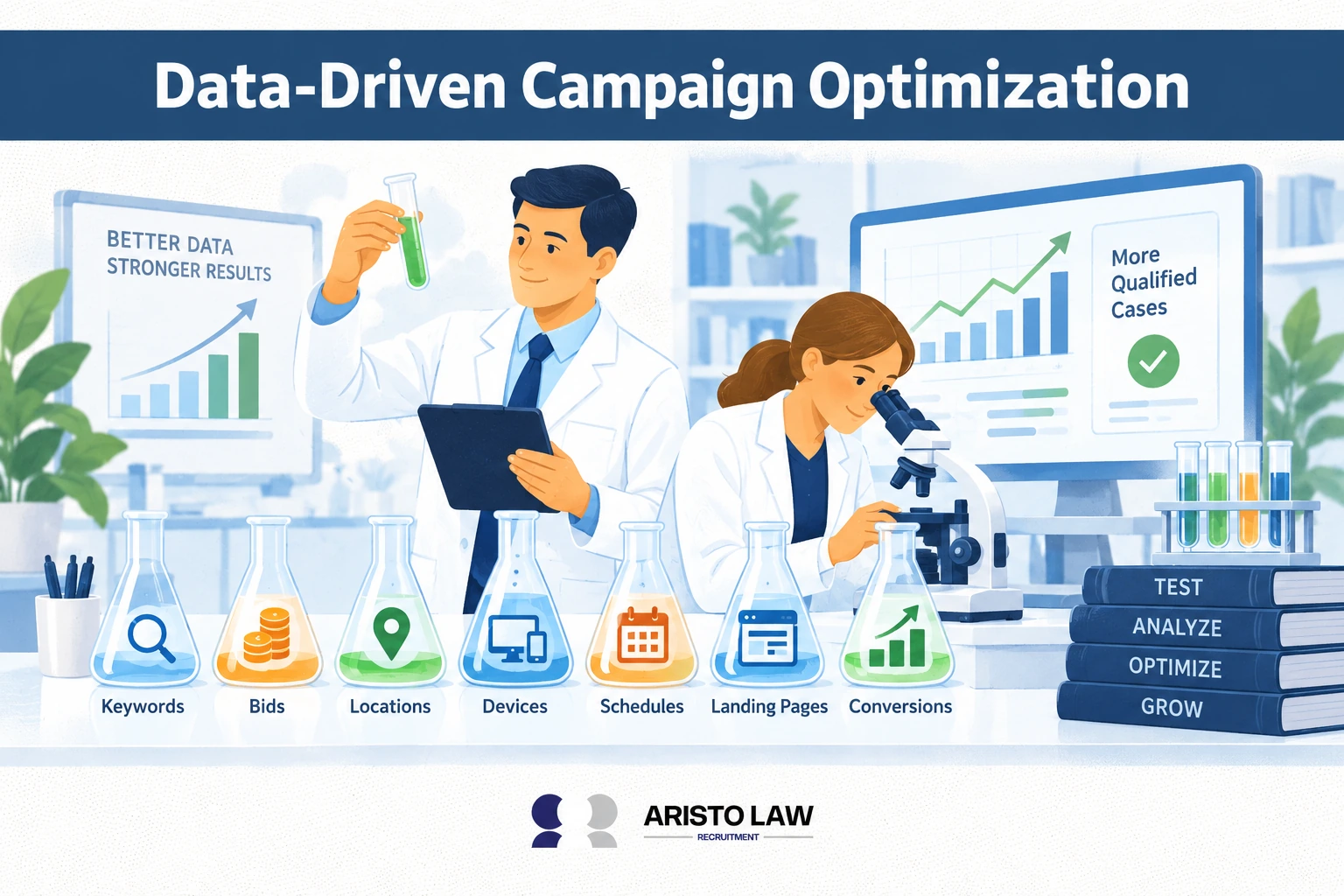
Marketing efficiency improves because decisions rely on measurable
performance indicators. Law firms improve optimization through reporting
reviews, keyword analysis, and campaign testing.
18. Cost-Per-Lead Management
Cost-per-lead management is the process of monitoring and
controlling the amount spent to generate each qualified lead.
Google Ads supports cost analysis through campaign reporting and
conversion tracking. Financial performance improves because firms
identify efficient and inefficient lead sources.
Law firms use cost-per-lead management to measure advertising
efficiency and identify campaigns that generate qualified consultations
at sustainable acquisition costs. Effective lead-cost optimization
supports the business case for virtual
legal marketing assistant services by improving
campaign monitoring, budget allocation, and conversion-focused reporting
that explains why law firms should invest in Google Ads.
Research by IBM (2007) showed that two-thirds of senior
marketers expected 20% of advertising revenue to shift from
impression-based advertising to performance-based models such as
cost-per-lead (CPL) because CPL allows companies to pay only for
qualified leads rather than clicks or impressions, improving marketing
ROI. Law firms improve cost-per-lead outcomes through keyword
refinement, landing-page optimization, intake improvements, and
conversion-focused campaign management.
How much do Google
Ads cost for law firms?
Law firm PPC costs frequently range between $5 ($4.60 €,
£3.90)-$300 ($276 €, £234) per click, with some highly
competitive personal injury, mass tort, and serious-injury keywords
exceeding several hundred dollars per click in major metropolitan
markets. Google Ads costs for law firms vary based on legal niche
competition, geographic market, keyword demand, bidding strategies, and
campaign optimization quality. In the United States, law firm PPC costs
rank among the highest across all industries because legal clients
represent substantial case value and strong revenue potential.
Google Ads costs are commonly measured through cost per click (CPC),
cost per lead (CPL), and cost per acquisition (CPA), with actual
spending varying by practice area and location. Personal injury
campaigns command the highest CPCs because a single retained client
generates substantial case revenue.
Family law campaigns face lower CPCs than personal injury campaigns,
though divorce, child custody, and emergency family-law matters remain
highly competitive in large cities. Criminal defense, immigration,
employment law, and bankruptcy campaigns fall between these pricing
ranges depending on market demand and local competition.
Competitive metro markets such as major cities generally experience
higher bid pricing because more law firms compete for the same search
traffic. Smaller markets and narrower practice-area keywords produce
lower CPCs and reduced competition. Keyword selection strongly affects
costs because broad, high-volume legal terms attract aggressive bidding,
while highly specific long-tail searches generate lower costs and
stronger lead quality.
Legal advertising budgets are managed through daily budgets, monthly
spending limits, bid strategies, and conversion goals. Some firms
operate with daily budgets of $50 ($46 €, £39), while larger firms
invest several thousand dollars per day depending on growth objectives
and market size. Cost per lead frequently ranges from tens of dollars to
several hundred dollars, while cost per acquisition depends on
consultation conversion rates, intake quality, and signed-client
performance.
High legal keyword costs occur because Google Ads operates through an
auction system where multiple firms compete for the same prospective
clients. Competition, client value, geographic demand, ad quality,
landing-page performance, and conversion rates all influence final
pricing. Strong intake systems, rapid lead response, CRM tracking, and
conversion optimization have greater impact on profitability than simply
reducing cost per click, because qualified-client acquisition remains
the primary objective of law firm Google Ads campaigns.
How to run a
Google Ads campaign for a law firm?
Running a Google Ads campaign for a law firm requires
practice-area targeting, high-intent keyword selection,
conversion-focused landing pages, intake optimization, and continuous
campaign management. The process begins with market research to
identify practice areas, competitor activity, geographic markets, and
high-intent search terms used by prospective clients. Google Ads for
lawyers perform best when keywords are segmented by intent, location,
and legal service, with separate campaign structures and ad groups for
areas such as personal injury, family law, criminal defense, estate
planning, or business law. Each ad group should direct visitors to a
dedicated legal-service landing page containing consultation-focused
calls-to-action, attorney credentials, trust signals, contact forms, and
clear pathways to schedule consultations.
Law firm PPC campaigns require geographic targeting, negative keyword
management, conversion tracking, call tracking, Quality Score
optimization, and strategic budget allocation to improve lead quality
and advertising efficiency. Campaign performance should be measured
using consultation bookings, qualified leads, signed cases, cost per
acquisition, and client-acquisition costs rather than clicks alone. Many
legal advertising campaigns underperform because firms optimize for
traffic volume instead of consultation conversions and retained clients.
Advertising performance is closely tied to intake responsiveness because
delayed follow-up, missed calls, poor lead qualification, and weak
intake workflows increase acquisition costs and reduce attorney lead
generation results.
Are legal Google Ads so
expensive?
Yes, legal Google Ads are expensive because law firms compete
aggressively for high-value clients capable of generating substantial
case revenue. Legal PPC costs are driven by auction-based
bidding systems where multiple firms compete for the same high-intent
searches, particularly in practice areas such as personal injury, mass
torts, medical malpractice, and criminal defense. Many law firms are
willing to pay premium costs per click because a single signed client
generates thousands or even hundreds of thousands of dollars in legal
fees, settlements, or contingency-fee revenue.
Geographic market saturation further increases lawyer advertising
costs, especially in large metropolitan areas where numerous firms
target the same keywords. Personal injury and mass-tort keywords
frequently rank among the highest CPC categories in digital advertising
because high case values, aggressive competition, and strong client
lifetime value justify higher acquisition costs and larger marketing
budgets.
Which
agencies are best at running Google Ads for law firms?
Agencies that help law firms run Google Ads campaigns are
Aristo Law, SEOForLawFirm.com, LawRank, MeanPug Digital, Rankings.io,
Justia, Consultwebs, and other specialized legal marketing
providers.
Listed below are the 7 agencies that help law firms run Google Ads
campaigns.
-
Aristo Law: Aristo Law supports law firm growth
through legal outsourcing, virtual staffing, intake support,
lead-generation assistance, and marketing execution resources. Aristo
Law helps firms access experienced Google Ads specialists, legal
marketing professionals, intake teams, virtual legal assistants, and
scalable support solutions without building large internal marketing
departments. -
SEOForLawFirm.com: Focuses on Modern legal SEO, Google Ads
management, local search visibility, lead generation, conversion
optimization, and AI poweredbdigital marketing strategies designed specifically for law firms. -
LawRank: Specializes in law firm PPC management,
attorney SEO, local search marketing, website optimization, and
client-acquisition campaigns. -
MeanPug Digital: Provides legal PPC management, paid
advertising strategy, law firm branding, website development, and
lead-generation support. -
Rankings.io: Known for legal marketing campaigns
focused on personal injury firms, competitive PPC markets, attorney SEO,
and client-acquisition strategies. -
Justia Marketing Solutions: Offers Google Ads
management, attorney websites, legal directories, local marketing, and
lead-generation services for law firms. -
Consultwebs: Provides legal PPC advertising, intake
optimization, SEO, content marketing, website services, and law firm
growth consulting.
Law firms achieve stronger results with a legal PPC
agency than a general advertising agency because legal-industry
providers understand attorney advertising regulations, intake workflows,
consultation conversion processes, legal lead qualification, case
economics, and client-acquisition costs. Legal marketing services that
combine PPC management, intake optimization, lead tracking, and law-firm
growth strategy produce stronger outcomes than campaigns focused only on
click volume or website traffic.
What types
of law firms benefit most from Google Ads?
Law firms that benefit most from Google Ads include personal
injury firms, estate planning firms, and consumer-facing litigation
practices.
Listed below are the 13 law firm types that benefit most from Google
Ads.
-
Personal injury law firms: Personal injury firms
benefit from Google Ads because accident victims search for legal
representation immediately after injuries occur. High client value,
urgent consultations, and strong legal lead generation opportunities
make paid search campaigns effective for personal injury marketing. -
Criminal defense law firms: Criminal defense PPC
campaigns perform well because arrests, investigations, and criminal
charges create immediate demand for legal assistance. Client urgency
produces rapid consultation decisions and high-intent search
behavior. -
Family law firms: Family law marketing benefits from
Google Ads because individuals facing divorce, child custody disputes,
support matters, adoption issues, and protective-order situations
frequently search online for legal help. Consultation-driven client
acquisition supports measurable advertising performance. -
Immigration law firms: Immigration firms generate
strong results from paid advertising because visa applications,
residency matters, citizenship processes, deportation concerns, and
employment-based immigration issues begin with online research and
consultation requests. -
Estate planning law firms: Estate planning practices
benefit because prospective clients frequently search for wills, trusts,
probate assistance, and asset-protection services within local markets.
Google Ads improves visibility during active planning decisions. -
Bankruptcy law firms: Bankruptcy firms attract
high-intent searches from individuals experiencing financial hardship,
creditor pressure, foreclosure concerns, and debt-management problems.
Client urgency supports consultation-focused campaigns. -
Employment law firms: Employment law practices
benefit because workers facing wrongful termination, discrimination
claims, retaliation concerns, wage disputes, and workplace conflicts
seek immediate legal guidance through online searches. -
DUI and traffic defense firms: DUI and traffic
defense practices benefit from urgent legal searches immediately
following citations, arrests, or court notifications. Search intent
converts into rapid consultation requests. -
Workers’ compensation law firms: Workers’
compensation firms benefit because injured employees actively search for
legal representation after workplace injuries, denied claims, or benefit
disputes. High-intent searches improve lead-generation
opportunities. -
Consumer litigation firms: Consumer-facing
litigation practices benefit because clients search directly for
assistance involving debt collection issues, consumer protection claims,
fraud disputes, and contract-related conflicts. Consultation-focused
campaigns improve lead generation. -
Medical malpractice law firms: Medical malpractice
practices benefit when prospective clients actively investigate
healthcare-related injuries, treatment errors, and negligence claims.
Google Ads increases visibility for specialized legal services. -
Civil litigation firms serving individuals: Civil
litigation practices targeting individuals benefit because disputes
involving contracts, property issues, business conflicts, and personal
claims generate direct search demand and consultation opportunities. -
Local legal practices with consultation-driven business
models: Local firms perform well because Google Ads supports
geographic targeting, allowing firms to appear for searches within
specific cities, counties, or service areas where client acquisition
occurs.
Client urgency, local competition, and consultation-driven retention
models strongly influence ad performance across practice areas. Practice
areas involving immediate legal problems, high search volume, local
service demand, and measurable consultation outcomes generate the
strongest results from Google Ads for attorneys and legal lead
generation campaigns.
How do law firms
track Google Ads lead quality?
Law firms track Google Ads lead quality by combining
conversion tracking, CRM data, intake scoring systems, and case outcome
analysis. Law firms use these data sources to determine not
only how many leads are generated, but also how many leads become
qualified consultations, retained clients, and profitable legal
cases.
Google Ads for law firms generates large volumes of clicks, calls,
and form submissions, yet legal marketing ROI depends on lead quality
rather than lead quantity. Legal marketing analytics studies
consistently show that lead-quality tracking through CRM attribution,
call tracking, and intake scoring improves advertising ROI because these
systems identify which keywords, ads, and campaigns generate paying
clients instead of low-intent inquiries.
Multi-touch attribution further improves performance measurement by
tracking the complete client journey across searches, ads, website
visits, calls, consultations, and client retention outcomes.
Listed below are the 12 primary methods law firms use to track Google
Ads lead quality.
-
Conversion tracking setup: Conversion tracking
measures form submissions, phone calls, live-chat inquiries,
consultation requests, and appointment bookings generated through Google
Ads campaigns. -
Call tracking systems: Call tracking legal marketing
platforms record phone leads, call duration, caller intent, consultation
outcomes, and conversion potential. Call analysis helps identify
high-quality legal inquiries. -
CRM integration: Law firm CRM integration connects
advertising data to intake systems, consultation records, and
case-management platforms, allowing firms to track lead-to-client
conversion performance. -
Lead scoring systems: Lead scoring assigns values
based on case type, urgency, location, legal issue complexity,
practice-area relevance, and client-retention potential. -
Intake qualification: Legal intake quality processes
determine whether inquiries meet case-acceptance standards or represent
low-value, non-qualified prospects. -
Cost per qualified lead (CPQL): CPQL measures
advertising spend required to generate a qualified prospect who passes
intake screening and demonstrates genuine legal-service potential. -
Cost per signed case: Cost per signed case measures
advertising cost required to acquire an actual paying client. Many law
firms consider this one of the most valuable legal marketing ROI
metrics. -
Keyword performance analysis: Keyword analysis
identifies which search terms generate qualified consultations, retained
clients, and higher-value legal matters rather than simple traffic
volume. -
Landing page tracking: Landing page tracking
measures how effectively individual pages convert visitors into
consultations, calls, and qualified legal inquiries. -
Multi-touch attribution: Multi-touch attribution
evaluates every interaction across the client-acquisition journey,
including ad clicks, repeat searches, website visits, email engagement,
calls, and consultation bookings. -
Lead source segmentation: Lead source segmentation
separates branded searches, non-branded searches, practice-area
campaigns, local campaigns, referral campaigns, and retargeting traffic
for accurate performance evaluation. -
Follow-up tracking: Follow-up tracking measures
response speed, consultation scheduling activity, appointment
attendance, and conversion outcomes. Faster response times correlate
with stronger lead-conversion performance.
Industry data consistently shows that law firms achieve stronger
marketing efficiency when they track qualified leads, signed clients,
and revenue outcomes rather than relying only on clicks, impressions, or
form submissions. Legal services involve high client value and intense
competition, making legal intake quality, cost per qualified lead, and
cost per signed case stronger indicators of campaign success than raw
traffic metrics alone.
What
mistakes reduce Google Ads performance for law firms?
Mistakes that reduce Google Ads performance for law firms
include weak intake systems, delayed response times, and missing
conversion tracking.
Listed below are 17 mistakes that reduce Google Ads performance for
law firms.
-
Weak intake systems: Weak intake systems create lead
leakage because qualified prospects receive inconsistent follow-up,
incomplete intake screening, poor consultation scheduling, or no
response at all. Intake failures waste advertising spend after leads
have already been acquired. -
Poor keyword targeting: Poor keyword targeting
attracts unqualified traffic and irrelevant clicks. Law firm PPC
optimization depends on selecting search terms aligned with legal
services, geographic targets, and client intent. -
Broad-match keyword misuse: Broad-match keywords
trigger ads for unrelated searches, increasing click costs without
generating qualified legal leads. Excessive broad matching frequently
reduces legal advertising ROI. -
Irrelevant landing pages: Disconnected landing pages
reduce conversions because visitors expect content that directly matches
the ad message and search intent. Poor landing-page relevance increases
abandonment rates. -
Delayed response times: Slow consultation follow-up
reduces lead conversion because prospective clients frequently contact
multiple law firms. Delayed responses result in lost consultations and
retained clients. -
Missing conversion tracking: Missing conversion
tracking prevents firms from identifying which ads, keywords, and
campaigns generate consultations and signed cases. Performance decisions
become difficult without reliable data. -
Lack of call tracking: Call tracking gaps prevent
firms from measuring phone-lead quality, call outcomes, consultation
rates, and campaign effectiveness. Many legal leads originate through
phone calls rather than form submissions. -
Poor mobile optimization: Mobile usability problems
reduce conversions because many legal-service searches occur on
smartphones. Slow-loading pages, difficult forms, and poor navigation
increase lead abandonment. -
Weak ad-copy relevance: Ad copy that does not align
with search intent lowers click-through rates and attracts lower-quality
traffic. Relevant messaging improves qualified lead generation. -
Insufficient geographic targeting: Poor
geo-targeting displays ads outside intended service areas, generating
inquiries from prospects who cannot become clients. Geographic precision
improves advertising efficiency. -
Ignoring negative keywords: Negative keywords
prevent ads from appearing for irrelevant searches. Failure to use
negative keywords increases wasted clicks and unnecessary advertising
costs. -
Inconsistent follow-up workflows: Lead nurturing
failures reduce consultation-booking rates because interested prospects
require multiple contact attempts before scheduling appointments. -
Poor CRM integration: Disconnected CRM systems
reduce visibility into lead status, consultation outcomes, referral
sources, and signed-client performance. Accurate tracking supports
stronger optimization decisions. -
Weak consultation-booking processes: Complicated
scheduling procedures, limited availability, and unclear next steps
reduce conversion rates after leads enter the intake process. -
Lack of landing-page testing: Landing pages
underperform when headlines, calls-to-action, forms, and layouts remain
untested. Conversion optimization improves advertising performance
through ongoing refinement. -
Ignoring campaign data: Failure to review keyword
performance, cost per acquisition, consultation rates, and lead quality
prevents continuous improvement. Data-driven optimization improves
long-term campaign profitability. -
Poor intake staffing coverage: Missed calls,
unanswered forms, and after-hours response gaps reduce lead capture.
Dedicated intake support improves results more than increasing
advertising budgets.
Law firm PPC optimization depends on both advertising performance and
operational execution. Intake failures, consultation delays, weak
follow-up systems, and lead-management breakdowns damage legal
advertising ROI more than Google Ads platform settings themselves
because revenue depends on converting inquiries into retained
clients.
How
important are landing pages for legal Google Ads?
Landing pages are important for legal Google Ads because they
determine whether paid traffic converts into consultations and signed
clients. Legal landing pages function as the primary conversion
point between advertising clicks and client acquisition, making them one
of the most influential factors in PPC optimization and legal website
conversions.
Law firms invest in Google Ads to generate qualified inquiries, and
high-converting landing pages determine whether ad traffic becomes
retained leads or lost opportunities. Effective law
firm website management and landing page support aligns
ad messaging with user intent, improves conversion rates, and increases
return on advertising spend.
Google Ads generate qualified traffic, yet consultation conversion
depends heavily on the landing-page experience prospects encounter after
clicking an advertisement. Trust-building plays a major role because
legal consumers evaluate credibility before contacting a law firm.
Attorney profiles, bar admissions, years of experience, case results
where permitted, client reviews, legal testimonials, awards, and
professional credentials help establish confidence and reduce
hesitation.
Practice-area specificity further improves performance because
prospective clients searching for divorce representation, criminal
defense, personal injury assistance, immigration help, or estate
planning services expect content directly related to their legal issue
rather than general law firm information.
Mobile usability affects consultation conversion because many legal
searches occur on mobile devices. Fast page speed, clear navigation,
click-to-call functionality, simple contact forms, and visible
consultation CTAs improve user experience and reduce abandonment.
Conversion psychology supports performance when landing pages provide
clear next steps, reduce uncertainty, address common concerns, and make
contacting the firm straightforward.
Focused legal-service landing pages outperform generic homepages
because they align more closely with search intent, ad messaging, and
client expectations. A prospective client searching for a “car accident
lawyer” responds more positively to a dedicated personal injury landing
page than to a broad homepage covering multiple practice areas. Message
consistency between the keyword, advertisement, and landing page
improves relevance, strengthens user confidence, and increases
conversion rates.
PPC optimization depends on more than advertising bids and keyword
selection. Legal landing pages influence trust, consultation booking
behavior, lead quality, and client acquisition outcomes. Strong landing
pages improve legal website conversions by combining attorney
credibility, practice-area relevance, mobile performance,
consultation-focused design, and clear conversion pathways into a single
client-acquisition experience.
What role
does ad copy play in law firm Google Ads?
Ad copy plays a major role in law firm Google Ads because it
influences click-through rates, trust perception, consultation intent,
and lead quality. Lawyer ad copy serves as the first
interaction between a prospective client and a law firm, making legal
advertising messaging a major factor in determining whether a searcher
clicks an ad, requests a consultation, or contacts a competing firm.
Effective legal PPC ads align closely with the legal problem a prospect
is trying to solve, helping attract qualified leads rather than
generating irrelevant traffic.
Practice-area relevance improves performance because prospects
searching for divorce representation, criminal defense, immigration
assistance, personal injury claims, or estate-planning services expect
ad messaging that directly addresses those legal needs. Local references
improve trust and relevance because many legal consumers prefer firms
serving their city, county, or region. Geographic relevance increases
click quality by attracting prospects located within the firm’s service
area.
Trust signals strengthen consultation intent by communicating
experience, availability, responsiveness, client focus, and
legal-service credibility. Professional positioning, attorney
experience, years in practice, and consultation availability help reduce
uncertainty for prospective clients evaluating legal options. Emotional
alignment further improves performance because legal searches occur
during stressful situations involving accidents, arrests, family
disputes, immigration concerns, employment conflicts, or financial
hardship. Ad copy that acknowledges client concerns while presenting a
clear path forward generates stronger engagement.
Urgency language improves response rates when it reflects legitimate
client needs, such as immediate legal assistance, time-sensitive
matters, consultation availability, or rapid case evaluation.
Consultation CTAs guide user action by providing clear next steps such
as scheduling a consultation, requesting a case review, calling the
firm, or submitting an intake form. Strong CTA structure reduces
confusion and improves conversion opportunities.
Legal advertising messaging affects both click quality and conversion
intent because it filters who responds to the advertisement. Accurate,
relevant, and practice-specific messaging attracts prospects more likely
to become qualified consultations, while weak or generic ad copy
produces lower-quality clicks, reduced conversion rates, and less
efficient advertising performance.
Should law firms use
Google Ads or SEO?
Law firms use both Google Ads and SEO because paid
advertising generates immediate visibility while SEO builds long-term
organic authority and inbound lead stability. Google Ads for
law firms places advertisements in search results as soon as campaigns
launch, making paid search effective for rapid client acquisition, new
practice-area promotion, geographic expansion, and short-term lead
generation. Legal SEO focuses on organic rankings through content
development, local optimization, technical improvements, authority
building, and website performance, producing results that develop over a
longer timeframe.
Law firms benefit from Google Ads because the platform delivers
immediate visibility for high-intent legal searches and generates leads
without waiting for organic rankings to develop. Law firms that combine
paid search campaigns with law
firm SEO expert virtual assistant support strengthen
long-term search visibility while maintaining a consistent client
acquisition strategy.
Speed represents one of the largest differences between the two
channels. Paid search generates traffic and consultations immediately
after activation, while legal SEO requires months of consistent
optimization before organic visibility develops. Scalability also
differs because Google Ads traffic generally increases through larger
advertising budgets, whereas SEO growth depends on content quality,
search authority, competition levels, and long-term optimization
efforts.
Acquisition costs follow different patterns. Google Ads requires
ongoing advertising spend to maintain visibility and lead flow. SEO
requires investment in content, optimization, website improvements, and
ongoing maintenance, yet organic traffic continues generating inbound
leads without direct payment for each click. Competitive barriers exist
in both channels. Highly competitive legal keywords increase advertising
costs in PPC campaigns, while highly competitive organic search results
require substantial authority and optimization to achieve strong
rankings.
Conversion timelines vary as well. Paid search captures prospects
actively seeking legal services at that moment, producing faster
consultation opportunities. SEO attracts prospects throughout the
research process and creates long-term visibility across a broader range
of legal searches. Over time, organic rankings compound because
published content, local authority, and website trust continue
generating traffic and consultations.
Many law firms combine both channels because each serves a different
growth objective. Google Ads supports immediate lead generation, rapid
growth initiatives, and practice-area targeting. Legal SEO strengthens
long-term inbound leads, reduces dependence on advertising budgets,
improves market authority, and creates sustainable client-acquisition
systems. A balanced strategy produces stronger lead diversification,
improved marketing stability, and more consistent law firm growth than
relying exclusively on either paid search or organic search.
Build a legal support team that moves work forward.
Tell us what is slowing your practice down. We will help map the role, workflow, and support structure that fits.