
How to Manage a Small Law Firm: Tools, Costs, and Workflow Systems

Practical guidance for building efficient, accountable legal support operations.

Managing a small law firm requires coordinated business
operations, efficient legal workflows, financial discipline, and
strategic marketing that enable attorneys to deliver high-quality legal
services while maintaining profitability and sustainable
growth. Successful lawyers standardize client intake, case
management, document workflows, and performance reporting so that every
process supports efficiency, compliance, and consistent client
service.
A study by Thomson Reuters Institute titled “State of U.S.
Small Law Firms Report” in year 2024, states that managing a small law
firm successfully requires striking a critical business balance by
implementing modern technology, active marketing, and disciplined
internal operations to reduce administrative burdens, freeing lawyers to
focus on high-quality practice performance while maintaining financial
health. Practice management software, CRM platforms, document
automation, and workflow automation reduce administrative burdens,
minimize errors, and improve productivity across the firm.
Effective management also depends on measurable financial
performance, structured delegation, and continuous operational
improvement. Small law firms monitor operating costs, billable hours,
collections, and key performance indicators (KPIs) to guide business
decisions. Digital marketing systems create predictable client
acquisition. Standardized communication and document management improve
client experience and regulatory compliance.
A study by Clio and the American Bar Association titled
“Legal Trends Report” in year 2025, states that law firms adopting
standardized cloud workflows, automation, and legal technology achieve
double the revenue growth, higher billable capacity, lower cognitive
strain, and significantly better client satisfaction metrics than
stagnant firms clinging to manual operations. As firms grow,
operational complexity increases, making outsourced legal support,
virtual assistants, and workflow specialists valuable resources for
maintaining scalability.
Aristo Law is a Legal Process Outsourcing (LPO) that supports
small law firm growth by providing solutions that include operational
consulting, workflow optimization, legal staffing, and automation
strategies. Hire
a Virtual Legal Administrative Assistant with Aristo Law. Aristo
Law connects small law firms with outsourcing solutions that match
trained legal administrative support staff to each workflow system task,
cost-control need, tool coordination duty, client service function, and
law firm operations responsibility.
Listed below are 15 steps to manage a small law firm.
-
1. Define business goals and strategic plans:
Business goals guide revenue targets, practice area focus, staffing
needs, and long-term firm growth. -
2. Establish standard workflows: Standard workflows
create repeatable processes for intake, conflict checks, document
drafting, and client follow-up. -
3. Implement practice management software: Practice
management software centralizes matters, deadlines, documents, and
reporting in one system. -
4. Manage client intake: Client intake systems
qualify leads, collect case details, run conflict checks, and move
prospects into signed engagements. -
5. Build marketing systems to generate qualified
leads: Marketing systems connect SEO, paid ads, referrals, and
intake tracking to consistent qualified lead generation. -
6. Improve client communication: Client
communication systems keep clients informed through email templates,
portals, automated updates, and clear response protocols. -
7. Organize case management: Case management
structures matter stages, deadlines, task ownership, and case progress
across the firm. -
8. Automate repetitive tasks: Automation reduces
manual work in appointment reminders, document templates, email
follow-ups, and status updates. -
9. Track billable time: Time tracking records lawyer
and staff work accurately, supports billing discipline, protects
revenue, and reveals workflow inefficiencies. -
10. Manage legal billing: Legal billing systems
handle invoices, payment plans, retainers, and client-facing financial
records. -
11. Manage trust accounting: Trust accounting
separates client funds from operating funds, tracks retainers, records
withdrawals, and supports bar compliance. -
12. Monitor financial performance and control operating
costs: Financial monitoring reviews revenue, profit margins,
payroll, and cash flow. -
13. Manage staffing and delegation: Staffing and
delegation assign legal, administrative, intake, and case support work
to the right internal or outsourced role. -
14. Maintain ethical compliance: Ethical compliance
protects confidentiality, conflict management, trust accounting, and
billing accuracy. -
15. Monitor KPIs and review firm performance: KPI
reviews measure leads, consultations, signed cases, and client
satisfaction.
1. Define business
goals and strategic plans
Defining business goals and strategic plans establishes the
direction for small law firm management and aligns daily operations with
long-term objectives. Strategic planning identifies target
practice areas, revenue goals, growth opportunities, and measurable
success indicators that support informed decision-making.

Clear business strategy guides staffing decisions, marketing
investment, financial planning, and client acquisition priorities. Clear
business goals also improve profitability, client satisfaction, and
operational performance.
Practice management software, law firm reviews, financial management,
and operational reporting provide data that supports continuous
improvement and resource allocation. Best results come from setting
measurable goals, reviewing progress regularly, aligning every
department with firm objectives, and adjusting strategy according to
performance data and market conditions.
2. Establish standard
workflows
Standard workflows create consistent procedures for client
intake, case management, document preparation, and administrative
operations. Standard workflows improve efficiency and
reduce errors throughout the firm.
Workflow systems eliminate unnecessary manual steps, clarify staff
responsibilities, and ensure legal tasks follow documented processes.
Standardization supports compliance, improves turnaround times,
strengthens client experience, and reduces operational bottlenecks.
Practice management software and workflow automation reinforce
consistency across every matter. Effective implementation requires
documented procedures, regular process reviews, staff training, and
continuous workflow optimization.
3. Implement practice
management software
Practice management software centralizes case management,
calendaring, document storage, communication, and reporting to improve
law firm operations and productivity. Law firms implement
practice management software by integrating legal
case management systems to unify matter tracking,
billing records, and client communication workflows within a single
operational structure. Centralized legal technology improves
collaboration, reduces duplicate work, strengthens deadline management,
and provides lawyers with complete matter visibility.
Software integration also supports CRM systems, trust accounting,
workflow automation, and reporting dashboards. Successful implementation
includes selecting software that matches firm size, integrating existing
workflows, training users thoroughly, and monitoring adoption through
performance metrics.
4. Automate repetitive tasks
Automating repetitive tasks reduces manual administrative
work, improves operational efficiency, and allows attorneys to devote
more time to billable legal services. Automation supports
document generation, appointment reminders, client intake, and
reporting.
Workflow automation decreases administrative costs, reduces human
error, and accelerates legal service delivery. Firms achieve stronger
results by automating high-volume repetitive processes first, monitoring
workflow performance, and refining automation rules as operations
evolve.
5. Build
marketing systems to generate qualified leads
Marketing systems generate predictable qualified leads
through SEO, Local SEO, Google Business Profile optimization, and
conversion optimization. Marketing strategy supports
sustainable client acquisition, improves online visibility, and reduces
dependence on referrals alone.
Analytics identify high-performing channels, conversion tracking
measures ROI, and continuous optimization strengthens campaign
performance. Successful implementation requires consistent publishing,
accurate performance measurement, and coordinated marketing across
multiple channels.
6. Manage client intake
Client intake transforms prospective clients into qualified
matters through structured screening, conflict checks, consultation
scheduling, and engagement procedures. Organized intake
workflows improve response speed, increase consultation conversion, and
strengthen first impressions.
Managing a small law firm involves assigning intake ownership,
qualifying new matters fast, and routing client details into the case
management workflow through virtual
intake specialist services. Managing a small law firm
also requires intake data, conflict checks, consultation scheduling, and
follow-up tasks to connect each prospective client with the right legal
service path.
CRM systems, intake software, and automated communication improve
consistency while reducing administrative workload. Best practice
includes standardized intake forms, rapid follow-up, documented
qualification criteria, and continuous review of intake performance.
7. Improve client
communication
Client communication strengthens trust, improves
satisfaction, and reduces misunderstandings throughout legal
representation. Communication protocols establish expectations
for updates, response times, document sharing, and case progress.

Secure client portals, email systems, messaging platforms, and
automated notifications improve transparency while protecting
confidentiality. Effective communication requires documented standards,
timely responses, consistent messaging, and regular client feedback.
8. Organize case management
Organized case management coordinates legal tasks, deadlines,
documents, and communications across every matter. Practice
management software centralizes case information, improves
collaboration, and reduces missed deadlines.
Structured case workflows support litigation, transactional work,
document review, and client service while increasing lawyer
productivity. Continuous monitoring, standardized procedures, and clear
task ownership strengthen overall operational performance.
9. Track billable time
Billable time tracking measures attorney productivity,
improves revenue capture, and strengthens profitability.
Accurate time recording supports client invoicing, workload analysis,
staffing decisions, and financial forecasting.
Integrated time-tracking applications reduce lost billable hours and
improve billing accuracy. Best practice involves recording time
immediately, auditing entries regularly, and integrating time tracking
with billing systems.
10. Manage legal billing
Legal billing converts completed legal work into collected
revenue through accurate invoicing, payment processing, collections
management, and billing transparency. Standardized billing
procedures reduce disputes, improve cash flow, and strengthen client
confidence.
Managing a small law firm requires the firm owner to connect billing
intake, time tracking, invoice review, and trust-account documentation
into one controlled revenue workflow. Managing a small law firm also
includes using virtual
legal billing specialist services to assign billing
records, LEDES formatting, invoice audits, and payment reporting to
trained legal billing staff.
Billing software integrates with time tracking, accounting systems,
and financial reporting to improve operational efficiency. Firms achieve
stronger collection performance through regular invoicing, clear billing
policies, and proactive accounts receivable management.
11.
Monitor financial performance and control operating costs
Financial performance monitoring provides visibility into
profitability, cash flow, operating expenses, and financial
health. Budgeting, financial reporting, and expense analysis
support informed business decisions while controlling unnecessary
spending.
Performance dashboards identify improvement opportunities, strengthen
forecasting, and guide strategic investment. Effective management
includes monthly financial reviews, variance analysis, cost controls,
and profitability reporting.
12. Manage trust accounting
Trust accounting protects client funds, ensures regulatory
compliance, and maintains financial integrity within law firm
operations. Trust accounting procedures include segregated
client accounts, reconciliation, transaction monitoring, and audit
preparation.
Compliance with jurisdictional trust accounting rules reduces
financial risk and disciplinary exposure. Best practice requires
frequent reconciliations, documented procedures, secure accounting
systems, and ongoing compliance monitoring.
13. Manage staffing and
delegation
Staffing and delegation distribute work according to
expertise, improve operational capacity, and increase attorney
productivity. Attorneys concentrate on legal strategy and
client representation while delegated responsibilities support
administration, research, billing, marketing, and case preparation.
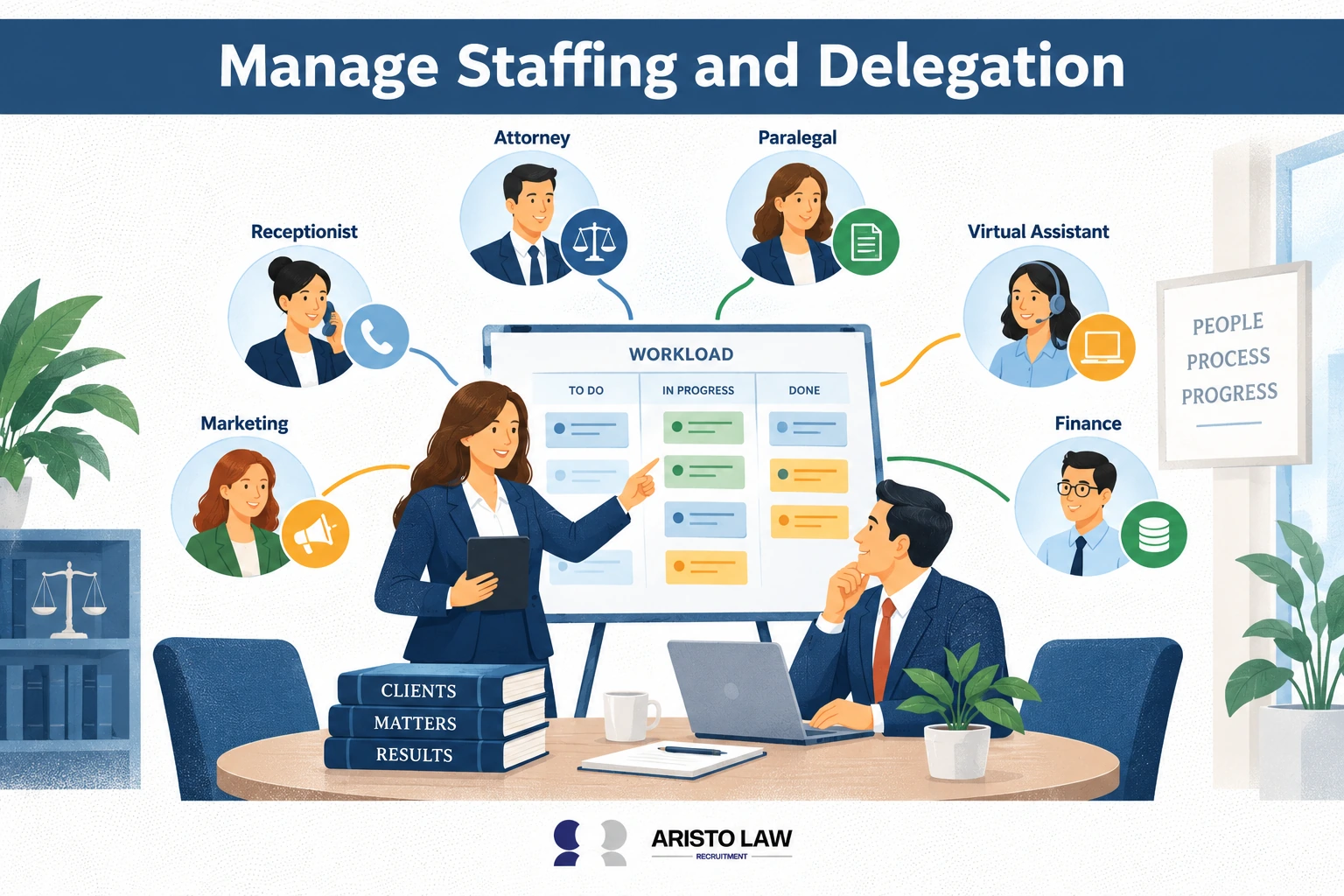
Law firms require partners to map each legal task to the right owner,
so attorneys handle legal judgment, paralegals handle case support, and
administrative staff handle intake, billing, scheduling, and client
updates. Managing a small law firm also depends on law firm
staffing and recruitment support that connects workload
demand, role fit, hiring gaps, and delegation structure into one
operating system.
Clear role definitions, documented workflows, and performance
expectations improve accountability and efficiency. Regular workload
reviews and structured delegation strengthen sustainable firm
growth.
14. Maintain ethical
compliance
Ethical compliance protects client interests, preserves
professional responsibility, and reduces regulatory risk throughout law
firm operations. Compliance systems govern confidentiality,
conflicts of interest, trust accounting, and legal ethics.
Regular policy reviews, staff education, compliance audits, and
secure technology strengthen regulatory adherence. Continuous compliance
monitoring protects both clients and firm reputation.
15. Monitor KPIs and
review firm performance
Monitoring key performance indicators (KPIs) and reviewing
firm performance measure operational efficiency, profitability, client
satisfaction, and business growth. Common law firm KPIs include
billable hours, realization rate, collection rate, and client
retention.
Performance reviews identify strengths, reveal operational
bottlenecks, and guide continuous improvement. Effective management
requires consistent reporting, data-driven decision-making, benchmark
comparisons, and regular strategic reviews to support sustainable law
firm growth.
What tools help manage
a small law firm?
Tools that help manage a small law firm include practice
management software, document management tools, billing software, and
accounting tools. Tools that help manage a small law firm also
include phone systems, review platforms, workflow automation tools, and
e-signature tools.
Listed below are 14 tools that help manage small law firms.
-
Practice Management Software: Centralizes case
management, task tracking, calendaring, and matter organization to
improve operational efficiency and workflow visibility. -
Document Management Tools: Store, organize, search,
and securely share legal documents while reducing duplication and
improving collaboration. -
Billing Software: Automates time tracking,
invoicing, collections, and financial reporting to improve revenue
realization and cash flow. -
CRM and Client Intake Tools: Capture leads, manage
consultations, automate follow-ups, and improve conversion throughout
the intake process. -
Scheduling and Calendaring Tools: Coordinate
appointments, court dates, deadlines, and lawyer availability while
reducing scheduling conflicts. -
Accounting and Financial Management Tools: Manage
bookkeeping, operating expenses, budgeting, and financial reporting. -
Phone and Communication Systems: Route client calls,
record communications where appropriate, support virtual reception, and
improve responsiveness across the firm. -
Review and Reputation Management Platforms: Monitor
client reviews, manage online reputation, encourage feedback, and
strengthen local search visibility. -
Workflow Automation Tools: Automate repetitive
administrative processes such as client onboarding, document routing,
reminders, and internal approvals. -
Document Automation Software: Generate legal
documents from standardized templates, reduce drafting time, and improve
consistency across legal matters. -
Communication and Collaboration Platforms: Improve
coordination between lawyers, paralegals, assistants, and remote staff
through secure messaging and file sharing. -
Cybersecurity Solutions: Protect confidential client
information through secure authentication, encryption, backup systems,
and access controls. -
Reporting and Dashboard Tools: Consolidate
operational, financial, marketing, and productivity data into measurable
KPIs that support management decisions. -
Electronic Signature Tools: Accelerate engagement
agreements, document approvals, and client authorizations while reducing
administrative delays.
Effective law firm management depends on integration between these
tools, consistent data hygiene, staff adoption, and workflow
compatibility. Connected systems eliminate duplicate data entry, improve
reporting accuracy, strengthen collaboration, and allow growing law
firms to scale operations without creating unnecessary administrative
complexity.
What
workflow systems should small law firms implement?
Small law firms should implement workflow systems that
standardize legal operations, improve efficiency, reduce administrative
work, and support scalable firm growth.
Listed below are the 18 important workflow systems for small law
firms.
-
Client Intake Workflow: Intake workflows qualify
leads, collect case details, trigger conflict checks, and route
prospects into the CRM. Automation improves response speed, reduces
missed leads, and increases consultation conversion. -
Conflict Checking Workflow: Conflict workflows
screen parties, matters, related entities, and prior representations
before engagement. Practice management and CRM integration reduces
ethics risk and protects professional compliance. -
Consultation Scheduling Workflow: Scheduling
workflows connect intake forms, calendars, reminders, and confirmation
emails. Automation reduces no-shows and improves client experience. -
Client Onboarding Workflow: Onboarding workflows
manage engagement letters, e-signatures, payment links, and document
requests. Standardization improves trust and reduces administrative
delay. -
Case Management Workflow: Case workflows organize
tasks, deadlines, documents, and matter status. Practice management
software improves visibility and accountability. -
Document Management Workflow: Document workflows
store, name, version, and archive legal files. Data hygiene improves
searchability and reduces duplicate work. -
Document Automation Workflow: Automation workflows
generate templates, letters, pleadings, and forms from approved data
fields. Automation reduces drafting time and improves consistency. -
Task and Deadline Workflow: Deadline workflows
assign responsibilities, track court dates, send reminders, and escalate
overdue tasks. Calendaring integration reduces missed deadlines. -
Billing and Time Tracking Workflow: Billing
workflows capture time, generate invoices, and track collections. Time
tracking improves revenue capture and law firm profitability. -
Trust Accounting Workflow: Trust workflows separate
client funds, reconcile accounts, document transactions, and support
audits. Accounting integration reduces compliance risk. -
Accounts Receivable Workflow: Collection workflows
monitor unpaid invoices, send reminders, process payments, and report
aging balances. Cash flow improves through consistent follow-up. -
Client Communication Workflow: Communication
workflows define update schedules, response times, message channels, and
client portal use. Consistent communication improves client
satisfaction. -
CRM and Lead Management Workflow: CRM workflows
track leads, referral sources, consultations, follow-ups, and conversion
outcomes. Marketing attribution improves business development
decisions. -
File Closing and Archiving Workflow: Closing
workflows finalize documents, confirm billing, return client property,
and preserve records. File hygiene supports compliance and future
retrieval. -
Reporting and KPI Dashboard Workflow: KPI workflows
track intake conversion, billable hours, realization rate, and staff
productivity. Performance reviews identify bottlenecks and guide
improvement. -
Digital Marketing Workflow: Marketing workflows
manage content calendars, SEO updates, PPC reporting, and lead tracking.
Integrated systems connect marketing activity to signed clients. -
Staff Onboarding and Training Workflow: Training
workflows document SOPs, role expectations, software use, and reporting
procedures. Clear responsibilities improve adoption and reduce
errors. -
Quality Assurance Workflow: QA workflows review
documents, billing entries, client communication, and compliance steps.
Quality checks reduce rework and protect client service.
Workflow systems must integrate with practice management software,
CRM systems, document management tools, and marketing platforms. SOPs
must define each process step, responsible person, required tool, and
KPI. A study by Clio titled “Legal Trends Report” in 2025,
states that law firms using legal technology and standardized,
client-centered systems significantly drop their overall cognitive load
by 25% and reduce billing strain, allowing them to dramatically improve
internal productivity, increase accuracy, and elevate the client
experience.
How much does
it cost to manage a small law firm?
The cost to manage a small law firm ranges from
$5,000–$30,000+ per month for common operating expenses, depending on
staffing, software, marketing, and growth goals. Startup costs
for a small law firm range from $10,000–$100,000+, depending on
jurisdiction, practice area, headcount, office requirements,and
technology investments.
Startup costs include business formation, office setup, computers,
and licensing. Monthly operating costs include owner compensation,
payroll, office rent, and outsourced legal support.
Fixed costs include salaries, rent, insurance, and software
subscriptions, while variable costs include advertising, contractor
fees, litigation expenses, and case-specific expenditures. Firms using
remote staff, outsourced legal support, and cloud-based legal technology
reduce overhead compared with firms maintaining large in-house teams and
physical offices.
Quantitative cost planning must separate one-time startup investments
from recurring monthly operating expenses, monitor payroll as the
largest operating cost for most firms, track software and marketing ROI
separately, and review financial performance regularly to identify
opportunities for greater operational efficiency and profitability.
When should a
small law firm hire a consultant?
A small law firm should hire a consultant when growth,
profitability, staffing, or owner capacity problems exceed the firm’s
internal management ability. Small law firm business
consultants are engaged during periods of rapid growth, declining
profitability, or operational stagnation where internal teams lack the
experience to identify root causes.
Consulting becomes necessary when revenue remains inconsistent
despite high workload, profit margins stay low due to billing leakage or
poor pricing structure, or the firm experiences owner burnout caused by
excessive administrative responsibility and lack of delegation systems.
An industry analysis by LawPay in 2025 titled “The Ultimate
Guide to Increasing Law Firm Profitability” states that when a small law
firm experiences growing client acquisition costs, irregular cash flow,
or a failure to translate rising case volumes into real net profit
margins, the firm must actively delegate, outsource, or bring in
specialized management solutions to restructure its pricing and
operational overhead.
Workflow breakdowns such as disorganized case management, inefficient
billing systems, weak and inconsistent marketing performance indicate
the need for external expertise. Law firm management consulting
addresses these gaps by analyzing operations, identifying
inefficiencies, and implementing structured systems for intake, billing,
staffing, and KPI tracking. Compared with software, training,
outsourcing, or internal operations roles, consultants focus on
diagnosing structural problems and redesigning workflows rather than
executing day-to-day tasks.
Consultants also become valuable when hiring decisions repeatedly
fail, client intake processes underperform, follow-ups are missed, and
case pipelines lack structure, directly reducing conversion rates and
revenue predictability. Effective consulting improves delegation
systems, strengthens financial control, enhances marketing performance,
and creates scalable operational structures that support sustainable
firm growth and increased owner capacity.
Where
can small law firms get management consulting services?
Small law firms can get management consulting services from
law firm management consulting firms, legal business consultants, legal
operations consultants, and practice management advisors. Small
law firms also get management consulting services from bar association
practice management programs, legal technology consulting firms, and
specialized legal outsourcing providers.
Listed below are the 11 sources of management consulting services for
small law firms.
-
Law Firm Management Consulting Firms: Provide
strategic planning, profitability analysis, workflow optimization, and
growth strategy development tailored specifically to law firms. -
Outsourced Legal Support Providers: LPOs like Aristo
Law offer consulting alongside staffing solutions, including workflow
optimization, legal staffing support, virtual assistants, and scalable
operational design. Aristo Law supports small law firms by combining
consulting insight with execution through trained remote
professionals. -
Legal Business Consultants: Focus on business
planning, revenue optimization, pricing strategy, and long-term growth
strategy for solo and small firms. -
Legal Operations Consultants: Improve internal
workflows including case management, client intake, billing systems, and
operational efficiency. -
Practice Management Advisors (Bar Associations):
Offer guidance on ethics compliance, law office setup, client management
systems, and operational best practices, at low or no cost. -
Legal Technology Consulting Firms: Assist with
selecting and implementing practice management software, CRM systems,
automation tools, and digital infrastructure. -
Accounting and Financial Consultants: Support
budgeting, trust accounting compliance, financial reporting, and cost
control systems. -
HR and Legal Staffing Consultants: Help firms with
recruitment, outsourcing strategies, delegation systems, and performance
management structures. -
Strategic Planning Consultants: Guide law firms in
defining business goals, competitive positioning, expansion planning,
and long-term operational strategy. -
Marketing and Business Development Consultants:
Improve law firm SEO strategy, PPC performance, branding, and client
acquisition funnels. -
Business Coaching Firms: Provide leadership
coaching, accountability systems, productivity optimization, and owner
performance improvement strategies.
Law firms must evaluate legal industry experience, measurable
results, implementation methodology, and long-term ROI before selecting
a consultant. Management consulting is most effective during periods of
rapid growth, declining profitability, operational inefficiencies, or
business restructuring.
Research by the Business Accelerator Institute in 2026,
published in the study Law Firm Management Consulting: A Guide for Firm
Leaders, states that utilizing external advisory services equips law
firm leaders with data-driven metric frameworks and objective KPI
systems, fundamentally removing internal leadership biases and shifting
decision-making from reactive guesswork to strategic execution.
Law firms using external consulting and advisory services improve
decision-making quality, scalability, and long-term business performance
compared with firms relying solely on internal management
structures.
How
does Aristo Law help small law firms improve management and
operations?
Aristo Law helps small law firms improve management and
operations by providing dedicated remote legal and business support
professionals who streamline workflows, reduce administrative workloads,
improve operational efficiency, and enable lawyers to focus on
practicing law and growing their firms.
Managing a small law firm means aligning intake, calendars,
documents, and reporting with repeatable workflows, and Aristo Law
supports this management model through virtual
legal assistant support for law firm operations. Aristo
Law operates through a structured Legal Process Outsourcing (LPO) model
where it provides outsourced legal staff, small law firms delegate
administrative work, and the firm’s management system gains cleaner task
ownership, faster matter movement, and more controlled daily
operations.
Listed below are 7 ways Aristo Law helps small law firms improve
management and operations.
-
Remote Paralegals: Support case preparation, legal
research, discovery assistance, document drafting, and litigation
support to improve case turnaround efficiency. -
Virtual Legal Assistants: Handle scheduling, email
management, client communication, document organization, and
administrative workflows to reduce attorney workload. -
Legal Accounting Specialists: Manage billing
support, trust accounting assistance, expense tracking, and financial
reporting to improve financial accuracy and compliance. -
Intake Specialists: Optimize client onboarding,
qualification, lead handling, and consultation scheduling to increase
conversion rates. -
Executive & Administrative Assistants: Manage
calendars, communication pipelines, reporting tasks, and workflow
coordination to improve operational structure. -
SEO and Digital Marketing Specialists: Support law
firm visibility through SEO, Local SEO, content creation, social media
management, and lead generation systems. -
Content Writers and Social Media Managers: Develop
legal content, blog articles, practice area pages, and social media
campaigns that improve brand visibility and client engagement.
Aristo Law professionals collectively optimize core operational areas
such as case management, document workflows, CRM systems, and internal
communication structures. Aristo Law’s outsourcing model reduces
recruitment time, lowers labor and overhead costs, improves scalability,
and allows firms to build fully functional remote teams without the
long-term financial commitment of in-house hiring.
Small law firms measure success through KPIs such as billable
utilization rate, case turnaround time, client response time, and
operational cost efficiency. Operational improvements result in faster
case processing, increased billable hours, reduced administrative
bottlenecks, and higher profitability.
Build a legal support team that moves work forward.
Tell us what is slowing your practice down. We will help map the role, workflow, and support structure that fits.