
Freelance Social Media Manager for Law Firms vs. Virtual Assistant: Differences, Costs, and Brand Growthntitled document

Practical guidance for building efficient, accountable legal support operations.
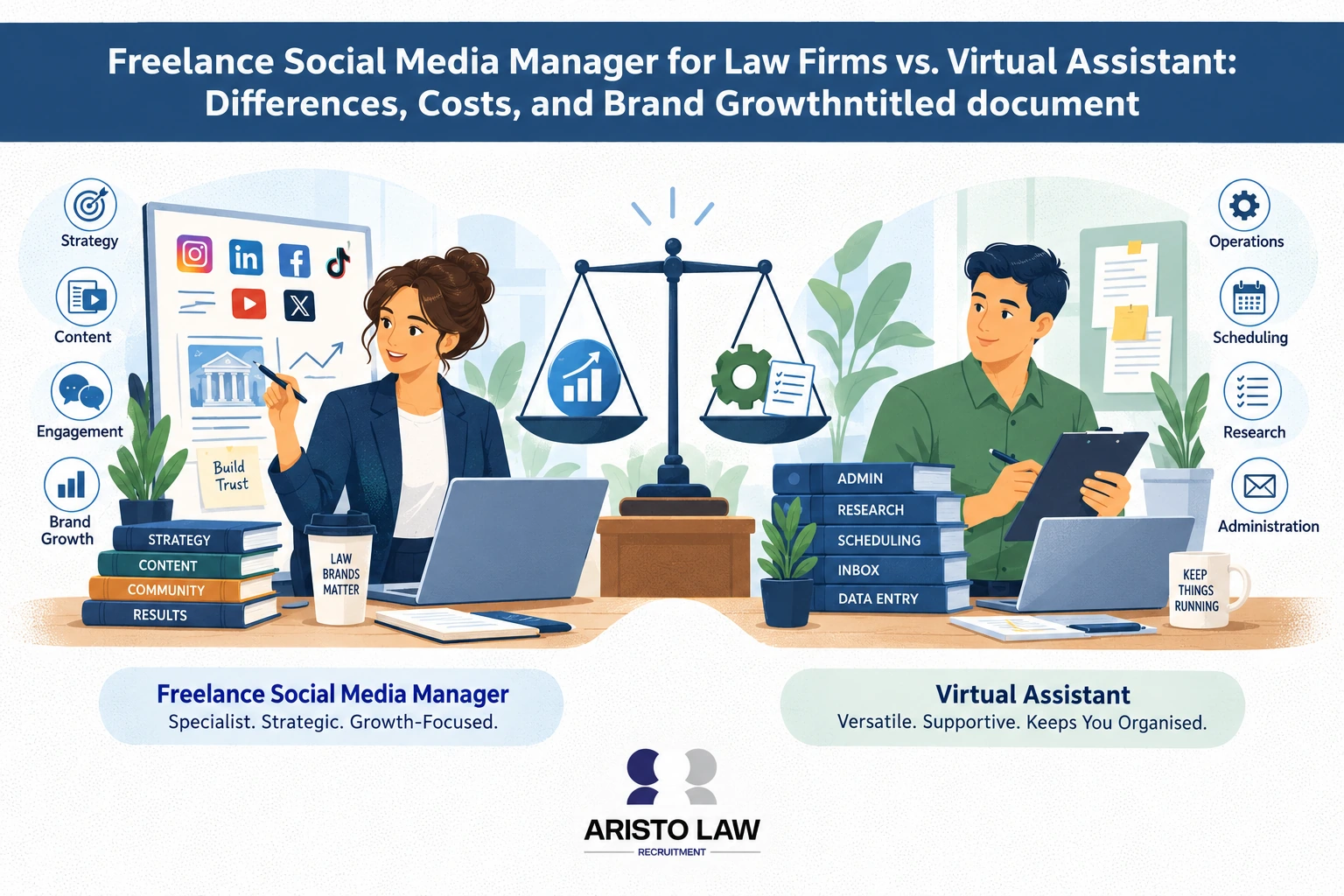
A freelance social media manager for law firms drives legal
marketing and brand growth. A virtual legal assistant manages legal
administrative and operational workflows that improve law firm
efficiency. Freelance social media managers develop content
strategies, perform audience research, manage content calendars, and
manage online reputation. Freelance social media managers increase brand
awareness, lead generation, and client engagement through copywriting,
SEO, branding, and marketing analytics.
Virtual assistants manage calendars, emails, scheduling, and
administrative coordination. Virtual assistants improve productivity and
reduce operating costs by handling recurring administrative tasks and
support workflows.
Freelance social media managers charge $10–$150+ per hour or
$300–$10,000+ per month, while virtual legal assistants charge $3–$75+
per hour or $200–$6,000+ per month, depending on experience,
specialization, and workload. Law firms hire freelance social media
managers to strengthen online visibility, improve search and social
engagement, and generate qualified leads, whereas virtual legal
assistants improve productivity, streamline operations, and support
scalable growth. Many growing firms benefit from both roles because
marketing strategy drives client acquisition, administrative support
improves execution, and task specialization increases operational
efficiency.
A study by Deloitte titled “Global Outsourcing Survey” in
2024 states that organizations using outsourcing improve operational
efficiency, reduce costs, and increase workforce flexibility.
Aristo Law evaluates operational requirements, recommends the most
suitable staffing model, and provides trained virtual legal assistants
together with specialized legal marketing support, enabling law firms to
improve productivity, strengthen brand visibility, and achieve
sustainable long-term growth.
Aristo Law is a Legal Process Outsourcing company that helps
law firms strengthen brand growth by providing outsourced Virtual Legal
Marketing Assistant support for social media coordination, content
scheduling, campaign assistance, and law firm visibility workflows. Call Aristo Law at +1 307 888 9491
for Virtual Legal Marketing Assistant staffing support. Aristo
Law connects law firms with outsourcing solutions that match trained
legal marketing support staff to each social media management task,
brand growth workflow, content coordination duty, and visibility
improvement needs.
Who is a
freelance social media manager for law firms?
A freelance social media manager for law firms is an
independent professional who develops and executes social media
strategies to grow a law firm’s online presence, audience engagement,
and client acquisition. Freelance social media managers develop
content strategy, audience research identifies prospective legal
clients, and social media marketing aligns with law firm business
objectives.
Content calendars organize consistent publishing, platform analytics
measure campaign performance, and performance optimization improves
engagement and lead generation. Community management strengthens
relationships with prospective clients, campaign management coordinates
organic and paid initiatives, and social advertising expands visibility
across platforms such as LinkedIn, Facebook, Instagram, and X.
Social media activities support business growth, lead generation
increases qualified consultations, and consistent branding strengthens
competitive positioning. A study by HubSpot titled “State of
Marketing” in 2024 states that organizations using data-driven social
media strategies generate higher engagement, stronger brand awareness,
and better lead-generation performance than organizations without
structured social media management.
Freelance social media managers perform responsibilities beyond
content posting. Audience research identifies legal service demand,
content creation communicates practice-area expertise, and platform
optimization improves discoverability. Analytics evaluate engagement,
conversion data guides campaign improvements, and reporting measures
marketing performance. Reputation management strengthens public trust,
community engagement improves client relationships, and continuous
optimization supports customer retention and long-term brand
awareness.
What
Are the Responsibilities of a Freelance Social Media Manager?
A freelance social media manager is responsible for planning,
creating, managing, and optimizing a law firm’s social media presence to
increase audience engagement, brand awareness, and business
results.
A freelance social media manager for law firms owns strategy,
compliance-aware content planning, campaign execution, and performance
reporting, whereas a virtual assistant supports scheduling, publishing,
inbox triage, and admin tasks tied to remote
social media assistant responsibilities.
Listed below are the 20 primary responsibilities of a freelance
social media manager.
-
Social Media Strategy: Social media strategy
supports law firm growth, content strategy aligns with client
acquisition goals, and marketing activities contribute to measurable
business outcomes. -
Audience Research: Audience research identifies
prospective legal clients, customer personas improve content relevance,
and marketing campaigns reach qualified audiences. -
Content Calendar: Content calendars organize
consistent publishing, scheduled content strengthens brand visibility,
and regular posting improves audience engagement. -
Content Creation: Content creation communicates
legal expertise, persuasive copy improves engagement, and educational
content builds public trust. -
Visual Assets: Visual content increases message
retention, branded graphics strengthen firm identity, and videos improve
audience interaction. -
Post Scheduling: Publishing schedules maintain
consistency, platform management increases visibility, and automated
scheduling improves workflow efficiency. -
Community Management: Community management
strengthens client relationships, timely responses improve engagement,
and active communication builds credibility. -
Follower Engagement: Audience engagement encourages
conversations, prompt communication improves client experience, and
professional responses strengthen reputation. -
Organic Growth: Organic engagement expands audience
reach, valuable content attracts followers, and consistent interaction
improves brand awareness. -
Campaign Management: Campaign management supports
practice-area marketing, promotional campaigns generate consultations,
and coordinated execution improves marketing performance. -
Paid Social Ads: Social media advertising targets
qualified audiences, paid campaigns generate leads, and advertising
budgets produce measurable returns. -
Reputation Monitoring: Reputation management tracks
public sentiment, online conversations influence perception, and
proactive responses protect the firm’s reputation. -
KPI Tracking: KPI tracking measures reach,
engagement, impressions, and follower growth, analytics identify
successful campaigns, and data supports strategic improvements. -
Performance Reports: Performance reporting evaluates
campaign effectiveness, marketing decisions rely on measurable data, and
continuous improvement becomes possible. -
Competitor Research: Competitor analysis identifies
market opportunities, industry research strengthens positioning, and
legal marketing strategies remain competitive. -
Trend Monitoring: Platform updates influence content
visibility, algorithm changes affect engagement, and timely adaptation
maintains performance. -
Optimization: Analytics reveal optimization
opportunities, strategy adjustments improve results, and ongoing
refinement increases return on investment. -
Team Collaboration: Collaboration aligns marketing
activities, brand messaging remains consistent, and campaign execution
becomes more efficient. -
Brand Consistency: Brand consistency strengthens
recognition, professional messaging builds trust, and visual identity
improves recall. -
Compliance: Compliance protects advertising
accounts, platform policies reduce enforcement risks, and legal
marketing activities remain ethically compliant.
A study by HubSpot titled “State of Marketing” in year 2026
states that organizations using data-driven social media strategies
achieve higher engagement, stronger brand visibility, and better
lead-generation performance than organizations using inconsistent or
unstructured social media marketing. Responsibilities vary
according to the law firm’s marketing objectives, practice areas, target
audience, and the scope of the freelance engagement.
What
Skills Does a Freelance Social Media Manager Need?
A freelance social media manager needs a combination of
marketing, creative, analytical, communication, and business skills to
effectively manage social media accounts and achieve a law firm’s
branding and marketing objectives.
Listed below are the 28 essential skills of a freelance social media
manager.
-
Social Media Strategy: Social media strategy aligns
marketing activities with business goals, content planning improves
client acquisition, and audience growth supports law firm
visibility. -
Content Planning: Editorial planning organizes
publishing schedules, consistent content strengthens brand awareness,
and structured campaigns improve engagement. -
Copywriting: Persuasive copy communicates legal
services, compelling captions increase engagement, and clear messaging
improves conversions. -
Content Creation: Content creation educates
prospective clients, valuable content builds authority, and multimedia
assets increase audience interaction. -
Graphic Design: Visual design strengthens brand
identity, professional graphics improve credibility, and engaging
visuals increase content performance. -
Video Editing: Short-form videos improve engagement,
educational legal videos increase visibility, and video content supports
client education. -
Platform Expertise: Platform knowledge optimizes
Facebook, Instagram, LinkedIn, X, TikTok, and other channels,
platform-specific strategies improve reach, and audience engagement
increases. -
Audience Research: Audience research identifies
legal client needs, customer personas improve targeting, and campaigns
attract qualified prospects. -
Community Management: Community management
strengthens client relationships, timely responses improve trust, and
audience interaction supports reputation. -
Analytics: Analytics measure campaign performance,
KPI tracking identifies growth opportunities, and data-driven decisions
improve marketing outcomes. -
Data Analysis: Performance data identifies
successful strategies, reporting supports optimization, and measurable
insights improve ROI. -
Paid Advertising: Paid campaigns generate qualified
leads, advertising optimization improves conversions, and budget
allocation increases campaign efficiency. -
SEO Fundamentals: SEO improves content visibility,
keyword optimization increases organic reach, and search traffic
supports lead generation. -
Trend Research: Industry trends identify emerging
opportunities, platform updates influence strategy, and social listening
improves audience relevance. -
Brand Management: Brand consistency strengthens
recognition, messaging builds credibility, and visual identity improves
trust. -
Creativity: Creative thinking develops engaging
campaigns, storytelling strengthens audience connections, and innovative
content increases engagement. -
Communication: Communication improves client
collaboration, project expectations remain clear, and stakeholder
relationships become stronger. -
Client Management: Client relationship management
improves service delivery, regular communication builds confidence, and
long-term partnerships develop. -
Project Management: Project management coordinates
campaigns, workflow organization improves productivity, and deadlines
remain achievable. -
Time Management: Time management prioritizes tasks,
publishing schedules remain consistent, and campaign execution
improves. -
Problem Solving: Problem-solving resolves campaign
challenges, performance issues receive prompt attention, and marketing
objectives remain achievable. -
Adaptability: Adaptability responds to algorithm
changes, platform updates influence strategy, and marketing performance
remains competitive. -
Collaboration: Collaboration aligns marketers,
designers, content creators, and attorneys, coordinated execution
improves campaign quality, and brand messaging remains consistent. -
Budget Management: Budget management controls
advertising spend, campaign efficiency improves, and return on
investment increases. -
Marketing Knowledge: Marketing knowledge supports
branding, audience targeting improves campaign effectiveness, and
strategic planning strengthens business growth. -
Customer Service: Customer service improves audience
interactions, conflict resolution protects brand reputation, and client
satisfaction increases. -
Attention to Detail: Attention to detail improves
content quality, publishing errors decrease, and brand professionalism
strengthens. -
Continuous Learning: Continuous learning keeps
skills current, emerging technologies improve campaign performance, and
professional development strengthens long-term marketing success.
A study by HubSpot titled “State of Marketing” in year 2026
states that organizations using data-driven social media strategies
achieve substantially higher engagement, stronger brand awareness, and
improved lead generation than organizations relying on inconsistent
social media activities. Skill requirements vary according to
the law firm’s practice areas, target audience, marketing objectives,
and the scope of the freelance engagement.
How
Much Does Hiring a Freelance Social Media Manager Cost?
The cost of hiring a freelance social media manager for a law
firm ranges from approximately $10–$150+ per hour, $300–$10,000+ per
month, or $200–$5,000+ per project, depending on experience, service
scope, legal marketing expertise, geographic location, and whether the
professional is sourced locally or internationally. Freelance
social media manager cost varies by pricing model, social media
marketing rates increase with specialization, and digital marketing
budgets depend on business objectives.
Entry-level freelance social media managers charge $10–$25
per hour or $300–$800 per month for content posting,
scheduling, and basic community management. Mid-level
professionals charge $25–$75 per hour or $800–$2,500 per month
for content strategy, audience engagement, analytics reporting, and
campaign management. Expert specialists commonly charge
$75–$150+ per hour or $2,500–$10,000+ per month for
comprehensive strategy, paid advertising, reputation management,
audience growth, and performance optimization. Project-based
pricing ranges from $200–$1,000 for small campaigns and $1,000–$5,000+
for complete law firm branding or social media campaigns.
Freelance social media managers in South Africa commonly
charge $8–$30 per hour or $800–$2,500 per month. Professionals in Brazil
charge $10–$35 per hour or $900–$3,000 per month. Freelancers in the
Philippines charge $5–$20 per hour or $500–$2,000 per month,
depending on experience, English proficiency, and specialization in
legal or professional services marketing.
Pricing increases when services include content strategy, paid
advertising management, video production, legal content creation,
analytics reporting, influencer outreach, and multi-platform campaign
management. Small law firms begin with lower-cost freelancers, larger
firms frequently retain experienced specialists or agencies, and
long-term retainers provide consistent marketing execution.
How
to Hire a Freelance Social Media Manager for Law Firms?
Hiring a freelance social media manager for a law firm
involves defining your marketing goals, evaluating candidates with legal
marketing experience, and selecting a professional who develops a
compliant, results-driven social media strategy.
Listed below are the 15 steps in hiring a freelance social media
manager for law firms.
-
Define marketing goals: Identify business
objectives, target audience, and measurable outcomes such as
consultations, brand awareness, or client engagement. -
Select priority platforms: Determine whether
LinkedIn, Facebook, Instagram, X, or other platforms best match your
practice areas and target clients. -
Define the scope of work: Specify responsibilities
including content strategy, content creation, community management, paid
advertising, analytics, and reporting. -
Set a hiring budget: Choose an hourly, monthly
retainer, or project-based pricing model that matches the firm’s
marketing needs. -
Choose a hiring model: Decide between an independent
freelancer, a marketing agency, or a dedicated remote professional. -
Source qualified candidates: Recruit through legal
marketing agencies, Legal staffing providers like Aristo.law, freelance
marketplaces, or professional networks. -
Review legal marketing portfolios: Evaluate previous
work involving law firms or other regulated professional services. -
Assess legal compliance knowledge: Confirm
familiarity with attorney advertising rules, ethics requirements, and
legal marketing regulations. -
Evaluate technical skills: Review expertise in
content strategy, copywriting, branding, audience engagement, local SEO,
and campaign management. -
Verify software proficiency: Assess experience with
Meta Business Suite, LinkedIn Campaign Manager, Canva, Google Analytics,
and scheduling platforms. -
Conduct structured interviews: Discuss communication
style, reporting frequency, collaboration methods, and workflow
expectations. -
Request work samples: Review legal content, campaign
strategies, performance reports, or relevant case studies. -
Check references: Verify previous client results,
testimonials, reliability, and long-term performance. -
Define KPIs: Establish measurable goals for
engagement, reach, leads, conversions, reporting schedules, and campaign
success. -
Complete onboarding: Sign confidentiality and
service agreements, provide brand guidelines, practice area information,
marketing assets, and system access, then monitor analytics regularly
and optimize campaigns using measurable performance data.
A study by the Society for Human Resource Management (SHRM)
titled “The Cost of a Bad Hire” in year 2024 states that structured
hiring processes and job-specific assessments improve hiring quality and
long-term employee performance. Consistent, data-driven social
media management increases brand awareness, audience engagement, and
lead generation compared with inconsistent marketing efforts.
What is a virtual assistant?
A virtual assistant is a remote professional who provides
administrative, operational, technical, or specialized business support
services to individuals, entrepreneurs, organizations, and law firms
without working on-site. Virtual assistants perform tasks
remotely using digital communication and collaboration tools,
administrative support improves business productivity, and remote work
increases operational flexibility.
For law firms, virtual assistants manage email and calendar
management, client communication, scheduling, customer support, data
entry, legal document preparation, research, CRM updates, project
coordination, bookkeeping support, travel arrangements, and social media
assistance, allowing attorneys and paralegals to focus on billable legal
work and client representation.
Virtual assistants work as freelancers, independent contractors,
dedicated remote professionals, or through virtual assistant agencies
and legal staffing providers. Responsibilities vary according to the
firm’s practice areas, business size, operational requirements, and
service agreement. Specialized legal virtual assistants also support
client intake, case administration, document organization, billing
assistance, legal research coordination, and workflow management using
practice management software and cloud-based collaboration
platforms.
A study by Prialto titled “Virtual
Assistant Statistics” in year 2025 states that outsourcing
administrative work to virtual assistants reduces operating costs by
30%–78% compared with hiring equivalent in-house administrative staff
while improving operational efficiency and enabling business owners to
dedicate more time to strategic activities. Organizations adopt
outsourcing to improve efficiency, reduce costs, and increase
organizational flexibility, making virtual assistant services an
effective staffing solution for growing law firms and professional
service businesses.
What Are
the Responsibilities of a Virtual Assistant?
A virtual assistant is responsible for providing remote
administrative, technical, and operational support to businesses,
entrepreneurs, and organizations. This support helps law firms
and businesses improve efficiency while allowing focus on core legal and
business activities.

Listed below are the 20 responsibilities of a virtual assistant.
-
Email Management: Managing inbox organization,
filtering messages, prioritizing urgent legal communications, and
reducing attorney and staff overload. -
Scheduling & Calendar Management: Scheduling
appointments, court dates, consultations, and meetings while ensuring
deadlines and reminders are properly tracked. -
Data Entry & Database Management: Maintaining
accurate client records, updating case information, and ensuring
structured data storage for law firm systems. -
Online Research: Conducting legal, client, or
competitor research and compiling structured reports to support case
preparation and marketing decisions. -
Customer Support: Responding to client inquiries,
handling intake communication, and improving client responsiveness for
law firms. -
Social Media Assistance: Managing basic posting,
scheduling content, and supporting law firm branding and online
visibility. -
Bookkeeping Support: Tracking invoices, organizing
financial records, and assisting with billing documentation and expense
monitoring. -
CRM Management: Updating client relationship
management systems, ensuring accurate case tracking, and maintaining
follow-up pipelines. -
Document Preparation: Creating, formatting, and
organizing legal and business documents, spreadsheets, and
presentations. -
Project Coordination: Tracking case-related tasks,
assigning updates, and ensuring workflow progress across teams. -
Travel Coordination: Arranging travel logistics for
attorneys, including scheduling, bookings, and itinerary management. -
File Organization: Managing digital and cloud-based
filing systems to ensure quick access to legal documents and case
files. -
Lead Follow-ups: Assisting intake teams by following
up on prospective clients and ensuring no missed opportunities. -
Marketing Support: Assisting with email campaigns,
newsletters, and basic marketing coordination for law firm growth. -
Transcription Services: Converting recordings,
dictations, or meeting notes into structured written documents. -
Market & Competitor Research: Supporting
strategic decisions through data collection and analysis of legal market
trends. -
E-commerce & Admin Support (where applicable):
Handling order tracking, listings, and customer queries for
legal-adjacent businesses. -
Technical Support: Assisting with basic software
tools, troubleshooting, and platform management for daily
operations. -
Internal Communication: Maintaining communication
flow between attorneys, staff, and clients to improve coordination. -
Workflow Automation: Using productivity tools to
automate repetitive tasks and improve operational efficiency.
Virtual Assistant executes administrative coordination, inbox
management, scheduling, client communication, and task execution, while
the Freelance Social Media Manager executes content strategy, platform
optimization, engagement tracking, and audience growth. Virtual
Assistant responsibilities extend into marketing execution layers
through virtual
legal marketing assistant services, where workflow
coordination, campaign scheduling, content distribution, and lead
monitoring operate as structured operational outputs.
A study by Prialto titled “Virtual Assistant Statistics” in
year 2025 states that outsourcing administrative tasks to virtual
assistants can save businesses several hours per week per employee while
reducing operational costs by 30%–78% compared to in-house staffing
models, improving productivity and allowing legal teams to
focus on billable work and strategic case development.
What Skills Does a
Virtual Assistant Need?
A virtual assistant needs a combination of administrative,
technical, communication, organizational, and digital skills to
effectively support clients remotely and manage law firm or business
operations efficiently.
Listed below are the 20 skills of a virtual assistant.
-
Communication Skills: Clear written and verbal
communication ensures accurate client interaction, improves coordination
with attorneys and staff, and reduces operational errors in legal
workflows. -
Time Management: Strong time management enables
prioritization of deadlines, court schedules, and administrative tasks,
improving productivity and reducing missed obligations. -
Organization & Multitasking: Organizational
skills ensure case files, documents, and workflows remain structured,
while multitasking supports handling multiple legal and administrative
tasks efficiently. -
Email & Calendar Management: Managing inboxes
and schedules reduces attorney overload, improves response times, and
ensures deadlines, hearings, and meetings are properly tracked. -
Data Entry Accuracy: Accurate data entry ensures
reliable case records, reduces documentation errors, and strengthens law
firm database integrity. -
Research Skills: Research ability supports legal
case preparation, client background checks, and competitive analysis for
marketing and operational decisions. -
Customer Service Skills: Professional client
communication improves client intake experience, strengthens trust, and
enhances law firm reputation. -
Basic Bookkeeping: Invoicing and financial tracking
support billing accuracy, improve cash flow visibility, and reduce
accounting errors. -
CRM Management: Proper CRM usage ensures client data
is updated, follow-ups are tracked, and case pipelines remain
organized. -
Social Media Management: Basic scheduling and
posting support law firm visibility, audience engagement, and marketing
consistency. -
Productivity Tool Proficiency: Familiarity with
tools like Google Workspace, Trello, Asana, and Slack improves workflow
automation and team coordination. -
Problem-Solving Skills: Critical thinking helps
resolve operational issues quickly and improves efficiency in remote
work environments. -
Tech-Savviness: Ability to learn new software
ensures adaptability to law firm systems, case management tools, and
legal tech platforms. -
Document Preparation Skills: Formatting and
preparing documents improves workflow efficiency and ensures
professional legal documentation standards. -
Project Coordination: Task tracking ensures
deadlines are met, responsibilities are assigned clearly, and legal
projects remain organized. -
Confidentiality Awareness: Protecting sensitive
legal information ensures compliance with ethical and legal data
protection standards. -
Marketing & Lead Support: Basic marketing
knowledge supports lead generation, intake follow-ups, and law firm
growth activities. -
Adaptability: Flexibility ensures virtual assistants
adjust to different law firm workflows, industries, and client
requirements. -
Email Marketing Support: Assisting with newsletters
and campaigns improves client communication and marketing
consistency. -
Independent Work Discipline: Self-management ensures
productivity in remote environments without constant supervision.
Industry research on outsourcing and remote administrative work shows
that businesses using virtual assistants improve productivity by saving
several hours per week per employee and reduce operational workload,
allowing attorneys and staff to focus on higher-value legal work instead
of routine administrative tasks.
How
Much Does Hiring a Virtual Assistant Cost for Law Firms?
The cost of hiring a virtual assistant for law firms ranges
from approximately $3–$75+ per hour, $200–$6,000+ per month, or
$50–$3,000+ per project, depending on experience, specialization,
location, and the scope of legal support required. Virtual
assistant cost varies by pricing model, remote assistant pricing
reflects skill level, and business outsourcing provides flexible
staffing options.
Entry-level virtual assistants charge $3–$10 per hour or
$200–$600 per month for administrative support such as email
management, scheduling, client intake, and data entry. Mid-level
virtual assistants charge $10–$25 per hour or $600–$2,000 per month for
CRM management, customer communication, legal research assistance, and
social media support. Specialized or executive virtual
assistants commonly charge $25–$75+ per hour or $2,000–$6,000+ per month
for bookkeeping, executive assistance, legal marketing support, project
management, compliance coordination, and technical responsibilities.
Project-based work ranges from $50–$300 for small assignments
and $500–$3,000+ for complex or ongoing legal support
projects.
Location influences pricing. Virtual assistants from the Philippines,
South Africa, and Latin America offer lower rates while maintaining high
service quality, whereas professionals based in North America and
Western Europe command higher fees because of local labor costs. Law
firms reduce staffing expenses through remote hiring, administrative
workloads shift to dedicated professionals, and attorneys spend more
time on billable legal work.
A study by Prialto titled “Virtual Assistant Statistics” in
year 2025 states that outsourcing administrative responsibilities
reduces operating costs by approximately 30–78% compared with
maintaining equivalent in-house positions, allowing law firms to improve
productivity while scaling support more cost-effectively.
How to Hire a Virtual
Legal Assistant?
Hiring a virtual legal assistant involves identifying your
firm’s support needs, evaluating candidates with relevant legal
experience, and selecting a professional who integrates seamlessly into
your workflows while maintaining confidentiality and
compliance.
Listed below are 17 steps to hire a legal VA.
-
Identify Outsourced Tasks: Administrative
responsibilities receive evaluation, repetitive legal tasks become
outsourcing candidates, and attorneys focus on billable legal work. -
Define the Role: Job responsibilities establish
expectations, required qualifications identify suitable candidates, and
role clarity improves hiring accuracy. -
Choose the Engagement Model: Part-time, full-time,
or project-based staffing aligns with workload, operational flexibility
increases, and staffing costs remain controlled. -
Set the Hiring Budget: Budget planning determines
affordable compensation, pricing models support financial planning, and
recruitment decisions remain cost-effective. -
Create a Job Description: Job descriptions define
responsibilities, software requirements establish technical
expectations, and hiring criteria remain consistent. -
Source Qualified Candidates: Legal staffing
providers, virtual legal assistant agencies, freelance marketplaces, and
professional networks provide access to experienced legal support
professionals. -
Review Legal Experience: Candidate experience
demonstrates familiarity with law firm operations, legal administrative
knowledge reduces training time, and hiring quality improves. -
Evaluate Legal Knowledge: Legal terminology,
document preparation, procedural workflows, and client communication
confirm job readiness. -
Verify Technical Skills: Legal software proficiency
supports workflow integration, document management improves efficiency,
and CRM systems organize client information. -
Conduct Structured Interviews: Communication skills
demonstrate professionalism, organizational ability predicts
productivity, and problem-solving supports operational success. -
Request Practical Assessments: Work samples validate
technical competence, task simulations measure performance, and hiring
decisions rely on objective evidence. -
Check References: Previous employers verify work
quality, professional reliability strengthens hiring confidence, and
employment history confirms experience. -
Confirm Confidentiality Practices: Confidentiality
protects client information, legal ethics guide professional conduct,
and data security reduces compliance risk. -
Define Performance Expectations: KPIs measure
productivity, communication protocols establish accountability, and
reporting expectations support performance management. -
Finalize the Agreement: Service agreements define
responsibilities, confidentiality obligations protect client interests,
and payment terms establish clear expectations. -
Complete Onboarding: System access enables
productivity, workflow documentation supports consistency, and firm
procedures improve integration. -
Monitor and Optimize Performance: Regular feedback
improves performance, evolving workloads guide responsibility
adjustments, and continuous management strengthens long-term
productivity.
A study by the Society for Human Resource Management (SHRM)
titled “The Cost of a Bad Hire” in year 2024 states that structured
hiring and onboarding processes improve employee performance, retention,
and organizational outcomes. Delegating administrative and
procedural legal work to qualified support professionals improves
attorney productivity, operational efficiency, and overall law firm
performance.
What
is the difference between a freelance social media manager and a virtual
assistant?
The difference between a freelance social media manager and a
virtual assistant is that a freelance social media manager manages
social media strategy, content, engagement, and platform growth, while a
virtual assistant manages administrative, operational, communication,
scheduling, and task-support workflows.
The table below shows the difference between a freelance social media
manager and a virtual assistant.
| Aspect | Freelance Social Media Manager | Virtual Assistant |
|---|---|---|
| Primary Focus | Managing and growing the law firm’s social media presence | Providing administrative and operational support for the law firm |
| Core Role | Strategy development, content creation, audience engagement, and analytics |
Administrative coordination, organization, scheduling, and workflow support |
| Work Scope | Specialized in social media marketing and brand growth | Broad support across multiple business and legal administrative functions |
| Strategic vs. Operational | Highly strategic, focusing on marketing performance and client acquisition |
Primarily operational, focusing on task execution and productivity |
| Key Tasks | Content strategy, content creation, posting, paid campaigns, analytics, reputation management, and engagement |
Email management, calendar scheduling, client communication, data entry, CRM updates, legal document support, and research |
| Tools Used | Meta Business Suite, LinkedIn, Hootsuite, Buffer, Canva, Google Analytics, and social media analytics platforms |
Google Workspace, Microsoft Office, Clio, MyCase, Trello, Asana, Slack, CRM platforms, and document management systems |
| Skill Type | Marketing strategy, copywriting, branding, SEO, analytics, advertising, and content creation |
Organization, communication, multitasking, legal administration, technology proficiency, and workflow management |
| Business Impact | Increases brand awareness, audience engagement, lead generation, and client acquisition |
Improves operational efficiency, reduces administrative workload, and increases attorney productivity |
| Client Interaction | Plans marketing campaigns, manages community engagement, and strengthens brand relationships |
Coordinates appointments, responds to inquiries, and supports day-to-day client communication |
| Level of Specialization | High specialization in social media marketing and digital brand growth |
Moderate to broad specialization across administrative and operational support |
| Contribution to Growth | Directly improves online visibility, marketing performance, and business development |
Indirectly supports firm growth by improving efficiency and allowing attorneys to focus on billable legal work |
A study by Deloitte titled “Structured Delegation Boosts
Governance and Efficiency” in year 2026 states that role specialization
improves operational efficiency, productivity, and business performance
through focused expertise and effective task delegation.
Research from HubSpot also found that organizations using dedicated
social media management achieve more consistent audience engagement,
stronger brand visibility, and higher lead-generation performance, while
administrative outsourcing enables professionals to devote more time to
strategic business activities.
What
Are the Similarities Between Freelance Social Media Managers and Virtual
Assistants?
Freelance social media managers and virtual assistants are
remote professionals who support law firms by handling digital tasks,
improving operational efficiency, and helping attorneys save time and
resources.
Listed below are 14 similarities between freelance social media
managers and legal virtual assistants.
-
Remote Work: Freelance social media managers and
Legal virtual assistants work remotely. Digital communication supports
daily collaboration, and law firms access qualified professionals
without geographic limitations. -
Flexible Engagement: Freelance social media managers
and Legal virtual assistants operate as freelancers, independent
contractors, or agency-based professionals, and law firms choose
engagement models that match operational needs. -
Business Productivity: Freelance social media
managers and Legal virtual assistants improve productivity,
administrative workloads decrease, and attorneys dedicate more time to
billable legal work. -
Digital Tools: Freelance social media managers and
Legal virtual assistants rely on digital platforms, cloud-based software
improves collaboration, and workflow management becomes more
efficient. -
Task-Based Delivery: Freelance social media managers
and Legal virtual assistants complete assigned projects or recurring
responsibilities, defined workflows improve accountability, and
measurable deliverables support performance. -
Communication Skills: Freelance social media
managers and Legal virtual assistants communicate regularly with clients
and internal teams, professional interactions strengthen workflow
coordination, and service quality improves. -
Support for Growing Firms: Freelance social media
managers and Legal virtual assistants frequently support solo attorneys,
small law firms, startups, and expanding legal practices that require
scalable remote assistance. -
Operational Flexibility: Freelance social media
managers and Legal virtual assistants adjust responsibilities according
to workload, business priorities determine task allocation, and staffing
remains scalable. -
Business Growth Support: Freelance social media
managers and Legal virtual assistants contribute to business growth,
delegated responsibilities improve operational capacity, and firm
leadership focuses on strategic objectives. -
Productivity Platforms: Freelance social media
managers and Legal virtual assistants use tools such as Google
Workspace, Microsoft 365, Trello, Asana, Slack, CRM platforms, and legal
practice management software to complete daily work. -
Independent Work: Freelance social media managers
and Legal virtual assistants require self-discipline, remote
accountability maintains productivity, and minimal supervision supports
efficient execution. -
Client Reporting: Freelance social media managers
and Legal virtual assistants provide regular progress updates, completed
work remains transparent, and performance becomes easier to
evaluate. -
Cross-Industry Adaptability: Freelance social media
managers and Legal virtual assistants adapt to different industries,
legal workflows receive specialized support, and client requirements
determine task specialization. -
Cost Efficiency: Freelance social media managers and
Legal virtual assistants reduce staffing costs compared with full-time
in-house hiring, outsourcing improves operational flexibility, and law
firms scale support more economically.
A study by Deloitte titled “Global Outsourcing Survey” in
year 2024 states that outsourcing business functions improves
productivity, increases operational flexibility, and reduces costs
through effective task delegation. Remote freelance support
enables business owners to spend more time on high-value strategic
activities while maintaining efficient day-to-day operations.
Where
can law firms hire a freelance social media manager or virtual
assistant?
Law firms can hire freelance social media managers or virtual
assistants through specialized legal outsourcing providers such as
Aristo Law, BELAY, and Boldly. Other hiring channels include freelance
marketplaces such as Upwork and Fiverr, recruitment agencies, LinkedIn
professional networks, and legal-focused staffing companies that recruit
remote professionals for law firms.

Aristo Law operates as a legal outsourcing and remote staffing
company, Aristo Law recruits experienced virtual legal assistants and
legal marketing professionals from talent-rich markets such as the
Philippines, South Africa, and other regions, and rigorous screening
enables law firms to access high-quality professionals at substantially
lower costs than comparable in-house hiring in the United States.
Time-zone advantages allow remote professionals to complete
administrative work, content publishing, SEO tasks, and marketing
activities overnight, completed work becomes available before attorneys
begin the next business day, and operational productivity increases
without extending internal working hours.
Law firms also source candidates through legal virtual assistant
agencies, digital marketing agencies specializing in law firms, LinkedIn
professional networks, and referrals within legal and marketing
communities. Virtual assistants primarily manage administrative support,
client intake, scheduling, CRM updates, and document preparation, while
freelance social media managers develop legal marketing strategies,
strengthen online branding, manage social media campaigns, and increase
law firm visibility.
Legal-focused staffing providers understand confidentiality, client
privilege, professional ethics, GDPR, and legal compliance, making them
preferable to general staffing providers for many firms. Law firms
compare freelance social media manager and Virtual Assistant to decide
whether to hire campaign-focused social media talent or hire
virtual legal marketing assistant services for broader
outsourced marketing support tied to law firm workflows.
A study by Deloitte titled “Global Outsourcing Survey” in
year 2024 states that outsourcing non-core business functions improves
operational efficiency, lowers operating costs, and enables
professionals to focus on higher-value work. Law firms evaluate
candidates based on legal industry experience, communication skills,
technical proficiency, confidentiality practices, and familiarity with
legal workflows, allowing attorneys to devote more time to billable
legal services while improving firm profitability and long-term
growth.
What
Are Common Misconceptions About Freelance Social Media Managers and
Virtual Assistants?
Misconceptions about freelance social media managers and
virtual assistants include assuming both roles perform the same
marketing tasks, expecting virtual assistants to own social media
strategy and overlooking how each role supports different law firm
growth workflows.
Listed below are 14 common misconceptions about freelance social
media managers and virtual assistants.
-
They Only Perform Simple Tasks: Freelance social
media managers develop marketing strategy, virtual assistants coordinate
complex legal workflows, and both roles require specialized
expertise. -
They Do Not Require Professional Training: Social
media management depends on marketing, analytics, and branding skills,
virtual legal assistance requires legal administration knowledge, and
professional training improves performance. -
Freelance Social Media Managers Only Post Content:
Social media managers build content strategies, campaign analytics guide
decision-making, and audience engagement drives law firm growth. -
Virtual Assistants Only Perform Basic Administrative
Work: Virtual assistants manage client intake, CRM systems,
legal document preparation, scheduling, and workflow coordination,
extending far beyond basic data entry. -
Both Roles Perform the Same Work: Freelance social
media managers specialize in legal marketing and brand growth, virtual
assistants specialize in administrative and operational support, and
each role serves a different business objective. -
They Do Not Contribute to Business Growth: Marketing
specialists generate visibility and qualified leads, virtual assistants
improve operational efficiency, and both roles strengthen law firm
performance. -
Anyone Can Perform These Roles: Technical knowledge
supports effective execution, legal industry experience improves service
quality, and specialized skills increase measurable business
outcomes. -
Freelancers Are Less Accountable Than Employees:
Professional freelancers work under contracts, performance metrics
establish accountability, and deliverables remain measurable. -
Social Media Management Does Not Require Strategy:
Content strategy drives audience growth, analytics optimize campaign
performance, and data supports continuous improvement. -
Virtual Assistants Cannot Handle Specialized Legal
Tasks: Experienced virtual legal assistants support client
intake, document management, legal research assistance, CRM
administration, and practice management workflows. -
These Roles Only Benefit Small Firms: Solo
practices, growing firms, and large law firms all use outsourced
professionals to improve scalability and operational efficiency. -
They Are Not Involved in Performance Decisions:
Social media managers analyze campaign performance, virtual assistants
generate operational reports, and data supports management
decisions. -
Communication Skills Are Not Important: Client
communication strengthens professional relationships, internal
collaboration improves workflow efficiency, and communication quality
affects service delivery. -
Outsourcing Has Little Business Impact: Outsourcing
improves productivity, specialized professionals reduce administrative
burdens, and attorneys dedicate more time to billable legal work.
A study by McKinsey & Company titled “Freelance work,
side hustles, and the gig economy” in year 2022 states that role
specialization and effective task delegation improve organizational
performance and business outcomes, contradicting the belief
that freelance support roles are low-skill or limited to routine task
execution.
How
do freelance social media managers and virtual assistants differ in
their impact on brand growth?
Freelance social media managers drive law firm brand growth
through strategy and engagement, while virtual assistants support brand
growth through marketing coordination and follow-ups.
The table below shows how freelance social media managers and virtual
assistants differ in their impact on brand growth.
| Aspect | Freelance Social Media Manager | Virtual Assistant |
|---|---|---|
| Primary Role in Brand Growth | Direct driver of law firm visibility, engagement, and client acquisition |
Indirect support by improving operational efficiency and workflow execution |
| Marketing Impact | High impact through strategy-led social media campaigns and content optimization |
Low to moderate impact, limited to supporting marketing execution tasks |
| Content Creation | Develops and optimizes legal content for engagement, authority building, and reach |
Assist with scheduling or uploading pre-created content |
| Audience Engagement | Actively builds relationships with potential legal clients and online communities |
No direct role in audience growth or engagement strategy |
| Lead Generation | Directly supports consultation bookings and client inquiries through campaigns |
Indirect support by freeing time for marketing or intake processes |
| Strategic Contribution | Designs and executes social media growth strategies aligned with law firm goals |
Executes assigned operational tasks without marketing strategy input |
| Brand Positioning | Shapes law firm voice, authority, and online reputation | Minimal influence on brand messaging or positioning |
| Analytics Use | Uses engagement data to refine campaigns and improve conversions |
Compile reports but does not drive marketing decisions |
| Business Growth Impact | Direct and measurable impact on visibility, leads, and client acquisition |
Indirect impact through efficiency gains and reduced administrative burden |
| Dependency on Role | Essential for firms focused on digital marketing and online client acquisition |
Essential for operational support and administrative efficiency |
Freelance social media managers influence brand growth directly
through structured content strategy, audience targeting, and engagement
optimization, while virtual assistants improve growth indirectly by
reducing administrative workload and allowing attorneys to focus on
billable legal work and strategic development.
A study by HubSpot titled “State of Marketing” in year 2026
states that businesses using consistent, strategy-driven social media
management achieve higher engagement rates, stronger brand recognition,
and improved conversion outcomes compared to businesses without
structured digital marketing systems. Outsourcing
administrative functions improves organizational efficiency and allows
leadership to focus on high-value growth activities such as marketing
strategy and client acquisition.
Can
a law firm use both a freelance social media manager and a virtual
assistant together?
Yes, a law firm can effectively use both a freelance social
media manager and a virtual assistant together because each role
performs distinct responsibilities that strengthen legal marketing,
operational efficiency, and sustainable business growth.
Freelance social media managers develop social media strategy,
content creation increases law firm visibility, and audience engagement
generates qualified client inquiries. Virtual assistants manage
scheduling, inbox management, client intake, CRM updates, reporting
assistance, data entry, and document administration, allowing attorneys
to focus on client representation and other billable legal work. Task
delegation improves workflow management, operational efficiency
increases productivity, and scalable outsourcing supports law firm
growth without unnecessary in-house staffing costs.
Both roles complement each other without overlapping
responsibilities. Freelance social media managers create marketing
campaigns, analyze platform performance, optimize content, and
coordinate brand growth, while virtual assistants organize publishing
schedules, update client databases, prepare reports, coordinate
appointments, and maintain administrative workflows that support
marketing execution.
For example, a social media manager launches a campaign promoting a
new practice area, campaign analytics identify qualified leads, and a
virtual assistant schedules consultations, manages follow-up
communications, updates CRM records, and prepares performance reports
for attorneys.
A study by Deloitte titled “Global Outsourcing Survey” in
year 2024 states that task specialization and outsourcing improve
operational efficiency, increase productivity, and reduce organizational
costs. Specialized roles and effective task delegation reduce
cognitive workload, improve execution consistency, and enable
organizations to achieve stronger operational and marketing performance
through clearer role separation.
When
Should a Law Firm Hire Both a Freelance Social Media Manager and a
Virtual Assistant?
A law firm should hire both a freelance social media manager
and a virtual assistant when it needs strategic marketing growth and
consistent operational support.
Listed below are 12 situations when hiring both a freelance social
media manager and virtual assistant is most effective.
-
Rapid Firm Growth: Case volume and marketing demands
increase simultaneously, operational support becomes necessary, and
specialized roles maintain efficiency. -
Need for Consistent Marketing Growth: Social media
strategy drives client acquisition, administrative support maintains
daily operations, and both functions progress together. -
No In-House Marketing or Administrative Team:
Outsourced specialists provide marketing expertise and operational
support without expanding permanent staff. -
Launching New Practice Areas or Campaigns: Marketing
campaigns require strategic execution, administrative coordination
supports campaign delivery, and client inquiries receive timely
responses. -
Attorney Workload Becomes Overwhelming: Marketing
activities compete with legal responsibilities, administrative tasks
consume billable time, and task delegation restores productivity. -
Marketing Requires Strategy and Operations Require
Structure: Freelance social media managers optimize content and
engagement, virtual assistants organize workflows, and execution remains
consistent. -
Need for Greater Operational Efficiency: Specialized
responsibilities reduce duplicated effort, role clarity improves
accountability, and workflows become more efficient. -
Content Marketing Needs Administrative Support:
Content calendars require scheduling, campaign reporting requires
organization, and administrative support keeps marketing activities on
schedule. -
CRM and Reporting Become More Complex: Client
records require maintenance, marketing reports need preparation, and
coordinated support improves decision-making. -
Scaling Without Hiring Full-Time Staff: Remote
professionals provide flexible capacity, staffing costs remain
controlled, and law firm growth becomes more sustainable. -
Brand Growth and Productivity Are Equal Priorities:
Marketing increases visibility and client acquisition, operational
support improves internal efficiency, and both objectives reinforce
long-term growth. -
Workflow Coordination Needs Improvement: Marketing
activities align with administrative processes, communication improves
across functions, and client service becomes more consistent.
Task specialization and outsourcing improve productivity, operational
efficiency, and organizational performance through clearer role
allocation. A study by McKinsey & Company titled “For
smarter decisions, empower your employees” in year 2020 states that
effective delegation reduces cognitive overload, improves execution
quality, and enables organizations to achieve more consistent strategic
and operational outcomes.
When
Should a Law Firm Hire a Freelance Social Media Manager?
A law firm should hire a freelance social media manager when
it needs to strengthen its online presence, improve audience engagement,
and use social media strategically to support growth and marketing
goals.
Listed below are the 13 situations when hiring a freelance social
media manager for a law firm becomes necessary.
-
Inconsistent Social Media Posting: Posting schedules
lack consistency, audience engagement declines, and law firm visibility
decreases. -
Low Brand Visibility: Online presence remains weak,
prospective clients discover competing firms more frequently, and brand
awareness suffers. -
Declining Engagement: Likes, comments, shares, and
follower interactions decrease, audience interest weakens, and marketing
performance declines. -
Launching a New Practice Area or Service: New legal
services require promotion, targeted campaigns generate awareness, and
strategic content supports client acquisition. -
Expanding Into New Markets: Geographic expansion
increases marketing demands, localized content improves visibility, and
audience targeting reaches new communities. -
No In-House Marketing Team: Marketing
responsibilities lack dedicated ownership, outsourced expertise fills
capability gaps, and consistent execution improves performance. -
Unstructured Social Media Strategy: Marketing
activities lack direction, content fails to support business goals, and
campaign performance becomes inconsistent. -
Need for More Client Leads: Social media campaigns
generate consultations, lead generation improves business growth, and
conversion-focused content supports client acquisition. -
Need for Professional Content Creation: High-quality
legal content strengthens credibility, consistent branding improves
recognition, and educational posts build authority. -
Managing Paid Social Media Advertising: Paid
campaigns require optimization, advertising budgets perform more
efficiently, and campaign analytics improve return on investment. -
Competitors Have Stronger Online Visibility:
Competitor activity increases market pressure, strategic social media
strengthens competitive positioning, and brand awareness improves. -
Limited Attorney Time: Attorneys focus on billable
legal work, marketing responsibilities transfer to a specialist, and
consistent social media activity continues. -
Need for Data-Driven Marketing: Analytics identify
successful campaigns, performance data guides strategic decisions, and
continuous optimization improves marketing outcomes.
A study by HubSpot titled “State of Marketing” in year 2026
states that organizations using consistent, strategy-driven social media
marketing achieve stronger brand recognition, higher engagement rates,
and better conversion performance than organizations relying on
irregular or unstructured posting. Freelance social media
managers provide specialized expertise that is particularly valuable for
solo practitioners, small law firms, and growing firms without dedicated
in-house marketing teams.
When Should a
Law Firm Hire a Virtual Assistant?
A law firm should hire a virtual assistant when it needs to
reduce administrative workload, improve operational efficiency, and free
up time for higher-value legal and strategic tasks such as client
acquisition, marketing, and business development.

Listed below are the 13 situations when hiring a virtual assistant
for law firms is beneficial.
-
Excess Administrative Workload: Administrative tasks
consume attorney or staff time, legal work becomes delayed, and
operational efficiency decreases. -
Rapid Firm Growth: Case volume increases,
operational demands expand, and internal administrative capacity becomes
insufficient. -
No Dedicated Support Staff: Lack of in-house
assistants creates workflow bottlenecks, and attorneys manage non-legal
tasks directly. -
Overwhelming Email and Communication Volume: Email
management becomes time-consuming, client communication slows, and
response efficiency declines. -
Repetitive Administrative Tasks: Data entry,
document updates, and reporting reduce productivity, and high-value
legal work receives less attention. -
High Client Inquiry Volume: Customer support demands
increase, intake processes require consistency, and response times
affect client experience. -
Need for Cost Reduction: Hiring full-time staff
increases overhead, outsourcing reduces operational costs, and financial
flexibility improves. -
Workflow and System Disorganization: Processes lack
structure, task tracking becomes inconsistent, and operational
efficiency declines. -
CRM and Database Management Needs: Client records
require updates, CRM systems need maintenance, and data accuracy becomes
essential. -
Marketing and Sales Support Needs: Routine marketing
tasks require assistance, lead follow-ups increase, and sales pipelines
need organization. -
Focus on Core Legal Work: Attorneys require more
time for litigation and advisory services, and administrative delegation
improves productivity. -
Scaling Without Full-Time Hiring: Growth requires
flexible staffing, workload fluctuates, and virtual assistance provides
scalability. -
Seasonal or Project-Based Demand: Temporary workload
spikes occur, short-term support is required, and staffing flexibility
becomes essential.
A study by Deloitte titled “Global Outsourcing Survey” in
year 2024 states that outsourcing administrative functions improves
operational efficiency, reduces staffing costs, and allows professionals
to focus on higher-value strategic work. Delegating routine
administrative tasks to virtual assistants saves business owners several
hours per week, increases productivity, and improves overall business
performance by reducing operational bottlenecks.
How
does Aristo Law help businesses choose between a freelance social media
manager and a virtual assistant?
Aristo Law helps law firms choose between a freelance social
media manager and a virtual assistant by evaluating operational needs,
marketing objectives, and growth priorities before recommending the most
suitable remote staffing solution. Aristo Law assesses current
workload, marketing maturity, administrative demands, available
resources, and law firm objectives, staffing recommendations align with
operational requirements, and remote professionals integrate into
existing legal workflows.
Law firms seeking stronger online visibility, brand awareness, client
acquisition, and social media strategy benefit from a freelance social
media manager, while firms requiring administrative support, client
communication, scheduling, document management, CRM administration, and
workflow organization benefit from a virtual legal assistant. Expanding
law firms frequently achieve better results by combining both roles,
marketing strategy drives business growth, administrative support
improves operational efficiency, and attorneys dedicate more time to
billable legal work.
Aristo Law recruits experienced remote professionals, rigorous
screening verifies legal industry competence, and candidate matching
aligns skills with each firm’s practice areas, technology stack, and
business goals. Staffing recommendations also consider confidentiality,
legal ethics, client privilege, compliance requirements, secure handling
of client information, communication skills, and the ability to
collaborate effectively with attorneys and legal staff.
A study by McKinsey & Company titled “The productivity
blueprint: How companies can optimize organizational design” in year
2024 states that role specialization reduces operational bottlenecks,
improves execution quality, and enables professionals to focus on
higher-value strategic work. Aristo Law applies these
principles through structured legal outsourcing, enabling law firms to
balance marketing growth, administrative efficiency, and long-term
operational scalability.
Build a legal support team that moves work forward.
Tell us what is slowing your practice down. We will help map the role, workflow, and support structure that fits.