
How to Focus on Your Law Firm Through Outsourcing? (15 Ways)

Practical guidance for building efficient, accountable legal support operations.

Law firm outsourcing allows attorneys to spend more time on client representation, case strategy, and revenue-generating legal work while external specialists manage operational responsibilities. Law firms focus on practicing law by outsourcing legal and administrative responsibilities to external professionals and technology providers, thereby increasing efficiency, profitability, scalability, and attorney productivity.
Law firms outsource during periods of growth, staffing shortages, rising caseloads, administrative overload, or situations requiring specialized expertise. Outsourcing models commonly include hourly pricing, monthly retainers, project-based engagements, and dedicated remote staffing arrangements. Outsourced services frequently cost less than hiring full-time employees because firms avoid expenses associated with recruitment, employee benefits, office space, equipment, and payroll taxes.
Legal outsourcing ROI comes from reduced overhead costs, increased attorney billable hours, improved productivity, faster turnaround times, stronger client satisfaction, and increased profitability. A study by Deloitte found that cost reduction, operational flexibility, and efficiency improvement remain leading reasons organizations adopt outsourcing. Industry reports frequently show operational cost reductions of 30%–70% through outsourced staffing and remote workforce models.
Successful outsourcing requires confidentiality protections, data security controls, regulatory compliance procedures, communication standards, quality assurance processes, technology integration capabilities, and experienced providers. Law firms achieve stronger results when responsibilities remain clearly documented, KPIs remain measurable, onboarding processes remain structured, and provider performance receives continuous monitoring.
Common outsourced legal support services include virtual paralegals, legal assistants, legal researchers, document drafting professionals, bookkeepers, billing specialists, marketing assistants, IT support personnel, intake specialists, and administrative professionals.
Aristo Law helps law firms focus on practicing law by providing experienced remote legal professionals, scalable staffing solutions, standardized workflows, secure technology integration, and flexible operational support. Call Aristolaw at +1 307 888 9491 for legal outsourcing support. Aristo Law recruits qualified legal talent, manages screening and matching processes, shortens hiring timelines, and helps firms expand operational capacity without building large internal teams.
Strategic outsourcing reduces administrative burdens, operational performance improves, profitability increases, and attorneys dedicate more time to serving clients and growing their law firms.
Listed below are the 15 ways law firms focus on legal work through outsourcing:
1. Delegate document review: Delegating document review gives attorneys more time for case strategy, client communication, and legal analysis.
2. Outsource legal research: Outsourcing legal research helps law firms get case law, statutes, regulations, and legal arguments prepared without pulling attorneys away from client-facing work.
3. Contract freelance attorneys: Contracting freelance attorneys gives law firms extra legal capacity for drafting, research, hearings, and case support during workload spikes.
4. Hire virtual paralegals: Hiring virtual paralegals shifts drafting, filing, discovery support, and case organization away from attorneys.
5. Automate client intake: Automating client intake captures lead details, case facts, contact information, and consultation requests without manual attorney involvement.
6. Outsource bookkeeping: Outsourcing bookkeeping keeps trust accounting, expense tracking, reconciliations, and financial records organized outside attorney workflows.
7. Delegate administrative scheduling: Delegating administrative scheduling removes appointment booking, follow-ups, calendar updates, and meeting coordination from attorney’s workload.
8. Deploy e-discovery technology: Deploying e-discovery technology helps law firms process, search, tag, and review large volumes of digital evidence faster.
9. Outsource marketing management: Outsourcing marketing management keeps SEO, content, ads, email campaigns, and online visibility active without attorney-led execution.
10. Utilize appearance counsel: Utilizing appearance counsel helps law firms cover routine hearings, status conferences, and procedural appearances without disrupting attorney schedules.
11. Externalize billing operations: Externalizing billing operations moves invoice preparation, time entry review, payment follow-up, and billing support away from attorneys.
12. Optimize document indexing: Optimizing document indexing keeps pleadings, contracts, exhibits, correspondence, and discovery files easier to retrieve.
13. Outsource IT compliance: Outsourcing IT compliance helps law firms manage cybersecurity, data privacy, access controls, and system safeguards for legal operations.
14. Contract virtual intake receptionists: Contracting virtual intake receptionists gives law firms front-line support for calls, lead screening, appointment booking, and client routing.
15. Automate calendar and docket management: Automating calendar and docket management tracks court dates, filing deadlines, reminders, and case milestones with less manual oversight.
1. Delegate document review
Document review delegation helps law firms focus on legal strategy, case theory, negotiation, and court preparation. Legal outsourcing teams sort records, flag privileged material, code responsive documents, and route attorney review through legal technology and practice management systems.
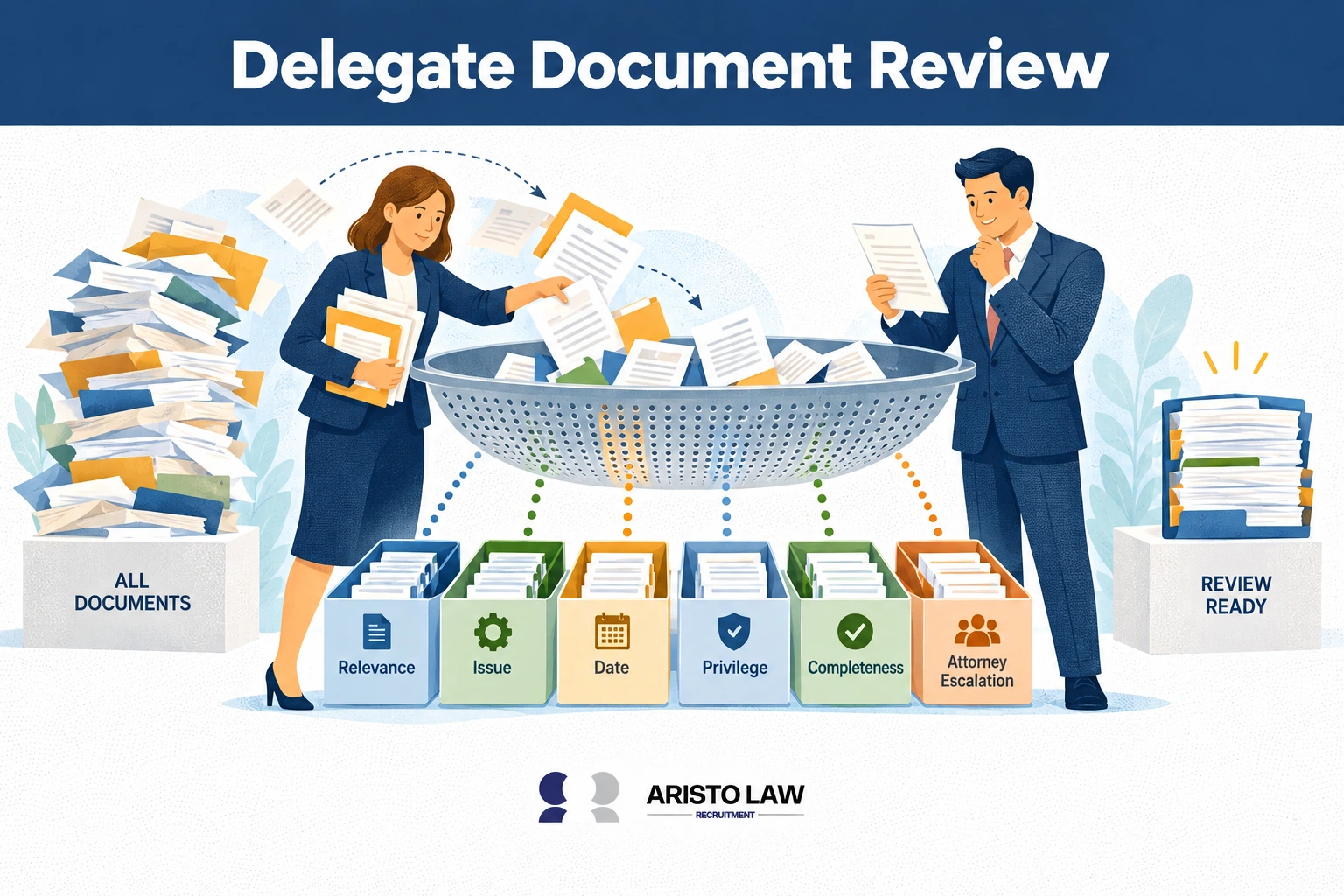
Law firm operations gain stronger document review speed, lower overhead, and higher attorney efficiency when review protocols, quality checks, confidentiality rules, and escalation paths are set before work begins.
2. Outsource legal research
Legal research outsourcing helps attorneys spend more time on legal analysis, client advice, and litigation decisions. External legal research teams review statutes, case law, regulations, secondary sources, and jurisdiction rules, then deliver research memos that support attorney judgment.
Outsourcing legal research shifts case law review, statute tracking, and precedent mapping into outsourced legal research services that protect attorney time for strategy, client advice, and litigation planning. Legal teams gain sharper matter focus because outsourced legal research services handle source collection, issue spotting, and legal memo preparation before attorney review.
Law firms improve law firm productivity when research scope, citation format, deadlines, preferred authorities, and review checkpoints are defined at intake.
3. Contract freelance attorneys
Freelance attorney contracting helps law firms handle workload spikes without permanent payroll growth. Contract attorneys support legal research, document review, drafting, discovery, motion preparation, and appearance coverage under firm supervision and compliance rules.
Law firm growth becomes easier when engagement letters, conflict checks, work ownership, billing rates, and client communication limits are documented before assignments begin.
4. Hire virtual paralegals
Virtual paralegals help law firms move routine legal support away from attorneys and into trained support roles. Virtual paralegals organize files, prepare drafts, manage discovery tasks, support client intake, update case data, and coordinate workflow automation inside practice management systems.
Virtual paralegal services reduce administrative load for attorneys, preserve internal attention for client strategy, and keep legal support workflows aligned with active case demands. Law firms increase billable capacity when task lists, approval rules, data access, turnaround times, and performance metrics guide each virtual paralegal role.
5. Automate client intake
Client intake automation helps law firms capture leads, screen matters, collect facts, and route prospects without manual follow-up delays. Client intake systems use forms, CRM fields, e-signatures, conflict prompts, document uploads, and legal virtual assistants to support faster matter opening.
Law firm outsourcing shifts intake screening, lead qualification, and consultation scheduling away from attorneys, so the firm protects billable time and focuses on legal strategy. Aristolaw connects law firms with virtual intake specialist services that capture client details, organize matter data, and route qualified leads into the firm’s case pipeline.
Law firm operations improve when intake scripts, qualification rules, response timelines, consent language, and handoff steps match the firm’s practice areas.
6. Outsource bookkeeping infrastructure
Bookkeeping infrastructure outsourcing helps law firms control financial management without pulling attorneys into accounting tasks. External bookkeeping teams manage trust records, operating accounts, reconciliation, expense coding, payroll coordination, and reporting inside compliant financial systems.
Law firms focus on legal work by moving bookkeeping infrastructure to outsourced law firm bookkeeping services that manage trust accounting, invoice reconciliation, expense categorization, and financial reporting. Outsourcing bookkeeping infrastructure gives law firm owners cleaner financial visibility, fewer back-office interruptions, and more time for client service, case strategy, and firm growth.
Legal billing accuracy improves when chart of accounts, trust-account rules, monthly close dates, access controls, and review reports stay consistent.
7. Delegate administrative scheduling
Administrative scheduling delegation helps attorneys protect legal work time and reduce calendar friction. Legal virtual assistants coordinate meetings, client calls, court dates, reminders, travel blocks, and internal deadlines through practice management and calendar systems.

Attorney efficiency improves when scheduling rules, priority levels, buffer times, rescheduling limits, and confirmation templates guide administrative delegation.
8. Deploy e-discovery technology
E-discovery technology helps law firms process large data sets with stronger speed, search control, and review accuracy. E-discovery tools support collection, deduplication, metadata review, keyword searching, privilege tagging, redaction, production formatting, and audit trails.
Law firms reduce review costs when technology integration, vendor access, data security, production standards, and attorney sign-off rules are defined before discovery begins.
9. Outsource marketing management
Marketing management outsourcing helps law firms keep business growth active without shifting attorney time away from legal service. External marketing teams manage SEO, content planning, local visibility, ads, reporting, reputation tasks, and lead tracking connected to client intake.
Law firms improve scalability when brand rules, intake goals, reporting cadence, approval steps, and practice-area messaging guide each marketing workflow.
10. Utilize appearance counsel
Appearance counsel helps law firms cover routine court appearances, status conferences, hearings, and procedural matters without disrupting attorney schedules. Local counsel supports attorney efficiency through hearing coverage, court updates, filing coordination, and jurisdiction-specific procedure knowledge.
Law firms protect client service when appearance instructions, case background, authority limits, reporting deadlines, and billing terms are delivered before the hearing.
11. Externalize billing operations
Billing operations outsourcing helps law firms protect cash flow and reduce attorney involvement in invoice administration. External legal billing teams manage time entry review, invoice formatting, LEDES billing, client guidelines, payment follow-up, write-down tracking, and reporting.
Law firm operations improve when billing rules, approval workflows, rate tables, payment policies, and compliance checks guide every invoice cycle.
12. Optimize document indexing
Document indexing optimization helps law firms find matter records faster and reduce time lost in file searches. Legal support teams classify pleadings, contracts, medical records, discovery files, correspondence, invoices, and exhibits inside document management systems.
Law firm productivity improves when naming rules, folder structures, metadata fields, version controls, and access permissions stay uniform across every matter.
13. Outsource IT compliance
IT compliance outsourcing helps law firms protect client data, meet confidentiality duties, and maintain secure legal technology systems. External IT compliance teams manage access control, encryption, backups, device policies, vendor reviews, incident response, and cybersecurity training.
Law firms reduce risk when compliance audits, user permissions, data retention rules, software updates, and breach response plans follow documented standards.
14. Contract intake receptionists
Intake receptionist contracting helps law firms answer calls, qualify leads, and protect client service during busy work periods. Intake receptionists collect caller details, apply screening scripts, book consultations, route urgent matters, and update client intake systems.

Law firms increase conversion when call scripts, disqualification rules, response times, language needs, and escalation triggers match the firm’s practice management process.
15. Automate calendar dockets
Calendar docket automation helps law firms track court deadlines, filing dates, limitation periods, hearings, and internal reminders with fewer manual errors. Workflow automation connects docket rules, matter data, court dates, task assignments, and alerts inside legal technology platforms.
Law firms support long-term growth when docket ownership, verification steps, rule-set updates, attorney review, and backup alerts are tested before live use.
When should a law firm outsource legal support?
A law firm should outsource legal support when internal capacity is stretched, administrative and procedural tasks begin limiting billable hours, or additional legal expertise is required without the cost and commitment of hiring full-time in-house staff. Legal teams outsource admin work, intake tasks, case updates, document preparation, billing entries, and client follow-ups through outsourced virtual legal support services. Outsourcing transfers routine legal operations to trained remote staff, so attorneys preserve attention for case strategy, client counsel, firm growth, and revenue-generating legal work.
Law firms also outsource legal support when they require assistance with legal research, document drafting, contract review, discovery, case preparation, e-discovery, client intake, or case management but do not need permanent employees. Solo practitioners and small to mid-sized firms use outsourcing to access skilled legal professionals while reducing recruitment costs, payroll expenses, benefits obligations, and office infrastructure requirements. Larger firms use outsourced support to handle overflow workloads, meet litigation deadlines, and expand operational capacity without disrupting internal teams.
Aristo Law supports this model by recruiting and placing experienced remote legal professionals from cost-efficient, high-skill talent markets including South Africa, Brazil, and the Philippines. Aristo Law screens candidates for legal competency, communication skills, confidentiality awareness, and workflow compatibility, ensuring firms receive high-quality support at lower costs than equivalent US-based hiring. Aristo Law integrates outsourced professionals into law firm systems, improving efficiency while maintaining legal standards and operational consistency.
A study by R. Swamy and S. Kulkarni, titled “Legal process outsourcing: the provider landscape” in year 2014, shows that law firms utilize external support providers to handle routine tasks like research and document review, which creates immediate operational capacity for attorneys to handle unexpected and high-value legal needs. Legal process outsourcing (LPO) helps attorneys move routine legal operations to a remote paralegal, virtual legal assistant, or litigation support provider.
How much does outsourcing legal support cost?
Outsourcing legal support costs $10–$65 per hour for virtual legal assistants, $22–$75 per hour for freelance or virtual paralegals, $500–$1,500 per project for document or filing support, and $1,000–$4,700 per month for ongoing legal support packages, depending on service type, experience level, workload volume, location, and staffing model.
Legal process outsourcing pricing uses hourly rates, monthly legal staffing, dedicated remote roles, and project-based fees. Remote paralegal cost ranges from $25 (€22, £19) to $100+ (€88, £76+) per hour. Virtual legal assistant pricing ranges from $10 (€9, £8) to $40 (€35, £30) per hour for administrative legal operations support. Dedicated remote paralegal roles range from $1,500 (€1,321, £1,139) to $4,000+ (€3,523, £3,036+) per month for litigation support, case management, legal research, document drafting, compliance, and client communication.
Aristo Law charges a one-time recruitment fee of $2,997 (€2,640, £2,275) to source and place a qualified remote paralegal or virtual legal assistant, then the law firm hires the remote assistant directly and pays the assistant’s monthly salary directly. Law firm outsourcing reduces legal staffing costs, protects the legal operations budget, increases attorney productivity, and gives firms flexible outsourced legal services for workload growth.
What is the return on investment of outsourcing legal operations?
The return on investment of outsourcing legal operations ranges from 40% to 70% in staffing-cost reduction and $139.60 to $244.30 in recovered attorney value per outsourced hour when measured against the $349 average lawyer hourly rate. Outsourced legal support also produces an estimated 1.5× to 4× ROI when lower-cost paralegal, intake, billing, research, document, or administrative support replaces non-billable attorney work.
Clio reports a $349 average lawyer hourly rate and a 38% utilization rate in 2025, equal to 3.0 billable hours in an 8-hour workday, which explains why shifting non-billable legal operations away from attorneys raises attorney utilization and revenue capacity.
The return on investment of outsourcing legal operations comes from increased efficiency, improved attorney utilization, lower overhead costs, and greater operational scalability. The ROI of outsourcing legal operations shows in recovered billable hours, extra law firm capacity, faster case throughput, and better client responsiveness. Legal process outsourcing examples include document review, legal research, client intake, e-discovery, billing support, docketing, and case management.
Business process outsourcing for law firms reduces payroll pressure, recruitment costs, training time, software waste, and administrative drag. Outsourced legal operations move repeatable work to trained support teams, so attorneys spend more hours on legal strategy, client counseling, negotiation, and revenue-generating matters.
Legal process outsourcing market growth reflects rising demand for flexible legal staffing and scalable legal operations support. Law firms gain stronger ROI when outsourcing rules, quality checks, turnaround targets, confidentiality controls, and performance metrics connect each outsourced task to billable capacity, client experience, and business growth.
What should law firms consider before outsourcing legal tasks?
Law firms need to evaluate operational needs, legal ethics duties, data protection requirements, and outsourced legal professional qualifications before outsourcing legal tasks. Legal outsourcing considerations begin with task selection, including legal research, document drafting, contract review, discovery, case management, client intake, and administrative support.
Attorney supervision remains required because legal judgment, client representation, and final work approval stay inside the firm. Law firm outsourcing decisions need provider screening, legal process outsourcing (LPO) experience, remote paralegal skill level, virtual legal assistant availability, time-zone fit, communication rules, and legal technology integration. Client confidentiality requires secure document-sharing systems, limited access rights, cybersecurity controls, NDAs, and clear data handling rules.
Legal operations planning needs pricing review, service-level agreements, onboarding support, replacement policies, scalability terms, quality checks, and performance tracking. Law firm management gains better outsourcing results when scope, deadlines, reporting channels, confidentiality terms, and approval workflows are documented before outsourced legal work begins.
How can law firms implement outsourcing successfully?
Steps for implementing outsourcing successfully include assessing workflow gaps, setting performance metrics, and aligning outsourced legal support with long-term business objectives.
Listed below are the 7 steps for implementing outsourcing successfully.
Identify operational bottlenecks: Law firms start the legal outsourcing process by identifying tasks that slow attorney productivity, delay client service, or increase internal workload. Operational bottlenecks include client intake, legal research, document review, drafting, billing, scheduling, discovery support, and case management.
Prioritize functions suitable for outsourcing: Law firms prioritize outsourcing legal services that follow repeatable workflows, defined standards, and clear attorney review points. Outsourcing legal process work works best when administrative tasks, support tasks, and overflow legal tasks are separated from legal judgment and client representation.
Select qualified service partners: Law firms select legal process outsourcing providers based on legal experience, recruitment standards, confidentiality controls, technology fit, communication rules, and practice-area knowledge. Outsourcing law firms gain better results when provider screening includes sample work, references, security practices, and role-specific skills.
Establish documented workflows: Law firms need written workflows for task intake, deadlines, file access, approvals, revision cycles, reporting, and escalation. Poor process documentation creates delays, duplicate work, missed instructions, and weak accountability across outsourced legal services.
Define performance expectations: Law firms set performance expectations through turnaround times, accuracy standards, quality checks, communication timelines, confidentiality duties, and attorney approval rules. Unclear responsibilities create gaps between internal staff, outsourced professionals, and supervising attorneys.
Integrate communication systems: Law firms connect outsourced teams to practice management software, secure file-sharing tools, calendars, messaging channels, and reporting dashboards. Legal outsourcing process integration keeps outsourced support inside daily law firm operations instead of separating providers from case workflows.
Measure outcomes and refine the process: Law firms measure outsourcing success through billable hour recovery, turnaround speed, cost reduction, client responsiveness, task accuracy, and attorney workload relief. Insufficient performance monitoring hides workflow problems, reduces accountability, and limits the business value of outsourcing legal services.
Where can law firms outsource legal support services?
Law firms outsource legal support services through legal staffing companies, legal process outsourcing (LPO) providers, remote paralegal agencies, freelance legal marketplaces, and virtual legal support firms.
Aristo Law gives law firms a reliable legal recruitment path for dedicated remote paralegal and virtual legal assistant support. Aristo Law helps law firm operations by sourcing, screening, interviewing, and matching legal professionals for legal research, document drafting, contract review, discovery, case management, client communication, and administrative legal support.
Legal process outsourcing (LPO) providers fit firms that need scalable outsourced legal services across document review, litigation support, e-discovery, and case workflows. Freelance legal marketplaces fit project-based legal support for short-term research, drafting, and review work.
Legal staffing agencies fit firms that need temporary or long-term paralegals, legal assistants, and case support staff. Provider selection depends on workload, practice area, budget, client confidentiality, data security, legal experience, and the firm’s need for dedicated or project-based legal support.
How does Aristo Law help law firms focus on practicing law through outsourcing?
Aristo Law helps law firms focus on practicing law by outsourcing time-consuming legal support tasks to experienced remote paralegals and virtual legal assistants. Aristo Law helps attorneys get more time for client advocacy, legal strategy, and billable work. Aristo Law manages legal staffing through recruitment, screening, interviewing, and placement of qualified legal professionals for legal research, document drafting, contract review, discovery, litigation support, case management, client intake, file organization, scheduling, and administrative legal tasks.
Aristo Law supports law firm outsourcing by reducing internal hiring pressure, improving attorney productivity, and expanding legal operations capacity without full-time in-house staffing costs. Legal process outsourcing (LPO) through Aristo Law helps firms handle rapid growth, case volume increases, and support gaps with dedicated remote paralegal and virtual legal assistant services.
Law firm efficiency improves when Aristo Law connects attorneys with trained legal support staff who protect billable hours, reduce administrative load, and keep attorneys focused on legal representation.
Build a legal support team that moves work forward.
Tell us what is slowing your practice down. We will help map the role, workflow, and support structure that fits.