
What Skills Do You Need to Be a Lawyer? Traits and Qualifications

Practical guidance for building efficient, accountable legal support operations.


Lawyer skills consist of the legal, analytical, and interpersonal abilities required to practice law effectively, ethically, and competitively. Core lawyer skills include legal knowledge, research proficiency, analytical reasoning, structured writing, and clear communication, which form the foundation of competent legal work. Entry-level lawyer skills focus on interpreting statutes and case law, conducting legal research, drafting documents, and communicating arguments to clients, courts, and colleagues.
Lawyer effectiveness increases through soft skills such as negotiation, client relationship management, ethical judgment, time management, and teamwork, which directly affect outcomes and professional reputation. Lawyer skill impact shows measurable results, as a 2020 study by the National Association for Law Placement found lawyers with strong research and communication skills progressed faster and achieved higher case success rates across firms.
A study by the Professional Identity Formation Work Group from the National Association for Law Placement (NALP), titled Report on 2020 Survey of Law Firm Competency Expectations for Associate Development, in 2021 (analyzing 2020 empirical tracking data), directly confirms that traditional legal analysis, written advocacy, and communication skills serve as the critical baseline benchmarks law firms use to measure associate proficiency and accelerate career advancement.
Lawyer skills vary by practice area, with advocacy-heavy roles requiring persuasion and courtroom presence, while advisory roles emphasize risk analysis, drafting precision, and client counseling. Lawyer qualifications require formal legal education, bar admission, and ongoing compliance with licensing standards. Lawyer skill development continues through training, mentoring, specialization, and the adoption of legal technology that improves research, drafting, and workflow efficiency. Lawyer career growth depends on combining technical legal expertise with strong interpersonal skills that build client trust, credibility, and long-term professional success.
Aristolaw connects law firms with trained legal support professionals who contribute to stronger workflow. Build practical legal experience and support high-performing legal teams with Aristolaw today. Aristolaw supports law firms with management, legal coordination, client communication, and operational productivity.
Listed below are the 20 skills you need to be a lawyer.
- Strong legal knowledge: Strong legal knowledge improves case analysis, legal interpretation, and procedural decision-making across legal practice areas.
- Critical thinking ability: Critical thinking ability improves legal reasoning, argument evaluation, and strategic legal decision-making.
- Effective communication skills: Effective communication skills improve client interactions, courtroom presentations, and professional legal coordination.
- Active listening skills: Active listening skills improve client understanding, fact gathering, and legal communication accuracy.
- Excellent writing skills: Excellent writing skills improve legal drafting, contract preparation, and persuasive legal documentation.
- Analytical reasoning ability: Analytical reasoning ability improves legal issue evaluation, evidence interpretation, and case strategy development.
- Problem-solving aptitude: Problem-solving aptitude improves legal dispute resolution, workflow adaptability, and operational decision-making.
- Research proficiency skills: Research proficiency skills improve case law analysis, statutory interpretation, and legal information retrieval accuracy.
- Negotiation skills mastery: Negotiation skills mastery improves settlement discussions, contract agreements, and client advocacy outcomes.
- Time management ability: Time management ability improves deadline control, scheduling efficiency, and legal workload organization.
- Detail orientation focus: Detail orientation focus improves legal accuracy, compliance monitoring, and document consistency across legal workflows.
- Ethical judgment standards: Ethical judgment standards improve professional responsibility, confidentiality management, and legal compliance practices.
- Client relationship skills: Client relationship skills improve communication, trust, client retention, and professional legal service delivery.
- Persuasive advocacy skills: Persuasive advocacy skills improve legal argument presentation, negotiation effectiveness, and courtroom representation.
- Logical reasoning capability: Logical reasoning capability improves legal analysis, argument structure, and strategic case evaluation.
- Strategic thinking skills: Strategic thinking skills improve litigation planning, legal positioning, and long-term case management decisions.
- Stress management ability: Stress management ability improves productivity, operational focus, and professional performance under legal workload pressure.
- Team collaboration skills: Team collaboration skills improve coordination between attorneys, paralegals, legal assistants, and administrative staff.
- Adaptability and flexibility: Adaptability and flexibility improve responsiveness to legal changes, workflow adjustments, and evolving client needs.
- Technological literacy skills: Technological literacy skills improve legal software usage, workflow automation, and digital case management efficiency.
1. Strong legal knowledge
Strong legal knowledge refers to a lawyer’s command of statutes, case law, regulations, and legal doctrine relevant to practice. Strong legal knowledge underpins professional competence by enabling accurate advice, defensible arguments, and compliant decision-making in legal practice.
Strong legal knowledge requires continuous engagement with legal developments, jurisdictional boundaries, and precedent hierarchy. Strong legal knowledge improves reliability when combined with regular reading, continuing legal education, and structured issue-spotting routines.
2. Critical thinking ability
Critical thinking ability involves evaluating facts, identifying issues, and testing legal arguments logically. Critical thinking ability supports legal skills by separating relevant information from noise and assessing strengths and weaknesses in positions. Critical thinking ability requires cognitive discipline, skepticism, and structured reasoning. Critical thinking ability improves through case analysis exercises, outlining arguments, and reviewing opposing viewpoints.
3. Effective communication skills
Effective communication skills involve conveying legal information clearly to clients, courts, and colleagues. Effective communication skills protect client relations and professional competence by reducing misunderstandings and errors. Effective communication skills require clarity, audience awareness, and precision. Effective communication skills improve through practice, feedback, and structured messaging frameworks.
4. Active listening skills
Active listening skills involve accurately receiving and interpreting spoken information. Active listening skills strengthen client relations by uncovering facts, priorities, and risks early. Active listening skills require focus, patience, and verification. Active listening skills improve through deliberate note-taking and clarification techniques.
5. Excellent writing skills
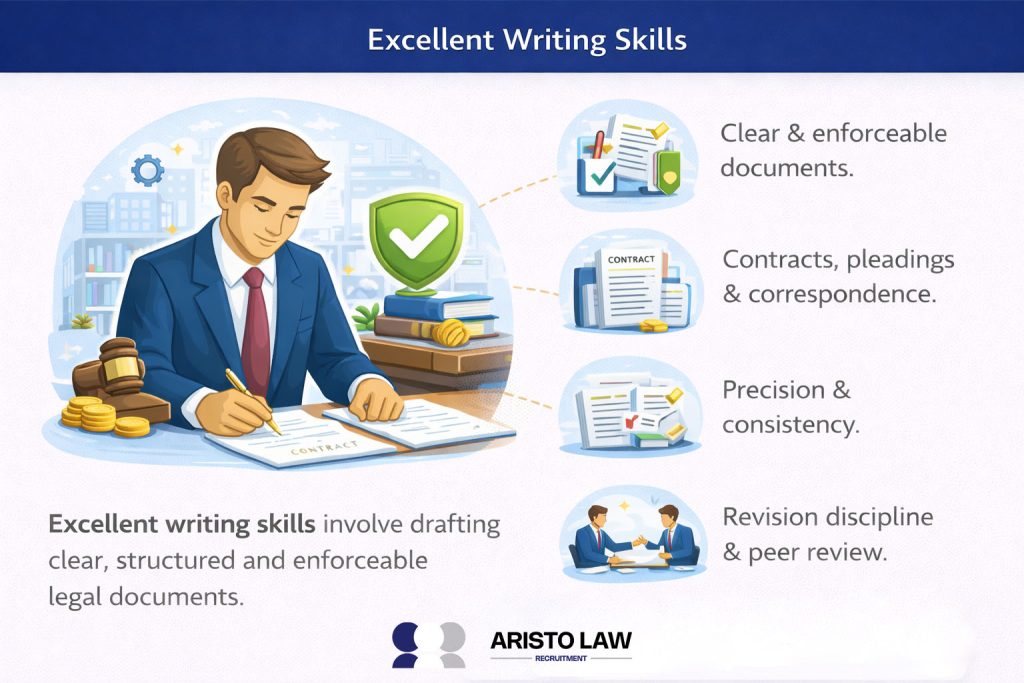
Excellent writing skills involve drafting clear, structured, and enforceable legal documents. Excellent writing skills protect legal practice quality by reducing ambiguity and dispute risk through strong legal drafting and writing skills applied consistently across contracts, pleadings, and correspondence. Excellent writing skills require precision, consistency, and logical flow. Excellent writing skills improve through revision discipline and peer review.
6. Analytical reasoning ability
Analytical reasoning ability involves breaking complex legal problems into structured components. Analytical reasoning ability supports legal research and argument construction. Analytical reasoning ability requires methodical thinking and evidence evaluation. Analytical reasoning ability improves through outlining and case comparison.
7. Problem-solving aptitude
Problem-solving aptitude involves identifying workable legal solutions within constraints. Problem-solving aptitude supports professional competence by aligning law with client objectives. Problem-solving aptitude requires creativity and risk awareness. Problem-solving aptitude improves through scenario analysis.
8. Research proficiency skills
Research proficiency skills involve locating, validating, and applying legal authority. Research proficiency skills support legal research accuracy and efficiency through effective use of legal research skills and tools in case analysis and precedent validation. Research proficiency skills require source evaluation and citation discipline. Research proficiency skills improve through structured research workflows.
9. Negotiation skills mastery
Negotiation skills mastery involves advancing client interests through structured compromise. Negotiation skills mastery supports client relations and dispute resolution. Negotiation skills mastery requires preparation and leverage awareness. Negotiation skills mastery improves through role-play and outcome review.
10. Time management ability
Time management ability involves controlling workload, deadlines, and priorities. Time management ability protects professional competence under pressure through effective time management skills for lawyers applied to case timelines, court dates, and client obligations. Time management ability requires planning and execution discipline. Time management ability improves through task batching and deadline tracking.
11. Detail orientation focus
Detail orientation focus involves accuracy in facts, language, and procedure. Detail orientation focus protects legal practice from errors. Detail orientation focus requires concentration and verification. Detail orientation focus improves through checklists and review cycles.
12. Ethical judgment standards
Ethical judgment standards involve applying ethical rules and professional responsibility. Ethical judgment standards protect client trust and legal integrity. Ethical judgment standards require awareness and consistency. Ethical judgment standards improve through ethics training and supervision.
13. Client relationship skills
Client relationship skills involve managing expectations and communication over time. Client relationship skills support retention and reputation through consistent client intake and relationship-building practices that strengthen trust and transparency. Client relationship skills require empathy and clarity. Client relationship skills improve through regular updates and responsiveness.
14. Persuasive advocacy skills
Persuasive advocacy skills involve influencing decision-makers through reasoned argument. Persuasive advocacy skills support litigation and negotiation outcomes. Persuasive advocacy skills require preparation and structure. Persuasive advocacy skills improve through practice and feedback.
15. Logical reasoning capability
Logical reasoning capability involves applying rules consistently to facts. Logical reasoning capability supports defensible conclusions. Logical reasoning capability requires discipline and structure. Logical reasoning capability improves through argument mapping.
16. Strategic thinking skills
Strategic thinking skills involve long-term planning within legal constraints. Strategic thinking skills support complex legal practice. Strategic thinking skills require foresight and prioritization. Strategic thinking skills improve through case planning reviews.
17. Stress management ability
Stress management ability involves maintaining performance under pressure. Stress management ability protects professional competence and judgment. Stress management ability requires boundaries and recovery practices. Stress management ability improves through workload control.
18. Team collaboration skills
Team collaboration skills involve working effectively with legal teams. Team collaboration skills support complex legal practice delivery. Team collaboration skills require communication and coordination. Team collaboration skills improve through role clarity.
19. Adaptability and flexibility
Adaptability and flexibility involve adjusting to legal, client, and technology change. Adaptability and flexibility protect relevance in legal practice. Adaptability and flexibility require openness and learning. Adaptability and flexibility improve through continuous development.
20. Technological literacy skills
Technological literacy skills involve using technology in law effectively and securely. Technological literacy skills support efficiency and accuracy in legal practice through the legal tech skills lawyers need to manage systems, data, and digital workflows responsibly. Technological literacy skills require tool awareness and data discipline. Technological literacy skills improve through ongoing training and system use.
What personality traits are common among successful lawyers?
Successful lawyers often share discipline, attention to detail, resilience, intellectual curiosity, and strong ethical judgment. Lawyer discipline supports meeting deadlines and managing workload. A lawyer’s attention to detail reduces errors in drafting, filing, and compliance. Lawyer resilience sustains performance under pressure and long case cycles.
Lawyer persistence supports thorough research and issue resolution. Lawyer calm under pressure improves judgment during negotiations, hearings, and urgent client matters. Lawyers’ integrity and accountability protect client trust and professional standing. Lawyer adaptability supports responses to changing laws and case facts. Lawyer confidence without arrogance strengthens advocacy and client communication. Lawyer traits develop through experience, mentoring, and continuous practice, reinforcing legal career success.
What educational qualifications are required to become a lawyer?
Educational qualifications required to become a lawyer must include formal legal education, practical training, and eligibility for professional licensing. Lawyer qualifications typically begin with an undergraduate degree, where applicable, followed by a recognized law degree, such as an LLB or JD, that provides foundational legal education. Legal education commonly includes structured coursework in core legal subjects alongside legal research and writing.
Practical training requirements usually involve internships, clinical programs, apprenticeships, or supervised legal practice to develop applied skills. Bar admission or equivalent licensing eligibility follows completion of academic and practical requirements and confirms readiness to practice law. Lawyer qualification requirements vary by country and jurisdiction, with differences in degree structure, training duration, and licensing examinations.
What Licenses are required for lawyers?
Lawyers generally need a professional license to practice law, while certifications remain optional credentials that signal specialization or advanced competence. Lawyer license requirements include bar admission or equivalent licensing, character and fitness evaluation, and compliance with ongoing continuing legal education obligations to maintain good standing.
Legal certification options vary by role and include specialist or board certifications, mediation or arbitration training, and compliance or regulatory credentials relevant to specific practice areas. Licensing remains mandatory for legal practice, while certifications function as strategic enhancements that support credibility, expertise positioning, and career development rather than baseline eligibility.
What soft skills are important for lawyers in daily practice?
Soft skills are critical in law because they shape how lawyers communicate, manage pressure, and build trust with clients and colleagues.
Listed below are 9 main soft skills that directly affect client experience, teamwork, and professional effectiveness in daily legal practice.
- Communication skills. Clear, concise communication improves client understanding, court interactions, and internal alignment.
- Emotional intelligence. Emotional intelligence supports client rapport, empathy, and sound judgment under stress.
- Active listening. Active listening ensures accurate fact gathering and reduces misunderstandings with clients and colleagues.
- Negotiation skills. Negotiation skills influence outcomes in settlements, contracts, and dispute resolution.
- Conflict resolution. Conflict resolution helps manage disputes constructively without escalating risk or tension.
- Teamwork. Teamwork enables coordination across lawyers, paralegals, and support staff on complex matters.
- Adaptability. Adaptability allows lawyers to adjust strategies as facts, law, or client priorities change.
- Professionalism. Professionalism maintains credibility, ethical standards, and client confidence.
- Time management. Time management supports deadline control, responsiveness, and workload balance.
How do lawyer skills differ by practice area or role?
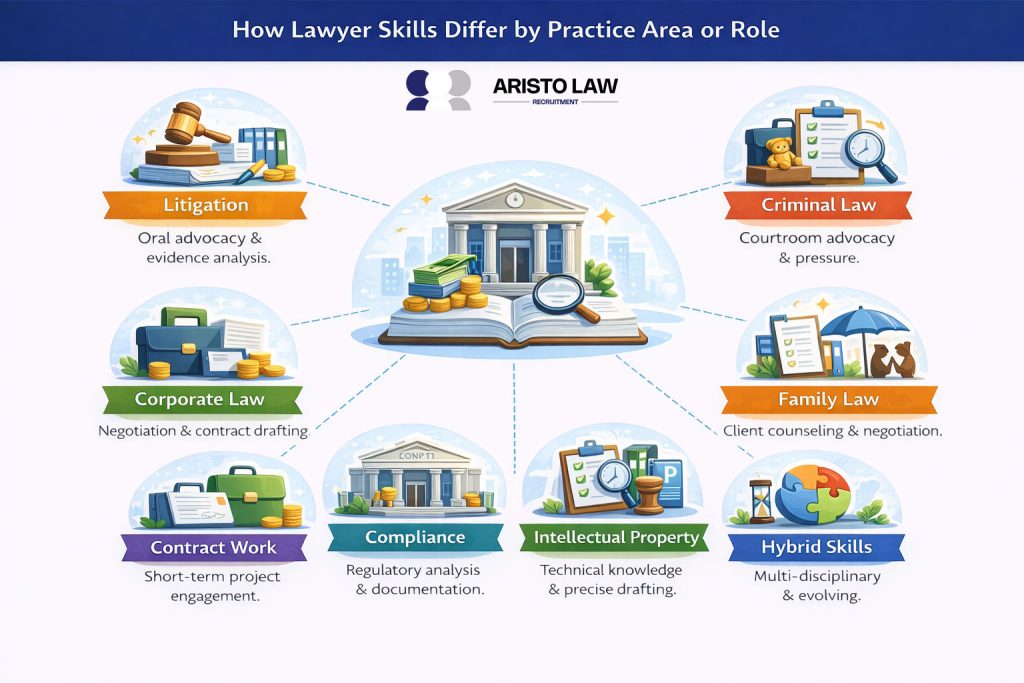
Lawyer skills differ by practice area and role because each field imposes distinct legal knowledge, workflows, client expectations, and risk profiles. Litigation roles emphasize oral advocacy, procedural command, evidence analysis, motion writing, and a cross-examination mindset suited to court-driven outcomes. Corporate and transactional roles prioritize contract drafting, negotiation, due diligence, compliance alignment, and business judgment focused on deal execution. Criminal practice requires courtroom advocacy, client counseling under pressure, and rapid issue assessment tied to procedural deadlines.
The American Bar Association’s 2022 Profile of the Legal Profession documents that lawyers’ daily activities, required competencies, and risk exposure vary by practice setting and specialization, noting clear distinctions between litigation-heavy, transactional, regulatory, and advisory roles. Family law combines legal analysis with client communication, negotiation, and emotional intelligence due to personal stakes. Immigration and compliance roles emphasize regulatory interpretation, documentation accuracy, and process management. Intellectual property practice demands technical understanding, precise drafting, and analytical reasoning. About 20% of lawyers develop hybrid skills over time as roles evolve and practice areas overlap within legal specialization.
How do communication skills affect a lawyer’s success?
Communication skills affect a lawyer’s success by improving client trust, strengthening legal arguments, and reducing misunderstandings in high-stakes matters. Lawyer communication skills shape written outputs such as emails, memos, contracts, and briefs, where clarity, structure, and tone determine accuracy and enforceability.
Verbal communication influences courtroom advocacy, negotiation calls, client updates, and internal discussions where persuasion, confidence, and listening matter. Clear communication prevents errors, aligns expectations, and supports effective decision-making across legal work. Strong communication skills therefore improve case outcomes, client satisfaction, and professional reputation within legal practice.
What legal research must every lawyer master?
Every lawyer must master legal research skills that ensure accurate issue identification, authority selection, and validation of legal sources. Legal research competence requires identifying relevant legal issues, selecting appropriate sources such as case law, statutes, and regulations, and applying Boolean search methods to retrieve precise results. Legal research accuracy depends on validating authority through citator tools such as Shepardizing or KeyCite-style checks to confirm current standing.
Legal research mastery includes synthesizing holdings, comparing authorities, and documenting citations clearly for review and accountability. Research efficiency and accuracy differentiate effective lawyers by supporting stronger drafting, sound legal strategy, and defensible client advice.
What client-relationship skills help lawyers build trust with clients?
Client-relationship skills help lawyers build trust with clients by ensuring clear communication, ethical conduct, and reliable service throughout legal representation. Client-relationship skills in legal practice define how lawyers manage expectations, protect confidentiality, and maintain professional accountability.
Listed below are 11 practical skills that strengthen client trust and client experience.
- Active listening. Active listening captures facts, priorities, and risk tolerance accurately.
- Empathy. Empathy acknowledges client concerns during stressful legal matters.
- Clear explanation of legal options. Clear explanations reduce confusion and support informed decisions.
- Expectation management. Expectation management aligns timelines, costs, and outcomes early.
- Responsiveness. Responsiveness signals reliability through timely replies and updates.
- Confidentiality professionalism. Confidentiality handling protects sensitive information and credibility.
- Honesty and transparency. Transparency builds confidence through realistic assessments.
- Conflict de-escalation. Conflict control maintains constructive dialogue during disputes.
- Documentation and follow-ups. Written summaries confirm advice and next steps.
- Cultural sensitivity. Cultural awareness improves communication across diverse clients.
- Proactive updates. Proactive updates prevent uncertainty and reduce anxiety.
Strong client-relationship skills increase trust, improve referrals, help retain clients, and strengthen professional reputation.
Can lawyers develop their professional skills over time?
Yes, lawyers can develop their professional skills over time through experience, training, and structured feedback across their legal careers. Professional development for lawyers occurs by handling real cases, increasing research and drafting efficiency, refining judgment, and improving client communication through repeated practice.
Legal skill improvement accelerates through continuing legal education programs, mentorship, shadowing senior lawyers, redline reviews, mock hearings or negotiations, and self-review systems. Lawyer training supported by mentoring and consistent evaluation strengthens accuracy, confidence, and professional credibility. Skill growth over time improves client trust, decision quality, and long-term career advancement.
Can lawyers improve skills through training and mentoring?
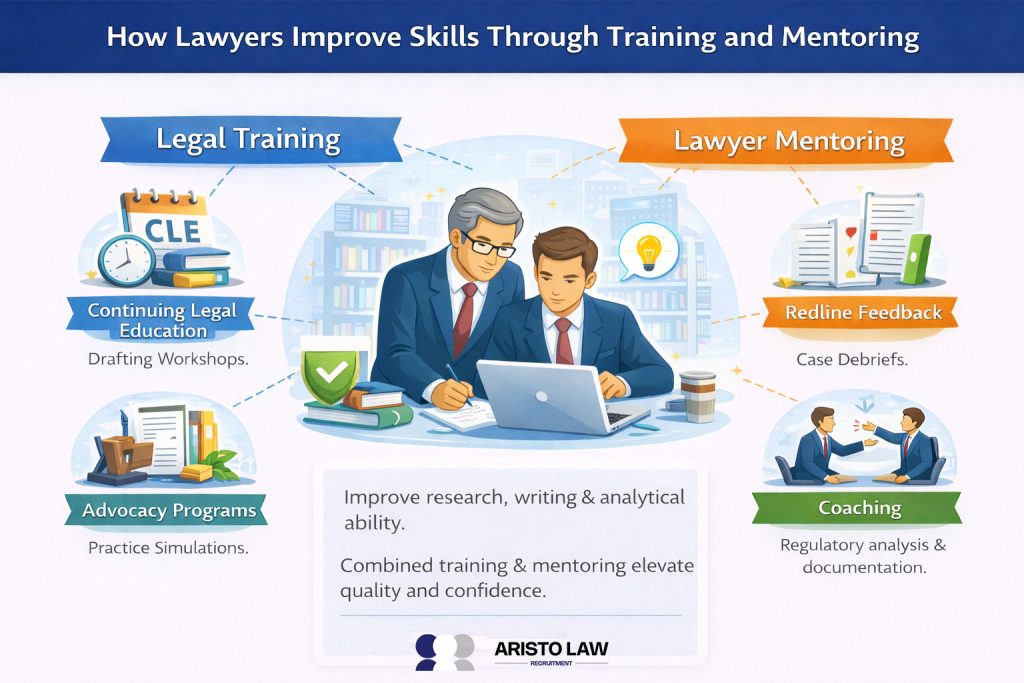
Yes, lawyers can improve their skills through training and mentoring because both accelerate technical competence and professional judgment. Legal training, such as continuing legal education courses, drafting workshops, advocacy programs, negotiation training, and practice simulations, strengthens research, writing, and analytical ability. Lawyer mentoring develops judgment and professional habits through shadowing, supervised drafting, redline feedback, case debriefs, and coaching.
Mentoring helps lawyers learn client handling, risk spotting, and decision-making faster than self-learning alone. Combined legal training and mentoring improve work quality, consistency, confidence, and long-term career growth.
How do strong legal skills impact career growth?
Strong legal skills impact career growth by improving work quality, strengthening outcomes, and building a professional reputation that leads to higher responsibility and advancement. Legal skills produce accurate analysis, clear drafting, and effective advocacy, which drive favorable client outcomes and repeat engagements. Legal skills support credibility with clients, courts, and peers, increasing referrals and trust.
Legal skills enable specialization in complex practice areas, supporting higher-value matters and earning potential. Legal skills position lawyers for leadership roles, supervisory responsibility, and partnership consideration through consistent performance. Legal skills reinforce professional reputation, which accelerates promotion, negotiation authority, and long-term career stability.
Build a legal support team that moves work forward.
Tell us what is slowing your practice down. We will help map the role, workflow, and support structure that fits.