
Legal Technology Trends: Automation, AI, and the Future of Law Firms

Practical guidance for building efficient, accountable legal support operations.

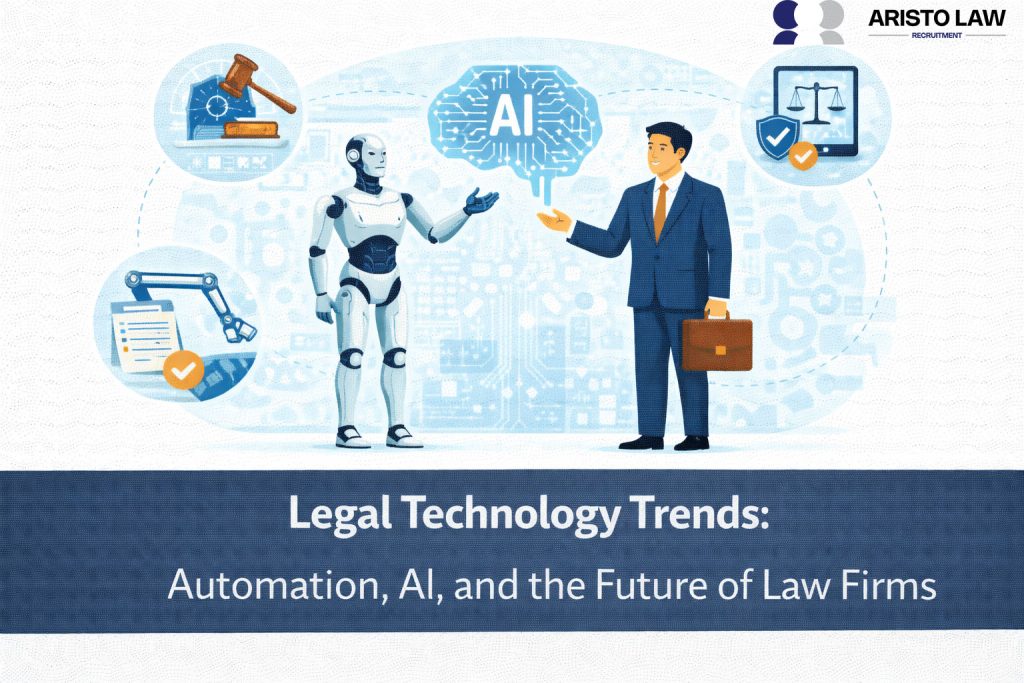
Legal technology trends refer to the use of digital systems, automation, and artificial intelligence to increase efficiency, accuracy, and scalability in law firms. Legal technology trends focus on structured workflows, controlled data handling, and repeatable legal operations.
Legal technology trends for 2026 concentrate on automation, generative AI, AI copilots, document management systems, analytics platforms, and secure collaboration software. Legal technology trends support faster task execution, centralized legal knowledge, and permission-based collaboration.
Legal technology trends most affect document drafting, contract review, legal research, workflow management, billing coordination, and matter tracking. Legal technology trends reduce manual repetition and standardize high-volume legal tasks.
Legal technology trends show quantified productivity gains supported by external research. A review by Rodgers, Armour & Sako, “How Technology Is (or Is Not) Transforming Law Firms” (2023), concludes that AI tools reduce time spent on routine drafting and review tasks.
Legal technology trends position artificial intelligence as a support system rather than a lawyer replacement. Legal technology trends emphasize supervised automation, human verification, and accountable system use.
Legal technology trends introduce risks related to over-reliance, output verification, data exposure, and cybersecurity threats. Legal technology trends require audit logs, access controls, and secure infrastructure.
Legal technology trends prioritize legal operations platforms, analytics dashboards, and secure collaborative authoring tools. Legal technology trends drive new service models, define AI integration practices, and lead to the long-term transformation of legal work and firm operations.
Aristolaw helps law firms adapt to legal technology trends. Position your law firm for long-term operational growth with Aristolaw today. Aristolaw helps AI workflow support, legal automation services, and outsourced operational staffing solutions built for modern legal environments.
What are legal technology trends?
Legal technology trends are the adoption of digital tools and structured processes that improve efficiency, accuracy, and scale within legal services. Legal technology trends cover software systems and operational methods used in law firm innovation and legal tech modernization.
Legal technology trends include artificial intelligence for research and drafting, automation for workflow and document handling, security technologies for data protection and compliance, analytics for performance and decision support, and cloud platforms for access and collaboration. Legal technology trends shape how law firms organize work, manage risk, and deliver services using repeatable, technology-driven legal operations.
What are the biggest legal technology trends for 2026?
The biggest legal technology trends for 2026 are automation platforms, AI-driven legal systems, and operational technologies that scale law firm work while maintaining control and security.
Listed below are the 12 2026 legal tech trends shaping AI in law firms and automation adoption.
- AI copilots providing embedded drafting, research, and matter guidance
- Generative AI drafting, producing contracts, and pleadings under supervised review
- AI legal research using semantic search and citation analysis
- Workflow automation managing intake, task routing, approvals, and deadlines
- Client portals supporting secure communication and document exchange
- E-signature and e-notary tools enabling remote execution and validation
- Legal analytics platforms measuring performance, pricing, and risk exposure
- Cybersecurity systems enforcing access control and data protection
- Cloud document management systems supporting version control and collaboration
- eDiscovery platforms prioritizing document review using machine learning
- Digital payments and billing tools are improving collections and financial tracking
- Legal operations and LPM tools aligning staffing, budgeting, and delivery metrics
What is automation in law firms?
Automation in law firms is the use of rules-based software to execute repeatable legal and administrative tasks without human intervention. Law firm automation relies on predefined logic rather than prediction or generation, which differentiates workflow automation from AI systems used in legal operations.
Law firm automation covers client intake routing, calendaring and deadline tracking, document assembly from templates, billing workflows, and task status updates across legal operations systems.
What legal tasks are most impacted by automation?
The legal tasks most impacted by automation are intake, conflict checks, calendaring, document assembly, billing, and compliance tasks that directly affect workflow efficiency and error reduction. Automated legal tasks operate through legal workflow automation tools that apply rules-based logic across routine legal operations.
Listed below are the 11 legal tasks most impacted by automation.
- Client intake through automated data capture and routing
- Conflict checks using predefined client and matter rules
- Calendaring with automated deadline calculation
- Reminders and alerts for filings, hearings, and internal actions
- Document assembly using template-driven logic
- Time capture through automated activity tracking
- Invoicing via rules-based billing workflows
- Matter updates are synchronized across internal systems
- E-filing preparation based on standardized submission checklists
- Template-based correspondence for routine communications
- Basic compliance checklists enforced through workflow automation
What is legal technology AI?
Legal technology AI refers to the use of machine learning systems and statistical models within legal software to support analysis, classification, and decision workflows. Legal technology AI applies pattern recognition and probabilistic scoring rather than rules-based execution inside AI legal tech environments.
Legal technology AI supports legal research through semantic search, document review through issue spotting, summarization through content compression, and classification through matter and document tagging. Legal technology AI functions inside the legal workflow as an assistive layer that requires human review and verification rather than autonomous judgment.
What is generative AI for law firms?
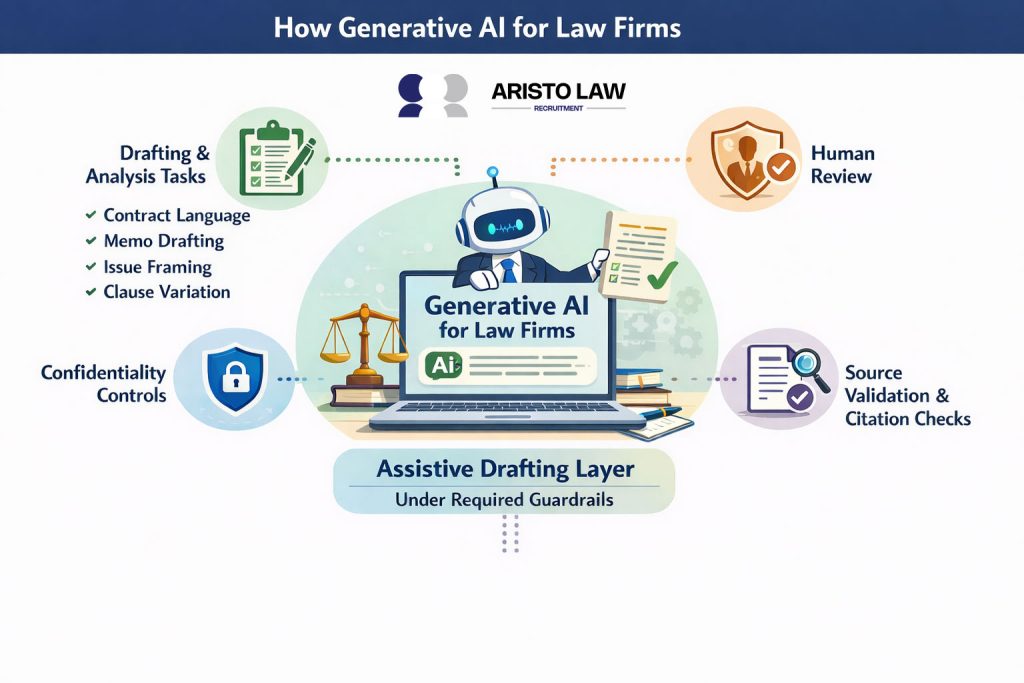
Generative AI for law firms is software that produces legal text outputs using trained language models within controlled legal systems. Generative AI supports law firm drafting and analysis tasks such as contract language creation, memo drafting, issue framing, and clause variation inside AI copilots. Generative AI operates under required guardrails that include human review, confidentiality controls, source validation, and citation checks within the legal workflow. Generative AI functions as an assistive drafting layer rather than an autonomous legal decision system.
What is the future of law firms with AI?
The future of law firms with AI will reflect higher productivity, process-driven legal services, and measurable changes in how legal work is delivered and priced. The future of law firms shows AI adoption and automation increasing output per lawyer, reducing manual workload, and shifting focus toward supervision, strategy, and client-facing judgment.
The future of law firms includes pricing models based on value and outcomes rather than billable hours, supported by predictable automation and analytics. The future of law firms reflects staffing mixes that combine fewer junior roles with stronger legal operations, technologists, and AI-governed workflows aligned with evolving client expectations in legal services.
What is the future of legal work with AI copilots?
The future of legal work with AI copilots is defined by in-workflow assistance that increases legal productivity through direct integration into daily legal systems. AI copilots operate inside documents, email, document management systems, and practice management platforms to support drafting, review, summarization, and task guidance without leaving the legal workflow.
AI copilots depend on workflow integration that enforces permissions, role-based access, audit trails, and firm-controlled knowledge bases to ensure traceability and compliance. AI copilots shift legal work toward supervised execution, faster turnaround, and consistent output quality across matters.
Can AI replace lawyers in the future?
No, AI cannot replace lawyers because legal judgment, advocacy, and professional responsibility remain human-controlled functions. AI replacing lawyers applies only to task execution, such as document drafting, contract review, legal research, classification, and workflow automation, where pattern recognition and repetition dominate.
AI systems lack authority over legal judgment, ethical accountability, client strategy, courtroom advocacy, and responsibility for legal outcomes, which define professional responsibility. AI adoption positions technology as an augmentation layer that increases speed and consistency while lawyers retain decision ownership, risk accountability, and client trust within legal services.
Can AI automate legal documents safely?
Yes, AI supports safe legal document automation when attorney oversight governs drafting risk and professional responsibility. AI document automation operates under conditions that include structured templates, controlled clause libraries, mandatory review steps, approval workflows, version control, and privacy safeguards, where safe legal document automation support functions as a governed process rather than unsupervised generation.
AI document automation increases reliability for standardized documents, while higher-risk legal documents require stronger attorney oversight, layered approvals, and restricted deployment to protect accuracy, confidentiality, and legal accountability.
What is the future of legal technology trends beyond 2026?
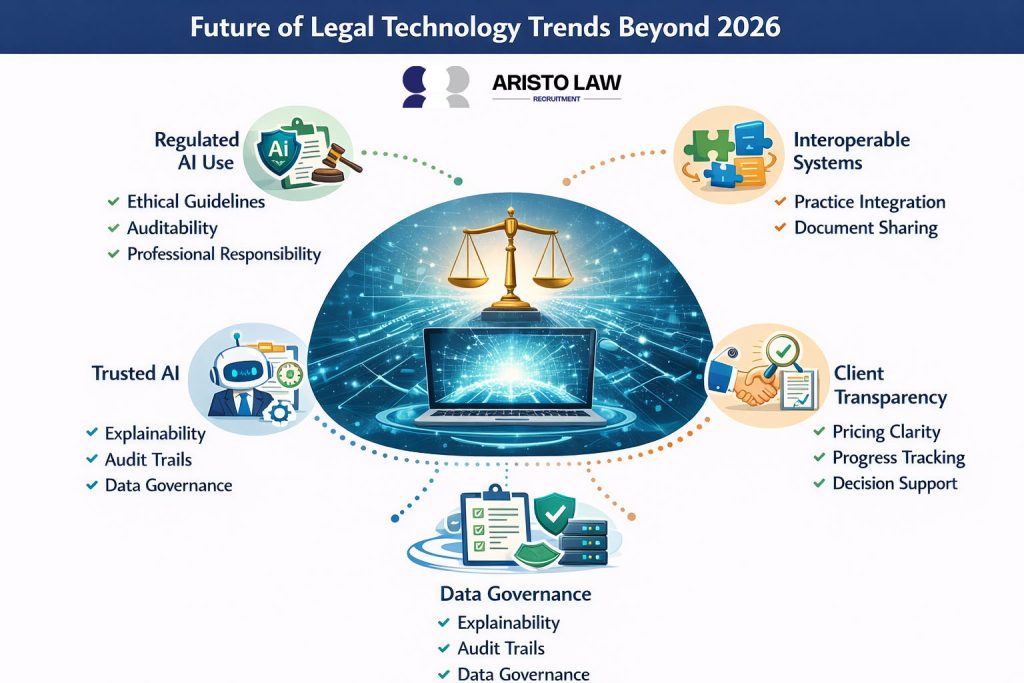
The future of legal technology trends beyond 2026 is shaped by regulation, interoperability, trusted AI systems, data governance, and client transparency. Future legal tech shifts emphasize regulated AI use, standardized compliance frameworks, and clear accountability structures aligned with professional responsibility. Future legal tech development prioritizes interoperability between practice management systems, document platforms, courts, and client environments to reduce fragmentation. Future legal tech direction strengthens trusted AI through explainability, auditability, and permission-based deployment governed by data governance rules. Future legal tech adoption raises client transparency expectations around pricing, progress tracking, and decision support within legal services ecosystems.
What best practices help law firms adopt AI responsibly?
Best practices that help law firms adopt AI responsibly are governance controls, risk management standards, and compliance safeguards that regulate how AI is used in legal work. Responsible AI adoption depends on responsible AI use in legal work supported by clear policies, verification rules, and accountability structures.
Listed below are the 11 Best practices that help law firms adopt AI responsibly.
- AI usage policy defining permitted use cases and restrictions
- Approved tools list limiting AI systems to vetted vendors
- Confidentiality controls protecting client data and privileged content
- Client consent protocols applied where disclosure obligations exist
- Prompt and data handling guidelines governing input quality and scope
- Verification standards requiring human review of AI outputs
- Staff training programs covering AI limits and compliance duties
- Audit and monitoring processes tracking AI usage and outcomes
- Bias and accuracy checks applied to AI-assisted decisions
- Incident response plans addressing data exposure or output errors
- Vendor due diligence assessing security, governance, and liability terms
What are the biggest risks of AI in legal tech adoption?
The biggest risks of AI in legal tech adoption are hallucinations, outdated legal outputs, data leakage, bias, and compliance failures that threaten confidentiality and legal responsibility.
Listed below are 10 AI risks affecting legal compliance and confidentiality.
- Hallucinated outputs producing incorrect facts or citations
- Outdated legal knowledge is causing reliance on superseded law
- Data leakage exposing client-confidential information
- Privilege waiver risk triggered by improper data handling
- Bias in AI outputs is affecting fairness and consistency
- Overreliance on automation is weakening legal judgment and review
- Vendor lock-in restricts portability and long-term control
- Intellectual property concerns involving training data and outputs
- Regulatory exposure from non-compliant AI usage
- Audit gaps are limiting traceability and accountability
Can law firms trust legal AI outputs without verification?
No, law firms cannot rely on legal AI outputs without verification because unchecked outputs create legal accuracy and professional responsibility risks. AI verification requires primary source checking against statutes and case law, citator validation to confirm authority status, structured attorney review for legal judgment, and internal standards governing acceptable use.
AI verification remains enforced through documented review steps, approval thresholds, and audit trails that align AI outputs with legal accuracy and attorney review obligations.
What technology is most important for modern law firms?
The most important technology for modern law firms is foundational legal infrastructure that supports case management, security, and client service, with priority depending on firm needs. Modern law firm tech centers on case and matter management systems that organize workflows, deadlines, and documents across legal teams.
Modern law firm tech includes document management systems for version control, access control, and secure collaboration. Modern law firm tech depends on cybersecurity controls that protect client data, preserve confidentiality, and meet legal compliance standards. Modern law firm tech relies on integrated email, billing systems, and client portals to support communication, transparency, and financial operations within daily legal practice.
What is the role of analytics in legal technology trends?
The role of analytics in legal technology trends is performance measurement that guides pricing, staffing, and delivery decisions across legal services. Legal analytics support law firm KPIs by tracking matter cycle time, realization rates, utilization, and cost drivers. Legal analytics inform pricing models through historical outcomes and predictability signals tied to similar matters.
Legal analytics support staffing decisions by aligning workload, skill mix, and capacity planning. Legal analytics improve forecasting for revenue, timelines, and risk exposure using aggregated matter data. Legal analytics extend to performance measurement for client acquisition and optional marketing attribution, linking intake sources to outcomes and revenue.
What is legal operations technology?
Legal operations technology refers to software and systems that manage intake, matter workflows, financial control, and performance measurement across legal teams. Legal operations technology supports both in-house legal departments and law firms by standardizing matter management, coordinating resources, and improving delivery visibility.
Legal ops tech covers intake systems, matter management platforms, eBilling and spend control tools, analytics for performance tracking, and knowledge management for reuse of legal work. Legal operations technology is growing because legal services demand cost control, predictability, transparency, and scalable operations aligned with business expectations.
What is document management in legal tech today?
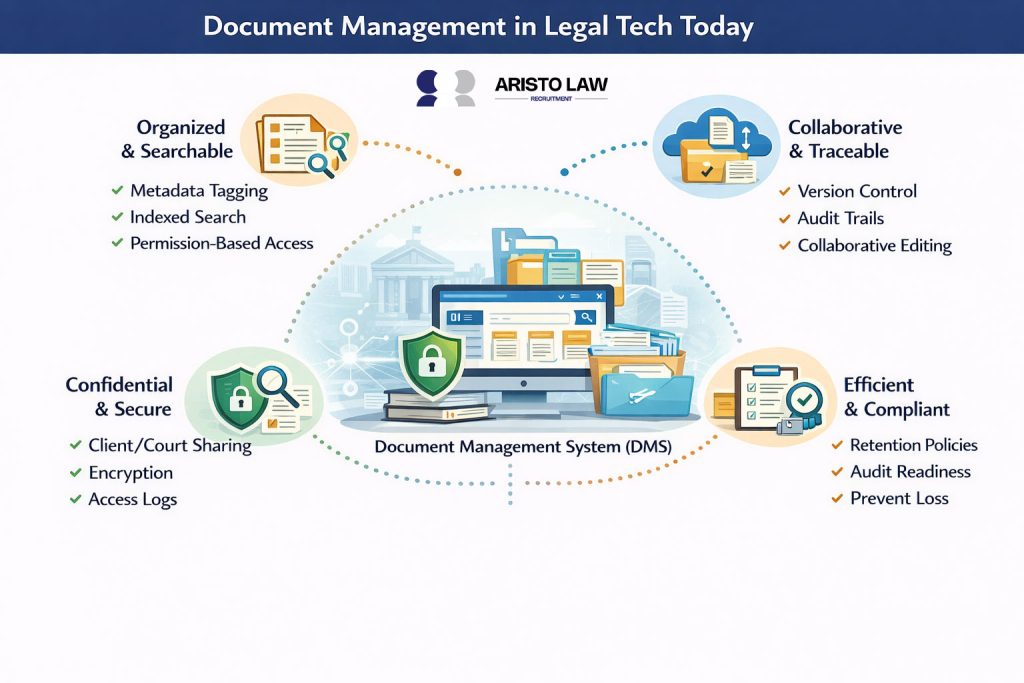
Document management in legal tech today is the structured control of legal files to protect confidentiality while increasing productivity across legal teams. Legal document management relies on modern document management systems to organize files using metadata tagging, indexed search, and permission-based access within a DMS environment. Legal document management enforces version control, collaborative editing, audit trails, and retention policies to prevent loss, duplication, and unauthorized changes. Legal document management supports secure sharing with clients and courts while maintaining confidentiality, traceability, and workflow efficiency across matters.
What is the role of cybersecurity in legal tech trends?
The role of cybersecurity in legal tech trends is the protection of client data, legal confidentiality, and system integrity within technology-driven legal services. Law firm cybersecurity supports secure and ethical legal tech adoption by defending legal systems that store sensitive client records, privileged communications, and financial data that attract targeted attacks.
Law firm cybersecurity includes access controls, encryption, multi-factor authentication, secure backups, and vendor security assessments to reduce data protection and confidentiality risk. Law firm cybersecurity functions as a foundation layer that enables safe automation, AI use, cloud platforms, and third-party integrations across modern legal operations.
What are legal technology business verticals?
Legal technology business verticals are legal software categories that support specific operational, compliance, and service functions across the legal market. Legal tech verticals organize tools by capability scope and functional role within legal services.
Listed below are the 12 Legal technology business verticals.
- Practice and case management for matter tracking, workflows, and deadlines
- Legal research platforms for case law, statutes, and citation analysis
- eDiscovery tools for data collection, review, and production
- Document automation systems for template-driven drafting
- Contract lifecycle management for contract creation and renewal
- Billing and payments software for invoicing, time tracking, and collections
- Document management and knowledge management for secure storage and reuse
- Compliance and risk management tools for regulatory tracking
- Client intake and CRM systems for lead handling and communication
- Analytics platforms for performance measurement
- Cybersecurity solutions for data protection and access control
- Court and e-filing tools for procedural submission and tracking
What is secure collaborative authoring in legal work?
Secure collaborative authoring in legal work is the controlled creation and review of legal documents by multiple participants within protected drafting environments. Secure collaborative authoring supports contracts and briefs that require parallel reviewers, tracked redlines, and selective client sharing during drafting cycles.
Secure collaborative authoring defines “secure” through role-based permissions, encryption at rest and in transit, detailed audit trail records, and controlled external access. Secure collaborative authoring relies on version control to prevent overwriting, preserve authorship history, and maintain document integrity across iterations.
Build a legal support team that moves work forward.
Tell us what is slowing your practice down. We will help map the role, workflow, and support structure that fits.