
How to Streamline Legal Research with Technology

Practical guidance for building efficient, accountable legal support operations.


Legal research streamlining works by using technology such as AI tools, semantic search, automated document review, integrated case databases, and workflow automation to accelerate and validate legal analysis. Legal research streamlining improves efficiency and accuracy by reducing manual review across case law, statutes, regulations, and internal firm matter data. Legal research streamlining impact shows measurable gains.
A 2025 study titled AI-Assisted Legal Research: AIALR (published by the British and Irish Association of Law Librarians) found that AI-assisted legal research tools, such as modern AI search and summarization systems, are reshaping how legal researchers find and synthesize case law, statutes, and commentary, indicating that these technologies substantially streamline legal research workflows compared with traditional methods.
Legal research streamlining supports AI-assisted case law analysis through precedent discovery, citation mapping, and jurisdiction filtering. Legal research streamlining strengthens document drafting, demand letters, and personal injury research through automated summaries, pattern detection, and prior matter comparison. Legal research streamlining adoption at the firm level depends on standardized workflows, tool integration, and structured change management to ensure consistent use.
Legal research streamlining carries limitations related to ethical use, data bias, hallucination risk, and confidentiality exposure, which reinforces the need for attorney oversight and human validation. Legal research streamlining delivers the strongest results in litigation, personal injury, employment, and compliance practices through hybrid AI–traditional workflows using reliable free and paid research platforms.
Aristolaw helps law firms streamline legal research through outsourced legal support, AI workflow integration, document management, and research coordination services. Hire legal research support staff with Aristolaw to improve legal workflow efficiency today. Strengthen legal research accuracy, document organization, and case preparation workflows with outsourced legal support from Aristolaw.
Listed below are the 20 steps of how Legal research streamlining works.
- Use AI tools: AI tools improve legal research speed, document analysis, and workflow automation across legal operations.
- Automate document review: Automated document review systems improve contract analysis, evidentiary organization, and legal review efficiency.
- Deploy research assistants: Research assistants improve case law analysis, citation management, and legal research workflow support.
- Integrate case databases: Integrated case databases improve legal information access, records organization, and litigation workflow management.
- Leverage predictive analytics: Predictive analytics improve legal strategy evaluation, case outcome forecasting, and operational decision-making.
- Apply natural language: Natural language processing improves legal query interpretation, document analysis, and semantic search functionality.
- Enable semantic search: Semantic search systems improve contextual legal research accuracy and information retrieval efficiency.
- Consolidate research platforms: Consolidated research platforms improve workflow organization, database access, and legal research coordination.
- Utilize citation checkers: Citation checkers improve legal citation accuracy, formatting consistency, and research validation processes.
- Adopt legal search engines: Legal search engines improve access to statutes, case law, regulations, and jurisdiction-specific legal authorities.
- Track research insights: Research insight tracking improves legal analysis organization, workflow monitoring, and strategic case preparation.
- Sync matter data: Matter data synchronization improves case coordination, document consistency, and operational workflow integration.
- Standardize workflow automation: Workflow automation standardization improves procedural consistency, operational efficiency, and task management accuracy.
- Generate research summaries: Research summaries improve legal information review, case preparation, and attorney decision-making efficiency.
- Integrate practice tools: Practice tool integration improves workflow coordination, scheduling, billing, and legal operations management.
- Enable cross-jurisdiction search: Cross-jurisdiction search systems improve multi-state legal research and comparative legal analysis workflows.
- Optimize query refinement: Query refinement improves legal search accuracy, information filtering, and research precision across databases.
- Implement workflow alerts: Workflow alerts improve deadline tracking, task monitoring, and legal operational oversight.
- Share annotated results: Annotated result sharing improves collaboration, legal analysis review, and research communication workflows.
- Validate source accuracy: Source accuracy validation improves legal reliability, citation integrity, and research credibility across legal matters.
1. Use AI tools
AI tool usage defines the application of Artificial Intelligence to accelerate Legal Research and analysis. AI tool improves research speed and Research Accuracy by scanning large volumes of case law, statutes, and regulations. The importance of AI tools supports Legal Operations by reducing manual review and cognitive load.
AI tool considerations include model training scope, jurisdiction coverage, and data privacy controls. AI tool optimization relies on clear research prompts, defined validation steps, and attorney review checkpoints.
2. Automate document review
Document review automation defines technology-driven analysis of legal texts for relevance and structure. Document review automation purpose improves Legal Research efficiency and accuracy through automated legal document review and templates embedded into workflows.
Document review automation’s importance reduces review time and inconsistency. Document review automation considerations include OCR quality, clause detection logic, and version control. Document review automation optimization relies on standardized templates and continuous output review.
3. Deploy research assistants
Research assistant deployment defines the use of human-supported or AI-supported research coordination. The purpose improves Legal Research throughput using a virtual legal research assistant support integrated with case analysis tasks.
Research assistant’s importance supports Knowledge Management and the attorney’s focus. Research assistant considerations include research scope, confidentiality handling, and reporting format. Research assistant optimization relies on clear task briefs and validation protocols.
4. Integrate case databases
Case database integration defines unified access to Case Law Databases across platforms. Case database integration improves Research Accuracy by reducing source fragmentation.
The importance of case database integration supports Legal Operations consistency. Case database integration considerations include licensing, update frequency, and citation coverage. Case database integration optimization relies on centralized access controls.
5. Leverage predictive analytics
Predictive analytics usage defines data-driven forecasting of legal outcomes. Predictive analytics purpose improves Legal Research insight using historical case patterns. Predictive analytics importance supports strategy evaluation.
Predictive analytics considerations include dataset relevance and bias control. Predictive analytics optimization relies on a limited-scope application and human validation.
6. Apply natural language
Natural language processing defines machine understanding of legal text queries. Natural language purpose improves Legal Research usability and query precision. Natural language importance supports Semantic Search.
Natural language considerations include language ambiguity and jurisdiction nuance. Natural language optimization relies on a refined query structure.
7. Enable semantic search
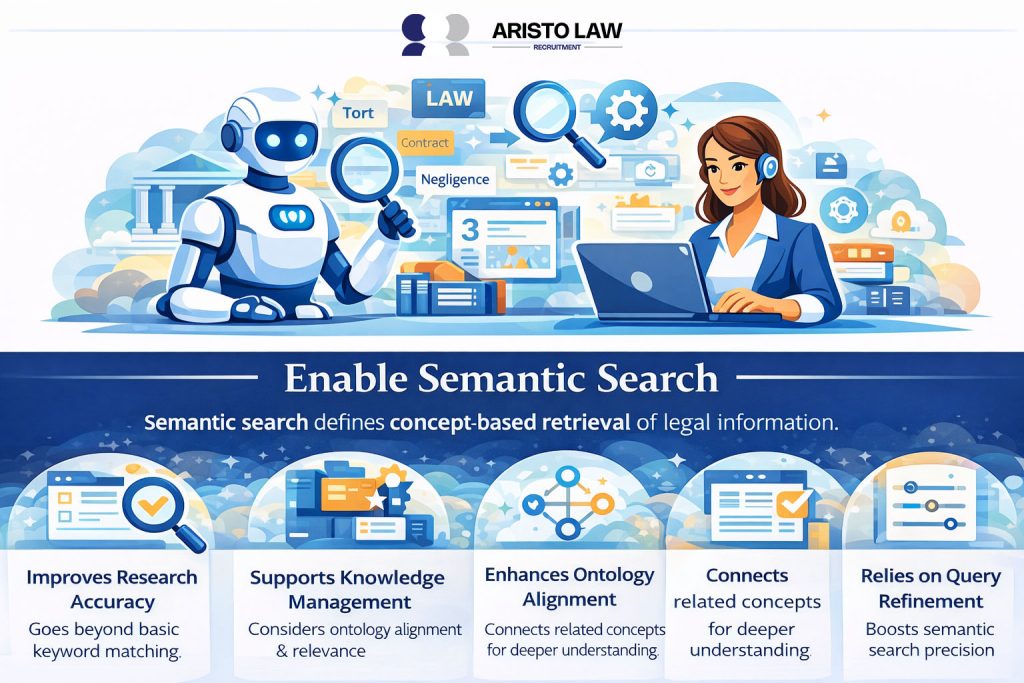
Semantic search defines concept-based retrieval of legal information. Semantic search purpose improves Research Accuracy beyond keyword matching. Semantic search importance supports Knowledge Management. Semantic search considerations include ontology alignment and relevance scoring. Semantic search optimization relies on query refinement.
8. Consolidate research platforms
Research platform consolidation defines unifying tools into a single research environment. Platform consolidation improves Workflow Automation and efficiency. The importance of platform consolidation reduces context switching. Platform consolidation considerations include data compatibility. Platform consolidation optimization relies on phased migration.
9. Utilize citation checkers
Citation checker usage defines automated validation of legal citations. Citation checker improves Research Accuracy and compliance.
Citation checker importance reduces reputational risk. Citation checker considerations include jurisdiction rules. Citation checker optimization relies on final review checkpoints.
10. Adopt legal search engines
Legal search engine adoption defines the use of specialized legal discovery tools. Legal search engine improves Legal Research depth.
Legal search engine importance supports faster precedent discovery. Legal search engine considerations include database scope. Legal search engine optimization relies on advanced filters.
11. Track research insights
Research insight tracking defines capturing findings for reuse. Insight tracking purpose improves Knowledge Management. Insight tracking importance supports future research efficiency.
Insight tracking considerations include tagging standards. Insight tracking optimization relies on shared repositories.
12. Sync matter data
Matter data synchronization defines linking research to active cases. Matter data sync purpose improves Legal Operations alignment.
Matter data sync importance supports relevance. Matter data sync considerations include access controls. Matter data sync optimization relies on role-based permissions.
13. Standardize workflow automation
Workflow automation standardization defines repeatable research execution paths. Workflow automation purpose improves efficiency through standardizing legal research workflow automation embedded into Legal Operations. Workflow automation’s importance reduces variability. Workflow automation considerations include exception handling. Workflow automation optimization relies on periodic review.
14. Generate research summaries
Research summary generation defines automated synthesis of findings. Research summary purpose improves attorney consumption speed.
Research summary importance supports decision-making. Research summary considerations include accuracy thresholds. Research summary optimization relies on human review.
15. Integrate practice tools
Practice tool integration defines connecting research with drafting and case tools. Practice tool integration improves Workflow Automation.
Practice tool integration’s importance supports continuity. Practice tool integration considerations include API reliability. Practice tool integration optimization relies on compatibility testing.
16. Enable cross-jurisdiction search
A cross-jurisdiction search defines multi-region legal discovery. CA cross-jurisdiction search purpose improves coverage and comparison.
Cross-jurisdiction search importance supports complex matters. Cross-jurisdiction search considerations include legal variation. Cross-jurisdiction search optimization relies on filtering rules.
17. Optimize query refinement
Query refinement optimization defines improving search precision. Query refinement purpose improves Research Accuracy. Query refinement importance reduces noise. Query refinement considerations include Boolean logic. Query refinement optimization relies on iterative testing.
18. Implement workflow alerts
Workflow alert implementation defines automated research notifications. Workflow alert purpose improves timeliness. Workflow alert importance supports deadline control. Workflow alert considerations include alert thresholds. Workflow alert optimization relies on relevance tuning.
19. Share annotated results
Annotated result sharing defines collaborative knowledge exchange. An annotated sharing purpose improves Knowledge Management. An annotated sharing of importance supports team alignment. Annotated sharing considerations include access permissions. Annotated sharing optimization relies on annotation standards.
20. Validate source accuracy
Source accuracy validation defines the verification of legal authority. Source validation purpose protects Research Accuracy. Source validation importance supports ethical compliance. Source validation considerations include citation currency. Source validation optimization relies on final attorney confirmation.
What is Legal Research?
Legal research is the systematic process of identifying, analyzing, and validating legal authorities to support legal reasoning, decision-making, and advocacy. Legal research relies on primary authority such as case law, statutes, regulations, and legal precedents, supported by secondary sources including treatises, legal commentary, and scholarly analysis that interpret and explain the law.
Why is technology important for modern legal research?
Technology is necessary for modern legal research because it manages legal information overload while improving efficiency, accuracy, and competitive positioning. Modern legal research faces rising volumes of case law, statutes, regulations, and legal precedents, which increases time pressure and cost exposure without technology support. Modern legal research efficiency improves through faster retrieval, cross-jurisdiction coverage, and consistent access to primary authority and secondary sources.
Modern legal research accuracy improves by reducing missed authorities, outdated citations, and fragmented source review that increase legal risk. Modern legal research competitiveness improves as clients expect faster turnaround, transparent billing, and well-supported analysis under tight deadlines. Modern legal research technology strengthens risk control by supporting comprehensive coverage, auditability, and repeatable research standards across legal operations.
What are the main benefits of using technology for legal research?
The main benefits of using technology for legal research include faster research cycles, stronger accuracy support, and improved client service outcomes. Legal research technology matters because legal information volume continues to grow while time, budget, and accuracy expectations increase across legal operations.
Listed below are 10 main benefits that support research efficiency and legal workflow optimization.
- Faster search and filtering. Technology accelerates the discovery of relevant case law and statutes through advanced filtering and indexing.
- Accuracy support through relevance ranking. Technology improves result quality by prioritizing authoritative and jurisdiction-specific sources.
- Broader legal coverage. Technology expands access to multi-jurisdiction case law databases and regulatory materials.
- Cost efficiency. Technology reduces billable research time and lowers internal research overhead.
- Citation tracking and alerts. Citator tools monitor treatment of cases and flag negative or updated authorities.
- Research organization. Technology enables folders, annotations, and saved searches for structured knowledge management.
- Team collaboration. Technology supports shared research, notes, and updates across legal teams.
- Automation support. Technology assists with summaries, issue spotting, and pattern identification.
- Risk reduction. Technology lowers the risk of missed authorities and outdated citations.
- Client service improvement. Technology enables faster turnaround and more defensible legal analysis.
Legal research technology supports efficiency and coverage, while attorneys remain responsible for validating primary authority and citations.

How does AI-powered legal research work?
AI-powered legal research uses structured queries processed through NLP-driven retrieval, relevance ranking, summarization, and citation linking to deliver faster and more accurate results. AI legal research begins with a query that triggers retrieval across case law, statutes, regulations, and secondary sources, followed by relevance ranking based on jurisdiction, authority strength, and contextual similarity.
AI legal research then produces concise summaries and links citations to validating sources, which improves review speed and traceability. AI legal research benefits include reduced research time, broader coverage, improved relevance ranking, and lower risk of missed authorities, while maintaining attorney oversight for final validation.
What data sources do AI legal research tools rely on?
AI legal research tools rely on case law, statutes and codes, regulations, court rules, dockets and filings, and legal news datasets, depending on vendor and jurisdiction coverage.
Listed below are the 8 primary legal datasets used across AI-powered legal research systems.
- Case law. Case law databases include published judicial opinions from trial, appellate, and supreme courts.
- Statutes and codes. Statutes and codes contain enacted laws at the federal, state, and local levels.
- Regulations. Regulations cover administrative rules issued by government agencies.
- Court rules. Court rules define procedural standards for filings, motions, and litigation conduct.
- Dockets and filings. Dockets and filings include procedural history, briefs, motions, and case status records.
- Agency guidance. Agency guidance provides interpretive rules, enforcement policies, and administrative opinions.
- Secondary treatises. Secondary treatises include legal commentary, practice guides, and analytical references.
- Legal news and analysis. Legal news and analysis supply contextual updates on legal developments and trends.
AI legal research dataset scope, update frequency, and jurisdiction coverage vary by provider and licensing agreements.
What are the best AI tools for legal research in 2026?
The best AI tools for legal research in 2026 are selected based on coverage depth, citator strength, transparency of outputs, system integration, and data security rather than tool names alone. Best AI tools for legal research evaluation focus on legal AI platforms that handle large case law datasets, provide reliable citators, explain relevance ranking, integrate with legal workflows, and protect confidential data.
Listed below are the 6 best AI tools for legal research.
- Comprehensive legal research platforms. Platforms combining AI search, citators, and multi-jurisdiction case law coverage.
- AI-enhanced citator systems. Tools focused on citation validation, negative treatment alerts, and authority tracking.
- Semantic legal search engines. Systems using NLP to retrieve concept-based results beyond keyword matching.
- Document analysis and summarization tools. Tools supporting issue spotting, case comparison, and research synthesis.
- Workflow-integrated research tools. Legal AI platforms are embedded into drafting, billing, and matter management systems.
- Public and low-cost access tools. Genuinely free public databases, freemium legal AI tools, and limited free trial platforms.
Free access varies across public legal databases, freemium AI tiers, and time-limited trials, which require verification discipline. Legal research accuracy depends on validating AI outputs against primary authority, confirming citator status, and avoiding reliance on unverified summaries for legal advice.
How do AI-powered legal research tools improve speed?
AI-powered legal research tools improve speed by reducing manual search steps while preserving research accuracy across large legal datasets. Research speed increases through semantic search that retrieves relevant case law and statutes based on meaning rather than keywords. Research speed improves through instant summaries and passage stating that surface key holdings and reasoning without full-text review.
Research speed benefits from citation chaining that connects precedents and authorities in a single workflow. Research speed improves further through automated support for briefs and demand letter preparation by organizing relevant authorities and factual patterns. Legal efficiency increases when these speed levers shorten review cycles while maintaining accuracy through linked citations and source traceability.
What workflows combine AI with traditional legal research methods?
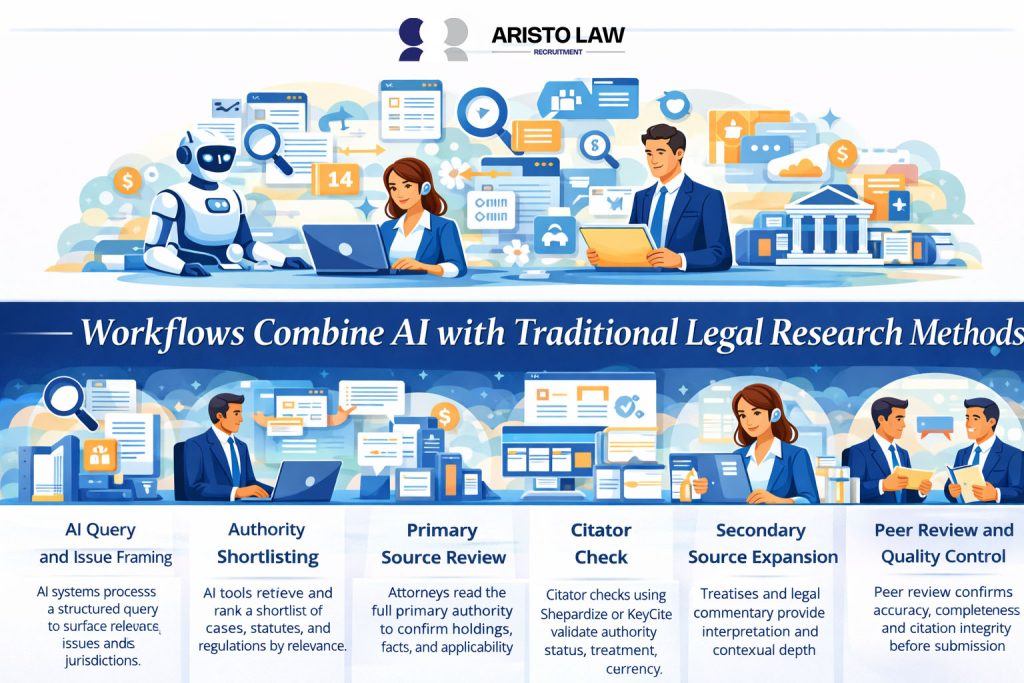
Workflows that combine AI with traditional legal research methods follow this sequence: AI query, authority shortlisting, secondary source expansion, draft synthesis, and peer review.
Listed below are the 7 standard step-by-step stages used in professional legal research.
- AI query and issue framing. AI systems process a structured query to surface relevant issues and jurisdictions.
- Authority shortlisting. AI tools retrieve and rank a shortlist of cases, statutes, and regulations by relevance.
- Primary source review. Attorneys read the full primary authority to confirm holdings, facts, and applicability.
- Citator check. Citator checks using Shepardize or KeyCite validate authority status, treatment, and currency.
- Secondary source expansion. Treatises and legal commentary provide interpretation and contextual depth.
- Draft synthesis. Research findings are organized into a memo or brief with verified citations.
Peer review and quality control. Peer review confirms accuracy, completeness, and citation integrity before submission.
Can law firms implement an AI legal research firm-wide?
Yes, law firms can implement an AI legal research firm-wide by establishing clear research governance, controlled rollout, and measurable operational standards. Firm-wide AI adoption in legal operations starts with approving specific AI research tools, defining matter eligibility rules, and setting boundaries for acceptable use.
Firm-wide AI adoption requires structured training so attorneys and staff apply AI consistently and validate outputs against primary authority. Firm-wide AI adoption succeeds through pilot rollouts that test workflows, capture feedback, and refine usage before full deployment. Firm-wide AI adoption remains effective when research governance includes performance measurement, accuracy review, and ongoing evaluation tied to productivity, risk control, and research quality outcomes.
What are the limitations of AI legal research?
Limitations of AI legal research include hallucinated authorities, incomplete coverage, outdated sources, weak jurisdiction filtering, confidentiality constraints, and bias in outputs.
Listed below are 7 specific AI limitations that create research risks and coverage gaps.
- Hallucinated authorities. AI systems produce non-existent cases or citations without verification.
- Incomplete coverage. AI datasets omit courts, jurisdictions, or practice areas based on vendor scope.
- Outdated authorities. AI tools lag in updates and miss recent rulings or statutory changes.
- Weak jurisdiction filters. AI results mix jurisdictions when filtering lacks precision.
- Overconfident summaries. AI summaries oversimplify legal nuance and limitations.
- Confidentiality constraints. AI usage introduces data exposure risk for sensitive client information.
- Bias in outputs. AI ranking reflects historical bias within training datasets.
Best practice requires validating AI outputs against primary authority, applying citator checks, confirming jurisdiction relevance, and limiting AI use to supervised research workflows.
What ethical risks exist in AI legal research?
Ethical and compliance risks in AI legal research include confidentiality exposure, unverified authorities, inadequate supervision, and compliance failures. Ethical and compliance risks reflect ethical risks of AI in legal work when tools process sensitive client data, generate unsupported summaries, or obscure citation sources. Ethical and compliance risks increase without client consent controls, secure approved systems, and mandatory citation verification. Ethical and compliance risks are reduced through strict supervision duties, human validation of primary authority, restricted data input, approved tool governance, and audit trails aligned with legal ethics and confidentiality rules.
Build a legal support team that moves work forward.
Tell us what is slowing your practice down. We will help map the role, workflow, and support structure that fits.