
PPC Advertising for Law Firms: Platforms, Formats, Costs, and Benefits

Practical guidance for building efficient, accountable legal support operations.
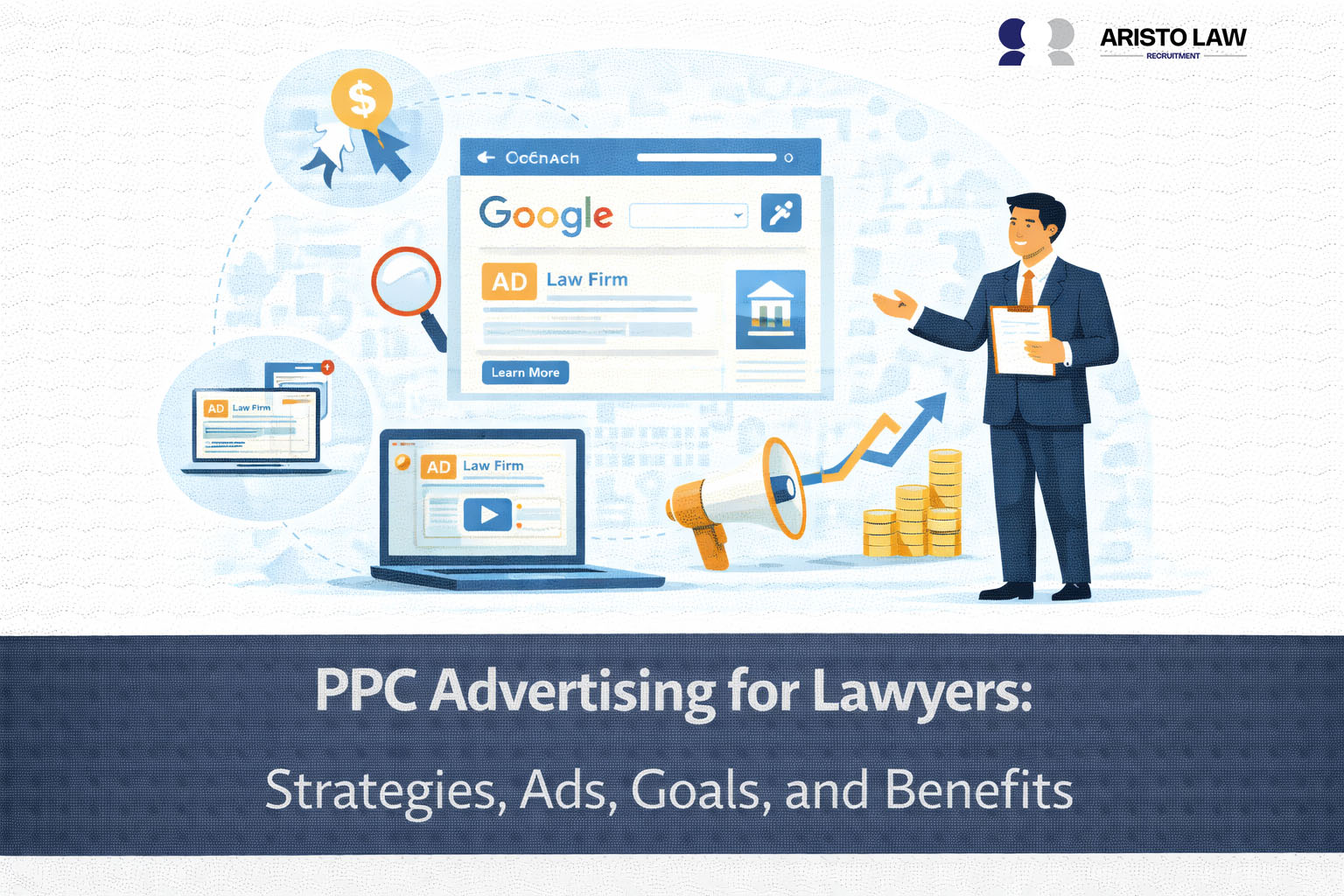
PPC advertising for law firms refers to paid search and display campaigns where attorneys pay per click to generate targeted legal leads. PPC advertising operates on platforms such as Google Ads and uses keyword-triggered ads that appear when users search for legal services. PPC advertising includes search ads, Local Service Ads, display ads, and remarketing campaigns that re-engage prior website visitors.
PPC benefits include immediate visibility, fast lead flow, geographic precision, and scalable budget control compared to SEO timelines. PPC cost drivers include practice area competitiveness, metropolitan location, Quality Score, and bidding strategy. PPC in personal injury and criminal defense shows a higher average CPC due to competition intensity.
A study by Oldenburg et al., titled “Interpretable Deep Learning for Forecasting Online Advertising Costs: Insights from the Competitive Bidding Landscape,” in 2023, examined methods for predicting CPC trends in digital advertising markets. PPC cost-per-lead varies based on landing page quality and intake efficiency.
PPC strategy requires high-intent keyword targeting, negative keywords, segmented campaigns by practice area, and optimized landing pages. PPC metrics include CTR, CPC, Quality Score, conversion rate, CPA, and ROAS. PPC management involves continuous bid adjustments, search term audits, and structured scaling based on profitable data.
Aristolaw helps law firms strengthen online reputation management. Improve law firm credibility and client trust with reputation management support from Aristolaw today. Aristolaw helps outsourced client communication, review monitoring, intake coordination, and legal marketing support services.
What is PPC advertising for law firms?
PPC advertising for law firms is a paid search marketing model where attorneys pay each time a user clicks on their advertisement. PPC advertising operates within law firm marketing as a paid search strategy that places ads on search engines and partner display networks. PPC advertising triggers ads when users enter relevant legal keywords such as “personal injury lawyer near me” or “DUI attorney.”
PPC advertising includes search-based ads that appear at the top of search engine results and display ads that appear across websites within ad networks. PPC advertising charges only when a user clicks the ad, which creates measurable cost control and direct response tracking. PPC advertising supports immediate visibility compared to long-term organic ranking strategies.
What are the best PPC Platforms for lawyers?
The best PPC platforms for lawyers are Google Ads, Microsoft Ads, and Facebook Ads because these PPC platforms deliver paid search visibility and scalable legal lead generation. PPC platforms function as advertising systems where lawyers run pay-per-click campaigns within structured law firm marketing strategies focused on measurable ROI. PPC platforms differ in audience intent, reach, and cost structure, which influences platform selection for paid search campaigns.
Listed below are the 3 best PPC platforms for lawyers.
- Google Ads for Lawyers: Google Ads for lawyers improve law firm visibility through search-based advertising targeting high-intent legal queries and local client searches.
- Microsoft Ads for Lawyers: Microsoft Ads for lawyers improve legal advertising reach across Bing-powered search networks and lower-cost PPC environments.
- Facebook Ads for Lawyers: Facebook Ads for lawyers improve client engagement, audience targeting, and lead generation through social media advertising campaigns.
1. Google Ads for Lawyers
Google Ads for lawyers is a paid search platform where attorneys bid on legal keywords and pay when users click their ads. Google Ads dominates legal lead generation because high-intent searches such as “personal injury lawyer” or “criminal defense attorney near me” occur directly on Google, which drives immediate inquiry demand, as discussed in Google Ads for law firms’ strategy analysis.
Google Ads works through keyword bidding, Quality Score evaluation, and ad rank calculation that determine placement position. Google Ads costs vary based on keyword competition, location, and practice area demand. Google Ads benefits include top-of-page visibility, geographic precision, and measurable ROI through conversion tracking.
2. Microsoft Ads for Lawyers
Microsoft Ads for lawyers is a pay-per-click platform that places ads on the Bing search network and partner sites. Microsoft Ads reaches search users with lower advertiser density in some markets. Microsoft Ads shows lower cost-per-click in certain regions while maintaining intent-based targeting. Microsoft Ads supports legal lead generation through keyword bidding and location filters similar to Google Ads.
3. Facebook Ads for Lawyers
Facebook Ads for lawyers is a paid social PPC platform that charges per click or defined action within segmented audiences. Facebook Ads differ from paid search because Facebook Ads target users based on demographics and behavior rather than active search queries. Facebook Ads supports legal lead generation through audience segmentation, retargeting campaigns, and native lead forms that complement search-based PPC efforts.
What are the types of PPC Ads formats?
The main types of PPC ad formats for law firms include search ads, display ads, call-only ads, remarketing ads, and Local Services Ads. PPC ad formats represent the different ways paid ads appear across search engines and networks within paid search campaigns.
Listed below are the 5 main types of PPC ad formats for law firms.
- Search Ads: Search ads improve law firm visibility by targeting users searching for legal services through keyword-based search engine advertising.
- Display Ads: Display ads improve brand awareness through visual banner advertising across websites, apps, and online media platforms.
- Call-Only Ads: Call-only ads improve direct client communication by encouraging phone calls from mobile search users seeking immediate legal assistance.
- Remarketing Ads: Remarketing ads improve client conversion opportunities by re-engaging users who previously visited a law firm website or landing page.
- Local Services Ads: Local Services Ads improve local lead generation by promoting law firms directly within geographically targeted search results.
1. Search Ads
Search ads are text-based PPC ads that appear at the top of search engine results when users enter legal queries. Search ads work through keyword targeting that matches high-intent phrases such as “car accident lawyer” or “divorce attorney near me.” Search ads produce a strong ROI for lawyers because search ads reach users actively seeking legal services. Search ads costs depend on keyword competition, location, and Quality Score, which influences cost-per-click and lead volume.
2. Display Ads
Display ads are visual banner ads that appear on websites within advertising networks. Display ads build brand awareness and support top-of-funnel exposure for law firms. Display ads generate a lower cost-per-click compared to search ads but show lower direct conversion intent.
3. Call-Only Ads
Call-only ads are PPC ads designed to generate direct phone calls instead of website visits. Call-only ads show a clickable phone number on mobile devices and suit urgent legal needs such as criminal defense. Call-only ads improve intake speed and increase immediate consultation opportunities.
4. Remarketing Ads
Remarketing ads are PPC ads shown to users who previously visited the law firm’s website. Remarketing ads use tracking data to re-engage visitors who viewed practice-area pages but did not submit inquiries. Remarketing ads improve conversion rates by targeting warm prospects.
5. Local Services Ads
Local Services Ads are pay-per-lead ads that appear above traditional search ads with verification badges. Local Services Ads operate on a cost-per-lead model rather than cost-per-click. Local Services Ads support high-conversion intake because Local Services Ads display trust indicators and direct contact options for qualified prospects.
What PPC ads work best for legal services?
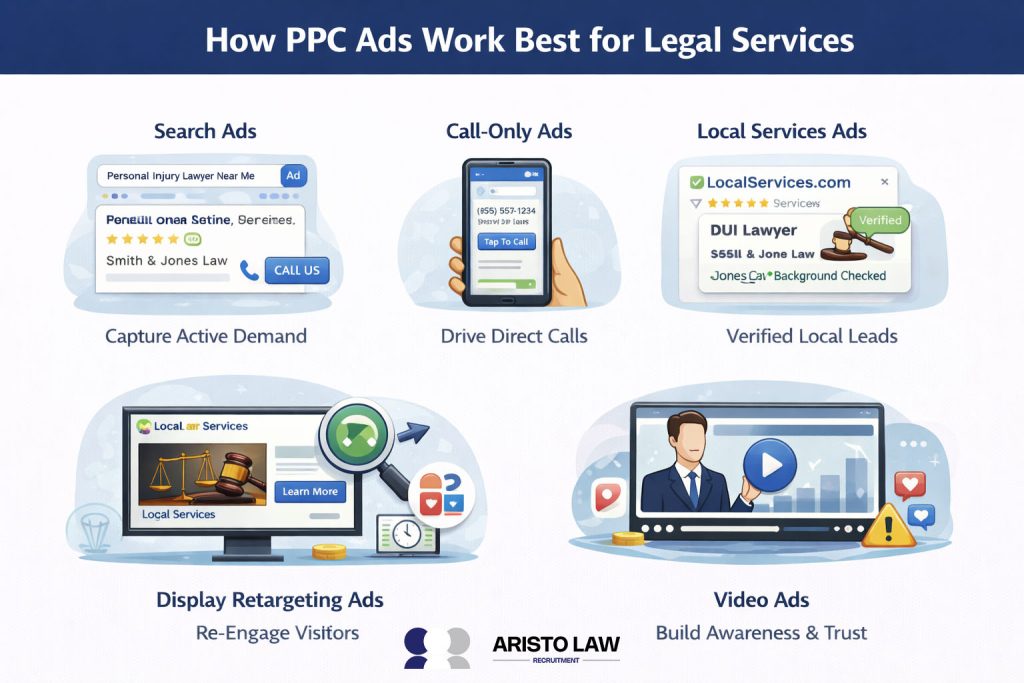
The most effective types of PPC ads for legal services are search ads, call-only ads, Local Services Ads, display retargeting ads, and video ads. PPC performance depends on user intent level and local targeting precision.
Listed below are the 5 most effective types of PPC ads for legal services.
- Search ads: Search ads work best when users enter high-intent legal queries such as “personal injury lawyer near me.” Search ads capture active demand and generate strong conversion rates.
- Call-only ads: Call-only ads work best for urgent matters such as DUI or arrest cases, where prospects prefer immediate phone contact. Call ads drive direct intake conversations without requiring website visits.
- Local Services Ads: Local Services Ads work best for practice areas eligible under platform guidelines and for firms focused on verified local targeting. Local Services Ads appear above search ads and operate on a pay-per-lead model.
- Display retargeting ads: Display retargeting ads work best for re-engaging website visitors who viewed service pages but did not submit inquiries. Retargeting increases follow-up visibility and improves lead conversion rates.
- Video ads: Video ads work best for awareness campaigns and trust building through attorney explanations and case education.
How much does PPC cost for law firms?
PPC costs for law firms range from $5 to over $100 per click, depending on practice area competition, geographic market, and bidding strategy. PPC cost per click (CPC) increases in competitive niches such as personal injury, medical malpractice, and criminal defense due to higher advertiser demand. PPC ad budget requirements rise in metropolitan markets where multiple firms bid on identical high-intent keywords.
A study by Yang & Li, titled “Keyword Decisions in Sponsored Search Advertising: A Literature Review and Research Agenda,” in 2023, analyzed keyword strategy and auction mechanisms in sponsored search advertising. PPC cost-per-lead varies based on landing page quality, Quality Score, and intake conversion rate. PPC competition level directly influences bid prices, which makes structured keyword selection and negative keyword filtering necessary for budget control.
What factors affect law firm PPC costs the most?
The factors that influence PPC cost are competition level, Quality Score, landing page quality, and bidding strategy. PPC cost factors determine cost-per-click and overall ad budget efficiency.
Listed below are the 6 factors that influence PPC cost.
- Competition level: Competition increases bid prices when multiple law firms target the same high-intent keywords.
- Keyword demand: Keyword demand raises CPC when search volume and commercial intent align in competitive practice areas.
- Geographic location: Location impacts PPC cost because metropolitan markets contain more competing advertisers.
- Quality Score: Quality Score influences ad rank and CPC by measuring ad relevance, expected click-through rate, and landing page experience. Higher Quality Score reduces average cost-per-click.
- Landing page quality: Landing page quality affects conversion rate and Quality Score, which impacts cost efficiency.
- Bidding strategy: Bidding strategy affects how aggressively campaigns compete in auctions and directly influences CPC levels.
What is a good budget for law firm pay-per-click advertising?
A good PPC budget for a law firm aligns with the target cost per lead, case value, and market competition. PPC budget planning starts with a controlled testing phase that allocates sufficient spend to gather statistically meaningful data across core keywords and ad groups. PPC testing budgets focus on validating cost per lead, conversion rate, and intake quality before expansion.
PPC scaling budgets increase after campaigns produce consistent, qualified leads at sustainable acquisition costs. PPC budget allocation remains data-driven, with funds shifted toward high-intent keywords and high-converting practice areas. PPC budget decisions depend on competition density, geographic reach, and average retained-case revenue rather than fixed monthly assumptions.
What are the benefits of PPC for lawyers?
PPC advertising offers lawyers immediate visibility, precise targeting control, scalable budgets, and predictable legal lead generation. PPC benefits support structured growth within competitive legal markets.
Listed below are the 7 benefits of PPC for lawyers.
- Immediate visibility: PPC ads appear at the top of search results as soon as campaigns launch, which accelerates lead flow.
- Targeting control: PPC platforms allow keyword targeting, audience segmentation, and device filtering to reach defined prospects.
- Measurable ROI: PPC tracking systems measure clicks, conversions, cost per lead, and return on ad spend in real time.
- Geographic precision: PPC campaigns restrict ads to cities, ZIP codes, or service radii aligned with firm coverage areas.
- Scalable budgets: PPC budgets increase or decrease based on performance data without long-term commitment.
- High-intent traffic: PPC search ads capture users actively seeking legal representation.
- Brand visibility reinforcement: PPC display and remarketing ads maintain visibility among prior website visitors.
Can PPC generate leads faster than SEO for law firms?
Yes, PPC can generate leads faster than SEO because PPC places ads at the top of search results immediately after campaign launch. PPC vs SEO comparison shows that paid search activates law firm PPC lead generation systems without waiting for organic ranking cycles or content indexing delays. PPC captures high-intent users at the moment of search, which increases short-term lead speed.
SEO builds authority and long-term organic traffic through content, backlinks, and technical optimization, which requires time to gain rankings. PPC produces immediate visibility but stops generating traffic when the budget pauses. SEO compounds value over time but does not provide instant lead flow. PPC vs SEO strategy works best when PPC drives short-term inquiries while SEO builds a sustainable organic presence.
What keywords should law firms target in PPC?
Law firms should target service + location keywords, specific case-type keywords, and structured negative keywords. Legal keywords with strong search intent produce higher conversion rates and stronger lead quality.
Listed below are the 5 keywords law firms target in PPC.
- Service + location keywords: Service + location keywords, such as “personal injury lawyer Miami,” reflect local hiring intent.
- Urgent or emergency terms: Urgent terms such as “DUI lawyer now” signal immediate need and high conversion probability.
- Consultation-focused keywords: Consultation keywords such as “free consultation attorney” indicate readiness to contact a law firm.
- Specific case-type keywords: Case-type keywords such as “truck accident lawyer” show defined legal demand.
- Negative keywords: Negative keywords exclude irrelevant traffic,c such as “lawyer salary” or “law school requirements,s” to control wasted spend.
What are negative keywords for legal PPC campaigns?
Negative keywords prevent PPC ads from appearing in searches that lack hiring intent and drain advertising budget. Negative keywords improve budget control by excluding terms such as “free legal forms,” “DIY divorce papers,” “lawyer salary,” “law school,” or unrelated practice areas. Negative keywords filter informational or employment-related searches that do not align with client acquisition goals. Negative keywords increase traffic relevance and protect cost-per-click efficiency within competitive legal markets.
A study by Jansen, Liu & Simon, titled “The Effect of Ad Rank on the Performance of Keyword Advertising Campaigns,” in 2013, found that higher ad positions increase clicks and overall campaign performance in search advertising. Negative keywords strengthen Quality Score by aligning ad delivery with high-intent search queries. Negative keywords support controlled ad spend by reducing wasted impressions and low-value clicks.
How do you write PPC ad copy that converts for legal services?
High-converting PPC ad copy for legal services addresses a clear legal problem, presents a direct benefit, and ends with a strong call-to-action. Ad copy structure in paid search campaigns follows principles associated with a high-converting legal ad copy strategy within competitive legal markets. Headline language names the service and location, such as “Chicago Personal Injury Lawyer,” to match search intent. Problem statements reflect urgency, such as injury, arrest, or custody dispute, to align with user needs. Benefit statements highlight consultation availability, experience, or responsive service without exaggerated claims. Call-to-action language directs users to “Book a Free Consultation” or “Call Now” to prompt immediate response.
PPC ad copy in legal services must comply with attorney advertising rules that prohibit guarantees, misleading comparisons, or unverifiable success claims. Ad copy clarity and relevance improve click-through rate and conversion performance while maintaining compliance standards.
How do you structure PPC campaigns for lawyers?
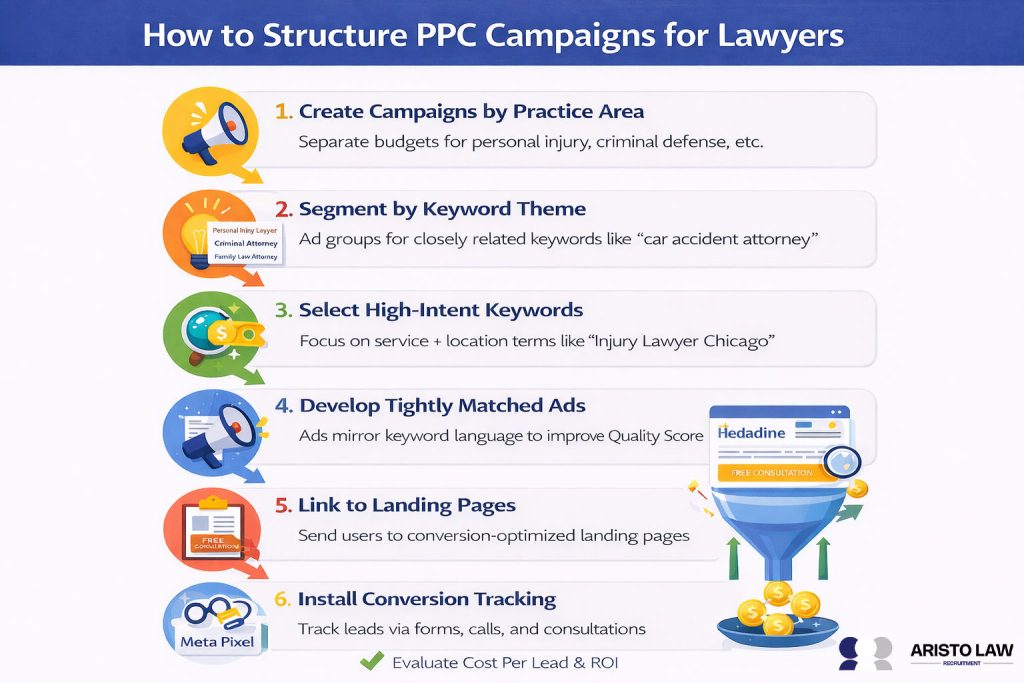
PPC campaigns for lawyers should be structured by practice area, search intent, and geographic targeting.
Listed below are the 6 steps the campaign is structured.
- Create separate campaigns by practice area: Campaign structure begins with distinct campaigns for personal injury, criminal defense, family law, or other services to control budget allocation.
- Segment ad groups by keyword theme: Ad groups organize closely related legal keywords such as “car accident lawyer” and “truck accident attorney” to maintain relevance.
- Select high-intent keywords: Keywords focus on service + location and consultation terms aligned with strong search intent.
- Develop tightly matched ads: Ads mirror keyword language in headlines and descriptions to improve Quality Score and click-through rate.
- Link to dedicated landing pages: Landing pages match the ad group theme and present a clear consultation call-to-action.
- Install conversion tracking: Tracking measures form submissions, calls, and booked consultations to evaluate cost per lead and ROI.
What metrics should law firms track in PPC campaigns?
The most important PPC metrics for law firms are cost per lead, conversion rate, click-through rate, Quality Score, call tracking data, and booked consultations. PPC metrics determine campaign efficiency and conversion tracking accuracy.
Listed below are the 6 most important PPC metrics for law firms.
- Cost per lead (CPL): Cost per lead measures the average ad spend required to generate one qualified inquiry.
- Conversion rate: Conversion rate measures the percentage of clicks that result in a submitted form or phone call.
- Click-through rate (CTR): Click-through rate measures the percentage of impressions that generate clicks, which signals ad relevance.
- Quality Score: Quality Score evaluates keyword relevance, expected CTR, and landing page experience, which influences cost per click.
- Call tracking data: Call tracking measures phone inquiries generated from ads and connects calls to specific campaigns.
- Booked consultations: Booked consultations measure how many inquiries progress to scheduled case evaluations.
What is law firm PPC management?
Law firm PPC management is the ongoing process of planning, monitoring, and optimizing paid search campaigns to generate qualified legal leads at controlled acquisition costs. PPC management includes campaign setup, keyword selection, ad creation, and conversion tracking within a structured account architecture. PPC management focuses on campaign optimization through bid adjustments based on cost per lead and conversion rate performance.
PPC management requires continuous ad testing to improve click-through rate and relevance. PPC management involves refining keyword lists by expanding high-intent terms and adding negative keywords to reduce wasted spend. PPC management analyzes search term reports, Quality Score data, and landing page performance to protect return on investment and scale profitable campaigns.
Who handles PPC management for attorneys?
Law firm marketing teams, PPC agencies, and outsourced specialists handle PPC management for attorneys. PPC agency services include keyword research, ad creation, bid management, tracking setup, and performance reporting, and many firms rely on Virtual legal marketing assistants who work remotely to monitor campaigns and maintain optimization workflows. PPC management tasks cover search term analysis, negative keyword refinement, landing page guidance, and compliance awareness under attorney advertising standards.
PPC consultants and outsourced partners, such as Aristo sourcing support campaign structure, reporting dashboards, and budget allocation decisions. PPC management oversight ensures ads remain aligned with practice area targeting, cost per lead benchmarks, and conversion tracking accuracy.
Can a pay-per-click consultant help a law firm scale faster?
Yes, a PPC consultant can help a law firm scale faster by improving campaign performance, refining budget allocation, and implementing structured PPC scaling strategies. PPC scaling depends on data analysis, keyword expansion, bid optimization, and controlled budget increases based on cost per lead benchmarks. Marketing consultant oversight strengthens campaign structure through testing frameworks that evaluate ad variations, landing page performance, and audience segmentation.
PPC consultant strategy identifies high-converting keywords, removes underperforming segments, and reallocates spend toward profitable practice areas. PPC consultant guidance improves conversion tracking accuracy and supports systematic scaling without uncontrolled cost growth.
Can landing pages improve PPC conversion rates for lawyers?
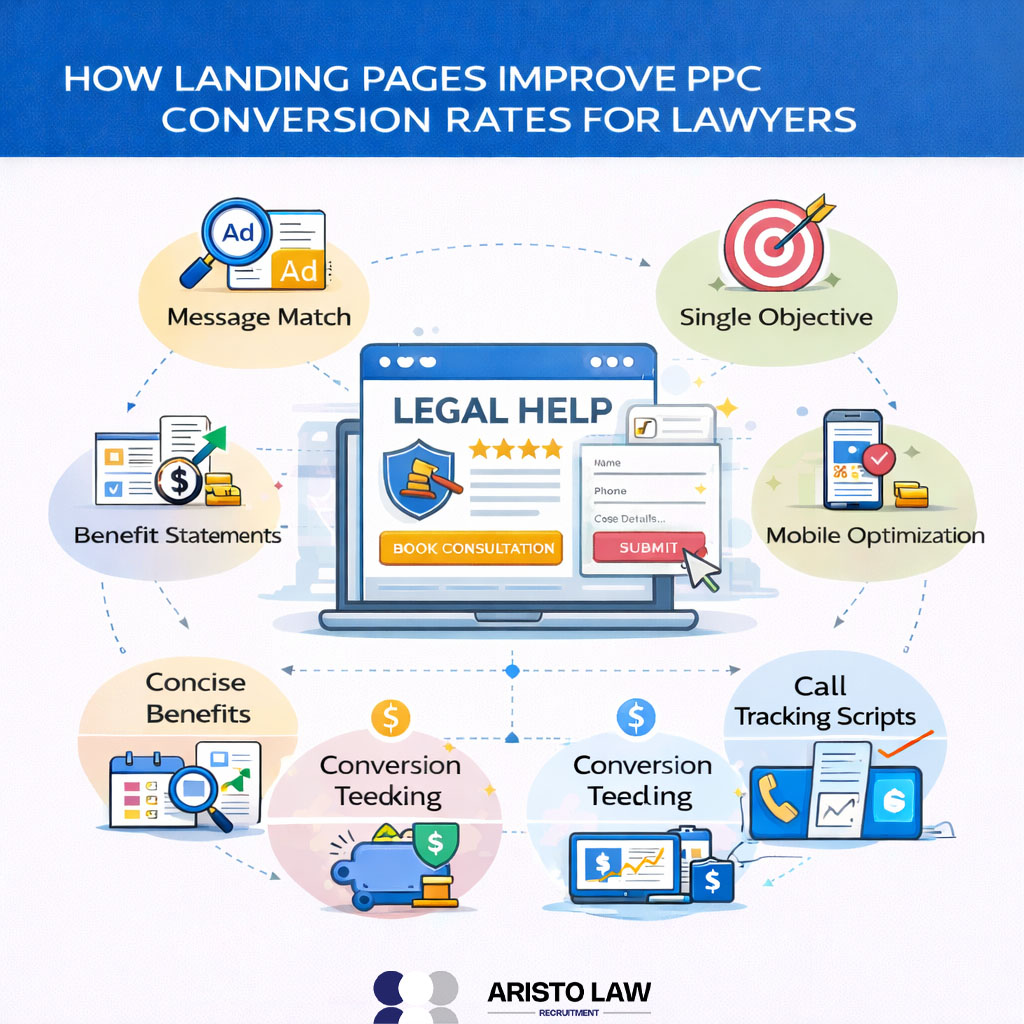
Yes, landing pages can improve PPC conversion rates for lawyers by aligning ad messaging with focused content and clear calls-to-action. Landing pages increase conversion rate through message match between keyword, ad copy, and headline, which strengthens relevance and user trust. Landing pages remove navigation distractions and unrelated content that dilute user intent. Landing pages present a single objective, such as booking a consultation or submitting a case review form.
Landing pages improve conversion rate by using concise benefit statements, visible contact forms, and mobile-optimized layouts. Landing pages support tracking accuracy through embedded conversion tracking and call tracking scripts.
What should a PPC landing page for attorneys include?
A strong PPC landing page for attorneys should include a clear headline, focused benefits, and compliance disclosures.
Listed below are the 7 landing page elements.
- Compelling headline: Headline matches the keyword and ad copy to reinforce relevance and search intent.
- Clear benefit statements: Benefit sections explain legal service value, response speed, and consultation availability.
- Client testimonials: Testimonials provide social proof when compliant with attorney advertising rules.
- Contact form: The contact form collects name, phone, email, and case details to support lead capture.
- Visible phone number: Phone number supports immediate intake, especially for urgent legal matters.
- Frequently asked questions (FAQs): FAQs address common concerns and reduce hesitation before inquiry.
- Compliance disclaimer: Disclaimer clarifies advertising intent and avoids misleading outcome expectations.
What is PPC for criminal defense lawyers?
PPC for criminal defense lawyers is a paid search strategy that targets urgent legal queries and charges per click to generate immediate client inquiries. Criminal defense PPC focuses on high-intent keywords such as “DUI lawyer now” or “criminal attorney near me” that reflect urgent search behavior. Criminal defense PPC prioritizes mobile targeting because many searches occur immediately after arrest or police contact.
Criminal defense PPC uses call-only ads to drive direct phone conversations rather than website visits. Criminal defense PPC budgets allocate higher bids to competitive keywords due to strong demand and limited decision time. Criminal defense PPC performance depends on fast intake response, geographic precision, and message clarity aligned with urgent legal needs.
What are common PPC mistakes law firms should avoid?
The common PPC mistakes law firms should prevent are broad keyword targeting, missing conversion tracking, poor ad copy, lack of optimization, and compliance violations. PPC mistakes reduce lead quality and undermine credibility, linking to broader concerns around avoiding marketing mistakes that hurt law firm trust within competitive markets.
Listed below are the 8 common PPC mistakes law firms must prevent.
- Broad keywords: Broad keywords attract low-intent traffic and inflate cost per click.
- No conversion tracking: Missing tracking prevents accurate measurement of cost per lead and ROI.
- Poor landing pages: Weak landing pages reduce conversion rate and lower Quality Score.
- Ignoring negative keywords: Absence of negative keywords wastes budget on irrelevant searches.
- Unmanaged negative comments or reviews: Negative engagement signals damage brand perception and reduces trust.
- Weak ad copy: Generic ad copy lowers click-through rate and fails to reflect search intent.
- No ongoing optimization: Lack of bid adjustments and keyword refinement increases wasted spend.
- Compliance violations: Non-compliant claims risk ad disapproval and regulatory scrutiny.
Do law firms need a PPC audit checklist?
Yes, law firms need a PPC audit checklist because a structured PPC audit protects budget efficiency and campaign performance. PPC audit review examines campaign structure, ad group segmentation, keyword targeting, and negative keyword coverage. The PPC audit process verifies conversion tracking accuracy, call tracking integration, and attribution settings to confirm reliable data reporting. PPC audit evaluation reviews performance metrics such as cost per lead, conversion rate, click-through rate, and Quality Score. The PPC audit checklist includes landing page relevance, message match, and mobile usability assessment.
A study by Thomaidou, Liakopoulos & Vazirgiannis, titled “Toward an Integrated Framework for Automated Development and Optimization of Online Advertising Campaigns,” in 2012, found that structured campaign optimization improves click performance and cost efficiency in Google AdWords campaigns. PPC audit process strengthens campaign review discipline and supports measurable ROI control.
Build a legal support team that moves work forward.
Tell us what is slowing your practice down. We will help map the role, workflow, and support structure that fits.