
Virtual Estate Planning Attorney: Benefits, Services, and Costs

Practical guidance for building efficient, accountable legal support operations.
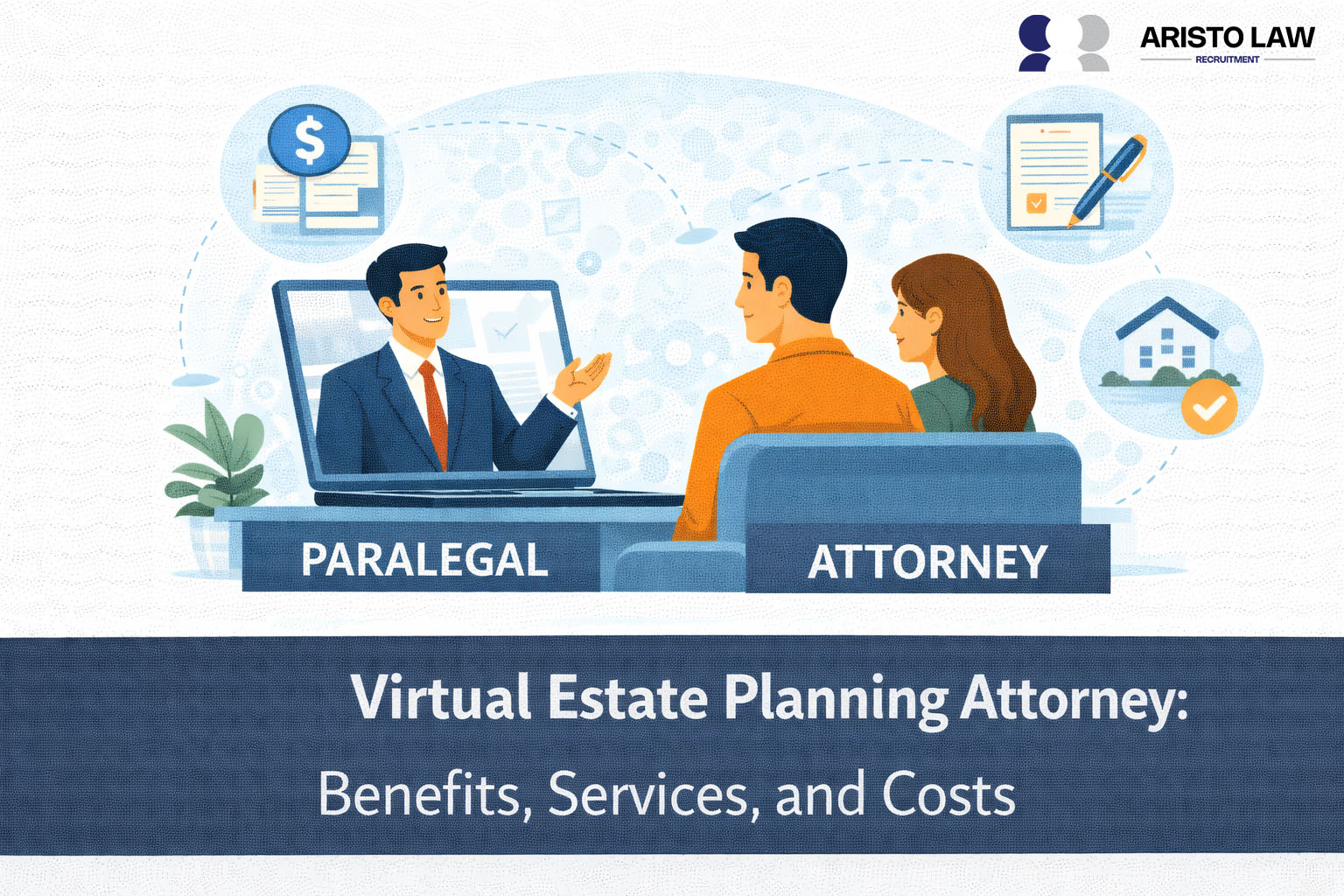
A virtual estate planning attorney is a licensed lawyer who delivers estate planning services remotely using secure digital tools for consultation, drafting, and execution. Virtual estate planning differs from traditional in-person services by replacing office visits with video consultations, encrypted client portals, and digital document workflows, which reduces scheduling friction and turnaround time. Virtual estate planning attorney services increase convenience, speed, and accessibility while preserving direct attorney oversight for legal accuracy and compliance.
A study by Selkova, “Would Online Legal Services Guarantee the Availability of Justice and Legal Aid?” (2022), shows that online legal services reduce travel time, scheduling delays, and client friction, improving access and convenience. Virtual estate planning attorney services commonly include wills, revocable trusts, powers of attorney, healthcare directives, beneficiary reviews, and estate plan updates, with attorney review required for customized or risk-sensitive documents.
Virtual estate planning works best for individuals and families with straightforward assets, clear beneficiaries, and limited tax or cross-border exposure. Virtual estate planning is less appropriate for complex estates involving international property, business succession, contested family structures, or advanced tax planning.
Virtual estate planning relies on encrypted portals, secure file storage, identity verification, e-signatures, and video conferencing to protect confidentiality and enforceability. Virtual estate planning attorney costs range from $500 to $1,800, depending on jurisdiction, document scope, customization level, and legal complexity, offering stronger protection than DIY tools while remaining more time-efficient than in-office models.
Aristolaw helps law firms support estate planning workflows. Strengthen virtual estate planning operations with legal support solutions from Aristolaw today. Aristolaw outsourced legal support for document preparation, client coordination, scheduling, and administrative case management.
What is a virtual estate planning attorney?
A virtual estate planning attorney is a licensed lawyer who provides estate planning services remotely through secure digital tools while retaining full legal responsibility for advice and documents. Virtual estate planning attorney services combine online consultations, document drafting, and legal review to deliver enforceable wills, trusts, and directives without in-person meetings.
Virtual estate planning attorney work differs from DIY platforms by providing attorney judgment, jurisdiction-specific compliance, and accountability rather than automated forms. Virtual estate planning attorney delivery uses encrypted portals, video consultations, and e-signatures to support remote legal services while preserving confidentiality and legal validity.
What benefits does hiring a virtual estate planning attorney offer?
Hiring a virtual estate planning attorney offers convenience, faster turnaround, lower overhead costs, and direct legal oversight without in-person meetings.
Listed below are the 10 benefits of virtual estate planning.
- Convenience. Virtual estate planning attorney services remove travel and office visits.
- Faster scheduling. Online calendars and video consultations reduce wait times.
- Lower cost. Reduced office overhead lowers total estate planning expense.
- Document accuracy. Attorney review ensures enforceable, jurisdiction-aligned documents.
- Guided decisions. Licensed legal advice supports informed estate choices.
- Secure storage. Encrypted portals protect sensitive estate planning data.
- Flexible access. Virtual delivery fits busy schedules and nonstandard hours.
- Efficient revisions. Online intake forms and templated drafting shorten revision cycles.
- E-signature support. Digital execution speeds completion where legally permitted.
- Expanded access. Remote services improve availability for rural or underserved areas.
What services does a virtual estate planning attorney provide?
A virtual estate planning attorney provides remote estate planning consultation, legal strategy, document drafting, review, updates, and execution guidance through secure online workflows. Virtual delivery improves convenience by combining online intake, video consultations, secure portals, and virtual legal support for estate planning matters that reduce delays and simplify follow-ups.
Listed below are the 8 virtual estate planning attorneys.
- Estate planning consultation. Asset review, goals definition, and risk evaluation.
- Document drafting and review. Attorney-prepared, jurisdiction-compliant documents.
- Will and trust strategy. Structuring wills and revocable trusts for asset transfer.
- Beneficiary planning. Primary and contingent beneficiary coordination.
- Incapacity planning. Durable power of attorney and healthcare decision planning.
- Updates and amendments. Revisions after life events or legal changes.
- Funding guidance. Instructions for asset titling and beneficiary alignment.
- Execution instructions. Guidance on signing, witnessing, notarization, or e-signatures where permitted.
Which estate planning services require attorney oversight versus automation?
Estate planning services that require attorney oversight include trusts, complex wills, tax planning, business assets, blended family planning, and special-needs planning, while automation supports only basic wills, simple powers of attorney, and standard healthcare directives. Educational comparisons of estate planning document automation vs attorney oversight show that templates improve efficiency for low-risk situations but lack legal judgment.
Attorney oversight protects enforceability, compliance, and risk management when wills, trusts, and powers of attorney involve customization, legal exposure, or long-term consequences across jurisdictions.
What are the typical costs for virtual estate planning services versus in-person?
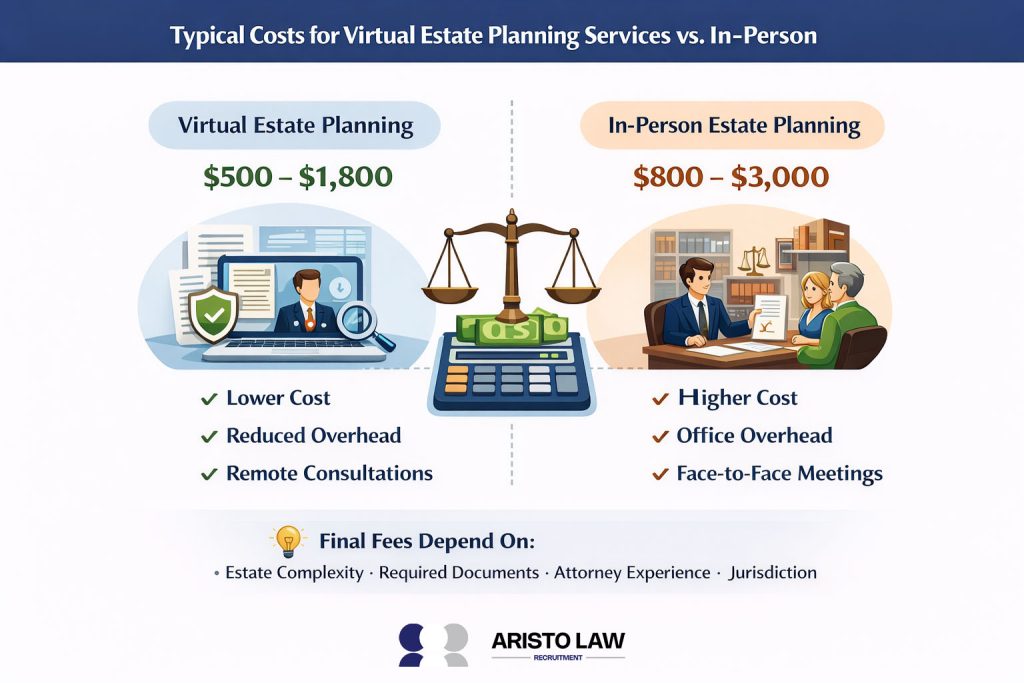
Virtual estate planning services cost less than in-person estate planning, with virtual services ranging from $500 to $1,800 compared to $800 to $3,000 for similar in-person work. Cost differences reflect reduced office overhead, faster workflows, and remote consultations, while final fees still depend on estate complexity, required documents, attorney experience, and jurisdiction.
What factors influence the cost of virtual estate planning services?
The cost of virtual estate planning services depends primarily on estate complexity, document scope, legal risk, and customization requirements. Pricing analysis reflects the factors that drive estate planning service costs when legal oversight, jurisdictional rules, and client-specific needs increase workload and review time.
Listed below are the 9 factors that influence the cost of virtual estate planning services.
- Asset complexity. Multiple assets, valuations, or ownership structures increase drafting effort.
- Trust requirements. Revocable or specialized trusts raise planning and review costs.
- Number of beneficiaries. Larger or layered beneficiary structures require more customization.
- Tax planning needs. Estate or inheritance tax considerations increase attorney involvement.
- International or multi-state property. Cross-border or multi-jurisdiction assets add compliance work.
- Revisions and amendments. Multiple review cycles increase total attorney time.
- Signing and execution requirements. Witnessing, notarization, or jurisdiction-specific execution rules affect cost.
- Urgency. Expedited timelines increase pricing due to priority handling.
- Ongoing updates. Subscription-style updates or future amendments raise long-term costs.
How does a virtual estate planning attorney differ from a traditional estate lawyer?
A virtual estate planning attorney differs from a traditional estate lawyer in delivery model, using remote consultations and digital workflows instead of in-person meetings. Virtual estate planning relies on video calls, encrypted portals, online intake, and e-signatures to streamline process steps and reduce scheduling friction. Traditional estate lawyers rely more on office visits, paper-based exchanges, and longer turnaround times tied to physical meetings.
Virtual estate planning improves convenience, speed, and accessibility while maintaining licensed attorney oversight. Traditional estate planning offers face-to-face interaction that some clients prefer for complex discussions. Legal validity depends on jurisdictional law, execution requirements, and attorney licensing, not on whether services are delivered remotely or in person.
Who is virtual estate planning best suited for?
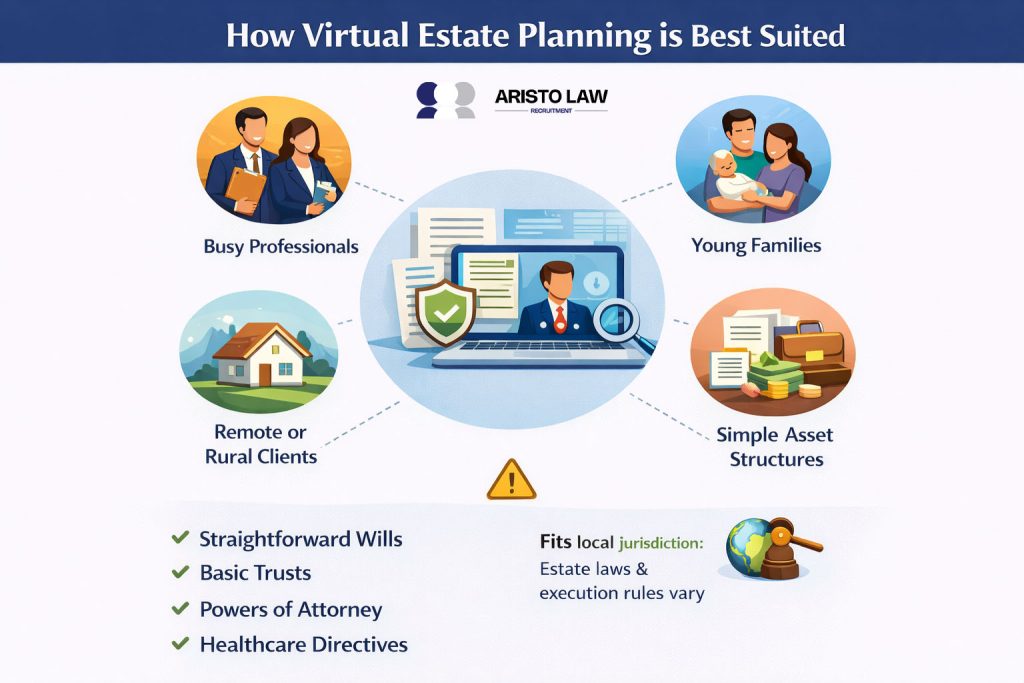
Virtual estate planning is best suited for busy professionals, remote or rural clients, young families, and individuals creating first-time estate plans with simple asset structures. Virtual estate planning fits clients who value convenience, faster turnaround, and remote consultations while needing licensed attorney oversight. Virtual estate planning works well for straightforward wills, basic trusts, powers of attorney, and healthcare directives without complex tax planning or cross-border assets. Jurisdiction fit remains important, since estate planning laws, execution rules, and witnessing requirements vary by state or country, regardless of remote delivery.
What are the risks of online estate planning services?
The risks of online estate planning services include invalid documents, jurisdiction errors, improper execution, privacy exposure, and a lack of attorney review. Discussion of risk and compliance in virtual legal services shows that automated tools increase legal and compliance risk when witnessing rules, local laws, and data protection standards are not properly managed.
Listed below are the 7 risks of online estate planning services.
- Wrong jurisdiction application. Local law mismatches invalidate documents.
- Improper witnessing or notarization. Execution defects defeat enforceability.
- Incomplete asset coverage. Assets remain outside the estate plan.
- Beneficiary conflicts. Ambiguous terms trigger disputes.
- Outdated templates. Forms fail to reflect the current law.
- Privacy and security risks. Weak safeguards expose sensitive data.
- Lack of attorney oversight. Missing a review increases legal risk.
Who should avoid virtual estate planning services?
Virtual estate planning services should be avoided by individuals and families with complex estates that require extensive customization and ongoing legal coordination. Complex estates involving large asset values, international or multi-jurisdiction property, special needs trusts, business succession planning, or contested family dynamics demand in-depth, continuous attorney involvement and localized execution support.
Virtual estate planning is not aligned with estate risk profiles that depend on frequent in-person coordination, advanced tax structuring, or jurisdiction-specific formalities tied to complex family or business arrangements.
How do virtual estate planning consultations work?
Virtual estate planning consultations work by guiding clients through online intake, remote attorney consultation, and secure storage in a structured digital workflow.
Listed below are the 8 standard steps used in virtual estate planning consultations.
- Intake questionnaire. Online collection of assets, beneficiaries, and objectives.
- Remote consultation. Video or phone meeting to clarify goals and legal risks.
- Strategy outline. Definition of estate structure and required documents.
- Draft preparation. Attorney drafting of wills, trusts, and directives.
- Review call. Attorney explanation and walkthrough of drafts.
- Revisions. Updates based on client feedback.
- Signing instructions. Jurisdiction-specific execution guidance.
- Storage and updates. Secure document storage and future amendment planning.
What technology enables secure virtual estate planning processes?
Technologies that enable secure virtual estate planning processes include encrypted client portals, identity verification, secure e-signatures, controlled cloud document storage, audit trails, and protected payment systems. Adoption of secure legal tech for virtual services supports confidentiality, compliance, and document automation in remote estate planning.
Listed below are the 8 Secure virtual estate planning processes.
- Secure client portals. Encrypted access for documents and communication.
- Encrypted email and messaging. Protection of sensitive legal data.
- E-signature tools. Compliant digital signing is permitted.
- Identity verification. Authentication before execution.
- Cloud document storage. Secure, access-controlled repositories.
- Access controls. Role-based permission management.
- Audit trails. Activity logs for compliance review.
- Secure payments. Encrypted billing and payment processing.
Do you need a lawyer for online estate planning?
No, a lawyer is not always required for online estate planning, but a lawyer is necessary when legal complexity, risk, or customization is involved. Online estate planning without a lawyer works for simple situations involving basic assets, a single jurisdiction, no minor children, and straightforward beneficiary designations using standard templates.
A lawyer becomes necessary for trusts, blended families, minor children, business ownership, tax-sensitive estates, special needs planning, or multi-state or international assets. Online estate planning rules, execution requirements, and document validity vary by state or country, so attorney oversight reduces the risk of invalid documents, disputes, or noncompliance.
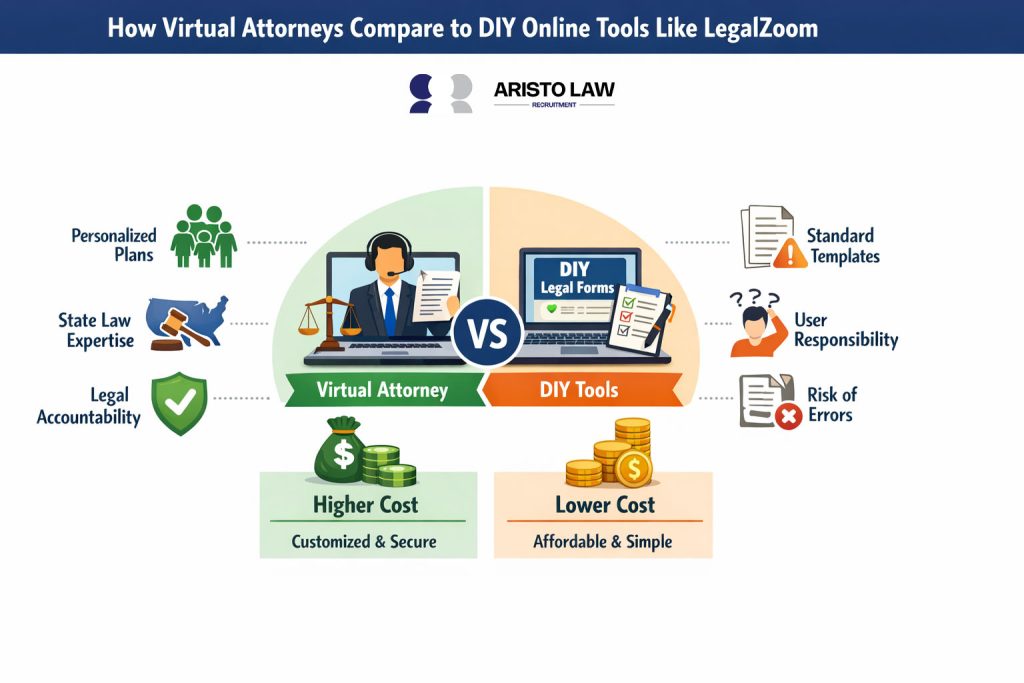
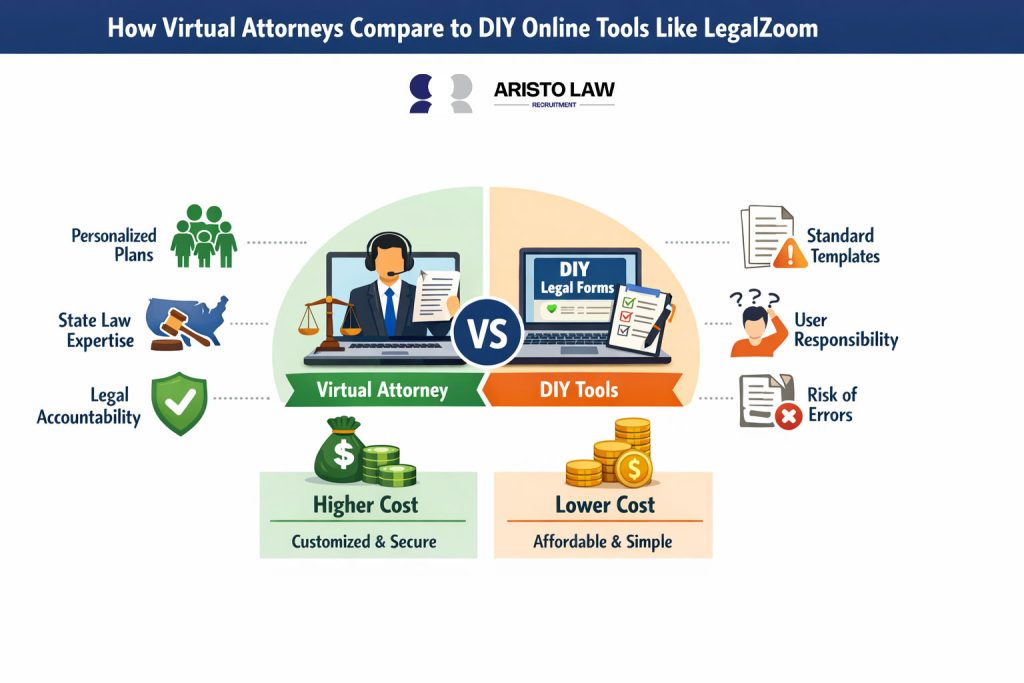
Can virtual attorneys compare to DIY online tools like LegalZoom?
Yes, virtual estate planning attorneys can differ from DIY tools like LegalZoom because virtual legal services provide personalized legal judgment and accountability, while DIY platforms rely on standardized templates and user-driven input. In a virtual attorney vs DIY comparison, virtual attorneys customize estate plans to individual family structures, assets, and state-specific laws, and assume professional legal responsibility for accuracy and compliance, which reduces risk in complex situations. Estate planning tools offered by DIY platforms will be more affordable upfront, but place responsibility on the user to interpret legal requirements correctly, increasing the risk of errors for blended families, tax-sensitive estates, or special needs planning. From a pricing standpoint, DIY tools generally offer lower initial costs, while virtual attorneys charge higher fees that reflect customization, legal oversight, and risk mitigation, making both viable LegalZoom alternatives depending on complexity and tolerance for legal responsibility.
Build a legal support team that moves work forward.
Tell us what is slowing your practice down. We will help map the role, workflow, and support structure that fits.