
Paralegal vs. Attorney: Responsibilities, Salary, and Court Roles

Practical guidance for building efficient, accountable legal support operations.
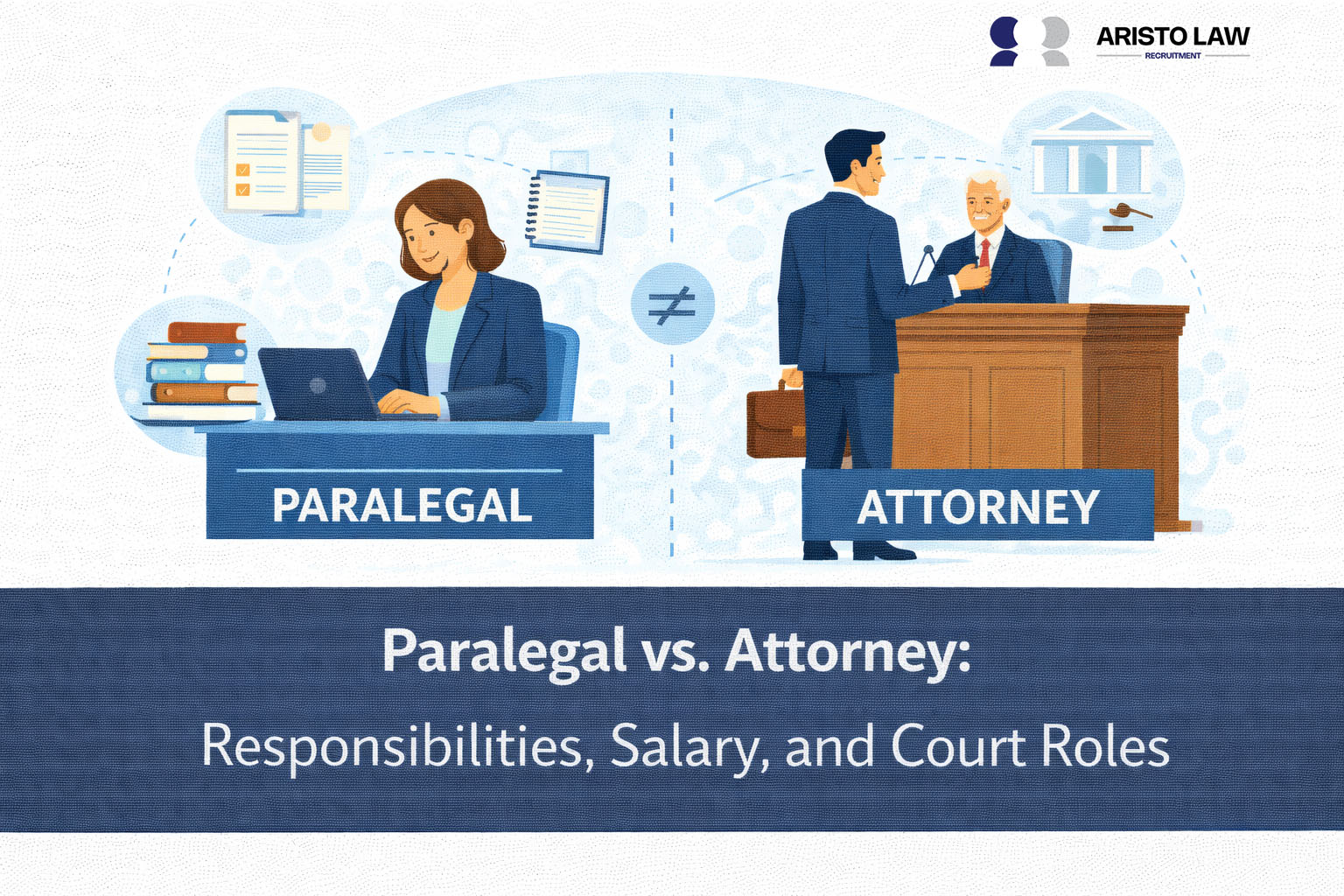
Paralegals and attorneys are distinct legal professionals, with attorneys licensed to practice law and paralegals providing structured legal support under attorney supervision. Attorneys hold legal authority to advise clients, represent parties in court, sign pleadings, and make binding legal decisions, while paralegals assist with substantive and administrative legal work that does not constitute the practice of law.
Paralegal responsibilities include legal research, document drafting support, discovery preparation, filing management, deadline tracking, and litigation coordination. Attorney responsibilities include legal strategy, client advice, courtroom advocacy, negotiations, and final accountability for outcomes. Court roles differ clearly: paralegals support hearings and trials through exhibits, filings, coordination, and note-taking, while attorneys conduct arguments, examinations, and representation.
Education and licensing separate the roles. Attorneys complete a law degree and bar admission, while paralegals complete certificates or degrees in legal studies without licensing to practice law. Salary reflects this difference, with attorneys earning higher compensation tied to legal authority and risk, and paralegals earning lower but stable salaries aligned with support functions.
A study by Engel, titled “The Standardization of Lawyers’ Services” (1977), examined how legal services are decomposed into standardized tasks and reassigned to lower-cost legal labor such as paralegals. Effective firms use paralegals to improve workflow, reduce bottlenecks, and control costs while maintaining strict supervision, legal boundaries, and ethical compliance.
Aristolaw helps law firms strengthen legal operations. Build a more efficient legal team with outsourced legal staffing support from Aristolaw today. Aristolaw outsourced Paralegal and legal support services for research, case management, drafting, and administrative workflows.
What is a paralegal?
A paralegal is a legal support professional who assists attorneys by performing substantive legal and administrative work under attorney supervision. Paralegals are not licensed attorneys and generally cannot give legal advice, represent clients, sign pleadings, or make binding legal decisions.
Paralegal responsibilities often include legal research, drafting support, document management, filings, deadline tracking, and litigation preparation. Paralegals work in law firms, courts, corporate legal departments, government agencies, and legal service organizations, supporting legal operations while attorneys retain legal authority, accountability, and responsibility for outcomes.
What is an attorney?
An attorney is a licensed lawyer authorized to practice law, provide legal advice, and represent clients in legal matters. Attorney licensing requires completion of a qualifying law degree and admission to the bar or equivalent regulatory body.
Attorney responsibilities include advising clients on legal rights and obligations, drafting and signing legal documents, negotiating on behalf of clients, and representing clients in court or formal proceedings. Attorney authority carries professional accountability, ethical duties, and responsibility for legal outcomes.
How does Paralegal vs. Attorney compare?
A paralegal vs. an attorney differs mainly in legal authority, scope of responsibility, accountability, and professional licensing.
The table below shows A paralegal vs. an attorney comparison.
| Comparison Area | Paralegal | Attorney |
| Legal role and professional status | Legal support professional performing substantive and administrative tasks under supervision. | Licensed legal professional with independent authority and accountability. |
| Authority to practice law | No authority to practice law or provide legal advice. | Full authority to practice law, advise clients, and act legally. |
| Scope of permitted legal work | Research, drafting support, filings, case coordination, and document management. | Legal advice, strategy, negotiations, pleadings, and representation. |
| Education and licensing requirements | Certificate, associate, or bachelor’s degree in legal studies; no bar license. | Law degree (LLB/JD) plus bar admission or equivalent licensing. |
| Relationship to legal assistants and law clerks | Often coordinates with legal assistants; supports attorneys and law clerks. | Supervises paralegals, clerks, and assistants. |
| Legal boundaries and supervision requirements | Must work under direct attorney supervision; no independent judgment. | Holds final responsibility, ethical duties, and supervision obligations. |
| Salary range and compensation structure | Lower salary or billable rate tied to support tasks. | Higher compensation is tied to legal authority, risk, and outcomes. |
| Factors influencing earning potential | Experience, specialization, firm size, and efficiency. | Practice area, seniority, client base, outcomes, and leadership. |
| Career path and advancement options | Progression to senior or specialized paralegal roles. | Advancement to senior attorney, partner, or independent practice. |
| Common misconceptions about the role | are mistaken as being able to give legal advice or represent clients. | Sometimes assumed to perform all tasks without delegation. |
What are the responsibilities of a paralegal?
A paralegal’s responsibilities focus on legal research, drafting support, document management, case coordination, and trial preparation under attorney supervision. A paralegal’s duties reflect core paralegal responsibilities that support legal operations, case preparation, and workflow efficiency.
Listed below are the 11 responsibilities of a paralegal.
- Legal research. Finding statutes, case law, and supporting authorities.
- Drafting support. Preparing pleadings, contracts, motions, and correspondence for review.
- Document management. Organizing, filing, and maintaining case records and exhibits.
- Discovery support. Assisting with document production, review, and responses.
- Court and agency filings. Preparing and submitting procedural filings.
- Client intake support. Collecting and organizing client information.
- Scheduling and deadline tracking. Managing calendars and case timelines.
- Trial preparation. Assembling exhibits, binders, and witness materials.
- Case summaries. Preparing factual and procedural summaries.
- Evidence organization. Managing physical and digital evidence.
- Compliance checklists. Tracking procedural and regulatory requirements.
Paralegal responsibilities remain within defined legal limits, with attorneys retaining authority, supervision, and accountability.
What are the responsibilities of an attorney?
An attorney’s responsibilities focus on providing legal advice, exercising legal judgment, representing clients, and assuming full accountability for legal outcomes.
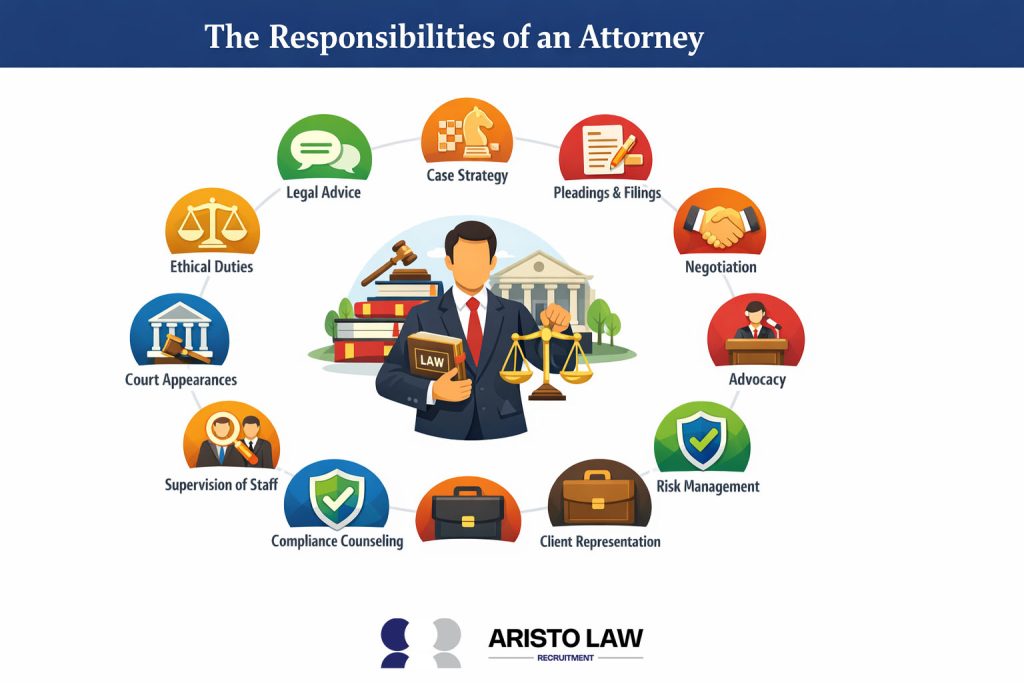
Listed below are the 11 attorney responsibilities within legal practice and representation.
- Legal advice. Advising clients on rights, obligations, risks, and legal options.
- Case strategy. Developing legal strategy and directing case approach.
- Pleadings and filings. Drafting, reviewing, and signing legal documents.
- Negotiation. Representing clients in settlements, agreements, and disputes.
- Advocacy. Arguing motions, examining witnesses, and presenting cases.
- Compliance counseling. Guiding clients on regulatory and legal compliance.
- Client representation. Acting on behalf of clients in legal matters.
- Risk management. Identifying and mitigating legal exposure.
- Ethical duties. Upholding professional conduct and confidentiality standards.
- Supervision of staff. Overseeing paralegals, clerks, and legal assistants.
- Court appearances. Representing clients before courts and tribunals.
Attorney responsibilities require licensing, ethical compliance, and professional judgment, distinguishing attorneys from all other legal support roles.
What factors affect paralegal salary?
Paralegal salary is influenced by experience level, specialization, workload intensity, geographic location, and employer type. Years of experience raise earning potential as paralegals handle more complex tasks with less supervision. Specialization in areas such as intellectual property, corporate law, or litigation increases compensation due to higher skill requirements. Billable expectations and litigation intensity affect salary in firms that rely heavily on hourly billing. City and regional cost of living strongly impact paralegal salary levels. Employer type also matters, with corporate legal departments, large law firms, and regulated industries often offering higher compensation. Professional credentials, certifications, and advanced training further influence earning potential by signaling competence and efficiency.
What does a paralegal do in court roles?
In court-related roles, a paralegal provides litigation support by managing filings, preparing trial materials, tracking exhibits, and coordinating court logistics under attorney supervision. Responsibilities align with common litigation paralegal court-related duties that support attorneys before, during, and after hearings or trials.
Paralegal court duties include preparing and filing documents, assembling trial binders, organizing and labeling exhibits, monitoring dockets and court calendars, coordinating witness schedules, and taking detailed notes during proceedings. Paralegals do not represent clients, argue motions, examine witnesses, or provide legal opinions in court, as courtroom advocacy and legal judgment remain the exclusive responsibility of licensed attorneys in most jurisdictions.
What does an attorney do in court roles?
In court roles, an attorney represents clients by exercising legal advocacy, presenting arguments, and directing litigation strategy before judges and tribunals. Attorney court duties include drafting and arguing pleadings and motions, appearing at hearings, conducting trials, examining and cross-examining witnesses, presenting evidence, and participating in settlement conferences.
Attorney courtroom advocacy requires legal judgment, procedural control, and ethical compliance, with attorneys responsible for case strategy, legal positions, and outcomes throughout litigation.
What does paralegal supervision by an attorney mean?
Paralegal supervision by an attorney means delegated legal work is assigned, reviewed, approved, and ethically controlled by a licensed lawyer who remains fully responsible for the outcome. Attorney supervision requires clear task delegation, ongoing review of work product, and final approval of documents, filings, and communications.
Supervision ensures paralegals perform permitted legal support tasks, such as research, drafting support, filings, and factual client communication, while avoiding restricted activities like legal advice, strategy decisions, or representation. Attorney supervision enforces professionalism, confidentiality, and compliance with ethical rules, protects clients from unauthorized practice of law, and reduces legal risk by maintaining accountability with the licensed attorney at all times.
What is the paralegal’s role in the litigation workflow?
The paralegal role in litigation workflow covers structured legal support across intake, pleadings, discovery, motions, trial preparation, and settlement support under attorney supervision. The paralegal role delivers litigation workflow support and case coordination by managing case intake materials, organizing pleadings and filings, coordinating discovery production, tracking deadlines for motions, preparing trial binders and exhibits, and supporting settlement documentation.
Paralegal involvement improves accuracy, timing, and coordination at each litigation phase while attorneys retain legal judgment, strategy control, and courtroom authority.
What are the best paralegal specializations?
The best paralegal specializations include litigation, corporate, real estate, immigration, family law, personal injury, intellectual property, compliance, probate and estate planning, and eDiscovery.
Listed below are the 10 best paralegal specializations.
- Litigation paralegal. Supports discovery, motions, and trial preparation.
- Corporate paralegal. Manages contracts, governance, and transactions.
- Real estate paralegal. Coordinates closings, title work, and leases.
- Immigration paralegal. Handles form-heavy filings and strict deadlines.
- Family law paralegal. Supports court filings and sensitive client matters.
- Personal injury paralegal. Manages medical records and claims support.
- Intellectual property paralegal. Oversees patents, trademarks, and filings.
- Compliance paralegal. Supports regulatory documentation and audits.
- Probate and estate planning paralegal. Prepares estate documents and court filings.
eDiscovery paralegal. Manages electronic evidence and litigation data.

What skills do paralegals need for court-related work?
Paralegals need strong court-procedure knowledge, precise document handling skills, and disciplined deadline management to perform court-related work effectively.
Listed below are the 10 skills a paralegal needs for court-related work.
- The court rules familiarity to ensure compliance with filing and procedural requirements.
- Calendaring and deadline management for hearings, motions, and court dates
- Attention to detail to avoid filing defects and missed deadlines
- Document formatting aligned with court-specific standards
- E-filing proficiency across state and federal court systems
- Exhibit management for organizing and tracking evidence
- Clear professional communication with attorneys, clerks, and court staff
- Confidentiality and ethical handling of sensitive case information
- Multitasking under pressure during trials and deadline-heavy periods
- Legal technology competence with case management and document systems
What education do you need to become a paralegal?
Paralegals qualify through a combination of formal legal education and practical training, earned through a certificate, associate degree, or bachelor’s degree in legal studies or a related field. Paralegal education pathways vary by country and employer, with roles accepting a paralegal certificate for entry-level positions, while others prefer a degree plus internships or on-the-job experience, and ongoing continuing education helps paralegals stay current with procedural rules and legal technology.
What should clients ask when working with a paralegal on a case?
Clients should ask clear questions to understand a paralegal’s role, supervision structure, communication process, and limits of authority on the case.
Listed below are 12 practical, client-friendly questions that help set expectations and avoid confusion.
- Who is the supervising attorney responsible for the case?
- What specific tasks will the paralegal handle versus the attorney?
- How and when will case updates be communicated?
- What is the expected response time for questions or documents?
- How is confidentiality and sensitive information protected?
- Will the paralegal draft documents, and who reviews them?
- How are paralegal services billed compared to attorney time?
- When and how are issues escalated to the attorney?
- Who is the main point of contact for urgent matters?
- What are the expected timelines for key case milestones?
- How are documents shared, stored, and approved?
- What role does the paralegal play in court or filings?
Can a paralegal give legal advice?
No, paralegals cannot give legal advice because providing legal opinions, strategy, or recommendations constitutes the unauthorized practice of law. Paralegals share legal information, explain procedures, gather facts, and assist with documents under attorney supervision, but actions such as advising on legal rights, recommending outcomes, interpreting laws for a client’s situation, or directing case strategy must be handled by a licensed attorney, with supervision boundaries in place to protect clients and ensure compliance.
Can a paralegal represent you in court?
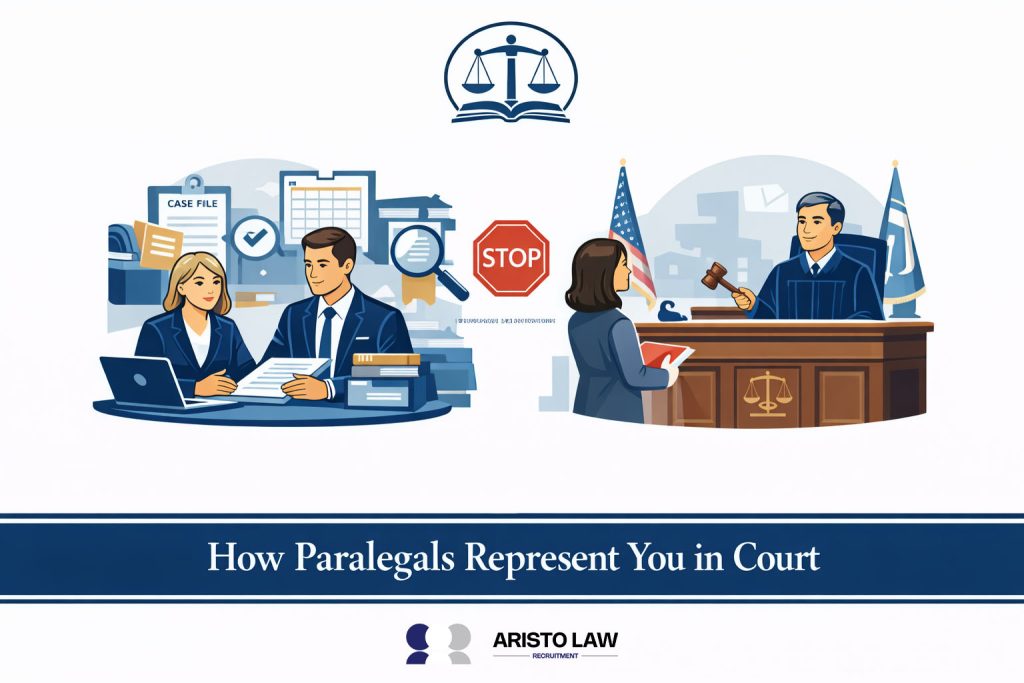
No, in most jurisdictions, paralegals cannot represent clients in court because court representation and legal advocacy are reserved for licensed attorneys. Paralegals assist with court-related tasks such as filings, exhibit preparation, docket tracking, and trial support under attorney supervision, while limited exceptions exist in certain administrative or small-claims forums, depending on jurisdiction, rules, and scope of authorization.
Can paralegals go to court with attorneys?
Yes, paralegals can go to court with attorneys to provide litigation support, manage filings and exhibits, coordinate schedules, and take notes during hearings or trials. Paralegals support the litigation workflow by organizing documents, tracking deadlines, and assisting with courtroom logistics, while attorneys retain full responsibility for legal arguments, advocacy, and client representation.
Can clients hire a paralegal instead of an attorney?
No, clients generally cannot hire a paralegal instead of an attorney for legal advice, representation, or decision-making authority, but paralegals are used for limited support tasks. In practice, clients work with paralegals for document organization, form preparation support, intake coordination, and administrative assistance under proper supervision, which aligns with the ethical use of paralegals and outsourced legal support in modern legal services. However, any activity involving legal advice, strategy, interpretation of law, or court representation must be handled by a licensed attorney, and the exact boundaries depend on jurisdiction and professional rules.
Can clients hire a paralegal instead of an attorney?
No, clients cannot hire a paralegal instead of an attorney for legal advice, representation, or decisions that require a law license. Clients, however, engage paralegals for limited support tasks such as document organization, form preparation assistance, intake coordination, and administrative help, which reflects the ethical use of paralegals and outsourced legal support when boundaries and supervision are properly maintained.
Any work involving legal judgment, strategy, interpretation of rights, or court advocacy must be performed or directly supervised by a licensed attorney, with specific rules varying by jurisdiction.
Are paralegals allowed to draft legal documents?
Yes, paralegals are allowed to draft legal documents under attorney supervision, but they cannot independently create or finalize documents that require legal judgment. Paralegals assist with outlines, formatting, revisions, and assembly of documents as part of legal document drafting and preparation support, while a licensed attorney must review, approve, and take responsibility for the final content.
Paralegals boundary ensures compliance with professional rules, protect clients from unauthorized legal advice, and maintain clear accountability, with specific limitations varying by jurisdiction and firm policy.
Build a legal support team that moves work forward.
Tell us what is slowing your practice down. We will help map the role, workflow, and support structure that fits.