
Facebook Marketing for Lawyers: Strategies, Ads, Goals, and ROI

Practical guidance for building efficient, accountable legal support operations.
Facebook marketing for lawyers means organic content and paid Facebook ads that drive visibility, qualified leads, and client acquisition.
Facebook marketing for lawyers separates organic posting from Facebook PPC campaigns built around funnel stages and retargeting flows.
Facebook ads for lawyers use targeting through geographic filters, practice-area relevance, custom audiences, and lookalike audiences based on prior inquiries.
Facebook ad formats for lawyers include Lead Ads, video ads, carousel ads, and retargeting ads aligned to campaign goals such as awareness, traffic, lead generation, and conversions.
Facebook ad copy for lawyers follows ABA Model Rules 7.1–7.5 and state bar standards that prohibit misleading claims, unverifiable success statements, and improper specialization labels.
Facebook lead qualification for lawyers uses structured intake forms, screening questions, call tracking, and CRM tagging to filter case quality.
Facebook ROI for lawyers relies on CPL, CTR, conversion rate, consultation rate, and ROAS tracked through Meta Pixel and CRM attribution models.
Facebook budget comparison shows lower average CPL versus Google Ads in many industries. A study by Hugar & Basavapattan, titled “Exploring the Effectiveness of Google Ads in Digital Marketing,” in 2025 found that Google Ads improves website traffic, customer acquisition, and lead generation when strategically implemented.
Aristolaw helps law firms manage Facebook marketing through outsourced legal marketing support and client engagement workflows. Hire a Virtual Legal Marketing Assistant with Aristolaw today. Strengthen your law firm’s Facebook visibility, lead generation, and client outreach with legal marketing support from Aristolaw.
What is Facebook marketing for lawyers?
Facebook marketing for lawyers refers to the use of Facebook platforms to promote legal services through organic content and paid advertising to generate visibility, leads, and retained clients. Facebook marketing in law firm marketing includes unpaid posts such as educational content, case insights, and community updates that build authority and engagement. Facebook marketing in social media marketing differs from paid Facebook advertising, which uses Meta Ads Manager to target defined audiences with structured campaigns focused on traffic, lead generation, or conversions.
Facebook marketing for lawyers forms part of a broader law firm marketing strategy that aligns practice areas, audience intent, and compliance rules under attorney advertising standards. Facebook marketing for lawyers supports funnel stages through awareness content at the top, retargeting ads in the middle, and lead capture campaigns at the bottom. Facebook marketing establishes measurable performance through data tracking, audience segmentation, and CRM integration, which supports scalable client acquisition.
How does Facebook marketing for attorneys work?
Facebook marketing for attorneys works by using business pages, targeted advertising, and tracking tools to attract, engage, and convert potential clients.
Listed below are the 9 ways Facebook marketing for attorneys works.
- Creating a dedicated business page that represents the law firm professionally
- Using Facebook Ads Manager to set up campaigns, budgets, and placements
- Segmenting audiences through demographic filters and interest-based targeting
- Reaching users with audience segmentation tools like custom and lookalike audiences
- Running lead-generation ads using Facebook’s built-in lead forms for faster intake
- Installing the Meta Pixel to track conversions and optimize performance
- Retargeting users who visited the website or interacted with prior ads
- Testing multiple creatives, headlines, and CTAs to improve results
- Monitoring performance metrics to refine targeting and maximize ROI
What are the best strategies for law firm Facebook Marketing?
Effective Facebook marketing strategies for law firms focus on precise targeting, structured funnels, and measurable lead generation. An effective Facebook strategy aligns with broader law firm social media marketing strategies that integrate authority building, paid promotion, and intake optimization within a unified legal marketing strategy.
Listed below are 9 high-impact Facebook marketing strategies.
- Retargeting website visitors: Retargeting reconnects prior visitors using Meta Pixel data and increases conversion rates through reminder ads.
- Video-based authority ads: Video ads present attorneys explaining case types, processes, and outcomes, which increases engagement signals.
- Facebook Lead Ads with screening fields: Lead forms collect case type, injury date, and contact data, which improves lead qualification.
- Practice-area-specific campaigns: Segmented campaigns for personal injury, family law, or criminal defense improve relevance and CTR.
- Geo-targeting by service radius: Geographic filters restrict spend to qualified local prospects.
- Custom and lookalike audiences: Audience segmentation expands reach based on prior client data patterns.
- Educational content promotion: Educational posts build trust and support top-of-funnel awareness.
- Client testimonials within compliance limits: Structured testimonials increase credibility while respecting attorney advertising rules.
- Dedicated landing pages: Conversion-focused pages improve consultation booking rates.
What are Facebook ads for lawyers?
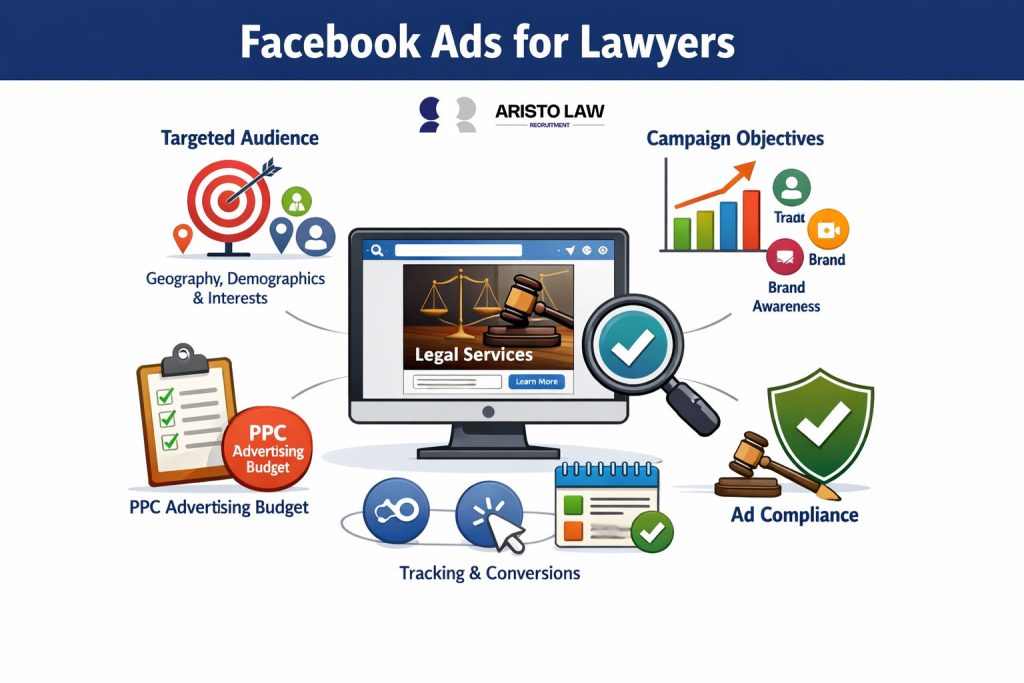
Facebook ads for lawyers are paid advertising campaigns run through Meta Ads Manager to generate legal leads, consultations, and retained clients. Facebook ads differ from organic content because Facebook ads require budget allocation, structured targeting, defined campaign objectives, and performance tracking, which places Facebook ads within broader PPC advertising options for law firms in a measurable legal lead generation system.
Facebook ads use audience targeting based on geography, demographics, behaviors, custom audiences, and lookalike audiences. Facebook ads support objectives such as traffic, lead generation, conversions, and brand awareness. Facebook ads rely on tracking tools such as Meta Pixel to measure clicks, form submissions, and booked consultations. Facebook ads operate under attorney advertising compliance rules, which restrict misleading claims and guarantee language.
How do you set up Facebook ads for lawyers?
Setting up Facebook ads for lawyers involves structured campaign setup inside Facebook Ads Manager, precise targeting, compliant creative, and performance tracking.
Listed below are the 7 steps for setting up Facebook ads for lawyers.
- Select campaign objective: Campaign setup begins with choosing lead generation, traffic, or conversions inside Facebook Ads Manager based on the law firm’s goal.
- Define audience targeting: Audience targeting applies geographic radius, age filters, interests, behaviors, custom audiences, and lookalike audiences aligned with the practice area.
- Set budget and bidding: Budget selection assigns daily or lifetime spend and defines bid strategy based on cost control and lead targets.
- Create ad creative: Creative development includes compliant ad copy, clear value statements, strong call-to-action, and relevant visuals or video.
- Install Meta Pixel: Tracking setup installs Meta Pixel on landing pages to record page views, form submissions, and booked consultations.
- Launch campaign: Campaign launch activates ads after review approval and policy compliance confirmation.
- Optimize performance: Optimization adjusts audience size, creative, placements, and budget based on CTR, CPL, and conversion rate data.
What ad formats can law firms use on Facebook?
Law firms can use image ads, video ads, carousel ads, lead form ads, and Messenger ads on Facebook. Law firms select ad formats based on campaign objective and funnel stage within a defined creative strategy.
Listed below are the 5 primary Facebook ad formats.
- Image ads: Image ads use a single visual with concise copy and perform well for local awareness and direct response offers.
- Video ads: Video ads present attorney explanations, case processes, or client education and drive engagement in awareness campaigns.
- Carousel ads: Carousel ads display multiple cards in one placement and support practice-area breakdowns or multi-step case explanations.
- Lead form ads: Lead form ads collect prospect details inside Facebook and support consultation booking and case screening.
- Messenger ads: Messenger ads start direct conversations and support intake qualification and follow-up.
How do you write Facebook ad copy for lawyers?
Effective Facebook ad copy for lawyers focuses on a clear hook, a defined legal problem, a concise solution, and a strong call-to-action while staying compliant with legal advertising rules.
Listed below are the 5 steps to write Facebook ad copy for lawyers.
- Start with a direct hook that names the case type or pain point
- Describe the client’s legal problem in simple, relatable language
- Present the law firm as the solution using factual, non-promissory statements
- Add a clear call-to-action that guides the user toward the next step
- Ensure all ad copy follows legal advertising rules and avoids guarantees or improper claims
Facebook ad copy in legal advertising follows state bar and ABA rules that prohibit misleading statements, unverifiable guarantees, or improper specialization claims. Facebook ad copy maintains a factual tone, avoids promises of outcomes, and includes required disclaimers where applicable.
What are examples of Facebook lawyer ads that work?
Effective Facebook lawyer ads include personal injury consultation offers, estate planning lead magnets, DUI defense urgency ads, and retargeting conversion ads. Ad examples align message clarity with conversion ads built around defined legal problems.
Listed below are the 5 Effective Facebook lawyer ads.
- Personal injury consultation ad: Personal injury ad states “Injured in a car accident?” followed by a short explanation of rights and a call-to-action such as “Schedule a free case review.”
- Estate planning checklist ad: Estate planning ad offers a downloadable “Estate Planning Checklist” in exchange for contact details to capture planning-intent leads.
- DUI defense urgency ad: DUI defense ad states “Charged with DUI?” and emphasizes immediate legal response with a direct consultation booking CTA.
- Family law custody guidance ad: Family law ad addresses custody concerns and invites users to request a confidential case evaluation.
- Retargeting consultation reminder ad: Retargeting ad targets prior website visitors and reinforces consultation availability with a direct booking button.
What are the benefits of Facebook advertising for law firms?
Facebook advertising allows law firms to target specific local audiences, control ad spend, retarget prospects, build brand awareness, and generate qualified leads. Facebook advertising in paid social channels provides geographic filters, demographic controls, interest targeting, custom audiences, and lookalike modeling, which increases audience precision. Facebook advertising enforces cost control through daily or lifetime budgets and bid strategies tied to cost-per-lead targets.
Facebook advertising increases brand visibility through repeated exposure across feeds, stories, and placements. Facebook advertising improves conversion rates through retargeting campaigns aimed at prior website visitors and ad engagers. Facebook advertising captures leads directly through integrated lead forms that sync with CRM systems and support measurable digital marketing ROI.
What Facebook ad campaign types work best for lawyers?
The best Facebook campaign ads for lawyers are Lead Generation, Conversions, Traffic, Engagement, and Video Views. Campaign objectives determine delivery optimization and impact legal lead generation performance.
Listed below are the 5 best Facebook campaign ads for lawyers.
- Lead Generation: Lead Generation campaigns collect contact details through native Facebook forms and suit consultation booking and case screening.
- Conversions: Conversion campaigns optimize for completed actions such as booked consultations or submitted case forms tracked through Meta Pixel.
- Traffic: Traffic campaigns drive users to landing pages and suit content promotion or practice-area education pages.
- Engagement: Engagement campaigns increase post interactions and suit brand awareness or testimonial amplification.
- Video Views: Video Views campaigns distribute attorney explanation videos and suit top-of-funnel awareness and trust building.
How much should law firms spend on Facebook ads?
Law firm Facebook ad budgets range from $1,000 to $5,000 per month, depending on market competition, practice area value, and target cost-per-lead. Law firm ad budget in the testing phase stays near the lower end to validate audience targeting, creative performance, and intake quality. Law firm testing phase measures cost-per-lead, consultation rate, and retained-case value before budget expansion.
Law firm scaling phase increases ad budget after campaigns show consistent lead flow and stable cost-per-lead benchmarks. Law firm high-competition practice areas, such as personal injury, require higher monthly spend to compete in dense markets. Law firm budget allocation shifts toward high-performing audiences and creatives to protect return on ad spend.
What goals should law firms set for Facebook marketing?
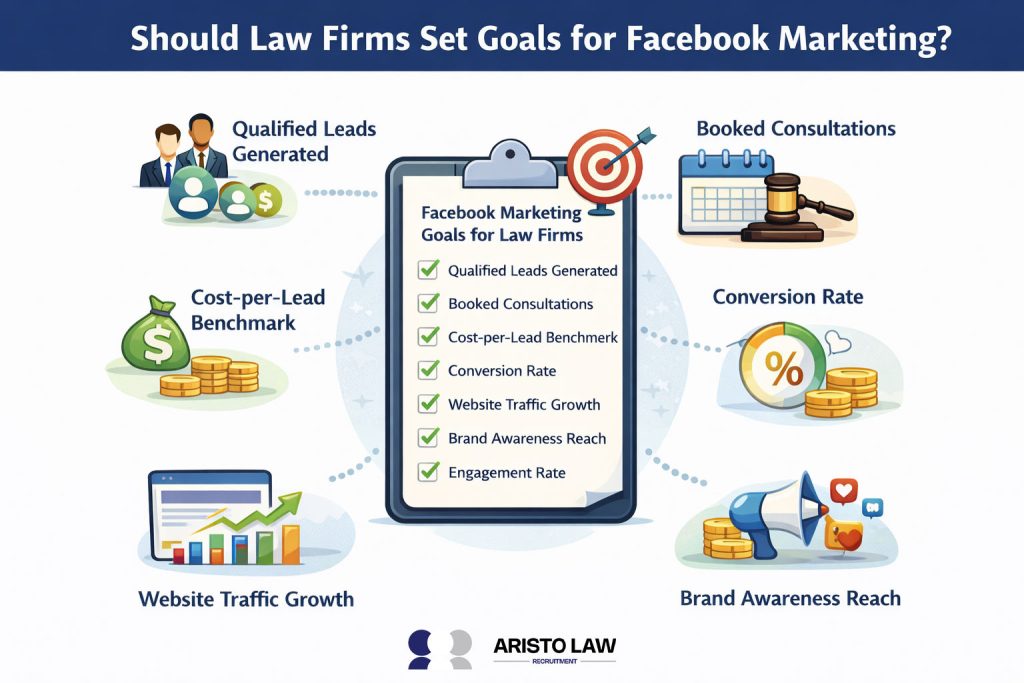
Law firms should set measurable marketing goals that include qualified leads, booked consultations, cost-per-lead targets, and engagement rate benchmarks. Law firm marketing goals align with revenue targets and structured lead generation goals for law firms tied to intake performance and case value.
Listed below are the 7Facebook marketing goals for law firms.
- Qualified leads generated: Lead volume tracks completed inquiries from defined target audiences.
- Booked consultations: Consultation bookings measure progress from inquiry to scheduled case review.
- Cost-per-lead benchmark: Cost-per-lead sets acquisition efficiency targets and budget control standards.
- Conversion rate: Conversion rate measures the percentage of clicks that turn into inquiries.
- Website traffic growth: Traffic volume tracks user visits driven by campaigns.
- Brand awareness reach: Reach and impressions measure market visibility.
- Engagement rate: Engagement rate tracks interactions relative to impressions.
How do you track ROI from Facebook marketing for lawyers?
Tracking ROI from Facebook marketing requires using connected tracking tools, monitoring conversions, and attributing leads back to specific campaigns.
Listed below are the 5 way to track ROI from facebook marketing.
- Using the Meta Pixel to measure website actions such as form submissions or calls
- Connecting the firm’s CRM to identify which leads originated from Facebook ads
- Reviewing attribution data to understand which campaigns produce qualified inquiries
- Tracking cost per lead and cost per signed client to evaluate profitability
- Comparing campaign performance over time to find the highest-ROI audiences and creatives
What metrics matter most for Facebook ads for lawyers?
The most important Facebook ad metrics for lawyers are cost per lead, conversion rate, click-through rate, cost per click, and return on ad spend. Facebook metrics determine campaign efficiency and legal lead quality.
Listed below are the 7 most important Facebook ad metrics for lawyers.
- Cost per lead (CPL): Cost per lead measures the average ad spend required to generate one inquiry.
- Conversion rate: Conversion rate measures the percentage of clicks that result in a submitted form or consultation request.
- Click-through rate (CTR): Click-through rate measures the percentage of users who click after seeing the ad.
- Cost per click (CPC): Cost per click measures the average spend for each ad click.
- Engagement rate: Engagement rate tracks interactions such as comments, shares, and reactions relative to impressions.
- Booked consultations: Booked consultations measure how many leads convert into scheduled case evaluations.
- Return on ad spend (ROAS): Return on ad spend compares revenue from signed cases to total advertising cost.
What is retargeting for law firm Facebook ads?
Retargeting for law firm Facebook ads involves showing ads to users who previously visited the law firm website or engaged with prior ads. Retargeting uses the Facebook Pixel to track website visitors, form viewers, and content readers, then places those users into custom audiences inside Ads Manager. Retargeting campaigns deliver follow-up ads that remind prospects about consultation offers, case evaluations, or specific practice areas.
Retargeting improves conversion rates because it targets users who already showed intent through prior engagement. Retargeting reduces wasted spend by focusing the budget on warmer audiences rather than broad cold traffic. Retargeting strengthens lead quality by reinforcing trust and familiarity before the consultation decision.
Can Facebook ads support personal injury marketing?
Yes, Facebook ads can support personal injury marketing by targeting local accident victims and delivering urgency-based consultation offers. Facebook ads in personal injury marketing apply local targeting through city, ZIP code, or radius filters to reach users within the firm’s service area. Facebook ads use messaging such as “Injured in a car accident?” combined with clear consultation calls-to-action to prompt immediate response.
Facebook ads strengthen personal injury marketing through retargeting campaigns that re-engage prior website visitors who viewed accident-related pages. Facebook ads in personal injury marketing must follow attorney advertising rules that prohibit misleading claims, unverifiable results, or guaranteed settlement language. Facebook ads maintain compliance by using factual statements and required disclaimers where applicable.
What compliance rules apply to attorney Facebook advertising?
Attorney Facebook advertising must comply with state bar rules that prohibit misleading claims, outcome guarantees, improper specialization statements, and non-compliant testimonials. Attorney advertising compliance requires truthful communication that avoids unverifiable comparisons and exaggerated success language. Attorney Facebook advertising includes required disclaimers where jurisdiction rules mandate identification of the responsible attorney or law firm.
Attorney Facebook advertising restricts testimonials that create unjustified expectations or imply guaranteed results. Attorney Facebook advertising standards vary by state bar authority, so law firms review applicable bar rules before launching campaigns.
What are common Facebook marketing mistakes for lawyers?
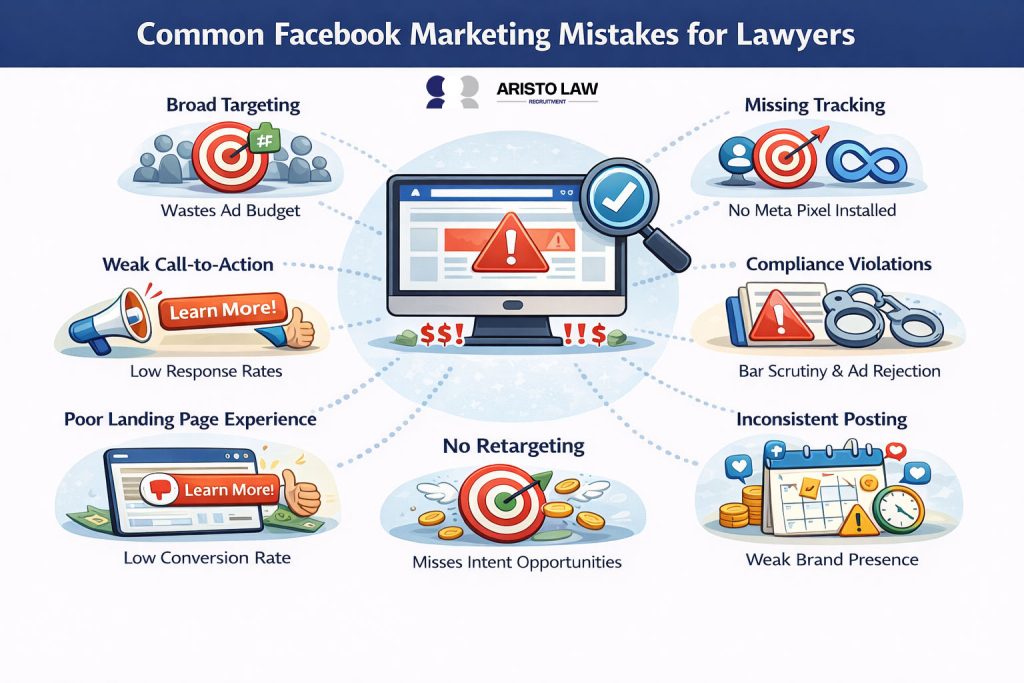
The common avoidable mistakes law firms make in Facebook marketing are broad targeting, missing tracking, compliance violations, no retargeting, and inconsistent posting. Marketing mistakes reduce lead quality and increase cost-per-lead.
Listed below are the 7 common avoidable mistakes law firms make in Facebook marketing.
- Broad targeting: Broad targeting wastes ad budget on users outside the intended legal audience.
- No Meta Pixel installation: Missing tracking pixel blocks conversion tracking, and prevents accurate ROI measurement.
- Weak call-to-action (CTA): Weak CTA lowers response rates and reduces consultation bookings.
- Poor landing page experience: Poor landing page design reduces trust and lowers conversion rate.
- Attorney advertising compliance violations: Compliance errors expose law firms to bar scrutiny and ad rejection.
- No retargeting campaigns: Lack of retargeting ignores warm prospects who already showed intent.
- Inconsistent organic posting: Irregular posting weakens brand presence and reduces engagement signals.
Can Facebook ads generate leads for law firms?
Yes, Facebook ads can generate qualified leads for law firms because Facebook ads combine targeted reach, structured lead forms, and tracked conversion systems. Facebook ads support lead generation through native lead forms that capture contact details and case type information inside the platform. Facebook ads direct users to landing pages built for consultation booking and intake screening.
Facebook ads improve lead quality through retargeting campaigns that focus on users who previously visited practice-area pages or engaged with prior ads. Facebook ads connect captured inquiries to CRM systems where intake teams qualify prospects based on case facts and jurisdiction. Facebook ads performance tracking measures cost-per-lead and conversion rate to evaluate lead generation efficiency.
Can Facebook ads be cheaper than Google Ads for lawyers?
Yes, Facebook ads can be less expensive than Google Ads for lawyers, depending on audience competition, campaign structure, and cost comparison metrics such as cost-per-lead. Cost comparison between platforms reflects different buyer intent models, often discussed in Google Ads vs Facebook ads for lawyers analysis within paid acquisition strategy.
Facebook ads operate on interruption-based social targeting where advertisers define audience attributes before demand occurs. Google Ads operate on intent-based search where users actively search for legal services, which increases keyword competition. Facebook ads often produce lower cost-per-click in awareness stages, while Google Ads often produce higher conversion intent due to search behavior. Platform selection depends on practice area urgency, geographic competition, and intake conversion efficiency rather than fixed pricing assumptions.
How do lawyers qualify Facebook leads?
Lawyers qualify Facebook leads by using structured lead forms, intake screening questions, and defined follow-up processes. Lead qualification begins inside Facebook lead forms that request case type, incident date, location, and contact details to filter irrelevant inquiries. Lead qualification improves when forms include mandatory fields that screen out non-service-area or non-practice-area requests.
Lead qualification continues through an intake process that uses scripted questions to verify liability, damages, timeline, and jurisdiction. Lead qualification systems route submissions into CRM software where automated responses confirm receipt and prompt consultation scheduling. Lead qualification metrics track consultation rate and retained-case rate to measure inquiry quality.
What audiences should lawyers target on Facebook?
Lawyers should target geo-based users, interest-based segments, and retargeting lists on Facebook. Audience targeting structure determines relevance, lead quality, and cost-per-lead efficiency.
Listed below are the 5 steps lawyers target geo-based users.
- Geo-targeting: Geo-targeting limits ads to users within defined cities, ZIP codes, or service radiuses around the law firm office.
- Custom audiences: Custom audiences use website visitors, past client data, or prior lead submissions to re-engage known prospects.
- Lookalike audiences: Lookalike audiences identify new users who match characteristics of high-value custom audiences.
- Interest-based targeting: Interest-based targeting reaches users based on behaviors, demographics, and practice-area-related interests.
- Retargeting lists: Retargeting lists focus on users who viewed landing pages, watched videos, or interacted with prior ads.
What is Facebook PPC for lawyers?
Facebook PPC for lawyers refers to paid social advertising where law firms pay per click or per defined action to generate legal leads. Facebook PPC operates inside Meta Ads Manager using bidding models such as cost-per-click or cost-per-conversion. Facebook PPC differs from organic content because Facebook PPC requires ad spend, structured audience targeting, and measurable campaign objectives.
Facebook PPC uses audience segmentation, creative testing, and performance tracking to control cost-per-lead and conversion rate. Facebook PPC relies on defined campaign goals such as lead generation or conversions rather than unpaid visibility.
What should lawyers post on Facebook?
Lawyers should post educational FAQs, compliant case updates, testimonials where permitted, and local involvement content. Organic content strategy in law firm social media aligns with broader content marketing ideas for lawyers that position authority and trust without direct selling.
Listed below are the 6 things lawyers post on Facebook.
- Frequently asked questions (FAQs): FAQ posts answer common legal questions related to specific practice areas.
- Compliant case updates: Case updates share procedural milestones or legal insights without disclosing confidential details or promising outcomes.
- Blog article links: Blog links drive traffic to educational content hosted on the law firm website.
- Short educational videos: Video posts explain legal processes, timelines, or rights in clear language.
- Client testimonials where allowed: Testimonials follow attorney advertising compliance rules and avoid guaranteed results.
- Local community involvement posts: Community posts highlight events, sponsorships, or outreach within the firm’s service area.
Build a legal support team that moves work forward.
Tell us what is slowing your practice down. We will help map the role, workflow, and support structure that fits.