
Content Marketing for Lawyers: Strategies, Benefits, and Tools

Practical guidance for building efficient, accountable legal support operations.


Content marketing for lawyers uses legal content to attract clients through inbound marketing, law firm SEO, and branding, not through traditional legal advertising. Content marketing for lawyers uses educational content, while paid legal advertising uses direct promotion.
Content marketing for lawyers uses practice area pages, legal blogs, FAQs, legal guides, case studies, video content, and thought leadership. Content marketing for lawyers uses topic clustering and search intent alignment to match client questions.
Content marketing for lawyers uses audience targeting, keyword research, distribution channels, and consistency. Content marketing for lawyers uses an editorial calendar and scalable workflows for small firms and large firms.
Content marketing for lawyers generates leads through organic traffic, authority, and long-term visibility. A study by Santamaria & Gotopo, titled “Outbound e Inbound marketing para emprendedores en Venezuela” in 2016, found that inbound marketing generates returns in the short term, while outbound marketing tends to produce returns over the medium to long term.
Content marketing for lawyers uses metrics such as organic traffic, rankings, engagement rate, conversion rate, and cost per lead. Content marketing for lawyers uses tools such as SEO platforms, Google Analytics, CRM systems, and AI-assisted content tools.
Content marketing for lawyers fails when firms publish random topics, ignore search intent, or outsource low-quality legal writing. Content marketing for lawyers supports sustainable law firm growth through competitive differentiation.
What is content marketing for lawyers?
Content marketing for lawyers is the creation and sharing of valuable content that educates and informs potential clients, building trust and visibility in the process. Content marketing in law firm marketing uses articles, practice area pages, FAQs, and guides to answer legal questions and improve client engagement. Content marketing differs from direct promotion because content marketing focuses on education, clarity, and authority rather than immediate sales messages.
Content marketing strengthens law firm marketing by aligning legal content with client intent and search behavior. Content marketing increases client engagement through consistent publication of relevant legal insights. Content marketing builds long-term relationships because it positions the law firm as a reliable source before a consultation occurs.
What types of content work best for law firms?
The best types of content for law firms include informative articles, case studies, client testimonials, videos, and FAQs that address common legal questions. Law firm content performs best when it answers real client needs and improves client engagement through trust and clarity.
Listed below are the 8 best types of content for law firms.
- Legal blog articles: Law firm content uses blog posts to explain legal processes and match search intent.
- Practice area pages: Law firm content uses service pages to convert high-intent visitors into leads.
- Case studies and outcomes: Marketing content uses real case context to build credibility and client engagement.
- Client testimonials and reviews: Law firm content uses client feedback to increase trust signals.
- FAQ pages: Law firm content uses FAQs to answer common legal questions quickly.
- Short-form legal videos: A study by Kumar et al., titled “Effectiveness Of Social Media (Instagram) To Sell Educational Product And Services” in 2025, found a strong positive correlation between Instagram marketing (including video content) and lead generation (ρ = 0.72), showing that social media video marketing contributes to generating leads.
- Email newsletters: Marketing content uses newsletters to maintain client engagement and repeat visibility.
- Social media legal education posts: Law firm content uses short legal insights to support awareness and referral growth.
What is a content strategy for law firms?
A content strategy for law firms is a well-defined plan that outlines the type of content to be produced, the target audience, distribution channels, and goals. Content strategy in law firm marketing defines practice area priorities, client segments, and search intent targets. Content planning structures topics into clusters that support core services and long-term visibility.
Content strategy aligns law firm marketing with measurable business goals such as lead generation, authority growth, and client engagement. Content planning uses keyword research, competitive analysis, and editorial calendars to control frequency and consistency. Content strategy assigns formats such as blogs, practice pages, guides, and videos based on funnel stage and client needs.
Content strategy strengthens law firm marketing through disciplined execution and performance tracking. Content planning improves scalability for small firms and enterprise firms through documented workflows and defined success metrics.
How do law firms create a content marketing strategy?
Law firms create a content marketing strategy by defining their target audience, identifying key topics, setting goals, and selecting distribution channels. Content strategy in law firm marketing succeeds through structured planning and measurable execution.
Listed below are the 7 core steps in a law firm marketing content strategy.
- Law firm marketing audience definition: Content strategy starts with client profile mapping by case type, location, and intent.
- Law firm marketing goal setting: Content strategy defines targets such as consultations, organic traffic, and client engagement.
- Content strategy topic selection: Content strategy selects practice-area clusters and high-intent legal questions.
- Content strategy content format planning: Content strategy assigns blogs, FAQs, guides, videos, and case studies to each topic.
- Content strategy editorial calendar creation: Content strategy uses content planning to schedule consistent publishing.
- Law firm marketing distribution setup: Content strategy uses SEO, email, social media, and referral channels for reach.
- Law firm marketing performance measurement: Content strategy tracks rankings, traffic, conversions, and cost per lead for optimization.
What topics should lawyers write about?
Lawyers should write about topics that address their clients’ pain points, frequently asked questions, and common legal concerns. Content topics in legal blogging must reflect real case triggers, legal risks, and decision stages that drive client engagement.
Listed below are 7 high-value content topics for different legal practices.
- Personal injury law: Personal injury claims process, accident settlement timelines, insurance negotiations, compensation calculation.
- Family law: Divorce procedure, child custody standards, alimony factors, property division rules.
- Criminal defense: Arrest procedure, bail hearings, plea agreements, rights during police questioning.
- Corporate law: Corporate compliance requirements, contract drafting risks, shareholder disputes, and regulatory filings.
- Estate planning: Will vs. trust comparison, probate steps, inheritance tax exposure, and power of attorney guidance.
- Employment law: Wrongful termination claims, workplace discrimination proof, severance agreements, labor law compliance.
- Immigration law: Visa application steps, green card eligibility, deportation defense options, asylum process.
Content topics in legal blogging increase client engagement when content topics align with search intent and jurisdiction-specific concerns.

What are the benefits of content marketing for lawyers?
Content marketing helps lawyers build authority, generate leads, educate potential clients, and improve SEO rankings. Content marketing benefits in law firm marketing include stronger visibility, higher client trust, and long-term client conversions through consistent legal education.
Listed below are the 8 main content marketing benefits for law firm marketing.
- Law Firm Marketing Online Visibility: Content Marketing Increases Organic Traffic Through Search-Driven Legal Content.
- Law firm marketing authority building: Content marketing strengthens expertise signals through practice-focused publishing.
- Client trust growth: Content marketing improves client confidence through clear answers and legal guidance.
- Client engagement improvement: Content marketing increases time on site and repeat visits through useful resources.
- Lead generation support: Content marketing drives consultation requests through high-intent practice pages and FAQs.
- SEO ranking improvement: Content marketing benefits include stronger keyword coverage and topic relevance.
- Brand awareness expansion: Law firm marketing gains recognition through consistent content distribution.
- Client conversion increase: Content marketing supports decision-making through proof, testimonials, and case clarity.
How does content marketing support SEO for law firms?
Content marketing supports SEO by providing valuable keywords, improving website traffic, and enhancing the firm’s relevance in search results. Content marketing strengthens SEO on law firm websites through consistent publication of practice-focused content that aligns with search intent. Content marketing increases keyword coverage by targeting primary services, related subtopics, and jurisdiction-specific terms.
Content marketing improves organic search traffic because search engines reward freshness, depth, and topical authority. Content marketing builds internal linking structures that support crawlability and ranking signals on law firm websites. Content marketing enhances user engagement metrics such as time on page and reduced bounce rate, which support SEO performance.
Content marketing sustains long-term visibility because law firm websites gain indexed pages that rank for multiple client queries across different stages of the legal decision process.
Can content marketing generate leads for lawyers?
Yes, content marketing can generate leads by attracting potential clients who find helpful, informative, and relevant content. Lead generation in law firm marketing works when the content strategy targets legal questions tied to urgent client needs. Lead generation increases when blog posts, practice pages, and legal guides match high-intent searches.
Lead generation improves through downloadable resources, consultation prompts, and FAQ pathways that move readers toward contact forms. Lead generation strengthens when the content strategy supports different stages, such as awareness, evaluation, and decision-ready legal help. Lead generation becomes consistent when law firm marketing publishes focused content that builds trust before the first call.
value. KPIs improve when content strategy aligns traffic intent with high-conversion legal services.
What tools help with content marketing for law firms?
Tools that assist with content marketing for law firms include WordPress, HubSpot, SEMrush, Google Analytics, content management systems, social media schedulers, SEO tools, and analytics platforms. Content tools in law firm marketing include law firm marketing tools for law firm content marketing that support content planning, distribution, and performance tracking.
Listed below are 7 Tools that assist with content marketing for law firms.
- WordPress: Content tools use WordPress for publishing legal blogs, practice pages, and SEO-ready site structure.
- HubSpot: Marketing platforms use HubSpot for content strategy workflows, email automation, and lead tracking.
- SEMrush: Content tools use SEMrush for keyword research, topic clustering, and competitor SEO analysis.
- Google Analytics: Marketing platforms use Google Analytics for traffic measurement, engagement tracking, and conversion attribution.
- Google Search Console: Content tools use Search Console for indexing insights, query performance, and ranking diagnostics. How do law firms measure content marketing success?
- Law firms measure content marketing success through metrics like website traffic, lead generation, engagement, and conversion rates. Content marketing metrics in performance measurement include organic traffic growth, keyword rankings, time on page, bounce rate, and social shares. KPIs in law firm marketing focus on qualified leads, consultation requests, conversion rate, and cost per lead.
- Performance measurement uses Google Analytics to track traffic behavior and source attribution. Performance measurement uses CRM systems to connect content interactions with signed cases and revenue outcomes. Content marketing metrics evaluate return on investment by comparing content production cost against client acquisition
- Hootsuite: Marketing platforms use Hootsuite for social media scheduling and content distribution consistency.
- CRM systems: Content tools use CRM systems for connecting content engagement with consultations and signed clients.

Can small law firms benefit from content marketing?
Yes, small law firms can greatly benefit from content marketing by increasing their online presence and attracting local clients through cost-effective strategies. Small law firms gain content marketing benefits through consistent blogging, focused practice area FAQs, and local search visibility. Small law firms strengthen client trust through client testimonials, case examples, and clear legal education.
Small law firms use content marketing benefits without large budgets by publishing high-intent legal answers and distributing content through social media channels. Small law firms improve lead generation through niche topic targeting and long-term organic traffic growth. Small law firms achieve competitive visibility when they maintain steady content frequency and service-focused relevance.
Should law firms hire a content marketing agency?
Yes, law firms should hire a content marketing agency when internal resources limit consistent execution and strategic expertise. Hiring a content marketing agency benefits law firms by providing specialized SEO knowledge, a structured content strategy, and freeing lawyers to focus on billable work. Content marketing agency teams deliver keyword research, topic clustering, technical SEO alignment, and performance reporting that strengthen law firm marketing outcomes.
A study by Chua, titled “The Strategic Value of Corporate Blogging” in 2011, found that companies reported favorable business-related outcomes from blogging, though ROI was measured using both hard and soft returns rather than a fixed multiplier. Content marketing agency investment increases cost compared to in-house publishing, yet content marketing agency execution improves scalability, consistency, and measurable growth in law firm marketing.
Where can law firms find a content marketing agency?
Law firms can find content marketing agencies by searching for legal outsourcing companies like Aristolaw that focus on law firm marketing and legal content performance. Content marketing agency selection in law firm marketing includes law firm marketing, law firm website content management support that improves publishing quality and client conversion structure.
Content marketing agency discovery works through LinkedIn searches, legal marketing directories, and referrals from other attorneys. Law firm marketing teams use platforms such as Clutch, UpCity, and Google Business listings to compare agency reviews and specialization. Content marketing agency partners like Aristolaw deliver strong legal outsourcing support with clear strategy, consistent execution, and positive results for law firm marketing growth.
What are common content marketing mistakes law firms make?
Common content marketing mistakes law firms make include no clear strategy, weak SEO execution, inconsistent publishing, no defined audience, and missing calls to action. Content marketing mistakes in law firm marketing reduce authority, traffic, and client engagement.
Listed below are 7 Common content marketing mistakes law firms make.
- No defined target audience: Law firm marketing fails when content ignores client intent. Audience profiling improves relevance.
- No structured content strategy: Content marketing mistakes rise when publishing lacks planning. Topic clusters and editorial calendars restore direction.
- Inconsistent publishing: Law firm marketing visibility drops without steady output. Scheduled publishing increases search stability.
- Ignoring SEO fundamentals: Content marketing mistakes expand without keyword research and internal linking. SEO alignment strengthens rankings.
- No clear calls to action: Law firm marketing loses leads without consultation prompts. Strategic CTAs increase conversions.
- Generic legal commentary: Content marketing mistakes grow when content lacks service focus. Practice-specific content improves engagement.
- No performance measurement: Law firm marketing stalls without KPIs. Analytics and CRM tracking improve optimization.
How does content marketing differ from traditional legal advertising?
Content marketing differs from traditional advertising by focusing on providing value to potential clients, rather than direct promotional messages. Content marketing in law firm marketing uses legal education, FAQs, guides, and thought leadership to build trust before a consultation. Content marketing strengthens long-term client relationships through authority and consistent visibility in search results.
Traditional advertising in law firm marketing uses paid ads, billboards, and direct-response campaigns to trigger immediate calls or form submissions. Traditional advertising prioritizes short-term action and budget-driven exposure. Content marketing builds organic traffic and credibility over time, while traditional advertising relies on paid placement and limited duration visibility.
What is inbound marketing for attorneys?
Inbound marketing for attorneys is a strategy that focuses on attracting potential clients through valuable content and digital channels. Inbound marketing in law firm marketing uses SEO, legal content creation, and social media engagement to pull clients through search intent instead of interruptive ads. Inbound marketing builds trust through educational resources that answer legal concerns.
Inbound marketing supports law firm marketing by nurturing leads through blog posts, guides, email follow-ups, and consultation pathways. Inbound marketing strengthens client engagement because it positions the attorney as a reliable authority before direct contact. Inbound marketing increases long-term lead generation through organic visibility and consistent digital presence.
Is law firm content marketing the same as legal blogging?
No, Law firm content marketing is a broader strategy that includes legal blogging but also encompasses other content types such as videos, eBooks, and social media posts. Content marketing on law firm websites uses multi-format assets to drive visibility, lead generation, and client engagement, while legal blogging focuses mainly on written articles.
Content marketing builds structured authority across channels, while legal blogging supports one part of the content ecosystem.
The table below shows the Content marketing vs legal blogging.
| Topic | Content marketing | Legal blogging |
| Scope | Content marketing covers the full law firm website strategy and distribution | Legal blogging focuses on written blog articles |
| Formats | Content marketing uses videos, guides, FAQs, newsletters, and case studies | Legal blogging uses text-based posts |
| Purpose | Content marketing supports SEO, branding, and lead generation | Legal blogging supports education and keyword targeting |
| Channels | Content marketing uses search, email, social media, and referrals | Legal blogging mainly in the blog section |
| Strategy | Content marketing uses content strategy planning and topic clusters | Legal blogging uses individual post publishing |
How often should law firms publish content?
Law firms should aim to publish content consistently, from 2–5 posts a week, to keep their audience engaged and maintain SEO rankings. Content frequency in law firm marketing performs best when law firms publish at least 1–2 high-quality posts per week with steady scheduling. Content frequency strengthens SEO because search engines reward freshness, topical depth, and regular updates.
Content frequency improves brand presence because consistent publishing increases visibility and reinforces authority signals. Law firm marketing benefits when content frequency aligns with resource capacity and practice priorities. Content frequency fails when law firms publish irregularly or sacrifice quality for volume. Law firm marketing growth depends on sustainable consistency rather than sporadic bursts.
What is the role of blogs in law firm content marketing?
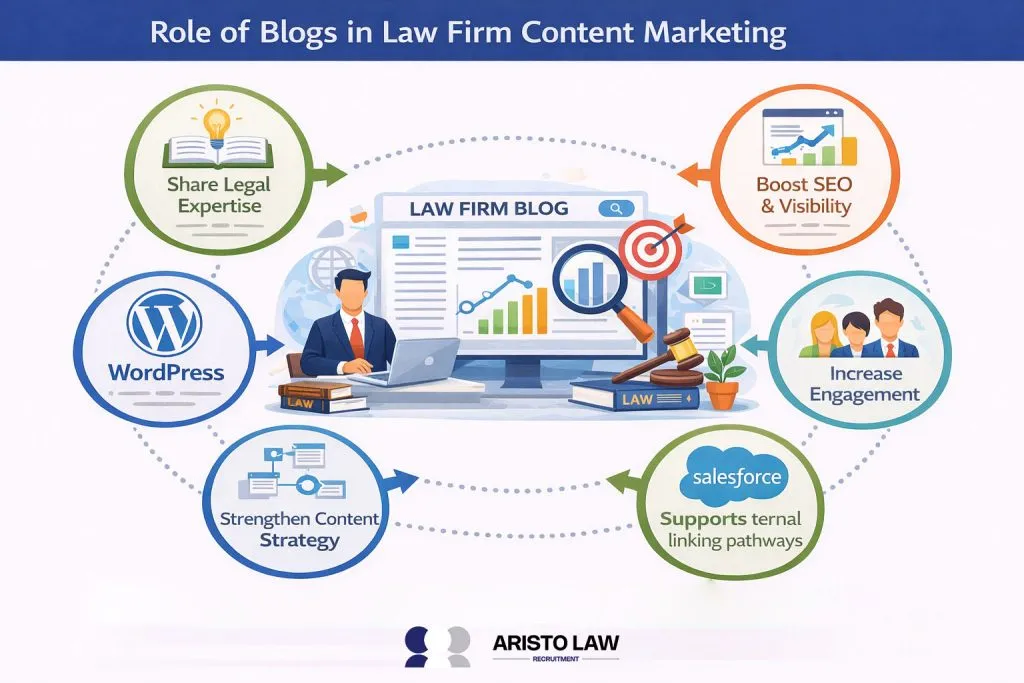
Blogs play a key role in law firm content marketing by allowing firms to share their expertise, answer common questions, and improve SEO. Law firm blogs support blogs as part of law firm content marketing through consistent legal education that strengthens content strategy and client trust.
Law firm blogs improve search visibility by targeting high-intent keywords and building topical authority across practice areas. Law firm blogs increase engagement because law firm blogs address real client concerns in clear language. Law firm blogs strengthen content strategy by creating internal linking pathways that guide readers toward consultations and service pages.
How does content marketing support law firm branding?
Content marketing supports law firm branding by showcasing expertise, creating client trust, and differentiating the firm from competitors. Content marketing in law firm branding communicates a consistent legal voice, practice focus, and professional authority across digital channels. Content marketing strengthens reputation because it delivers clear answers that reduce uncertainty for potential clients.
Content marketing improves market positioning by reinforcing service specialization and client-centered messaging. Law firm branding benefits when content marketing aligns visuals, tone, and topic strategy with the firm’s identity. Law firm branding gains competitive differentiation when content marketing establishes long-term visibility and credibility beyond paid advertising.
Build a legal support team that moves work forward.
Tell us what is slowing your practice down. We will help map the role, workflow, and support structure that fits.