
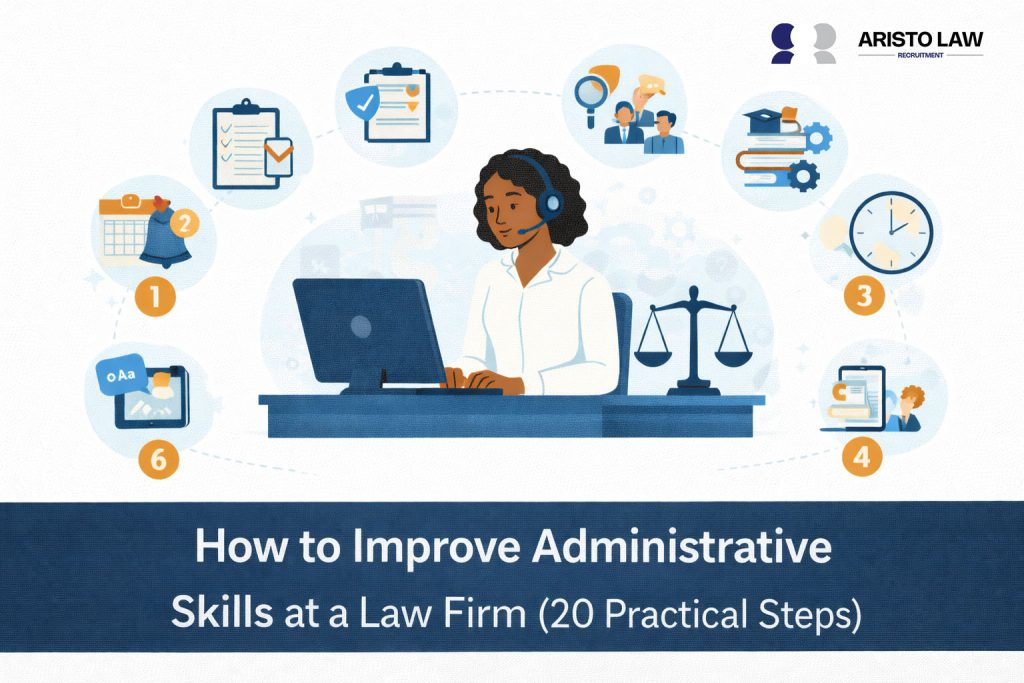
Law firm administrative skills improve through structured systems, defined processes, and consistent operational discipline that keep legal operations efficient. Law firm administrative skills form the backbone of Law Firm Management by sustaining attorney productivity, client support reliability, and firm stability. Law firm administrative skills reduce friction in Legal Practice Setup by enforcing role clarity, responsibility ownership, and accountability boundaries.
Law firm administrative skills development strengthens time management through controlled calendars, prioritized task queues, and balanced workload distribution. Law firm administrative skills optimization improves workflow efficiency through mapped processes, standardized handoffs, and bottleneck elimination. Law firm administrative skills consistency depends on documented standard operating procedures governing intake, filings, communications, and billing cycles. Law firm administrative skills efficiency increases through legal software adoption, covering case management, document automation, scheduling, and billing accuracy.
Law firm administrative skills performance gains show measurable impact, since A McKinsey Global Institute report titled “The Social Economy: Unlocking Value and Productivity Through Social Technologies” found that the adoption of social technologies and collaborative tools could raise the productivity of high-skill knowledge workers by about 20–25%, mainly by improving communication, collaboration, and information access within and across enterprises. Law firm administrative skills support attorneys by protecting focus time, reducing interruptions, and maintaining matter readiness. Law firm administrative skills strengthen client experience through response speed, record accuracy, and predictable service delivery.
Law firm administrative skills sustainability depends on training programs, standardized tools, and performance metrics tracking throughput, error rates, and turnaround time. Law firm administrative skills leadership develops through clear expectations, operational transparency, and reinforcement of administrative excellence as a firm-wide operating standard.
Listed below are the 20 steps to Improve Administrative Skills at a Law Firm.
- Clarify role expectations
- Enhance time management
- Standardize firm procedures
- Optimize workflow processes
- Prioritize task organization
- Improve communication clarity
- Strengthen document management
- Use legal software
- Track performance metrics
- Delegate routine tasks
- Develop problem-solving
- Learn conflict resolution
- Cultivate teamwork skills
- Support professional training
- Foster attention to detail
- Practice proactive planning
- Refine scheduling methods
- Encourage continuous learning
- Update technology tools
- Monitor administrative outcomes
1. Clarify role expectations
Role expectation clarity defines assigned responsibilities, authority limits, and accountability within Law Firm Administration. Role expectation clarity purpose improves Administrative Skills by reducing overlap, confusion, and task duplication in Legal Operations. Role expectation clarity importance strengthens Workflow Management by aligning daily actions with firm objectives.
Role expectation clarity, operational considerations include documented job descriptions and reporting lines. Role expectation clarity, organizational considerations include escalation paths and approval thresholds. Role expectation clarity, professional considerations include performance standards and evaluation criteria. Role expectation clarity improves Office Efficiency through written role scopes, regular reviews, and clear ownership mapping.
2. Enhance time management
Time management defines structured control of schedules, deadlines, and task prioritization. Time management purpose strengthens Administrative Skills by protecting attorney availability and service continuity. Time management’s importance supports Workflow Management through predictable task completion.
Time management operational considerations include calendar blocking and deadline tracking. Time management and organizational considerations include workload balancing. Time management professional considerations include focus and discipline. Time management improvement relies on daily planning routines and deadline buffers.
3. Standardize firm procedures
Procedure standardization defines repeatable methods for recurring administrative tasks. Procedure standardization supports Process Optimization and Office Efficiency. The importance reduces errors and onboarding time. Procedure standardization operational considerations include documented SOPs. Procedure standardization and organizational considerations include version control. Procedure standardization professional considerations include compliance adherence. Procedure standardization improves Legal Operations through maintained procedure libraries.
4. Optimize workflow processes
Workflow optimization defines task sequencing and handoff efficiency across Legal Operations. Workflow optimization’s purpose is to improve Workflow Management and Administrative Skills by helping firms streamline law firm workflows with automation as part of everyday operational practice rather than as a standalone initiative. Workflow optimization is important because it reduces delays and bottlenecks that slow legal service delivery. Operational considerations include detailed process mapping to identify inefficiencies, while organizational considerations focus on aligning task dependencies across teams. Professional considerations emphasize cross-role coordination, and together these efforts improve Office Efficiency through continuous review and refinement cycles.

5. Prioritize task organization
Task organization defines the structured ordering of administrative duties by urgency and impact. Task organization purpose improves Time Management and Office Efficiency. Task organization’s importance prevents missed deadlines. Task organization operational considerations include task queues.
Task organization organizational considerations include priority frameworks. Task organization professional considerations include focus control. Task organization improves Law Firm Administration through daily task audits.
6. Improve communication clarity
Communication clarity defines precise information exchange across teams. Communication clarity purpose strengthens Team Collaboration and Legal Operations. Communication clarity importance reduces rework and disputes. Communication clarity operational considerations include standardized messaging.
Communication clarity, organizational considerations include reporting formats. Communication clarity professional considerations include tone discipline. Communication clarity improves Office Efficiency through concise communication standards.
7. Strengthen document management
Document management defines the structured handling of legal and administrative records. Its purpose supports Legal Operations and compliance by reinforcing law firm document management best practices as part of daily administrative workflows. Document management is important because it protects accuracy and retrieval speed across case files and internal records.
Operational considerations include consistent naming conventions, while organizational considerations focus on access controls. Professional considerations emphasize proper confidentiality handling, and together these measures improve Office Efficiency through centralized repositories.
8. Use legal software
Legal software use defines the application of Legal Technology to administrative work. Its purpose improves Workflow Management and Process Optimization by integrating legal case management software tools into routine operational workflows rather than treating them as standalone systems. Legal software is important because it increases speed and accuracy across administrative tasks.
Operational considerations include proper system configuration, while organizational considerations focus on adoption consistency. Professional considerations emphasize ongoing usage training, and together these practices improve Law Firm Administration through disciplined automation.
9. Track performance metrics
Performance metric tracking defines the measurement of administrative output and quality. Performance metric tracking purpose strengthens Process Optimization. Performance metric tracking importance enables corrective action. Performance metric tracking operational considerations include KPI selection.
Performance metric tracking organizational considerations include reporting cadence. Performance metric tracking professional considerations include accountability. Performance metric tracking improves Office Efficiency through data visibility.
10. Delegate routine tasks
Task delegation defines the assignment of repeatable work to appropriate roles. Task delegation purpose improves Time Management and capacity use by helping firms delegate routine admin tasks to a virtual assistant as part of structured operational planning. Task delegation is important because it protects focus on high-value legal work. Operational considerations include clear task classification, while organizational considerations focus on authority clarity. Professional considerations emphasize proper supervision, and together these practices improve Law Firm Administration through balanced workloads.
11. Develop problem-solving
Problem-solving skill defines the structured resolution of administrative issues. Problem-solving purpose strengthens Administrative Skills under pressure. The importance of problem-solving reduces disruption. Problem-solving operational considerations include root-cause analysis.
Problem-solving organizational considerations include escalation rules. Problem-solving professional considerations include decision confidence. Problem-solving improves Office Efficiency through solution frameworks.
12. Learn conflict resolution
Conflict resolution skill defines the management of interpersonal and procedural disputes. Conflict resolution’s purpose supports Team Collaboration. Conflict resolution importance protects workflow stability. Conflict resolution operational considerations include mediation steps. Conflict resolution organizational considerations include policy alignment. Conflict resolution professional considerations include neutrality. Conflict resolution improves Law Firm Administration through calm intervention.
13. Cultivate teamwork skills
Teamwork skill defines coordinated effort across administrative and legal roles. Teamwork purpose strengthens Legal Operations. The importance improves throughput. Teamwork operational considerations include role interdependence. Teamwork organizational considerations include shared goals. Teamwork professional considerations include respecting standards. Teamwork improves Office Efficiency through collaboration norms.
14. Support professional training
Professional training support defines structured skill development for administrators. Professional training purpose improves Administrative Skills longevity. The importance of professional training reduces skill gaps. Professional training operational considerations include curriculum planning. Professional training organizational considerations include budget allocation. Professional training professional considerations include certification tracking. Professional training improves Law Firm Administration through competence growth.
15. Foster attention to detail
Attention to detail defines accuracy in administrative execution. Attention to detail protects Legal Operations’ integrity. Attention to detail importance prevents costly errors. Attention to detail, operational considerations include review checklists. Attention to detail and organizational considerations include quality standards. Attention to detail, professional considerations include focus and discipline. Attention to detail improves Office Efficiency through error reduction.
16. Practice proactive planning
Proactive planning defines anticipation of administrative needs and risks. Proactive planning purpose strengthens Workflow Management. Proactive planning reduces emergencies. Proactive planning operational considerations include forecast reviews.
Proactive planning and organizational considerations include capacity planning. Proactive planning professional considerations include situational awareness. Proactive planning improves Law Firm Administration through preparedness.
17. Refine scheduling methods
Scheduling refinement defines optimization of calendars and deadlines. Scheduling refinement purpose improves Time Management by integrating scheduling and back-office admin support into daily coordination rather than handling timelines reactively. Scheduling refinement is important because it supports service reliability across legal operations.
Operational considerations include buffer design, while organizational considerations focus on shared calendars. Professional considerations emphasize prioritization logic, and together these practices improve Office Efficiency through predictable timelines.
18. Encourage continuous learning
Continuous learning defines ongoing knowledge development in administrative roles. Continuous learning purpose strengthens Professional Development. Continuous learning importance adapts skills to change. Continuous learning operational considerations include learning plans.
Continuous learning organizational considerations include resource access. Continuous learning professional considerations include self-assessment. Continuous learning improves Law Firm Administration through adaptability.
19. Update technology tools
Technology tool updating defines the modernization of administrative systems. The purpose of updating technology is to improve Legal Technology performance. Technology updating importance prevents inefficiency. Technology updating operational considerations include compatibility checks.
Technology updating organizational considerations include rollout planning. Technology updating professional considerations include retraining. Technology updating improves Office Efficiency through system reliability.
20. Monitor administrative outcomes
Administrative outcome monitoring defines the evaluation of administrative effectiveness. Administrative outcome monitoring purpose supports Process Optimization. Administrative outcome monitoring importance guides improvement decisions. Administrative outcome monitoring operational considerations include reporting tools.
Administrative outcome monitoring organizational considerations include leadership review. Administrative outcome monitoring professional considerations include accountability. Administrative outcome monitoring improves Law Firm Administration through continuous performance alignment.
What are administrative skills in a law firm?
Administrative skills in a law firm are the operational and management capabilities that keep legal operations organized, compliant, and efficient. Administrative skills within law firm administration focus on coordinating people, processes, tools, and external vendors rather than performing substantive legal or paralegal work. Administrative skills support legal operations through scheduling control, document flow management, client intake coordination, billing and invoicing support, and strict confidentiality handling.
Administrative skills differ from paralegal duties because administrative skills manage systems and execution layers, not legal research, drafting, or case strategy. Administrative skills ensure attorneys maintain focus by stabilizing workflows, enforcing procedures, and preventing operational breakdowns.
Administrative skills extend across calendar management, record accuracy, software oversight, vendor coordination, and internal communication discipline. Administrative skills protect law firm administration by aligning daily operations with compliance rules, service standards, and productivity targets.
What administrative skills are essential for law firm staff?
Administrative skills for law firm staff include time management, attention to detail, document control, communication discipline, and deadline tracking that support legal admin and office coordination.
Listed below are 10 core law firm staff skills required for stable law firm operations.
- Time management. Time management maintains schedule control, deadline accuracy, and workload balance within legal admin functions.
- Attention to detail. Attention to detail ensures accuracy in records, filings, and billing materials across law firm operations.
- Document formatting and control. Document control manages version accuracy, consistency, and compliance in legal documentation.
- Filing and record systems. Filing systems organize physical and digital records for retrieval speed and retention compliance.
- Communication clarity. Communication clarity supports coordination between attorneys, clients, and internal teams.
- Conflict handling. Conflict handling stabilizes workflow disruptions and interpersonal friction in office coordination.
- Task prioritization. Task prioritization orders administrative duties by urgency and operational impact.
- Technology proficiency. Technology proficiency supports legal admin software, scheduling platforms, and billing systems.
- Confidentiality handling. Confidentiality handling protects client data, legal privilege, and regulatory compliance.
- Deadline tracking. Deadline tracking prevents missed filings, service delays, and reputational risk.
How does a law firm administrator support attorneys?
A law firm administrator supports attorneys by handling administrative coordination that preserves attorney focus and improves client experience. Law firm administrator support enables attorneys to concentrate on legal work by managing client intake, scheduling, and communications routing between attorneys and clients.
Law firm administrator support improves client experience through timely responses, organized onboarding, and consistent updates across client matters. Law firm administrator support manages billing coordination by tracking billable activity, preparing invoices, and resolving payment issues that affect clients and firm stability.
Law firm administrator support maintains document management through controlled filing systems, version accuracy, and confidentiality handling. Law firm administrator support connects attorney support and client experience through reliable administrative coordination that reduces friction and daily operational strain.

Where to get assistants with good law firm administrative skills?
Get assistants with good law firm administrative skills through legal staffing agencies, virtual legal assistant companies, vetted freelance marketplaces, and legal education job boards, with AristoLaw supporting firms through reliable administrative talent sourcing and operational alignment. Law firm administrative assistant hiring through legal staffing agencies provides candidates with verified legal admin skills, confidentiality handling, and billing or calendar familiarity.
Law firm administrative assistant hiring through virtual legal assistant providers supports remote legal operations and intake coordination. Law firm administrative assistant hiring through freelance marketplaces with legal talent filters allows screening for document control and workflow discipline. Law firm administrative assistant hiring through law school, paralegal programs, and legal associations connects firms with compliance-aware candidates.
Law firm administrative assistant selection stays effective by testing legal admin experience, document accuracy, confidentiality handling, and billing or scheduling knowledge through skills tests and a short trial task.
What operational bottlenecks reduce administrative efficiency in law firms?
Operational bottlenecks that reduce administrative efficiency in law firms include unclear processes, duplicate data entry, scattered systems, manual billing, and poor intake routing.
Listed below are the 7 Operational bottlenecks that reduce administrative efficiency in law firms.
- Unclear processes. Unclear processes break task ownership, approval flow, and execution order across the law firm workflow.
- Duplicate data entry. Duplicate data entry increases errors, time loss, and admin inefficiency across disconnected systems.
- Scattered systems. Scattered systems fragment information access and weaken coordination in law firm workflow.
- Manual billing workflows. Manual billing delays invoicing, increases inaccuracies, and destabilizes cash flow.
- Poor intake routing. Poor intake routing misdirects client information and slows response timelines.
- Lack of templates. Missing templates force repeated manual work and inconsistent outputs.
- Inconsistent filing standards. Inconsistent filing standards reduce document control, retrieval speed, and compliance reliability.
How do law firm administrators handle common daily challenges?
Law firm administrators handle daily challenges by managing last-minute filings, scheduling conflicts, missing documents, billing disputes, and client follow-ups through structured admin problem-solving. Law firm administrators stabilize daily operations by applying priority rules, deadline tracking, and escalation paths to urgent law firm challenges.
Law firm administrators reduce disruption through centralized document management, standardized intake checklists, and verified billing workflows. Law firm administrators maintain service continuity by using shared calendars, proactive communication, and repeatable response procedures across daily operations.
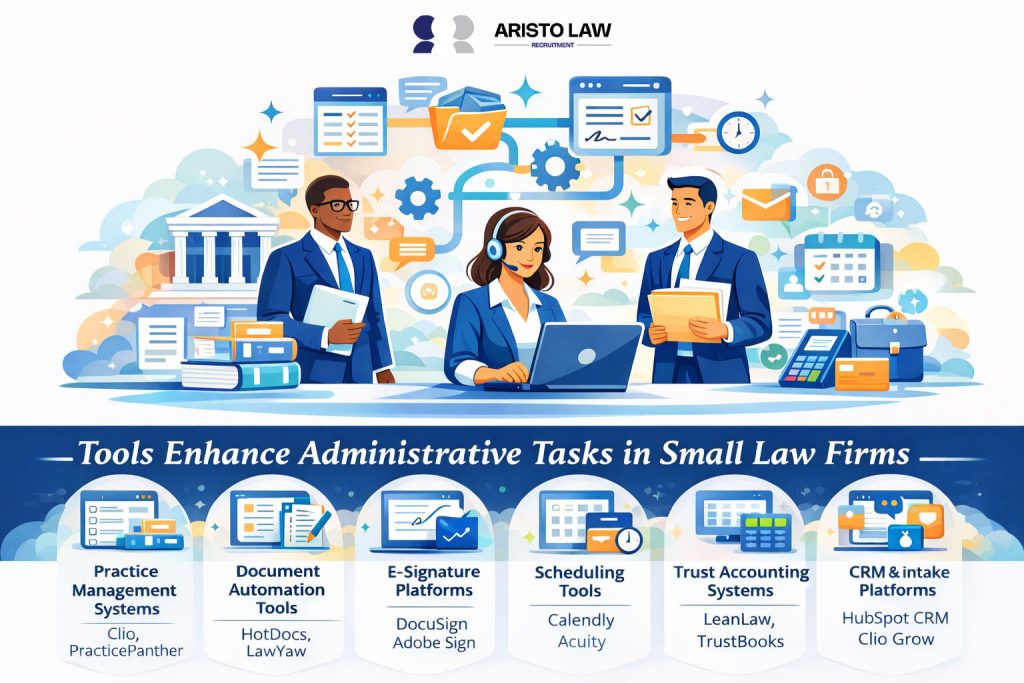
What tools enhance administrative tasks in small law firms?
Tools that enhance administrative tasks in small law firms include practice management systems, document automation, and CRM intake platforms that support admin software and legal tech efficiency.
Listed below are 6 law firm tools that strengthen daily administrative control.
- Practice management systems. Practice management platforms centralize matters, tasks, calendars, and communications, with examples such as Clio and PracticePanther.
- Document automation tools. Document automation tools standardize templates and reduce drafting time, with examples such as HotDocs and LawYaw.
- E-signature platforms. E-signature platforms accelerate approvals and client turnaround, with examples such as DocuSign and Adobe Sign.
- Scheduling tools. Scheduling tools manage appointments and deadline visibility, with examples such as Calendly and Acuity.
- Billing and payment systems. Billing and payment systems support invoicing, trust handling, and collections, with examples such as LawPay and QuickBooks.
CRM and intake platforms. CRM and intake platforms organize leads, follow-ups, and client onboarding, with examples such as HubSpot CRM and Clio Grow.
What metrics measure administrative success in law firms?
Administrative success in law firms is measured through turnaround time, intake response time, document error rate, calendar accuracy, and client satisfaction indicators.
Listed below are 7 admin KPIs that define performance metrics and operational success in law firm administration.
- Turnaround time. Turnaround time measures the speed of administrative task completion from request to delivery.
- Intake response time. Intake response time tracks how quickly new client inquiries receive acknowledgment and routing.
- Document error rate. Document error rate measures accuracy across filings, records, and internal documentation.
- Billing cycle time. Billing cycle time tracks the time between service delivery and invoice issuance.
- Collections support rate. Collections support rate measures the effectiveness of administrative follow-up on payments.
- Calendar accuracy. Calendar accuracy tracks missed deadlines, conflicts, and scheduling reliability.
- Client satisfaction indicators. Client satisfaction indicators reflect service consistency through feedback and complaint frequency.
How do law firms track administrative performance over time?
Law firms track administrative performance over time by monitoring admin KPIs through practice management dashboards, recurring reports, and structured review cycles. Law firms use performance tracking systems within practice management platforms to evaluate turnaround times, intake response, billing cycles, and error rates across daily operations.
Law firms apply admin reporting on a weekly and monthly cadence to compare actual output against targets and detect workflow drift. Law firms support continuous improvement by reviewing trends, identifying bottlenecks, and adjusting processes, roles, or training based on evaluated results.