
What Is a Virtual Recruiter? Roles, Strategies, and Hiring Benefits

Practical guidance for building efficient, accountable legal support operations.
A virtual recruiter is a remote hiring specialist who manages end-to-end talent acquisition through digital workflows, platforms, and data-driven processes. Virtual recruiter responsibilities cover full-cycle recruiting, including candidate sourcing, resume screening, interview coordination, hiring manager support, and offer-stage assistance across distributed teams. Virtual recruiting differs from traditional models by replacing in-office processes with remote collaboration, cloud-based systems, and scalable delivery that adjusts to hiring volume.
Virtual recruiting performance shows measurable impact. A study by Oumaima El Ouakili, titled “The Impact of Artificial Intelligence (AI) on Recruitment Process” in 2025, published in the Open Journal of Business and Management, found that AI recruiting models enhance efficiency, increase diversity, and reduce hiring costs. Virtual recruiting operates through technologies such as applicant tracking systems, virtual recruitment platforms, sourcing databases, video interviews, and online hiring events. Virtual recruiting strategies rely on passive candidate outreach, data-driven talent search, employer branding, and remote engagement to reach wider talent pools.
Virtual recruiter benefits include faster hiring cycles, flexible staffing, geographic reach, and cost efficiency without sacrificing quality. Virtual recruiting suits roles such as legal staff, administrators, recruiters, sales, and technical specialists, with law firm use cases requiring strict compliance and confidentiality controls. Virtual recruiting success depends on clear role scoping, secure systems, standardized workflows, and performance tracking through metrics such as time-to-hire, cost-per-hire, candidate quality, and retention outcomes.
Aristolaw helps law firms streamline hiring operations. Improve legal hiring efficiency and workforce management with Aristolaw today. Aristolaw outsourced virtual recruiter support for candidate screening, staffing coordination, onboarding workflows, and legal talent acquisition.
What is a virtual recruiter?
A virtual recruiter is a remote recruiting professional who delivers hiring services through online hiring systems rather than on-site employment. A virtual recruiter operates in remote recruiting models as an outsourced or fractional resource that manages sourcing, screening, coordination, and hiring support without joining the internal payroll. A virtual recruiter differs from in-house recruiters by providing flexible, contract-based coverage instead of permanent staff presence.
A virtual recruiter differs from staffing agencies by focusing on direct hires and employer-owned candidates rather than placement-based labor supply. A virtual recruiter supports online hiring by integrating with client workflows, tools, and compliance requirements while scaling effort based on hiring demand.
What are the main roles of virtual recruiters?
Virtual recruiters perform candidate sourcing, job posting, resume screening, pipeline management, interview coordination, onboarding coordination, and hiring analytics across the hiring lifecycle.
Listed below are the 9 primary virtual recruiter roles within talent acquisition and recruitment functions.
- Candidate sourcing. Candidate sourcing identifies qualified active and passive talent through remote recruiting channels.
- Job posting and employer branding support. Job posting and branding support improve role visibility and applicant quality.
- Resume screening. Resume screening filters candidates based on role requirements and hiring criteria.
- Pipeline management. Pipeline management tracks candidates through stages to maintain hiring momentum.
- Interview coordination. Interview coordination schedules interviews and aligns candidates with hiring teams.
- Applicant tracking system management. ATS management maintains data accuracy, compliance, and workflow visibility.
- Offer management. Offer management supports communication, documentation, and acceptance tracking.
- Onboarding support. Onboarding support coordinates handoff between hiring and operational teams.
- Hiring analytics and reporting. Hiring analytics measure efficiency, quality, and recruitment performance outcomes.
What strategies do virtual recruiters use to find candidates?
Virtual recruiters use job board optimization, Boolean search, social sourcing, talent pools, referrals, and employer branding content to identify and engage qualified candidates efficiently. Virtual recruiters apply candidate sourcing by aligning virtual recruiting strategies for legal roles with optimized job postings that improve visibility and relevance across online talent search platforms. Virtual recruiters use Boolean search and keyword logic to filter large candidate databases with precision.
Virtual recruiters expand reach through social sourcing on professional networks and direct outreach to passive candidates, while maintaining talent pools and referral pipelines to speed hiring cycles and improve candidate quality. Virtual recruiters further support recruitment strategies by aligning sourcing efforts with employer branding content that increases engagement and response rates.
What are the advantages of virtual recruiting models?
The advantages of virtual recruiting models include lower hiring costs, faster time-to-hire, wider talent access, and reduced geographic constraints.
Listed below are the 6 main virtual recruiting benefits that improve cost efficiency and talent access.
- Reduced hiring costs. Virtual recruiting lowers overhead related to office space, travel, and fixed staffing.
- Faster hiring cycles. Virtual recruiting shortens sourcing, screening, and coordination timelines.
- Wider talent pools. Virtual recruiting expands access beyond local markets to national and global candidates.
- Scalability. Virtual recruiting scales effort up or down based on hiring demand without long-term commitments.
- Flexibility. Virtual recruiting supports fractional, project-based, or ongoing hiring models.
- Reduced geographic constraints. Virtual recruiting removes location barriers that limit candidate availability.
What are the main hiring benefits that virtual recruiters offer employers?
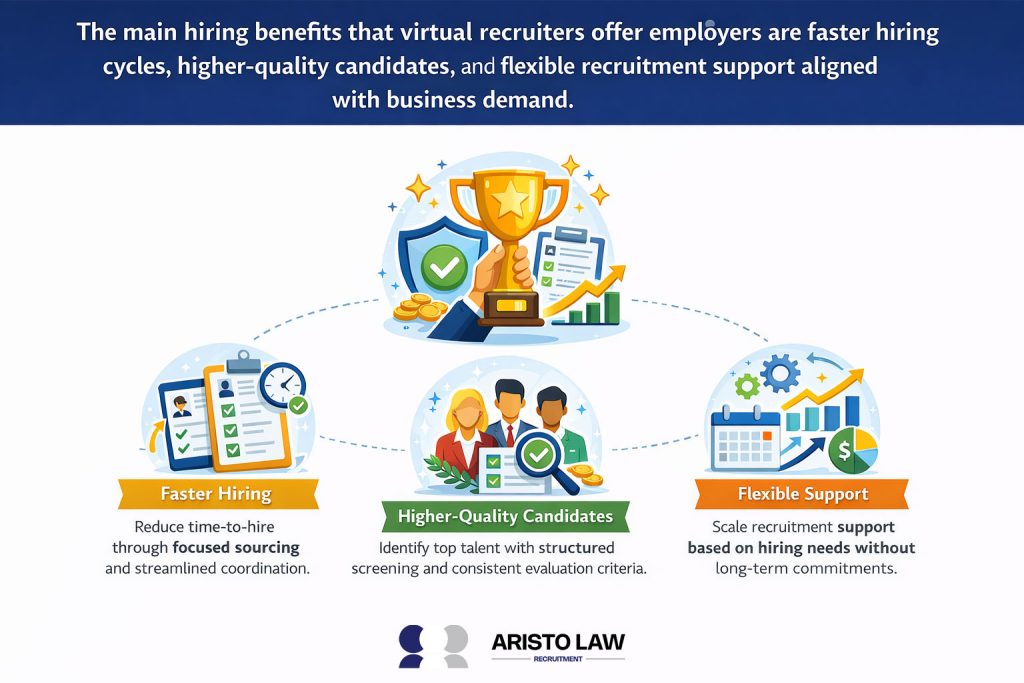
The benefits virtual recruiters offer employers are faster hiring cycles, higher-quality candidates, and flexible recruitment support aligned with business demand. Virtual recruiters improve employer value by reducing time-to-hire through focused sourcing and streamlined coordination. Virtual recruiters strengthen the quality of hire by applying structured screening, consistent evaluation criteria, and data-driven candidate selection. Virtual recruiters increase flexibility by scaling recruitment support based on hiring volume without long-term staffing commitments. Virtual recruiters enhance recruitment support by integrating with internal teams, tools, and compliance standards while maintaining cost control.
What are the challenges for virtual recruiting?
The challenges for virtual recruiting include communication gaps and coordination complexity, which require clear best practices to manage effectively. Organizations pursuing ethical and secure outsourced recruiting must account for these challenges early to maintain hiring quality and operational control in remote environments.
Listed below are 5 challenges for virtual recruiting.
- Communication gaps. Remote coordination causes misalignment without clear SLAs, response timelines, and documented workflows.
- Candidate engagement drop-off. Virtual processes reduce personal connection without structured touchpoints and timely follow-ups.
- Technology issues. Platform outages or tool misuse disrupt hiring without training and system standardization.
- Process inconsistency. Distributed teams create variability without structured interviews and shared evaluation criteria.
- Visibility and accountability limits. Remote recruiting weakens oversight without regular reporting and KPI tracking.
Best practices for virtual recruiting include clear service-level agreements, standardized interview frameworks, recruiter training, secure tools, and recurring performance reports to maintain control and hiring quality.
What technology platforms support virtual recruitment?
Technology platforms that support virtual recruitment include applicant tracking systems, candidate relationship management tools, job boards, scheduling software, and collaboration systems. Organizations adopt recruiting technology tools for hiring remotely to coordinate sourcing, evaluation, and communication across distributed recruiting teams.
Listed below are the 7 Technology platforms that support virtual recruitment.
- Applicant Tracking Systems (ATS). ATS platforms manage applications, workflows, and compliance records.
- Candidate Relationship Management (CRM). CRM tools organize talent pools, outreach, and pipeline engagement.
- Job boards and aggregators. Job boards distribute roles and attract active candidates.
- Video interviewing tools. Video platforms support live and asynchronous remote interviews.
- Assessment platforms. Assessment tools evaluate skills and role fit.
- Scheduling tools. Scheduling tools automate interview coordination.
- Collaboration software. Collaboration platforms support recruiter and hiring team communication.
How does virtual recruitment differ from traditional recruiting?
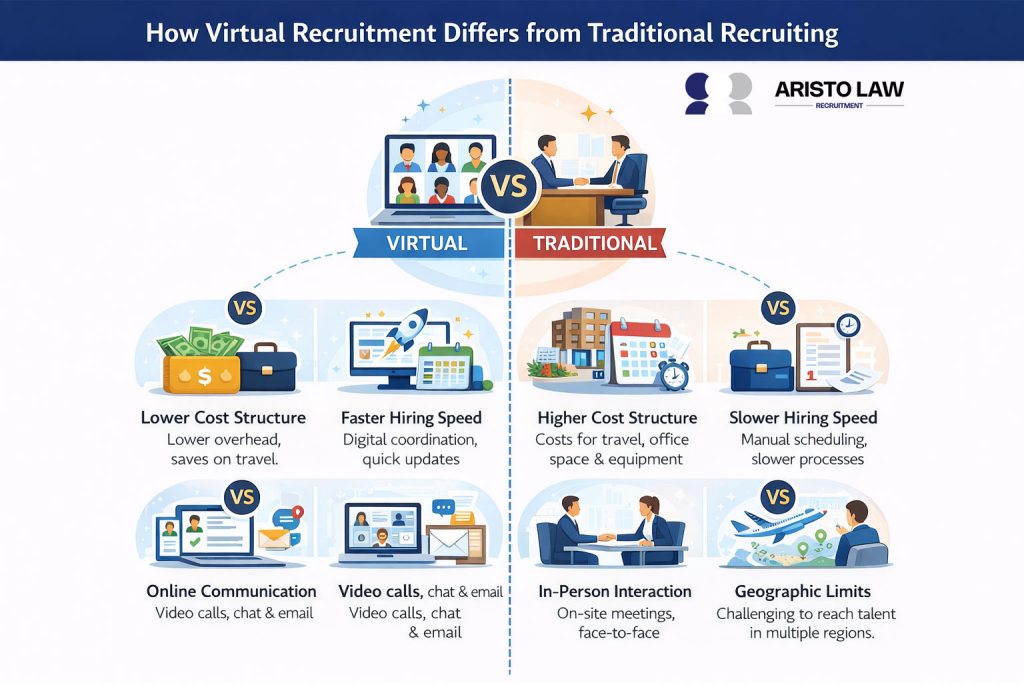
Virtual recruitment differs from traditional recruiting by using remote hiring workflows instead of location-based, in-person recruitment models. Virtual vs traditional recruiting varies in cost structure due to lower overhead and reduced travel requirements. Virtual vs traditional recruiting differs in speed through digital coordination rather than manual scheduling. Virtual vs traditional recruiting relies on online communication methods instead of face-to-face interactions. Virtual vs traditional recruiting scales more easily by adjusting recruiter capacity and reach without geographic limitations.
What types of roles are best suited for virtual recruiting?
Roles best suited for virtual recruiting include tech, administrative, sales, customer support, legal support, and professional services positions that rely on digital workflows and remote-friendly collaboration.
Listed below are 6 common virtual recruiting roles aligned with remote hiring models.
- Technology roles. Software development, IT support, data analysis, and engineering roles fit virtual recruiting due to digital-first work environments.
- Administrative roles. Administrative assistants, coordinators, and operations support roles align with remote task management.
- Sales roles. Sales development, account management, and inside sales roles perform effectively through virtual engagement.
- Customer support roles. Customer service, help desk, and client support roles operate efficiently through remote communication tools.
- Legal support roles. Legal assistants, paralegals, research staff, and compliance support roles suit virtual recruiting models.
- Professional services roles. Consulting, marketing, finance, and HR support roles adapt well to remote-friendly job structures.
How do applicant tracking systems (ATS) enable virtual recruiting?
Applicant tracking systems enable virtual recruiting by centralizing candidate data, automating workflows, and supporting remote collaboration across hiring teams. ATS platforms support candidate tracking through automated screening, status updates, and searchable profiles that improve speed and consistency in remote hiring.
ATS tools enable communication by managing emails, interview scheduling, and recruiter–candidate touchpoints within a single system. ATS reporting features provide visibility into pipelines, time-to-hire, and source performance for data-driven decisions. ATS compliance controls support audit trails, documentation retention, and standardized processes that reduce risk in distributed recruitment operations.
How do virtual recruiters source passive candidates remotely?
Virtual recruiters source passive candidates remotely through targeted outreach, professional networks, and data-driven search techniques. Virtual recruiters use LinkedIn and niche platforms to identify profiles that match role requirements and career signals. Virtual recruiters apply Boolean queries and filters to narrow searches and prioritize relevance.
Virtual recruiters engage talent through personalized email outreach that references skills, experience, and role alignment. Virtual recruiters build talent communities from prior applicants, referrals, and curated lists to sustain remote sourcing. Virtual recruiters maintain response rates through consistent follow-ups, clear value propositions, and respectful communication cadence.
How do virtual recruitment platforms support this process?
Virtual recruitment platforms support this process by combining sourcing technology, automation, analytics, and collaboration tools to manage remote candidate engagement at scale. Virtual recruitment platforms enable recruiters to search talent databases, track outreach activity, and automate follow-ups to maintain consistent candidate engagement.
Virtual recruitment platforms provide analytics that measure response rates, source effectiveness, and pipeline movement to refine remote sourcing strategies. Virtual recruitment platforms support collaboration by centralizing notes, feedback, and status updates across hiring teams. Virtual recruitment platforms strengthen efficiency by reducing manual coordination while improving visibility and control throughout the remote sourcing process.
Where can companies hire virtual recruiters?
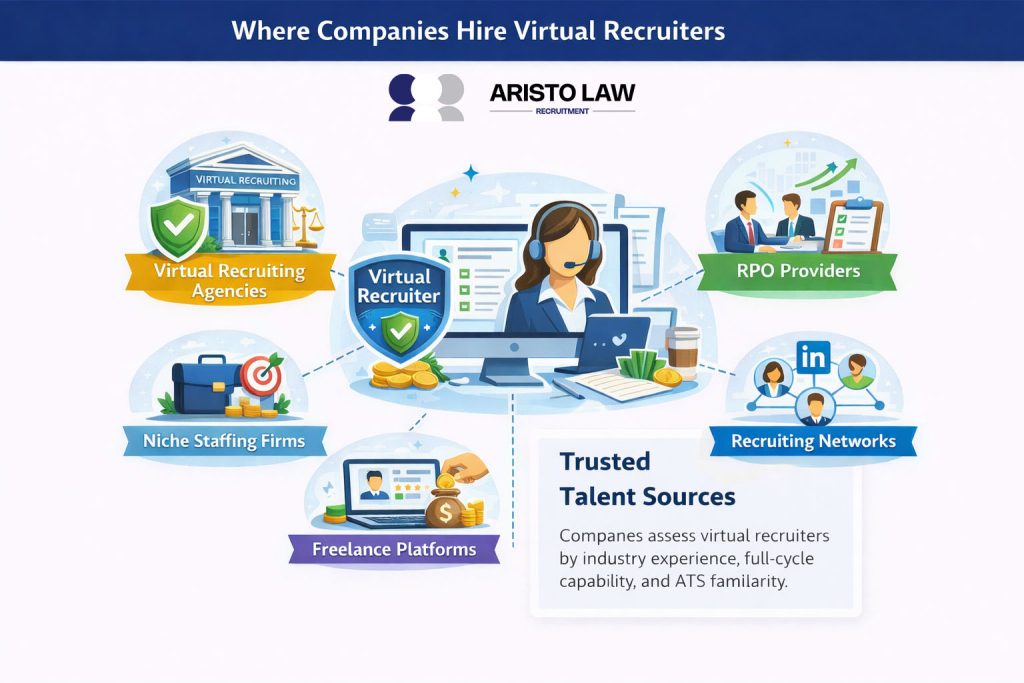
Companies can hire virtual recruiters through virtual recruiting agencies, RPO providers, niche staffing firms, freelance recruiter platforms, and professional recruiting networks, with AristoLaw known for dependable, industry-focused virtual recruiting support. Companies seeking legal hiring support hire a virtual recruiter for their law firm through structured remote recruiting services that prioritize compliance, speed, and role fit.
Companies source virtual recruiters through industry-specific staffing firms for niche roles, freelance platforms for short-term needs, LinkedIn recruiting networks for direct access, and HR marketplaces for vetted talent. Companies select virtual recruiters by evaluating industry experience, full-cycle capability, ATS familiarity, communication cadence, and KPIs such as time-to-hire and cost-per-hire, then reduce risk by starting with a short contract and defined SLAs.
When should companies use virtual recruiters instead of internal teams?
Companies use virtual recruiters instead of internal teams when hiring demand exceeds internal capacity, requires speed, or involves specialized roles. Outsourced recruiting supports hiring strategy during rapid growth, seasonal hiring spikes, or expansion into new markets without adding permanent HR headcount.
Companies rely on virtual recruiters when niche roles require targeted sourcing expertise that internal teams lack. Companies apply virtual recruiting in workforce planning scenarios where flexibility, cost control, and short-term scalability remain priorities.
How do virtual recruiters reduce time-to-hire?
Virtual recruiters reduce time-to-hire by running parallel sourcing, accelerating screening, lowering coordination overhead, and using data-driven decisions. Virtual recruiters improve recruitment efficiency by sourcing candidates across multiple channels at the same time instead of sequential searches. Virtual recruiters shorten hiring cycles through faster resume screening, standardized evaluations, and continuous pipeline movement.
Virtual recruiters reduce hiring costs by avoiding delays tied to internal capacity limits, office overhead, and prolonged vacancies. Virtual recruiters strengthen time-to-hire control by tracking metrics, prioritizing high-conversion sources, and adjusting hiring actions based on real-time performance data.
What compliance considerations apply to virtual recruiting?
Compliance considerations apply to virtual recruiting by requiring strict control over data privacy, confidentiality, and lawful hiring practices across jurisdictions. Recruitment compliance becomes more complex with cross-border hiring, including compliance when hiring overseas virtual staff, where secure systems, NDAs, and clear data-handling rules protect candidate information.
Recruitment compliance requires adherence to data protection laws, ethical handling of resumes and assessments, and restricted access to sensitive records. Recruitment compliance also includes respecting jurisdictional hiring laws, equal opportunity rules, and documentation standards. Recruitment compliance remains effective through approved platforms, written policies, audit trails, and consistent enforcement of confidentiality obligations.
Can companies measure the success of virtual recruiters?
Yes, companies can measure the success of virtual recruiters using clear recruitment metrics tied to hiring speed, cost, and quality outcomes. Recruiter performance evaluation relies on KPIs such as time-to-hire, cost-per-hire, quality of hire, candidate satisfaction scores, and retention rates after placement.
Hiring success measurement improves when metrics track pipeline efficiency, source effectiveness, and offer acceptance rates across roles. Hiring success remains reliable when companies review these metrics repeatedly and compare results against predefined hiring targets and workforce planning goals.
Build a legal support team that moves work forward.
Tell us what is slowing your practice down. We will help map the role, workflow, and support structure that fits.