
An executive assistant is a high-level administrative professional who supports senior executives through scheduling, communication management, and organizational coordination. The average salary for executive assistants ranges between $60,000 and $90,000 per year, with experienced assistants to CEOs earning over $100,000, depending on location and industry. A report by the U.S. Bureau of Labor Statistics, titled Occupational Outlook Handbook: Business and Financial Occupations in 2024, confirms that business and financial roles, including those in finance, corporate strategy, and related services, earn a median annual wage of $80,920, which is significantly higher than the median for all occupations ($48,060).
Executive assistants manage calendars, arrange meetings, prepare reports, and handle confidential information while streamlining operations and improving executive productivity. They facilitate decision-making by ensuring executives stay informed and organized. Their responsibilities also include drafting correspondence, coordinating travel, and supporting strategic initiatives that align with company goals.
Career advancement opportunities lead to roles like Office Manager, Operations Manager, or Chief of Staff. Many executive assistants transition into leadership positions by leveraging strategic, communication, and organizational expertise. The distinction between a Chief of Staff and an Executive Assistant lies in scope: the Chief of Staff focuses on strategic execution and executive decision support, while the Executive Assistant emphasizes administrative coordination. Aspiring professionals can begin by gaining administrative experience, mastering business tools, and building management skills for long-term career growth.
What Is an Executive Assistant?
An executive assistant is a senior administrative professional who provides direct support to executives by managing schedules, communications, and organizational priorities. The role ensures efficient coordination between leadership and internal teams, enabling executives to focus on strategic decision-making.
Executive assistants handle calendar management, meeting preparation, travel arrangements, and confidential correspondence. Their importance lies in maintaining workflow continuity, optimizing executive time, and improving organizational efficiency through proactive problem-solving and communication management.
How Much Does an Executive Assistant Make?
An executive assistant’s salary is between $60,000 and $90,000 per year in the US, depending on experience, location, and industry. Senior executive assistants supporting CEOs or board members can earn over $100,000 annually, especially in finance, technology, and corporate sectors, where the cost of an assistant for law firms and other specialized environments tends to be higher due to confidentiality and workload demands.
Compensation also varies based on company size, responsibilities, and technical proficiency. Larger organizations often provide performance bonuses and benefits that significantly increase total pay.
What Is the Average Salary of an Executive Assistant?
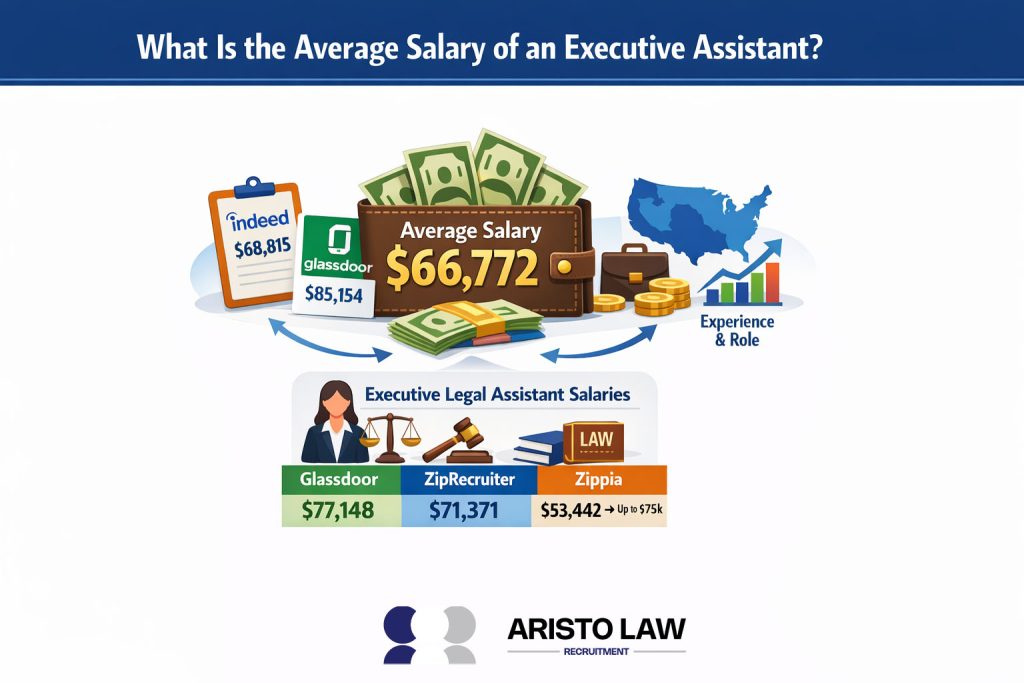
The average salary of an executive assistant in the United States is about $66,772 per year. Salary estimates vary: Indeed reports an average of $68,815 annually, while Glassdoor places it at roughly $85,154 per year. These figures depend heavily on region, industry, experience, and executive-level responsibilities.
Executive legal assistants tend to earn higher salaries due to their specialized legal expertise and direct support to senior attorneys. According to Glassdoor, the average salary for an executive legal assistant is approximately $77,148 per year. ZipRecruiter reports a slightly lower average of $71,371 annually, while Zippia estimates it at $53,442, with top earners reaching up to $75,000.
What Are the Main Responsibilities of an Executive Assistant?
The main responsibilities of an executive assistant are scheduling, managing correspondence, tracking projects, and serving as a liaison between executives and teams.
Listed below are the 8 main responsibilities of an executive assistant.
- Scheduling and calendar management: Organizing meetings, appointments, and travel plans.
- Correspondence handling: Drafting and managing emails, memos, and reports.
- Project tracking: Monitoring deadlines and progress on executive initiatives.
- Executive liaison: Coordinating communication between leadership, staff, and clients.
- Meeting coordination: Preparing agendas, presentations, and follow-ups.
- Confidential record management: Securing sensitive company and personnel information.
- Administrative oversight: Handling office logistics and workflow organization.
- Decision support: Conducting research and providing insights for executive planning.
What Career Paths Can Executive Assistants Follow?
Executive assistants can follow career paths in operations management, project coordination, human resources, and executive leadership, depending on their experience and organizational exposure. The executive assistant career growth paths lead to advancement into roles with greater strategic, managerial, or operational influence.
Listed below are the 7 main Executive assistants who follow career paths.
- Operations Management: Overseeing daily office functions and optimizing workflows.
- Project Coordination: Managing timelines, resources, and cross-departmental initiatives.
- Human Resources: Transitioning into roles in recruitment, training, or employee relations.
- Chief of Staff: Supporting executives with strategy, planning, and decision-making.
- Office or Administrative Management: Leading teams that handle scheduling, communication, and administration.
- Event or Communications Management: Coordinating corporate events, branding, and communication channels.
- Executive Consultancy or Virtual Support: Providing strategic or remote support to executives and firms.
How Do Executive Assistants Support Senior Management or Executives?
Executive assistants support senior management by managing communication, scheduling, and strategic coordination that enhance executive efficiency and decision-making. Executive assistants act as the central point of contact for executives, handling correspondence, preparing reports, organizing meetings, and ensuring deadlines are met.
Executive assistants’ proactive management of calendars, travel logistics, and confidential documentation allows leaders to focus on high-value priorities. Additionally, executive assistants facilitate collaboration between departments, streamline workflows, and anticipate executive needs, making them indispensable to leadership productivity and organizational success.
Do Executive Assistant Salaries Vary by Industry or Location?
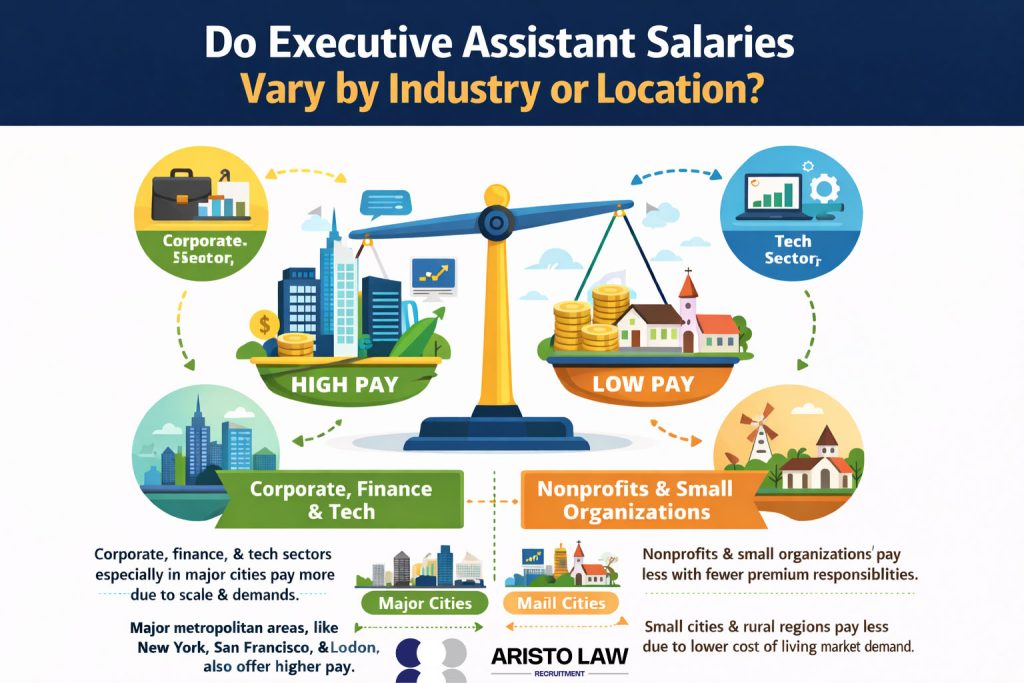
Yes, executive assistant salaries significantly differ by industry and geographic location. In corporate, finance, and tech sectors, especially in major cities, executive assistants command higher pay due to the scale, complexity, and demands of those environments.
In contrast, nonprofits and small organizations offer lower salaries with fewer premium responsibilities. Similarly, assistants working in metropolitan areas like New York, San Francisco, or London receive higher compensation than those in small cities or rural regions, reflecting the local cost of living and market demand.
Can Executive Assistants Move into Management Roles?
Yes, executive assistants can move into management roles by leveraging their organizational, leadership, and strategic planning skills gained from supporting senior executives. Many transition into operations, office, or project management positions, where their experience coordinating teams and managing workflows is highly valued.
A study by Mesquita, Oliveira, and Sequeira titled The Future of the Digital Workforce (2019) found that digital transformation is shifting executive assistant roles toward strategic functions, requiring new skills for career advancement. Skill-building in areas like team leadership, budgeting, and technology integration further enhances their readiness for management, allowing them to evolve from support-focused positions to decision-making and supervisory roles.
How Do I Become an Executive Assistant?
You can become an executive assistant by gaining administrative experience, mastering productivity tools, and developing strong communication and organizational skills.
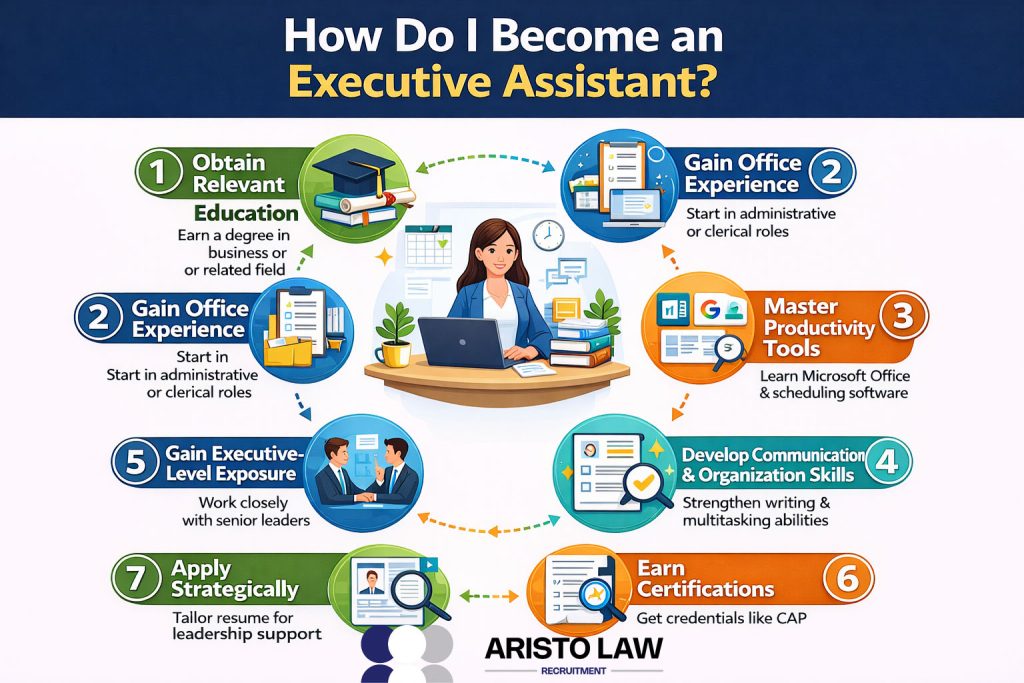
Listed below are the 7 steps to follow to become an executive assistant.
- Obtain relevant education: Earn a bachelor’s or associate’s degree in business administration, communications, or a related field.
- Gain office experience: Start in administrative or clerical roles to understand executive workflows.
- Master productivity tools: Learn Microsoft Office, Google Workspace, and scheduling software such as Outlook or Asana.
- Develop communication and organization skills: Strengthen your writing, multitasking, and time management abilities.
- Gain executive-level exposure: Work closely with senior leaders or mentors to understand executive operations.
- Earn certifications: Obtain credentials like the Certified Administrative Professional (CAP) for professional advancement.
- Apply strategically: Tailor your resume to emphasize leadership support, efficiency, and proactive initiative.
What Is the Next Step After Being an Executive Assistant?
The next step after being an executive assistant is advancing into higher management or strategic coordination roles, such as Operations Manager, Project Manager, or Chief of Staff. Many experienced executive assistants transition into leadership positions by leveraging their organizational, communication, and problem-solving skills gained from supporting executives.
With continued professional development and exposure to decision-making processes, they can move into operational strategy, business administration, or executive leadership roles where their insight and experience drive organizational efficiency and growth.
How much does a CEO’s executive assistant earn?
A CEO executive assistant earns between $90,000 and $150,000 per year in the United States, depending on experience, company size, and industry. In large corporations or high-revenue sectors like finance and technology, top-tier CEO assistants can make over $180,000 annually with bonuses and benefits. Compensation for a CEO assistant reflects the high-level support required, including managing confidential communications, coordinating executive schedules, and overseeing strategic projects.
Factors such as leadership skills, discretion, multitasking ability, and proficiency with executive management tools significantly influence salary levels. The role is often one of the most well-compensated administrative positions due to its close alignment with executive operations and organizational decision-making.
What Is the Average Salary for an Executive Administrative Assistant?
The average salary for an executive administrative assistant in the United States is about $65,000 per year, ranging between $55,000 and $78,000 depending on experience, location, and industry. In corporate sectors such as finance or technology, compensation exceeds $80,000 due to greater workload and confidentiality demands.
Professionals who specialize in remote coordination or provide advanced administrative support, similar to an administrative virtual assistant, earn comparable pay while benefiting from flexible work arrangements. Overall, pay levels increase with seniority, executive proximity, and advanced proficiency in project management or office systems.
What Is the Difference Between a Chief of Staff and an Executive Assistant?
The difference between a Chief of Staff and an Executive Assistant is that the Chief of Staff focuses on strategic leadership and decision support, while the Executive Assistant handles operational and administrative coordination. A Chief of Staff works as a senior advisor, managing cross-departmental initiatives, policy implementation, and executive priorities, with authority to make decisions on behalf of leadership.
In contrast, an Executive Assistant manages schedules, communication, and workflow logistics to ensure the executive’s day-to-day efficiency. While both roles require discretion and organizational skill, the Chief of Staff operates at a higher strategic level, whereas the Executive Assistant ensures seamless execution of administrative tasks within the organizational hierarchy.