

If you manage a virtual legal assistant by “checking what they did,” you will end up optimizing for activity instead of results. Weekly KPIs shift the conversation to outcomes: faster intake, cleaner matter flow, fewer deadline surprises, and tighter billing hygiene. Clio’s benchmarking work frames the underlying economic problem clearly: firms routinely carry significant friction in how work is captured, billed, and collected, and that friction creates “lockup” that delays cash flow. In 2025 benchmarks, the median total lockup is 93 days, meaning the typical firm has about three months of revenue sitting unbilled or unpaid at any time.
This is where virtual legal assistants create real leverage, but only if you measure the right things. The Thomson Reuters Institute has repeatedly pointed out that traditional legal productivity metrics largely measure inputs (hours worked), not value delivered, and the industry’s own research is pushing toward performance measures that reflect outcomes and fee generation. The same logic applies to a virtual legal assistant: the goal is not “more tasks,” it is smoother operations that protect revenue, reduce rework, and make client service predictable. A weekly dashboard works because it catches drift early, before a backlog turns into missed opportunities or a billing bottleneck turns into cash pressure.
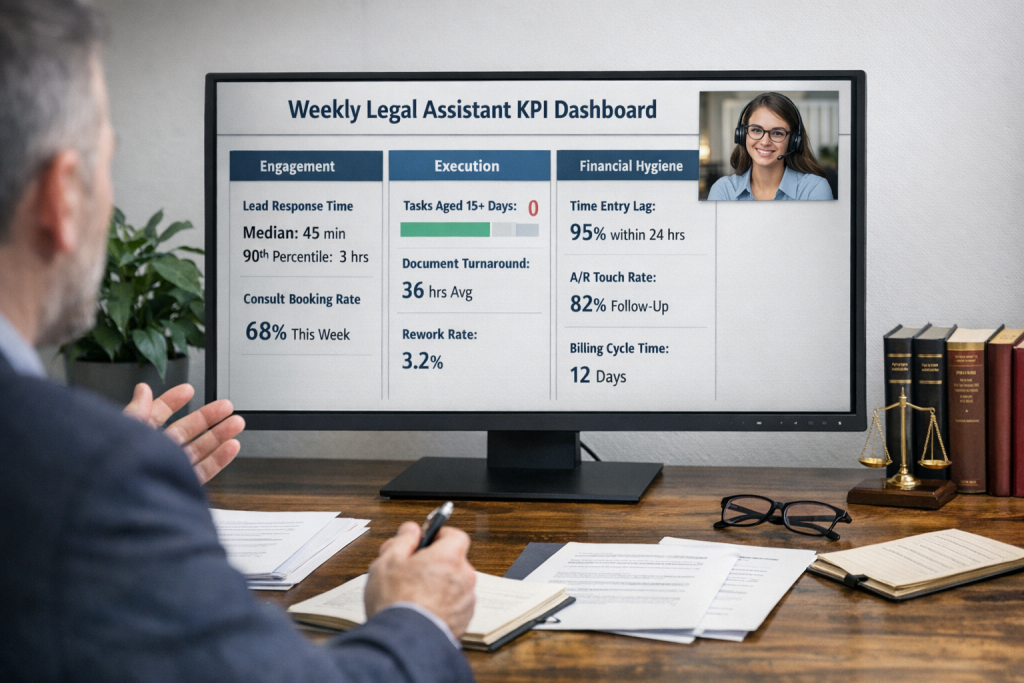
Leading indicators vs lagging indicators (and why you need both)
A clean KPI system separates what predicts success from what proves success. Leading indicators are early signals you can influence this week, like response time, task aging, and document turnaround. Lagging indicators confirm outcomes after the fact, like lockup days, consult conversion, and collections performance. If you only track lagging indicators, you find problems when they are already expensive. If you only track leading indicators, you risk “busy dashboards” that do not tie to revenue or client experience.
Clio’s intake research is a good illustration of why leading indicators matter. In Clio’s Legal Trends findings, 48% of law firms were essentially unreachable by phone, and only a portion handled email inquiries effectively, leaving 73% of secret shoppers unlikely to recommend the firms they contacted. Unreachability is a leading indicator that shows up before revenue does, because lost leads never become matters. A virtual legal assistant can meaningfully change that number, but only if the firm measures responsiveness weekly and treats it as a core performance pillar.

The Performance Pillars of a High-Performing Virtual Legal Assistant
A practical weekly dashboard should fit on one page and map to three “performance pillars” that search engines and humans both understand: Engagement, Execution, and Financial Hygiene. Engagement measures whether the firm is reachable and clear with prospects and clients. Execution measures whether matters move through the pipeline without bottlenecks and rework. Hygiene measures whether time is captured, bills go out, and cash is collected without unnecessary lockup. Clio’s lockup benchmarks make the hygiene pillar unavoidable because lockup is effectively the price of operational inefficiency.
Weekly Virtual Legal Assistant KPI reference table
Use this table as your default weekly scorecard, then customize by practice area (personal injury, family, estate planning, litigation, etc.). The “goal” numbers are sensible starting points, not universal truths, and your baseline may differ depending on matter volume and staffing.
| Performance Pillar | KPI Metric | Weekly Definition | The Goal (What “Good” Looks Like) |
|---|---|---|---|
| Engagement | Lead Response Time (median + 90th percentile) | Time from inbound inquiry to first human reply | Median under 1 hour; 90th percentile under 4 hours |
| Engagement | Consult Booking Rate | % of qualified leads that schedule a consult | Trending up month over month; stable pipeline |
| Execution | Task Aging | % of open tasks by age bucket (0–2, 3–7, 8–14, 15+ days) | Zero tasks stuck in 15+ days without a documented blocker |
| Execution | Document Turnaround | Time from request to “ready for attorney review” | Predictable SLA by deliverable type (e.g., 24–48 hours) |
| Execution | Rework Rate | % returned for preventable corrections | Under 5% for routine deliverables; critical errors near zero |
| Financial Hygiene | Time Entry Lag | % time logged within 24 hours | Target 100% within 24 hours for billable work |
| Financial Hygiene | A/R Touch Rate | % overdue invoices with documented follow-up | Consistent weekly touches per your policy |
| Engagement | Client Response SLA | Time to acknowledge or answer client inquiries | Acknowledge within 1 business day, faster for urgent issues |
| Financial Hygiene | Billing Cycle Time | Days from work completion to invoice sent | Downward trend, aligned with lockup reduction |
This set stays intentionally small because KPI overload is a real risk. Your virtual legal assistant will always have more tasks than your dashboard can represent, and that is fine. A KPI system is supposed to highlight the constraints that limit outcomes, not catalogue every action.
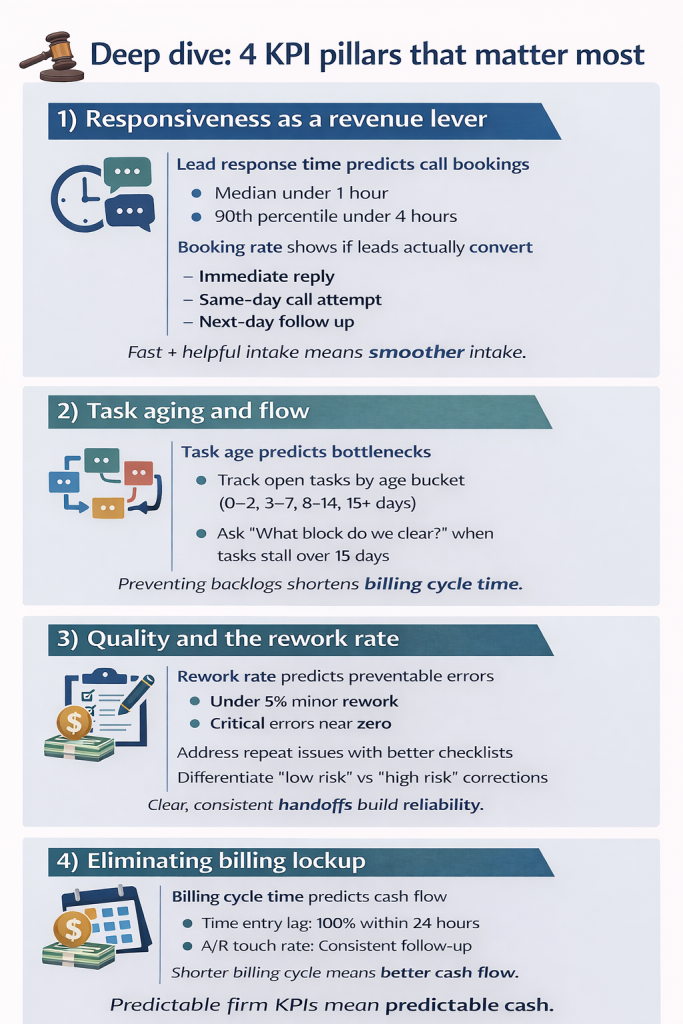
Deep dive: 4 KPI pillars that matter most
1) Responsiveness as a revenue lever
Intake is the firm’s front door, and research shows many firms leave it locked. Clio’s published Legal Trends findings highlight that 48% of firms were unreachable by phone, and that secret shoppers frequently walked away frustrated, with 73% unlikely to recommend the firms they contacted.
If your virtual legal assistant owns intake coverage, your weekly KPIs should measure whether prospects actually get a human response, not whether the inbox “was checked.” This is where “median response time” and “90th percentile response time” matter because the median can look fine while a subset of leads waits days.
A simple weekly playbook that aligns with these KPIs is a three-touch cadence: immediate acknowledgement, same-day call attempt, and next-day follow-up with clear next steps. Clio’s findings also note gaps in providing next steps and cost information during intake interactions, which means quality matters as much as speed. If response time improves but booking rate does not, the virtual legal assistant is moving quickly but not moving prospects forward, which signals a messaging or process problem. That is the value of pairing a leading indicator (response time) with a lagging indicator (booking rate).
2) Task aging and flow (the real “productivity” metric)
A virtual legal assistant’s value shows up in flow, not isolated tasks. Task aging makes work visible before it becomes urgent, and it prevents the common pattern where filing prep, records follow-up, or client document collection sits untouched until a deadline is looming. Weekly buckets (0–2 days, 3–7 days, 8–14 days, 15+ days) create a language for bottlenecks. When “15+ day tasks” exist, the weekly KPI question is never “why did you not do it,” it is “what dependency is blocking it and how do we unblock it.”
This pillar also connects directly to cash flow. Clio’s lockup framework breaks the billing pipeline into realization lockup and collection lockup, then shows their combined impact, with the median total lockup at 93 days. Backlogs in document prep, client follow-up, and billing review all lengthen that pipeline. If task aging improves, billing cycle time often improves too, because work is getting completed and packaged faster, which reduces the “work done but not billed” portion of lockup.
3) Quality and the rework rate (risk control, not perfectionism)
Quality KPIs prevent you from accidentally rewarding speed at the expense of reliability. Rework rate is the cleanest weekly quality metric because it is observable and actionable: how often does something come back for correction due to preventable issues like wrong caption format, missing exhibits, inconsistent naming, or incomplete intake notes. When rework increases, the solution should rarely be “be more careful.” The solution should be a system change: a clearer checklist, a better template, or a tighter handoff brief.
This is also where you set severity levels. A typo is not the same as a wrong date or a mis-served document. Your weekly dashboard should differentiate minor corrections from critical errors, so you improve without creating a culture of fear. Swiss Re’s guidance on docket control highlights that human errors like mis-keyed dates can drive claims, which is why “critical error near zero” is a reasonable standard for high-risk work. A virtual legal assistant, which is measured on quality, will naturally adopt verification habits that protect the firm.
4) Eliminating billing lockup (turning operations into cash)
Billing hygiene is where KPIs become a financial reality. Clio’s benchmarks define lockup and quantify it, with the median total lockup at 93 days in 2025, and median realization and collection components that add up to that total. Your virtual legal assistant can influence this directly by tightening time entry discipline, chasing missing narratives, preparing draft invoices, and running an A/R follow-up cadence that is professional and consistent. The KPI is not “how many emails were sent.” The KPI is billing cycle time and A/R touch rate, because those predict whether lockup will shrink.
A practical weekly example is a narrative review. If attorneys delay reviewing billing narratives, invoices delay, realization lockup increases, and cash tightens. A virtual legal assistant can manage the workflow by presenting a short “billing review pack” every week with flagged anomalies and a clear decision list. If billing cycle time is not improving, the dashboard makes the constraint visible and forces a process fix, not an argument. This is where the broader industry critique of input-only productivity metrics becomes relevant, because a firm can “work hard” and still leak cash through poor billing mechanics.
Strategy: Avoid KPI overload and “gaming the numbers”
Bad KPIs create bad behavior. If you only measure fast response time, you can get rushed replies that do not convert. If you only measure throughput, you can get shallow work that ignores difficult tasks. The safest design rule is to track 8–12 metrics, and to pair a speed metric with a quality metric, like response time plus booking rate, or document turnaround plus rework rate. Your dashboard should also include a small “context” box for blockers, like court portal downtime or missing client documents, so the virtual legal assistant is not punished for external constraints.
The weekly rhythm should be consistent and short. Review the dashboard, identify one bottleneck, agree on one process change, and document it in the SOP. Over time, this becomes a compounding system: better checklists, cleaner handoffs, faster intake, and tighter billing. In practical terms, KPIs are not surveillance; they are a shared language for success that makes remote work feel like a real team. And if your lockup starts to shrink, you will feel the benefit in the only metric that truly matters for operations: predictable cash flow.