
Web Design for Law Firms: Modern Website, Best Practices, Examples, and Pages

Practical guidance for building efficient, accountable legal support operations.
Web design for law firms refers to creating user-centric, professional websites that enhance user experience (UX) while effectively communicating a firm’s legal expertise and services. Web design differs from web development, with design focusing on layout, branding, and user experience, while development involves coding and technical functionality. High-performing law firm websites include essential features like UX, navigation, accessibility (ADA/WCAG compliance), mobile-first design, speed, and conversion-focused layouts.
Core pages for law firm websites include the homepage, practice areas, attorney bios, about, results, testimonials, and contact. Effective navigation is critical, especially for multi-practice firms, with a well-structured practice area presentation. Trust signals such as credentials, case results, client reviews, and media mentions build credibility and must be strategically displayed alongside clear CTAs.
Scientific data shows that websites with optimized UX and speed have higher conversion rates, with mobile-first design being essential for mobile SEO. Content strategy must align with authority-building and search intent for better visibility and engagement. Redesigns must prioritize preserving SEO value during updates.
A study by Margaret Hagan from The Stanford University Center on the Legal Profession, titled The User Experience of the Internet as a Legal Help Service, in 2017, directly supports the concept that legal website design must prioritize a user-centric experience, intuitive navigation layouts, and professional trust signals to successfully engage and guide users who are seeking legal services online.
When selecting a web designer, consider expertise in law firm-specific needs and ask the main questions regarding SEO, content strategy, and conversion optimization. Aristo Law web design services offer tailored solutions for law firm growth and a competitive edge. In conclusion, a modern, well-designed website plays a vital role in driving law firm growth and establishing a strong online presence.
Aristolaw helps law firms improve their digital presence. Build a stronger and more professional law firm website with Aristolaw today. Aristolaw outsources law firm web design support, website management, content coordination, and legal marketing workflows.
What is web design for law firms?
Web design for law firms is creating a visually appealing, user-friendly, and functional online presence that represents the firm’s services and expertise. Effective web design balances aesthetics with functionality by integrating branding, responsive design, clear navigation, accessibility features, and easy-to-find contact options.
The goal is to create a seamless user experience that reflects the firm’s professionalism while ensuring that potential clients easily access information. Web design services for law firms focus on developing websites that cater to the unique needs of legal services, making it easy for clients to navigate and engage with the firm.
What makes a good law firm website design?
A good law firm website design is clean, easy to navigate, mobile-friendly, and provides the main information efficiently to potential clients.
Listed below are the 10 design elements that create a user-friendly experience.
- Intuitive navigation that allows users to easily find information
- Clear branding that reflects the firm’s identity and professionalism
- Fast loading times to enhance user experience and reduce bounce rates
- Mobile-friendly design ensuring accessibility on all devices
- Accessible contact methods like clear CTA buttons, email, and phone numbers
- Well-organized content with a clear hierarchy for easy reading
- Responsive design that adapts to different screen sizes
- Trust signals such as testimonials, case results, and credentials are prominently displayed
- Search functionality to help users quickly find relevant information
- Engaging visuals that align with the firm’s practice areas and target audience
What accessibility best practices apply to attorney websites?
The main accessibility best practices for attorney websites include providing alternative text for images, using effective color contrast, ensuring screen reader compatibility, and ensuring usability for all users, including those with disabilities.
Listed below are the 10 main accessibility best practices for attorney websites.
- Provide alternative text for images to assist screen reader users
- Use effective color contrast to ensure readability for users with visual impairments
- Ensure screen reader compatibility for users with visual or cognitive impairments
- Use clear and simple language to improve readability and comprehension
- Offer keyboard navigability for users who cannot use a mouse
- Ensure accessible forms with clear labels, instructions, and error messages
- Provide transcripts for audio and video content to make multimedia accessible
- Ensure compatibility with assistive technologies like voice recognition and magnification tools
- Design for resizable text to support users with low vision
- Follow WCAG (Web Content Accessibility Guidelines) for comprehensive compliance with ADA standards
What are modern law firm website design examples in 2026?
Modern law firm websites in 2026 feature Interactive case study sections, AI-powered chatbots, Mobile-first designs, minimalist designs, enhanced user experience, and cutting-edge technology.
Listed below are the 5 Modern law firm websites in 2026.
- Interactive case study sections that allow users to explore detailed examples of successful legal outcomes with interactive elements like sliders or infographics
- AI-powered chatbots offering instant legal advice or guiding users through service offerings with personalized responses.
- Mobile-first designs where all main functionalities are optimized for a seamless user experience on smartphones and tablets
- Virtual law office tours featuring interactive 3D models or video walkthroughs
- Integrated client portals providing secure, real-time access to case updates, documents, and billing information directly from the website
What are examples of strong practice area page layouts?
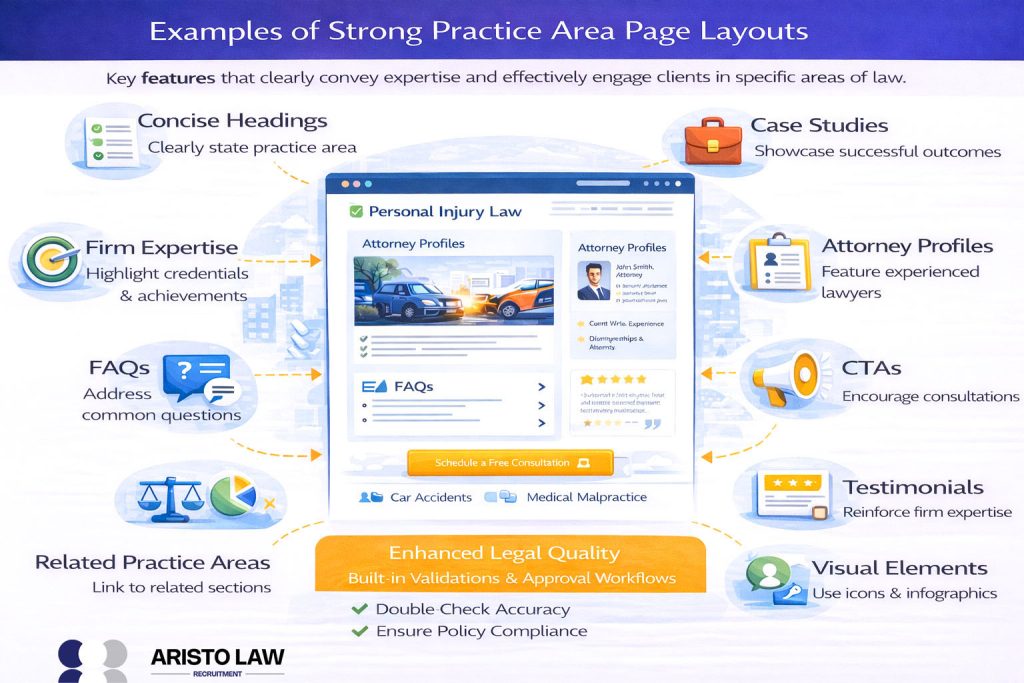
Strong practice area page layouts clearly convey concise headings, Case studies, Attorney profiles, FAQs, and the firm’s expertise, with organized, accessible content specific to each area of law.
Listed below are the 8 Strong practice area page layouts.
- Concise headings that state the main areas of expertise and services offered
- Case studies showcasing successful outcomes relevant to the practice area
- Attorney profiles featuring the experience and qualifications of lawyers handling the specific practice area
- FAQs addressing common client concerns and questions specific to the practice area
- Clear calls to action (CTAs) encouraging users to schedule consultations or contact the firm for more information
- Testimonials from clients that reinforce the firm’s credibility and expertise in the practice area
- Visual elements, such as icons or infographics, to break up text and enhance readability
Related practice areas with links to relevant sections on the website for broader client engagement
What are the best practices for law firm website navigation?
The best practices for law firm website navigation are simple, sticky navigation bar, minimizing click-throughs, using dropdown menus, Consistent labels, prioritizing ease of use, with intuitive menus and clear pathways to essential information.
Listed below are the 8 best practices for law firm website navigation.
- Simple, sticky navigation bar that remains visible as users scroll, ensuring easy access to main sections
- Minimize click-throughs by organizing content into fewer, well-structured sections for quick access.
- Dropdown menus that display relevant subcategories and related pages for better user flow
- Consistent labels for navigation options that clearly describe each page or section
- Clear hierarchy of content to guide users from general to more specific information
- Mobile-optimized menus ensure navigation is intuitive across all devices
- Prominent call-to-action buttons in navigation to direct users toward consultations or services
- Search functionality to quickly locate specific content across the website
What are the most important pages on a law firm website?
Main pages on a law firm website include the homepage, about us, practice areas, and attorney bios. Website pages are important for user engagement, trust-building, and converting visitors into clients.
Listed below are the 7 Main pages on a law firm website.
- Homepage: The first point of contact, offering an overview of the firm’s services and guiding users to other main areas of the site. It sets the tone for the user experience and influences initial impressions.
- About Us: Builds trust by showcasing the firm’s values, experience, and team, helping potential clients connect with the firm on a personal level.
- Practice Areas: Provides detailed information about the firm’s services, helping visitors find what they need and improving SEO by targeting specific legal needs.
- Attorney Bios: Establishes the credibility and expertise of the firm’s attorneys, including their experience, credentials, and areas of focus, to build client trust.
- Contact Page: Enables easy communication with the firm, offering forms, phone numbers, and office locations, and is essential for lead conversion.
- Case Results/Testimonials: Demonstrates the firm’s track record of success and client satisfaction, offering social proof that influences potential clients’ decisions.
- Blog/Resources: Provides valuable content on legal topics, improving SEO, and positioning the firm as a thought leader in its field.
What are the best practices for navigation in multi-practice law firm websites?
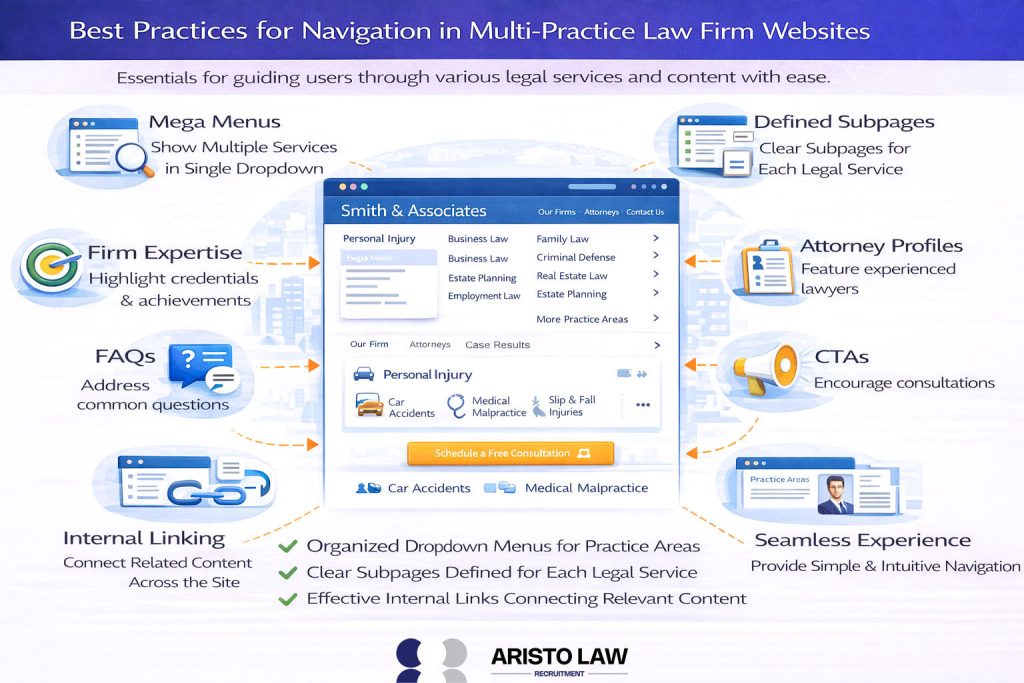
The best practices for navigation in multi-practice law firm websites include creating clear, organized structures that allow clients to easily find information on various services offered by the firm. Multi-practice law firm websites require specialized navigation, such as using mega menus for practice areas to present multiple services in a single dropdown, ensuring easy access to all offerings. Subpages for each service must be clearly defined, allowing visitors to dive deeper into specific legal areas without confusion. Internal linking strategies must be used to connect related content across the site, guiding users through relevant practice areas, attorney bios, and case results. Multi-practice helps maintain a seamless user experience, making navigation intuitive and ensuring visitors quickly access the legal information they need.
What should be included on a law firm homepage?
A law firm homepage should immediately communicate the firm’s value proposition, practice areas, and have clear CTAs for potential clients to get in touch. The law firm homepage is important to showcase practice areas to ensure visitors understand the services offered, with direct links to detailed pages.
Attorney bios must state the expertise and experience of the legal team, building trust with potential clients. Client testimonials and trust signals, such as certifications, awards, and recognitions, help establish credibility and confidence in the firm’s capabilities. Additionally, clear CTAs like “Contact Us” or “Schedule a Consultation” are critical for driving conversions and encouraging visitors to take the next step in engaging the firm.
What is a practice area page in law firm web design?
A practice area page is a dedicated webpage that details a law firm’s services in a specific area of law, aimed at educating potential clients. Effective practice area pages feature concise explanations of the services offered, helping visitors understand how the firm assists with their legal needs.
Client testimonials and case results provide social proof and showcase the firm’s success in that practice area, building trust with potential clients. Strong CTAs like “Contact an Attorney” or “Schedule a Consultation” encourage user engagement and conversions, guiding visitors toward taking the next step in their legal journey. Practice area pages’ elements are essential for both conversion optimization and creating a user-friendly experience.
How should practice areas be showcased on law firm sites?
Practice areas on law firm websites should be showcased in a way that states the firm’s expertise, credibility, and approachability. Each practice area must have a dedicated section with a clean and organized layout, featuring concise content that clearly explains the firm’s services, legal approach, and benefits. Using multimedia elements like videos or infographics further engages visitors by providing visual explanations or client success stories.
Case studies or client testimonials within each section enhance credibility, while clear calls to action (CTAs) such as “Schedule a Consultation” or “Learn More” encourage visitors to take the next step. By combining strong content with multimedia and user-friendly navigation, law firms effectively present their practice areas while building trust with potential clients.
What is the best practice for attorney bio page design?
The best practices for attorney bio pages include presenting attorneys’ qualifications, experience, and personality to build trust with potential clients. A well-designed attorney bio page must feature professional photos that make the attorney appear approachable and trustworthy. Detailed bios must outline the attorney’s education, qualifications, experience, and areas of expertise to state their legal proficiency.
Including contact information or direct CTAs for scheduling consultations helps convert visitors into clients. Testimonials or case studies showcasing successful outcomes further build credibility and trust. By combining a personal touch with professional credentials, attorney bio pages create a strong connection with potential clients.
How can a law firm website increase leads?
A well-designed law firm website can increase leads by improving user experience, making information accessible, and building credibility. Main site design elements such as clear CTAs, intuitive navigation, and prominent trust signals like testimonials, credentials, and case results help guide visitors through the site and encourage conversions, even without SEO.
How law firm websites can increase client leads relies on providing users with the information they need quickly and establishing trust from the first point of contact. A study titled “Optimizing Marketplace Registration Page Design with Predictive Heatmap Analysis” by Bagaskoro et al. (2025), which investigates the optimization of registration pages to enhance user experience and conversion rates.
Does attorney website design impact client conversions?
Yes, attorney website design impacts client conversions by establishing credibility and making it easy for visitors to take action. Factors like a clean website layout, placed CTAs, user-friendly contact forms, and trust signals such as client testimonials, case results, and certifications help build trust and encourage visitors to engage with the firm.
Mobile optimization is also crucial, as a responsive design ensures a seamless experience across devices, increasing the likelihood of conversion. A well-designed website improves user experience, guiding potential clients to take the next step toward contacting the firm.
How do law firms build trust through website design?
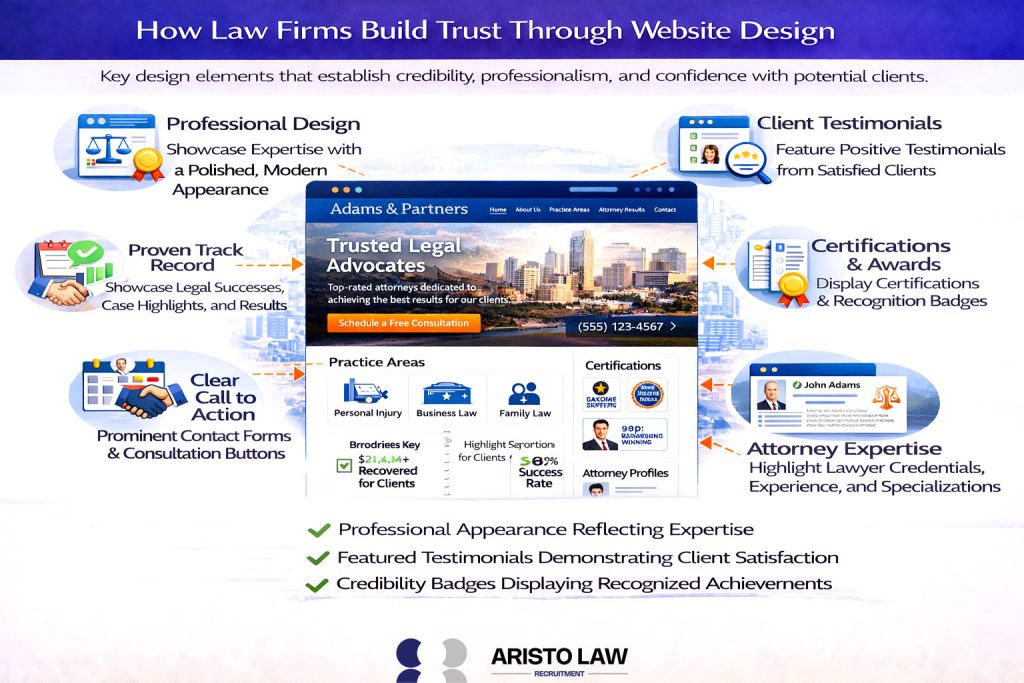
Law firms build trust through website design by providing clear, accurate, and easy-to-navigate information alongside credibility-enhancing elements. A professional design reflects the firm’s expertise and establishes an authoritative presence, while client testimonials and case results act as trust signals, demonstrating the firm’s success and client satisfaction. Displaying certifications or industry recognitions further enhances credibility. A user-friendly interface ensures that potential clients easily find the information they need, creating a seamless experience that fosters confidence in the firm’s services. Professional design elements work together to build trust and encourage visitors to take the next step in engaging with the firm.
What are the best trust signals for law firm websites?
The best trust signals on law firm websites include Client testimonials, Awards and recognitions, Certifications, Professional logos, and elements that reassure potential clients of the firm’s professionalism, expertise, and reliability.
Listed below are the 10 best trust signals on law firm websites.
- Client testimonials showcasing positive experiences and successful outcomes
- Awards and recognitions from reputable legal organizations or industry bodies
- Certifications such as bar memberships or specialized legal qualifications
- Professional logos of affiliations with legal associations or partners
- Privacy policies ensuring user data protection and confidentiality
- SSL encryption for secure browsing and protecting client information
- Case results or success stories demonstrating the firm’s capability
- Attorney credentials and detailed bios stating expertise and experience
- Social proof through positive reviews or media mentions
- Clear contact information and accessible communication channels for trust and transparency
What are law firm website design tips that improve conversions?
Law firm website design tips include Clear messaging, User-friendly forms, Compelling CTAs, improving conversions by simplifying navigation, providing clear CTAs, and making it easy for visitors to contact the firm.
Listed below are the 10 Law firm website design tips.
- Clear messaging that communicates the firm’s value proposition upfront
- User-friendly forms that simplify the process of scheduling consultations or submitting inquiries
- Compelling CTAs that encourage visitors to take action, such as “Contact Us” or “Schedule a Consultation.”
- Trust-building visuals, including professional photos, client testimonials, and certifications
- Mobile optimization ensures a seamless experience across all devices
- Simple navigation that allows visitors to easily find the main information and services
- Fast loading times to enhance user experience and reduce bounce rates
- Engaging content that states the firm’s expertise and success stories
- Visible contact information, including a phone number, email, and a contact form easily accessible throughout the site
- Social proof, such as case results and media mentions, helps build credibility
What is a law firm website content strategy?
A law firm website content strategy defines the approach to creating, organizing, and presenting content that attracts, informs, and converts potential clients. This strategy includes SEO to improve visibility on search engines, blog posts that address relevant legal topics and demonstrate the firm’s expertise, practice area pages that clearly explain services offered, and FAQs that answer common client questions.
CTAs are integrated throughout to encourage visitor engagement, such as scheduling consultations or contacting the firm. The goal of a content strategy is to increase client engagement, build trust, and guide visitors through the journey from learning about the firm to becoming clients.
What is the best mobile website design for law firms?
The best mobile website design for law firms is a responsive design, Clear, concise CTAs, simplified forms, and one that is responsive, easy to navigate, and optimized for fast loading on mobile devices. A mobile-first design ensures that the website adapts seamlessly to smaller screens while maintaining usability. Mobile-specific features include simplified forms for quick submissions, mobile-optimized CTAs for easy client contact, and speed optimization to enhance performance and reduce bounce rates.
Listed below are the 8 best mobile website designs for law firms.
- Responsive design that adjusts the layout to fit different screen sizes
- Clear, concise CTAs that are easily tappable and visible on smaller screens
- Simplified forms that minimize the number of fields for faster client submissions
- Optimized images and media to ensure fast loading times
- Sticky navigation for easy access to main pages and services
- Accessible contact options such as tap-to-call buttons and location maps
- Touch-friendly design with buttons and links large enough for easy tapping
- Minimalist design that focuses on essential information and avoids clutter
Can mobile design affect law firm SEO?
Yes, mobile design affects law firm SEO as search engines prioritize mobile-friendly websites for ranking. With mobile-first indexing, search engines now primarily use the mobile version of a website to determine rankings, meaning mobile optimization directly impacts SEO performance. Mobile design affects load times, where faster loading on mobile devices improves rankings and user experience, as easy navigation and clear CTAs reduce bounce rates and increase engagement.
A study titled “An Insight on Mobile Friendly Web” (2013) states the significant benefits of having a mobile-friendly website, noting that mobile-optimized sites drive greater levels of user adoption, accessibility, and conversions for businesses. As mobile searches continue to dominate, law firms must prioritize mobile design to stay competitive in search rankings.
What is law firm website development?
Law firm website development involves building and maintaining a website that meets the firm’s technical, design, and content needs. The process begins with planning, where the firm’s objectives, target audience, and main features are defined. Design follows, focusing on creating an intuitive and user-friendly interface that aligns with the firm’s branding and user experience goals.
The coding phase involves turning the design into a functional site, ensuring responsiveness, fast loading, and security. Testing ensures that the website works across devices and browsers, and any bugs or issues are fixed before the site goes live. Once launched, ongoing maintenance is necessary to update content, fix technical issues, and ensure the website remains secure and optimized for performance and SEO. Effective website development ensures the law firm’s online presence is reliable, professional, and able to meet client needs.
What is the difference between web design and web development for lawyers?
The difference between web design and web development for lawyers is that web design focuses on the aesthetics, layout, and user experience of a website, while web development involves coding, functionality, and performance.
The table below shows the difference between web design and web development for lawyers.
| Aspect | Web Design | Web Development |
| Focus | Aesthetics, layout, and user experience | Coding, functionality, and website performance |
| Main Tasks | Designing the look and feel of the site | Coding the site’s backend and ensuring functionality |
| Goal | Creating an appealing, user-friendly interface | Ensuring the site works smoothly and efficiently |
| Main Elements | Color schemes, fonts, navigation, and layout | Backend coding, CMS integration, and database management |
| User Interaction | Enhancing the usability and visual appeal | Ensuring fast load times, security, and reliability |
| SEO Impact | Influence on user engagement and conversion rates | Impacts page speed, mobile optimization, and indexing |
| Tools Used | Photoshop, Figma, Sketch | HTML, CSS, JavaScript, PHP, Content Management Systems |
| Maintenance | Focused on updates to layout, images, and content | Ongoing backend maintenance and updates for performance |
| Importance for Law Firms | Improves user experience and first impressions | Ensures a functional, secure, and fast website |
What should law firm websites prioritize for speed and performance?
Law firm websites should prioritize fast loading times, smooth navigation, and minimal page size to ensure an optimal user experience. Speed directly impacts SEO, as search engines like Google favor fast-loading websites, leading to better rankings. User retention is also affected, as slow websites increase bounce rates, which harms both engagement and conversions.
Best practices for speed optimization include image compression to reduce file sizes, caching to store static elements for faster loading, and minification of code (HTML, CSS, JavaScript) to streamline the site’s performance. techniques improve website performance, leading to higher conversion rates and better overall user satisfaction on law firm websites.
Where to hire a law firm web designer for attorneys?
Law firms can hire a web designer with experience in the legal industry through legal outsourcing companies like Aristolaw, freelance platforms, or specialized legal design firms. Aristolaw offers a tailored approach with expertise in law firm website design, ensuring the site meets legal-specific needs.
Platforms like Upwork, Fiverr, and LinkedIn provide access to freelance designers, while specialized legal design firms focus on creating websites specifically for law firms, ensuring compliance with legal industry standards. Hiring a designer with industry experience is crucial, as it guarantees that the website will not only look professional but also meet the functional and regulatory requirements unique to the legal field.
What questions should lawyers ask before hiring website designers?
Lawyers should ask specific questions like What experience do you have working with law firms?, Can you show past examples of law firm websites you’ve designed? to ensure that a web designer understands their needs and has experience in the legal field. The questions help evaluate the designer’s expertise, suitability, and approach to creating a functional and effective law firm website.
Listed below are the 10 common questions lawyers ask before hiring a website designer.
- What experience do you have working with law firms? to ensure familiarity with legal industry standards
- Can you show past examples of law firm websites you’ve designed? To assess style and functionality
- How do you approach SEO for law firm websites to ensure the website will be optimized for search engines?
- Are your designs mobile-responsive? To guarantee the site works well on smartphones and tablets.
- What is the typical timeline for designing a law firm website? to set clear expectations for project duration
- What is your pricing structure? To understand costs and ensure the budget aligns with the services offered
- Do you provide ongoing support and maintenance after the site is launched? For post-launch assistance and updates
- How do you handle site security and compliance with legal regulations? to ensure the website meets legal privacy and accessibility standards
- What tools or content management systems (CMS) do you use to ensure the website is easy to update and manage
- How do you ensure the website is user-friendly and conversion-focused? To ensure the site attracts and retains clients effectively.
For law firms looking for expertise, Aristo Law’s web design services offer customized solutions to the unique needs of legal professionals.
Can law firms redesign a website without losing SEO value?
Yes, law firms can redesign their websites without losing SEO value by maintaining existing URLs, using proper redirects, and ensuring new content is optimized for SEO. Best practices for SEO preservation during redesigns include URL mapping to ensure old URLs are redirected to new ones, avoiding duplicate content to prevent SEO penalties, and preserving backlinks by keeping high-quality links intact. Optimizing new content with targeted keywords and ensuring mobile optimization helps maintain or even improve SEO rankings during the redesign process.
Build a legal support team that moves work forward.
Tell us what is slowing your practice down. We will help map the role, workflow, and support structure that fits.