
21 Types of Legal Outsourcing Services: Drafting, Intake, Case Management, and their Outsourcing providers.

Practical guidance for building efficient, accountable legal support operations.


Legal outsourcing services are external solutions that help law firms and corporate legal departments delegate specialized or routine tasks for efficiency and cost reduction. These services include legal drafting, legal research and writing, client intake and management, case management, and document review or contract administration.
Legal document drafting outsourcing involves experienced paralegals or lawyers preparing contracts, pleadings, and agreements under firm supervision to save time and maintain quality. Legal intake outsourcing uses trained teams or AI-based systems to handle client onboarding, communication, and qualification. Case management outsourcing covers scheduling, document tracking, and administrative coordination. Legal document review outsourcing supports due diligence, e-discovery, and compliance checks, handled by offshore teams.
Legal BPO (Business Process Outsourcing) encompasses IT, billing, and operational support, while offshore legal services, commonly based in India or the Philippines, a prominent hub for legal outsourcing, known for its skilled workforce, cost efficiency, and strong English proficiency, provide 24-hour workflow coverage at lower costs.
Outsourced legal services must comply with jurisdictional regulations, data privacy laws, and professional standards to ensure ethical and secure operations.
A 2023 report by Thomson Reuters, titled Alternative Legal Services Providers Report, confirms that firms increasingly use ALSPs like Integreon, Aristo Law, QuisLex, and Elevate for multi-domain services. These services include document automation, compliance, and data management. Effective outsourcing lets lawyers focus on core advocacy and client strategy while ensuring compliance, speed, and accuracy across their legal operations.
Aristolaw helps law firms streamline legal outsourcing operations. Schedule a consultation with Aristolaw to hire outsourced legal support staff today. Aristolaw helps provide trained professionals for legal drafting, client intake, case management, litigation support, and back-office legal workflows through structured outsourcing solutions.
Listed are 21 Types of Legal Outsourcing Services.
- Legal Drafting Services: Legal drafting services prepare contracts, pleadings, agreements, motions, and legal correspondence for attorneys and law firms. Legal drafting services maintain document consistency, jurisdiction compliance, formatting accuracy, and procedural alignment across legal workflows.
- Legal Research and Writing Services: Legal research and writing services analyze case law, statutes, regulations, and legal precedents using professional legal databases. Legal research and writing services produce memoranda, briefs, summaries, and research-supported legal documents for litigation and advisory matters.
- Client Intake and Management Services: Client intake and management services organize onboarding workflows, appointment scheduling, intake forms, and client communications for law firms. Client intake and management services maintain CRM records, improve intake efficiency, and support legal operations management.
- Case Management and Support Services: Case management and support services coordinate legal calendars, deadlines, filings, discovery records, and litigation documentation for attorneys. Case management and support services improve workflow organization, operational tracking, and legal case administration.
- Document Review and Contract Management Services: Document review and contract management services evaluate contracts and legal records for compliance requirements, obligations, inconsistencies, and legal risks. Document review and contract management services organize repositories, monitor amendments, and support contract lifecycle operations.
- Virtual Legal Assistant: Virtual legal assistants manage scheduling, correspondence, document handling, and administrative coordination for attorneys and law firms. Virtual legal assistants improve workflow organization, communication management, and operational support across legal services.
- Virtual Legal Secretary: Virtual legal secretaries coordinate filings, document formatting, deadline tracking, and court-related administrative tasks for legal teams. Virtual legal secretaries maintain procedural accuracy, communication consistency, and document organization across law firm operations.
- Virtual Paralegal Assistant: Virtual paralegal assistants support attorneys through legal research, discovery coordination, evidence organization, and document preparation. Virtual paralegal assistants strengthen case management efficiency, litigation preparation, and legal workflow support.
- Medical Records Specialist: Medical records specialists retrieve, organize, review, and maintain medical documentation used in legal and insurance-related matters. Medical records specialists improve records accuracy, evidentiary organization, and medical document accessibility across case workflows.
- Virtual Legal Administrative Assistant (Back-office Operations): Virtual legal administrative assistants coordinate internal documentation, scheduling, reporting, and operational support activities for law firms. Virtual legal administrative assistants improve administrative consistency, workflow management, and back-office legal operations.
- Virtual Executive Assistant for Lawyers: Virtual executive assistants for lawyers manage executive scheduling, communication prioritization, meeting coordination, and strategic administrative support. Virtual executive assistants improve leadership efficiency, operational organization, and executive workflow management within legal practices.
- AI Legal Assistant Setup & Workflow Support: AI legal assistant setup and workflow support services configure AI systems for legal drafting, intake, research, and operational workflows. AI legal assistant support services improve automation efficiency, workflow optimization, and structured legal process management.
- Legal Document Automation / Template Specialist: Legal document automation specialists develop reusable templates, clause libraries, and automated legal drafting systems for law firms. Legal document automation services improve drafting consistency, reduce manual workload, and strengthen document workflow efficiency.
- Virtual Legal Billing Specialist: Virtual legal billing specialists manage invoicing, billing reconciliation, expense tracking, and time-entry review for legal practices. Virtual legal billing specialists improve financial accuracy, billing compliance, and revenue management across law firm operations.
- Virtual Law Firm Bookkeeper / Financial Assistant: Virtual law firm bookkeepers manage reconciliations, financial tracking, expense reporting, and operational accounting support for legal practices. Virtual law firm bookkeepers improve financial transparency, bookkeeping accuracy, and operational financial management.
- Virtual Legal Marketing Assistant: Virtual legal marketing assistants coordinate content publishing, campaign management, CRM updates, and marketing workflow support for law firms. Virtual legal marketing assistants improve client engagement, lead generation, and law firm brand visibility.
- Law Firm Branding & Creative Support VA: Law firm branding and creative support VAs manage brand assets, presentation materials, visual content, and marketing collateral for legal practices. Branding and creative support services improve visual consistency, professional positioning, and brand communication across legal marketing channels.
- Law Firm Web Design / Website Management Support: Law firm web design and website management support services maintain website functionality, content updates, security monitoring, and digital performance optimization. Website management support services improve online visibility, operational efficiency, and user experience across legal websites.
- Law Firm Reputation Management Assistant: Law firm reputation management assistants monitor online reviews, client feedback, and public-facing communication workflows for legal practices. Reputation management assistants improve brand credibility, review management, and digital trust signals across online platforms.
- Virtual Recruiter / Staffing Coordinator for Law Firms: Virtual recruiters and staffing coordinators manage hiring workflows, candidate screening, onboarding coordination, and staffing operations for legal organizations. Staffing coordination services improve recruitment efficiency, hiring consistency, and operational workforce management.
- Legal Data Entry & Records Management Assistant: Legal data entry and records management assistants organize client records, case files, legal databases, and documentation systems for law firms. Records management assistants improve data accuracy, document accessibility, and operational organization across legal workflows.
1. Legal Drafting Services
Legal drafting services involve preparing contracts, pleadings, legal memoranda, and agreements under attorney supervision. Legal drafting outsourcing services ensure precision, compliance, and consistency across legal documents while helping firms manage workload efficiently.
Outsourced drafting reduces pressure on internal teams and maintains high accuracy through standardized templates and structured review processes. Ethically, firms must uphold confidentiality and ensure attorney oversight during delegation. Best practices include using secure collaboration platforms, maintaining version control, and performing regular quality audits to align with firm standards.
2. Legal Research and Writing Services
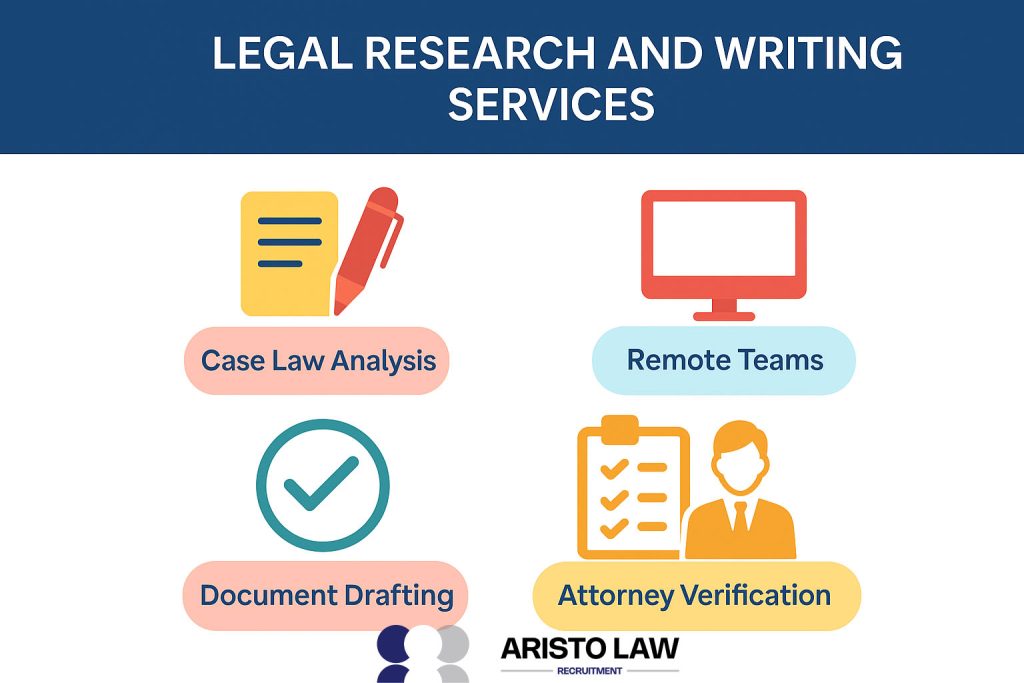
Legal research and writing services provide detailed case law analysis, statutory interpretation, and drafting of legal briefs or opinions. Legal research services are essential for attorneys handling complex litigation or policy matters.
Many firms rely on remote teams and virtual writing services to streamline document creation and maintain cost efficiency. Outsourcing ensures faster turnaround on analytical documents without compromising accuracy. To optimize workflow, firms must establish citation protocols, maintain legal database subscriptions, and ensure attorney verification before submission.
3. Client Intake and Management Services
Client intake and management services handle onboarding, screening, and communication processes for new clients, often supported by a Virtual Legal Intake Specialist. These services improve efficiency by automating data collection, verifying case eligibility, and ensuring quick response times across Law Firm Operations. Proper Client Management reduces errors, increases lead conversion, and enhances client satisfaction throughout the engagement lifecycle.
From a functional and ethical standpoint, law firms must use encrypted intake software, maintain compliance with privacy laws, and ensure attorney oversight of screening decisions. Workflow Optimization is achieved by integrating CRM systems that track leads, communication history, and case progression in real time. Best practices include standardized intake questionnaires, secure data storage, and regular audits to ensure Legal Services remain compliant, accurate, and client-focused.
4. Case Management and Support Services
Outsourced case management services help law firms organize legal files, manage deadlines, and streamline attorney-client communication, overseen by a dedicated Litigation Case Manager. Case management and support services are central to effective Case Management, allowing firms to coordinate complex matters while maintaining procedural accuracy and operational efficiency.
The case management team uses centralized platforms such as Clio, MyCase, or PracticePanther to track case progress, automate reminders, and assign tasks through structured workflows. Ethical considerations include controlled access, secure client portals, and attorney supervision of key milestones. Regular performance reports and dashboards maintain transparency and oversight, reducing administrative burdens and allowing attorneys to focus on legal analysis and strategy.
5. Document Review and Contract Management Services
Document review and contract management services involve analyzing, categorizing, and maintaining large volumes of legal documents, contracts, and evidentiary materials, often coordinated by a Remote Contract Manager. Document review and contract management services are important during e-discovery, due diligence, and compliance reviews where accuracy, speed, and consistency are essential.
Ethical standards demand strict confidentiality, version tracking, and audit trails throughout the Document Review and Contract Management process. Workflow Optimization is achieved by combining structured review protocols with AI-assisted tools that accelerate analysis without sacrificing precision. Best practices include implementing strong data security measures, maintaining clear approval workflows, and scheduling periodic audits for contract renewal and compliance accuracy within Legal Support operations.
6. Virtual Legal Assistant
A Virtual Legal Assistant provides comprehensive administrative and operational support across Legal Services, assisting attorneys with scheduling, correspondence, document handling, and day-to-day coordination. The virtual legal assistant role is essential to Law Firm Operations because it centralizes routine legal support tasks, allowing attorneys to focus on Legal Drafting, Legal Research, and client-facing responsibilities.
Virtual Legal Assistants manage calendars, prepare documents, coordinate communications, and support internal workflows using secure legal software. Ethical considerations include maintaining confidentiality, adhering to attorney supervision requirements, and handling sensitive client information responsibly. Efficiency is achieved through Workflow Optimization tools such as task management systems, shared dashboards, and standardized operating procedures.
Best practices include clearly defining task scopes, using secure collaboration platforms, and integrating the assistant into existing case and client management systems. Regular performance reviews and documented workflows ensure the Virtual Legal Assistant operates as a reliable extension of the firm’s Legal Support infrastructure.
7. Virtual Legal Secretary
A Virtual Legal Secretary specializes in high-volume administrative coordination, document formatting, correspondence management, and court-related scheduling within Legal Services. This role supports Law Firm Operations by ensuring procedural accuracy, timely filings, and professional communication across all legal matters.
From a functional perspective, Virtual Legal Secretaries handle transcription, filing preparation, deadline tracking, and document organization. Ethical considerations require strict confidentiality, version control, and compliance with court and jurisdictional requirements. Efficiency gains come from standardized templates, calendaring systems, and workflow automation that reduce clerical errors and missed deadlines.
To optimize this role, firms should provide clear formatting standards, deadline escalation protocols, and secure document access. Integrating the secretary into Case Management systems ensures seamless coordination and strengthens Workflow Optimization across legal teams.
8. Virtual Paralegal Assistant
A Virtual Paralegal Assistant provides substantive legal support by assisting with Legal Research, document preparation, discovery coordination, and case file organization under attorney supervision. A virtual paralegal assistant service is critical to Law Firm Operations because it expands legal capacity without increasing in-house staffing costs.
Functionally, Virtual Paralegal Assistants support Case Management, draft supporting documents, organize evidence, and prepare materials for attorney review. Ethical compliance requires clear delegation boundaries, attorney oversight, and adherence to confidentiality and jurisdictional rules. Efficiency is enhanced through structured workflows, research databases, and collaborative review systems.
Best practices for virtual paralegal assistant services include defining permissible paralegal tasks, using standardized research and drafting protocols, and integrating paralegals into secure Legal Support platforms. Consistent oversight and performance tracking ensure accuracy while maximizing Workflow Optimization benefits.
9. Medical Records Specialist
A Medical Records Specialist manages the retrieval, organization, review, and maintenance of medical records used in Legal Services, particularly in personal injury, medical malpractice, and insurance-related cases. A medical records specialist role is vital to Law Firm Operations because accurate medical documentation directly impacts case valuation, liability analysis, and litigation outcomes.
Functionally, Medical Records Specialists coordinate record requests, track provider responses, summarize medical data, and ensure records are complete and properly indexed for Document Review and Case Management. Ethical considerations include strict compliance with privacy regulations, secure handling of protected health information, and attorney oversight of medical summaries. Efficiency is achieved through standardized request workflows, deadline tracking, and secure document repositories.
Best practices for a Medical Records Specialists include using encrypted record-request platforms, maintaining detailed audit trails, and integrating medical records into centralized case management systems. Clear protocols for follow-ups, summaries, and attorney review help optimize Workflow Optimization while reducing delays and evidentiary gaps.
10. Virtual Legal Administrative Assistant (Back-office Operations)
A Virtual Legal Administrative Assistant supports back-office Legal Support functions such as internal coordination, documentation management, scheduling, reporting, and operational logistics. A Virtual Legal Administrative Assistant role strengthens Law Firm Operations by ensuring administrative continuity across departments and legal teams.
From a functional standpoint, these assistants handle internal communications, document routing, process documentation, and system updates that support Client Management and Case Management workflows. Ethical responsibilities include safeguarding confidential information, following internal compliance policies, and operating under attorney-defined procedures. Efficiency gains come from workflow standardization, task automation, and centralized operational oversight.
To optimize a Virtual Legal Administrative Assistant role, firms should document internal processes, assign clear responsibility boundaries, and integrate assistants into secure operational platforms. Regular process reviews and performance metrics ensure administrative workflows remain aligned with overall Workflow Optimization goals.
11. Virtual Executive Assistant for Lawyers
A Virtual Executive Assistant for Lawyers provides high-level strategic and administrative support to attorneys, partners, and firm leadership. A Virtual Executive Assistant for Lawyers service is essential within Law Firm Operations because it enables legal executives to focus on client strategy, Legal Drafting, and firm growth rather than operational coordination.
Virtual Executive Assistants manage complex calendars, prioritize communications, coordinate meetings, and support executive-level decision-making. Ethical considerations require absolute discretion, confidentiality, and strict adherence to attorney-client privilege standards. Efficiency is achieved through advanced scheduling systems, priority management frameworks, and streamlined communication workflows.
Best practices of a Virtual Executive Assistant for Lawyers include establishing clear authority thresholds, using secure executive communication tools, and aligning the assistant closely with leadership objectives. When handled correctly, this role significantly enhances Workflow Optimization and executive effectiveness across Legal Services.
12. AI Legal Assistant Setup & Workflow Support
AI Legal Assistant Setup & Workflow Support focuses on configuring, training, and integrating AI-powered tools into existing Legal Services to support research, drafting, intake, and internal operations. Within Law Firm Operations, an AI Legal Assistant enhances productivity by automating repetitive tasks while preserving attorney control over legal judgment and client outcomes.
Functionally, this service includes workflow mapping, tool configuration, prompt structuring, and integration with Case Management, Document Review, and Client Management systems. Ethical considerations require strict data governance, confidentiality safeguards, and attorney oversight to ensure AI outputs are reviewed and validated before use. Efficiency gains are realized through Workflow Optimization that reduces turnaround time without compromising legal accuracy.
Best practices include limiting AI usage to defined task scopes, implementing human-in-the-loop review processes, and regularly auditing AI outputs for compliance and reliability. When handled correctly, AI assistants become a controlled extension of Legal Support rather than a replacement for legal expertise.
13. Legal Document Automation / Template Specialist
Legal Document Automation services streamline the creation of standardized legal documents by designing reusable templates and automated drafting workflows. A Legal Document Automation Specialist reduces drafting time while ensuring consistency across contracts, pleadings, and internal documentation.
Legal Document Automation services involve building logic-based templates, clause libraries, and document rules that support Legal Drafting and Contract Management. Ethical considerations include attorney review of all templates, version control, and jurisdictional accuracy. Efficiency improvements stem from reduced manual drafting, minimized errors, and faster document turnaround across Legal Services.
To optimize legal document automation, firms should standardize commonly used documents, maintain clear approval processes for template updates, and integrate automation tools with Case Management systems. Regular audits ensure automated documents remain compliant and aligned with evolving legal standards.
14. Virtual Legal Billing Specialist
A Virtual Legal Billing Specialist manages invoicing, time tracking, expense reconciliation, and billing compliance within Legal Services. By leveraging a Virtual Legal Billing Specialist, law firms strengthen Law Firm Operations through accurate financial reporting and improved cash flow management.
A Virtual Legal Billing Specialist role supports billing software, prepares invoices, tracks billable hours, and resolves discrepancies in coordination with attorneys and finance teams. Ethical considerations include transparency, adherence to billing regulations, and accurate representation of legal work performed. Efficiency during a Virtual Legal Billing Specialist is achieved through Workflow Optimization tools that automate billing cycles and reduce administrative friction.
Best practices of a Virtual Legal Billing Specialist include using standardized billing codes, integrating billing systems with Case Management platforms, and performing regular reconciliation checks. Clear communication protocols between attorneys and billing specialists ensure accuracy, compliance, and client trust.
15. Virtual Law Firm Bookkeeper / Financial Assistant
A Virtual Law Firm Bookkeeper manages financial tracking, reconciliation, and reporting tasks that support stable and compliant Law Firm Operations. By working with a Virtual Law Firm Bookkeeper, legal practices maintain accurate records of income, expenses, trust accounts, and operational costs while allowing attorneys to focus on Legal Services delivery.
A Virtual Law Firm Bookkeeper role handles bookkeeping software, reconciles accounts, prepares financial reports, and supports budgeting aligned with Case Management and billing systems. Ethical considerations include strict confidentiality, compliance with financial regulations, and clear separation of client trust funds. Efficiency for a Virtual Law Firm Bookkeeper is improved through Workflow Optimization that connects bookkeeping systems with billing and case platforms.
Best practices of a Virtual Law Firm Bookkeeper include routine reconciliations, standardized chart-of-accounts structures, and regular financial reviews with firm leadership. When handled correctly, financial assistants strengthen operational transparency and long-term firm sustainability.
16. Virtual Legal Marketing Assistant
A Virtual Legal Marketing Assistant supports law firm visibility, lead generation, and brand consistency across digital and offline channels. Within Law Firm Operations, a Virtual Legal Marketing Assistant plays a key role in aligning Legal Services with targeted outreach and client engagement strategies.
A Virtual Legal Marketing Assistant role manages content publishing, email campaigns, social media scheduling, and performance tracking while coordinating with Client Management systems. A Virtual Legal Marketing Assistant offers compliance with legal advertising regulations, accuracy of service claims, and responsible use of client testimonials. Efficiency gains come from structured marketing calendars, automation tools, and data-driven optimization.
Best practices of a Virtual Legal Marketing Assistant include maintaining approved messaging guidelines, tracking lead attribution, and aligning marketing workflows with intake and CRM platforms. Consistent oversight ensures marketing efforts support Workflow Optimization without compromising professional standards.
17. Law Firm Branding & Creative Support VA
A Law Firm Branding & Creative Support VA focuses on visual identity, messaging consistency, and creative asset development that reinforce a firm’s professional image. By engaging a Law Firm Branding & Creative Support VA, Legal Services are presented clearly and consistently across all client-facing touchpoints.
A Law Firm Branding & Creative Support VA service supports brand assets, presentation materials, marketing collateral, and visual guidelines used across Legal Support and marketing channels. A Law Firm Branding & Creative Support VA gives an accurate representation of services, compliance with legal advertising rules, and protection of proprietary branding materials. Efficiency is achieved through centralized asset management and standardized creative workflows.
Best practices of Law Firm Branding & Creative Support VAs include maintaining brand guidelines, using shared design repositories, and coordinating closely with marketing and intake teams. Strong branding alignment improves client trust and enhances Workflow Optimization across Law Firm Operations.
18. Law Firm Web Design / Website Management Support
Law Firm Web Design and Website Management Support focuses on building, maintaining, and optimizing law firm websites to ensure accessibility, performance, and compliance with professional standards. Through Law Firm Web Design / Website Management Support, Legal Services are presented clearly while supporting Client Management and lead generation across Law Firm Operations.
A Law Firm Web Design and Website Management Support manages website updates, content publishing, performance monitoring, security maintenance, and integration with intake and CRM systems. A Law Firm Web Design and Website Management Support complies with legal advertising rules, accessibility standards, and accurate representation of legal services. Efficiency is achieved through Workflow Optimization tools that automate updates, monitor uptime, and streamline content management.
A Law Firm Web Design and Website Management Support practices include maintaining secure hosting, performing regular audits, integrating intake forms properly, and aligning website workflows with marketing and client intake systems. A well-managed website becomes a central Legal Support asset rather than a maintenance burden.
19. Law Firm Reputation Management Assistant
A Law Firm Reputation Management Assistant oversees online reviews, client feedback, and public-facing responses to protect and enhance a firm’s professional credibility. By engaging a Law Firm Reputation Management Assistant, Law Firm Operations gain structured oversight of how Legal Services are perceived across digital platforms.
A Law Firm Reputation Management Assistant role monitors review platforms, manages response workflows, escalates sensitive issues, and coordinates reputation reporting with Client Management teams. Ethical considerations include honesty in responses, avoidance of misleading claims, and compliance with confidentiality and solicitation rules. Efficiency improves through automated alerts, response templates, and centralized tracking dashboards.
A Law Firm Reputation Management Assistant’s best practice includes timely review monitoring, attorney-approved response protocols, and regular reputation reporting. Properly handled reputation workflows support Workflow Optimization while reinforcing trust and professionalism.
20. Virtual Recruiter / Staffing Coordinator for Law Firms
A Virtual Recruiter or Staffing Coordinator for Law Firms manages hiring workflows, candidate screening, and staffing coordination tailored to Legal Services environments. With support from a Virtual Recruiter / Staffing Coordinator for Law Firms, Law Firm Operations can scale efficiently while maintaining role-specific hiring standards.
A Virtual Recruiter or Staffing Coordinator for Law Firms service handles job postings, candidate screening, interview coordination, and onboarding support for legal and administrative roles. Ethical considerations include fair hiring practices, data privacy, and accurate role representation. Efficiency is achieved through Workflow Optimization tools that standardize hiring pipelines and reduce time-to-hire.
Best practices of a Virtual Recruiter or Staffing Coordinator for Law Firms include clear role definitions, structured screening criteria, and integration with internal HR or operations systems. A dedicated staffing workflow ensures firms maintain operational continuity without internal disruption.
21. Legal Data Entry & Records Management Assistant
A Legal Data Entry and Records Management Assistant supports Legal Services by accurately inputting, organizing, and maintaining legal records, client data, and case-related documentation. Through a Legal Data Entry & Records Management Assistant, Law Firm Operations maintains structured, searchable, and compliant records that support Client Management, Case Management, and Document Review processes.
A Legal Data Entry and Records Management Assistant role handles data entry into case management systems, document indexing, record updates, and file maintenance across digital repositories. Ethical considerations of a Legal Data Entry and Records Management Assistant include strict confidentiality, access controls, and compliance with data protection regulations. Efficiency is achieved through Workflow Optimization practices such as standardized data fields, validation checks, and centralized record systems.
A Legal Data Entry and Records Management Assistant’s best practices include implementing quality-control reviews, using secure document management platforms, and aligning data structures with firm-wide operational workflows. When handled correctly, records management reduces errors, improves retrieval speed, and strengthens the reliability of Legal Support systems.
What Are Outsourced Legal Services?
Outsourced legal services refer to external legal process solutions where law firms or corporations delegate specific legal tasks to third-party providers for efficiency and cost savings. Outsourced legal services include document drafting, research, case management, client intake, and compliance reviews handled by specialized teams or offshore professionals.
A study titled “Legal Offshoring: A Cost-Benefit Analysis” by Courtney I. Schultz in 2010, published in The Journal of Corporation Law, examined the cost savings and operational advantages of LPO. Outsourced legal improves productivity, ensures round-the-clock support, and allows attorneys to focus on complex, high-value work while maintaining accuracy and confidentiality.
How Does Legal Document Drafting Outsourcing Work?
Legal document drafting outsourcing works by assigning contract creation, pleadings, and agreement preparation to qualified external lawyers or paralegals under a firm’s supervision. The process begins with secure document transfer and detailed instructions from the firm, followed by research, drafting, and internal review by the outsourcing team.
Final drafts are sent back for attorney approval to ensure legal accuracy and compliance. Strict confidentiality agreements, encrypted communication, and version control systems protect client data. Quality control involves multi-stage proofreading, peer review, and alignment with jurisdiction-specific legal standards, ensuring precision and consistency across all outsourced documents.
What Is Legal Intake Outsourcing?
Legal intake outsourcing is the delegation of client onboarding, screening, and communication tasks to specialized external teams or AI-assisted systems. Legal intake outsourcing process ensures faster response times, improved client conversion, and consistent communication standards for law firms.
Outsourced intake teams manage inquiries 24/7, verify case eligibility, and schedule consultations efficiently. A report by Clio, titled “Legal Trends Report” in 2023, analyzes key performance indicators across law firms, such as utilization, realization, and collection rates, and how client expectations are shifting. This approach allows attorneys to focus on case strategy while ensuring no potential client inquiry goes unanswered.
What Are Outsourced IT Services for Law Firms?
Outsourced IT services for law firms are external technology solutions that manage cloud infrastructure, cybersecurity, and software integration to support legal operations. These services include setting up secure networks, maintaining case management systems, automating document workflows, and ensuring data protection compliance.
Providers handle system updates, encryption protocols, and backup management to safeguard sensitive client information. Outsourced IT teams also integrate legal software such as Clio, NetDocuments, and iManage for seamless collaboration. This approach reduces downtime, strengthens cybersecurity defenses, and enables remote access, allowing law firms to operate efficiently and securely.
Who Are the Top Legal Process Outsourcing Providers?
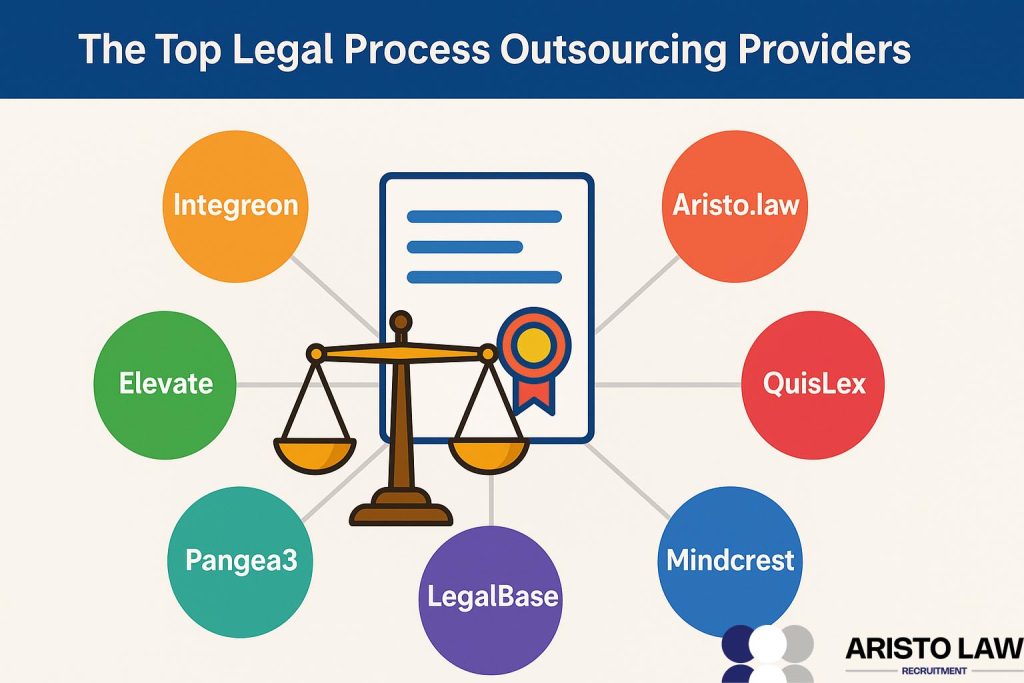
The top legal process outsourcing providers are Integreon and Aristo.law, Elevate, QuisLex, Pangea3, LegalBase, and Mindcrest.
Legal Process Outsourcing (LPO) continues to reshape how law firms and corporate legal departments operate, offering scalable, cost-effective solutions without compromising quality.
Listed below are the 7 top legal process outsourcing providers.
- Integreon: A global powerhouse in legal outsourcing, Integreon delivers high-volume document review, contract lifecycle management, and compliance support through its international delivery centers.
- Aristo. law: Aristo. law is redefining legal staffing with its elite network of virtual legal assistants and remote paralegal services. With a 93% hiring success rate and a streamlined recruitment process, they empower law firms to scale faster, reduce overhead by up to 70%, and stay focused on high-value legal work. From client intake to document prep, Aristo. The law offers support that feels in-house, without the overhead.
- QuisLex: Known for its precision in e-discovery and compliance audits, QuisLex supports complex litigation and regulatory matters with deep expertise and robust infrastructure.
- Elevate: Elevate blends legal operations consulting with tech-enabled solutions, helping in-house teams optimize workflows and manage legal spend more effectively.
- Pangea3 (a Thomson Reuters company): Offers offshore legal support for contract review, IP management, and legal drafting, with a strong reputation for quality and reliability.
- Mindcrest: Specializes in legal research, regulatory analysis, and contract abstraction for enterprise-level clients across industries.
- Cenza: Provides due diligence, lease abstraction, and compliance documentation services, primarily for global firms seeking scalable support.
What Is Outsourced Litigation Support?
Outsourced litigation support includes external assistance for legal teams in managing e-discovery, evidence review, document processing, and trial preparation. The meaning of outsourced litigation support extends to using specialized vendors that handle large data volumes, organize case materials, and prepare exhibits or witness files efficiently.
This model improves scalability, allowing firms to manage complex cases without increasing in-house staff. Outsourced support also ensures cost control through flexible pricing and access to advanced tools like Relativity or Everlaw for secure data handling. Outsourced support helps firms maintain accuracy, meet tight deadlines, and focus on core litigation strategy while reducing administrative burdens.
What Are Offshore Legal Services?
Offshore legal services are international outsourcing arrangements where legal tasks are delegated to professionals or firms located in other countries for efficiency and cost savings. Offshore legal services operate under global delivery models, combining onshore client management with offshore execution teams based in countries like India or the Philippines.
Tasks include legal drafting, contract review, compliance monitoring, and document management. Offshore legal services fall under legal BPO frameworks, emphasizing scalability and 24-hour workflow continuity. Compliance considerations include data privacy, cross-border confidentiality, and adherence to professional ethics standards to ensure lawful and secure global collaboration.
What Is Legal Document Review Outsourcing?
Legal document review outsourcing assigns the examination and categorization of case files, contracts, and e-discovery materials to specialized external teams for accuracy and efficiency. The process often integrates legal document review and automation to streamline tasks like initial screening, relevance assessment, privilege review, and quality assurance before attorney approval. Outsourced teams use secure platforms such as Relativity and Everlaw to ensure compliance and confidentiality.
Data privacy protocols, including encryption and access controls, safeguard sensitive information throughout the workflow. A 2023 Thomson Reuters Legal Market Report found that firms using document review outsourcing reduced turnaround time by 40% and costs by 30%, demonstrating its value in managing large-scale litigation and compliance reviews with precision and consistency.
What is legal BPO?
Legal BPO (Business Process Outsourcing) is the delegation of specific legal support functions, such as research, document review, and contract management, to specialized external service providers. Unlike traditional law firm outsourcing, which involves case-specific or project-based legal tasks, legal BPO focuses on streamlining recurring business processes through structured workflows and technology-driven systems.
Legal BPO integrates principles of business process management to enhance efficiency, reduce operational costs, and maintain consistent quality across legal operations. Legal BPO providers often handle administrative and back-office tasks, allowing law firms and corporate legal departments to concentrate on core legal strategy and client service.
Build a legal support team that moves work forward.
Tell us what is slowing your practice down. We will help map the role, workflow, and support structure that fits.