
Litigation Support for Small Law Firms: Definition, Benefits, Types, and How to Outsource

Practical guidance for building efficient, accountable legal support operations.
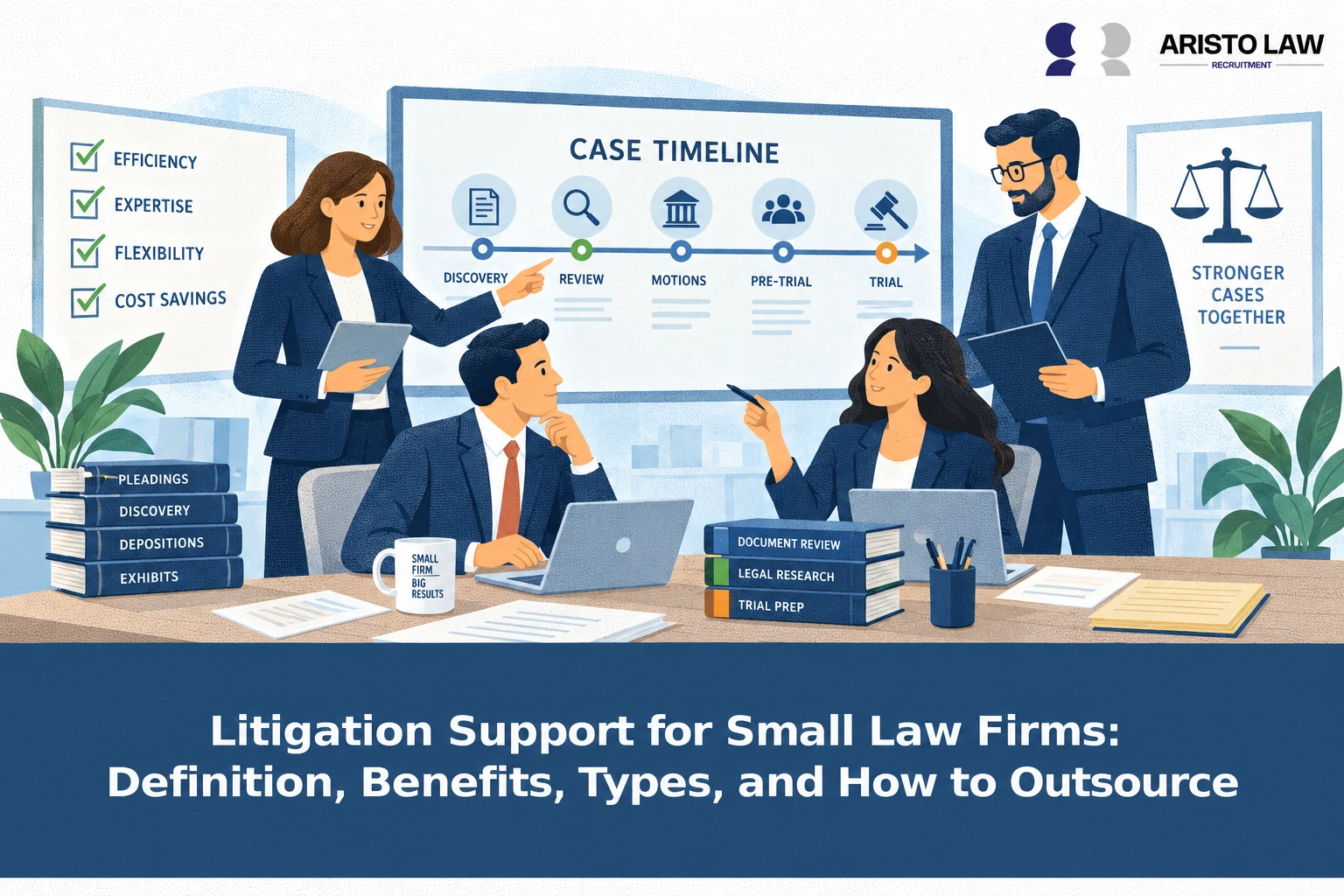
Litigation support outsourcing for small law firms involves
delegating litigation-related tasks to external legal support providers
to expand operational capacity, improve efficiency, and strengthen case
management workflows without increasing full in-house staffing.
Small law firms outsource litigation support to compete more effectively
with larger firms by accessing scalable legal operations, specialized
litigation assistance, and structured workflow support across
high-volume legal matters. Outsourced litigation support services
include document review, legal research, case management, deposition
coordination, drafting support, intake management, client communication,
discovery organization, and administrative litigation workflows.
Legal process outsourcing (LPO) functions as the broader outsourcing
framework that supports litigation operations through offshore, hybrid,
and provider-managed delivery models. Offshore and hybrid structures
help small firms reduce operating costs while maintaining workflow
continuity and litigation support coverage across growing caseloads.
Benefits include lower staffing overhead, faster workflow execution,
improved document organization, stronger deadline management, and
scalable litigation operations during periods of increased workload or
specialized case demands.
Small firms use legal process outsourcing when litigation volume
increases, specialized expertise becomes necessary, or internal staffing
limits slow case progression. Risks include confidentiality concerns,
communication gaps, workflow inconsistency, and provider quality
differences, which make vendor screening, compliance controls, legal
experience, and operational transparency important selection
criteria.
A study by Georgetown Law, the University of Oxford, and the Thomson
Reuters Institute from the Alternative Legal Services Providers 2023
Report in 2023 found that the market for alternative legal services
(ALSPs) grew rapidly to a $20.6 billion segment as law firms and
corporate legal departments increasingly leveraged outsourcing to drive
productivity. Litigation support outsourcing continues shaping modern
small-firm legal operations through scalable legal workflows, remote
staffing models, and integrated litigation management systems.
Speak
with an LPO for Litigation support.
What
is litigation support outsourcing for small law firms?
Litigation support outsourcing for small law firms is the
practice of delegating legal support tasks, such as document review,
case management, research, and administrative work, to external
providers to improve efficiency and reduce operational costs.
Litigation outsourcing allows small law firms to expand operational
capacity without increasing permanent in-house staffing, office
overhead, or long-term employment costs. Legal support outsourcing
services help firms manage document organization, discovery
coordination, deadline tracking, intake workflows, drafting support, and
litigation administration through scalable remote legal operations.
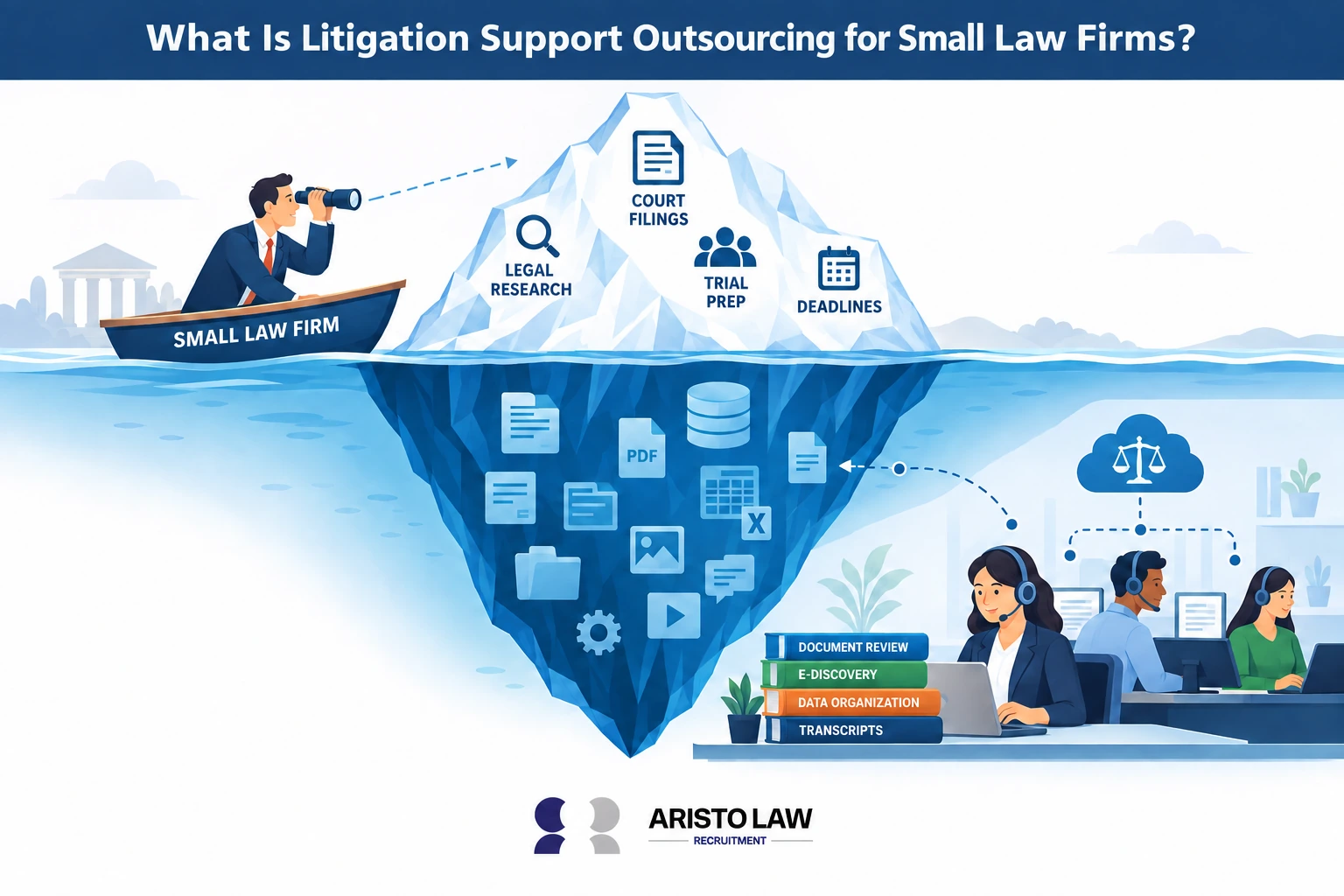
Legal process outsourcing structures support small firms by providing
access to specialized litigation resources, workflow support, and
flexible staffing models that improve productivity across active legal
matters. Outsource legal services models also help small firms handle
fluctuating caseloads, specialized litigation requirements, and
high-volume workflow demands more efficiently across litigation
operations.
What
are the benefits of litigation outsourcing for small firms?
Small law firms outsource litigation support to reduce
overhead, access specialized expertise, and scale operations without
increasing full-time staffing. Listed below are the main benefits of
litigation outsourcing for small firms. Law firms apply legal
outsourcing models and best practices workflows to
improve operational efficiency, staffing flexibility, workflow
management, and litigation support capacity across active legal
matters.

Listed below are the 12 benefits of litigation outsourcing for small
firms.
-
Lower operating costs through reduced staffing and office
overhead -
Access to specialized litigation expertise and legal support
functions -
Faster workflow execution across document review and case
management -
Flexible scaling during high-volume litigation periods
-
Reduced administrative burden on attorneys and internal staff
-
Improved deadline tracking and workflow organization
-
Better document management and litigation support coordination
-
Expanded operational capacity without permanent hiring
commitments -
More efficient back-office legal operations and support workflows
-
Increased attorney focus on strategy, client work, and court
preparation -
Stronger support for discovery, intake, and litigation
administration -
Improved productivity across outsourced legal team operations
Does outsourcing
reduce legal operating costs?
Yes, outsourcing reduces legal operating costs by eliminating
the need for full-time salaries, infrastructure, and training expenses
while allowing firms to pay only for the services used.
Outsource legal operations models to reduce overhead tied to office
space, employee benefits, payroll taxes, equipment, onboarding, and
long-term staffing commitments across litigation support workflows. Cost
savings improve because law firms scale legal support capacity based on
workload volume instead of maintaining large permanent internal teams
during fluctuating caseloads. ROI of outsourcing legal operations
increases when firms shift document review, intake coordination, legal
research, administrative workflows, and litigation support tasks to
external providers that operate through lower-cost delivery structures
and specialized legal support systems. Operational efficiency also
improves because attorneys spend less time on administrative management
and more time on billable legal work, litigation strategy, and client
representation.
How
does outsourcing level the playing field for small firms?
Outsourcing levels the playing field for small firms by
giving access to the same litigation infrastructure, technology, and
skilled personnel that larger law firms use at a fraction of the
cost. Outsourced legal services allow small firms to expand
operational capacity, improve workflow organization, access specialized
litigation support, and manage complex legal matters without maintaining
large in-house legal teams.
Legal outsourcing solutions help smaller firms use advanced document
management systems, e-discovery workflows, legal research support,
intake coordination, and scalable litigation operations that were
previously more accessible to larger firms with extensive internal
resources. Outsourced legal work also improves responsiveness and case
handling efficiency because small firms gain access to flexible support
structures that increase productivity during high-volume litigation
periods. Legal outsourcing companies support competitive growth by
helping smaller practices improve operational consistency, deadline
management, and litigation coordination across active legal matters.
The table below shows how outsourcing levels the playing field for
small firms.
Area |
Small Firms Without
|
Small Firms Using
|
|---|---|---|
| Staffing capacity | Limited internal support staff | Scalable outsourced legal teams |
| Technology access | Restricted access to advanced systems | Access to litigation software and e-discovery tools |
| Operational cost | High cost of expanding in-house teams | Lower-cost scalable support structure |
| Case volume handling | Limited capacity during high workload periods | Flexible support for larger caseloads |
| Specialized expertise | Limited access to niche litigation support | Access to specialized legal professionals |
| Workflow management | Greater administrative strain on attorneys | Centralized litigation workflow support |
| Document review | Time-consuming internal processing | Faster outsourced document management |
| Client responsiveness | Slower intake and communication workflows | Improved communication and case coordination |
| Litigation preparation | Limited preparation resources | Expanded support for discovery and trial preparation |
| Competitive positioning | Operational disadvantage against large firms | More competitive litigation infrastructure |
What
types of litigation support services can be outsourced?
The types of litigation support services that can be
outsourced include court reporting, document review, medical record
management, trial preparation, case management, intake coordination,
billing support, and litigation administration workflows. Law
firms use personal
injury litigation support services and benefits, virtual
legal research assistant and research analyst services,
litigation
case manager services for attorneys, and virtual
intake specialists for client intake support workflows
to expand litigation capacity, improve operational efficiency, and
strengthen legal support coordination across active matters.
Listed below are the 30 types of litigation support services that are
outsourced.
-
In-person and remote court reporting for depositions and hearings
-
Virtual mediation and arbitration hosting
-
Real-time transcription and rough draft preparation
-
Video deposition recording and synchronization
-
First-pass document relevance and responsiveness review
-
Privilege review, identification, and logging
-
PII masking and document redaction workflows
-
AI-assisted Technology Assisted Review (TAR) and predictive
coding -
Digital forensics and forensic data collection
-
Data processing, indexing, and litigation document hosting
-
Early Case Assessment (ECA) support
-
Document production preparation for opposing counsel
-
Statutory and case law legal research
-
Drafting of legal memoranda and issue analysis
-
Drafting pleadings, motions, and appellate briefs
-
Multi-jurisdictional regulatory research and analysis
-
Medical record retrieval and indexing
-
Medical chronologies and injury summary preparation
-
Insurance claim calculations and settlement demand drafting
-
Wage, employment, and financial record support documentation
-
Trial graphics, exhibits, and courtroom presentation design
-
Jury research, mock trials, and voir dire consulting
-
Courtroom operator and trial technician support
-
Witness preparation and exhibit binder coordination
-
Electronic filing (e-filing) and docket management
-
Deadline tracking and litigation calendar management
-
Client intake, screening, and conflict check workflows
-
Legal billing, timekeeping, and collections support
-
Case management and litigation workflow coordination
-
Client communication and litigation support administration
How
are legal BPO services in litigation support executed?
Legal BPO services in litigation support are executed by
transferring selected legal workflows, litigation tasks, and operational
support functions from a law firm to an external legal process
outsourcing provider that manages the work through structured remote
delivery systems. Legal BPO services improve law firm
efficiency by expanding litigation support capacity, reducing
administrative burden, and providing scalable operational workflows
across active legal matters.
Listed below are the 9 steps that legal BPO services in litigation
support are executed.
-
The law firm identifies litigation tasks suitable for outsourcing,
such as document review, legal research, intake support, discovery
management, drafting support, or case administration. -
The law firm selects a legal BPO provider based on experience,
confidentiality standards, workflow capacity, technology infrastructure,
and litigation support specialization. -
The provider establishes secure communication systems,
document-sharing workflows, reporting procedures, and operational
guidelines for the engagement. -
Case files, litigation records, deadlines, and workflow instructions
are transferred through secure legal processing outsourcing systems and
centralized document platforms. -
The outsourced legal support team performs assigned litigation tasks
such as document review, legal research, discovery coordination,
drafting, intake management, billing support, or workflow tracking. -
Litigation support activities are monitored through legal case
management systems, reporting dashboards, workflow tracking tools, and
communication updates shared with attorneys and internal staff. -
Quality control reviews, compliance checks, and procedural oversight
processes maintain accuracy, confidentiality, and litigation workflow
consistency throughout the engagement. -
Attorneys review completed work product, provide legal direction, and
integrate outsourced litigation support into ongoing case strategy and
legal operations. -
The law firm scales outsourced support capacity up or down based on
litigation volume, operational demands, and case complexity.
How to outsource to a
legal BPO company?
To outsource to a legal BPO company, define the legal
processes to delegate, evaluate qualified vendors, establish compliance
requirements, and implement a structured transition workflow.
Legal BPO outsourcing usually starts with identifying high-volume tasks
such as document review, demand writing, intake coordination, legal
research, discovery management, drafting support, billing
administration, or litigation workflow tracking. Vendor selection
focuses on litigation experience, workflow scalability, reporting
systems, confidentiality controls, and legal technology infrastructure.
Data security compliance requires HIPAA, GDPR, secure file handling,
restricted access controls, and confidentiality protections where
applicable. Service-level agreements (SLAs) define turnaround times,
quality standards, communication procedures, reporting expectations, and
workflow accountability.
Listed below are the 5 stages of the outsourcing process.
-
Identifying repetitive or operationally heavy legal processes
suitable for outsourcing -
Reviewing vendors based on legal support experience, staffing
capacity, compliance standards, and workflow systems -
Establishing workflow procedures, software access, communication
channels, and reporting structures -
Executing outsourced legal process tasks under attorney supervision
and quality review oversight -
Monitoring SLA performance, turnaround speed, workflow accuracy, cost
efficiency, and operational consistency across outsourced legal
operations
What are
the main outsourcing models used by law firms?
The main outsourcing models used by law firms include
offshore, nearshore, onshore, and hybrid outsourcing structures that
balance cost, operational control, scalability, and workflow flexibility
across litigation support operations.
The table below shows the main outsourcing models used in litigation
support for law firms.
Model |
Description |
Cost Level |
Best Use Case |
Flexibility Advantages |
Control Advantages |
Main Pros |
Main Cons |
|---|---|---|---|---|---|---|---|
| Offshore outsourcing | Legal support work is handled in lower-cost overseas markets | Low | High-volume document review, intake, research, and back-office support |
Large scalable staffing capacity and extended work-hour coverage |
Lower direct operational oversight | Significant cost savings and scalable operations | Communication, timezone, and compliance management challenges |
| Nearshore outsourcing | Legal support outsourced to nearby or regional countries | Medium-Low | Firms need lower costs with closer collaboration | Easier coordination and overlapping business hours | Better communication visibility than offshore models | Lower costs with improved workflow coordination | Smaller talent pool than offshore structures |
| Onshore outsourcing | Outsourced legal support is handled within the same country | High | Compliance-sensitive litigation and client-facing support | Easier workflow integration and faster collaboration | Strong operational control and regulatory alignment | Better communication, compliance, and quality oversight | Higher operational cost |
| Hybrid outsourcing | A combination of internal staff, offshore, and onshore support teams |
Medium | Firms balancing cost control with operational oversight | Flexible workload distribution across teams | Stronger control over sensitive legal functions | Balanced scalability, efficiency, and workflow control | More complex management structure |
How
does outsourcing improve efficiency in litigation workflows?
Outsourcing improves efficiency in litigation workflows by
reducing administrative workload, improving task distribution,
increasing operational scalability, and allowing attorneys to focus on
legal strategy while external teams handle repetitive and time-consuming
litigation support tasks. Litigation workflow efficiency
improves when outsourced legal process outsourcing teams manage document
review, discovery coordination, legal research, intake support, deadline
tracking, billing administration, and litigation documentation through
structured operational workflows.
Outsource litigation support models reduce administrative bottlenecks
because external legal teams process high-volume operational tasks
without increasing internal staffing pressure. Workflow division
improves case progression by separating strategic legal work from
process-driven litigation support activities, which strengthens
turnaround speed, document organization, and deadline management across
active matters. Legal process outsourcing also improves operational
scalability because law firms increase support capacity during complex
or high-volume litigation periods without expanding permanent in-house
teams.
When
should a small law firm use legal process outsourcing?
A small law firm should use legal process outsourcing when
caseload increases, deadlines tighten, specialized expertise becomes
necessary, operational bottlenecks slow workflow, or additional
litigation support is required without expanding internal
staff. Law firms outsource legal work during high-volume
litigation periods, large discovery projects, rapid client growth, trial
preparation phases, staffing shortages, or deadline-intensive case
activity that exceeds internal operational capacity.
Legal process outsourcing providers also support firms handling
specialized tasks such as document review, medical record analysis,
legal research, intake coordination, drafting support, eDiscovery
workflows, or multi-jurisdictional litigation requirements. Workflow
efficiency improves because external legal support teams expand
operational capacity without increasing permanent staffing overhead,
office infrastructure, or long-term employment costs. Small firms also
use legal process outsourcing in the USA when internal attorneys spend
excessive time on repetitive administrative workflows instead of
strategy, client representation, and litigation preparation.
What are
the risks of outsourcing litigation support?
The risks of outsourcing litigation support include data
security exposure, communication gaps, quality control issues,
compliance failures, workflow inconsistency, and operational oversight
challenges when external providers manage legal support
functions. The risks of outsourcing litigation support state
the main concerns law firms must manage when working with external
providers.
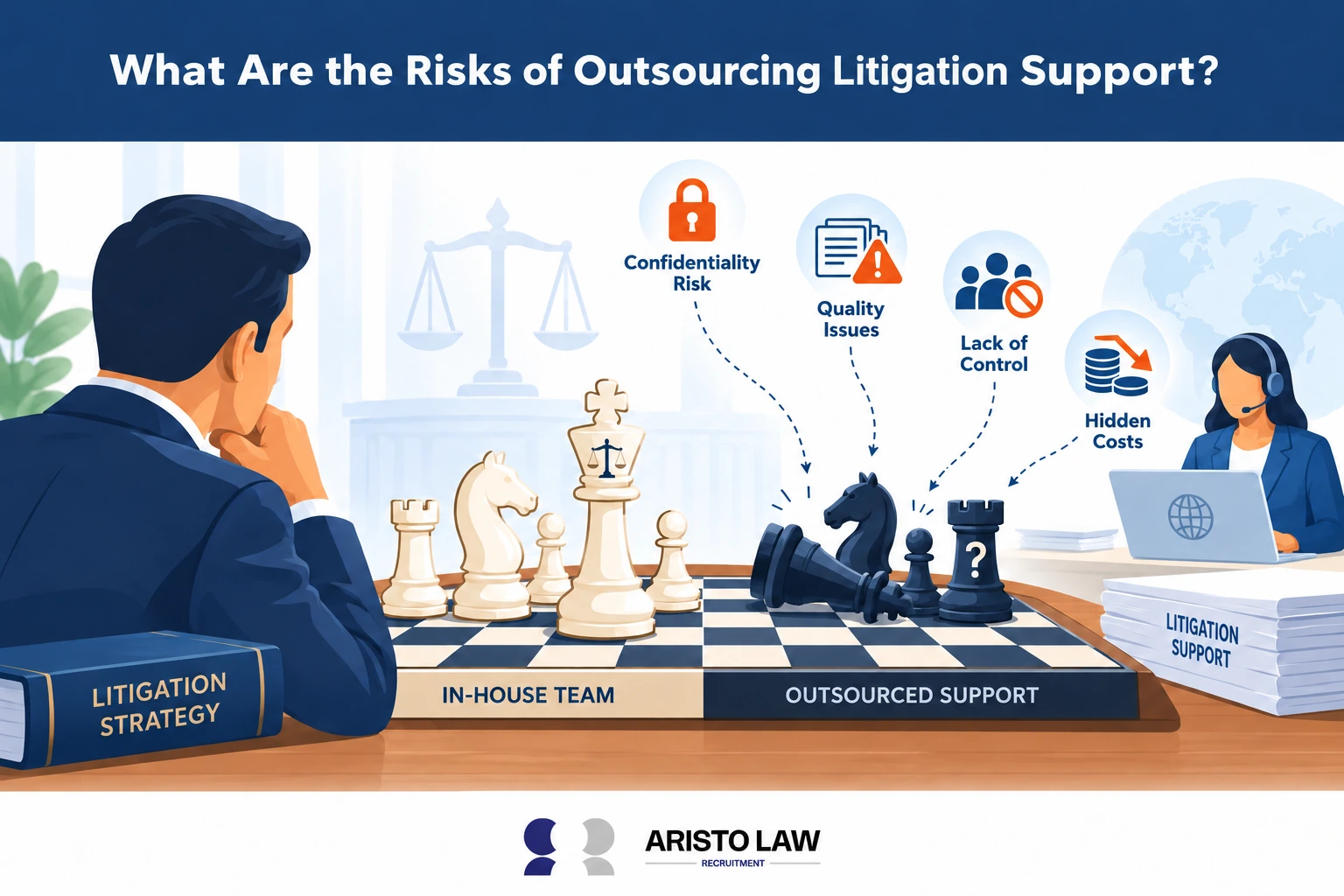
Listed below are the 12 risks of outsourcing litigation support.
-
Data security risks involving confidential client records and
litigation files -
Communication gaps between attorneys, vendors, and outsourced legal
teams -
Quality control issues affecting document accuracy and workflow
consistency -
Compliance risks related to HIPAA, GDPR, court procedures, and
confidentiality standards -
Operational oversight challenges across remote outsourced legal work
environments -
Timezone coordination problems in offshore legal outsourcing
structures -
Inconsistent turnaround times are affecting litigation deadlines and
workflow speed -
Vendor dependency risks tied to long-term outsourced legal support
operations -
Technology integration problems between law firm systems and provider
platforms -
Limited visibility into outsourced workflow execution and task
progression -
Knowledge transfer gaps during onboarding and litigation workflow
transitions -
Ethical and privilege management risks in outsourced legal processing
activities
How
can small firms choose the right legal outsourcing provider?
Small firms choose the right legal outsourcing provider by
evaluating litigation experience, data security standards, communication
processes, service specialization, and operational reliability before
outsourcing legal support work. Legal process outsourcing
companies must demonstrate experience in document review, legal
research, case management, drafting support, intake coordination, and
litigation workflow operations.
Data security review must include confidentiality controls, HIPAA and
GDPR compliance where applicable, secure document handling, restricted
access systems, and cybersecurity protections. Communication evaluation
must focus on reporting structure, turnaround times, workflow
visibility, escalation procedures, and operational responsiveness.
Service specialization matters because legal outsourcing firms with
litigation or practice-area experience usually provide stronger workflow
alignment and operational consistency.
A study by Grand View Research from the Legal Process Outsourcing
Market Size, Share | Growth [2030] Report in 2023 found that the global
legal process outsourcing (LPO) market size was valued at $13.67 billion
and is expected to grow at a compound annual growth rate (CAGR) of
31.4%. The report states that corporate legal departments are shifting
from traditional in-house management to external providers to tackle
high-volume, data-heavy tasks.
Build a legal support team that moves work forward.
Tell us what is slowing your practice down. We will help map the role, workflow, and support structure that fits.