
What Is Legal Drafting? Definition and Importance for Law Firms

Practical guidance for building efficient, accountable legal support operations.
Legal drafting refers to the structured creation of clear, precise, and enforceable legal documents that define rights, obligations, and legal outcomes. Legal drafting holds central importance for law firms because drafting quality directly affects legal protection, risk reduction, and enforceability across client matters. Legal drafting reduces disputes by removing ambiguity, aligning language with governing legal standards, and maintaining consistency with statutes, regulations, and case law.
Legal drafting precision remains critical for high-risk documents such as contracts, pleadings, policies, demand letters, and settlement agreements, where minor wording defects create major exposure. According to WorldCC’s 2019 “Conflicts and Disputes in Commercial and Contracting Relationships” report, between 10–25% of contracts experience disputes, with ambiguous or missing contract terms ranked as the leading cause by both buyers and suppliers. Legal drafting follows a defined process involving issue identification, authority review, structured language construction, internal review, and final validation.
Legal drafting requires lawyer skills in legal reasoning, jurisdiction awareness, risk anticipation, and attention to detail. Legal drafting accuracy improves through modern legal drafting software that supports clause libraries, templates, version control, and consistency checks. Legal drafting failures, such as vague definitions, conflicting clauses, and missing obligations, weaken enforceability and damage client outcomes. Legal drafting services, outsourcing arrangements, and structured staff training help firms manage volume while maintaining quality. Legal drafting standardization across teams strengthens consistency, compliance, and long-term operational reliability.
Aristolaw helps law firms streamline legal drafting workflows. Hire outsourced legal drafting support with Aristolaw today. Aristolaw helps law firms providing trained legal support professionals for contracts, pleadings, agreements, motions, and legal document preparation.
What is legal drafting?
Legal drafting is the structured creation of legal documents designed to produce clear, enforceable agreements and legally binding outcomes. Legal drafting focuses on translating legal intent into precise language that aligns with governing law, minimizes ambiguity, and supports enforceability in courts or regulatory settings. Legal drafting serves the core purpose of defining rights, obligations, remedies, and limitations within legal documents while protecting parties from interpretive risk. A study by Christopher R. Trudeau from The Western Michigan University Cooley Law School, titled The Public Perspective: An Empirical Study of Which Legal Writing Style the Public Prefers, in 2012, confirms that 80% of individuals prefer clear legal language, as increased complexity correlates with higher risks of misunderstanding legal obligations. The research demonstrates that, beyond improving comprehension, using plain language strengthens the enforceability of legal documents and reduces litigation risk.
Why is legal drafting important for law firms?
Legal drafting is important for law firms because precise, enforceable documents reduce risk, protect clients, and preserve firm credibility. Legal drafting supports law firm risk management by limiting ambiguity that leads to disputes, claims, and liability exposure. Legal drafting strengthens client protection by clearly defining rights, obligations, and remedies that withstand scrutiny. Legal drafting reinforces reputation by signaling legal accuracy, care, and reliability in high-stakes matters. Legal drafting protects revenue by preventing rework, fee disputes, and avoidable litigation costs tied to unclear agreements.
Listed below are the 10 importance of legal drafting for law firms.
- Legal accuracy and risk reduction: Legal drafting reduces ambiguity, inconsistencies, and legal exposure within contracts, pleadings, and agreements. Accurate legal drafting protects law firms and clients from compliance violations, disputes, and procedural errors.
- Contract enforceability: Legal drafting establishes legally enforceable terms, obligations, rights, and remedies within legal documents. Strong drafting improves contractual clarity and strengthens enforceability during litigation or dispute resolution.
- Litigation preparation and case strength: Legal drafting supports motions, pleadings, affidavits, and legal arguments used during litigation proceedings. Effective drafting improves case presentation, procedural compliance, and evidentiary organization.
- Client communication and clarity: Legal drafting translates complex legal concepts into structured and understandable documentation for clients and stakeholders. Clear drafting improves transparency, client trust, and legal comprehension.
- Regulatory and jurisdictional compliance: Legal drafting aligns documents with statutes, regulations, court procedures, and jurisdiction-specific legal requirements. Compliance-focused drafting reduces penalties, rejected filings, and legal disputes.
- Operational efficiency and workflow consistency: Legal drafting standardizes document preparation through templates, clause libraries, and structured drafting systems. Standardized drafting improves turnaround speed, document consistency, and workflow efficiency across law firm operations.
- Professional credibility and reputation: Legal drafting reflects the professionalism, competence, and reliability of a law firm. High-quality drafting strengthens an attorney’s credibility and improves client confidence in legal representation.
- Dispute prevention and conflict mitigation: Legal drafting defines obligations, timelines, liabilities, and dispute-resolution mechanisms within legal agreements. Precise drafting reduces misunderstandings, contractual conflicts, and future litigation risks.
- Negotiation support and strategic positioning: Legal drafting structures negotiation terms, contractual leverage points, and protective legal provisions for clients. Strategic drafting strengthens bargaining positions and improves negotiation outcomes.
- Documentation and record management: Legal drafting creates structured legal records supporting compliance, audits, litigation history, and operational tracking. Organized drafting improves document retrieval, case management, and long-term legal record maintenance.
How does legal drafting protect law firms legally?
Legal drafting protects law firms by reducing malpractice risk and strengthening liability protection through clear, compliant, and auditable legal documents. Legal drafting limits exposure by using precise language, defined terms, and a consistent structure that prevents misinterpretation and conflicting obligations.
Legal drafting supports compliance drafting by aligning documents with statutes, regulations, and professional standards, which reduces enforcement and disciplinary risk. Legal drafting enhances auditability through documented intent, traceable revisions, and standardized clauses that support defense in disputes or reviews.
What steps are involved in the legal drafting process?
Steps involved in the legal drafting process include understanding facts and objectives, legal research, outlining, clause drafting, revision, finalization, and execution or filing.
Listed below are the 9 standard stages in the legal drafting process across the document lifecycle.
- Understanding facts and objectives. Legal drafting begins by clarifying client goals, factual background, and legal risks within the relevant jurisdiction.
- Legal research. Legal drafting relies on reviewing statutes, case law, and legal precedents to ensure jurisdiction awareness and authority alignment.
- Outlining structure. Legal drafting uses structured outlines to organize issues, clauses, and logical flow before writing begins.
- Drafting clauses. Legal drafting converts legal intent into precise clauses using consistent terminology and established precedent language.
- Internal review. Legal drafting undergoes quality control to check accuracy, consistency, and risk exposure.
- Client review. Legal drafting incorporates client feedback while preserving legal accuracy and enforceability.
- Revision and refinement. Legal drafting adjusts language to resolve ambiguities, conflicts, and compliance gaps.
- Finalization. Legal drafting confirms completeness, formatting, and readiness for use.
- Execution or filing. Legal drafting concludes with signing, submission, or filing based on the document’s purpose and jurisdiction rules.
What types of legal documents require skilled drafting?
Legal documents that require skilled drafting include contracts, pleadings, motions, agreements, compliance filings, and settlement documents due to enforceability and compliance risk.
Listed below are the 8 main legal documents where drafting precision directly affects legal outcomes.
- Contracts. Contracts require precise terms defining obligations, remedies, and risk allocation.
- Pleadings. Pleadings require structured allegations that meet procedural standards.
- Motions. Motions require accurate legal arguments aligned with court rules.
- Agreements. Agreements require clear language to ensure enforceability and mutual intent.
- Policies. Policies require unambiguous wording to support compliance and enforcement.
- Wills and estate documents. Wills require exact language to reflect intent and prevent disputes.
- Compliance filings. Compliance filings require strict adherence to regulatory requirements.
- Settlement documents. Settlement documents require precision to avoid future claims.
What are the main principles of effective legal drafting?
Main principles of effective legal drafting include clarity, precision, consistency, logical structure, plain language where appropriate, and dispute foreseeability to ensure enforceable language.
Listed below are the 9 core drafting principles applied across legal documents.
- Clarity. Clarity ensures legal intent remains understandable and unambiguous to all parties.
- Precision. Precision limits interpretation risk by using exact legal terms and measurements.
- Consistency. Consistency maintains uniform terminology and structure across the document.
- Logical structure. Logical structure organizes clauses in a clear, predictable sequence.
- Defined terms. Defined terms control meaning and prevent conflicting interpretations.
- Completeness. Completeness addresses all rights, obligations, remedies, and contingencies.
- Compliance alignment. Compliance alignment ensures conformity with statutes, regulations, and professional standards.
- Plain language where appropriate. Plain language improves comprehension without weakening legal effect.
- Foreseeability of disputes. Foreseeability anticipates potential conflicts and resolves them through drafting.
What are common mistakes to avoid in legal drafting?
Common mistakes to avoid in legal drafting include vague language, inconsistent terminology, missing clauses, and a lack of jurisdiction alignment, all of which increase legal error and dispute risk.
Listed below are the 8 common mistakes to avoid in legal drafting.
- Vague language. Ambiguity weakens enforceability and increases interpretation disputes.
- Inconsistent terms. Inconsistent definitions create conflicting obligations and weaken legal clarity.
- Missing clauses. Omitted remedies, limitations, or termination terms expose clients to avoidable risk.
- Poor formatting. Disorganized structure reduces readability and increases review and enforcement errors.
- Outdated references. Superseded statutes or cases invalidate provisions and undermine legal accuracy.
- Lack of jurisdiction alignment. Misaligned governing law or venue clauses trigger compliance failures.
- Undefined terms. Missing definitions invite conflicting interpretations and disputes.
- Inadequate compliance language. Weak compliance drafting increases regulatory exposure.
Drafting mistakes raise litigation likelihood, delay resolution, increase costs, and damage law firm credibility.
What legal standards govern legal drafting?
Legal standards govern legal drafting by requiring compliance with statutes, regulations, court precedents, professional conduct rules, and applicable industry requirements. Legal standards shape drafting obligations by mandating statutory compliance, accurate reflection of governing law, and alignment with binding judicial interpretations.
Legal standards incorporate bar rules and professional conduct obligations that require competence, clarity, and avoidance of misleading language. Legal standards extend to industry-specific frameworks where contracts, policies, or filings must meet sector regulations and compliance thresholds. Legal standards collectively ensure drafted documents remain enforceable, ethical, and defensible within legal and regulatory review.
What legal standards govern legal drafting?
Legal standards govern legal drafting by requiring compliance with statutes, regulations, court precedents, professional conduct rules, and applicable industry requirements. Legal standards shape drafting obligations by mandating statutory compliance, accurate reflection of governing law, and alignment with binding judicial interpretations.
Legal standards incorporate bar rules and professional conduct obligations that require competence, clarity, and avoidance of misleading language. Legal standards extend to industry-specific frameworks where contracts, policies, or filings must meet sector regulations and compliance thresholds. Legal standards collectively ensure drafted documents remain enforceable, ethical, and defensible within legal and regulatory review.
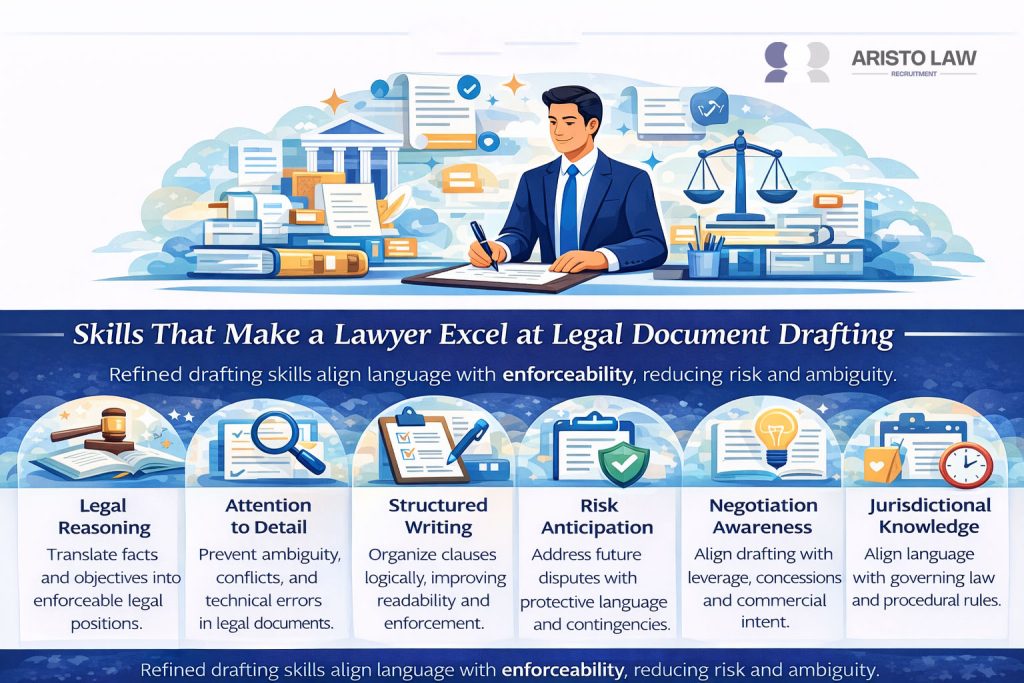
What skills make a lawyer excel at legal document drafting?
Skills that make a lawyer excel at legal document drafting include legal reasoning, attention to detail, structured writing, risk anticipation, clarity, and jurisdictional knowledge.
Listed below are 8 Skills that make a lawyer excel at legal document drafting.
- Legal reasoning. Legal reasoning translates facts and objectives into enforceable legal positions.
- Attention to detail. Attention to detail prevents ambiguity, conflicts, and technical errors in legal documents.
- Structured writing. Structured writing organizes clauses logically and improves readability and enforcement.
- Risk anticipation. Risk anticipation addresses future disputes through protective language and contingencies.
- Negotiation awareness. Negotiation awareness aligns drafting with leverage, concessions, and commercial intent.
- Clarity of expression. Clarity ensures defined rights, obligations, and remedies without misinterpretation.
- Jurisdictional knowledge. Jurisdictional knowledge aligns language with governing law and procedural rules.
- Revision discipline. Revision discipline refines accuracy through repeated review and quality control.
Exposure to litigation, negotiations, and repeated revisions sharpens drafting judgment by revealing how courts and counterparties interpret language over time.
What tools support modern legal drafting?
Tools that support modern legal drafting include document automation, clause libraries, AI drafting assistance, version control, collaboration systems, and citation validation tools that improve accuracy and consistency. Tools supporting modern legal drafting rely on legal drafting software and automation tools to standardize language, reduce manual errors, and maintain enforceable structure across documents.
Listed below are 6 core legal drafting tools used in legal tech–driven workflows.
- Document automation tools. Document automation generates structured drafts from predefined logic and inputs.
- Clause libraries. Clause libraries store approved language to ensure consistency and risk control.
- AI drafting assistants. AI drafting assistants support issue spotting, language refinement, and drafting speed with human oversight.
- Version control systems. Version control tracks changes, authorship, and document history for auditability.
- Collaboration tools. Collaboration tools enable real-time review, comments, and controlled access across teams.
- Citation tools. Citation tools verify references, cross-check authority, and reduce citation errors.
What legal drafting services do law firms provide?
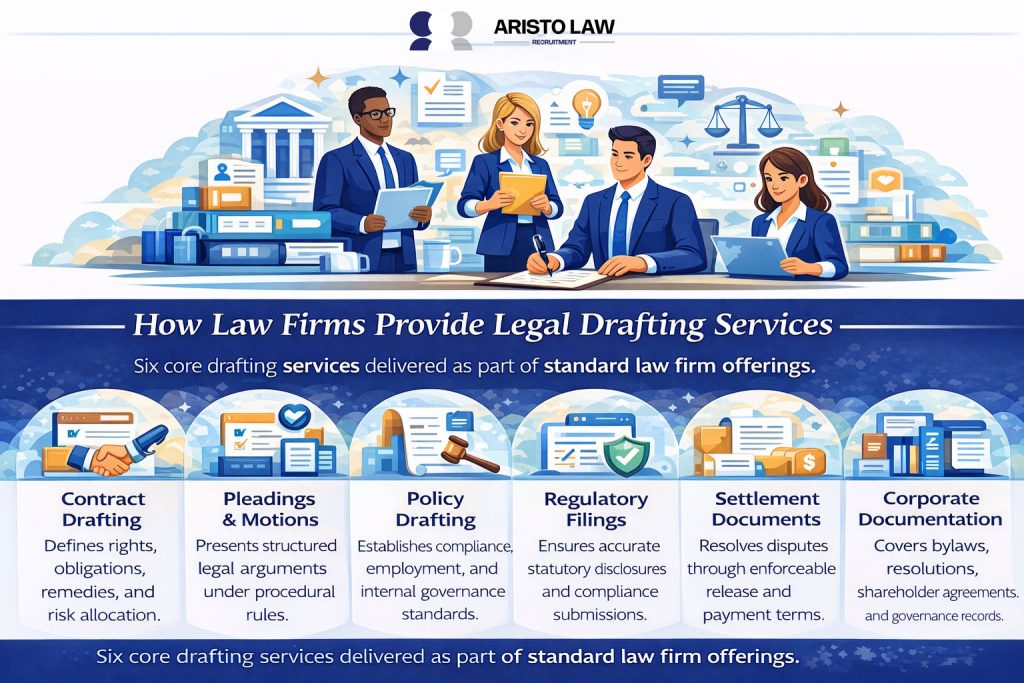
Legal drafting services law firms provide include contract drafting, pleadings and motions, policy drafting, settlement documents, and corporate documentation. Legal drafting services within law firm offerings often rely on legal document templates and drafting automation to maintain accuracy, consistency, and turnaround speed.
Listed below are 6 core legal drafting services delivered as part of standard law firm offerings.
- Contract drafting. Contract drafting defines rights, obligations, remedies, and risk allocation.
- Pleadings and motions. Pleadings and motions present structured legal arguments under procedural rules.
- Policy drafting. Policy drafting establishes compliance, employment, and internal governance standards.
- Regulatory filings. Regulatory filings ensure accurate statutory disclosures and compliance submissions.
- Settlement documents. Settlement drafting resolves disputes through enforceable release and payment terms.
Corporate documentation. Corporate drafting covers bylaws, resolutions, shareholder agreements, and governance records.
Where to get legal drafting services?
To get legal drafting services, firms and businesses rely on law firms, specialized legal outsourcing teams, independent lawyers, online platforms, and in-house counsel, with AristoLaw positioned as a trusted provider delivering reliable, high-quality drafting support. Legal drafting services from full-service or boutique law firms fit high-risk contracts, litigation documents, and regulatory filings, while routine contract drafting and document drafting support align well with legal drafting outsourcing services delivered through AristoLaw’s structured, confidentiality-driven workflows.
Legal drafting services from solo attorneys or contract lawyers suit niche matters requiring direct jurisdiction alignment. Legal drafting services from online legal platforms address standardized, low-risk documents at scale. Legal drafting services from in-house counsel support ongoing corporate documentation and policy needs. Legal drafting service selection remains effective by verifying provider credentials, confirming jurisdiction fit, and enforcing confidentiality through NDAs and secure handling practices.
When should businesses outsource legal drafting to a law firm?
Businesses outsource legal drafting to a law firm when legal documents involve high business risk, regulatory exposure, disputes, or limited in-house legal expertise. Outsourcing decisions align with outsourcing legal drafting work during complex transactions, multi-party agreements, compliance-driven documentation, or situations requiring external counsel oversight.
Businesses rely on law firm drafting when accuracy, enforceability, and jurisdiction alignment directly affect financial or operational outcomes. Businesses choose external counsel when internal teams lack capacity, specialization, or litigation-informed drafting judgment. Businesses reduce risk by outsourcing legal drafting for contracts, policies, and dispute-related documents that demand professional accountability, confidentiality controls, and validated legal standards.
Can law firms train staff in legal drafting best practices?
Yes, law firms can train staff in legal drafting best practices through structured programs that combine standards, supervision, and continuous quality control. Legal drafting training often includes onboarding playbooks, drafting style guides, clause libraries, and training staff on drafting and admin best practices embedded into daily workflows.
Legal drafting training applies to both lawyers and support staff through shadowing, mentorship, supervised drafting tasks, and guided exposure to real matters. Legal drafting training strengthens quality control through redline review sessions, peer review, drafting checklists, and strict version control. Legal drafting training programs reduce drafting errors, improve consistency across teams, and strengthen client service by aligning documents with firm standards and enforceable legal outcomes.
Build a legal support team that moves work forward.
Tell us what is slowing your practice down. We will help map the role, workflow, and support structure that fits.