
Remote Corporate Paralegal – Strategic Advantages, Corporate Legal Support, and Law Firm Efficiency

Practical guidance for building efficient, accountable legal support operations.
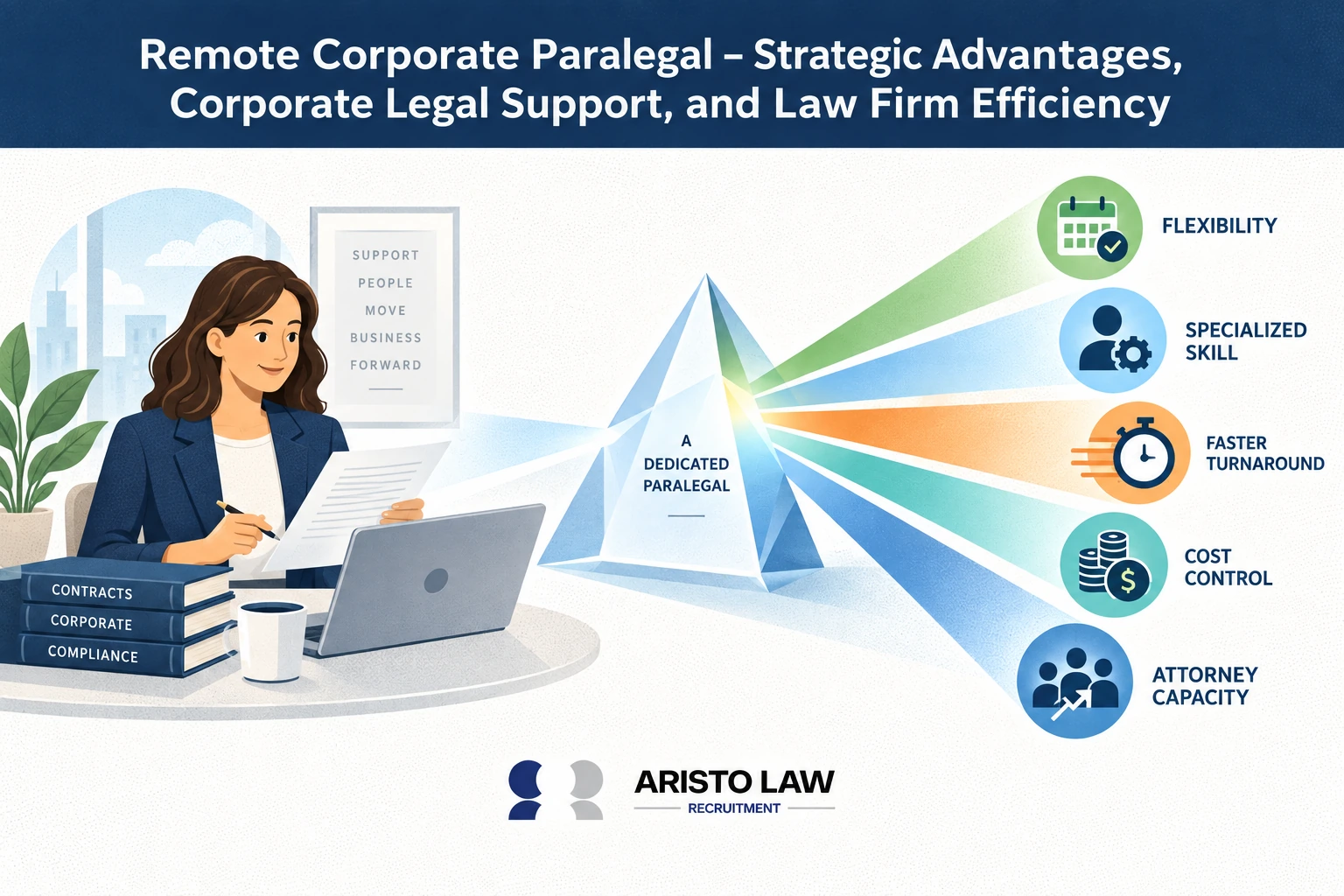
A remote corporate paralegal is a legal support professional
who works remotely to assist corporate legal departments and law firms
with transactional, compliance, governance, and operational legal
workflows. Remote corporate paralegals use cloud-based legal
systems and digital collaboration platforms to manage documentation,
coordinate legal processes, and support corporate legal operations.
Remote corporate paralegals support attorneys and legal operations
teams by managing contract lifecycle workflows, regulatory compliance
tracking, due diligence coordination, entity management, document
preparation, corporate filings, governance documentation, legal
research, and transaction support under attorney supervision. A
2019 survey report published by the National Association of Legal
Assistants (NALA) involving roughly 150 paralegals across multiple
industries found that corporate legal support professionals were heavily
involved in contract lifecycle management workflows, including contract
coordination, compliance monitoring, document management, filing
systems, and legal operations support. Corporate legal
departments and law firms increasingly rely on remote corporate
paralegals because distributed legal workflows improve scalability,
reduce operational overhead, and support efficient matter management
across growing business environments.
Remote corporate paralegals differ from virtual legal assistants
because corporate paralegal work involves more substantive legal support
tied to contracts, governance, compliance operations, regulatory
filings, transactional coordination, and legal analysis workflows.
Virtual legal assistants primarily focus on administrative coordination,
intake management, scheduling, billing support, and workflow
organization, while remote corporate paralegals handle
document-intensive legal operations that directly support corporate
transactions and compliance management.
Corporate workflows handled by remote corporate paralegals commonly
include contract lifecycle management, vendor agreement tracking,
governance record maintenance, compliance reporting, subsidiary
management, due diligence review, litigation support coordination,
SEC-related documentation support, board-resolution preparation, and
transaction-closing workflows. Contract lifecycle platforms,
document-management systems, e-signature tools, billing systems, legal
databases, secure cloud repositories, and collaboration software allow
remote corporate paralegals to integrate directly into modern legal
operations across distributed legal teams.
Strategic advantages of remote corporate paralegal staffing include
lower operational costs, reduced office overhead, flexible staffing
scalability, broader access to specialized legal talent, faster workflow
execution, and improved turnaround time for document-heavy legal
processes. Remote legal staffing allows firms to absorb workload spikes
during mergers, acquisitions, audits, litigation surges, compliance
reviews, and high-volume contract operations without expanding permanent
in-house staffing infrastructure. Legal operations research consistently
shows that flexible legal staffing models improve workflow efficiency,
reduce administrative bottlenecks, and increase attorney productivity by
delegating process-driven legal support tasks through centralized
digital systems.
Hiring considerations commonly include corporate legal experience,
contract-management proficiency, compliance familiarity, legal software
capability, confidentiality awareness, communication skill, onboarding
structure, workflow supervision, and performance measurement systems.
Firms often choose between direct hiring, freelance staffing,
outsourcing providers, or hybrid staffing models depending on workload
volume, operational complexity, budget structure, and supervision
capacity. Performance metrics commonly focus on turnaround time,
document accuracy, compliance tracking consistency, contract-management
efficiency, workflow completion rates, and attorney time saved.
Law firms and corporate legal departments hire remote corporate
paralegals when contract volume increases, compliance obligations
expand, transactional workflows become more complex, or administrative
legal bottlenecks begin slowing operational performance. Remote
corporate paralegals contribute to long-term legal operations efficiency
and scalability by maintaining organized workflows, improving document
coordination, strengthening compliance continuity, and supporting
technology-driven legal operations across distributed legal
environments.
Aristolaw helps law firms improve remote corporate paralegal
support, corporate legal workflows, and law firm efficiency by providing
outsourced support for entity management, compliance tracking, contract
coordination, due diligence tasks, board document preparation, and
corporate filing workflows. Call Aristolaw at +1 307
888 9491 for legal support outsourcing services.
Aristolaw connects law firms with outsourcing solutions that
match trained remote corporate paralegal staff to each corporate support
task, compliance responsibility, document coordination duty, entity
record function, and law firm efficiency needs.
What is a remote corporate
paralegal?
A remote corporate paralegal is a legal support professional
who works for law firms or legal departments from an off-site
location. A remote corporate paralegal performs corporate,
transactional, compliance, governance, and document-intensive paralegal
work remotely.
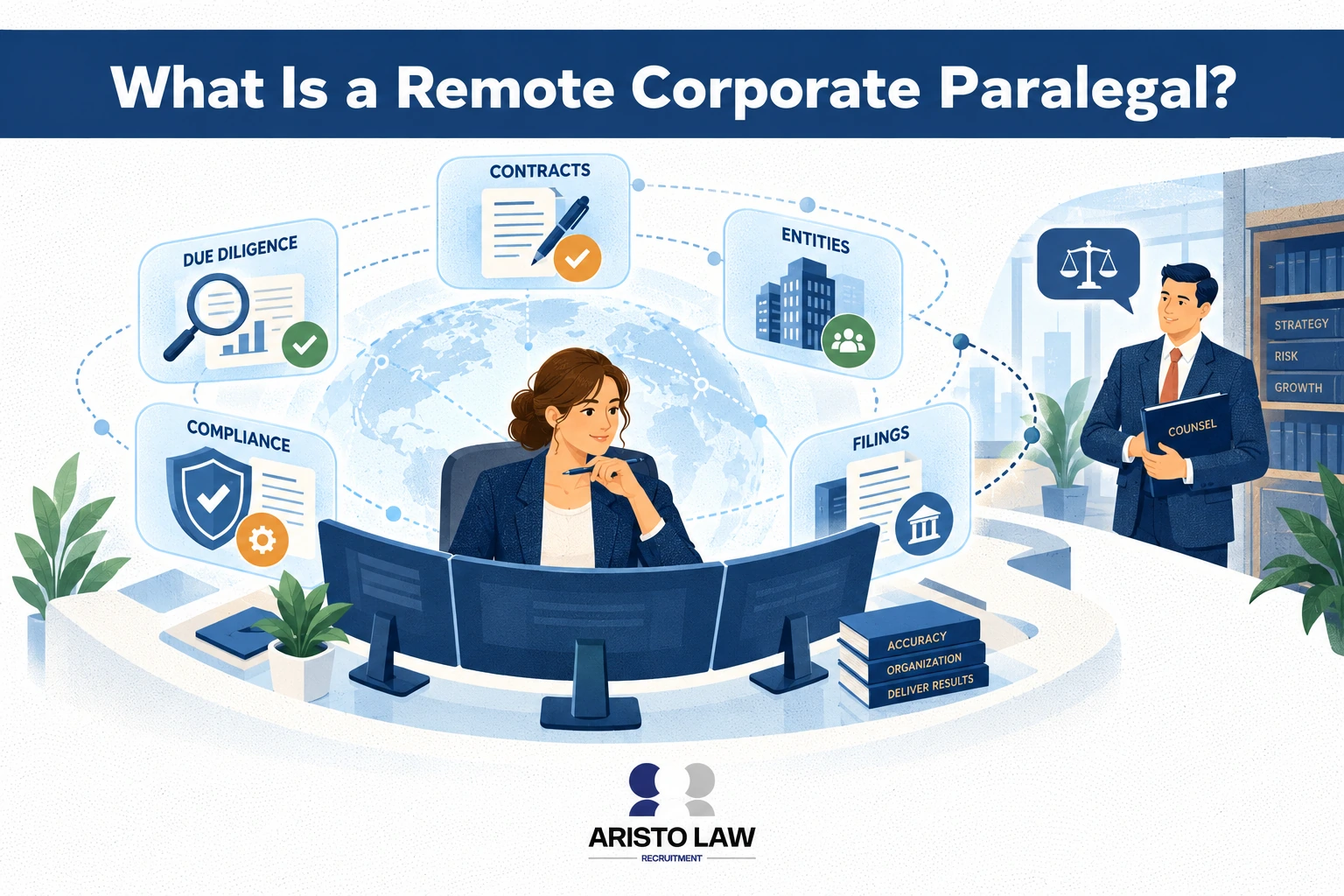
Remote corporate paralegals support attorneys through corporate legal
workflows involving entity management, contract review support,
compliance tracking, due diligence coordination, governance
documentation, legal research, corporate filing preparation, and
transaction support using cloud-based legal systems and secure digital
collaboration platforms. Corporate legal departments and law firms use
remote corporate paralegals to maintain operational continuity across
contract lifecycle management, regulatory reporting, board-document
coordination, subsidiary tracking, and document-intensive transactional
workflows without requiring full-time on-site staffing.
According to the U.S. Bureau of Labor Statistics (BLS)
Occupational Employment and Wage Statistics published in 2024, the
United States employed approximately 366,200 paralegals and legal
assistants, many of whom perform legal support functions for law firms
and corporate legal departments through digital and remote
workflows. The BLS described these professionals as responsible
for maintaining legal records, organizing documents, conducting legal
research, coordinating communications, and supporting attorneys through
technology-based systems that allow work to be completed outside
traditional office settings.
The role remains supervised by licensed attorneys because remote
corporate paralegals cannot independently provide legal advice,
establish attorney-client relationships, or practice law without
attorney oversight. Remote delivery functions as a staffing model rather
than a reduction in legal capability, allowing firms to improve
scalability, reduce office overhead, increase workflow flexibility, and
expand access to specialized legal support talent across distributed
legal operations.
Remote corporate paralegals strengthen workflow capacity by
supporting high-volume legal processes efficiently through legal
databases, document-management systems, contract-management platforms,
e-signature tools, and centralized compliance workflows. Remote
Corporate Paralegal workflows improve operational flexibility,
accelerate document handling efficiency, and strengthen
cross-jurisdiction legal support through the remote
corporate paralegal strategic advantages associated
with scalable remote legal infrastructure.
What does a remote
corporate paralegal do?
Tasks a remote corporate paralegal does include entity
management, contract support, due diligence, compliance tracking,
corporate filings, legal research, and document
organization.
Listed below are 10 tasks assigned to a remote corporate
paralegal.
-
Entity management workflows: Remote corporate
paralegals support entity formation, subsidiary maintenance, annual
reports, registered-agent coordination, jurisdictional filings, and
corporate record-book management to maintain organized governance
structures and regulatory compliance. -
Corporate governance documentation: Remote legal
support includes preparing board minutes, resolutions, consent
documents, governance records, meeting materials, and organizational
documentation that improve operational consistency across recurring
corporate workflows. -
Contract-support workflows: Corporate paralegals
assist with contract abstraction, contract lifecycle tracking, clause
organization, repository management, signature coordination, and
document-review preparation to reduce attorney administrative workload
in high-volume contract environments. -
Due diligence coordination: Remote corporate
paralegals organize data rooms, collect transaction documents, manage
diligence checklists, review records, and coordinate information flow
during mergers, acquisitions, financing transactions, and audits. -
Compliance-tracking operations: Compliance support
includes maintaining compliance calendars, monitoring filing deadlines,
organizing regulatory records, tracking reporting obligations, and
coordinating governance updates that reduce procedural risk. -
Corporate filing preparation: Remote paralegals
prepare and organize state filings, governance submissions, SEC-support
documentation, registration materials, and transactional filing packages
under attorney supervision. -
Legal research and memo preparation: Corporate
paralegals conduct legal research, compile regulatory information,
summarize findings, prepare legal memoranda, and organize supporting
documentation for attorney review. -
Transaction-support workflows: Remote legal support
teams maintain closing checklists, organize execution documents,
coordinate signature workflows, track deliverables, and support
transactional process continuity across complex corporate matters. -
Document-management and records organization:
Corporate paralegals maintain searchable repositories, update legal
databases, manage version control, organize digital records, and improve
workflow accuracy across document-intensive legal operations. -
Cross-functional workflow coordination: Remote
corporate paralegals coordinate communication between attorneys, finance
teams, compliance departments, HR teams, vendors, and external parties
to maintain operational workflow continuity across corporate legal
environments.
How
does a remote corporate paralegal support law firms?
A remote corporate paralegal supports law firms by expanding
paralegal capacity for corporate matters without requiring permanent
in-office staffing. Law firms use remote corporate paralegals
to manage overflow work, recurring corporate maintenance, transaction
surges, compliance-heavy workflows, and deadline-sensitive legal
operations through cloud-based legal systems and distributed workflow
coordination.
Remote support is especially valuable during mergers and
acquisitions, financing transactions, governance updates,
entity-management projects, regulatory filings, contract-review spikes,
and high-volume business-law matters where document-intensive workflows
increase rapidly within short operational windows.
Remote corporate paralegals reduce attorney bottlenecks by handling
recurring legal support functions such as due diligence coordination,
governance-document preparation, contract lifecycle tracking, compliance
monitoring, filing organization, and corporate-record maintenance under
attorney supervision.
Faster document turnaround, centralized workflow tracking, organized
repositories, and continuous compliance monitoring improve matter
throughput and reduce operational delays across corporate legal
environments. Remote staffing models also improve scalability because
firms expand workflow capacity without adding permanent payroll
overhead, office infrastructure, or fixed staffing commitments.
Remote support works particularly well for firms handling fluctuating
corporate, M&A, business-law, governance, and compliance workloads
because many of those workflows are process-driven, repetitive,
document-heavy, and technology-enabled. A 2025 legal outsourcing
industry analysis published by ASL Gate found that demand for remote and
outsourced legal support was being driven by cross-border M&A
activity, corporate restructuring, governance requirements, and
compliance monitoring. The report stated that companies
increasingly rely on remote legal teams for “document-intensive
processes,” including contract lifecycle management, regulatory
tracking, e-discovery, and high-volume legal administration because
these workflows are standardized, process-oriented, and
technology-enabled.
Distributed paralegal support allows firms to maintain
responsiveness, keep compliance obligations current, absorb temporary
transaction surges, and improve operational continuity while attorneys
remain focused on negotiations, legal strategy, client counseling, and
transactional execution.
How
does a remote corporate paralegal support corporate legal
departments?
A remote corporate paralegal supports corporate legal
departments by managing recurring legal operations, compliance
documentation, contract workflows, and governance records across
business units. In-house legal teams use remote corporate
paralegals to support general counsel, compliance officers, procurement
teams, HR departments, finance teams, contract managers, and executive
leadership through structured workflow coordination and
document-intensive legal operations.
Remote corporate paralegals maintain contract repositories, organize
vendor agreements, update governance records, track subsidiary
information, manage board-document workflows, maintain regulatory
calendars, and coordinate policy-tracking systems through cloud-based
legal platforms and centralized document-management systems.
Corporate legal departments also rely on remote corporate paralegals
to process internal legal requests, organize approval workflows, monitor
filing deadlines, support compliance reporting, maintain entity records,
and coordinate transactional documentation across distributed business
operations.
This operational support reduces backlog inside legal departments by
delegating repetitive and process-driven workflows that otherwise
consume attorney and compliance-team time. Remote staffing allows
corporate legal departments to increase workflow capacity, improve
turnaround time, and maintain operational continuity without immediately
expanding permanent in-house headcount or increasing fixed overhead
costs.
Can paralegals work from
home?
Yes, paralegals can work from home when their duties rely on
digital documents, legal software, secure communication, and
attorney-supervised workflows. Modern legal operations
increasingly use cloud-based case-management systems, document
repositories, e-signature platforms, legal databases, billing software,
and encrypted communication tools that allow paralegals to perform many
legal support functions remotely without reducing workflow
continuity.
Tasks that translate well to remote work include legal research,
document review, contract abstraction, compliance tracking,
case-management updates, discovery coordination, due diligence support,
legal drafting preparation, filing coordination, and client
communication under attorney supervision.
Remote paralegal workflows operate efficiently because
document-intensive legal operations are now heavily digitized across
litigation, corporate, compliance, transactional, immigration, and
administrative legal environments. Attorneys supervise remote paralegals
through centralized workflow systems, communication platforms, deadline
tracking tools, and role-based access controls that maintain
accountability and confidentiality compliance. Remote staffing also
improves scalability, operational flexibility, and workflow coverage
during high-volume legal periods.
Some legal workflows require stronger controls or continued in-office
handling. Physical court filings, notarization requirements,
wet-signature processing, paper-record management, evidence handling,
mail processing, office-specific procedural workflows, and
jurisdiction-specific confidentiality obligations may require direct
in-person coordination or additional compliance safeguards. Law firms
and corporate legal departments therefore commonly use hybrid staffing
models where remote paralegals manage digital legal workflows while
sensitive physical or jurisdiction-dependent processes remain internally
controlled.
What
is the difference between remote paralegals and virtual legal
assistants?
The table below shows how substantive legal support differs from
administrative legal support.
| Category | Remote Paralegal | Virtual Legal Assistant |
|---|---|---|
| Primary role focus | Provides substantive legal support under attorney supervision | Provides administrative and workflow coordination support |
| Workflow complexity | Handles document-intensive and legally substantive workflows | Handles operational and administrative legal workflows |
| Legal research involvement | Conducts legal research, case-law compilation, and regulatory review |
Usually does not perform substantive legal research |
| Drafting support | Assists with pleadings, contracts, governance records, filings, and due diligence documentation |
Formats templates, organizes documents, and manages administrative drafting workflows |
| Contract support | Supports contract abstraction, review preparation, clause tracking, and lifecycle workflows |
Coordinates signatures, filing organization, and repository updates |
| Compliance responsibilities | Tracks regulatory obligations, governance filings, compliance documentation, and audit support |
Tracks deadlines, reminders, and workflow follow-up tasks |
| Corporate governance support | Assists with board minutes, resolutions, entity records, and governance documentation |
Coordinates scheduling, communication, and document organization |
| Due diligence involvement | Organizes data rooms, transaction checklists, and diligence documentation |
Supports administrative coordination and workflow tracking |
| Client communication scope | Communicates regarding factual updates and procedural support under attorney supervision |
Handles intake responses, scheduling, reminders, and general communication workflows |
| Billing relevance | Supports billable legal workflows tied to substantive legal operations |
Supports administrative efficiency and non-billable workflow coordination |
| Education and training | Often has paralegal education, legal training, or substantive legal workflow experience |
Commonly trained in legal administration, intake, scheduling, and workflow systems |
| Attorney supervision | Requires attorney oversight for substantive legal support tasks | Requires attorney or office-management supervision for operational tasks |
| Typical workflows handled | Legal research, due diligence, compliance tracking, filings, discovery, contract support, governance records |
Intake, scheduling, CRM updates, inbox management, billing support, and document organization |
| Technology usage | Uses legal databases, contract-management systems, eDiscovery tools, and governance platforms |
Uses CRM systems, scheduling tools, billing software, communication systems, and case-management platforms |
| Operational objective | Reduces attorney workload in substantive legal matters | Reduces attorney and staff administrative burden while improving workflow continuity |
Which
corporate workflows can remote paralegals handle?
Corporate workflows remote paralegals can handle include
entity governance, contract lifecycle support, and transaction
checklists.
Listed below are the10 corporate workflows remote paralegals can
handle.
-
Entity-governance workflows: Remote corporate
paralegals manage entity formations, amendments, annual reports,
registered-agent coordination, board resolutions, consent documents, and
minute-book maintenance to keep governance structures organized and
compliant. -
Contract lifecycle workflows: Corporate paralegals
support contract abstraction, repository updates, renewal tracking,
obligation monitoring, signature coordination, clause indexing, and
redline support under attorney review across vendor, procurement, and
commercial agreements. -
Due diligence workflows: Remote legal support teams
coordinate document collection, organize data rooms, maintain diligence
checklists, track missing records, summarize findings, and support issue
spotting during mergers, acquisitions, financing transactions, and
audits. -
Compliance-calendar management: Corporate paralegals
monitor recurring deadlines, licensing obligations, policy updates,
governance filings, renewal schedules, and reporting requirements across
regulated business operations. -
Regulatory-filing workflows: Remote paralegals
prepare and organize filing materials, maintain submission records,
coordinate procedural documentation, and support regulatory reporting
under attorney supervision. -
Corporate-records management: Legal support includes
maintaining corporate repositories, updating subsidiary records,
organizing governance documents, managing version control, and
preserving searchable legal archives. -
Transaction-checklist coordination: Remote corporate
paralegals track closing deliverables, maintain execution checklists,
coordinate signatures, organize transaction documents, and monitor
workflow progression during corporate transactions. -
Board and governance-document workflows: Corporate
paralegals organize board packets, meeting materials, resolutions,
agendas, and governance communications that support executive and legal
department operations. -
Policy and audit-support workflows: Remote legal
support teams track policy acknowledgments, maintain audit
documentation, organize compliance records, and prepare supporting
materials for internal reviews or regulatory examinations. -
Cross-department legal coordination: Corporate
paralegals coordinate workflows between legal departments, procurement
teams, HR departments, compliance officers, finance teams, and external
vendors to maintain operational continuity across business units.
How do
remote paralegals support contract management?
Remote paralegals support contract management by organizing
contract intake, extracting key terms, tracking obligations, updating
repositories, and supporting attorney review workflows.
Corporate legal departments and law firms use remote corporate
paralegals throughout the full contract lifecycle, beginning with intake
coordination and workflow routing for NDAs, vendor agreements, customer
contracts, employment agreements, service agreements, procurement
contracts, and amendment requests.
Remote paralegals maintain contract-management systems by organizing
submissions, updating metadata, tagging contract categories, tracking
approval status, and maintaining repository hygiene across centralized
legal databases. According to research cited by Gartner and
contract-management analysts in enterprise legal operations,
organizations using automated contract workflows and centralized legal
repositories significantly improved contract administration tasks such
as metadata management, approval tracking, tagging, and repository
maintenance. Gartner reported that companies implementing
automated contract workflows reduced approval cycle times
by 50% or more, showing how legal support
professionals and remote paralegals increasingly manage approval
routing, status tracking, and contract organization across centralized
databases.
During contract-review workflows, remote corporate paralegals assist
with contract abstraction by extracting renewal dates, termination
clauses, notice periods, payment obligations, indemnification
references, compliance requirements, and operational deliverables into
searchable tracking systems. They also coordinate redline workflows,
signature routing, version control, amendment tracking, and execution
management through cloud-based collaboration systems and e-signature
platforms. Ongoing support includes renewal tracking, obligation
monitoring, compliance-calendar updates, and repository maintenance that
help legal departments avoid missed deadlines, unmanaged renewals, or
disorganized contract records.
Remote paralegals support operational contract analysis and workflow
organization, but attorney-level legal judgment remains reserved for
licensed attorneys. Remote Corporate Paralegals support contract
management by organizing agreement workflows, monitoring deadlines,
reviewing contract documentation, and maintaining compliance records
across legal operations. Law firms and corporate legal departments use
remote
contract manager services to connect Remote Corporate
Paralegal support with structured contract tracking, version control,
and administrative coordination.
Attorneys remain responsible for interpreting legal risk, negotiating
legal terms, drafting substantive legal strategy, approving contractual
language, and providing legal advice. Remote corporate paralegals
therefore strengthen contract-management efficiency by handling
document-intensive and process-driven workflows that improve turnaround
time, workflow visibility, and operational continuity across high-volume
contract environments.
How do
remote paralegals support regulatory compliance?
Remote paralegals support regulatory compliance by tracking
deadlines, maintaining compliance records, organizing filings, and
preparing documentation for attorney or compliance-officer
review. Corporate legal departments and regulated businesses
use remote corporate paralegals to manage monitoring and documentation
workflows tied to licensing calendars, annual reports, corporate
registrations, beneficial ownership records, policy registers,
compliance certifications, training records, and jurisdiction-specific
filing obligations.
Remote paralegals maintain centralized compliance repositories,
update regulatory calendars, organize supporting documentation, and
coordinate filing workflows through cloud-based legal systems and
compliance-management platforms. A 2023 survey by legal
professionals reviewing cloud-based legal document management systems
found that 78% of legal professionals considered legal technology
essential for daily operations, particularly for organizing documents,
maintaining centralized records, and managing compliance workflows
through digital platforms. The report explained that modern
legal document systems are designed to help legal teams securely store,
organize, retrieve, and coordinate legal files through centralized
cloud-based environments, supporting remote legal operations and
workflow management.
Compliance support also includes preparing audit packets, maintaining
governance records, tracking policy acknowledgments, monitoring renewal
schedules, organizing vendor-compliance documentation, and coordinating
recurring reporting obligations across multiple jurisdictions or
business entities. Remote corporate paralegals improve audit readiness
because centralized document organization, deadline monitoring, and
structured recordkeeping reduce missing documentation, outdated filings,
and procedural gaps that commonly create regulatory risk in heavily
regulated industries.
Their role remains operational and documentation-focused rather than
advisory. Attorneys and compliance officers retain responsibility for
interpreting regulations, assessing legal exposure, making compliance
decisions, and providing legal guidance. Remote paralegals strengthen
compliance workflows by reducing missed deadlines, improving reporting
accuracy, maintaining organized records, and supporting scalable
compliance operations across distributed legal and corporate
environments.
How do
remote paralegals support entity management?
Remote paralegals support entity management by maintaining
corporate records, tracking annual obligations, preparing governance
documents, and coordinating filings across jurisdictions.
Entity management functions as a recurring governance system requiring
continuous monitoring, record maintenance, filing coordination, and
deadline tracking across corporations, subsidiaries, LLCs, partnerships,
and affiliated business entities.
Remote corporate paralegals support these workflows by organizing
entity formations, dissolutions, foreign qualifications, annual reports,
registered-agent coordination, officer and director updates, ownership
records, subsidiary tracking, and jurisdiction-specific filing
requirements through centralized legal-management systems.
Remote entity-management support is especially valuable for firms
serving corporate groups, holding companies, private-equity portfolios,
franchise systems, or multinational organizations with ongoing
maintenance obligations involving large numbers of entities and
recurring governance requirements. Remote Corporate Paralegal manages
entity records, tracks compliance deadlines, and coordinates corporate
documentation across distributed legal operations. Structured reporting,
document control, and governance coordination strengthen virtual
paralegal assistant support for corporate legal
workflows within multi-entity business
environments.
Remote legal support also includes preparing board consents,
resolutions, governance updates, minute books, organizational records,
and entity-status documentation under attorney supervision. Corporate
legal departments and law firms managing multiple business entities rely
on remote paralegals to maintain compliance calendars, track filing
deadlines, organize governance repositories, and coordinate recurring
entity-maintenance workflows efficiently across multiple jurisdictions.
This operational support reduces administrative bottlenecks, prevents
missed compliance obligations, improves governance continuity, and
strengthens record accuracy across complex corporate structures.
What
are the strategic advantages of hiring a remote corporate
paralegal?
Strategic advantages of hiring a remote corporate paralegal
include lower overhead, scalable capacity, faster turnaround,
specialized legal support, better workflow coverage, and reduced
attorney administrative burden.
Listed below are 10 strategic advantages of hiring a remote corporate
paralegal.
-
Lower operational overhead: Remote corporate
paralegals reduce fixed staffing costs tied to office space, equipment,
on-site infrastructure, employee overhead, and permanent in-house
expansion, improving staffing economics across corporate legal
operations. -
Scalable legal-support capacity: Remote staffing
converts legal support from fixed capacity into flexible capacity,
allowing firms and legal departments to expand or reduce workflow
support during mergers, acquisitions, audits, compliance cycles, and
transaction surges without permanent payroll growth. -
Faster turnaround time: Distributed workflow support
improves matter velocity by accelerating document preparation, due
diligence coordination, contract tracking, compliance updates,
governance workflows, and filing organization across high-volume legal
operations. -
Specialized corporate legal support: Remote
corporate paralegals often possess focused experience in governance
workflows, entity management, compliance tracking, contract lifecycle
management, and transactional support, improving workflow accuracy and
operational consistency. -
Improved workflow coverage: Remote staffing
strengthens operational continuity by reducing bottlenecks, maintaining
deadline visibility, organizing document-heavy workflows, and supporting
distributed legal teams across multiple jurisdictions or business
units. -
Reduced attorney administrative burden: Attorneys
delegate recurring operational tasks such as governance-document
preparation, compliance coordination, contract abstraction, repository
management, and filing workflows, preserving attorney time for
negotiations, legal analysis, and strategic legal work. -
Greater responsiveness during cyclical workloads:
Firms handling fluctuating corporate transactions, financing deals,
regulatory reporting periods, or high-volume contract activity maintain
operational flexibility without staffing shortages or workflow
congestion. -
Broader access to specialized talent: Remote
staffing models allow firms to source corporate paralegals with niche
expertise in securities, governance, M&A, compliance, or
contract-management workflows beyond local hiring markets. -
Improved legal-operations efficiency: Centralized
digital workflows, cloud-based collaboration systems, and remote
coordination improve visibility, workflow tracking, document
organization, and procedural consistency across legal operations. -
Better long-term operational scalability: Remote
corporate paralegal integration allows firms and corporate legal
departments to support growth, increasing entity volume, expanding
regulatory obligations, and rising contract workloads without
proportionally increasing fixed operational infrastructure.
Why are
remote paralegals cost-effective for law firms?
Remote paralegals are cost-effective for law firms because
they reduce fixed staffing costs while increasing legal support capacity
for billable and non-billable workflows. Law firms lower
operational expenses tied to office space, equipment, workstation setup,
employee overhead, and long-term payroll commitments because remote
staffing operates through distributed legal workflows and cloud-based
legal systems.
Flexible staffing structures also allow firms to scale support
according to workload demand rather than maintaining excess in-house
staffing during slower operational periods. Distributed and offshore
staffing models further improve staffing economics by expanding access
to lower-cost legal support talent without reducing workflow
coverage.
Remote corporate paralegals also improve operational leverage because
attorneys spend less time handling recurring paralegal-level tasks such
as entity maintenance, contract abstraction, governance-document
organization, filing coordination, due diligence review, compliance
tracking, and repository management. The hidden operational cost of
attorneys performing those repetitive workflows includes lost billable
hours, slower matter progression, reduced transaction velocity, and
delayed client service.
Delegating document-intensive and process-driven workflows to remote
paralegals allows attorneys to focus on negotiations, legal strategy,
transactional execution, client counseling, and revenue-generating legal
work. Cost-effectiveness depends heavily on workflow fit, onboarding
quality, supervision structure, task standardization, and legal-workflow
volume. Firms handling recurring corporate maintenance, high contract
volume, cyclical transaction surges, compliance-heavy operations, or
document-intensive legal processes generally achieve the strongest
operational and financial efficiency gains from remote paralegal
integration.
How
do remote corporate paralegals improve law firm efficiency?
Remote corporate paralegals improve law firm efficiency by
taking structured corporate legal tasks off attorney calendars and
moving matters through repeatable workflows faster. Efficiency
improves through delegation design because attorneys spend less time
switching between high-value legal analysis and repetitive operational
tasks such as entity maintenance, contract tracking, governance-document
preparation, filing coordination, due diligence organization, compliance
monitoring, and repository management.
Reduced context switching improves attorney utilization by preserving
uninterrupted focus for negotiations, legal strategy, drafting
decisions, and client counseling while remote corporate paralegals
manage recurring workflow execution under attorney supervision.
Remote corporate paralegals also improve operational consistency
through standardized filing checklists, centralized document
organization, compliance-calendar tracking, transaction-support
workflows, and contract-lifecycle coordination. Structured workflow
systems create cleaner matter organization, more predictable document
handling, faster contract-cycle support, and improved deadline
visibility across high-volume corporate legal operations.
Front-end responsiveness improves because intake requests, governance
updates, contract-routing workflows, and client communications move more
quickly through centralized workflow systems, while back-end matter
completion improves through organized repositories, procedural tracking,
due diligence coordination, and continuous workflow monitoring. Remote
Corporate Paralegal teams reduce administrative bottlenecks by
organizing contract workflows, maintaining compliance records, and
accelerating document turnaround across legal operations. Remote
Corporate Paralegal support strengthens workflow
efficiency in law firms through structured task
delegation, centralized communication, and continuous coordination
between attorneys, clients, and internal departments.
These operational improvements produce measurable business outcomes
tied to faster turnaround time, higher attorney utilization, stronger
deadline completion rates, reduced administrative bottlenecks, improved
workflow predictability, and more consistent client delivery.
Firms handling recurring business-law matters, transactional
workflows, governance maintenance, and compliance-heavy operations often
experience the greatest efficiency gains because remote paralegal
integration strengthens scalability and workflow continuity across
document-intensive legal environments.
How do remote
paralegals help law firm growth?
Remote paralegals help law firm growth by expanding support
capacity, improving client delivery, reducing attorney bottlenecks, and
allowing firms to accept more corporate work without immediate in-house
hiring. Growth becomes more sustainable when law firms shift
repetitive and document-intensive workflows away from attorneys and into
structured operational systems managed by remote legal support
professionals. Remote paralegals increase matter capacity by handling
recurring workflows such as contract management, due diligence
coordination, entity maintenance, compliance tracking, filing
preparation, governance documentation, and repository organization under
attorney supervision.

Operational leverage improves because attorneys spend less time on
administrative and procedural workflow interruptions and more time on
negotiations, client counseling, legal analysis, business development,
and transactional execution. Faster client-service response, improved
workflow continuity, reduced backlog, and cleaner matter organization
strengthen client satisfaction and improve delivery consistency across
expanding legal operations. Remote staffing also provides scalable
capacity during transaction surges, compliance-heavy periods, mergers,
acquisitions, and growth phases without requiring immediate investment
in permanent office infrastructure or full-time internal staffing
expansion.
Cost control improves because firms add workflow support
incrementally instead of expanding fixed payroll obligations
prematurely. Remote paralegal integration also helps firms enter new
practice areas more efficiently by supporting operational workflows
before fully scaling internal departments. Law firms therefore move from
reactive administrative handling toward structured legal operations with
centralized systems, repeatable workflows, measurable performance
tracking, and scalable staffing models that support long-term
operational growth.
How
do remote paralegals help law firms scale during changing
workloads?
Remote paralegals help law firms scale during changing
workloads by providing flexible, on-demand legal support that allows
firms to rapidly expand or reduce operational capacity without the fixed
costs and limitations of traditional in-office staffing. Legal
operations and outsourcing studies consistently show remote legal
staffing models improve scalability, reduce operational bottlenecks,
shorten turnaround times, and increase attorney productivity by enabling
dynamic allocation of legal support resources during workload
fluctuations.
Remote paralegals strengthen workflow continuity through cloud-based
legal systems, e-discovery platforms, contract-management software,
case-management systems, and centralized document repositories that
support distributed legal operations across litigation, corporate,
compliance, and transactional practice areas.
Remote staffing improves scalability because firms redistribute
document-intensive and process-driven workflows quickly during
litigation surges, discovery-heavy matters, seasonal filing deadlines,
transaction spikes, regulatory audits, or temporary project expansions.
This operational flexibility helps law firms maintain client
responsiveness, reduce backlog, control staffing costs, and prevent
burnout among attorneys and in-house support teams while maintaining
predictable workflow execution across fluctuating caseloads.
Listed below are 12 ways remote paralegals help law firms scale
during workloads.
-
Rapidly scale legal support during litigation spikes or
transaction-heavy periods -
Reduce fixed staffing costs during slower workflow periods
-
Absorb overflow work such as document review, drafting, and discovery
coordination -
Support high-volume case management without expanding physical office
infrastructure -
Improve turnaround time for deadline-driven legal workflows
-
Provide flexible staffing for temporary legal projects and seasonal
demand surges -
Assist attorneys with legal research, compliance support, and
document-heavy operations -
Integrate into cloud-based case management and e-discovery systems
for remote workflow coordination -
Reduce administrative pressure and burnout among in-house legal
staff -
Allow firms to access specialized legal talent regardless of
geographic location -
Improve operational continuity during sudden workload fluctuations or
staff shortages -
Support scalable legal outsourcing and hybrid workforce models for
modern law firm operations
Is a remote
corporate paralegal right for your firm?
A remote corporate paralegal is right for your firm when
corporate legal work is recurring, document-heavy, deadline-driven, and
suitable for secure digital collaboration. Law firms and
corporate legal departments typically benefit most when workflows
involve recurring entity management, contract lifecycle support,
governance documentation, compliance tracking, due diligence
coordination, filing management, and transaction-support operations that
follow repeatable process structures.
Firms handling fluctuating corporate workloads, transaction surges,
regulatory obligations, or growing business-law practices often achieve
strong ROI because remote corporate paralegals expand operational
capacity without requiring immediate in-house staffing expansion or
increased office overhead.
According to the U.S. Bureau of Labor Statistics in its 2025
Occupational Outlook report on paralegals and legal assistants, legal
support work is heavily document-driven and deadline-oriented, with
professionals routinely responsible for organizing legal documents,
drafting contracts and correspondence, maintaining case files, filing
legal materials, and coordinating schedules for meetings, hearings, and
depositions. The report noted that approximately 376,200
paralegals and legal assistants were employed in the United States in
2024, with many working under fast-paced conditions involving multiple
simultaneous deadlines, making the role highly compatible with
structured digital workflows and remote collaboration systems.
Successful remote paralegal integration depends heavily on workload
volume, task repeatability, attorney supervision capacity, software
readiness, confidentiality controls, and operational process maturity.
Firms using cloud-based case-management systems, contract repositories,
compliance platforms, document-management software, and secure
communication tools generally integrate remote workflows more
efficiently because legal operations already function through
centralized digital systems. Confidentiality planning, access-control
policies, workflow documentation, escalation rules, and structured
quality-control procedures also remain necessary before assigning
corporate legal workflows remotely.
Firms with unclear delegation structures, inconsistent SOPs,
fragmented communication systems, or undefined legal workflows should
first document operational processes before hiring remote corporate
paralegal support. Firms with recurring corporate workflows,
standardized legal operations, measurable workflow bottlenecks, and
scalable legal-support needs typically experience faster operational
improvement, stronger workflow continuity, reduced attorney
administrative burden, and higher long-term ROI from remote corporate
paralegal integration.
When
should a law firm hire a remote corporate paralegal?
A law firm should hire a remote corporate paralegal when
contract backlogs, delayed filings, attorney overload, recurring entity
work, compliance deadlines, transaction surges, or growing corporate
client demand begin to affect operational efficiency.
Listed below are 12 instances when a remote corporate paralegal is
hired by a law firm..
-
Contract backlogs are slowing client delivery:
Delayed contract review support, repository updates, amendment tracking,
and signature coordination reduce matter velocity and weaken client
responsiveness across corporate workflows. -
Corporate filings are becoming delayed or
inconsistent: Missed annual reports, governance updates,
foreign qualifications, or regulatory submissions increase compliance
risk and expose firms to deadline-related operational failures. -
Attorneys are overloaded with paralegal-level tasks:
Attorneys spending excessive time on entity maintenance, due diligence
organization, compliance tracking, governance records, and filing
coordination lose billable capacity and strategic focus. -
Recurring entity-management work is increasing:
Growing subsidiary structures, recurring governance obligations, and
ongoing corporate maintenance workflows create operational demand
requiring specialized paralegal support rather than general
administrative staffing. -
Compliance deadlines are difficult to track
consistently: Expanding regulatory obligations, licensing
schedules, reporting requirements, and governance calendars create
procedural bottlenecks that increase risk exposure without dedicated
workflow oversight. -
Transaction volume is increasing rapidly: Mergers,
acquisitions, financing transactions, and contract-heavy business
operations generate document-intensive workflows that slow legal
delivery without scalable paralegal support. -
Due diligence workflows are becoming unmanageable:
Data-room organization, checklist coordination, document collection, and
transaction support consume significant attorney time during high-volume
corporate matters. -
Client delivery speed is declining: Slower
turnaround time, delayed responses, disorganized records, and workflow
congestion reduce client satisfaction and limit operational
scalability. -
Corporate client demand is growing faster than staffing
capacity: Expanding business-law practices often require
specialized legal workflow support before committing to permanent
in-house staffing expansion. -
Attorneys are experiencing workflow fatigue and
burnout: Repetitive operational tasks, deadline-heavy
maintenance work, and recurring compliance administration reduce
attorney efficiency and increase operational strain. -
Matter throughput is constrained by workflow
bottlenecks: Legal work slows when attorneys handle recurring
procedural workflows instead of focusing on negotiations, legal
analysis, and strategic client work. -
The firm needs scalable legal-support capacity without
permanent overhead growth: Remote corporate paralegal staffing
provides flexible operational support during cyclical corporate
workloads without requiring immediate expansion of fixed payroll and
office infrastructure.
Should
firms use a remote paralegal service or hire directly?
The table below compares recruiting speed, cost, control, replacement
support, training burden, and long-term integration.
| Factor | Remote Paralegal Service / Staffing Provider | Direct Remote Hire |
|---|---|---|
| Recruiting speed | Faster placement through pre-vetted talent pools and existing staffing infrastructure |
Slower hiring process involving sourcing, interviews, onboarding, and screening |
| Candidate vetting | Provider typically handles background checks, skill screening, and workflow assessment |
Firm manages vetting, testing, reference checks, and evaluation internally |
| Payroll and administration | Staffing provider handles payroll, contracts, invoicing, and administrative logistics |
Firm manages payroll, contracts, compliance, and HR administration directly |
| Replacement support | Providers commonly offer backup staffing and replacement options during turnover or performance issues |
Firm must restart recruitment and onboarding if the hire does not work out |
| Hourly or staffing cost structure | Higher markup due to managed-service overhead and staffing support |
Lower long-term staffing cost once hiring and onboarding are completed |
| Training burden | Reduced onboarding burden because many providers train staff on legal workflows and remote operations beforehand |
Firm must build and maintain internal onboarding and workflow training systems |
| Workflow integration depth | Moderate integration focused on operational support and workflow execution |
Deeper long-term integration into firm culture, systems, and legal operations |
| Supervision structure | Shared supervision between provider management and firm oversight |
Direct supervision controlled entirely by the law firm or legal department |
| Cultural fit and operational alignment | May require adaptation to external staffing structure and provider workflow standards |
Stronger alignment with internal communication style, culture, and workflow preferences |
| Confidentiality management | Provider-managed security systems and confidentiality protocols support remote operations |
Firm directly controls confidentiality policies, access permissions, and workflow oversight |
| Scalability | Easier rapid scaling during transaction surges, litigation spikes, or temporary projects |
Scaling requires additional recruitment and onboarding cycles |
| Staffing flexibility | Supports project-based, temporary, overflow, or cyclical workload staffing models |
Better suited for stable long-term operational demand |
| Knowledge retention | Some workflow knowledge may remain tied to provider staffing rotation |
Institutional knowledge stays more deeply embedded within the firm |
| Management overhead | Lower internal recruiting and staffing-management burden | Higher internal management responsibility for workflow performance and staffing continuity |
| Best operational fit | Effective for firms needing fast deployment, flexible capacity, and reduced hiring friction |
Effective for firms with predictable long-term workflow volume requiring deep operational integration |
Agencies and managed staffing providers reduce hiring friction,
accelerate placement speed, and improve staffing flexibility during
fluctuating legal workloads. Direct remote hiring generally provides
stronger long-term workflow integration, institutional familiarity, and
operational continuity when a firm has stable corporate legal volume and
predictable long-term staffing demand.
What
skills should a remote corporate paralegal have?
Skills a remote corporate paralegal should have include corporate
governance knowledge, contract analysis, legal research, compliance
tracking, document management, software proficiency, and remote
communication discipline.
Listed below are 12 skills a remote corporate paralegal should
have.
-
Corporate governance knowledge: Understanding entity
maintenance, annual reports, board resolutions, minute books, subsidiary
structures, officer updates, and governance filings improves accuracy
across recurring corporate legal operations. -
Contract-analysis capability: Strong contract-review
support skills help remote paralegals extract key terms, monitor
obligations, track renewals, organize amendments, and support attorney
review workflows efficiently. -
Legal research skills: Corporate paralegals must
conduct business-law research, summarize regulatory information, compile
legal authorities, and support attorneys with organized legal-reference
materials. -
Compliance-tracking ability: Monitoring filing
deadlines, licensing schedules, reporting obligations, policy updates,
and audit requirements improves compliance continuity and reduces
procedural risk. -
Document-management proficiency: Organizing
repositories, maintaining version control, indexing legal records,
supporting data rooms, and preserving searchable document structures
improve workflow efficiency across document-heavy legal matters. -
Legal-software proficiency: Familiarity with
contract-management systems, governance platforms, e-signature tools,
case-management software, document repositories, compliance platforms,
and cloud-based collaboration systems improves workflow execution
speed. -
Due diligence coordination skills: Managing
transaction checklists, collecting records, organizing diligence
materials, and supporting data-room workflows strengthens operational
continuity during mergers, acquisitions, and financing transactions. -
Attention to detail: Accuracy in filings, governance
records, contract tracking, deadline management, and document
organization reduces workflow errors and compliance failures. -
Remote communication discipline: Clear digital
communication, structured workflow updates, responsive collaboration,
and organized task reporting improve productivity across distributed
legal teams. -
Time-management and prioritization skills: Managing
multiple deadlines, recurring filings, transaction workflows, and
document-heavy tasks simultaneously improves turnaround time and
operational reliability. -
Confidentiality and data-security awareness: Strong
understanding of privileged information handling, access-control
procedures, secure communication systems, and confidentiality
obligations reduces operational and regulatory risk. -
Workflow-process discipline: Following SOPs,
escalation procedures, checklist systems, and structured approval
workflows improves consistency and scalability across recurring legal
operations.
What tools do
remote corporate paralegals use?
Tools remote corporate paralegals use include
practice-management platforms, contract-management systems, document
repositories, e-signature tools, data rooms, filing portals, and secure
communication tools.
Remote Corporate Paralegals use contract management platforms,
compliance databases, document automation software, and secure
collaboration systems to coordinate legal operations across distributed
teams. Remote Corporate Paralegals also rely on legal
case management systems to organize corporate records,
track regulatory workflows, monitor deadlines, and maintain structured
communication between legal departments and external stakeholders.
Listed below are 14 tools remote corporate paralegals use.
-
Practice-management platforms: Support matter
tracking, workflow coordination, deadline management, task assignment,
billing integration, and centralized legal-operations visibility across
corporate legal matters. -
Contract-management systems: Manage contract
lifecycle workflows including intake routing, key-term extraction,
obligation tracking, renewal monitoring, approval workflows, amendment
history, and repository organization. -
Document repositories: Maintain centralized legal
records, governance files, subsidiary documentation, version control,
searchable archives, and structured document organization across
recurring legal workflows. -
E-signature tools: Coordinate execution workflows,
signature routing, approval tracking, and digital authorization
processes for contracts, governance documents, and transactional
records. -
Virtual data rooms: Support due diligence workflows
by organizing transaction materials, indexing documents, controlling
permissions, tracking access activity, and maintaining structured deal
repositories during mergers, acquisitions, audits, and financing
transactions. -
Corporate filing portals: Facilitate annual reports,
entity registrations, compliance filings, governance submissions, and
jurisdiction-specific filing coordination through secure regulatory
systems. -
Board-portal systems: Organize board packets,
meeting agendas, resolutions, governance records, and executive
communication workflows tied to corporate governance operations. -
Secure file-sharing platforms: Enable encrypted
document transfer, controlled collaboration, remote repository access,
and secure workflow coordination across distributed legal teams. -
Task-management and workflow systems: Track
recurring compliance obligations, transaction checklists, filing
deadlines, workflow progression, and operational accountability across
corporate legal departments. -
Time-tracking and billing tools: Monitor workflow
activity, support legal billing coordination, maintain productivity
records, and improve operational reporting for law firms and
legal-service providers. -
Secure communication platforms: Support attorney
communication, internal coordination, executive updates, remote
collaboration, and workflow escalation through encrypted messaging and
video systems. -
Audit-trail and access-control systems: Monitor
document activity, maintain permission-based access, track workflow
changes, and strengthen confidentiality management across remote legal
operations. -
Compliance-management software: Track regulatory
deadlines, licensing obligations, policy updates, reporting schedules,
and audit-preparation workflows through centralized compliance
systems. -
Cloud-based collaboration tools: Integrate
distributed legal workflows through shared task visibility, document
synchronization, workflow coordination, and centralized operational
communication.
How
should law firms onboard a remote corporate paralegal?
Steps to onboard a remote corporate paralegal include
defining role scope, document workflows, assigning secure access,
training on templates, setting review checkpoints, and measuring
performance.

Listed below are 12 ways law firms onboards a remote corporate
paralegal.
-
Define the role scope clearly: Identify which
corporate workflows the remote paralegal will support, including entity
management, contract lifecycle workflows, governance documentation,
compliance tracking, due diligence coordination, filing preparation, and
legal research support. -
Document workflow procedures and SOPs: Create
structured procedures for contract management, governance filings,
repository updates, compliance calendars, transaction checklists, and
escalation workflows to maintain operational consistency. -
Assign secure software access: Configure role-based
permissions for contract-management systems, document repositories,
filing portals, compliance platforms, e-signature tools, and
communication systems using controlled-access policies. -
Execute confidentiality and security agreements:
Implement confidentiality agreements, device-security standards,
password-management policies, encrypted communication rules, and
access-control procedures before granting document access. -
Train on corporate-document templates: Provide
standardized templates for resolutions, board minutes, annual reports,
governance records, transaction checklists, filing packets, and
compliance documentation. -
Establish naming conventions and repository rules:
Train the paralegal on file naming, version control, metadata tagging,
repository organization, and document-retention standards to improve
searchability and workflow hygiene. -
Train on data-room and due diligence procedures:
Explain indexing structures, permission controls, checklist tracking,
document categorization, and transaction-workflow coordination protocols
used during audits and corporate transactions. -
Review filing checklists and compliance workflows:
Teach recurring filing schedules, annual-report procedures, regulatory
deadlines, subsidiary tracking, and compliance-calendar management
systems. -
Define communication cadence and escalation rules:
Establish workflow-update expectations, response-time standards,
reporting structures, attorney-review thresholds, and issue-escalation
procedures for sensitive legal matters. -
Implement attorney-review checkpoints: Define which
filings, contract updates, governance documents, diligence summaries,
and compliance workflows require attorney review before finalization or
submission. -
Assign first-week sample workflows: Use controlled
onboarding assignments such as contract abstraction exercises,
governance-record updates, filing preparation tasks, or repository
organization projects to evaluate workflow accuracy and operational
discipline. -
Track onboarding performance metrics: Measure
turnaround time, document accuracy, compliance tracking consistency,
workflow completion rates, repository organization quality, and
communication responsiveness during early integration.
Corporate paralegal onboarding must prioritize accuracy, security,
repeatability, and workflow discipline because recurring corporate legal
operations rely heavily on organized records, controlled access,
procedural consistency, and predictable document-management systems
across distributed legal environments.
How
should law firms measure remote paralegal performance?
The table below shows KPIs for turnaround time, accuracy,
deadline completion, attorney time saved, and matter
throughput.
| KPI / Metric | What It Measures | Why It Matters |
|---|---|---|
| Contract abstraction turnaround time | Speed of extracting key contract terms, obligations, renewal dates, and metadata into contract-management systems |
Faster turnaround improves contract-cycle efficiency and reduces operational backlog |
| Filing completion rate | Percentage of filings completed accurately and submitted on time |
Reduces compliance risk, missed deadlines, and workflow disruption |
| Data-room organization accuracy | Quality and consistency of indexing, categorization, permissions, and document structure inside due diligence repositories |
Improves transaction efficiency, diligence visibility, and audit readiness |
| Compliance-calendar accuracy | Reliability of tracking recurring deadlines, renewals, licensing obligations, and regulatory schedules |
Prevents missed deadlines and strengthens compliance continuity |
| Attorney revision rate | Frequency of corrections or rework required after attorney review |
Lower revision rates indicate stronger workflow accuracy and operational consistency |
| Deadline adherence rate | Percentage of assigned tasks completed before internal or external deadlines |
Maintains workflow predictability and reduces procedural delays |
| Matter cycle time | Time required to move recurring workflows from intake to completion |
Shorter cycle times improve matter throughput and client delivery speed |
| Document error rate | Frequency of formatting mistakes, missing information, filing inconsistencies, or repository errors |
Reduces rework, compliance exposure, and workflow inefficiency |
| Attorney time saved | Reduction in attorney hours spent on recurring operational legal tasks |
Improves attorney utilization and increases focus on higher-value legal work |
| Utilization rate | Percentage of productive workflow time spent on active legal support tasks |
Measures operational efficiency and staffing effectiveness |
| Repository hygiene score | Consistency of file naming, metadata tagging, version control, and document organization |
Improves retrieval speed, audit readiness, and workflow continuity |
| Contract-renewal tracking accuracy | Reliability of monitoring renewals, obligations, and notice periods |
Prevents missed contractual obligations and unmanaged renewals |
| Transaction-checklist completion rate | Percentage of due diligence or closing tasks completed accurately and on schedule |
Improves transaction coordination and reduces closing delays |
| Communication responsiveness | Speed and consistency of responding to attorneys, legal teams, or business units |
Strengthens workflow coordination and operational continuity |
| Compliance-document readiness | Accuracy and completeness of audit packets, governance records, and regulatory documentation |
Supports audit preparation and reduces compliance-related operational risk |
| Matter throughput volume | Number of corporate legal workflows completed within a defined period |
Measures operational scalability and workflow capacity |
| Workflow escalation accuracy | Correct identification of tasks requiring attorney review or legal decision-making |
Reduces unauthorized-practice-of-law risk and protects workflow quality |
| Task completion consistency | Reliability in completing recurring workflows without interruption or delay |
Improves predictability across high-volume corporate legal operations |
Build a legal support team that moves work forward.
Tell us what is slowing your practice down. We will help map the role, workflow, and support structure that fits.