
Internet Marketing Consultant: Client Acquisition, Lead Generation, and Law Firm Growth

Practical guidance for building efficient, accountable legal support operations.

Internet marketing consultants for law firms are digital
marketing professionals who develop and manage client acquisition, lead
generation, and growth strategies for legal practices. These
strategies help law firms attract, engage, and convert prospective
clients through online marketing channels.
A study by Nicole Black, Ed Walters, and Jack Newton in 2024
states that the top 3 lead sources for law firms are Google Search, law
firm websites, and client referrals. This study shows that firms invest
in internet marketing to increase online visibility and generate
qualified legal leads. Law firms hire internet marketing
consultants to increase visibility, generate qualified legal leads,
improve marketing ROI, strengthen competitive positioning, and support
sustainable business growth in increasingly competitive legal
markets.
Internet marketing consultants oversee a broad range of client
acquisition activities, including SEO, PPC management, website
conversion optimization, legal content marketing, local search
optimization, Google Business Profile management, social media
marketing, reputation management, email marketing, lead nurturing,
landing page development, marketing analytics, retargeting campaigns,
directory management, marketing automation, and growth strategy
alignment. These activities work together to create predictable
lead-generation systems that support consultation growth and client
acquisition.
Lead generation improves when consultants focus on qualified traffic
acquisition, conversion-focused website design, intake optimization,
faster lead follow-up, and data-driven campaign management. Rather than
focusing solely on website traffic, consultants evaluate how prospective
clients move through the entire marketing and intake process, from
search visibility and advertising engagement to consultation booking and
client retention.
Major client acquisition channels include SEO, Google Ads, Local SEO,
Google Business Profile optimization, legal directories, content
marketing, referral marketing, email marketing, social media campaigns,
and retargeting strategies. Each channel serves a different role within
the client-acquisition process. SEO helps law firms attract high-value
clients through organic visibility, practice-area targeting, local
search rankings, and long-term lead generation. Google Ads supports
immediate visibility, high-intent traffic acquisition, qualified lead
generation, and scalable client-acquisition opportunities.
Online reviews play a major role in legal marketing performance
because they influence trust, local search rankings, click-through
rates, and consultation decisions. Positive reviews strengthen
credibility and improve conversion opportunities among prospective
clients evaluating multiple law firms.
Common mistakes that reduce online client acquisition include poor
website conversion design, weak intake processes, slow response times,
inconsistent marketing execution, inadequate tracking systems, poor
local SEO implementation, and missing follow-up procedures. Marketing
campaigns underperform when operational systems fail to convert
inquiries into consultations and retained clients.
Benefits of hiring an internet marketing consultant include improved
lead quality, stronger marketing performance, lower client acquisition
costs, increased conversion rates, improved competitive positioning, and
measurable business growth. Consultants measure success through lead
volume, consultation rates, conversion rates, cost per lead, client
acquisition cost, website traffic growth, search ranking improvements,
return on investment, and revenue growth metrics.
The costs of hiring an internet marketing consultant vary,
ranging from $50 to $500 per hour, $1,000 to $7,500 per project, or
$5,000 to $20,000 per month on a retainer basis, depending
heavily on their expertise, industry specialization, and your campaign
scope. Law firms obtain internet marketing consultant services through
legal marketing agencies, independent consultants, specialized law firm
marketing providers and LPOs like Aristolaw.
Aristolaw helps law firms support client acquisition and lead
generation by providing outsourced support for CRM management, intake
coordination, lead follow-up workflows, marketing administration,
appointment scheduling, and client communication tasks. Hire
a Virtual Legal Marketing Assistant with Aristolaw today.
Aristolaw connects law firms with outsourcing solutions that match
trained legal marketing support staff to each lead generation activity,
client intake process, marketing workflow, CRM management task, client
follow-up responsibility, and business growth objective.
Virtual legal assistants frequently support marketing consultants by
handling CRM management, lead intake, follow-up communication,
appointment scheduling, content coordination, reputation management, and
marketing-administration workflows. These support functions improve
response speed and operational consistency throughout the
lead-generation process.
A successful law firm digital marketing strategy integrates SEO, PPC,
website optimization, intake systems, reputation management, automation,
and performance tracking into a unified client-acquisition framework.
When these systems operate together, law firms generate more qualified
leads, improve consultation conversion rates, strengthen marketing ROI,
and support long-term business growth.
What is
an internet marketing consultant for law firms?
Internet marketing consultants for law firms develop, manage,
and optimize digital client-acquisition systems that generate qualified
legal leads and support sustainable law firm growth. Unlike a
general marketing vendor that executes individual services or an
in-house marketer who focuses on day-to-day campaign management, an
internet marketing consultant designs and coordinates the entire legal
marketing strategy.
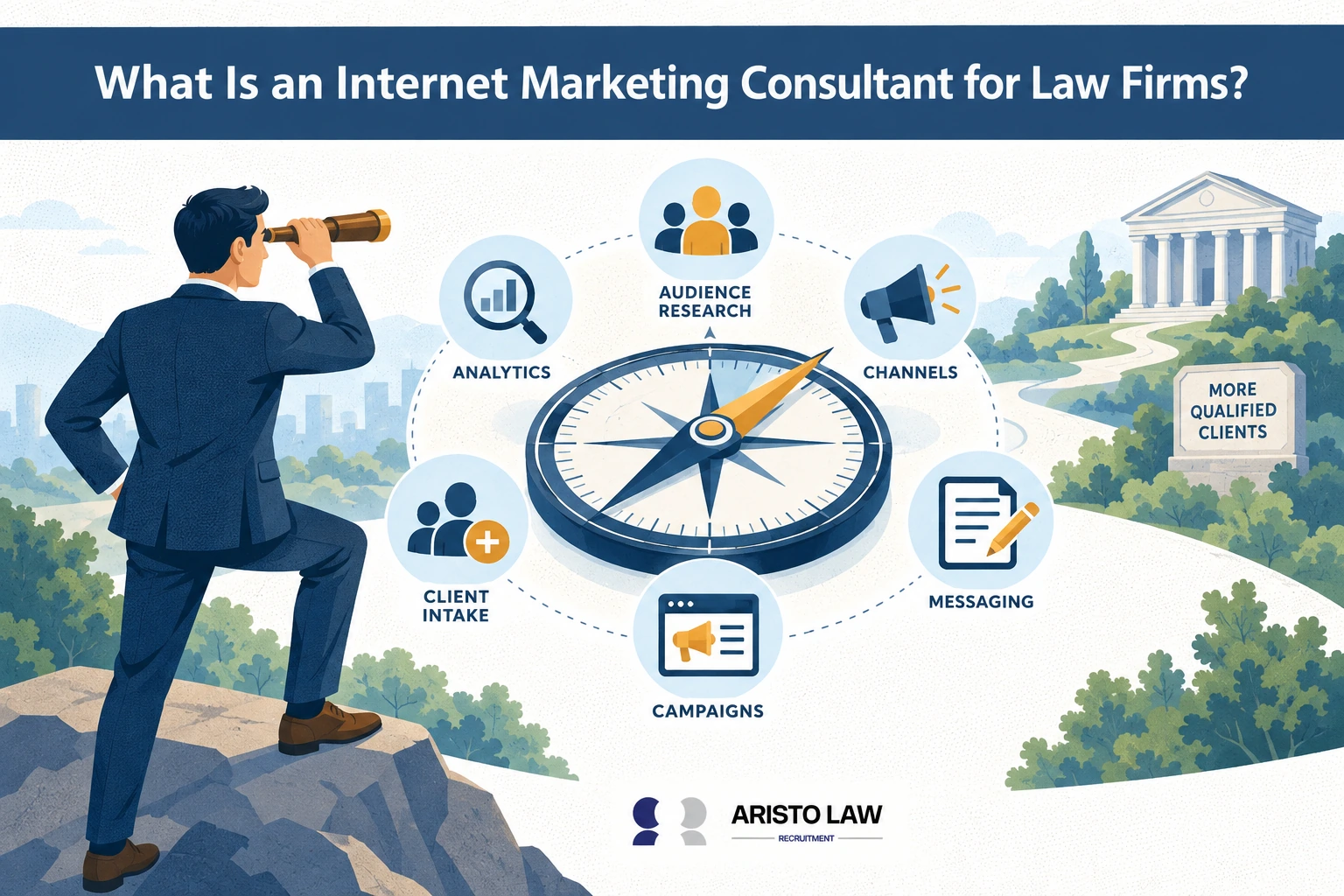
The role involves connecting SEO, PPC advertising, website
optimization, content marketing, lead generation, intake workflows,
conversion tracking, CRM systems, reputation management, and
client-acquisition processes into a unified framework that improves
marketing performance and business outcomes.
A study by Jun Tao, Qian Chen, and James W. Snyder Jr. in
2023 stated that the growing number of online marketing channels and
customer touchpoints creates attribution challenges because prospects
interact with multiple touchpoints before conversion, making coordinated
oversight across channels increasingly important. Law firm
digital marketing increasingly requires cross-functional oversight
because prospective clients interact with multiple touchpoints before
hiring an attorney. A consultant evaluates how search visibility, Google
Ads campaigns, website usability, consultation-booking processes, intake
responsiveness, follow-up systems, and conversion tracking work
together.
The objective is not simply generating traffic but converting
qualified prospects into consultations and retained clients. Consultants
identify growth bottlenecks such as poor search rankings, weak landing
pages, slow response times, ineffective intake procedures, inadequate
CRM tracking, low consultation-conversion rates, or underperforming
advertising campaigns. After identifying these issues, consultants
implement data-driven improvements that strengthen client acquisition
and improve marketing ROI.
Research by James Oldroyd, Kristina McElheran, and David
Elkington in 2007 states that companies responding to leads within one
hour are nearly seven times more likely to qualify those leads than
companies that wait longer, demonstrating the direct relationship
between rapid lead response and client acquisition outcomes.
Businesses responding to inquiries within the first hour are more likely
to qualify and convert leads than organizations with slower response
processes.
A study by Hennessey Digital analysts, Jason Hennessey, and
digital marketing researchers in 2025 states that branded organic search
traffic remains a major source of visibility for consumer-facing law
firms, with leading personal injury firms generating tens of thousands
of monthly searches. This study highlights the importance of organic
search for client acquisition. Organic search and paid search
remain among the highest-performing client-acquisition channels for
consumer-facing law firms because prospective clients actively search
online when legal needs arise.
Competitive search environments and rising client-acquisition costs
have increased demand for specialized legal marketing strategy
expertise. Personal injury, family law, criminal defense, immigration,
and other high-intake practice areas compete aggressively for online
visibility.
An internet marketing consultant helps law firms allocate budgets
efficiently, improve conversion rates, lower client-acquisition costs,
strengthen competitive positioning, and build scalable
client-acquisition systems that support long-term law firm growth.
Through continuous measurement of lead volume, consultation rates,
conversion rates, cost per lead, client acquisition cost, and revenue
performance, consultants provide strategic direction that aligns
marketing investment with measurable business outcomes.
Why do law
firms hire internet marketing consultants?
Law firms hire internet marketing consultants to improve
visibility, attract qualified legal prospects, increase signed cases,
and maximize marketing performance. Many firms engage
consultants when legal leads decline, website traffic falls,
consultation bookings remain inconsistent, SEO rankings underperform,
advertising campaigns fail to generate profitable results, or
client-acquisition costs continue increasing. Competitive legal markets
make growth difficult because prospective clients compare multiple firms
across search results, legal directories, review platforms, and
advertising channels before scheduling consultations.
Operationally, consultants help law firms solve problems that reduce
client acquisition. Stagnant lead pipelines indicate weaknesses in
search visibility, paid advertising, content marketing, intake
workflows, or conversion processes. Declining website traffic results
from poor SEO performance, outdated content, technical website issues,
weak local search presence, or increased competition.
Low consultation rates frequently occur when landing pages fail to
convert visitors, calls-to-action lack clarity, intake processes create
friction, or response times delay engagement with prospective clients.
A study by Sofia Scicolone, Brian Dean, and Neil Patel in 2025
states that unclear calls-to-action (CTAs), poor user experience, and
mismatched landing page messaging reduce conversion rates, causing
visitors to leave without taking action. Rising cost-per-lead
metrics signal inefficient campaign management, poor audience targeting,
weak conversion tracking, or ineffective budget allocation.
Strategically, internet marketing consultants evaluate the entire
client-acquisition journey rather than focusing on a single marketing
channel. They analyze SEO performance, Google Ads campaigns, local
search visibility, website conversion rates, online reviews, CRM
systems, intake procedures, lead follow-up processes, and reporting
systems to identify where prospective clients disengage.
Weak conversion tracking prevents firms from understanding which
marketing activities generate consultations and signed clients.
Consultants implement measurement systems that connect marketing
investments to actual business outcomes, allowing firms to make
data-driven decisions.
Consultants also build growth systems aligned with specific practice
areas and business objectives. Personal injury firms, family law
practices, criminal defense firms, immigration attorneys,
estate-planning lawyers, and business-law practices each face different
client-acquisition challenges, search behaviors, and competitive
pressures. A successful law firm marketing strategy requires
practice-area-specific positioning, targeted traffic acquisition,
conversion-focused websites, intake optimization, and performance
measurement frameworks.
By diagnosing performance gaps across marketing channels and aligning
client-acquisition strategies with firm goals, internet marketing
consultants help law firms generate more qualified legal leads, increase
consultation bookings, improve marketing ROI, strengthen competitive
positioning, and create sustainable long-term growth systems.
How
do internet marketing consultants help law firms get more clients?
Internet marketing consultants help law firms get more
clients by improving visibility, increasing lead generation, optimizing
conversions, and strengthening client-acquisition workflows.
The client-acquisition process begins when prospective clients discover
a law firm through search engines, Google Ads, local search results,
online reviews, legal directories, content marketing, referrals, social
media platforms, or email campaigns.
Internet marketing consultants improve search visibility through SEO,
local optimization, content strategy, and paid advertising so that law
firms appear in front of individuals actively searching for legal
services. A study by Paul Usmany, Rima Rachmawati, and
Elismayanti Rembe in 2024 states that the implementation of Search
Engine Optimization (SEO) is consistently associated with an increase in
organic search rankings and website traffic, with a high effect size of
1.049, demonstrating that SEO improves online visibility and customer
reach. Legal lead generation increases when firms attract
qualified prospects rather than generic website traffic.
After prospects arrive on a website, consultants focus on
consultation conversion through website optimization, landing-page
improvements, mobile usability enhancements, trust-building elements,
attorney profiles, client reviews, and clear calls-to-action. This
finding is highly relevant to legal lead generation because prospective
clients contact multiple law firms before selecting representation.
Internet marketing consultants also improve intake responsiveness by
evaluating contact forms, call handling procedures, consultation
scheduling processes, CRM systems, and lead-routing workflows. Lead
nurturing systems help maintain communication with prospective clients
through follow-up emails, reminders, appointment confirmations, and
consultation coordination. These operational systems prevent lead
leakage that occurs when inquiries receive slow responses or
inconsistent follow-up.
Marketing success depends on more than traffic generation.
Consultants analyze how prospects move through each stage of the client
journey, from search visibility and advertising exposure to consultation
scheduling, retained-client conversion, and referral generation.
Conversion tracking, CRM integration, call tracking, and performance
reporting identify which marketing channels generate qualified
consultations and signed clients. Retention-focused communication and
positive client experiences generate referral growth, online reviews,
and repeat business opportunities that further strengthen client
acquisition.
By connecting visibility, lead generation, consultation conversion,
intake management, follow-up systems, and referral development into a
single growth framework, internet marketing consultants help law firms
generate more qualified clients, improve marketing performance, and
create sustainable long-term client-acquisition systems.
Listed below are 13 ways internet marketing consultants help law
firms get more clients.
-
1. Search Engine Optimization (SEO) & Technical Website
Performance: Improves organic visibility, search rankings, site
speed, crawlability, and overall website performance for sustained lead
generation. -
2. Local Search Pack Optimization Directories & Citation
Management: Strengthens local search presence through accurate
business listings, citation consistency, and map-based visibility. -
3. Pay-Per-Click (PPC) Search Advertising Campaigns:
Generates qualified leads through targeted paid search ads that capture
high-intent prospects. -
4. Content Marketing Strategy Thought Leadership & Legal
Publishing: Builds authority and trust through educational
content, legal insights, and practice-area-focused publishing. -
5. High-Converting Landing Page Design & Conversion Rate
Optimization (CRO): Increases consultation requests by
improving user experience, messaging, and conversion pathways. -
6. Retargeting Lookalike Audiences & Paid Social Media Ad
Campaigns: Re-engages previous visitors and expands audience
reach through data-driven social advertising. -
7. Reputation Management Review Cultivation & Social
Proof Assets: Enhances credibility by increasing positive
reviews, testimonials, and trust-building assets. -
8. Email Marketing Automated Lead Nurturing & Value-First
Drips: Maintains engagement with prospects through automated
communication and relationship-building campaigns. -
9. Client Intake Optimization “Speed-to-Lead” Workflows &
Chat Integration: Improves lead conversion by reducing response
times and streamlining client intake processes. -
10. Referral Strategic Partnership & B2B Legal Networking
Campaigns: Expands business opportunities through referral
networks, partnerships, and professional relationships. -
11. Data Analytics KPI Monitoring & Marketing ROI
Alignment: Measures campaign performance and aligns marketing
activities with business growth objectives. -
12. Organic Social Media Branding Multi-Platform Engagement
& Awareness: Strengthens brand recognition through
consistent content distribution and audience engagement. -
13. Direct Legal Lead Sourcing & Third-Party Lead
Generation Partnerships: Supplements marketing efforts by
acquiring qualified leads through external sourcing channels and lead
providers.
1.
Search Engine Optimization (SEO) & Technical Website
Performance
Search Engine Optimization (SEO) and technical website
performance involve improving a law firm’s organic visibility and
website functionality so prospective clients discover legal services
through search engines. An Internet Marketing Consultant uses
SEO as a core Law Firm Marketing strategy because Legal Lead Generation
begins when potential clients search for attorneys, legal solutions, or
practice-area-specific information online.
A study by Deepak Bansal, Rakesh Kumar, and Priya Sharma in
2024 states that well-implemented technical SEO practices, including
website speed optimization, mobile responsiveness, and UX-focused
design, improve website performance and user engagement, which in turn
strengthens search visibility. Technical performance factors
directly influence search rankings and user experience. SEO supports
Client Acquisition by attracting high-intent visitors, while Conversion
Optimization ensures those visitors become consultations and retained
clients. Branding benefits occur through increased authority, trust, and
visibility across competitive legal markets.
Performance measurement includes rankings, organic traffic,
click-through rates, consultation requests, conversion rates, and
revenue attribution. Best practices include optimizing technical
infrastructure, targeting high-intent legal keywords, improving page
speed, publishing authoritative legal content, and continuously
monitoring SEO performance to strengthen marketing ROI and long-term law
firm growth.
2.
Local Search Pack Optimization, Directories & Citation
Management
Local Search Pack Optimization, directory management, and
citation management focus on increasing a law firm’s visibility within
location-based searches and map results. Internet Marketing
Consultants prioritize local visibility because many legal consumers
search for attorneys within specific geographic areas.
Accurate directory listings, consistent citations, optimized Google
Business Profiles, and localized content improve local search rankings
and client trust. A study by David Mihm, Darren Shaw, and Miriam
Ellis in 2024 states that consistent business citations and accurate NAP
(Name, Address, Phone Number) information across directories are among
the strongest local SEO signals, helping businesses improve visibility
in local search results and Google Maps rankings. Legal Lead
Generation benefits because prospects contact firms appearing
prominently within local search results. Branding improves through
stronger geographic authority and credibility.
Performance measurement includes local rankings, calls, direction
requests, profile interactions, and consultation conversions. Best
practices include maintaining consistent NAP information, optimizing
local profiles, acquiring quality reviews, and monitoring citation
accuracy across platforms.
3. Pay-Per-Click
(PPC) Search Advertising Campaigns
PPC Advertising involves purchasing visibility within
search-engine results through targeted keyword bidding.
Internet Marketing Consultants use PPC campaigns to generate immediate
Client Acquisition opportunities while complementing long-term SEO
efforts.
An internet marketing consultant manages keyword targeting, bid
strategy, and conversion tracking to improve the performance of PPC
advertising for law firms. An internet marketing
consultant analyzes search intent, campaign data, and
cost-per-acquisition metrics to align paid search traffic with law firm
lead generation goals.
Research by CallRail, MyCase, and the American Bar
Association in 2025 states that 78% of law firms use paid search
marketing, demonstrating that PPC has become a major channel
for generating legal leads from prospective clients searching online for
legal assistance. PPC supports Legal Lead Generation by targeting
prospects actively searching for legal representation. Conversion
Optimization focuses on matching keywords, advertisements, and landing
pages to user intent. Branding benefits arise through increased
visibility in competitive markets.
Performance measurement includes cost per click, cost per lead,
consultation rates, client acquisition cost, and marketing ROI. Best
practices include refining keyword targeting, improving ad relevance,
optimizing landing pages, monitoring conversion tracking, and
continuously adjusting bids based on campaign performance.
4.
Content Marketing Strategy, Thought Leadership & Legal
Publishing
Content Marketing Strategy involves creating educational
legal content that attracts, informs, and converts prospective
clients. Internet Marketing Consultants use legal publishing to
position attorneys as trusted authorities within their practice
areas.
An internet marketing consultant develops authoritative legal
publishing frameworks that position law firms as trusted sources across
practice-specific topics and search-driven user journeys. Effective content
marketing for lawyers enables an internet marketing
consultant to align thought leadership assets with audience intent,
organic visibility, and client acquisition objectives.
Content supports Legal Lead Generation by capturing informational
searches throughout the client journey. A study by Lisa Murton
Beets, Robert Rose, and Stephanie Stahl for the Content Marketing
Institute in 2024 states that 72% of marketers reported that content
marketing increased the number of leads they generated,
demonstrating how content captures potential clients throughout
different stages of the buyer journey. Branding
improves through demonstrated expertise and professional credibility.
Conversion Optimization relies on strategically placed calls-to-action
that guide readers toward consultations.
Performance measurement includes traffic growth, engagement metrics,
lead generation, rankings, and consultation requests. Best practices
include publishing practice-area content, addressing common legal
questions, maintaining editorial consistency, and aligning content with
client-acquisition goals.
5.
High-Converting Landing Page Design & Conversion Rate Optimization
(CRO)
Landing page design and CRO focus on turning website visitors
into consultations and retained clients. Internet Marketing
Consultants optimize landing pages to improve Conversion Optimization by
reducing friction and increasing trust.
Effective pages combine persuasive messaging, attorney credibility,
client testimonials, consultation forms, and strong calls-to-action.
Research by Khalid Saleh, Ayat Shukairy, and Tim Ash in
2010–2012 stated that conversion rate optimization enables businesses to
generate more leads and sales without increasing website traffic,
improving marketing ROI and overall profitability. Legal Lead
Generation becomes more valuable when conversion rates improve. Branding
benefits include professional presentation and credibility
reinforcement.
Performance measurement includes bounce rates, form completions, call
volume, consultation rates, and client acquisition metrics. Best
practices include A/B testing, mobile optimization, trust-building
elements, simplified forms, and ongoing conversion analysis.
6.
Retargeting, Lookalike Audiences & Paid Social Media Ad
Campaigns
Retargeting and paid social campaigns reconnect with
prospects who previously engaged with a law firm’s website or
content. Internet Marketing Consultants use these channels to
improve Client Acquisition by maintaining visibility throughout longer
legal decision-making processes.
Research by Yongchun Zhu, Yudan Liu, and Ruobing Xie in 2021
states that audience expansion (lookalike modeling) is an effective
method for finding potential customers who are similar to existing
audiences and are more likely to achieve campaign goals.
Lookalike audiences help identify prospects with characteristics similar
to existing clients. Branding benefits arise through repeated exposure
and message reinforcement.
Performance measurement includes audience engagement, conversion
rates, cost per lead, and campaign ROI. Best practices include audience
segmentation, compelling creative assets, targeted messaging, and
integrated tracking systems.
7.
Reputation Management, Review Cultivation & Social Proof Assets
Reputation Management involves monitoring, acquiring, and
promoting positive client feedback and trust signals. Internet
Marketing Consultants strengthen Law Firm Marketing by building
credibility through reviews, testimonials, ratings, and social proof
assets.
An internet marketing consultant strengthens review acquisition
systems, improves testimonial visibility, and organizes social proof
assets that influence trust and conversion decisions. Internet marketing
consultant strategies align with law
firm reputation management assistant services to manage
client feedback, monitor public perception, and maintain a consistent
online reputation.
Prospective clients evaluate reputation before scheduling
consultations. Research by Michaela Pocchiari, Ko de Ruyter, and
Martin Wetzels in 2025 states that online reviews help reduce
information asymmetry, strengthen business reputation, and boost
consumer decision-making, leading to better conversion
performance. Legal Lead Generation improves because strong reviews
increase trust and click-through rates.
Performance measurement includes review volume, review ratings,
profile engagement, and consultation conversions. Best practices include
requesting reviews systematically, responding professionally,
highlighting client success stories, and maintaining consistent
reputation monitoring.
8.
Email Marketing, Automated Lead Nurturing & Value-First Drips
Email Marketing and automated lead nurturing maintain
engagement with prospective clients who are not ready to hire
immediately. Internet Marketing Consultants use Marketing
Automation to deliver educational content, reminders, updates, and
consultation invitations.
A study by Forrester Research in 2026 states that companies
that excel at lead nurturing generate 50% more sales-ready leads at a
33% lower cost, showing that nurturing prospects over time
improves conversion outcomes by building trust and engagement. Branding
benefits include ongoing visibility and relationship development.
Performance measurement includes open rates, click rates,
consultation bookings, lead progression, and conversion outcomes. Best
practices include audience segmentation, personalized communication,
automated workflows, and value-driven content.
9.
Client Intake Optimization, Speed-to-Lead Workflows & Chat
Integration
Client Intake Optimization focuses on improving how quickly
and effectively law firms respond to inquiries. Internet
Marketing Consultants improve Legal Lead Generation by reducing delays
between inquiry submission and initial contact.
A study by James Oldroyd, Kristina McElheran, and David
Elkington in 2011 further states that firms responding to leads within
one hour were nearly 7 times more likely to qualify those leads compared
to firms that waited two hours, highlighting the importance of rapid
follow-up in lead conversion. Conversion Optimization depends
heavily on response speed and follow-up quality.
Performance measurement includes response times, consultation rates,
lead qualification rates, and signed-client conversions. Best practices
include automated notifications, live chat systems, intake scripting,
CRM tracking, and rapid-response procedures.
10.
Referral, Strategic Partnership & B2B Legal Networking
Campaigns
Referral and partnership campaigns generate clients through
trusted professional relationships. Internet Marketing
Consultants support these channels by identifying referral
opportunities, strengthening partnerships, and creating
referral-marketing systems.
A study by Berger, Black, and Scott in 2025 states that
referral networks promote trust and honesty because referred prospects
rely on recommendations from trusted professionals, reducing uncertainty
and increasing confidence in service providers, including legal
services. Legal Lead Generation benefits because referred
prospects arrive with higher trust levels. Branding improves through
professional association and industry visibility.
Performance measurement includes referral volume, referral conversion
rates, partnership activity, and revenue contribution. Best practices
include maintaining referral relationships, providing educational
resources, tracking referral sources, and creating mutually beneficial
partnerships.
11. Data
Analytics, KPI Monitoring & Marketing ROI Alignment
Data Analytics and KPI monitoring involve measuring marketing
performance against business objectives. Internet Marketing
Consultants use analytics to identify strengths, weaknesses,
opportunities, and growth barriers within Client Acquisition
systems.
A study by Muhammad Awais, Agnihotri Bakeshloo, and Mani in
2024 states that companies using advanced analytics gain deeper insights
into customer behavior, allowing them to identify strengths, weaknesses,
opportunities, and barriers within customer acquisition systems, leading
to improved marketing performance and better decision-making.
Performance measurement includes lead volume, consultation rates,
conversion rates, client acquisition cost, revenue growth, and marketing
ROI.
Data-driven decision-making improves Law Firm Marketing efficiency
and budget allocation. Best practices include accurate tracking
implementation, CRM integration, attribution reporting, dashboard
development, and continuous optimization.
12.
Organic Social Media Branding, Multi-Platform Engagement &
Awareness
Organic social media branding focuses on building awareness,
engagement, and professional credibility across social
platforms. Internet Marketing Consultants use social media to
strengthen branding and distribute legal content.
A study by Yogesh K. Dwivedi, Elvira Ismagilova, and D.
Laurie Hughes in 2021 states that social media marketing plays a major
role in strengthening brand visibility, customer engagement, and digital
content distribution, making it a critical tool for modern marketing
strategies. Although direct Legal Lead Generation is lower than
search-based channels, social engagement supports trust-building and
audience development.
Performance measurement includes engagement rates, audience growth,
referral traffic, and brand visibility metrics.
Best practices include consistent publishing schedules, educational
content, attorney thought leadership, and community engagement.
13.
Direct Legal Lead Sourcing & Third-Party Lead Generation
Partnerships
Direct legal lead sourcing and third-party lead-generation
partnerships involve acquiring prospective clients through specialized
providers and referral networks. Internet Marketing Consultants
evaluate lead quality, conversion potential, acquisition costs, and
alignment with practice-area goals.
Legal Lead Generation improves when purchased leads integrate with
strong intake and follow-up systems. A study by Lead Docket
researchers Zack Glaser, Brian Glass, and Mike Morse in 2025 found that
79% of legal consumers hire the first attorney who responds
helpfully, indicating that purchased legal leads are far more
valuable when firms have effective intake and follow-up procedures in
place. Branding considerations include maintaining credibility and
client trust throughout the acquisition process.
Performance measurement includes cost per lead, cost per acquisition,
consultation rates, signed-client rates, and profitability. Best
practices include rigorous lead-source evaluation, CRM tracking, rapid
follow-up, qualification standards, and ongoing ROI analysis to ensure
sustainable law firm growth.
What
client-acquisition channels generate the most legal clients?
Client-acquisition channels that generate legal clients
include SEO, GBP, Referrals and Legal directories.
Listed below are the 15 client-acquisition channels that generate
legal clients.
-
Search Engine Optimization (SEO): SEO generates
legal clients by placing law firms in front of prospects actively
searching for legal services. Search-intent behavior makes SEO one of
the strongest long-term legal lead generation channels because prospects
begin the legal buyer journey with practice-area and location-based
searches. Strengths include sustained visibility, lower long-term
acquisition costs, and high trust. Limitations include slower results
and ongoing optimization requirements. Ideal use cases include personal
injury, family law, criminal defense, immigration, estate planning, and
other practice areas seeking consistent inbound leads. -
Google Ads (PPC Advertising): Google Ads captures
prospects during high-intent and emergency legal searches when immediate
representation is needed. Searches related to arrests, accidents,
divorce filings, workplace disputes, or immigration concerns generate
strong consultation intent. Strengths include immediate visibility,
rapid lead generation, and scalability. Limitations include high
competition and rising advertising costs. Ideal use cases include urgent
legal matters and highly competitive practice areas. -
Google Business Profile: Google Business Profile
generates legal clients through local visibility and map-based searches.
Many legal consumers search for nearby attorneys before scheduling
consultations. Strengths include strong local presence, review
visibility, and mobile-search performance. Limitations include local
competition and profile-management requirements. Ideal use cases include
consumer-facing law firms serving defined geographic markets. -
Online Reviews and Reputation Platforms: Reviews
influence consultation decisions by providing social proof and
trust-building mechanisms. Prospective clients compare reviews before
contacting a law firm. Strengths include credibility enhancement and
conversion support. Limitations include dependence on client
participation. Ideal use cases include all practice areas where trust
plays a major role in attorney selection. -
Referrals: Referrals generate legal clients through
recommendations from former clients, attorneys, healthcare providers,
accountants, financial advisors, and business contacts. Strengths
include high trust, strong conversion rates, and lower acquisition
costs. Limitations include lower scalability and reduced predictability.
Ideal use cases include relationship-driven practice areas and
established firms. -
Legal Directories: Legal directories connect law
firms with prospects researching attorneys and comparing legal-service
providers. Strengths include targeted visibility and referral
opportunities. Limitations include directory competition and variable
lead quality. Ideal use cases include firms seeking additional exposure
beyond search engines. -
Content Marketing: Content marketing attracts
prospects through educational content, legal guides, blogs, FAQs,
videos, and resource pages. Educational content consumption occurs
before a consultation request. Strengths include authority building, SEO
support, and trust development. Limitations include longer timelines
before results appear. Ideal use cases include practice areas requiring
education and relationship building. -
Local SEO: Local SEO improves visibility for
geographic searches involving legal services. Prospects search using
city, county, or neighborhood-specific terms. Strengths include highly
targeted traffic and strong consultation intent. Limitations include
local-market competition. Ideal use cases include firms serving specific
communities and regions. -
Email Marketing: Email marketing nurtures prospects
who have already shown interest in legal services but have not yet
retained counsel. Strengths include relationship building, follow-up
support, and retention opportunities. Limitations include dependence on
list quality and engagement levels. Ideal use cases include consultation
follow-up, referral development, and lead nurturing. -
Social Media Marketing: Social media marketing
supports awareness, engagement, and trust-building throughout the legal
buyer journey. Strengths include audience development, content
distribution, and brand visibility. Limitations include lower
direct-intent lead generation compared to search-based channels. Ideal
use cases include brand-building and community engagement. -
Retargeting Campaigns: Retargeting reconnects with
website visitors who did not schedule consultations during their initial
visit. Strengths include improved conversion pathways and repeated brand
exposure. Limitations include advertising costs and audience-size
requirements. Ideal use cases include firms generating substantial
website traffic. -
Video Marketing: Video content strengthens trust by
allowing prospects to learn about attorneys, legal processes, and
practice areas. Strengths include engagement and authority development.
Limitations include production requirements and longer development
cycles. Ideal use cases include consultation-focused and
education-driven practice areas. -
Webinars and Educational Events: Educational events
generate legal leads by providing information to prospects researching
legal issues before hiring counsel. Strengths include authority
positioning and lead capture opportunities. Limitations include
preparation and audience-building requirements. Ideal use cases include
estate planning, business law, employment law, and compliance-related
services. -
Strategic Partnerships and Professional Networks:
Partnership-based marketing generates legal clients through ongoing
relationships with complementary professionals and organizations.
Strengths include trust transfer and referral quality. Limitations
include relationship-development timelines. Ideal use cases include
niche and referral-driven legal practices. -
Client Retention and Referral Programs: Satisfied
clients become repeat clients and referral sources. Strengths include
strong trust and lower acquisition costs. Limitations include dependence
on service quality and client satisfaction. Ideal use cases include
firms focused on long-term relationship development.
The strongest law firm marketing channels work together rather than
independently. SEO and Google Ads capture search intent, reviews and
referrals build trust, content marketing educates prospects, local
visibility supports consultation opportunities, and intake systems
convert inquiries into retained clients. Successful legal lead
generation strategies integrate multiple attorney marketing channels
across the entire client-acquisition journey.
How do
online reviews influence legal client acquisition?
Online reviews influence legal client acquisition by shaping
client trust, improving local search visibility, and increasing
consultation conversion rates.
Listed below are 20 ways online reviews influence legal client
acquisition.
-
Improve client trust during attorney selection:
Prospective clients evaluate reviews before contacting a law firm.
Positive feedback reduces uncertainty and increases confidence in legal
services, attorney professionalism, and client experience. -
Provide social proof for legal services: Reviews
demonstrate that previous clients successfully worked with the law firm.
Social proof influences decision psychology because people frequently
rely on the experiences of others when choosing legal
representation. -
Increase consultation conversion rates: Strong
review profiles encourage prospective clients to move from research to
action. Firms with positive reviews receive more calls, form
submissions, and consultation requests than firms with weaker online
reputations. -
Strengthen local SEO performance: Search engines use
review signals as part of local ranking algorithms. Review quantity,
review quality, review recency, and review engagement contribute to
local search visibility and map-pack performance. -
Improve visibility in local search results: Law
firms with stronger review profiles appear more prominently within local
search listings, increasing exposure to prospective clients searching
for nearby legal services. -
Influence click-through rates from search results
High ratings and visible review counts attract attention within
search results. Prospective clients are more likely to click listings
that display strong reputational signals. -
Support legal reputation management efforts: Reviews
provide public evidence of service quality, responsiveness,
communication standards, and client satisfaction. Reputation management
programs use reviews to strengthen brand credibility. -
Help prospects compare competing law firms: Many
legal consumers compare multiple attorneys before making contact. Review
quality, review volume, and overall ratings become major differentiators
between competing firms. -
Demonstrate consistency of client experience: A
large collection of positive reviews indicates that positive outcomes
and professional service occur consistently rather than
occasionally. -
Highlight practice-area expertise: Reviews reference
specific legal matters such as personal injury, family law, criminal
defense, immigration, or estate planning. These references help
prospects evaluate relevant experience. -
Show responsiveness and communication quality:
Comments discussing responsiveness, professionalism, and communication
help prospective clients assess how the firm manages client
relationships. -
Influence decision psychology through risk
reduction: Hiring an attorney involves financial, legal, and
emotional consequences. Reviews reduce perceived risk by providing
third-party validation. -
Demonstrate transparency and accountability: Public
reviews create visible accountability. Prospective clients view
transparent feedback as evidence of operational maturity and confidence
in service quality. -
Provide opportunities for review responses:
Professional responses to reviews demonstrate engagement, client care,
and reputation management practices. Response patterns influence how
prospects perceive the firm. -
Support referral-like trust signals at scale:
Reviews function similarly to referrals because they provide
recommendations from previous clients, but they remain accessible to a
much larger audience. -
Improve mobile-search decision making: Many legal
searches occur on mobile devices where review ratings are highly
visible. Positive reviews influence immediate consultation decisions
during urgent legal situations. -
Strengthen brand authority in competitive markets:
Law firms operating in crowded legal markets use reviews to
differentiate themselves and establish stronger market credibility. -
Increase lead quality: Prospects who contact firms
after reading positive reviews arrive with higher levels of trust and
stronger intent to schedule consultations. -
Encourage ongoing client feedback loops: Consistent
review collection provides valuable client-experience insights that help
improve service delivery and client satisfaction. -
Create long-term client-acquisition assets: Unlike
temporary advertising campaigns, reviews continue influencing
prospective clients over time, supporting both local SEO performance and
consultation conversion behavior.
Online review platforms, including Google reviews, legal directories,
and attorney-review websites, play a major role in legal reputation
management because prospective clients frequently compare firms using
review quality, review volume, review recency, and response patterns.
Strong law firm reviews improve client trust, strengthen local SEO
visibility, and create conversion advantages throughout the legal
client-acquisition process.
How does
SEO help law firms attract high-value clients?
SEO helps law firms attract high-value clients by increasing
visibility for high-intent legal searches and positioning firms as
authoritative solutions during client decision-making stages.
High-value prospects search for specific legal services rather than
general legal information, using commercial-intent keywords such as
“business litigation attorney,” “mergers and acquisitions lawyer,”
“corporate counsel,” “estate planning attorney,” or practice-area and
location-specific terms.

A study by Dirk Lewandowski, Sebastian Schultheiß, and their
research team in 2022 states that 59.2% of internet users believe SEO
has a very strong impact on search rankings, demonstrating that search
visibility influences how users discover and evaluate service providers
online. Law firm SEO improves search visibility for these
searches, allowing firms to appear when prospects are actively
evaluating legal representation options.
Practice-area targeting plays a major role in legal SEO because
high-value clients seek attorneys with demonstrated expertise in
specific legal matters. SEO strategies use optimized legal service
pages, topic clusters, attorney profiles, case-related resources, and
supporting content to establish relevance and authority around targeted
legal services. Local SEO further strengthens client acquisition by
helping firms appear in geographic searches where prospects are looking
for attorneys within specific cities, regions, or jurisdictions.
Authority building is another important component of attracting
high-value clients. Corporate clients, business owners, litigation
clients, and high-net-worth individuals frequently conduct extensive
online research before contacting a law firm. These prospects review
attorney credentials, legal content, published articles, case
experience, practice-area resources, client reviews, and professional
reputation signals. SEO-supported content marketing helps law firms
demonstrate expertise through educational resources that answer legal
questions and address complex legal concerns.
Trust signals such as attorney biographies, professional credentials,
client testimonials, review profiles, case results, awards, and
authoritative content contribute to stronger search performance and
higher conversion rates. Prospective clients are more likely to engage
with firms that appear credible, knowledgeable, and visible across
multiple search results.
A study by Jim Yu, Lemuel Park, and Eric Enge at BrightEdge
in 2019 found that organic search drives approximately 53% of all
trackable website traffic across industries, making search visibility
one of the largest sources of inbound prospect acquisition.
Additional research published by HubSpot consistently reports that
organic search generates highly qualified traffic because users actively
seek solutions to specific problems rather than responding passively to
advertisements. Within legal marketing, this behavior is particularly
valuable because legal consumers perform extensive research before
scheduling consultations.
Compared with paid acquisition channels such as PPC advertising, SEO
supports long-term lead generation because visibility continues beyond
the duration of advertising budgets. Paid campaigns generate traffic
only while ads remain active, whereas well-optimized legal content,
practice-area pages, local SEO assets, and authority-building resources
continue attracting prospects for months or years. As a result, law firm
SEO serves as both a client-acquisition channel and a long-term digital
asset that strengthens attorney marketing performance, increases search
visibility, and helps law firms consistently attract high-value
clients.
How
do internet marketing consultants improve law firm lead generation?
Internet marketing consultants improve law firm lead
generation by identifying acquisition bottlenecks, optimizing marketing
channels, and increasing conversion efficiency. A legal
marketing consultant evaluates the entire client-acquisition process
from prospect discovery through consultation booking, retained-client
conversion, and revenue generation. The objective is to determine where
potential clients are entering the funnel, where they are leaving, and
which improvements produce the greatest business impact.
Consultants examine how prospects arrive through SEO, PPC
advertising, Google Business Profile listings, legal directories,
referrals, social media, email campaigns, and other acquisition
channels. A study by JoAnna Dettmann, Kaysha Kalkofen, and the
tSunela Digital Marketing Team in 2014 states that 3 out of 4 people in
need of legal services use the internet to find attorneys and law
firms, highlighting the importance of SEO, PPC advertising, and
online visibility in client acquisition.
Funnel diagnostics then identify weaknesses such as poor search
visibility, ineffective advertisements, low-performing landing pages,
weak calls-to-action, confusing consultation-request processes, or
abandoned intake forms. Conversion tracking systems connect marketing
activities to actual consultations, signed clients, and revenue
outcomes, allowing firms to measure which channels generate profitable
law firm leads rather than simply attracting visitors.
Intake audits frequently reveal operational issues that reduce lead
generation performance. Slow response times, missed calls, delayed
follow-up, inconsistent CRM updates, weak qualification processes, and
poor consultation scheduling procedures create lead leakage. Internet
marketing consultants evaluate these workflows and recommend
improvements that increase consultation rates and improve
client-acquisition efficiency.
Campaign optimization focuses on improving the performance of
existing marketing investments. Consultants refine keyword targeting,
advertising strategies, local SEO efforts, content marketing
initiatives, landing-page design, and audience segmentation to improve
lead quality and conversion outcomes. Landing-page performance receives
particular attention because even small increases in conversion rates
increase consultation volume without increasing advertising spend.
Client-acquisition metrics such as cost per lead, cost per
consultation, consultation-to-client conversion rate, signed-case value,
client acquisition cost, and marketing ROI guide decision-making.
Consultants prioritize improvements based on measurable revenue
opportunities rather than vanity metrics such as page views,
impressions, or traffic volume alone. For example, increasing
consultation conversion rates by 20% produce greater business growth
than increasing website traffic by 50% if the additional traffic lacks
purchase intent.
Through lead-flow analysis, funnel diagnostics, conversion tracking,
intake optimization, campaign management, and performance measurement,
internet marketing consultants help law firms generate more qualified
leads, improve consultation rates, reduce acquisition costs, and create
scalable client-acquisition systems that support long-term business
growth.
What
role does Google Ads play in law firm lead generation?
Google Ads helps law firms generate leads by placing legal
services in front of prospects actively searching for legal
solutions. Google Ads targets users who already demonstrate
intent through specific search queries, making it one of the most direct
client-acquisition channels available in attorney advertising.
When prospective clients search for terms related to personal injury,
criminal defense, family law, immigration, estate planning, business
litigation, or other legal services, Google Ads allows law firms to
appear prominently at the top of search results during critical
decision-making moments. Intent-driven advertising is the primary
advantage of legal PPC campaigns.
Keyword targeting enables law firms to focus on searches that
indicate consultation intent rather than general information gathering.
A study by Bernard J. Jansen, Yinghui Yang, and Xunhua Guo in
2022 states that keyword optimization and targeting strategies in search
advertising improve campaign performance because keywords act as the
link between user intent and advertiser objectives, allowing businesses
to focus on high-intent searches that are more likely to convert into
leads or clients. Geographic targeting further refines audience
selection by displaying advertisements only within relevant service
areas, jurisdictions, cities, or regions where attorneys actively accept
clients. This targeting structure helps improve lead quality while
reducing wasted advertising spend.
Landing-page optimization plays a major role in campaign success.
Effective Google Ads campaigns direct prospects to consultation-focused
landing pages that align with the specific legal service being
advertised. These pages include attorney credentials, client
testimonials, trust signals, clear calls-to-action, consultation-request
forms, phone numbers, and other conversion elements designed to
encourage immediate contact. Strong landing-page performance improves
intake conversion rates and reduces client-acquisition costs.
Internet marketing consultants evaluate Google Ads performance
through profitability metrics rather than traffic metrics alone. Clicks
and impressions provide useful diagnostic information, but campaign
success depends on lead quality, consultation volume, signed-client
conversions, client-acquisition cost, and return on investment.
Consultants analyze which keywords generate qualified legal leads, which
practice areas produce the highest-value clients, and how effectively
intake systems convert inquiries into consultations and retained
matters.
Competitive legal advertising environments make campaign management
particularly important. Many legal practice areas operate within some of
the most expensive pay-per-click markets because successful cases
generate substantial client value. Competition among law firms increases
bid prices and acquisition costs, making precise keyword targeting,
conversion optimization, intake responsiveness, and performance tracking
essential. Consultants focus on cost-per-acquisition management,
practice-area targeting, consultation conversion rates, and revenue
attribution to ensure that legal PPC campaigns produce profitable
client-acquisition outcomes rather than simply generating website
traffic.
Within a comprehensive law firm lead-generation strategy, Google Ads
serves as a scalable channel for generating qualified legal leads,
increasing consultation opportunities, and providing immediate
visibility while longer-term marketing assets such as SEO and content
marketing continue to develop.
How does
internet marketing support law firm growth?
Content marketing supports law firm growth by attracting
prospective clients, educating legal consumers, and generating qualified
leads throughout the client-acquisition journey.

Listed below are 20 ways content marketing supports law firm
growth.
-
Publishing informational content that answers legal
questions: Informational content helps prospective clients
understand legal issues before contacting an attorney. Articles
addressing common concerns, legal processes, timelines, costs, and
rights attract individuals during the research stage of the buyer
journey. -
Creating commercial-intent content that supports consultation
decisions: Commercial-intent content targets prospects actively
seeking legal representation. Service pages, attorney profiles,
consultation pages, and practice-area resources help move visitors from
research into direct engagement. -
Developing frequently asked questions (FAQs): FAQs
address common legal concerns quickly and efficiently. Prospective
clients search for specific answers before deciding whether to schedule
a consultation, making FAQ content valuable for both user experience and
search visibility. -
Producing detailed legal guides: Legal guides
provide comprehensive educational resources that help prospects
understand complex legal matters. These resources strengthen trust while
positioning attorneys as knowledgeable authorities within their practice
areas. -
Publishing case studies and success stories: Case
studies demonstrate practical experience and outcomes related to
specific legal issues. Prospective clients evaluate real-world examples
when comparing legal-service providers. -
Creating practice-area resource centers:
Practice-area resources organize related legal information into
structured content hubs. These resources improve topical relevance and
help search engines understand the breadth of a firm’s expertise. -
Supporting client education before consultations
occur: Many legal consumers conduct extensive research before
contacting an attorney. Educational content helps answer questions,
reduce uncertainty, and prepare prospects for productive
consultations. -
Building authority within specific legal niches:
Consistently publishing relevant legal content establishes authority and
expertise. Authority-building improves credibility among prospective
clients and strengthens attorney marketing efforts. -
Improving topical relevance for search engines:
Search engines evaluate content depth and subject-matter coverage when
determining rankings. Comprehensive legal content helps improve
visibility for relevant legal searches. -
Increasing organic search visibility: Content
supports SEO by targeting legal keywords, answering user questions, and
creating additional entry points into a law firm’s website. Increased
visibility results in more qualified legal traffic. -
Generating long-term lead acquisition assets: Unlike
short-term advertising campaigns, high-quality content continues
attracting visitors long after publication. Well-optimized legal
resources generate leads for months or years. -
Strengthening trust before direct contact occurs:
Prospective clients frequently judge credibility based on the quality
and usefulness of educational content. Valuable resources help establish
confidence before consultations take place. -
Supporting local SEO efforts: Location-specific
legal content improves visibility for geographic searches and
strengthens local search relevance. -
Nurturing prospects throughout longer decision
cycles: Some legal matters involve extensive evaluation before
attorney selection. Content helps maintain engagement during these
longer consideration periods. -
Enhancing conversion pathways: Educational resources
guide prospects toward consultations through strategic calls-to-action,
downloadable resources, contact forms, and consultation requests. -
Improving referral confidence: Referral sources
review website content before recommending a law firm. Strong
educational resources reinforce confidence among professional partners
and former clients. -
Supporting social media and email marketing
campaigns: Legal content provides material for social media
distribution, email nurturing, and audience engagement efforts,
increasing overall marketing effectiveness. -
Demonstrating attorney expertise and
professionalism: Thought leadership content showcases legal
knowledge, practical experience, and professional competence, helping
differentiate a firm from competitors. -
Reducing common intake objections: Educational
content addresses concerns regarding legal processes, costs, timelines,
and expectations before prospects enter the consultation process. -
Contributing to sustainable law firm growth: A
strong legal content marketing strategy creates a compounding effect
where authority, search visibility, trust, and lead generation improve
over time.
Legal content marketing, law firm blogs, legal education resources,
attorney marketing materials, FAQs, legal guides, case studies, and
practice-area content work together to attract, educate, and convert
prospective clients. By addressing client concerns before consultations
occur and building topical authority over time, content marketing
becomes a long-term driver of law firm growth and client
acquisition.
What
mistakes prevent law firms from generating more clients online?
Mistakes that prevent law firms from generating more clients
online include poor website conversion, ineffective content strategy,
and limited online reputation management.
Listed below are 23 mistakes that prevent law firms from generating
more clients.
-
Poor website usability: A difficult-to-navigate
website reduces trust, increases visitor abandonment, and lowers
consultation requests. Confusing menus, slow loading times, broken
pages, and poor mobile experiences create friction that prevents
prospects from becoming clients. -
Weak consultation-request processes: Complicated
contact forms, unclear calls-to-action, and difficult scheduling systems
reduce conversion rates. Prospective clients leave when the next step is
unclear or requires excessive effort. -
Slow lead response times: Delayed responses to
calls, emails, chats, and form submissions frequently result in lost
revenue opportunities because legal consumers contact multiple firms
before making a hiring decision. -
Neglected local SEO: Poor local search visibility
limits exposure to prospects searching for nearby legal services.
Incomplete local profiles, inconsistent citations, and weak geographic
optimization reduce consultation opportunities. -
Poor Google Business Profile management: Outdated
information, missing updates, and limited engagement reduce local
visibility and trust. Prospects rely on local listings when selecting
attorneys. -
Weak online review strategies: Insufficient reviews,
negative reputation signals, or failure to manage client feedback reduce
trust and consultation conversion rates. Many legal consumers compare
review quality before contacting a law firm. -
Ineffective SEO execution: Poor keyword targeting,
weak content strategies, technical website issues, and limited
authority-building efforts reduce search visibility and organic lead
generation. -
Overreliance on a single marketing channel:
Dependence on one source of leads increases business risk. Changes in
search algorithms, advertising costs, referral patterns, or platform
policies impact client acquisition. -
Poor landing-page performance: Landing pages that
fail to match user intent generate traffic without producing
consultations. Weak messaging, missing trust signals, and unclear value
propositions reduce conversions. -
Ineffective PPC campaign management: Poor keyword
selection, weak audience targeting, and inadequate conversion
optimization increase advertising costs while producing lower-quality
leads. -
Lack of marketing attribution systems: Without
proper attribution tracking, firms cannot determine which channels
generate consultations, retained clients, and revenue. Marketing budgets
become misallocated as a result. -
Weak CRM management: Incomplete lead records,
inconsistent follow-up, and poor pipeline visibility create lead leakage
throughout the client-acquisition process. -
Inconsistent lead nurturing: Many prospects require
multiple interactions before hiring an attorney. Failure to maintain
communication causes qualified leads to choose competing firms. -
Limited content marketing efforts: Insufficient
educational content reduces search visibility, authority development,
and trust-building opportunities throughout the legal buyer journey. -
Failure to address client concerns before
consultations: Prospects seek answers about legal processes,
costs, timelines, and outcomes. Missing educational resources reduce
confidence and consultation readiness. -
Poor mobile optimization: A large percentage of
legal searches occur on mobile devices. Poor mobile usability directly
affects visibility, engagement, and conversion performance. -
Lack of performance tracking: Without measuring
traffic, leads, consultation rates, client-acquisition costs, and
conversion metrics, firms cannot identify growth opportunities or
operational weaknesses. -
Weak intake workflows: Missed calls, inconsistent
qualification processes, poor consultation scheduling, and inadequate
follow-up systems reduce signed-client conversion rates. -
Failure to monitor marketing ROI: Marketing
investments become difficult to optimize when firms focus on impressions
and clicks rather than consultations, retained clients, and revenue
outcomes. -
Ignoring client retention and referral
opportunities: Many firms focus exclusively on new-client
acquisition while overlooking repeat business, referrals, reviews, and
relationship-based growth opportunities. -
Inconsistent branding and messaging: Conflicting
messages across websites, advertisements, directories, and social
platforms create confusion and weaken trust among prospective
clients. -
Outdated attorney profiles and service pages:
Prospects evaluate experience, credentials, and practice-area expertise
before contacting a firm. Outdated content reduces credibility and
conversion potential. -
Failure to adapt to competitive legal markets: Legal
marketing environments change continuously. Firms that fail to update
strategies, technologies, and client-acquisition systems lose visibility
and market share.
Each of these law firm marketing mistakes affects visibility, trust,
legal lead generation, consultation conversion rates, client retention,
or revenue growth. The most successful client-acquisition systems
integrate strong SEO, local visibility, conversion-focused websites,
responsive intake processes, accurate marketing attribution, CRM
management, and performance tracking to maximize online client
generation and long-term business growth.
What
are the benefits of hiring an internet marketing consultant for a law
firm?
Hiring an internet marketing consultant for a law firm
improves lead generation, search visibility, client acquisition, and
overall marketing performance.
Listed below are the 25 main benefits of hiring an internet marketing
consultant.
-
Improved client acquisition performance: Internet
marketing consultants focus on generating qualified legal leads and
increasing signed-client volume. Marketing efforts become aligned with
measurable business outcomes rather than traffic metrics alone. -
Identification of revenue bottlenecks: Consultants
analyze SEO, PPC campaigns, website performance, intake systems, CRM
workflows, and consultation-conversion processes to identify where
prospective clients are being lost before becoming retained clients. -
Higher-quality legal leads: Lead-quality
optimization helps law firms attract prospects that match targeted
practice areas, geographic markets, case values, and business objectives
rather than generating large volumes of low-intent inquiries. -
Improved search visibility: SEO strategies increase
visibility for practice-area keywords, local searches, and
commercial-intent legal queries, resulting in stronger organic lead
generation and greater market exposure. -
Better Google Ads performance: Consultants improve
PPC campaign efficiency by refining keyword targeting, audience
segmentation, geographic targeting, landing-page alignment, and
conversion optimization, reducing wasted advertising spend. -
Stronger consultation-conversion rates: Website
improvements, intake optimization, follow-up systems, and
conversion-focused user experiences increase the percentage of prospects
who become consultations and retained clients. -
More efficient marketing ROI: Marketing budgets
become more effective when consultants identify underperforming
channels, eliminate waste, and allocate resources toward
higher-performing client-acquisition activities. -
Clear marketing attribution: Consultants implement
tracking systems that connect legal leads, consultations, signed
clients, and revenue to specific marketing channels, improving
decision-making and budget allocation. -
Improved website performance: Website audits reveal
issues affecting visibility, user experience, and conversions. Optimized
websites generate more inquiries from existing traffic without requiring
additional advertising spend. -
Enhanced CRM workflow management: Consultants
improve lead tracking, follow-up systems, intake processes, and
consultation management workflows, reducing lead leakage throughout the
client-acquisition journey. -
Practice-area growth opportunities: Marketing
analysis identifies underserved practice areas, emerging demand
patterns, and profitable service opportunities that support strategic
law firm expansion. -
Local-market expansion: Local SEO, Google Business
Profile optimization, citation management, and geographic targeting help
firms increase visibility within new service areas and local
markets. -
Stronger competitive positioning: Consultants
evaluate competitor strategies, search visibility, advertising activity,
content performance, and market presence to help law firms strengthen
their position within competitive legal markets. -
Reduced advertising waste: Campaign audits
frequently uncover inefficient spending, weak keyword targeting, poor
landing-page performance, and low-value traffic sources that reduce
profitability. -
Better intake-system performance: Lead response
times, consultation scheduling procedures, call handling systems, and
qualification workflows are optimized to improve signed-client
conversion rates. -
Data-driven decision making: Performance metrics
such as lead volume, consultation rates, conversion rates,
client-acquisition cost, cost per lead, and revenue attribution provide
objective guidance for marketing decisions. -
Long-term lead-generation assets: SEO, content
marketing, reputation management, and local visibility improvements
create sustainable client-acquisition assets that continue generating
opportunities beyond individual campaigns. -
Improved online reputation and trust:
Review-management strategies, client-feedback systems, and reputation
monitoring strengthen credibility and influence consultation decisions
among prospective clients. -
Access to specialized legal marketing expertise: Law
firms gain knowledge of legal SEO, attorney advertising, intake
optimization, legal lead generation, conversion tracking, and
legal-industry marketing practices without maintaining a large internal
marketing department. -
Alignment between marketing and business goals:
Consultants evaluate marketing success through signed cases,
client-acquisition costs, profitability, and revenue growth rather than
focusing solely on impressions, clicks, or website visits. -
Faster identification of growth opportunities:
Market analysis, performance tracking, and competitive research help
firms recognize opportunities for expansion, service diversification,
and improved client-acquisition efficiency. -
Scalable law firm growth systems: Consultants build
integrated systems that connect visibility, lead generation, intake
management, consultation conversion, CRM workflows, and performance
tracking into a sustainable growth framework. -
Reduced operational inefficiencies: By identifying
weaknesses across marketing, intake, and follow-up processes,
consultants help law firms recover lost revenue opportunities and
improve operational performance. -
Improved marketing accountability: Clear reporting,
measurable KPIs, and revenue-focused analysis provide transparency into
how marketing investments contribute to law firm growth. -
Increased marketing ROI and signed-case growth: The
combined effect of stronger visibility, better lead quality, improved
conversion systems, optimized advertising, and effective intake
management results in more profitable client acquisition and sustainable
law firm growth.
When
should a law firm hire an internet marketing consultant?
A law firm should hire an internet marketing consultant when
growth goals exceed current marketing performance, lead generation
becomes inconsistent, or marketing investments fail to produce
predictable results. Many firms reach a point where website
traffic, legal lead generation, consultation bookings, and signed-client
growth no longer align with business objectives.
A legal marketing consultant helps identify the causes of
underperformance and develops a structured client-acquisition strategy
designed to support sustainable law firm growth. Research by
Christian Homburg, Dominik M. Wielgos, and colleagues in 2022 states
that firms that develop advanced digital marketing capabilities are
better positioned to remain competitive and improve
performance, demonstrating the value of strategic marketing
expertise in driving sustainable growth.
Several warning signs indicate the need for consulting support.
Declining inquiries suggest problems with search visibility, local SEO
performance, online reputation, advertising effectiveness, or website
conversion rates. Increasing acquisition costs signal inefficient PPC
campaigns, rising competition, poor targeting, weak landing pages, or
ineffective intake processes. Weak online visibility frequently occurs
when competitors outperform the firm in SEO, Google Business Profile
rankings, content marketing, and local search results. Stagnant website
performance indicate technical issues, poor user experience, weak
calls-to-action, or content that fails to address client needs.
Low consultation rates reveal conversion problems rather than traffic
problems. Prospective clients visit the website but fail to contact the
firm because of weak trust signals, unclear messaging, poor intake
workflows, or delayed follow-up procedures. Poor campaign ROI occurs
when marketing channels generate clicks and impressions but fail to
produce qualified legal leads or retained clients. Consultants evaluate
these issues through funnel analysis, conversion tracking, intake
audits, CRM reviews, and performance measurement systems.
Law firms also benefit from consulting support when expanding into
new markets, launching new practice areas, increasing advertising
budgets, entering competitive jurisdictions, or pursuing aggressive
growth objectives. Internet marketing consultants create structured
growth roadmaps that align SEO, PPC advertising, content marketing,
local search optimization, reputation management, website performance,
consultation conversion systems, and client-acquisition workflows with
specific business goals.
Rather than focusing on isolated marketing tactics, consultants
identify scalable client-acquisition opportunities across the entire
client journey. Through data analysis, competitive research, marketing
attribution, and revenue-focused planning, they help law firms build
predictable lead-generation systems, improve marketing ROI, strengthen
competitive positioning, and support long-term business growth.
How
much does an internet marketing consultant cost for a law firm?
Internet marketing consultant costs for law firms ranges from
approximately $100–$500+ per hour, $1,500–$15,000+ per month for
retainers, $3,000–$50,000+ for project-based engagements, and
$3,000–$20,000+ per month for fractional CMO arrangements, depending on
the consultant’s expertise, market specialization, and scope of
responsibility. Performance-focused consulting models combine
fixed fees with performance incentives tied to lead generation,
consultation growth, or revenue objectives.
Several factors influence legal marketing pricing. Law-firm size,
number of office locations, practice-area diversity, competitive market
conditions, campaign complexity, and service depth all affect costs. A
single-location estate-planning practice requires less strategic
oversight than a multi-office personal injury firm competing for highly
contested legal keywords. Firms operating in major metropolitan markets
face higher consulting costs because search competition, advertising
costs, and client-acquisition challenges are greater.
Pricing structures vary based on engagement type. Hourly consulting
is commonly used for audits, strategic planning, training, and
troubleshooting. Monthly retainers generally include ongoing SEO
oversight, PPC guidance, marketing analytics, conversion optimization,
intake reviews, content strategy, and performance reporting.
Project-based consulting focuses on website audits, growth plans,
market-entry strategies, CRM implementation, conversion optimization, or
marketing-system redesigns. Fractional CMO models provide
executive-level marketing leadership without the expense of hiring a
full-time chief marketing officer.
Marketing consultant costs should be evaluated against
client-acquisition value rather than consulting fees alone. In many
legal practice areas, a single retained client generates thousands or
tens of thousands of dollars in revenue. A study by researchers
at Clio in its annual legal trends reporting found that client
acquisition and marketing efficiency remain among the largest growth
drivers for law firms, with firms increasingly investing in digital
marketing systems and performance measurement to improve
profitability.
Within legal marketing, these differences become especially important
because client-acquisition costs in competitive practice areas
frequently reach hundreds or even thousands of dollars per qualified
lead. The lowest-cost option fails to generate meaningful legal
marketing results because successful client acquisition requires more
than basic campaign execution.
Strategic expertise, conversion optimization, intake-process
improvement, marketing attribution, competitive analysis, and growth
planning frequently determine whether marketing investments produce
signed cases or simply generate website traffic. Law firms evaluate
internet marketing consultant costs based on marketing ROI,
client-acquisition efficiency, consultation growth, and long-term
business-development opportunities rather than consulting fees
alone.
Where
can law firms get internet marketing consultant services?
Law firms can get internet marketing consultant services from
legal marketing agencies, legal-growth consultants, specialized law-firm
marketing providers, and outsourced legal support
organizations. The best provider depends on the firm’s growth
goals, marketing maturity, internal staffing resources, budget,
competitive environment, and practice-area focus.
An internet marketing consultant helps law firms evaluate digital
marketing performance, identify growth opportunities, and improve
lead-generation strategies across search, content, and advertising
channels. Law firms seeking broader execution support alongside
consulting combine an internet marketing consultant with virtual
legal marketing assistant services to manage ongoing
marketing tasks and campaign implementation.
Specialized legal marketing agencies are among the most common
providers because they offer comprehensive services including SEO, PPC
advertising, website optimization, content marketing, reputation
management, local SEO, conversion optimization, and marketing analytics.
These agencies are well suited for firms seeking full-service law firm
marketing services, although costs are higher and smaller firms receive
less individualized strategic attention.
Legal SEO firms focus primarily on organic search visibility, local
search rankings, content strategy, technical SEO, and authority
building. These providers are a strong fit for firms seeking long-term
legal lead generation through organic search channels. Their limitation
is that they provide less support for paid advertising, intake
optimization, and broader client-acquisition systems.
PPC-focused consultants specialize in Google Ads, paid search
management, landing-page optimization, conversion tracking, and
advertising ROI improvement. These consultants are valuable for law
firms operating in highly competitive practice areas where immediate
lead generation is a priority. Their expertise is generally strongest
within paid acquisition channels rather than broader marketing
strategy.
Fractional CMOs provide executive-level marketing leadership without
requiring a full-time marketing executive. They help law firms align
marketing activities with business goals, manage vendors, allocate
budgets, develop growth strategies, and coordinate performance
measurement. This model works well for growing firms that need strategic
direction but do not yet require a permanent in-house marketing
leader.
Digital-growth consultancies focus on comprehensive
client-acquisition systems rather than individual marketing tactics.
These providers evaluate SEO, PPC, conversion optimization, CRM
workflows, intake systems, marketing automation, consultation
conversion, and revenue attribution. They are particularly effective for
firms seeking structured growth roadmaps and measurable business
outcomes.
AristoLaw represents a different category of provider by supporting
law firm growth through outsourced legal support and
marketing-administration services. AristoLaw helps firms strengthen
client acquisition by providing trained remote professionals who assist
with CRM management, lead tracking, intake coordination, appointment
scheduling, follow-up communication, reputation-management support,
marketing administration, and client-engagement workflows. This approach
allows attorneys and marketing teams to focus on strategy while
operational support staff help maintain consistent lead handling and
client communication.
Outsourced legal-growth partners combine elements of marketing
consulting and operational support. These providers help firms improve
lead-generation systems, intake responsiveness, consultation scheduling,
follow-up workflows, and client-conversion processes. They are a strong
option for firms that struggle with operational execution after leads
are generated.
Provider selection should ultimately depend on the firm’s objectives.
Firms seeking stronger organic visibility benefit from legal SEO firms.
Firms pursuing rapid lead generation frequently choose PPC specialists.
Firms needing executive-level strategy will benefit from a fractional
CMO.
Firms requiring comprehensive legal growth consulting select
digital-growth consultancies or full-service legal marketing agencies.
Firms seeking operational support for lead management, intake
coordination, CRM workflows, and marketing administration will find
AristoLaw and similar outsourced legal-growth partners particularly
valuable. The most effective choice is the provider whose expertise best
matches the firm’s growth stage, internal capabilities, practice-area
competition, and client-acquisition goals.
How
do internet marketing consultants measure law firm marketing
success?
Internet marketing consultants measure law firm marketing
success through lead quality, consultation rates, client-acquisition
costs, signed cases, and marketing-generated revenue. While
metrics such as impressions, clicks, website visits, and social-media
reach provide useful visibility indicators, they fail to show whether
marketing activities are producing actual business outcomes.
A law firm receives thousands of website visitors yet generates very
few consultations or retained clients. For this reason, experienced
consultants focus on legal marketing KPIs that directly connect
marketing performance to revenue generation and client acquisition.
Performance measurement begins with lead-to-consultation rates, which
track the percentage of inquiries that become scheduled consultations.
Consultants also monitor consultation-to-client conversion rates, which
measure how effectively consultations turn into signed engagements.
These metrics help identify weaknesses in intake systems, follow-up
procedures, consultation processes, and client communication workflows.
If lead volume is high but signed-client volume remains low, the problem
lies within conversion systems rather than marketing visibility.
Financial metrics provide deeper insight into marketing efficiency.
Cost per lead (CPL) measures the amount spent to generate a qualified
inquiry, while cost per acquisition (CPA) measures the total marketing
investment required to secure a retained client. Consultants compare
these figures against lifetime client value (LCV), which estimates the
total revenue generated by a client relationship. A campaign producing
higher acquisition costs are still highly profitable if client value
exceeds marketing expenses.
Source attribution is another major component of law firm analytics.
Consultants use CRM systems, call tracking, conversion tracking, intake
data, and attribution models to identify which channels generate
consultations, signed clients, and revenue. SEO, Google Ads, local
search, referrals, legal directories, content marketing, email
campaigns, and social media all contribute differently to client
acquisition. Attribution analysis helps firms allocate budgets toward
the highest-performing channels.
Data-driven marketing organizations frequently outperform competitors
in revenue growth and marketing efficiency because performance decisions
are based on measurable business outcomes rather than awareness metrics
alone. Within the legal industry, the annual legal-industry research
published by Clio consistently shows that firms tracking lead sources,
conversion rates, and client-acquisition costs gain stronger visibility
into growth opportunities and operational performance.
Marketing ROI remains the ultimate measurement standard. Consultants
evaluate how marketing investments contribute to signed cases,
retained-client revenue, profitability, and business growth. This
measurement framework allows law firms to identify successful campaigns,
eliminate underperforming initiatives, improve budget allocation, and
build scalable client-acquisition systems. By focusing on lead quality,
conversion efficiency, acquisition costs, source attribution, and
revenue outcomes, internet marketing consultants transform law firm
analytics into a strategic decision-making tool that supports
sustainable growth and stronger marketing performance.
What
makes a successful law firm digital marketing strategy?
A successful law firm digital marketing strategy combines
SEO, paid advertising, email marketing, intake systems, analytics, and
referral development into a unified client-acquisition
framework.
Listed below are the 13 successful law firm digital marketing
strategy.
-
Search Engine Optimization (SEO): SEO improves
visibility for high-intent legal searches and generates long-term
organic client acquisition opportunities. A strong legal marketing plan
targets practice-area keywords, local search terms, attorney-focused
searches, and commercial-intent legal queries that prospective clients
use during attorney selection. -
Paid Advertising (Google Ads and PPC Campaigns):
Paid advertising generates immediate visibility for competitive legal
searches and urgent legal needs. PPC campaigns help law firms acquire
qualified prospects while SEO assets continue developing. -
Content Marketing: Content marketing attracts,
educates, and converts prospective clients through legal guides, FAQs,
service pages, blogs, videos, and practice-area resources. Educational
content supports trust-building before consultations occur. -
Local Search Optimization: Local SEO improves
visibility within geographic markets where legal services are delivered.
Google Business Profile optimization, local citations, location pages,
and local-content strategies strengthen local client acquisition. -
Online Reviews and Reputation Management: Reviews
influence trust, local rankings, click-through rates, and consultation
decisions. Reputation management strengthens credibility and improves
conversion performance throughout the client journey. -
Email Marketing and Lead Nurturing: Email campaigns
maintain communication with prospects who are not ready to hire
immediately. Automated nurturing sequences improve consultation rates
and client-conversion opportunities. -
Client Intake Systems: Marketing generates
opportunities, but intake systems convert opportunities into
consultations and retained clients. Fast response times, CRM management,
consultation scheduling, and structured follow-up processes improve
conversion performance. -
Marketing Analytics and Attribution Tracking:
Analytics systems measure lead quality, consultation rates, conversion
rates, signed clients, client-acquisition costs, and marketing ROI.
Performance data helps law firms allocate resources toward
higher-performing channels. -
Referral Development Programs: Referral
relationships with former clients, attorneys, healthcare providers,
accountants, and business professionals generate highly trusted
client-acquisition opportunities and complement digital marketing
efforts. -
Conversion-Focused Website Design: A website should
function as a client-acquisition asset rather than an online brochure.
Strong calls-to-action, attorney credentials, trust signals, mobile
usability, and consultation-focused pages improve conversion rates. -
Practice-Area-Specific Marketing Strategies:
Different practice areas require different client-acquisition
approaches. Personal injury firms prioritize Google Ads, Local SEO,
reviews, and rapid-response intake systems because many prospects seek
immediate legal help. Estate-planning firms frequently benefit from
content marketing, educational resources, email nurturing, and webinar
campaigns because prospects conduct extensive research before hiring
counsel. Business-law practices rely on authority-building content,
referral networks, thought leadership, and SEO targeting
commercial-intent searches. -
Marketing and Intake Alignment: Marketing success
depends on operational execution after leads arrive. Strong alignment
between advertising, SEO, intake teams, CRM systems, consultation
scheduling, and follow-up workflows increases signed-client conversion
rates. -
Long-Term Growth Planning: Successful law firm
digital marketing strategies balance immediate lead generation with
long-term authority building. PPC delivers immediate visibility, while
SEO, content marketing, reputation management, and referral development
create sustainable growth assets.
A successful legal marketing plan integrates all client-acquisition
channels around measurable business objectives. Isolated tactics fail
because website traffic, advertising clicks, social-media engagement, or
search rankings do not automatically generate clients. The strongest law
firm digital marketing strategies connect visibility, trust, lead
generation, consultation conversion, intake management, referral
development, and analytics into a coordinated system designed to support
consistent client acquisition and long-term law firm growth.
How
can virtual legal assistants support internet marketing
consultants?
Virtual legal assistants support internet marketing
consultants by improving lead handling, intake workflows, follow-up
systems, and operational execution across client-acquisition
channels. Marketing campaigns generate value only when
prospective clients move efficiently from inquiry to consultation and
ultimately to retained-client status. A virtual legal assistant helps
bridge the gap between marketing activity and client conversion by
ensuring that leads generated through SEO, PPC advertising, local
search, legal directories, social media, referrals, and content
marketing are handled consistently and promptly.
An internet marketing consultant manages campaign strategy, audience
targeting, and performance optimization, while virtual legal assistants
support content coordination, lead tracking, and administrative
execution. Internet marketing consultant workflows benefit from virtual
legal marketing assistant support for marketing
campaigns that improves task management, reporting
accuracy, and campaign implementation efficiency.
Consultation scheduling is one of the most important support
functions. Virtual legal assistants coordinate calendars, confirm
appointments, send reminders, manage rescheduling requests, and reduce
consultation no-show rates. CRM management is another major
responsibility, with assistants updating lead records, tracking inquiry
sources, documenting communication history, and maintaining accurate
pipeline visibility. These activities help internet marketing
consultants evaluate lead quality and campaign performance more
accurately.
Lead qualification and intake coordination further strengthen
conversion efficiency. Virtual legal assistants collect preliminary
information, route inquiries to the appropriate attorney or department,
verify intake requirements, and ensure that prospects move through
established workflows. Inquiry routing prevents delays that reduce
consultation conversion rates, particularly in competitive practice
areas where prospects contact multiple firms before making a hiring
decision.
Follow-up communication also plays a major role in client
acquisition. Many legal leads do not schedule consultations immediately
after the first interaction. Virtual legal assistants support marketing
consultants by managing follow-up emails, appointment reminders,
intake-status updates, consultation confirmations, and lead-nurturing
activities. Consistent communication reduces lead leakage and improves
conversion opportunities.
Review-request coordination supports reputation management efforts by
helping satisfied clients provide feedback on Google Business Profile
listings, legal directories, and review platforms. Strong review
profiles improve trust, local search visibility, and consultation
conversion performance. Virtual legal assistants also assist with
marketing workflow support by coordinating content approvals, updating
directories, tracking campaign tasks, maintaining reporting schedules,
and supporting client-communication processes.
Marketing performance improves when lead-generation systems connect
seamlessly with intake and client-conversion processes. Even highly
successful SEO and advertising campaigns will underperform if inquiries
are not handled effectively. Virtual legal assistants increase
operational scalability by managing administrative workloads associated
with growing lead volumes, allowing attorneys and internet marketing
consultants to focus on strategy, client service, and business
development. Through stronger intake coordination, CRM management, lead
conversion support, and workflow execution, virtual legal assistants
help transform marketing-generated opportunities into consultations,
retained clients, and long-term law firm growth.
Build a legal support team that moves work forward.
Tell us what is slowing your practice down. We will help map the role, workflow, and support structure that fits.