
Legal Assistants vs Paralegals in Corporate Law:Differences, Corporate Legal Support, Responsibilities, and Legal Workflows

Practical guidance for building efficient, accountable legal support operations.
Corporate legal assistants and corporate paralegals are legal
support professionals who help manage corporate legal operations,
documentation, and compliance workflows. Both roles support
attorneys by coordinating corporate matters, maintaining contracts,
preparing corporate filings, tracking compliance deadlines, and
organizing documentation for governance, transactional, and regulatory
processes. Daily responsibilities include document drafting support,
case and matter management, intake coordination, contract lifecycle
tracking, corporate record maintenance, and workflow updates through
legal software platforms and cloud-based systems.
A 2024 occupational analysis conducted by the U.S. The Bureau
of Labor Statistics (BLS), a federal agency responsible for labor market
data, found that paralegals and legal assistants, including corporate
legal assistants and corporate paralegals, served as legal support
professionals in approximately 376,200 positions nationwide.
According to the BLS, their core duties include maintaining and
organizing legal files, conducting legal research, and drafting legal
documents, all essential functions for managing corporate legal
operations, documentation, and compliance workflows. The data
further showed that about 74% of these professionals work in
legal services, with others employed in industries such as
finance, insurance, and government where documentation and compliance
are critical.
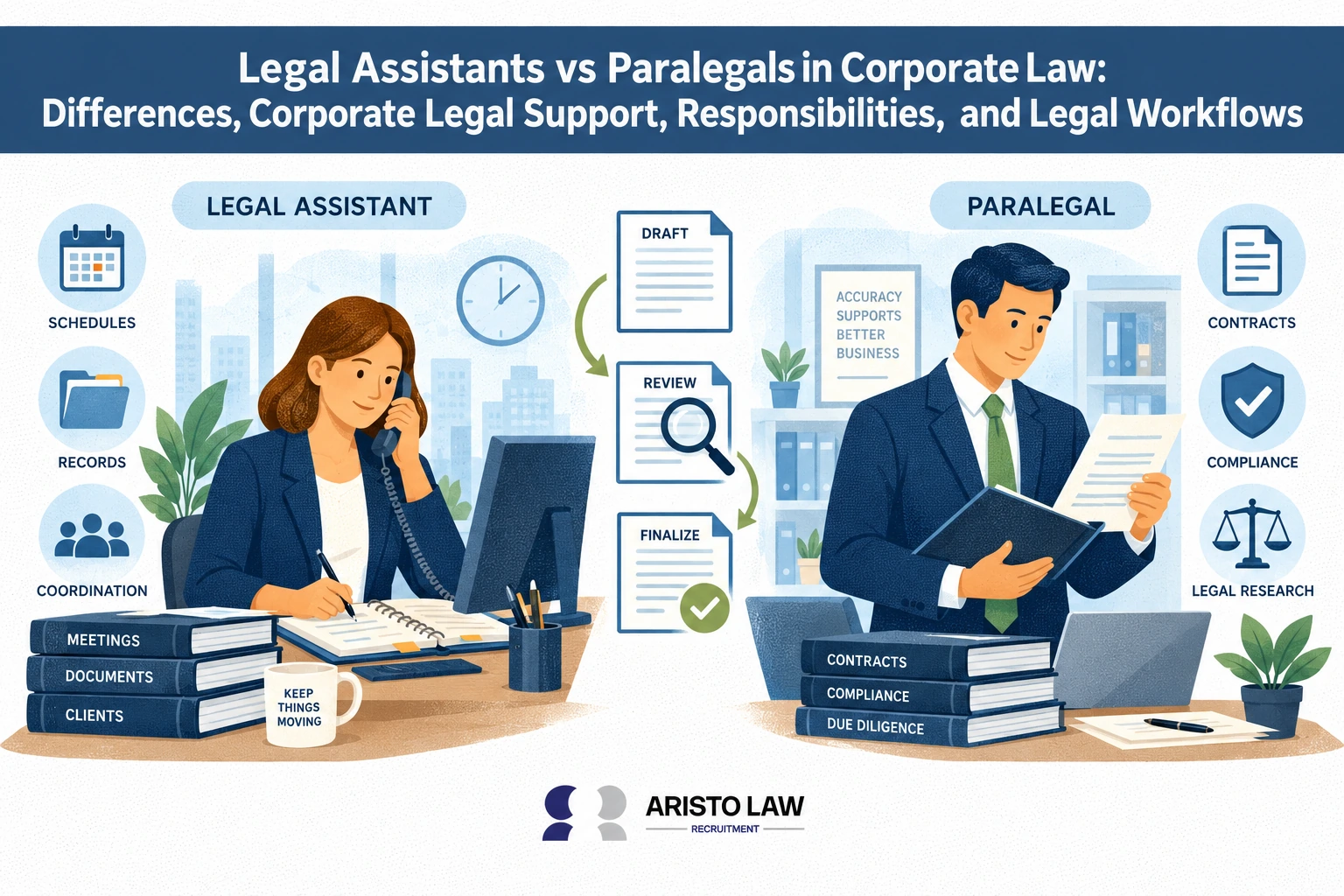
Key differences lie in legal authority, substantive legal work, and
document preparation. Corporate paralegals conduct legal research, draft
legal documents for attorney review, analyze contracts, monitor
regulatory compliance, and support corporate transactions. Legal
assistants perform administrative and procedural tasks, including
scheduling, formatting documents, maintaining records, coordinating
communications, and supporting paralegals and attorneys. Paralegals
exercise more substantive responsibility under attorney supervision,
while legal assistants operate primarily in administrative or
operational capacities without independent legal authority. Both roles
share similarities in workflow coordination, technology usage, corporate
documentation management, and attorney support.
Reporting structures often place legal assistants under paralegals or
attorneys, while paralegals report directly to corporate counsel, legal
department heads, or transactional teams. Both in-house and remote legal
staff operate in corporate legal environments, using contract management
systems, compliance dashboards, e-discovery tools, and digital workflow
platforms. Required skills include communication, organization, legal
research, contract handling, compliance tracking, document management,
and technology proficiency. Legal limitations restrict paralegals from
providing independent legal advice and require supervision for legal
assistants in substantive legal tasks.
Career progression pathways include legal assistants becoming
paralegals through education or certification, while paralegals may
pursue law school and attorney licensure. Both roles work together to
maintain scalable, efficient, and technology-driven corporate legal
operations, enabling firms and departments to handle complex corporate
transactions, compliance obligations, and high-volume legal
workflows.
Aristolaw helps law firms compare legal assistants and
paralegals in corporate law by providing outsourced legal support staff
for administrative workflows, document coordination, compliance support,
and corporate legal operations. Hire legal support staff with
Aristolaw today. Aristolaw connects law firms with legal
outsourcing solutions that match the right support role to the firm’s
corporate law responsibilities.
What is a legal
assistant in corporate law?
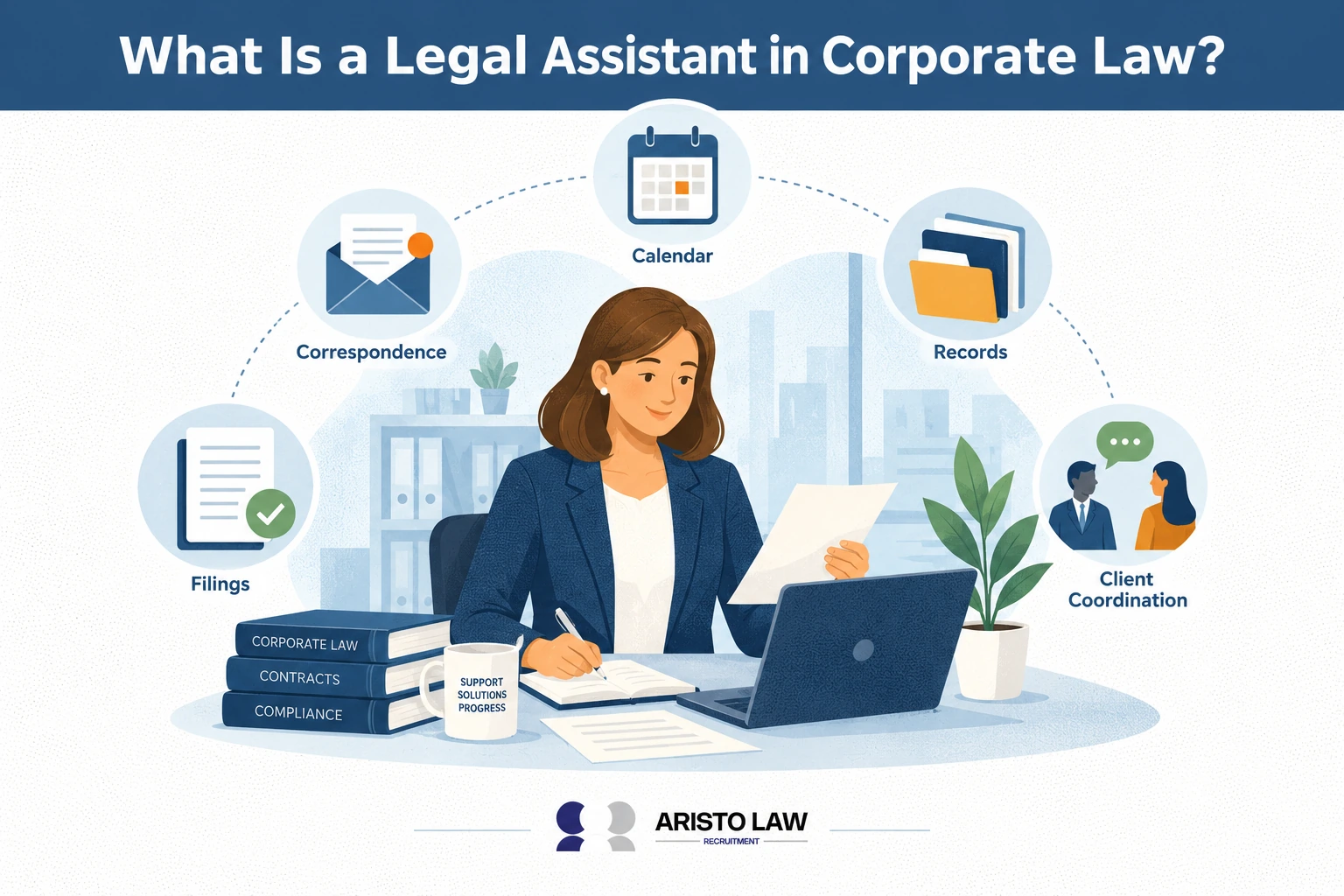
A legal assistant in corporate law supports attorneys and
legal departments through administrative, operational, scheduling,
documentation, and workflow coordination tasks tied to legal
operations. Corporate legal assistants manage legal calendars,
organize filing systems, coordinate board meetings, handle legal
correspondence, route contracts, format legal documents, track
compliance deadlines, and manage matter intake and e-signature
workflows.
According to the U.S. Bureau of Labor Statistics (BLS), the
principal U.S. federal statistical agency, paralegals and legal
assistants (which include corporate legal assistants) held about 376,200
jobs in 2024 and their role is defined by supporting lawyers with a
variety of tasks including maintaining and organizing legal files,
preparing legal documents, and scheduling meetings and
deadlines. This reflects the substantial employment base and
scope of responsibilities involved in legal support roles.
Legal assistants ensure legal workflow organization by maintaining
task assignments, monitoring deadlines, and updating case or transaction
status across corporate legal operations. Legal assistants support
billing coordination, invoice tracking, and cross-department
communication to keep attorneys, executives, and internal teams
informed.
By managing document preparation, intake workflows, and operational
logistics, corporate legal assistants help maintain efficiency across
high-volume legal operations and executive communication channels while
allowing attorneys to focus on substantive corporate legal work and
decision-making.
What does a
corporate legal assistant do daily?
Daily responsibilities of a corporate legal assistant include
legal scheduling, document management, executive coordination, filing
support, and workflow administration.
Listed below are 12 daily responsibilities of a corporate legal
assistant.
-
Matter intake: Receiving and organizing new
corporate matters, updating case or project tracking systems. -
Contract tracking: Routing contracts for review,
tracking approval status, and monitoring renewal deadlines. -
Board packet preparation: Compiling meeting
materials, resolutions, and supporting documents for board meetings. -
Legal billing coordination: Collecting time entries,
preparing invoices, and coordinating with finance or billing teams. -
Litigation calendar updates: Maintaining court
dates, filing deadlines, and hearing schedules. -
Signature collection: Managing internal and external
signatures for contracts, filings, and approvals. -
Compliance reminders: Monitoring regulatory
deadlines and alerting attorneys or corporate teams to upcoming
obligations. -
Attorney scheduling: Coordinating meetings,
hearings, conference calls, and client appointments. -
Legal database maintenance: Updating case management
systems, contract repositories, and corporate filing databases. -
Communication management: Coordinating
correspondence between legal departments, executives, vendors, and
external counsel. -
Document formatting and filing: Preparing and
organizing documents for internal records, court submissions, or
regulatory filings. -
Workflow administration: Tracking tasks, updating
project status, and maintaining operational continuity across
high-volume corporate legal operations.
What
corporate legal workflows involve legal assistants?
Corporate legal workflows involving legal assistants include
document coordination, scheduling, filing management, communication
routing, and legal operations administration.
In data published by the U.S. Bureau of Labor Statistics
(BLS) in the Occupational Outlook Handbook for Paralegals and Legal
Assistants, legal assistant workflows within corporate and legal
settings were quantitatively characterized to include
document coordination and management,
scheduling of meetings and court dates, filing
and case record maintenance, communication routing with
clients and internal teams, and administrative support
for legal operations.
Listed below are 11 corporate legal workflows that involve legal
assistants.
-
Document indexing and organization: Maintaining
structured filing systems for contracts, corporate records, and
regulatory filings. -
Legal intake system management: Logging new matters,
updating case databases, and assigning initial workflows. -
Executive coordination: Preparing board packets,
scheduling executive meetings, and distributing supporting
materials. -
Legal billing support: Tracking attorney time
entries, preparing invoices, and coordinating with finance
departments. -
Meeting logistics: Scheduling internal and external
meetings, hearings, and conference calls. -
Litigation scheduling: Maintaining court calendars,
filing deadlines, and deposition timelines. -
Workflow software management: Updating task-tracking
systems, matter management platforms, and workflow dashboards. -
Contract-routing systems: Managing contract review
processes, approval status, signature collection, and renewal
notifications. -
Communication tracking: Coordinating messages,
updates, and correspondence between attorneys, corporate teams, vendors,
and external counsel. -
Document preparation and formatting: Drafting,
formatting, and compiling documents for internal use, filings, or
regulatory submissions. -
Operational continuity oversight: Ensuring
high-volume corporate legal workflows progress without delays and
maintaining task visibility across departments.
Who
does a legal assistant report to in a corporate legal department?
Legal assistants in corporate legal departments commonly
report to general counsel, senior attorneys, legal operations managers,
or executive legal administrators depending on organizational
structure. In hierarchical corporate legal teams, legal
assistants may report directly to general counsel or deputy counsel for
transactional and governance matters, while supporting compliance
officers or litigation teams for regulatory and litigation
workflows.
In a 2021 State of the Industry Survey reported by the
Corporate Legal Operations Consortium (CLOC), around 60 % of corporate
legal departments reported that the head of legal operations (the role
often overseeing workflow and support functions such as those performed
by legal assistants) reports directly to the General Counsel or Chief
Legal Officer, illustrating how legal support staff are embedded within
formal reporting hierarchies that link administrative roles to senior
legal leadership.
Legal operations directors often oversee legal assistants responsible
for workflow management, document preparation, intake coordination, and
administrative support across departments. Executive assistants may
provide additional reporting layers for scheduling, executive
communication, and board-meeting preparation. In multinational
corporations and regulated industries, reporting chains include regional
legal heads, compliance managers, or specialized departmental counsel to
ensure adherence to local regulations.
In outsourced or remote legal support models, corporate legal
assistants may coordinate with internal managers while remaining
administratively accountable to external service providers or virtual
legal operations teams. Clear reporting structures ensure task
accountability, workflow continuity, confidentiality compliance, and
effective attorney supervision across complex corporate legal
operations.
Can legal assistants
draft legal documents?
Yes, legal assistants can help prepare and organize legal
documents under attorney direction, although substantive legal drafting
responsibilities usually belong to paralegals or attorneys.
According to the U.S. Bureau of Labor Statistics (BLS)
Occupational Outlook Handbook for Paralegals and Legal Assistants, legal
assistants routinely help lawyers collect, organize, and maintain legal
documents and information under attorney supervision, contributing to
tasks such as preparing correspondence, filing materials with courts or
agencies, and organizing evidence files as part of case
preparation. Legal assistants focus on formatting, assembling,
and proofreading documents, preparing templates, managing signature
workflows, and coordinating filing and distribution.
Legal assistants handle operational aspects of corporate contracts,
board resolutions, NDAs, litigation documents, and corporate governance
records without independently analyzing legal clauses or providing legal
advice. Substantive drafting, such as contract negotiation language,
regulatory compliance provisions, or legal argument construction,
remains the responsibility of paralegals or licensed attorneys. Legal
assistants ensure document accuracy, maintain version control, and
integrate materials into workflow systems, supporting attorneys and
paralegals in efficiently completing corporate legal operations.
What skills do
corporate legal assistants need?
Skills needed by corporate legal assistants include
organization, legal software management, communication, workflow
coordination, and document administration.

Listed below are 8 skills needed by corporate legal assistants.
-
Workflow systems:Task-tracking, matter management,
legal project coordination, and deadline monitoring. -
Communication management: Internal correspondence
with attorneys, executives, compliance teams, vendors, and external
counsel; email and virtual meeting coordination. -
Executive coordination: Scheduling board meetings,
preparing executive packets, managing calendar conflicts, and
coordinating corporate governance activities. -
Document control: Filing, indexing, version control,
proofreading, formatting, and preparing board resolutions, contracts,
NDAs, and litigation documents. -
Confidentiality handling: Secure document storage,
restricted access, NDAs, privileged communication management, and
compliance with corporate and regulatory confidentiality
requirements. -
Legal technology proficiency: Contract management
systems, e-billing platforms, document management software, scheduling
tools, e-signature platforms, and cloud-based case or matter management
systems. -
Operational efficiency: Prioritization,
multitasking, and workflow continuity in high-volume corporate legal
environments. -
Compliance awareness: Understanding regulatory
deadlines, corporate governance requirements, and documentation
standards.
What is a paralegal in
corporate law?
A paralegal in corporate law performs substantive legal
support work involving contracts, compliance, legal research, due
diligence, filings, and transactional preparation under attorney
supervision. Corporate paralegals handle entity formation,
maintain governance documentation, assist with SEC filing preparation,
review due diligence materials, abstract contract clauses, support
litigation, track intellectual property, conduct compliance audits, and
perform regulatory research.
Paralegals interact directly with attorneys in executing legal
strategy, preparing documentation for corporate transactions, managing
corporate filings, and supporting compliance initiatives. Corporate
paralegals operate as legally substantive support professionals,
contributing to complex legal workflows and transactional processes, yet
paralegals remain prohibited from practicing law independently,
providing legal advice, or representing clients in legal proceedings.
Paralegals’ roles bridge operational administration and substantive
legal analysis, ensuring accuracy, regulatory compliance, and effective
attorney oversight across corporate legal operations.
What does a corporate
paralegal do daily?
Daily responsibilities of a corporate paralegal include legal
research, contract review, due diligence support, compliance tracking,
and corporate filing preparation.
Corporate paralegals streamline workflows by preparing reports,
tracking deadlines, and liaising with internal teams or external
counsel. Leveraging modern technology, many firms now rely on solutions
like virtual
legal assistant support for corporate legal tasks to
enhance efficiency, reduce administrative burdens, and ensure that
critical legal responsibilities are consistently met throughout the
business day.
Listed below are 14 daily responsibilities of a corporate
paralegal.
-
Legal research memoranda preparation: Researching
statutes, regulations, case law, and compliance requirements for
attorney review. -
Contract review and abstraction: Reviewing
agreements, summarizing clauses, tracking obligations, and maintaining
contract databases. -
Due diligence support: Organizing transactional
records, reviewing corporate documents, and preparing due diligence
materials for mergers, acquisitions, and financing transactions. -
Entity maintenance: Updating corporate records,
monitoring subsidiary structures, maintaining governance files, and
tracking jurisdictional filings. -
Corporate filing preparation: Assisting with annual
reports, governance filings, SEC-related documentation, and regulatory
submissions. -
Compliance monitoring: Tracking deadlines,
maintaining compliance calendars, and reviewing operational adherence to
regulatory requirements. -
M&A transaction support: Coordinating closing
documents, signature packets, disclosure schedules, and transactional
workflows. -
Intellectual property tracking: Monitoring
trademarks, patents, renewals, and intellectual property filing
deadlines. -
Discovery preparation: Organizing litigation
documents, managing evidence files, and supporting eDiscovery
workflows. -
Governance documentation support: Preparing board
resolutions, meeting materials, minutes, and shareholder
documentation. -
Litigation-support coordination: Tracking litigation
deadlines, maintaining case files, and assisting attorneys with
document-heavy disputes. -
Regulatory research and reporting: Monitoring legal
developments and preparing summaries for attorneys and compliance
teams. -
Workflow and database management: Updating legal
management systems, maintaining document repositories, and coordinating
task tracking across corporate legal operations. -
Attorney workload reduction: Handling high-volume
document review, compliance administration, and transaction support so
attorneys focus on legal analysis, negotiation, and strategic
decision-making.
What
corporate legal workflows involve paralegals?
Corporate legal workflows involving paralegals include due
diligence, compliance management, entity governance, contract review,
and transactional support.
In an occupational analysis of corporate paralegal duties
summarized by ParalegalEdu.org, researchers reported that more than 30%
of paralegals identify corporate law or compliance as their primary
specialization, with core responsibilities including contract drafting
and review, corporate governance support, regulatory compliance, entity
formation documentation, and due diligence work for mergers and
acquisitions as part of transactional legal processes,
reflecting the broad scope of transactional support paralegals provide
within corporate legal workflows.
Listed below are 11 corporate legal workflows involving
paralegals.
-
Mergers and acquisitions (M&A) workflows:
Paralegals organize due diligence materials, review contracts, summarize
liabilities, coordinate data-room access, and prepare closing
documents. -
Financing transaction support: Tracking loan
agreements, preparing filings, coordinating approvals, and managing
document execution across departments. -
Contract review and lifecycle management:
Abstracting clauses, monitoring renewal dates, coordinating internal
approvals, and maintaining contract databases. -
Compliance management: Monitoring regulatory
deadlines, auditing corporate policies, coordinating internal compliance
reporting, and supporting HR and procurement teams. -
Entity governance workflows: Updating corporate
records, preparing board resolutions, maintaining subsidiary filings,
and ensuring regulatory filing compliance. -
Litigation hold and discovery support: Organizing
evidence, managing document repositories, preparing eDiscovery
submissions, and coordinating with legal operations and IT teams. -
Vendor and procurement contract workflows: Reviewing
vendor agreements, tracking approval processes, and integrating contract
obligations with procurement and finance teams. -
Employment and labor compliance: Supporting HR with
employment contracts, regulatory filings, and compliance tracking. -
Intellectual property monitoring: Tracking patent,
trademark, and copyright filings, renewals, and registration
deadlines. -
Regulatory audits and reporting: Preparing
documentation for internal and external audits, coordinating with
compliance and finance teams, and summarizing findings for
attorneys. -
Workflow integration across departments:
Collaborating with finance, HR, procurement, and compliance teams to
ensure continuity, visibility, and accuracy in high-volume corporate
legal operations.
Can paralegals give legal
advice?
No, paralegals cannot give independent legal advice because
legal advice must come directly from licensed attorneys.
Unauthorized practice of law restrictions prevent paralegals from
interpreting statutes, providing legal opinions, negotiating client
rights, or offering strategic guidance.
According to definitions adopted by the American Bar
Association (ABA) and outlined in the Legal Information Institute’s Wex
legal dictionary, paralegals and legal assistants “perform specifically
delegated substantive legal work for which a lawyer is responsible,” but
they are not licensed to practice law or give legal advice. Only
licensed attorneys, who have completed law school, passed a bar
examination, and meet professional standards, are authorized to provide
legal advice such as interpreting laws for a client or recommending
legal strategy. Paralegals are prohibited from offering legal
opinions or guidance to clients on their own because doing so would
constitute the unauthorized practice of law (UPL), a
legal violation in virtually all U.S. jurisdictions.
In practical corporate workflow terms, paralegals may conduct legal
research, prepare drafts of contracts or filings, organize
documentation, track compliance obligations, manage case or matter
workflows, and summarize factual information for attorney review.
Paralegals support legal operations by providing legal information,
procedural assistance, and administrative coordination, but all
substantive legal interpretation, decision-making, and client guidance
must be performed or approved by an attorney.
This boundary ensures compliance with professional conduct rules,
preserves attorney-client privilege, and maintains the integrity of
corporate legal workflows while allowing paralegals to contribute
efficiently to document-heavy and process-intensive tasks.
What skills do
corporate paralegals need?
Skills needed by corporate paralegals include legal research,
contract analysis, due diligence review, compliance tracking, and
regulatory documentation management.
Listed below are 11 skills corporate paralegals need.
-
Legal research proficiency: Conducting statutory,
regulatory, and case law research to support attorneys’
decision-making. -
Contract analysis and abstraction: Identifying key
clauses, obligations, and risk factors across agreements. -
Due diligence review: Examining corporate records,
financial statements, contracts, and filings for transactional
accuracy. -
Compliance tracking and interpretation: Monitoring
regulatory deadlines, interpreting corporate governance rules, and
supporting audits. -
Governance documentation management: Preparing board
resolutions, shareholder communications, and entity filings. -
Transactional organization: Coordinating M&A,
financing, and corporate transaction workflows with structured
timelines. -
Litigation support systems: Using eDiscovery,
document-review platforms, and matter-management tools for case
preparation. -
Legal writing and drafting: Preparing supporting
memos, summaries, and procedural documents for attorney review. -
Issue spotting and risk awareness: Identifying
potential legal or compliance issues within contracts, filings, or
corporate policies. -
Regulatory documentation familiarity: Handling SEC
filings, licensing reports, and other jurisdiction-specific regulatory
submissions. -
Document-intensive analysis: Maintaining accuracy,
version control, and workflow consistency in high-volume corporate legal
operations.
Accuracy, risk awareness, and detailed document review are critical
in corporate legal environments to ensure compliance, mitigate
liability, and support efficient attorney decision-making.
What
is the difference between a legal assistant and a paralegal?
Paralegals handle more complex legal tasks, such as drafting
legal documents, conducting detailed legal research, and preparing for
court filings, whereas legal assistants focus on administrative duties
like scheduling, client correspondence, and document
organization. Understanding these distinctions, including
qualifications, day-to-day responsibilities, and compensation, is
essential for anyone exploring a legal support career; see our guide on
legal
assistant vs paralegal differences skills and salaries
for a detailed breakdown.
The table below shows the difference between a legal assistant and a
paralegal and compares responsibilities, legal authority, workflow
involvement, substantive legal work, and corporate support
functions.
| Function / Workflow | Legal Assistant | Paralegal |
|---|---|---|
| Legal authority | Administrative support; no independent legal advice | Substantive legal support under attorney supervision; cannot provide independent legal advice |
| Contract intake | Logs contracts, collects information, schedules review | Reviews contract terms, abstracts key clauses, flags issues for attorneys |
| Contract drafting | Prepares templates, formats documents, manages signature routing |
Drafts clauses or supporting contract language for attorney review; supports negotiation preparation |
| Negotiation support | Coordinates communication between departments or external parties |
Summarizes contract changes, compares redlines, prepares negotiation briefs |
| Execution coordination | Tracks signatures, manages e-signature workflows, updates contract repository |
Ensures execution documents comply with internal policies, monitors obligations and renewals |
| Obligation tracking | Maintains administrative reminders and filing schedules | Monitors contractual obligations, compliance deadlines, and deliverables for attorney oversight |
| Contract repository management | Organizes files, maintains version control, updates tracking systems |
Ensures documents are accurately indexed, annotated, and integrated into workflow systems |
| Legal research | Supports attorneys with basic information gathering | Conducts substantive research, prepares memoranda, analyzes regulatory or transactional issues |
| Compliance support | Tracks filing deadlines, organizes audit documentation, maintains training records |
Reviews policies, prepares compliance reports, conducts regulatory research, supports internal investigations |
| Workflow involvement | Administrative coordination across high-volume legal tasks | Participates in end-to-end substantive corporate legal workflows, including transaction, governance, and litigation support |
| Billing and timekeeping | Collects time entries and assists with invoicing | Prepares detailed billing records linked to substantive legal work and compliance review |
| Transactional support depth | Limited to administrative processing and coordination | Involved in due diligence, M&A support, contract review, corporate filings, and regulatory compliance analysis |
| Client communication | Coordinates appointments, distributes non-legal updates | Summarizes legal issues, prepares documents for attorney-client communication under supervision |
| Scheduling functions | Manages calendars, hearings, and meetings | Supports attorney scheduling in transactional or litigation matters, integrates workflow timelines |
Role distinctions: Legal assistants commonly
manage administrative workflow continuity, document formatting, intake
tracking, and operational logistics, while paralegals perform
substantive review, compliance analysis, legal research, and transaction
support. In contract management, legal assistants handle
intake, signature routing, and repository maintenance, whereas
paralegals handle clause abstraction, negotiation support, obligation
tracking, and compliance verification. In compliance support, legal
assistants maintain filing deadlines, audit preparation, and policy
organization, while paralegals analyze regulatory requirements, prepare
compliance reports, and support governance documentation and internal
investigations to reduce regulatory risk.
What
are Similarities Between a Legal Assistant and a Paralegal?
Legal assistants and paralegals share many similarities
because both roles are designed to support attorneys, improve legal
workflow efficiency, and help manage legal operations within law firms,
corporate legal departments, and litigation environments. Both
positions contribute to operational efficiency by reducing attorney
administrative burden, supporting structured legal processes, and
maintaining case organization.
A legal assistant and a paralegal operate under attorney supervision,
adhere to confidentiality and ethical rules, and are prohibited from
independently practicing law in most jurisdictions. Legal operations
research consistently shows that trained legal support professionals
improve workflow efficiency, document organization, and productivity,
allowing attorneys to focus on higher-value legal analysis and client
representation.
Listed below are 10 similarities Between a Legal Assistant and a
Paralegal.
-
Both support attorneys in managing legal workflows and case
organization -
Both assist with legal documentation, filing systems, and record
management -
Both communicate with clients, courts, vendors, or third parties
under attorney supervision -
Both use legal software, document management systems, and case
management platforms -
Both help improve law firm and legal department efficiency
-
Both work under attorney supervision and cannot independently provide
legal advice -
Both require strong organizational, communication, and
confidentiality skills -
Both contribute to litigation preparation and administrative legal
operations -
Both may work in law firms, corporate legal departments, government
agencies, or outsourced legal support environments -
Both play important roles in maintaining procedural accuracy and
workflow coordination
Do
corporate law firms use both legal assistants and paralegals?
Yes, corporate law firms commonly use both legal assistants
and paralegals because large legal workflows require both administrative
coordination and substantive legal support. In transactional
law firms, in-house legal departments, compliance-heavy industries, and
litigation teams, staffing structures often separate workflow
administration from substantive legal tasks to optimize efficiency and
reduce operational risk.
According to a role analysis by Thomson Reuters in its July
10, 2023 industry guidance on legal staffing, corporate law firms and
legal departments routinely distinguish between legal assistants, who
focus on administrative and operational support (such as document
management, scheduling, and client communications), and paralegals, who
provide more substantive legal support including legal research,
drafting documents, and assisting in legal case
preparation.
Legal assistants handle administrative coordination, scheduling,
document formatting, filing, correspondence, and workflow tracking,
while paralegals perform contract analysis, due diligence, regulatory
compliance review, legal research, and transactional support under
attorney supervision.
This division of labor improves billing efficiency, allows
specialization in high-volume or complex corporate legal operations,
reduces errors, and enables attorneys to focus on strategic legal
decision-making, client representation, and transactional execution.
Using both roles ensures that corporate law firms maintain continuity,
accuracy, and productivity across diverse legal workflows and complex
organizational structures.
Do
corporate law firms use in-house or remote legal support staff?
Corporate law firms use both in-house and remote legal
support staff, with most modern firms operating hybrid staffing models
that combine on-site legal teams with remote or outsourced legal
professionals to improve flexibility, scalability, and operational
efficiency. In-house legal assistants, paralegals, litigation
support staff, and compliance personnel manage confidential,
high-collaboration, and client-facing workflows, ensuring mentorship,
supervision, and firm culture continuity.
Leveraging off-site professionals allows firms to maintain high
productivity without expanding physical office space. Firms that
integrate virtual roles effectively experience reduced turnaround times,
better resource allocation, and cost savings, highlighting the practical
benefits outlined in remote
corporate paralegal advantages for law firms.
In the 2024 Thomson Reuters Remote Work Report cited by
InterCore Technologies, 87 % of law firms now offer remote work options
for legal professionals, reflecting a widespread shift away from purely
in‑office staffing models in corporate legal practice. According to the
same industry data, 82 % of paralegals and legal assistants work
remotely in some capacity, with 32 % fully remote, 28.5 % remote
one‑to‑two days a week, and 21 % remote three‑to‑four days a week, while
only 14 % are exclusively on‑site. This distribution shows that most
modern firms have adopted hybrid staffing structures that blend in‑house
teams with remote or outsourced legal support to enhance flexibility and
operational efficiency.
Remote legal support staff, including virtual paralegals, legal
assistants, litigation support personnel, and case managers, handle
scalable, document-heavy tasks such as contract review, legal research,
eDiscovery, billing, and administrative operations. Legal process
outsourcing (LPO) models provide additional capacity for transactional
and compliance-intensive tasks while reducing office overhead.
Cloud-based legal software, case-management platforms, and secure
collaboration systems integrate remote staff into daily workflows,
maintaining attorney supervision, workflow visibility, and operational
control. Industry reports show hybrid legal workforce models are
now dominant because they allow law firms to access broader talent
pools, scale document-intensive legal operations, and maintain cost
efficiency, while fully remote staffing remains less common for core
attorney functions. Hybrid work continues to be the prevailing
structure in corporate law firms and legal departments globally.
Can a legal assistant
become a paralegal?
Yes, many legal assistants become paralegals by gaining legal
experience, expanding substantive legal responsibilities, or completing
paralegal education and certification programs. Career
progression often occurs through exposure to transactional workflows,
contract management, compliance tracking, legal research, document
drafting, and corporate filings.
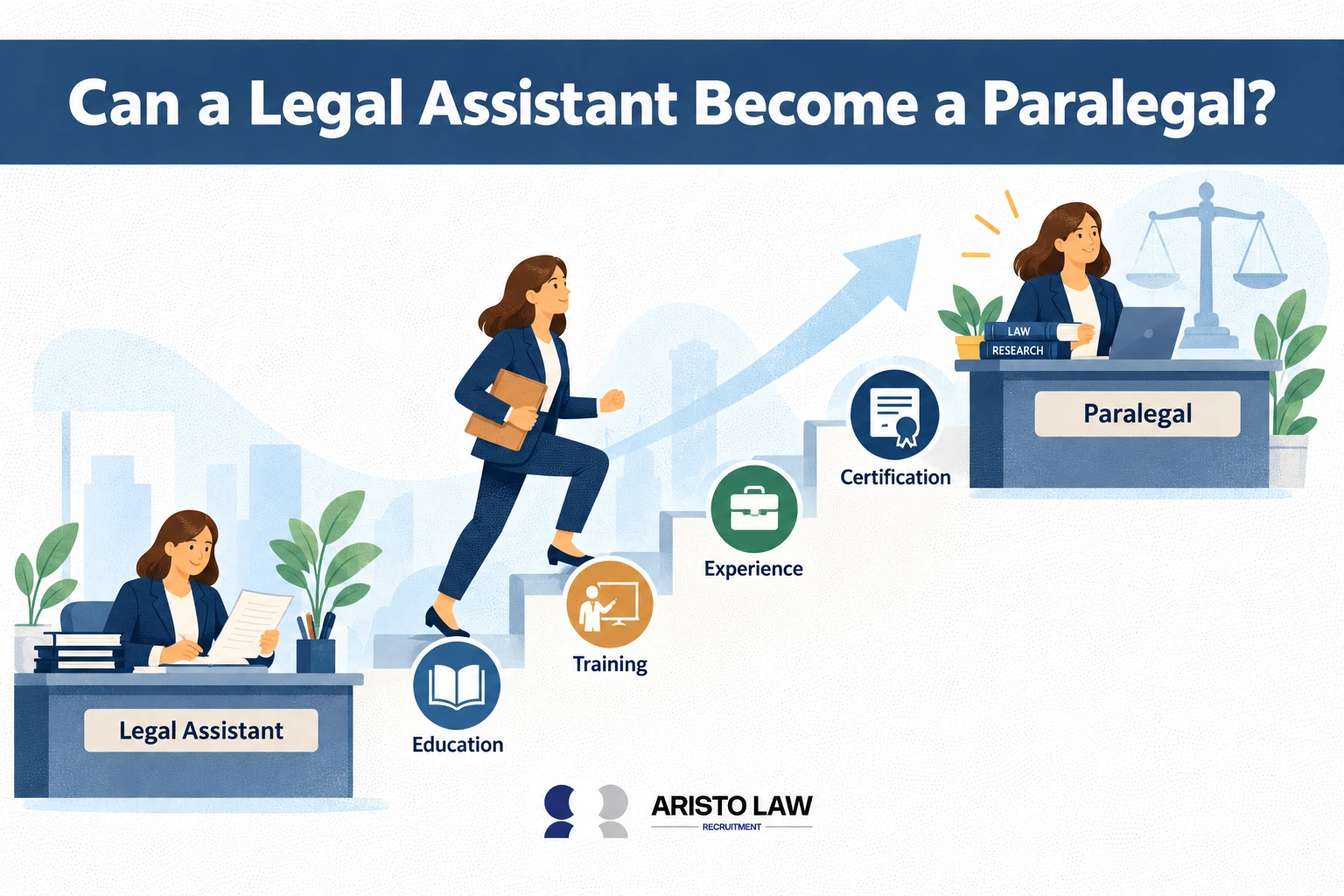
A legal assistant can advance into a paralegal role by acquiring
additional skills, formal education, and specialized training in areas
such as legal research, document drafting, and case management.
Understanding the responsibilities and expectations of a paralegal is
crucial for career progression, and structured programs provide a clear
roadmap for development. Exploring opportunities for certification,
mentorship, and practical experience helps bridge the gap between roles,
making legal
assistant training and career path a central resource
for those seeking advancement in the legal field.
Legal assistants develop software proficiency with case-management
systems, document repositories, e-signature platforms, and
workflow-tracking tools while supporting attorneys and paralegals.
Corporate legal departments frequently promote operational staff into
higher-responsibility legal support roles after demonstrating competency
in drafting, due diligence support, regulatory compliance, and
structured legal workflows.
Completing accredited paralegal certification programs or formal
paralegal studies enhances eligibility for promotion, enabling legal
assistants to assume greater responsibility in substantive corporate
legal operations while maintaining attorney supervision.
Can a paralegal become a
lawyer?
Yes, paralegals can become lawyers by completing formal legal
education, passing licensing requirements, and transitioning from
supervised legal support into licensed legal practice.
Paralegal experience strengthens law-school preparation by providing
exposure to litigation support, regulatory compliance, legal drafting,
contract review, corporate transactions, and legal operations.
According to a professional career guide published by
ParalegalEdu.org, many paralegals transition into licensed lawyers by
completing formal legal education and meeting bar exam and licensing
requirements; the guide explains that paralegals must earn a law degree
(such as a Juris Doctor) and pass the bar in their jurisdiction, a
process that often takes 4-7 years of additional study after paralegal
work before they can legally practice as attorneys, demonstrating that
practical legal experience, formal education, and licensing are key
steps in moving from legal support to full legal practice.
Corporate legal experience helps build procedural knowledge,
transactional familiarity, and understanding of governance, filing
obligations, and compliance workflows before attorney licensing. Working
as a paralegal allows future lawyers to develop practical skills in case
management, document organization, and attorney collaboration, which
enhances their readiness for law school coursework, bar exams, and the
demands of legal practice.
The transition from paralegal to lawyer leverages hands-on exposure
to substantive legal processes while maintaining compliance with
supervision and ethical standards.
Build a legal support team that moves work forward.
Tell us what is slowing your practice down. We will help map the role, workflow, and support structure that fits.