
What Do Paralegals Do: Roles, Remote Support, Legal Workflows, and Law Firm Efficiency

Practical guidance for building efficient, accountable legal support operations.
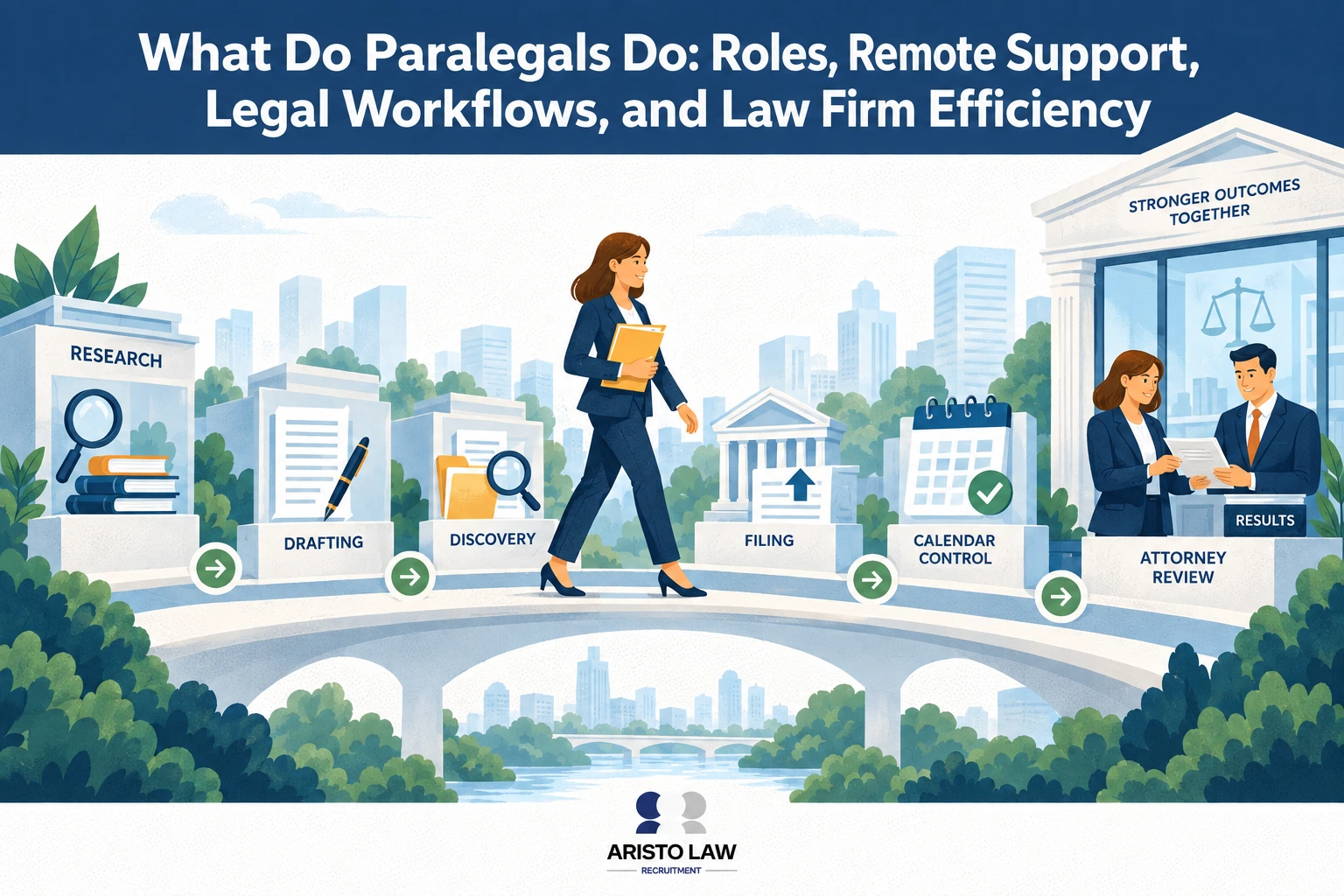
Paralegals are legal support professionals who assist
attorneys with legal research, documentation, compliance, and case
management workflows across litigation, corporate, transactional,
compliance, and regulatory legal operations. Paralegals support
law firms and businesses by handling drafting support, discovery
management, contract review assistance, due diligence coordination,
trial preparation, evidence organization, legal filings, and client
communication under attorney supervision.
According to the U.S. Bureau of Labor Statistics (BLS)
Occupational Outlook Handbook published in 2024, paralegals and legal
assistants routinely support law firms and corporate legal departments
by conducting legal research, organizing and maintaining files, drafting
legal documents, assisting attorneys during trial preparation, and
managing communication with clients and witnesses. The BLS
reported that approximately 376,200 paralegal and legal
assistant jobs existed in the United States, showing the
large-scale operational role these professionals play in legal
workflows. U.S. Bureau of Labor Statistics Occupational Outlook
Handbook
Legal operations rely on paralegals to maintain organized workflows,
manage deadlines, prepare legal documentation, coordinate eDiscovery
processes, maintain case records, and support attorneys with
document-intensive legal tasks that improve matter throughput and
operational efficiency.
Outsourceable paralegal services commonly include legal research,
document preparation, compliance tracking, case organization, contract
administration, litigation support, discovery coordination, remote legal
database management, and workflow tracking. Remote litigation support
and virtual legal workflows allow law firms to scale staffing capacity
without increasing fixed overhead costs. Cloud-based collaboration
systems, case-management platforms, e-signature tools, and secure
document repositories allow remote paralegals to integrate directly into
modern legal operations.
Paralegals can legally conduct research, prepare attorney-reviewed
documents, organize evidence, coordinate filings, track compliance
obligations, manage case files, and communicate procedural information
under attorney supervision. Paralegals cannot independently give legal
advice, represent clients in court as attorneys, negotiate legal rights
without supervision, or practice law independently because those
activities require attorney licensure.
Law firms and businesses hire paralegals instead of attorneys for
process-driven legal support, administrative coordination, document
management, and workflow-heavy legal tasks because paralegal staffing
reduces operational costs while improving legal workflow efficiency.
Corporate law firms, litigation firms, family law practices, compliance
departments, personal injury firms, real estate practices, and
transactional legal teams frequently use remote paralegals for scalable
staffing and operational flexibility.
In-house paralegal support provides closer collaboration, direct
supervision, and internal workflow integration, while remote paralegal
support offers lower overhead, flexible staffing structures, broader
talent access, and scalable legal operations. Remote paralegals improve
workflow optimization, reduce administrative burden, strengthen case
organization, improve deadline tracking, and increase law firm
efficiency through technology-driven legal support systems and
structured workflow coordination.
Aristolaw helps law firms manage what paralegals do across
legal roles, remote support, legal workflows, and law firm efficiency by
providing outsourced paralegal support for case preparation, document
drafting, discovery coordination, legal research assistance, client
communication, and workflow management. Hire
paralegal support staff with Aristolaw today.
Aristolaw connects law firms with outsourcing solutions that
match trained paralegal staff to each case support task, remote workflow
needs, document preparation duties, research support functions, and law
firm efficiency responsibility.
What does a paralegal do?
A paralegal supports attorneys by conducting legal research,
preparing legal documents, organizing case materials, managing discovery
workflows, tracking compliance obligations, and coordinating litigation
or transactional support activities under attorney supervision.
Paralegals reduce attorney workload by handling document-intensive and
workflow-driven legal operations such as contract drafting support,
evidence organization, due diligence review, corporate filing
preparation, case management, and litigation support.

Modern law firms and corporate legal departments rely on paralegals
to maintain workflow continuity, improve procedural accuracy, monitor
deadlines, and manage high-volume legal documentation through case
management systems, eDiscovery platforms, and cloud-based legal
software.
Paralegals manage legal documentation, case preparation, research
coordination, and administrative support that help attorneys maintain
organized legal workflows and procedural accuracy. Law firms that expand
operational capacity through virtual
paralegal assistant services delegate drafting support,
file management, intake coordination, and litigation preparation to
improve efficiency across ongoing matters.
Paralegals increase matter throughput because attorneys delegate
structured operational tasks that do not require direct legal
representation or independent legal advice. This division of labor
allows attorneys to focus on negotiations, legal strategy, courtroom
advocacy, and client counseling while paralegals support workflow
coordination, legal documentation management, and compliance tracking.
A 2024 legal operations analysis by Thomson Reuters reported
that 79% of legal departments experienced rising matter volume without
proportional staffing growth, increasing reliance on workflow support
roles, and legal operations efficiency systems. Industry
compensation and staffing reports consistently show that law firms use
paralegals to improve operational productivity, accelerate document
review, and manage expanding litigation and transactional workloads more
efficiently across modern legal operations.
A paralegal manages legal research, document preparation, case
organization, client communication, and administrative support within
legal workflows. Understanding these responsibilities provides clearer
insight into what
a virtual paralegal is and how remote legal support
integrates into modern law firm operations.
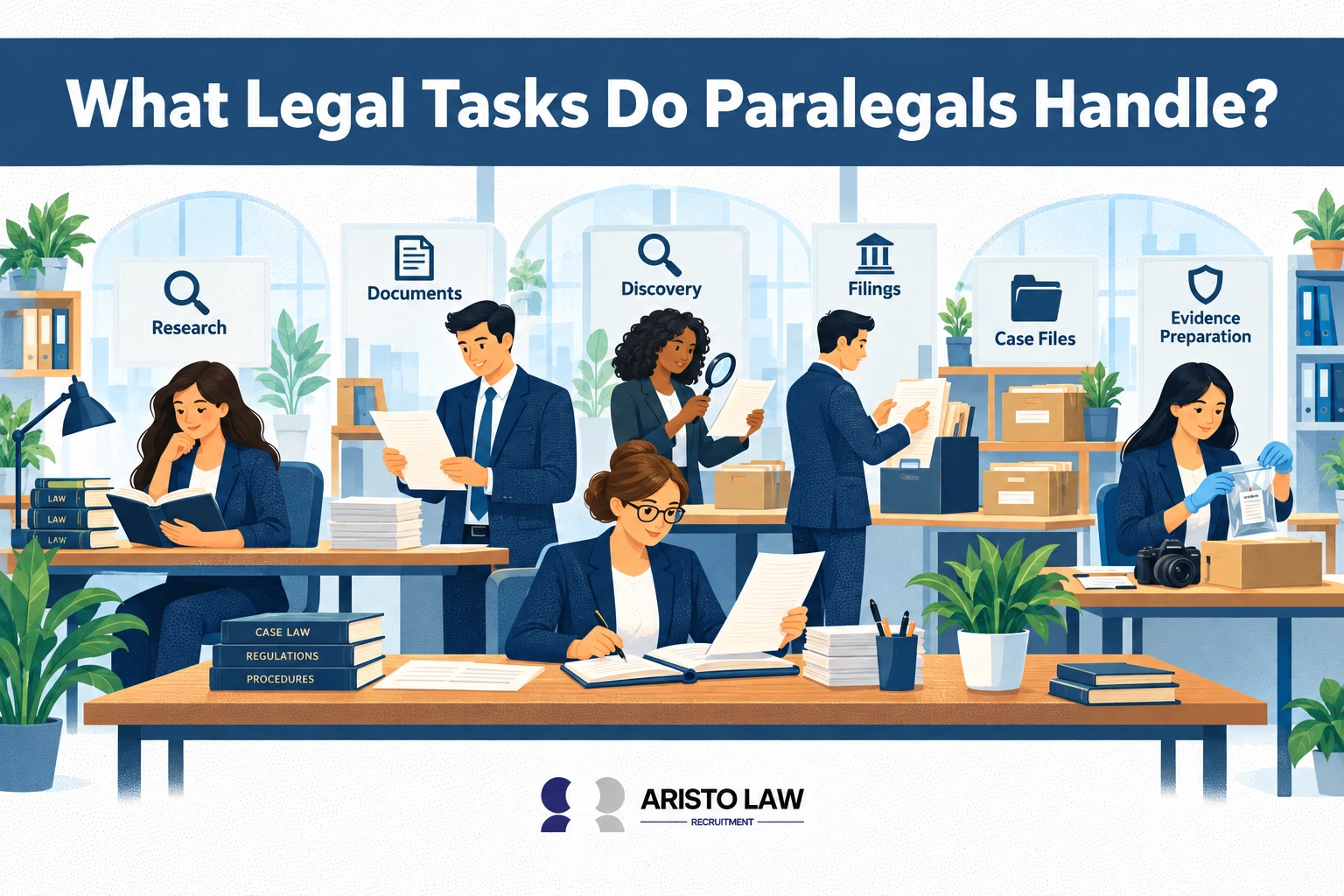
Listed below are the 12 most common responsibilities of a
paralegal.
-
1. Conducting legal research: Legal research
involves identifying relevant statutes, case law, and regulations to
support client matters. It ensures attorneys have accurate and timely
information for informed decision-making. -
2. Providing drafting support: Drafting support
helps prepare legal documents such as pleadings, motions, and
correspondence. It ensures consistency, accuracy, and adherence to
procedural requirements. -
3. Managing discovery support: Discovery support
includes organizing, reviewing, and indexing documents for litigation.
It facilitates evidence sharing and helps meet court deadlines
efficiently. -
4. Organizing case files and documentation: Case
file organization maintains all legal materials in a structured system.
It allows quick access to relevant information for ongoing cases. -
5. Assisting with contract review: Contract review
support involves identifying key terms, risks, and compliance issues. It
helps attorneys provide accurate advice and reduces potential legal
exposure. -
6. Handling client communication under attorney
supervision: Client communication management includes
responding to inquiries and scheduling consultations. All interactions
are supervised to ensure legal accuracy and confidentiality. -
7. Supporting due diligence processes: Due diligence
support collects, reviews, and summarizes legal, financial, and
operational information. It helps attorneys assess risks and make
informed business decisions. -
8. Preparing trial materials and documentation:
Trial preparation includes organizing exhibits, witness lists, and court
submissions. Proper documentation ensures attorneys are fully prepared
for hearings and trials. -
9. Organizing evidence and exhibits: Evidence
management tracks and categorizes physical and digital exhibits. It
ensures admissibility and easy retrieval during litigation. -
10. Tracking compliance requirements and deadlines:
Compliance tracking monitors regulatory obligations and filing
deadlines. It prevents violations and reduces the risk of penalties. -
11. Managing legal databases and records: Database
management maintains structured access to case law, statutes, and
internal documents. Accurate records support efficient legal research
and operations. -
12. Preparing corporate filings and legal forms:
Corporate filing support ensures business registrations, licenses, and
legal forms are correctly completed and submitted. It maintains
compliance with local and international regulations.
1. Conducting legal research
Conducting legal research is a core paralegal
responsibility. Conducting legal research involves the review
of statutes, regulations, case law, court rules, and legal databases to
support attorney analysis and legal strategy. Paralegals perform
research under attorney supervision to help law firms prepare motions,
contracts, litigation arguments, compliance assessments, and
transactional documentation.
Legal research supports case management and attorney workflows by
identifying relevant legal authority, organizing findings, summarizing
precedents, and maintaining accurate research records inside legal
databases and case management systems. Research-driven legal support
improves workflow coordination, strengthens legal documentation
accuracy, and allows attorneys to focus on strategy, negotiation, and
court representation across litigation, corporate, compliance, and
transactional practice areas.
2. Providing drafting support
Providing drafting support involves assisting attorneys with
the preparation, formatting, revision, and organization of legal
documents under attorney supervision. Paralegals support
drafting workflows for contracts, pleadings, motions, discovery
responses, corporate filings, compliance records, and legal
correspondence.
Drafting support improves legal operations by maintaining document
consistency, reducing administrative workload, organizing version
control, and preparing attorney-reviewed materials for filing or client
use. Structured drafting workflows strengthen case management, legal
organization, and workflow efficiency while helping law firms manage
high-volume legal documentation across multiple practice areas.
3. Managing discovery support
Managing discovery support involves organizing, reviewing,
tracking, and preparing documents and evidence used during litigation
and investigations. Paralegals coordinate discovery workflows
by handling eDiscovery systems, indexing records, preparing document
productions, monitoring deadlines, and supporting attorney review
processes.
Discovery support strengthens case management by maintaining
organized evidence repositories, improving procedural compliance, and
reducing delays in litigation preparation. Efficient discovery
coordination improves law firm operations by increasing workflow
visibility, supporting trial preparation, and ensuring accurate document
handling in document-intensive legal matters.
4. Organizing case
files and documentation
Organizing case files and documentation involves maintaining
structured legal records, matter files, client correspondence, court
filings, contracts, and supporting evidence within case management
systems and document repositories. Paralegals ensure attorneys
and legal teams have access to accurate, current, and properly
categorized information during litigation, compliance, and transactional
workflows.
Organized documentation improves workflow coordination, supports
procedural accuracy, reduces filing errors, and strengthens legal
operations across high-volume law firm environments. Effective file
management increases operational efficiency and supports timely legal
decision-making across multiple practice areas.
5. Assisting with contract
review
Assisting with contract review involves analyzing agreements,
summarizing clauses, tracking obligations, identifying inconsistencies,
and organizing contract documentation under attorney
supervision. Paralegals support legal operations by maintaining
contract databases, monitoring renewal deadlines, coordinating
approvals, and preparing agreements for attorney review.
Contract review assistance improves workflow organization, reduces
administrative pressure on attorneys, and strengthens compliance
tracking across corporate, transactional, and vendor-management
workflows. Structured contract support increases operational efficiency
and improves document accuracy throughout the contract lifecycle.
6.
Handling client communication under attorney supervision
Handling client communication under attorney supervision
involves coordinating updates, scheduling meetings, gathering
information, relaying procedural instructions, and maintaining
communication records without providing independent legal
advice. Paralegals support client communication workflows by
ensuring responsiveness, organizing intake information, tracking
follow-up actions, and maintaining consistent communication between
attorneys and clients.
Supervised communication improves case management, reduces workflow
delays, and strengthens client experience while maintaining compliance
with attorney supervision requirements and confidentiality
obligations.
7. Supporting due diligence
processes
Supporting due diligence processes involves reviewing,
organizing, and summarizing legal, financial, contractual, and
compliance-related records used in corporate transactions,
investigations, and regulatory reviews. Paralegals coordinate
due diligence workflows by managing data rooms, indexing documents,
preparing summaries, tracking deficiencies, and supporting attorney
review processes.
Due diligence support improves transactional efficiency, strengthens
workflow coordination, and reduces operational delays during mergers,
acquisitions, financing transactions, and compliance audits. Organized
due diligence workflows support accurate legal analysis and efficient
transaction management.
8. Preparing trial
materials and documentation
Preparing trial materials and documentation involves
organizing exhibits, witness files, deposition summaries, trial binders,
motions, and procedural records used during litigation
proceedings. Paralegals support trial preparation by
coordinating document production, maintaining evidence logs, tracking
deadlines, and ensuring attorneys have organized materials for hearings
and courtroom presentations.
Trial preparation workflows improve litigation efficiency, reduce
procedural errors, and strengthen workflow coordination during
high-pressure legal proceedings. Organized trial documentation supports
attorney performance and improves case management throughout
litigation.
9. Organizing evidence and
exhibits
Organizing evidence and exhibits involves collecting,
categorizing, labeling, indexing, and maintaining records used in
litigation, investigations, hearings, and discovery workflows.
Paralegals manage evidence organization through document repositories,
eDiscovery systems, and trial-preparation workflows to ensure attorneys
have access to accurate and properly structured materials.
Evidence organization improves legal operations by reducing retrieval
delays, maintaining procedural compliance, and strengthening litigation
workflow efficiency. Structured exhibit management supports case
preparation and improves operational coordination across legal
teams.
10. Tracking
compliance requirements and deadlines
Tracking compliance requirements and deadlines involves
monitoring filing schedules, court dates, regulatory obligations,
governance requirements, and procedural timelines within legal
operations systems. Paralegals maintain compliance calendars,
update workflow systems, coordinate reminders, and support attorneys in
meeting operational and regulatory deadlines.
Compliance tracking reduces procedural risk, improves workflow
visibility, and strengthens legal organization across litigation,
corporate, and compliance-driven practice areas. Accurate deadline
management supports operational continuity and reduces exposure to
filing errors or missed obligations.
11. Managing legal
databases and records
Managing legal databases and records involves maintaining
case management systems, document repositories, billing platforms,
contract databases, and workflow-tracking systems used in legal
operations. Paralegals update records, verify data accuracy,
organize files, maintain audit trails, and ensure information
accessibility across legal teams.
Database management supports case management, legal research
workflows, compliance tracking, and operational reporting while
improving workflow coordination and reducing administrative
inefficiencies. Accurate records management strengthens legal
organization and supports scalable law firm operations.
12. Preparing
corporate filings and legal forms
Preparing corporate filings and legal forms involves
organizing, completing, formatting, and coordinating documents required
for corporate governance, regulatory compliance, entity management, and
transactional workflows under attorney supervision. Paralegals
support filings related to business formation, annual reports,
compliance submissions, SEC-related documentation, governance records,
and licensing requirements.
Filing preparation improves legal operations by maintaining
procedural accuracy, reducing administrative backlog, and ensuring the
timely submission of regulatory documents. Organized filing workflows
strengthen compliance management, workflow coordination, and operational
efficiency across corporate legal environments.
What paralegal
services can law firms outsource?
Law firms can outsource a wide range of paralegal services,
especially structured, document-heavy, and process-driven legal tasks
that can be managed remotely under attorney supervision through secure
legal workflow systems. Outsourced paralegal services help law
firms and corporate legal departments improve scalability, reduce
operational costs, accelerate turnaround time, and manage fluctuating
workloads without expanding permanent staffing.
Legal process outsourcing research consistently shows firms outsource
workflow-driven legal support functions to improve operational
efficiency while allowing attorneys to focus on legal strategy,
negotiations, litigation advocacy, and client representation. Outsourced
paralegal work remains subject to attorney supervision, confidentiality
obligations, conflict checks, and professional conduct requirements to
maintain ethical compliance and protect attorney-client privilege.
Listed below are 16 paralegal services law firms can outsource.
-
Legal research and case law compilation
-
Document review and discovery support workflows
-
Litigation case management and docket tracking
-
Drafting support for pleadings, motions, contracts, and legal
forms -
Contract review, abstraction, and contract lifecycle support
-
Corporate filings and governance documentation
-
Compliance tracking and regulatory support workflows
-
E-discovery coordination and electronic document organization
-
Trial preparation support and exhibit management
-
Medical record summaries and personal injury case support
-
Immigration form preparation and document organization
-
Real estate transaction document preparation and closing
coordination -
Family law case file organization and drafting assistance
-
Bankruptcy petition preparation and creditor documentation
workflows -
Client intake processing and legal administrative support
-
Billing coordination, legal transcription, and document formatting
tasks
What can
paralegals legally do without an attorney?
Paralegals legally perform many substantive legal support
tasks without an attorney physically present, but they generally cannot
practice law independently, provide legal advice, represent clients in
court, or make legal decisions without attorney supervision.
Legal ethics rules and bar association standards in most jurisdictions
classify paralegals as supervised legal professionals whose work may be
substantive but must remain under the responsibility and oversight of a
licensed attorney to avoid unauthorized practice of law (UPL)
violations.
The distinction centers on independent task execution versus
independent legal authority. Paralegals may complete delegated workflow
tasks autonomously, yet attorneys remain responsible for legal analysis,
client representation, legal strategy, and attorney-client
relationships.
Listed below are 9 supervised legal support activities paralegals can
legally perform.
-
Conduct legal research and compile case law summaries
-
Draft legal documents, pleadings, contracts, and correspondence for
attorney review -
Organize case files, discovery materials, and litigation
documents -
Manage deadlines, calendars, and procedural workflows
-
Communicate with clients for factual information gathering and case
updates -
Coordinate document collection, evidence organization, and trial
preparation support -
Prepare administrative filings and assist with e-filing workflows
-
Conduct investigations, witness coordination, and document review
tasks -
Perform substantive legal support work delegated by supervising
attorneys
Some jurisdictions allow limited exceptions through licensed
paralegal practitioner programs or administrative tribunal
representation rules, though those exceptions remain narrowly regulated
and jurisdiction-specific.
What can a paralegal not do?
A paralegal cannot represent clients in court, provide legal
advice, or perform duties restricted to licensed attorneys.
Legal interpretation, legal strategy decisions, courtroom
representation, settlement negotiation authority, and formal legal
opinions remain attorney responsibilities to protect clients, preserve
ethical compliance, and maintain attorney accountability.

Law firms using remote or outsourced paralegal support must maintain
attorney supervision, workflow oversight, confidentiality controls, and
quality-review procedures to reduce unauthorized practice of law risk
and malpractice exposure.
Listed below are 15 activities a paralegal is not allowed to
perform.
-
Give legal advice or legal opinions to clients
-
Represent clients in court as an attorney
-
Establish attorney-client relationships independently
-
Accept legal representation agreements without attorney
authorization -
Negotiate legal settlements independently
-
Make final legal strategy decisions
-
Interpret law for clients without attorney review
-
Sign pleadings or legal filings requiring attorney authorization
-
Appear in formal legal proceedings as legal counsel
-
Set legal fees independently
-
Provide independent legal analysis directly to clients
-
Advertise legal services as an attorney
-
Make binding legal decisions on behalf of clients
-
Supervise legal representation without attorney oversight
-
Practice law independently without attorney licensure
When
should you hire a paralegal instead of a lawyer?
You should hire a paralegal instead of a lawyer when the work
primarily involves administrative, procedural, document-heavy, or
research-based legal support tasks that do not require legal advice,
courtroom representation, or independent legal judgment by a licensed
attorney. Paralegals provide cost-effective support for
structured legal workflows, helping law firms and businesses reduce
operational costs, improve workflow efficiency, and manage high-volume
legal tasks more efficiently.
Legal operations research consistently shows that delegating
repetitive and process-driven legal work to paralegals improves matter
throughput and allows attorneys to focus on negotiations, litigation
strategy, legal analysis, and client advocacy. Attorney supervision
remains necessary because unauthorized practice of law (UPL) rules
prohibit paralegals from independently practicing law or making legal
decisions.
Listed below are 10 instances where you should hire a paralegal
instead of a lawyer.
-
Hire a paralegal for document preparation and administrative legal
workflows. -
Use paralegals for organizing discovery materials, case files, and
evidence documentation. -
Hire paralegals for legal research support and case law compilation
under attorney supervision. -
Use paralegals for compliance tracking, contract administration, and
procedural filings. -
Hire paralegals when managing high-volume repetitive legal workflows
to reduce costs. -
Use paralegals for client intake coordination and communication
support -
Hire lawyers when legal advice, legal strategy, or courtroom
representation is required -
Use lawyers for negotiations, litigation advocacy, and complex legal
interpretation -
Lawyers are required when legal liability, rights, or legal
decision-making authority are involved -
Paralegals are best suited for supportive legal operations rather
than independent legal practice
Can paralegals work remotely?
Yes, paralegals can work remotely because modern legal
operations increasingly rely on cloud-based legal software, digital
document systems, and virtual collaboration platforms rather than
paper-based in-office workflows. Remote paralegals support
attorneys through legal research, remote discovery review, contract
abstraction, compliance tracking, legal intake coordination, document
preparation, and case management workflows using secure legal-tech
systems.
A 2024 survey published by the American Bar Association
examining remote legal assistance found that 82% of paralegals and legal
assistants worked remotely in some capacity, demonstrating that
paralegal work can be effectively performed outside traditional office
settings. Remote paralegals support law firms by organizing
legal documents, managing case workflows, coordinating filings, and
maintaining communication across attorneys, clients, and third parties.
These operational functions improve efficiency, reduce administrative
burden, and clarify the remote
corporate paralegal advantages for law firms within
scalable legal support structures.
Case management platforms, eDiscovery tools, cloud-based document
repositories, e-signature systems, billing software, and encrypted
communication platforms allow virtual paralegals to manage high-volume
legal tasks efficiently across distributed legal teams.
Remote legal work expanded rapidly as law firms and corporate legal
departments adopted legal technology to improve scalability, operational
flexibility, and workflow continuity. Distributed law-firm operations
now use remote paralegal support for litigation management,
transactional workflows, compliance administration, corporate filings,
and legal database management without requiring full-time on-site
staffing.
Virtual collaboration tools support workflow visibility, deadline
tracking, task coordination, and secure attorney supervision across
remote legal environments. Remote paralegal models reduce office
overhead, improve staffing flexibility, and allow firms to access
broader legal-support talent pools while maintaining organized and
technology-driven legal workflows.
How do remote
paralegals support law firms?
Remote paralegals support law firms by handling legal
workflows, administrative coordination, and document-intensive tasks
without increasing physical office overhead. Many firms adopt
remote staffing models because the remote
corporate paralegal advantages for law firms include
greater workload flexibility, improved operational efficiency, and
expanded support capacity. Remote paralegals assist with client intake,
legal research, discovery support, filing preparation, document review,
litigation scheduling, compliance management, deadline tracking, case
organization, and attorney workflow support under attorney
supervision.
Remote staffing helps law firms absorb workload spikes, manage larger
caseloads, reduce document turnaround times, and maintain responsiveness
to clients, courts, and opposing counsel without expanding office space
or in-house staffing costs. By managing procedural and administrative
legal tasks, remote paralegals increase attorney leverage, improve
workload management, and allow attorneys to focus on legal strategy,
client representation, and higher-value legal work.
What types of law
firms use remote paralegals?
Law firms that use remote paralegals include litigation
firms, personal injury firms, immigration firms, family law firms, real
estate firms, and corporate legal departments.
Listed below are the 10 types of law firms that use remote
paralegals.
-
Litigation firms: Remote paralegals support
discovery management, document review, evidence organization, deposition
summaries, docket tracking, and trial preparation for document-intensive
litigation workflows. -
Personal injury firms: Remote legal support helps
manage client intake, medical-record summaries, settlement
documentation, insurance correspondence, and records management across
high-volume caseloads. -
Immigration firms: Immigration workflows benefit
from remote paralegals because immigration practice involves form-heavy
filings, document collection, deadline tracking, and
compliance-intensive procedural workflows. -
Family law firms: Family law operations use remote
paralegals for client communication, scheduling, drafting support,
discovery organization, and case management in communication-intensive
legal environments. -
Real estate firms: Remote paralegals coordinate
closing documentation, title records, contract preparation, transaction
tracking, and filing workflows for real estate transactions. -
Corporate legal departments: Corporate paralegals
support contract management, governance documentation, compliance
tracking, due diligence review, and regulatory filing coordination
through cloud-based legal systems. -
Employment law firms: Remote support teams manage
document organization, compliance records, policy documentation, and
employment dispute workflows. -
Bankruptcy firms: Bankruptcy practices use remote
paralegals for petition preparation, creditor documentation, filing
coordination, and deadline tracking. -
Insurance defense firms: Remote paralegals organize
litigation records, maintain discovery workflows, track deadlines, and
support claims-related legal operations. -
Intellectual property firms: Virtual paralegals
manage trademark filings, patent documentation, renewal tracking, and
intellectual property databases through digital workflow systems.
What
is the difference between in-house and remote paralegal support?
The main difference between in-house and remote paralegal
support is that in-house paralegals work physically within a law firm or
legal department, while remote paralegals provide legal support
virtually through digital communication and cloud-based legal workflow
systems. Legal operations research consistently shows hybrid
and remote staffing models improve scalability and reduce operational
overhead, while in-house structures strengthen real-time collaboration,
mentorship, and direct workflow integration for complex legal
matters.
Both staffing models remain subject to attorney supervision,
confidentiality obligations, and professional conduct requirements
despite different operational environments.
The table below shows the main difference between in-house and remote
paralegal support.
Aspect |
In-House Paralegal
|
Remote Paralegal Support |
|---|---|---|
| Work location | Works physically inside a law firm or legal department | Works virtually from a remote location |
| Communication style | Face-to-face and office-based collaboration | Digital communication through email, chat, and video platforms |
| Workflow integration | Integrated into daily office operations and meetings | Integrated through cloud-based legal systems and remote workflows |
| Supervision | Direct in-person attorney supervision | Remote supervision through digital management systems |
| Cost structure | Higher overhead due to office space, equipment, and on-site staffing |
Lower operational costs and reduced office overhead |
| Scalability | Limited by office capacity and local hiring availability | Easier to scale across multiple locations and fluctuating workloads |
| Hiring flexibility | Usually tied to geographic location | Access to broader national or global talent pools |
| Collaboration | Stronger real-time office collaboration and team interaction | More dependent on structured communication systems |
| Technology reliance | Moderate reliance on digital collaboration tools | Heavy reliance on cloud-based legal technology and secure remote systems |
| Confidentiality management | Controlled through physical office security protocols | Managed through encrypted digital systems and remote security policies |
| Workflow suitability | preferred for highly collaborative or sensitive legal matters | Effective for document-heavy, standardized, and scalable legal workflows |
| Staffing model | Traditional full-time legal department structure | Flexible, contract-based, freelance, or hybrid staffing models |
What legal
workflows can remote paralegals improve?
Legal workflows remote paralegals improve include intake
workflows, litigation workflows, contract workflows, discovery
workflows, and compliance workflows.
Remote paralegals improve legal workflows by organizing case
documentation, coordinating deadlines, tracking discovery materials, and
maintaining communication across attorneys, clients, and providers.
Structured task delegation and documentation oversight also strengthen
litigation
case manager support for legal workflows by improving
case progression, workflow continuity, and operational accuracy.
Listed below are 10 legal workflows that remote paralegals
improve.
-
Intake workflows: Remote paralegals improve intake
response speed by handling client onboarding, information gathering,
document collection, conflict checks, and matter setup through digital
intake systems and case-management platforms. -
Litigation workflows: Remote litigation support
improves calendar coordination, deadline tracking, filing preparation,
document organization, and procedural workflow continuity during
high-volume litigation matters. -
Contract workflows: Remote paralegals improve
contract lifecycle tracking by organizing approvals, monitoring
renewals, maintaining repositories, coordinating signatures, and
updating contract-management systems. -
Discovery workflows: Remote discovery support
improves indexing, categorization, document review coordination,
evidence organization, and eDiscovery workflow management across
document-heavy litigation environments. -
Compliance workflows: Remote legal support
strengthens compliance reporting, deadline monitoring, governance
tracking, regulatory filing coordination, and audit-document
organization. -
Matter coordination workflows: Remote workflow
coordination improves task visibility, attorney communication, deadline
management, and workload distribution across distributed legal
teams. -
Document management workflows: Remote paralegals
reduce bottlenecks by maintaining centralized document repositories,
version control, and searchable legal records through cloud-based legal
software. -
Client communication workflows: Remote support
improves responsiveness by coordinating updates, scheduling meetings,
organizing correspondence, and maintaining communication records under
attorney supervision. -
Transactional workflows: Remote paralegals support
due diligence coordination, closing-document organization, filing
preparation, and workflow tracking during mergers, acquisitions, and
financing transactions. -
Administrative legal workflows: Remote delegation
improves billing coordination, e-signature routing, records management,
and procedural filing efficiency without increasing internal
administrative burden.
What are the
benefits of hiring remote paralegals?
Benefits of hiring remote paralegals include scalability,
lower overhead, flexible staffing, faster workflow handling, reduced
cost, and access to specialized legal support.
Remote paralegals support legal operations by organizing case files,
preparing legal documents, managing deadlines, and assisting attorneys
with administrative and procedural tasks without requiring in-office
staffing. Law firms seeking scalable support models evaluate affordable
virtual paralegal options for law firms to maintain
consistent paralegal functions while reducing overhead and improving
workflow efficiency.
Listed below are the 10 benefits of hiring remote paralegals.
-
Scalability during workload surges: Remote
paralegals help law firms absorb litigation spikes, discovery-heavy
matters, transactional closings, and compliance projects without
expanding permanent staff. -
Lower operational overhead: Remote staffing reduces
office-space costs, equipment expenses, on-site administrative costs,
and long-term employment overhead. -
Flexible staffing structures: Law firms use
contract-based, freelance, project-based, or hybrid remote staffing
models to match fluctuating workload demand. -
Faster workflow handling: Distributed legal support
improves turnaround time for document review, discovery indexing,
drafting support, filing coordination, and compliance tracking. -
Reduced recruitment friction: Remote hiring expands
access to broader talent pools without geographic hiring limitations or
relocation requirements. -
Access to specialized legal expertise: Remote
staffing allows firms to source paralegals experienced in litigation,
immigration, family law, corporate transactions, compliance,
intellectual property, and eDiscovery workflows. -
Timezone flexibility and extended coverage:
Distributed remote teams support workflow continuity across multiple
jurisdictions and extended operational hours. -
Reduced administrative burden on attorneys: Remote
paralegals handle process-driven legal tasks, allowing attorneys to
focus on legal strategy, negotiations, and client representation. -
Workflow continuity across distributed teams:
Cloud-based legal systems and virtual collaboration tools maintain
centralized workflow visibility, deadline tracking, and case
coordination. -
Improved responsiveness: Remote legal support
improves intake response speed, communication workflows, and procedural
task completion without requiring full-time in-house hiring
commitments.
Build a legal support team that moves work forward.
Tell us what is slowing your practice down. We will help map the role, workflow, and support structure that fits.