
Legal Outsourcing: Services, Benefits, Providers, and Costs

Practical guidance for building efficient, accountable legal support operations.

Legal outsourcing, often called legal process outsourcing (LPO), means assigning defined legal support or administrative work to an external provider. The law firm keeps responsibility for client representation, legal judgment, supervision, and final review. A clear scope, secure workflow, and accountable reviewer are essential to a successful arrangement.
Firms use legal outsourcing to manage workload peaks, clear document backlogs, add a specialist skill, or build capacity without immediately expanding an in-house team. This guide explains common services, benefits, risks, provider selection, and costs—including how legal outsourcing differs from hiring a virtual legal professional directly.
What is legal process outsourcing (LPO)?
Legal process outsourcing is the delegation of defined, process-driven legal support tasks to an outside provider. Work may include legal research support, document review, discovery organization, contract administration, compliance documentation, and case-file coordination. The law firm or client retains responsibility for legal decisions and attorney-client representation.
“Outsourcing” describes who performs the work; “offshoring” describes where the provider is located. Outsourcing can be domestic or international. Offshoring is cross-border outsourcing and may require additional review of privacy, data-transfer, confidentiality, and professional-responsibility requirements.
What services can law firms outsource?
Law firms commonly outsource repeatable, well-scoped work that can be assigned, checked, and securely delivered through documented procedures. Examples include:
- Paralegal and legal assistant support: document preparation, file organization, deadline tracking, and case coordination.
- Legal research support: source gathering, case-law and statute research, citation checks, and research summaries for attorney review.
- Litigation support: discovery organization, medical-record indexing, deposition summaries, and evidence tracking.
- Client intake and administration: initial information collection, appointment scheduling, follow-up, and CRM updates.
- Contract support: contract intake, template-based drafting assistance, version tracking, and lifecycle administration.
- Compliance documentation: policy records, audit preparation, and regulatory tracking under the firm’s direction.
- Billing and records support: time-entry administration, invoice coordination, data entry, and structured file maintenance.
- Legal operations support: workflow documentation, reporting, technology coordination, and approved automation tasks.
Other roles can include virtual legal secretaries, demand-writing support, medical-record specialists, contract managers, recruiters, bookkeepers, marketing assistants, and legal transcriptionists. The right scope depends on the firm’s practice, systems, confidentiality obligations, and available attorney supervision.
What tasks can virtual legal assistants handle?
Virtual legal assistants can support law-firm administration remotely. Depending on training and the firm’s instructions, tasks may include:
- Preparing and formatting documents from approved templates.
- Coordinating calendars, appointments, and deadline reminders.
- Organizing matter files and updating case-management systems.
- Managing routine client communications and follow-ups approved by the firm.
- Gathering information, organizing records, and preparing research materials.
- Supporting billing administration, data entry, and other defined office workflows.
They should not independently provide legal advice, decide legal strategy, or act as the client’s lawyer. The responsible attorney sets the scope, reviews work, and retains the professional responsibilities that apply.
Why are law firms outsourcing legal tasks?
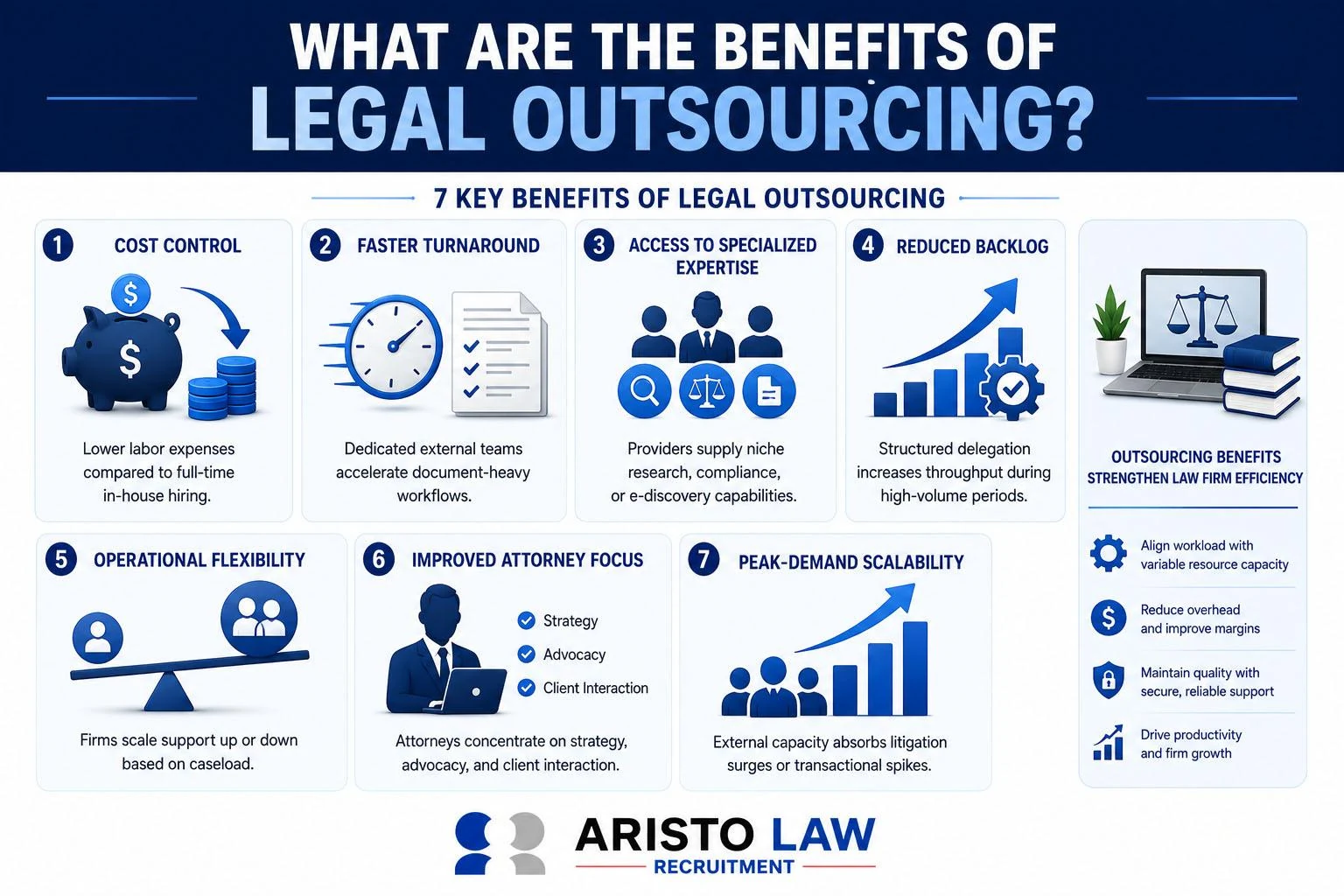
Law firms outsource when internal capacity, turnaround, or specialist skills do not match the work in front of them. A carefully scoped arrangement can help a firm:
- Reduce backlogs during litigation surges or seasonal demand.
- Give attorneys more time for legal analysis, advocacy, and client work.
- Add capacity without committing immediately to a permanent in-house role.
- Make repeatable workflows more consistent through written procedures.
- Access skills that are needed for a particular matter or workflow.
- Scale support up or down as matter volume changes.
What are the benefits of legal outsourcing?
The main benefits are added capacity, more predictable workflows, and flexibility. Firms may also gain access to specialized support and reduce the administrative load on attorneys and in-house staff. Results depend on the task, provider, onboarding, supervision, security controls, and the time required to review deliverables.
Outsourcing does not guarantee a fixed percentage of savings or faster work in every matter. Compare the total arrangement—including onboarding, software, attorney review, revisions, and management time—with the cost and capacity of handling the work internally.
What types of law firms benefit most?
Small firms may use outsourced support to cover recurring administrative work without adding a full-time employee. Growing firms can add capacity as caseloads change. Litigation-heavy practices may need help organizing large document sets, while transactional or in-house teams may have recurring contract and compliance workflows.
Common practice-area applications include medical-record organization and demand preparation in personal injury; document collection and case tracking in immigration; financial-file organization in family law; contract administration in business practices; and discovery or evidence organization in mass tort and insurance litigation. The tasks and supervision arrangements should be tailored to the applicable rules and the firm’s workflow.
Which practice areas rely on outsourced legal support?
Outsourced support can be useful in any practice with defined, document-heavy processes. Examples include:
- Personal injury: medical-record organization, chronology preparation, and discovery indexing.
- Immigration: document collection, form preparation support, and case tracking.
- Family law: financial-document organization and procedural drafting support.
- Corporate and transactional law: contract administration and template-based document support.
- Insurance defense and mass torts: document review coordination, evidence organization, and deposition summaries.
- Compliance and regulatory practices: policy documentation and reporting preparation.
These are examples of support workflows, not substitutes for legal advice or attorney review.
What should a legal outsourcing agreement include?
A written agreement should set expectations before client information or firm-system access is shared. It should cover:
- Scope and deliverables: tasks, outputs, exclusions, and who may assign work.
- Service levels: turnaround times, quality measures, revision rules, and escalation contacts.
- Confidentiality and conflicts: protections for client information and procedures for conflict checks.
- Security: access controls, encryption, device requirements, retention, incident reporting, and data return or deletion.
- Supervision and review: who directs the work, checks it, and makes legal decisions.
- Fees and billing: the pricing model, invoicing, expenses, and any separate salary or software costs.
- Work product and compliance: ownership, permitted use, subcontracting, and applicable professional obligations.
- Continuity and termination: notice, handover, access removal, and secure exit procedures.
Requirements vary by jurisdiction and engagement. The firm should assess the rules that apply to its work and maintain appropriate attorney supervision.
What common legal outsourcing mistakes should firms avoid?
- Giving an unclear assignment without defining the expected deliverable.
- Choosing only by price instead of checking role fit, quality, security, and communication.
- Skipping onboarding, written procedures, conflict checks, or attorney review.
- Granting broader system access than the task requires.
- Failing to set turnaround targets, escalation steps, and responsibility for rework.
- Leaving data retention, staff turnover, or service interruption plans unresolved.
Begin with a limited workflow, use least-privilege access, and review quality and turnaround before expanding the arrangement.
Can legal outsourcing improve law firm productivity?
It can, when the work is clearly defined and the review process is efficient. Delegating appropriate administrative and process-driven tasks can reduce bottlenecks and give attorneys more time for client-facing and substantive legal work. Productivity gains are less likely when instructions are vague, systems do not fit, or attorney review takes as long as doing the task internally.

What is the difference between outsourced legal work and outsourced lawyers?
Legal support outsourcing generally covers defined support tasks performed under the law firm’s direction. Contracting with a licensed attorney is different: that lawyer may perform substantive legal work under a separate engagement and applicable licensing, conflict, and professional-responsibility requirements. The firm should identify who is qualified to perform each task and who remains responsible for legal decisions.
| Topic | Outsourced legal support | Contract attorney |
|---|---|---|
| Typical work | Document organization, research support, discovery coordination, and administrative case workflows | Substantive legal analysis, drafting, negotiation, or other attorney work |
| Legal judgment | Reserved for the responsible lawyer; support work is reviewed as appropriate | Performed by a licensed attorney within the agreed scope |
| Key controls | Clear instructions, confidentiality, limited access, quality checks, and supervision | Licensing, conflicts, confidentiality, supervision, and engagement terms |
Examples of legal outsourcing providers
The market includes large legal process outsourcing firms, legal operations providers, specialist litigation-support companies, and recruiting firms. Names found in the sector include QuisLex, Integreon, Pangea3 (EY Law), Mindcrest (DWF Group), UnitedLex, Elevate, Cobra Legal Solutions, Legal Advantage, and Exigent Group. Their services, locations, and engagement models differ. Treat this as a non-ranked starting list and verify each provider’s current services, security practices, references, and terms directly.
How do you choose the right legal outsourcing company?
Match the provider to the work and the firm’s risk profile. Ask who will perform the work, how they are trained, how conflicts are checked, what security controls apply, how deliverables are reviewed, and how the provider handles missed deadlines or staff changes. Review anonymized work samples where appropriate, confirm pricing and exit terms, and consider a small pilot before expanding.
Document the workflow and provide only the access needed for the assignment. Set a review point before work is sent to a client, court, opposing counsel, or another external party.
How does Aristo Law support legal staffing?
Aristo Law helps law firms recruit remote legal support professionals. Its recruitment model is different from a project-based LPO vendor: the firm hires and supervises the selected professional directly and pays the professional’s salary separately. The published recruitment fee is a one-time $2,997; confirm current scope and terms with Aristo Law before making a decision.
Firms can explore virtual legal assistant staffing, virtual legal research assistant staffing, and other legal staffing services to find a role that fits their workflow.
When should a law firm use legal process outsourcing?
Consider it when internal capacity is exceeded, a backlog is slowing case progress, a short-term volume surge is expected, or the firm needs support for a defined workflow. It may be a poor fit when the task is not clearly scoped, the firm cannot provide adequate supervision, or the work requires legal judgment that should remain with an attorney.
What are the costs of legal outsourcing services?
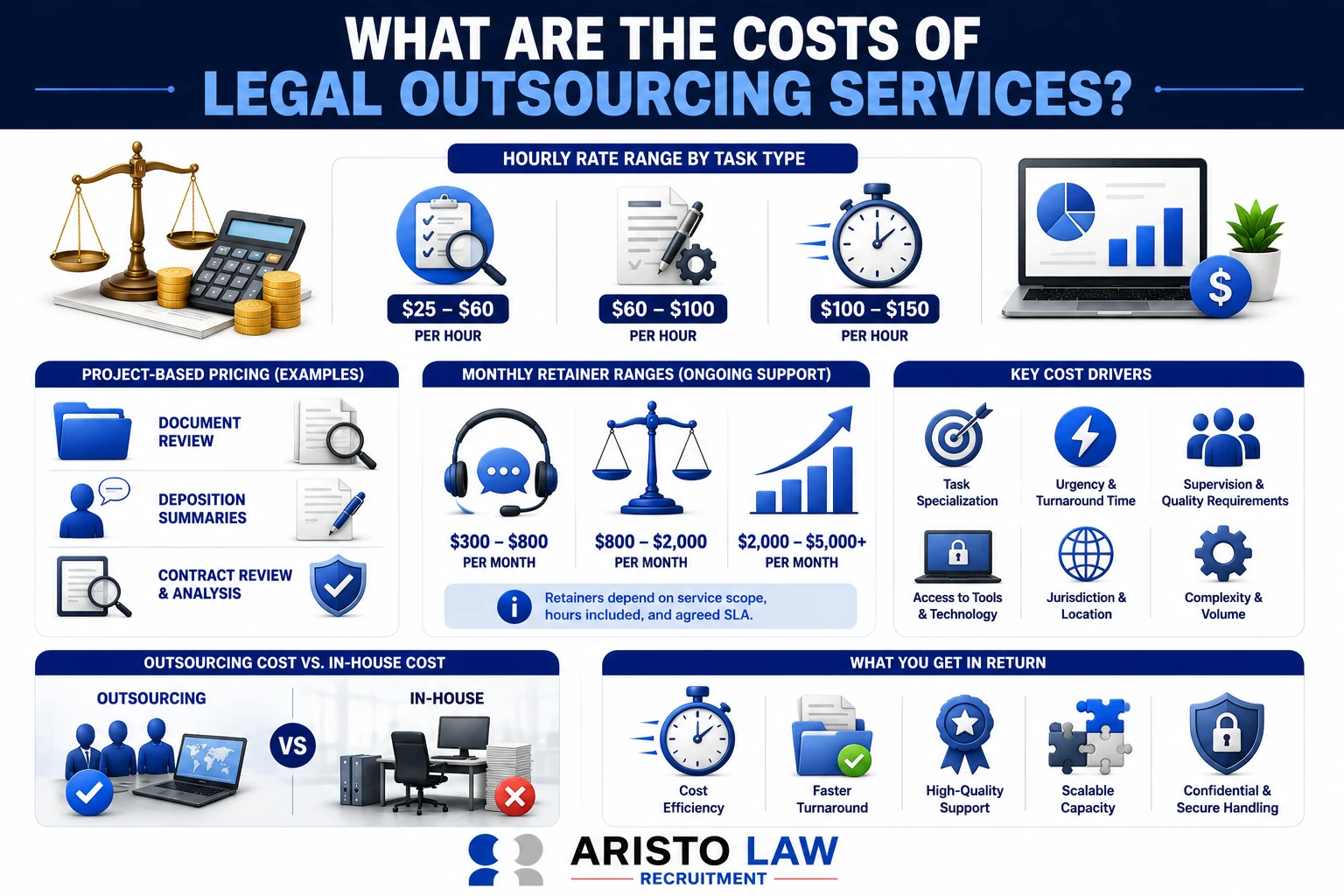
There is no single legal outsourcing rate. Providers may charge hourly, per project, or through a monthly arrangement. Price depends on the role, experience, jurisdiction, complexity, volume, turnaround, technology, and review requirements. Ask for a written quote and compare the full cost, including onboarding, attorney supervision, software, quality review, and rework.
For Aristo Law’s direct-hire recruitment model, the firm pays the one-time recruitment fee and separately employs and pays the selected professional. This differs from a vendor’s hourly or monthly service fee. Confirm current pricing and terms before proceeding.
Is legal outsourcing cost-effective for law firms?
It may be cost-effective when the work is repeatable, the arrangement reduces delays or internal workload, and the full cost of oversight is lower than the value gained. Compare provider fees with internal salary, benefits, recruiting, training, software, management, and attorney review. The right answer depends on the firm’s actual workload and quality requirements.
Can small law firms benefit from outsourcing?
Yes. A small firm can add support for a defined workload without immediately building a larger in-house team. The firm still needs to budget for onboarding, appropriate supervision, secure access, and any service fees or salary obligations.
How does legal offshoring differ from outsourcing?
Outsourcing means assigning work to an outside provider. Offshoring means the provider is in another country, so offshoring is one form of outsourcing. Cross-border arrangements may require additional attention to data-transfer rules, confidentiality, access controls, time zones, and professional obligations. Domestic outsourcing also requires appropriate supervision and security safeguards.
Where can law firms find reliable legal outsourcing providers?
Firms can identify providers through professional referrals, legal operations networks, industry directories, and direct research. Check references from comparable firms, review relevant work samples, verify security and conflict procedures, and confirm how supervision and quality checks work. A limited pilot can test communication and turnaround before client data or larger workloads are involved.
What is paralegal outsourcing?
Paralegal outsourcing is obtaining paralegal support from an outside provider or through remote staffing. Paralegals may assist with research, document preparation, case tracking, discovery organization, and other support tasks within the law firm’s procedures. The attorney remains responsible for supervision and legal judgment.
What is a virtual paralegal?
A virtual paralegal is a paralegal who provides support remotely. Depending on the role and jurisdiction, the work may include document preparation, legal research support, file organization, deadline tracking, discovery coordination, and client-intake administration. Remote work should use secure systems and clear communication and review procedures.
Are virtual paralegals cost-effective, and how much do they cost?
They can be cost-effective when a firm has enough recurring work to justify the role and the tasks can be assigned and reviewed efficiently. Costs vary with experience, specialization, location, hours, and whether the arrangement is direct employment, recruitment, or a vendor service. Request a current written quote and compare the total cost—including salary or fees, onboarding, benefits where applicable, tools, supervision, and coverage.
What is incident management software in a legal context?
Incident management software records and tracks reported events, investigations, and corrective actions. In legal departments or compliance teams, it can help organize reports about policy violations, privacy incidents, or regulatory concerns and preserve an audit trail. It is a legal operations tool; it is separate from ordinary law-firm case management and does not replace legal advice or incident response planning.
Discuss the right support model for your firm
Start with the workflow that is creating the clearest bottleneck. Define the task, the required review, the security controls, and how success will be measured. Then compare project outsourcing, direct hiring, and recruitment support. Contact Aristo Law to discuss a legal staffing need.
Build a legal support team that moves work forward.
Tell us what is slowing your practice down. We will help map the role, workflow, and support structure that fits.