
Freelance Paralegal for Hire vs. Dedicated Remote Paralegal Services: Roles, Costs, and Benefits

Practical guidance for building efficient, accountable legal support operations.
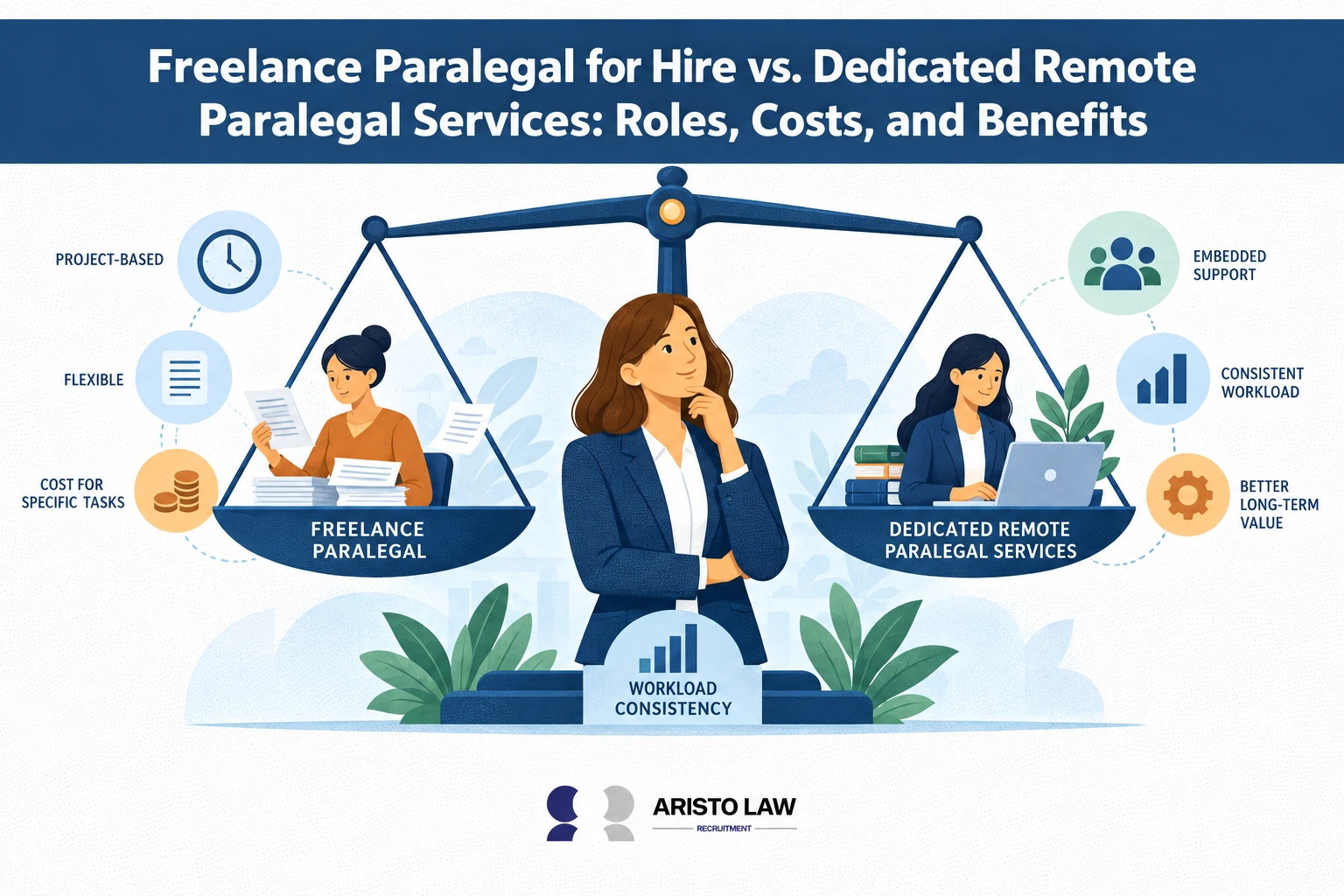
Freelance paralegals for hire and dedicated remote paralegal
services represent two distinct outsourced legal support models that
differ in engagement structure, continuity, scalability, and operational
integration. Freelance paralegals are commonly engaged for
project-based assignments such as legal research, document drafting,
discovery review, contract review, records organization, and short-term
case support. Dedicated remote paralegal services provide ongoing
assistance embedded within a law firm’s daily operations, supporting
case management, litigation workflows, client intake, deadline tracking,
discovery coordination, billing support, and long-term administrative
functions.
Freelance paralegals pricing models range from approximately
$25–$100+ per hour depending on specialization and experience. Dedicated
remote paralegal services frequently use monthly staffing arrangements
that range from approximately $1,000–$4,000+ per month, depending on
workload, support level, and staffing structure.
Both models require legal research skills, document-preparation
experience, case-management proficiency, confidentiality awareness,
communication skills, and familiarity with legal software. The primary
difference lies in workflow integration. Freelance support works best
for discrete projects and fluctuating workloads, while dedicated remote
paralegals provide consistent long-term support integrated into firm
operations.
Freelance paralegals are often hired through platforms such as
Upwork, freelance marketplaces, and independent contractor networks.
Dedicated remote paralegal services are commonly sourced through legal
staffing agencies, legal outsourcing providers, and organizations such
as Aristo Law. Aristo Law provides dedicated remote paralegal services
designed for scalable, long-term support, helping law firms manage legal
workflows, improve operational efficiency, strengthen case
administration, and expand capacity without increasing internal staffing
overhead.
For firms with occasional projects, limited case volume, or
short-term support needs, freelance paralegals often provide a
cost-effective solution. Firms seeking workflow continuity, integrated
support, predictable availability, and scalable operational assistance
benefit more from dedicated remote paralegal services. Selecting the
appropriate model depends on workload complexity, staffing goals, budget
requirements, and long-term growth objectives.
Aristolaw helps law firms compare freelance paralegals and
dedicated remote paralegal services by providing outsourced support for
case preparation, document drafting, discovery coordination, legal
research, client communication, and remote legal workflows. Hire
a dedicated Virtual Paralegal Assistant with Aristolaw.
Aristolaw connects law firms with outsourcing solutions that match
trained remote paralegal staff to each cost-control goal, role coverage
need, case support task, document workflow, research duty, and long-term
legal operations responsibility.
What is a freelance
paralegal for hire?
A freelance paralegal for hire is an independent legal
support professional who provides project-based assistance to attorneys
and law firms on a contract basis rather than as a permanent
employee. Law firms procure freelance legal support through
freelance marketplaces, contractor networks, professional referrals,
legal staffing platforms, or direct contractor arrangements when they
need additional capacity for specific matters, temporary workload
increases, or overflow assignments.

A freelance paralegal for hire provides project-based legal support,
whereas dedicated remote paralegal services supply ongoing workflow
coverage, case continuity, and long-term operational support for law
firms. Freelance
virtual paralegal services fit short-term assignments
and fluctuating workloads, while dedicated remote paralegal services
align with recurring legal processes, predictable staffing needs, and
scalable firm operations.
The freelance model is designed around defined deliverables and
short-term engagements rather than ongoing ownership of legal
operations. Attorneys commonly engage freelance paralegals for legal
research, document review, discovery summaries, contract abstraction,
records organization, filing preparation, case-file administration,
citation verification, document formatting, and litigation-support
projects. These assignments are often tied to specific deadlines,
transactions, cases, or operational needs.
Project-based legal work provides flexibility because firms obtain
support only when needed without committing to long-term staffing
arrangements. This makes freelance paralegals particularly useful for
workload spikes, large discovery projects, trial preparation periods,
contract-review initiatives, due-diligence assignments, and temporary
staffing gaps.
Unlike dedicated remote paralegal services, freelance paralegals do
not become deeply integrated into daily law-firm operations. They focus
on completing assigned tasks, delivering project outcomes, and
supporting specific legal workflows. Ongoing case management, continuous
client communication, long-term deadline monitoring, intake
administration, and operational coordination remain with lawyers,
internal staff, or dedicated legal-support teams.
Attorney supervision remains a critical component of freelance legal
support. Law firms are responsible for onboarding freelance
professionals, providing workflow instructions, establishing
confidentiality protocols, managing system access, communicating
expectations, and reviewing completed work. Firms must also maintain
quality-control processes to ensure accuracy, compliance, and alignment
with firm standards.
As a result, freelance paralegals serve as a flexible resource for
on-demand legal support, helping attorneys complete specialized tasks
and project-based assignments efficiently while maintaining attorney
oversight and responsibility for legal strategy, client representation,
and final work product.
What are dedicated
remote paralegal services?
Dedicated remote paralegal services provide long-term legal
support through a remote paralegal integrated into a law firm’s
workflows and daily operations. Unlike project-based freelance
support that focuses on individual assignments, dedicated remote
paralegal services function as embedded staffing solutions that support
ongoing legal operations, workflow management, and case
administration.
Dedicated remote paralegal services assign a law firm to a consistent
legal support professional who manages recurring workflows, case
coordination, and firm-specific procedures over time. Dedicated
remote paralegal services provide continuity,
institutional knowledge, and long-term operational support, whereas
freelance engagement is project-based and task-specific.
A dedicated remote paralegal works with the same lawyers and legal
teams over an extended period, developing familiarity with firm
procedures, case-management practices, client expectations, document
standards, and operational requirements. This recurring availability
allows the paralegal to assume responsibility for routine legal-support
workflows rather than simply completing isolated tasks. Common
responsibilities include case management support, litigation
administration, deadline tracking, discovery coordination, client intake
assistance, document preparation, records organization, billing support,
and workflow monitoring.
Because dedicated remote legal support professionals remain involved
across multiple matters, they develop institutional knowledge regarding
attorney preferences, firm processes, recurring case types, technology
systems, and internal procedures. This familiarity improves efficiency
and reduces the need for repeated onboarding, workflow explanations, and
task-specific training each time new work is assigned.
Dedicated remote paralegals often operate within law firm
case-management systems, document repositories, CRM platforms, billing
applications, and communication tools. Their integration into these
systems supports stronger collaboration, better workflow visibility, and
more consistent operational performance. Attorneys delegate recurring
responsibilities with greater confidence because the paralegal
understands established procedures and ongoing case requirements.
Workflow continuity is one of the most significant advantages of
dedicated remote paralegal services. Rather than starting each
assignment with limited context, dedicated professionals maintain
awareness of active matters, upcoming deadlines, procedural
developments, and operational priorities. This continuity helps reduce
delays, improve communication, strengthen accountability, and support
more efficient legal operations.
Practice-area specialization further increases value. Dedicated
remote paralegals often gain experience supporting specific practice
areas such as personal injury, litigation, family law, immigration,
employment law, corporate law, or estate planning. This specialization
allows them to contribute more effectively to recurring workflows and
procedural requirements.
By combining recurring availability, workflow ownership,
institutional knowledge, lawyer collaboration, process documentation,
and technology integration, dedicated remote paralegal services provide
scalable legal support that strengthens operational consistency,
improves productivity, and creates long-term efficiency across law firm
operations.
What tasks can
freelance paralegals handle?
Freelance paralegals handle project-based legal support tasks
such as legal research, document review, drafting assistance, discovery
organization, and contract-related work.
Listed below are the 16 tasks freelance paralegals commonly
handle.
-
Legal research
-
Research memoranda preparation
-
Document review
-
Contract abstraction
-
Deposition digests and summaries
-
Document drafting support
-
Discovery organization
-
Filing preparation
-
Records management projects
-
Due-diligence support
-
Case management administration
-
Client intake management
-
Discovery workflow management
-
Litigation support coordination
-
Case-management system administration
-
Long-term client communication support
Freelance paralegals perform delegated legal-support functions under
attorney supervision. Attorneys remain responsible for reviewing work
product, validating accuracy, applying legal judgment, maintaining
compliance, and overseeing client representation. Research findings,
drafted documents, contract summaries, discovery analyses, and filing
materials require attorney review before use in legal matters.
Recurring operational processes such as daily case administration,
intake management, deadline monitoring, client communications, billing
coordination, and workflow ownership often become less efficient when
repeatedly assigned to new contractors. Activities that depend on
familiarity with firm procedures, lawyer preferences, active matters,
client histories, and practice-specific workflows perform better under
dedicated remote legal support arrangements because they require
continuity and accumulated institutional knowledge.
Freelance paralegal tasks are most effective when assignments have
clearly defined objectives, limited dependency on institutional
knowledge, measurable deliverables, and a finite completion timeline.
Legal research, discovery projects, document summaries, contract work,
deposition digests, and one-time drafting assignments commonly fit this
model, whereas ongoing legal operations often benefit from dedicated
remote support with greater continuity and workflow ownership.
What
tasks can dedicated remote paralegal services handle?
Tasks dedicated remote paralegals can handle include case
management, recurring drafting workflows, client communication support,
contract administration, compliance tracking, and ongoing litigation
support.
Listed below are 32 tasks dedicated remote paralegals handle.
-
Matter Tracking and Case Administration: Maintain
active matter records, update case-management systems, monitor case
progress, track milestones, and support ongoing legal operations across
multiple matters. -
Litigation Calendar Management: Manage court
deadlines, hearing schedules, filing dates, discovery deadlines,
deposition calendars, and procedural timelines to support continuous
workflow execution. -
Deadline and Task Management: Monitor critical
deadlines, assign tasks, coordinate workflow completion, and maintain
visibility into active legal matters. -
Discovery Coordination: Organize document requests,
track productions, manage discovery schedules, maintain evidence
records, and coordinate discovery workflows throughout litigation
matters. -
Trial Preparation Support: Prepare trial binders,
organize exhibits, maintain witness files, coordinate litigation
documents, and support pretrial and trial-related activities. -
Case File Maintenance: Maintain organized case
files, update matter records, manage correspondence, and ensure
documentation remains current and accessible. -
Client Intake Management: Collect intake
information, manage intake forms, schedule consultations, update CRM
systems, and support new-client onboarding processes. -
Client Communication Support: Coordinate status
updates, document requests, appointment scheduling, follow-up
communications, and administrative interactions with clients. -
Matter Onboarding Coordination: Assist with opening
new matters, gathering required documents, organizing information, and
establishing workflow structures for ongoing legal work. -
Ongoing Document Preparation: Support recurring
preparation of pleadings, discovery documents, legal correspondence,
procedural filings, forms, and administrative legal documents under
lawyer supervision. -
Template Management and Standardization: Maintain
approved document templates, formatting standards, drafting procedures,
and document consistency across the firm. -
Document Revision Coordination: Manage revisions,
updates, amendments, redlines, and version control processes for
recurring legal documents. -
Contract Lifecycle Support: Assist with contract
drafting workflows, review coordination, execution tracking, amendment
management, renewal monitoring, and contract administration. -
Obligation Tracking: Monitor contractual
obligations, reporting deadlines, notice periods, performance
requirements, payment schedules, and renewal dates. -
Contract Repository Management: Organize, maintain,
and manage contract databases to improve visibility and accessibility
across legal operations. -
Compliance Schedule Management: Track regulatory
deadlines, filing requirements, compliance obligations, reporting
schedules, and governance-related activities. -
Corporate Governance Record Maintenance: Maintain
board records, resolutions, annual filings, governance documentation,
compliance records, and corporate organizational documents. -
Audit Preparation Support: Organize compliance
records, maintain supporting documentation, prepare audit materials, and
assist with internal and external review processes. -
Document Repository Administration: Manage
centralized document systems, organize legal records, maintain
searchable databases, and improve document accessibility. -
Records Management: Oversee client files, litigation
records, compliance documents, contracts, correspondence, and legal
archives. -
Version Control Management: Maintain document
accuracy, track revisions, manage updates, and reduce duplication across
legal workflows. -
Case-Management System Administration: Update legal
software platforms, manage matter information, maintain workflow
records, and support operational reporting. -
Billing and Administrative Coordination: Assist with
time-entry management, invoice preparation, billing workflows, expense
tracking, and administrative support functions. -
Cross-Department Workflow Coordination: Facilitate
communication and workflow alignment among lawyers, legal assistants,
compliance personnel, administrators, vendors, and external
stakeholders. -
Compliance Monitoring and Reporting: Track
compliance activities, monitor regulatory obligations, prepare reports,
and support governance initiatives. -
Legal Research Coordination: Conduct recurring legal
research, organize findings, update research repositories, and support
ongoing legal analysis projects. -
Document Collection and Organization: Gather
records, organize supporting documentation, maintain evidence files, and
coordinate information management activities. -
Discovery Database Administration: Maintain
discovery databases, manage document indexing, support review workflows,
and track production activities. -
Workflow Documentation and Process Management:
Document procedures, maintain workflow guides, standardize operational
processes, and support continuous improvement initiatives. -
Attorney Workflow Support: Manage recurring
operational responsibilities that require familiarity with attorney
preferences, communication styles, matter histories, and firm
procedures. -
Long-Term Litigation Support: Provide continuous
support across active litigation matters, maintaining historical context
and procedural awareness throughout the case lifecycle. -
Ongoing Legal Operations Support: Serve as an
embedded legal support resource that maintains continuity across
matters, clients, workflows, systems, and operational processes.
These recurring responsibilities benefit from continuity,
institutional knowledge, historical context, and familiarity with
attorney preferences and firm procedures, making them particularly
well-suited for dedicated remote paralegal services rather than
short-term project-based support.
Which
legal workflows are better suited to freelance vs dedicated remote
paralegals?
Freelance paralegals are better suited to project-based legal
work with defined deliverables, whereas dedicated remote paralegals are
better suited to ongoing legal workflows that require continuity,
coordination, and long-term case involvement.
A study by EliteCoders titled “Dedicated Team vs
Project-Based Engagement” in the year 2024 shows that project-based
structures are most cost-effective for well-defined, short-term
initiatives, whereas dedicated teams increase velocity over 12 months,
yielding a 30% to 40% percent long-term cost reduction by retaining
critical institutional knowledge and maintaining complete operational
continuity.
Dedicated remote paralegal services provide continuity across intake,
documentation, deadlines, and case
management support for legal workflows, whereas
freelance arrangements are optimized for defined deliverables and
short-term legal tasks.
The table below compares which legal workflows are better suited to
freelance paralegals versus dedicated remote paralegals based on the
duration, complexity, and continuity of legal support required.
| Legal Workflow | Freelance Paralegal | Dedicated Remote Paralegal |
|---|---|---|
| One-time legal research | Best suited | Can perform |
| Contract drafting for individual matters | Best suited | Can perform |
| Document review for large discovery projects | Best suited | Can support ongoing reviews |
| Litigation support during trial preparation | Best suited | Supports long-term litigation matters |
| Temporary workload spikes | Best suited | Can assist if already assigned |
| Staff leave or short-term coverage | Best suited | Can provide if long-term engagement exists |
| Ongoing case management | Can perform | Best suited |
| Calendar and deadline management | Limited | Best suited |
| Client intake and communication | Limited | Best suited |
| Legal document management | Project-specific | Best suited |
| Billing and administrative support | Limited | Best suited |
| Practice management software maintenance | Limited | Best suited |
| Long-term litigation support | Can assist | Best suited |
| Corporate legal operations | Can assist | Best suited |
| Daily legal administrative tasks | Not ideal | Best suited |
| Firm workflow standardization | Not ideal | Best suited |
| Long-term attorney collaboration | Limited | Best suited |
| Scalable operational support | Limited | Best suited |
| Discovery coordination and tracking | Project-specific | Best suited |
| Matter lifecycle management | Limited | Best suited |
| Compliance tracking and reporting | Limited | Best suited |
| Contract lifecycle management | Can assist | Best suited |
| Client onboarding workflows | Limited | Best suited |
| Recurring document drafting workflows | Can assist | Best suited |
| CRM updates and maintenance | Limited | Best suited |
| Workflow documentation and process management | Not ideal | Best suited |
| Vendor and contract administration | Can assist | Best suited |
| Records management and file organization | Project-specific | Best suited |
| Ongoing attorney support across multiple matters | Limited | Best suited |
| Trial exhibit organization for a single matter | Best suited | Can perform |
| Deposition summaries and digests | Best suited | Can perform |
| Contract abstraction projects | Best suited | Can perform |
| Due diligence reviews | Best suited | Can support recurring transactions |
Freelance paralegals are most effective for project-based legal work
with clearly defined deliverables, deadlines, and limited dependency on
firm-specific knowledge. Dedicated remote paralegals are most effective
for recurring legal workflows that require continuity, institutional
knowledge, ongoing attorney collaboration, case familiarity, workflow
ownership, and long-term integration into law firm operations. For firms
with consistent caseloads, active litigation matters, recurring client
intake, and growing operational demands, dedicated remote paralegal
services provide greater efficiency, workflow stability, and
scalability.
How Much Does
Hiring a Freelance Paralegal Cost?
The cost of hiring a freelance paralegal ranges from
approximately $25 to $75 per hour for general paralegal work. Highly
experienced or specialized freelance paralegals working in areas such as
litigation, corporate law, intellectual property law, healthcare law, or
regulatory compliance charge $75 to $150+ per hour. Pricing
varies based on experience, legal specialization, project complexity,
jurisdiction, turnaround requirements, and whether the paralegal works
independently or through a legal support platform.
A study by ParalegalEDU titled “Freelance Paralegal Guide:
Salary, Requirements & Tips” in the year 2025 shows that hourly
billing is the most common pricing model for on-demand legal support
because it provides necessary operational flexibility for lawyers,
ensures fair compensation when project scopes change unexpectedly, and
allows law firms to scale variable costs strictly against specific legal
tasks. Under this model, firms pay only for the time spent on
legal research, document review, drafting support, discovery projects,
case-file organization, contract abstraction, or litigation support
activities.
Flat-fee pricing is also common for clearly defined assignments.
Freelance paralegals frequently offer fixed pricing for projects such as
document drafting, contract summaries, deposition digests, legal
research memoranda, discovery organization, filing preparation, and
records-management projects. This approach provides predictable costs
and works well when project scope is clearly established.
Retainer arrangements are often used when firms require recurring
support but do not need a full-time dedicated paralegal. Monthly
retainers provide access to a predetermined number of hours for ongoing
case support, document preparation, legal administration, litigation
assistance, or workflow coordination.
Hiring a freelance paralegal begins when a law firm identifies a
specific project or workload need such as legal research, document
review, contract analysis, discovery support, drafting assistance, or
case-related administrative work. The attorney then hires a freelance
paralegal through a freelance marketplace, contractor network, legal
staffing platform, referral source, or direct independent-contractor
arrangement. Once engaged, the firm provides project instructions
outlining deadlines, deliverables, confidentiality requirements,
workflow expectations, and any necessary access to documents or
systems.
The freelance paralegal completes the assigned work independently and
delivers the requested research, summaries, drafted documents, discovery
materials, contract reviews, or administrative support. After
completion, the attorney reviews the work product to verify accuracy,
compliance, quality, and alignment with the firm’s legal strategy before
it is used in client matters or legal proceedings. This process allows
law firms to obtain specialized legal support on demand without
committing to a long-term staffing arrangement, making freelance
paralegals particularly useful for project-based legal work, temporary
workload spikes, and specialized assignments.
Listed below are several factors influencing freelance paralegal
costs.
-
Legal specialization and subject-matter expertise
-
Litigation, corporate, compliance, or intellectual-property
experience -
Project complexity
-
Urgency and turnaround expectations
-
Jurisdiction-specific requirements
-
Volume of work
-
Document-review scope
-
Legal research requirements
-
Discovery-management responsibilities
-
Independent contractor versus agency-provided support
Freelance legal support is often most cost-effective for one-time
projects, temporary workload spikes, trial preparation, document-review
initiatives, due-diligence projects, and specialized legal assignments.
Firms with recurring operational needs, ongoing case management
requirements, and continuous legal workflows often find greater
long-term efficiency through dedicated remote paralegal services, while
freelance paralegals provide flexible support for defined project-based
legal work.
How much
does hiring a dedicated remote paralegal cost?
Dedicated remote paralegals cost approximately $1,500–$4,500+
per month for full-time support, while hourly rates range from $15–$50
per hour depending on the country, experience level, and legal expertise
required. The cost of hiring a dedicated remote paralegal
depends on the professional’s experience, location, legal
specialization, and whether the role is part-time or full-time.
Paralegals supporting specialized practice areas such as litigation,
corporate law, intellectual property, healthcare compliance, regulatory
matters, or complex transactions often command higher rates because of
the additional knowledge and experience required.
Dedicated remote paralegal services are commonly structured through
monthly staffing arrangements in which a law firm receives consistent
support from the same legal professional. Some providers also offer
hourly billing models for firms that require ongoing assistance but do
not need full-time coverage. Pricing is influenced by workload volume,
case complexity, jurisdictional knowledge, legal-software proficiency,
communication requirements, reporting responsibilities, and the staffing
provider’s level of supervision, management, and administrative
support.
A study by TeamSquared titled “Unlocking Cost Efficiency: How
Legal Teams Are Reducing Their Talent Costs by Up to
70%” in the year 2024 shows that integrating global talent sourcing,
flexible engagement models, and outsourced administrative management
allows legal teams to systematically lower expenditures on salaries,
office space, and equipment, achieving total operational cost reductions
of up to 70%. These savings occur because firms avoid many
expenses associated with traditional employment, including office space,
employee benefits, payroll taxes, equipment purchases, recruiting costs,
onboarding expenses, and ongoing administrative overhead.
The process works by matching a dedicated remote paralegal to a law
firm’s practice areas, workflow requirements, and operational needs.
After onboarding, the paralegal becomes integrated into the firm’s daily
operations, working within case-management systems, document
repositories, communication platforms, CRM systems, and legal
workflows.
Unlike project-based freelance support, dedicated remote paralegals
provide ongoing assistance with case management, litigation support,
document preparation, deadline tracking, client intake coordination,
discovery administration, contract management, billing support, and
recurring legal operations. Because the same professional supports the
firm over time, lawyers benefit from continuity, institutional
knowledge, workflow familiarity, and reduced onboarding requirements,
creating greater operational efficiency and long-term staffing
value.
What skills does a
freelance paralegal have?
Freelance paralegals have legal research, legal writing,
document management, and case support skills that enable them to assist
lawyers on a contract or project basis. These skills allow
freelance paralegals to assist with project-based legal work such as
research memoranda, deposition summaries, contract abstraction,
discovery management, litigation support, and document preparation under
attorney supervision.
Professional paralegal associations and legal employers consistently
identify legal research, legal writing, case organization, communication
skills, technology proficiency, attention to detail, confidentiality,
and time management as core competencies for successful paralegals.
Because freelance professionals often work independently across multiple
clients and matters, strong organizational abilities, deadline
management, problem-solving skills, and workflow discipline are
particularly important for maintaining quality and efficiency.
Freelance paralegals are also commonly proficient with legal
practice-management platforms, document-management systems, e-discovery
software, legal billing applications, client relationship management
systems, and productivity tools. Many regularly use legal research
databases, electronic filing systems, and applications within the
Microsoft Office ecosystem to support document preparation, case
administration, reporting, and legal operations.
Many freelance paralegals develop specialized expertise in practice
areas such as litigation, corporate law, family law, real estate law,
intellectual property law, employment law, immigration law, estate
planning, healthcare law, and regulatory compliance. This specialization
allows lawyers to access targeted legal support for specific matters
without maintaining permanent in-house staffing. As a result, freelance
paralegals provide flexible, on-demand legal support that combines legal
knowledge, technical proficiency, and operational skills to help law
firms manage workloads efficiently and cost-effectively.
Listed below are 20 skills freelance paralegals have.
-
Legal Research: Research statutes, regulations, case
law, court rules, and legal authorities to support attorney analysis and
case preparation. -
Document Drafting: Prepare legal correspondence,
pleadings, forms, discovery documents, contracts, summaries, and
procedural filings under attorney supervision. -
Contract Preparation: Assist with drafting,
reviewing, organizing, summarizing, and managing contracts and related
documentation. -
Case Management: Maintain matter records, track
deadlines, organize case files, update case-management systems, and
support ongoing legal workflows. -
Discovery Support: Coordinate document collection,
organize discovery materials, manage records, track productions, and
support litigation-related information management. -
Document Review: Analyze, categorize, summarize, and
organize legal documents for litigation, compliance reviews, due
diligence, and case preparation. -
Legal Writing: Prepare research memoranda, case
summaries, deposition digests, correspondence, legal reports, and
procedural documentation. -
Court Filing Procedures: Support filing preparation,
document formatting, exhibit organization, and compliance with court
submission requirements. -
Client Communication: Coordinate information
requests, schedule appointments, facilitate document collection, and
support administrative client interactions. -
Trial Preparation: Organize exhibits, prepare trial
materials, maintain witness files, coordinate documentation, and support
litigation preparation activities. -
Legal Practice Management Software: Use
case-management platforms to maintain matter information, monitor
workflows, and improve operational efficiency. -
Document Management Systems: Organize, store,
retrieve, index, and manage legal records and client documentation. -
E-Discovery Platforms: Utilize discovery technology
to review, organize, search, and manage large volumes of electronically
stored information. -
Legal Research Databases: Navigate legal research
tools to locate relevant authorities, statutes, regulations, and case
precedents. -
Technology Proficiency: Work efficiently with
productivity software, collaboration platforms, document-automation
tools, and legal technology applications. -
Case Organization: Maintain structured files,
document repositories, records systems, and workflow documentation to
improve efficiency and accessibility. -
Attention to Detail: Review legal documents
carefully for accuracy, consistency, completeness, and compliance with
procedural requirements. -
Confidentiality Management: Handle sensitive client
information and legal records while maintaining professional
confidentiality standards. -
Time Management: Prioritize assignments, manage
multiple deadlines, coordinate projects, and maintain productivity
across multiple clients and matters. -
Practice-Area Specialization: Develop focused
expertise in litigation, corporate law, family law, real estate law,
intellectual property law, employment law, immigration law, estate
planning, healthcare law, or regulatory compliance.
These freelance paralegal skills allow law firms to access
experienced legal support professionals who contribute to legal
research, legal drafting, case management, contract preparation,
discovery, legal writing, and legal technology workflows without the
commitment of full-time in-house staffing.
What skills do
dedicated remote paralegals have?
Dedicated remote paralegals possess the legal,
administrative, technical, and communication skills needed to provide
ongoing support to law firms while working as an integrated member of a
remote legal team. Professional paralegal associations and
legal employers consistently identify legal research, legal writing,
organization, technology proficiency, communication, confidentiality,
attention to detail, and time management as essential competencies for
modern paralegals, particularly in remote work environments where
digital collaboration is critical.
Because dedicated remote paralegals support recurring legal workflows
and long-term case operations, they often develop deep familiarity with
lawyer preferences, firm procedures, practice-area requirements, and
case-management processes. Many also develop specialized expertise in
litigation, corporate law, family law, real estate law, intellectual
property law, employment law, immigration law, and other legal
disciplines, enabling them to provide consistent, high-quality support
to growing law firms.
Proficiency with legal practice-management platforms,
document-management systems, e-discovery tools, legal research
databases, cloud collaboration software, and Microsoft Office
applications further strengthens their ability to support complex legal
operations remotely.
Listed below are 24 skills dedicated remote paralegals have.
-
Legal Research: Research statutes, regulations, case
law, court rules, and legal authorities to support ongoing legal matters
and attorney decision-making. -
Document Drafting: Prepare pleadings, motions,
correspondence, discovery documents, contracts, legal forms, and
procedural filings under attorney supervision. -
Contract Preparation: Assist with contract drafting
workflows, amendments, contract administration, obligation tracking, and
contract lifecycle support. -
Case Management: Maintain matter records, update
case-management systems, track deadlines, monitor case progress, and
support ongoing legal operations. -
Discovery Management: Coordinate document
collection, organize discovery materials, manage productions, maintain
records, and support litigation workflows. -
Document Review: Review, summarize, categorize, and
organize legal documents for litigation, compliance, transactions, and
case preparation. -
Legal Writing: Prepare research memoranda, case
summaries, legal correspondence, procedural documents, reports, and
litigation-support materials. -
Court Filing Procedures: Support filing preparation,
court documentation, exhibit management, procedural compliance, and
filing coordination. -
Calendar and Deadline Management: Track hearings,
court dates, filing deadlines, discovery schedules, renewal dates,
compliance requirements, and lawyer calendars. -
Client Communication: Coordinate client updates,
intake activities, appointment scheduling, information requests,
document collection, and administrative communications. -
Billing Support: Assist with time-entry management,
invoice preparation, expense tracking, billing coordination, and
administrative financial workflows. -
Trial Preparation: Organize exhibits, prepare trial
binders, manage witness files, coordinate litigation materials, and
support trial-readiness activities. -
Legal Practice Management Software: Utilize
case-management platforms to maintain matter information, monitor
workflow progress, and support operational efficiency. -
Document Management Systems: Organize, maintain,
retrieve, categorize, and manage legal documents and client records. -
E-Discovery Platforms: Use electronic discovery
tools to review, search, organize, and manage large volumes of digital
evidence and records. -
Cloud Collaboration Tools: Work within cloud-based
environments to coordinate projects, share documents, communicate with
legal teams, and support remote workflows. -
Legal Research Databases: Navigate legal research
platforms to locate authorities, precedents, regulations, and supporting
legal materials. -
Technology Proficiency: Operate legal technology
systems, productivity software, document-automation tools, collaboration
platforms, and workflow-management applications. -
Case Organization: Maintain structured files,
records systems, document repositories, workflow documentation, and
operational processes. -
Attention to Detail: Review legal documents
carefully to ensure accuracy, completeness, consistency, and compliance
with procedural requirements. -
Confidentiality Management: Protect sensitive client
information, legal records, contracts, litigation materials, and
privileged communications. -
Time Management: Prioritize assignments, coordinate
multiple matters, meet deadlines, and maintain productivity across
recurring legal workflows. -
Workflow Coordination: Manage recurring legal
processes, support lawyer workflows, monitor task completion, and
maintain operational consistency. -
Practice-Area Specialization: Develop expertise in
litigation, corporate law, family law, real estate law, intellectual
property law, employment law, immigration law, estate planning,
healthcare law, and regulatory compliance.
These dedicated remote paralegal skills allow law firms to obtain
long-term remote legal support that strengthens case management, legal
research, legal drafting, discovery administration, legal technology
adoption, workflow continuity, and operational efficiency while
supporting scalable law firm growth through legal outsourcing and remote
staffing solutions.
What
are the differences between Freelance Paralegals and Dedicated Remote
Paralegals?
Freelance paralegals provide project-based legal support with
greater flexibility, whereas dedicated remote paralegals function as
ongoing team members who deliver consistent long-term support and
workflow continuity.
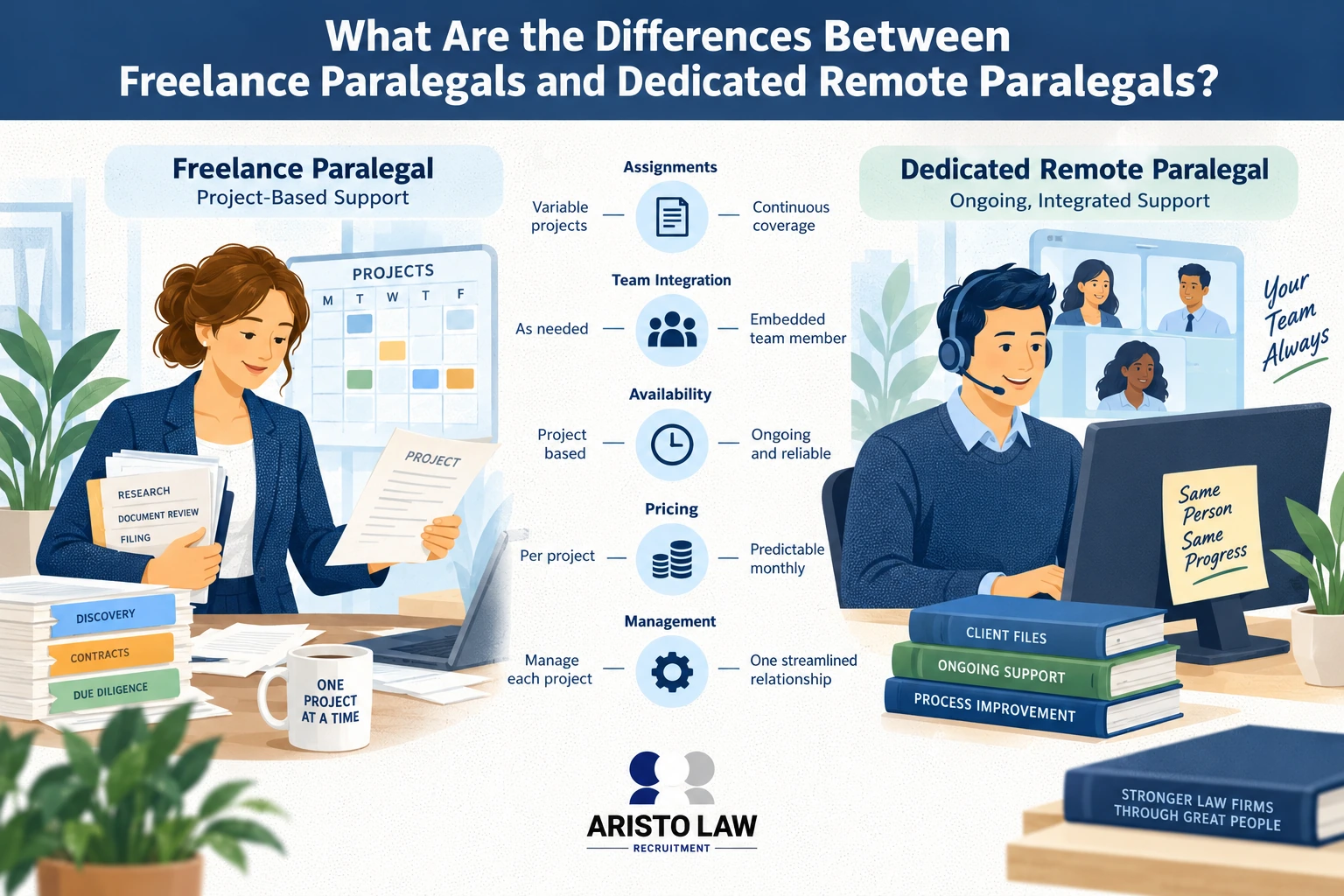
The table below compares freelance paralegals and dedicated remote
paralegals across key aspects of legal support, cost, flexibility, and
long-term value for law firms.
| Feature | Freelance Paralegal | Dedicated Remote Paralegal |
|---|---|---|
| Employment Model | Independent contractor hired per project or hourly | Long-term remote professional assigned to one law firm |
| Best For | Short-term projects and fluctuating workloads | Ongoing daily legal support and long-term growth |
| Availability | Varies by project and client commitments | Consistent full-time or part-time availability |
| Integration | Limited integration with firm operations | Functions as an extension of the in-house legal team |
| Knowledge of Firm Processes | Require onboarding for each project | Builds institutional knowledge over time |
| Cost Structure | Hourly, flat-fee, or project-based | Monthly dedicated staffing or hourly arrangements |
| Scalability | Easy to hire for individual projects | Easily scales with long-term business growth |
| Communication | Project-based communication | Continuous collaboration and regular team interaction |
| Administrative Support | Limited to assigned tasks | Supports ongoing administrative and operational workflows |
| Technology & Collaboration | Uses own tools or client systems | Regularly works within the firm’s legal software and collaboration platforms |
| Continuity | Change between projects | Provides consistent long-term support and workflow stability |
| Management | Minimal ongoing supervision after project assignment | Operates within established firm processes and management structures |
| Case Management | Limited to assigned matters | Ongoing management across multiple matters |
| Client Intake Support | Project-specific | Handles recurring intake and onboarding workflows |
| Calendar and Deadline Management | Limited involvement | Continuous monitoring of deadlines and schedules |
| Litigation Support | Effective for specific litigation projects | Supports entire litigation lifecycles |
| Contract Administration | Supports individual contracts or projects | Manages recurring contract workflows and obligations |
| Workflow Ownership | Focused on task completion | Supports and maintains ongoing workflows |
| Firm-Specific Knowledge | Limited retention between projects | Develops deep familiarity with firm procedures and preferences |
| Billing and Administrative Support | Limited | Provides ongoing operational and administrative assistance |
| Training Requirements | Often repeated for new projects | Reduced training after initial onboarding |
| Long-Term Attorney Collaboration | Limited | Strong and continuous collaboration |
| Operational Consistency | Varies by project engagement | High level of consistency across workflows |
| Resource Planning | Suitable for temporary needs | Suitable for strategic staffing and operational planning |
| Support Coverage | Assignment-based | Embedded within daily firm operations |
| Business Continuity | Dependent on project availability | Provides stable long-term support capacity |
| Growth Support | Supports individual growth initiatives | Supports sustained law firm expansion and scalability |
Freelance paralegals are most suitable for document review, legal
research, discovery projects, drafting assignments, due diligence
reviews, and temporary workload spikes. Dedicated remote paralegals are
most suitable for case management, client intake, litigation support,
contract administration, compliance tracking, deadline management, legal
operations, and recurring workflows that benefit from continuity,
institutional knowledge, and long-term integration with the law firm’s
processes and technology systems.
What
are the similarities between Freelance and Dedicated Remote
Paralegals?
Legal research, legal writing, case management, technology
proficiency, confidentiality, communication, attention to detail, and
organization remain core competencies for both freelance paralegals and
dedicated remote paralegals.
The table below highlights the key similarities between freelance
paralegals and dedicated remote paralegals, demonstrating how both
provide valuable legal support to law firms through remote working
arrangements.
| Aspect | Freelance Paralegal | Dedicated Remote Paralegal |
|---|---|---|
| Legal Research | Conducts legal research and case analysis | Conducts legal research and case analysis |
| Document Drafting | Prepares legal documents, contracts, and pleadings | Prepares legal documents, contracts, and pleadings |
| Case Management | Assists with organizing and maintaining case files | Manages and maintains ongoing case files |
| Discovery Support | Assists with document review and discovery | Assists with document review and discovery |
| Legal Writing | Drafts correspondence, summaries, and legal documents | Drafts correspondence, summaries, and legal documents |
| Client Communication | Supports client communication under attorney supervision | Supports client communication under attorney supervision |
| Legal Technology | Uses legal software, document management, and research platforms |
Uses legal software, document management, and research platforms |
| Confidentiality | Maintains attorney-client confidentiality and ethical standards | Maintains attorney-client confidentiality and ethical standards |
| Attention to Detail | Ensures accuracy in legal documentation | Ensures accuracy in legal documentation |
| Remote Collaboration | Works effectively with attorneys using digital collaboration tools |
Works effectively with attorneys using digital collaboration tools |
| Attorney Supervision | Performs work under attorney direction as required by law | Performs work under attorney direction as required by law |
| Goal | Improves law firm efficiency by handling legal support tasks | Improves law firm efficiency by handling legal support tasks |
| Contract Preparation | Assists with contract drafting, review, and organization | Assists with contract drafting, review, and organization |
| Document Review | Reviews and analyzes legal documents | Reviews and analyzes legal documents |
| Court Filing Support | Assists with filing preparation and procedural compliance | Assists with filing preparation and procedural compliance |
| Trial Preparation | Supports trial preparation and litigation activities | Supports trial preparation and litigation activities |
| Records Management | Organizes and maintains legal records | Organizes and maintains legal records |
| Legal Software Proficiency | Uses case-management and legal workflow systems | Uses case-management and legal workflow systems |
| Research Databases | Utilizes legal research databases and resources | Utilizes legal research databases and resources |
| Time Management | Manages deadlines and legal assignments | Manages deadlines and legal assignments |
| Communication Skills | Coordinates effectively with attorneys and legal teams | Coordinates effectively with attorneys and legal teams |
| Problem Solving | Supports legal workflow challenges and case-related tasks | Supports legal workflow challenges and case-related tasks |
| Compliance Awareness | Works within legal and ethical requirements | Works within legal and ethical requirements |
| Information Organization | Structures and manages legal information efficiently | Structures and manages legal information efficiently |
| Client Service Support | Assists with client-related administrative activities | Assists with client-related administrative activities |
| Legal Operations Support | Contributes to law firm workflow efficiency | Contributes to law firm workflow efficiency |
Freelance paralegals and dedicated remote paralegals share many of
the same legal competencies, technical skills, ethical responsibilities,
and professional standards. Both support lawyer through legal research,
legal drafting, discovery, case management, legal technology, client
communication, and legal operations.
Which
option is better for long-term legal support: freelance or dedicated
remote paralegals?
The better option for long-term legal support depends on a
law firm’s workload, growth objectives, and operational needs, but
dedicated remote paralegals provide greater long-term value for firms
requiring consistent legal assistance. Freelance paralegals are
well suited for short-term projects, specialized assignments, document
review initiatives, legal research projects, contract abstraction, trial
preparation support, and temporary workload increases because they offer
flexibility without long-term commitments. This model allows firms to
obtain targeted legal support only when needed, making it a practical
solution for intermittent or project-based legal work.
Dedicated remote paralegals, in contrast, provide ongoing legal
support and become increasingly integrated into a firm’s daily
operations over time. They develop familiarity with attorney
preferences, firm procedures, case-management systems, client-service
expectations, and recurring workflows. This institutional knowledge
reduces onboarding requirements, improves communication, strengthens
collaboration, and creates greater operational consistency across legal
matters.
Dedicated remote professionals often support case management,
litigation administration, contract management, client intake, deadline
tracking, compliance activities, legal drafting workflows, and other
recurring legal operations that benefit from continuity and long-term
involvement. Because dedicated remote paralegals remain embedded within
legal operations, they are often able to identify workflow improvements,
maintain historical context across matters, and support long-term
process optimization.
For growing law firms seeking scalability, predictable support,
stronger collaboration, and sustainable operational growth, dedicated
remote paralegals are the stronger long-term solution. Firms with
occasional support requirements, fluctuating project needs, or limited
legal workloads find freelance paralegals to be the more cost-effective
option. In most cases, the more frequently a law firm relies on legal
support, the greater the long-term efficiency, continuity, and value
provided by a dedicated remote paralegal arrangement.
When
should law firms hire a freelance paralegal instead of a dedicated
remote paralegal?
Law firms should hire a freelance paralegal instead of a
dedicated remote paralegal when they need flexible, short-term legal
support rather than ongoing assistance. Freelance paralegals
are particularly effective for temporary workload increases, one-time
legal projects, litigation spikes, document review assignments, legal
research projects, discovery support, contract drafting initiatives, due
diligence reviews, trial preparation activities, and temporary coverage
during employee absences. Because freelance professionals are engaged on
a project, hourly, or contract basis, firms quickly obtain legal support
without committing to long-term staffing arrangements.
This model is especially valuable when a law firm requires
specialized expertise for a specific matter. For example, a firm
handling a complex discovery project, preparing for trial, reviewing a
large volume of documents, conducting extensive legal research, or
managing a short-term surge in case volume benefit from bringing in a
freelance paralegal with relevant experience. Once the project is
completed, the engagement ends without ongoing staffing obligations.
A study by Lawtrades titled “Freelance vs. In-House Legal
Teams: A Cost Analysis” in the year 2025 shows that freelance legal
professionals provide a highly adaptable, pay-as-you-go resourcing
alternative that enables businesses and law firms to scale variable
support perfectly against fluctuating caseloads while minimizing
long-term fixed salary overhead. Firms avoid many long-term
costs related to continuous staffing while maintaining access to skilled
legal support when demand increases.
Freelance paralegals are the strongest option when legal support
needs are intermittent, highly specialized, temporary, or tied to a
defined deliverable. Firms that do not require daily case management,
recurring client communication, ongoing deadline monitoring, or
long-term workflow ownership often find freelance legal support to be an
efficient and economical solution. By contrast, firms with recurring
legal operations, consistent caseloads, growing client demands, and a
need for workflow continuity benefit more from dedicated remote
paralegals who become integrated into daily operations and provide
sustained long-term support.
Where
can law firms hire freelance paralegals or dedicated remote paralegal
services?
Law firms can hire freelance paralegals and dedicated remote
paralegal services through legal staffing agencies including Aristo Law,
as well as freelance marketplaces, specialized legal outsourcing
providers, and professional networks. Legal outsourcing and
remote staffing have grown as law firms seek to reduce overhead costs,
improve operational efficiency, and access specialized legal talent
without expanding in-house teams.
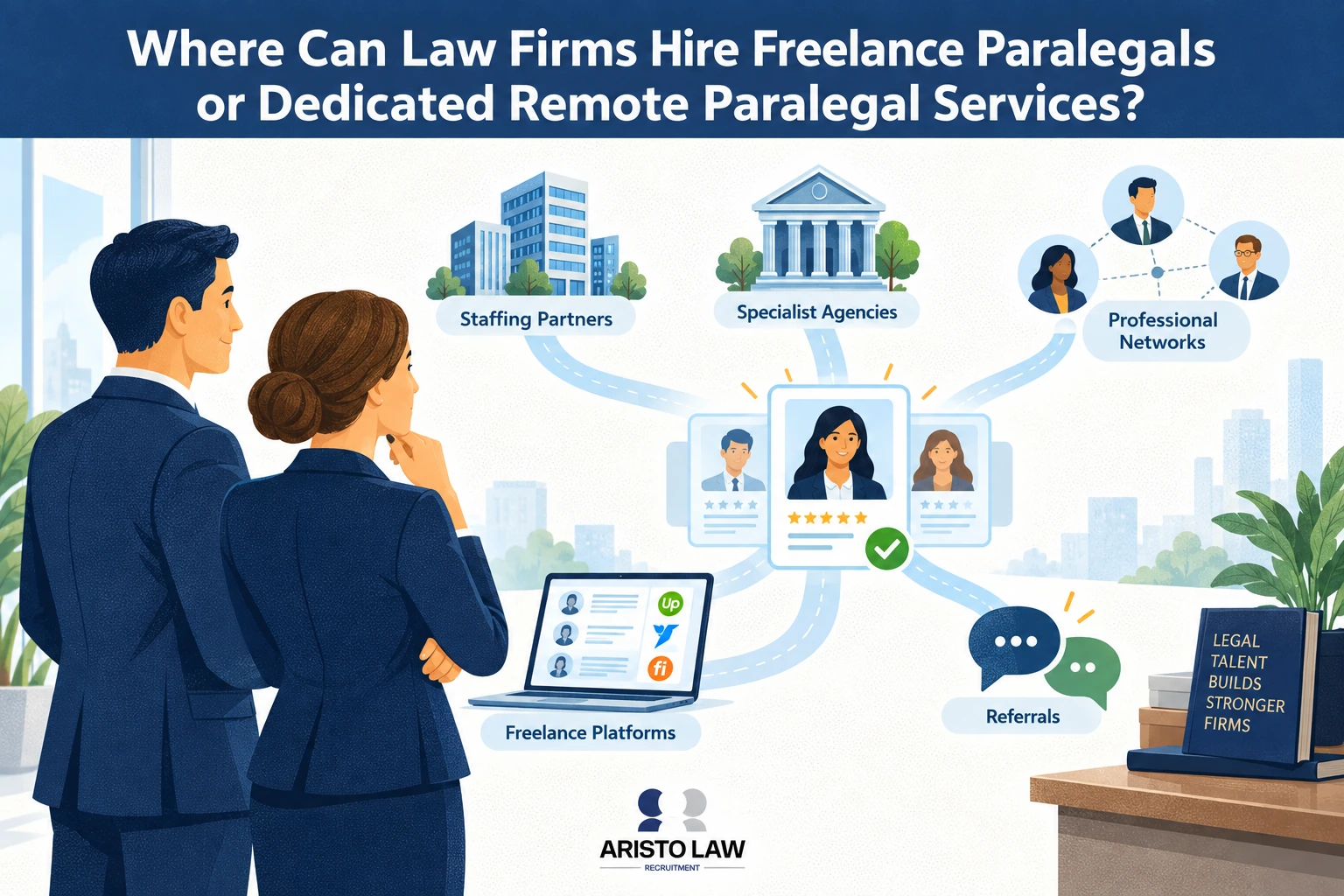
Law firms use freelance paralegals for project-based assignments and
hire
dedicated remote paralegal services for ongoing case
management, intake, and administrative workflows. Dedicated remote
paralegal services provide consistent legal support capacity, whereas
freelance engagements primarily address short-term or specialized
workload demands.
Listed below are 11 places law firms can hire freelance paralegals or
dedicated remote paralegals.
-
Specialized Legal Staffing Companies: Legal staffing
providers recruit and screen freelance paralegals and dedicated remote
paralegals with experience supporting law firms. These organizations
often offer candidate vetting, skills assessments, onboarding
assistance, and staffing flexibility. -
Virtual Legal Assistant and Remote Paralegal
Agencies: Agencies specializing in legal support services
provide remote paralegals, legal assistants, intake specialists, and
administrative professionals who support recurring legal workflows and
operational functions. Aristo Law is an example of this model, providing
dedicated remote paralegals, legal assistants, contract managers, intake
specialists, and other legal support professionals with workflow
integration, quality-control processes, confidentiality standards, and
ongoing operational support for law firms. Aristo Law is particularly
well suited for firms seeking reliable, embedded legal professionals who
support case management, litigation workflows, client intake, legal
research, contract administration, and day-to-day legal operations. -
Legal Process Outsourcing (LPO) Providers: LPO
companies provide contract-based and long-term legal support services,
including legal research, document review, discovery management,
contract administration, and litigation support. These providers often
offer scalable staffing resources and specialized legal expertise. -
Remote Legal Staffing Firms: Staffing firms recruit
legal professionals from talent markets such as South Africa,
Philippines, and Latin America. These firms help law practices access
skilled legal talent while maintaining cost efficiency and staffing
flexibility. -
Freelance Marketplaces: Platforms such as Upwork and
Fiverr allow law firms to hire independent freelance paralegals for
project-based legal work, document review, legal research, drafting
support, and temporary assignments. -
Professional Paralegal Associations: Organizations
such as National Federation of Paralegal Associations and National
Association of Legal Assistants often maintain member directories,
networking opportunities, and referral resources that help law firms
locate qualified paralegal professionals. -
Legal Recruiting and Staffing Agencies: Legal
recruitment firms specialize in sourcing temporary, contract, remote,
and permanent legal support professionals. These agencies often provide
extensive candidate screening and placement services. -
Legal Industry Job Boards: Legal employment
platforms frequently feature freelance, contract, and remote paralegal
opportunities, allowing firms to recruit candidates directly for
specific staffing needs. -
Managed Legal Services Providers: Managed legal
services organizations offer scalable remote legal support teams that
include paralegals, legal assistants, contract managers, intake
professionals, and administrative support staff under a managed-service
model. -
Professional Networking Platforms: Platforms such as
LinkedIn allow firms to identify, evaluate, and recruit experienced
freelance and dedicated remote paralegal professionals based on skills,
experience, certifications, and professional recommendations. -
Legal Industry Communities and Referral Networks:
Lawyer groups, bar association communities, legal operations networks,
and professional referral sources often provide access to vetted
paralegals with proven legal support experience and strong industry
reputations.
Law firms evaluate hiring sources based on legal expertise, staffing
flexibility, candidate quality, confidentiality standards, scalability,
onboarding support, communication capabilities, workflow integration,
and long-term operational fit. The ideal source depends on whether the
firm requires project-based freelance assistance or dedicated remote
paralegal services that provide ongoing support and workflow
continuity.
How
does Aristo Law provide dedicated remote paralegal services?
Aristo Law provides dedicated remote paralegal services by
assigning experienced legal professionals who integrate with each firm’s
workflows and support case management, legal documentation, and
administrative operations on an ongoing basis. Aristo Law
recruits, vets, and places dedicated remote paralegals based on a law
firm’s practice area, workload requirements, operational processes, and
staffing objectives. Professionals are matched according to legal
experience, technical proficiency, communication skills, and familiarity
with specific practice areas such as litigation, corporate law, family
law, real estate law, employment law, intellectual property law, and
immigration law.
Aristo Law’s dedicated remote paralegals support lawyers through
legal research, document drafting, case management, discovery
coordination, document review, client communication, calendar and
deadline management, billing support, records organization, and legal
administrative workflows. These professionals work directly within the
firm’s preferred legal technology environment, including case-management
systems, document repositories, client relationship management
platforms, communication tools, and legal research databases. Because
the same professionals remain assigned to the firm over time, they
develop institutional knowledge, gain familiarity with lawyer
preferences, understand firm procedures, and support workflow continuity
across matters.
A study by IntelAssist titled “Remote Staffing Solutions
Glossary: Terms and definitions” in the year 2026 shows that dedicated
staffing relationships guarantee that remote professionals seamlessly
integrate into permanent daily operations, which preserves critical
institutional knowledge, optimizes collaboration, and improves workflow
continuity compared to fragmented freelance staffing. Embedded
remote legal support often reduces onboarding requirements, minimizes
workflow disruptions, strengthens communication, and improves
operational consistency across legal teams.
Aristo Law’s flexible staffing model allows law firms to scale legal
support capacity without incurring many of the costs associated with
hiring additional in-house employees, including office space, employee
benefits, payroll taxes, equipment expenses, recruiting costs, and
administrative overhead. Firms expand support as caseloads increase
while maintaining predictable staffing arrangements and operational
flexibility.
The primary objective of Aristo Law’s dedicated remote paralegal
services is to allow lawyers to spend more time on client
representation, legal strategy, negotiations, and business development
while maintaining high-quality legal operations, efficient workflows,
and scalable long-term growth. Through integrated remote legal staffing
solutions, Aristo Law helps law firms increase productivity, strengthen
legal support capacity, and build sustainable operational infrastructure
that supports continued expansion and client service excellence.
Build a legal support team that moves work forward.
Tell us what is slowing your practice down. We will help map the role, workflow, and support structure that fits.