
What Is a Legal Virtual Paralegal? Duties, Costs, and Law Firm Support

Practical guidance for building efficient, accountable legal support operations.

A virtual paralegal supports law firms remotely with legal
research, document drafting, case management, and court filing
support. A virtual paralegal also assists with billing, CRM
updates, and legal administration under attorney supervision.
Virtual paralegals prepare contracts, pleadings, discovery materials,
trial binders, and review notes for personal injury, family law,
immigration, and real estate. Law firms hire virtual paralegals to
reduce overhead, increase attorney billable hours, improve productivity,
speed turnaround, scale staffing, access specialized talent, and improve
client service.
Hiring a virtual legal paralegal or virtual legal assistant
(VLA) in the US costs between $25 and $75+ per hour, or $1,000 to
$3,000+ per month for ongoing, part-to-full-time support.
Virtual paralegal hiring costs depend on experience, qualifications,
location, practice area, workload, and software needs. A data
release by the U.S. Bureau of Labor Statistics (BLS), titled
“Occupational Outlook Handbook: Paralegals and Legal Assistants,” in
2024, states that the national median annual pay for U.S. paralegals is
$61,010 (approximately $29.33 per hour).
Hiring a virtual legal paralegal or virtual legal assistant
through offshore talent markets costs about $8-$14 per hour in the
Philippines, $5-$13 per hour in Brazil, and $8-$18 per hour in South
Africa, depending on legal experience, English proficiency, law
firm workflow knowledge, and whether the role is part-time, full-time,
freelance, or agency-managed.
Aristo Law provides trained remote virtual paralegals for legal
research, document preparation, client intake, case management,
litigation support, scheduling, workflow optimization, and legal
operations. Hiring an Aristo Law virtual paralegal costs $2.997
as a one-time recruitment fee.
Qualified legal virtual paralegals need qualifications such as
paralegal education, certifications, legal experience, or technology
proficiency. Legal virtual paralegals use legal technology such as
practice management systems, DMS platforms, legal research tools, or CRM
software.
Aristo Law is a Legal Process Outsourcing company that helps
law firms manage virtual paralegal duties, costs, and law firm support
by providing outsourced Virtual Paralegal Assistant staff for case
preparation, document drafting, discovery coordination, and remote legal
workflows. Call Aristo Law at +1
307 888 9491 for Virtual Paralegal Assistant staffing support.
Aristo Law connects law firms with outsourcing solutions that match
trained virtual paralegal staff to each case support task, document
workflow, research duty, and attorney support function.
What is a legal virtual
paralegal?
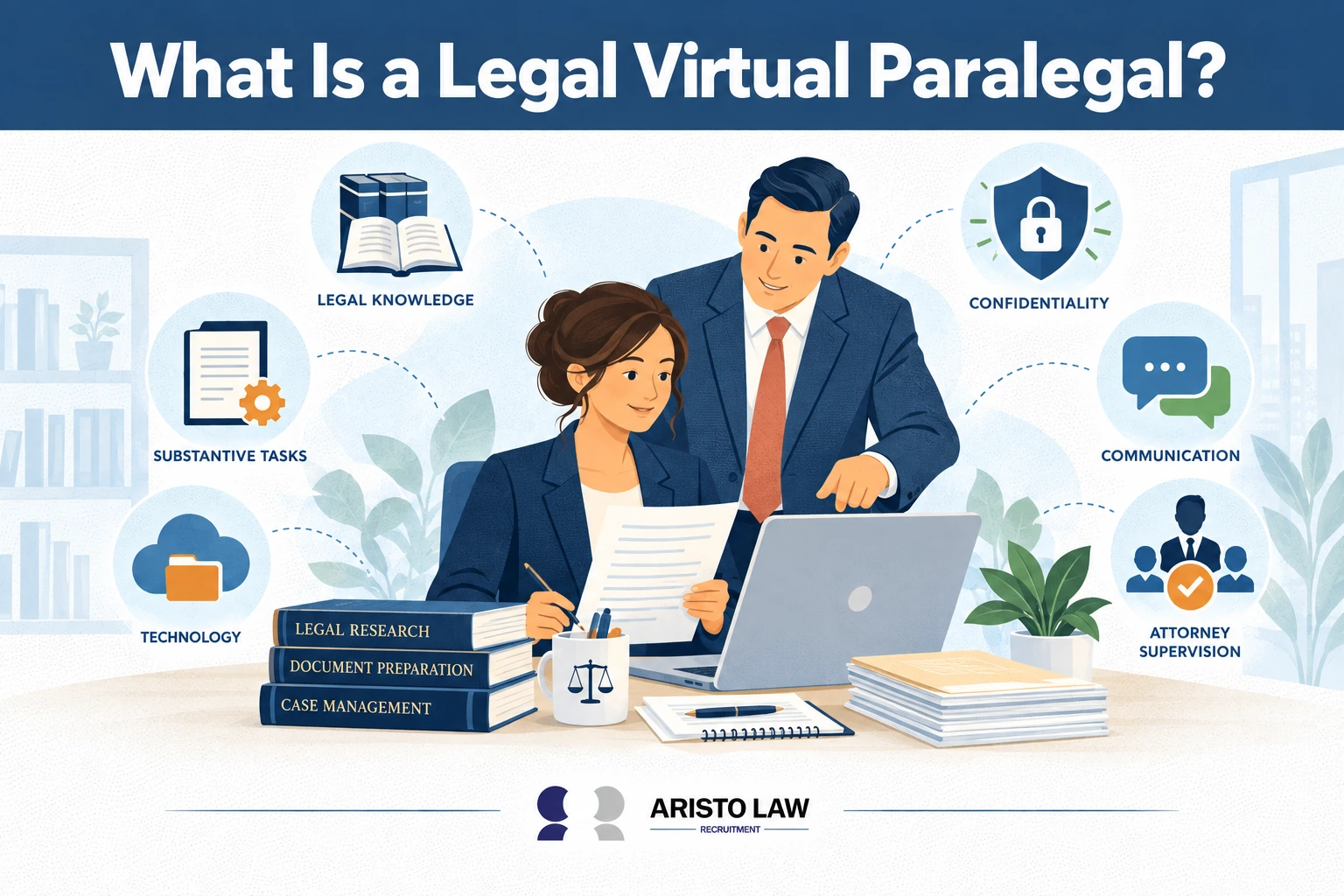
A legal virtual paralegal is a remote paralegal who performs
legal support tasks for attorneys through a home office, remote office,
outsourced provider, or virtual legal support company. Virtual
paralegals handle standard paralegal work such as legal research,
document drafting, case file organization, and legal correspondence.
A blog analysis by Bryant & Stratton College, titled
“What Are Virtual Paralegals and How Do I Become One?” in 2022, states
that virtual paralegals operate remotely, perform standard paralegal
tasks (such as drafting legal documents, submitting paperwork to
government agencies, and preparing exhibit binders), and must
continuously operate under the supervision of a practicing
attorney.
Virtual paralegals work under attorney supervision and support
lawyers across litigation, family law, immigration, and other legal
practice areas. Virtual paralegals support legal work but do not
independently practice law, create attorney-client relationships, set
legal fees, or provide legal advice.
What are the
duties of a legal virtual paralegal?
The duties of a virtual legal paralegal include remote legal
research, case management, document drafting, and legal administration
under attorney supervision. Virtual paralegal duties vary by
practice area, jurisdiction, law firm procedure, and client matter
type.
Legal virtual paralegals keep casework moving by turning attorney
instructions into drafted documents, organized files, deadline updates,
and research notes through virtual
paralegal assistant services. Legal virtual paralegals
support attorneys with discovery review, client record management, court
filing preparation, and litigation task coordination.
Listed below are 20 duties of a legal virtual paralegal.
-
Conducting legal research: A legal virtual paralegal
researches statutes, regulations, case law, and practice-area materials
for attorney review. -
Managing case files and case management systems: A
legal virtual paralegal organizes client matters, updates case
management software, tracks matter status, and keeps legal files
complete. -
Drafting legal documents and forms: A legal virtual
paralegal drafts pleadings, contracts, discovery requests, and legal
correspondence for attorney approval. -
Reviewing legal documents: A legal virtual paralegal
checks legal documents for accuracy, missing information, formatting
errors, and filing readiness. -
Preparing court documents: A legal virtual paralegal
prepares exhibits, pleadings, motions, and supporting materials for
court proceedings. -
Organizing legal records: A legal virtual paralegal
manages records, document folders, naming conventions, and matter
archives. -
Supporting discovery and e-discovery: A legal
virtual paralegal organizes discovery requests, responses, document
productions, and e-discovery review sets. -
Preparing exhibits and litigation evidence: A legal
virtual paralegal labels exhibits, indexes evidence, prepares binders,
and supports litigation workflows. -
Assisting with trial preparation: A legal virtual
paralegal prepares trial notebooks, witness files, exhibit lists, and
attorney task trackers. -
Supporting electronic court filing: A legal virtual
paralegal prepares eFiling documents, checks court formatting rules,
uploads filings where permitted, and tracks filing confirmations. -
Drafting contracts and correspondence: A legal
virtual paralegal prepares contract drafts, legal letters, client
updates, and internal matter summaries. -
Conducting client intake: A legal virtual paralegal
gathers case facts, intake forms, contact details, and initial matter
information. -
Communicating with clients and third parties: A
legal virtual paralegal sends approved updates, requests documents,
coordinates schedules, and routes legal questions to attorneys. -
Scheduling meetings and hearings: A legal virtual
paralegal schedules calls, client meetings, and internal matter
reviews. -
Tracking deadlines and calendars: A legal virtual
paralegal tracks statutes of limitation, filing dates, discovery
deadlines, and attorney reminders. -
Recording billable time and billing support: A legal
virtual paralegal enters time, organizes expense records, prepares
billing notes, and supports invoice documentation. -
Performing transcription and formatting: A legal
virtual paralegal transcribes notes, formats pleadings, cleans document
layouts, and prepares final drafts. -
Maintaining confidentiality and ethics compliance: A
legal virtual paralegal protects client data, follows confidentiality
rules, uses secure systems, and works under attorney supervision. -
Providing legal administrative support: A legal
virtual paralegal handles CRM updates, email organization, document
uploads, and workflow coordination. -
Coordinating matter workflows: A legal virtual
paralegal supports legal outsourcing, remote legal services, legal
staffing, and law firm support through organized task execution.
What
are the benefits of hiring a legal virtual paralegal?
The benefits of hiring a legal virtual paralegal include
lower operating costs, higher attorney billable time, and improved
client service.
Listed below are 8 benefits of hiring a legal virtual paralegal.
-
Reduce operating and staffing costs: A virtual
paralegal reduces office space, equipment, payroll, and full-time hiring
costs. Legal outsourcing gives law firms remote legal services without
permanent staff expansion. -
Increase attorney billable hours: A virtual
paralegal handles legal research, document drafting, discovery, and
legal administration. Attorneys spend more time on strategy, advocacy,
negotiations, and client representation. -
Improve law firm productivity: A virtual paralegal
supports case management, deadline tracking, records management, and
document organization. -
Access specialized legal support: A remote paralegal
gives law firms practice-area support for litigation, family law,
immigration, and personal injury matters. -
Scale support during peak caseloads: Virtual
paralegals support busy litigation periods, seasonal demand, growth
periods, and overflow tasks without full-time hiring overhead. -
Speed up routine legal work: A virtual paralegal
prepares legal documents, manages discovery, organizes exhibits, and
supports trial preparation. -
Improve client service: A virtual paralegal supports
client communication, intake follow-up, document requests, and faster
turnaround times. -
Strengthen confidentiality and compliance: A virtual
paralegal works under attorney supervision and follows confidentiality
rules, secure system access, and legal ethics procedures.
A study by the American Bar Association (ABA), titled “Legal
Technology Survey Report” in 2024, states that centralized cloud
repositories and document management infrastructure dramatically reduce
a firm’s operational overhead by minimizing the manual proliferation of
lost, duplicated, or unprotected data assets.
What
qualifications should legal virtual paralegals have?
Legal virtual paralegal qualifications include paralegal
education, legal work experience, software proficiency, and knowledge of
attorney-supervised legal support. Virtual legal paralegal
candidates need paralegal education through an associate degree,
bachelor’s degree, paralegal certificate, or employer-approved training
path.

Legal employers value NALA Certified Paralegal credentials, NFPA
certification pathways, CLE participation, court-registration knowledge
where relevant, and practical legal experience in document drafting,
legal research, case management, and legal administration. Qualification
rules vary by jurisdiction, employer, practice area, and task scope.
A career analysis by Bryant & Stratton College, titled
“What Are Virtual Paralegals and How Do I Become One?” in 2022, states
that formal education is not always mandated by law to enter the field,
but pursuing structured legal education, earning academic certificates,
passing national certification exams, and gaining practical experience
improves employment options and marketplace competitiveness.
Virtual paralegals need software skill, confidentiality discipline,
attorney-supervision awareness, and law firm procedure knowledge.
What skills
should a legal virtual paralegal have?
Skills a legal virtual paralegal should have include legal
research, drafting, time management, and practice-area
knowledge.
Listed below are 10 skills required of a legal virtual paralegal.
-
Legal research: A virtual paralegal needs legal
research skill to locate statutes, case law, court rules, and
practice-area materials for attorney review. -
Legal drafting: A virtual paralegal needs drafting
skill to prepare pleadings, discovery requests, contracts, and legal
correspondence under attorney supervision. -
Organization: A virtual paralegal needs strong
digital organization to manage case files, document folders, deadlines,
and remote workflows. -
Time management: A virtual paralegal needs time
management to prioritize tasks, meet filing dates, track court
deadlines, and complete remote work without in-office reminders. -
Communication: A virtual paralegal needs clear
communication for attorney updates, client messages, court coordination,
and remote team handoffs. -
Attention to detail: A virtual paralegal needs
attention to detail to catch errors in names, dates, filings, and
document versions. -
Confidentiality: A virtual paralegal needs
confidentiality discipline to protect client data, privileged records,
case facts, and internal firm information. -
Technology fluency: A virtual paralegal needs
technology skills with practice management software, legal research
tools, document systems, and secure communication tools. -
Practice-area knowledge: A virtual paralegal needs
practice-area knowledge to support litigation, family law, immigration,
or other legal matters. -
Remote independence: A virtual paralegal needs
stronger independence, responsiveness, digital organization, and
communication than many office-based roles because attorney supervision
happens through remote systems, messages, calls, and workflow tools.
What software do
legal virtual paralegals use?
Software programs legal virtual paralegals use include
practice management systems, document management tools, e-filing
systems, and secure communication platforms.
Legal virtual paralegals use legal
case management systems to organize case files, track
deadlines, assign tasks, and support attorney-supervised workflows.
Legal virtual paralegals connect case data, document records, billing
notes, and communication logs inside legal case management systems so
law firms maintain structured remote legal support operations.
Listed below are 9 software programs legal virtual paralegals
use.
-
Practice management systems: Case management systems
give virtual paralegals matter visibility, client records, task lists,
and attorney supervision points. -
Document management platforms: Document management
platforms help virtual paralegals store, organize, retrieve, and share
legal documents across remote workflows. -
E-filing systems: E-filing software supports court
document submission, filing status checks, confirmation tracking, and
deadline control where court rules permit remote filing support. -
Legal research platforms: Legal research tools help
virtual paralegals find statutes, case law, regulations, and
practice-area materials for attorney review. -
Calendar tools: Calendar software helps virtual
paralegals track hearings, client meetings, filing dates, and attorney
schedules. -
Task-management tools: Project management tools help
virtual paralegals manage assignments, workflow stages, priorities, and
remote accountability. -
Billing systems: Billing software helps virtual
paralegals record time, organize expenses, prepare billing notes, and
support invoice review. -
Secure communication platforms: Secure communication
tools help virtual paralegals send messages, share files, join calls,
and maintain attorney supervision. -
Collaboration suites: Microsoft 365, Google
Workspace, Adobe Acrobat, and cloud collaboration tools help virtual
paralegals edit documents, manage PDFs, share folders, and coordinate
remote legal work.
How do
outsourced virtual paralegals support law firms?
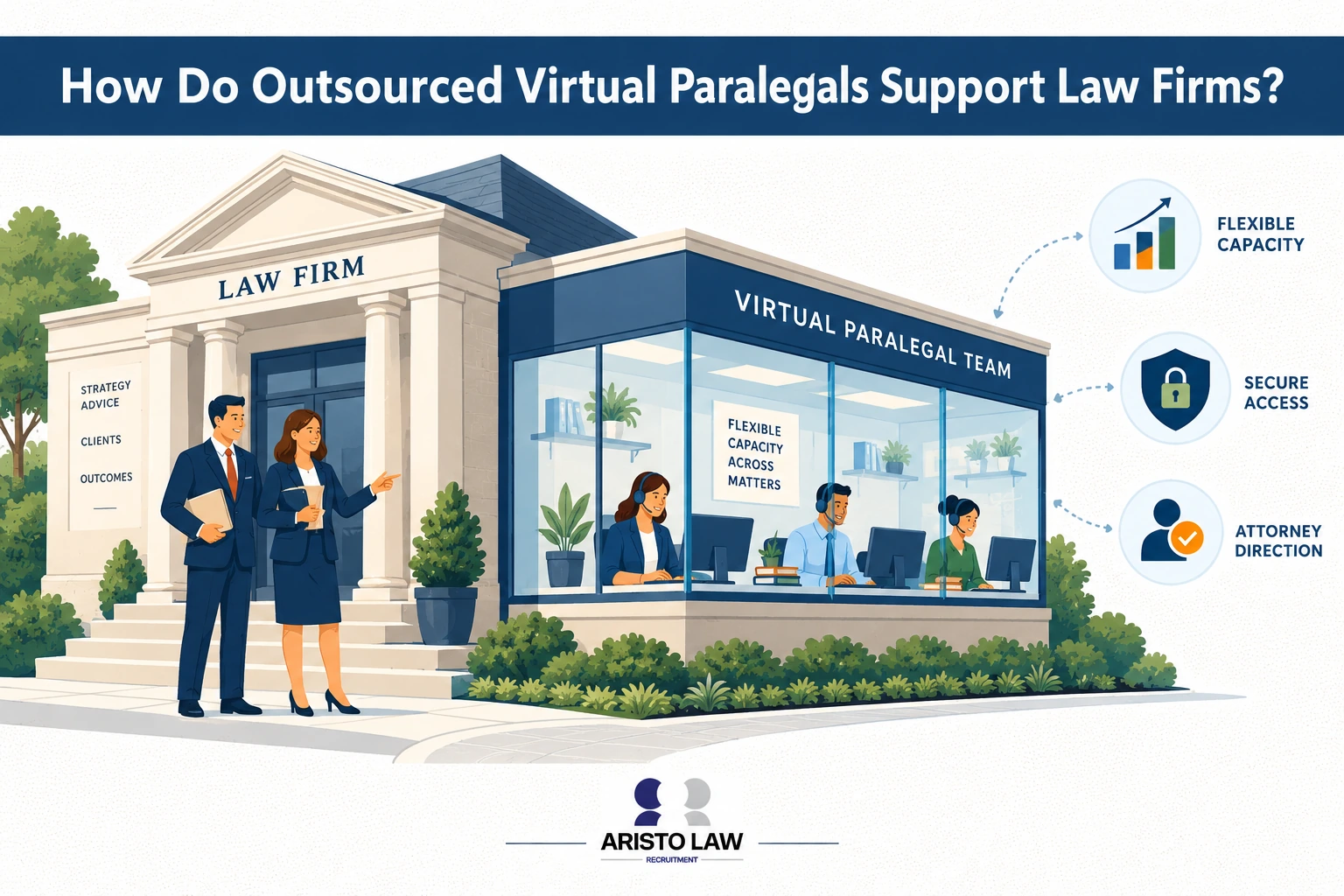
Outsourced virtual paralegals support law firms by handling
remote legal support tasks across legal research, document drafting,
case management, and legal administration. An outsourced
virtual paralegal works with attorneys, legal assistants, and practice
management systems to organize files, draft pleadings, review documents,
and coordinate matter workflows.
Remote legal support improves law firm efficiency because routine
legal and administrative tasks move to trained legal staffing talent
under attorney supervision. Confidentiality, attorney-client privilege,
data security, and practice-area expertise guide each outsourcing
arrangement.
Legal virtual paralegals support law firms by handling legal
research, document drafting, case file organization, and deadline
tracking across outsourced legal workflows. Legal virtual paralegals
connect law firms to legal
outsourcing benefits and best practices through lower
staffing overhead, faster case preparation, role-based delegation, and
scalable litigation support.
Paralegals support lawyers through file organization, legal research,
and document drafting. A standard by the American Bar
Association, titled “Model Rules of Professional Conduct: Rule 5.3
(Responsibilities Regarding Nonlawyer Assistance),” in 2012 (with active
state-level applications continuing through 2026), states that a lawyer
having direct supervisory authority over a nonlawyer assistant must make
reasonable efforts to ensure that the person’s conduct is compatible
with the professional obligations of the lawyer.
Which legal
practice areas use virtual paralegals?
Legal practice areas that use virtual paralegals include
litigation, personal injury, family law, and compliance.
Listed below are 10 legal practice areas that use virtual
paralegals.
-
Litigation: Virtual paralegals support litigation
through discovery tracking, e-discovery review, pleadings, and
litigation support calendars. -
Personal injury: Virtual paralegals support personal
injury matters through medical records requests, treatment summaries,
insurance correspondence, and client updates. -
Family law: Virtual family law paralegal support
covers petitions, financial disclosures, parenting-plan documents, and
court filing support. -
Real estate: Virtual real estate paralegal support
covers purchase files, title documents, closing checklists, and document
coordination. -
Corporate law: Virtual corporate paralegal support
covers entity formation, annual reports, corporate records, and entity
maintenance. -
Bankruptcy: Virtual paralegals support bankruptcy
through petitions, schedules, creditor lists, and deadline tracking. -
Immigration: Virtual paralegals support immigration
through forms, petitions, evidence checklists, and status tracking. -
Estate planning: Virtual paralegals support estate
planning through wills, trusts, powers of attorney, and signing
packets. -
Employment law: Virtual paralegals support
employment matters through personnel records, policy files, demand
letters, and litigation records. -
Compliance: Virtual paralegals support compliance
through policy records, audit files, regulatory documents, and evidence
preservation tasks.
When should a
law firm hire a virtual paralegal?
A law firm should hire a virtual paralegal when caseload
growth, attorney overload, document-heavy work, or administrative
bottlenecks reduce attorney productivity and billable
hours.
Listed below are the 12 signs that a law firm needs a virtual
paralegal.
-
Increasing caseloads: A virtual paralegal supports
legal research, document drafting, case management, and court filing
preparation as new matters increase. -
Attorney overload: A remote paralegal handles
routine legal support and legal administration, so attorneys focus on
legal strategy, advocacy, negotiations, and client representation. -
Excessive administrative work: A virtual paralegal
manages scheduling, billing support, and workflow coordination. -
Rapid law firm growth: Legal outsourcing gives a
growing law firm flexible legal staffing without full-time hiring,
office space, equipment, and benefits costs. -
Seasonal or project workload spikes: A remote
paralegal supports short-term overflow during discovery, trial
preparation, estate planning seasons, or intake surges. -
Litigation and discovery pressure: A virtual
paralegal supports discovery, e-discovery, exhibits, and litigation
support calendars. -
Document-heavy practice areas: A virtual paralegal
helps personal injury, family law, immigration, and employment law teams
prepare files faster. -
New practice-area expansion: A law firm uses remote
legal support when new services require practice-area support, case
templates, matter workflows, and research assistance. -
Remote or hybrid operations: A virtual paralegal
integrates with practice management software, secure document systems,
calendars, and communication tools. -
Client responsiveness gaps: A virtual paralegal
improves intake follow-up, document requests, scheduling, and client
communication routing. -
Deadline and calendar risk: A virtual paralegal
tracks hearings, filing dates, discovery deadlines, and matter
tasks.
An analysis by Clio, titled “Legal Trends Report,” published
in 2025, states that the average attorney utilization rate across law
firms is 38%, which means that exactly 5 hours of a standard
8-hour lawyer workday go unbilled. These benchmarks show why delegated
paralegal work improves billable-hour utilization, cost control,
workflow optimization, and law firm efficiency.
Where
can law firms hire remote virtual paralegal services?
Law firms can hire remote virtual paralegal services from
legal process outsourcing providers like Aristo Law. Law firms
also hire remote virtual paraegals from virtual paralegal agencies,
legal staffing firms, freelance marketplaces, and professional legal
support companies that provide experienced remote paralegals.
Legal staffing agencies help firms fill defined roles, but agency
support depends on candidate availability. Virtual paralegal service
providers offer managed remote paralegal support, but service scope
needs careful review. Law firms evaluate providers by metrics such as
practice-area expertise, communication skill, pricing model, and
workflow optimization.
Legal virtual paralegals support law firms through case file
organization, legal research, document preparation, and deadline
tracking across remote workflows. Law firms hire legal virtual
paralegals through remote
virtual paralegal services when internal teams need
trained paralegal support without adding full-time in-office staff.
Freelance marketplaces give flexible pricing, but firms need stronger
screening for confidentiality, attorney-client privilege, data security,
and technology skill. A publication by NALA (The National
Association of Legal Assistants), titled “National Utilization &
Compensation Report,” published in 2024, states that the nationwide
average paralegal billing rate is $134 per hour.
A standard by the American Bar Association, titled “Model
Rules of Professional Conduct: Rule 5.3 (Responsibilities Regarding
Nonlawyer Assistance),” in 2012 (with continuous state-level
enforcement), states that attorneys must actively supervise nonlawyer
assistance to ensure that the individual’s conduct aligns with the
professional and ethical obligations of the lawyer, showing why
delegated virtual paralegal work improves billable hours, law firm
efficiency, cost control, and client service.
Aristo Law provides qualified virtual paralegals who assist with
legal tasks such as legal research, document drafting, document review,
and workflow coordination. Aristo Law gives law firms structured remote
legal support with legal outsourcing, secure communication,
practice-area matching, and responsive workflow integration. Legal
outsourcing companies help firms scale support across high-volume
matters, but firms need clear supervision rules and quality
controls.
How
does Aristo Law help law firms with virtual paralegal support?
Aristo Law helps law firms with virtual paralegal support by
recruiting and matching trained remote paralegals with solo
practitioners, boutique firms, and multi-attorney practices.
Aristo Law virtual paralegals support legal tasks like legal research,
case management, document drafting, and workflow coordination.
Aristo Law matches each remote paralegal with the firm’s practice
area, workload, communication process, and legal technology tools.
Aristo Law’s flexible legal staffing model gives firms added capacity
during caseload growth, litigation periods, employee absences, and
long-term expansion without full-time office, equipment, benefits, and
recruitment expenses.
Aristo Law supplies legal virtual paralegals who organize case files,
prepare legal documents, manage discovery workflows, and support
attorneys through outsourced
virtual paralegal support services. Legal virtual
paralegals from Aristo Law connect law firms with structured paralegal
capacity, lower administrative workload, and role-specific support for
litigation, intake, research, and document management.
Secure access rules, confidentiality agreements, attorney
supervision, and data security procedures protect attorney-client
privilege and professional standards. Qualified paralegal delegation
protects attorney time, accelerates matter work, controls service costs,
and supports law firm profitability.
Build a legal support team that moves work forward.
Tell us what is slowing your practice down. We will help map the role, workflow, and support structure that fits.