
How to Hire a Paralegal for Your Law Firm: Recruitment, Skills And Costs

Practical guidance for building efficient, accountable legal support operations.

Hiring a paralegal for a law firm involves a structured recruitment
and evaluation process designed to secure qualified legal support
professionals who improve productivity, strengthen legal operations, and
support sustainable growth. The process of hiring a paralegal
for your law firm begins by identifying staffing needs and determining
whether the firm requires in-house, remote, freelance, or outsourced
legal support. Law firms then create role-specific job
descriptions, source candidates through staffing agencies, job boards,
professional associations, remote staffing providers, and specialized
legal outsourcing companies, and screen applicants based on legal
education, certifications, experience, and technical competencies.
A study by Dr. J. Anthony titled “The Impact Of People Hiring
Practices And Organizational Performance” in the year 2025 shows that
structured recruitment, meticulous selection processes, and pre-hiring
job analysis serve as critical mechanisms for achieving strategic
organizational goals, directly enhancing a business entity’s overall
efficiency, task competitiveness, and labor productivity while shaping a
supportive workplace culture.
Candidate evaluation includes assessments of legal research ability,
drafting proficiency, document organization, legal software competency,
communication skills, attention to detail, confidentiality awareness,
and scenario-based problem-solving abilities. Interviews, reference
checks, certification verification, and background screenings help firms
identify candidates who align with practice-area requirements and
operational needs. After selection, firms budget compensation, account
for salary and overhead costs, extend offers, onboard new hires,
integrate legal technology, and establish performance metrics.
A study by the U.S. Bureau of Labor Statistics titled
“Occupational Employment and Wage Statistics” in year 2024 shows that
paralegals and legal assistants earned a national median annual wage of
$61,010, while total compensation packages varied based on geographic
location, practice area specialization, and professional
experience. Beyond compensation, firms incur additional
expenses related to recruitment, payroll taxes, employee benefits,
equipment, office space, training, software licensing, and
supervision.
Paralegal qualifications frequently include paralegal education,
legal training, certifications, prior legal experience, and familiarity
with jurisdiction-specific procedures and legal technologies. Modern
paralegals commonly work with case-management platforms,
document-management systems, e-discovery tools, legal research
databases, and productivity software that support legal workflows and
operational efficiency.
Outsourcing paralegal services becomes advantageous when law firms
experience fluctuating workloads, rapid growth, budget constraints,
temporary staffing shortages, or specialized project requirements.
Remote and outsourced staffing models provide scalability, flexibility,
and access to specialized legal talent without many of the costs
associated with expanding internal teams.
Organizations such as Aristo Law help law firms hire qualified remote
paralegals by providing vetted legal professionals, onboarding
assistance, workflow integration support, and scalable legal staffing
solutions tailored to specific practice areas and operational
requirements. The most effective hiring strategy depends on case volume,
budget considerations, workflow complexity, and long-term growth
objectives. Firms that align their paralegal hiring model with
operational needs achieve stronger cost efficiency, higher productivity,
improved service delivery, and more sustainable law firm growth.
Aristolaw helps law firms hire a paralegal by providing
outsourced support for recruitment planning, role matching, skills
alignment, cost control, case preparation, document drafting, discovery
coordination, and legal research workflows. Book
a Virtual Paralegal Assistant staffing consultation with
Aristolaw. Aristolaw connects law firms with outsourcing
solutions that match trained paralegal staff to each hiring need, skill
requirement, case support task, document workflow, recruitment gap, and
law firm cost-control responsibility.
Listed below are 15 steps to hire a paralegal for your law firm.
-
Identify your law firm’s hiring needs: Determine
which legal, administrative, and practice-specific functions require
paralegal support. -
Draft a detailed paralegal job description: Define
the responsibilities, qualifications, experience requirements, and
expected performance outcomes for the role. -
Source qualified paralegal applicants: Use legal job
boards, professional networks, staffing agencies, and referrals to
attract suitable candidates. -
Screen candidate resumes and applications: Review
applications to identify candidates whose qualifications and experience
align with the firm’s requirements. -
Assess technical legal skills and competencies:
Evaluate proficiency in legal research, document drafting, case
management, and relevant legal software. -
Evaluate behavioral traits and cultural fit: Assess
communication, organization, adaptability, and alignment with the firm’s
work environment and values. -
Conduct structured interviews or panel interviews:
Use standardized questions to evaluate legal knowledge, practical
experience, and problem-solving abilities. -
Verify professional credentials and certifications:
Confirm educational qualifications, certifications, and any specialized
legal training relevant to the position. -
Perform background and reference checks: Verify
employment history, professional conduct, and references to assess
reliability and suitability. -
Calculate compensation and staffing budgets:
Determine salary expectations and total staffing costs based on market
rates and firm requirements. -
Account for employment overhead and operational
costs: Consider expenses such as benefits, training, software
licenses, and equipment when budgeting for the role. -
Extend an employment offer to the selected
candidate: Present a formal offer outlining compensation,
responsibilities, and employment terms. -
Structure onboarding and training processes:
Establish procedures that familiarize the paralegal with firm policies,
workflows, and practice management systems. -
Integrate the paralegal into legal technology and
workflows: Provide access to case management platforms,
document systems, and communication tools used by the firm. -
Review performance and operational effectiveness
regularly: Monitor productivity, work quality, and contribution
to legal operations to ensure the role continues to meet firm
objectives.
1. Identify Hiring Needs
Identifying hiring needs determines whether a law firm
requires additional paralegal support and defines the specific
responsibilities, workload requirements, and operational objectives of
the role. This step establishes the foundation for effective
paralegal hiring because it helps firms understand whether support is
needed for litigation, transactional work, client intake, case
management, legal research, document preparation, or administrative
workflows.

Law firms identify hiring needs by determining which legal tasks,
case workloads, and administrative functions require dedicated support
from a paralegal. Staffing assessments that involve case law review,
citation verification, and memorandum preparation include legal
research assistant support for research assignments as
part of the firm’s resource planning.
Proper workforce assessment prevents overstaffing, understaffing, and
misaligned recruitment decisions. Law firms must evaluate case volume,
attorney workload, practice-area demands, productivity constraints, and
future growth plans before initiating recruitment.
Firms must also determine whether in-house, remote, freelance, or
outsourced legal support aligns best with operational requirements.
Clear workforce planning improves hiring efficiency, reduces staffing
risks, and ensures legal recruitment efforts target candidates with the
appropriate skills and experience.
2. Draft Job Descriptions
Drafting job descriptions involves creating a detailed
document that outlines the paralegal’s responsibilities, qualifications,
reporting structure, required skills, and performance
expectations. Well-developed job descriptions attract qualified
candidates and establish clear expectations before recruitment
begins.
A study by Dr. Amy Kristof-Brown titled “The Impact of
Person-Job Fit on Performance and Retention” in the year 2017 shows that
accurate, highly detailed job descriptions directly improve person-job
fit by explicitly specifying technical skills, responsibilities, and
behavioral criteria, which serves as a communication bridge that allows
unqualified candidates to self-select out of the process while
attracting high-quality talent who align with the organization’s actual
day-to-day expectations. Effective descriptions specify
responsibilities such as legal research, document drafting, case
management, discovery support, court filing procedures, and legal
technology usage. Law firms must also identify required education,
certifications, experience levels, software proficiency, and
communication competencies.
Clear descriptions improve candidate quality, reduce mismatched
applications, and streamline screening activities. Firms must
periodically review and update job descriptions to ensure alignment with
evolving legal workflows and staffing requirements.
3. Source Qualified Applicants
Sourcing qualified applicants involves identifying and
attracting candidates who possess the experience and competencies needed
to support legal operations effectively. Recruitment sources
include legal staffing agencies, professional associations, job boards,
remote staffing providers, university career centers, employee referral
networks, and specialized legal outsourcing organizations.
The purpose of sourcing is to build a candidate pipeline that matches
the firm’s practice areas, staffing requirements, and long-term
objectives. Effective sourcing strategies improve access to specialized
talent and shorten hiring timelines.
Law firms improve paralegal recruitment outcomes by sourcing
candidates with verified legal experience, practice-area alignment, and
relevant technical skills. Law firms seeking scalable recruitment
support use virtual
recruiter services for hiring paralegals to identify,
screen, and present qualified applicants efficiently.
A study by the Aptitude Research Partners titled “Sourcing:
The Art and Science of Talent Acquisition” in year 2023 shows that
organizations employing targeted, proactive sourcing strategies reduce
their overall time-to-fill metrics by up to 50% and improve
candidate-to-hire conversion rates, because specialized pipelines allow
recruiters to engage high-quality, passive professionals long before an
active operational vacancy occurs. Law firms must diversify
recruitment channels, maintain employer branding initiatives, and
proactively engage legal talent communities to improve recruitment
outcomes and workforce quality.
4. Screen Candidate Resumes
Screening candidate resumes involves evaluating applicants’
qualifications, experience, education, certifications, and technical
competencies to determine suitability for the position. Resume
screening helps law firms identify candidates with relevant legal
backgrounds and eliminate applicants who do not meet established
requirements.
Hiring a paralegal for your law firm includes resume screening for
litigation experience, document drafting, client intake, and familiarity
with legal
case management systems. Law firms evaluate paralegal
candidates by matching resume evidence to practice-area needs, workflow
accuracy, and case-support responsibilities.
Evaluation commonly includes practice-area experience, legal writing
proficiency, software familiarity, case-management experience, and
evidence of progressive responsibility. Structured screening processes
improve recruitment efficiency and reduce the likelihood of unsuitable
hires. A study by Test Partnership titled “Structured vs
unstructured interviews” in year 2026 shows that structured screening
and evaluation frameworks achieve a 0.42 to 0.51 correlation coefficient
with actual subsequent job performance, nearly double the 0.19 to 0.38
predictive validity score of unstructured, conversational interviews,
while simultaneously reducing systemic bias and maximizing legal
compliance across the candidate selection pipeline. Law firms
must establish standardized screening criteria and use consistent
evaluation methods to improve hiring accuracy and minimize recruitment
risks.
5. Assess Technical Skills
Assessing technical skills involves evaluating a candidate’s
ability to perform substantive and administrative legal tasks required
for the role. Technical assessment helps law firms determine
whether candidates possess competencies in legal research, document
drafting, discovery support, case management, document review, legal
writing, and legal software usage.
Skills assessments include practical exercises, scenario-based
assignments, drafting tests, research tasks, and technology
demonstrations. Accurate evaluation improves hiring quality and reduces
training requirements after onboarding. Law firms must use realistic
assessments that mirror actual job responsibilities and measure both
competency and efficiency.
6. Evaluate Behavioral Traits
Evaluating behavioral traits involves assessing interpersonal
characteristics that influence performance, collaboration, and
professional effectiveness. Important qualities include
communication skills, attention to detail, confidentiality awareness,
adaptability, organization, accountability, initiative, and time
management.
Behavioral evaluation helps law firms identify candidates who fit the
firm’s culture and performs effectively under workload demands and
deadline pressures. A study by Florit Legal titled “Behavioural
Assessments in Legal Recruitment” in the year 2024 shows that
integrating psychometrics and behavioral evaluations into legal talent
pipelines yields a 24% improvement in overall employee performance,
minimizes turnover, and accurately forecasts a candidate’s cultural fit
by mapping non-academic competencies such as emotional stability,
teamwork, and decision-making capabilities directly against real-world
workload demands and high-pressure situations. Interviews,
situational questions, reference checks, and behavioral assessments
provide insights into professional conduct and problem-solving
approaches. Effective evaluation reduces turnover risks and improves
long-term workforce stability.
7. Conduct Panel Interviews
Conducting panel interviews involves evaluating candidates
through structured discussions with attorneys, administrators, and legal
support personnel. Panel interviews allow multiple stakeholders
to assess competencies, communication style, technical knowledge, and
cultural fit simultaneously. The process improves decision-making by
incorporating diverse perspectives and reducing individual bias.

Questions explore legal experience, workflow management, software
proficiency, confidentiality scenarios, and problem-solving
capabilities. Structured interviews increase hiring consistency and
improve candidate evaluation quality. Law firms must prepare
standardized interview questions and scoring criteria to support
objective decision-making.
8. Verify Professional
Certifications
Verifying professional certifications involves confirming
educational credentials, certifications, training records, and licensing
requirements where applicable. Verification ensures that
candidates possess the qualifications represented during the recruitment
process and meet established hiring standards.
Certification review also helps firms identify candidates who have
demonstrated commitment to professional development and continuing
education. A study by the National Association of Legal
Assistants (NALA) titled “NALA Certified Paralegal Program Description”
in the year 2024 shows that obtaining a professional credential
distinguishes candidates from the competition by demonstrating mastery
over their profession, establishing that they can handle complex tasks
rather than rote administrative work, and validating a
commitment to continuous professional development because certified
paralegals are strictly required to complete ongoing continuing legal
education (CLE) courses to maintain their credential status.
Verification reduces compliance risks and improves hiring confidence.
Law firms must implement formal credential verification procedures and
document all confirmation activities during recruitment.
9. Perform Background Checks
Performing background checks involves reviewing employment
history, education records, references, and other relevant information
to assess candidate suitability. Background reviews help law
firms protect confidential information, maintain professional standards,
and reduce hiring risks.
Verification commonly includes employment confirmation, criminal
history reviews where legally permitted, reference checks, and
credential verification. Thorough screening supports workforce integrity
and reduces exposure to operational and reputational risks. Law firms
must conduct background reviews consistently and in compliance with
applicable employment regulations.
10. Calculate Compensation
Budgets
Calculating compensation budgets involves determining the
total financial investment required to hire and retain a
paralegal. Budget planning extends beyond salary and includes
payroll taxes, bonuses, benefits, insurance contributions, training
costs, and performance incentives. Compensation planning ensures
hiring decisions align with financial objectives and market
conditions.
Effective budgeting also supports competitive recruitment and
long-term retention strategies. A study by Dr. Mahathir Mohamad
and Munawir Nasir Moh titled “Effectiveness of Recruitment Policies in
Attracting and Retaining Qualified Talent in the Company” in the year
2026 shows that competitive compensation packages, work-life balance
initiatives, and fair selection systems act as primary drivers for
candidate attraction and long-term organizational loyalty,
establishing that strategic compensation budgeting directly reduces
employee attrition and improves recruitment efficiency. Law firms must
regularly benchmark compensation against market conditions and forecast
staffing costs based on anticipated growth.
11. Account for Overhead
Accounting for overhead involves evaluating the indirect
costs associated with employing a paralegal. Overhead expenses
include office space, computer equipment, software licensing, legal
research subscriptions, onboarding expenses, administrative support, and
management time.
Accurate cost planning helps firms understand the total cost of
employment and compare in-house staffing with outsourced alternatives.
Proper financial analysis improves staffing decisions and resource
allocation. Law firms must evaluate both direct and indirect expenses
when planning workforce expansion.
12. Extend Employment Offers
Extending employment offers involves formally presenting
compensation, benefits, responsibilities, work arrangements, and
employment conditions to selected candidates. This stage
converts recruitment efforts into successful hires and establishes
expectations before onboarding begins.
Clear offers improve candidate acceptance rates and reduce
misunderstandings regarding role requirements and performance
expectations. Law firms must communicate compensation details, reporting
structures, confidentiality obligations, and work arrangements
transparently to support positive employment relationships.
13. Structure Onboarding
Training
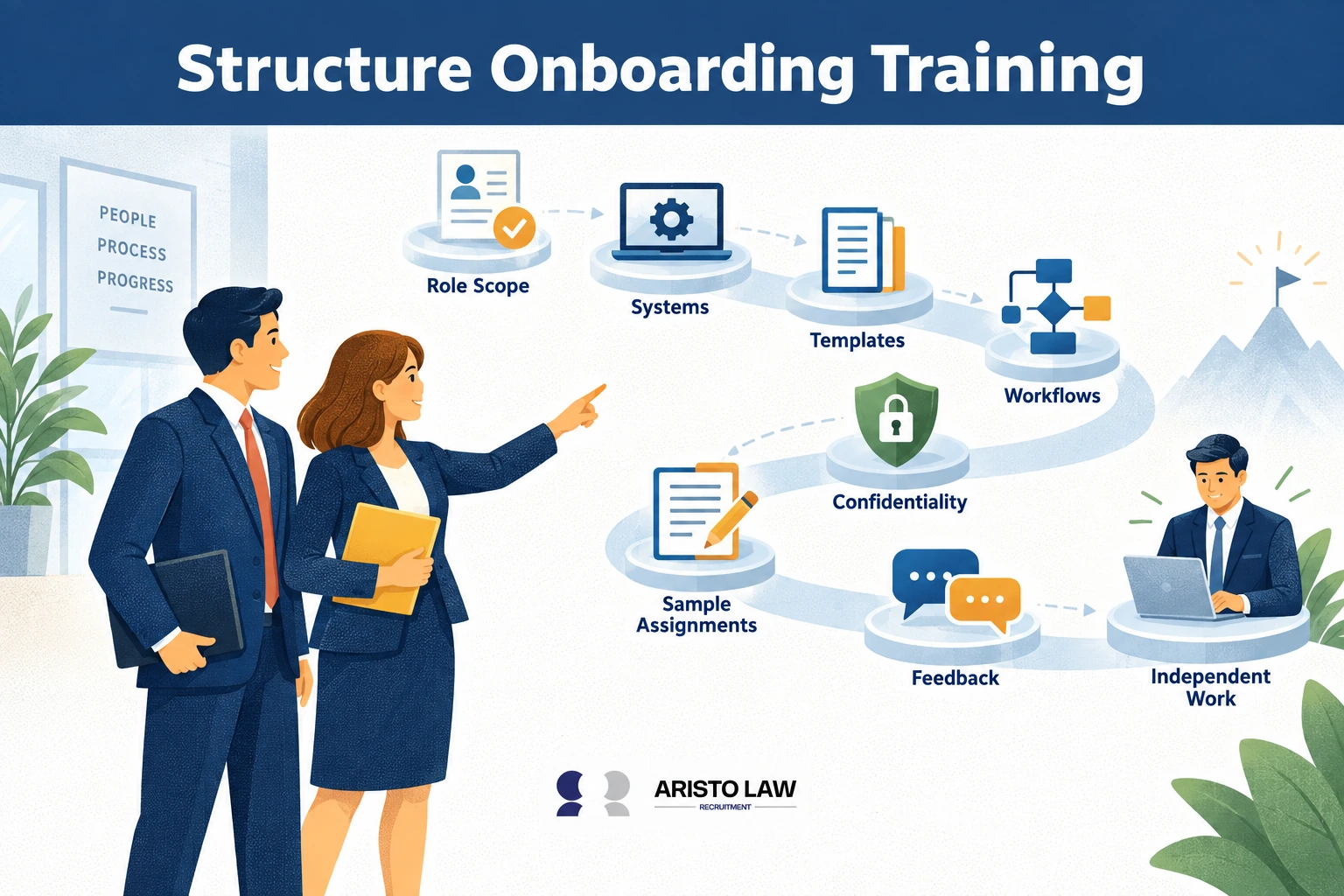
Structuring onboarding training involves preparing new
paralegals to perform effectively within the firm’s legal and
operational environment. Onboarding commonly includes
technology training, workflow instruction, document standards,
confidentiality procedures, communication protocols, and practice-area
orientation.
Effective onboarding accelerates productivity and reduces integration
challenges. A study by StrongDM titled “25 Surprising Employee
Onboarding Statistics in 2026” in the year 2026 shows that organizations
with standard, well-designed onboarding processes experience a 50%
increase in overall employee productivity and an 82% boost in new hire
retention, directly mitigating initial integration barriers and cutting
down the time it takes for professionals to operate at full
capacity. Structured training programs improve knowledge
retention, operational consistency, and long-term performance outcomes.
Law firms must implement standardized onboarding processes with
measurable milestones and ongoing support mechanisms.
14. Integrate Legal Technology
Integrating legal technology involves training paralegals to
work within the firm’s case-management systems, document repositories,
billing platforms, legal research databases, e-discovery tools, and
collaboration applications. Technology integration improves
workflow efficiency, communication, document accessibility, and
operational visibility.
A study by McKinsey & Company titled “Optimizing Workflow
Efficiency Through Integration of Digital Office Technologies” in the
year 2020 shows that organizations that effectively integrate digital
office technologies witness a 20-30% increase in overall productivity
because combining cloud-based applications, automation, and real-time
collaboration platforms successfully lowers communication barriers,
accelerates decision-making, and optimizes document accessibility across
distributed teams. Technology proficiency has become
increasingly important because modern legal operations depend heavily on
digital systems and remote collaboration capabilities. Law firms must
provide comprehensive software training and establish technology
standards that support productivity and consistent work quality.
15. Review Operational
Performance
Reviewing operational performance involves measuring a paralegal’s
effectiveness through productivity metrics, quality standards, workflow
efficiency indicators, communication performance, and contribution to
legal operations. Performance reviews help firms identify
strengths, address development opportunities, and align staffing
resources with strategic objectives. Evaluation commonly
includes workload management, document accuracy, deadline adherence,
client-service support, technology utilization, and collaboration
effectiveness.
Regular performance reviews improve accountability, support
professional development, and strengthen long-term workforce management.
A study by Workleap titled “Are Annual Performance Reviews Still
Relevant in 2026?” in the year 2026 shows that 83% of employees heavily
value receiving structured, regular performance feedback, confirming
that consistent review loops dismantle one-directional evaluation
styles, build operational trust, enforce workplace accountability, and
foster proactive professional development geared toward organizational
growth. Law firms must establish measurable performance
indicators and conduct periodic reviews to maintain high-quality legal
operations and continuous organizational improvement.
What
skills should a law firm evaluate before hiring a paralegal?
Skills law firms should evaluate before hiring a paralegal
include legal research, drafting, organization, communication,
analytical thinking, technology proficiency, and deadline
management.
The table below shows skills a law firm should evaluate before hiring
a paralegal.
| Skill | What It Looks Like in Practice | Why It Matters Operationally | How to Evaluate During Recruitment |
|---|---|---|---|
| Legal Research | Locating statutes, regulations, case law, court rules, and legal authorities efficiently |
Improves case preparation, legal analysis, and attorney decision-making |
Assign legal research exercises and ask candidates to prepare research memoranda or case summaries |
| Legal Drafting | Preparing pleadings, contracts, correspondence, motions, forms, and discovery documents |
Improves document quality, reduces attorney revisions, and increases workflow efficiency |
Conduct drafting tests using sample legal documents and assess structure, grammar, and accuracy |
| Document Organization | Managing case files, exhibits, records, and document repositories systematically |
Reduces information retrieval delays and improves case-management efficiency |
Provide document-sorting exercises and ask candidates to organize sample case materials |
| Communication Skills | Writing professional correspondence and communicating clearly with attorneys, clients, and staff |
Improves collaboration, client service, and workflow coordination |
Use scenario-based questions, written communication assessments, and role-playing exercises |
| Analytical Thinking | Reviewing information, identifying issues, recognizing inconsistencies, and drawing logical conclusions |
Strengthens problem solving and supports accurate legal work | Present hypothetical case scenarios and ask candidates to explain their reasoning and recommended actions |
| Technology Proficiency | Using case-management systems, document-management software, legal research platforms, and productivity tools |
Improves operational efficiency and supports modern legal workflows |
Conduct software demonstrations and ask candidates to complete practical technology exercises |
| Deadline Management | Prioritizing assignments, tracking due dates, and managing multiple matters simultaneously |
Reduces missed deadlines and improves productivity under workload pressure |
Present multi-task scenarios and ask candidates to prioritize and schedule assignments |
| Document Review | Reviewing contracts, records, and case materials for relevance and accuracy |
Improves quality control and supports litigation and transactional work |
Provide sample documents and ask candidates to identify important information, inconsistencies, and risks |
| Case Management | Tracking matters, maintaining records, monitoring deadlines, and updating case information |
Supports workflow continuity and operational visibility | Use practical exercises involving case updates, deadline tracking, and matter administration |
| Discovery Support | Organizing evidence, managing productions, and maintaining discovery records |
Improves litigation preparedness and information management | Assign discovery-management scenarios and document-organization exercises |
| Legal Writing | Preparing research memoranda, summaries, reports, and procedural documents |
Enhances attorney efficiency and improves work-product quality | Request writing samples and assign short legal writing exercises |
| Court Filing Procedures | Understanding filing requirements, document formatting, and procedural rules |
Reduces filing errors and procedural risks | Ask candidates to explain filing processes and complete filing-preparation exercises |
| Attention to Detail | Identifying errors, inconsistencies, omissions, and formatting issues |
Improves accuracy and reduces rework and compliance risks | Provide error-detection exercises and document-review tests |
| Contract Preparation | Assisting with drafting, reviewing, and organizing contractual documentation |
Supports transactional work and contract administration | Use contract-review exercises and ask candidates to summarize key provisions and obligations |
| Information Management | Maintaining accurate records, document repositories, and matter information |
Improves accessibility and supports efficient legal operations | Assess candidates through file-management and information-organization exercises |
The strongest recruitment assessments focus on measurable
competencies rather than personality traits. Research assignments,
drafting exercises, document-organization tasks, software
demonstrations, and scenario-based assessments provide objective
evidence of a candidate’s ability to perform effectively within law firm
operations and legal workflows.
What
qualifications should you look for when hiring a paralegal?
Qualifications to look for when hiring a paralegal include
legal education, technology competence, organizational skills, and
communication abilities.
Listed below are 14 qualifications to look for when hiring a
paralegal.
-
Legal Education: Legal education provides
foundational knowledge of legal principles, terminology, procedures, and
professional responsibilities. Common educational pathways include
paralegal studies programs, legal-assistant programs, associate degrees,
bachelor’s degrees, and post-baccalaureate paralegal certificates.
Educational qualifications help candidates understand legal concepts,
but practical performance remains equally important. -
Paralegal Certifications: Professional
certifications demonstrate commitment to continuing education and
professional development. Certifications indicate competency in legal
procedures, ethics, and specialized practice areas. Certifications
strengthen candidate credibility, but they must complement rather than
replace practical experience and demonstrated skills. -
Practice-Area Experience: Experience in litigation,
corporate law, family law, employment law, real estate law, intellectual
property law, immigration law, or other practice areas reduces
onboarding time and improves productivity. Candidates with relevant
experience understand common workflows, documentation requirements, and
procedural expectations. -
Legal Research Capabilities: Strong research skills
allow paralegals to locate statutes, regulations, court rules, and legal
authorities efficiently. Effective legal research supports case
preparation, improves attorney productivity, and strengthens legal
decision-making processes. -
Drafting Proficiency: The ability to prepare
correspondence, pleadings, contracts, forms, discovery documents, and
legal summaries directly influences workflow efficiency and document
quality. Strong drafting skills reduce revision requirements and
accelerate legal processes. -
Procedural Knowledge: Familiarity with court rules,
filing requirements, litigation procedures, transactional workflows, and
jurisdiction-specific processes reduces procedural errors and supports
operational efficiency. Procedural knowledge becomes increasingly
valuable in practice areas with strict deadlines and filing
requirements. -
Case-Management Familiarity: Experience maintaining
case files, updating matter records, tracking deadlines, and monitoring
workflow progress improves operational consistency and information
visibility. Familiarity with case-management processes allows paralegals
to contribute more effectively from the beginning of employment. -
Legal Technology Competence: Modern legal operations
depend heavily on case-management platforms, document-management
systems, legal research databases, e-discovery software, billing
applications, and productivity tools. Technology competence improves
efficiency, collaboration, reporting, and document accessibility. -
Document Management Skills: The ability to organize,
categorize, retrieve, and maintain legal records supports information
management and reduces administrative delays. Strong document-management
capabilities are particularly important in litigation, discovery,
compliance, and high-volume legal environments. -
Organizational Skills: Effective organization
enables paralegals to manage multiple matters, monitor deadlines,
prioritize assignments, and maintain accurate records. Strong
organizational capabilities improve productivity and reduce operational
risks. -
Communication Abilities: Clear written and verbal
communication supports collaboration with attorneys, clients, courts,
vendors, and administrative staff. Communication skills improve workflow
coordination, information exchange, and client-service experiences. -
Attention to Detail: Accuracy in document
preparation, data entry, legal research, and procedural compliance
reduces errors and minimizes rework. Attention to detail directly
affects work quality and operational reliability. -
Time Management and Prioritization Skill: Paralegals
frequently manage competing deadlines and multiple assignments
simultaneously. Effective time management improves productivity and
helps maintain workflow continuity under demanding workloads. -
Confidentiality and Professional Ethics: Paralegals
regularly handle sensitive client information, privileged
communications, and confidential records. Strong ethical awareness and
confidentiality practices protect clients and reduce legal and
reputational risks.
Hiring decisions must prioritize workflow outcomes rather than
credentials alone. Educational qualifications and certifications provide
evidence of foundational knowledge, but practical execution ability,
technology proficiency, procedural understanding, organization, and
demonstrated performance in real legal workflows determine whether a
paralegal contributes effectively to law firm operations and long-term
productivity.
How much does it cost
to hire a paralegal?
The cost of hiring a paralegal ranges from approximately
$40,000 to $95,000+ per year in direct compensation, depending on
location, experience, specialization, and employment structure.
The cost of hiring a paralegal depends on experience, specialization,
location, hiring model, and whether support is in-house, freelance,
outsourced, or remote.
A study by the U.S. Bureau of Labor Statistics titled
“Occupational Employment and Wage Statistics” in the year 2024 shows
that paralegals and legal assistants earned a national median annual
wage of $61,010, establishing a baseline labor midpoint where fifty
percent of these professionals earned more than this amount and fifty
percent earned less. However, the total cost of hiring a
paralegal extends well beyond salary and must be evaluated through total
operational expenditure rather than compensation alone.
Law firms incur additional expenses related to recruitment
activities, job advertising, staffing agency fees, background checks,
onboarding, payroll taxes, employee benefits, insurance contributions,
equipment purchases, software licensing, legal research subscriptions,
office space, and administrative support. New hires also require
supervision, training, workflow integration, and time to become fully
productive. Productivity ramp-up periods frequently last several weeks
or months as paralegals learn firm procedures, practice-area
requirements, legal technology systems, and attorney preferences.
Technology investments further increase hiring costs. Modern
paralegals require access to case-management platforms,
document-management systems, legal research databases, e-discovery
tools, communication platforms, and productivity software. Ongoing
training and continuing education expenses also contribute to total
employment costs.
Comparing only hourly rates or base salaries produces misleading cost
assumptions because it ignores indirect expenses and productivity
considerations. A lower salary results in higher total costs if
significant training, supervision, technology implementation, or
turnover occurs. Conversely, an experienced paralegal with higher
compensation generates greater operational value through faster
onboarding, stronger productivity, fewer errors, reduced attorney
administrative burdens, and improved workflow efficiency. Evaluating
total hiring expenses through a comprehensive operational lens allows
law firms to make more informed staffing decisions and accurately assess
the long-term cost and value of paralegal recruitment.
When should
a law firm outsource paralegal services?
A law firm should outsource paralegal services when workloads
fluctuate, operational flexibility is necessary, or the firm requires
specialized support without long-term employment commitments.
Outsourcing is particularly beneficial during temporary workload surges,
discovery-intensive litigation, transaction closings, large
document-review projects, trial preparation periods, regulatory
investigations, staff absences, and rapid growth phases that place
additional demands on legal operations.
Law firms must outsource paralegal services when case volume,
administrative workload, or staffing gaps exceed internal capacity and
begin affecting operational efficiency. Law firms use outsourced
virtual paralegal services to maintain document
management, case support, and workflow continuity without increasing
in-house headcount.
Outsourced paralegal services provide scalable support that allows
firms to increase or reduce legal staffing capacity based on changing
business requirements. This flexibility helps law firms avoid the fixed
costs associated with expanding in-house teams while maintaining access
to experienced legal professionals. Outsourcing also provides access to
specialized expertise in areas such as litigation support, corporate
transactions, contract administration, compliance management,
intellectual property matters, employment law, immigration law, and
complex document management projects.
Cost-management initiatives drive outsourcing decisions because firms
obtain legal support without incurring many expenses associated with
permanent employees, including office space, employee benefits, payroll
taxes, equipment costs, recruiting expenses, and long-term staffing
obligations. Outsourcing also allows attorneys to redirect time from
administrative tasks toward client representation, case strategy,
business development, and other higher-value legal activities.
Successful outsourcing requires effective operational management. Law
firms must establish clear supervision structures, define communication
protocols, implement secure document-sharing procedures, maintain
confidentiality standards, and integrate outsourced professionals into
case-management systems and legal workflows. Regular reporting, clearly
defined responsibilities, and secure technology platforms further
improve collaboration and workflow continuity.
Outsourcing is most effective when legal support needs are temporary,
highly specialized, variable, or expanding more rapidly than internal
staffing capacity. For firms seeking greater scalability, flexible
staffing, and efficient resource management, outsourced paralegal
services provide an effective solution for maintaining productivity
while adapting to changing operational demands.
Where
can law firms hire qualified paralegals or outsourced paralegal
services?
Law firms can hire qualified paralegals or outsourced
paralegal services through legal staffing agencies, specialized legal
outsourcing providers, freelance platforms, and professional legal
networks. Legal outsourcing and remote legal staffing have
expanded as law firms aim to reduce overhead costs, improve efficiency,
and access specialized legal talent without increasing in-house
headcount.
Law firms hire qualified paralegals through legal staffing providers,
specialized outsourcing companies, and dedicated virtual legal support
services that match paralegal skills to firm requirements. Law firms
seeking scalable staffing solutions hire
qualified virtual paralegal services to support case
management, legal research, document preparation, and administrative
workflows.
Listed below are 10 places where law firms can hire qualified
paralegals or outsourced paralegal services.
-
Legal Process Outsourcing (LPO) Companies: LPO
providers offer outsourced paralegal teams that support legal research,
document review, discovery management, contract administration,
litigation support, and legal operations. These providers offer
scalability, specialized expertise, and flexible staffing models for
firms managing fluctuating workloads. -
Law Firm-Focused Outsourcing Companies:
Organizations such as Aristo Law provide dedicated remote paralegals and
legal support professionals specifically trained to support law firm
operations. Aristo Law helps firms solve legal staffing challenges by
providing vetted legal talent, onboarding support, workflow integration,
scalability, and ongoing operational support tailored to specific
practice areas and workload requirements. -
Specialized Legal Staffing Agencies: Legal staffing
agencies recruit, screen, and place qualified paralegals for temporary,
contract, remote, and permanent positions. These agencies provide access
to vetted candidates and reduce recruitment time and administrative
burdens. -
Virtual Legal Assistant and Remote Paralegal Service
Providers: Remote legal support providers supply paralegals and
legal assistants who work within law firm workflows while supporting
case management, legal research, drafting, client intake, and
administrative processes. These services offer flexibility and cost
efficiency without requiring additional office infrastructure. -
Freelance Marketplaces: Platforms such as Upwork and
Fiverr allow firms to hire independent paralegals for project-based
assignments such as legal research, document review, discovery projects,
and drafting support. These platforms provide flexibility and quick
access to specialized skills. -
Remote Staffing Companies: Remote staffing firms
recruit legal professionals from global talent markets such as South
Africa, Philippines, United Kingdom, and United States. These providers
offer cost-effective staffing solutions and access to experienced legal
talent with diverse practice-area expertise. -
Professional Paralegal Associations: Organizations
such as National Federation of Paralegal Associations and National
Association of Legal Assistants maintain professional directories,
referral networks, and educational resources that help firms identify
qualified paralegals. -
Legal Recruitment Agencies: Recruitment firms
specializing in legal staffing assist with sourcing, screening, and
placing paralegals for permanent and contract positions. These agencies
have extensive candidate networks and provide additional support
throughout the hiring process. -
Online Legal Job Boards: Legal employment platforms
advertise remote, hybrid, and in-office paralegal opportunities and
allow firms to recruit candidates directly. Job boards broaden access to
active and passive candidates across multiple geographic markets. -
Managed Legal Services Providers: Managed legal
services organizations provide scalable outsourced paralegal support
teams that assist with legal operations, litigation support, contract
management, compliance activities, and administrative workflows. These
providers offer structured management processes, reporting capabilities,
and long-term staffing solutions.
Each sourcing option provides different advantages in candidate
screening, legal specialization, scalability, cost efficiency, and
ongoing support. The most appropriate hiring source depends on whether a
law firm requires project-based assistance, specialized expertise,
temporary staffing, or long-term integrated legal support that scale
alongside operational growth.
How
does Aristo Law help law firms hire qualified remote paralegals?
Aristo Law helps law firms hire qualified remote paralegals
by sourcing, screening, and placing experienced legal professionals who
are matched to a firm’s specific practice area, workload, and
operational needs. Aristo Law manages the entire recruitment
process, beginning with talent sourcing and candidate identification,
followed by skills evaluations, experience assessments, reference
verification, and background checks.
Candidates are evaluated for competencies such as legal research,
document drafting, case management, discovery support, document review,
legal technology proficiency, communication skills, organization, and
confidentiality practices to ensure alignment with law firm
requirements.
Aristo Law helps law firms hire paralegals by matching firm
requirements with vetted candidates who have experience in legal
research, case management, and document preparation. Law firms seeking
scalable staffing solutions can use Aristo Law for qualified
remote paralegal services that align with specific
practice areas and operational needs.
After screening, Aristo Law matches remote paralegals to roles
involving litigation support, case management, legal research, document
review, contract administration, client intake, billing support, and
administrative legal workflows. The placement process considers
practice-area experience, software proficiency, workload demands, and
operational preferences so that firms receive legal professionals who
contribute effectively from the beginning of the engagement.
Remote paralegals are then integrated into the firm’s case-management
systems, document repositories, communication platforms, legal research
databases, and workflow procedures to support seamless collaboration
with attorneys and legal teams. Because these professionals work within
established systems and processes, they develop familiarity with firm
procedures, attorney preferences, and ongoing matters, improving
continuity and operational consistency.
A study by the International Journal of Science and Advanced
Technology (IJSAT) titled “The Impact of Recruitment Processes on
Company Productivity” in the year 2025 shows that structured
recruitment, comprehensive candidate vetting, and realistic job previews
optimize worker performance and alignment with company goals while
reducing early employee turnover rates by up to fifteen
percent. Well-managed recruitment processes also reduce
onboarding challenges and improve long-term performance outcomes.
Aristo Law enables law firms to scale quickly by providing flexible
hiring options without the delays, recruitment expenses, and
administrative burdens associated with traditional in-house hiring.
Through access to trained, pre-vetted remote paralegals and ongoing
staffing support, Aristo Law helps firms strengthen legal operations,
improve productivity, increase staffing flexibility, and maintain
consistent access to qualified legal talent as business needs
evolve.
Build a legal support team that moves work forward.
Tell us what is slowing your practice down. We will help map the role, workflow, and support structure that fits.