
How Virtual Assistants Boost Law Firm Productivity, Profitability, and Operations

Practical guidance for building efficient, accountable legal support operations.

Virtual legal assistants help law firms increase
productivity, improve profitability, and strengthen operations by
handling administrative, intake, communication, and workflow-intensive
responsibilities that would otherwise consume attorney time.
Virtual legal assistants maximize billable hours, reduce operating
costs, streamline client onboarding, optimize case workflows, improve
client retention, support secure document management, manage
correspondence, eliminate scheduling conflicts, organize discovery
materials, assist with trial preparation, track deadlines, improve
collections, and provide workforce flexibility.
A study by Clio in its Legal Trends Report found that lawyers
spend approximately 31% of the workday on billable legal work,
demonstrating the substantial amount of time devoted to administrative
and operational activities. These productivity gains occur
because attorneys recover time previously spent on scheduling, intake
management, document organization, billing support, follow-up
communication, and administrative coordination.
Virtual legal assistants protect attorney bandwidth by managing
client intake, calendar coordination, CRM administration, legal document
preparation support, case management tasks, deadline tracking, email
management, billing workflows, and operational reporting. Common hiring
options include legal staffing agencies, virtual assistant providers,
legal outsourcing companies, freelance professionals, and
managed-service providers. Law firms evaluate candidates based on
legal-industry experience, communication skills, confidentiality
awareness, case-management software proficiency, CRM knowledge,
document-management expertise, and workflow coordination abilities.
Aristo Law helps law firms improve productivity through specialized
virtual legal assistant services, intake support, administrative
coordination, document management, legal workflow support, and scalable
staffing solutions. Virtual legal assistants support long-term law firm
growth by increasing operational consistency, improving client service,
expanding support capacity, and enabling firms to handle larger
caseloads without proportionally increasing overhead. The result is
sustainable growth, stronger profitability, improved attorney
utilization, and more efficient law firm operations.
Aristolaw helps law firms boost productivity, profitability,
and operations with virtual assistants by providing outsourced support
for administrative workflows, client intake, document coordination,
scheduling, billing support, follow-up tracking, and remote legal
operations. Call
Aristolaw at +1 307 888 9491 for virtual legal assistant staffing
support. Aristolaw connects law firms with
outsourcing solutions that match trained virtual assistant staff to each
productivity workflow, profitability support task, administrative duty,
client service function, and law firm operations need.
Listed below are the 15 primary ways virtual assistants support law
firm performance.
-
1. Maximizing billable hours: Virtual assistants
handle non-billable administrative tasks, allowing attorneys to spend
more time on revenue-generating legal work. -
2. Reducing operating costs: Virtual assistants
provide operational support without the expense of full-time in-house
staffing. -
3. Streamlining client onboarding: Virtual
assistants manage intake procedures, document collection, and client
communications during the onboarding process. -
4. Optimizing case workflows: Virtual assistants
coordinate tasks, updates, and case-related activities to improve
workflow efficiency. -
5. Improving client retention: Virtual assistants
maintain consistent communication and follow-up processes that
strengthen client relationships. -
6. Securing document management: Virtual assistants
organize, maintain, and retrieve legal documents within structured
document management systems. -
7. Delegating routine correspondence: Virtual
assistants handle emails, appointment confirmations, and other
repetitive communications. -
8. Eliminating calendar conflicts: Virtual
assistants coordinate schedules, appointments, hearings, and deadlines
to prevent overlapping commitments. -
9. Accelerating discovery organization: Virtual
assistants sort, categorize, and manage discovery materials for easier
review and case preparation. -
10. Protecting attorney bandwidth: Virtual
assistants reduce administrative interruptions that divert attention
from substantive legal work. -
11. Minimizing overhead margins: Virtual assistants
help law firms scale support functions without increasing fixed
operational expenses. -
12. Facilitating trial preparation: Virtual
assistants assist with exhibit organization, document preparation, and
pre-trial administrative tasks. -
13. Tracking filing deadlines: Virtual assistants
monitor court dates and filing requirements to support procedural
compliance. -
14. Scaling workforce flexibility: Virtual
assistants provide adaptable support that expands or contracts according
to workload demands. -
15. Enhancing collection rates: Virtual assistants
support invoicing, payment follow-up, and account tracking processes
that improve revenue collection.
1. Maximizing Billable Hours
Maximizing billable hours involves increasing the amount of
attorney time devoted to client work that generates revenue.
Legal VAs improve law firm productivity by handling scheduling, intake
coordination, document organization, and administrative support
tasks.
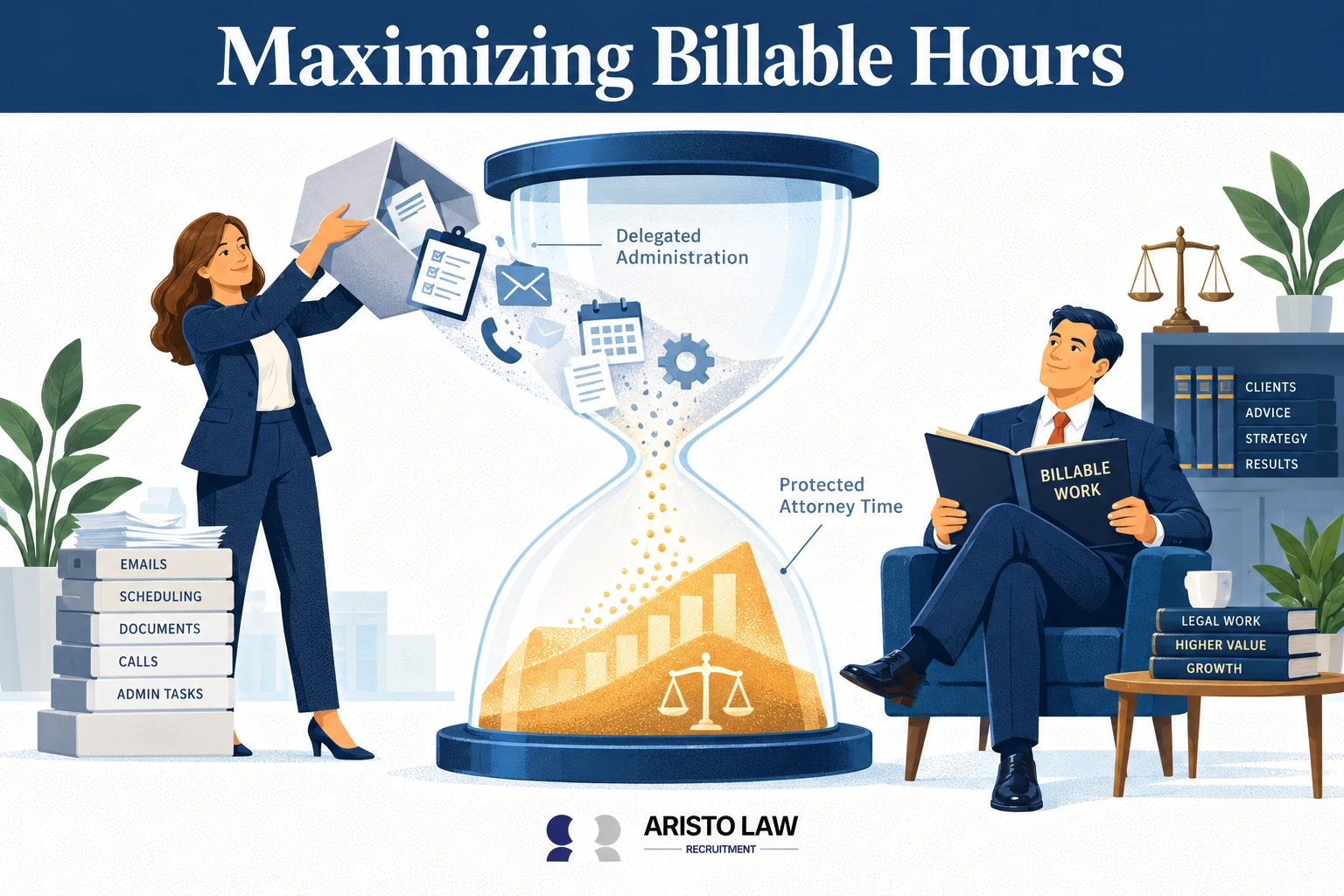
Increased attorney productivity improves profitability and resource
utilization. Law firms benefit from delegating non-billable activities
to support professionals and tracking attorney time allocation.
2. Reducing Operating Costs
Reducing operating costs involves lowering expenses
associated with staffing and daily operations. Legal virtual
assistants help reduce payroll obligations, office-space costs,
equipment expenses, and recruiting expenditures.
Lower operating costs improve law firm profitability and scalability.
Firms achieve stronger financial performance by aligning support
capacity with workload demand.
3. Streamlining Client
Onboarding
Streamlining client onboarding involves improving the process
of bringing new clients into the firm. Legal VAs manage intake
forms, document collection, consultation scheduling, and onboarding
communications.
Virtual assistants improve client onboarding by collecting intake
information, organizing documentation, and routing prospective clients
through standardized workflows. Law firms use virtual
intake specialist services to reduce response delays,
increase intake completion rates, and maintain consistent onboarding
operations.
Efficient onboarding improves client experience and operational
consistency. Standardized onboarding workflows improve service
delivery.
4. Optimizing Case Workflows
Optimizing case workflows involves improving the coordination
of tasks, documents, deadlines, and legal processes. Legal
virtual assistants support case management by tracking activities,
organizing records, and maintaining workflow progression.
Virtual assistants improve case workflow efficiency by coordinating
deadlines, tracking task completion, and maintaining case progression
across legal teams. Law firms use litigation
case manager service to strengthen workflow oversight,
reduce administrative bottlenecks, and support productivity,
profitability, and operations.
Workflow optimization improves efficiency and case movement.
Centralized systems improve visibility and accountability.
5. Improving Client Retention
Improving client retention involves strengthening long-term
client relationships and satisfaction. Legal virtual assistants
support communication, follow-ups, appointment reminders, and status
updates.
Better client engagement improves retention and referral
opportunities. Consistent communication processes improve client-service
outcomes.
6. Securing Document
Management
Securing document management involves protecting and
organizing legal records throughout their lifecycle. Legal VAs
support document management through file organization, access controls,
document tracking, and record maintenance.
Effective document security reduces operational risk and improves
compliance. Standardized storage procedures improve efficiency.
7. Delegating Routine
Correspondence
Delegating routine correspondence involves assigning
non-substantive communications to support staff. Legal virtual
assistants manage email communications, appointment confirmations,
client updates, and administrative inquiries.
Delegation improves attorney productivity and responsiveness.
Communication standards improve consistency and service quality.
8. Eliminating Calendar
Conflicts
Eliminating calendar conflicts involves coordinating
schedules to prevent overlapping commitments and missed
appointments. Legal virtual assistants manage calendars,
consultations, meetings, court appearances, and reminders.
Effective scheduling improves operational efficiency and client
service. Shared scheduling systems improve coordination.
9. Accelerating Discovery
Organization
Accelerating discovery organization involves improving the
management of evidence, records, and case materials. Legal
virtual assistants assist with indexing, categorization, document
collection, and discovery tracking.
Virtual assistants accelerate discovery organization by categorizing
records, maintaining document inventories, and supporting evidence
management workflows that improve operational efficiency. Law firms
handling complex discovery projects integrate litigation
support specialist services to strengthen document
review, data organization, and case preparation processes.
Efficient discovery organization supports litigation readiness and
workflow performance. Structured document-management systems improve
accessibility.
10. Protecting Attorney
Bandwidth
Protecting attorney bandwidth involves preserving attorney
time for legal analysis, strategy, and client representation.
Legal VAs absorb administrative and workflow-intensive responsibilities
that do not require attorney involvement.
Increased attorney productivity improves revenue generation and
service quality. Firms benefit from clear delegation frameworks.
11. Minimizing Overhead
Margins
Minimizing overhead margins involves controlling operational
expenses relative to revenue. Legal VAs provide scalable
support without requiring proportional increases in office
infrastructure or staffing costs.
Lower overhead improves profitability and growth potential. Firms
should regularly evaluate operational efficiency metrics.
12. Facilitating Trial
Preparation
Facilitating trial preparation involves supporting activities
required before hearings and trials. Legal virtual assistants
assist with document organization, exhibit preparation, scheduling
coordination, file management, and administrative support.

Efficient preparation improves workflow execution and readiness.
Standardized trial-preparation procedures improve consistency.
13. Tracking Filing Deadlines
Tracking filing deadlines involves monitoring court dates,
submission requirements, and procedural obligations. Legal VAs
maintain deadline calendars, reminder systems, and task-tracking
processes.
Effective deadline management reduces compliance risks and missed
filings. Automated tracking systems improve reliability.
14. Scaling Workforce
Flexibility
Scaling workforce flexibility involves adjusting support
capacity based on workload and growth requirements. Legal
virtual assistants provide additional operational support during periods
of increased demand without requiring permanent staffing
commitments.
Workforce flexibility improves law firm growth and resource
allocation. Firms benefit from scalable staffing models.
15. Enhancing Collection Rates
Enhancing collection rates involves improving the recovery of
outstanding invoices and client payments. Legal VAs support
billing follow-ups, payment reminders, account tracking, and collections
administration.
Improved collections strengthen cash flow and profitability.
Consistent billing and follow-up procedures improve financial
performance.
Where can law
firms hire virtual legal assistants?
Law firms can hire virtual legal assistants through legal
outsourcing companies, specialized legal staffing providers, virtual
assistant agencies, freelance marketplaces, and dedicated legal support
service firms.
Law firms use outsourced staffing providers to access trained legal
support professionals for administrative, intake, scheduling, document
management, and client communication workflows. Firms seeking to hire
virtual legal assistant services improve operational
efficiency by assigning repetitive legal support tasks to dedicated
remote staff while attorneys focus on billable legal work.
Listed below are the 7 places where law firms can hire virtual legal
assistants.
-
Juris Genius: Legal virtual assistant agency
offering support for legal research, case management, document drafting,
scheduling, and administrative legal workflows. -
Aristo Law: Provides remote paralegals and virtual
legal assistants for law firms, including support with client intake,
CRM management, document preparation, calendar management, lead
qualification, client communications, case coordination, and legal
workflow support. Aristo Law focuses on scalable legal staffing
solutions, operational efficiency, workflow integration, and law-firm
growth support, helping firms expand support capacity while controlling
overhead costs. -
Legal Soft: Legal staffing provider offering virtual
legal assistants, intake specialists, case managers, paralegals, demand
writers, and other legal support professionals. The company reports
serving more than 1,000 law firms and placing thousands of virtual staff
members. -
Freelance marketplaces (e.g., Upwork and Fiverr
Business): Suitable for project-based, part-time, or
specialized legal administrative support when firms prefer direct hiring
and management. -
Legal staffing and outsourcing agencies: Provide
pre-vetted legal professionals with experience in case management
systems, legal document preparation, intake management, billing support,
and client communications. -
Professional legal networks and referrals: Attorney
referrals, legal associations, bar-related communities, and professional
networking platforms connect firms with experienced legal support
personnel. -
Direct remote recruitment: Job boards, LinkedIn, and
legal-industry hiring platforms help firms recruit dedicated virtual
legal assistants and remote legal support teams.
A study by Clio in its Legal Trends Report found that lawyers
spend approximately 31% of the workday on billable legal work, showing
the administrative burden carried by many legal professionals.
Remote legal staffing reduces overhead costs, improves administrative
efficiency, and increases attorney capacity by shifting non-billable
work to specialized support professionals.
When evaluating hiring sources, law firms should assess
legal-industry experience, legal software proficiency, client-intake
expertise, document-management skills, confidentiality standards,
communication abilities, workflow integration capabilities, training
requirements, scalability, and long-term staffing flexibility. The best
hiring option depends on the firm’s practice area, workload volume,
growth objectives, supervision preferences, and operational
requirements.
How
much does it cost to hire a virtual legal assistant?
Hiring a virtual legal assistant costs between $10 and $50
per hour, depending on experience, legal specialization, location, and
service model. The cost of hiring a virtual legal assistant
varies based on experience, legal specialization, geographic location,
workload requirements, and whether the assistant is hired through an
agency or directly.
Virtual legal staffing is commonly offered through hourly
arrangements, part-time retainers, full-time dedicated staffing models,
and agency-managed service plans. Administrative virtual legal
assistants generally cost less than experienced legal assistants,
virtual paralegals, intake specialists, and litigation support
professionals because advanced legal workflows require greater expertise
and specialized training.
Listed below are market cost ranges for hiring a legal VA.
-
Entry-level offshore virtual legal assistant:
Approximately USD $8–$15 per hour -
Experienced offshore virtual legal assistant:
Approximately USD $15–$30 per hour -
Virtual intake specialist: Approximately USD $12–$25
per hour -
Virtual paralegal: Approximately USD $25–$75+ per
hour, depending on specialization -
U.S.-based virtual legal assistant: Approximately
USD $30–$60+ per hour -
Part-time dedicated support (20 hours per week):
Approximately USD $800–$2,500 per month -
Full-time dedicated support (40 hours per week):
Approximately USD $1,500–$5,000+ per month, depending on experience,
location, and responsibilities -
Agency-managed legal staffing solutions: Range from
USD $1,500–$6,000+ per month, depending on staffing level and support
scope
Pricing is influenced by legal software proficiency, case-management
experience, practice-area specialization, bilingual capabilities,
intake-management expertise, litigation-support experience,
responsiveness requirements, and availability. Offshore professionals
offer the lowest costs, nearshore professionals fall in the middle
range, and U.S.-based legal support professionals generally command
higher rates due to local labor costs and jurisdiction-specific
experience.
A study by Clio in its Legal Trends Report states that
lawyers spend only about 2.5–2.9 hours of an 8-hour workday on billable
legal work, representing approximately 31%–37% of their
workday. Many law firms evaluate virtual legal assistant costs
based on increased attorney productivity, expanded billable-hour
capacity, improved workflow efficiency, and reduced operational overhead
rather than hourly rates alone.
How
do virtual legal assistants support long-term law firm growth?
Virtual legal assistants support long-term law firm growth by
creating scalable operational systems that allow firms to handle more
work without sacrificing efficiency or service quality. They
contribute to growth infrastructure by supporting workflow
standardization, delegation systems, client intake processes, document
management, case coordination, scheduling, billing administration, and
communication workflows that remain effective as caseloads increase.
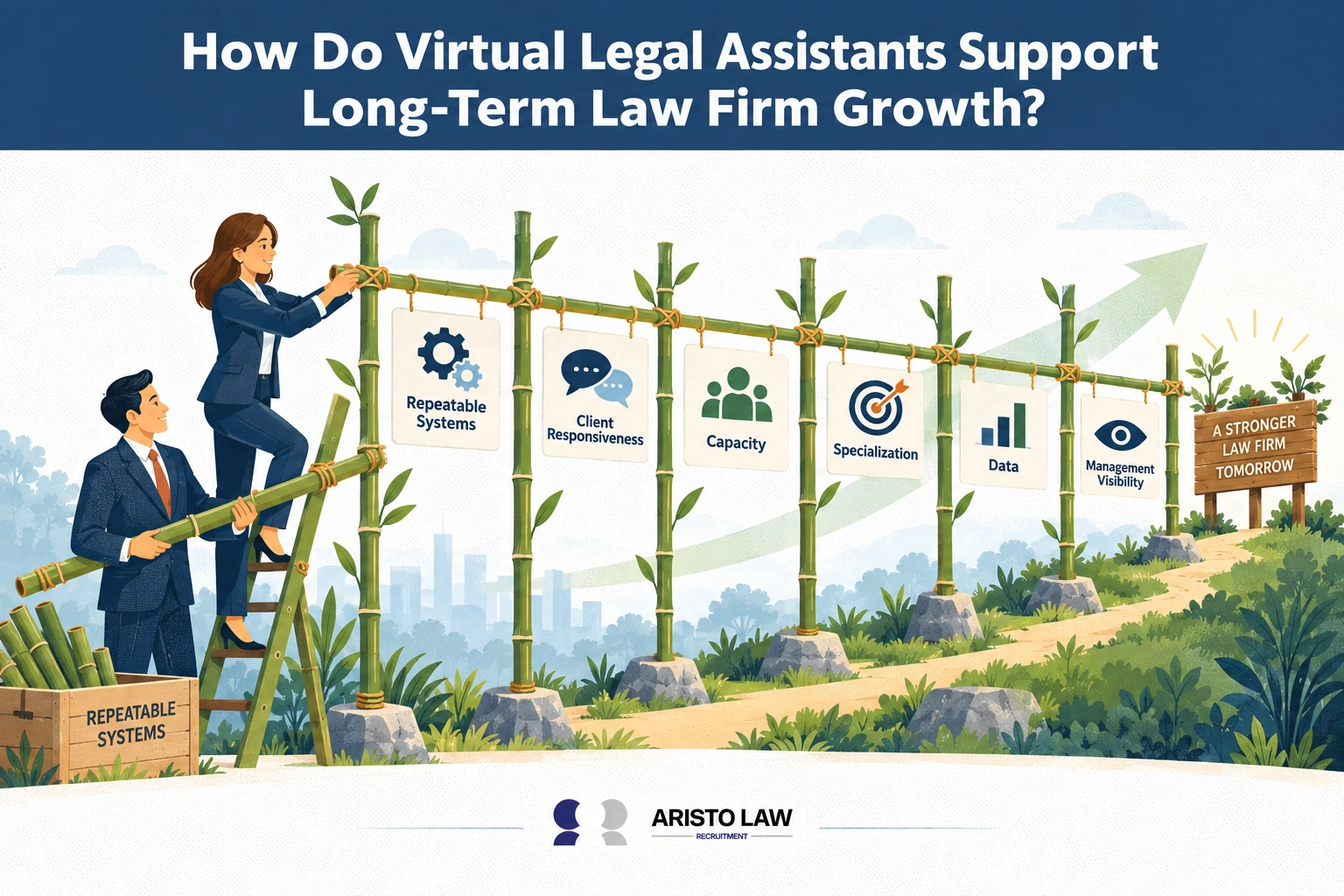
Consistent operational support improves staff utilization by allowing
attorneys, paralegals, and legal teams to focus on higher-value legal
work while virtual legal assistants manage administrative and
workflow-intensive responsibilities.
Virtual legal assistants also strengthen operational resilience by
providing flexible support capacity during growth periods, staffing
shortages, workload surges, and business expansion initiatives.
Standardized procedures, documented workflows, and scalable support
structures improve service consistency, reduce operational bottlenecks,
and support sustainable profitability expansion.
By increasing efficiency, improving client responsiveness,
strengthening legal operations strategy, and supporting long-term
business development objectives, virtual legal assistants help law firms
achieve operational maturity, maintain competitive positioning, and
scale services without proportionally increasing overhead costs.
How
does Aristo Law help law firms improve productivity with virtual legal
assistants?
Aristo Law helps law firms improve productivity with virtual
legal assistants by delegating administrative, operational, and legal
support tasks to trained remote staff, allowing attorneys to focus on
higher-value legal work.
Aristo Law provides trained virtual legal assistants who handle
administrative workflows, client communication, document management, and
task coordination to reduce operational bottlenecks across law firms.
Law firms use virtual
legal assistant support for law firm productivity
through Aristo Law to increase billable time, improve workflow
efficiency, and strengthen day-to-day operational performance.
Listed below are the 15 ways Aristo Law improves operations through
virtual legal assistant support.
-
Reduces administrative workload: Handles routine and
time-consuming support tasks, allowing legal teams to operate more
efficiently. -
Frees attorneys to focus on billable work: Allows
attorneys to dedicate more time to client representation, legal
analysis, case strategy, and revenue-generating activities. -
Supports legal research and document preparation:
Assists with legal research, document drafting, formatting, and
case-preparation workflows. -
Manages client intake processes: Improves lead
handling, consultation scheduling, onboarding efficiency, and client
acquisition workflows. -
Maintains CRM systems: Supports lead tracking,
client management, business development activities, and relationship
management. -
Coordinates calendars and deadlines: Manages
appointments, meetings, filing deadlines, reminders, and scheduling
activities to improve time management. -
Organizes case files and records: Maintains
accessible and organized case information, improving workflow
consistency and operational efficiency. -
Handles client communications: Supports follow-ups,
email management, appointment confirmations, and client-service
activities to improve responsiveness. -
Supports project and office management: Coordinates
administrative workflows, reporting functions, operational tasks, and
legal support activities. -
Assists with content and marketing support: Helps
with website updates, content development, communication campaigns, and
growth-support initiatives. -
Provides scalable staffing capacity: Allows firms to
increase or decrease support resources based on caseload volume and
business requirements. -
Reduces hiring timelines: Provides access to
pre-screened remote legal professionals, allowing firms to add capacity
faster than traditional hiring methods. -
Lowers operational overhead: Reduces costs
associated with office space, equipment, employee benefits, recruiting,
onboarding, and training. -
Provides access to specialized legal support skills:
Connects firms with professionals experienced in legal operations,
intake management, document management, and workflow coordination. -
Improves overall law firm productivity: Creates a
more efficient division of labor between attorneys and support
professionals, improving resource utilization and operational
performance.
Research by Alison Elliot, legal operations specialists, and
practice management researchers in 2025 states that law firms that
effectively delegate administrative and process-driven tasks to
paralegals and virtual assistants increase billable attorney hours by up
to 40% while reducing operational costs by 50-70%, allowing
attorneys to focus on higher-value legal work and improving overall
operational efficiency and resource utilization. Remote staffing also
helps reduce hiring delays, lower overhead costs, increase operational
capacity, and support sustainable law firm growth without proportional
increases in fixed expenses.
Build a legal support team that moves work forward.
Tell us what is slowing your practice down. We will help map the role, workflow, and support structure that fits.