
Law Firm Contract Management: Definition, Processes, Legal Workflows,Compliance and Software

Practical guidance for building efficient, accountable legal support operations.
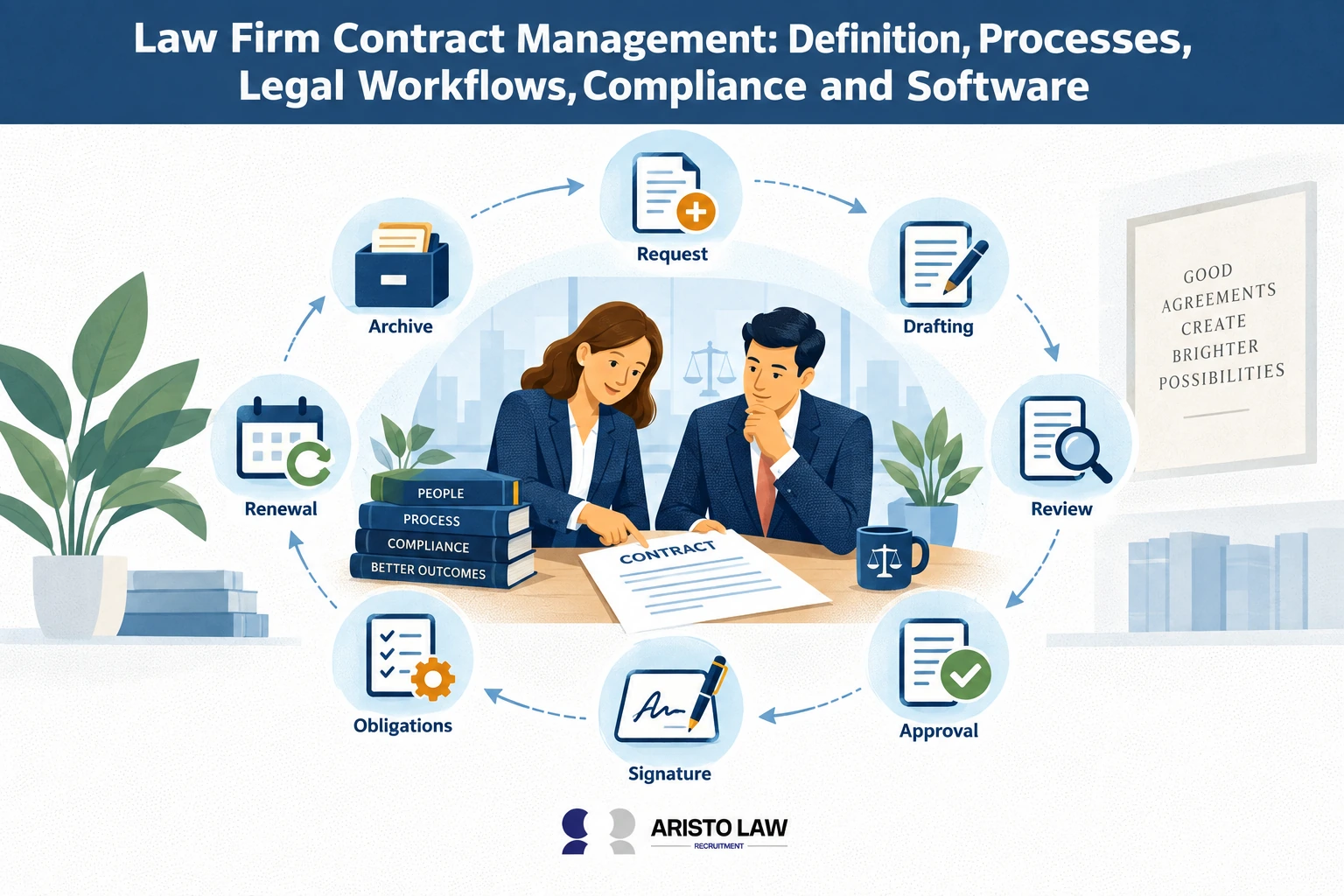
Law firm contract management is the structured process of
creating, reviewing, negotiating, executing, monitoring, and storing
contracts throughout their lifecycle. Contract management also
includes renewals and enforcement activities that support legal
operations, regulatory compliance, risk management, and business
performance.
Law firms manage a broad range of agreements, including client
engagement letters, vendor contracts, service agreements, employment
contracts, confidentiality agreements, referral agreements, software
subscriptions, partnership agreements, and commercial contracts.
Effective contract management ensures these agreements remain organized,
compliant, accessible, and aligned with firm objectives.
The contract lifecycle begins with contract drafting and legal
review, followed by negotiation, stakeholder approval, execution,
obligation tracking, performance monitoring, amendment management,
renewal evaluation, and contract closeout. These processes integrate
directly into legal workflows, case operations, document-management
systems, compliance programs, and business-administration functions.
Contract-management activities help attorneys, legal operations teams,
procurement professionals, finance departments, and firm leadership
maintain visibility into contractual commitments and operational
responsibilities.
Modern law firms increasingly rely on contract lifecycle management
(CLM) platforms, document repositories, workflow automation tools,
approval-routing systems, electronic-signature solutions, and reporting
dashboards. World Commerce & Contracting (WorldCC) research
reports that organizations lose approximately 8.6-9% of annual contract
value/revenue due to poor contract management practices, including
missed entitlements, invoicing errors, delayed delivery, disputes, and
failure to track obligations. This directly supports the claim
regarding reduced revenue leakage through improved contract
management.
Key benefits include improved operational efficiency, stronger
compliance oversight, enhanced risk reduction, better document
visibility, greater accountability, and more consistent legal workflows.
Contract management also supports audit readiness, obligation tracking,
regulatory adherence, and dispute prevention through centralized
governance and documentation controls.
Common challenges include tracking contractual obligations, managing
multiple versions of agreements, controlling approval bottlenecks,
maintaining regulatory compliance, monitoring renewal dates,
coordinating stakeholders, and ensuring contract data remains accurate
across systems. Without structured contract-management processes, firms
face increased risk of missed deadlines, compliance failures, financial
leakage, contract disputes, and operational inefficiencies.
Many firms supplement internal resources with outsourced
contract-management support. External contract managers, legal
operations specialists, and outsourced legal support providers help
firms manage contract administration, obligation monitoring, repository
maintenance, compliance tracking, reporting, and workflow coordination.
Outsourced support is particularly valuable when firms experience rapid
growth, high contract volumes, resource constraints, or specialized
compliance requirements.
Law firms can obtain contract-management services through internal
legal operations teams, dedicated contract managers, specialized
consultants, legal technology providers, and outsourced legal support
organizations such as Aristo Law. Provider selection depends on contract
volume, compliance complexity, technology requirements, operational
goals, and staffing capacity.
Aristolaw helps law firms manage contract management
processes, legal workflows, compliance tasks, and software-supported
agreement operations by providing outsourced support for contract review
coordination, clause tracking, renewal monitoring, compliance
documentation, agreement organization, and contract workflow management.
Hire
a Remote Contract Manager with Aristolaw. Aristolaw connects law
firms with outsourcing solutions that match trained contract management
staff to each contract process task, compliance workflow, renewal
responsibility, clause tracking duty, software update function, and law
firm agreement management needs.
Effective contract management strengthens law firm performance by
improving visibility, reducing risk, enhancing compliance, supporting
legal workflow automation, and creating scalable operational processes.
As contract volumes and regulatory requirements continue to increase,
structured contract-management programs provide law firms with greater
control, efficiency, and long-term operational stability.
What is law firm contract
management?
Law firm contract management is the process of creating,
reviewing, negotiating, organizing, and monitoring contracts throughout
their lifecycle. Contract management also involves enforcing
contractual obligations while ensuring legal compliance and operational
efficiency.
Law firm contract management governs how legal agreements are
created, reviewed, negotiated, executed, and monitored throughout their
lifecycle. Effective law firm contract management depends on structured
oversight, making contract
management and the importance of a contract manager
directly relevant to compliance, risk control, and contractual
performance.
A study by Tim Cummins, Sally Guyer, and the research team at
World Commerce & Contracting (2023) states that approximately 29% of
an organization’s workforce is involved in contract management
activities, demonstrating that contract management functions as
a core business-administration process that extends well beyond the
legal department. Within a law-firm environment, contract management
serves as both a legal operations function and a business-administration
function, helping firms maintain control over contractual obligations,
reduce risk, support compliance requirements, and improve visibility
into important legal and commercial relationships.
Law firms manage a diverse portfolio of agreements, including client
engagement letters, vendor contracts, software licensing agreements,
employment contracts, partnership agreements, referral agreements,
confidentiality agreements, professional-services agreements, office
leases, consulting contracts, and technology-service contracts.
Effective legal contract management ensures these agreements are drafted
appropriately, reviewed accurately, approved efficiently, executed
properly, and monitored throughout their active lifecycle.
The process extends beyond contract creation. Law firm contract
management includes obligation tracking, renewal monitoring, amendment
administration, performance oversight, compliance management, document
retention, reporting, and contract closeout activities. Firms must
monitor deadlines, payment obligations, service commitments,
confidentiality requirements, regulatory responsibilities, notice
periods, and renewal dates to avoid unnecessary risk and operational
disruption.
Contract management also plays an important role in client
relationships and risk mitigation. Engagement agreements establish the
scope of legal representation, billing arrangements, responsibilities,
and expectations between attorneys and clients. Proper oversight helps
ensure that contractual commitments are fulfilled while reducing the
likelihood of disputes, misunderstandings, and compliance failures.
As law firms grow, expand practice areas, adopt new technologies,
enter strategic partnerships, and increase operational complexity, the
number of contractual relationships increases. Larger contract volumes
create greater demands for tracking obligations, maintaining version
control, managing approvals, monitoring compliance requirements, and
coordinating stakeholders. Without structured contract-management
processes, firms face missed deadlines, contract disputes, financial
leakage, regulatory exposure, and administrative inefficiencies.
Modern contract management law practices frequently incorporate
contract lifecycle management systems, document repositories, workflow
automation tools, electronic-signature platforms, approval-routing
solutions, and reporting dashboards. These technologies improve
visibility, streamline administration, support audit readiness, and
reduce the manual effort associated with contract oversight.
Law firm contract management connects legal operations, compliance
oversight, business administration, client relationship management, risk
reduction, and organizational governance. By maintaining control over
contractual relationships throughout the entire contract lifecycle, law
firms improve operational consistency, strengthen compliance, protect
business interests, and create a more scalable foundation for long-term
growth.
Why is
contract management important for law firms?
Contract management is important for law firms because
contracts directly affect compliance obligations, client relationships,
financial performance, operational efficiency, and risk
exposure. Every law firm relies on contracts to govern
relationships with clients, employees, vendors, technology providers,
consultants, referral partners, landlords, and service providers.
Effective oversight of these agreements helps ensure that contractual
obligations are fulfilled, risks are controlled, and business operations
remain aligned with legal and regulatory requirements.
From a legal perspective, unmanaged contracts increase exposure to
liability, contractual disputes, confidentiality breaches, and
compliance failures. Client engagement letters, confidentiality
agreements, software licenses, employment contracts, and vendor
agreements contain obligations that must be monitored continuously.
Missed notice periods, overlooked termination clauses, expired
agreements, and unfulfilled commitments create legal disputes and
unnecessary financial exposure.
Poor contract management frequently leads to missed renewals,
duplicate agreements, version-control issues, approval delays, and
inefficient workflow coordination. Research by Tim Cummins,
Sally Guyer, and Mark David in 2024 states that organizations lose
approximately 9.2% of annual revenue because of poor contract management
practices, demonstrating the direct impact of contracts on
financial performance and risk exposure. Law firms that lack visibility
into contract status struggle to track obligations, monitor performance
requirements, and maintain accurate records.
Data-protection obligations represent another significant area of
concern. Many law firms maintain contracts that include confidentiality
requirements, cybersecurity commitments, privacy provisions, and
regulatory compliance obligations. Failure to monitor these requirements
create reputational damage, regulatory scrutiny, and potential legal
liability.
Contract management also plays a major role in financial performance.
Billing disputes, untracked pricing terms, missed renewal opportunities,
unnecessary vendor expenses, and overlooked contractual rights
negatively affect profitability. Effective contract oversight helps
firms maintain greater control over commercial relationships, payment
obligations, service commitments, and contract value.
Visibility is one of the most important benefits of structured legal
contract management. Centralized contract information allows firm
leadership, legal operations teams, and administrators to make
better-informed decisions based on accurate contractual data. Improved
visibility supports governance, resource planning, vendor management,
compliance monitoring, and strategic growth initiatives.
As law firms expand practice areas, add offices, increase staffing,
adopt new technologies, and manage larger volumes of contractual
relationships, contract management becomes increasingly important.
Strong contract-governance processes help maintain consistency, support
scalability, reduce administrative burden, and strengthen risk
management across the organization.
Ultimately, contract management supports law firm operations by
improving accountability, reducing legal and operational risk,
protecting profitability, strengthening compliance, and providing the
visibility necessary to manage contractual relationships effectively
throughout the contract lifecycle.
What types of
contracts do law firms manage?
Contracts law firms commonly manage include client engagement
agreements, confidentiality agreements, partnership agreements, and
service-provider contracts.
Listed below are 14 contracts law firms commonly manage.
-
Client Engagement Agreements: Client engagement
agreements define the attorney-client relationship, scope of
representation, billing arrangements, responsibilities, fee structures,
termination rights, and communication expectations. These contracts are
among the most important agreements a law firm manages because they
directly affect client services, professional liability exposure,
conflict-management requirements, and regulatory compliance
obligations. -
Vendor Contracts: Vendor contracts govern
relationships with suppliers that provide office equipment, technology,
marketing services, facilities support, records management, research
services, and other operational resources. Effective contract review and
management helps law firms control costs, monitor service levels, manage
vendor performance, and reduce operational disruptions. -
Software Agreements: Software agreements regulate
the use of practice-management systems, document-management platforms,
legal research databases, cybersecurity solutions, CRM platforms,
cloud-storage services, and productivity tools. These contracts contain
licensing terms, service-level commitments, data-security obligations,
privacy requirements, and renewal provisions that require ongoing
oversight. -
Employment Contracts: Employment agreements
establish compensation structures, job responsibilities, confidentiality
obligations, restrictive covenants, benefits arrangements, performance
expectations, and termination conditions for attorneys, paralegals,
administrators, and support staff. Proper management helps reduce
employment-related disputes and supports compliance with labor
regulations. -
Independent-Contractor Agreements: Law firms
frequently engage consultants, contract attorneys, freelance
professionals, technology specialists, investigators, and outsourced
support providers through independent-contractor agreements. These
contracts define project scope, payment terms, confidentiality
requirements, intellectual-property ownership, and contractor
responsibilities. -
Confidentiality Agreements: Confidentiality
agreements, non-disclosure agreements (NDAs), and information-protection
agreements help safeguard client information, proprietary business data,
trade secrets, litigation strategies, and sensitive firm records. These
contracts play a major role in risk management, data protection, and
professional responsibility compliance. -
Partnership Agreements: Partnership agreements
establish governance structures, ownership interests, profit-sharing
arrangements, voting rights, decision-making authority, succession
planning provisions, and partner responsibilities. These agreements help
maintain organizational stability and reduce internal disputes. -
Service-Provider Contracts: Service-provider
agreements govern relationships with accounting firms, marketing
agencies, outsourced legal support providers, consultants, technology
vendors, recruiters, and managed-service organizations. Contract
oversight helps ensure service quality, performance accountability, and
cost control. -
Office Lease Agreements: Lease contracts define
occupancy rights, rental obligations, maintenance responsibilities,
renewal options, operating expenses, and termination provisions. These
agreements have significant financial and operational implications for
law firms with physical office locations. -
Referral Agreements: Referral agreements regulate
relationships with other attorneys, law firms, professional-service
providers, and referral networks. These contracts contain compliance
requirements related to fee-sharing, professional responsibility rules,
and client disclosures. -
Technology-Service Agreements: Technology-service
contracts cover cybersecurity providers, cloud-hosting companies,
managed IT firms, telecommunications vendors, and software-support
providers. These agreements frequently include data-protection
requirements, uptime commitments, incident-response obligations, and
service-level agreements. -
Legal Research and Database Contracts: Law firms
maintain agreements with legal research providers, data vendors, and
subscription services. These contracts influence information access,
licensing rights, usage restrictions, and ongoing operational costs. -
Professional Liability and Insurance Agreements:
Insurance contracts establish coverage terms, policy limits, reporting
obligations, exclusions, and risk-transfer mechanisms. Proper management
helps ensure adequate protection against professional and operational
risks. -
Outsourced Legal Support Agreements: Contracts with
virtual legal assistants, contract managers, legal-process outsourcing
providers, and administrative-support organizations define service
scope, confidentiality obligations, performance standards, and
operational responsibilities.
Each contract category serves a different business purpose and
carries unique risk, compliance, and operational considerations.
Effective legal department contract management helps law firms maintain
visibility into these agreements, monitor obligations, reduce risk
exposure, support regulatory compliance, strengthen vendor and client
relationships, and improve overall operational efficiency.
How
do law firms use contract management in legal workflows?
Law firms use contract management to coordinate legal
workflows, monitor obligations, streamline approvals, manage risk, and
maintain contract visibility across departments and practice
areas. Rather than functioning as an isolated administrative
process, contract management serves as a central component of legal
operations that connects attorneys, legal assistants, contract managers,
compliance personnel, finance teams, procurement professionals,
technology administrators, and firm leadership through structured
workflows and shared contractual information.

Contract management begins during client onboarding, where engagement
agreements establish the scope of representation, billing arrangements,
confidentiality obligations, and client responsibilities. A
review by Md Nazrul Islam Khan, University of New Haven, published in
2022, examined 142 studies and found that legal technology and
structured contract management processes improve workflow efficiency,
strengthen compliance monitoring, enhance data governance, and support
risk management throughout the contract lifecycle. This reduces
administrative delays and improves compliance with
professional-responsibility requirements.
Billing workflows also depend heavily on effective contract
management. Fee agreements, payment schedules, alternative fee
arrangements, retainer provisions, reimbursement terms, and collection
procedures must be accurately documented and monitored. Contract
visibility helps finance teams track obligations, reduce billing
disputes, and maintain revenue consistency throughout the client
relationship.
Compliance reviews represent another major workflow dependency. Law
firms must monitor confidentiality obligations, data-protection
requirements, vendor commitments, cybersecurity provisions, regulatory
obligations, and professional-conduct standards contained within
contracts. Contract-management systems help compliance personnel
identify obligations, track deadlines, maintain documentation, and
support audit readiness.
Procurement decisions frequently involve contract review and approval
workflows that connect legal, finance, procurement, and operational
stakeholders. Vendor agreements, software licenses, technology-service
contracts, consulting arrangements, and office-service agreements
require coordinated review processes to ensure financial, operational,
legal, and compliance requirements are satisfied before execution.
Technology implementation projects rely on contract management to
oversee software subscriptions, cloud-service agreements, cybersecurity
contracts, data-processing agreements, and vendor-service commitments.
Structured oversight helps firms monitor service levels, renewal dates,
licensing obligations, and performance requirements while reducing
operational risk.
Vendor management workflows also benefit from centralized contract
visibility. Contract-management systems help firms track service-level
agreements, monitor vendor performance, manage renewals, document
amendments, and identify potential contractual issues before they affect
operations.
Throughout these workflows, attorneys focus primarily on legal
review, negotiation, risk analysis, and client representation. Contract
managers oversee lifecycle administration, obligation tracking,
performance monitoring, and workflow coordination. Legal assistants
support documentation, routing, record management, and communication
activities. Compliance personnel monitor regulatory requirements and
contractual controls. Finance teams manage payment obligations,
budgeting considerations, and financial reporting. Firm leadership
relies on contract reporting and analytics to support governance and
strategic decision-making.
Structured contract-management systems create significant operational
efficiencies by centralizing contract repositories, automating approval
routing, generating obligation reminders, maintaining audit trails,
improving document accessibility, and reducing manual administrative
work. These efficiencies help eliminate approval bottlenecks, strengthen
compliance oversight, improve stakeholder coordination, and provide
greater visibility into contractual relationships across the firm.
By integrating contract management into client onboarding, billing
operations, compliance reviews, procurement activities, technology
management, vendor oversight, and legal operations, law firms improve
workflow consistency, reduce risk exposure, strengthen governance, and
create a more scalable operational framework for managing contractual
relationships.
How
does contract management improve law firm efficiency?
Contract management improves law firm efficiency by reducing
administrative delays, improving contract visibility, automating
workflows, and strengthening compliance oversight. Law firms
manage large volumes of engagement agreements, vendor contracts,
software licenses, employment agreements, confidentiality agreements,
and service-provider contracts. Without structured contract workflows,
attorneys and staff spend significant time searching for documents,
tracking obligations manually, monitoring deadlines, and coordinating
approvals across multiple departments.
Centralized contract oversight improves efficiency by maintaining all
agreements within a searchable repository. This allows attorneys, legal
assistants, finance personnel, compliance teams, and firm leadership to
access accurate contract information quickly. Faster document retrieval
reduces time spent locating agreements and improves responsiveness
during audits, negotiations, compliance reviews, and client-service
activities.
Law firm contract management reduces administrative workload by
organizing contract creation, review, approval, and renewal workflows
into a structured process. Law firms improve document control and
compliance oversight through remote
contract manager services for law firms that support
contract tracking, deadline monitoring, and agreement lifecycle
management.
Contract management also streamlines intake processes and vendor
management workflows. Standardized templates, automated approval
routing, obligation tracking, and version-control systems reduce
duplication of effort and minimize administrative errors. Approval
bottlenecks are reduced because stakeholders receive automated
notifications, escalation alerts, and workflow reminders that keep
contracts moving through review and execution stages efficiently.
Renewal tracking and compliance reporting generate additional
operational benefits. Automated alerts help prevent missed deadlines,
overlooked notice periods, and unintended contract renewals.
Compliance-monitoring systems track obligations, reporting requirements,
service-level commitments, and regulatory responsibilities, reducing
manual oversight requirements and improving governance.
Stakeholder communication also becomes more efficient because
contract managers, attorneys, finance teams, procurement personnel, and
administrators work from the same contract data. This shared visibility
improves coordination, reduces miscommunication, and supports faster
decision-making.
By centralizing contract information, automating repetitive tasks,
improving workflow consistency, and strengthening contract governance,
contract management helps law firms utilize resources more effectively,
accelerate legal operations, improve compliance performance, and support
scalable growth across the organization.
How does
contract management support compliance?
Contract management supports compliance by monitoring
contractual obligations, regulatory requirements, reporting
responsibilities, and risk-control measures throughout the contract
lifecycle. Law firms operate within complex regulatory
environments that require continuous oversight of client-service
commitments, confidentiality obligations, data-protection requirements,
professional-responsibility standards, vendor agreements, employment
obligations, and contractual reporting duties. Effective contract
management helps ensure that these requirements are identified,
documented, tracked, and fulfilled consistently.
A study by Michael Bearman, Matt Lhoumeau, and industry
contract-management researchers in 2025 states that organizations using
advanced contract-management systems achieved a 356% ROI over three
years, largely because centralized visibility into contractual
obligations improved compliance monitoring, risk management, and
regulatory adherence. Key provisions such as notice periods,
service-level commitments, confidentiality clauses, insurance
requirements, data-security obligations, and regulatory reporting
deadlines are monitored through automated workflows, reminders, and
compliance-tracking tools. This visibility reduces the likelihood of
missed obligations and contractual breaches.
Audit readiness is another major benefit. Centralized repositories
maintain approval histories, amendments, communications, execution
records, compliance documentation, and audit trails that support
internal reviews, client audits, regulatory examinations, and governance
assessments. Accurate documentation improves accountability and
simplifies compliance verification processes.
Data-protection obligations have become increasingly important as law
firms manage sensitive client information and confidential records.
Contract-management systems help track privacy requirements,
cybersecurity commitments, vendor-security obligations, and
information-handling standards to support compliance with applicable
regulations and contractual commitments.
Vendor compliance monitoring also plays an important role. Law firms
rely on technology providers, consultants, outsourced service
organizations, and operational vendors that must satisfy contractual
performance and compliance standards. Contract oversight helps monitor
these obligations and identify potential issues before they affect
operations.
Internal governance controls are strengthened through approval
workflows, obligation tracking, compliance reporting, escalation
procedures, and periodic contract reviews. These mechanisms help firms
detect compliance risks early, implement corrective actions, and prevent
minor issues from developing into legal disputes, regulatory violations,
financial penalties, or operational disruptions.
By providing continuous monitoring, automated tracking, centralized
documentation, audit support, and proactive risk identification,
contract management strengthens contract compliance, improves legal
compliance performance, and helps law firms maintain effective
governance throughout the entire contract lifecycle.
What
challenges do law firms face with contract management?
Challenges law firms face with contract management include
contract volume growth, approval delays, obligation tracking failures,
and limited contract visibility.

Listed below are 15 challenges law firms face.
-
Contract Volume Growth: As law firms expand practice
areas, increase staffing, adopt new technologies, add vendors, and serve
more clients, the number of contracts grows. Higher contract volumes
increase administrative demands, create tracking challenges, and make
manual oversight less effective. Without scalable contract-management
processes, firms experience inefficiencies, missed obligations, and
increased operational risk. -
Fragmented Records: Contracts are frequently stored
across email systems, shared drives, local devices, document
repositories, and physical files. Fragmented storage makes agreements
difficult to locate, increases the risk of using outdated versions,
complicates audits, and reduces operational efficiency. Poor document
organization also limits collaboration and decision-making. -
Compliance Complexity: Modern law firms must manage
confidentiality obligations, privacy requirements, cybersecurity
provisions, professional-responsibility standards, employment
regulations, vendor commitments, and industry-specific compliance
obligations. Increasing regulatory requirements create additional
oversight demands and increase the risk of compliance failures when
obligations are not monitored effectively. -
Renewal Oversight: Many contracts contain renewal
dates, notice periods, renegotiation deadlines, and termination windows.
Firms that lack structured tracking systems frequently miss renewal
opportunities, allow unfavorable automatic renewals, or fail to
renegotiate important commercial terms. These oversights create
unnecessary costs and operational complications. -
Approval Delays: Contract approvals require input
from attorneys, firm leadership, compliance personnel, finance teams,
technology departments, and operational stakeholders. Manual approval
processes, unclear responsibilities, and inconsistent review procedures
create bottlenecks that slow negotiations, delay projects, and increase
administrative workload. -
Obligation Tracking Failures: Contracts frequently
contain deliverables, payment requirements, service commitments,
reporting obligations, performance milestones, and compliance
responsibilities. Failure to track these obligations result in
contractual breaches, missed deadlines, service failures, financial
penalties, and damaged business relationships. -
Limited Contract Visibility: When contract
information is not centralized, stakeholders lack visibility into
contract status, obligations, risks, performance metrics, and upcoming
deadlines. Limited visibility weakens governance, reduces
accountability, and makes proactive risk management more difficult. -
Version-Control Problems: Multiple contract drafts,
amendments, redlined documents, and stakeholder revisions create
confusion regarding which version is authoritative. Poor version control
increases negotiation errors, approval mistakes, and the risk of
executing incorrect agreements. -
Increasing Contract Complexity: Technology
agreements, data-processing contracts, cybersecurity provisions,
software licensing arrangements, outsourcing agreements, and regulatory
obligations have become increasingly complex. Managing sophisticated
contractual terms requires greater coordination, oversight, and
subject-matter expertise. -
Technology Integration Challenges: Many firms use
separate systems for document management, billing, CRM activities,
procurement, compliance tracking, and legal operations. Integrating
contract-management processes across these systems are difficult,
creating data inconsistencies and workflow inefficiencies. -
Audit and Documentation Requirements: Regulatory
reviews, client audits, compliance assessments, and internal governance
requirements demand detailed contract records and audit trails.
Incomplete documentation increases administrative burdens and creates
compliance risks. -
Vendor and Third-Party Risk Management: Law firms
depend on numerous vendors, software providers, consultants, and
outsourced service organizations. Monitoring contractual obligations,
security requirements, service-level commitments, and performance
standards across multiple third parties become increasingly difficult as
relationships expand. -
Resource Constraints: Attorneys and legal operations
teams frequently balance contract administration with client work,
compliance responsibilities, business development, and operational
management. Limited resources lead to delayed reviews, inconsistent
oversight, and increased contract-management risk. -
Communication and Stakeholder Coordination Issues:
Contract workflows involve legal teams, compliance personnel, finance
departments, technology staff, vendors, and firm leadership.
Miscommunication or lack of coordination delays approvals, create
misunderstandings, and increase administrative complexity. -
Risk Identification and Monitoring Difficulties:
Contractual risks involving liability provisions, indemnification
clauses, data-security obligations, service-level commitments, and
regulatory requirements remain unnoticed without structured monitoring
processes. Undetected risks become larger legal, financial, and
operational problems over time.
As law firms grow, adopt new technologies, manage more vendors, and
operate within increasingly regulated environments, these contract
management challenges become more significant. Structured legal contract
management systems, centralized repositories, workflow automation,
obligation tracking, and contract oversight processes help reduce risk,
improve compliance, strengthen visibility, and support more efficient
legal operations.
What
software is used for law firm contract management?
Software used for law firm contract management include
contract lifecycle management platforms, e-signature platforms, and
contract repositories.
Law firm contract management uses platforms that centralize contract
storage, approval workflows, obligation tracking, and version control
across the contract lifecycle. Law firm contract management also
integrates with legal
document automation software and tools to generate
standardized agreements, reduce drafting time, and maintain document
consistency.
Listed below are 13 software used for law firm contract
management
-
Contract Lifecycle Management (CLM) Platforms: CLM
platforms centralize contract activities from drafting and review
through negotiation, approval, execution, renewal, and termination.
These systems improve contract visibility, reduce administrative delays,
strengthen governance, and help law firms manage increasing contract
volumes more efficiently. By creating standardized workflows and
centralized oversight, CLM platforms support operational consistency and
risk reduction across legal operations. -
Document-Management Systems: Document-management
systems provide centralized storage and organization for contracts,
amendments, correspondence, and supporting records. These systems
improve document accessibility, reduce time spent searching for
agreements, strengthen version control, and support audit readiness.
Better document organization improves collaboration among attorneys,
legal assistants, contract managers, and administrative teams. -
Workflow-Automation Tools: Workflow-automation
solutions streamline contract reviews, approval routing, stakeholder
notifications, escalation procedures, and obligation tracking. Automated
workflows reduce bottlenecks, accelerate contract turnaround times,
improve accountability, and help law firms manage larger workloads
without proportionally increasing administrative resources. -
Compliance-Monitoring Solutions:
Compliance-monitoring systems track contractual obligations, regulatory
requirements, reporting commitments, renewal deadlines, service-level
agreements, and risk indicators. These tools help firms identify
compliance issues early, improve governance controls, reduce regulatory
exposure, and maintain stronger contract oversight throughout the
contract lifecycle. -
E-Signature Platforms: Electronic-signature
solutions accelerate contract execution by eliminating manual signing
processes. Faster execution reduces delays, improves client experience,
strengthens workflow efficiency, and supports geographically distributed
stakeholders. Digital execution processes also improve documentation
consistency and audit-trail visibility. -
Contract Repositories: Contract repositories serve
as centralized databases that maintain executed agreements, amendments,
renewal records, compliance documentation, and contract metadata.
Centralized repositories improve contract visibility, reduce
duplication, strengthen governance, and provide leadership with greater
insight into contractual obligations and risk exposure. -
Legal Practice-Management Systems: Many law firms
integrate contract-management activities into broader legal operations
platforms. These systems connect contract workflows with matter
management, billing, client records, deadlines, and legal operations,
improving coordination across departments and reducing information
silos. -
Document-Automation Software: Document-automation
platforms help generate contracts using approved templates, standardized
clauses, and preconfigured workflows. These systems improve consistency,
reduce drafting errors, accelerate contract creation, and support
quality-control initiatives. -
Reporting and Analytics Platforms: Reporting tools
provide visibility into contract performance, compliance metrics,
renewal schedules, approval timelines, obligation status, and
operational trends. Better reporting supports strategic decision-making,
resource planning, and risk-management activities. -
Collaboration and Communication Platforms:
Collaboration systems facilitate communication between attorneys,
contract managers, compliance personnel, vendors, finance teams, and
firm leadership. Shared visibility improves coordination, reduces
misunderstandings, and supports more efficient contract workflows. -
Risk-Management Platforms: Risk-management systems
help identify contractual vulnerabilities, monitor exposure areas, track
remediation efforts, and support governance initiatives. These tools
strengthen contract oversight and reduce the likelihood of legal,
financial, and operational issues. -
Vendor-Management Systems: Vendor-management
solutions help law firms monitor supplier agreements, service-level
commitments, renewal obligations, performance metrics, and compliance
requirements. Better vendor oversight improves operational reliability
and procurement efficiency. -
Cloud-Based Contract Platforms: Cloud-based systems
provide secure remote access to contracts and related documentation,
supporting distributed legal teams, multi-office firms, and remote-work
environments. These platforms improve accessibility, collaboration, and
operational scalability.
As contract volumes increase, legal contract management software
becomes increasingly important for maintaining visibility, reducing
risk, strengthening compliance, improving stakeholder collaboration, and
supporting scalable legal operations. By integrating contract workflows
with broader legal operations and governance processes, these
technologies help law firms manage contractual relationships more
efficiently while improving operational performance and control.
What
are the benefits of outsourced contract management support?
Benefits of outsourced contract management support include
cost efficiency, contract visibility, and administrative burden
reduction.

Listed below are the 15 benefits of outsourced contract management
support.
-
Cost Efficiency: Outsourced contract management
support helps law firms avoid the costs associated with recruiting,
training, compensating, and managing full-time contract-management
personnel. Firms gain access to experienced professionals without the
overhead associated with expanding internal teams. This approach
improves resource allocation and allows firms to invest more capital in
client services, technology, and growth initiatives. -
Operational Scalability: Contract volumes fluctuate
because of firm growth, new practice areas, mergers, technology
implementations, regulatory changes, and increased client activity.
Outsourced support allows firms to expand contract-management capacity
quickly without restructuring internal operations or adding permanent
staff. -
Compliance Support: Contract-management
professionals help monitor obligations, reporting requirements, renewal
deadlines, regulatory commitments, confidentiality provisions, and
governance controls. Strong compliance oversight reduces the risk of
missed obligations, audit findings, contractual breaches, and regulatory
issues. -
Workload Flexibility: Law firms frequently
experience temporary increases in contract activity related to vendor
transitions, office expansions, technology projects, client onboarding
initiatives, procurement programs, and compliance reviews. Outsourced
contract management provides additional support during peak workloads
without creating long-term staffing commitments. -
Contract Visibility: Outsourced professionals help
organize contract repositories, improve documentation practices,
maintain accurate records, track obligations, and generate reporting
insights. Improved visibility strengthens decision-making, governance,
and operational control across the contract lifecycle. -
Administrative Burden Reduction: Contract
administration requires substantial effort involving document
management, obligation tracking, renewal monitoring, stakeholder
coordination, reporting, and workflow management. Outsourcing these
responsibilities allows attorneys and internal staff to focus on
higher-value legal and strategic activities. -
Access to Specialized Expertise: Contract-management
specialists possess experience with contract lifecycle management,
compliance programs, risk monitoring, contract governance, workflow
optimization, and legal operations. Firms gain access to specialized
knowledge that do not exist internally. -
Support for Contract-Volume Growth: As contract
portfolios expand, manual processes become more difficult to manage.
Outsourced support helps firms maintain efficiency and oversight without
requiring proportional increases in internal staffing resources. -
Governance Improvements: Outsourced
contract-management professionals frequently implement structured
workflows, standardized procedures, approval controls, reporting
processes, and documentation standards. These improvements strengthen
accountability and contract governance across the organization. -
Resource Optimization: Attorneys, legal assistants,
compliance personnel, and administrative teams spend significant time on
contract-related administrative tasks. Outsourcing reallocates these
responsibilities to dedicated professionals, improving productivity and
allowing internal teams to concentrate on legal analysis, client
service, and business development. -
Faster Contract Processing: Dedicated
contract-management support improves contract turnaround times by
managing reviews, approvals, renewals, documentation, and stakeholder
communications more efficiently. Faster processing supports operational
performance and business responsiveness. -
Improved Risk Management: Outsourced professionals
help identify contractual risks, monitor compliance requirements, track
critical deadlines, and maintain contract controls. Strong oversight
reduces exposure to disputes, missed obligations, financial leakage, and
operational disruptions. -
Technology and Workflow Support: Many outsourced
providers have experience working with contract lifecycle management
platforms, document repositories, workflow-automation systems,
compliance-monitoring tools, and reporting solutions. This expertise
helps firms maximize the value of contract-management technology
investments. -
Business Continuity Support: Internal staffing
changes, employee absences, turnover, and resource constraints disrupt
contract-management activities. Outsourced support provides continuity
and helps maintain consistent contract oversight regardless of internal
workforce changes. -
Reduced Management Complexity: Building and
supervising an internal contract-management team requires ongoing
hiring, training, performance management, and operational oversight.
Outsourcing simplifies administration by shifting these responsibilities
to specialized service providers.
Outsourced contract management support provides the greatest
advantage when firms experience rapid growth, increasing contract
volumes, limited internal resources, complex compliance requirements,
technology transitions, or temporary workload surges.
In these situations, outsourced legal support helps improve
efficiency, strengthen governance, enhance compliance performance, and
maintain effective contract oversight without the expense and complexity
of building a larger internal contract-management function.
Where can
law firms get contract management services?
Law firms obtain contract management services through
internal legal operations teams, contract-management specialists, legal
outsourcing providers, and organizations such as Aristo Law.
The appropriate sourcing model depends on contract volume, operational
complexity, compliance requirements, staffing resources, and the firm’s
long-term growth objectives.
Many larger firms manage contracts internally through dedicated legal
operations teams, contract managers, compliance personnel, and
administrative professionals. This model provides direct oversight and
institutional knowledge but requires significant investment in staffing,
training, technology, and ongoing management. As contract volumes
increase, maintaining efficient internal processes become more
resource-intensive.
Some firms engage independent contract-management specialists or
consultants to support contract administration, compliance monitoring,
contract-review coordination, obligation tracking, renewal management,
reporting, and workflow optimization. This approach is commonly used
when firms need specialized expertise for specific projects, technology
implementations, compliance initiatives, or contract-management
improvements.
Legal outsourcing providers offer a more scalable solution by
supplying trained professionals who assist with contract administration,
repository management, compliance oversight, obligation monitoring,
document organization, reporting, stakeholder coordination, and contract
lifecycle support. Outsourced contract management allows firms to expand
operational capacity without hiring additional full-time employees.
Law firms obtain law firm contract management support through
specialized providers that manage contract drafting, review, negotiation
tracking, compliance monitoring, and lifecycle administration. Aristolaw
delivers law
firm contract management services that connect legal
teams with structured workflows for contract organization, obligation
tracking, and document control.
Managed legal operations providers deliver broader support that
combines contract management with workflow administration, compliance
processes, governance controls, reporting, technology coordination, and
legal operations management. These providers help firms standardize
procedures, improve visibility, and create more efficient
contract-management frameworks across departments and practice
areas.
When evaluating contract-management service providers, law firms
typically assess legal-industry expertise, familiarity with legal
workflows, compliance capabilities, contract-governance knowledge,
scalability, reporting standards, technology proficiency, workflow
integration capabilities, data-security controls, and operational
support depth. Firms also evaluate whether providers integrate with
existing document-management systems, contract repositories, CLM
platforms, compliance programs, and legal operations workflows.
Aristo Law helps law firms solve legal outsourcing challenges by
providing trained contract-management professionals who support contract
administration, compliance monitoring, legal workflows, and operational
efficiency across the contract lifecycle. Aristo Law assists firms with
contract tracking, obligation management, renewal oversight, document
organization, stakeholder coordination, compliance support, reporting
activities, and workflow administration. By connecting law firms with
experienced outsourced contract-management professionals, Aristo Law
helps reduce administrative burdens, improve contract visibility,
strengthen governance controls, and support scalable legal operations
without requiring substantial internal staffing expansion.
Through outsourced contract management and legal support services,
Aristo Law enables law firms to maintain stronger compliance, improve
operational consistency, reduce contract-related risk, and create more
efficient contract-management processes that support long-term business
performance and growth.
Build a legal support team that moves work forward.
Tell us what is slowing your practice down. We will help map the role, workflow, and support structure that fits.