
Virtual Receptionist for Law Firms: Legal Intake, Appointment Scheduling, and Client Communication

Practical guidance for building efficient, accountable legal support operations.

A virtual receptionist for law firms refers to a remote
client-communication and intake professional who manages incoming calls,
legal inquiries, appointment scheduling, and consultation
booking. A virtual receptionist for law firms also handles
message routing, client-service interactions, and communication support
on behalf of attorneys and legal staff.
Research by Julie Collado-Buaron (2026) states that 35% of
law firm calls go unanswered, highlighting why virtual receptionists are
used to improve responsiveness and ensure potential clients receive
immediate attention rather than reaching voicemail. Law firms
use virtual receptionists to improve responsiveness, strengthen client
experience, increase lead capture, and create more efficient intake
operations without the cost of maintaining full-time front-desk
staff.
Virtual receptionists serve as the first point of contact for
prospective and existing clients. Core responsibilities commonly include
legal intake, after-hours intake, appointment scheduling, call
answering, consultation coordination, message delivery, lead
qualification, client communication, and inquiry routing. These services
help law firms respond to potential clients quickly while maintaining
professional communication standards throughout the client journey.
Response speed plays a major role in legal lead conversion. Research
cited across legal marketing and sales-operations studies consistently
shows that prospects contacted quickly after an inquiry are more likely
to schedule consultations than prospects experiencing delayed responses.
A study by researchers at Harvard Business Review found that
organizations responding to leads within one hour were substantially
more likely to qualify prospects than organizations responding later.
This finding directly affects legal intake because prospective clients
contact multiple law firms before selecting representation.
Virtual receptionists differ from legal assistants and traditional
answering services. Legal assistants support broader legal workflows
such as document management, scheduling, billing coordination, and
administrative legal support. Traditional answering services focus only
on taking messages and forwarding calls. Virtual receptionists occupy a
middle ground by actively handling legal intake, consultation
scheduling, lead qualification, client communication, and appointment
management while maintaining attorney-approved intake procedures.
Solo attorneys and growing law firms benefit from virtual
receptionist services because missed calls frequently become lost
revenue opportunities. Virtual receptionists improve booking rates,
reduce missed leads, provide after-hours coverage, support multilingual
communication, and create scalable client-service capacity during growth
periods. Law firms also avoid many expenses associated with recruiting,
training, supervising, and maintaining in-house reception staff.
Modern virtual receptionist services integrate with technologies such
as VoIP phone systems, scheduling platforms, CRM software,
intake-management tools, call-tracking systems, document-sharing
platforms, and case-management applications. These integrations improve
workflow efficiency by connecting lead capture, consultation scheduling,
intake tracking, and attorney communication within a unified system.
Pricing models vary based on service scope and call volume. Common
options include per-minute billing, monthly subscription plans,
dedicated receptionist services, and hybrid intake-management packages.
Costs are generally influenced by call volume, after-hours coverage,
intake complexity, multilingual support requirements, and software
integrations. Compared with full-time in-house staffing, virtual
receptionist services provide greater operational flexibility and lower
overhead costs.
Popular virtual receptionist providers commonly offer legal-specific
call answering, intake management, appointment scheduling, and
lead-capture services. Law firms evaluating providers should consider
legal-industry experience, intake-training standards, confidentiality
controls, response quality, CRM integration capabilities, reporting
systems, scalability, after-hours availability, and consultation-booking
performance.
Aristo Law supports law firms through virtual receptionist services
and intake-management solutions designed to improve lead capture,
consultation scheduling, client communication, and intake coordination.
Aristo Law provides trained legal support professionals who assist with
call handling, appointment booking, intake workflows, CRM updates,
follow-up communication, and client-service operations while integrating
with broader law firm growth strategies.
Aristolaw helps law firms manage virtual receptionist
support, legal intake, appointment scheduling, and client communication
by providing outsourced support for call handling, lead screening,
client inquiries, consultation booking, follow-up tracking, and intake
workflow coordination. Call
Aristolaw +1 307 888 9491 for virtual receptionist and intake support
staffing. Aristolaw connects law firms with outsourcing
solutions that match trained virtual receptionist and intake support
staff to each client call task, appointment scheduling workflow, lead
response duty, intake communication function, and law firm client
service responsibility.
Virtual receptionists provide strategic value by connecting
marketing-generated inquiries with effective intake processes. Strong
legal intake, rapid response times, professional client communication,
and efficient appointment scheduling improve consultation conversion
rates, client satisfaction, operational efficiency, and long-term law
firm growth. As legal markets become increasingly competitive, virtual
receptionist services help law firms strengthen responsiveness, improve
intake performance, and maximize the value of every client inquiry.
Who is a virtual
receptionist for law firms?
A virtual receptionist for law firms is a remote legal intake
and client-communication professional who manages first-contact
interactions with prospective and existing clients. A virtual
receptionist captures lead information, schedules consultations, routes
messages, screens calls, and supports law firm intake workflows.

Research by Clio in 2024 states that 33% of law firms gained
1–2 additional leads per week after implementing virtual receptionist
services. A legal virtual receptionist functions as a
client-acquisition and intake resource that helps law firms convert
inquiries into consultations while maintaining a professional client
experience.
The role begins at the first point of contact. When prospective
clients call, submit inquiries, or seek information about legal
services, the virtual receptionist collects intake data, identifies the
nature of the legal matter, follows attorney-approved intake procedures,
and directs the inquiry to the appropriate attorney or team member. Call
screening helps prioritize urgent matters, while lead-capture processes
ensure that potential clients do not leave without entering the firm’s
intake system.
Consultation booking is another major responsibility. Virtual
receptionists coordinate calendars, schedule appointments, confirm
consultations, send reminders, and help reduce no-show rates. Message
routing ensures attorneys receive relevant communications quickly, while
after-hours communication services help law firms capture inquiries that
arrive outside normal business hours. These functions improve
responsiveness and prevent missed opportunities that occur when calls go
unanswered.
Client experience management remains a central part of the role.
Legal prospects frequently evaluate a law firm’s professionalism,
responsiveness, and reliability during the first interaction. Slow
responses, unanswered calls, poor communication, or disorganized intake
processes reduce consultation rates and damage trust. Well-structured
reception workflows create positive first impressions, improve lead
conversion, and support long-term law firm growth by ensuring that every
inquiry receives prompt attention.
A virtual receptionist differs from a traditional receptionist
because services are delivered remotely and supported by integrated
technologies such as VoIP systems, CRM platforms, intake software,
scheduling tools, and case-management applications. A virtual
receptionist also differs from a call center because the focus is on
legal intake, consultation coordination, lead qualification, and client
communication rather than high-volume generic call handling. The role
differs from that of a legal assistant as well. Legal assistants support
broader administrative and legal workflows such as document management,
billing coordination, scheduling, and case support, whereas virtual
receptionists primarily focus on intake and communication workflows at
the front end of the client-acquisition process.
By improving legal intake, consultation scheduling, call handling,
after-hours coverage, lead capture, and client communication, a law firm
receptionist operating virtually helps strengthen consultation rates,
improve client trust, reduce missed opportunities, and create a more
scalable client-acquisition system for growing law firms.
Why do law firms use
virtual receptionists?
Law firms use virtual receptionists to improve
responsiveness, capture more leads, reduce missed calls, and maintain
consistent client communication. Many law firms face
operational challenges that make it difficult for attorneys and legal
staff to answer every call, respond to every inquiry, and manage every
intake request in real time.
Attorneys spend portions of the day in court, client meetings,
depositions, negotiations, hearings, or case preparation activities,
limiting their availability to handle incoming communications. When
calls go unanswered or inquiries receive delayed responses, potential
clients frequently contact competing firms, resulting in lost
consultation opportunities and reduced client acquisition.
Missed inquiries and after-hours calls are among the most common
reasons firms adopt virtual receptionist services. Legal consumers seek
assistance during stressful or time-sensitive situations and expect
prompt responses. Prospective clients involved in accidents, criminal
matters, family disputes, immigration concerns, or employment issues
contact multiple attorneys before choosing representation. A virtual
receptionist helps ensure these inquiries receive immediate attention,
even when attorneys are unavailable.
Legal intake bottlenecks also create demand for virtual receptionist
support. A study by Jack Newton, Joshua Lenon, and George
Psiharis in the 2024 Clio Legal Trends Report states that only 40% of
law firms answer incoming calls from prospective clients, down from 56%
in 2019, and only 20% of firms return missed calls. Nearly 48%
of firms are effectively unreachable by phone, creating intake
bottlenecks that increase the need for virtual receptionist and intake
support services. Consultation scheduling, lead screening, intake data
collection, message routing, and appointment coordination require
consistent administrative attention.
Without structured intake workflows, law firms experience delayed
follow-up, scheduling conflicts, incomplete intake records, and reduced
consultation conversion rates. Virtual receptionists streamline these
processes by managing first-contact interactions and ensuring inquiries
move efficiently through the intake system.
Client-service expectations continue to increase as consumers become
accustomed to fast and convenient communication. Prospective clients
expect quick responses, professional interactions, clear next steps, and
reliable follow-up. Virtual receptionists help law firms meet these
expectations by providing consistent client communication, appointment
confirmations, reminder systems, and after-hours coverage.
Staffing costs represent another important consideration. Hiring,
training, managing, and retaining full-time in-house reception staff
requires ongoing payroll expenses, benefits, office space, equipment,
and supervision. Virtual receptionist services provide scalable client
communication systems without many of these fixed overhead costs. Solo
attorneys ofen use virtual receptionists to create professional intake
coverage without hiring full-time staff, while growing firms use them to
handle increasing call volumes, consultation requests, and client
communications without continuously expanding administrative teams.
By supporting legal intake, consultation scheduling, lead capture,
after-hours communication, and client-service operations, virtual
receptionists help law firms improve responsiveness, increase
consultation opportunities, strengthen client satisfaction, and create
more efficient law firm operations.
How does a
virtual receptionist work for a law firm?
A virtual receptionist works for a law firm by managing
inbound communications, client interactions, appointment scheduling,
intake workflows, and administrative tasks through remote communication
systems. The process begins when a prospective client calls the
law firm, submits a website inquiry, initiates a live chat conversation,
or contacts the firm through another communication channel. Instead of
the inquiry going unanswered, reaching voicemail, or interrupting
attorney workflow, the virtual receptionist responds promptly and serves
as the first point of contact.
During the initial interaction, the virtual receptionist gathers
basic information, identifies the nature of the inquiry, documents
contact details, and follows attorney-approved intake procedures.
Depending on the firm’s workflow, the receptionist collects preliminary
case information, determines urgency levels, identifies practice-area
relevance, and prepares information needed for conflict-check processes.
Intake information is then entered into CRM systems, intake software, or
case-management platforms to maintain accurate records and support
lead-tracking workflows.
Once intake is completed, the virtual receptionist coordinates
consultation scheduling by accessing attorney calendars, identifying
available appointment times, booking consultations, sending
confirmations, and delivering automated reminders. This reduces
scheduling friction and improves consultation attendance rates. If
immediate attorney involvement is required, the receptionist follows
predefined escalation procedures to notify the appropriate attorney or
staff member.
Throughout the process, phone systems, CRM platforms, intake
software, scheduling applications, case-management systems, and
communication tools work together to create a seamless workflow. Client
information is documented, communications are tracked, appointments are
managed, and follow-up activities are recorded within integrated
systems.
Attorney availability management is another important function.
Virtual receptionists monitor schedules, route calls according to
availability rules, prioritize urgent matters, and ensure that routine
inquiries are handled efficiently without disrupting legal work. When
attorneys are unavailable because of court appearances, meetings,
travel, or client consultations, the receptionist maintains
communication continuity and prevents inquiry loss.
Follow-up communication includes appointment reminders,
intake-document requests, status updates, message delivery, consultation
confirmations, and administrative communications. These activities help
maintain responsiveness and improve client experience throughout the
intake journey.
For existing clients, virtual receptionists route messages,
coordinate communications, update contact information, and assist with
appointment management. For prospective clients, the focus remains on
lead capture, intake coordination, consultation booking, and efficient
handoff to attorneys.
Through structured client-handling procedures, workflow escalation
protocols, integrated technology systems, and continuous communication
management, virtual receptionists help law firms improve responsiveness,
reduce missed opportunities, increase consultation bookings, strengthen
client service, and maintain efficient law firm telephone-answering
operations without requiring additional in-house reception staff.
What
are the benefits of a virtual receptionist for law firms?
Benefits of a virtual receptionist for law firms include
improved client responsiveness, operational scalability, and better
attorney productivity.
Listed below are 17 benefits of a virtual receptionist for law
firms.
-
Improved Client Responsiveness: Virtual
receptionists ensure that calls, inquiries, and consultation requests
receive prompt attention. Faster response times improve client
satisfaction, strengthen first impressions, and increase the likelihood
that prospective clients remain engaged with the firm rather than
contacting competitors. -
Reduced Missed Calls: Unanswered calls frequently
result in lost revenue opportunities. Virtual receptionists provide
consistent call coverage during business hours, after hours, weekends,
and attorney absences, helping firms capture inquiries that might
otherwise be lost. -
Higher Lead-Conversion Rates: Immediate engagement
with prospective clients improves consultation-booking opportunities.
Structured intake processes, professional communication, and rapid
follow-up help move prospects from inquiry to consultation more
efficiently. -
Lower Staffing Costs: Virtual receptionist services
cost substantially less than maintaining full-time in-house reception
staff. Firms avoid many expenses associated with salaries, benefits,
payroll taxes, office space, equipment, recruiting, and training. -
Operational Scalability: Call volume fluctuates
because of marketing campaigns, litigation surges, seasonal demand, and
business growth. Virtual receptionist services allow firms to increase
communication capacity without hiring additional internal staff. -
Better Attorney Productivity: Attorneys frequently
lose valuable time responding to routine calls, scheduling requests, and
administrative interruptions. Virtual receptionists handle these
responsibilities, allowing attorneys to focus on legal analysis, client
representation, negotiations, and billable work. -
Improved Client Retention: Consistent communication
helps maintain stronger client relationships. Clients who receive timely
responses, appointment reminders, and professional service are more
likely to remain satisfied throughout the legal engagement. -
Enhanced Lead Capture: Virtual receptionists collect
inquiry details, document contact information, coordinate intake
procedures, and route qualified leads appropriately. Better lead capture
reduces intake leakage and increases client-acquisition
opportunities. -
Greater Consultation Booking Efficiency:
Consultation scheduling, calendar coordination, reminders, and
appointment confirmations help reduce scheduling friction and increase
consultation attendance rates. -
Administrative Workload Reduction: Receptionists
manage communication-intensive tasks such as message routing,
appointment scheduling, intake coordination, and inquiry handling. This
reduces administrative pressure on attorneys and legal staff. -
Business Continuity Support: Virtual receptionist
services help maintain communication coverage during employee absences,
staff turnover, emergencies, weather disruptions, and unexpected
workload increases. -
Staffing Flexibility: Law firms gain access to
professional communication support without committing to permanent
staffing levels. Firms adjust coverage requirements as operational needs
change. -
After-Hours Client Coverage: Many legal inquiries
occur outside standard business hours. Virtual receptionists provide
extended availability that helps firms capture prospective clients when
competitors are unavailable. -
Improved Client Experience: Professional call
handling, prompt responses, and organized communication workflows create
a more positive client journey from initial inquiry through consultation
and retention. -
Stronger Firm Reputation: Communication quality
influences how prospective clients perceive a law firm. Consistent
responsiveness and professional interactions contribute to positive
reviews, referrals, and brand reputation. -
Increased Revenue Opportunities: Every captured
call, scheduled consultation, and retained client creates potential
revenue. Improved responsiveness and intake performance generate returns
that exceed the cost of receptionist services. -
Support for Firm Growth: As firms expand into new
markets, add attorneys, or increase marketing investments, virtual
receptionists provide scalable communication infrastructure that
supports sustainable growth without proportional increases in internal
staffing.
Reception quality directly affects client acquisition, client
retention, firm reputation, and overall law-firm efficiency. By
improving responsiveness, strengthening intake workflows, reducing
missed opportunities, and supporting consistent client communication,
virtual receptionists help law firms create stronger operational
foundations and increase long-term growth potential.
Why
do law firms lose clients without a professional receptionist?
Law firms lose clients without a professional receptionist
because delayed responses, unanswered calls, missed intake
opportunities, and poor client communication create barriers to
engagement. During the decision-making process, the quality and
speed of the first interaction frequently influence whether a prospect
schedules a consultation or moves on to a competitor.
A study by Mark Britton, Sarah Hurlburt, and Mike Sims
published in 2024 states that 78.9% of legal consumers who ultimately
hired a lawyer contacted more than one attorney before making their
hiring decision. Prospective legal clients contact multiple law
firms before deciding whom to hire, particularly when facing urgent
legal issues involving personal injury, family disputes, criminal
charges, immigration concerns, employment matters, or business
conflicts.
One of the most common causes of client loss is unanswered calls.
When prospective clients encounter voicemail, busy signals, long hold
times, or delayed callbacks, many continue contacting other firms rather
than waiting for a response. Every missed call represents a potential
missed consultation and a lost client-acquisition opportunity. Law firm
answering service and attorney call-answering systems help reduce this
problem by ensuring inquiries receive immediate attention.
Consultation delays create another challenge. Even when a prospect
reaches the firm, slow scheduling processes, unclear next steps,
incomplete intake procedures, and delayed follow-up reduce conversion
rates. Intake bottlenecks cause prospects to lose confidence in the
firm’s responsiveness and professionalism before speaking with an
attorney.
Communication quality also affects trust-building. Legal consumers
are experiencing stressful, time-sensitive situations and want
reassurance that their matter is receiving attention. Poor
communication, inconsistent follow-up, and administrative confusion
signal operational problems and weaken confidence in the firm’s ability
to handle the case effectively.
Competitor response advantages frequently determine who wins new
business. If one firm responds immediately, conducts intake efficiently,
and schedules a consultation promptly while another takes hours or days
to respond, the faster firm secures the opportunity. Responsiveness
becomes a competitive advantage in crowded legal markets where many
firms offer similar services.
Communication failures also increase client-acquisition costs. Law
firms invest resources in SEO, paid advertising, referrals, content
marketing, and lead-generation campaigns. When inquiries are missed or
mishandled, marketing dollars generate fewer retained clients, reducing
overall return on investment. Lead leakage caused by poor intake
management damages profitability more than marketing deficiencies
themselves.
Over time, these issues affect long-term business growth. Reduced
consultation volume, lower conversion rates, weaker client experiences,
fewer referrals, and missed revenue opportunities limit a firm’s ability
to expand. Professional receptionist services help prevent these
outcomes by ensuring consistent communication, efficient intake
management, prompt response times, and a positive first-contact
experience that strengthens client acquisition and supports sustainable
law-firm growth.
Are
virtual receptionist services cost-effective for law firms?
Yes, virtual receptionist services are cost-effective for law
firms because they reduce staffing overhead while improving client
intake efficiency and availability. Compared with hiring an
in-house receptionist, virtual receptionist services eliminate or reduce
expenses associated with salary, payroll taxes, employee benefits,
recruiting, onboarding, office space, equipment, software licensing, and
ongoing training. These savings are particularly valuable for solo
attorneys and small law firms that require professional client
communication but do not have sufficient call volume to justify a
full-time receptionist.
The financial value extends beyond direct cost reduction. Virtual
receptionists provide consistent call handling, appointment scheduling,
client intake coordination, message management, and lead-capture support
that help prevent missed opportunities. A study by Mark Britton,
Sarah Hurlburt, and Mike Sims in 2024 states that 78.9% of legal
consumers who ultimately hired a lawyer contacted more than one attorney
before making their hiring decision, and only 11% hired the first
attorney they contacted. This supports the claim that prospective
clients shop among multiple firms. Research within legal intake
and client-acquisition operations has found that many firms capture only
a fraction of inbound leads when structured intake systems are absent,
whereas organized intake processes supported by outsourced or automated
reception systems improve lead-conversion rates and client retention
outcomes.
Operational gains also contribute to cost-effectiveness. Virtual
receptionist services provide extended-hours or 24/7 call coverage,
helping firms capture inquiries that occur outside traditional business
hours. Improved responsiveness reduces voicemail abandonment,
strengthens client experience, and increases consultation-booking
opportunities. Many services also integrate with legal CRM systems,
intake platforms, scheduling software, and case-management systems,
creating more efficient workflows and reducing administrative burdens on
attorneys and support staff.
The return on investment varies by firm size and call volume. Solo
attorneys benefit because virtual receptionists provide professional
communication support without the expense of a full-time employee. Small
firms gain flexibility by scaling call coverage as demand changes.
Mid-sized firms frequently use virtual receptionist services to
supplement internal staff, manage higher inquiry volumes, and maintain
service quality during growth periods.
Scalability is another major advantage. Many providers offer
pay-per-use, per-call, per-minute, or monthly subscription pricing
models, allowing firms to align costs with actual demand rather than
maintaining fixed staffing expenses. During marketing campaigns,
litigation surges, seasonal fluctuations, or expansion initiatives,
firms increase coverage without hiring additional employees.
From a law firm operations perspective, the greatest value comes from
the combination of lower overhead, stronger lead capture, improved
intake conversion, better client communication, and greater staffing
flexibility. When properly integrated into client intake systems and
legal workflow processes, virtual receptionist services frequently
generate efficiency gains and revenue opportunities that outweigh the
service cost, making them a cost-effective legal services outsourcing
solution for many law firms.
What
services do virtual receptionists provide for law firms?
Services virtual receptionists provide for law firms include
call answering, message taking, lead qualification, and after-hours
support.
A virtual receptionist manages call handling, appointment scheduling,
client intake coordination, and communication routing to support
front-office legal operations. Virtual
intake specialist services extend the capabilities of a
legal virtual receptionist by collecting case information, qualifying
leads, and preparing prospective client data for attorney review.
Listed below are 16 services virtual receptionists provide for law
firms.
-
Call Answering: Call answering ensures that
prospective clients, existing clients, courts, vendors, and referral
sources reach a live representative rather than voicemail. This reduces
missed opportunities, improves responsiveness, and creates a stronger
first impression that supports client acquisition and retention. -
Legal Intake Support: Legal intake support helps
capture and organize prospective-client information before attorney
involvement. Virtual receptionists gather contact details, identify
legal needs, document inquiry information, and route leads into
structured intake workflows. This improves intake efficiency and
increases consultation opportunities. -
Appointment Scheduling: Consultation scheduling
eliminates administrative burdens associated with managing attorney
calendars. Virtual receptionists coordinate appointment times, send
confirmations, process rescheduling requests, and deliver reminders that
improve consultation attendance and reduce scheduling conflicts. -
Client Communication Management: Consistent
communication helps maintain strong client relationships. Virtual
receptionists respond to routine inquiries, coordinate follow-up
communications, relay information, and ensure clients receive timely
updates throughout the intake and onboarding process. -
Call Screening: Call screening helps attorneys avoid
unnecessary interruptions by categorizing calls based on urgency,
purpose, and relevance. Important client matters receive prompt
attention while routine inquiries are managed efficiently through
established procedures. -
Message Taking: Professional message management
ensures that attorneys receive accurate, organized, and actionable
information. Detailed message documentation improves communication
continuity and reduces the risk of missed follow-ups. -
Lead Qualification: Lead qualification helps law
firms identify prospective clients that align with practice-area
requirements and intake criteria. Virtual receptionists gather
preliminary information, assess inquiry relevance, and support
consultation-booking workflows that improve lead-conversion
efficiency. -
After-Hours Support: Many legal inquiries occur
outside normal business hours. After-hours coverage captures calls
during evenings, weekends, holidays, and attorney absences, helping
firms secure opportunities that might otherwise be lost. -
Client Onboarding Coordination: Virtual
receptionists assist with onboarding activities by collecting required
information, coordinating intake documentation, explaining next steps,
and helping prospective clients transition smoothly into the firm’s
intake process. -
Attorney Calendar Management: Managing attorney
availability, coordinating meetings, tracking scheduling changes, and
maintaining organized calendars improves operational efficiency and
reduces administrative disruptions. -
Call Routing: Call-routing services ensure inquiries
reach the appropriate attorney, department, or staff member. Efficient
routing improves response times and reduces communication bottlenecks
throughout the organization. -
Urgent Message Handling: Time-sensitive matters
require immediate attention. Virtual receptionists identify urgent
communications and follow escalation procedures to notify attorneys or
designated staff members quickly. -
Consultation Booking Support: Virtual receptionists
guide prospective clients from initial inquiry through consultation
scheduling, helping remove barriers that reduce conversion rates. -
Follow-Up Communication: Appointment reminders,
intake-document requests, consultation confirmations, and administrative
follow-ups help maintain engagement and reduce appointment
abandonment. -
CRM and Intake System Updates: Many virtual
receptionists update CRM platforms, intake systems, and client records,
helping maintain accurate data and improving visibility into lead and
client activity. -
Communication Continuity: Consistent communication
coverage ensures that clients and prospects receive timely responses
regardless of attorney availability, workload fluctuations, or office
staffing limitations.
Each of these virtual receptionist services addresses common
operational challenges within law firms. By improving intake capture,
strengthening lead conversion support, coordinating client onboarding,
managing attorney schedules, handling urgent communications, and
maintaining communication continuity, virtual receptionists improve
client experience, increase attorney productivity, support
business-development objectives, and strengthen overall law-firm
efficiency.
How
do virtual receptionists handle appointment scheduling for law
firms?
Virtual receptionists handle appointment scheduling for law
firms by acting as an external front desk that manages client bookings,
calendar coordination, and intake communication in real time.
The process begins when a prospective client contacts the law firm
through a phone call, website form, live chat, text message, or email.
The virtual receptionist responds promptly, gathers the client’s contact
information, identifies the legal issue, and follows attorney-approved
intake procedures to determine whether the inquiry aligns with the
firm’s practice areas.
A virtual receptionist for law firms manages appointment scheduling
by coordinating calendars, confirming availability, and reducing
scheduling conflicts across legal teams. Virtual
legal secretary services complement a legal virtual
receptionist by handling scheduling administration, calendar updates,
and appointment-related client communication.
After collecting preliminary information, the virtual receptionist
verifies client details and performs basic intake screening. This
includes identifying the type of legal matter, assessing urgency,
gathering essential case information, and determining whether the
prospect meets the firm’s intake criteria. Many law firms use this
screening process to ensure that attorney consultation time is reserved
for qualified leads.
Once the inquiry is qualified, the virtual receptionist accesses
shared calendars through platforms such as Google Calendar, Clio,
MyCase, or other legal practice-management systems. Available
consultation times are identified based on attorney schedules, court
appearances, meetings, and existing appointments. The receptionist then
books the consultation directly into the calendar system, preventing
scheduling conflicts and maintaining accurate attorney availability.
Following appointment booking, confirmation messages are sent through
email, text message, or phone call. Many virtual receptionists also
distribute intake forms, document requests, consultation instructions,
and meeting details. Automated reminder systems are commonly used to
reduce no-show rates and improve consultation attendance.
If a client needs to change an appointment, virtual receptionists
handle rescheduling requests, update calendars, issue revised
confirmations, and coordinate availability changes. Cancellations are
also processed and documented to maintain accurate scheduling
records.
Integration with legal CRM systems and law-firm software improves
efficiency throughout the process. Client information, consultation
status, intake records, communication history, and scheduling activity
are automatically recorded within platforms such as Clio, MyCase, and
legal CRM systems. This integration reduces duplicate data entry,
improves organization, and strengthens workflow visibility.
Research by James Oldroyd, Kristina McElheran, and David
Elkington published in 2011 states that organizations responding to
inbound inquiries within five minutes were 21 times more likely to
qualify a lead and 100 times more likely to make contact than
organizations that waited 30 minutes or longer. Faster
scheduling, immediate intake engagement, and streamlined communication
workflows help law firms reduce lead leakage and maximize marketing
return on investment.
By handling intake screening, appointment booking, calendar
management, confirmations, reminders, rescheduling requests,
cancellations, and CRM updates, virtual receptionists reduce
administrative burdens on attorneys while improving client experience,
consultation conversion rates, and overall law-firm operational
efficiency.
Can a
virtual receptionist answer calls after business hours?
Yes, a virtual receptionist can answer calls after business
hours by providing evening, weekend, holiday, and overflow call coverage
for law firms. This extended availability helps law firms
maintain communication continuity when attorneys and in-house staff are
unavailable, ensuring that important calls do not go unanswered during
evenings, weekends, holidays, or other non-business periods.
After-hours coverage is particularly valuable because many legal
prospects seek assistance during stressful or time-sensitive situations.
Individuals involved in accidents, arrests, family disputes, employment
issues, immigration concerns, or urgent business matters begin searching
for legal help outside traditional office hours. When a law firm relies
solely on voicemail, these prospects contact competing firms that offer
immediate responses. A virtual receptionist helps capture these
inquiries by answering calls live, gathering information, documenting
concerns, and initiating intake workflows.
The process involves receiving incoming calls, collecting client
details, identifying the nature of the legal issue, assessing urgency
levels, and following attorney-approved procedures. Routine inquiries
are documented and forwarded for follow-up during business hours, while
urgent matters are escalated according to predefined protocols. This
structure allows law firms to remain accessible without requiring
attorneys to monitor calls continuously.
After-hours answering strategies also support weekend and holiday
coverage. Prospective clients frequently conduct online research and
contact law firms when they are available rather than when the firm is
open. Capturing these inquiries improves lead-generation performance and
increases consultation-booking opportunities. Many firms view
after-hours coverage as a competitive advantage because responsiveness
influences which attorney a prospect chooses to contact first.
For existing clients, extended communication coverage improves
service quality by ensuring that messages are received, documented, and
routed appropriately. Clients gain reassurance that their concerns are
being acknowledged even when immediate attorney availability is
limited.
Many 24/7 law firm answering service providers integrate with CRM
systems, intake platforms, scheduling software, and case-management
systems. This integration helps maintain accurate records, improves
workflow continuity, and reduces administrative delays when attorneys
return to the office.
Client expectations have also evolved. Many consumers expect
immediate communication, rapid responses, and convenient access
regardless of the time of day. Firms that provide after-hours answering
service law firm coverage improve accessibility, strengthen client
experience, reduce missed opportunities, and support higher
lead-conversion rates.
By combining live call answering, emergency inquiry handling, weekend
coverage, holiday support, lead capture, and structured intake
procedures, attorney live answering service solutions help law firms
maintain continuous availability and maximize client-acquisition
opportunities beyond standard business hours.
How
does a virtual receptionist improve law firm efficiency?
A virtual receptionist improves law firm efficiency by
reducing administrative burdens, streamlining communication workflows,
and allowing attorneys to focus on billable legal work. In many
law firms, daily operations are disrupted by frequent phone calls,
appointment requests, intake inquiries, scheduling changes, message
management, and client follow-up activities. Although these tasks are
necessary for maintaining client relationships and supporting business
development, they interrupt attorneys during legal research, case
preparation, negotiations, court appearances, and client
consultations.
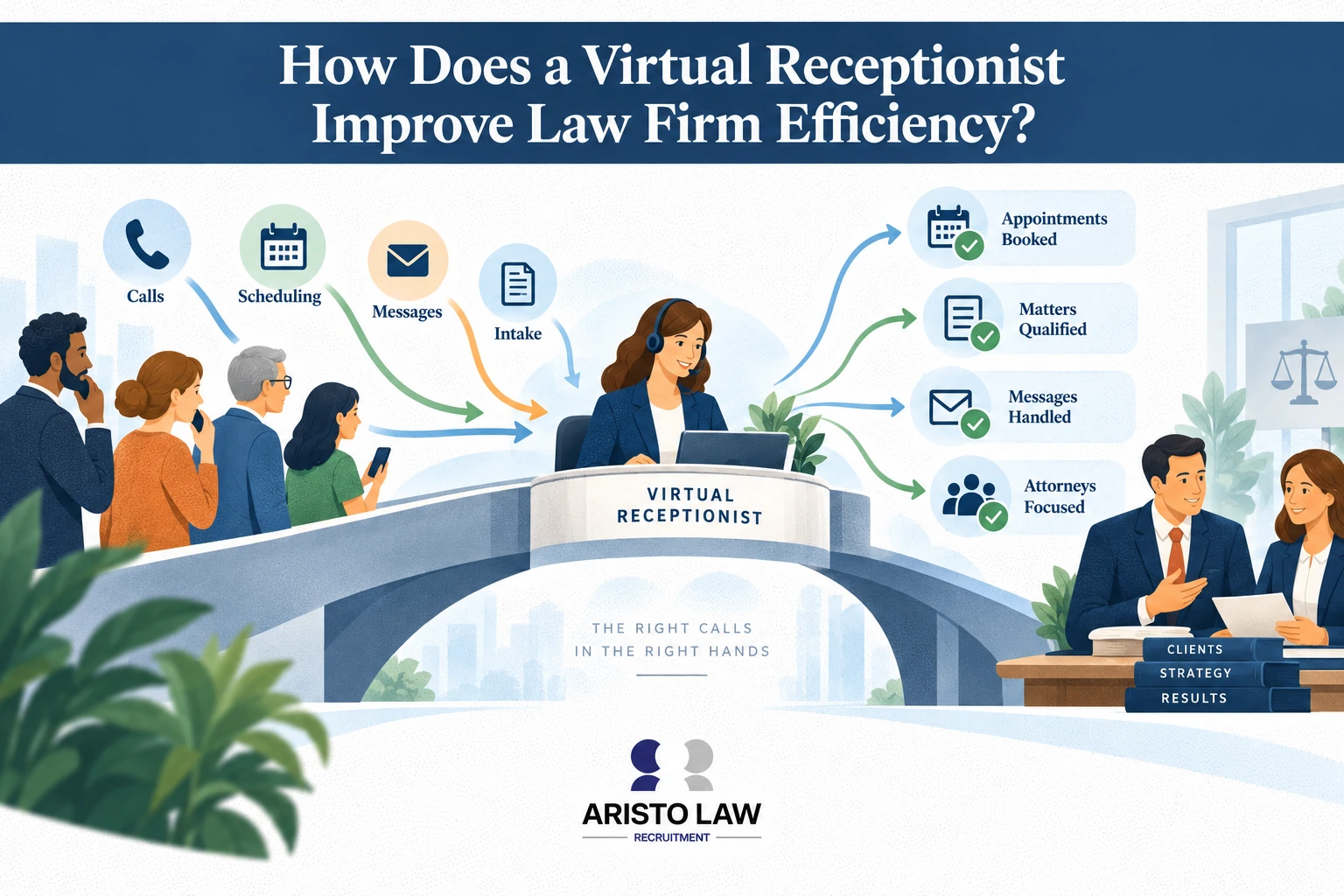
A virtual receptionist manages call intake, appointment scheduling,
and client routing, reducing administrative bottlenecks across daily
operations. Consistent communication handling by a virtual receptionist
supports workflow
efficiency in law firms through faster response times
and improved task coordination.
One of the largest efficiency gains comes from reducing call
interruptions. Without a structured communication system, attorneys and
legal staff frequently stop substantive work to answer calls, respond to
inquiries, or coordinate appointments. These interruptions create
task-switching costs that reduce concentration, slow workflow progress,
and decrease productivity. A virtual receptionist serves as a
centralized communication hub, ensuring that calls are answered
professionally while only escalating matters that require attorney
attention.
Intake administration is another area where operational improvements
occur. Virtual receptionists collect prospective-client information,
document inquiry details, coordinate intake procedures, and route
qualified leads into established workflows. This reduces administrative
workload while improving consistency in client onboarding and lead
management processes.
Scheduling responsibilities also consume significant time in many
legal offices. Consultation booking, calendar coordination, appointment
confirmations, reminder delivery, rescheduling requests, and
cancellation management require repeated communication. Virtual
receptionists handle these activities through integrated scheduling
systems, helping maintain organized calendars and reducing scheduling
conflicts.
Client follow-up and communication management create additional
efficiency gains. Virtual receptionists coordinate routine
communications, appointment reminders, message delivery, intake updates,
and administrative inquiries. This ensures that clients receive timely
responses without requiring constant attorney involvement. Consistent
communication improves client experience while reducing administrative
pressure on legal staff.
Workflow consistency improves because communication processes become
standardized. Calls are screened, messages are documented, inquiries are
categorized, appointments are managed systematically, and follow-up
procedures are executed according to established protocols. This
structure reduces errors, improves accountability, and creates more
predictable operational performance.
Virtual receptionists also support case-administration processes by
ensuring that intake records, communication logs, appointment
information, and client interactions are properly documented within CRM
systems, intake platforms, and case-management software. Better
organization improves information accessibility and reduces
administrative delays.
The cumulative effect is increased productive attorney time.
Attorneys spend less time handling administrative interruptions and more
time on legal analysis, client counseling, litigation preparation,
negotiations, business development, and revenue-generating activities.
Through centralized communication management, streamlined intake
procedures, efficient scheduling coordination, reduced task switching,
and stronger workflow consistency, virtual receptionist law firm
services improve legal office efficiency and help firms operate more
effectively while maintaining high levels of client service.
How
do virtual receptionists help increase law firm lead generation?
Virtual receptionists help increase law firm lead generation
by improving response times, capturing inquiries consistently,
qualifying prospects, and scheduling consultations efficiently.
Lead generation does not end when a marketing campaign produces a phone
call, website inquiry, or contact form submission.
A virtual receptionist captures, qualifies, and routes prospective
clients, increasing the number of retained opportunities from inbound
inquiries. A virtual receptionist supports consistent follow-up and
appointment scheduling, strengthening law
firm client intake strategies that convert leads into
consultations.
A study by Rustin Kretz, researchers at Dynata, and the
Scorpion Insights Team in 2025 states that the client intake process
plays a significant role in how prospective clients evaluate and choose
law firms, based on a survey of 3,000 U.S. adults about legal
search and intake experiences. The effectiveness of a law firm’s intake
and communication process determines whether a prospect becomes a
consultation, a retained client, or a lost opportunity. For this reason,
reception quality directly influences client acquisition performance and
overall marketing return on investment.
Response speed is one of the most important factors affecting law
firm leads. Prospective clients frequently contact multiple attorneys
before making a hiring decision. When inquiries are answered
immediately, prospects are more likely to remain engaged and proceed to
consultation scheduling. Delayed responses increase the likelihood that
a competitor will secure the opportunity first. Virtual receptionists
provide immediate engagement that helps reduce lead leakage and improve
conversion potential.
Consistent inquiry capture also plays a significant role. Many law
firms lose prospective clients because of missed calls, voicemail
abandonment, after-hours inquiries, and intake bottlenecks. Virtual
receptionists ensure that every inquiry receives attention regardless of
attorney availability, helping firms maximize the value of their
marketing efforts.
Consultation booking efficiency further strengthens lead-generation
outcomes. Virtual receptionists guide prospects through intake
procedures, collect relevant information, identify scheduling
opportunities, and book consultations directly into attorney calendars.
Reducing friction between inquiry and consultation increases the
likelihood that a prospect will move forward in the client-acquisition
process.
Lead qualification improves efficiency by helping firms focus
attorney time on prospective clients who match practice-area
requirements and intake criteria. Virtual receptionists gather
preliminary information, assess inquiry relevance, and route qualified
prospects appropriately, improving resource allocation and consultation
quality.
Missed-call recovery is another important benefit. Rather than
allowing inquiries to disappear into voicemail systems, virtual
receptionists document communications, conduct follow-up outreach, and
reconnect with prospective clients who are lost. This process increases
the percentage of marketing-generated leads that enter the consultation
pipeline.
Lead nurturing contributes to higher conversion rates as well. Many
prospective clients require follow-up communications, appointment
reminders, intake-document requests, and ongoing engagement before
committing to a consultation. Virtual receptionists help maintain these
communication workflows, improving continuity and keeping prospects
engaged.
Communication quality directly affects marketing ROI because law
firms invest heavily in SEO, paid advertising, referrals, content
marketing, and other client-acquisition channels. When inquiries are
missed, mishandled, or delayed, the effectiveness of those investments
declines. Strong reception systems improve lead conversion, increase
consultation volume, and help firms generate greater value from existing
marketing expenditures.
Through rapid response times, consistent intake management,
consultation scheduling, lead qualification, missed-call recovery, lead
nurturing, and conversion-focused communication processes, virtual
receptionists strengthen legal intake operations and help law firms
increase lead-generation effectiveness while improving overall
client-conversion performance.
How
much do virtual receptionist services cost for law firms?
Virtual receptionist services for law firms cost between $100
and $2,000+ per month, depending on call volume, service level, and
whether the support is shared, dedicated, or specialized for legal
intake. Pricing structures vary considerably because different
law firms require different levels of call handling, client intake,
appointment scheduling, after-hours coverage, and workflow
integration.
One of the most common pricing models is per-minute billing, where
firms pay only for the time receptionists spend handling calls. Legal
answering service industry benchmarks commonly place these rates between
approximately $0.75 and $1.50 per minute, although rates are higher when
services include legal intake screening, bilingual support, after-hours
coverage, or specialized workflows.
Many providers also offer monthly package plans that include a fixed
number of minutes, calls, or service features. These plans generally
range from approximately $100 to $1,000+ per month, depending on call
volume and included services. Lower-tier plans focus on basic call
answering and message taking, while higher-tier plans include client
intake, consultation scheduling, CRM updates, lead qualification,
appointment reminders, and extended-hours coverage.
Law firms seeking more personalized support choose dedicated
receptionist or legal intake specialist plans. These arrangements
provide a dedicated team member or a consistent group of receptionists
who become familiar with the firm’s procedures, practice areas, and
client-service standards. Dedicated legal receptionist services
commonly range from approximately $1,000 to $3,500+ per month, depending
on staffing levels, coverage hours, and workflow
complexity.
Listed below are 11 factors that influence pricing.
-
Monthly call volume
-
Business-hours versus 24/7 coverage
-
Client intake and lead qualification requirements
-
Appointment scheduling responsibilities
-
After-hours and weekend support
-
Bilingual or multilingual communication needs
-
CRM and case-management software integration
-
Call recording and reporting features
-
Practice-area complexity
-
Dedicated versus shared receptionist models
-
Customized intake workflows
Law firms pay higher rates for services that provide trained legal
intake staff because legal inquiries frequently involve sensitive
information, conflict-check procedures, consultation screening, and
practice-area-specific workflows. Providers offering HIPAA-compliant or
personally identifiable information (PII)-compliant processes also tend
to charge more because of the additional security controls,
confidentiality safeguards, documentation requirements, and operational
oversight involved.
Missed calls frequently result in lost consultations and lost revenue
opportunities, making lead capture and intake performance major factors
when evaluating cost. Many firms determine return on investment based on
improved client intake, consultation-booking rates, reduced missed-call
losses, and stronger client-conversion outcomes rather than subscription
price alone.
For solo attorneys, small firms, and growing practices, virtual
receptionist services provide a cost-effective alternative to
maintaining full-time in-house reception staff while delivering
professional communication support, scalable coverage, and structured
legal intake services.
What
should law firms look for in a virtual receptionist service?
Factors law firms should evaluate when selecting a virtual
receptionist service include legal-industry experience, scalability, and
availability.
Listed below are 18 factors law firms should evaluate when selecting
a virtual receptionist.
-
Legal-Industry Experience: Evaluate whether the
provider understands legal workflows, attorney-client communication
standards, consultation scheduling procedures, conflict-check
preparation requirements, and common law-firm operations. Familiarity
with legal terminology and legal intake processes improves communication
accuracy and client experience. -
Intake Capabilities: Assess the provider’s ability
to capture lead information, conduct intake screening, gather case
details, document inquiries, qualify prospects, and support
consultation-booking workflows. Strong intake processes help improve
lead conversion and reduce intake bottlenecks. -
Communication Quality: Review professionalism, tone,
responsiveness, listening skills, and consistency of client
interactions. Communication quality directly affects first impressions,
trust development, client satisfaction, and consultation-booking
rates. -
Scheduling Support: Determine whether the service
coordinates consultations, manage attorney calendars, process
appointment changes, send confirmations, deliver reminders, and reduce
scheduling conflicts. Effective scheduling systems improve operational
efficiency and consultation attendance. -
Technology Integration: Verify compatibility with
legal CRM systems, intake software, case-management platforms,
scheduling applications, VoIP systems, and communication tools. Strong
integration reduces manual data entry, improves workflow continuity, and
supports operational visibility. -
Scalability: Evaluate the provider’s ability to
accommodate increased call volume, business growth, marketing campaigns,
litigation surges, and seasonal demand fluctuations without sacrificing
service quality. -
Availability: Review business-hours coverage,
after-hours availability, weekend support, holiday coverage, and 24/7
service options. Broader availability helps improve accessibility and
lead-capture performance. -
Legal Terminology Familiarity: Receptionists should
understand common legal terminology, practice-area distinctions, intake
procedures, and attorney-approved communication protocols to reduce
misunderstandings and improve workflow accuracy. -
Confidentiality Standards: Assess data-security
practices, confidentiality policies, information-handling procedures,
access controls, and compliance safeguards. Law firms routinely manage
sensitive client information that requires secure communication
processes. -
CRM Compatibility: Determine whether the provider
updates client records, track inquiries, document communications, and
maintain accurate lead-management information within the firm’s existing
systems. -
Responsiveness Metrics: Request performance data
related to answer rates, call-response times, abandoned-call
percentages, message-delivery speed, and lead-handling efficiency. These
metrics help measure operational effectiveness. -
Reporting Capabilities: Evaluate available reporting
tools, call analytics, intake statistics, appointment-booking metrics,
lead-tracking data, and communication-performance reports. Reporting
visibility supports better management decisions. -
Escalation Procedures: Review how urgent matters,
emergency inquiries, attorney notifications, and time-sensitive
communications are handled. Effective escalation processes reduce risk
and improve responsiveness. -
Quality-Control Practices: Assess training programs,
call monitoring procedures, performance reviews, service standards,
documentation protocols, and continuous-improvement initiatives. Strong
quality-control systems help maintain consistency. -
Client-Service Standards: Evaluate how receptionists
handle difficult conversations, distressed callers, consultation
inquiries, and service requests. High client-service standards improve
retention, referrals, and overall client experience. -
Lead Qualification Processes: Determine whether the
service identifies qualified prospects, gather preliminary case
information, and support efficient attorney utilization by directing
appropriate inquiries into intake workflows. -
Customization Capabilities: Assess whether scripts,
intake questions, call-routing rules, scheduling procedures, and
communication workflows are customized to match the firm’s practice
areas and operational requirements. -
Multilingual Support: For firms serving diverse
communities, multilingual communication capabilities improve
accessibility, client service, and lead-conversion opportunities.
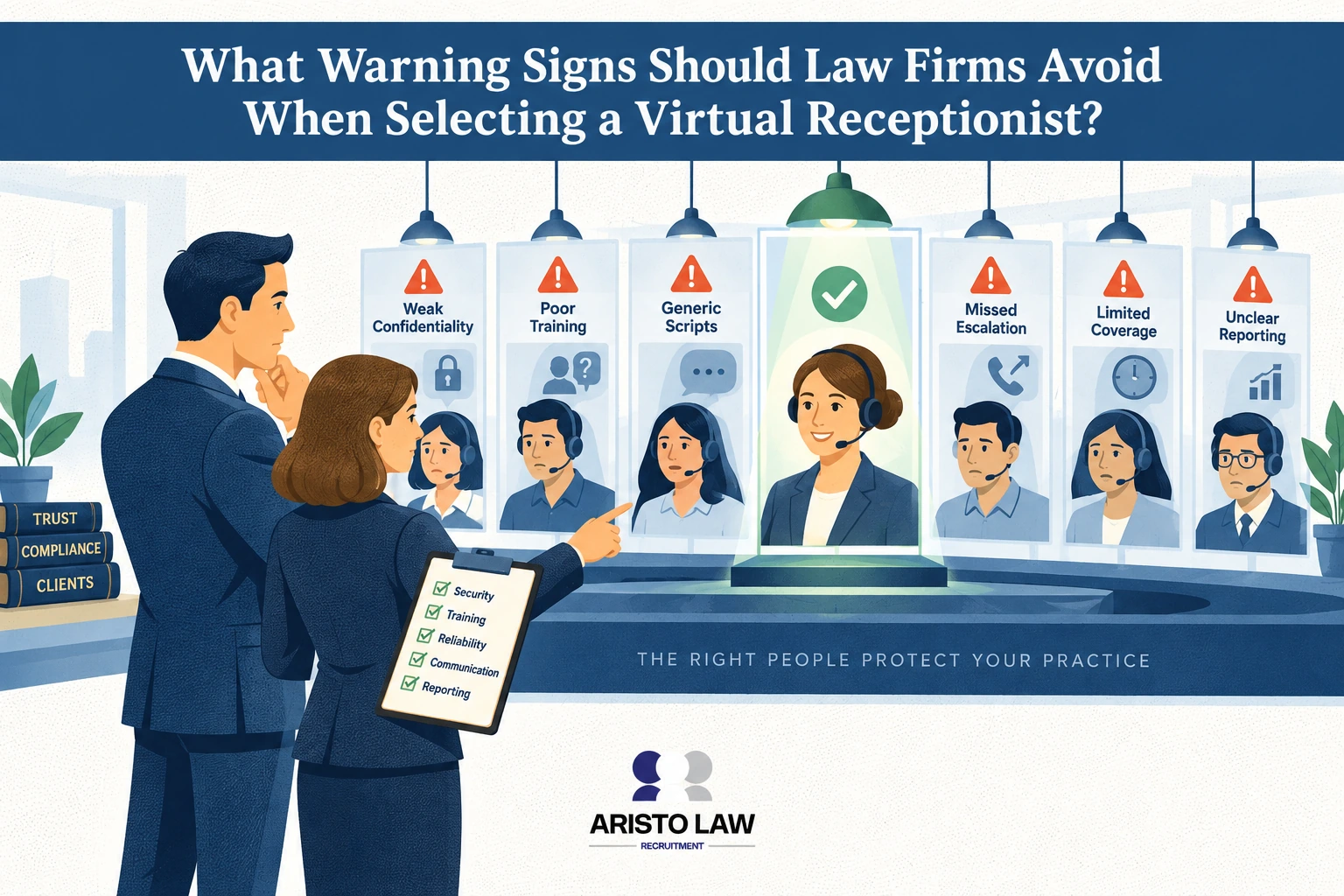
Listed
below are 10 warning signs to avoid when selecting a virtual
receptionist.
-
Limited legal-industry experience
-
Poor response-time performance
-
Weak intake procedures
-
Lack of CRM or case-management integration
-
Inadequate confidentiality controls
-
Minimal reporting visibility
-
Unclear escalation procedures
-
High call-abandonment rates
-
Inconsistent communication quality
-
Limited scalability during growth periods
Provider selection directly influences client experience,
consultation conversion, operational efficiency, and law-firm
reputation. A well-qualified law firm virtual receptionist service
improves responsiveness, strengthens intake performance, supports client
acquisition goals, and creates a more efficient communication
infrastructure for long-term growth.
Where
can law firms hire professional virtual receptionist services?
Law firms hire professional virtual receptionist services
through specialized legal answering-service providers, legal virtual
staffing firms, intake-service providers, and legal support
organizations, legal outsourcing companies such as Aristo Law.
Each sourcing option offers different levels of support, customization,
staffing flexibility, and operational integration, allowing firms to
select a solution that aligns with their intake volume, growth
objectives, and client-service requirements.
A virtual receptionist provides call handling, client intake,
appointment scheduling, and communication support through dedicated
remote staffing solutions. Law firms seeking scalable front-office
support evaluate providers offering professional
virtual receptionist and intake services aligned with
legal workflows and client communication requirements.
Legal answering-service companies primarily focus on call answering,
message taking, after-hours coverage, and basic client communication.
These providers are suitable for firms seeking immediate call coverage
but offer limited intake support and workflow integration. Legal virtual
staffing providers supply dedicated virtual receptionists who work
closely with the firm’s attorneys and staff, providing more personalized
service, consultation scheduling, client intake coordination, calendar
management, and communication support.
Intake-service providers focus specifically on lead capture, intake
screening, consultation booking, and client onboarding workflows. These
organizations are commonly used by firms investing heavily in marketing
and client acquisition because intake quality directly affects
consultation rates and marketing return on investment. Outsourced
legal-support organizations provide broader front-office and
administrative support, combining virtual receptionist services with
intake coordination, CRM management, appointment scheduling, client
communication, and legal administrative assistance.
When evaluating providers, law firms assess legal-industry expertise,
familiarity with legal terminology, intake quality, communication
standards, responsiveness, confidentiality safeguards, staffing
flexibility, scalability, reporting capabilities, and technology
integration. Compatibility with legal CRM systems, intake platforms,
scheduling software, case-management systems, and communication tools is
a major consideration because strong workflow integration improves
operational efficiency and reduces administrative burdens.
Aristo Law helps law firms solve legal outsourcing challenges by
providing access to trained virtual receptionists and legal support
professionals who support intake, scheduling, client communication, and
front-office operations. Rather than limiting support to basic call
answering, Aristo Law helps firms build structured communication and
intake systems that improve responsiveness, reduce missed opportunities,
and strengthen client-acquisition performance. Virtual receptionists
supplied through Aristo Law assist with lead capture, consultation
scheduling, CRM updates, intake coordination, appointment management,
and ongoing client communication workflows.
Aristo Law also helps law firms align outsourced support with
operational goals by matching trained professionals to specific
practice-area requirements, intake procedures, communication standards,
and growth objectives. This approach allows firms to expand front-office
capacity without increasing in-house staffing costs while maintaining
consistent service quality and workflow efficiency. For law firms
seeking scalable legal support staffing, stronger intake performance,
and improved client communication, outsourced legal support solutions
from organizations such as Aristo Law provide a practical alternative to
traditional reception and administrative staffing models.
Build a legal support team that moves work forward.
Tell us what is slowing your practice down. We will help map the role, workflow, and support structure that fits.