
How to Outsource Legal Work to an Offshore Personal Assistant? (15 Steps)

Practical guidance for building efficient, accountable legal support operations.

Offshore legal outsourcing is the process of delegating legal
support activities to trained remote professionals located in other
countries under attorney supervision. These activities include
legal research, drafting assistance, document management, client
communication, administrative coordination, and case workflow
support.
A study by Michael N. Hopwood, David A. Greene, and Richard
L. Daft in 2018 states that successful outsourcing depends on clearly
defining roles, responsibilities, and confidentiality requirements
before delegating work, as organizations with structured outsourcing
frameworks experience better operational outcomes and lower compliance
risks. Successful outsourcing begins with identifying
outsourceable tasks, defining responsibilities, selecting qualified
offshore assistants with legal experience, evaluating communication
skills, and implementing confidentiality protections.
The 15-step process includes identifying repetitive workflows,
defining task scope, selecting qualified offshore talent, verifying
legal-industry experience, assessing communication ability, executing
confidentiality agreements, implementing secure data-access controls,
establishing workflow documentation, providing software training,
assigning attorney supervision, creating quality-control procedures,
managing time-zone coordination, tracking performance metrics,
monitoring cost efficiency, and continuously improving processes.
Offshore legal assistants commonly support scheduling, intake
management, CRM updates, document formatting, billing coordination,
legal research preparation, and administrative workflows. Offshore
paralegals perform higher-level legal support activities involving
discovery assistance, case summaries, legal research, document review,
and drafting support under attorney supervision. Offshore legal
researchers strengthen operations through case-law analysis, precedent
research, legal writing support, citation verification, and
document-review workflows.
Benefits include cost savings, staffing flexibility, operational
scalability, increased productivity, reduced attorney workload, and
expanded support capacity. Governance requirements include
confidentiality protection, ethical compliance, attorney oversight,
documentation standards, secure communication systems, and role-based
access controls.
Common mistakes include poor task definition, inadequate supervision,
weak security controls, inconsistent communication, unclear
expectations, and missing SOPs. Law firms frequently hire offshore legal
assistants through legal outsourcing agencies, legal staffing providers,
remote legal support companies, and specialized legal-service platforms.
Offshore legal support becomes highly cost-effective when supported by
structured workflows, performance monitoring, compliance controls, and
clear supervision systems that protect quality, confidentiality, and
operational efficiency.
Aristolaw helps law firms outsource legal work to an offshore
personal assistant by providing outsourced support for administrative
workflows, document coordination, scheduling, client communication,
intake assistance, task delegation, and remote law firm operations. Book an
offshore Virtual Legal Assistant staffing consultation with
Aristolaw. Aristolaw connects law firms with outsourcing
solutions that match trained offshore personal assistant staff to each
delegated legal task, attorney support workflow, administrative duty,
client-facing function, and remote operations
responsibility.
Listed below are 15 ways to outsource legal work to an offshore
personal assistant.
-
Identify outsourceable legal tasks: Determine which
legal and administrative activities are delegated without affecting
attorney oversight or client service quality. -
Define assistant responsibilities: Establish clear
duties, deliverables, and performance expectations for the offshore
legal assistant. -
Choose qualified offshore assistants with legal
experience: Select professionals with relevant legal knowledge,
industry experience, and role-specific skills. -
Assess communication skills: Evaluate written and
verbal communication abilities to support accurate collaboration and
client interactions. -
Establish confidentiality agreements: Implement
legally binding agreements to protect client information and sensitive
firm data. -
Ensure data security compliance: Verify that
workflows and systems meet applicable data protection and cybersecurity
requirements. -
Maintain ethical compliance: Ensure outsourced work
aligns with legal ethics rules, supervision standards, and
jurisdictional requirements. -
Set workflow and documentation procedures: Create
standardized processes for task assignment, reporting, and record
management. -
Implement project management and legal software
tools: Use technology platforms to coordinate tasks, deadlines,
documents, and team communication. -
Provide task training: Deliver role-specific
training to align the assistant with firm procedures and work
expectations. -
Assign supervision structure: Designate responsible
personnel to oversee work quality, provide guidance, and review
outputs. -
Maintain regular communication and time zone
coordination: Establish communication schedules that support
timely collaboration across locations. -
Monitor work quality and productivity: Track
performance metrics and deliverables to ensure consistent service
standards. -
Evaluate cost efficiency: Measure financial savings
and operational benefits against outsourcing costs and resource
allocation. -
Scale support operations: Expand offshore staffing
capacity as workload, practice areas, or business requirements grow.
1. Identifying
Outsourceable Legal Tasks
Identifying outsourceable legal tasks is the process of
determining which legal support, administrative, operational, and
workflow-driven activities are delegated to offshore professionals
without requiring independent legal judgment. Offshore Legal
Outsourcing begins with task identification because successful Task
Delegation depends on separating process-driven work from attorney-only
responsibilities.
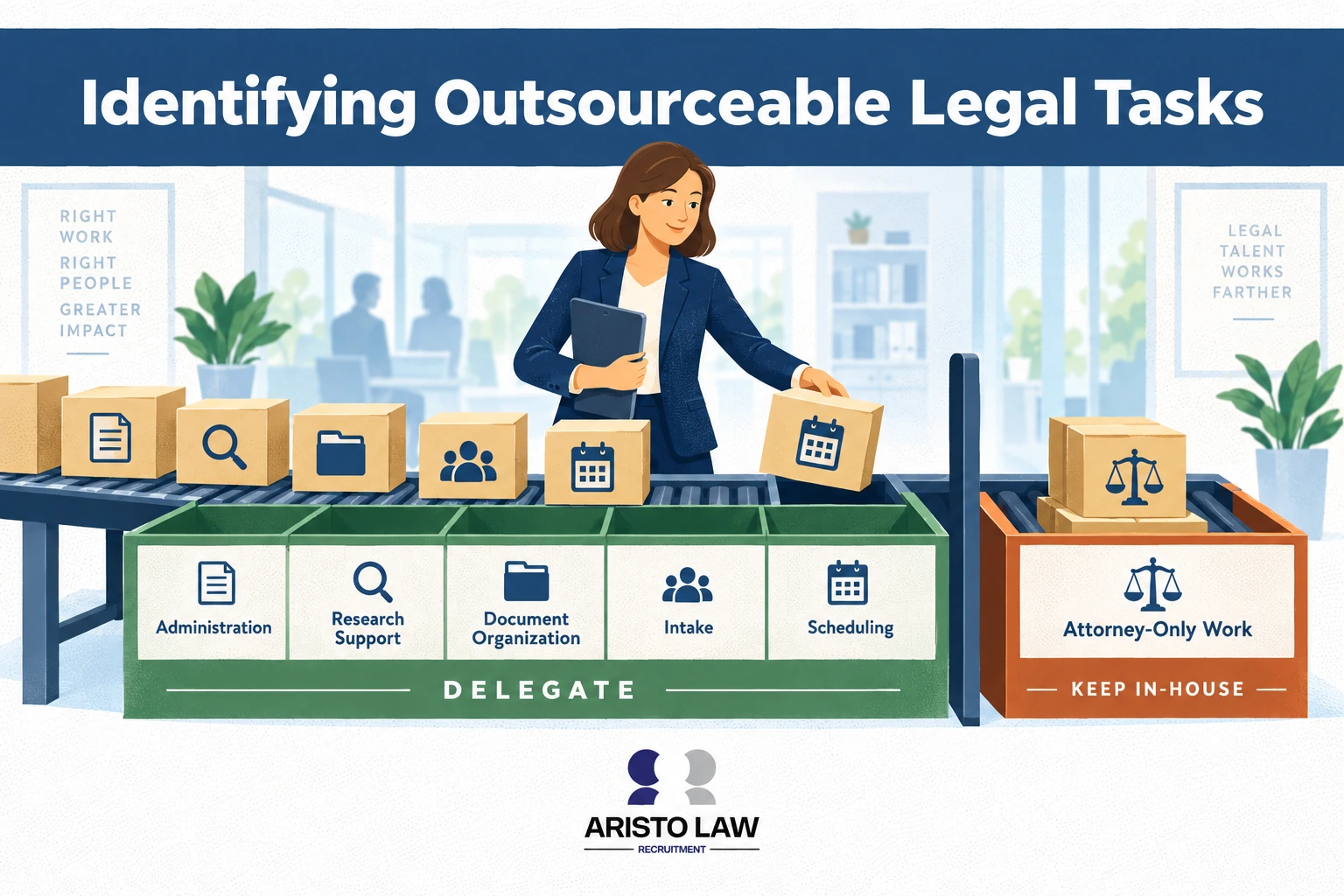
Legal Virtual Assistant and Remote Legal Support professionals
commonly handle intake coordination, scheduling, CRM updates, document
formatting, legal research support, billing assistance, records
management, case-status tracking, client communication support, and
Workflow Management activities. Ethical Compliance requires attorneys to
retain responsibility for legal advice, legal strategy, client
representation, settlement decisions, and final approval of legal
work.
Data Security considerations include limiting access to confidential
information through role-based permissions, secure communication
channels, encrypted storage, and approved Legal Software Tools.
Communication considerations include documenting expectations,
deadlines, escalation procedures, and reporting requirements to reduce
misunderstandings. Productivity Management improves when repetitive and
time-consuming workflows move to offshore support while attorneys focus
on higher-value legal work.
Law Firm Efficiency increases because operational tasks receive
dedicated support without expanding in-house staffing. Best practices
include creating a task inventory, classifying work by supervision
level, documenting procedures, applying least-privilege access controls,
establishing quality-review checkpoints, and regularly auditing
delegated workflows to ensure compliance, security, and consistent
performance.
2. Defining Assistant
Responsibilities
Defining assistant responsibilities is the process of
documenting specific duties, authority limits, workflow ownership,
reporting requirements, and performance expectations for offshore legal
support staff. Offshore Legal Outsourcing succeeds when
assistants understand exactly which tasks belong to them and which
responsibilities remain with attorneys.
Legal Virtual Assistant roles include intake management, scheduling,
document organization, CRM maintenance, billing coordination, and
administrative support. Ethical Compliance requires clear boundaries
around legal advice, legal conclusions, and attorney-only decisions.
Workflow Management improves through written job descriptions, task
ownership charts, approval procedures, and escalation protocols. Best
practices include documenting role scope, assigning measurable
deliverables, establishing review requirements, and updating
responsibilities as legal operations evolve.
3.
Choosing Qualified Offshore Assistants With Legal Experience
Choosing qualified offshore assistants with legal experience
is the process of evaluating candidates based on legal workflow
familiarity, technical proficiency, communication ability, and
professional reliability. Offshore Legal Outsourcing delivers
stronger results when assistants understand legal terminology,
case-management processes, document workflows, and law firm
operations.
Remote Legal Support providers with prior legal experience adapt more
quickly to existing systems and procedures. Workflow Management improves
because less time is required for basic operational training. Best
practices include reviewing legal-industry experience, testing workflow
skills, evaluating software proficiency, checking references, and
conducting trial assignments before long-term engagement.
4. Assessing Communication
Skills
Assessing communication skills is the process of evaluating
written communication, verbal communication, listening ability,
reporting consistency, and responsiveness. Communication
quality directly affects Workflow Management because offshore support
depends on clear instructions and accurate updates.
Remote Legal Support professionals frequently communicate with
attorneys, clients, vendors, and internal staff through email, messaging
systems, and video meetings. Productivity Management improves when
misunderstandings decrease and reporting remains consistent. Best
practices include communication assessments, role-play exercises,
writing samples, response-time standards, and recurring performance
reviews.
5. Establishing
Confidentiality Agreements
Establishing confidentiality agreements is the process of
creating legal obligations that protect sensitive client information,
firm records, and proprietary business data. Offshore Legal
Outsourcing requires confidentiality controls because remote
professionals frequently access privileged and confidential
information.
Ethical Compliance depends on maintaining confidentiality standards
equivalent to internal staff requirements. Data Security improves
through nondisclosure agreements, confidentiality policies, and
documented access procedures. Best practices include signed agreements,
confidentiality training, periodic compliance reviews, and documented
disciplinary procedures for policy violations.
6. Ensuring Data Security
Compliance
Ensuring data security compliance is the process of
protecting legal information through technical controls, access
restrictions, monitoring systems, and security procedures. Data
Security remains a primary requirement in Offshore Legal Outsourcing
because legal workflows involve confidential documents, client records,
and case-related information.
Legal Software Tools support security through encryption, audit logs,
role-based access, and secure authentication systems. Workflow
Management improves when security responsibilities are clearly assigned.
Best practices include multi-factor authentication, VPN access, secure
devices, password-management systems, access reviews, and cybersecurity
training.
7. Setting
Workflow and Documentation Procedures
Setting workflow and documentation procedures is the process
of creating standardized instructions for task execution, communication,
reporting, and quality control. Workflow Management improves
when offshore assistants follow documented procedures rather than
relying on informal guidance.
Legal Operations benefit because task consistency, accountability,
and scalability increase. Documentation supports training, supervision,
and process improvement initiatives. Best practices include SOP
creation, workflow mapping, process checklists, escalation guides, and
version-controlled documentation systems.
8. Providing Task Training
Providing task training is the process of teaching offshore
assistants how to perform assigned responsibilities according to firm
standards. Offshore Legal Outsourcing becomes more effective
when training covers legal workflows, software systems, communication
standards, confidentiality requirements, and productivity
expectations.
Legal Virtual Assistant performance improves because operational
errors decrease. Workflow Management becomes more consistent through
structured onboarding. Best practices include training modules, task
demonstrations, supervised practice, knowledge assessments, and ongoing
refresher training.
9.
Implementing Project Management and Legal Software Tools
Implementing project management and legal software tools is
the process of using technology platforms to organize tasks, deadlines,
communication, documents, and reporting. Legal Software Tools
improve Workflow Management by centralizing operational activity and
increasing visibility.
Offshore Legal Outsourcing becomes easier to supervise because
managers monitor progress, deadlines, and workload distribution.
Productivity Management improves through automation, task tracking, and
collaboration systems. Best practices include software standardization,
role-based permissions, workflow automation, and regular system
audits.
10. Assigning Supervision
Structure
Assigning supervision structure is the process of defining
who reviews work, approves deliverables, answers questions, and manages
performance. Offshore Legal Outsourcing requires clear
supervision because attorneys remain responsible for legal work quality
and Ethical Compliance.
Workflow Management improves when assistants know exactly where to
escalate issues and obtain approvals. Best practices include assigning
direct supervisors, establishing review schedules, defining escalation
paths, and documenting approval workflows.
11. Monitoring Work
Quality and Productivity
Monitoring work quality and productivity is the process of measuring
accuracy, timeliness, consistency, workload completion, and operational
performance. Productivity Management supports Law Firm Efficiency
because managers identify issues before they affect client service or
workflow outcomes. Legal Operations improve through recurring audits,
KPI tracking, quality reviews, and performance reporting. Best practices
include scorecards, quality-control checklists, turnaround-time
monitoring, and recurring performance evaluations.
12.
Maintaining Regular Communication and Time Zone Coordination
Maintaining regular communication and time zone coordination
is the process of managing collaboration across geographic locations and
working schedules. Offshore Legal Outsourcing depends on
structured communication because delays affect workflow continuity.
Remote Legal Support teams perform more effectively when reporting
schedules, availability windows, and communication channels remain
clearly defined. Best practices include overlapping work hours,
recurring meetings, shared calendars, status reports, and documented
communication protocols.
13. Evaluating Cost Efficiency
Evaluating cost efficiency is the process of comparing
outsourcing costs against productivity gains, workload capacity,
operational improvements, and business outcomes. Offshore Legal
Outsourcing improves Law Firm Efficiency by reducing staffing costs and
increasing support capacity. Productivity Management metrics help
determine whether outsourcing generates measurable value. Best practices
include tracking cost per task, cost per matter supported, time savings,
utilization rates, and operational ROI.
14. Maintaining Ethical
Compliance
Maintaining ethical compliance is the process of ensuring
offshore support activities comply with professional responsibility
rules, confidentiality requirements, and legal-practice
standards. Supervision obligations require law firms to oversee
offshore personnel, verify work quality, and ensure all delegated tasks
remain consistent with applicable ethical and regulatory
requirements.

Ethical Compliance protects law firms from
unauthorized-practice-of-law risks, confidentiality breaches, and
regulatory violations. Workflow Management must include review
procedures that preserve attorney control over legal judgments. Best
practices include compliance training, supervision policies,
role-boundary documentation, audit reviews, and recurring ethics
assessments.
15. Scaling Support Operations
Scaling support operations is the process of expanding
offshore staffing, workflows, and operational capacity as legal demand
increases. Offshore Legal Outsourcing supports growth because
firms add support resources without proportionally increasing internal
overhead.
Research by Fortune Business Insights in 2024 states that the
global Legal Process Outsourcing (LPO) market was valued at $23.45
billion and is projected to reach $105.66 billion by 2032, growing at a
21.02% CAGR, indicating that firms are increasingly using outsourced
legal support to scale operations efficiently rather than expanding
internal infrastructure. Workflow Management and Productivity
Management become increasingly important as teams expand.
Legal Operations scale more effectively when documentation,
supervision, technology systems, and performance metrics already exist.
Best practices include phased growth plans, standardized onboarding,
workload forecasting, quality-control systems, and scalable Legal
Software Tools that support long-term law firm efficiency.
What
are the benefits of outsourcing legal work to an offshore personal
assistant?
Benefits of outsourcing legal work to an offshore personal
assistant include cost efficiency, scalability, extended business
coverage, and improved attorney productivity.
Listed below are the 22 benefits of outsourcing legal work to an
offshore personal assistant.
-
Cost efficiency: Offshore legal support reduces
staffing expenses associated with recruiting, onboarding, office space,
equipment, and employee overhead. Law firms allocate resources more
efficiently while maintaining support capacity across legal
operations. -
Scalability: An outsourced legal team allows firms
to increase or reduce support resources based on workload demands. Law
firms scale operations during growth periods without expanding physical
office infrastructure. -
Operational flexibility: Offshore personal
assistants provide support across multiple workflows including intake
management, scheduling, document administration, billing coordination,
CRM management, and client communication. Operational capacity adjusts
more easily as firm priorities change. -
Faster workflow execution: Document preparation,
file organization, intake processing, administrative coordination, and
records management move through workflows more quickly when dedicated
support staff handle repetitive operational tasks. -
Administrative workload reduction: Attorneys spend
less time on scheduling, email management, data entry, appointment
coordination, billing administration, and routine communication
activities. Legal professionals focus more attention on client
representation and legal work. -
Extended business coverage: Offshore teams provide
support outside traditional office hours because of time-zone
differences. Client inquiries, intake requests, and administrative tasks
continue moving forward beyond standard business schedules. -
Improved attorney productivity: Attorney
productivity increases when operational responsibilities move to
offshore support staff. More attorney time becomes available for
billable activities, case strategy, legal analysis, and client
service. -
Improved intake responsiveness: Offshore personal
assistants monitor inquiries, schedule consultations, update CRM
systems, and follow intake procedures. Faster responses improve client
experience and consultation opportunities. -
Support for after-hours inquiries: Prospective
clients frequently submit inquiries outside office hours. Offshore
support teams help capture and process those opportunities before
competitors respond. -
Accelerated document workflows: Document
organization, formatting, indexing, filing support, and records
management progress more efficiently through dedicated offshore support
resources. -
Increased case-management capacity: Administrative
support allows legal teams to handle larger matter volumes without
overwhelming attorneys or internal staff. Workflow bottlenecks become
less frequent. -
Better resource allocation: Law firms assign
high-value legal work to attorneys and procedural work to offshore
assistants. This division improves operational efficiency and workload
distribution. -
Workload elasticity during litigation spikes:
Litigation surges generate large volumes of documents, scheduling tasks,
communication requests, and administrative demands. Offshore legal
support provides additional capacity during these periods. -
Support during client-intake surges: Marketing
campaigns, referral growth, and seasonal demand increases create intake
spikes. Offshore teams help maintain responsiveness and workflow
consistency. -
Business continuity and staffing redundancy:
Distributed staffing models reduce operational disruption caused by
employee absences, turnover, vacations, or unexpected workload
increases. -
Multilingual support opportunities: Offshore
staffing provides access to professionals with multilingual
communication capabilities, improving service for diverse client
populations. -
Faster turnaround times: Extended work coverage and
dedicated support resources reduce delays in administrative processing,
document handling, and workflow completion. -
Access to specialized legal support: Many offshore
professionals possess experience in legal administration, legal research
support, litigation workflows, contract management, compliance support,
and document review processes. -
Improved client experience: Faster responses,
organized communication, timely updates, and streamlined intake
processes improve client satisfaction and professional service
delivery. -
Higher consultation conversion rates: Prompt
follow-up, appointment coordination, lead tracking, and intake
management improve the likelihood that prospective clients become
scheduled consultations. -
Greater legal operations efficiency: Offshore
personal assistants improve workflow management, task completion,
communication coordination, and operational consistency throughout the
firm. -
Long-term law-firm profitability: Improved
productivity, stronger resource utilization, scalable staffing, better
client acquisition support, and reduced administrative overhead
contribute to stronger financial performance over time.
Where
can law firms hire offshore legal personal assistants?
Law firms hire offshore legal personal assistants through
specialized legal staffing providers and legal process outsourcing
companies like Aristo Law and dedicated offshore recruitment firms, and
legal virtual assistant agencies. The hiring channel a law firm
selects depends on workload requirements, supervision preferences,
staffing scale, budget, and the complexity of legal workflows being
outsourced.
Offshore legal staffing solutions commonly support intake management,
scheduling, client communication, legal administration, document
management, litigation support, legal research coordination, billing
assistance, and CRM maintenance.
Law firms that outsource legal work to an offshore personal assistant
expand support functions beyond administrative tasks to include document
review, case preparation, and information gathering. Firms that
outsource legal work to an offshore personal assistant frequently
integrate virtual
legal research assistant and research analyst services
to support legal research, citation verification, and case-law analysis
workflows.
Aristo Law operates as both an offshore legal staffing provider and a
legal process outsourcing (LPO) partner by supplying trained remote
legal support professionals who integrate into law firm workflows. Law
firms use Aristo Law to access dedicated legal virtual assistants,
intake specialists, legal administrative assistants, litigation-support
personnel, legal researchers, and other outsourced legal support staff.
This model provides structured onboarding, workflow integration,
supervision support, staffing scalability, quality-control processes,
and replacement support when staffing changes become necessary.
Direct recruitment represents another sourcing model where law firms
independently hire offshore legal assistants from markets such as the
Philippines, South Africa, India, and other established offshore
legal-support regions. This approach provides greater direct control but
requires the firm to manage recruiting, onboarding, training,
supervision, payroll administration, and performance management
internally.
Managed staffing providers supply dedicated remote legal
professionals while handling recruitment, human resources support,
replacement services, workforce administration, and operational
oversight. Legal virtual assistant agencies focus primarily on
administrative legal support, intake management, scheduling, CRM
updates, client communication, and workflow coordination. Legal process
outsourcing organizations generally support larger-scale legal
operations involving document review, legal research support, contract
management, compliance workflows, litigation support, and legal process
management.
Freelance marketplaces provide contract-based access to offshore
legal assistants and remote legal professionals. This model offers
flexibility for short-term projects, although supervision, quality
control, staffing continuity, and workflow consistency remain the
responsibility of the law firm. Dedicated remote staffing firms provide
long-term offshore professionals assigned exclusively to a specific law
firm, creating greater operational continuity and institutional
knowledge retention.
Evaluation criteria should include legal-industry experience,
communication skills, English proficiency, confidentiality standards,
software familiarity, intake-management experience, litigation-support
capabilities, workflow-management knowledge, responsiveness, and
staffing scalability. Law firms should also evaluate onboarding support,
training infrastructure, supervision models, quality-control systems,
replacement guarantees, cybersecurity controls, and long-term staffing
stability. Providers with documented SOPs, attorney-supervision
frameworks, confidentiality controls, and structured
performance-management systems generally provide stronger long-term
offshore legal services and more reliable legal VA outsourcing
outcomes.
How
much does it cost to outsource legal work to an offshore personal
assistant?
Offshore legal assistant rates range from $8 to $35 per hour
(€7–€31, £6–£27) depending on experience, specialization, and geographic
market. Part-time dedicated support ranges from $500 to $2,000 per month
(€460–€1,840, £390–£1,560), while full-time dedicated offshore legal
assistants frequently range from $1,200 to $4,500 per month
(€1,100–€4,140, £940–£3,510). The cost of outsourcing legal
work to an offshore personal assistant depends on location, experience
level, legal specialization, workload complexity, supervision
requirements, and engagement model.
Offshore legal staffing providers commonly offer several pricing
structures, including hourly arrangements, part-time staffing, full-time
dedicated assistants, project-based support, and agency-managed teams.
Specialized offshore paralegals, litigation-support professionals, and
legal researchers command higher rates because of advanced legal
workflow involvement and technical expertise.
Several cost drivers influence pricing. Litigation-support
experience, personal injury workflow knowledge, legal software
proficiency, bilingual communication capabilities, intake-management
expertise, discovery support skills, contract-review experience, and
jurisdiction-specific familiarity increase costs. Offshore professionals
experienced with case-management systems, CRM platforms,
document-management software, e-discovery tools, legal billing
platforms, and intake workflows generally command higher compensation
because they require less training and integrate more quickly into law
firm operations.
Compared with in-house hiring, offshore legal staffing reduces
expenses associated with payroll taxes, employee benefits, office space,
equipment purchases, recruiting fees, onboarding costs, insurance
obligations, and workplace overhead. An in-house legal assistant
in the United States costs a law firm $50,000 to $90,000+ annually
(€46,000–€82,800+, £39,000–£70,200+) when salary, benefits, payroll
obligations, office infrastructure, and management costs are
combined. Offshore staffing models frequently provide dedicated
support at a lower total operating cost while maintaining workflow
coverage across intake management, scheduling, document administration,
billing coordination, legal research support, and client
communication.
Law firms evaluate outsourcing based on total operational cost per
case, productivity-per-dollar performance, workflow coverage, and
attorney time recovery rather than hourly rates alone. A lower-cost
assistant who requires extensive supervision, generates rework, or
struggles with legal workflows ultimately cost more than an experienced
offshore professional.
Firms assess outsourcing value through efficiency gains, reduced
administrative burden, improved intake responsiveness, faster workflow
execution, scalability during litigation surges, and increased attorney
capacity. Offshore legal support becomes most cost-effective when
structured with clear workflows, strong supervision, appropriate
technology systems, and performance-management processes that maximize
operational efficiency rather than focusing exclusively on labor cost
reduction.
Is hiring
offshore legal assistants cost-effective?
Yes, hiring offshore legal assistants is highly
cost-effective for law firms because it reduces staffing overhead and
improves operational scalability. Offshore legal assistants
allow attorneys to delegate administrative and procedural legal support
tasks at lower labor costs than traditional in-house staffing
models.
Offshore legal assistants support intake management, scheduling,
document organization, CRM updates, billing coordination, client
communication, records management, and other legal operations functions
remotely, allowing attorneys to focus more time on billable legal work
and client representation.
Legal operations and outsourcing studies consistently show that
offshore legal staffing reduce personnel costs by approximately 40%–70%
while improving workflow scalability and operational efficiency when
firms implement proper supervision, confidentiality controls,
cybersecurity safeguards, and quality-management systems.
Listed below are the 10 reasons hiring offshore legal assistants is
cost-effective.
-
Reduce staffing and salary expenses compared to in-house
hiring: Offshore legal support frequently provides comparable
administrative coverage at substantially lower labor costs than
traditional domestic staffing models. -
Lower office overhead costs such as workspace, equipment,
payroll taxes, and benefits: Remote staffing reduces expenses
associated with physical office infrastructure and employee-related
overhead obligations. -
Scale support teams more flexibly during litigation surges or
growth periods: Law firms expand support capacity without
committing to permanent in-house hiring during temporary workload
increases. -
Access trained legal support professionals at lower hourly or
monthly rates: Many offshore legal assistants possess
experience with legal workflows, intake systems, case management
platforms, and law firm operations. -
Delegate repetitive administrative workflows to improve
attorney productivity: Scheduling, CRM updates, document
administration, billing support, and intake coordination move away from
attorneys and into structured support workflows. -
Extend operational coverage through different time zones and
remote staffing models: Offshore teams support after-hours
workflows, intake responsiveness, and administrative processing beyond
standard business hours. -
Improve turnaround speed for document-heavy and
administrative tasks: Dedicated support resources accelerate
workflow completion and reduce administrative bottlenecks. -
Reduce hiring and recruitment costs for support
positions: Managed staffing providers handle recruitment,
screening, onboarding, and workforce administration
responsibilities. -
Increase operational efficiency through cloud-based legal
workflow systems: Remote legal staffing integrates with modern
legal technology platforms, document-management systems, and
case-management software. -
Maintain leaner in-house teams while expanding support
capacity remotely: Law firms increase operational capability
without proportionally increasing internal staffing requirements.
Industry reports commonly estimate offshore legal staffing savings in
the range of 40%–70% compared to traditional in-house
staffing costs, particularly for legal assistants, administrative
support professionals, and certain legal process outsourcing functions.
Some providers market offshore legal assistant services at rates
as low as $12–$16 per hour (€11–€15, £9–£13) or several hundred dollars
per month depending on role complexity, staffing model, and geographic
region.
Cost-effectiveness depends heavily on implementation quality. Law
firms must still manage attorney supervision, confidentiality
protections, client-data security controls, communication standards,
workflow training, document-review procedures, cybersecurity
requirements, and unauthorized-practice-of-law restrictions. Community
discussions among attorneys frequently report strong efficiency gains
and substantial cost savings from offshore legal support, although
concerns remain regarding quality control, communication barriers,
confidentiality risks, and drafting accuracy when outsourcing lacks
proper management.
Providers such as Aristo
Law help address many of these challenges by supplying trained
offshore legal support professionals within structured staffing models
that include onboarding support, workflow integration, supervision
frameworks, quality-control processes, and scalable legal staffing
solutions. When supported by strong operational controls, offshore legal
assistants provide legal outsourcing ROI, improved law firm operational
efficiency, and sustainable long-term staffing flexibility.
What
mistakes should law firms avoid when outsourcing legal work?
Mistakes law firms should avoid when outsourcing legal work
include poor onboarding, and inconsistent communication
structures.
Listed below are 20 mistakes law firms should avoid when outsourcing
legal work
-
Poor onboarding: Inadequate onboarding leaves
offshore staff without a clear understanding of firm procedures,
client-service expectations, software systems, and workflow
requirements. Confusion during onboarding produces delays, errors, and
lower productivity. -
Unclear delegation boundaries: Unclear role
definitions create uncertainty regarding which tasks belong to offshore
staff and which responsibilities require attorney involvement. This
increases unauthorized-practice-of-law risks, workflow confusion, and
operational inefficiencies. -
Weak supervision: Insufficient attorney oversight
increases the likelihood of errors, missed deadlines, inconsistent work
quality, and compliance concerns. Legal outsourcing requires active
supervision structures and documented review procedures. -
Insecure systems: Weak cybersecurity controls expose
confidential client information, litigation materials, financial
records, and firm data to unnecessary risk. Poor security practices
result in confidentiality breaches and reputational damage. -
Inconsistent communication structures: Irregular
communication creates misunderstandings, duplicated effort, missed
instructions, and workflow delays. Structured reporting and
communication systems improve coordination across remote legal
teams. -
Undocumented workflows: Lack of written procedures
forces staff to rely on assumptions and inconsistent practices. Workflow
inconsistency reduces efficiency, increases training time, and creates
quality-control problems. -
Unrealistic expectations: Expecting offshore
professionals to perform complex legal functions without adequate
training, supervision, or guidance results in performance gaps and
frustration. Clear expectations improve outcomes. -
Lack of attorney oversight: Attorneys remain
responsible for legal judgments, legal advice, strategy decisions, and
final work product. Failure to maintain attorney control creates
ethical, regulatory, and malpractice risks. -
Insufficient quality-assurance systems: Without
quality-control reviews, errors reach clients, courts, opposing counsel,
or internal stakeholders. Regular audits and review checkpoints improve
accuracy and consistency. -
Fragmented communication channels: Using multiple
disconnected email threads, messaging platforms, spreadsheets, and
document repositories causes information loss and task confusion.
Centralized communication improves workflow visibility. -
Poor task definition: Vague instructions create
rework, delays, and inconsistent deliverables. Clearly defined tasks
improve accountability and execution quality. -
Hiring without legal-industry screening: Selecting
support staff without evaluating legal workflow experience increases
training requirements and operational errors. Legal-industry familiarity
improves integration and productivity. -
Ignoring time-zone planning: Failure to coordinate
schedules, response expectations, and availability windows creates
communication delays and workflow bottlenecks. Structured time-zone
management improves collaboration. -
Weak confidentiality controls: Inadequate access
controls, missing confidentiality agreements, and poor data-handling
procedures increase client-data exposure and compliance risks. -
Insufficient software training: Staff unfamiliar
with case-management systems, CRM platforms, document-management
software, and legal workflow tools struggle to perform efficiently. -
No escalation procedures: Offshore staff require
clear guidance on when and how to escalate legal questions, client
concerns, technical issues, or workflow exceptions. Missing escalation
paths increase operational risk. -
Measuring cost instead of performance: Focusing
exclusively on hourly rates overlooks quality, responsiveness,
productivity, and workflow coverage. Low-cost support becomes expensive
when rework, delays, and supervision burdens increase. -
Failure to monitor performance metrics: Without KPI
tracking, firms struggle to identify workflow bottlenecks, productivity
issues, turnaround delays, and quality concerns. Performance measurement
supports continuous improvement. -
Overdelegating attorney-controlled responsibilities:
Legal advice, legal strategy, settlement recommendations, court
representation, and final legal approvals should remain under attorney
control. Overdelegation increases compliance and
professional-responsibility risks. -
Lack of contingency planning: Failure to prepare for
staff turnover, technology disruptions, workload spikes, or unexpected
absences interrupt client service and legal operations. Backup staffing
and continuity plans improve operational resilience.
Each of these outsourcing mistakes creates downstream consequences
such as reduced productivity, compliance exposure, workflow delays,
client dissatisfaction, quality-control failures, and increased
operational costs. Strong onboarding, documented procedures, attorney
supervision, secure systems, and structured remote legal management
practices reduce offshore legal staffing risks and improve long-term
outsourcing success.
What
is the difference between an offshore legal assistant and an offshore
paralegal?
The difference between an offshore legal assistant and an
offshore paralegal is that offshore legal assistants primarily handle
administrative and operational tasks, while offshore paralegals perform
substantive legal support work.
Law firms that outsource legal work to an offshore personal assistant
assign administrative coordination, scheduling, client communication,
and document management tasks, whereas offshore paralegals perform
substantive legal support functions such as legal research, case
preparation, and drafting.
This distinction helps clarify legal
assistant vs paralegal differences, skills, and
salaries when evaluating which offshore role aligns
with specific legal workflows and support requirements.
The table below shows the difference between an offshore legal
assistant and an offshore paralegal.
| Aspect | Offshore Legal Assistant | Offshore Paralegal |
|---|---|---|
| Primary focus | Administrative and procedural legal support | Substantive legal support and legal workflow assistance |
| Core responsibilities | Scheduling, intake, billing support, file organization, CRM updates, document management, and communication coordination |
Legal research, case preparation, document review, discovery support, contract abstraction, and litigation support |
| Legal research involvement | Limited research coordination, citation collection, and information gathering |
Direct involvement in legal research, case law review, statute analysis, and legal research summaries under attorney supervision |
| Document drafting complexity | Document formatting, template preparation, administrative correspondence, and approved-content updates |
Drafting pleadings, discovery responses, legal summaries, contracts, and litigation-support documents subject to attorney review |
| Administrative workload | High administrative and operational focus | Lower administrative focus and greater concentration on substantive legal workflows |
| Legal analysis responsibilities | Minimal substantive legal analysis | Greater involvement in legal analysis and issue identification under attorney supervision |
| Workflow role | Supports Law Firm Efficiency through operational coordination and administrative management |
Supports case development, litigation preparation, compliance review, and legal workflow execution |
| Outsourcing use cases | Intake management, appointment scheduling, billing support, CRM management, client communication, and records management |
Litigation support, compliance research, discovery assistance, contract review, due diligence, and legal document preparation |
| Training expectations | Administrative support experience, legal-office workflow knowledge, and software proficiency |
Specialized legal education, paralegal training, legal research skills, and substantive legal workflow experience |
| Attorney supervision | Required for legal-related workflows, client-sensitive communications, and task approval |
Required for legal research review, substantive drafting approval, and compliance oversight |
| Cost structure | Generally lower-cost support role because responsibilities focus on administrative operations |
Generally higher-cost support role because responsibilities involve advanced legal support activities |
| Technology usage | CRM systems, scheduling platforms, billing systems, document-management tools, and legal administration software |
Legal research databases, e-discovery tools, contract-review platforms, case-management systems, and document-analysis software |
| Client interaction | Intake coordination, appointment scheduling, status updates, and workflow communication |
Limited client interaction, usually focused on case-support activities directed by attorneys |
| Confidentiality exposure | Access to client records, billing information, intake forms, and administrative case data |
Access to legal research materials, litigation documents, discovery records, and substantive case information |
| Compliance considerations | Must follow confidentiality policies, role boundaries, and unauthorized-practice-of-law restrictions |
Must follow confidentiality requirements, attorney-supervision rules, and restrictions on independent legal judgment |
| Best fit | Firms needing administrative support, intake assistance, billing coordination, and workflow management |
Firms needing legal research support, litigation assistance, contract analysis, and substantive legal workflow capacity |
Research on legal process outsourcing states that the model
is based on the division of labor principle, where time-consuming
activities such as due diligence, document review, legal research, and
drafting are delegated to specialized support personnel, allowing firms
to streamline productivity and focus lawyers on higher-value
work. Law firms improve scalability and cost efficiency when
administrative legal workflows and substantive legal support tasks are
separated into specialized offshore staffing roles.
This structure allows attorneys to focus on legal judgment and client
representation while maintaining confidentiality, compliance,
productivity, and operational control across outsourced legal support
functions.
How do
offshore legal researchers support law firms?
Offshore legal researchers support law firms by helping
attorneys and legal teams manage high-volume legal research workflows,
organize legal information, reduce research turnaround time, and improve
operational efficiency through remote legal support structures.
Offshore legal research support functions as a specialized segment of
legal outsourcing and legal process outsourcing (LPO), allowing law
firms to delegate research-intensive activities while attorneys focus on
legal strategy, client representation, and final legal analysis.

Legal operations and outsourcing studies consistently show that
offshore legal research support improves productivity, reduces
operational costs, and accelerates information retrieval because
attorneys delegate time-intensive research coordination tasks within
supervised legal workflows. Offshore legal researchers commonly
integrate into legal workflow management systems through legal
databases, cloud-based platforms, case-management software, document
repositories, and collaborative legal operations environments.
Law firms that outsource legal work to an offshore personal assistant
expand support capacity by adding specialized functions such as virtual
legal research assistant and research analyst services
for case preparation, legal analysis, and document review. Offshore
staffing models connect law firms with dedicated legal support
professionals, allowing firms to outsource legal work to an offshore
personal assistant while maintaining research and administrative
workflows.
Listed below are the 14 ways offshore legal researchers support law
firms.
-
Conducting case law, statute, and regulatory research
support: Offshore legal researchers locate relevant cases,
statutes, regulations, administrative guidance, and legal authorities
that attorneys use during matter preparation and legal analysis. -
Retrieving legal documents from research databases and court
systems: Researchers access legal database management
platforms, court records, government repositories, and legal information
systems to gather supporting materials efficiently. -
Organizing legal research materials and case
documentation: Research findings, court decisions, regulations,
and supporting authorities are categorized and indexed for faster
attorney review. -
Preparing research summaries and legal information
compilations for attorney review: Researchers create structured
summaries that help attorneys evaluate authorities and identify relevant
legal issues more efficiently. -
Supporting litigation preparation through evidence and
precedent organization: Litigation research support includes
organizing precedents, case histories, procedural authorities, and
supporting legal materials for case preparation. -
Assisting with compliance and regulatory research
workflows: Researchers monitor regulations, industry
requirements, compliance obligations, and legislative developments
affecting client matters. -
Managing citation formatting and legal reference
documentation: Citation management improves document
consistency by ensuring references comply with applicable legal citation
standards and court requirements. -
Tracking updates to laws, regulations, and procedural
requirements: Ongoing monitoring helps legal teams remain
informed about changes affecting litigation, compliance, contracts, and
client matters. -
Supporting contract review and due diligence research
processes: Researchers assist with background investigations,
contract-related research, regulatory reviews, and due-diligence
information gathering. -
Assisting with e-discovery organization and document
indexing: Document-heavy matters benefit from structured
indexing, categorization, tagging, and retrieval workflows that improve
information management. -
Coordinating legal research requests across distributed legal
teams: Remote legal researchers support multiple attorneys,
practice groups, and offices by managing research assignments and
information requests. -
Using cloud-based legal research platforms and case
management systems: Modern offshore legal research support
integrates with cloud-based workflows, allowing secure collaboration
across jurisdictions and time zones. -
Improving turnaround speed for document-heavy legal
matters: Dedicated research resources reduce delays by
accelerating information collection, document retrieval, and authority
compilation. -
Supporting scalable legal operations through remote staffing
models: Remote legal researchers increase capacity without
requiring proportional expansion of in-house legal support teams.
Offshore legal researchers generally work under attorney or paralegal
supervision and do not independently provide legal opinions, establish
legal strategy, determine legal conclusions, or practice law without
licensed attorney oversight.
Attorneys retain responsibility for legal interpretation, client
advice, litigation strategy, and final work-product approval. This
supervision structure allows law firms to improve efficiency,
scalability, and research capacity while maintaining ethical compliance,
confidentiality protections, and professional responsibility
standards.
Why do law firms
outsource legal work offshore?
Law firms outsource legal work offshore to reduce operational
costs, improve workflow scalability, increase administrative capacity,
and support high-volume legal workloads efficiently. Modern law
firms face growing economic pressures from rising payroll expenses,
increasing client expectations, competitive legal markets, staffing
shortages, and expanding administrative requirements.
Offshore legal support helps firms address these challenges by
providing additional operational capacity without requiring the
substantial costs associated with expanding in-house payroll structures,
office space, employee benefits, equipment purchases, and recruitment
programs.
Legal outsourcing is frequently used to manage repetitive
administrative tasks that consume attorney time but do not require legal
judgment. Offshore legal teams commonly support consultation scheduling,
intake management, CRM updates, client communication, document
organization, billing coordination, records management, and workflow
administration. By transferring these responsibilities to trained
offshore professionals, attorneys devote more time to legal analysis,
client representation, litigation strategy, negotiations, and other
revenue-generating legal work.
Scalability represents another major reason law firms adopt offshore
legal support. Litigation surges, marketing campaigns, referral growth,
seasonal workload increases, and large document-intensive matters create
operational bottlenecks. Offshore staffing provides flexible support
capacity that expands or contracts based on workload requirements. This
flexibility allows firms to handle document-heavy workflows, discovery
preparation, legal research coordination, case-management support, and
administrative processing without permanently increasing internal
staffing levels.
Client service also benefits from outsourced legal teams. Offshore
professionals help maintain faster intake response times, improved
consultation coordination, more consistent client communication, and
extended operational coverage across different time zones. Firms use
offshore support to reduce missed inquiries, improve workflow turnaround
times, and maintain service levels during periods of rapid growth.
Offshore legal support functions as a strategic operational solution
rather than simply a cost-reduction measure. Law firms use offshore
staffing to improve efficiency, increase workload capacity, strengthen
business continuity, address staffing shortages, support scalable
growth, and maintain competitive legal operations while preserving
attorney oversight, confidentiality protections, and professional
responsibility requirements.
Build a legal support team that moves work forward.
Tell us what is slowing your practice down. We will help map the role, workflow, and support structure that fits.