
How to Outsource Legal Staffing Securely and Ethically Without Risk (20 steps)

Practical guidance for building efficient, accountable legal support operations.
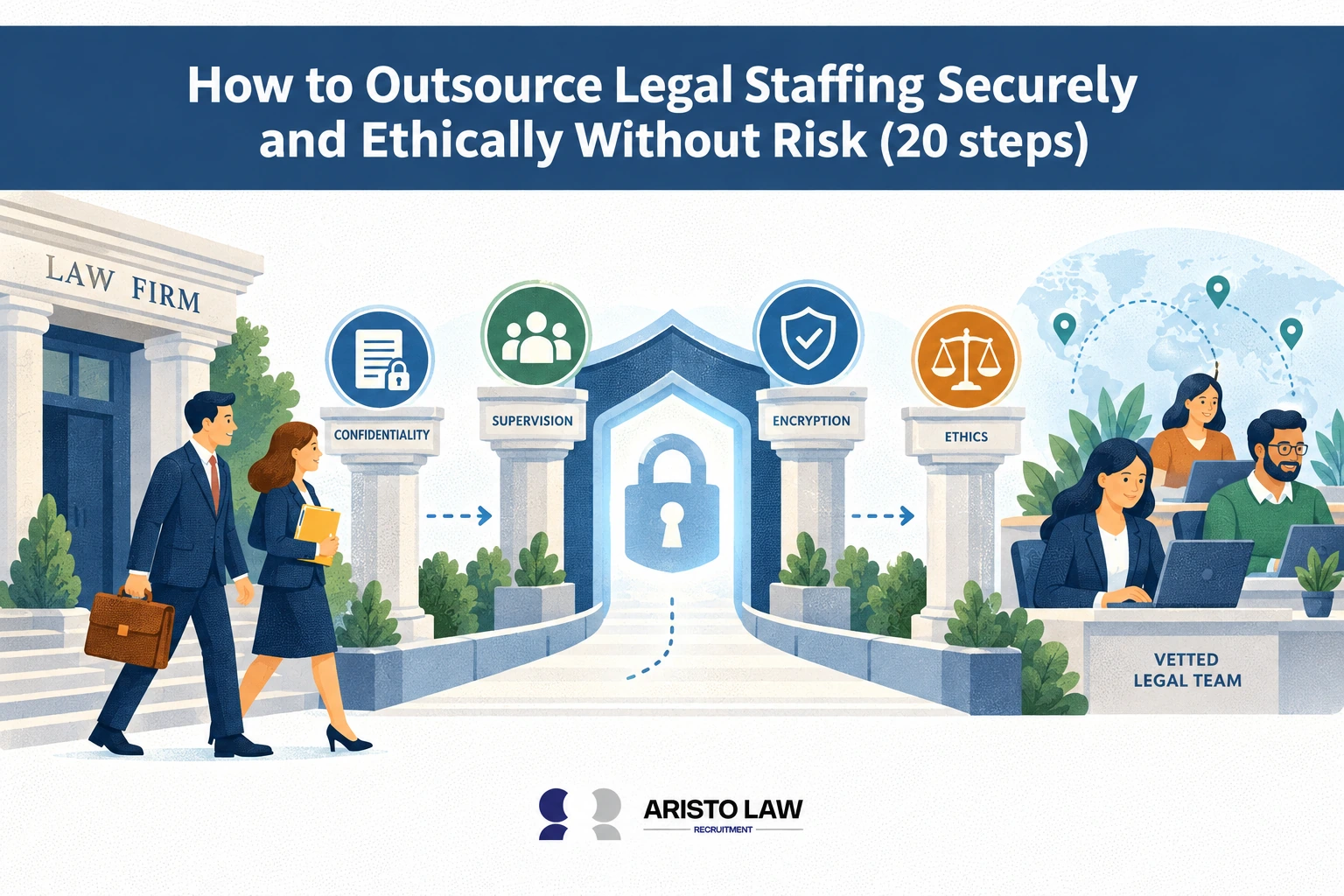
Legal staffing outsourcing is the process of delegating
administrative, operational, or legal support functions to external
professionals, agencies, or remote staffing providers under controlled
supervisory and ethical frameworks. Law firms commonly
outsource intake coordination, document management, legal assistance,
medical records review, billing support, litigation administration, and
workflow operations to improve scalability and reduce internal
workload.
According to the 2024 Clio Legal Trends Report cited by
Remote Legal Staff, attorneys spend up to 48% of their workday on
non-billable administrative tasks, while 64% of law firms now use some
form of remote staffing or outsourced legal support to handle operations
more efficiently. The report identified client intake, billing,
litigation support, document review, paralegal assistance, and
compliance monitoring among the most commonly outsourced functions,
showing that firms increasingly delegate operational workloads to
improve scalability and reduce internal pressure.
Secure outsourcing requires verifying provider credentials, reviewing
legal-industry experience, conducting conflict checks, defining task
boundaries, and confirming compliance with confidentiality obligations
and professional ethics rules. Operational safeguards include
confidentiality agreements, cybersecurity protocols, encrypted
communication systems, secure file sharing, role-based access
restrictions, audit trails, and attorney-supervision structures that
prevent unauthorized legal practice.
Effective legal outsourcing depends on selecting specialized
partners, defining measurable workflows, and maintaining consistent
communication between internal teams and external support staff. Firms
that implement structured onboarding, confidentiality controls, and
performance tracking often improve turnaround time, operational
scalability, and cost efficiency while reducing administrative burden.
These operational strategies also provide a clearer framework for
understanding legal
outsourcing providers benefits and best practices
within modern legal support models.
Law firms should also implement quality-control reviews, workflow
documentation, ongoing audits, performance monitoring, and continuous
risk assessments to maintain compliance and operational consistency.
Common outsourcing risks include confidentiality breaches, data
exposure, inconsistent work quality, and unauthorized legal services,
all of which require structured oversight and documented procedures.
Best practices include evaluating domestic versus offshore staffing
models, maintaining direct attorney supervision, limiting unnecessary
data exposure, and continuously monitoring outsourced legal workflows
for ethical and security compliance.
Aristolaw helps law firms outsource legal staffing securely
and ethically by providing structured support for compliant hiring,
supervised delegation, confidentiality controls, and risk-managed
workflows. Hire a Staffing
Coordinator with Aristolaw today. Aristolaw connects law firms
with legal outsourcing solutions that reduce staffing risk and support
ethical legal operations.
Listed below are 20 steps in outsourcing legal staffing securely and
ethically.
-
Verify provider credentials
-
Evaluate provider experience
-
Conduct conflict checks
-
Assess cybersecurity standards
-
Sign confidentiality agreements
-
Establish data protection protocols
-
Define task boundaries
-
Classify sensitive information
-
Obtain client consent
-
Ensure ethical compliance requirements
-
Implement secure file sharing systems
-
Restrict unauthorized data access
-
Create communication protocols
-
Assign supervision responsibilities
-
Train outsourced legal staff
-
Monitor outsourced work quality
-
Review legal deliverables
-
Audit outsourcing workflows
-
Maintain documentation records
-
Conduct ongoing risk assessments
Verify Provider Credentials
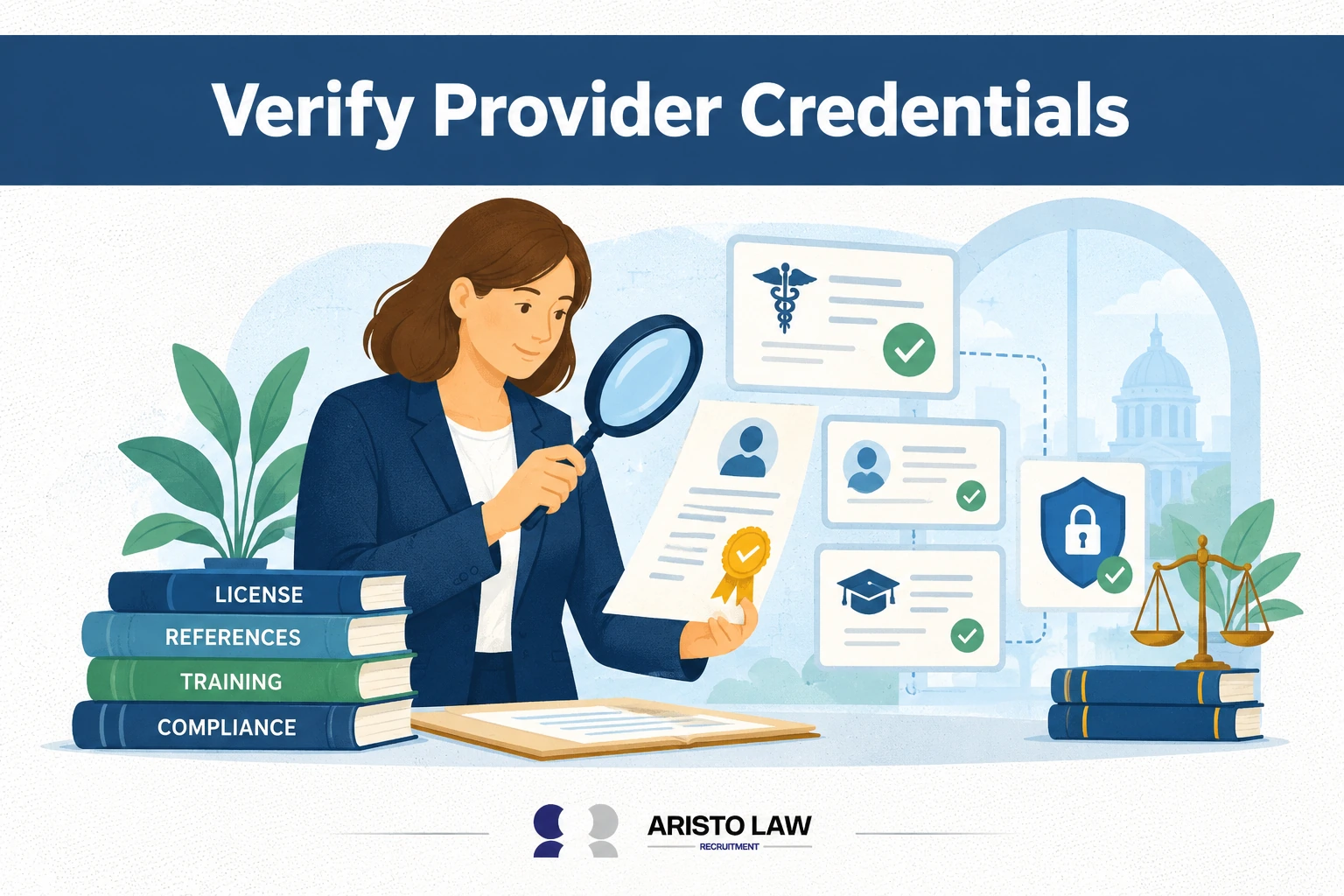
Legal staffing outsourcing starts with provider credential
verification. Provider credential verification confirms bar
affiliations, business registrations, legal staffing certifications,
data handling policies, and operational history.
According to the American Bar Association (ABA), unauthorized
practice of law creates major risks for clients because unverified
individuals may mishandle confidential information, provide inaccurate
legal guidance, or operate without ethical oversight. The ABA
emphasized that law firms implementing credential verification and
professional licensing checks reduce exposure to malpractice, fraud, and
confidentiality violations.
Law firms use provider credential verification to confirm regulatory
compliance, insurance coverage, and jurisdictional authorization before
sharing legal files or client data.
Legal staffing verification strengthens ethical outsourcing standards
because verified providers maintain documented hiring procedures,
background screening systems, and confidentiality controls. Legal
outsourcing compliance improves when law firms request references,
compliance records, cybersecurity certifications, and signed policy
documents. Legal staffing protection increases through verification of
physical office security, employee identity controls, and litigation
support qualifications.
Legal staffing verification practices include reviewing provider
audits, confirming malpractice insurance validity, checking sanctions
databases, requesting sample workflows, and validating employee
screening procedures. Legal staffing risk reduction improves when law
firms repeat provider verification annually and document every approval
decision.
Evaluate Provider Experience
Legal staffing outsourcing depends on provider experience
evaluation. Provider experience evaluation measures legal
industry knowledge, jurisdiction familiarity, workflow accuracy,
litigation support capability, and operational reliability.
According to a legal ethics analysis by M. Hasan Aijaz
published in 2010, effective legal outsourcing depends heavily on
providers understanding professional duties such as confidentiality,
conflicts of interest, and ethical compliance rules. The
research explained that outsourcing firms with legal expertise are
better equipped to meet competence and confidentiality obligations
required in legal practice. Legal outsourcing quality improves because
experienced providers understand legal terminology, court deadlines,
privilege rules, and ethical obligations.
Legal staffing experience assessment protects client matters from
procedural errors and confidentiality failures. Legal outsourcing
stability increases when providers demonstrate successful handling of
document review, legal research, contract drafting, case management, or
eDiscovery projects. Law firms reduce operational disruption through
review of case studies, staffing capacity, turnaround metrics, and
client retention records.
Legal staffing experience review supports secure delegation because
experienced providers maintain structured workflows and supervision
systems. Legal outsourcing reliability increases through interviews with
leadership teams, sample task testing, and analysis of quality assurance
procedures.
Legal staffing evaluation practices include requesting
industry-specific references, reviewing past legal project outcomes,
examining escalation procedures, and assessing employee retention rates.
Legal outsourcing optimization improves when law firms prioritize
providers with documented legal sector specialization instead of general
outsourcing vendors.
Conduct Conflict Checks
Legal staffing outsourcing requires conflict checks before
work assignment. Conflict checks identify relationships, prior
representations, financial interests, or competing client matters that
threaten confidentiality or professional responsibility obligations.
A 2020 ethics analysis published by Lawyers Representing
Lawyers found that law firms using outsourced legal providers must
implement conflict-screening systems because outsourced lawyers who work
on “the same or substantially related matters” for opposing parties can
trigger ethical violations and compromise attorney-client
confidentiality. The report emphasized that proper conflict
checks and confidentiality controls are necessary to protect privileged
communications and prevent malpractice risks. Legal conflict screening
protects attorney-client privilege and prevents ethical violations.
Legal outsourcing conflict management supports compliance with bar
association rules and fiduciary duties. Law firms reduce legal
malpractice exposure through systematic review of outsourced personnel
assignments, provider client lists, and matter overlaps. Legal conflict
prevention protects litigation strategy, merger negotiations,
intellectual property matters, and confidential investigations.
Legal staffing conflict reviews strengthen trust because outsourced
personnel avoid exposure to adverse client information. Legal
outsourcing security improves when providers maintain centralized
databases for conflict monitoring and immediate disclosure
procedures.
Legal conflict prevention practices include written conflict
questionnaires, periodic conflict audits, real-time disclosure
obligations, and documented screening procedures. Legal staffing
protection increases when law firms prohibit outsourced staff from
handling competing matters within related industries or
jurisdictions.
Assess Cybersecurity
Standards
Legal staffing outsourcing requires cybersecurity standard
assessment before data transfer. Cybersecurity assessment measures
encryption controls, endpoint security, access management, breach
response procedures, and network protection systems. Legal
outsourcing security depends on strong cybersecurity because legal files
contain privileged communications, financial records, intellectual
property, and litigation evidence.
According to a June 2023 Cyber Threat Report released by the
UK National Cyber Security Centre (NCSC), law firms are frequent
cyberattack targets because they store highly sensitive legal and
commercial information, including confidential client communications,
litigation strategy, and corporate transaction records. Legal
staffing cybersecurity review reduces ransomware exposure, phishing
attacks, insider threats, and unauthorized access incidents. Law firms
strengthen client protection through evaluation of ISO certifications,
multi-factor authentication systems, penetration testing results, and
employee security training procedures.
Legal outsourcing compliance improves because strong cybersecurity
supports privacy regulations and ethical confidentiality obligations. A
study by IBM Security titled “Cost of a Data Breach Report” in 2024
found that the average global data breach cost reached $4.88 million.
Cybersecurity failures create financial loss, reputational damage, and
regulatory penalties.
Legal cybersecurity practices include annual vendor security audits,
encrypted communication systems, restricted device usage policies, and
mandatory incident reporting timelines. Legal staffing risk management
improves when law firms require continuous cybersecurity monitoring and
independent security assessments.
Sign Confidentiality
Agreements
Legal staffing outsourcing requires confidentiality
agreements before information disclosure. Confidentiality agreements
define data handling obligations, non-disclosure requirements, access
restrictions, and breach liabilities. Legal outsourcing
confidentiality protects attorney-client privilege and preserves
litigation strategy security.
Legal staffing confidentiality agreements establish enforceable legal
protections against unauthorized disclosure or misuse of client
information. Law firms strengthen outsourcing accountability through
detailed confidentiality clauses covering electronic data, verbal
communications, archived files, and third-party access restrictions.
A 2008 ethics report by the Association of the Bar of the
City of New York found that legal outsourcing arrangements remain
ethically compliant when outsourced personnel are bound by
confidentiality obligations, supervised by attorneys, and aligned with
professional conduct standards. Legal staffing protection
improves through confidentiality survival clauses, breach notification
requirements, and injunctive relief provisions.
Legal confidentiality practices include provider-specific agreements,
employee-level non-disclosure contracts, periodic agreement renewals,
and jurisdiction-specific legal review. Legal outsourcing risk reduction
improves when law firms integrate confidentiality requirements into
onboarding and supervision procedures.
Establish Data Protection
Protocols
Legal staffing outsourcing requires documented data
protection protocols. Data protection protocols govern storage,
transfer, retention, deletion, and processing of legal information.
Legal outsourcing security depends on structured controls because legal
data contains confidential client records and privileged
communications.
Legal staffing data protection standards reduce exposure to
unauthorized disclosure, regulatory violations, and operational
disruption. Law firms strengthen outsourcing compliance through
encrypted storage systems, secure backup procedures, data minimization
policies, and incident response workflows.
Legal outsourcing governance improves because data protection
protocols define responsibility allocation and escalation procedures
during security incidents. Legal staffing compliance aligns with privacy
laws and professional confidentiality obligations through documented
handling procedures.
Legal data protection practices include restricted download
permissions, automatic deletion schedules, secure device policies, and
periodic compliance audits. Legal outsourcing stability improves when
providers maintain centralized data governance systems and written
breach response plans.
Define Task Boundaries
Legal staffing outsourcing requires clear task
boundaries. Task boundaries define permitted activities,
restricted responsibilities, supervision requirements, and escalation
procedures. Legal outsourcing control improves because outsourced
personnel avoid unauthorized legal practice and unsupervised legal
judgment.
Legal staffing boundary definition protects ethical compliance by
separating administrative support from attorney-exclusive
responsibilities. A 2017 study by Muhamad Khalil Omar and
Shamsiah Noor Samsuri at Universiti Teknologi MARA involving 183
outsourcing employees found that role ambiguity significantly reduced
employee performance (r = −0.493, p < 0.01), supporting the need for
clear task boundaries in outsourcing arrangements.
Law firms reduce operational confusion through written role
descriptions, workflow charts, and approval hierarchies.
Legal outsourcing structure strengthens accountability because
outsourced personnel understand assignment scope and reporting
requirements. Legal staffing quality improves through controlled
delegation of document review, scheduling, intake support, billing
assistance, and legal research preparation.
Legal boundary management practices include written service
agreements, periodic responsibility reviews, supervisor approvals, and
escalation triggers for legal interpretation issues. Legal outsourcing
risk reduction improves when law firms prohibit outsourced personnel
from providing independent legal advice.
Classify Sensitive
Information
Legal staffing outsourcing requires information
classification before file access. Information classification
organizes legal data according to confidentiality level, regulatory
exposure, and operational sensitivity. Legal outsourcing protection
improves because classified data receives appropriate access
restrictions and monitoring controls.
Legal staffing information classification supports secure handling of
litigation files, medical records, financial disclosures, intellectual
property documents, and merger negotiations. Law firms reduce data
exposure through labeling systems, restricted access permissions, and
segmented storage environments.
Legal outsourcing governance strengthens compliance because
classified information receives handling procedures aligned with ethical
duties and privacy regulations. Legal staffing security improves through
limited visibility rules and role-based permissions.
Legal information classification practices include confidential
labeling systems, encrypted storage tiers, restricted transmission
methods, and periodic access reviews. Legal outsourcing monitoring
improves when firms maintain updated classification inventories and
documented handling procedures.
Obtain Client Consent
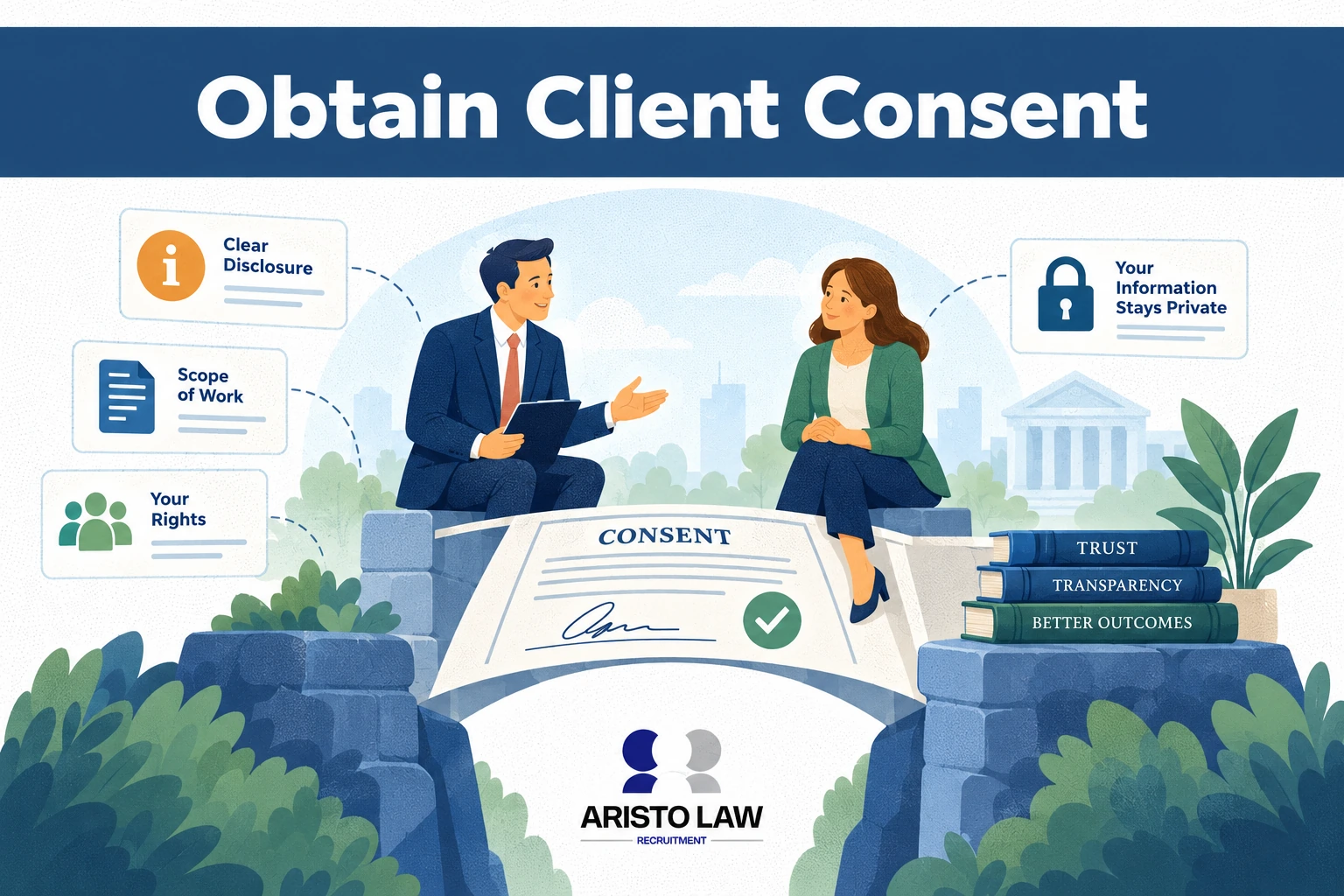
Legal staffing outsourcing requires client consent before
outsourced involvement in confidential matters. Client consent
confirms transparency regarding external staffing support and data
handling procedures. Legal outsourcing ethics improve because clients
understand who accesses legal information and how work processes
operate.
Legal staffing consent procedures strengthen attorney-client trust
and support compliance with professional responsibility rules. Law firms
reduce ethical disputes through written disclosures describing
outsourced functions, confidentiality controls, supervision standards,
and jurisdictional limitations.
Legal outsourcing transparency protects firms from allegations of
unauthorized disclosure or inadequate representation. A legal
ethics analysis published in Legal Information Management by legal
researcher Mark Ross in 2011 found that outsourcing legal services
raises ethical concerns specifically around confidentiality,
supervision, and client disclosure. The study noted that clearer
disclosure about outsourced legal processes and access to client data
improves compliance with professional ethical standards because clients
better understand who is handling sensitive legal
information.
Legal staffing accountability improves because clients acknowledge
outsourcing participation and associated protections.
Legal consent practices include engagement letter disclosures,
written approvals, updated privacy notices, and matter-specific
outsourcing disclosures. Legal outsourcing compliance improves when law
firms maintain documented client consent records within case management
systems.
Ensure Ethical
Compliance Requirements
Legal staffing outsourcing requires ethical compliance
enforcement across all workflows. Ethical compliance
requirements include confidentiality obligations, supervision duties,
conflict avoidance, billing transparency, and unauthorized practice
restrictions. Legal outsourcing ethics protect professional integrity
and client trust.
Legal staffing ethical oversight supports compliance with bar
association regulations and professional conduct standards. Law firms
reduce disciplinary exposure through documented supervision procedures,
employee conduct policies, and ethical training programs.
Legal outsourcing governance strengthens accountability because
providers follow established legal ethics frameworks. A study by
the American Bar Association titled “Formal Opinion 498” in 2021 stated
that lawyers remain responsible for competent supervision of outsourced
legal services. Ethical oversight protects legal accuracy and
confidentiality.
Legal compliance practices include recurring ethics training,
documented escalation procedures, attorney supervision reviews, and
provider compliance certifications. Legal outsourcing protection
improves when firms conduct periodic ethical audits and maintain written
compliance records.
Implement Secure File
Sharing Systems
Legal staffing outsourcing requires secure file sharing
systems for document exchange. Secure file sharing systems
protect confidential records through encryption, authentication
controls, and monitored access channels. Legal outsourcing security
improves because unsecured communication exposes legal data to
interception and theft.
According to the American Bar Association’s 2025 Legal Tech
Survey, 73% of law firms now use cloud-based legal tools for document
management and practice operations, while 60% have implemented formal
cybersecurity policies due to growing risks tied to digital document
exchange. The report also noted that phishing and ransomware remain
major threats to legal data handling, reinforcing the need for secure
file-sharing systems in legal staffing and outsourcing environments
where confidential documents are transferred
electronically.
Legal staffing file transfer protection reduces phishing exposure,
unauthorized downloads, and accidental disclosure incidents. Law firms
strengthen confidentiality through encrypted portals, secure cloud
environments, and permission-based access systems.
Legal outsourcing efficiency improves because secure sharing systems
centralize workflows and preserve audit trails. Legal staffing
compliance aligns with privacy regulations through controlled document
transmission procedures.
Legal file sharing practices include multi-factor authentication,
automatic expiration links, restricted download permissions, and
centralized activity logging. Legal outsourcing risk reduction improves
when firms prohibit public email attachments for confidential legal
files.
Restrict Unauthorized Data
Access
Legal staffing outsourcing requires strict access control
enforcement. Access restrictions limit legal data visibility to
authorized personnel assigned to specific matters.
According to analysis of UK legal-sector breach data by
NetDocuments using Information Commissioner’s Office (ICO) records
covering Q3 2022–Q2 2023, about 60% of identified data breaches in legal
firms were caused by insiders, including accidental disclosures and
employee mistakes, while only 40% came from external attackers.
The report specifically identified data emailed to the wrong recipients
and mishandling of paperwork as major causes of confidential information
exposure, supporting the argument that limiting internal access can
reduce disclosure risks and insider threats. Legal outsourcing
confidentiality improves because limited access reduces insider threats
and accidental disclosure risks.
Legal staffing access management supports ethical obligations tied to
attorney-client privilege and sensitive litigation strategy. Law firms
strengthen security through role-based permissions, device
authentication systems, and monitored login activity.
Legal outsourcing governance improves because restricted access
creates accountability for every document interaction. Legal staffing
protection increases through session monitoring, access expiration
timelines, and real-time alert systems.
Legal access control practices include least-privilege policies,
periodic access reviews, inactive account removal, and centralized
identity management systems. Legal outsourcing security improves when
firms isolate high-risk files within restricted environments.
Create Communication
Protocols
Legal staffing outsourcing requires structured communication
protocols. Communication protocols define reporting channels,
response timelines, escalation procedures, and confidentiality
standards. Legal outsourcing coordination improves because clear
communication reduces misunderstandings and workflow disruption.
Legal staffing communication management strengthens supervision and
protects sensitive discussions from unauthorized exposure. Law firms
improve operational efficiency through designated contact persons,
secure messaging platforms, and documented approval procedures.
Research published in Heliyon by H. Shakeri and project
management researchers in 2020 found that communication failures among
employees and stakeholders caused major workflow inefficiencies and
financial losses in outsourced and large-scale projects. The study
concluded that structured and timely communication improved coordination
by reducing misunderstandings, delays, and information flow problems
between teams.
Legal outsourcing accountability increases because communication
protocols establish traceable decision-making and task assignment
records. Legal staffing transparency improves through regular progress
updates and issue escalation systems.
Legal communication practices include encrypted messaging tools,
scheduled reporting meetings, documented instructions, and restricted
communication platforms. Legal outsourcing monitoring improves when
firms maintain centralized communication records for compliance
review.
Assign Supervision
Responsibilities
Legal staffing outsourcing requires attorney supervision
assignment for every outsourced workflow. Supervision
responsibilities define oversight authority, review obligations,
escalation handling, and performance accountability.
According to the American Bar Association’s Formal Ethics
Opinion 08-451, published on August 5, 2008, attorneys who outsource
legal or nonlegal support services remain “ultimately responsible” for
the outsourced work and must ensure proper supervision under ABA Rules
5.1 and 5.3. The opinion states that lawyers with direct supervisory
authority are required to make “reasonable efforts” to ensure outsourced
personnel comply with professional legal obligations, meaning outsourced
legal workflows cannot operate without attorney oversight.
Legal outsourcing ethics depend on attorney supervision because legal
responsibility remains with the law firm.
Legal staffing supervision strengthens work accuracy and
confidentiality protection. Law firms reduce malpractice exposure
through designated supervisors who monitor deadlines, review
deliverables, and verify compliance with legal standards.
Legal outsourcing governance improves because outsourced personnel
receive structured guidance and immediate clarification during complex
assignments. Legal staffing accountability increases through documented
review processes and supervisor approvals.
Legal supervision practices include workflow checklists, scheduled
performance reviews, escalation reporting structures, and approval
requirements for legal deliverables. Legal outsourcing quality improves
when supervisory attorneys maintain continuous involvement in outsourced
work processes.
Train Outsourced Legal Staff
Legal staffing outsourcing requires legal staff training
before assignment execution. Legal staff training covers
confidentiality obligations, cybersecurity standards, workflow
procedures, ethics requirements, and communication protocols.
A 2003 study by Thomas W. Gainey and Brian S. Klaas published
in the Journal of Management analyzed data from 157 organizations and
found that outsourcing performance and client satisfaction improved when
vendors had clear contractual expectations, strong relationship
management, and well-defined training processes. The
researchers concluded that operational consistency increased when
outsourced personnel clearly understood organizational requirements and
service standards. Legal outsourcing consistency improves because
trained personnel understand operational expectations and compliance
obligations.
Legal staffing education reduces procedural errors, confidentiality
violations, and workflow delays. Law firms strengthen operational
security through onboarding programs, legal terminology education, and
matter-specific instruction sessions.
Legal outsourcing compliance improves because trained outsourced
staff follow documented handling procedures and escalation requirements.
Legal staffing reliability increases through recurring education on
privacy regulations, secure technology usage, and legal ethics
standards.
Legal training practices include simulated workflows, cybersecurity
awareness testing, written policy acknowledgments, and recurring
compliance refreshers. Legal outsourcing performance improves when firms
measure training completion and knowledge retention metrics.
Monitor Outsourced Work
Quality
Legal staffing outsourcing requires continuous quality
monitoring. Work quality monitoring measures accuracy, deadline
compliance, formatting consistency, confidentiality adherence, and
procedural reliability. Legal outsourcing performance improves because
early issue detection prevents client impact and operational
disruption.
Legal staffing quality review strengthens trust between law firms and
outsourcing providers. Law firms reduce rework costs through structured
feedback systems, performance metrics, and workflow tracking
procedures.
Legal outsourcing accountability increases because quality monitoring
identifies recurring process failures and staffing weaknesses. Legal
staffing consistency improves through random audits, document sampling,
and supervisor evaluations.
Legal quality monitoring practices include service-level agreements,
error rate tracking, deadline performance reviews, and documented
corrective action procedures. Legal outsourcing optimization improves
when firms maintain measurable performance benchmarks and recurring
provider evaluations.
Review Legal Deliverables
Legal staffing outsourcing requires attorney review of all
legal deliverables before client use. Legal deliverable review
verifies legal accuracy, confidentiality compliance, formatting
standards, and jurisdictional consistency.
According to the American Bar Association (ABA) Formal
Opinion 08-451 issued on August 5, 2008, attorneys who outsource legal
work remain “ultimately responsible” for all outsourced legal services
and must ensure competent supervision before any work is used by
clients. The ABA specifically stated that lawyers must make “reasonable
efforts” to supervise outsourced lawyers and nonlawyers to ensure
compliance with professional ethics rules, meaning legal deliverables
cannot be relied upon without attorney oversight and review.
Legal outsourcing protection improves because attorney oversight
prevents inaccurate or incomplete submissions.
Legal staffing deliverable review supports professional
responsibility obligations tied to competent representation. Law firms
strengthen quality assurance through layered review systems and
documented approval procedures.
Legal outsourcing reliability increases because reviewed deliverables
align with litigation strategy, regulatory standards, and client
expectations. Legal staffing supervision improves through tracked
revisions and structured feedback loops.
Legal review practices include checklist-based evaluations, legal
citation verification, privilege review procedures, and final attorney
approval requirements. Legal outsourcing risk reduction improves when
firms document every review stage and correction process.
Audit Outsourcing Workflows
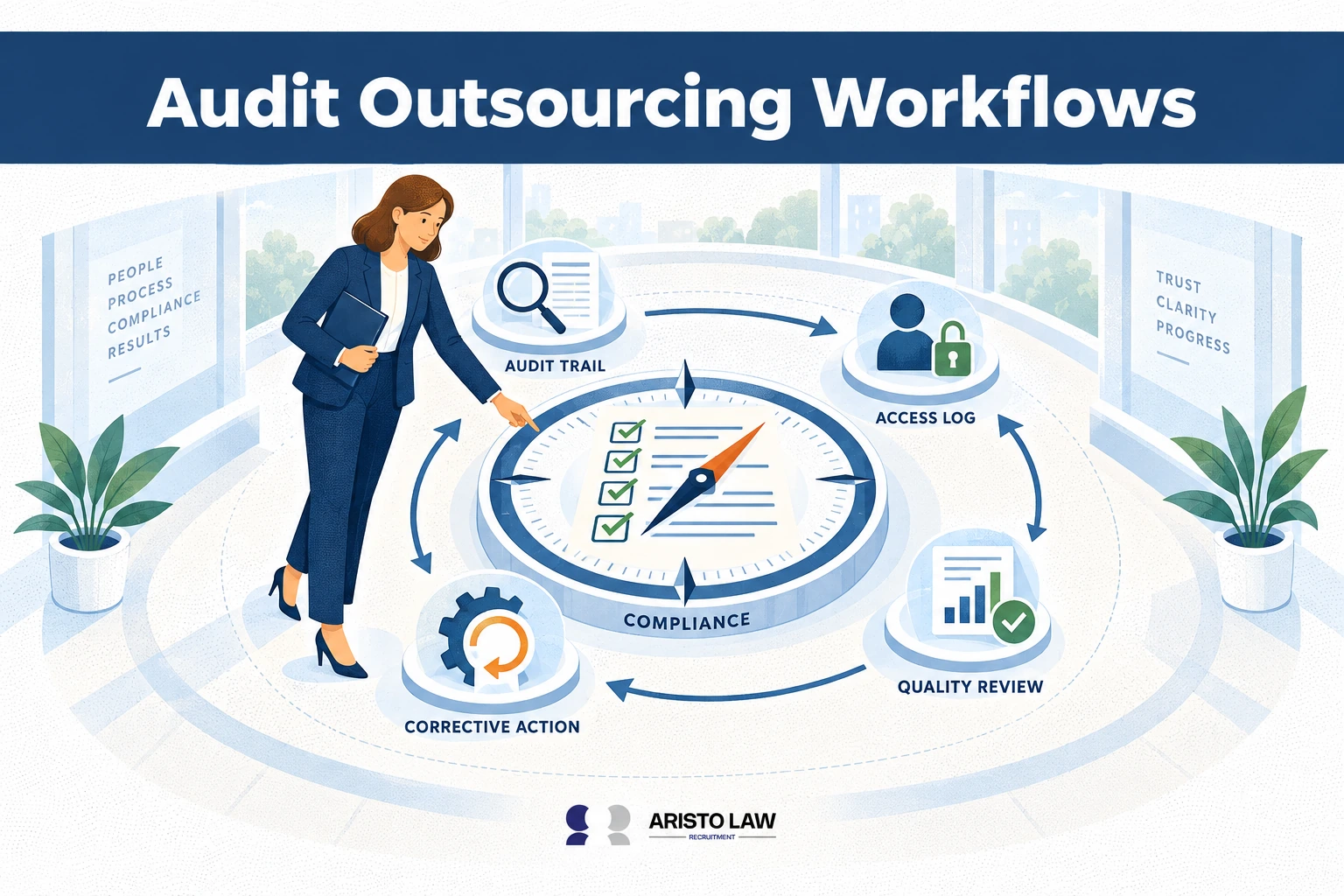
Legal staffing outsourcing requires recurring workflow
audits. Workflow audits evaluate operational controls,
compliance adherence, cybersecurity practices, and process efficiency.
Legal outsourcing governance improves because audits identify hidden
risks, procedural weaknesses, and compliance failures.
Legal staffing audit procedures strengthen accountability across
providers, supervisors, and outsourced personnel. Law firms reduce
operational exposure through documented evaluations of access controls,
communication systems, and file handling processes.
Legal outsourcing monitoring improves because audits create
measurable compliance records and performance benchmarks. A 2021
Global Legal Department Benchmarking Survey conducted by KPMG found that
companies integrating legal, compliance, and audit functions under
unified monitoring structures achieved stronger oversight and measurable
performance tracking. The survey reported that 11% of legal departments
combined legal, compliance, and audit management, while organizations
using disciplined oversight structures recorded cost advantages of
9%–15% per US$1 billion in sales, showing how audits create measurable
benchmarks for monitoring outsourced legal performance.
Legal staffing transparency increases through corrective action plans
and recurring operational reviews. Legal workflow audit practices
include independent compliance reviews, process mapping, access log
analysis, and incident response testing. Legal outsourcing protection
improves when firms schedule annual audits and document remediation
efforts.
Maintain Documentation
Records
Legal staffing outsourcing requires complete documentation
records for compliance and accountability. Documentation
records preserve outsourcing agreements, consent forms, training logs,
audit findings, supervision records, and workflow approvals. Legal
outsourcing governance improves because records support regulatory
review and dispute resolution.
Legal staffing documentation strengthens transparency and
operational continuity. According to the 2025 Legal Department
Operations Index published by Thomson Reuters, 47% of legal
departments reported that balancing operational control with compliance
documentation and process oversight improved organizational
accountability and workflow continuity. The report identified
legal compliance oversight, process compliance, and workflow
documentation as core factors supporting operational stability and
transparency in legal operations.
Law firms reduce liability exposure through organized evidence of
compliance efforts, confidentiality controls, and supervision
procedures.
Legal outsourcing accountability improves because documented
workflows create traceable operational histories. Legal staffing
protection increases through centralized record storage and restricted
document access systems.
Legal documentation practices include digital compliance
repositories, version-controlled policies, incident logs, and archived
communication records. Legal outsourcing monitoring improves when firms
maintain searchable documentation systems for audits and legal
review.
Conduct Ongoing Risk
Assessments
Legal staffing outsourcing requires continuous risk
assessment procedures. Ongoing risk assessments evaluate
cybersecurity threats, operational weaknesses, regulatory exposure,
provider reliability, and confidentiality risks.
A 2023 cybersecurity report by IBM and the Ponemon Institute
found that organizations using continuous risk assessments and proactive
vulnerability identification reduced the average cost of a data breach
by about USD 1.76 million compared to organizations that responded only
after operational damage occurred. Legal outsourcing protection
improves because recurring assessments identify emerging vulnerabilities
before operational damage occurs.
Legal staffing risk evaluation strengthens strategic decision-making
and compliance planning. Law firms reduce legal exposure through
recurring analysis of provider performance, incident trends, and access
control effectiveness.
Legal outsourcing governance improves because risk assessments
support proactive policy updates and workflow improvements. Legal
staffing resilience increases through continuous monitoring of
technology systems, employee conduct, and regulatory changes.
Legal risk assessment practices include quarterly security reviews,
provider scorecards, incident trend analysis, compliance testing, and
contingency planning exercises. Legal outsourcing stability improves
when firms integrate risk assessment findings into operational and
cybersecurity policies.
What legal tasks are
commonly outsourced?
The table below shows the legal tasks most commonly
outsourced, including administrative, litigation, intake, compliance,
and document-support functions handled by external legal
teams.
Law firms and corporate legal teams frequently outsource operational
and administrative functions to improve efficiency, reduce internal
workload, and expand access to specialized support, with types
of legal outsourcing services ranging from document
review and legal research to intake management, billing support,
contract processing, and litigation assistance.
The table below shows the legal tasks commonly outsourced.
| Outsourced Legal Work Category | Legal Support Outsourcing Function | Primary Operational Purpose | Attorney Supervision Requirement | Confidentiality Exposure Level |
|---|---|---|---|---|
| Client intake management | Client screening, appointment setup, intake questionnaire processing, lead qualification |
Law firm intake coordination and response management | High attorney oversight during legal issue evaluation | High |
| Legal research support | Case law collection, statute compilation, citation verification, research summaries |
Litigation preparation and legal analysis support | Direct attorney review before legal use | High |
| Contract management | Contract abstraction, clause tracking, renewal monitoring, document organization |
Contract lifecycle administration and compliance monitoring | Attorney review for legal interpretation and approval | High |
| Litigation support | Trial preparation, exhibit organization, deposition summary preparation, case file management |
Litigation workflow coordination | Attorney supervision across all litigation strategy activities | High |
| Discovery preparation | eDiscovery processing, document indexing, privilege tagging support, evidence organization |
Discovery workflow management and document review outsourcing | Attorney validation for privilege and production decisions | High |
| Billing support | Invoice generation, time entry review, payment tracking, legal expense reporting |
Financial administration and revenue management | Limited attorney review for billing compliance | Medium |
| Scheduling coordination | Court calendar management, meeting scheduling, deadline reminders, hearing coordination |
Legal administration and operational coordination | Minimal attorney supervision | Low |
| Records retrieval | Medical record requests, court filing retrieval, public record collection, document tracking |
Evidence gathering and case documentation support | Attorney oversight for privileged records | Medium |
| Demand drafting assistance | Template preparation, factual compilation, supporting exhibit organization |
Pre-litigation documentation support | Mandatory attorney drafting review and approval | High |
| Compliance tracking | Regulatory deadline monitoring, compliance checklist updates, filing schedule tracking |
Compliance administration and audit readiness | Attorney supervision for regulatory interpretation | Medium |
| Legal transcription | Deposition transcription, hearing transcription, interview documentation, audio conversion |
Legal documentation accuracy and record maintenance | Attorney review for evidentiary accuracy | Medium |
| Document management | File indexing, digital archiving, metadata tagging, version control |
Legal workflow management and document organization | Limited attorney oversight | Medium |
| Paralegal support services | Discovery coordination, filing preparation, case chronology management |
Litigation and case support operations | Attorney supervision required by ethical rules | High |
| Legal data entry | Case information updates, CRM management, database maintenance | Administrative workflow support | Minimal attorney review | Low |
| Intellectual property support | Trademark monitoring, filing preparation support, docket tracking |
Intellectual property administration | Attorney approval before legal filing | High |
| Compliance documentation support | Policy formatting, audit documentation assembly, filing preparation |
Regulatory documentation support | Attorney review for legal accuracy | Medium |
| Court filing support | Filing package preparation, formatting, submission coordination | Court procedure administration | Attorney verification before filing submission | High |
| Virtual receptionist services | Client call routing, intake scheduling, communication logging | Law firm communication management | Minimal attorney supervision | Low |
| Legal translation support | Translation of contracts, evidence records, compliance documents |
Cross-border legal communication support | Attorney review for legal precision | High |
| Case management administration | Workflow updates, deadline tracking, internal coordination | Legal workflow management and operational organization | Limited attorney supervision | Medium |
What
is legal process outsourcing (LPO)?
Legal process outsourcing is the delegation of structured
legal support operations to specialized external providers that manage
outsourced legal services through standardized workflow systems,
compliance controls, service-level agreements (SLA), and supervised
remote staffing models. Legal process outsourcing differs from
random freelancer hiring because LPO providers operate organized legal
BPO infrastructures with dedicated teams, documented procedures,
workflow automation systems, secure document handling environments, and
measurable performance standards.
A 2026 Legal Process Outsourcing Market analysis by Mordor
Intelligence reported that 43% of chief legal officers planned to
outsource more legal work in 2025, an increase of 17 percentage points
from 2024, indicating growing institutional dependence on external
providers operating under formalized service-level agreements (SLAs),
compliance procedures, and scalable remote staffing models.
Legal BPO providers support law firms and corporate legal departments
through intake processing, document review, litigation support, legal
research support, compliance operations, contract management,
transcription, e-discovery coordination, and legal administration
workflows. Legal process outsourcing structures repeatable operational
systems through workflow automation, centralized communication
platforms, case management integration, and quality-control review
layers. Offshore staffing models reduce operational cost through
international legal support teams. Nearshore and remote staffing
structures improve time-zone alignment, communication speed, and
operational continuity.
Legal process outsourcing agreements define turnaround times,
confidentiality obligations, escalation procedures, reporting
structures, and performance metrics through SLA frameworks. Legal BPO
operations require stronger oversight than traditional staffing agencies
because outsourced legal services involve privileged information
exposure, regulatory obligations, litigation-sensitive records, and
attorney-client confidentiality protections. Legal process outsourcing
improves efficiency and cost predictability, yet attorney supervision,
secure workflow systems, ethical compliance, and restricted data access
remain mandatory across all legal BPO environments.
Is
outsourcing legal work ethical?
Yes, outsourcing legal work is ethical when law firms
maintain supervision, confidentiality protection, competence standards,
and compliance with professional conduct rules. Legal ethics
focus on attorney responsibility, oversight quality, privilege
protection, and informed delegation instead of geography alone. Legal
outsourcing remains compliant when licensed attorneys supervise
outsourced legal work, review deliverables, verify legal accuracy, and
retain control over client representation and legal judgment.
A 2023 survey by the Association of Corporate Counsel found
that 74% of in-house legal departments in the United States outsourced
compliance-related legal tasks to specialized legal process outsourcing
(LPO) providers, showing that outsourcing legal work has become a widely
accepted practice within the legal industry when ethical safeguards are
followed.
Attorney responsibility remains active throughout outsourced legal
operations because professional conduct rules prohibit delegation of
independent legal advice to non-lawyers. Legal ethics require attorneys
to monitor outsourced personnel, perform quality review procedures,
conduct conflict checks, and preserve confidentiality protections across
all workflows. Client confidentiality remains protected through
non-disclosure agreements, secure communication systems, restricted data
access, and encrypted document management platforms. Legal privilege
protection depends on controlled handling of litigation files,
contracts, financial records, and attorney-client communications.
Legal ethics concerns increase when law firms lose operational
oversight, hide outsourcing relationships, fail to supervise outsourced
work, or allow unauthorized legal practice. Billing transparency remains
necessary because clients deserve accurate disclosure of outsourced
legal support costs and staffing structures where required by
jurisdictional rules. Professional conduct obligations require
competence, diligence, confidentiality, and accountability across all
outsourced legal services. Legal outsourcing becomes unethical when
operational efficiency replaces attorney supervision, legal accuracy, or
client protection standards.
What are the
benefits of outsourced paralegal services?
Outsourced paralegal services provide benefits such as
workload flexibility, lower overhead costs, extended support coverage,
faster document handling, and scalable legal operations.
According to a 2025 Thomson Reuters Institute report
conducted with Georgetown Law and the University of Oxford, the global
alternative legal services market reached $28.5 billion, driven largely
by law firms seeking lower costs, scalable staffing, and specialized
support such as outsourced paralegals and legal assistants. The report,
based on surveys from 424 law firms and 213 corporate legal departments,
found that firms increasingly outsource high-volume legal work to
improve efficiency and reduce operational burden.
Outsourced paralegal support improves operational flexibility by
reducing administrative bottlenecks, accelerating document turnaround
times, and allowing legal teams to focus more directly on case strategy
and client communication. Firms handling fluctuating caseloads also gain
scalable support without the long-term overhead associated with in-house
staffing, making virtual
paralegal assistant services a practical solution for
maintaining efficiency across litigation, intake, and legal
documentation workflows.
Listed below are 10 benefits of outsourced paralegal services.
-
Workload flexibility: Outsourced paralegal services
help law firms manage litigation spikes, intake surges, mass tort
expansion, seasonal workload increases, and urgent filing periods
without permanent staffing expansion. Paralegal outsourcing supports
temporary case-volume growth through scalable support structures under
attorney supervision. -
Lower operational overhead: Paralegal outsourcing
reduces recruitment costs, payroll obligations, office space expenses,
employee benefits, workstation setup costs, and long-term staffing
liabilities. Legal operations improve because law firms pay for defined
support tasks instead of maintaining excess full-time staffing capacity
during lower caseload periods. -
Extended support coverage: Outsourced paralegal
services improve operational continuity through offshore, remote, or
after-hours legal support coverage. Litigation support workflows
continue during weekends, time-zone shifts, staff absences, or internal
hiring gaps. Legal operations maintain case progress without workflow
interruption. -
Faster document handling: Paralegal outsourcing
accelerates document review, file organization, records coordination,
transcription support, discovery preparation, demand-letter support, and
court filing preparation. Litigation support improves because outsourced
teams process repetitive legal-adjacent tasks through structured
workflows and standardized procedures. -
Scalable legal operations: Outsourced paralegal
services support law firm growth without immediate expansion of internal
administrative infrastructure. Legal operations scale through flexible
staffing allocation across multiple cases, departments, or practice
areas based on workload demand. -
Litigation support continuity: Paralegal outsourcing
strengthens litigation support during discovery-heavy cases, trial
preparation periods, and evidence-management workflows. Outsourced legal
teams organize exhibits, summarize records, track deadlines, and manage
case documentation under attorney review layers. -
Intake overflow management: Outsourced paralegal
services support client intake coordination during high-volume lead
periods. Legal operations improve because outsourced teams manage
appointment scheduling, intake forms, follow-up communication, and
document collection without delaying attorney consultations. -
Administrative continuity during staffing gaps:
Paralegal outsourcing maintains workflow stability during employee
turnover, parental leave, medical leave, recruitment delays, or office
expansion periods. Legal operations continue without major disruption
because outsourced support fills temporary staffing shortages. -
Records coordination support: Outsourced paralegal
services improve medical records retrieval, billing record collection,
court document tracking, and evidence organization workflows. Litigation
support systems maintain organized documentation for attorney review and
case preparation. -
Attorney workload redistribution: Paralegal
outsourcing removes repetitive administrative pressure from attorneys so
attorneys focus on litigation strategy, negotiations, court appearances,
legal analysis, and client communication. Scalable support strengthens
legal operations without replacing attorney oversight, legal judgment,
or ethical responsibility.
Can small law
firms outsource legal support safely?
Yes, small law firms can outsource legal support safely when
workflows, supervision, confidentiality protections, and vendor controls
are clearly structured. Small law firms and solo practice
operations frequently face budget limitations, staffing instability,
intake overload, inconsistent caseload volume, and limited in-house
operations support.
Outsourced legal support reduces operational pressure through
scalable assistance for intake management, scheduling, document
organization, records retrieval, litigation support, billing
coordination, and administrative legal workflows. Small law firms gain
operational relief because outsourced support expands staffing capacity
without permanent payroll expansion or long-term hiring commitments.
Outsourced legal support improves workflow continuity during trial
preparation periods, sudden case spikes, employee absences, or delayed
hiring cycles. Intake management systems improve because outsourced
legal teams handle client communication, appointment coordination, and
document collection under attorney supervision.
Workflow controls remain necessary because solo practice environments
frequently operate with informal procedures, limited cybersecurity
infrastructure, and undocumented operational systems. Legal outsourcing
risks increase when small law firms share confidential information
without written confidentiality agreements, access restrictions,
conflict checks, or secure communication platforms.
Small law firms maintain safe legal outsourcing practices through
documented workflows, attorney review layers, secure file-sharing
systems, role-based permissions, and clear task boundaries. Attorney
supervision remains mandatory because outsourced legal support does not
replace legal judgment, client representation, or professional
responsibility obligations. Workflow controls, compliance monitoring,
and structured vendor oversight protect small law firms from
confidentiality breaches, operational errors, and ethical compliance
failures during outsourced legal operations.
What are the
biggest risks in legal outsourcing?
The biggest risks in legal outsourcing involve
confidentiality breaches, cybersecurity failures, compliance violations,
quality control issues, and ethical liability arising from delegating
sensitive legal work to third-party providers. Legal process
outsourcing transfers access to privileged legal files, financial
records, litigation strategy, regulatory documents, and client
communications outside the internal law firm environment.
Outsourced legal staffing improves scalability and operational
flexibility, yet legal outsourcing risks increase when supervision,
cybersecurity controls, workflow systems, and compliance procedures
remain weak or undocumented. Attorney-client privilege exposure,
unauthorized practice of law, jurisdictional conflicts, AI legal risk,
and operational dependency create major legal and reputational threats
across legal process outsourcing environments.
Legal outsourcing risks increase because law firms remain responsible
for outsourced work quality, confidentiality protection, billing
accuracy, and ethical compliance under professional conduct rules.
Cybersecurity threats target legal organizations because law firms store
sensitive corporate, financial, healthcare, intellectual property, and
litigation data.
The American Bar Association’s 2023 Legal Technology Survey
Report found that law firms continued to face cybersecurity threats
involving hackers, malware, website exploits, and unauthorized access
risks to confidential client information, with 29% of firms reporting a
security breach or incident in 2023. AI legal risk exposure has
increased through unverified AI-generated legal research, hallucinated
legal analysis, and privilege leakage into unsecured public AI systems.
Outsourced legal staffing failures damage client trust, trigger
regulatory scrutiny, and create malpractice exposure when legal
operations lack supervision or verification controls.
Confidentiality risks in outsourcing depend less on outsourcing
itself and more on how access, compliance, and data governance are
structured across external workflows. Legal and healthcare organizations
that implement encrypted communication channels, role-based access
controls, signed NDAs, and jurisdiction-specific compliance standards
are better positioned to outsource
securely and ethically without compromising sensitive
client or patient information.
Listed below are 12 biggest risks in legal outsourcing.
-
Confidentiality and attorney-client privilege
breaches: Legal outsourcing risks increase when external
vendors access privileged communications, litigation files, merger
documents, financial records, or healthcare data without strict
confidentiality controls. Attorney-client privilege exposure weakens
legal protection and increases malpractice liability. -
Cybersecurity attacks and third-party data exposure:
Legal process outsourcing environments face phishing attacks, ransomware
incidents, cloud-storage breaches, credential theft, and unsecured
endpoint exposure. Outsourced legal staffing providers become
cyberattack entry points when cybersecurity standards remain weak or
outdated. -
Unauthorized practice of law (UPL): Legal
outsourcing risks increase when unlicensed personnel provide independent
legal advice, interpret legal strategy, negotiate legal rights, or
perform attorney-only functions without supervision. Unauthorized
practice of law violations trigger disciplinary and regulatory
consequences. -
Inadequate supervision of outsourced legal work:
Attorney responsibility remains active throughout outsourced legal
operations. Legal process outsourcing failures occur when lawyers
delegate tasks without review layers, workflow oversight, or competence
verification. -
Poor quality control and inaccurate legal
deliverables: Outsourced legal staffing creates operational
risk when legal research, discovery preparation, contract review, or
drafting support contains factual inaccuracies, missed deadlines,
incomplete analysis, or formatting defects. -
Conflicts of interest involving outsourced vendors:
Legal outsourcing risks increase when vendors simultaneously support
competing clients, related litigation matters, or opposing business
interests without conflict disclosure procedures. -
Cross-border compliance and jurisdictional regulatory
risks: Legal process outsourcing frequently involves offshore
staffing structures operating across multiple privacy laws,
data-transfer rules, and legal ethics standards. Regulatory conflict
exposure increases during international legal operations. -
Communication gaps, time-zone issues, and workflow
delays: Outsourced legal staffing operations experience
operational disruption through delayed communication, inconsistent
reporting structures, language barriers, and disconnected workflow
coordination systems. -
Ethical billing and transparency concerns with
clients: Legal outsourcing risks increase when firms inflate
outsourced billing rates, conceal third-party staffing usage, or fail to
disclose outsourcing structures where ethical rules require
transparency. -
AI-related risks such as hallucinated legal analysis and
privilege leakage: AI legal risk exposure increases when
outsourced providers rely on unverified AI-generated citations,
fabricated case law, inaccurate legal summaries, or unsecured public AI
systems that process confidential legal information. -
Reputational damage and loss of client trust after
outsourcing failures: Legal outsourcing failures damage law
firm reputation when confidentiality breaches, missed deadlines,
inaccurate filings, or unethical outsourcing practices become public or
affect client outcomes. -
Vendor dependency and operational disruption if providers
fail or disappear: Legal process outsourcing creates
operational dependency when law firms rely heavily on external providers
without backup systems, internal documentation, or contingency staffing
procedures.
What is
unauthorized practice of law in outsourcing?
Unauthorized practice of law occurs when non-lawyers perform
legal functions that require attorney judgment, legal advice, or
independent representation authority. Unauthorized practice of
law develops in outsourcing environments when non-lawyer staff, virtual
legal assistants, offshore personnel, or paralegals independently
interpret laws, advise clients, recommend legal strategy, negotiate
legal positions, draft binding legal opinions without review, or present
themselves as licensed attorneys.
Attorney supervision remains mandatory because only licensed lawyers
hold authority to provide legal counsel, represent clients, and exercise
legal judgment.
Non-lawyer staff support legal operations through administrative
coordination, drafting assistance, intake management, records retrieval,
legal research support, scheduling, document organization, and
supervised litigation preparation. Paralegal support remains compliant
when attorneys direct assignments, review legal work, verify accuracy,
and maintain responsibility for final legal decisions. Outsourced legal
staffing crosses ethical boundaries when non-lawyer personnel
communicate legal advice directly to clients, interpret contractual
rights independently, determine litigation strategy, or make legal
conclusions without attorney oversight.
Unauthorized practice of law creates malpractice exposure, regulatory
penalties, disciplinary action, confidentiality risks, and client
deception concerns. Attorney supervision protects legal compliance
because supervising lawyers review outsourced work, control client
communication, define task boundaries, and prevent non-lawyer staff from
exercising independent legal authority. Legal outsourcing remains
compliant when outsourced personnel operate as supervised legal support
instead of unsupervised legal representatives.
Clear role boundaries and supervised delegation remain central to
compliant legal outsourcing, particularly when outsourced staff
participate in document preparation, client communication, or case
support activities connected to paralegal
tasks and legal responsibilities within regulated legal
workflows.
What mistakes do
law firms make when outsourcing?
Law firms commonly make outsourcing mistakes such as choosing
vendors only by cost, failing to supervise work, ignoring cybersecurity
requirements, using unclear contracts, and outsourcing inappropriate
legal tasks.
Listed below are 13 most common mistakes law firms make.
-
Choosing vendors only by cost: Outsourcing mistakes
increase when law firms prioritize low pricing over experience, legal
workflow capability, confidentiality controls, and operational
reliability. Vendor selection improves through credential verification,
legal-sector specialization review, and security assessment instead of
price-only evaluation. -
Failing to supervise outsourced work: Attorney
responsibility remains active during outsourced legal operations.
Accountability failures develop when attorneys delegate legal support
tasks without review layers, deadline monitoring, or legal accuracy
verification. Attorney supervision prevents ethical violations and
inaccurate deliverables. -
Ignoring cybersecurity controls: Cybersecurity
failures expose privileged files, financial records, litigation
strategy, and client communications to ransomware attacks, phishing
attempts, and unauthorized access. Secure outsourcing operations require
encryption, multi-factor authentication, access logging, and restricted
file permissions. -
Using unclear outsourcing contracts: Workflow
confusion develops when contracts fail to define task boundaries,
confidentiality duties, deliverables, escalation procedures, supervision
requirements, or turnaround expectations. Workflow documentation
strengthens accountability and operational consistency. -
Outsourcing inappropriate legal tasks: Unauthorized
practice of law risks increase when law firms delegate legal judgment,
legal advice, negotiation authority, or unsupervised legal
interpretation to non-lawyer staff. Ethical outsourcing limits
outsourced personnel to supervised legal support functions. -
Failing to conduct conflict checks:
Conflict-of-interest exposure develops when vendors simultaneously
support competing clients or related litigation matters without
disclosure procedures. Vendor selection protocols require documented
conflict screening before assignment approval. -
Granting excessive system access: Access
over-permissioning increases confidentiality and cybersecurity risk
because outsourced personnel gain unnecessary visibility into unrelated
client matters or sensitive operational systems. Role-based permissions
reduce data exposure. -
Operating without workflow documentation:
Operational disruption increases when law firms lack documented
procedures for communication, file handling, escalation reporting,
supervision, or quality review. Workflow documentation creates
repeatable outsourcing standards and operational continuity. -
Ignoring communication structure: Communication
breakdowns develop through undefined reporting channels, delayed
responses, unclear escalation procedures, and inconsistent workflow
coordination. Structured communication systems improve accountability
and task visibility. -
Failing to verify work quality: Quality-control
failures create inaccurate filings, incomplete discovery preparation,
missed deadlines, and defective legal support deliverables.
Accountability systems improve through audits, review checkpoints, and
measurable performance standards. -
Using unsecured communication channels:
Confidentiality exposure increases when legal files move through
personal email accounts, public cloud drives, unsecured messaging apps,
or unmanaged devices. Cybersecurity protection depends on encrypted
communication systems and monitored file-sharing platforms. -
Ignoring hidden operational costs: Hidden-cost
problems develop through rework expenses, delayed turnaround time,
emergency corrections, technology integration failures, and unmanaged
provider transitions. Vendor selection improves through transparent
pricing structures and measurable service-level agreements. -
Failing to maintain accountability ownership:
Outsourcing mistakes increase when internal teams assume external
vendors control legal responsibility. Accountability remains with the
law firm because attorneys retain professional conduct obligations,
confidentiality duties, and supervision requirements.
Should law
firms outsource offshore or domestically?
Yes, law firms should outsource either offshore or
domestically depending on operational priorities, compliance
requirements, supervision needs, and cost considerations.
The table below shows the differences in cost, supervision
complexity, time zones, legal familiarity, and data-governance
considerations.
| Legal Staffing Factor | Offshore Outsourcing | Nearshore Outsourcing | Domestic Outsourcing |
|---|---|---|---|
| Labor cost structure | Lowest operational labor cost | Moderate labor cost | Highest labor cost |
| Supervision burden | Higher supervision demand because of distance, workflow separation, and jurisdiction differences |
Moderate supervision complexity | Lower supervision complexity |
| Time-zone alignment | Significant time-zone differences | Partial time-zone overlap | Full time-zone alignment |
| Communication speed | Delayed real-time coordination risk | Faster coordination than offshore models | Fastest response and communication alignment |
| Legal-system familiarity | Lower familiarity with local court procedures and jurisdiction-specific practice rules |
Moderate familiarity depending on regional legal alignment | Strong familiarity with domestic legal systems |
| Confidentiality law alignment | Cross-border privacy and data-transfer risks | Reduced cross-border exposure compared with offshore structures | Strongest alignment with domestic confidentiality laws |
| Attorney-client privilege protection | Increased privilege-management complexity during international data transfer |
Moderate privilege-management complexity | Simplified privilege protection controls |
| Data-governance exposure | Higher data-governance risk because legal files cross international systems |
Moderate data-governance exposure | Lower data-governance complexity |
| Cybersecurity monitoring | Higher vendor-security monitoring requirements | Moderate cybersecurity oversight demand | Easier direct cybersecurity enforcement |
| Workflow scalability | High-volume staffing scalability | Moderate-to-high scalability | Limited scalability compared with offshore models |
| Litigation support suitability | Suitable for repetitive legal support and administrative workflows |
Suitable for blended support operations | Suitable for sensitive litigation and client-facing operations |
| Intake management support | Strong after-hours intake coverage through time-zone differences |
Moderate extended-hour support | Standard business-hour support |
| Response-time consistency | Variable because of communication delays | More consistent than offshore staffing | Highest operational consistency |
| Compliance risk exposure | Higher regulatory and jurisdictional compliance complexity | Moderate compliance exposure | Lower compliance complexity |
| Client perception and trust | Some clients express confidentiality concerns | Balanced perception between cost and oversight | Strongest client trust perception |
| Operational control visibility | Lower direct operational visibility | Moderate operational visibility | Highest operational visibility |
| Best-fit workflow types | Document review, administrative support, records processing, transcription |
Mixed legal operations and litigation support | Client-sensitive work, regulated compliance tasks, privileged legal operations |
| Hybrid model compatibility | Frequently paired with domestic oversight teams | Frequently integrated with domestic legal operations | Frequently used as oversight layer within hybrid structures |
Build a legal support team that moves work forward.
Tell us what is slowing your practice down. We will help map the role, workflow, and support structure that fits.