
Legal Outsourcing for Law Firms: Business Growth, Operational Efficiency, and Strategic Legal Support

Practical guidance for building efficient, accountable legal support operations.

Legal outsourcing for law firms increases operational
capacity, reduces staffing costs, and improves workflow consistency
through outsourced legal support services. Legal outsourcing
includes outsourced paralegals, intake specialists, legal researchers,
billing teams, legal marketers, case managers, and outsourced CMOs.
Legal process outsourcing focuses on process-driven legal workflows such
as document review, contract management, legal drafting, and discovery
support. Outsourced lawyers handle supervised legal work under attorney
direction. Outsourced legal support teams manage administrative and
operational workloads.
Legal outsourcing improves law firm profitability through lower labor
costs and faster turnaround times. Deloitte’s Global Outsourcing
research shows that many organizations outsource primarily to reduce
operational costs and improve efficiency, with industry analyses
commonly reporting cost reductions in the range of 20-30%. Law
firm outsourcing reduces recruitment costs, office overhead, software
expenses, and training burdens. Remote legal operations increase
staffing flexibility during litigation spikes, intake surges, and rapid
business expansion.
Legal outsourcing supports intake management, paralegal support,
legal research, drafting, billing, document review, marketing, CRM
management, and case administration. Attorney-client strategy, courtroom
representation, legal opinions, and final legal review require direct
attorney oversight.
Legal outsourcing success depends on turnaround time, utilization
rate, drafting accuracy, client satisfaction, case completion speed, and
profit margin growth. Confidentiality agreements, encrypted systems,
access controls, compliance protocols, and workflow audits protect legal
data security. Aristolaw helps law firms scale operations through
outsourced legal staffing support for intake, litigation workflows,
administrative operations, and legal business growth.
Aristolaw helps law firms improve business growth and
operational efficiency by providing outsourced support for legal
research, client intake coordination, case management, document
drafting, administrative workflows, billing operations, and litigation
support tasks. Hire outsourced
legal support staff with Aristolaw today. Aristolaw connects law
firms with outsourcing solutions that match trained legal professionals
to each workflow management task, client communication process, document
organization duty, legal research function, operational support
activity, and strategic legal workflow responsibility.
What is legal
outsourcing for law firms?
Legal outsourcing for law firms is the practice of delegating
legal, administrative, operational, marketing, IT, billing, research,
writing, and support workflows to external providers or remote legal
teams. Law firms retain supervisory control over outsourced
processes to maintain compliance, workflow consistency, and service
quality.
Virtual inside sales representatives support legal outsourcing for
law firms by managing client intake communication, lead qualification,
and consultation coordination within outsourced legal operations. Law
firms evaluating outsourced workflows analyze legal
outsourcing providers benefits and best practices to
improve operational scalability, response efficiency, and intake
conversion performance.
Legal outsourcing functions as a business growth and operations model
that increases staffing flexibility, operational capacity, workflow
speed, and service scalability across legal departments and law firms.
Legal process outsourcing includes document review, legal drafting,
contract management, discovery support, compliance workflows, and legal
research. Outsourced legal support includes intake management,
scheduling, client communication, billing support, CRM administration,
paralegal assistance, and case coordination. Law firm outsourcing
includes outsourced legal teams, litigation outsourcing, legal writing
support, customer service outsourcing, matter management outsourcing,
and legal IT outsourcing for cybersecurity, software management, and
remote infrastructure support.
Legal outsourcing gives law firms access to specialized support staff
without internal hiring delays, office overhead costs, or long-term
payroll expansion. Strategic legal support improves response times,
productivity, and case throughput during litigation growth, intake
surges, or operational expansion. Attorneys retain responsibility for
legal judgment, legal advice, client strategy, ethics compliance,
confidentiality protection, court representation, and final work
approval under all law firm outsourcing arrangements.
How does
legal outsourcing support business growth?
Legal outsourcing supports business growth by giving law
firms flexible capacity to handle more clients, more matters, more
administrative work, and more operational demand without immediately
expanding full-time in-house teams. Law firm capacity increases
through outsourced intake teams, outsourced litigation support,
outsourced billing teams, outsourced marketing support, and outsourced
administrative staff that reduce attorney workload and improve matter
throughput.
Attorney leverage improves because attorneys spend more time on legal
strategy, negotiations, court preparation, and client advisory work
instead of repetitive operational tasks. Outsourced teams improve lead
response times, document production speed, client communication
consistency, billing cycles, and case management workflows across
growing law firms.
Research by Clio’s Legal Trends Report and related Clio
studies found that faster and more organized client intake processes
improve lead conversion opportunities, reduce lost revenue
opportunities, and contribute to stronger law firm performance.
Legal outsourcing improves business growth only when law firms use
defined service scopes, workflow documentation, confidentiality
controls, cybersecurity systems, turnaround benchmarks, utilization
tracking, and performance metrics tied to accuracy, profitability, and
client satisfaction. Outsourced legal support creates operational
stability that supports long-term revenue expansion and scalable law
firm growth.
Listed below are the 20 primary ways legal outsourcing contributes to
law firm growth.
-
1. Reduces operational costs: Legal outsourcing
lowers overhead expenses associated with in-house staffing,
infrastructure, and administrative operations. -
2. Improves workflow scalability: Outsourced legal
support allows firms to increase or decrease operational capacity based
on workload demand. -
3. Expands legal service capacity: Legal outsourcing
enables firms to handle more cases and client requests without
proportionally increasing internal staffing. -
4. Increases attorney productivity: Attorneys spend
more time on strategic legal work when repetitive administrative tasks
are delegated externally. -
5. Improves client response times: Outsourced intake
and support teams accelerate communication and reduce client waiting
periods. -
6. Strengthens case management efficiency: Legal
outsourcing improves organization, tracking, and handling of legal
workflows across multiple cases. -
7. Supports faster task completion: Dedicated
outsourced teams reduce turnaround times for legal documentation and
support processes. -
8. Reduces administrative workload: Administrative
burdens such as scheduling, data entry, and document handling are
shifted away from internal staff. -
9. Improves staffing flexibility: Firms gain access
to scalable legal support without long-term hiring commitments. -
10. Enhances client satisfaction: Faster
communication and more consistent support improve the overall client
experience. -
11. Supports business expansion: Outsourcing enables
firms to grow operations into larger markets without proportionally
expanding physical infrastructure. -
12. Improves operational consistency: Standardized
outsourced workflows support more predictable legal operations and
service delivery. -
13. Strengthens resource allocation: Firms redirect
internal resources toward litigation, negotiation, and high-priority
legal functions. -
14. Improves profitability and cost management:
Reduced labor and operational expenses improve financial efficiency and
profit margins. -
15. Enables focus on high-value legal work:
Attorneys gain additional capacity for complex legal analysis and client
strategy. -
16. Supports remote legal operations: Outsourced
teams maintain operational continuity across remote and distributed
legal environments. -
17. Improves turnaround times for legal tasks:
Dedicated external support accelerates completion of research, drafting,
and intake workflows. -
18. Enhances legal support coverage: Outsourcing
increases the availability of legal support across extended business
hours and larger caseloads. -
19. Reduces hiring and training overhead: Firms
avoid the cost and time required to recruit, onboard, and train
full-time internal staff. -
20. Supports long-term operational growth:
Sustainable outsourcing structures help firms maintain growth without
operational bottlenecks.
1. Reduces operational costs
Legal outsourcing reduces operational costs through
outsourced legal support that lowers payroll expenses, office overhead,
software licensing costs, recruitment expenses, and employee benefit
obligations. Legal outsourcing improves business growth because
law firms increase operational efficiency without immediate in-house
expansion. Cost reduction improves law firm profitability through
variable staffing structures tied to workload demand instead of fixed
staffing costs. Outsourced legal operations reduce administrative
duplication, reduce idle staffing costs, and improve legal operations
budgeting. Clear service agreements, workflow documentation,
confidentiality controls, and utilization tracking improve outsourcing
cost management and operational consistency.
2. Improves workflow
scalability
Workflow scalability refers to the ability of law firms to
increase operational output without operational breakdowns or staffing
shortages. Legal outsourcing improves workflow scalability
through outsourced teams that absorb litigation surges, intake spikes,
discovery workloads, and document production demand.
Workflow scalability strengthens business growth because law firms
accept more matters without slowing case progression or client
communication. Remote legal support improves staffing flexibility across
multiple jurisdictions and time zones. Structured workflows, centralized
communication systems, task delegation protocols, and workload
monitoring improve scalable legal operations.
3. Expands legal service
capacity
Legal service capacity refers to the number of matters,
clients, and legal tasks a law firm handles within operational
limits. Legal outsourcing expands legal service capacity
through outsourced paralegals, legal researchers, intake specialists,
litigation support teams, and administrative support staff.
Expanded legal service capacity improves business growth because
attorneys handle more revenue-generating legal work. Outsourced legal
support reduces bottlenecks in drafting, scheduling, billing, and
document review workflows. Defined task ownership, workload balancing
systems, and measurable turnaround benchmarks improve operational
efficiency and service scalability.
4. Increases attorney
productivity
Attorney productivity refers to attorney output tied to
billable work, legal strategy, negotiations, and client
representation. Legal outsourcing increases attorney
productivity because outsourced teams handle repetitive administrative
workflows, document preparation, intake coordination, and operational
support.
A 2022 report by Lawmatics showed that legal process
outsourcing helps firms maximize output and profitability by
transferring routine intake, data entry, and administrative work to
external providers, allowing attorneys to focus on higher-value legal
tasks. Attorney productivity strengthens law firm profitability
through improved billable hour utilization and faster matter
progression. Outsourced legal operations reduce attorney burnout and
reduce non-billable administrative workloads. Workflow automation,
delegation structures, supervision protocols, and productivity reporting
improve attorney leverage and operational performance.
5. Improves client response
times
Client response times refer to the speed of communication
between law firms and prospective or existing clients. Legal
outsourcing improves client response times through outsourced intake
teams, virtual receptionists, client communication coordinators, and
case support staff.
Faster response times improve business growth because law firms
increase lead conversion rates and client satisfaction levels.
Outsourced legal support improves communication consistency during
high-volume operational periods. Shared communication systems,
response-time benchmarks, CRM integration, and escalation procedures
improve operational efficiency and client experience.
6. Strengthens case
management efficiency
Case management efficiency refers to the organization,
tracking, coordination, and progression of legal matters through
operational workflows. Legal outsourcing strengthens case
management efficiency through outsourced case managers, legal
assistants, and litigation support teams that manage deadlines,
documentation, scheduling, and workflow coordination.
Research by Hazen Tech in 2025 showed that law firms using
outsourced legal support teams could reduce operational costs by 30-50%
while improving workflow efficiency through delegated case management,
e-filing, scheduling, and litigation support services.
Efficient case management improves operational consistency and reduces
missed deadlines or duplicated work. Outsourced legal operations improve
visibility across growing caseloads and remote legal teams. Centralized
case management software, task assignment protocols, audit trails, and
reporting dashboards improve legal operations control.
7. Supports faster task
completion
Faster task completion refers to reduced turnaround time for
legal drafting, intake processing, billing workflows, discovery support,
and administrative tasks. Legal outsourcing supports faster
task completion through distributed outsourced teams operating across
extended work hours and specialized support functions.
A study by Clio’s 2025 Legal Trends Report in 2025 showed
that lawyers spend only 3.0 billable hours in an 8-hour workday, meaning
outsourcing administrative and support tasks improve productivity and
speed of task completion. Operational efficiency improves
because attorneys receive completed support work faster for review and
approval. Service-level agreements, turnaround benchmarks, quality
assurance reviews, and workload prioritization systems improve legal
outsourcing performance.
8. Reduces administrative
workload
Administrative workload refers to non-billable operational
tasks such as scheduling, document management, billing coordination,
intake processing, and communication tracking. Legal
outsourcing reduces administrative workload through outsourced legal
support teams that manage operational workflows outside attorney legal
strategy functions.
Reduced administrative burden improves attorney productivity and
operational efficiency. Law firm profitability improves because
attorneys allocate more time toward revenue-producing legal services.
Process mapping, delegation standards, workflow separation, and
operational accountability improve outsourcing implementation.
9. Improves staffing
flexibility
Staffing flexibility refers to the ability of law firms to
increase or reduce operational support based on workload
demand. Legal outsourcing improves staffing flexibility because
outsourced teams scale faster than internal hiring systems.
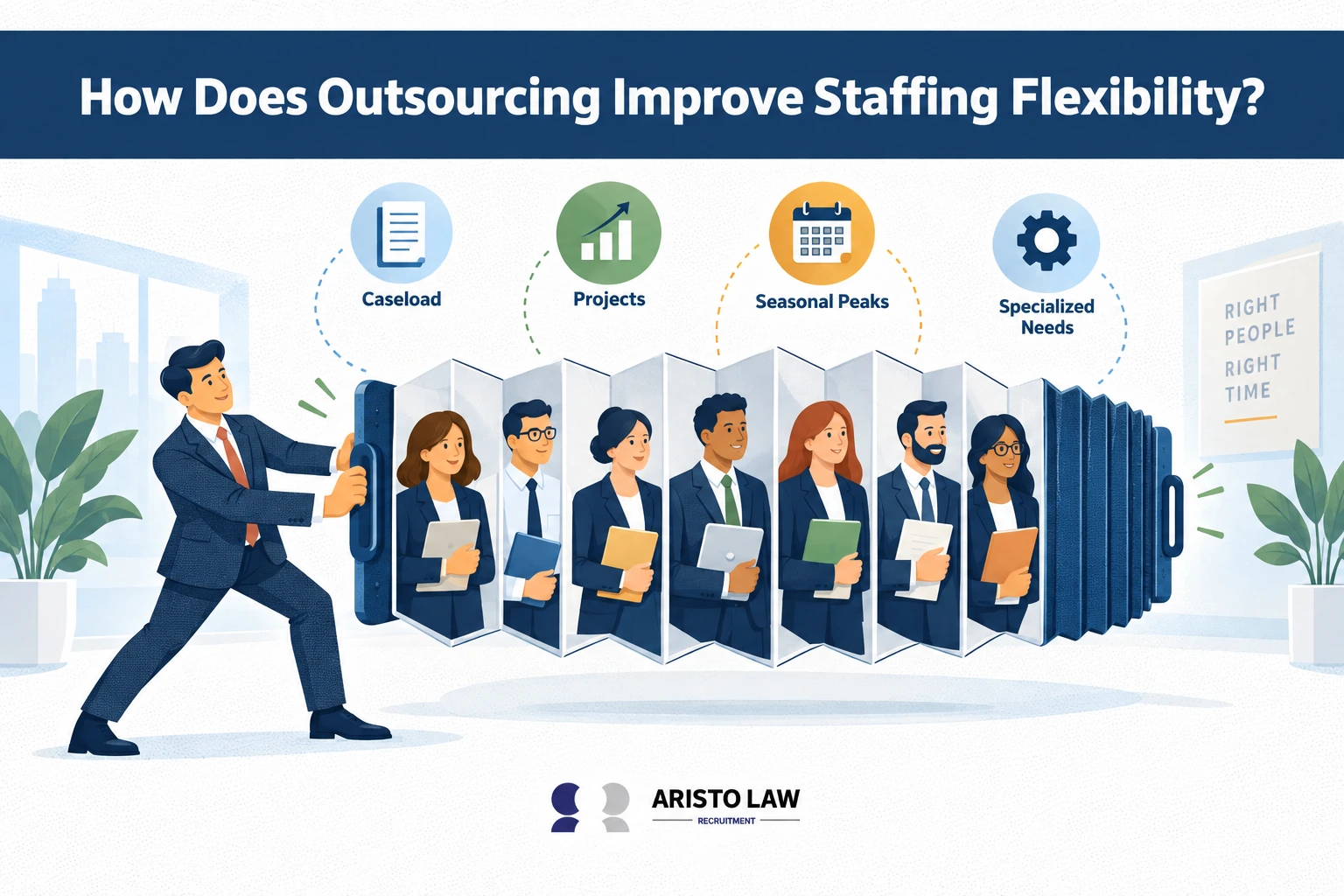
Research by Thomson Reuters in 2023 shows that over 68% of Am
Law 100 firms outsourced at least one core legal function, largely
because outsourced legal teams provided faster scalability and
operational flexibility compared to traditional in-house hiring
systems. Flexible staffing supports business growth during
litigation spikes, seasonal workload changes, and rapid expansion
periods. Remote legal support reduces long-term payroll obligations and
office space limitations. Workforce planning, workload forecasting,
onboarding systems, and performance monitoring improve staffing
efficiency and operational scalability.
10. Enhances client
satisfaction
Client satisfaction refers to client perception of
communication quality, responsiveness, operational reliability, and
legal service experience. Legal outsourcing enhances client
satisfaction through faster updates, improved communication coverage,
organized workflows, and reduced delays.
Outsourced legal support improves operational consistency across
intake, scheduling, billing, and case coordination. Higher client
satisfaction improves law firm retention rates and referral generation.
Client feedback systems, response-time monitoring, communication
protocols, and service quality reviews improve outsourcing outcomes.
11. Supports business
expansion
Business expansion refers to law firm growth through
increased market reach, client volume, operational capacity, and service
offerings. Legal outsourcing supports business expansion
because outsourced legal operations reduce internal growth barriers tied
to staffing and operational overhead.
Law firm profitability improves because operational infrastructure
expands without proportional fixed cost increases. Outsourced teams
support remote legal operations across multiple geographic markets.
Expansion planning, standardized workflows, operational reporting, and
scalable support structures improve sustainable growth.
12. Improves operational
consistency
Operational consistency refers to repeatable workflow
quality, communication standards, documentation accuracy, and service
reliability across legal operations. Legal outsourcing improves
operational consistency through standardized support workflows and
documented operational procedures.
A study by the EY in 2025 showed that 55% of legal
departments planned to increase their use of Legal Process Outsourcing
(LPO) to improve operational efficiency, while 60% intended to expand
outsourcing partnerships for better workflow management and standardized
support operations. Consistent legal operations improve client
trust and reduce workflow errors. Outsourced legal support improves
coordination across growing legal teams and remote staffing structures.
Written SOPs, quality-control audits, centralized communication systems,
and workflow tracking improve operational reliability.
13. Strengthens resource
allocation
Resource allocation refers to the distribution of attorney
time, staffing resources, operational budgets, and workflow
responsibilities across legal operations. Legal outsourcing
strengthens resource allocation because law firms shift repetitive
operational tasks toward outsourced support teams.
Attorney leverage improves because internal legal talent focuses on
strategy, negotiations, litigation, and client advisory services.
Efficient resource allocation improves profitability and matter
throughput. Capacity planning, workload analysis, budgeting controls,
and utilization reporting improve outsourcing performance.
14. Improves
profitability and cost management
Profitability and cost management refer to law firm financial
performance tied to revenue generation, operational expenses, staffing
efficiency, and workflow utilization. Legal outsourcing
improves profitability through lower staffing costs, reduced operational
waste, and improved attorney productivity.
Cost management improves because outsourced legal operations follow
scalable pricing models tied to workload demand. Business growth
improves because firms increase operational output without excessive
fixed costs. Budget forecasting, profitability tracking, vendor
oversight, and KPI reporting improve financial performance.
15. Enables focus on
high-value legal work
High-value legal work includes litigation strategy, legal
analysis, negotiations, courtroom advocacy, and complex client advisory
services. Legal outsourcing enables focus on high-value legal
work because outsourced teams absorb administrative, operational, and
support-heavy workflows.
A Clio 2025 Legal Trends Report cited in research by
LegalSoft in 2025 shows that lawyers record only 3 billable hours in an
8-hour workday, meaning nearly 5 hours are spent on non-billable
administrative and operational work. The study explains that
outsourcing administrative support helps attorneys reclaim this time and
focus on higher-value legal work. Attorney productivity improves because
attorneys allocate more time toward billable legal functions. Law firm
profitability improves through stronger revenue concentration on premium
legal services. Delegation structures, supervision systems, workflow
separation, and operational oversight improve outsourcing
efficiency.
16. Supports remote legal
operations
Remote legal operations refer to distributed legal workflows
managed through virtual systems, cloud-based infrastructure, and remote
legal support teams. Legal outsourcing supports remote legal
operations through outsourced staffing structures that operate outside
traditional office environments.
Remote legal support improves workflow scalability, staffing
flexibility, and operational coverage across multiple locations. Legal
operations improve because law firms maintain service continuity during
staffing shortages or geographic expansion. Secure communication
systems, encrypted platforms, access controls, and cloud-based case
management improve remote outsourcing performance.
17. Improves
turnaround times for legal tasks
Turnaround time refers to the completion speed for legal
drafting, intake processing, billing workflows, research support, and
administrative coordination. Legal outsourcing improves
turnaround times because outsourced legal support distributes workload
pressure across dedicated operational teams.
Research by the McKinsey & Company in 2017 showed that
approximately 23% of legal work are automated, improving turnaround time
for legal drafting, billing workflows, and administrative
coordination. Faster turnaround improves client satisfaction,
matter throughput, and operational efficiency. Business growth improves
because law firms process higher case volumes without workflow delays.
Turnaround benchmarks, workflow prioritization systems, quality reviews,
and performance dashboards improve operational consistency.
18. Enhances legal support
coverage
Legal support coverage refers to the availability of
operational and administrative legal assistance across business hours,
practice areas, and workflow stages. Legal outsourcing enhances
legal support coverage through outsourced intake teams, virtual
assistants, legal researchers, case coordinators, and customer support
personnel.
Expanded coverage improves client communication and operational
continuity. Remote legal operations improve responsiveness during
high-demand periods. Staffing schedules, communication protocols,
escalation procedures, and workflow tracking improve support
reliability.
19. Reduces hiring and
training overhead
Hiring and training overhead refers to recruitment costs,
onboarding expenses, employee benefits, training time, and operational
delays tied to internal staffing growth. Legal outsourcing
reduces hiring and training overhead because outsourced providers supply
trained legal support professionals with existing workflow
experience.
Research by Solvo Global in 2026 showed that legal
outsourcing reduces law firm overhead costs by 40-60% because firms
avoid expenses tied to salaries, onboarding, training, office space, and
equipment while gaining access to trained legal support
professionals. Cost reduction improves profitability and
operational efficiency. Staffing flexibility improves because law firms
scale support capacity without prolonged recruitment cycles. Vendor
screening, onboarding documentation, training standards, and performance
reviews improve outsourcing implementation.
20. Supports long-term
operational growth
Long-term operational growth refers to sustainable expansion
in law firm capacity, workflow infrastructure, staffing systems, and
revenue production over time. Legal outsourcing supports
long-term operational growth through scalable outsourced legal
operations that adapt to workload changes and market demand.
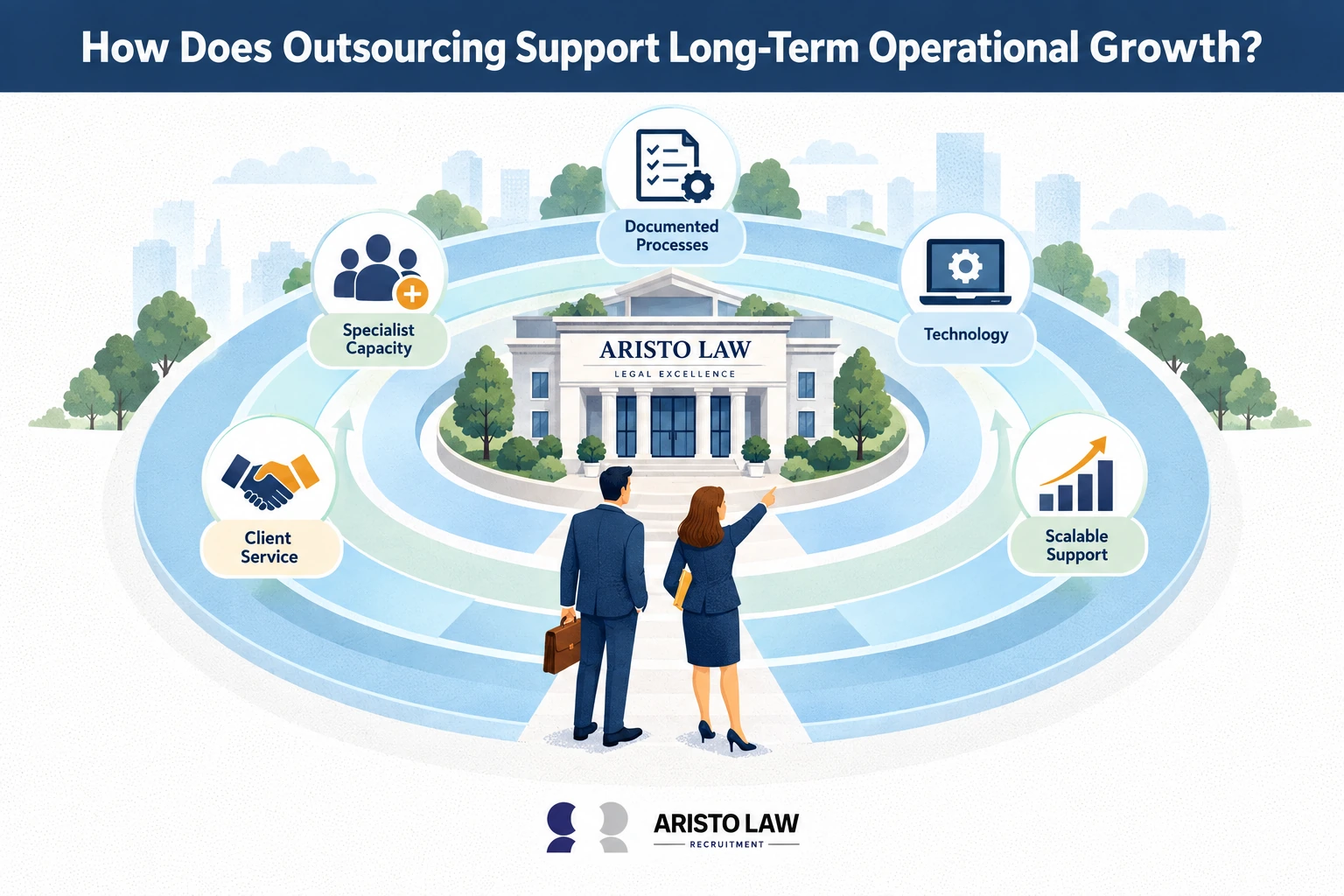
Business growth improves because law firms maintain operational
consistency during expansion periods. Outsourced legal support
strengthens workflow scalability, profitability, and staffing
flexibility across growing legal practices. Strategic planning,
operational KPIs, cybersecurity controls, and continuous process
improvement improve long-term outsourcing success.
What
strategic legal support work can law firms outsource?
Legal work law firms can outsource are intake operations,
legal drafting support, legal research, litigation support,
administrative workflows, legal IT services, billing operations, and
document management support.
Law firms integrate virtual
legal assistant support for outsourced legal workflows
to connect intake handling, consultation scheduling, and case conversion
processes within distributed legal support systems.
Listed below are the 10 legal work law firms outsource.
-
Legal research memos: Legal research memos involve
case law analysis, statute review, citation gathering, and
jurisdictional research support. Outsourced legal work providers prepare
research summaries and source materials under attorney supervision.
Attorney review remains necessary before legal advice, court filing, or
strategic use. -
Pleadings support: Pleadings support includes motion
formatting, exhibit organization, template population, table generation,
citation formatting, and draft assembly. Litigation outsourcing teams
handle process-driven preparation tasks. Attorneys approve legal
arguments and final filings. -
Document summaries: Document summaries involve
medical record summaries, deposition summaries, chronology creation, and
case timeline preparation. Outsourced legal support teams organize large
case files into searchable summaries for litigation workflows. -
Contract abstraction: Contract abstraction includes
clause extraction, obligation tracking, renewal-date review, risk
flagging, and metadata indexing. Specialized providers support
high-volume contract management operations. Attorneys review contract
interpretation and negotiation strategy. -
Deposition preparation support: Deposition
preparation support includes transcript review, exhibit labeling,
witness file organization, and chronology preparation. Litigation
outsourcing teams manage administrative preparation tasks. Attorneys
control questioning strategy and legal analysis. -
Records organization: Records organization includes
indexing, document categorization, e-discovery tagging, folder
structuring, and file reconciliation. Process-driven legal operations
improve case management efficiency and document retrieval speed. -
Legal word processing outsourcing: Legal word
processing outsourcing includes formatting briefs, creating tables of
authorities, proofreading citations, converting file formats, and
preparing court-compliant documents. Legal formatting vendors support
operational consistency and turnaround speed. -
Transcription services: Transcription services
convert depositions, hearings, interviews, and recorded statements into
searchable legal documents. Specialized transcription providers improve
litigation documentation workflows. -
Client-service workflows: Client-service workflows
include intake calls, appointment scheduling, CRM updates, follow-up
communication, billing reminders, and status updates. Outsourced legal
support teams improve response times and operational coverage. -
Legal IT support: Legal IT outsourcing includes
cybersecurity management, cloud system administration, software
maintenance, data backup management, access control configuration, and
remote infrastructure support. Specialized legal IT providers manage
compliance-focused technical operations under law firm security
policies.
What
legal work should law firms not outsource without attorney control?
Legal work law firms should not outsource without attorney
control include legal advice, legal conclusions, and attorney-client
representation responsibilities.
Listed below are the 8 legal work law firms must not outsource.
-
Legal advice: Legal advice involves interpreting
laws, advising clients on rights or liabilities, recommending legal
actions, and applying legal judgment to specific facts. Attorney control
remains mandatory because unauthorized legal advice creates unauthorized
practice of law risk and ethics violations. -
Legal strategy: Legal strategy includes litigation
planning, negotiation positioning, settlement evaluation, witness
preparation direction, and courtroom decision-making. Outsourced legal
support teams organize supporting materials under supervision, but
attorneys retain responsibility for strategic judgment and case
direction. -
Final legal conclusions: Final legal conclusions
involve liability analysis, contract interpretation decisions,
compliance determinations, and risk opinions. Nonlawyer teams prepare
summaries, draft analyses, and supporting documentation, but attorney
review and approval remain mandatory before client delivery. -
Attorney-client communications involving legal
opinions: Attorney-client privilege protections apply to
confidential legal communications and legal advice discussions.
Outsourced teams support scheduling, intake, and operational
communication workflows, but attorneys control privileged legal
communications and final legal recommendations. -
Court representation and legal advocacy: Court
appearances, oral arguments, settlement authority, and formal legal
advocacy require licensed attorney supervision under
jurisdiction-specific rules. Nonlawyer outsourcing providers lack
authority to represent clients in legal proceedings. -
Conflict-of-interest determinations: Conflict checks
involve ethical review of client relationships, representation risks,
and confidentiality obligations. Outsourced administrative teams support
database reviews and records organization, but attorneys approve final
conflict decisions. -
Privilege-sensitive document review: Privilege
review involves identifying attorney-client communications, work-product
materials, and confidential legal analysis. Litigation outsourcing teams
assist with document organization and tagging, but attorneys supervise
privilege determinations and final production decisions. -
Signing legal filings and certifications: Court
filings, sworn declarations, compliance certifications, and legal
attestations require attorney accountability and direct review.
Outsourced legal writing support prepares draft materials, but attorneys
approve, sign, and assume responsibility for final submissions.
What are legal
process outsourcing services?
Legal process outsourcing services are outsourced legal
workflows that support litigation, legal research, and law firm
operations under attorney supervision.
Virtual inside sales representatives support legal process
outsourcing services by managing client intake communication, lead
qualification, and follow-up coordination within outsourced legal
operations. Legal outsourcing providers structure types
of legal outsourcing services around operational
functions such as intake management, document support, billing
coordination, and remote administrative workflows.
Listed below are the 9 legal process outsourcing services.
-
Document review services: Document review services
include evidence classification, relevance tagging, privilege flagging,
metadata review, and litigation file organization. Document review
improves litigation preparation through faster evidence analysis and
structured case review workflows. Discovery-focused providers manage
high-volume records during investigations and lawsuits. -
Contract support services: Contract support services
include contract abstraction, clause extraction, obligation tracking,
renewal monitoring, and template management. Contract support improves
corporate legal operations through organized agreement management and
reduced administrative delays. -
Legal research support services: Legal research
support services include case law research, statute review,
jurisdictional analysis, citation gathering, and legal memo preparation.
Research support improves attorney preparation through organized legal
findings and faster legal analysis workflows. -
Legal drafting support services: Legal drafting
support services include pleadings preparation, motion formatting,
document assembly, exhibit organization, and template population.
Drafting support improves output speed through process-driven document
production under attorney review. -
Discovery support services: Discovery support
services include e-discovery processing, evidence indexing, transcript
organization, data collection, and document production coordination.
Discovery support handles high-volume evidence management during
litigation and regulatory investigations. -
Compliance support services: Compliance support
services include deadline tracking, regulatory monitoring, policy
documentation, audit preparation, and reporting coordination. Compliance
support improves operational consistency through structured workflow
tracking and risk management. -
Matter management services: Matter management
services include case tracking, workflow coordination, scheduling,
status reporting, deadline monitoring, and file organization. Matter
management improves operational visibility across growing legal
operations and remote legal teams. -
Billing support services: Billing support services
include invoice preparation, payment tracking, trust accounting
coordination, time-entry review, and collections follow-up. Billing
support improves cash flow and reduces administrative billing
delays. -
Administrative legal support services:
Administrative legal support services include intake management,
appointment scheduling, CRM updates, records organization, client
communication, and legal word processing outsourcing. Administrative
support reduces attorney overload and improves law firm operational
efficiency.
When should
law firms use legal process outsourcing?
Law firms should use legal process outsourcing when internal
legal operations slow matter progression, reduce attorney productivity,
create staffing pressure, increase document backlog, or limit
client-service capacity.
Listed below are the 10 occasions to use legal process
outsourcing.
-
Workload spikes increase beyond internal capacity:
Workload spikes occur during litigation surges, mass tort filings,
discovery-heavy matters, mergers, regulatory investigations, or seasonal
intake increases. Legal process outsourcing improves matter speed and
prevents workflow bottlenecks during temporary operational overload. -
Staffing gaps reduce operational performance:
Staffing gaps develop through employee turnover, leave periods,
recruitment delays, or rapid firm growth. Outsourced legal support
maintains workflow continuity and protects client response times without
immediate in-house hiring expansion. -
Document backlog delays case progression: Document
backlog includes unreviewed discovery files, delayed billing, incomplete
records organization, unprocessed intake forms, or overdue drafting
support. Legal process outsourcing improves turnaround times and
restores operational consistency. -
Cost pressure limits internal hiring: Cost pressure
affects payroll budgets, office expansion plans, software costs, and
training expenses. Outsourced legal operations reduce fixed staffing
obligations through scalable support models tied to workload demand. -
Attorney productivity declines because of administrative
overload: Administrative overload includes scheduling, billing
coordination, document formatting, records organization, and repetitive
workflow management. Legal process outsourcing improves attorney
productivity by shifting process-driven tasks toward outsourced legal
teams. -
Client response times weaken client satisfaction:
Delayed intake callbacks, missed follow-ups, slow billing communication,
and inconsistent updates reduce client trust and conversion rates.
Outsourced support teams improve communication coverage and
client-service consistency. -
Discovery-heavy litigation increases evidence-management
pressure: High-volume litigation creates operational strain
through evidence review, transcript organization, metadata tagging, and
document production requirements. Discovery outsourcing improves
litigation workflow efficiency and document handling speed. -
Law firm growth exceeds operational infrastructure:
Business expansion increases operational demand across intake, billing,
case management, legal support, and administrative coordination. Ongoing
outsourced support improves workflow scalability and operational
flexibility during long-term growth phases. -
Temporary overflow work requires short-term support:
Temporary overflow outsourcing supports limited-duration projects such
as trial preparation, large-scale document review, or regulatory
investigations. Short-term outsourcing improves matter completion speed
without long-term staffing commitments. -
Recurring operational tasks require permanent support
coverage: Ongoing outsourced support fits intake management,
billing workflows, legal IT support, client communication, and
administrative legal operations that require continuous operational
coverage. Permanent outsourced legal support improves law firm
efficiency and long-term cost management.
How can law
firms get legal outsourcing support
Law firms can get legal outsourcing support by identifying
repeatable tasks, then hiring an outsourced legal support provider or
managed legal process outsourcing team. Legal outsourcing
support acquisition starts with operational analysis that identifies
high-volume, process-driven workflows affecting attorney productivity,
matter throughput, client response times, or operational consistency.
Law firm outsourcing decisions involve intake support, virtual paralegal
work, billing coordination, legal research support, litigation
workflows, legal document preparation, CRM management, legal IT support,
and administrative legal operations.
Outsourced legal support implementation requires defined task scopes,
workflow documentation, confidentiality agreements, cybersecurity
reviews, and attorney-supervision structures that protect privilege
obligations and ethics compliance. Remote legal staff require secure
system access through encrypted communication platforms, role-based
permissions, cloud-based case management systems, and monitored login
controls. Pilot projects help law firms test workflow compatibility,
turnaround times, drafting quality, communication standards, and
operational reliability before expanding outsourced support
coverage.
Standard operating procedures, escalation protocols, utilization
tracking, response-time benchmarks, and quality-control reviews improve
law firm outsourcing performance and operational scalability. Aristolaw
helps law firms obtain trained remote legal staff for virtual legal
assistant support, virtual paralegal services, intake management,
billing support, legal research, document automation, litigation
support, and back-office legal workflows that improve operational
efficiency and business growth.
Where can
law firms get legal outsourcing services?
Law firms can get legal outsourcing services from Aristolaw,
legal process outsourcing companies, legal staffing agencies, virtual
legal assistant providers, outsourced paralegal services, contract
attorney networks, legal IT providers, and outsourced law firm
operations support companies. Aristolaw provides outsourced
legal staffing support for law firms that need trained remote legal
staff for virtual legal assistant workflows, virtual paralegal support,
intake management, litigation support, billing coordination, legal
research, document preparation, legal marketing support, and back-office
legal operations. Aristolaw supports workflow scalability, attorney
productivity, and operational efficiency through structured remote legal
support services.
Legal outsourcing for law firms connects legal practices with remote
staffing providers that support intake, document preparation, billing,
litigation support, and administrative workflows. Legal outsourcing for
law firms also clarifies the virtual
legal assistant services outsourcing benefits through
structured delegation models, role-based staffing, and operational cost
reduction.
Legal process outsourcing companies support repeatable legal
workflows such as document review, discovery support, contract
management, compliance tracking, legal drafting support, and matter
management coordination. Legal staffing agencies supply remote legal
staff for temporary overflow support, long-term staffing flexibility,
and practice-area-specific operational needs.
Virtual legal assistant providers support intake operations,
scheduling, CRM management, administrative coordination, and
client-service workflows. Outsourced paralegal services support legal
research, records organization, deposition preparation, drafting
support, and document-heavy litigation workflows. Contract attorney
networks provide licensed attorney support for supervised legal
analysis, drafting, and jurisdiction-specific legal work.
Legal IT providers manage cybersecurity, cloud systems, software
administration, and remote legal infrastructure. Outsourced operations
providers support billing workflows, intake management, marketing
coordination, collections tracking, and operational reporting. Law firms
should select providers based on practice-area compatibility,
confidentiality protections, attorney-supervision structures, software
readiness, pricing models, operational scalability, and replacement
staffing support.
How much does legal
outsourcing cost?
Legal outsourcing costs range from $15 (14 €, £12) to $200
(185 €, £156) per hour depending on the task type, provider location,
legal complexity, and turnaround time. Pricing structures also
vary based on supervision requirements, technology infrastructure,
security controls, and whether the service operates under a
project-based, hourly, retainer-based, or team-based model.
Outsourced paralegals, billing support teams, customer-service
support, and administrative legal operations follow lower hourly pricing
because workflows remain process-driven and operational. Legal writing
support, litigation support, contract abstraction, legal research, and
discovery review involve moderate pricing because attorney supervision,
accuracy controls, and workflow coordination affect quality
requirements. Outsourced attorneys, legal IT providers, cybersecurity
support, compliance operations, and complex litigation outsourcing
involve higher pricing because licensed legal analysis, infrastructure
management, and privilege-sensitive workflows require advanced
oversight.
Project-based pricing supports document review, transcript
summarization, records organization, and legal document automation with
fixed-scope deliverables. Hourly pricing supports overflow litigation
work, intake surges, and flexible operational coverage. Retainer pricing
supports long-term outsourced legal team arrangements managing intake,
case coordination, billing workflows, legal research, and operational
legal support.
A study by Deloitte titled Global Outsourcing Survey 2022
found that organizations increasingly used outsourcing to reduce costs,
improve access to talent, and enhance operational agility through more
flexible and outcome-based service delivery models.
Low-cost legal outsourcing increases long-term expenses when rework,
missed filing deadlines, inconsistent drafting quality, cybersecurity
failures, poor communication, or weak supervision damage operational
performance. Law firm profitability improves when outsourced legal teams
follow documented workflows, confidentiality controls, measurable
service standards, attorney oversight, and secure technology
systems.
What are the
best practices for legal outsourcing?
Best practices for legal outsourcing are structured
operational controls that improve workflow consistency, protect
confidentiality, maintain attorney supervision, and support scalable
legal operations.
Listed below are the 10 best practices for legal outsourcing.
-
Define a clear task scope: Clear task scope prevents
scope creep, workflow confusion, duplicated work, and missed deadlines.
Legal outsourcing works better when law firms define deliverables,
turnaround expectations, escalation paths, and supervision requirements
before workflow delegation begins. -
Choose providers based on workflow fit: Provider
selection improves operational efficiency when outsourcing partners
match the law firm’s practice area, software systems, workload volume,
and operational structure. Provider mismatch reduces productivity and
increases rework costs. -
Use confidentiality agreements and security
controls: Confidentiality protections reduce data exposure risk
and privilege violations. Legal outsourcing best practices include
encrypted communication systems, role-based access controls, VPN usage,
secure cloud storage, and signed nondisclosure agreements. -
Maintain attorney supervision: Attorney supervision
protects ethics compliance, legal accuracy, and unauthorized practice of
law boundaries. Outsourced legal support teams handle process-driven
tasks, but attorneys control legal advice, legal strategy, legal
conclusions, and final approvals. -
Start with a pilot project: Pilot project
implementation reduces operational risk before long-term outsourcing
expansion. Pilot workflows test communication quality, turnaround speed,
drafting consistency, and provider reliability under real operational
conditions. -
Create written SOPs and workflow instructions: Weak
instructions create quality drift, inconsistent output, and workflow
delays. Standard operating procedures improve operational consistency
through documented processes, templates, review rules, and escalation
procedures. -
Centralize software and communication systems:
Software fragmentation slows matter management and creates operational
errors. Centralized case management systems, shared dashboards, secure
messaging platforms, and integrated workflow tools improve remote legal
support coordination. -
Track measurable performance metrics: Performance
tracking improves accountability and operational growth. Law firms
should monitor turnaround time, drafting accuracy, utilization rates,
workload completion, client response speed, and profitability
impact. -
Use structured quality-control reviews:
Quality-control reviews reduce drafting errors, missed filings, and
workflow inconsistencies. Multi-level review systems improve legal
support reliability and operational efficiency. -
Avoid single-vendor dependency: Vendor dependency
increases operational disruption risk during staffing shortages, service
failures, or provider turnover. Backup staffing plans and diversified
outsourced legal support improve operational stability and long-term
business continuity.
What
is the difference between legal outsourcing and legal process
outsourcing?
The difference between legal outsourcing and legal process
outsourcing is that legal outsourcing covers all forms of external legal
and law-firm operational support, while legal process outsourcing
focuses on structured, repeatable, process-driven legal workflows
managed through standardized systems.
The table below shows the difference between legal outsourcing and
legal process.
| Dimension | Legal Outsourcing | Legal Process Outsourcing |
|---|---|---|
| Definition | Legal outsourcing refers to external legal, operational, administrative, or technical support provided to law firms. |
Legal process outsourcing refers to structured outsourcing of repeatable legal workflows through standardized operational processes. |
| Scope | Broad outsourcing category covering legal support, staffing, legal IT, legal marketing, intake, billing, and legal administration. |
Narrower workflow-focused category centered on repeatable legal process execution. |
| Workflow Structure | Workflow structure varies depending on staffing model, provider type, and law firm needs. |
Workflow structure follows documented systems, SOPs, production rules, and scalable operational processes. |
| Primary Goal | Law firm capacity expansion, staffing flexibility, and operational support. |
Process efficiency, high-volume workflow handling, and operational scalability. |
| Common Services | Outsourced attorneys, outsourced paralegals, virtual legal assistants, legal IT support, legal marketing support, and billing support. |
Document review, discovery support, contract abstraction, legal research support, records management, and legal word processing outsourcing. |
| Supervision Level | Attorney supervision varies based on service type and legal responsibility. |
Attorney supervision focuses on workflow review, quality control, and final legal approval. |
| Staffing Model | Staffing involves dedicated remote legal staff, freelancers, contract attorneys, or outsourced legal teams. |
Staffing involves structured process outsourcing teams handling standardized workflows. |
| Litigation Support | Litigation outsourcing includes deposition support, case coordination, drafting assistance, and attorney overflow support. |
Litigation process outsourcing focuses on discovery review, evidence organization, transcript management, and document production workflows. |
| Technology Usage | Legal outsourcing includes software support, remote staffing systems, legal IT infrastructure, and workflow coordination tools. |
LPO operations rely heavily on workflow automation, process tracking systems, document management platforms, and production workflows. |
| Best Use Case | Law firms needing flexible operational support across multiple business functions. |
Law firms needing scalable support for repetitive, high-volume legal processes. |
What
is the difference between outsourcing lawyers and outsourcing legal
support?
The difference between outsourcing lawyers and outsourcing
legal support is that outsourced lawyers perform licensed legal work
within attorney licensing and engagement limits, while outsourced legal
support teams handle operational, administrative, research, drafting,
and workflow support functions under attorney supervision.
The table below show the difference between outsourcing lawyers and
outsourcing legal support.
| Dimension | Outsourcing Lawyers | Outsourcing Legal Support |
|---|---|---|
| Definition | Outsourcing lawyers involves hiring contract attorneys or outsourced lawyers for licensed legal work. |
Outsourced legal support involves hiring nonlawyer support teams for operational and process-driven legal workflows. |
| Legal Authority | Outsourced lawyers hold legal licenses and perform authorized legal work within jurisdiction limits. |
Outsourced legal support teams lack authority to practice law or provide legal advice. |
| Legal Advice | Contract attorneys provide legal analysis and legal advice under engagement terms and licensing rules. |
Outsourced legal support teams assist with research, drafting preparation, intake, and administration without giving legal advice. |
| Client Representation | Outsourced lawyers assist with negotiations, filings, and representation activities when permitted by licensing and engagement structures. |
Outsourced legal support teams do not represent clients in court or legal proceedings. |
| Drafting Responsibility | Outsourced lawyers draft motions, contracts, legal memoranda, and legal strategy documents subject to attorney review structures. |
Outsourced legal support teams prepare templates, formatting, summaries, document organization, and draft support materials under attorney supervision. |
| Supervision Structure | Attorney supervision focuses on engagement management, ethics compliance, and legal strategy alignment. |
Attorney supervision focuses on workflow review, quality control, confidentiality, and unauthorized practice of law prevention. |
| Operational Focus | Outsourcing lawyers supports overflow legal analysis, litigation preparation, contract review, and specialized legal projects. |
Outsourced legal support improves billing workflows, intake management, records organization, legal research support, and administrative legal operations. |
| Cost Structure | Outsourced lawyers involve higher hourly or project-based pricing because licensed legal judgment carries higher professional responsibility. |
Outsourced legal support follows lower-cost staffing models tied to process-driven operational tasks. |
| Risk Exposure | Outsourced lawyer risk involves licensing compliance, malpractice exposure, jurisdiction restrictions, and ethics obligations. |
Outsourced legal support risk involves confidentiality breaches, workflow errors, poor supervision, and unauthorized practice concerns. |
| Best Use Case | Law firms use outsourced lawyers during litigation surges, specialized legal projects, or temporary attorney staffing gaps. |
Law firms use outsourced legal support for scalable operational support, administrative relief, and workflow efficiency improvements. |
| Boundary Requirements | Role boundaries define legal authority, representation scope, and client communication permissions. |
Role boundaries define support limitations, attorney-control requirements, and workflow escalation procedures. |
What are the
benefits of legal outsourcing?
Benefits of legal outsourcing are lower operational costs,
stronger workflow scalability, improved attorney productivity, and
expanded operational capacity through outsourced legal
support.
Listed below are the 10benefits of legal outsourcing.
-
Lower overhead: Lower overhead reduces fixed
operational costs tied to payroll, office space, employee benefits,
recruitment, training, and software licensing. Legal outsourcing
improves law firm profitability through variable staffing models tied to
workload demand instead of permanent in-house expansion. -
Flexible staffing: Flexible staffing improves
operational stability during litigation surges, intake spikes, staffing
shortages, and rapid business growth. Outsourced legal teams increase or
reduce support coverage based on workflow demand without long-term
hiring obligations. -
Faster turnaround: Faster turnaround improves client
service through quicker document preparation, intake response, billing
cycles, records organization, and litigation support workflows. Faster
operational output improves matter throughput and client
satisfaction. -
Workflow scalability: Workflow scalability allows
law firms to increase operational output without operational breakdowns
or excessive infrastructure expansion. Legal outsourcing supports
scalable growth through distributed support teams and repeatable
workflow systems. -
Improved attorney productivity: Improved attorney
productivity increases billable legal work capacity because outsourced
legal support teams handle administrative, operational, and
process-driven tasks. Attorneys spend more time on legal strategy,
negotiations, litigation, and client advisory work. -
Broader operational expertise: Broader operational
expertise fills capability gaps in legal IT, discovery support, billing
operations, intake management, legal marketing, compliance tracking, and
document management. Specialized outsourcing providers improve workflow
quality and operational efficiency. -
Reduced workflow bottlenecks: Workflow coverage
reduces bottlenecks in drafting support, document review, billing
coordination, scheduling, and case administration. Outsourced legal
support improves operational consistency across growing caseloads. -
Improved client response times: Improved client
response times strengthen client satisfaction and lead conversion rates
through faster communication coverage, intake handling, and status
updates. Outsourced legal support improves communication reliability
during high-demand periods. -
Improved matter throughput: Matter throughput
improves because outsourced teams accelerate operational workflows tied
to case progression, records processing, discovery coordination, and
document production. Faster matter movement improves revenue capacity
and operational efficiency. -
Scalable business growth: Scalability supports
long-term business growth because law firms expand service capacity
without building every operational function internally. Outsourced legal
operations reduce expansion barriers tied to staffing costs and
operational infrastructure.
How
should law firms protect confidentiality when outsourcing?
Law firms protect confidentiality when outsourcing through
nondisclosure agreements, role-based access, secure file sharing,
conflict checks, audit trails, vendor due diligence, and
attorney-supervised workflows. Confidentiality controls protect
attorney-client privilege, work-product protections, litigation
strategy, financial records, and sensitive client communications across
outsourced legal support operations.
Vendor due diligence includes background screening, cybersecurity
reviews, breach-response procedures, software audits, confidentiality
training verification, and operational compliance assessments before
outsourced access begins.
Role-based access limits outsourced legal teams to only the files,
systems, and workflows required for assigned tasks. Least-privilege
permissions reduce unnecessary data exposure and lower confidentiality
risk. Secure file sharing systems use encryption, secure cloud storage,
VPN access, password management controls, and two-factor authentication
to protect legal data during remote legal operations. Secure devices,
monitored login activity, document-version control, audit trails, and
centralized case management systems improve accountability and workflow
visibility.
Attorney supervision protects privilege obligations and unauthorized
disclosure risks through workflow review, escalation controls, and
restricted communication procedures. Data-retention policies define
document storage timelines, deletion requirements, backup standards, and
access revocation protocols after outsourced work concludes. Vendor
staff training improves confidentiality awareness for phishing threats,
social engineering risks, privileged information handling, and secure
communication practices.
Confidentiality controls differ by workflow type because litigation
support handles evidence-heavy privileged records, billing support
handles financial and payment data, legal writing support accesses
strategy-sensitive drafting materials, legal IT support manages
infrastructure-level system access, and client-service outsourcing
handles intake communications and confidential client information.
What is an outsourced
CMO for law firms?
An outsourced CMO for law firms is an external marketing
leader who guides strategy, brand positioning, campaigns, lead
generation, reporting, and growth planning without joining the firm as a
full-time executive. Outsourced CMO law firm services focus on
strategic marketing leadership that improves client acquisition, market
visibility, referral growth, intake performance, and long-term business
expansion.

Research by Clio in 2025 shows that law firm performance
should be managed with KPIs tied to productivity, revenue generation,
hourly rates, and practice-area benchmarks, supporting analytics
reporting and revenue forecasting. Law firm marketing strategy
under an outsourced CMO includes competitive positioning, practice-area
growth planning, website strategy, SEO direction, paid advertising
oversight, referral campaign development, analytics reporting, vendor
coordination, and performance forecasting tied to revenue goals.
Legal outsourcing for law firms includes outsourced CMO support that
manages law firm branding, client acquisition strategy, and marketing
operations without requiring an in-house executive hire. Legal
outsourcing for law firms also integrates virtual
legal marketing assistant services to support campaign
execution, intake coordination, content workflows, and digital
visibility management.
Growth planning responsibilities include identifying high-value
practice opportunities, improving intake conversion workflows, aligning
marketing spend with profitability targets, and strengthening law firm
brand authority across digital channels. Outsourced CMO leadership
manages marketing vendors, SEO agencies, paid advertising providers, web
developers, and content production systems to improve operational
consistency and marketing ROI. Growth KPIs include lead volume,
qualified consultation rates, cost per lead, website conversion rates,
intake response speed, referral growth, and retained-client value.
Outsourced CMO work differs from marketing VA support and legal
assistant support because outsourced CMO services focus on
executive-level marketing strategy, operational forecasting, budget
direction, campaign performance analysis, and long-term growth planning
rather than administrative execution tasks. Marketing virtual assistants
handle scheduling, posting, CRM updates, email coordination, and
workflow support instead of strategic law firm marketing leadership.
How should
law firms measure outsourcing performance?
Law firms should measure outsourcing performance through
operational KPIs tied to work quality, turnaround speed, cost control,
attorney productivity, and workflow visibility.
A study by Clio titled “Legal Trends Report” in 2023 found
that faster response systems and operational efficiency improved client
conversion and law firm productivity.
The table below shows how law firms must measure outsourcing
performance.
| Outsourcing KPI | What It Measures | Why It Matters |
|---|---|---|
| Turnaround time | Time required to complete outsourced legal tasks, intake workflows, billing work, or document production |
Faster turnaround time improves client service, matter throughput, and operational efficiency |
| Revision rate | Frequency of corrections, rewrites, or quality-control edits after outsourced task completion |
High revision rates increase attorney review time, rework costs, and workflow delays |
| Deadline completion | Percentage of outsourced work completed before required deadlines |
Deadline consistency improves litigation readiness, operational reliability, and client trust |
| Cost per task | Average operational cost for outsourced workflows such as drafting, intake, billing, or discovery support |
Cost tracking improves budgeting, profitability analysis, and outsourcing ROI evaluation |
| Attorney review time | Amount of attorney time spent reviewing outsourced work before approval |
Lower attorney review time improves attorney productivity and billable-hour utilization |
| Backlog reduction | Reduction in pending tasks, document queues, unprocessed intake files, or delayed workflows |
Backlog reduction improves matter progression and operational scalability |
| Client response time | Speed of communication with leads, clients, or referral sources | Faster response time improves lead conversion, client satisfaction, and law firm growth |
| Billing cycle time | Time required to process invoices, collections, and payment workflows |
Faster billing cycles improve cash flow and operational consistency |
| Document accuracy | Error frequency in legal documents, formatting, records organization, and drafting support |
Higher accuracy reduces malpractice exposure, filing risks, and operational disruption |
| Vendor response time | Speed of outsourced provider communication, escalation handling, and workflow updates |
Faster vendor response improves workflow coordination and operational continuity |
| Matter progress visibility | Visibility into case status, workflow stages, pending tasks, and operational reporting |
Better visibility improves management decisions, staffing allocation, and operational control |
| Attorney time saved | Reduction in attorney involvement in administrative and process-driven workflows |
Attorney time savings improve focus on litigation, negotiations, strategy, and client advisory work |
Build a legal support team that moves work forward.
Tell us what is slowing your practice down. We will help map the role, workflow, and support structure that fits.