
International Law Firms – Global Legal Support, Virtual Legal Assistants, and Cross-Border Legal Workflows

Practical guidance for building efficient, accountable legal support operations.

International law firms manage cross-border legal matters,
multinational clients, international compliance obligations, and
multi-jurisdiction legal workflows requiring coordinated legal
operations across different countries, regulatory systems, languages,
and time zones. These firms rely heavily on structured legal
support systems involving litigation coordination, multilingual client
communication, document management, legal research support, compliance
tracking, billing coordination, scheduling, and centralized workflow
administration supporting global legal operations.
Virtual legal assistants help international law firms maintain
scalable remote workflows through structured administrative and
operational support. Research by Team Squared in 2025 shows that
virtual legal assistants can save law firms 40-60% of lawyers’ time by
handling document drafting, formatting, and administrative revisions,
helping firms maintain scalable and efficient remote
workflows.
Virtual legal assistants support intake management, calendar
coordination, CRM updates, communication routing, repository
organization, document formatting, billing support, deadline tracking,
and cross-border workflow coordination through cloud-based legal
systems. International virtual legal assistants often differ from local
legal assistants because they support multiple jurisdictions
simultaneously, coordinate across time zones, manage multilingual
communication workflows, and operate inside globally distributed legal
teams requiring stronger workflow standardization and centralized
communication systems.
International legal operations frequently outsource administrative
and procedural workflows such as intake coordination, scheduling,
repository management, billing support, e-signature routing, compliance
tracking, document organization, legal workflow reporting, and client
follow-up. Attorney-only responsibilities including legal advice,
jurisdiction-specific legal interpretation, negotiation strategy,
regulatory opinion work, privileged legal analysis, and courtroom
representation remain under licensed attorney supervision. Legal
operations and outsourcing research consistently shows structured
delegation of procedural legal workflows improves attorney productivity,
reduces operational bottlenecks, accelerates turnaround times, and
increases workflow scalability across multinational legal
environments.
International law firms maintain confidentiality and compliance
through role-based access controls, encrypted communication systems,
audit trails, MFA authentication, centralized repositories, secure
document-sharing systems, workflow permissions, and
jurisdiction-sensitive confidentiality protocols protecting cross-border
legal data. Cloud-based practice-management systems, workflow automation
tools, document automation platforms, CRM systems, e-signature software,
and centralized communication tools support scalable international legal
operations by improving workflow visibility, communication continuity,
and remote operational coordination across distributed legal teams.
Successful international virtual legal support also depends heavily
on structured hiring, onboarding, SOP documentation, multilingual
communication standards, attorney-review checkpoints, performance
metrics, workflow governance, and secure operational systems. Law firms
usually measure remote legal support through KPIs involving response
speed, intake completion, document turnaround, communication
consistency, billing support completion, workflow accuracy, and attorney
time recovery.
Aristolaw helps international law firms manage global legal
support, virtual legal assistant coverage, and cross-border legal
workflows by providing outsourced support for administrative
coordination, document organization, client communication, scheduling
across time zones, intake assistance, and remote legal
operations. Hire
a Virtual Legal Assistant with Aristolaw.
Aristolaw connects international law firms with outsourcing
solutions that match trained virtual legal assistant staff to each
cross-border support task, global workflow need, client-facing duty,
document coordination function, and remote law firm operations
responsibility.
What are international law
firms?
International law firms are legal organizations that support
clients, matters, transactions, disputes, and compliance needs across
multiple jurisdictions, countries, time zones, and legal
systems. International legal operations function as
cross-border workflow structures coordinating legal services, regulatory
obligations, communication systems, procedural requirements, and
operational support across geographically distributed legal environments
rather than simply representing clients located overseas.
International law firms commonly manage multinational corporate
transactions, international litigation support, regulatory compliance,
immigration workflows, employment matters, and cross-border mergers.
A report by London Stock Exchange Group in 2026 shows that
global M&A activity surged to $4.6 trillion in 2025, with top
international law firms handling more than $600 billion each in
cross-border deals, highlighting their central role in
multinational mergers and acquisitions. These firms also coordinate
commercial contracts, intellectual property matters, tax-related
workflows, and jurisdiction-sensitive legal documentation requiring
collaboration between attorneys, local counsel, legal operations teams,
compliance professionals, and remote legal support staff across
different legal systems.
Global legal work frequently involves multilingual communication,
local counsel coordination, international filing procedures, document
localization, entity-management support, procedural deadline tracking,
compliance monitoring, centralized repository management, and
cross-border communication workflows requiring structured operational
systems. International law firms therefore rely heavily on legal
operations infrastructure involving practice-management platforms,
cloud-based repositories, workflow dashboards, CRM systems, secure
communication tools, e-signature platforms, document automation systems,
and centralized reporting environments improving visibility across
distributed legal matters. Legal operations research consistently shows
centralized workflow management and technology-enabled coordination
improve scalability, communication continuity, procedural consistency,
and operational efficiency across multinational legal environments.
Outsourced legal support structures help international firms expand
operational coverage without proportionally increasing permanent office
overhead in every jurisdiction. Cross-border legal workflows depend
heavily on centralized legal technology, structured delegation systems,
secure communication channels, confidentiality governance, and scalable
remote legal support infrastructure maintaining operational consistency
across complex multinational legal operations.
What
legal support do international law firms need?
International law firms need specialized legal support
systems capable of managing cross-border legal workflows across multiple
jurisdictions and time zones. Global legal operations involve
complex coordination between attorneys, local counsel, compliance teams,
courts, corporate entities, regulators, clients, and outsourced legal
support professionals operating across different procedural frameworks
and legal systems.
Legal operations and international legal-services research
consistently show global law firms depend heavily on integrated legal
support systems and outsourced workflow structures to reduce operational
complexity, improve coordination across jurisdictions, strengthen
workflow visibility, and manage large-scale international legal
documentation efficiently.
Listed below are the 14 major legal support systems international law
firms commonly require:
-
Cross-border litigation and international case-management
support: International disputes require centralized tracking of
procedural deadlines, filings, hearing coordination, discovery
workflows, repository management, and communication across multiple
jurisdictions. -
Multilingual legal document preparation and translation
coordination: International operations frequently require
translated contracts, regulatory filings, litigation documents,
corporate records, and multilingual communication workflows coordinated
across legal teams and translators. -
International contract management and compliance
tracking: Global firms manage multinational contracts,
regulatory obligations, policy updates, and jurisdiction-specific
compliance workflows requiring structured tracking systems and
centralized oversight. -
E-discovery and global document-review coordination:
International litigation and investigations often involve high-volume
document review, repository indexing, metadata management, and
procedural discovery coordination across countries and legal
systems. -
International corporate-governance and regulatory filing
support: Cross-border corporate structures require
entity-management workflows, governance documentation, filing
coordination, and regulatory tracking across multiple jurisdictions. -
Legal research across multiple jurisdictions and regulatory
systems: International firms frequently coordinate comparative
legal research, regulatory analysis support, procedural documentation
retrieval, and jurisdiction-sensitive legal information management. -
Time-zone coordination across distributed legal
teams: Global operations require scheduling systems supporting
attorneys, clients, courts, regulators, vendors, and legal teams working
across multiple geographic regions simultaneously. -
International client intake and communication
management: Cross-border legal practices depend heavily on
structured intake systems, multilingual communication workflows, CRM
management, and centralized client coordination processes. -
Secure handling of confidential cross-border legal
data: International firms manage privilege-sensitive
communication, corporate records, litigation materials, financial data,
and regulatory documents requiring strict confidentiality governance and
secure access systems. -
Remote legal staffing and outsourced legal
operations: Virtual legal assistants, outsourced paralegals,
compliance coordinators, and remote legal operations teams help
international firms scale support capacity without proportionally
increasing office overhead in every jurisdiction. -
Coordination of immigration, tax, trade, IP, and corporate
legal workflows: International legal operations frequently
involve highly procedural workflows requiring centralized tracking and
operational coordination across multiple practice areas. -
Use of cloud-based legal technology and centralized
case-management systems: Practice-management software, cloud
repositories, CRM systems, e-signature platforms, workflow dashboards,
and collaboration tools improve operational visibility and cross-border
coordination. -
Administrative support for arbitration, mergers, and global
transactions: International arbitration, M&A activity, and
multinational transactions require structured workflow coordination
involving deadlines, filings, due diligence documentation, communication
management, and repository organization. -
Workflow standardization across multinational legal
teams: International firms rely heavily on SOPs, template
systems, centralized reporting structures, audit controls, and
workflow-governance systems, ensuring operational consistency across
offices and jurisdictions.
Confidentiality controls, role-based permissions, audit trails, MFA
authentication, encrypted communication systems, secure repositories,
and centralized workflow governance remain heavily important because
international legal operations involve high regulatory exposure and
complex cross-border data-management obligations.
How
do international virtual assistants differ from local legal
assistants?
International virtual assistants and local legal assistants
differ in work structure, geographic flexibility, jurisdictional
exposure, communication workflows, and operational cost
models.
The table below the difference between international virtual
assistants and local legal assistants.
| Comparison Area | International Virtual Assistants | Local Legal Assistants |
|---|---|---|
| Primary work structure | Remote legal support operating through cloud-based systems and distributed workflows |
In-office or locally based support integrated into physical law-firm operations |
| Location coverage | Often support attorneys and clients across multiple countries and jurisdictions |
Usually operate within the same city, state, or jurisdiction as the law firm |
| Time-zone coverage | Frequently provide extended-hour or multi-time-zone workflow coverage supporting global operations |
Typically aligned with local office hours and domestic workflow schedules |
| Cross-border workflow exposure | Commonly support multinational legal workflows, international communication, and distributed operations |
Usually focused on domestic legal operations and local procedural workflows |
| Multilingual communication support | More likely to support multilingual intake, international communication, and translated workflow coordination |
Often limited to the dominant language of the local jurisdiction |
| Remote communication systems | Heavily dependent on CRM systems, cloud repositories, workflow dashboards, secure messaging, and video collaboration tools |
Frequently combine digital systems with direct in-office communication and physical workflow coordination |
| Cultural and international coordination | Often experienced with international client communication, distributed teams, and cross-cultural workflow coordination |
Usually more familiar with local business culture, court procedures, and jurisdiction-specific expectations |
| Legal workflow specialization | Strong fit for intake management, scheduling, billing support, CRM updates, repository management, communication tracking, and operational coordination |
Strong fit for in-person procedural workflows, office coordination, local filings, and jurisdiction-specific administrative support |
| Data security and confidentiality controls | Operate through role-based access systems, encrypted communication platforms, VPNs, MFA systems, and audit-tracked repositories |
Often combine digital confidentiality systems with physical office controls and direct supervision |
| Local court and procedural familiarity | May have limited familiarity with specific courthouse procedures or localized administrative practices |
Usually stronger understanding of local filing systems, courthouse processes, and regional legal administration |
| Physical office presence | No physical presence inside the law office | Available for physical office coordination and in-person workflow support |
| Original document handling | Limited ability to manage notarization, physical evidence, wet-signature handling, or courthouse delivery workflows |
Better suited for physical filing, mail handling, original records, and in-person procedural tasks |
| Cost structure | Often provides more flexible staffing models and lower operational cost through remote staffing structures |
Usually involves higher office overhead, payroll obligations, and infrastructure costs |
| Scalability | Easier to scale quickly during litigation surges, intake spikes, or international operational growth |
Scaling often requires additional office space, equipment, and local hiring infrastructure |
| Attorney supervision model | Requires structured SOPs, workflow dashboards, communication systems, and output-based supervision |
Often supervised through direct in-office interaction and physical workflow visibility |
| Technology dependence | Highly dependent on cloud-based legal technology and workflow automation systems |
Technology-supported but less dependent on fully remote operational infrastructure |
| Best operational fit | Strong fit for international law firms, distributed legal operations, multilingual intake, centralized workflow coordination, and scalable remote legal support |
Strong fit for physical office administration, local court procedures, in-person client interaction, and jurisdiction-specific administrative workflows |
| Workflow flexibility | Frequently supports fractional staffing, overflow operations, after-hours support, and project-based legal workflows |
More commonly structured around fixed office schedules and localized workflow responsibilities |
What
tasks should international law firms not outsource?
Tasks international law firms should not outsource without
attorney control include legal advice, legal strategy, local-law
interpretation, privileged decision-making, settlement recommendations,
and court representation.
Listed below are the 15 tasks international law firms should not
outsource.
-
Legal advice to clients: Attorneys licensed in the
relevant jurisdiction must provide legal advice because unauthorized
legal guidance creates regulatory exposure, malpractice risk, and
potential unauthorized-practice-of-law violations across cross-border
legal operations. -
Legal strategy and substantive legal judgment:
Decisions involving litigation positioning, negotiation strategy, risk
analysis, procedural direction, or transactional legal structure require
attorney-level legal interpretation and professional responsibility
oversight. -
Local-law interpretation and jurisdiction-specific legal
conclusions: International matters frequently involve
country-specific licensing rules, procedural requirements, regulatory
frameworks, and court systems requiring qualified local counsel or
jurisdiction-authorized attorneys. -
Court representation and advocacy: Remote legal
support staff cannot appear in court, argue motions, negotiate formally
as counsel, or represent clients in legal proceedings because
representation rights remain tied to attorney licensing and
jurisdictional authority. -
Settlement recommendations and negotiation
authority: Attorneys must control settlement evaluation,
negotiation strategy, liability analysis, and formal client
recommendations because these decisions involve substantive legal
judgment and professional responsibility obligations. -
Attorney-client privilege determinations:
Privilege-sensitive communication and legal strategy analysis require
attorney oversight to preserve confidentiality protections and avoid
waiver risk during international workflow coordination. -
Conflict-sensitive legal decisions: Conflict checks,
ethical determinations, client acceptance decisions, and
representation-risk analysis require attorney supervision because
international matters frequently involve overlapping jurisdictions and
multinational entity structures. -
Fee-setting and legal billing judgments: Attorneys
or authorized firm leadership should control legal fee structures,
engagement terms, trust-account decisions, and billing-policy
interpretation because these involve compliance, ethics, and
jurisdiction-specific regulations. -
Final legal drafting and legal opinion approval:
Remote legal assistants may organize, format, route, and prepare
documents administratively, but attorneys must review and approve
substantive legal content, legal conclusions, filings, contracts, and
opinion work before client delivery. -
Regulatory interpretation and compliance opinions:
International compliance matters involving trade law, employment law,
immigration law, tax regulation, anti-corruption rules, privacy law, or
securities regulation require licensed legal analysis and
jurisdiction-specific expertise. -
Sensitive litigation decision-making: Decisions
involving discovery strategy, witness preparation, evidentiary
positioning, arbitration tactics, or procedural escalation require
attorney-controlled legal judgment. -
Client-representation authority in negotiations or government
communication: Formal legal communication with regulators,
courts, opposing counsel, or governmental agencies should remain under
attorney supervision and authorized representation structures. -
Trust-account management and financial compliance
decisions: International legal operations involving client
funds, escrow systems, trust accounting, or settlement disbursement
require attorney-controlled oversight and strict compliance
governance. -
Independent interpretation of laws or contracts:
Outsourced support staff may help organize legal materials, track
revisions, maintain repositories, and support workflow coordination, but
substantive interpretation of statutes, contracts, or regulations
remains an attorney’s responsibility. -
Confidential strategic communications without
supervision: Highly sensitive legal communications involving
mergers, investigations, arbitration strategy, regulatory exposure,
sanctions, or multinational disputes require strict attorney-controlled
workflow governance.
International legal outsourcing functions most effectively when
administrative, procedural, coordination, repository-management, intake,
scheduling, billing, and workflow-tracking tasks move to remote support
teams while attorneys retain control over legal conclusions,
jurisdiction-specific analysis, strategic decisions, privilege-sensitive
matters, and client-facing legal advice.
How
do international law firms protect confidentiality with remote
staff?
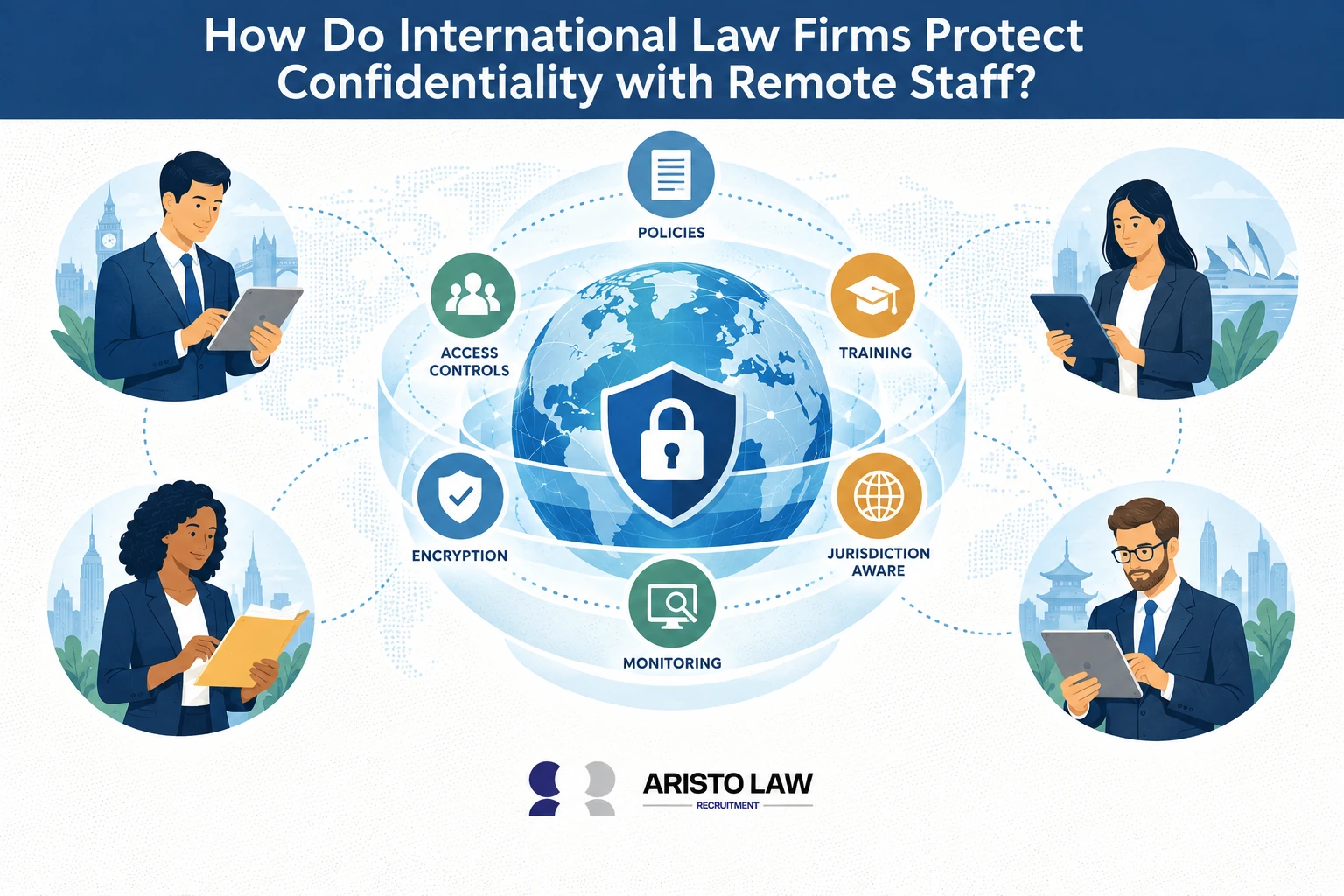
International law firms protect confidentiality with remote
staff through role-based access, secure devices, encrypted
communication, confidentiality agreements, audit trails, attorney
supervision, and jurisdiction-aware data handling.
Confidentiality protection in multinational legal operations functions
as a global risk-control system because cross-border legal workflows
involve sensitive client records, litigation materials, privileged
communication, regulatory filings, financial data, intellectual
property, and jurisdiction-specific confidentiality obligations moving
across distributed legal teams, outsourced support providers, cloud
platforms, and international communication systems.
A survey by the American Bar Association in 2019 showed that
26% of law firms experienced a data breach, leading many firms to
strengthen remote-work confidentiality practices through secure access
controls, encrypted systems, and regular audits.
Attorney-client privilege remains heavily important in international
legal operations because privilege protections may differ across
jurisdictions, creating additional exposure when confidential
communication moves between countries, cloud systems, local counsel,
virtual assistants, outsourced legal operations teams, IT vendors, and
remote support providers. International firms commonly use
least-privilege access structures restricting staff access only to
systems, matters, repositories, communication channels, or billing
environments directly necessary for assigned workflow
responsibilities.
International law firms commonly establish clean remote-work policies
covering secure workspaces, screen privacy, restricted public-network
usage, approved communication platforms, device-lock requirements,
physical-document handling, prohibited local storage, and workflow
escalation procedures for confidentiality incidents. Vendor-security
reviews also remain heavily important because outsourced staffing
providers, cloud vendors, IT contractors, litigation-support companies,
e-discovery providers, and translation vendors frequently access
sensitive legal systems and confidential legal workflows.
Successful international remote legal operations depend heavily on
centralized security governance, attorney-supervised workflows, secure
legal technology infrastructure, standardized operational policies,
recurring confidentiality training, and monitored access systems
maintaining privilege protection and regulatory compliance across
distributed global legal environments.
How
do virtual legal assistant companies support international law
firms?
Virtual legal assistant companies support international law
firms by providing scalable remote legal support services that help
manage cross-border workflows, multilingual communication, and legal
documentation. These companies also assist with administrative
coordination and global case management through cloud-based legal
systems and distributed staffing models.
International law firms use outsourced legal support teams to
coordinate cross-border administrative workflows, client communication,
document handling, and jurisdiction-specific case support across
multiple time zones. Structured virtual
legal assistant services for international law firms
help international law firms maintain operational continuity, reduce
staffing overhead, and standardize legal support processes across
distributed practices.
Listed below are the 14 major ways virtual legal assistant companies
support international law firms:
-
Providing remote administrative and procedural legal support
across jurisdictions: Virtual legal assistant companies help
international firms manage intake workflows, scheduling, repository
maintenance, billing coordination, CRM updates, communication routing,
and procedural support across distributed legal environments. -
Managing multilingual client communication and international
scheduling coordination: Cross-border legal operations
frequently require multilingual communication, consultation
coordination, appointment scheduling, reminder workflows, and time-zone
alignment across attorneys, clients, regulators, and local counsel. -
Supporting cross-border document management and legal
workflow organization: Virtual legal support teams maintain
repositories, document-routing systems, metadata organization, version
control, workflow tracking, and centralized case-file coordination
improving operational consistency across multinational legal
matters. -
Assisting with legal research coordination and regulatory
information tracking: Remote legal support professionals
frequently organize legal research materials, track compliance updates,
maintain regulatory documentation systems, and coordinate information
retrieval workflows across multiple jurisdictions. -
Handling billing support, invoicing workflows, and legal
administrative operations: International firms commonly
outsource invoice coordination, payment tracking, billing-entry
workflows, accounts receivable follow-up, and administrative financial
processes improving cash-flow continuity. -
Coordinating international case files, deadlines, and
workflow timelines: Virtual legal assistant companies help
maintain litigation calendars, filing reminders, procedural timelines,
transactional workflows, and centralized deadline tracking across
cross-border operations. -
Supporting contract management and corporate compliance
workflows: International corporate legal operations frequently
require structured workflow support involving contract repositories,
compliance reporting, policy tracking, entity-management coordination,
and procedural governance workflows. -
Assisting with e-discovery and international document-review
organization: Litigation-heavy multinational practices often
use outsourced legal support teams to organize discovery materials,
maintain repositories, track review workflows, and coordinate
large-scale document-management operations. -
Providing scalable staffing during litigation surges or
transaction-heavy periods: Remote staffing structures allow
international firms to increase support capacity rapidly without
proportionally increasing permanent office infrastructure across every
jurisdiction. -
Reducing operational overhead through remote staffing
models: Outsourced virtual legal support reduces office-space
costs, infrastructure expenses, localized hiring pressure, and fixed
operational overhead across multinational legal environments. -
Integrating into cloud-based legal practice-management and
collaboration systems: Virtual legal assistant companies
commonly operate inside centralized practice-management software, CRM
systems, workflow dashboards, secure repositories, e-signature systems,
and communication platforms supporting distributed legal operations. -
Supporting law firms operating across multiple time zones and
legal jurisdictions: Distributed staffing models improve
operational continuity and communication coverage for firms handling
international matters requiring extended-hour workflow coordination. -
Maintaining confidentiality through encrypted communication
and secure document systems: International virtual legal
support depends heavily on MFA systems, encrypted communication,
role-based access, audit trails, VPN controls, secure repositories, and
confidentiality governance protecting cross-border legal data. -
Helping international law firms standardize workflows across
distributed legal teams: SOPs, workflow templates, centralized
reporting systems, operational dashboards, and task-management
structures improve consistency across multinational legal
operations.
Virtual legal assistant companies function most effectively when
integrated directly into centralized legal technology systems supporting
workflow visibility, communication continuity, secure collaboration,
procedural coordination, and scalable international legal operations
across distributed teams and jurisdictions.
How
should international law firms hire virtual legal assistants?
Steps to hire virtual legal assistants for international law
firms include defining workflows, identifying jurisdictional needs,
choosing staffing model, screening legal experience, testing
communication skills, set security rules, and onboard with
SOPs.
International law firms hire virtual legal assistants by evaluating
jurisdictional compatibility, legal workflow requirements,
confidentiality standards, and cross-border communication capabilities.
International law firms improve onboarding accuracy and outsourcing
efficiency by standardizing how
to hire a virtual legal assistant within structured
legal support and compliance processes.
Listed below are 15 ways international law firms should hire virtual
legal assistants.
-
Define cross-border workflows and operational
bottlenecks: International law firms should first identify
which workflows require remote support, including intake coordination,
multilingual communication, litigation administration, compliance
tracking, billing support, scheduling, repository management, or
cross-border case coordination. Clear workflow definition prevents role
confusion and improves staffing alignment. -
Identify jurisdictional, language, and time-zone
requirements: Global legal operations frequently require
multilingual communication, overlapping business-hour coverage, and
familiarity with jurisdiction-sensitive workflows. Firms should define
whether support staff need experience handling international clients,
coordinating local counsel, managing cross-border scheduling, or
supporting multinational legal operations. -
Choose the appropriate staffing model: International
firms should determine whether they need fractional support,
project-based staffing, dedicated full-time remote legal assistants,
agency-managed staffing, or scalable overflow support for litigation
surges or transaction-heavy periods. -
Screen candidates for legal workflow experience:
Strong international virtual legal assistants usually demonstrate
familiarity with legal terminology, document-management systems, CRM
platforms, practice-management software, intake workflows, litigation
coordination, and distributed legal operations. Practice-area
familiarity involving corporate law, litigation, immigration,
compliance, arbitration, or international transactions improves
operational fit. -
Evaluate multilingual communication quality:
International legal operations depend heavily on communication clarity
across clients, attorneys, regulators, local counsel, and distributed
teams. Firms should evaluate written communication quality, professional
tone, response discipline, and multilingual capability where
required. -
Test cross-time-zone scheduling and coordination
skills: Sample workflow tasks should include coordinating
meetings across multiple time zones, maintaining scheduling accuracy,
managing deadline conflicts, and organizing distributed workflow
communication. -
Assess document-handling and workflow-management
ability: International firms should test repository
organization, version control, metadata tagging, document-routing
workflows, template management, matter-status tracking, and CRM-update
accuracy. -
Verify legal software proficiency and cloud-system
familiarity: Candidates should demonstrate competency using
practice-management systems, cloud repositories, e-signature platforms,
billing software, workflow dashboards, communication tools, and
task-management systems supporting distributed legal operations. -
Evaluate confidentiality awareness and cybersecurity
discipline: International legal workflows involve cross-border
confidentiality obligations, privilege-sensitive communication, and
regulated legal data. Firms should assess MFA usage, password hygiene,
encrypted communication familiarity, access-control discipline, and
remote security awareness. -
Test operational reliability and remote-work
discipline: International virtual legal assistants frequently
operate independently across distributed teams, making deadline
management, responsiveness, workflow prioritization, and accountability
heavily important. -
Use workflow-based sample tasks during hiring: Firms
should assign realistic operational tests such as cross-time-zone
scheduling, CRM updates, document-routing workflows, matter-status
tracking, intake follow-up, billing coordination, or multilingual
communication scenarios reflecting actual legal operations. -
Establish supervision structure and attorney-review
checkpoints: International firms should define escalation
protocols, communication standards, workflow ownership, attorney-review
thresholds, reporting cadence, and operational accountability systems
before onboarding begins. -
Document SOPs and workflow standards before
onboarding: Remote staffing integrates more effectively when
firms provide documented intake procedures, naming conventions,
communication policies, confidentiality rules, billing workflows,
repository standards, and procedural escalation guidelines. -
Implement secure access controls and confidentiality
systems: International legal operations require role-based
permissions, encrypted communication systems, VPN access, audit trails,
secure repositories, and controlled workflow visibility protecting
cross-border legal data. -
Start with a monitored trial period and measurable
KPIs: Firms should evaluate performance using response speed,
communication consistency, document accuracy, scheduling reliability,
workflow completion rate, billing support quality, and operational
responsiveness before expanding responsibilities.
AristoLaw helps international law firms hire virtual legal assistants
by matching staffing structures to cross-border operational workflows,
multilingual communication needs, practice-area requirements,
confidentiality standards, legal technology environments, and scalable
remote legal support systems supporting multinational legal
operations.
How
should international law firms train virtual legal assistants?
Steps to train virtual legal assistants for international law
firms include explaining role boundaries and reviewing
performance.
Listed below are 15 ways virtual legal assistants can get
trained.
-
Explain role boundaries and attorney-supervision
requirements: International law firms should clearly define
which tasks virtual legal assistants may handle and which
responsibilities remain attorney-only functions. Training should cover
unauthorized-practice-of-law restrictions, attorney-review checkpoints,
privilege-sensitive communication rules, and escalation requirements for
legal conclusions or jurisdiction-specific questions. -
Teach firm workflows and cross-border operational
structure: Remote legal assistants should understand how the
firm manages intake, litigation coordination, compliance workflows,
international transactions, repository organization, billing operations,
and communication routing across multiple jurisdictions and time
zones. -
Train on legal software and cloud-based systems:
International legal operations rely heavily on practice-management
systems, CRM platforms, document repositories, workflow dashboards,
billing systems, e-signature platforms, and secure communication tools.
Training should include workflow navigation, task updates, repository
standards, reporting systems, and audit-trail awareness. -
Document jurisdiction-specific rules and workflow
limitations: International firms should train staff on
country-specific filing restrictions, local counsel coordination
procedures, document-handling requirements, translation protocols,
privacy regulations, and procedural limitations varying across
jurisdictions. -
Establish confidentiality, privilege, and cybersecurity
protocols: Training should cover attorney-client privilege,
secure communication standards, MFA systems, password controls,
encrypted file sharing, VPN requirements, clean remote-work policies,
document-security expectations, and restricted-access workflows
protecting cross-border legal data. -
Set communication protocols for distributed legal
teams: International operations require structured
communication systems involving escalation rules, response-time
expectations, multilingual communication standards, timezone
coordination procedures, and workflow visibility across distributed
teams. -
Train staff on local counsel and international partner
coordination: Virtual legal assistants supporting international
matters frequently communicate with local counsel, foreign vendors,
translators, regulators, and multinational clients requiring
professional communication discipline and workflow coordination
standards. -
Standardize document naming conventions and repository
management: International firms should maintain strict file
structures, metadata standards, version-control systems, translation
labeling rules, and centralized repository governance improving
cross-border workflow consistency. -
Teach translation and multilingual workflow
coordination: Cross-border operations frequently involve
translated contracts, multilingual intake workflows, international
filings, and jurisdiction-sensitive communication requiring standardized
translation-routing procedures and quality-control systems. -
Assign workflow-based sample tasks during
onboarding: Practical training should include cross-time-zone
scheduling exercises, document-routing workflows, CRM updates,
matter-status tracking, intake follow-up, billing coordination, and
multilingual communication scenarios reflecting actual operational
workflows. -
Define task queues, escalation paths, and workflow
ownership: International firms should clarify who owns each
workflow stage, how operational handoffs occur, when attorney approval
becomes necessary, and how unresolved workflow issues escalate across
distributed teams. -
Control legal software permissions and access
visibility: Remote legal assistants should receive role-based
access aligned only with workflow responsibilities. Training should
explain repository restrictions, communication permissions, billing
visibility limits, and audit-tracked workflow systems. -
Implement quality-review and performance-feedback
systems: International firms should review communication
quality, response speed, document accuracy, scheduling consistency,
repository organization, billing support workflows, and operational
reliability during early onboarding phases. -
Train on time-zone coordination and operational
handoffs: Distributed legal teams frequently operate
continuously across multiple geographic regions. Training should cover
scheduling overlap, workflow continuity, handoff procedures, and
delayed-response escalation standards. -
Maintain centralized SOPs for distributed workflow
consistency: International law firms require stronger SOP
systems than single-office firms because cross-border legal operations
involve more complex handoffs, multilingual communication, distributed
staffing structures, local counsel coordination, and
jurisdiction-sensitive workflows requiring standardized operational
governance.
International virtual legal assistant training functions most
effectively when firms treat onboarding as a centralized
operational-control system designed to improve workflow consistency,
confidentiality compliance, communication continuity, and cross-border
legal coordination across distributed legal environments.
How
should international law firms measure virtual assistant
performance?
International law firms evaluate virtual assistant
performance through operational accuracy, responsiveness, workflow
efficiency, and legal task completion quality.

The table below shows virtual assistant performance metrics for
international law firms.
| KPI Metric | What It Measures | Why It Matters for Global Legal Workflow Reliability |
|---|---|---|
| Response time across time zones | Speed of responding to attorneys, clients, local counsel, vendors, or workflow requests across multiple regions |
Faster response improves international workflow continuity and reduces communication delays across distributed legal teams |
| Meeting scheduling accuracy | Accuracy of coordinating consultations, hearings, calls, and cross-border meetings involving multiple jurisdictions and time zones |
Prevents scheduling conflicts, missed meetings, and operational disruption across international legal operations |
| Document routing completion rate | Percentage of documents successfully delivered, organized, tracked, and routed through workflow systems |
Improves procedural continuity and reduces delays in cross-border legal workflows |
| CRM update accuracy | Reliability of client records, matter updates, communication logs, and intake progression tracking |
Improves workflow visibility and centralized operational coordination across multinational legal matters |
| Local counsel follow-up completion | Consistency of communication tracking and procedural coordination with foreign counsel or external legal partners |
Reduces cross-jurisdiction communication gaps and improves procedural reliability |
| Translation-status tracking accuracy | Accuracy of tracking translated contracts, filings, compliance documents, and multilingual workflows |
Prevents procedural errors, duplicate work, and international document delays |
| E-signature completion rate | Percentage of contracts, engagement letters, approvals, and legal documents completed through digital signature workflows |
Accelerates international document execution and reduces transaction delays |
| Billing support turnaround time | Speed of invoice preparation, payment tracking, billing-entry updates, and accounts-receivable coordination |
Improves international cash-flow continuity and financial workflow organization |
| Task backlog volume | Number of incomplete or delayed operational tasks across international workflows |
Rising backlog indicates workflow imbalance, staffing pressure, or operational bottlenecks |
| Revision rate | Frequency of corrections required for documents, workflow updates, communication records, or administrative tasks |
Lower revision rates indicate stronger workflow accuracy and operational consistency |
| Attorney administrative hours saved | Reduction in attorney time spent on scheduling, intake coordination, communication tracking, and administrative workflows |
Measures delegation effectiveness and attorney productivity recovery |
| Deadline completion rate | Percentage of international workflow tasks completed before procedural or operational deadlines |
Reduces compliance risk and improves global workflow reliability |
| Cross-border communication consistency | Reliability of communication across clients, local counsel, regulators, and distributed legal teams |
Improves coordination quality and operational continuity in multinational legal operations |
| Document-management accuracy | Quality of repository organization, version control, metadata tagging, and centralized file management |
Reduces retrieval delays and prevents operational confusion across distributed legal systems |
| Matter-status update consistency | Frequency and reliability of updating matter progression across international case-management systems |
Improves centralized visibility into multinational legal operations |
| Workflow escalation response time | Speed of escalating privilege-sensitive issues, procedural risks, or attorney-review items |
Prevents workflow breakdowns and reduces operational exposure |
| Client follow-up completion rate | Consistency of reminders, onboarding communication, status updates, and intake follow-up workflows |
Improves client experience and international communication reliability |
| Compliance workflow tracking accuracy | Reliability of tracking regulatory deadlines, filings, compliance tasks, and jurisdiction-sensitive procedural workflows |
Reduces regulatory exposure and cross-border procedural risk |
| Remote collaboration efficiency | Effectiveness of coordinating workflows through cloud-based legal systems and distributed communication platforms |
Strengthens productivity across multinational remote legal operations |
| Utilization rate | Percentage of available staffing capacity actively supporting productive workflow activity |
Helps international firms scale staffing efficiently without overstaffing or operational waste |
International law firms usually achieve stronger operational
reliability when virtual assistant performance metrics focus on workflow
continuity, communication consistency, document accuracy, procedural
coordination, and attorney time recovery rather than simply tracking
online activity or hours logged.
When
should an international law firm outsource legal support?
An international law firm should outsource legal support when
there are cross-border coordination overload, or recurring process-heavy
work.
Listed below are 13 occasions when international law firms should
outsource legal support.
-
Cross-border coordination overload: International
matters frequently involve local counsel communication, multinational
scheduling, compliance tracking, cross-border filings, and distributed
workflow coordination. Firms experiencing communication breakdowns,
delayed updates, or operational congestion often need a virtual legal
assistant or legal operations coordinator improving centralized workflow
visibility and coordination continuity. -
Growing document backlog across jurisdictions:
High-volume contracts, discovery records, translated filings, compliance
documents, and multinational case materials frequently overwhelm
internal support teams. Firms facing repository congestion, slow
turnaround, or filing delays often benefit from remote paralegals,
document-review teams, or outsourced litigation-support providers. -
Time-zone coverage gaps and delayed responsiveness:
International clients, regulators, and legal teams frequently operate
across multiple regions simultaneously. Firms struggling with overnight
communication delays, intake-response gaps, or scheduling conflicts
commonly require international virtual legal assistants supporting
extended-hour operational coverage. -
High administrative overhead across multiple
offices: Expanding in-house support teams in every jurisdiction
increases payroll costs, infrastructure burden, office-space expense,
and operational duplication. International firms frequently outsource
administrative workflows to improve scalability and reduce fixed
operational cost. -
Multilingual communication and translation pressure:
Cross-border operations involving multilingual intake, translated
contracts, regulatory communication, or multinational clients often
require outsourced support professionals with language capability and
international workflow familiarity. -
Recurring process-heavy legal workflows: Intake
processing, billing coordination, CRM updates, compliance tracking,
repository maintenance, scheduling, document routing, and reporting
workflows become strong outsourcing candidates when repetitive
operational volume increases consistently. -
Attorney overload and declining billable focus:
Attorneys spending excessive time on scheduling, intake management,
communication routing, workflow tracking, and procedural coordination
lose productivity and increase burnout risk. Administrative overload
usually indicates the need for a virtual legal assistant or legal
secretary. -
Matter delays caused by workflow bottlenecks:
Delayed filings, inconsistent communication, backlog accumulation, and
missed follow-up workflows often indicate insufficient operational
support capacity inside international legal operations. -
Litigation surges and discovery-heavy matters: Large
investigations, arbitration proceedings, cross-border litigation, and
multinational disputes frequently require scalable remote paralegal
support, document-review teams, or specialized litigation-support
providers. -
Need for local jurisdiction support: International
firms handling jurisdiction-sensitive procedural work, court
appearances, regulatory filings, or country-specific legal
interpretation often require local counsel rather than purely remote
administrative support. -
Technology-management and cybersecurity pressure:
Firms managing distributed legal systems, secure repositories,
cross-border data transfers, or cloud infrastructure often require
specialized legal IT providers supporting cybersecurity governance and
operational continuity. -
Compliance and regulatory tracking complexity:
Multinational compliance workflows involving privacy regulation, trade
law, employment law, tax reporting, or corporate governance frequently
require outsourced operational coordination improving deadline
visibility and procedural consistency. -
Scalability pressure during rapid growth: Firms
expanding into new jurisdictions, onboarding multinational clients, or
increasing transaction volume often outsource operational support before
expanding permanent in-house staffing structures. -
Client-service gaps and communication inconsistency:
Slow intake response, delayed updates, missed reminders, and fragmented
communication reduce client trust and weaken international operational
reliability.
International law firms achieve stronger outsourcing outcomes when
staffing decisions match the operational bottleneck precisely. Virtual
legal assistants support administrative coordination, legal secretaries
support communication and scheduling, and IT providers manage secure
legal infrastructure and remote operational systems.
Remote paralegals support procedural and document-heavy legal
workflows, outsourced attorneys support jurisdiction-sensitive legal
work under licensing rules, and local counsel handle
jurisdiction-specific representation and regulatory interpretation.
Are
virtual legal assistants right for international law firms?
Virtual legal assistants are right for international law
firms when workflows are remote-friendly, repeatable, secure,
supervised, and dependent on strong coordination across clients,
attorneys, staff, and jurisdictions. International legal
operations usually gain the strongest value from virtual legal
assistants when administrative and procedural workflows such as intake
coordination, multilingual communication, scheduling, CRM updates,
billing support, repository management, document routing, compliance
tracking, and cross-border workflow coordination occur consistently
enough to justify structured remote support systems.
Research by Actionstep on cloud-based legal practice
management systems showed that law firms improved operational
efficiency, workflow management, and organizational scalability through
centralized digital legal systems and cloud-supported collaboration
tools. International law firms should evaluate workload volume,
time-zone coverage needs, multilingual communication requirements,
procedural complexity, and operational bottlenecks before expanding
remote legal support.
Firms managing multinational clients, cross-border litigation,
international transactions, compliance-heavy workflows, or globally
distributed legal teams often benefit strongly from remote support
because virtual legal assistants improve coordination continuity across
multiple jurisdictions and business hours simultaneously. Technology
readiness also remains heavily important because remote legal operations
depend on practice-management systems, cloud repositories, workflow
dashboards, CRM platforms, secure messaging tools, e-signature systems,
and centralized communication infrastructure supporting distributed
legal workflows.
International firms with mature SOPs, standardized workflows,
centralized repositories, communication protocols, and operational
governance systems usually achieve faster ROI and smoother remote
integration. Firms with fragmented workflows, inconsistent communication
systems, weak confidentiality controls, or unclear task ownership
frequently need stronger workflow documentation, operational
standardization, and security governance before scaling virtual legal
support successfully.
How
do virtual assistants support cross-border legal workflows?
Virtual assistants support cross-border legal workflows by
keeping documents, deadlines, communications, meetings, signatures, and
matter updates organized across jurisdictions. Cross-border
legal operations depend heavily on coordination infrastructure because
international matters frequently involve multinational clients, local
counsel, regulators, translators, compliance teams, distributed
attorneys, and procedural deadlines operating simultaneously across
different legal systems and time zones.
Legal operations and workflow-management research consistently shows
that international legal matters become operationally unstable when
document ownership, version control, communication routing, task
accountability, procedural deadlines, and workflow handoffs are not
centrally managed through structured systems and clearly assigned
operational support roles.
Virtual assistants support intake routing by directing new matters
into the correct jurisdictional workflow, assigning intake checklists,
updating CRM systems, and coordinating onboarding communication across
distributed legal teams. Cross-border document workflows also depend
heavily on repository organization, multilingual file management,
version-control systems, metadata tagging, and structured document
checklists ensuring contracts, compliance records, litigation materials,
filings, and translated documents remain traceable across jurisdictions.
Virtual assistants frequently coordinate local counsel follow-up,
maintain communication logs, track procedural updates, monitor filing
status, and route workflow reminders improving operational continuity
across multinational legal matters.
Time-zone scheduling becomes especially important in international
legal operations because attorneys, regulators, clients, vendors,
courts, and local counsel often operate across different regions
simultaneously. Virtual assistants maintain meeting coordination,
hearing reminders, scheduling overlap management, and communication
continuity reducing operational delays and missed coordination
windows.
Compliance calendar management represents another major operational
function because multinational legal workflows frequently involve
recurring filing deadlines, regulatory obligations, renewal schedules,
reporting requirements, and procedural milestones varying across
jurisdictions. Virtual assistants help maintain centralized reminder
systems, escalation workflows, status tracking, and workflow visibility
improving procedural reliability and reducing deadline risk.
How
does legal technology support international law firms?
Legal technology supports international law firms by
centralizing matters, automating workflows, protecting documents,
coordinating remote staff, tracking deadlines, and improving
cross-border collaboration. International legal operations
depend heavily on legal technology because multinational matters
frequently involve distributed attorneys, virtual legal assistants,
paralegals, local counsel, regulators, clients, translators, vendors,
and outsourced support teams operating across multiple jurisdictions and
time zones simultaneously.

Research by the Corporate Legal Operations Consortium in 2026
shows that 83% of legal departments expect legal-work demand to
increase, while 63% identified workload pressure and limited bandwidth
as their biggest operational challenge, leading organizations
to adopt centralized legal technology and workflow-management systems to
improve scalability and visibility across legal operations.
International law firms use legal technology to standardize
cross-border workflows, automate document handling, and coordinate
multi-jurisdictional legal operations through centralized digital
systems. International law firms also integrate AI-assisted review,
cloud-based collaboration, and data-driven compliance tools to support
legal
technology trends automation AI and future of law firms
across global practice environments.
Practice-management platforms function as centralized operational
hubs where international firms track matters, deadlines, client
communication, billing workflows, task assignments, procedural status,
and distributed team activity across jurisdictions. Contract lifecycle
management (CLM) systems support multinational contract workflows
through centralized repository management, approval routing, clause
tracking, version control, negotiation coordination, renewal reminders,
and compliance visibility, improving transaction efficiency across
international legal operations. E-signature platforms reduce delays
involving cross-border contract execution, regulatory approvals,
engagement letters, and multinational workflow approvals by allowing
secure digital execution across geographic regions.
Request-tracking systems further improve operational control by
preventing workflow fragmentation inside email threads and creating
visibility into pending assignments, unresolved requests, procedural
bottlenecks, and distributed operational responsibilities. Legal
technology therefore functions as the infrastructure connecting
attorneys, virtual assistants, paralegals, local counsel, clients,
compliance teams, vendors, and outsourced legal operations staff into a
centralized operational structure supporting scalable, secure, and
coordinated international legal workflows.
How
can legal workflow automation help international law firms?
Legal workflow automation helps international law firms by
standardizing repetitive tasks, routing work across teams, reducing
manual follow-up, and improving visibility across
jurisdictions. International legal operations involve
distributed attorneys, local counsel, compliance teams, clients, virtual
legal assistants, translators, vendors, and outsourced support staff
working across different countries and time zones, making workflow
consistency heavily important for operational reliability.
A 2025 industry analysis by NexLaw showed that comprehensive
legal workflow automation systems saved law firms between 40% and 70% of
the time spent on routine legal tasks, enabling faster case handling,
improved coordination, and higher client satisfaction.
Automated intake routing helps international firms direct new matters
into the correct jurisdictional workflow, assign intake tasks, trigger
multilingual onboarding communication, and update CRM systems
automatically reducing lead-response delays and intake confusion.
International law firms use automated workflows to standardize
cross-border document handling, reduce administrative delays, and
coordinate multi-jurisdictional legal operations with greater accuracy.
Operational efficiency, task routing, compliance tracking, and
centralized case management demonstrate the legal
workflow automation tools benefits and examples
relevant to international law firms managing high-volume legal
processes.
Compliance calendars and automated deadline reminders improve
procedural reliability by tracking filings, renewals, reporting
obligations, hearing schedules, and regulatory milestones across
jurisdictions. Automated client follow-up sequences maintain
communication continuity through reminders, onboarding updates,
scheduling notifications, and status alerts improving international
client-service consistency.
Virtual legal assistants remain heavily important inside automated
legal systems because automation alone cannot manage incomplete intake
data, document inconsistencies, translation issues, workflow exceptions,
procedural escalation, or jurisdiction-sensitive coordination. Remote
legal assistants therefore maintain data quality, monitor workflow
failures, update repositories, verify communication accuracy, track
unresolved tasks, and escalate attorney-review items when automated
workflows require human oversight or operational judgment.
Build a legal support team that moves work forward.
Tell us what is slowing your practice down. We will help map the role, workflow, and support structure that fits.