
Virtual Marketing Assistants – Why Your Law Firm Can No Longer Ignore the Impact

Practical guidance for building efficient, accountable legal support operations.
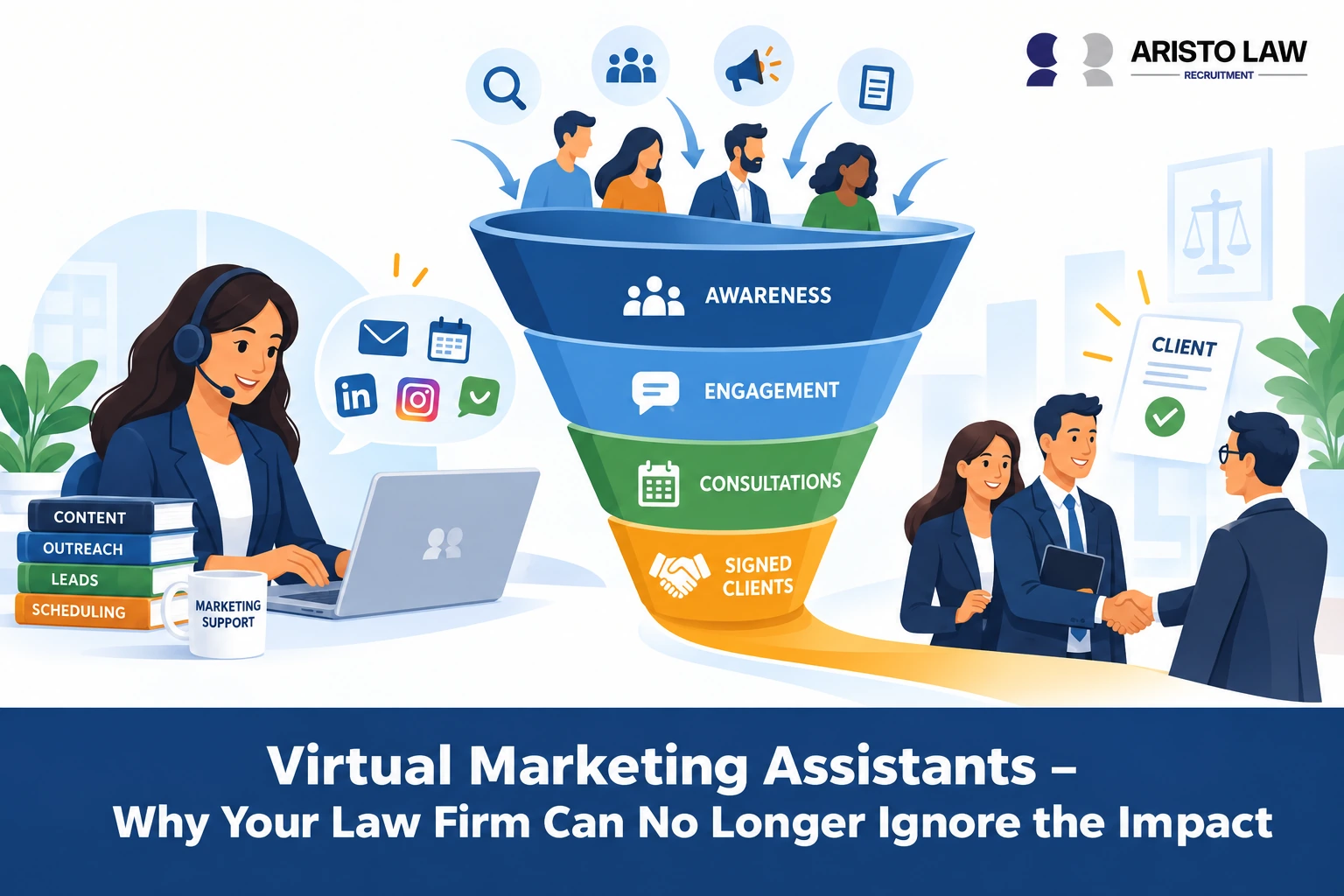
A virtual marketing assistant manages and executes remote
marketing tasks that help law firms improve visibility, client
acquisition, and operational efficiency through scalable digital
workflows. Virtual marketing assistants support law firms
through content creation, social media management, SEO support, CRM
management, lead generation, email campaigns, analytics tracking, and
marketing coordination across digital platforms. Law firms increasingly
rely on virtual marketing support because remote staffing models reduce
overhead costs, improve workflow flexibility, and support scalable
marketing operations without expanding in-house teams.
Virtual marketing assistants differ from general virtual assistants
because legal marketing support requires an understanding of law firm
branding, legal advertising compliance, SEO strategy, client intake
workflows, CRM systems, and legal content coordination. Common tasks
delegated first include blog publishing, CRM updates, lead tracking,
client follow-ups, social media scheduling, analytics reporting, and
campaign support.
Virtual marketing assistants integrate into remote legal teams
through marketing platforms such as HubSpot, Google Analytics,
Mailchimp, and CRM systems that centralize marketing workflows and
reporting visibility. Hiring options include direct freelance
recruitment or legal staffing providers, with pricing structures varying
based on experience, specialization, and workload scope.
A study by A. Badalyan, from the research analysis “The
Impact of E-Marketing Automation on Business Performance,” in 2025,
confirms that structured digital coordination systems and automated data
tracking significantly improve campaign execution. The study reports
that integrating automation workflows leads to a 25% increase in lead
conversion rates due to more effective, timely communications.
Additionally, the research notes that utilizing automated analytics to
monitor key performance indicators (KPIs) reduces manual reporting times
by approximately 40%, driving a 20% to 30% boost in overall campaign
performance by allowing teams to pivot resources toward strategic
optimization rather than manual administrative tasks.
Virtual marketing assistants help law firms streamline marketing
operations, improve campaign consistency, and support measurable
marketing performance across growing legal practices.
Aristolaw helps law firms solve legal outsourcing problems by
providing marketing support staff for campaign coordination, content
workflows, lead tracking, and client acquisition operations. Hire
a Legal Marketing Assistant with Aristolaw today.
Aristolaw connects law firms with outsourced legal marketing support
that improves visibility, consistency, and growth execution.
What is a virtual
marketing assistant?
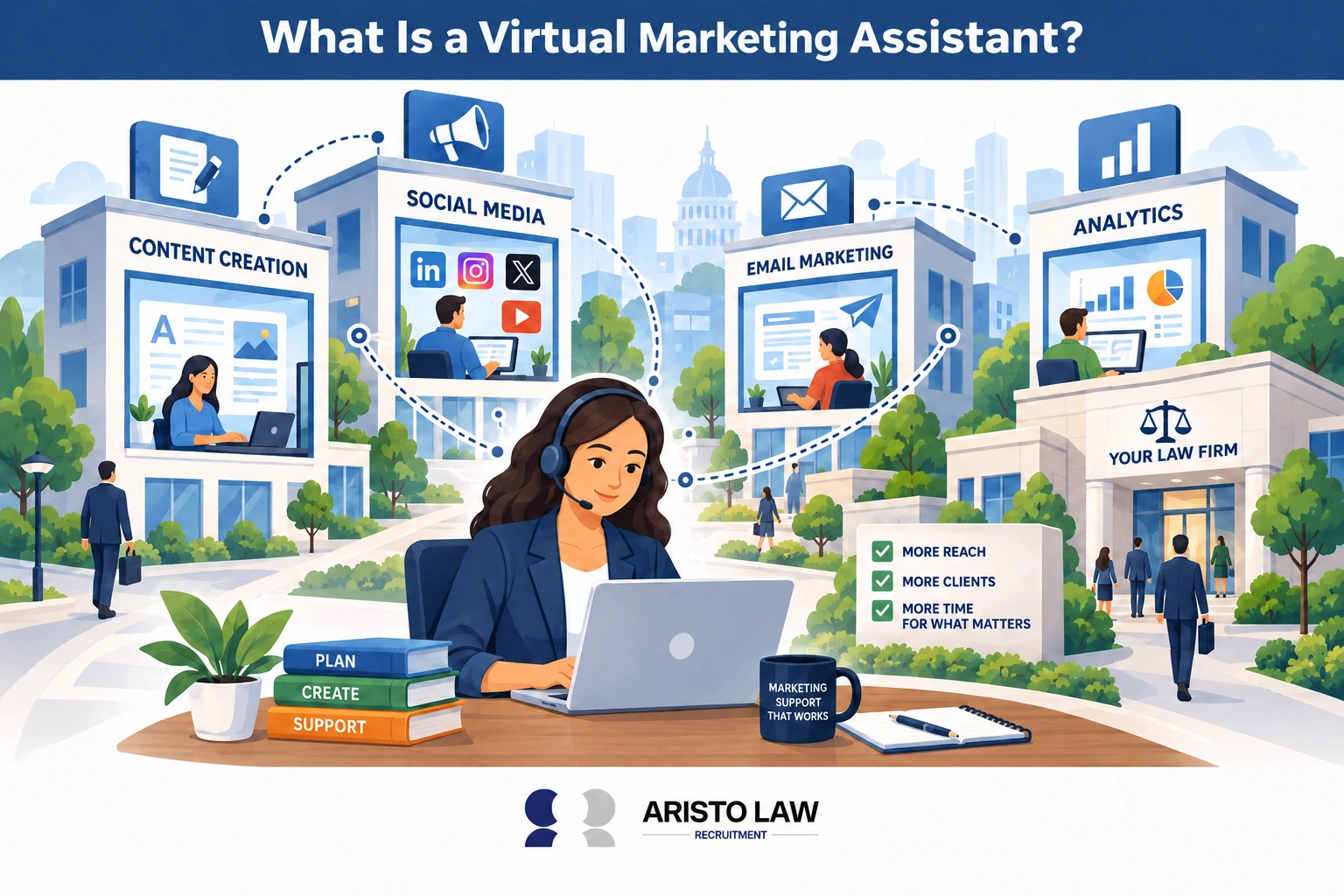
A virtual marketing assistant is a remote professional who
supports marketing activities from a distance across content, social,
email, coordination, and administrative workflows. Virtual
marketing assistants provide remote marketing support by managing
content scheduling, social media posting, CRM updates, email marketing
coordination, analytics reporting, lead tracking, and workflow
organization across digital marketing operations.
Marketing workflows remain more organized because virtual marketing
assistants support execution tasks that maintain campaign consistency,
communication flow, and operational efficiency without owning high-level
marketing strategy decisions. Law firms, agencies, and in-house teams
use virtual marketing assistants to handle recurring marketing
activities through cloud-based platforms, collaboration tools, social
media systems, content management software, and remote communication
channels that support scalable digital operations.
What
services do virtual marketing assistants provide?
Virtual marketing assistants provide services such as social
media management, email marketing support, content coordination, blog
and website updates, campaign tracking, reporting, and marketing
administration for law firms and businesses. Law firms use virtual
legal marketing assistant services workflows to improve
marketing organization, campaign consistency, lead management, and
operational efficiency across digital marketing activities.
The table below shows the services that virtual marketing assistants
provide.
Service |
What It Includes |
Why It Matters |
Best Fit for Law Firms |
|---|---|---|---|
| Social media management | Post scheduling, captions, and engagement tracking | Maintains online visibility and consistency | Firms building brand awareness |
| Email marketing support | Newsletter setup, follow-ups, and list management | Improves lead nurturing and communication | Firms managing client outreach |
| Content marketing support | Blog coordination, content uploads, and formatting | Supports SEO and website activity | Firms growing organic traffic |
| Blog and website support | CMS updates, page edits, and publishing | Maintains accurate online presence | Firms updating legal content regularly |
| Campaign coordination | Workflow tracking and campaign scheduling | Improves marketing organization | Firms running multiple campaigns |
| Reporting and analytics | Performance tracking and KPI summaries | Improves visibility into marketing results | Firms monitoring lead performance |
| CRM management | Contact updates and lead organization | Supports intake and follow-up workflows | Firms handling high lead volume |
| Administrative marketing support | Calendar management and task coordination | Reduces operational workload | Firms needing scalable support |
Why
can law firms no longer ignore virtual marketing assistants?
Law firms can no longer ignore virtual marketing assistants
because virtual marketing assistants reduce execution bottlenecks,
expand marketing output capacity, and provide specialized legal
marketing support without the cost of a full in-house team. Law
firm virtual assistant workflows improve content publishing speed, lead
follow-up consistency, CRM organization, social media management,
reporting coordination, and campaign execution across legal marketing
operations.
Legal marketing support becomes more scalable because outsourced
support models allow law firms to increase marketing activity without
adding permanent office overhead, employee benefit costs, or large
internal marketing departments. Cost leverage improves because virtual
marketing assistants handle recurring execution tasks such as blog
coordination, SEO support, intake follow-ups, analytics reporting, and
email marketing that delay attorneys and internal staff. Marketing
operations remain more consistent because virtual marketing assistants
maintain workflow continuity, scheduled publishing, lead management, and
communication tracking across high-volume legal marketing
environments.
What
is the difference between a virtual marketing assistant and a general
virtual assistant?
The difference between a virtual marketing assistant and a
general virtual assistant is that a virtual marketing assistant focuses
on marketing execution, campaign support, and digital growth activities,
while a general virtual assistant focuses more on administrative support
tasks.
The table below shows the difference between a virtual marketing
assistant and a general virtual assistant.
Role |
Primary Focus |
Typical Tasks |
Level of Marketing
|
|---|---|---|---|
| Virtual Marketing Assistant | Marketing execution and campaign support | Social media management, content coordination, CRM updates, email marketing, reporting, SEO support |
High marketing specialization |
| General Virtual Assistant | Administrative and operational support | Scheduling, email management, data entry, calendar coordination, travel booking, and customer support |
Low marketing specialization |
What
qualifications should a virtual marketing assistant have for law
firms?
The qualifications a virtual marketing assistant should have
for law firms include digital marketing expertise, analytics knowledge,
software proficiency, and compliance awareness related to legal
marketing operations.
Listed below are the 14 qualifications a virtual marketing assistant
must have for law firms.
-
Demonstrating digital marketing skills for SEO, email, content, and
campaign support -
Understanding legal advertising regulations and compliance
requirements -
Managing social media platforms for law firm branding and audience
engagement -
Analyzing marketing data through reporting and analytics tools
-
Using marketing automation tools for workflows, lead nurturing, and
campaign tracking -
Creating content for legal audiences across blogs, websites, and
email campaigns -
Communicating effectively with clients, attorneys, and marketing
teams -
Managing CRM systems for lead tracking and intake coordination
-
Organizing marketing workflows, publishing schedules, and reporting
tasks -
Understanding law firm operations and legal service marketing
processes -
Maintaining attention to detail for compliance-sensitive legal
content -
Using content management systems and website publishing platforms
-
Coordinating client follow-ups and intake-related communication
workflows -
Supporting campaign execution through structured marketing task
management
What
marketing tasks should law firms delegate first?
The marketing tasks law firms should delegate first include
social scheduling, blog formatting, lead follow-up support, and calendar
coordination because these repeatable workflows consume time without
requiring direct attorney involvement. The marketing tasks law
firms must delegate first are the repeatable tasks that consume time but
do not require attorney attention.
Listed below are the 10 marketing tasks law firms must delegate
first.
-
Social scheduling for consistent law firm social media activity
-
Blog formatting for website publishing and content organization
-
Newsletter production for client communication and email
campaigns -
CRM updates for lead tracking and contact management
-
Reporting for analytics summaries and marketing performance
tracking -
Lead follow-up support for intake coordination and response
management -
Calendar coordination for campaign timelines and publishing
schedules -
Content uploads for blogs, landing pages, and website updates
-
Email marketing setup for drip campaigns and client outreach
-
Review monitoring for reputation management and client feedback
tracking
How
do virtual marketing assistants streamline legal operations?
Virtual marketing assistants streamline legal operations by
taking repetitive marketing work off attorneys and staff, which creates
more time for client work, intake follow-up, and business
development. Delegation of marketing execution tasks such as
content scheduling, CRM updates, reporting, social media coordination,
email campaigns, and lead tracking improves productivity across law firm
workflows.
Attorney time shifts away from repetitive operational tasks and
toward legal strategy, client communication, intake conversion, and
revenue-generating legal work. Marketing workflows remain more organized
because virtual marketing assistants maintain publishing schedules,
campaign coordination, analytics reporting, and lead follow-up systems
through structured remote support processes. Streamlining legal
operations improves consistency, reduces workflow bottlenecks, and
strengthens operational efficiency across legal marketing and client
acquisition activities.
Can
a virtual marketing assistant function as part of a virtual marketing
team?
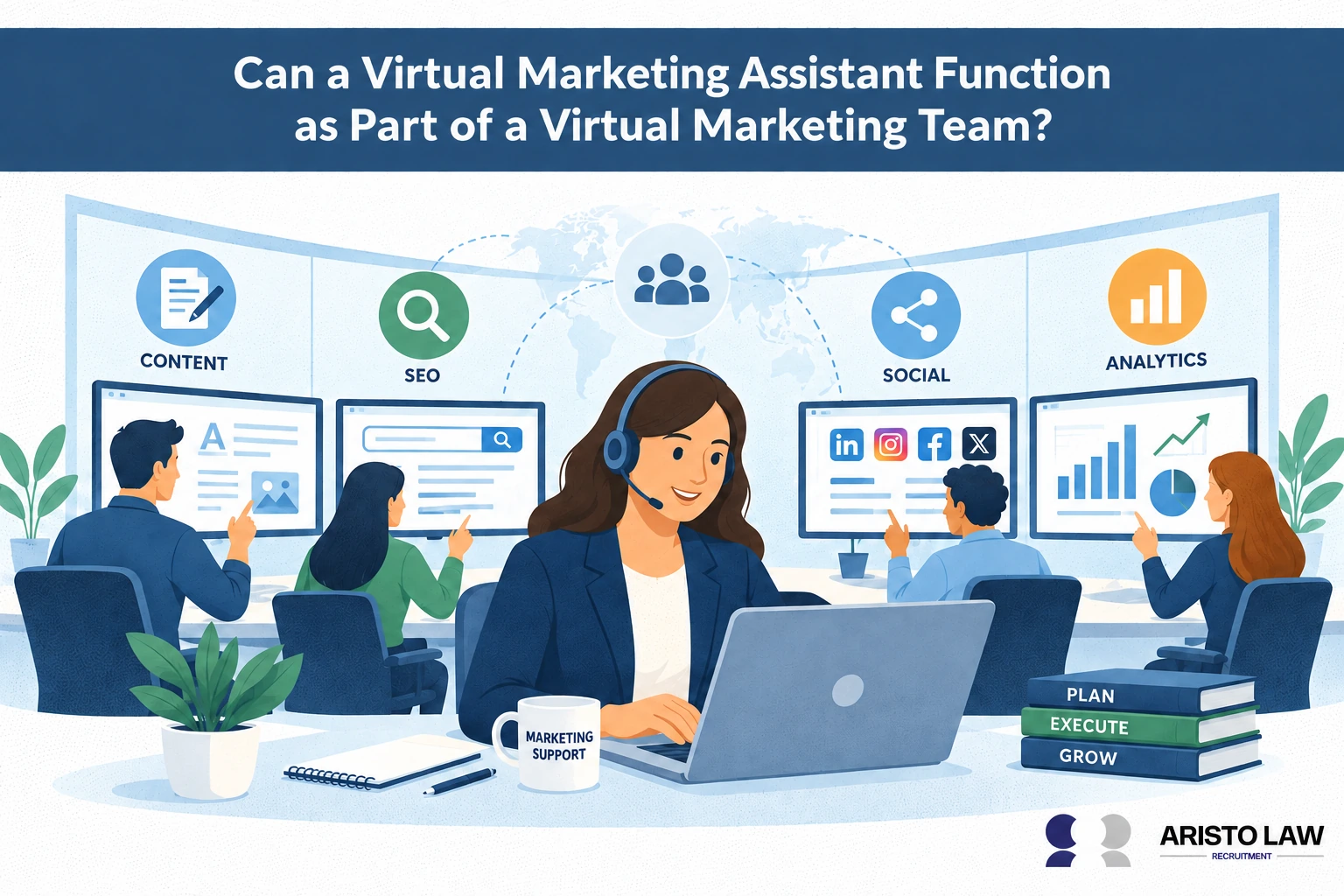
Yes, a virtual marketing assistant can function as part of a
virtual marketing team by taking ownership of execution-layer work
inside a broader remote marketing structure. Virtual marketing
assistants integrate into virtual marketing departments through
coordinated workflows that connect attorneys, intake staff, agencies,
SEO specialists, content writers, designers, and marketing managers
across remote operations. Execution support responsibilities include
content publishing, CRM management, reporting, social scheduling, email
coordination, lead follow-up workflows, and campaign administration that
maintain organized marketing operations for growing law firms.
Integrated workflows improve communication, task visibility, and
operational consistency because remote teams work through centralized
marketing platforms, shared calendars, analytics dashboards, and project
management systems. Growing law firms use virtual marketing teams to
scale marketing output, maintain workflow flexibility, and support
expanding client acquisition activities without building large in-house
marketing departments.
What
types of virtual marketing assistants matter most for law firms?
The types of virtual marketing assistants that matter most
for law firms include content marketing VAs, digital marketing VAs,
outreach VAs, and website or blog support VAs because these roles
support recurring client-facing marketing workflows. Law firms
use types
of virtual assistants for law firms staffing models to
improve marketing execution, lead management, publishing consistency,
and digital client acquisition operations.
Listed below are the 10 types of virtual marketing assistants that
matter most for law firms.
-
Content marketing virtual assistant for blog coordination, content
uploads, and SEO publishing -
Social media virtual assistant for scheduling posts, engagement
tracking, and brand visibility -
Email marketing virtual assistant for newsletters, drip campaigns,
and lead nurturing -
Digital marketing VA for campaign coordination, analytics reporting,
and marketing workflows -
Outreach virtual assistant for lead follow-up, intake communication,
and partnership outreach -
Website and blog support VA for CMS updates, page edits, and
publishing management -
CRM support a virtual assistant for contact management and intake
workflow tracking -
Reporting support to VA for KPI monitoring and campaign performance
summaries -
Review management VA for reputation monitoring and client feedback
coordination -
Administrative marketing VA for scheduling, workflow coordination,
and publishing calendars
What
are the benefits of hiring a virtual marketing assistant?
The benefits of hiring a virtual marketing assistant include
cost-effectiveness, time savings, increased productivity, flexible
scaling, wider skill access, lower overhead, and more consistent
marketing execution.
Listed below are the 12 benefits of hiring a virtual marketing
assistant.
-
Cost-effectiveness through reduced staffing and operational
expenses -
Time savings through delegated marketing execution tasks
-
Increased productivity across marketing and intake workflows
-
Flexible scaling based on workload and campaign volume
-
Wider skill access across SEO, content, CRM, and digital marketing
support -
Lower overhead compared with full in-house marketing hires
-
Faster content publishing and campaign coordination
-
More consistent social media and email marketing activity
-
Better workflow organization through structured remote support
-
Improved lead follow-up and CRM management
-
Greater operational efficiency across legal marketing activities
-
Better support for growing law firm marketing operations
Can
virtual marketing assistants scale with a growing law firm?
Yes, virtual marketing assistants can scale with a growing
law firm because the model supports flexible capacity, broader skill
coverage, and lower headcount pressure as workload expands.
Growing law firms increase marketing output through remote support
workflows that handle content publishing, CRM management, campaign
coordination, social media activity, reporting, and lead follow-up
without requiring large in-house marketing departments.
Flexible capacity allows firms to adjust marketing support based on
case volume, intake growth, advertising activity, and business
development demands across different growth stages. Lower headcount
pressure improves operational efficiency because law firms expand
marketing execution and workflow coverage without increasing office
space costs, employee overhead, or permanent staffing commitments.
Growth-stage support becomes more sustainable because virtual marketing
assistants integrate into existing law firm marketing operations through
scalable remote workflows, centralized software platforms, and
collaborative digital systems.
What
tools should virtual marketing assistants use inside a law firm?
The tools virtual marketing assistants should use inside a
law firm include email platforms, analytics tools, website management
systems, and collaboration platforms that support marketing execution
and reporting workflows. Law firms use law
firm social media marketing tools and trends
discussions to improve campaign coordination, client engagement
visibility, workflow organization, and digital marketing efficiency
across legal operations.
Listed below are the 10 tools virtual marketing assistants must use
inside a law firm.
-
Email marketing platforms for newsletters, drip campaigns, and client
outreach -
Social scheduling tools for post management and publishing
consistency -
CRM systems for lead tracking, intake coordination, and contact
management -
Analytics and reporting tools for campaign monitoring and KPI
visibility -
Website and blog management tools for publishing and content
updates -
Collaboration platforms for task coordination and remote workflow
management -
Content management systems for organizing legal marketing content
-
Project management tools for campaign scheduling and workflow
tracking -
Video conferencing tools for remote marketing coordination and
meetings -
Cloud storage systems for secure access to marketing files and
documents
How do
you hire the right virtual marketing assistant?
You hire the right virtual marketing assistant by defining
marketing needs, creating a detailed job description, evaluating
communication and software skills, interviewing qualified candidates,
and setting clear workflow goals before onboarding. Law firms
use how
to hire a virtual legal assistant hiring frameworks to
improve candidate selection, workflow alignment, communication quality,
and remote operational efficiency.
Listed below are the 10 steps to hire the right virtual marketing
assistant.
-
Define marketing needs based on workload, channels, and growth
priorities. -
Create a detailed job description covering responsibilities, tools,
and reporting expectations. -
Source candidates through staffing providers, referrals, or remote
hiring platforms. -
Review experience related to legal marketing, content workflows, CRM
systems, and campaign coordination. -
Interview candidates to assess organization, responsiveness, and
workflow fit. -
Check communication skills through written responses and live
discussions. -
Evaluate software proficiency with marketing, analytics, and
collaboration tools. -
Set clear goals, KPIs, deadlines, and reporting expectations before
onboarding. -
Establish workflow procedures for approvals, communication, and task
tracking. -
Monitor early performance and adjust responsibilities based on
operational needs.
How much does
a virtual marketing assistant cost?
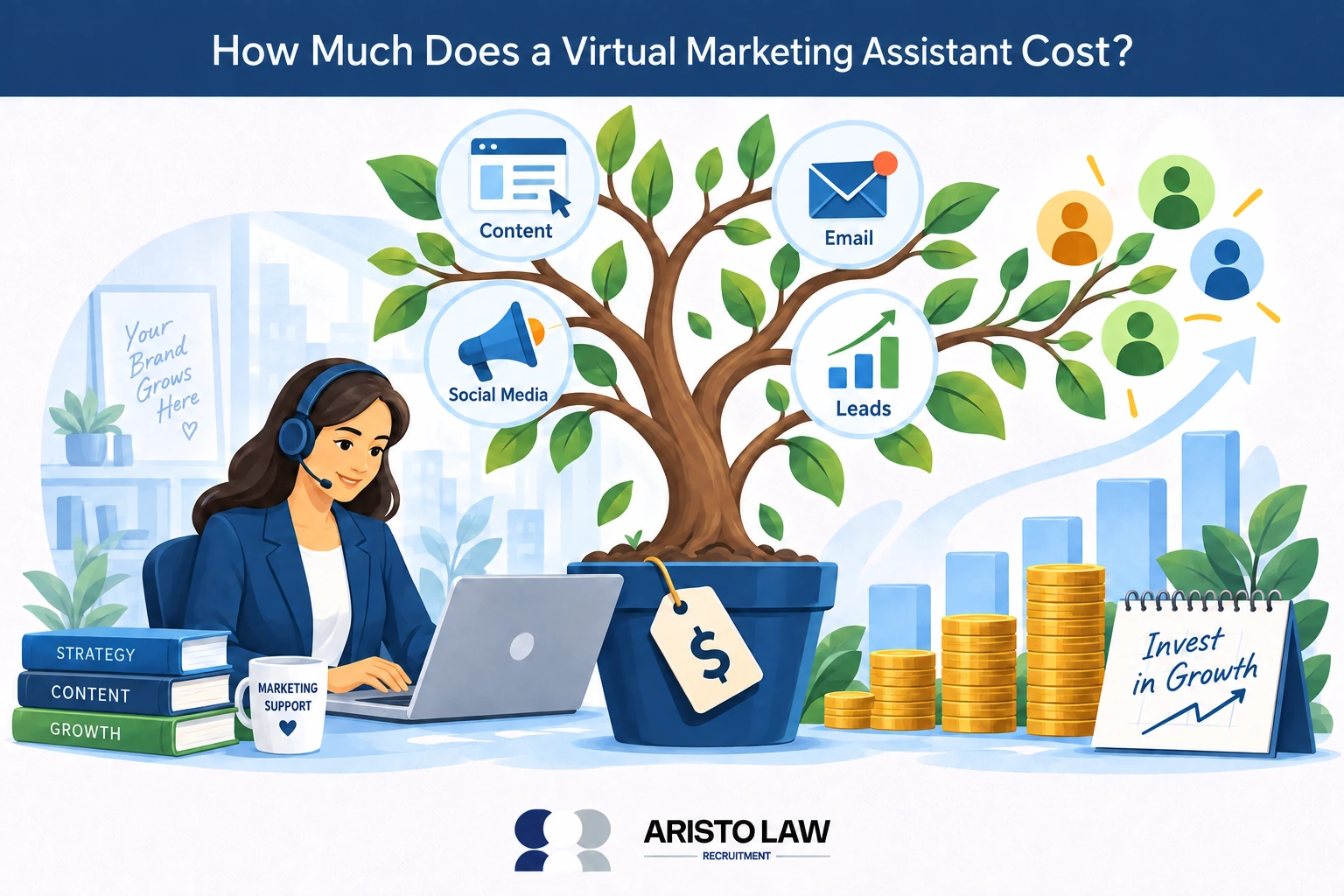
A virtual marketing assistant costs between $10 and $50 per
hour or approximately $1,000 to $4,000 per month, depending on
experience level, service scope, specialization, and hiring
model. Entry-level remote marketing support usually falls near
the lower end of the range, while specialized assistants handling SEO
support, analytics, CRM workflows, content operations, automation, and
legal marketing coordination charge higher rates. Costs also vary based
on whether the law firm hires a freelancer, agency-managed support, or a
dedicated remote marketing operator integrated into ongoing
workflows.
A study by MyOutDesk, from the analytical report “25 Virtual
Assistant Statistics To Help Scale Your Business,” in 2026, confirms
that businesses reduce operating expenses by up to 78% when utilizing
virtual assistants instead of a traditional, full-time in-house staffing
structure. A study by N. Bloom and colleagues from Stanford University,
titled “Does Working from Home Work? Evidence from a Chinese
Experiment,” confirms that remote workers in structured operational
environments achieved a 13% increase in productivity compared to their
in-office counterparts. A study by Wishup, from the comprehensive market
report “How Much Does a Virtual Assistant Cost in 2026?”, in 2026,
confirms that premium virtual assistant support ranges from $2,500 to
over $5,000 per month, with specialized roles commonly costing around
$3,000 to $4,000 per month.
How
do virtual marketing assistants improve marketing ROI for law
firms?
Virtual marketing assistants improve marketing ROI for law
firms by optimizing campaign execution, reducing operational costs,
improving lead conversion efficiency, and maintaining consistent
marketing workflows across digital channels. Law firms apply content
marketing for lawyers’ benefits and strategies
workflows to improve lead generation, campaign visibility, intake
follow-up, and client acquisition performance through structured remote
marketing support. Virtual marketing assistants manage social media
publishing, CRM updates, targeted email campaigns, analytics tracking,
lead nurturing, reporting coordination, and marketing automation
workflows that improve campaign consistency and operational
efficiency.
Marketing ROI improves because law firms reduce expenses tied to
large in-house marketing teams while maintaining scalable execution
across content, advertising, intake support, and digital communication
workflows. Lead conversion efficiency increases when virtual marketing
assistants coordinate timely follow-ups, organize CRM pipelines, monitor
campaign performance, and maintain consistent communication throughout
the client acquisition process. Attorneys gain more time for high-value
legal work because repetitive marketing execution, reporting,
scheduling, and operational marketing tasks shift into structured remote
support workflows.
Build a legal support team that moves work forward.
Tell us what is slowing your practice down. We will help map the role, workflow, and support structure that fits.