
How Virtual Assistants Help Reduce Paralegal Burnout, Workload, and Administrative Stress

Practical guidance for building efficient, accountable legal support operations.
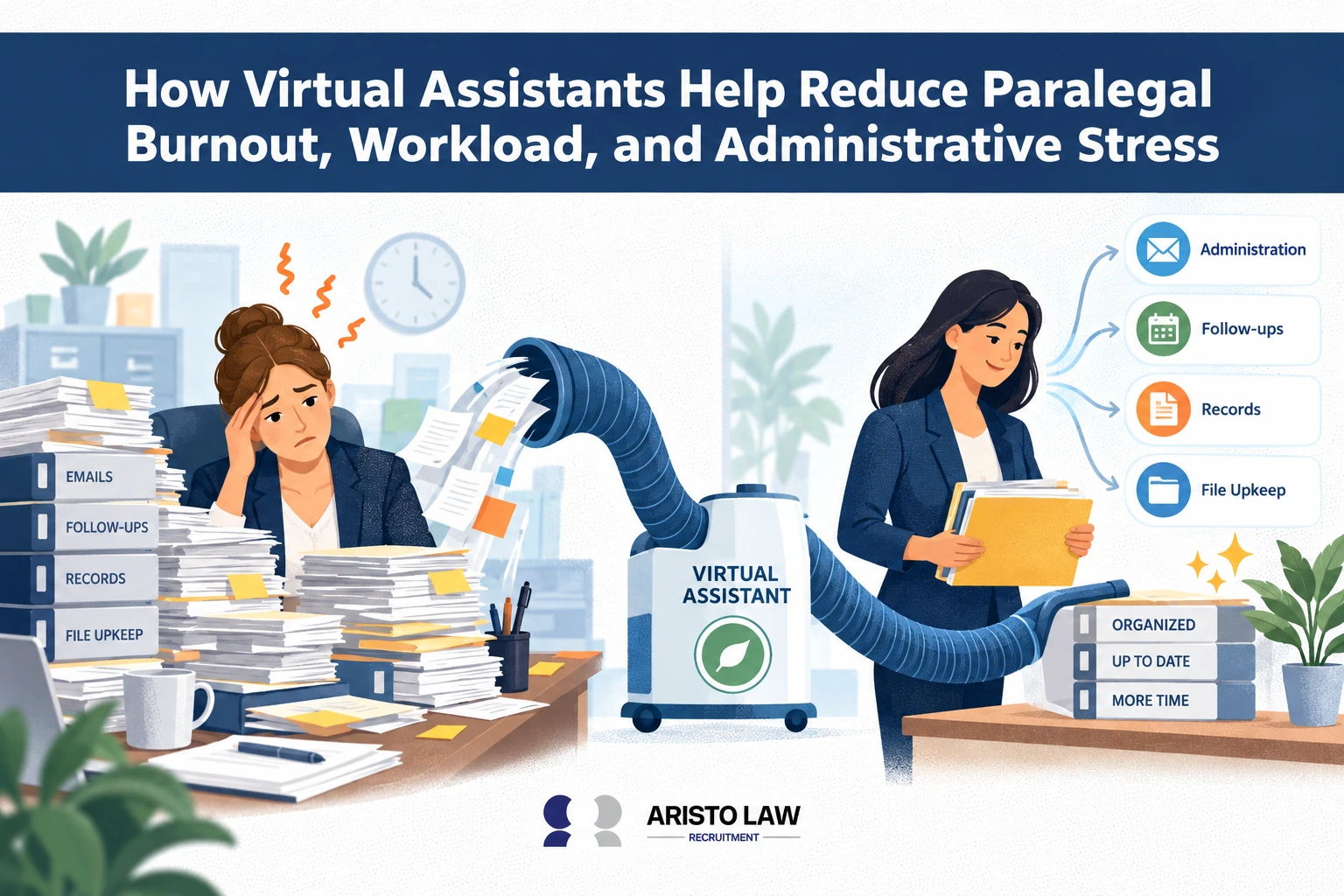
Legal virtual assistants reduce paralegal burnout by taking
over repetitive administrative tasks, lowering workload pressure, and
helping paralegals focus on higher-value legal support work.
Paralegal burnout occurs when excessive caseloads, inbox pressure,
docket demands, client intake, billing tasks, and repetitive
documentation create physical, mental, and professional exhaustion.
Law firms should hire a virtual legal assistant during rapid growth,
rising caseloads, staffing shortages, declining productivity,
administrative overload, or visible burnout among legal staff. Legal
virtual assistants are hired through legal staffing providers, virtual
assistant agencies, outsourcing companies, freelance marketplaces, and
specialized legal support firms.
A study by Clio titled “Why You Should Have a Legal AI
Assistant in Your Firm” in year 2026 states that using automated legal
technology and virtual assistance tools reduces cognitive load by 25%
for legal professionals. By systematically eliminating the
friction of administrative burdens, firms successfully mitigate chronic
industry exhaustion and reallocate internal capacity to high-value
client advocacy.
For a U.S. law firm hiring a virtual legal
assistant, the practical pricing range is
$3.60–$14/hour in the Philippines, $7–$20/hour
in Brazil, $3–$18/hour in South Africa, and
$29–$36/hour in the U.S. Virtual legal assistant
pricing commonly follows hourly, part-time, full-time, dedicated remote
staffing, or monthly service models, making outsourced support more
flexible than full-time in-house hiring.
Aristo Law is a Legal Process Outsourcing company that helps
law firms reduce paralegal burnout, workload pressure, and
administrative stress by providing outsourced Virtual Legal Assistant
support for routine admin tasks, document coordination, scheduling,
client follow-ups, case file updates, and workflow assistance. Hire a
Virtual Legal Assistant with Aristo Law. Aristo Law connects law
firms with outsourcing solutions that match trained virtual assistant
staff to each paralegal workload relief task, administrative support
need, client communication duty, document coordination function, and law
firm workflow responsibility.
Listed below are 15 ways legal virtual assistants reduce paralegal
burnout.
-
1. Administrative Support: Legal virtual assistants
handle routine admin work, paralegals regain time, and workload pressure
decreases. -
2. Calendar Dockets: Legal virtual assistants manage
deadlines, docket accuracy improves, and deadline stress decreases. -
3. Inbox Triage: Legal virtual assistants filter
emails, urgent messages receive attention, and inbox clutter
decreases. -
4. Client Intake: Legal virtual assistants collect
intake details, leads move faster, and paralegals avoid repetitive
screening. -
5. Payment Collection: Legal virtual assistants
support invoices and reminders, collections improve, and admin follow-up
decreases. -
6. Medical Records: Legal virtual assistants request
records, case preparation accelerates, and paralegals avoid time-heavy
retrieval work. -
7. Boilerplate Pleadings: Legal virtual assistants
prepare templates, drafting speed improves, and attorney review becomes
easier. -
8. Discovery Evidence: Legal virtual assistants
organize files, evidence review improves, and litigation support becomes
more structured. -
9. Transcription: Legal virtual assistants
transcribe notes and recordings, documentation improves, and paralegal
workload decreases. -
10. Lead Filtering: Legal virtual assistants screen
non-viable leads, intake teams save time, and conversion quality
improves. -
11. CRM Records: Legal virtual assistants update CRM
data, client tracking improves, and follow-up workflows stay
organized. -
12. Folder Structures: Legal virtual assistants
standardize files, document access improves, and case teams reduce
search time. -
13. Billing Invoices: Legal virtual assistants
prepare billing support, invoices move faster, and paralegals avoid
finance admin. -
14. After-Hours Support: Legal virtual assistants
cover time-zone gaps, client responsiveness improves, and daytime
workload decreases. -
15. Billable Time Protection: Legal virtual
assistants handle admin tasks, attorneys and paralegals protect billable
capacity, and firm revenue improves.
1. Offloading Administrative
Burdens
Virtual Legal Assistants reduce administrative burdens by
handling repetitive support responsibilities such as scheduling,
document organization, intake updates, and follow-up tasks. This
redistribution of work reduces paralegal burnout and gives attorneys
more time for legal strategy, client communication, and billable
work.

Workload delegation shifts email management, scheduling, document
preparation, file organization, CRM updates, and routine communication
away from paralegals, case management becomes more efficient, and legal
operations improve. Workflow automation standardizes repetitive
processes, administrative stress declines, and law firms improve
implementation by documenting procedures, assigning responsibilities,
monitoring performance, and continuously refining workflows.
2. Managing Calendar Dockets
Managing calendar dockets enables Virtual Legal Assistants to
organize court deadlines, appointments, hearings, meetings, and
reminders. Managing calendar dockets accuracy and makes
workload management more effective for attorneys and legal teams.
Case administration benefits from centralized calendar management,
communication remains coordinated, and missed deadlines become less
likely. Law firms strengthen operational efficiency through automated
reminders, standardized scheduling procedures, and regular calendar
reviews.
3. Triaging Inbox Clutter
Virtual Legal Assistants reduce inbox clutter by organizing,
prioritizing, and responding to routine communications. This
lowers administrative interruptions and allows paralegals to focus on
substantive legal work.
Communication workflows improve through inbox categorization,
document requests receive timely routing, and workflow automation
increases responsiveness. Law firms optimize email management through
response templates, escalation protocols, and daily inbox reviews.
4. Streamlining Client Intake
Streamlining client intake enables Virtual Legal Assistants to
collect prospective client information, schedule consultations, and
verify documentation before attorney review. Client intake
becomes faster, administrative workload decreases, and case management
begins with organized records. Standardized intake forms,
automated scheduling, and consistent follow-up improve productivity and
client satisfaction.
Virtual Assistants help reduce paralegal burnout by handling lead
capture, conflict-check routing, document collection, and appointment
coordination as delegated virtual support tasks. Law firms use virtual
intake specialist services to move intake calls, CRM
updates, consultation scheduling, and follow-up tasks away from
paralegals, reducing administrative load during early case
evaluation.
5. Automating Payment
Collection
Automating payment collection enables Virtual Legal
Assistants to send invoices, payment reminders, and follow-up
communications, billing support improves cash flow, and attorneys spend
less time managing collections. Workflow automation reduces
manual payment tracking, financial administration becomes more
efficient, and standardized billing procedures improve law firm
operations.
6. Retrieving Medical Records
Retrieving medical records enables Virtual Legal Assistants to
request, track, organize, and follow up on medical documentation
required for legal matters. Document management becomes more
efficient, case preparation accelerates, and paralegals avoid
time-consuming administrative follow-up. Organized retrieval
procedures improve case readiness and operational performance.
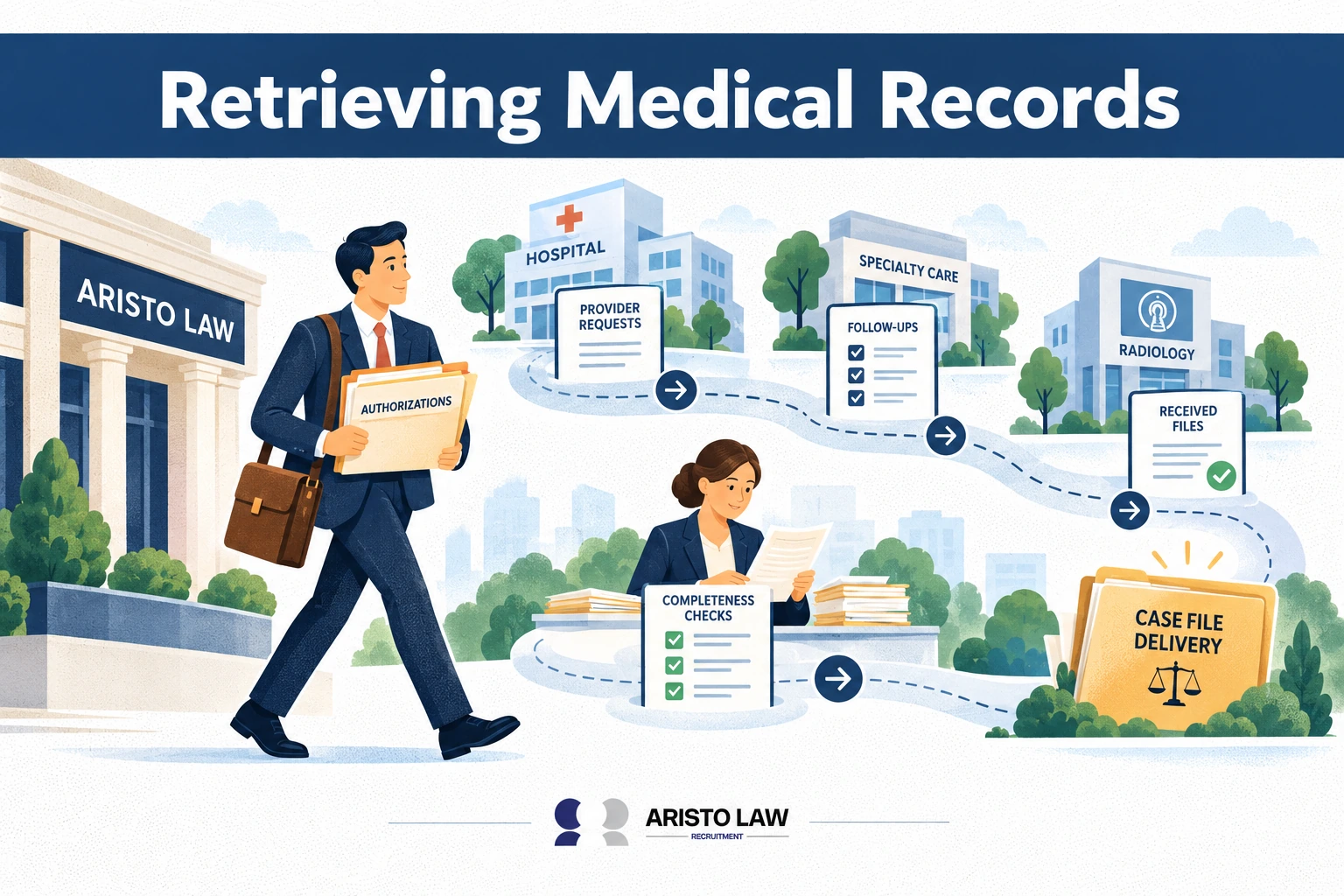
Virtual assistants help reduce paralegal burnout and workload because
virtual assistants handle medical record requests, tracking,
organization, and routing before paralegals lose billable time on
provider follow-ups and file chasing. Aristo Law supports retrieving
medical records through medical
records specialist services, where trained legal
support staff manage provider follow-ups, HIPAA-ready documentation
workflows, record indexing, and delivery tracking for litigation
teams.
7. Drafting Boilerplate
Pleadings
Drafting boilerplate pleadings enables Virtual Legal
Assistants to prepare standardized legal documents for attorney review.
Document preparation becomes faster, repetitive drafting decreases, and
attorneys devote more time to legal analysis. Standardized
templates improve consistency, workflow efficiency increases, and
administrative stress declines.
8. Organizing Discovery
Evidence
Organizing discovery evidence enables Virtual Legal Assistants to
categorize documents, label evidence, and maintain structured case
files. Case management improves through organized records,
document retrieval becomes faster, and litigation support operates more
efficiently. Standardized folder structures strengthen legal
operations and reduce administrative workload.
9. Outsourcing Transcription
Duties
Outsourcing transcription duties enables Virtual Legal
Assistants to convert recordings into organized written documents,
documentation accuracy improves, and paralegals reduce repetitive
clerical work. Workflow automation accelerates document
preparation, communication records remain complete, and productivity
increases through standardized transcription processes.
10. Filtering Non-Viable Leads
Filtering non-viable leads enables Virtual Legal Assistants
to qualify inquiries before attorney involvement, client intake becomes
more efficient, and administrative workload decreases. Intake
screening improves lead quality, attorneys spend more time with
qualified prospects, and operational efficiency increases through
standardized qualification criteria.
11. Maintaining CRM Records
Maintaining CRM records enables Virtual Legal Assistants to
update client information, monitor communications, and track follow-up
activities. CRM management improves organization, client
relationships remain current, and workflow automation strengthens law
firm efficiency. Consistent data management improves productivity and
operational visibility.
12. Standardizing Folder
Structures
Standardizing folder structures enables Virtual Legal
Assistants to organize digital and physical case files consistently,
document retrieval becomes faster, and case administration
improves. Standardized filing systems reduce duplication,
workflow consistency strengthens collaboration, and administrative
stress decreases.

13. Handling Billing Invoices
Billing support improves financial operations, administrative
workload decreases, and attorneys focus on billable legal
services. Handling billing invoices enables Virtual Legal
Assistants to prepare invoices, verify billing information, and
coordinate payment follow-up. Standardized invoicing procedures
strengthen cash flow and operational efficiency.
Virtual assistants help reduce paralegal burnout, workload, and
administrative stress through billing support because virtual assistants
prepare invoice data, verify billing entries, and reduce repetitive
billing tasks during invoice handling. Law firms use virtual
legal billing specialist services to assign invoice
review, time-entry checks, billing record updates, and payment follow-up
to trained virtual assistants instead of overloading paralegals.
14. Providing Over-Hours
Coverage
Providing over-hours coverage enables Virtual Legal
Assistants working across global time zones to continue administrative
support after normal office hours. Client communication
continues beyond business hours, completed work becomes available the
next business day, and law firm efficiency increases without expanding
local staffing. Time-zone coverage reduces backlogs and improves
responsiveness.
15. Protecting Billable
Bandwidth
Protecting billable bandwidth enables Virtual Legal
Assistants to manage administrative responsibilities while attorneys and
paralegals focus on revenue-generating legal work.
Administrative support reduces interruptions, workload management
increases billable capacity, and legal operations become more
profitable.
Clear task delegation, standardized workflows, and ongoing
performance reviews strengthen productivity, reduce burnout risk, and
improve overall law firm performance.
When
should a law firm hire a virtual legal assistant?
A law firm should hire a virtual legal assistant when
administrative work consistently limits attorney productivity or
contributes to staff workload overload. Recurring
administrative backlogs delay case progression, client communication
becomes inconsistent, and billing delays reduce cash flow.
A study by MyCase titled “Why Virtual Staffing Is the Future
for Law Firms” in year 2025 states that virtual legal assistant services
reduce administrative backlog, workload management improves operational
efficiency, and law firm growth increases the need for scalable staffing
support. Growing caseloads increase document preparation,
scheduling demands overwhelm internal staff, and excessive overtime
contributes to paralegal burnout and declining job satisfaction.
Operational indicators include missed deadlines, overloaded inboxes,
delayed client intake, incomplete CRM updates, slow document management,
increasing billing backlogs, and attorneys spending excessive time on
non-billable administrative work. Staffing shortages reduce service
quality, workflow bottlenecks slow legal operations, and repetitive
tasks prevent attorneys and paralegals from focusing on higher-value
legal responsibilities. Client expectations increase, communication
responsiveness becomes more important, and operational inefficiencies
become more visible as the firm expands.
Virtual legal assistants assume routine administrative
responsibilities, standardized workflows improve productivity, and
attorneys recover more billable time. Law firms achieve better results
when hiring occurs before workload overload becomes chronic,
responsibilities remain clearly delegated, technology supports workflow
automation, and performance metrics continuously measure efficiency
improvements, burnout reduction, and overall operational
performance.
How
much does it cost to hire a virtual legal assistant?
The cost of hiring a virtual legal assistant for a U.S. law
firm ranges from $10–$75+ per hour or $800–$5,000+ per month.
The final cost depends on the assistant’s experience, legal
specialization, location, workload, and whether the engagement is
hourly, part-time, full-time, or through a legal process outsourcing
(LPO) provider.
Virtual legal assistant pricing varies according to the sourcing
model, legal outsourcing providers recruit talent from different global
markets, and labor costs differ by country. Entry-level virtual
legal assistants charge $10–$20 per hour or $800–$1,500 per
month for client intake, scheduling, calendar management, email
management, and document organization. Experienced virtual legal
assistants commonly charge $20–$40 per hour or $1,500–$3,000 per
month for legal document preparation, case management, legal
research support, CRM management, billing assistance, and client
communication. Specialized virtual legal assistants supporting
litigation, corporate law, immigration, family law, or personal injury
charge $40–$75+ per hour or $3,000–$5,000+ per month.
Virtual legal assistants in South Africa cost $8–$20 per hour
or $1,000–$2,500 per month. Professionals in Brazil commonly charge
$10–$25 per hour or $1,200–$3,000 per month, depending on legal
experience and English proficiency. Virtual legal assistants in
the Philippines charge $5–$15 per hour or $800–$2,000 per
month, making the country one of the most cost-effective
sources of experienced remote legal support.
Some legal staffing providers use a recruitment-based pricing model
instead of hourly billing. For example, Aristo Law charges a
one-time recruitment fee of $2,997 to recruit, screen, interview, and
place a dedicated remote legal professional, after which the law firm
pays the assistant’s monthly salary directly. This model
enables firms to hire long-term remote legal support while avoiding many
of the recruitment, onboarding, payroll, and overhead costs associated
with expanding an in-house legal team.
A study by Clio titled “Legal Trends Report” in year 2024
states that the average attorney spends only 2.3 hours of an 8-hour
workday on billable tasks, with the rest consumed by non-billable
administrative obligations. Transitioning these administrative
burdens to qualified virtual assistants reduces operating costs by up to
70%, increases billable hours by an average of 40%, and recovers
critical capacity for revenue-generating client representation and
business development
Where can law
firms hire virtual legal assistants?
Law firms can hire virtual legal assistants through
specialized legal staffing providers, legal process outsourcing (LPO)
companies like Aristolaw, and remote legal support agencies. Other
hiring options include freelance marketplaces and recruitment firms that
focus on legal professionals.
Aristo Law recruits dedicated remote virtual legal assistants from
established talent markets such as the Philippines, South Africa, and
Brazil. Rigorous screening identifies experienced legal support
professionals, and structured recruitment enables law firms to access
high-quality talent at lower costs than traditional U.S. hiring. Aristo
Law manages the complete recruitment process, including sourcing,
interviewing, skills assessment, background evaluation, and candidate
matching, allowing firms to hire remote professionals who integrate
seamlessly into existing legal workflows.
Law firms hire
virtual legal assistant services to shift intake,
scheduling, document formatting, billing support, and client follow-up
from overloaded paralegals to trained remote legal support staff.
Virtual assistants help reduce paralegal burnout, workload, and
administrative stress by assigning repeatable administrative tasks to
virtual legal assistants, preserving paralegal time for case
preparation, legal drafting, attorney support, and deadline-sensitive
matter work.
Law firms also hire through legal staffing agencies, LPO providers,
freelance marketplaces for project-based work, and remote staffing
companies specializing in legal support. Candidate evaluation should
prioritize legal industry experience, familiarity with practice
management software, communication skills, confidentiality, legal ethics
knowledge, and the ability to work effectively within attorney
workflows.
Global sourcing provides additional operational advantages. Remote
professionals working in different time zones continue administrative
work after U.S. office hours, completed tasks become available before
attorneys begin the next business day, and firms maintain continuous
operational progress without extending internal staff hours.
A study by Thomson Reuters titled “Alternative Legal Service
Providers Report” in year 2025 states that law firms outsourcing
administrative and specialized functions experience a 25% to 30%
reduction in overhead costs and a 40% increase in operational turnaround
speed. Aristo Law combines legal recruitment expertise,
scalable remote staffing, and legal-specific operational knowledge to
help law firms build reliable, cost-effective support teams while
maintaining confidentiality, compliance, and high service quality.
How
does Aristo Law help reduce paralegal burnout with virtual legal
assistants?
Aristo Law helps reduce paralegal burnout by providing law
firms with dedicated virtual legal assistants who take over
time-consuming administrative and routine legal support tasks, allowing
paralegals and attorneys to focus on higher-value legal work.
Aristo Law recruits experienced legal professionals from talent markets
including the Philippines, South Africa, and Brazil, structured
screening identifies candidates with legal industry experience, and
dedicated remote staffing provides cost-effective long-term support
without compromising service quality.
Aristo Law manages sourcing, interviewing, skills assessments, and
placement, enabling virtual legal assistants to integrate into each
firm’s existing workflows and support client intake, calendar and email
management, document formatting, file organization, scheduling, billing
support, CRM updates, data entry, follow-up communications, and case
administration.
Virtual assistants reduce paralegal burnout by taking over intake
coordination, document formatting, calendar tracking, client follow-ups,
and billing updates that increase workload and administrative stress.
Aristo Law provides virtual
legal assistant support to reduce paralegal workload so
paralegals spend more time on legal research, case preparation, attorney
support, and deadline-sensitive matter management.
Administrative responsibilities shift to virtual legal assistants,
workload management becomes more balanced, and operational bottlenecks
decrease. Paralegals spend more time on legal research, document
drafting, discovery, case preparation, and other substantive legal work,
while attorneys recover additional billable hours by delegating
repetitive operational tasks. Global staffing also provides time-zone
advantages, remote legal assistants continue administrative work after
U.S. business hours, and completed tasks are ready before attorneys
begin the next workday.
A study by Bloomberg Law titled “Attorney Workload &
Hours Survey” in year 2026 states that excessive administrative
workloads, frequent task switching, and high caseloads cause legal
professionals to experience acute burnout over 50% of the time, while
structured task delegation improves productivity and employee
well-being. Aristo Law combines experienced remote legal
assistants, scalable staffing solutions, standardized workflows, and
flexible legal support services to help law firms reduce burnout,
improve operational efficiency, strengthen employee satisfaction, and
build sustainable long-term legal operations.
Build a legal support team that moves work forward.
Tell us what is slowing your practice down. We will help map the role, workflow, and support structure that fits.