
How Non-Profit Legal Organizations Benefit from Virtual Assistants

Practical guidance for building efficient, accountable legal support operations.
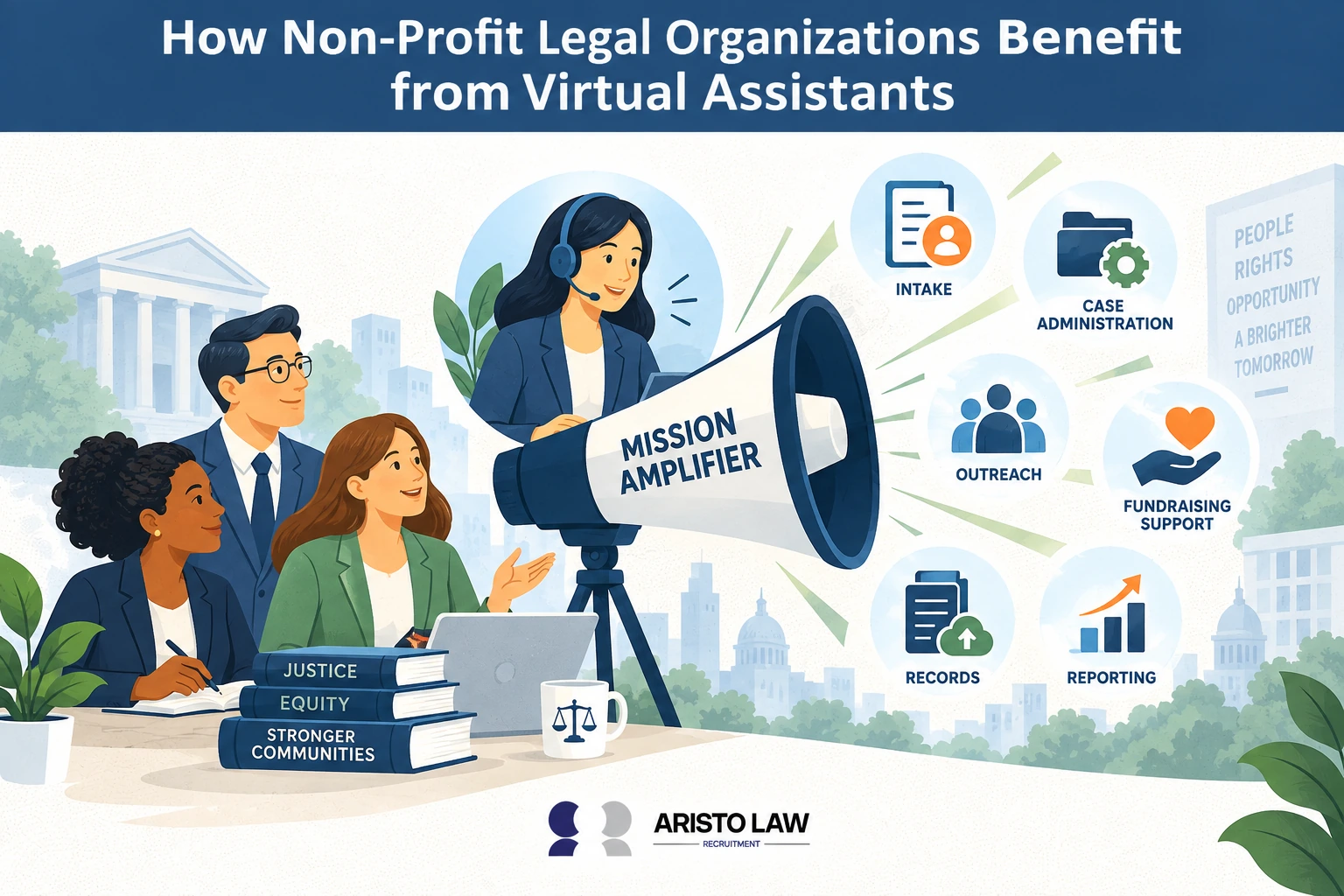
Non-profit legal organizations benefit from virtual
assistants by expanding service capacity, improving operational
efficiency, and reducing administrative costs without increasing
staffing overhead. Virtual assistants support client intake,
donor relations, legal document management, calendar coordination, grant
tracking, community outreach, and volunteer management.
Virtual assistants also assist with compliance monitoring, billing
support, digital marketing, legislative monitoring, appellate brief
formatting, board coordination, and Freedom of Information Act (FOIA)
request processing. These services allow legal teams to dedicate more
time to advocacy, litigation, policy work, and mission-driven legal
services.
A study by Juliana King, Houston University researchers, and
legal support specialists in 2025 states that virtual legal assistants
handle document management, scheduling, client communication, and legal
research, allowing attorneys to focus on core legal work and improving
operational efficiency.
Virtual assistants supporting non-profit legal organizations require
skills in legal administration, communication, project coordination,
technology platforms, confidentiality management, document organization,
and stakeholder communication. They help solve resource constraints,
administrative backlogs, scheduling challenges, compliance tracking
requirements, and documentation-management issues.
Pricing ranges from USD $10–$40 per hour, depending on
experience, specialization, and service scope, which is equivalent to
approximately USD $20,800–$83,200 per year based on a full-time schedule
of 40 hours per week. Hiring options include freelance virtual
assistants, legal outsourcing providers, dedicated staffing firms, and
managed support teams.
Aristo Law supports non-profit legal organizations through
specialized virtual assistant services, legal workflow coordination,
intake management, document administration, scheduling support,
compliance tracking, and scalable legal staffing solutions. Virtual
assistants provide strategic value by improving efficiency,
sustainability, responsiveness, and long-term mission-focused legal
service delivery.
Aristolaw helps non-profit legal organizations benefit from
virtual assistants by providing outsourced support for administrative
workflows, client intake, case file organization, donor communication
coordination, scheduling, document handling, and remote legal
operations. Book a
Virtual Legal Assistant staffing consultation with Aristolaw.
Aristolaw connects non-profit legal organizations with outsourcing
solutions that match trained virtual assistant staff to each client
service task, administrative workflow, document coordination duty,
outreach support function, and legal operations
responsibility.
Listed below are the 15 ways non-profit legal organizations benefit
from VAs.
-
Reducing overhead costs: Virtual assistants perform
administrative and legal support tasks without the expenses associated
with full-time in-house staffing. -
Streamlining client intake: Virtual assistants
collect, organize, and manage client information to improve intake
efficiency and response times. -
Managing donor relations: Virtual assistants
maintain donor communications, update records, and support fundraising
activities. -
Organizing legal documentation: Virtual assistants
sort, file, and maintain legal records to improve document accessibility
and compliance. -
Optimizing calendar scheduling: Virtual assistants
coordinate appointments, meetings, hearings, and deadlines to improve
organizational efficiency. -
Facilitating grant tracking: Virtual assistants
monitor grant applications, reporting deadlines, and funding
requirements. -
Coordinating community outreach: Virtual assistants
support event planning, stakeholder communication, and public engagement
initiatives. -
Automating routine billing: Virtual assistants
assist with invoice preparation, payment tracking, and recurring
administrative billing tasks. -
Enhancing digital presence: Virtual assistants
manage website updates, social media activities, and online
communications. -
Processing freedom of information requests: Virtual
assistants prepare, track, and organize public records and information
requests. -
Maintaining volunteer rosters: Virtual assistants
manage volunteer databases, schedules, and communication records. -
Auditing compliance records: Virtual assistants
review documentation and maintain records required for regulatory and
organizational compliance -
Formatting appellate briefs: Virtual assistants
prepare legal documents according to court formatting and filing
requirements. -
Tracking legislative updates: Virtual assistants
monitor legal and regulatory developments relevant to the organization’s
practice areas. -
Coordinating board logistics: Virtual assistants
organize board meetings, prepare agendas, distribute materials, and
track action items.
1. Reducing Overhead Costs
Reducing overhead costs involves lowering administrative and
operational expenses through Virtual Assistant support.
Non-profit legal organizations use VAs to manage administrative support
functions without increasing payroll, office space, equipment, or
recruitment costs.
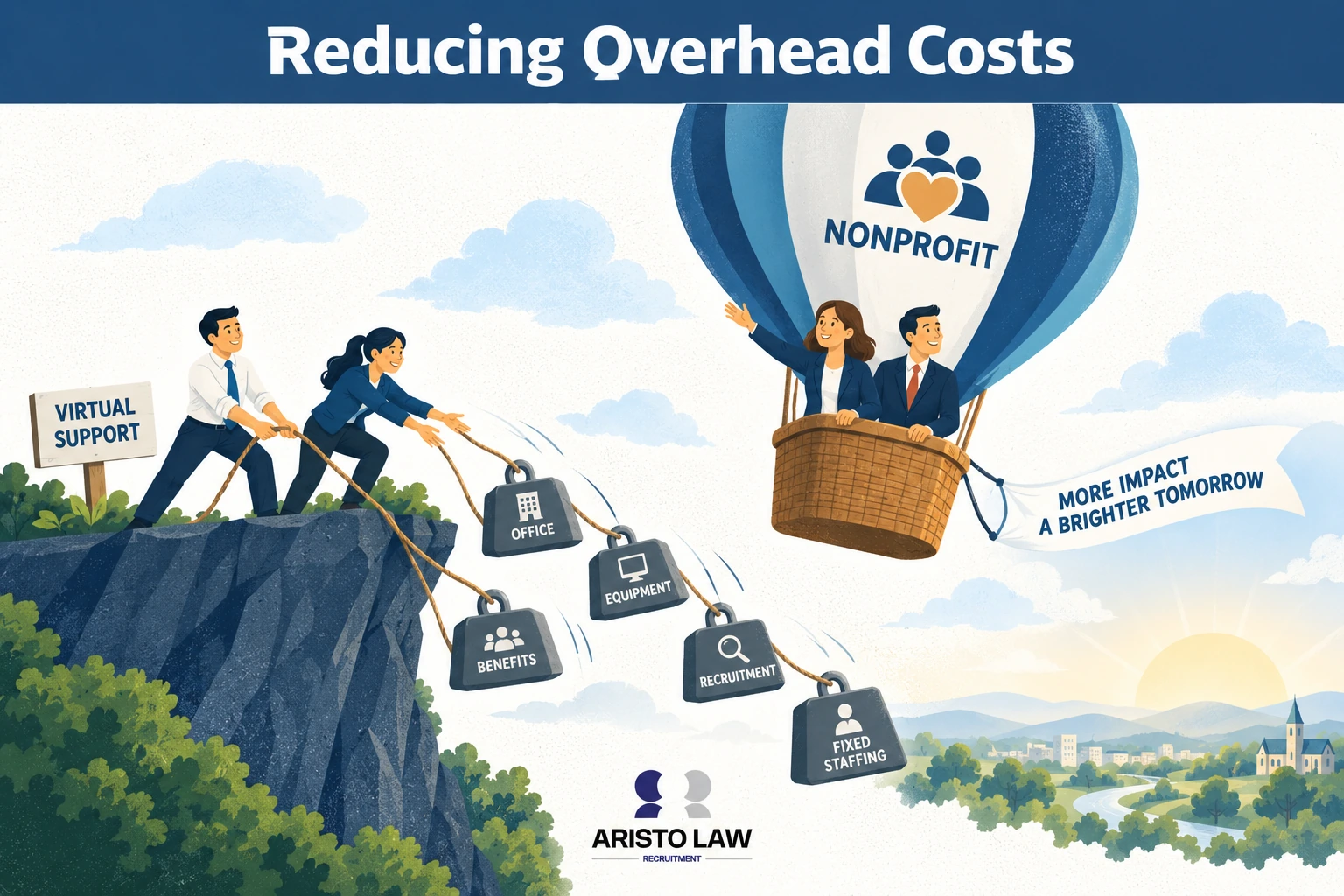
Cost reduction improves resource allocation and allows more funding
to support legal services and mission objectives. Best practices include
outsourcing repetitive administrative tasks and tracking cost-efficiency
metrics.
2. Streamlining Client Intake
Streamlining Client Intake involves improving the process of
collecting, organizing, and managing client information.
Virtual Assistants support intake screening, appointment scheduling,
document collection, and follow-up communication.
Non-profit legal organizations improve intake efficiency by assigning
inquiry screening, eligibility assessment, and appointment coordination
to trained support staff. These workflows align with virtual
intake specialist services, which help non-profit legal
organizations process client requests, reduce administrative burden, and
maintain consistent intake operations.
Efficient intake processes improve responsiveness and service
accessibility. Organizations benefit from standardized intake procedures
and automated workflow systems.
3. Managing Donor Relations
Managing Donor Relations involves maintaining communication
and engagement with funding supporters. Virtual Assistants
assist with donor outreach, communication tracking, acknowledgment
processes, fundraising coordination, and relationship management.
Strong donor engagement supports financial sustainability and
fundraising outcomes. Regular communication schedules and donor
databases improve effectiveness.
4. Organizing Legal
Documentation
Organizing legal documentation involves maintaining accurate,
accessible, and structured legal records. Virtual Assistants
support document filing, record management, case documentation, and
information organization.
Non-profit legal organizations use virtual assistants to classify,
store, retrieve, and maintain case files across legal workflows,
improving accuracy and accessibility of records. Virtual assistants
provide legal
records management and document organization support,
enabling non-profit legal organizations to maintain structured
documentation and reduce administrative burden.
Effective documentation improves Legal Operations and compliance
readiness. Consistent document-management procedures reduce
administrative inefficiencies.
5. Optimizing Calendar
Scheduling
Optimizing calendar scheduling involves coordinating
appointments, meetings, hearings, and organizational events.
Virtual Assistants manage scheduling workflows, deadline tracking, and
calendar updates. Efficient scheduling reduces conflicts and improves
organizational responsiveness. Centralized scheduling systems improve
coordination.
6. Facilitating Grant Tracking
Facilitating grant tracking involves monitoring grant
applications, reporting obligations, deadlines, and funding
requirements. Virtual Assistants support Grant Management
through documentation tracking and reporting coordination.
Effective grant tracking improves funding compliance and financial
stability. Organizations benefit from structured grant-management
systems.
7. Coordinating Community
Outreach
Coordinating community outreach involves managing engagement
activities that connect legal organizations with the public.
VAs support event planning, outreach communication, stakeholder
coordination, and awareness campaigns.
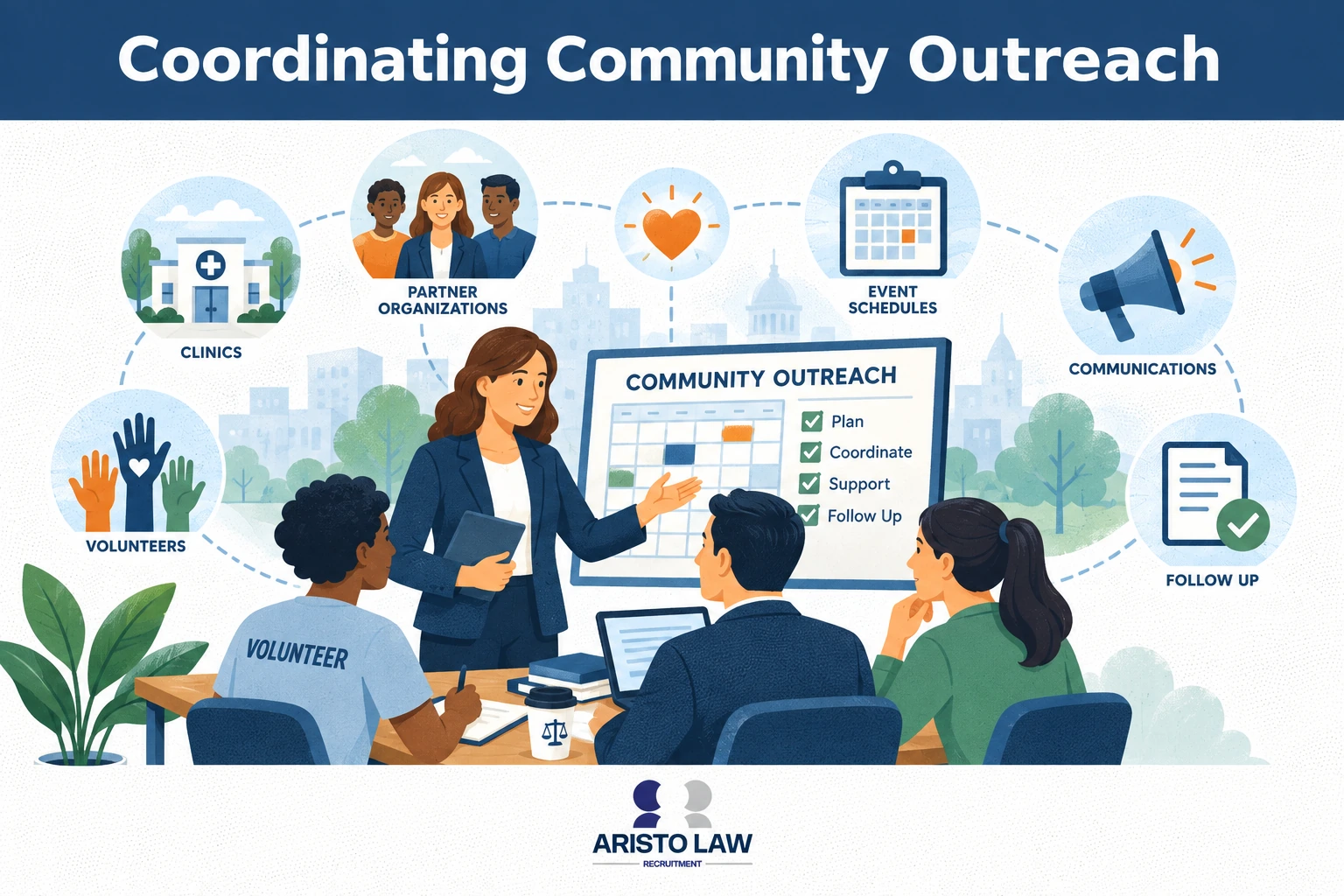
Community outreach strengthens mission impact and public engagement.
Communication plans and outreach schedules improve effectiveness.
8. Automating Routine Billing
Automating routine billing involves streamlining invoicing,
payment tracking, and financial administration processes.
Virtual Assistants support billing workflows through software systems
and administrative coordination.
Automation improves efficiency and reduces manual workload.
Standardized billing procedures improve financial management.
9. Enhancing Digital Presence
Enhancing digital presence involves improving online
visibility, communication, and stakeholder engagement. Virtual
Assistants support website updates, social media management, content
distribution, and digital communications.
Strong online engagement increases visibility and community
awareness. Consistent digital strategies improve outreach
effectiveness.
10. Processing Freedom
Requests
Processing freedom requests involves managing requests for
public records and information access. Virtual Assistants
support document collection, request tracking, communication management,
and workflow coordination.
Efficient processing improves responsiveness and compliance with
disclosure requirements. Tracking systems improve request
management.
11. Maintaining Volunteer
Rosters
Maintaining volunteer rosters involves organizing volunteer
information, schedules, responsibilities, and participation
records. Virtual Assistants support volunteer coordination
through database management and communication tracking.
Non-profit legal organizations use virtual assistants to manage
website updates, content publishing, and audience engagement across
digital
channels. Virtual legal marketing assistant services
support non-profit legal organizations by improving online visibility,
maintaining consistent outreach, and strengthening communication with
prospective clients, donors, and community stakeholders.
Effective volunteer management improves organizational capacity and
community involvement. Updated records improve coordination.
12. Auditing Compliance
Records
Auditing compliance records involves reviewing organizational
documentation for regulatory and policy compliance. Virtual
Assistants support Compliance Tracking through record maintenance,
deadline monitoring, reporting support, and documentation
organization.
Compliance management reduces operational risk. Routine audits
improve record accuracy.
13. Formatting Appellate
Briefs
Formatting appellate briefs involves preparing legal
documents according to court rules and filing requirements.
Virtual Assistants assist with document formatting, citation
consistency, proofreading, and submission preparation.
Proper formatting improves filing accuracy and procedural compliance.
Standardized document templates improve efficiency.
14. Tracking Legislative
Updates
Tracking legislative updates involves monitoring legal,
regulatory, and policy developments relevant to organizational
activities. VAs support legislative monitoring through
research, update reporting, and information distribution.
Timely updates improve organizational awareness and compliance
readiness. Structured monitoring processes improve information
management.
15. Coordinating Board
Logistics
Coordinating board logistics involves managing meetings,
agendas, records, communications, and governance activities.
Virtual assistants support board operations through scheduling, document
distribution, meeting preparation, and follow-up coordination.
Effective board administration improves organizational governance and
decision-making. Standardized board-management procedures improve
efficiency and accountability.
Why
do non-profit legal organizations need virtual assistants?
Non-profit legal organizations need virtual assistants to
manage growing operational demands while maintaining cost-effective
service delivery. Many organizations face limited funding,
staffing shortages, increasing client demand, volunteer-coordination
requirements, compliance obligations, grant reporting responsibilities,
community outreach activities, and administrative complexity.
Support functions such as client intake, donor communication,
calendar management, document organization, compliance tracking,
volunteer coordination, and reporting often expand faster than available
internal resources. Virtual assistants help non-profit operations
maintain responsiveness, improve workflow efficiency, reduce
administrative backlogs, and support legal organization operations
without increasing payroll and infrastructure costs.
By handling administrative and operational responsibilities, virtual
assistants allow attorneys, advocates, and organizational leaders to
focus on legal services, community impact, fundraising initiatives, and
mission-driven objectives while maintaining service quality and
controlling operational expenses.
What
are the benefits of hiring virtual assistants for non-profit legal
organizations?
Hiring virtual assistants helps non-profit legal
organizations reduce administrative workload, improve operational
efficiency, lower staffing costs, and expand support
capacity.
Listed below are the 20 benefits of hiring virtual assistants for
non-profit legal organizations.
-
Reduces staffing and operational overhead costs:
Supports nonprofit operations without the expenses associated with
additional full-time employees. -
Allows attorneys and legal advocates to focus on client
representation and legal work: Reduces administrative workload
and increases time available for legal aid services. -
Improves client intake and case screening
efficiency: Supports faster intake processing, eligibility
screening, and appointment scheduling. -
Enhances scheduling, calendar management, and appointment
coordination: Improves organizational responsiveness and
resource utilization. -
Supports legal document preparation and administrative case
management: Assists with documentation, file organization, and
workflow coordination. -
Increases organizational capacity without adding full-time
employees: Expands support capabilities while maintaining
budget flexibility. -
Provides scalable support during periods of increased
demand: Helps manage surges in client requests, outreach
initiatives, and program activities. -
Assists with grant administration, reporting, and program
coordination: Supports grant-funded operations and reporting
requirements. -
Improves communication with clients, volunteers, donors, and
stakeholders: Strengthens stakeholder engagement and service
delivery. -
Supports compliance tracking and deadline
management: Helps maintain regulatory, grant, and operational
compliance. -
Enhances document organization and records management
processes: Improves accessibility, accuracy, and workflow
consistency. -
Facilitates remote and hybrid legal service delivery
models: Supports flexible service delivery and distributed work
environments. -
Improves responsiveness to client inquiries and
requests: Increases communication speed and client
satisfaction. -
Provides access to specialized legal administrative skills on
demand: Supports legal operations without long-term staffing
commitments. -
Supports legal technology platforms, CRM systems, and case
management software: Improves technology adoption and workflow
efficiency. -
Increases productivity by reducing administrative burdens on
in-house staff: Allows teams to focus on mission-critical legal
services. -
Improves resource allocation across legal aid and nonprofit
programs: Supports more efficient use of organizational
resources. -
Enables flexible staffing based on funding levels and program
needs: Aligns staffing capacity with budget and operational
requirements. -
Helps maintain business continuity during staffing shortages
or organizational growth: Provides operational stability and
workload coverage. -
Contributes to improved service delivery and organizational
sustainability: Supports long-term mission impact and
operational resilience.
Administrative efficiency and resource optimization are major factors
affecting nonprofit performance. Research by Francisco Cardona,
SIGMA/OECD governance specialists, and public administration researchers
in 2004 states that delegation of administrative responsibilities
improves management quality, increases administrative efficiency, and
supports more effective decision-making processes. Virtual
assistants also support workforce flexibility, remote service delivery,
technology adoption, and access to specialized support skills that
strengthen legal aid programs and nonprofit sustainability.
What
skills should virtual assistants have when supporting non-profit legal
organizations?
Skills virtual assistants should have when supporting
non-profit legal organizations include communication, confidentiality
awareness, and workflow coordination.
Listed below are the 14 skills virtual assistants should have when
supporting non-profit legal organizations.
-
Communication skills: Support donor communications,
client inquiries, volunteer outreach, appointment scheduling, and
stakeholder engagement activities. -
Organizational skills: Manage case records, donor
databases, outreach programs, volunteer schedules, and administrative
workflows efficiently. -
Stakeholder coordination: Coordinate communication
among attorneys, staff, volunteers, donors, community partners, and
service recipients. -
Administrative management: Handle scheduling,
document preparation, meeting coordination, correspondence management,
and operational support tasks. -
Technology proficiency: Use CRM platforms,
case-management systems, document-storage tools, communication
platforms, spreadsheets, and reporting software effectively. -
Confidentiality awareness: Protect sensitive client
information, donor records, legal documents, financial data, and
organizational communications. -
Workflow coordination: Monitor tasks, deadlines,
intake activities, reporting requirements, and program-support workflows
to maintain operational continuity. -
Donor management support: Maintain donor records,
track interactions, schedule follow-ups, and support fundraising
communications. -
Volunteer coordination: Manage volunteer
applications, scheduling, onboarding, communication, and participation
tracking. -
Intake administration: Process inquiries, collect
information, route requests, schedule consultations, and support
client-intake workflows. -
Data management: Maintain accurate records, update
databases, organize documents, and support reporting accuracy. -
Reporting support: Compile program data, prepare
reports, track outcomes, and assist with grant-reporting
requirements. -
Outreach support: Coordinate community outreach
activities, event communications, educational campaigns, and stakeholder
engagement initiatives. -
Attention to detail: Maintain accurate records,
monitor deadlines, verify information, and reduce administrative
errors.
These skills improve organizational effectiveness by supporting
legal-service delivery, stakeholder communication, program
administration, and mission-focused operations.
What
challenges can virtual assistants help solve for non-profit legal
organizations?
Challenges virtual assistants help solve for non-profit legal
organizations include staffing limitations, reporting obligations, and
resource constraints.
Listed below are the 12 challenges virtual assistants help solve for
non-profit legal organizations.
-
Staffing limitations: Virtual assistants provide
administrative and operational support without the cost of expanding
full-time staff, helping organizations maintain service capacity during
periods of growth or increased demand. -
Administrative overload: Virtual assistants manage
scheduling, document organization, data entry, correspondence, and
record maintenance, reducing administrative burdens on attorneys and
program staff. -
Communication bottlenecks: Virtual assistants handle
inquiries, coordinate follow-ups, manage emails, and support stakeholder
communication, improving responsiveness and reducing delays. -
Volunteer coordination difficulties: Virtual
assistants assist with volunteer scheduling, onboarding, communication,
attendance tracking, and program coordination, improving volunteer
participation and management. -
Donor-management demands: Virtual assistants
maintain donor databases, schedule outreach activities, track
interactions, and support fundraising communications, improving
relationship management. -
Reporting obligations: Virtual assistants collect
data, organize records, prepare reports, and support grant-reporting
requirements, helping organizations meet compliance and funding
obligations. -
Resource constraints: Virtual support expands
operational capacity without requiring additional office space,
equipment, or extensive hiring investments. -
Client-intake backlogs: Virtual assistants process
inquiries, schedule consultations, collect information, and support
intake workflows, reducing wait times for legal services. -
Data-management challenges: Virtual assistants
maintain databases, update records, organize documents, and improve
information accuracy across programs. -
Event and outreach coordination: Virtual assistants
support community events, educational programs, advocacy campaigns, and
stakeholder engagement initiatives. -
Workflow inefficiencies: Virtual assistants monitor
tasks, deadlines, and operational processes, helping organizations
maintain workflow continuity and reduce delays. -
Limited staff availability: Virtual assistants
provide ongoing support during peak workload periods, staff shortages,
and high-demand service cycles.
These solutions improve response times, reduce administrative
bottlenecks, increase operational efficiency, strengthen stakeholder
engagement, and allow non-profit legal organizations to dedicate more
resources to mission delivery and community impact.
Where
can non-profit legal organizations hire virtual assistants?
Non-profit legal organizations hire virtual assistants from
legal outsourcing firms, specialized staffing providers, and freelance
talent platforms.
Listed below are the 9 VA hiring sources for law firms.
-
Juris Genius: Provides legal virtual assistants
focused on legal administration, client communication, scheduling,
document management, and legal support workflows. Suitable for
organizations seeking legal-industry experience with minimal training
requirements. -
Aristo Law: Aristo Law provides virtual legal
assistants and remote paralegals support from small to large law firms
for legal intake, administration, document management, client
communication, and workflow support. Aristo Law charges a one-time
recruitment fee of $2.997, after which the law firm hires the remote
assistant directly and pays the assistant’s monthly salary. Aristo Law
assigns legal support professionals experienced in case management,
records organization, and administrative workflows. Aristo Law helps law
firms improve efficiency, maintain workflow continuity, and support
growing legal workloads. -
Legal Soft: Offers legal assistants, intake
specialists, paralegals, and other remote legal professionals. Suitable
for organizations requiring larger support teams and scalable staffing
models. -
Legal Core USA: Provides virtual legal assistants
who support scheduling, intake, case management, administrative
coordination, and legal operations. -
Turn Key Ops Legal Services: Supplies virtual legal
assistants, intake specialists, and reception support professionals for
legal organizations seeking operational assistance. -
Elite Virtual Assistants (EVA): Provides fractional
legal assistants and paralegals for organizations requiring flexible
staffing arrangements and part-time support. -
Freelance marketplaces (such as Upwork and
Fiverr): Useful for project-based, temporary, or specialized
administrative support. Often lower cost but requires more supervision
and training. -
Nonprofit-focused recruitment platforms (such as
Idealist): Help organizations recruit mission-aligned remote
professionals familiar with nonprofit operations. -
Direct recruitment through legal associations, professional
networks, and referrals: Provides greater control over hiring
and candidate selection but generally requires more time and internal
recruiting effort.
Organizations use outsourcing and remote staffing models to improve
operational flexibility, expand workforce capacity, and reduce fixed
employment costs. Research by Johnny Muller, healthcare
workforce specialists, and compliance professionals in 2024 states that
partnering with specialized staffing agencies reduces administrative
workload associated with recruitment, onboarding, payroll, and
regulatory compliance, enabling organizations to improve operational
efficiency and workforce coverage.
When selecting a hiring source, non-profit legal organizations should
evaluate confidentiality standards, legal workflow experience,
onboarding requirements, budget constraints, supervision needs, and
long-term scalability.
How
much does it cost to hire a virtual assistant for a non-profit legal
organization?
Starting Statement: Hiring a virtual assistant for a
non-profit legal organization costs between $8 and $30 per hour or
$1.200 to $4.500 per month, depending on experience, legal
specialization, location, and workload requirements. Providers such as
Aristolaw charge a one-time recruitment fee of $2.997 and allow
organizations to hire the assistant directly on an ongoing salary
basis.
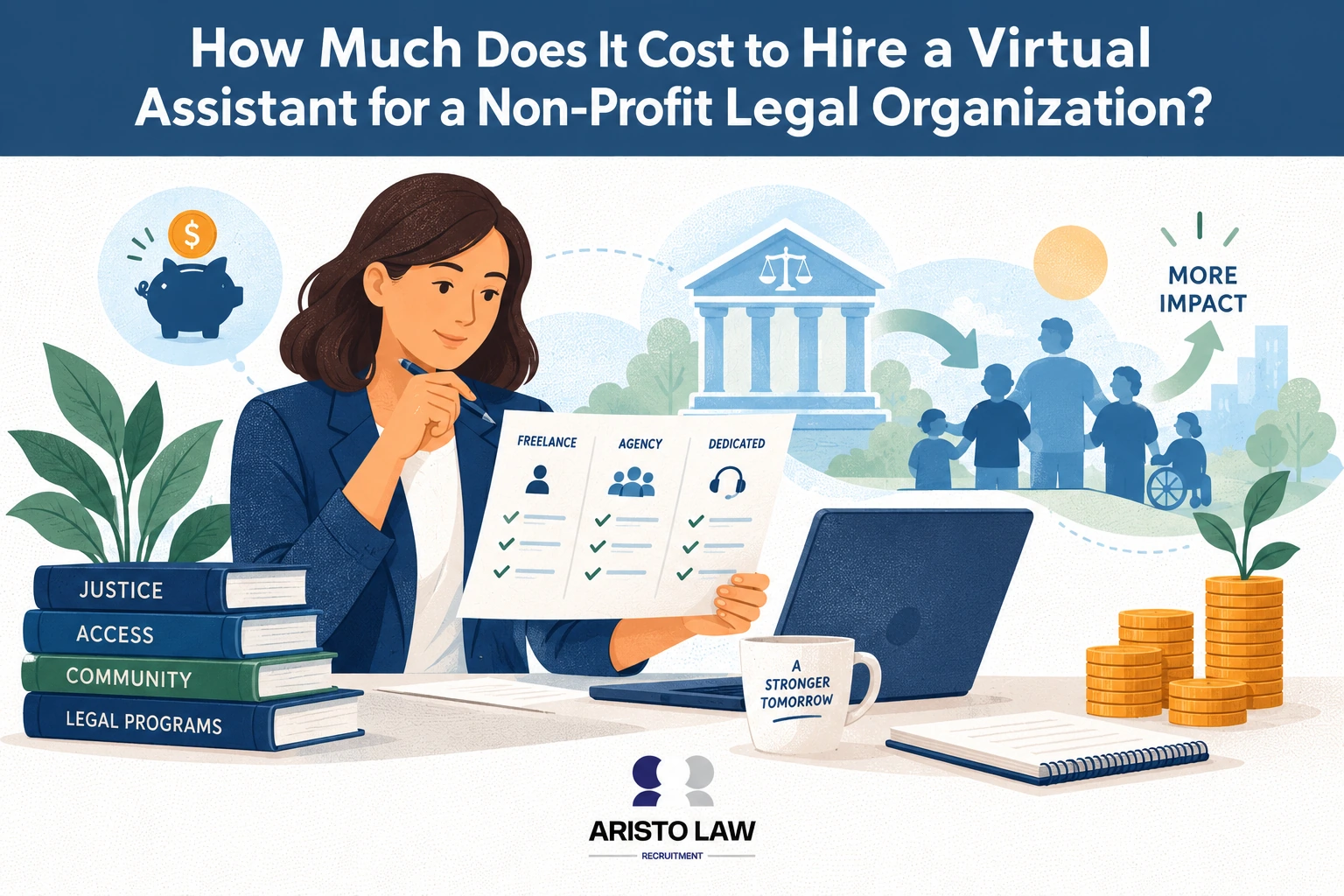
Virtual staffing is commonly available through hourly, part-time,
full-time, and agency-managed engagement models. Administrative virtual
assistants generally cost less than legal virtual assistants and
specialized virtual paralegals because legal support roles often require
legal-administration knowledge, compliance support experience,
document-management skills, client-intake coordination, and legal
workflow familiarity. Factors such as case volume, grant administration
responsibilities, legal document preparation, compliance tracking,
bilingual capabilities, and stakeholder communication requirements also
influence pricing.
Research by the Eugene and Agnes E. Meyer Foundation,
Management Assistance Group, and Rick Moyers in 2009 states that
outsourcing back-office functions can lead to greater long-term
efficiencies and cost savings, particularly for small and
midsized nonprofits seeking alternatives to in-house administrative
staffing. Virtual staffing also provides scalable support aligned with
organizational demand, funding levels, and program growth.
Listed below are the 6 cost ranges associated with VA services for
non-profit legal organizations.
-
Entry-level offshore legal virtual assistant:
Approximately USD $10–$18 per hour -
Experienced offshore legal virtual assistant:
Approximately USD $18–$30 per hour -
U.S.-based legal virtual assistant: Approximately
USD $30–$60 per hour -
Specialized virtual paralegal or legal specialist:
Approximately USD $50–$90+ per hour, depending on
expertise -
Part-time support (approximately 20 hours per week):
Approximately USD $1,000-$1,800 per month for offshore
legal support services -
Full-time support (approximately 40 hours per week):
Approximately USD $1,800-$3,500 per month for offshore
legal virtual assistants, with higher costs for specialized legal
work
Compared with hiring in-house legal support personnel, virtual
assistants often provide greater flexibility, lower operational costs,
and scalable administrative capacity for non-profit legal organizations
managing client intake, legal administration, compliance support,
grant-funded programs, and community-service initiatives.
What
skills should virtual assistants have when supporting non-profit legal
organizations?
Skills virtual assistants should have when supporting
non-profit legal organizations include communication, organization,
volunteer management, and data management skills.
Listed below are 15 skills VAs should have for supporting non-profit
legal organizations.
-
Communication skills: Support client intake, donor
communications, volunteer engagement, stakeholder updates, and community
outreach activities. -
Organization skills: Maintain legal records, client
files, grant documents, compliance records, and administrative
documentation in structured systems. -
Stakeholder coordination: Coordinate communication
and activities involving clients, donors, volunteers, board members,
attorneys, community partners, and funding organizations. -
Administrative management: Manage scheduling,
reporting, document processing, meeting coordination, data entry, and
operational workflows. -
Technology proficiency: Use CRM platforms,
case-management software, donor-management systems, project-management
tools, and communication platforms efficiently. -
Confidentiality awareness: Protect sensitive client
information, donor records, legal documentation, financial data, and
organizational information. -
Workflow coordination: Monitor tasks, deadlines,
reporting requirements, grant obligations, intake activities, and
organizational processes. -
Donor-relations support: Maintain donor databases,
coordinate fundraising communications, track donor interactions, and
support stewardship activities. -
Volunteer management: Organize volunteer rosters,
schedules, assignments, communication records, and participation
tracking. -
Client-intake administration: Process inquiries,
collect information, schedule appointments, and coordinate intake
workflows for legal services. -
Outreach support: Assist with community engagement
programs, awareness campaigns, event coordination, and stakeholder
communications. -
Reporting and compliance support: Track reporting
deadlines, maintain compliance records, and assist with grant and
regulatory documentation. -
Data management skills: Maintain accurate records,
update databases, manage information systems, and support reporting
accuracy. -
Project coordination abilities: Support grant-funded
initiatives, outreach programs, legal-service projects, and
organizational operations. -
Time management skills: Prioritize tasks, manage
multiple deadlines, coordinate activities, and maintain workflow
continuity across programs.
These skills improve organizational effectiveness by strengthening
client service delivery, donor engagement, volunteer coordination,
compliance tracking, legal support operations, and overall mission
execution within non-profit legal organizations.
How
does Aristo Law support non-profit legal organizations with virtual
assistants?
Aristo Law helps non-profit legal organizations improve
efficiency, client support, administrative operations, and service
delivery through outsourced legal virtual assistant solutions.
Aristo Law provides trained virtual assistants who support intake
management, scheduling, stakeholder communication, volunteer
coordination, legal administration, CRM management, reporting support,
document organization, compliance tracking, and daily operational
workflows.
Non-profit legal organizations use virtual assistants to manage
intake, document preparation, scheduling, and administrative workflows
without increasing internal staffing costs. Aristo Law provides virtual
legal assistant support for non-profit legal
organizations by matching legal support staff to
operational tasks that improve service delivery, case coordination, and
organizational efficiency.
These professionals help non-profit legal organizations manage client
inquiries, coordinate appointments, maintain records, support
grant-funded programs, organize outreach activities, and improve
communication with donors, volunteers, clients, and community partners.
Outsourced legal staffing allows organizations to reduce administrative
burdens and dedicate more resources toward advocacy initiatives, legal
services, community outreach programs, policy work, and mission-driven
objectives.
Aristo Law’s virtual assistant services provide scalable support that
adapts to changing workloads, funding levels, program expansion, and
service demand. Aristo Law helps non-profit legal organizations improve
sustainability, expand service capacity, and increase community impact
without increasing internal staffing costs or operational overhead.
Build a legal support team that moves work forward.
Tell us what is slowing your practice down. We will help map the role, workflow, and support structure that fits.