
Virtual Inside Sales Representatives – Law Firm Growth, Client Intake Support, and Lead Conversion Workflows

Practical guidance for building efficient, accountable legal support operations.
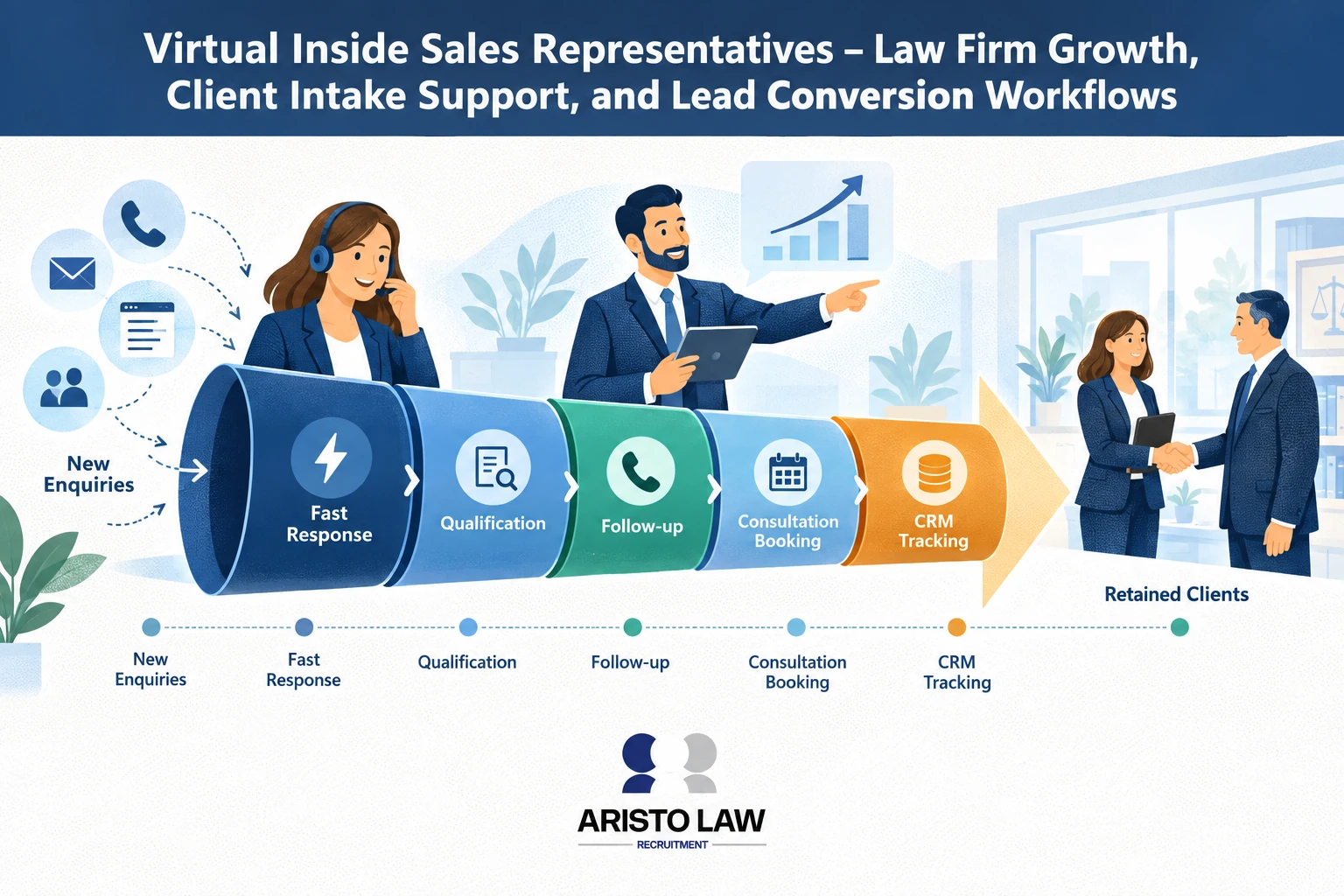
A virtual inside sales representative is a remote sales and
intake professional who helps law firms manage lead conversion,
consultation scheduling, and follow-up communication. A virtual
inside sales representative also supports client acquisition workflows
through structured CRM systems and centralized intake operations.
A study by Clio in 2025 showed that law firms lose potential
clients when they fail to respond quickly to inquiries, while firms
using AI-assisted intake and automated follow-up systems improve intake
conversion and client acquisition efficiency. Law firms improve
consultation conversion, intake responsiveness, and revenue growth when
lead-management workflows operate through fast response systems,
structured follow-up sequences, and measurable intake processes rather
than unmanaged inquiry handling.
Virtual inside sales representatives commonly support lead
qualification, PPC lead tracking, website inquiry management, referral
follow-up, CRM updates, consultation scheduling, intake coordination,
call tracking, pipeline reporting, and attorney closer support across
law-firm intake systems. Unlike legal intake specialists who frequently
focus on administrative intake processing and information collection,
inside sales representatives operate with stronger conversion-focused
responsibilities involving lead engagement, follow-up persistence,
consultation commitment, and intake funnel progression. Law firms
frequently integrate both roles into hybrid intake systems where
administrative intake support and sales-oriented lead conversion
workflows operate together.
Remote inside sales support improves law-firm growth operationally
through faster speed-to-lead response, reduced missed consultations,
structured intake automation, consistent follow-up communication, and
stronger pipeline visibility across referrals, advertising campaigns,
social-media inquiries, and website leads. Representatives commonly ask
prospects about injury type, practice-area fit, urgency, timeline,
jurisdiction, accident details, opposing parties, and scheduling
availability helping attorneys prioritize qualified consultations
without providing legal advice or legal conclusions.
Law firms must additionally maintain ethics and compliance controls
because non-attorney inside sales personnel cannot provide legal advice,
guarantee outcomes, recommend litigation strategy, or create
attorney-client relationships independently. Strong intake systems
depend heavily on attorney-review thresholds, approved communication
scripts, confidentiality controls, escalation procedures, and secure
intake repositories protecting attorney-client privilege and advertising
compliance obligations.
Modern inside sales workflows frequently rely on CRM platforms,
intake automation systems, AI-assisted intake workflows, scheduling
software, call-tracking systems, workflow dashboards, communication
platforms, and reporting tools supporting scalable remote legal intake
operations. Effective virtual inside sales representatives demonstrate
strong communication skill, intake discipline, CRM proficiency,
objection-handling ability, follow-through consistency, escalation
judgment, and workflow accountability across distributed legal
operations.
Law firms benefit most from virtual inside sales support when intake
volume, missed calls, slow follow-up, inconsistent lead handling, or
consultation-conversion problems begin limiting growth capacity. Remote
sales support improves scalable intake operations, client
responsiveness, operational visibility, and long-term law-firm revenue
growth when supported through structured SOPs, measurable KPIs, secure
systems, and attorney-supervised intake governance.
Aristolaw helps law firms manage virtual inside sales
representative support, law firm growth, client intake support, and lead
conversion workflows by providing outsourced support for lead response,
prospect follow-up, consultation scheduling, intake handoff, CRM
updates, and conversion tracking. Call Aristolaw at +1 307 888
9491 for client intake and legal support outsourcing
services. Aristolaw connects law firms with
outsourcing solutions that match trained intake and inside sales support
staff to each lead qualification task, prospect communication workflow,
appointment-setting duty, intake conversion function, and law firm
growth responsibility.
What is a virtual
inside sales representative?
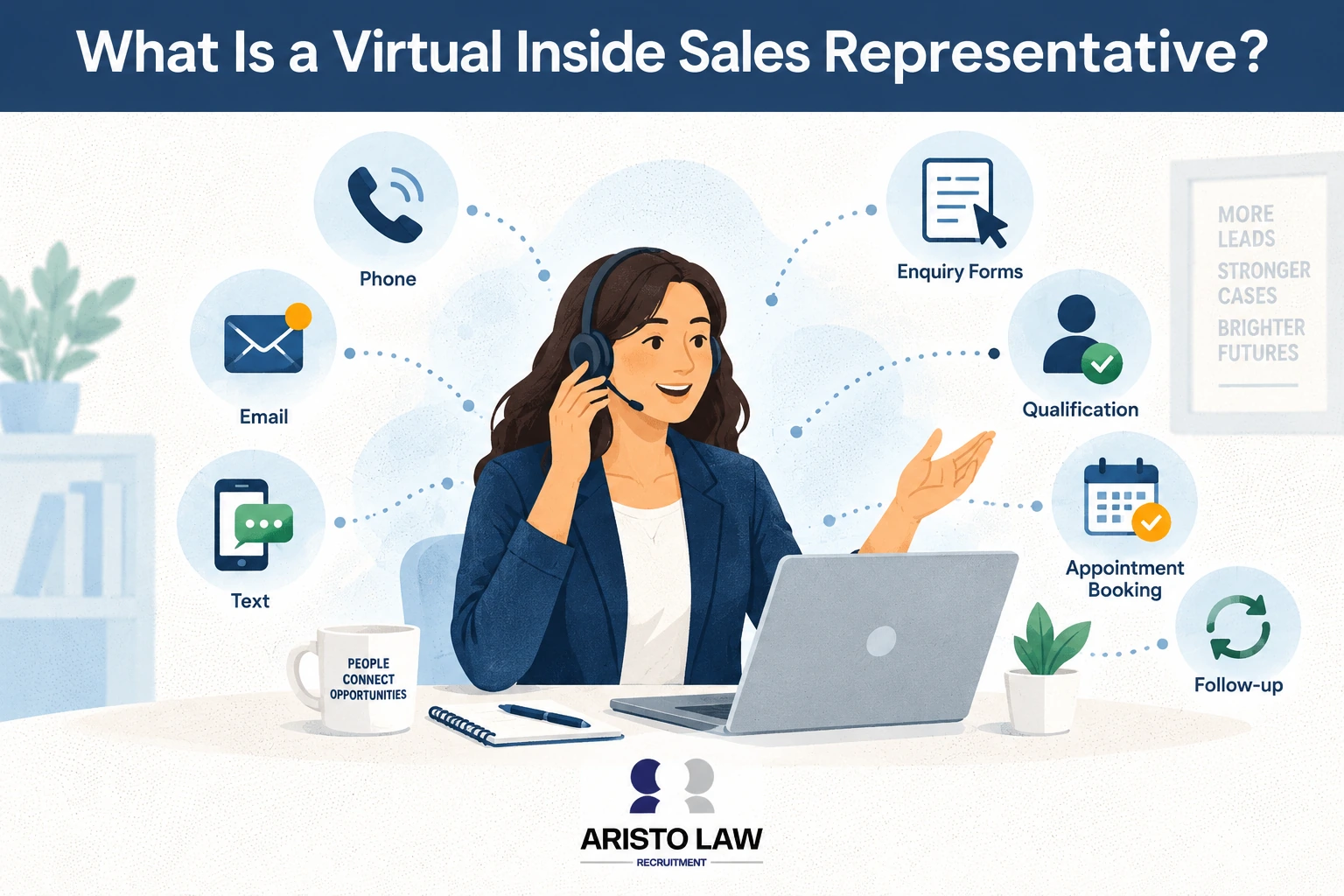
A virtual inside sales representative is a remote sales
professional who manages lead generation, prospect communication, client
follow-ups, appointment setting, and sales conversion activities through
phone, email, CRM systems, and digital communication platforms.
A virtual inside sales representative works without a physical office
presence or field sales visits and supports remote sales operations
through structured digital communication and pipeline management. Modern
inside sales operations function through centralized digital workflows
where representatives manage lead engagement, sales coordination,
pipeline visibility, and conversion support remotely using cloud-based
communication systems and structured CRM processes.
Research by the Harvard Business Review in 2011 showed that
companies responding to leads within one hour were nearly 7 times more
likely to qualify the lead compared to companies that waited even one
hour longer, demonstrating how centralized inside sales systems improve
response speed and conversion efficiency. Inside sales models
improve scalability, reduce customer acquisition costs, increase
response speed, and strengthen lead-management efficiency because
digital communication systems allow organizations to centralize
follow-up workflows, automate outreach sequences, and monitor conversion
performance in real time.
Virtual inside sales representatives commonly support inbound inquiry
handling, outbound prospecting, lead qualification, CRM management,
consultation scheduling, communication tracking, pipeline reporting,
proposal coordination, and follow-up communication across distributed
digital sales environments. Representatives frequently manage PPC leads,
website inquiries, referral pipelines, social-media campaigns,
call-tracking systems, and email sequences through centralized customer
relationship management platforms improving operational visibility
throughout the sales funnel. Structured lead qualification workflows
also help businesses prioritize high-intent prospects based on timing,
budget, service fit, urgency, and conversion readiness.
Remote inside sales representatives operate primarily through CRM
software, VoIP systems, workflow dashboards, automation tools,
scheduling platforms, AI-assisted communication systems, and cloud-based
collaboration environments supporting scalable digital sales operations.
Automation sequences frequently support appointment reminders, follow-up
campaigns, lead scoring, communication tracking, and pipeline management
improving operational consistency and reducing manual sales
administration.
Inside sales models differ from field or outside sales structures
because virtual inside sales representatives conduct prospect engagement
remotely through digital communication systems rather than in-person
travel, field meetings, or territory-based relationship management.
Inside sales workflows emphasize centralized communication, faster lead
response, structured follow-up cadence, measurable pipeline visibility,
and scalable digital sales coordination rather than physical territory
coverage and face-to-face prospect development.
What is inside sales for law
firms?
Inside sales for law firms are remote lead-management process
that turns inquiries from ads, websites, referrals, phone calls, and
legal lead-generation campaigns into qualified consultations and signed
clients. Modern law-firm inside sales systems operate as
structured intake-to-conversion workflows where trained intake and sales
personnel manage inquiry handling, lead qualification, follow-up
communication, consultation scheduling, CRM tracking, and attorney
escalation through centralized digital communication systems.
A 2025 study by Hennessey Digital showed that law firms
responding to online leads within 5 minutes increased from 13% in 2021
to 25% in 2025, and firms with faster intake-response workflows
consistently achieved stronger conversion outcomes and better client
acquisition performance. Law firms improve consultation
conversion and client acquisition when lead-response workflows operate
through fast communication cadence, structured intake systems, and
measurable pipeline management rather than unmanaged receptionist-style
inquiry handling.
Law-firm inside sales workflows begin with lead capture through PPC
campaigns, website forms, referral networks, social-media inquiries,
chat systems, inbound calls, or legal lead providers. Virtual inside
sales representatives or intake teams then manage first-response
communication, gather preliminary information, confirm practice-area
fit, identify urgency level, verify jurisdiction relevance, and route
conflict-check details through CRM systems and intake dashboards.
Qualified prospects frequently move into consultation scheduling
workflows supported through automated reminders, follow-up sequences,
communication logging, and pipeline tracking systems improving
consultation attendance and intake continuity.
Inside sales operations also depend heavily on structured follow-up
cadence because many legal prospects delay consultation decisions, miss
calls, compare firms, or fail to complete intake requirements initially.
Centralized CRM tracking, communication templates, scheduling
automation, and reminder workflows improve operational visibility across
intake pipelines and reduce lost conversion opportunities.
Law-firm inside sales differs from traditional commercial sales
because representatives do not “sell” legal outcomes, guarantee case
success, provide legal advice, or make attorney-level legal
recommendations. Instead, inside sales personnel help prospects
understand the next procedural step through approved scripts, accurate
intake communication, consultation coordination, and attorney-supervised
escalation systems. Fee discussions, legal strategy, representation
decisions, settlement evaluation, and substantive legal analysis remain
attorney-controlled because legal ethics rules and
unauthorized-practice-of-law restrictions require clear operational
boundaries between intake support and licensed legal judgment.
What is an attorney closer?
An attorney closer is a law-firm sales or intake role focused
on converting qualified prospects into consultations, signed clients, or
attorney-approved engagement steps. The title commonly appears
in law-firm marketing, intake, and client-acquisition systems where
firms use structured follow-up workflows to improve consultation
attendance, signed-retainer completion, intake responsiveness, and
lead-conversion performance.
Research by James Publishing/ISBA in 2017 showed that when
law firms delayed initial lead follow-up from 5 minutes to 10 minutes,
lead conversion rates dropped by up to 400%, demonstrating the
importance of rapid intake response and structured follow-up
systems. Law firms improve conversion efficiency when qualified
leads receive structured communication, fast follow-up, objection
handling, and clear intake coordination through centralized CRM and
intake-management systems.
Attorney closers frequently operate as remote closers, intake
closers, legal sales representatives, consultation setters, or
client-acquisition specialists supporting intake-to-conversion workflows
through phone calls, CRM tracking, email communication, consultation
scheduling, reminder systems, and follow-up sequences. Their operational
role involves responding to inquiries, qualifying leads, explaining
procedural next steps, handling intake objections, confirming
consultation attendance, coordinating fee-agreement workflows after
attorney review, and maintaining communication continuity throughout the
intake pipeline.
Law firms use attorney closers to improve lead response speed, reduce
missed consultations, recover stalled leads, improve consultation-show
rates, and maintain structured intake communication across PPC
campaigns, website inquiries, referrals, social-media leads, and
call-tracking systems. Closers frequently communicate firm value,
explain intake procedures, coordinate scheduling logistics, and maintain
follow-up cadence with prospective clients who delay decisions or
require additional intake coordination before engagement.
Attorney closers must operate within strict ethical and legal
boundaries because non-attorney intake and sales personnel cannot
provide legal advice, interpret legal rights, predict case outcomes,
guarantee results, recommend litigation strategy, or pressure prospects
into representation decisions. Fee discussions, engagement approval,
legal analysis, representation terms, and substantive legal conclusions
must remain attorney-supervised. Effective law-firm closer systems
depend heavily on approved scripts, escalation rules, communication
standards, CRM tracking, attorney-review checkpoints, and
compliance-focused intake workflows protecting both client trust and
legal ethics obligations.
How
is an inside sales representative different from a legal intake
specialist?
An inside sales representative focuses on generating and
converting sales opportunities, while a legal intake specialist
evaluates potential legal clients, gathers case information, and manages
intake workflows.
The table below difference between an inside sales representative and
a legal intake specialist.
| Aspect | Inside Sales Representative | Legal Intake Specialist |
|---|---|---|
| Primary operational focus | Drives lead conversion and consultation movement through the intake pipeline |
Collects case information and supports administrative intake workflows |
| Core workflow objective | Converts inquiries into consultations and signed-client opportunities |
Organizes intake data and prepares prospects for attorney review |
| Lead qualification role | Evaluates lead readiness, urgency, fit, responsiveness, and conversion potential |
Gathers factual intake information and routes inquiries appropriately |
| Speed-to-lead responsibility | Strong focus on rapid response and immediate follow-up cadence | Responds to inquiries but within broader intake-processing workflows |
| Consultation scheduling | Frequently owns consultation booking and appointment-confirmation workflows |
Commonly supports scheduling administratively after qualification |
| Sales and conversion involvement | Stronger focus on persuasion, objection handling, and intake conversion progression |
More focused on procedural intake accuracy and information collection |
| Follow-up communication | Maintains aggressive follow-up cadence for stalled or unresponsive leads |
Handles intake reminders and administrative communication support |
| CRM management | Tracks pipeline movement, lead stages, conversion metrics, and sales workflows |
Maintains intake notes, client records, and onboarding documentation |
| Pipeline ownership | Monitors consultation-show rates, conversion flow, and lead progression |
Monitors intake completion and administrative onboarding status |
| Attorney handoff function | Transfers qualified prospects into attorney consultation or closer workflows |
Routes completed intake files and factual summaries to attorneys |
| Communication style | More conversion-oriented and relationship-driven | More administrative and procedural in communication structure |
| Intake documentation | Records high-level lead details and qualification information | Frequently gathers detailed intake facts, incident details, and procedural information |
| Conflict-check support | Limited conflict-check involvement in many firms | Commonly supports conflict-check data collection and routing |
| Client onboarding role | Focuses on moving leads toward engagement decisions | Focuses on administrative onboarding after engagement approval |
| Objection handling | Frequently addresses scheduling hesitation, communication delays, or intake resistance |
Less sales-oriented and more information-focused |
| Metrics commonly tracked | Consultation booking rate, response speed, lead conversion, follow-up completion |
Intake completion accuracy, file readiness, intake response consistency |
| Relationship to legal sales workflows | Functions more directly inside law-firm sales and revenue-generation systems |
Functions more directly inside intake operations and administrative workflows |
| Attorney supervision boundaries | Cannot provide legal advice, guarantee outcomes, or negotiate legal strategy |
Cannot provide legal advice or substantive legal interpretation |
| Workflow stage ownership | Earlier-stage lead conversion and prospect engagement | Intake processing and administrative onboarding support |
| Use of automation systems | Frequently manages CRM automation, sales reminders, pipeline dashboards, and lead sequences |
Frequently manages intake forms, onboarding systems, and intake tracking workflows |
| Best fit for law firms | Firms needing stronger intake conversion and consultation management |
Firms needing stronger intake organization and administrative workflow support |
| Overlap in smaller firms | Collect intake information and manage onboarding workflows | Perform consultation scheduling and lead follow-up tasks |
Inside sales representatives and legal intake specialists frequently
overlap operationally inside smaller law firms where one remote intake
professional handles both conversion-focused communication and
administrative intake coordination. Larger firms separate the roles more
clearly by assigning sales-oriented pipeline management to inside sales
personnel and factual intake processing to dedicated intake
specialists.
How
do virtual inside sales representatives support law firm growth?
Virtual inside sales representatives support law firm growth
by increasing lead response speed, improving follow-up consistency,
booking more consultations, and reducing missed opportunities from
unworked inquiries. Virtual inside sales representatives
improve operational growth systems by creating structured
intake-to-conversion workflows supported through CRM platforms,
communication automation, consultation scheduling systems, and
centralized lead-management processes.
Research by Clio in 2024 showed that only 33% of law firms
responded to emails from prospective clients, while nearly half of firms
were unreachable by phone, demonstrating how delayed responses and weak
intake coordination lead to lost business opportunities. Law
firms lose substantial revenue when inbound leads receive delayed
responses, inconsistent communication, weak follow-up, or poor intake
coordination because prospective clients frequently contact multiple
firms before deciding who to hire.
Speed-to-lead remains one of the strongest drivers of intake
conversion because prospects contacting law firms expect rapid
communication after website submissions, PPC inquiries, referral
introductions, social-media messages, or inbound phone calls. Virtual
inside sales representatives maintain fast first-response workflows,
qualify leads, route conflict-check details, identify practice-area fit,
and move qualified prospects into scheduled consultations before
communication momentum declines. Structured follow-up cadence also
improves conversion performance because many leads initially fail to
respond, postpone scheduling, miss consultations, or require multiple
communication attempts before engagement decisions occur.
Virtual inside sales representatives additionally support law-firm
growth by maintaining CRM accuracy, consultation reminders, pipeline
visibility, no-show recovery workflows, communication logging, and
lead-stage tracking across intake systems. Centralized intake dashboards
improve operational visibility into unresolved leads, stalled prospects,
referral performance, PPC conversion trends, and consultation-show rates
helping firms optimize client-acquisition workflows systematically.
Law firms frequently lose growth opportunities when attorneys,
receptionists, or overloaded administrative staff handle sales
inconsistently because operational interruptions reduce responsiveness,
follow-up discipline, and intake accountability. Virtual inside sales
representatives protect attorney time by handling intake communication,
scheduling coordination, follow-up persistence, and CRM management while
attorneys focus on legal analysis, consultations, litigation, and
substantive legal work. The role supports revenue operations through
structured conversion systems and intake discipline rather than
aggressive legal selling because ethical boundaries prohibit
non-attorneys from providing legal advice, guaranteeing results, or
applying improper sales pressure during legal intake workflows.
What lead sources
should law firms track?
Lead sources law firms should track include organic search,
paid ads, social media, and community partnerships.
Listed below are 15 lead sources law firms should track
-
Organic search: Organic search leads come from
search-engine rankings and SEO-driven content visibility. Law firms
track organic leads to measure which practice pages, blog topics, and
search keywords generate qualified consultations, signed clients, and
high-value legal matters over time. -
Paid ads: PPC campaigns, display advertising, and
paid social campaigns frequently generate high lead volume but also
produce unqualified or expensive inquiries. Source tracking helps firms
compare advertising spend against consultation booking rate,
signed-client conversion, case value, and intake responsiveness. -
Referrals: Referral leads from attorneys, former
clients, medical providers, accountants, business contacts, and
professional networks frequently produce high-trust consultations and
stronger conversion rates. Tracking helps firms identify the most
productive referral relationships and partnership sources. -
Legal directories: Leads from legal directories
frequently vary heavily in quality depending on practice area, market
competition, and listing placement. Tracking helps firms measure close
rate, response speed, consultation quality, and intake efficiency by
directory source. -
Website forms: Website contact forms frequently
support intake automation and consultation requests. Tracking form
submissions helps firms evaluate landing-page performance, inquiry
quality, response time, and intake funnel progression across practice
areas. -
Phone calls: Call-tracking systems help law firms
monitor call volume, consultation requests, missed-call recovery, intake
responsiveness, and conversion performance across advertising channels,
referral sources, and geographic campaigns. -
Live chat inquiries: Live chat systems frequently
capture prospects unwilling to call immediately. Tracking
chat-originated leads helps firms measure engagement quality,
consultation conversion, intake responsiveness, and after-hours inquiry
performance. -
Email campaigns: Newsletter campaigns, drip
sequences, referral outreach, and reactivation campaigns generate leads
through ongoing communication nurturing. Tracking email-driven inquiries
helps firms evaluate open rates, engagement behavior, and consultation
conversion effectiveness. -
Social media inquiries: Social platforms generate
intake opportunities through educational content, reputation visibility,
referral sharing, and direct-message communication. Source tracking
helps firms identify which campaigns and platforms produce meaningful
consultations rather than low-intent engagement only. -
Community partnerships: Community organizations,
networking groups, nonprofit partnerships, local events, and educational
outreach programs frequently generate long-term referral opportunities
and trust-based consultations. Tracking helps firms measure
relationship-driven intake value over time. -
Review platforms and reputation channels: Google
reviews, testimonial platforms, and reputation-driven searches
frequently influence consultation decisions. Tracking helps firms
identify how reputation management contributes to intake growth and
signed-client conversion. -
Retargeting campaigns: Retargeting advertisements
reconnect with prospects who previously visited the website or abandoned
intake forms. Tracking helps firms measure lead recovery and delayed
consultation conversion performance. -
Video and webinar campaigns: Educational webinars,
YouTube content, and video-based legal marketing generate highly
informed leads. Tracking helps identify whether educational content
produces stronger consultation quality and conversion readiness. -
Direct traffic and branded search: Direct website
visits and branded keyword searches frequently indicate strong referral
recognition or prior exposure to the firm. Tracking helps firms evaluate
overall brand awareness and intake trust signals. -
Third-party legal lead providers: Purchased legal
leads frequently produce inconsistent quality and high intake-management
pressure. Tracking helps firms identify cost-per-signed-client, lead
quality, response-time sensitivity, and wasted follow-up effort across
purchased lead campaigns.
Virtual inside sales representatives commonly tag lead sources inside
CRM systems and intake dashboards allowing firms to compare response
speed, consultation booking rate, no-show rate, signed-client
conversion, case value, and follow-up workload across every intake
channel. Source tracking functions as a revenue-operations system
helping law firms identify which marketing channels produce qualified
consultations, profitable matters, low-quality inquiries, or excessive
intake-management costs.
How should law firms
manage speed-to-lead?
Law firms should manage speed-to-lead by contacting new
inquiries quickly, assigning clear ownership, automating alerts, using
call-back workflows, and tracking response-time metrics.
Speed-to-lead functions as a major conversion driver inside modern
law-firm revenue operations.
Research by Hennessey Digital in 2025 showed that firms
responding to online leads within five minutes dramatically improved
conversion potential, while firms taking hours or days to respond lost
significant opportunities to competitors. Consultation
conversion rates decline sharply when prospective clients wait too long
for a response because legal consumers frequently contact multiple firms
simultaneously and choose the first responsive firm demonstrating
professionalism, availability, and intake clarity.
Effective speed-to-lead systems begin with centralized intake routing
connected to CRM platforms, website forms, call-tracking systems, chat
tools, and intake automation software. Real-time notifications, lead
queues, and automated alerts immediately assign ownership for new
inquiries preventing leads from remaining unattended inside shared
inboxes, voicemail systems, or disconnected communication channels. CRM
timestamps additionally allow firms to measure exact response speed
across phone calls, web forms, live chat inquiries, PPC campaigns,
referral leads, and after-hours intake submissions improving intake
accountability and operational visibility.
Missed-call workflows remain heavily important because unanswered
calls frequently become lost revenue opportunities. Law firms commonly
use callback SLAs, SMS acknowledgments, voicemail-to-CRM routing,
after-hours escalation systems, and automated follow-up sequences
ensuring inquiries receive immediate engagement even when attorneys
remain unavailable. Chat transcripts, form alerts, consultation
reminders, and communication dashboards additionally improve intake
continuity across distributed teams.
Virtual inside sales representatives strengthen speed-to-lead
performance by actively monitoring intake channels, managing follow-up
cadence, qualifying leads, booking consultations, recovering missed
calls, and maintaining communication persistence while attorneys focus
on legal work. Without structured intake ownership, many law firms lose
potential clients because inquiries sit unresolved in voicemail, email
inboxes, receptionist queues, or fragmented intake systems lacking
centralized workflow accountability.
How should law firms
follow up with leads?
Law firms should follow up with leads through a fast,
structured, and multi-channel intake process that prioritizes rapid
response and consistent communication. Law firms should
maintain personalized outreach and ongoing follow-up until the lead is
qualified, scheduled, or clearly disengaged.
Research by Lead Response Management and InsideSales.com in
2016 showed that the odds of qualifying a lead dropped about 4 times
when response time increased from 5 minutes to 10 minutes, demonstrating
that immediate responsiveness improves client conversion
outcomes. Leads contacted within 5 minutes convert at
dramatically higher rates than leads contacted later because prospective
clients frequently contact multiple firms simultaneously and hire the
first firm demonstrating responsiveness, professionalism, and intake
clarity. Research additionally shows firms using structured intake
systems, CRM tracking, automated reminders, and multi-touch follow-up
workflows achieve higher consultation-booking and signed-client
conversion rates than firms relying on inconsistent receptionist
handling or attorney-managed intake communication.
Listed below are 12 ways law firms should follow up with leads.
-
Respond to every lead as quickly as possible, ideally within
5 minutes of inquiry submission: Fast response speed improves
trust, engagement momentum, and consultation conversion across PPC
leads, referrals, website forms, and inbound calls. -
Use multiple communication channels including phone calls,
SMS, email, and chat follow-ups: Multi-channel communication
increases contact rates and improves intake responsiveness because
prospective clients prefer different communication methods. -
Prioritize live phone answering or rapid callback systems to
avoid missed opportunities: Missed calls frequently become lost
consultations when callback systems operate slowly or
inconsistently. -
Personalize follow-up messages based on the lead’s legal
issue and inquiry details: Personalized communication improves
engagement quality and demonstrates procedural attentiveness during
emotionally sensitive legal situations. -
Implement structured intake scripts to qualify leads
consistently and gather necessary case information: Scripts
improve intake consistency, lead qualification accuracy, escalation
handling, and consultation preparation. -
Track all leads inside a CRM or intake management system for
visibility and accountability: CRM systems improve pipeline
visibility, response tracking, intake ownership, communication logging,
and conversion measurement. -
Use automated intake workflows for instant confirmations,
scheduling links, and reminders: Automation improves response
speed, reduces manual workload, and strengthens consultation attendance
rates. -
Follow up multiple times during the first 72 hours because
many leads contact multiple firms before hiring one: Structured
persistence improves conversion recovery and reduces lost opportunities
from delayed decision-making. -
Assign dedicated intake staff or virtual inside sales
representatives instead of overloading attorneys or paralegals:
Centralized intake ownership improves responsiveness, communication
consistency, and consultation management. -
Monitor response time, consultation booking rates, and
signed-client conversion metrics regularly: KPI tracking helps
firms identify intake bottlenecks, communication failures, and
conversion weaknesses. -
Maintain empathetic, professional communication to build
trust during emotionally sensitive legal situations: Legal
prospects frequently experience stress, urgency, financial anxiety, or
uncertainty requiring careful communication tone and procedural
clarity. -
Standardize onboarding and retainer follow-up processes to
reduce drop-off after consultation: Structured
post-consultation workflows improve signed-retainer completion and
client onboarding continuity.
Research consistently shows many law firms lose qualified leads
because of slow response time, inconsistent intake handling, missed
calls, weak follow-up cadence, and fragmented communication systems.
Firms using centralized CRM tracking, rapid intake response, structured
automation, and repeatable multi-touch follow-up workflows consistently
achieve stronger consultation conversion, intake efficiency, and
long-term client acquisition performance.
How
do virtual inside sales representatives support client intake?
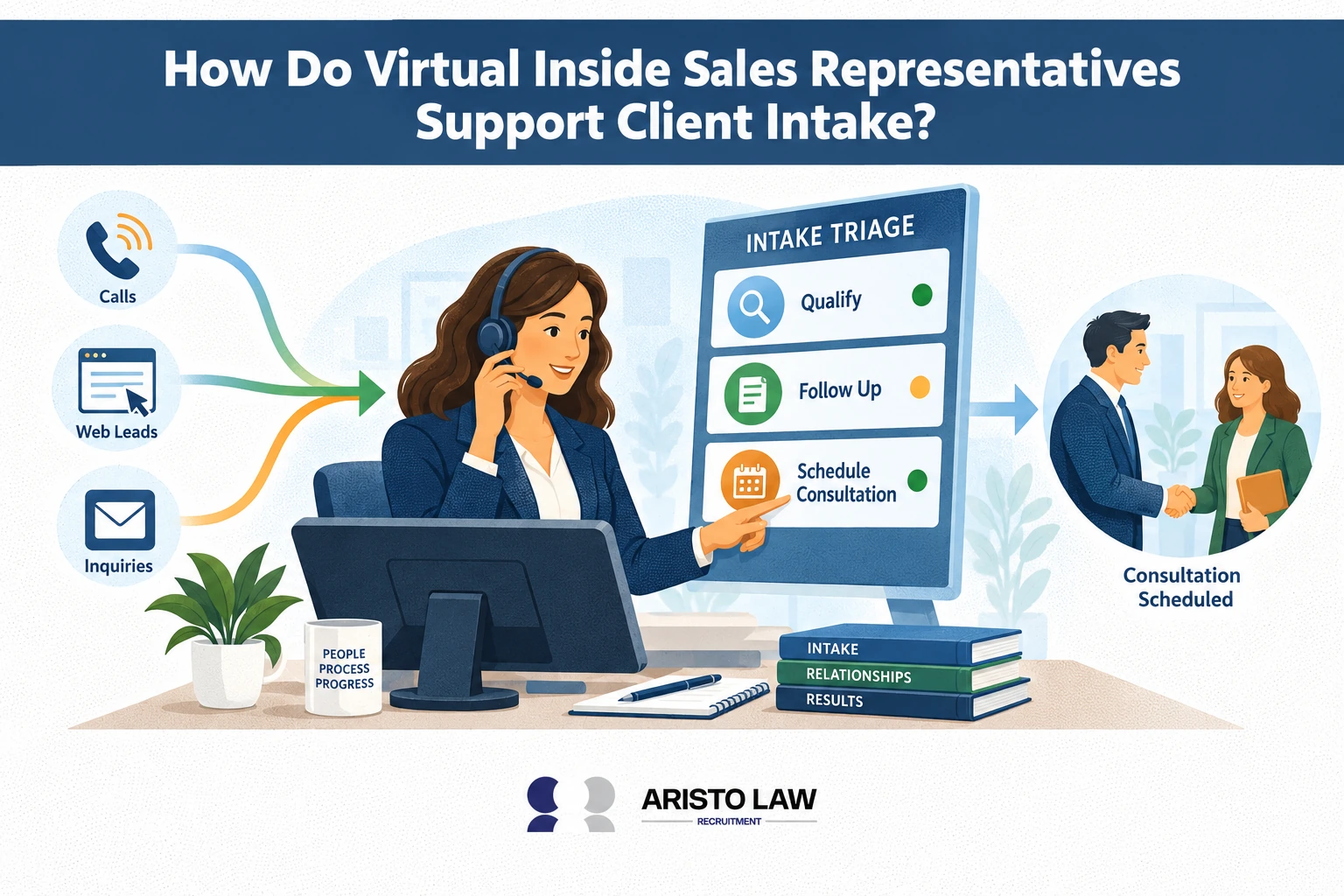
Virtual inside sales representatives contact prospects, ask
approved qualification questions, and identify leads that match the
firm’s intake criteria. Virtual inside sales representatives
also enter lead data, schedule consultations, send reminders, and
transfer qualified leads to attorneys or intake teams.Modern legal
intake systems function as the operational bridge between marketing and
legal service delivery because law firms frequently lose qualified leads
when inquiries move slowly, communication becomes inconsistent, or
intake ownership remains unclear.
A study by Reciprocity Industries in 2025 showed that 87% of
people seeking legal representation hire the first lawyer they speak
with, while 64% of law firms fail to respond to leads at all,
demonstrating how intake bottlenecks and missed communication directly
reduce signed-client conversion. Intake systems improve
consultation-booking rates, response consistency, intake visibility, and
signed-client conversion because centralized workflows reduce missed
communication and intake bottlenecks.
Virtual inside sales representatives qualify leads, collect intake
information, and route prospective clients into structured onboarding
workflows for law firms. Virtual inside sales representatives coordinate
communication efficiency and strengthen virtual
intake specialist support for law firm intake through
faster response handling and intake data organization.
Virtual inside sales representatives commonly manage inquiries
originating from PPC campaigns, website forms, live chat systems,
referrals, call-tracking systems, social-media inquiries, legal
directories, and email campaigns. After initial contact, representatives
move prospects through structured lead-status stages such as new
inquiry, contacted, qualified, consultation scheduled, consultation
completed, retained, or disengaged improving intake visibility across
the law-firm pipeline.
Qualification workflows frequently rely on attorney-approved scripts
gathering practice-area fit, incident details, jurisdiction information,
urgency level, opposing-party details, scheduling availability, and
conflict-check routing information without providing legal advice or
evaluating legal claims independently. Representatives additionally
maintain CRM notes documenting communication history, intake progress,
matter-type tagging, follow-up status, scheduling outcomes, and
unresolved intake requirements improving operational continuity across
distributed legal teams.
Virtual inside sales representatives also coordinate consultation
scheduling, intake reminders, no-show recovery, preliminary document
requests, intake packet routing, and communication follow-up reducing
consultation drop-off and intake inconsistency. During these workflows,
representatives frequently collaborate with intake specialists, legal
assistants, paralegals, and attorneys supporting procedural intake
coordination rather than replacing substantive legal evaluation, case
assessment, litigation strategy, or attorney-controlled legal
judgment.
How should law firms qualify
leads?
Steps to qualify law firm leads include identifying matter
type, scheduling consultation, and documenting the lead
status.
Listed below are the 12 steps to qualify law firm leads.
-
Identify the matter type: Inside sales
representatives or intake staff should first determine the legal
category connected to the inquiry such as personal injury, family law,
immigration, criminal defense, estate planning, employment law, business
litigation, or real-estate disputes. Matter categorization improves
routing accuracy and attorney assignment efficiency. -
Confirm jurisdiction fit: Law firms should verify
whether the legal issue falls within the jurisdictions, states, courts,
or geographic regions where the firm practices. Jurisdiction screening
prevents intake time loss on matters outside licensing boundaries or
operational service areas. -
Assess urgency and deadline sensitivity: Intake
workflows should identify urgent deadlines, court dates, statute
limitations, arrest situations, injury timing, filing deadlines,
eviction notices, or emergency legal concerns requiring rapid attorney
escalation. Urgency classification improves intake prioritization and
response management. -
Collect basic factual information: Representatives
should gather non-legal factual information including names, contact
details, timeline summaries, opposing-party information, incident dates,
injury details, contract disputes, family-law circumstances, or business
context improving consultation readiness and intake visibility. -
Check practice-area and service fit: Law firms
should determine whether the inquiry matches the firm’s operational
focus, case acceptance criteria, fee structure, and service model.
Intake qualification helps reduce consultation waste involving poor-fit
matters or unsupported legal categories. -
Discuss budget or fee expectations where
appropriate: Certain practice areas require preliminary intake
discussion regarding consultation fees, retainer expectations,
contingency structures, or service affordability. Representatives
explain attorney-approved fee processes but cannot negotiate legal
representation terms independently. -
Evaluate consultation readiness: Intake staff should
determine whether the prospect is prepared to schedule a consultation,
gather required documents, complete intake forms, and engage in the next
procedural step. Consultation readiness improves intake efficiency and
conversion visibility. -
Route conflict-review information: Intake personnel
should collect opposing-party names, related businesses, prior
representation information, and connected parties supporting
attorney-supervised conflict-check workflows before substantive
consultation occurs. -
Identify attorney-review triggers: Emergency
filings, potential conflicts, sensitive litigation, media exposure,
criminal allegations, domestic safety concerns, or high-value disputes
frequently require immediate attorney review rather than standard intake
processing. -
Schedule consultations and intake follow-up:
Qualified leads should move quickly into consultation scheduling
workflows supported through automated reminders, confirmation systems,
intake packets, and follow-up communication improving attendance and
intake continuity. -
Document lead status inside the CRM system: Intake
representatives should maintain CRM notes documenting communication
history, qualification outcome, urgency level, matter category,
consultation status, follow-up requirements, and escalation activity
improving operational visibility across the intake pipeline. -
Apply clear legal-service boundaries: Inside sales
representatives and intake personnel collect information, maintain
communication workflows, and support consultation progression but must
not evaluate legal claims, predict case outcomes, provide legal advice,
recommend litigation strategy, or determine representation decisions
independently. Attorneys remain responsible for substantive legal
evaluation and legal judgment throughout the intake process.
What
questions should law firm inside sales reps ask leads?
Questions law firm inside sales reps should ask leads include
matter type, consultation availability, and preferred communication
method.
Listed below are 11 questions law firms should ask.
-
Matter type questions: Intake personnel should
identify the legal category connected to the inquiry such as personal
injury, family law, immigration, criminal defense, employment law,
estate planning, or business disputes. Matter-type questions help firms
route leads correctly, assign the proper attorney, and determine whether
the inquiry matches the firm’s practice areas. -
Location and jurisdiction questions: Representatives
should ask where the incident, dispute, business issue, accident,
arrest, or legal matter occurred because jurisdiction determines whether
the law firm handles the matter operationally and ethically. Geographic
fit improves attorney routing and reduces intake waste. -
Deadline and urgency questions: Intake workflows
should identify hearings, filing deadlines, arrest situations, statute
limitations, court notices, evictions, or emergency legal concerns
requiring rapid attorney review. Urgency classification improves
response prioritization and escalation management. -
Opposing-party questions: Representatives commonly
gather names of opposing individuals, businesses, insurers, employers,
spouses, or related parties supporting attorney-supervised
conflict-review workflows before consultations proceed. -
Desired-help questions: Intake personnel should
understand what type of assistance the prospect seeks such as
representation, consultation, document review, negotiation support,
defense strategy, or procedural guidance helping clarify intake
expectations and service fit. -
Prior attorney-contact questions: Firms frequently
ask whether the prospect has spoken with another attorney, signed a
retainer, received legal advice elsewhere, or previously transferred
representation because this information affects intake routing and
conflict awareness. -
Consultation-availability questions: Scheduling
questions help intake staff coordinate consultation timing,
communication windows, urgency handling, and attorney calendar
management improving intake efficiency and consultation attendance. -
Preferred communication-method questions: Intake
systems frequently document whether prospects prefer phone calls, SMS,
email, live chat, or video communication improving responsiveness and
follow-up effectiveness throughout the intake process. -
Document-readiness questions: Representatives ask
whether the prospect already has contracts, police reports, court
notices, medical records, financial documents, photographs, or
supporting materials available for consultation preparation. -
Referral-source questions: Intake personnel commonly
ask how the prospect found the firm helping marketing teams track PPC
performance, referral quality, SEO conversion, legal-directory results,
and campaign ROI. -
Fee-expectation and consultation-readiness
questions: Certain practice areas require preliminary intake
questions regarding consultation fees, contingency arrangements, payment
expectations, or readiness to move forward operationally.
Representatives communicate attorney-approved fee structures without
independently negotiating legal representation. -
Availability for follow-up questions: Firms
frequently ask when prospects are easiest to reach improving callback
success and reducing communication delays throughout intake
workflows.
Law-firm inside sales representatives must operate within strict
intake boundaries. Representatives should avoid legal opinions, outcome
predictions, settlement estimates, litigation strategy recommendations,
case-value promises, or substantive legal interpretation because those
functions require attorney supervision and licensed legal judgment.
Effective intake systems depend heavily on approved scripts, escalation
rules, practice-area-specific intake forms, CRM documentation standards,
and attorney-review checkpoints.
What scripts
should law firm inside sales reps use?
Law-firm inside sales scripts should follow structured
workflow stages supporting intake consistency, consultation conversion,
communication quality, and legal-compliance boundaries without creating
unauthorized practice of law exposure.
Listed below are the 7 scripts law firmsm should use inside sales
reps.
-
New inquiry response scripts: Initial communication
scripts should acknowledge the inquiry quickly, explain the intake
process, gather basic information, confirm communication preferences,
and move the prospect toward consultation scheduling. -
Missed-call follow-up scripts: Callback workflows
should reconnect with prospects rapidly, confirm the reason for the
inquiry, offer scheduling assistance, and maintain communication
momentum before the lead contacts competing firms. -
Qualification-question scripts: Qualification
workflows should gather matter type, jurisdiction details, urgency
level, opposing-party information, and consultation readiness using
neutral intake language rather than legal interpretation. -
Consultation-scheduling scripts: Scheduling
communication should confirm attorney availability, explain intake
requirements, verify contact details, and send reminders through
CRM-supported intake systems. -
No-show recovery scripts: Recovery workflows should
politely reconnect with missed consultations, offer rescheduling
options, identify communication barriers, and preserve intake
opportunities without aggressive pressure tactics. -
Document-request scripts: Intake personnel
frequently use structured communication requesting intake forms,
identification documents, police reports, medical records, contracts,
financial documents, or supporting materials before attorney review. -
Post-consultation next-step scripts: Follow-up
workflows after consultations should confirm attorney-directed next
steps, explain onboarding requirements, coordinate retainer
communication, and document unresolved intake actions.
Strong law-firm intake scripts depend on plain language, approved fee
terminology, empathy-focused communication, CRM note requirements,
escalation triggers, confidentiality awareness, and strict avoidance of
legal interpretations, outcome guarantees, or attorney-level legal
conclusions.
What should
inside sales reps not do for law firms?
Tasks inside sales reps should not do for law firms include
giving legal advice, pressurizing prospects, or misrepresenting attorney
fees.
Listed below are 17 tasks inside sales reps should not do for law
firms.
-
Give legal advice: Inside sales representatives must
not interpret laws, explain legal rights, recommend legal action, or
advise prospects on what decision to make because legal advice requires
licensed attorney judgment and attorney-client relationship
protections. -
Evaluate the strength of legal claims: Intake and
sales personnel collect facts and route inquiries operationally, but
they cannot decide whether a case is “good,” “winnable,” “valuable,” or
legally viable. Substantive claim evaluation remains
attorney-controlled. -
Promise case outcomes or settlement results:
Representatives must never guarantee compensation amounts, litigation
success, custody outcomes, immigration approval, dismissal results, or
settlement value because legal outcomes depend on facts, jurisdiction,
evidence, judicial discretion, and attorney analysis. -
Set legal strategy: Non-attorney sales personnel
cannot recommend negotiation tactics, litigation approaches, filing
decisions, plea strategy, settlement timing, or procedural direction
because those decisions involve substantive legal judgment. -
Pressure prospects into hiring the firm: Ethical
intake systems require professional, respectful communication. Inside
sales representatives should not manipulate emotionally vulnerable
prospects, create false urgency, or pressure individuals into signing
representation agreements without attorney-supervised intake review. -
Misrepresent attorney fees or billing structures:
Representatives communicate attorney-approved fee information and
consultation procedures, but they cannot independently negotiate fees,
alter pricing structures, promise discounts, or create unauthorized
billing commitments. -
Create unintended attorney-client relationships:
Intake communication must avoid language implying guaranteed
representation, confirmed legal protection, or active attorney
engagement before attorney approval and formal engagement procedures
occur. -
Interpret legal documents or court notices: Sales
personnel should not explain legal meaning, procedural consequences, or
legal obligations contained in contracts, court filings, settlement
agreements, police reports, or litigation documents. -
Recommend whether prospects should settle or
litigate: Settlement evaluation and litigation recommendations
require attorney analysis involving risk assessment, legal strategy,
evidence review, and jurisdiction-specific considerations. -
Handle privilege-sensitive legal analysis
independently: Representatives route communication and organize
intake data operationally but cannot independently analyze privileged
legal communication or provide legal interpretation based on
confidential facts. -
Provide inaccurate advertising or intake
representations: Law firms remain responsible for advertising
compliance and intake communication accuracy. Inside sales
representatives must avoid misleading claims regarding experience,
success rates, timelines, attorney availability, or legal outcomes. -
Ignore confidentiality and privacy obligations:
Intake personnel frequently handle highly sensitive personal, financial,
medical, criminal, or family-related information. Improper communication
handling, insecure systems, or careless disclosure creates
confidentiality and professional-responsibility exposure. -
Bypass attorney-review triggers: Emergency filings,
high-risk litigation, domestic violence concerns, criminal accusations,
immigration detention matters, statute limitations, or
conflict-sensitive issues require immediate attorney escalation rather
than routine intake handling. -
Use unapproved intake scripts: Intake workflows
should rely on attorney-approved scripts, escalation rules, CRM
documentation standards, and practice-area-specific communication
protocols reducing unauthorized-practice-of-law risk and intake
inconsistency. -
Offer legal opinions during emotional conversations:
Legal prospects frequently contact firms during financially, medically,
criminally, or emotionally stressful situations. Representatives should
maintain empathy and professionalism without crossing into legal
counseling or substantive legal guidance. -
Alter engagement terms without authorization:
Retainer terms, representation scope, contingency agreements, and
legal-service conditions require attorney-controlled approval and
documentation. -
Operate outside documented intake governance
systems: Law-firm intake operations require structured
supervision, communication standards, CRM visibility, escalation
pathways, and attorney-review checkpoints protecting both prospects and
the firm from ethical, operational, and compliance risk.
Inside sales representatives support intake conversion, communication
continuity, consultation scheduling, and operational responsiveness, but
attorneys remain responsible for legal interpretation, strategy,
representation decisions, and substantive legal judgment throughout the
client-acquisition process.
What ethics
rules affect law firm sales workflows?
Ethics rules affect law firm sales workflows by limiting
legal advice, misleading claims, solicitation practices, fee statements,
confidentiality handling, and nonlawyer supervision. Legal
intake and sales operations operate under professional-responsibility
standards requiring attorneys to supervise marketing communication,
intake procedures, consultation scheduling systems, lead-conversion
workflows, and nonlawyer personnel involved in client acquisition
activities.
A study by American Bar Association in 2023 (Formal Opinion
506) showed that nonlawyer intake staff assist with client intake only
under attorney supervision, and prospective clients must still have
access to a lawyer for discussions involving legal judgment, fees, or
representation scope. Legal ethics frameworks across many
jurisdictions consistently restrict nonlawyer staff from interpreting
laws, evaluating claims, recommending legal strategy, predicting case
outcomes, or creating unauthorized attorney-client relationships during
intake communication.
Attorney advertising rules heavily influence law-firm sales systems
because firms must avoid misleading claims regarding specialization,
guaranteed outcomes, settlement value, litigation success, attorney
availability, or comparative superiority. Testimonials, case results,
online reviews, referral promotions, and marketing statements frequently
require careful review to avoid deceptive advertising exposure or
inaccurate client expectations. Fee communication also remains heavily
regulated because intake personnel and inside sales representatives
cannot independently negotiate representation terms, alter pricing
structures, or misrepresent consultation costs, contingency
arrangements, or billing obligations.
Confidentiality obligations additionally affect intake workflows
because prospective clients disclose sensitive financial, criminal,
medical, family, employment, or litigation-related information before
representation begins. Law firms commonly implement secure CRM systems,
encrypted communication platforms, role-based repository access, audit
trails, confidentiality agreements, and attorney-supervised escalation
procedures protecting privileged or sensitive intake communication.
Conflict-management rules also influence intake operations because firms
frequently collect opposing-party information and route inquiries
through conflict-review systems before consultations proceed.
Solicitation restrictions create additional operational boundaries
because jurisdictions regulate direct outreach methods, real-time
communication practices, referral arrangements, compensation structures,
and intake communication involving vulnerable individuals following
accidents, arrests, injuries, or emotionally sensitive legal situations.
Nonlawyer supervision rules further require attorneys to oversee inside
sales representatives, intake coordinators, virtual assistants, and
intake automation systems ensuring all communication remains compliant
with professional-responsibility obligations.
For these reasons, every inside sales script, intake workflow,
follow-up sequence, consultation-booking process, automated
communication system, and CRM-based intake procedure should operate
through attorney-approved language, documented escalation rules,
approved fee terminology, confidentiality safeguards, and
jurisdiction-reviewed compliance standards protecting both the law firm
and prospective clients throughout the intake and conversion
process.
How
do inside sales representatives improve lead conversion?
Inside sales representatives improve lead conversion by
responding quickly to inquiries, qualifying prospects accurately, and
maintaining consistent follow-up communication. Inside sales
representatives reduce no-shows and move qualified leads toward
attorney-approved consultations or engagement workflows.
Research by Hennessey Digital in 2025 showed that slow intake
response times create major revenue losses for law firms because
prospective legal clients frequently contact multiple firms
simultaneously and hire the first responsive firm. Conversion
performance improves when law firms treat intake as a structured
operational system rather than an informal administrative task because
prospective clients frequently contact multiple firms simultaneously and
disengage after delayed response, inconsistent communication, or weak
follow-up. Inside sales representatives improve conversion through a
sequence of small workflow improvements occurring throughout the intake
pipeline rather than through aggressive sales tactics alone.
Virtual inside sales representatives improve lead conversion by
qualifying prospects, reducing response delays, and maintaining
structured follow-up across the sales pipeline. Virtual inside sales
representatives also strengthen law
firm client intake strategies through consistent lead
screening, appointment coordination, and conversion-focused
communication workflows.
Conversion begins with source tracking and lead visibility. Inside
sales representatives monitor PPC campaigns, website forms, referrals,
social-media inquiries, legal directories, call-tracking systems, and
chat inquiries inside centralized CRM pipelines allowing firms to
identify which lead sources generate qualified consultations, high-value
matters, or wasted intake effort. Fast response management then improves
contact rate because leads receiving immediate callbacks, SMS replies,
or intake communication engage at substantially higher levels than leads
sitting unresolved in voicemail systems or shared inboxes.
Accurate qualification workflows further improve conversion by
filtering inquiries according to matter type, jurisdiction fit, urgency,
conflict-review status, consultation readiness, and operational service
fit before attorney escalation occurs. Consultation booking rate
improves when inside sales representatives maintain structured follow-up
cadence, scheduling coordination, reminder workflows, and CRM-based
intake tracking reducing communication gaps and abandoned intake
opportunities.
Law firms achieve stronger lead-conversion performance when intake
handling becomes operationally separated from attorney legal work
because attorneys frequently lose intake consistency when balancing
hearings, litigation, drafting, and client representation
simultaneously. CRM-driven pipelines, structured intake ownership,
automated workflows, communication scripts, and centralized reporting
allow inside sales representatives to manage contact rate, qualification
rate, consultation booking rate, show rate, and signed-client conversion
systematically while attorneys remain focused on legal analysis and
substantive representation.
How
can inside sales representatives reduce missed consultations?
Inside sales representatives reduce missed consultations by
confirming appointment details, sending reminders, checking readiness,
collecting documents, and following up quickly after no-shows.
Missed consultations frequently occur because of forgotten appointments,
unclear preparation instructions, communication gaps, scheduling
confusion, emotional hesitation, or unresolved intake questions rather
than lack of legal need alone.
A 2025 study published in Applied Sciences found that
combining automated reminders, confirmation systems, and telephone
follow-up reduced missed appointments from 18.55% to 7.01%,
demonstrating the effectiveness of proactive communication workflows and
coordinated intake management. Consultation attendance improves
when law firms use structured reminder systems, centralized intake
ownership, automated communication workflows, and proactive follow-up
rather than relying on single confirmation emails or passive scheduling
systems.
Effective no-show prevention begins immediately after consultation
scheduling through confirmation workflows verifying appointment time,
communication method, attorney assignment, meeting location or video
link, timezone accuracy, and contact information. Inside sales
representatives frequently send calendar invites, SMS reminders, email
confirmations, and automated appointment notifications improving
scheduling visibility and reducing avoidable intake confusion. Reminder
cadence commonly increases during the final 24–48 hours before the
consultation because many legal prospects remain distracted, stressed,
uncertain, or actively comparing multiple firms during the intake
stage.
Consultation readiness workflows additionally improve attendance by
providing preparation instructions, intake forms, document checklists,
identification requirements, case-summary requests, insurance
information, financial records, or procedural expectations before the
appointment occurs. Representatives also identify unresolved barriers
such as transportation issues, scheduling conflicts, childcare problems,
uncertainty regarding fees, or missing documents allowing rescheduling
support before the appointment becomes a no-show.
When missed consultations occur, inside sales representatives
frequently initiate rapid no-show recovery workflows through calls, SMS
follow-up, email reminders, CRM-triggered communication, and
rescheduling offers preserving intake opportunities before communication
momentum disappears. Strong recovery systems frequently include urgency
notes, follow-up scheduling links, intake-status tracking, and
attorney-escalation pathways for high-value or time-sensitive
matters.
Stronger consultation readiness improves attorney time utilization
because prepared prospects arrive with organized documents, clearer
expectations, completed intake forms, and confirmed scheduling
availability reducing consultation inefficiency, repeated intake work,
and wasted calendar time. Structured no-show prevention systems improve
both client experience and law-firm operational efficiency across intake
and conversion workflows.
How
do virtual inside sales representatives use CRM systems?
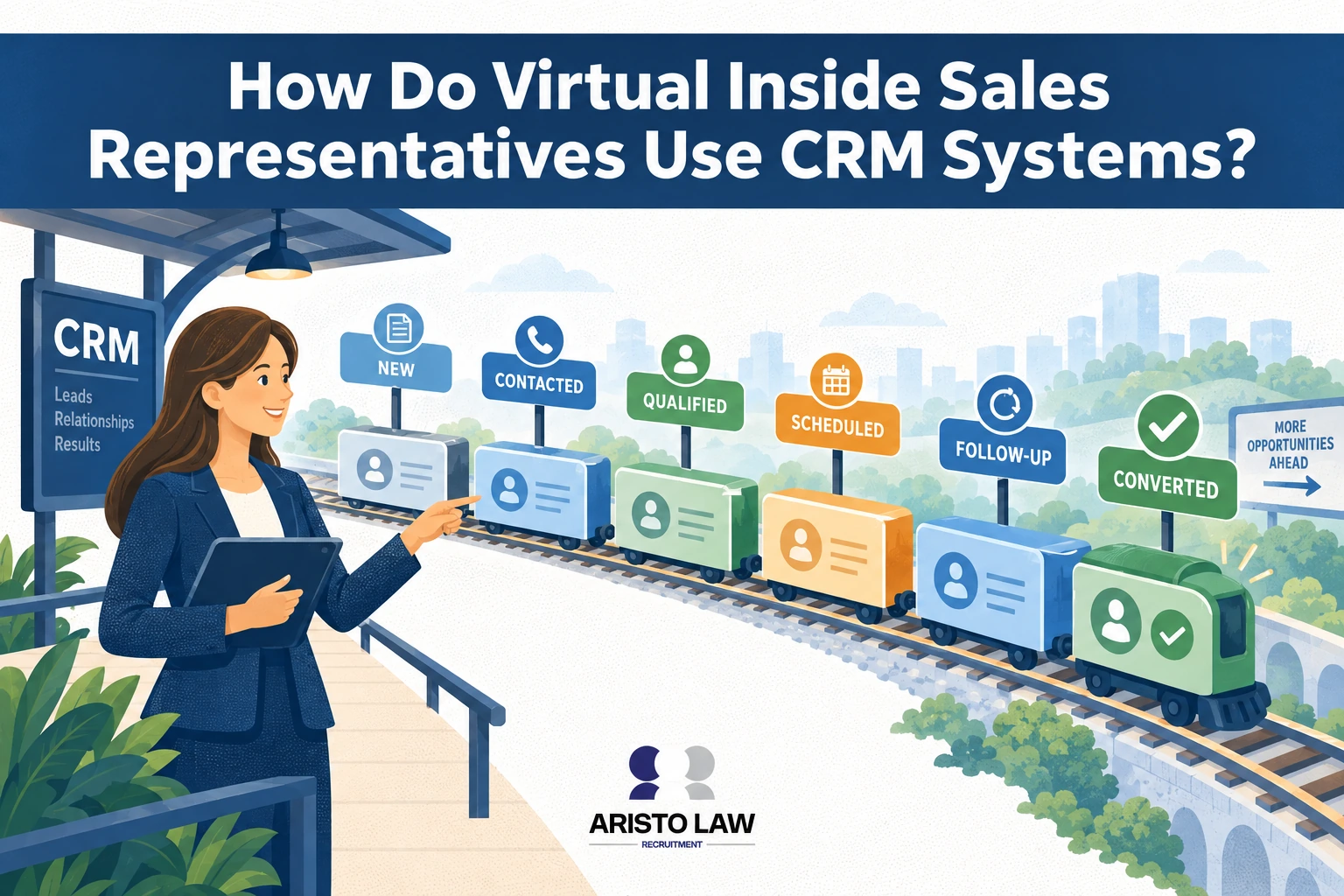
Virtual inside sales representatives use CRM systems to
record lead details, update pipeline stages, schedule follow-ups, track
source attribution, log conversations, and report conversion
performance. Modern CRM platforms function as the operational
control center for legal lead conversion because intake workflows
frequently involve multiple communication attempts, consultation stages,
scheduling actions, marketing channels, attorney handoffs, and follow-up
sequences occurring simultaneously across hundreds or thousands of
inquiries.
A 2026 study by Lawmatics showed that legal CRM systems help
firms achieve “fewer missed leads,” “more consistent intake,” “faster
response times,” and “higher conversion rates” by centralizing intake
workflows, automating follow-ups, and assigning ownership across intake
stages. Law firms using centralized CRM systems improve
response consistency, consultation booking, intake visibility, and
signed-client conversion because structured pipeline management reduces
communication gaps and unresolved leads.
Inside sales representatives commonly enter lead source data from PPC
campaigns, website forms, legal directories, referrals, social-media
campaigns, live chat systems, call-tracking platforms, and email
campaigns allowing firms to measure marketing ROI and intake quality by
channel. CRM workflows also track matter type, jurisdiction fit, urgency
level, qualification status, conflict-check routing, communication
preferences, and consultation readiness improving intake prioritization
and attorney escalation management.
Virtual inside sales representatives use CRM systems to track lead
activity, manage follow-up sequences, and organize communication data
across the sales pipeline. Virtual inside sales representatives also
adapt CRM-based workflow structures used in legal
case management systems to coordinate intake status,
client interactions, and task progression with higher operational
accuracy.
CRM systems also support no-show tracking, document-request
workflows, fee-agreement follow-up, consultation reminders, referral
attribution, and signed-client reporting improving operational
visibility across the intake funnel. Conversion reporting frequently
measures contact rate, qualification rate, consultation booking rate,
show rate, signed-client rate, response speed, and lead-source
performance helping firms optimize intake operations systematically.
Poor CRM hygiene creates major operational problems because
incomplete notes, outdated lead stages, missing follow-up tasks,
inaccurate source attribution, duplicate records, inconsistent tagging,
and unresolved communication history frequently cause missed follow-ups,
duplicate outreach, weak conversion reporting, intake confusion, and
lost revenue opportunities. Strong CRM discipline remains heavily
important for maintaining intake accountability, conversion visibility,
workflow continuity, and scalable legal lead-management operations.
What
tools do virtual inside sales representatives use?
Tools virtual inside sales representatives use include CRM
systems, analytics dashboards, and reporting spreadsheets.
Listed below are 18 the tools virtual inside sales representatives
use.
-
CRM systems: CRM platforms function as the central
pipeline-management system for legal intake and sales workflows. Virtual
inside sales representatives use CRM tools to track lead stages, log
communication history, assign follow-up tasks, monitor consultation
status, document no-shows, manage attorney handoffs, and report
signed-client conversion performance. -
Intake software: Intake systems capture prospect
information including matter type, jurisdiction details, urgency level,
conflict-review data, contact information, referral source, and
consultation requests. Structured intake workflows improve qualification
consistency and consultation readiness across distributed legal intake
teams. -
Call-tracking systems: Call-tracking platforms
identify which marketing channels generate phone inquiries, qualified
consultations, signed clients, and low-quality leads. Inside sales
representatives use call-tracking data to compare PPC campaigns, SEO
traffic, legal directories, referrals, and social-media conversion
performance. -
VoIP phone systems: Cloud-based VoIP systems support
remote calling, call routing, voicemail management, call recording,
intake escalation, and distributed intake communication allowing virtual
inside sales representatives to operate remotely without physical office
infrastructure. -
Calendar and scheduling tools: Scheduling platforms
coordinate attorney consultations, callback appointments, intake
follow-up, reminder workflows, and consultation rescheduling improving
attendance rates and intake continuity. -
Email automation tools: Email automation systems
send intake confirmations, consultation reminders, follow-up
communication, onboarding instructions, document requests, and no-show
recovery sequences improving intake responsiveness and communication
consistency. -
SMS communication tools: SMS systems support rapid
communication for appointment reminders, callback confirmations, intake
updates, scheduling coordination, and consultation follow-up because
text messaging frequently achieves higher response rates than email
alone. -
Live chat systems:Website chat tools capture inbound
website inquiries, after-hours prospects, consultation requests, and
intake questions before visitors leave the site. Chat systems frequently
improve lead-capture volume and response speed. -
Analytics dashboards: Reporting dashboards display
lead-source performance, response speed, contact rate, consultation
booking rate, show rate, signed-client conversion, marketing ROI, and
intake-team productivity helping firms optimize client-acquisition
workflows operationally. -
Reporting spreadsheets: Spreadsheet systems
frequently support custom reporting, intake audits, conversion tracking,
campaign analysis, workflow monitoring, and operational KPI management
when CRM reporting functions remain limited or require additional
customization. -
Workflow automation systems: Automation platforms
trigger callbacks, reminders, intake tasks, CRM updates, follow-up
sequences, scheduling notifications, and escalation alerts improving
intake efficiency and reducing manual workflow gaps. -
Document-sharing platforms: Secure file-sharing
systems allow intake teams to collect intake forms, identification
records, contracts, medical documents, police reports, or financial
records supporting consultation preparation workflows. -
Video conferencing tools: Video-meeting platforms
support virtual consultations, intake coordination, attorney meetings,
and remote client communication workflows improving scheduling
flexibility and geographic reach. -
AI-assisted intake systems: AI-supported intake
workflows help route inquiries, automate scheduling suggestions,
classify matter categories, generate intake summaries, and improve
communication responsiveness across high-volume intake pipelines. -
Task-management tools: Task boards and workflow
systems help representatives track unresolved callbacks, no-show
recovery actions, intake follow-up queues, consultation preparation
tasks, and escalation workflows improving operational
accountability. -
Reputation-management platforms: Reputation tools
monitor online reviews, referral feedback, and client-response trends
helping firms evaluate intake quality and client-experience
performance. -
Secure communication platforms: Encrypted messaging
and communication systems protect confidential intake communication,
client contact information, consultation coordination, and operational
workflow data supporting privacy compliance. -
Marketing attribution tools: Attribution systems
connect intake conversion results to advertising campaigns, referral
partners, SEO content, and social-media sources helping firms identify
which channels produce profitable signed clients.
Virtual inside sales operations function most effectively when CRM
systems, intake software, communication platforms, automation workflows,
and analytics tools operate together as a centralized lead-conversion
ecosystem improving intake visibility, follow-up consistency,
consultation management, and law-firm growth performance.
How
should law firms use AI in sales and intake workflows?
Ways law firms should use AI in sales and intake workflows
include lead scoring, analytics, and campaign reporting.
Virtual inside sales representatives improve law firm intake
workflows by qualifying leads, automating follow-up sequences, and
routing prospective clients based on case criteria and conversion
priority. Law firms integrating virtual inside sales representatives
into consultation scheduling, CRM synchronization, and response
automation demonstrate measurable AI
assistant tools applications and business impact across
intake speed, lead retention, and operational scalability.
Listed below are 12 ways law firms should use AI in sales and intake
workflows.
-
Lead scoring and intake prioritization: AI systems
help law firms rank inquiries based on urgency, practice-area fit,
communication behavior, geographic relevance, intake completeness, and
consultation readiness improving response prioritization across
high-volume intake pipelines. Human review remains necessary because
automated scoring systems incorrectly deprioritize valuable matters or
misclassify sensitive legal inquiries. -
Call summaries and intake-note generation:
AI-assisted transcription and summarization tools reduce manual
note-taking by converting intake calls into structured summaries,
communication logs, callback reminders, and qualification notes
improving CRM consistency and intake efficiency. Attorneys and intake
managers should still verify summaries because AI systems occasionally
omit context or generate inaccurate factual interpretations. -
Chat intake and website inquiry capture: AI chat
systems support after-hours intake, website engagement, FAQ routing,
appointment requests, and initial information gathering helping firms
reduce abandoned website inquiries and improve speed-to-lead
performance. Chat workflows should remain carefully supervised because
AI chatbots must not provide legal advice, predict outcomes, or create
unintended attorney-client relationships. -
Follow-up drafting and communication support: AI
tools help generate intake reminders, consultation confirmations,
follow-up emails, SMS communication, no-show recovery messages, and
onboarding communication improving workflow speed and communication
consistency. Human oversight remains important because legal intake
communication requires tone control, confidentiality awareness, and
attorney-approved language. -
CRM updates and workflow automation: AI systems help
update pipeline stages, assign follow-up tasks, categorize matter types,
route intake workflows, detect missing fields, and maintain intake
visibility reducing administrative workload across legal sales
operations. Firms should continuously review automated CRM actions
because inaccurate data handling weakens reporting quality and
conversion tracking. -
Analytics and conversion optimization: AI-powered
analytics identify which lead sources, campaigns, intake workflows,
response times, and communication patterns produce stronger
consultation-booking and signed-client conversion rates helping firms
optimize marketing ROI and intake operations systematically. -
Campaign reporting and marketing attribution: AI
reporting systems analyze PPC campaigns, SEO traffic, referral
performance, social-media inquiries, consultation-show rates, and
signed-client outcomes across intake channels improving marketing
decision-making and operational forecasting. -
Conversation analysis and coaching support: AI
systems review intake-call recordings identifying missed follow-up
opportunities, communication gaps, slow response patterns, intake
inconsistency, and objection-handling weaknesses improving inside sales
training and intake quality control. -
Scheduling automation and reminder management:
AI-driven scheduling tools support consultation coordination, reminder
timing, calendar synchronization, rescheduling workflows, and intake
confirmations improving attendance rates and operational
responsiveness. -
Lead-routing workflows: AI systems help distribute
inquiries according to practice area, urgency, jurisdiction, attorney
availability, language preference, or geographic region improving intake
efficiency and reducing routing delays. -
Document collection and intake completion support:
AI-assisted workflows remind prospects about missing forms,
identification records, contracts, police reports, medical records, or
financial documents helping improve consultation readiness and intake
completeness. -
Predictive intake reporting: AI forecasting tools
analyze intake trends, seasonal inquiry patterns, campaign performance,
consultation volume, and staffing demand helping firms improve
operational planning and resource allocation.
Law firms should use AI as a workflow-assistance system rather than
an unsupervised replacement for intake personnel, attorneys, or legal
judgment. Risks remain heavily important because AI systems generate
hallucinated facts, inaccurate summaries, biased qualification patterns,
improper lead scoring, weak confidentiality protection, over-automation
errors, or unauthorized legal guidance through chatbots and automated
communication systems. Attorney-approved review, human supervision,
secure systems, escalation controls, and confidentiality governance
remain necessary throughout AI-assisted legal intake and sales
workflows.
What
qualities make a good law firm inside sales representatives?
Qualities that make a good law firm inside sales representative
include empathy, follow-up consistency, and appointment-setting
ability.
Listed below are 18 qualities that make a good law firm inside sales
representative.
-
Empathy: Legal inquiries frequently involve injury,
criminal accusations, divorce, immigration stress, financial pressure,
employment disputes, or emotionally sensitive personal situations.
Empathetic communication improves trust, intake comfort, and
consultation engagement without crossing into legal counseling or
emotional dependency. -
Responsiveness: Fast response speed protects intake
opportunities because legal prospects commonly contact multiple firms
before choosing representation. Strong responsiveness improves contact
rate, consultation booking, and overall intake conversion
performance. -
Listening skill: Effective intake qualification
depends heavily on active listening. Strong listening improves matter
categorization, urgency recognition, conflict-review routing,
consultation readiness assessment, and attorney handoff quality. -
CRM discipline: Accurate CRM management prevents
missed follow-ups, duplicate outreach, unresolved intake tasks,
inaccurate source attribution, and weak conversion reporting. Strong CRM
discipline improves operational visibility and intake accountability
across legal sales workflows. -
Script control: Law-firm inside sales
representatives must follow attorney-approved intake scripts, escalation
rules, and communication standards carefully. Script discipline reduces
compliance exposure, intake inconsistency, misleading communication, and
unauthorized-practice-of-law risk. -
Ethical judgment: Legal intake workflows require
constant awareness of confidentiality, advertising compliance, fee
communication boundaries, solicitation concerns, and
attorney-supervision rules. Ethical judgment protects the firm from
intake misconduct and professional-responsibility exposure. -
Follow-up consistency: Many legal prospects delay
decisions, miss consultations, stop responding temporarily, or compare
multiple firms before hiring representation. Persistent but professional
follow-up improves consultation-show rate, intake recovery, and
signed-client conversion. -
Appointment-setting ability: Strong inside sales
representatives convert interest into attorney conversations efficiently
by coordinating schedules, reducing hesitation, confirming readiness,
and maintaining intake momentum throughout the consultation-booking
process. -
Communication clarity: Clear communication improves
intake understanding, scheduling accuracy, consultation preparation, and
workflow coordination reducing intake confusion and abandoned
inquiries. -
Professional composure: Intake personnel frequently
interact with distressed, frustrated, emotional, or urgent prospects.
Calm communication helps maintain professionalism and operational
stability during difficult conversations. -
Organizational skill: Intake pipelines involve
reminders, callbacks, consultation scheduling, CRM updates, document
requests, no-show recovery, and communication tracking requiring
structured workflow management. -
Confidentiality awareness: Inside sales
representatives frequently handle sensitive financial, medical,
criminal, employment, family, or litigation-related information
requiring disciplined confidentiality practices and secure communication
habits. -
Adaptability: Legal intake workflows shift quickly
based on urgency, practice area, attorney availability, court deadlines,
marketing campaigns, and communication volume requiring flexible
operational responsiveness. -
Objection-handling ability: Prospects frequently
hesitate because of timing, uncertainty, consultation anxiety,
scheduling conflicts, or fee concerns. Strong representatives maintain
intake momentum through professional clarification and attorney-approved
communication rather than pressure tactics. -
Attention to detail: Intake errors involving names,
dates, deadlines, contact information, matter categorization, or
conflict-check details frequently create operational risk and
consultation disruption. -
Escalation awareness: Effective representatives
recognize when emergency filings, legal questions, ethical concerns,
conflict issues, or emotionally sensitive situations require immediate
attorney involvement instead of standard intake handling. -
Technology proficiency: Modern intake systems depend
heavily on CRM platforms, scheduling systems, VoIP tools, automation
workflows, call tracking, analytics dashboards, and communication
software supporting distributed legal intake operations. -
Reliability and accountability: Law-firm growth
systems depend heavily on consistent intake ownership, communication
follow-through, workflow discipline, and measurable operational
accountability across distributed sales and intake environments.
Strong law-firm inside sales representatives improve conversion
performance not through aggressive sales pressure but through structured
intake discipline, ethical communication, operational consistency, and
reliable movement of qualified leads toward attorney-supervised
consultations and representation workflows.
How
should law firms hire virtual inside sales representatives?
Steps to hire virtual inside sales representatives for law
firms include defining the sales workflow, mapping intake stages and
training on ethics rules.
Virtual inside sales representatives help law firms manage lead
qualification, consultation follow-up, and client conversion workflows
through structured remote intake operations. Law firms use virtual
recruiter staffing support for law firms to source,
evaluate, and onboard virtual inside sales representatives with
experience in legal communication and case acquisition processes.
Listed below are the 15 steps to hire virtual inside sales
representatives for law firms.
-
Define the law-firm sales and intake workflow: Law
firms should first identify exactly where the inside sales
representative fits operationally including lead response,
qualification, consultation booking, no-show recovery, CRM management,
intake follow-up, and attorney handoff workflows. Clear workflow
ownership improves hiring accuracy and intake accountability. -
Map intake stages and conversion checkpoints: Firms
should document every intake stage including new inquiry, contacted
lead, qualified prospect, consultation scheduled, consultation
completed, retained client, and disengaged lead. Structured intake
mapping improves onboarding clarity and KPI visibility. -
Create attorney-approved scripts and escalation
rules: Intake communication should rely on approved scripts
covering inquiry response, qualification questions, consultation
scheduling, fee-discussion boundaries, no-show recovery, and attorney
escalation. Script governance reduces compliance exposure and intake
inconsistency. -
Screen for legal intake and consultative sales
experience: Candidates with prior law-firm intake, legal sales,
CRM-based intake operations, or consultative sales backgrounds adapt
faster to legal conversion workflows and emotionally sensitive
communication environments. -
Evaluate empathy and communication skill: Strong
inside sales representatives must communicate calmly, professionally,
and empathetically because legal prospects frequently contact firms
during stressful personal, financial, medical, family, or criminal
situations. -
Test phone handling and objection management: Law
firms should assess live communication skill, consultation-setting
ability, intake control, active listening, and objection handling during
simulated intake conversations or mock lead calls. -
Verify CRM discipline and workflow management:
Candidates should demonstrate experience updating pipeline stages,
assigning follow-up tasks, logging communication history, managing
reminders, tracking source attribution, and maintaining intake
visibility inside CRM systems. -
Assess writing quality and intake-note accuracy:
Representatives frequently draft follow-up messages, consultation
confirmations, intake summaries, CRM notes, and scheduling communication
requiring clear, organized, and professional written communication. -
Test compliance awareness and ethical judgment:
Candidates should understand boundaries involving legal advice, fee
promises, case-value discussions, confidentiality handling, solicitation
rules, and attorney-supervision requirements protecting the firm from
intake-related ethics exposure. -
Review confidentiality and data-handling practices:
Virtual inside sales representatives frequently access sensitive intake
records, communication history, and client information requiring strong
confidentiality discipline, secure-system awareness, and professional
data-handling practices. -
Assess no-show recovery and follow-up persistence:
Strong intake personnel maintain communication cadence, callback
persistence, reminder systems, and consultation recovery workflows
improving consultation-show rate and signed-client conversion. -
Conduct a practical intake simulation test:
Effective hiring processes frequently include a mock lead call, CRM
update exercise, follow-up email or SMS draft, intake qualification
workflow, scheduling scenario, and escalation decision test evaluating
operational readiness across real intake workflows. -
Train representatives on law-firm ethics and workflow
boundaries: New hires should receive structured onboarding
covering attorney advertising rules, intake compliance, confidentiality,
escalation procedures, approved communication standards, CRM workflows,
and unauthorized-practice-of-law restrictions. -
Measure early-stage intake KPIs during onboarding:
First-month review metrics frequently include response speed,
consultation booking rate, follow-up completion, CRM accuracy, no-show
recovery rate, intake-note quality, and signed-client conversion
visibility helping firms identify coaching needs early. -
Use specialized legal staffing support when operational
scaling is needed: Law firms frequently work with legal
staffing and remote intake providers such as Aristo Law when they need
pre-vetted virtual inside sales representatives familiar with intake
systems, CRM workflows, legal communication standards, and
attorney-supervised client-acquisition operations.
Law firms achieve stronger hiring outcomes when virtual inside sales
representatives are selected for operational discipline, intake
consistency, ethical judgment, communication quality, CRM proficiency,
and law-firm workflow fit rather than generic high-pressure sales
ability alone.
How
should law firms train virtual inside sales representatives?
Steps to train virtual inside sales representatives include
teaching ethics rules, defining intake stages, and measuring conversion
metrics.
Listed below are the 16 steps to train virtual inside sales
representatives.
-
Teach legal ethics and compliance rules first:
Training should begin with confidentiality obligations, attorney-client
privilege awareness, unauthorized-practice-of-law restrictions,
advertising compliance, fee-discussion boundaries, and nonlawyer
supervision rules because intake compliance failures create major
operational and ethical risk for law firms. -
Define every intake and conversion stage clearly:
Representatives should understand how inquiries move through the
pipeline including new lead, contacted, qualified, consultation
scheduled, consultation completed, retained, declined, no-show, and
follow-up pending stages improving workflow ownership and conversion
visibility. -
Approve scripts and communication standards: Law
firms should train representatives on attorney-approved intake scripts
covering inquiry response, qualification questions, consultation
scheduling, no-show recovery, fee-language boundaries, escalation
triggers, and follow-up communication reducing intake inconsistency and
compliance exposure. -
Train CRM use and pipeline management discipline:
Representatives should learn how to update lead stages, assign follow-up
tasks, document communication history, track source attribution, log
no-show status, route conflict-check information, and maintain accurate
CRM records supporting operational visibility and intake
accountability. -
Explain practice-area basics without legal analysis:
Intake personnel should understand high-level differences between
practice areas such as personal injury, family law, immigration,
criminal defense, estate planning, and employment law helping improve
routing accuracy and matter categorization without crossing into legal
advice. -
Teach lead qualification workflows: Training should
cover jurisdiction fit, urgency assessment, consultation readiness,
opposing-party collection, conflict-check routing, scheduling
qualification, and attorney-escalation triggers improving intake
consistency and conversion quality. -
Train approved fee language and intake boundaries:
Representatives should learn how to explain attorney-approved
consultation procedures, contingency structures, retainers, or billing
processes without independently negotiating fees, making promises, or
altering engagement terms. -
Develop urgent-lead escalation protocols: Intake
systems should train representatives to recognize emergency filings,
arrest situations, domestic safety concerns, statute limitations,
time-sensitive hearings, or emotionally sensitive matters requiring
immediate attorney involvement. -
Run mock calls and intake simulations regularly:
Mock lead calls help representatives practice intake flow, objection
handling, consultation scheduling, escalation awareness, communication
tone, and intake control before interacting with real prospects. -
Review call recordings and intake communication:
Ongoing call review helps firms improve qualification quality, empathy,
communication clarity, intake discipline, and workflow consistency
without turning legal intake into aggressive pressure sales. -
Train consultation-booking and no-show recovery
workflows: Representatives should learn scheduling
coordination, reminder systems, consultation confirmations, no-show
follow-up procedures, and rescheduling workflows improving attendance
rates and intake continuity. -
Reinforce confidentiality and secure-system use
continuously: Intake teams should receive ongoing training on
secure communication systems, password standards, role-based access, CRM
permissions, document handling, and privacy controls protecting
sensitive lead information. -
Teach CRM hygiene and reporting accuracy: Strong CRM
discipline reduces missed follow-ups, duplicate outreach, inaccurate
reporting, unresolved tasks, and intake confusion improving law-firm
conversion visibility and operational control. -
Measure conversion and intake KPIs during training:
Firms should monitor response speed, contact rate, consultation booking
rate, show rate, signed-client conversion, follow-up completion, and CRM
accuracy helping identify coaching needs and operational weaknesses
early. -
Provide ongoing coaching rather than one-time onboarding
only: Legal intake workflows change frequently because of
practice-area growth, marketing campaigns, automation updates, staffing
shifts, and ethics-review requirements. Continuous coaching improves
intake quality, compliance consistency, and conversion performance over
time. -
Separate consultative intake from aggressive sales
culture: Law-firm inside sales training should emphasize
empathy, intake discipline, communication quality, operational
consistency, and attorney-supervised conversion systems rather than
manipulative pressure tactics because legal prospects contact firms
during stressful and emotionally sensitive situations.
How
should law firms measure inside sales performance?
Virtual inside sales representatives in law firms are
evaluated through conversion efficiency, lead responsiveness, intake
quality, and retained client value.
The table below shows inside sales performance metrics for law
firms.
| Metric | What It Measures | Why It Matters |
|---|---|---|
| First-response time | Time between lead submission and first contact attempt | Faster response improves contact rate, consultation conversion, and intake responsiveness because legal prospects frequently contact multiple firms simultaneously. |
| Contact rate | Percentage of leads successfully reached through phone, SMS, email, or chat communication |
Strong contact rates improve intake visibility and reduce lost opportunities from unanswered inquiries. |
| Qualified lead rate | Percentage of contacted leads meeting practice-area, jurisdiction, urgency, and service-fit standards |
Qualification accuracy improves attorney time use and reduces consultations with poor-fit inquiries. |
| Consultation booking rate | Percentage of qualified leads converted into scheduled consultations |
Booking rate measures intake effectiveness and conversion efficiency across the sales pipeline. |
| Consultation show rate | Percentage of scheduled consultations completed successfully | High show rates improve attorney calendar utilization and signed-client opportunity volume. |
| No-show recovery rate | Percentage of missed consultations successfully rescheduled or re-engaged |
Recovery workflows reduce revenue loss from abandoned intake opportunities. |
| Follow-up completion rate | Percentage of required callbacks, reminders, emails, and intake tasks completed on time |
Consistent follow-up improves consultation conversion and reduces unresolved lead backlog. |
| CRM note accuracy | Accuracy and completeness of intake notes, communication history, lead status, and follow-up documentation |
Strong CRM hygiene improves operational visibility, intake continuity, and reporting reliability. |
| Lead source conversion rate | Conversion performance by PPC campaign, referral source, legal directory, website form, or marketing channel |
Source tracking helps firms identify which channels generate profitable consultations and signed clients. |
| Fee-agreement follow-up completion | Percentage of post-consultation fee or retainer follow-up workflows completed properly |
Strong fee-follow-up systems improve signed-client conversion and onboarding continuity. |
| Signed-client rate | Percentage of consultations converting into retained clients | Signed-client conversion directly measures intake and sales workflow effectiveness. |
| Lead-response consistency | Reliability of communication timing across all intake channels and lead sources |
Consistent responsiveness improves client trust and intake accountability. |
| Pipeline-stage accuracy | Accuracy of lead-stage updates inside CRM workflows | Accurate pipeline visibility improves forecasting, intake management, and workflow coordination. |
| Missed-call recovery rate | Percentage of unanswered calls successfully returned and re-engaged |
Rapid callback systems reduce intake leakage and improve conversion opportunity retention. |
| Consultation scheduling accuracy | Accuracy of appointment details, reminders, timezone handling, and calendar coordination |
Scheduling precision reduces no-shows and intake confusion. |
| Urgent-lead escalation accuracy | Percentage of emergency or time-sensitive matters correctly routed to attorneys quickly |
Proper escalation protects clients and reduces operational risk during critical legal situations. |
| Script adherence score | Compliance with attorney-approved intake scripts and communication standards |
Script discipline reduces ethics exposure, misleading communication, and unauthorized-practice-of-law risk. |
| Escalation accuracy | Correct identification of legal questions, conflicts, fee issues, or attorney-review triggers |
Proper escalation protects compliance and improves intake workflow quality. |
| Consultation readiness rate | Percentage of consultations arriving with completed forms and requested documents |
Better consultation preparation improves attorney efficiency and client experience. |
| Lead aging time | Average amount of time leads remain unresolved inside the intake pipeline |
Long lead-aging periods indicate follow-up breakdown or intake bottlenecks. |
| Response-channel effectiveness | Conversion performance by phone, SMS, email, chat, or referral communication channel |
Channel analysis improves intake communication strategy and outreach optimization. |
| Retention of qualified leads | Percentage of qualified leads remaining active throughout intake follow-up workflows |
Lead retention measures intake persistence and communication effectiveness. |
| Client communication quality | Professionalism, empathy, clarity, and responsiveness during intake interactions |
Communication quality strongly influences trust, consultation attendance, and conversion performance. |
| Objection-handling effectiveness | Ability to maintain intake momentum during hesitation, scheduling resistance, or consultation uncertainty |
Effective objection handling improves booking rates without creating pressure-sales behavior. |
| Compliance review score | Overall adherence to confidentiality rules, ethics policies, fee-language standards, and intake governance |
Compliance monitoring protects the law firm from advertising, intake, and professional-responsibility exposure. |
Law firms achieve stronger inside sales performance when KPIs connect
directly to intake responsiveness, conversion efficiency, CRM
discipline, compliance control, and operational consistency rather than
measuring call volume or aggressive sales activity alone.
How much
do virtual inside sales representatives cost?
Virtual inside sales representatives cost between $15 and $60
per hour or $30,000–$90,000 annually. Virtual inside sales
representative cost depends on sales experience, legal intake knowledge,
location, hours, compensation model, CRM skills, lead volume, and
whether the role is direct-hire, freelance, offshore, or agency-managed.
Law-firm intake and conversion roles frequently cost more than general
virtual assistant support because inside sales representatives handle
consultation booking, intake qualification, follow-up communication, CRM
management, no-show recovery, and client-acquisition workflows directly
affecting signed-client conversion and revenue operations.
Compensation structures commonly vary between hourly pay, monthly
retainers, salaried remote staffing, base-plus-performance models,
commission-supported intake roles, agency-managed staffing programs, and
outsourced intake-service arrangements. Firms handling high lead volume,
multi-channel intake campaigns, after-hours response coverage, or
practice areas requiring emotionally sensitive communication frequently
invest more heavily in experienced intake and sales personnel because
conversion quality affects revenue performance.
Cost-effectiveness depends heavily on operational performance rather
than low hourly rates alone. Lower-cost representatives frequently
become expensive operationally when they mishandle emotionally sensitive
leads, delay response time, create scheduling confusion, ignore CRM
updates, violate intake scripts, weaken follow-up consistency, reduce
consultation-show rates, or create advertising and compliance risk
through improper intake communication. Strong inside sales systems
evaluate staffing value through consultation conversion, signed-client
rate, intake responsiveness, CRM accuracy, no-show recovery, and
operational reliability rather than compensation cost alone.
Should law firms pay
sales reps commission?
Law firms should treat commission for sales reps carefully
because legal ethics, fee-sharing limits, advertising rules, and
nonlawyer compensation rules restrict performance-based payment
structures. Legal intake and sales operations differ from
traditional commercial sales environments because law firms must balance
growth objectives with professional-responsibility obligations, attorney
supervision requirements, confidentiality protections, and restrictions
involving nonlawyer participation in legal-service revenue generation.
Many jurisdictions scrutinize compensation arrangements connecting
nonlawyer payment directly to legal fees, case outcomes, settlement
value, or representation revenue.
Law firms commonly use safer compensation structures such as base
salary, hourly pay, fixed monthly retainers, administrative performance
bonuses, consultation-booking incentives, response-speed metrics,
follow-up completion targets, CRM accuracy goals, intake-quality
benchmarks, or team-based operational bonuses rather than aggressive
commission models tied directly to signed-case revenue.
Intake-performance incentives frequently focus on measurable workflow
activity such as consultation attendance, response consistency, no-show
recovery, intake completeness, scheduling accuracy, or client-service
quality improving operational accountability without creating improper
financial incentives around legal outcomes.
Team-oriented incentives frequently create lower compliance risk than
aggressive individual commission structures because collaborative intake
systems encourage communication quality, workflow consistency,
confidentiality discipline, and proper attorney handoff rather than
high-pressure intake behavior. Law firms should additionally review
whether referral arrangements, intake outsourcing models, marketing
partnerships, or third-party intake providers create indirect
fee-sharing exposure under applicable professional-responsibility
standards.
When
should a law firm hire a virtual inside sales representative?
A law firm should hire a virtual inside sales representative
when there are slow lead responses, missed calls, and attorney overload
from sales conversations.
Listed below are 18 occasions when a law firm should hire a virtual
inside sales representative.
-
Slow lead response: Law firms should hire inside
sales support when website inquiries, PPC leads, referrals, chat
messages, or intake calls wait too long for follow-up. Slow response
frequently lowers consultation conversion because legal prospects
contact multiple firms before hiring representation. -
Missed calls and unreturned voicemails: Repeated
missed calls indicate intake ownership problems and lost revenue
opportunities. Firms struggling with live call coverage or callback
speed requires a virtual inside sales representative or virtual
receptionist depending on whether the problem involves conversion
follow-up or basic call handling. -
Poor follow-up consistency: Leads frequently
disengage when firms fail to maintain callback cadence, reminder
systems, consultation confirmations, or intake communication. Inside
sales representatives improve follow-up structure and intake
accountability across the conversion pipeline. -
Low consultation booking rates: Firms generating
inquiries but struggling to convert leads into consultations need
stronger qualification workflows, intake communication, objection
handling, and scheduling coordination. This bottleneck frequently
signals the need for inside sales support rather than more marketing
spend alone. -
High no-show rates: Missed consultations indicate
weak reminder systems, poor consultation preparation, or inconsistent
intake communication. Inside sales representatives strengthen
confirmation workflows, rescheduling systems, and no-show recovery
improving attorney calendar utilization. -
Weak CRM tracking and intake visibility:
Disorganized lead stages, missing follow-up tasks, duplicate outreach,
unresolved inquiries, or incomplete intake notes frequently reduce
conversion visibility and intake accountability. Firms experiencing CRM
breakdown benefit from dedicated intake and sales workflow
ownership. -
Attorney overload from intake and sales
conversations: Attorneys frequently lose productivity when
balancing legal work with intake calls, consultation scheduling,
callback follow-up, and lead management simultaneously. Virtual inside
sales representatives protect attorney time by managing intake
communication and conversion workflows operationally. -
Growing marketing spend without improved signed-client
conversion: Firms increasing PPC budgets, SEO investment,
referral campaigns, or advertising volume without stronger signed-client
performance have an intake-conversion bottleneck rather than a
lead-generation problem. -
Inconsistent intake communication quality: Poor
intake tone, delayed callbacks, weak qualification, or inconsistent
communication frequently damages client trust and conversion
performance. Dedicated inside sales personnel improve intake
professionalism and workflow consistency. -
Lead volume exceeds existing support capacity: Rapid
intake growth frequently overwhelms attorneys, receptionists, or
administrative staff causing unresolved follow-up, delayed
qualification, and consultation leakage. Inside sales support helps
firms scale intake operations without immediate in-office staffing
expansion. -
Low conversion from paid advertising campaigns:
Firms receiving high PPC traffic but weak consultation conversion
frequently require stronger speed-to-lead management, intake
qualification, and follow-up persistence rather than additional
advertising volume. -
After-hours inquiries remain unmanaged: Website
leads, live-chat inquiries, and voicemail messages submitted outside
office hours frequently become lost opportunities without structured
remote intake coverage and callback systems. -
Referral leads receive inconsistent handling:
Referral relationships weaken when referred prospects experience delayed
intake response or poor communication. Inside sales representatives
improve intake responsiveness and referral-source retention. -
Consultation scheduling consumes too much staff
time: Firms struggling with reminders, rescheduling,
consultation confirmations, and intake coordination need operational
intake support rather than additional legal staffing. -
The firm needs intake conversion rather than legal workflow
support: Firms primarily struggling with lead response,
consultation booking, follow-up persistence, and intake communication
need a virtual inside sales representative. Firms struggling with
factual intake processing require an intake specialist, while
administrative scheduling overload signals the need for a legal
assistant or virtual receptionist. -
Marketing performance lacks operational reporting:
Firms unable to track response speed, contact rate, booking rate, show
rate, or signed-client conversion frequently need structured CRM
management and intake reporting systems supported by inside sales
personnel. -
The firm wants scalable intake growth without expanding
physical staffing: Virtual inside sales representatives allow
firms to improve intake responsiveness, conversion management, and
client-acquisition workflows through centralized remote intake
operations. -
Specialized intake staffing support is needed
quickly: Firms scaling intake operations frequently work with
remote legal staffing providers such as Aristo Law to access trained
virtual inside sales representatives familiar with legal intake systems,
consultation workflows, CRM management, and attorney-supervised lead
conversion processes.
Law firms benefit most from hiring virtual inside sales
representatives when intake breakdowns begin reducing conversion
performance, attorney focus, marketing ROI, client experience, or
operational visibility rather than waiting until unresolved leads and
missed consultations create severe revenue loss.
Are
virtual inside sales representatives right for law firms?
Successful implementation also depends on attorney-approved scripts,
active CRM systems, and clearly managed ethical boundaries.
Research by Consultwebs in 2025 showed that law firms with
structured intake systems and rapid-response workflows convert more
leads into signed clients because delayed responses and inconsistent
follow-ups cause firms to lose potential clients. The study found that
centralized intake processes improve responsiveness, workflow
visibility, and operational consistency. Law firms improve
consultation conversion, response consistency, intake visibility, and
signed-client growth when lead-management workflows operate through
centralized intake ownership and structured CRM systems rather than
fragmented receptionist handling or overloaded attorney communication.
Virtual inside sales support fits firms experiencing measurable intake
friction rather than firms still struggling to generate consistent
inquiries.
Lead volume remains one of the strongest decision factors because
inside sales systems create the most operational value when firms manage
recurring website inquiries, PPC campaigns, referrals, legal-directory
traffic, live chat conversations, or outbound follow-up workflows
requiring fast response and structured communication cadence. Practice
area also matters because high-volume consumer-facing practices such as
personal injury, family law, immigration, criminal defense, employment
law, and bankruptcy frequently benefit more from dedicated intake
conversion support than low-volume relationship-based practices relying
heavily on direct attorney referral networks.
CRM readiness and workflow structure remain heavily important because
virtual inside sales representatives depend on organized intake stages,
communication logging, source tracking, follow-up systems, automation
workflows, and measurable conversion reporting to operate effectively.
Firms without active CRM systems, documented intake procedures, callback
ownership, consultation scheduling workflows, or follow-up
accountability frequently experience operational confusion regardless of
staffing quality.
Law firms should additionally evaluate conversion gaps carefully.
High missed-call rates, delayed response speed, inconsistent follow-up,
weak consultation booking, low show rate, intake backlog, or attorney
overload from intake communication indicate strong operational fit for
virtual inside sales support. Marketing spend also influences the
decision because firms investing heavily in PPC campaigns, SEO,
social-media advertising, referrals, or legal lead generation frequently
lose ROI when intake systems fail to convert inquiries consistently.
Ethical boundaries and supervision capacity remain critical because
inside sales personnel must operate through attorney-approved scripts,
escalation rules, confidentiality systems, CRM governance, and intake
compliance controls preventing unauthorized legal advice, misleading
communication, or improper fee discussions. Compensation structures
should additionally align with professional-responsibility obligations
and jurisdiction-reviewed intake policies before implementation.
Law firms with steady inquiry flow, structured intake systems, active
CRM pipelines, measurable conversion goals, and operational supervision
gain faster value from virtual inside sales representatives. Firms
lacking reliable lead flow, intake ownership, CRM discipline, or
documented intake workflows should strengthen marketing systems,
consultation processes, and operational foundations first before scaling
remote inside sales support.
Build a legal support team that moves work forward.
Tell us what is slowing your practice down. We will help map the role, workflow, and support structure that fits.