
Family Law Virtual Paralegal Support: Divorce Case Management, Legal Workflow Efficiency, and Remote Legal Assistance

Practical guidance for building efficient, accountable legal support operations.
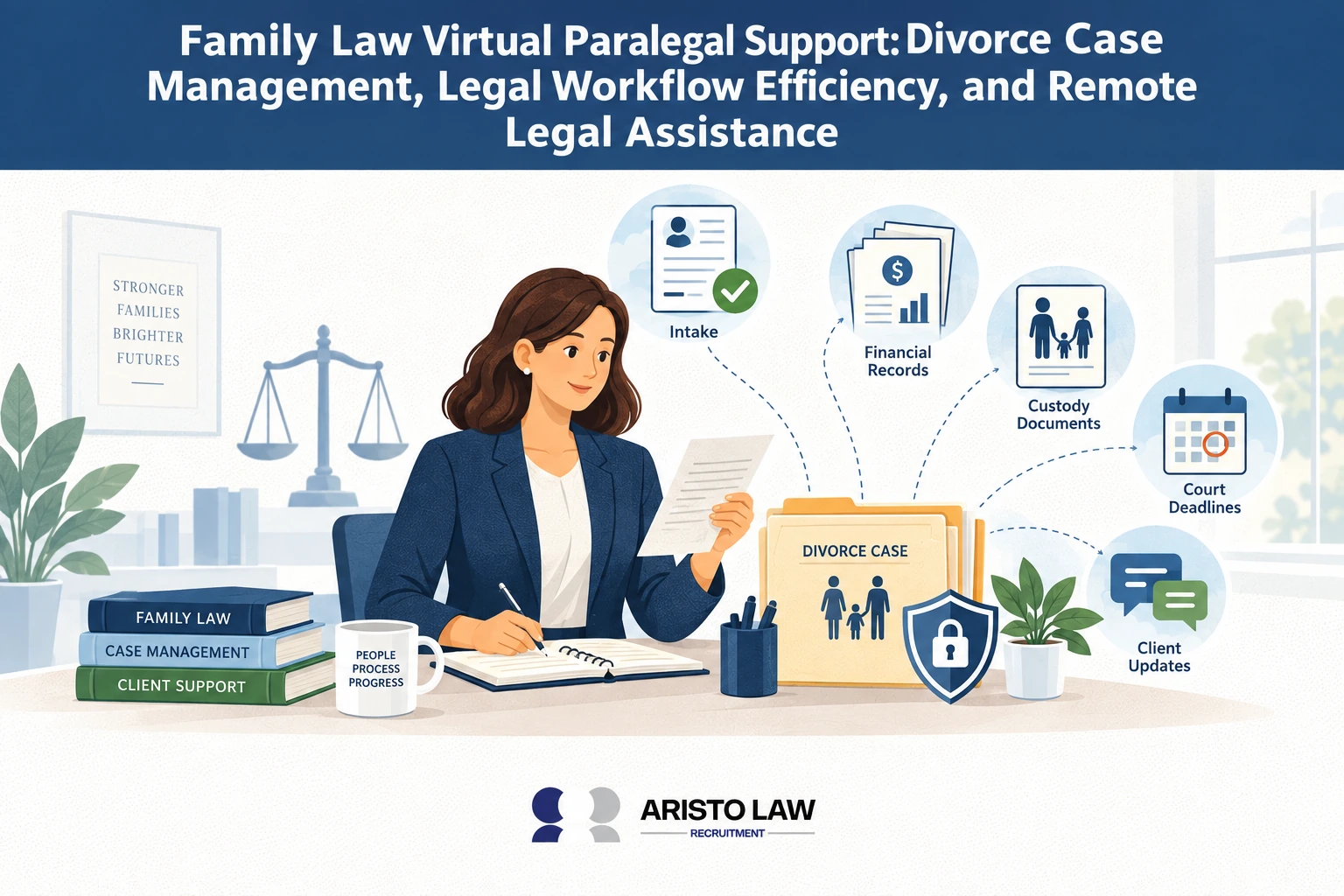
Family law virtual paralegal support provides remote legal
assistance for divorce, custody, support, and family law workflows
through digital case-management systems, secure communication platforms,
and cloud-based legal operations tools.
A study by M. Sadiku, P. Adekunte, and J. Sadiku from the
International Journal of Trend in Scientific Research and Development,
titled “Virtual Legal Assistant,” in 2025, the researchers reported that
virtual and remote legal staff improve workflow coordination, document
management, deadline tracking, and client communication across law firm
operations.
Virtual family law paralegals support attorneys by managing case
files, preparing legal documents, organizing discovery, coordinating
schedules, handling intake support, and maintaining client communication
throughout family law proceedings. Virtual legal assistants differ from
virtual paralegals because paralegals handle more advanced legal
workflow responsibilities, such as drafting pleadings, organizing
litigation materials, and supporting procedural family law operations
under attorney supervision.
Virtual support improves divorce case management by accelerating
document coordination, reducing administrative burden, centralizing
workflow tracking, and improving responsiveness across active legal
matters. Common outsourced tasks include filing coordination, discovery
organization, hearing scheduling, document preparation, client updates,
financial document management, and mediation coordination. Attorney-only
responsibilities such as legal advice, courtroom representation, legal
strategy, and settlement authority remain non-delegable. Research
discussing legal operations efficiency reported that standardized legal
workflows and organized case management improve productivity and
procedural consistency in document-heavy legal environments.
Solo attorneys and small firms benefit from virtual paralegal support
through lower staffing costs, scalable workflow capacity, improved
scheduling flexibility, and faster client communication without
expanding full in-house legal teams. Virtual family law support commonly
operates through cloud-based case-management systems, encrypted
communication tools, secure file-sharing platforms, e-signature systems,
and digital calendaring software protected through confidentiality
controls, restricted-access permissions, and cybersecurity
protocols.
Virtual paralegal pricing models include hourly billing, monthly
retainers, contract-based support, or outsourced legal staffing
arrangements that cost less than full-time in-house staffing due to
reduced office overhead and operational expenses. Effective virtual
family law paralegals demonstrate strong case-management skills, family
law workflow experience, confidentiality awareness, legal software
proficiency, organized communication practices, and reliable remote
legal support systems.
Aristolaw helps law firms manage family law virtual paralegal
support by providing outsourced support for divorce case management,
client document organization, court filing coordination, discovery
tracking, scheduling assistance, and remote family law workflows. Hire
Family Law Virtual Paralegal Support with Aristolaw today.
Aristolaw connects law firms with outsourcing solutions that match
trained family law paralegal staff to each divorce case task, legal
workflow need, client communication duty, filing support function, and
remote legal assistance responsibility.
What is family law
virtual paralegal support?
Family law virtual paralegal support is remote legal
assistance that helps family law attorneys manage divorce cases, client
communication, legal documents, deadlines, and case workflows.
Many firms use virtual
family law paralegal assistant support systems to
improve divorce case management, maintain organized legal workflows, and
reduce administrative pressure during emotionally sensitive family law
matters.

Remote family law paralegals support attorneys through document
preparation, discovery organization, scheduling coordination, deadline
tracking, case-file management, intake support, and procedural workflow
management under attorney supervision. These remote legal assistance
workflows help law firms maintain client responsiveness, protect filing
deadlines, organize financial and custody documentation, and improve
operational efficiency across active family law cases.
Remote administrative help and substantive paralegal support differ
in legal workflow complexity and responsibility. Virtual legal
assistants handle scheduling, intake communication, calendar
coordination, billing support, and administrative organization, while
family law virtual paralegals manage more advanced legal-support
functions such as preparing pleadings, organizing litigation materials,
coordinating discovery, maintaining procedural compliance, and
supporting hearing preparation under attorney direction.
Family law firms use both support structures to reduce attorney
administrative overload, improve workflow continuity, and maintain
organized client-service operations throughout divorce proceedings,
custody disputes, support matters, mediation workflows, and related
family law litigation activities.
What does a virtual
family law paralegal do?
A virtual family law paralegal’s responsibilities include
case intake, divorce document preparation, calendar tracking, and client
communication support throughout family law proceedings under attorney
supervision. A virtual family law paralegal’s responsibilities
follow the operational lifecycle of divorce, custody, support, and
related family law matters.
Listed below are the 12 virtual family law paralegals’
responsibilities.
-
Pre-filing intake support: collecting client
information, organizing initial records, managing intake questionnaires,
and preparing case files for attorney review -
Divorce document preparation: drafting petitions,
affidavits, financial disclosures, parenting plans, and procedural
family court forms under attorney supervision -
Financial-document organization: collecting tax
records, bank statements, income records, expense documentation, and
support-related financial materials -
Discovery coordination: tracking document requests,
organizing evidence, managing disclosures, and monitoring discovery
deadlines -
Court filing coordination: preparing filing packets,
managing e-filing workflows, tracking submission confirmations, and
monitoring procedural compliance -
Calendar and deadline tracking: managing hearings,
mediation sessions, consultations, filing deadlines, and attorney
scheduling workflows. -
Client communication support: providing procedural
updates, requesting missing documents, coordinating scheduling changes,
and maintaining organized communication records -
Mediation preparation: organizing settlement
documents, parenting schedules, financial summaries, and mediation
support materials -
Hearing and trial preparation: organizing exhibits,
witness information, hearing binders, timelines, and litigation support
documentation -
Workflow management: maintaining cloud-based case
files, updating workflow systems, tracking case progress, and reducing
administrative workload for attorneys -
Post-judgment follow-up: supporting enforcement
filings, modification requests, updated financial disclosures, and
procedural follow-up after court orders or settlements -
Remote legal workflow support: managing digital
case-management systems, secure file-sharing platforms, e-signature
workflows, and virtual legal communication systems to improve
operational efficiency across family law practices
What
is the difference between a virtual legal assistant and a virtual
paralegal?
The difference between a virtual legal assistant and a
virtual paralegal is that virtual legal assistants mainly handle
administrative and operational support, while virtual paralegals handle
more substantive legal workflow support under attorney
supervision.
The table below shows the difference between a virtual legal
assistant and a virtual paralegal.
Area |
Virtual Legal
|
Virtual
|
|---|---|---|
| Primary role | Administrative and operational support | Substantive legal workflow support under attorney direction |
| Client intake | Handles intake scheduling, questionnaires, and communication setup |
Reviews intake records and organizes legal case information |
| Scheduling support | Manages calendars, appointments, hearings, and reminders | Tracks legal deadlines and procedural scheduling requirements |
| Document formatting | Formats documents and manages templates | Drafts and prepares legal documents under supervision |
| Case management updates | Updates workflow systems and client records | Maintains legal case progression and procedural tracking |
| Drafting assistance | Limited to administrative templates and formatting | Assists with pleadings, affidavits, disclosures, and motions |
| Discovery organization | Organizes files and tracks document requests | Coordinates discovery workflows and evidence organization |
| Legal research | limited or administrative only | Conducts legal research and procedural review support |
| Billing support | Manages invoicing, payment tracking, and administrative billing tasks |
support legal billing tied to case workflows |
| Attorney supervision | Works under operational direction | Works under direct attorney supervision for legal tasks |
| Substantive legal work | Minimal or limited | Higher involvement in legal workflow coordination |
| Client communication | Handles updates, scheduling, and administrative follow-up | Handles procedural communication and legal workflow coordination |
| Workflow overlap | Shares intake, scheduling, and communication tasks with paralegals |
Shares administrative coordination tasks with legal assistants |
| Legal responsibility level | Lower procedural responsibility | Higher procedural and legal documentation responsibility |
| Common work environment | Law firms, solo practices, virtual legal operations | Litigation support, family law, corporate law, and legal operations support |
How
does virtual paralegal support improve divorce case management?
Virtual paralegal support improves divorce case management by
organizing documents, deadlines, discovery, client updates, and attorney
workflows in a centralized digital system. Many firms use family
law virtual paralegal support in divorce case workflows
to improve case visibility, reduce administrative overload, and maintain
organized family law operations during divorce proceedings. Divorce case
management involves intake coordination, conflict checks, financial
record organization, parenting-plan preparation, court-form management,
discovery tracking, mediation preparation, hearing scheduling, and
deadline monitoring.
Family law cases create administrative pressure because firms manage
emotionally distressed clients, sensitive financial records, custody
disputes, urgent filings, and deadline-heavy court procedures
simultaneously.
Virtual paralegal support reduces workflow delays by organizing case
files, tracking deadlines, coordinating communication, preparing
documents, managing discovery workflows, and maintaining centralized
legal records through cloud-based legal systems. Remote support also
improves responsiveness through faster document turnaround, fewer missed
calls, consistent client updates, and stronger attorney focus on legal
strategy and litigation management.
Which
family law tasks can be outsourced to a virtual paralegal?
Family law tasks that can be outsourced to a virtual
paralegal include intake support, document drafting assistance,
discovery organization, financial record review, e-filing coordination,
and case status tracking under attorney supervision. Attorney
review remains necessary for legal advice, legal strategy, settlement
decisions, courtroom representation, and final approval of legal
filings. Family law tasks that are outsourced to a virtual paralegal
support operational efficiency across divorce and custody workflows.
Listed below are the 15 family law tasks that are outsourced to a
virtual paralegal.
-
Intake support: collecting client information,
organizing intake forms, and preparing case files -
Uncontested divorce paperwork: drafting procedural
divorce forms and organizing supporting documentation -
Custody-document assembly: preparing parenting-plan
drafts, visitation schedules, and custody-related forms -
Child-support worksheet preparation support:
organizing financial records and preparing calculation worksheets for
attorney review -
Financial record organization: reviewing tax
records, bank statements, income documentation, and expense
summaries -
Marital asset summaries: organizing property, debt,
and asset documentation for case preparation -
Discovery organization: tracking disclosures,
organizing evidence, and managing document exchange workflows -
E-filing coordination: preparing filing packets,
uploading court documents, and monitoring submission confirmations -
Client follow-ups: requesting missing records,
confirming signatures, and providing procedural updates -
Case status tracking: updating workflow systems,
monitoring deadlines, and maintaining centralized case visibility. -
Hearing packet preparation: organizing exhibits,
affidavits, timelines, and hearing materials -
Exhibit organization: labeling, categorizing, and
preparing evidence for hearings or mediation -
Calendar coordination: scheduling hearings,
consultations, mediation sessions, and procedural deadlines -
Case management platform updates: maintaining
digital case records, workflow tracking, and document repositories -
Document formatting support: organizing motions,
disclosures, declarations, and procedural court forms for attorney
review
What
legal workflows benefit most from remote family law support?
Family law workflows that benefit most from remote support
include intake management, financial-disclosure organization,
calendaring, and e-filing because these workflows involve repetitive
documentation, deadline tracking, and high-volume
communication. Many firms use litigation
case manager support for legal workflow systems to
standardize legal operations, improve case visibility, and recover
attorney time through centralized workflow management.
In a study by G. Jafarov and S. Sharifov from the Advanced
Engineering Forum, titled “Cloud-Based Legal Solutions: Streamlining
Legal Processes and Case Management,” in 2026, the researchers found
that structured digital workflows improve deadline tracking, document
coordination, communication management, and operational efficiency
across litigation environments.
The table below shows the family law workflows that benefit most from
remote support.
Workflow Area |
Remote Paralegal
|
Efficiency
|
|---|---|---|
| Client intake | Collects intake forms, organizes records, and prepares case files |
Faster onboarding and reduced attorney administrative workload |
| Pleadings preparation | Drafts procedural documents and organizes filing packets under supervision |
Faster document turnaround and standardized legal documentation |
| Discovery coordination | Tracks disclosures, organizes evidence, and manages document exchange |
Improved workflow visibility and reduced discovery delays |
| Financial disclosures | Organizes tax records, bank statements, and support-related documentation |
Faster financial review and improved document accessibility |
| Custody documentation | Prepares parenting-plan drafts and visitation documentation | More organized custody workflows and reduced preparation time |
| Hearing preparation | Organizes exhibits, timelines, affidavits, and hearing packets | Improved litigation readiness and centralized case materials |
| Mediation support | Coordinates settlement records, financial summaries, and scheduling |
Faster mediation preparation and improved workflow coordination |
| E-filing workflows | Prepares filings, uploads court documents, and tracks confirmations |
Reduced filing delays and improved procedural compliance |
| Calendaring and deadlines | Tracks hearings, consultations, mediation sessions, and filing deadlines |
Lower risk of missed deadlines and scheduling conflicts |
| Client communication | Provides procedural updates and follows up on missing records | Fewer missed calls and stronger client responsiveness |
| Case management updates | Maintains cloud-based case files and workflow tracking systems | Better case visibility and workflow standardization |
| Document management | Organizes legal records and maintains centralized repositories | Faster document retrieval and improved legal organization |
| Discovery review support | Categorizes records, labels evidence, and updates workflow systems |
Reduced attorney review burden and improved case preparation |
| Post-judgment follow-up | Tracks enforcement filings, modifications, and procedural updates |
Improved continuity after hearings or settlements |
What
tasks should not be delegated to a virtual paralegal?
Tasks that should not be delegated to a virtual paralegal
include giving legal advice, setting legal strategy, signing pleadings,
appearing as counsel, and making final legal judgments because these
responsibilities fall under attorney authority and unauthorized practice
of law restrictions. Boundaries matter heavily in family law
because custody decisions, divorce settlements, parenting disputes,
support obligations, and financial disclosures carry significant
emotional, legal, and financial consequences.
Listed below are the 12 tasks that must not be delegated to a virtual
paralegal.
-
Giving legal advice: interpreting laws, recommending
legal actions, or advising clients on legal rights and outcomes -
Setting legal strategy: deciding litigation
strategy, negotiation positions, settlement direction, or case
tactics -
Signing pleadings: approving and signing legal
filings submitted to the court as attorney counsel -
Appearing as counsel: representing clients during
hearings, trials, depositions, or mediation proceedings -
Making final legal judgments: deciding legal
positions, procedural direction, or attorney-approved legal actions -
Providing custody advice: recommending parenting
arrangements or advising clients on custody outcomes -
Negotiating settlements independently: conducting
legal settlement negotiations without attorney supervision -
Offering legal opinions: interpreting statutes,
court rulings, or legal consequences for clients -
Establishing attorney-client relationships: formally
accepting representation or legal responsibility for a matter -
Determining legal filing strategy: deciding which
motions, claims, or procedural actions to pursue -
Counseling clients on legal risks: advising on
litigation exposure, settlement risks, or financial consequences -
Representing clients before courts or agencies:
communicating as legal counsel in official proceedings
Virtual paralegals still organize facts, prepare draft documents,
manage discovery workflows, coordinate communication, maintain case
files, and support legal operations under attorney supervision. The
distinction between procedural support and legal judgment protects
clients, maintains attorney responsibility, and prevents unauthorized
practice of law violations in family law environments.
How
does remote legal assistance improve law firm efficiency?
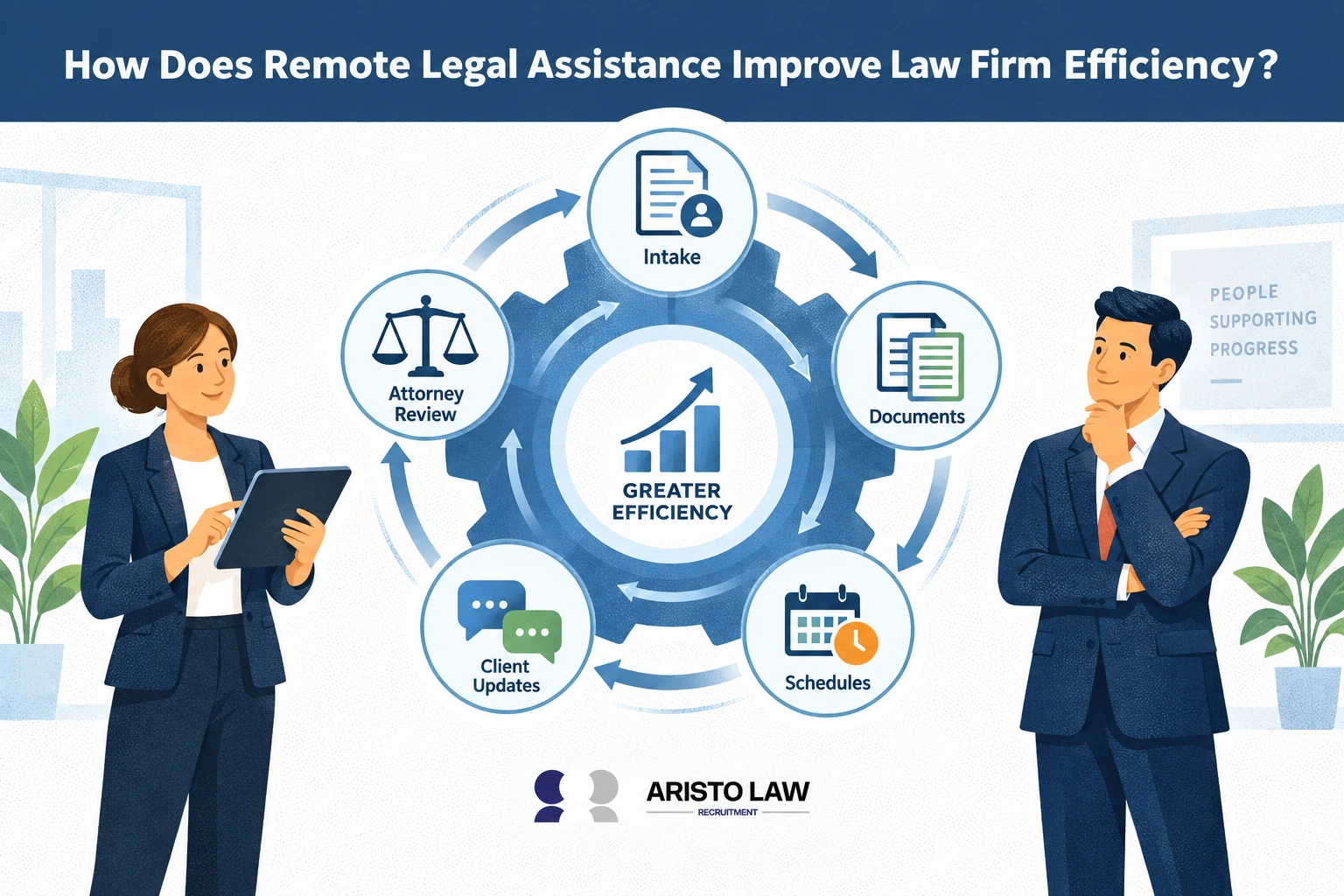
Remote legal assistance improves law firm efficiency by
reducing attorney administrative workload, improving case organization,
accelerating client communication, standardizing workflows, and
increasing operational throughput through structured digital support
systems. Remote legal assistance shifts repeatable
administrative and paralegal tasks away from attorneys and into
organized support workflows without requiring additional in-office
staffing.
The efficiency improvements address common law firm problems such as
missed calls, delayed service, overextended attorneys, inconsistent
follow-up, workflow bottlenecks, and deadline management issues.
Listed below are the 15 ways remote legal assistance improves law
firm efficiency.
-
Task delegation: moving scheduling, document
organization, intake support, and procedural workflows away from
attorneys -
Task triage systems: prioritizing urgent filings,
deadlines, client requests, and workflow updates more efficiently -
Case management software integration: centralizing
deadlines, documents, notes, and workflow tracking in one system -
Document queue management: organizing drafting
requests, discovery records, and filing workflows to reduce
bottlenecks -
Calendar discipline: tracking hearings,
consultations, filing deadlines, and mediation schedules
consistently -
Client communication systems: improving response
times, intake follow-up, and procedural updates across active
matters -
Workflow automation: reducing repetitive
administrative work through templates, reminders, and automated tracking
systems -
Remote intake support: handling new clients’
onboarding and information collection without interrupting attorneys -
Discovery coordination: organizing records,
disclosures, and evidence workflows more efficiently -
Deadline monitoring: reducing missed filings and
scheduling conflicts through centralized tracking systems -
Matter updates: maintaining organized case progress
records and workflow visibility across active legal matters. -
Attorney workload reduction: allowing attorneys to
focus more on legal strategy, hearings, negotiations, and client
representation -
Faster document turnaround: improving drafting,
review preparation, and filing coordination workflows -
Scalable staffing support: increasing operational
capacity without expanding physical office infrastructure -
Improved workflow visibility: giving legal teams
centralized access to case status, deadlines, and procedural activity
across distributed legal operations.
Can
virtual paralegals work for solo family law attorneys?
Yes, virtual paralegals can work for solo family law
attorneys by providing flexible case support without the fixed cost of a
full in-office employee. Solo attorneys commonly use virtual
paralegal support for overflow pleadings, intake coverage, discovery
organization, billing support, court deadline tracking, scheduling
coordination, client updates, and document preparation during active
family law matters. Remote staffing also helps solo family law practices
manage workload spikes connected to divorce filings, custody disputes,
mediation periods, trial preparation, emergency motions, and high-volume
procedural deadlines without expanding permanent office staffing.
Virtual paralegals improve operational efficiency by organizing case
files, maintaining workflow visibility, tracking deadlines, coordinating
communication, and supporting document-heavy family law workflows
through cloud-based case management systems and remote legal operations
tools.
Solo attorneys achieve better workflow consistency when virtual
support structures include clear instructions, standardized templates,
centralized case-management systems, defined turnaround expectations,
and organized communication processes. Structured remote staffing
workflows reduce administrative overload and allow solo attorneys to
focus more on hearings, negotiations, litigation strategy, and client
representation.
How does
virtual paralegal support help firms scale?
Virtual paralegal support helps family law firms scale by
expanding case capacity, improving workflow efficiency, and reducing
attorney administrative overload without immediately adding full-time
in-office staff. Flexible staffing allows firms to handle
higher volumes of divorce, custody, child support, and mediation matters
during workload spikes without disrupting client service quality or
deadline management. Virtual paralegals support scaling through intake
coordination, discovery organization, document preparation, scheduling
management, client updates, billing support, and centralized workflow
tracking across active family law cases.
Remote support structures improve attorney productivity because
repetitive administrative and procedural tasks move into standardized
workflows managed through cloud-based case management systems and remote
legal operations platforms. Faster intake response, organized document
handling, improved deadline tracking, and consistent client
communication also help firms increase case throughput while maintaining
operational visibility across growing workloads.
Virtual paralegal support further reduces burnout risk because
attorneys spend less time on repetitive administrative coordination and
more time on hearings, negotiations, litigation strategy, and client
representation. Structured delegation, workflow automation, and overflow
coverage allow family law firms to scale operations gradually while
maintaining organized legal workflows and responsive client service.
How much does a virtual
paralegal cost?
Virtual paralegal costs range from approximately $20 to $110+
per hour (€18–€101+ / £16–£87+) depending on experience, workload
complexity, service model, and family law specialization.
Family law virtual paralegal pricing increases based on drafting
responsibilities, discovery volume, custody and divorce workflow
complexity, legal software proficiency, supervision requirements, and
litigation support experience. Hourly pricing is commonly used for
overflow work, hearing preparation, discovery organization, and
temporary support, while monthly retainers and project-based pricing are
used for ongoing family law workflows.
In a market analysis by Wyzer Staffing, titled “What Are The
Average Virtual Paralegal Rates?”, published in 2026, along with a data
report by Regents Remote Services, titled “Paralegal services price
list,” published in 2026, the researchers reported that virtual
paralegal support commonly ranges between $25 and $75 per hour for
general legal workflows.
Virtual support costs less than in-house staffing because firms avoid
office overhead, employee benefits, payroll taxes, equipment costs, and
long-term staffing commitments. Flexible virtual staffing also allows
firms to scale support during high-volume divorce, custody, mediation,
and discovery workflows without hiring full-time office staff.
What
pricing models do virtual paralegal services use?
Virtual paralegal services use hourly, retainer,
project-based, subscription, hybrid, tiered, and on-demand pricing
models depending on workload structure, service complexity,
specialization, and long-term support needs. Pricing varies
based on family law, litigation, corporate law, compliance workflows,
urgency, jurisdictional familiarity, turnaround expectations, and the
scope of delegated legal support tasks. Law firms choose pricing
structures based on cost predictability, workflow scalability, staffing
flexibility, and operational control across ongoing legal matters.
Legal operations and outsourcing research reported that retainer and
subscription-based legal support models improve cost predictability and
workflow efficiency by stabilizing support expenses and allowing
scalable delegation through structured service agreements. Research
discussing legal outsourcing models also found that flexible remote
staffing arrangements improve workload management and reduce fixed
operational overhead compared with traditional in-house staffing
structures.
Listed below are the 7 pricing models that virtual paralegal services
use.
-
Hourly billing model: clients pay only for actual
time worked, commonly used for variable workloads, overflow support, or
short-term legal tasks -
Monthly retainer model: fixed monthly fee covering
ongoing support or a set number of support hours each month -
Fixed-fee or project-based pricing: one-time pricing
for defined deliverables such as discovery review, divorce-document
preparation, or case-file organization -
Subscription-based pricing: recurring monthly or
annual pricing for continuous access to virtual paralegal services
through defined support tiers -
Hybrid pricing model: combination of retainer
pricing with hourly or project-based add-ons for additional workload
volume -
Tiered service packages: different pricing levels
based on complexity, turnaround speed, specialization, or litigation
support intensity -
On-demand pricing: pay-as-needed structure for
urgent filings, temporary overflow support, or short-notice legal
tasks
Specialized family law, litigation, and corporate paralegal workflows
generally cost more because they involve higher procedural complexity,
advanced drafting support, discovery coordination, compliance
management, and deadline-sensitive litigation workflows.
Is
outsourcing divorce paralegal services cost-effective?
Yes, outsourcing divorce paralegal services is cost-effective
when firms have repeatable workflows, fluctuating caseloads, or high
administrative workload without enough volume to justify full in-house
staffing. Outsourced support reduces costs tied to payroll
taxes, employee benefits, office space, equipment, and long-term
staffing commitments while providing flexible capacity during divorce,
custody, discovery, mediation, and hearing-heavy workflows. Virtual
paralegals also improve attorney time recovery by handling intake
coordination, document organization, scheduling, discovery tracking,
deadline monitoring, and client follow-ups.
Outsourcing improves workflow efficiency through faster document
turnaround, reduced bottlenecks, scalable overflow support, and more
consistent client communication without increasing office staffing.
Firms increase case capacity while maintaining organized workflows and
deadline visibility across active family law matters.
Cost-effectiveness still depends on onboarding, attorney supervision,
confidentiality systems, workflow standards, quality control, and
jurisdiction-specific family law knowledge. Weak supervision or poorly
defined workflows reduce operational efficiency in deadline-heavy family
law environments.
What
tools do virtual family law paralegals use?
Tools used by virtual family law paralegals include
case management systems, document management platforms, e-signature
tools, e-filing portals, secure communication tools, and billing systems
that support remote legal workflows. Many firms evaluate legal
case management systems, examples, benefits, and
reviews when selecting platforms for workflow
visibility, deadline tracking, client communication, and remote family
law operations. Tool proficiency is also a major hiring criterion
because virtual paralegals must manage digital workflows accurately
across document-heavy family law matters.
Listed below are the 13 tools used by virtual family law
paralegals.
-
Case management systems: tracking deadlines,
hearings, tasks, case notes, workflow progress, and legal records across
active family law matters -
Client portal platforms: managing secure client
communication, document requests, status updates, and intake
coordination -
Document management systems: organizing pleadings,
financial records, custody documentation, discovery materials, and legal
correspondence -
Cloud productivity platforms: managing shared
documents, spreadsheets, scheduling, workflow collaboration, and remote
legal operations -
Secure file-sharing systems: transferring
confidential legal documents, custody records, and financial disclosures
securely -
Calendaring systems: tracking hearings,
consultations, mediation sessions, filing deadlines, and attorney
schedules -
Document automation tools: generating repetitive
family law forms, disclosures, motions, and procedural documents -
E-signature platforms: collecting legally compliant
signatures on agreements, affidavits, disclosures, and court forms -
E-filing portals: submitting legal filings
electronically and monitoring filing confirmations and procedural
updates -
Billing systems: tracking billable time, invoices,
payment records, and legal billing workflows -
CRM systems: managing lead intake, client
follow-ups, communication tracking, and workflow coordination -
Secure communication tools: supporting encrypted
messaging, virtual meetings, and confidential legal communication -
Workflow tracking platforms: monitoring task
progression, case activity, and operational workflow visibility across
distributed legal teams
How can
virtual paralegals protect confidentiality?
Virtual paralegals protect confidentiality through encrypted
communication, secure file-sharing systems, role-based access controls,
confidentiality agreements, and attorney-controlled workflows.
Confidentiality is critical in family law because virtual paralegals
handle sensitive financial records, custody disputes, protective orders,
medical information, and private client communications.
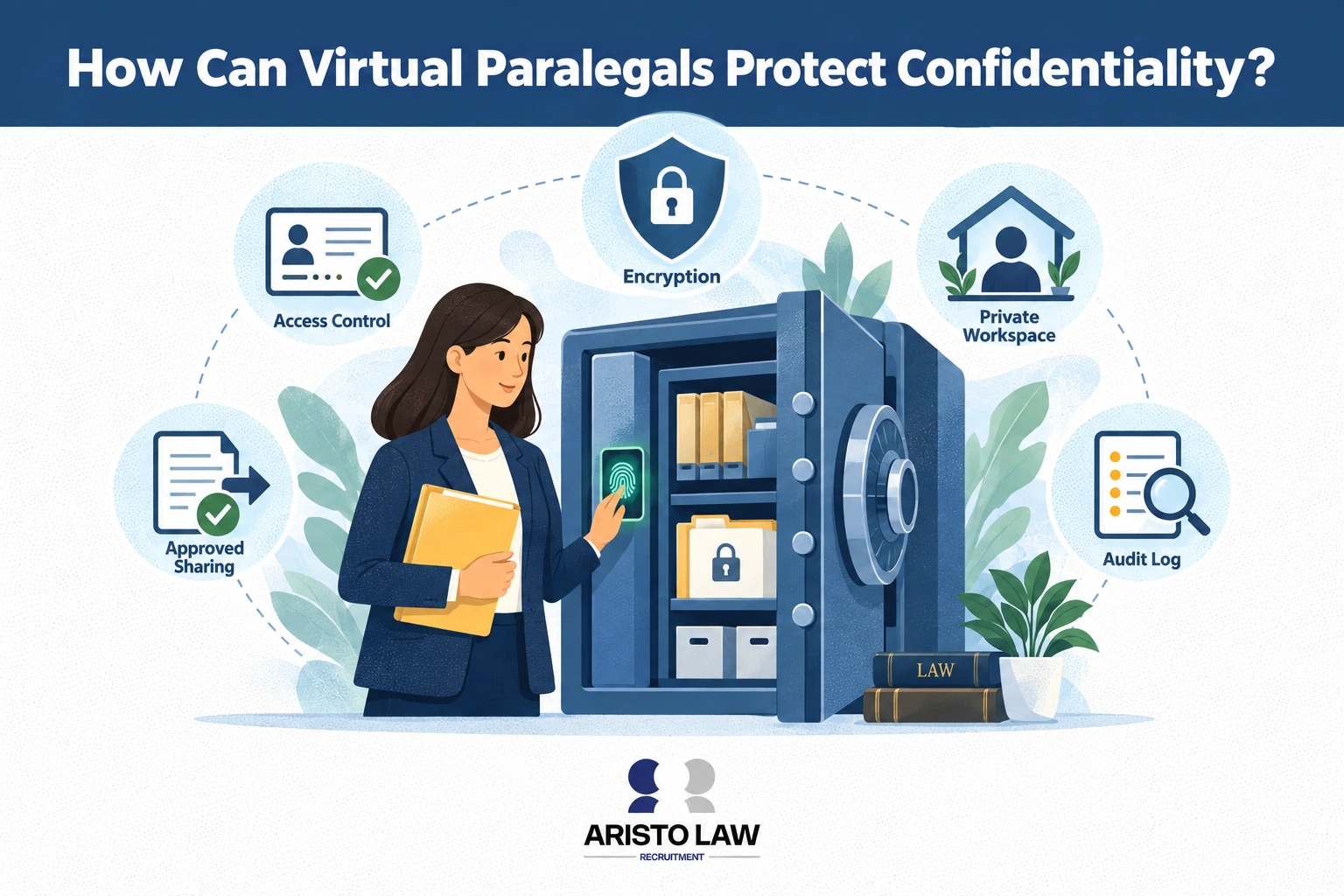
Remote legal support systems commonly use password protection,
multi-factor authentication, secure cloud storage, restricted-access
permissions, device-security policies, and encrypted communication
platforms to reduce unauthorized access risks.
Attorney-controlled workflows limit access to only the files required
for assigned tasks, while audit trails track document access, edits,
downloads, and workflow activity. Many firms also use VPN access,
centralized document repositories, confidentiality agreements, and
standardized data-handling policies to maintain secure remote legal
operations and protect client data.
What
should a family law firm look for in a virtual paralegal?
Qualities to look for in a family law virtual paralegal
include family law experience, document accuracy, confidentiality
discipline, software fluency, communication judgment, and deadline
control because family law workflows involve sensitive records, strict
deadlines, and high-volume legal documentation. Qualities to
look for in a family law virtual paralegal support include organized
family law operations and reliable remote legal workflow management.
Listed below are the 16 qualities to look for in a family law virtual
paralegal.
-
Family law experience: familiarity with divorce
pleadings, custody disputes, child-support matters, mediation workflows,
and family court procedures -
Document accuracy: ability to prepare affidavits,
disclosures, motions, parenting plans, and procedural filings with
minimal errors -
Confidentiality discipline: secure handling of
financial records, custody information, protective orders, and sensitive
client communications -
Software fluency: proficiency with case management
systems, e-filing portals, document repositories, calendaring systems,
and secure communication platforms -
Communication judgment: professional handling of
emotionally sensitive client interactions, procedural updates, and
attorney coordination -
Deadline control: consistent tracking of hearings,
discovery deadlines, mediation schedules, and filing requirements -
Discovery organization skills: managing financial
disclosures, evidence tracking, document requests, and procedural
workflows -
Court-calendar management: coordinating hearings,
consultations, mediation sessions, and attorney schedules accurately -
Remote workflow management: maintaining organized
digital case files and centralized workflow visibility across active
matters -
Writing and drafting ability: preparing clear,
organized legal-support documentation under attorney supervision -
Attention to detail: identifying missing records,
filing inconsistencies, deadline conflicts, and document errors
early -
Confidentiality agreements: willingness to follow
strict legal confidentiality and remote data-security policies -
Reference checks: verifying reliability, workflow
accuracy, and family law operational experience through prior employers
or attorneys -
Writing-sample reviews: evaluating drafting quality,
formatting accuracy, and procedural organization skills -
Software testing: confirming proficiency with legal
case-management systems and remote workflow tools before onboarding -
Attorney-supervised trial tasks: testing workflow
accuracy through supervised drafting, discovery organization, or
scheduling assignments before expanding responsibilities
Build a legal support team that moves work forward.
Tell us what is slowing your practice down. We will help map the role, workflow, and support structure that fits.