
What Does a Family Law Paralegal Do to Keep Attorneys Organized and Clients Informed

Practical guidance for building efficient, accountable legal support operations.
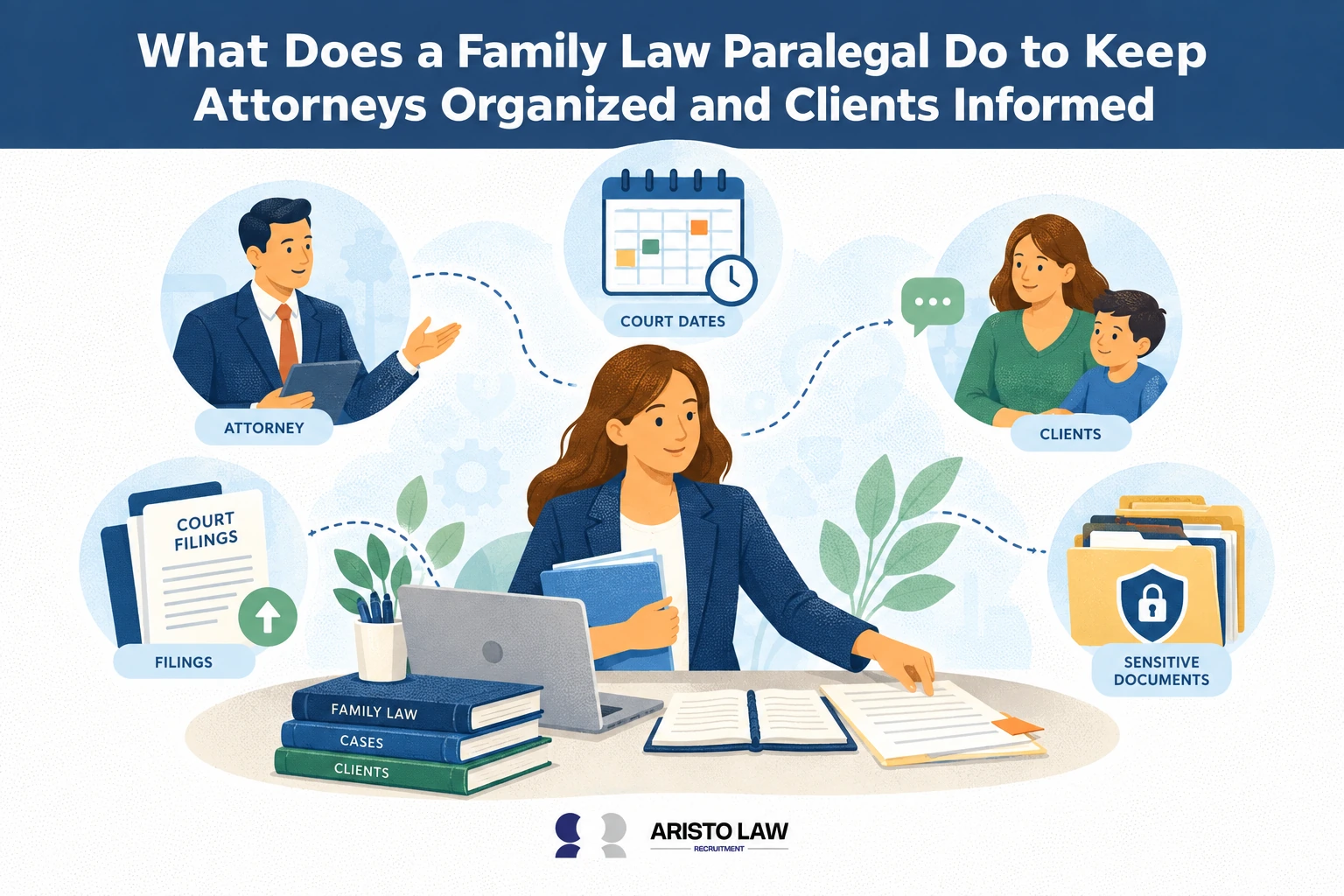
A family law paralegal supports attorneys by organizing legal
workflows, maintaining case documentation, coordinating client
communication, and managing procedural tasks across family law matters
such as divorce, custody, child support, and support disputes.
Family law paralegals maintain case files, track court deadlines, manage
attorney calendars, organize legal records, and coordinate workflow
activity that keeps family law operations structured and efficient.
Client-facing responsibilities include intake coordination, scheduling
updates, communication support, procedural explanations that do not
constitute legal advice, and liaison work between attorneys, clients,
courts, mediators, and external professionals.
Document preparation responsibilities include drafting divorce
filings, custody paperwork, child-support documentation, affidavits,
discovery materials, motions, financial disclosures, hearing exhibits,
and trial-preparation records under attorney supervision. Family law
paralegals also organize evidence, manage financial documentation,
coordinate mediation sessions, prepare deposition materials, and support
hearing logistics through centralized case management systems and legal
workflow software. Research discussing family law paralegal workflows
reported that paralegals regularly handle legal research, document
drafting, client communication, scheduling, discovery support, and case
organization activities that improve operational efficiency across
family law practices.
Family law paralegals differ from attorneys because paralegals cannot
provide legal representation, make independent legal decisions, or
appear in court on behalf of clients. Attorneys maintain legal
authority, legal strategy control, and representation rights throughout
family law proceedings. Research discussing paralegal responsibilities
reported that paralegals support workflow management, legal
documentation, trial preparation, and client coordination under attorney
supervision rather than independently practicing law.
Modern family law practices increasingly use cloud-based case
management platforms, document management systems, e-signature tools,
calendaring software, and remote communication systems that allow
virtual and hybrid family law support workflows. Key skills include
organization, communication, deadline management, document accuracy,
client coordination, legal software proficiency, and workflow tracking.
Career pathways usually involve paralegal education, legal-support
training, internship experience, and specialization in family law
procedures and litigation workflows.
Aristolaw helps family law firms solve legal outsourcing problems by
providing paralegal support staff for case organization, document
preparation, client updates, court deadlines, and attorney workflow
coordination. Hire
a Virtual Paralegal Assistant with Aristolaw today.
Aristolaw connects law firms with outsourced family law support that
keeps attorneys organized and clients informed.
What
does a family law paralegal do?
A family law paralegal supports attorneys by managing case
preparation, organizing legal documents, coordinating court-related
workflows, and keeping clients informed throughout family law
proceedings. Family law practices use virtual
paralegal assistant services for family law firms
workflows to manage divorce disputes, custody matters, child support
cases, alimony proceedings, domestic violence protection orders,
adoption filings, and guardianship operations through structured legal
support systems. The daily responsibilities of family law paralegals
include client follow-ups, court filing coordination, document
preparation, scheduling management, billing coordination, discovery
tracking, attorney workflow support, and deadline management across
active family law disputes.
Listed below are the 20 duties of a family law paralegal.
-
Organize and maintain client case files and legal records
-
Manage attorney calendars, court dates, and filing deadlines
-
Maintain accurate case documentation and workflow tracking
-
Monitor deadlines to prevent missed filings or court appearances
-
Manage client intake and collect initial case information
-
Communicate with clients and provide case updates
-
Act as a liaison between attorneys, clients, and court personnel
-
Follow up with clients regarding missing documents and signatures
-
Explain legal procedures and next steps without providing legal
advice -
Schedule hearings, depositions, consultations, and mediation
sessions -
Draft and prepare family law documents under attorney supervision
-
Prepare divorce, child custody, child support, and adoption
paperwork -
Prepare affidavits, motions, declarations, and other legal forms
-
Assist with discovery and document exchange
-
Support attorneys with trial and hearing preparation
-
Organize evidence, witness information, and exhibits
-
Conduct legal research related to family law matters
-
Gather and organize financial and custody-related documentation
-
Coordinate communication between courts, clients, and attorneys
-
Help reduce attorneys’ administrative workload to improve case
efficiency and focus
Organize
and maintain client case files and legal records
Organizing and maintaining client case files and legal
records is the process of managing legal documents, court filings,
evidence, financial records, correspondence, and procedural information
throughout family law proceedings. Family Law Paralegal
professionals use organized case management systems to support client
communication, court scheduling, discovery support, workflow
coordination, and trial preparation across divorce proceedings, child
custody disputes, child support cases, adoption matters, and related
family law operations. Organized legal documentation improves workflow
efficiency, deadline tracking, document accessibility, and communication
between attorneys, clients, courts, and mediators.
Family law case files include affidavits, motions, financial
disclosures, parenting plans, discovery responses, custody records,
court notices, and hearing documentation that require centralized
organization and accurate version control. Poor file management
increases the risk of missed deadlines, filing errors, lost records,
duplicated work, and communication breakdowns during active
litigation.
Effective family law organization requires consistent document
labeling, secure file storage, confidentiality protection, regular
workflow updates, centralized digital repositories, and accurate
deadline tracking systems. Best practices include maintaining
standardized folder structures, updating case notes immediately,
organizing records chronologically, and reviewing files regularly to
keep legal records complete and accessible throughout the case
lifecycle.
Manage
attorney calendars, court dates, and filing deadlines
Managing attorney calendars, court dates, and filing
deadlines is the process of coordinating legal schedules, hearings,
consultations, mediation sessions, and procedural deadlines throughout
family law proceedings. Family Law Paralegal professionals use
calendar management systems to support case management, workflow
coordination, court scheduling, and client communication across divorce
proceedings, custody disputes, child support matters, and other family
law operations. Accurate scheduling helps attorneys prepare for
hearings, meet court requirements, avoid missed deadlines, and maintain
organized legal workflows.
Family law practices involve multiple overlapping deadlines including
filing dates, discovery responses, mediation sessions, court
appearances, client meetings, and document submission requirements that
require continuous monitoring and coordination. Missed deadlines or
scheduling conflicts create procedural delays, court sanctions, workflow
disruption, and communication problems across active legal matters.
Effective calendar management requires centralized scheduling
systems, deadline reminders, regular calendar reviews, court-rule
awareness, and immediate updates when hearings or filings change. Best
practices include maintaining shared legal calendars, confirming court
dates regularly, tracking filing deadlines in advance, and coordinating
schedules with attorneys, clients, courts, and external professionals to
maintain workflow continuity.
Maintain
accurate case documentation and workflow tracking
Maintaining accurate case documentation and workflow tracking
is the process of recording legal activity, updating case progress,
organizing procedural records, and monitoring workflow status throughout
family law proceedings. Family Law Paralegal professionals use
documentation and workflow systems to support legal case support, client
communication, court scheduling, discovery tracking, and trial
preparation across divorce proceedings, child custody disputes, support
cases, and related family law matters. Accurate records help attorneys
monitor case progress, access current information quickly, and maintain
procedural consistency across active legal operations.
Family law workflows generate continuous updates involving filings,
hearings, mediation sessions, client communication, financial
disclosures, discovery responses, and court notices that require
organized tracking and accurate documentation. Incomplete or outdated
records increase the risk of missed deadlines, workflow confusion,
communication errors, and procedural delays during active
litigation.
Effective workflow tracking requires centralized case management
systems, real-time updates, chronological documentation, deadline
monitoring, and organized digital recordkeeping. Best practices include
updating case notes immediately after activity occurs, tracking workflow
status consistently, maintaining document version control, and reviewing
case records regularly to keep legal operations accurate and organized
throughout the case lifecycle.
Monitor
deadlines to prevent missed filings or court appearances
Monitoring deadlines to prevent missed filings or court
appearances is the process of tracking court schedules, filing
requirements, response dates, hearings, and procedural obligations
throughout family law proceedings. Family Law Paralegal
professionals use deadline-tracking systems to support case management,
court scheduling, workflow coordination, and legal documentation across
divorce proceedings, child custody disputes, child support matters, and
related family law operations. Accurate deadline monitoring helps
attorneys maintain procedural compliance, prepare filings on time, and
avoid disruptions in active legal matters.
Family law cases involve strict procedural timelines for motions,
discovery responses, financial disclosures, mediation requirements,
hearings, and court appearances that require continuous oversight.
Missed deadlines create risks such as case delays, court sanctions,
rejected filings, procedural disadvantages, and communication problems
between attorneys, clients, and courts.
Effective deadline management requires centralized calendaring
systems, automated reminders, court-rule awareness, workflow reviews,
and regular status monitoring across all active cases. Best practices
include tracking deadlines in multiple systems, reviewing court
calendars daily, confirming filing requirements early, and communicating
upcoming deadlines clearly with attorneys and clients to maintain
organized legal workflows.
Manage
client intake and collect initial case information
Managing client intake and collecting initial case
information is the process of gathering client details, legal background
information, supporting documents, and case-related facts at the
beginning of family law representation. Family Law Paralegal
professionals use intake workflows to support case management, client
communication, legal documentation, and workflow coordination across
divorce proceedings, child custody disputes, child support cases,
adoption matters, and related family law operations. Organized intake
processes help attorneys evaluate cases quickly, identify urgent legal
issues, and maintain accurate case records from the start of
representation.
Family law intake involves collecting personal information, financial
records, custody details, court notices, communication records, prior
legal filings, and supporting documentation connected to emotionally
sensitive legal disputes. Incomplete intake information creates workflow
delays, communication problems, inaccurate records, and procedural
issues during active case management.
Effective client intake requires structured questionnaires, organized
document collection systems, confidentiality protection, accurate data
entry, and clear communication with clients about required information
and next steps. Best practices include verifying client information
carefully, organizing intake records immediately, maintaining secure
document storage, and following standardized intake procedures to
improve workflow consistency and legal case organization.
Communicate
with clients and provide case updates
Communicating with clients and providing case updates is the
process of maintaining regular contact with clients regarding case
progress, scheduling changes, document requests, procedural
developments, and workflow activity throughout family law
proceedings. Family Law Paralegal professionals support client
communication across divorce proceedings, child custody disputes, child
support matters, adoption cases, and related family law operations to
help clients remain informed and organized during emotionally sensitive
legal matters. Consistent communication improves workflow coordination,
reduces confusion, and helps attorneys maintain organized client-service
operations.
Family law clients require frequent updates involving hearings,
filings, mediation sessions, discovery activity, financial
documentation, court notices, and scheduling changes. Delayed or
inconsistent communication creates client frustration, missed procedural
steps, workflow confusion, and increased administrative pressure on
attorneys and legal staff.
Effective client communication requires organized follow-up systems,
accurate case knowledge, confidentiality awareness, professional
communication practices, and timely workflow updates. Best practices
include documenting all client interactions, responding promptly to
inquiries, providing clear procedural explanations without legal advice,
and maintaining consistent communication schedules to improve case
continuity and client confidence throughout the legal process.
Act
as a liaison between attorneys, clients, and court personnel
Acting as a liaison between attorneys, clients, and court
personnel is the process of coordinating communication, exchanging
procedural information, managing scheduling activity, and supporting
workflow continuity throughout family law proceedings. Family
Law Paralegal professionals facilitate communication across divorce
proceedings, child custody disputes, child support matters, adoption
cases, and related family law operations to keep legal workflows
organized and responsive. Liaison responsibilities help attorneys
maintain efficient case progression while improving communication
accuracy between all parties involved in active legal matters.
Family law workflows involve continuous interaction between
attorneys, clients, clerks, mediators, court staff, opposing counsel,
and external professionals regarding filings, hearings, deadlines,
discovery activity, and procedural updates. Poor communication
coordination creates scheduling conflicts, missed information, workflow
delays, and procedural confusion across active cases.
Effective liaison work requires strong communication skills, accurate
recordkeeping, confidentiality awareness, procedural knowledge, and
organized workflow tracking. Best practices include documenting all
communications, confirming scheduling details promptly, maintaining
professional communication standards, and centralizing updates within
case management systems to improve coordination and procedural
consistency throughout family law operations.
Follow
up with clients regarding missing documents and signatures
Following up with clients regarding missing documents and
signatures is the process of requesting, tracking, and collecting
incomplete legal paperwork, financial records, disclosures, and required
signatures needed for family law proceedings. Family Law
Paralegal professionals manage document follow-ups to support case
management, legal documentation, workflow coordination, and court
scheduling across divorce proceedings, child custody disputes, child
support matters, and related family law operations. Timely document
collection helps attorneys maintain procedural compliance, prepare
filings accurately, and avoid delays in active legal matters.
Family law cases require large volumes of supporting documentation
including financial statements, tax records, parenting plans,
affidavits, court forms, discovery responses, and signed legal
agreements. Missing records or unsigned documents create filing delays,
incomplete case preparation, workflow interruptions, and procedural
risks during litigation.
Effective follow-up management requires organized tracking systems,
regular client communication, deadline monitoring, confidentiality
protection, and accurate document checklists. Best practices include
maintaining centralized document-request logs, sending reminders early,
confirming receipt of completed records, and reviewing documents
immediately for missing information or signatures to maintain workflow
continuity and case accuracy.
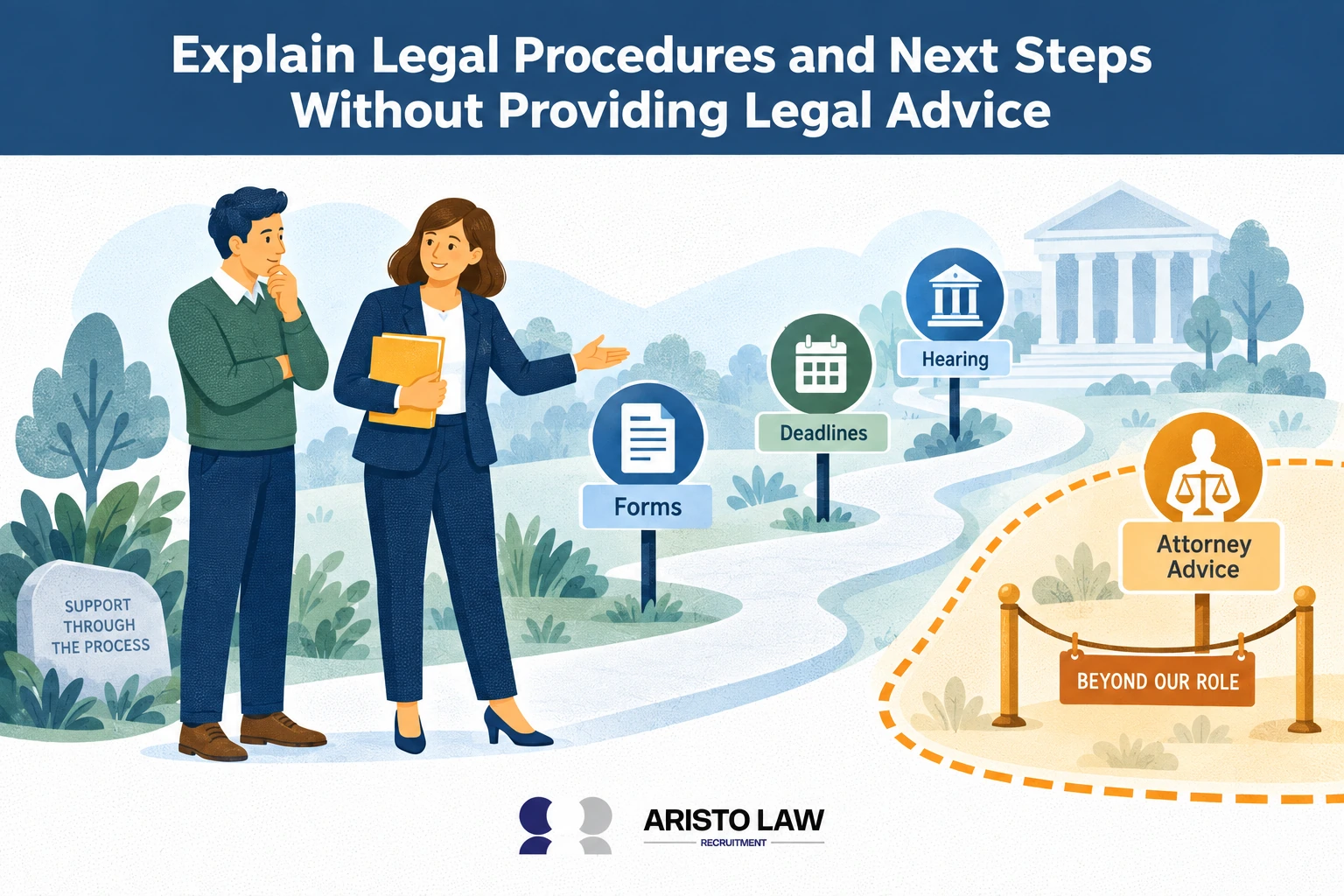
Explain
legal procedures and next steps without providing legal advice
Explaining legal procedures and next steps without providing
legal advice is the process of helping clients understand court
procedures, scheduling requirements, document requests, filing
processes, and workflow stages during family law proceedings under
attorney supervision. Family Law Paralegal professionals
support client communication across divorce proceedings, child custody
disputes, child support matters, adoption cases, and related family law
operations by providing procedural guidance while avoiding legal
interpretation or legal decision-making. Clear procedural communication
improves workflow coordination, reduces confusion, and helps clients
remain informed throughout active legal matters.
Family law clients need clarification regarding hearings, mediation
sessions, discovery timelines, filing requirements, financial
disclosures, parenting-plan procedures, and court scheduling processes.
Confusion about legal procedures creates missed deadlines, incomplete
documentation, communication delays, and workflow disruption across
active cases.
Effective procedural communication requires strong organizational
skills, professional communication practices, confidentiality awareness,
and clear understanding of the boundary between procedural support and
legal advice. Best practices include using attorney-approved
communication guidelines, documenting client interactions, explaining
procedural steps clearly, and referring legal strategy or legal
interpretation questions directly to attorneys to maintain compliance
and workflow consistency.
Schedule
hearings, depositions, consultations, and mediation sessions
Scheduling hearings, depositions, consultations, and
mediation sessions is the process of coordinating legal appointments,
court appearances, attorney meetings, and procedural events throughout
family law proceedings. Family Law Paralegal professionals
manage scheduling workflows to support case management, court
coordination, workflow organization, and client communication across
divorce proceedings, child custody disputes, child support matters,
adoption cases, and related family law operations. Organized scheduling
helps attorneys maintain procedural compliance, prepare effectively for
hearings, and avoid conflicts across active legal matters.
Family law scheduling involves coordinating availability between
attorneys, clients, courts, mediators, opposing counsel, witnesses,
evaluators, and external professionals while managing strict procedural
deadlines and court calendars. Scheduling errors create missed
appearances, procedural delays, workflow disruption, and communication
problems during active litigation.
Effective scheduling management requires centralized calendaring
systems, deadline tracking, accurate communication, court-rule
awareness, and immediate workflow updates when schedules change. Best
practices include confirming appointments in writing, maintaining shared
legal calendars, tracking court notices carefully, and sending reminders
before hearings or mediation sessions to maintain organized legal
operations and procedural continuity.
Draft
and prepare family law documents under attorney supervision
Drafting and preparing family law documents under attorney
supervision is the process of creating, organizing, formatting, and
reviewing legal paperwork required for family law proceedings.
Family Law Paralegal professionals support legal documentation workflows
across divorce proceedings, child custody disputes, child support
matters, adoption cases, guardianship filings, and related family law
operations. Accurate document preparation helps attorneys maintain
procedural compliance, reduce workflow delays, and manage active legal
matters more efficiently.
Family law documentation includes petitions, motions, affidavits,
financial disclosures, parenting plans, discovery responses, court
notices, settlement agreements, and hearing materials that require
accurate formatting, organized supporting records, and compliance with
court filing requirements. Errors in legal documentation create rejected
filings, missed deadlines, procedural complications, and workflow
disruption during litigation.
Effective document preparation requires strong attention to detail,
organized workflow systems, court-rule awareness, confidentiality
protection, and accurate version control. Best practices include using
standardized templates, reviewing documents carefully before filing,
organizing supporting records consistently, confirming attorney approval
before submission, and maintaining updated digital document repositories
to improve legal workflow efficiency and case organization.
Prepare
divorce, child custody, child support, and adoption paperwork
Preparing divorce, child custody, child support, and adoption
paperwork is the process of organizing, drafting, reviewing, and
managing legal forms and supporting documents required for family law
proceedings. Family Law Paralegal professionals support legal
documentation workflows across divorce proceedings, custody disputes,
support matters, adoption cases, and related family law operations by
preparing court-ready records under attorney supervision. Accurate
paperwork preparation helps attorneys maintain procedural compliance,
reduce filing delays, and manage active family law cases more
efficiently.
Family law paperwork includes petitions, parenting plans, financial
disclosures, custody agreements, support calculations, adoption forms,
affidavits, court notices, and supporting evidence that require accurate
formatting and complete documentation. Incomplete or inaccurate
paperwork creates rejected filings, delayed hearings, procedural
complications, and workflow disruption across active legal matters.
Effective paperwork preparation requires organized document
management, court-rule awareness, confidentiality protection, accurate
data entry, and deadline tracking. Best practices include reviewing
forms carefully for completeness, verifying supporting documentation
before filing, maintaining organized digital records, and coordinating
closely with attorneys and clients to keep legal paperwork accurate and
ready for court submission.
Prepare
affidavits, motions, declarations, and other legal forms
Preparing affidavits, motions, declarations, and other legal
forms is the process of drafting, organizing, formatting, and reviewing
court-required legal documents used throughout family law
proceedings. Family Law Paralegal professionals support legal
documentation workflows across divorce proceedings, child custody
disputes, child support matters, domestic violence orders, adoption
cases, and related family law operations under attorney supervision.
Accurate legal form preparation helps attorneys maintain procedural
compliance, support court filings, and manage case progression
efficiently.
Family law legal forms contain financial disclosures, factual
statements, custody requests, procedural motions, supporting
declarations, and court-specific filing requirements that require
accuracy, organized supporting documentation, and compliance with
procedural rules. Errors or incomplete information create rejected
filings, hearing delays, procedural complications, and workflow
disruption during active litigation.
Effective legal form preparation requires strong attention to detail,
organized workflow systems, confidentiality protection, court-rule
awareness, and accurate document review practices. Best practices
include using approved templates, verifying factual information
carefully, organizing supporting exhibits consistently, reviewing
formatting requirements before filing, and obtaining attorney approval
before submitting legal forms to the court.
Assist with
discovery and document exchange
Assisting with discovery and document exchange is the process
of organizing, reviewing, tracking, and coordinating the transfer of
legal documents and evidence between parties during family law
proceedings. Family Law Paralegal professionals support
discovery workflows across divorce proceedings, child custody disputes,
child support matters, and related family law operations by managing
document requests, responses, disclosures, and evidence organization
under attorney supervision. Organized discovery support helps attorneys
prepare cases efficiently, maintain procedural compliance, and avoid
delays during litigation.
Family law discovery involves financial records, communication
records, custody evaluations, medical documentation, employment
information, tax records, and other evidence required for hearings,
negotiations, mediation, or trial preparation. Poor discovery
coordination creates missing evidence, delayed responses, procedural
disputes, and workflow disruption across active legal matters.
Effective discovery support requires organized document tracking,
deadline monitoring, confidentiality protection, accurate recordkeeping,
and centralized document management systems. Best practices include
maintaining discovery checklists, organizing evidence chronologically,
tracking document requests and responses carefully, reviewing records
for completeness, and coordinating closely with attorneys and clients to
maintain efficient discovery workflows and procedural accuracy.
Support
attorneys with trial and hearing preparation
Supporting attorneys with trial and hearing preparation is
the process of organizing legal materials, coordinating case
information, preparing exhibits, and managing procedural workflows
before court appearances in family law proceedings. Family Law
Paralegal professionals support trial preparation across divorce
proceedings, child custody disputes, child support matters, domestic
violence hearings, adoption cases, and related family law operations
under attorney supervision. Organized preparation helps attorneys
present cases efficiently, maintain procedural compliance, and respond
effectively during hearings and litigation proceedings.
Family law trial preparation involves organizing witness information,
financial records, discovery materials, exhibits, court filings, custody
documentation, timelines, and hearing schedules that require accurate
coordination and centralized case management. Poor preparation creates
missing evidence, scheduling confusion, procedural delays, and workflow
disruption during active litigation.
Effective trial and hearing preparation requires organized document
systems, deadline tracking, exhibit management, communication
coordination, and accurate workflow review. Best practices include
preparing hearing binders early, organizing exhibits clearly, confirming
witness schedules, reviewing filing requirements before hearings, and
maintaining updated case summaries to support efficient courtroom
preparation and legal workflow continuity.
Organize
evidence, witness information, and exhibits
Organizing evidence, witness information, and exhibits is the
process of collecting, categorizing, reviewing, and maintaining legal
materials used to support family law proceedings. Family Law
Paralegal professionals manage evidence organization across divorce
proceedings, child custody disputes, child support matters, domestic
violence hearings, and related family law operations to support trial
preparation, discovery coordination, and legal workflow management under
attorney supervision. Organized evidence systems help attorneys prepare
arguments efficiently, access records quickly, and maintain procedural
accuracy during litigation.
Family law evidence includes financial records, communication logs,
photographs, custody evaluations, medical records, school records,
witness statements, parenting documentation, and court exhibits that
require accurate labeling, chronological organization, and centralized
storage. Disorganized evidence creates missing records, procedural
delays, workflow confusion, and reduced preparation efficiency during
hearings or trial proceedings.
Effective evidence management requires structured document systems,
confidentiality protection, accurate indexing, exhibit tracking, and
regular workflow reviews. Best practices include maintaining digital and
physical exhibit lists, organizing records chronologically, labeling
evidence clearly, confirming exhibit completeness before hearings, and
coordinating witness information carefully to support organized and
efficient family law case preparation.
Conduct
legal research related to family law matters
Conducting legal research related to family law matters is
the process of reviewing statutes, case law, court rules, legal
procedures, and regulatory guidance connected to family law
proceedings. Family Law Paralegal professionals support legal
research workflows across divorce proceedings, child custody disputes,
child support matters, adoption cases, guardianship proceedings, and
related family law operations under attorney supervision. Accurate legal
research helps attorneys prepare filings, support legal arguments,
monitor procedural requirements, and maintain organized case strategy
development.
Family law research involves custody standards, support calculations,
jurisdictional requirements, procedural deadlines, domestic violence
protections, property division rules, and local court procedures that
require accurate source review and organized documentation. Incomplete
or inaccurate legal research creates procedural errors, weak case
preparation, workflow delays, and communication problems during active
litigation.
Effective legal research requires organized research methods,
reliable legal databases, accurate citation practices, procedural
awareness, and detailed documentation of findings. Best practices
include verifying legal sources carefully, maintaining organized
research notes, tracking jurisdiction-specific requirements, summarizing
findings clearly for attorneys, and updating research regularly to
maintain accurate and current legal workflow support.
Gather
and organize financial and custody-related documentation
Gathering and organizing financial and custody-related
documentation is the process of collecting, reviewing, categorizing, and
maintaining records required for family law proceedings involving
support, custody, property division, and parenting disputes.
Family Law Paralegal professionals support legal documentation workflows
across divorce proceedings, child custody disputes, child support
matters, and related family law operations by organizing financial
records, custody evidence, and supporting materials under attorney
supervision. Accurate documentation helps attorneys prepare filings,
support negotiations, maintain procedural compliance, and manage active
family law cases efficiently.
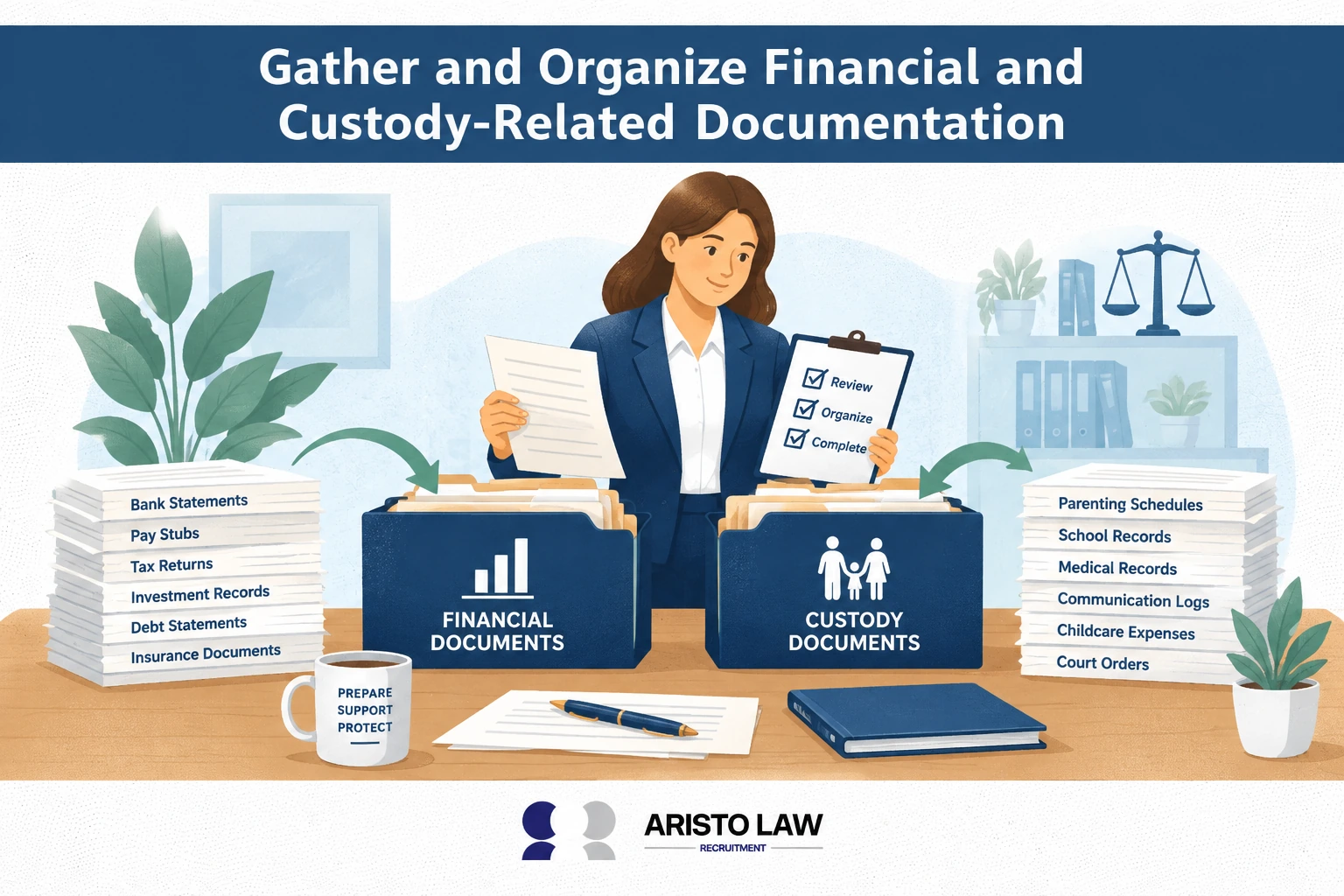
Family law documentation includes tax returns, bank statements, pay
stubs, debt records, parenting schedules, school records, medical
reports, custody evaluations, communication logs, and expense
documentation that require centralized organization and accurate
tracking. Missing or disorganized records create filing delays,
inaccurate support calculations, procedural complications, and workflow
disruption during litigation or mediation.
Effective document organization requires confidentiality protection,
structured filing systems, accurate labeling, deadline monitoring, and
centralized digital repositories. Best practices include organizing
records chronologically, maintaining document checklists, reviewing
submissions for completeness, separating financial and custody records
clearly, and updating documentation regularly to maintain accurate and
accessible family law case files.
Coordinate
communication between courts, clients, and attorneys
Coordinating communication between courts, clients, and
attorneys is the process of managing procedural updates, scheduling
information, filing notices, case status communication, and workflow
coordination throughout family law proceedings. Family Law
Paralegal professionals support communication workflows across divorce
proceedings, child custody disputes, child support matters, domestic
violence hearings, adoption cases, and related family law operations to
maintain organized legal case support and workflow continuity. Accurate
communication coordination helps attorneys manage deadlines, respond to
court requirements, and maintain consistent client-service operations
during active legal matters.
Family law workflows involve continuous communication regarding
hearings, filings, mediation sessions, discovery deadlines, court
notices, scheduling updates, and procedural requirements that require
centralized tracking and organized information sharing. Communication
failures create missed deadlines, scheduling conflicts, procedural
delays, workflow confusion, and client frustration across active
cases.
Effective communication coordination requires organized workflow
systems, confidentiality protection, accurate recordkeeping,
professional communication practices, and timely status updates. Best
practices include documenting all communications, confirming court
instructions promptly, maintaining centralized contact records, tracking
procedural updates consistently, and using shared case management
systems to improve workflow visibility and communication accuracy
throughout family law operations.
Help
reduce attorneys’ administrative workload to improve case efficiency and
focus
Helping reduce attorneys’ administrative workload to improve
case efficiency and focus is the process of handling procedural,
organizational, scheduling, documentation, and communication tasks that
support family law operations under attorney supervision.
Family Law Paralegal professionals manage workflow coordination across
divorce proceedings, child custody disputes, child support matters,
adoption cases, and related family law operations to allow attorneys to
focus more on legal strategy, negotiations, hearings, and client
representation. Efficient workload distribution improves legal workflow
management, case continuity, and operational organization throughout
active family law matters.
Family law practices generate high volumes of administrative work
involving court scheduling, document preparation, filing coordination,
discovery tracking, client communication, billing support, evidence
organization, and deadline management that reduce attorney productivity
when handled directly by attorneys. Administrative overload increases
workflow delays, communication bottlenecks, missed deadlines, and
operational inefficiency during active litigation.
Effective workload support requires organized case management
systems, accurate workflow tracking, centralized communication
processes, strong document organization, and proactive deadline
monitoring. Best practices include delegating repetitive administrative
tasks appropriately, maintaining updated workflow records, using
centralized legal software systems, and coordinating continuously with
attorneys to improve operational efficiency and maintain organized
family law case management.
What
is the difference between a family law paralegal and a family law
attorney?
The difference between a family law paralegal and a family
law attorney is that a paralegal supports legal workflows and case
preparation under attorney supervision, while an attorney holds legal
authority to provide legal advice, represent clients, and make legal
decisions independently.
The table below shows the difference between a family law paralegal
and a family law attorney.
Area |
Family Law
|
Family Law
|
|---|---|---|
| Legal authority | Supports legal operations under attorney supervision | Holds legal authority to represent clients independently |
| Courtroom representation | Cannot represent clients in court | Represents clients during hearings, trials, and negotiations |
| Legal advice | Cannot provide independent legal advice | Provides legal advice, legal interpretation, and case strategy |
| Client representation rights | Assists with procedural communication only | Acts as official legal representative for the client |
| Document drafting | Drafts legal documents under attorney review | Drafts, approves, signs, and files legal documents independently |
| Negotiation participation | Supports negotiations through preparation and coordination | Leads settlement negotiations and legal discussions |
| Licensing requirements | Usually requires paralegal education or legal-support training | Requires law degree, bar admission, and legal licensing |
| Ethical liability | Operates under attorney supervision and firm policies | Holds direct ethical and professional legal responsibility |
| Case strategy involvement | Supports workflow organization and case preparation | Develops legal strategy and litigation decisions |
| Workflow function | Handles scheduling, documentation, filing coordination, and client updates |
Oversees legal representation, advocacy, and legal decision-making |
| Client communication | Explains procedures without legal advice | Advises clients on rights, risks, and legal outcomes |
| Legal research role | Conducts research to support attorneys | Uses research to develop legal arguments and representation strategy |
What family law cases
do paralegals support?
The family law cases paralegals commonly support include
divorce, child custody, child support, and domestic violence proceedings
involving document preparation, workflow coordination, court scheduling,
and client communication support. The family law cases
paralegals commonly support include litigation, negotiation, mediation,
and procedural family law operations.
Listed below are the 12 family law cases paralegal handle.
-
Divorce proceedings: petitions, financial
affidavits, asset documentation, discovery coordination, settlement
paperwork, and court filing support -
Child custody disputes: parenting plans, visitation
schedules, custody documentation, hearing preparation, and mediation
coordination -
Child support matters: income verification, support
calculations, financial disclosures, payment records, and court-document
preparation -
Alimony and spousal-support cases: financial
analysis support, expense documentation, affidavits, and modification
filings -
Adoption proceedings: consent forms, court filings,
background documentation, scheduling coordination, and procedural
tracking -
Guardianship cases: medical records, financial
documentation, court petitions, and hearing coordination -
Domestic violence proceedings: emergency filings,
protection-order documentation, court scheduling, and urgent workflow
coordination -
Mediation preparation: settlement documentation,
financial summaries, parenting-plan coordination, and exhibit
organization -
Discovery support: document exchange, financial
record organization, communication logs, and evidence tracking -
Enforcement and modification proceedings: updated
financial records, custody modifications, support enforcement filings,
and procedural follow-up -
Paternity matters: legal filings, scheduling
coordination, record management, and court-document preparation -
Relocation and visitation disputes: custody
schedules, communication records, parenting documentation, and hearing
preparation
What skills do family law
paralegals need?
The skills family law paralegals need include organization,
legal-document management, communication coordination, emotional
professionalism, confidentiality management, and procedural case
management across emotionally sensitive legal matters.
Emotional intelligence and confidentiality management matter heavily in
family law environments because paralegals regularly handle
high-conflict disputes, sensitive financial records, custody matters,
domestic violence documentation, and emotionally stressed clients
throughout active litigation and negotiation workflows. The skills
family law paralegals need support legal workflow efficiency and
organized case management.
Listed below are the 14 skills family law paralegals need.
-
Organization skills: managing high-volume case
files, court records, and legal documentation across multiple active
family law matters -
Legal-document management: preparing, reviewing,
organizing, and tracking affidavits, motions, disclosures, and court
filings accurately -
Deadline management: monitoring hearings, filing
dates, mediation sessions, discovery deadlines, and procedural
timelines -
Communication coordination: managing communication
between attorneys, clients, courts, mediators, and external
professionals -
Emotional professionalism: maintaining
professionalism and calm communication during emotionally sensitive
family law disputes -
Confidentiality management: protecting sensitive
financial records, custody information, personal data, and privileged
legal communication -
Financial-record organization: organizing tax
records, income documentation, support calculations, expense reports,
and financial disclosures -
Court-filing accuracy: ensuring procedural
compliance, accurate formatting, and complete filing documentation -
Case management skills: tracking workflow activity,
maintaining organized records, and monitoring procedural case
progression -
Mediation preparation: organizing settlement
records, parenting plans, financial summaries, and negotiation
materials -
Litigation coordination: supporting hearings,
discovery workflows, exhibit preparation, and trial organization -
Legal software proficiency: using case management
systems, calendaring tools, document repositories, and workflow
platforms -
Client-service skills: providing procedural updates,
managing intake communication, and maintaining organized client support
workflows -
Attention to detail: identifying missing
information, filing errors, procedural inconsistencies, and workflow
gaps across active legal matters
What
software and systems do family law paralegals use?
The software and systems family law paralegals commonly use
include case management platforms, document automation systems, billing
software, and court filing tools that support family law
workflow coordination and legal
case organization.
Listed below are the 14 software and systems family law paralegals
use.
-
Legal Case management platforms: tracking deadlines,
hearings, client communication, and legal workflow activity -
Document automation systems: generating affidavits,
motions, parenting plans, and standardized family law forms -
Billing software: managing invoicing, time tracking,
payment records, and legal billing workflows -
E-filing systems: submitting court filings,
procedural documents, and hearing materials electronically -
Client portals: sharing secure updates, document
requests, and communication between clients and legal teams -
Calendaring systems: managing attorney schedules,
court appearances, mediation sessions, and filing deadlines -
E-signature tools: collecting legally compliant
signatures on agreements, disclosures, and legal forms -
Discovery databases: organizing evidence, financial
records, communication logs, and discovery materials -
Document assembly systems: preparing repetitive
legal documents through automated workflows -
Communication tracking software: monitoring client
communication, procedural updates, and workflow coordination -
Cloud-based document repositories: maintaining
centralized legal records and secure file access -
Workflow tracking systems: monitoring procedural
status, filing progress, and case activity across active matters -
Legal research platforms: accessing statutes, case
law, court rules, and procedural guidance related to family law -
Secure communication systems: protecting
confidential client information and privileged legal communication
across digital workflows
Can family law
paralegals work remotely or virtually?
Yes, family law paralegals can work remotely or virtually in
many law firms because family law operations rely heavily on digital
documentation, client communication, scheduling coordination, and
cloud-based legal workflow systems. Remote family law
paralegals commonly handle document drafting, client communication, case
file management, discovery organization, financial-document review,
deadline tracking, and scheduling through legal case management systems,
e-filing platforms, encrypted communication tools, and secure document
repositories. Many courts now support e-filing systems that allow remote
workflow integration for filings and procedural case management.
Some tasks such as notarization, certain court submissions, and
sensitive client meetings still require hybrid or in-office involvement
depending on jurisdiction and firm policy. Family law firms also use
encrypted communication systems, restricted-access platforms, secure
cloud storage, and confidentiality controls to protect sensitive
custody, divorce, and financial records during remote legal
operations.
A study by Thomson Reuters from the Thomson Reuters
Institute, titled “Everywhere you are: Driving legal productivity with
CoCounsel and digital workflows,” in 2024, the researchers reported that
digital legal workflows improved operational efficiency and productivity
across remote legal support environments.
Listed below are the 7 tasks family law paralegals work remotely.
-
Remote drafting: pleadings, motions, affidavits, and
court forms -
Virtual communication: intake calls, status updates,
and scheduling coordination -
Cloud-based case management: document organization
and workflow tracking -
Discovery support: financial-document review and
evidence organization -
E-filing systems: remote filing and court-document
submission -
Hybrid tasks: notarization and certain in-person
court or client activities -
Confidentiality protection: encrypted systems and
secure legal communication tools
How can someone
become a family law paralegal?
Becoming a family law paralegal usually involves
legal-support education, procedural training, and experience handling
family law documentation and case-management workflows. Common
education pathways include paralegal studies programs, legal-support
certifications, associate or bachelor’s degrees related to legal
studies, and specialized paralegal training focused on legal procedures,
document preparation, and case management. Many family law paralegals
gain experience through internships, entry-level legal assistant
positions, clerkships, or direct law-firm exposure involving divorce
proceedings, custody disputes, child support matters, and related family
law operations.
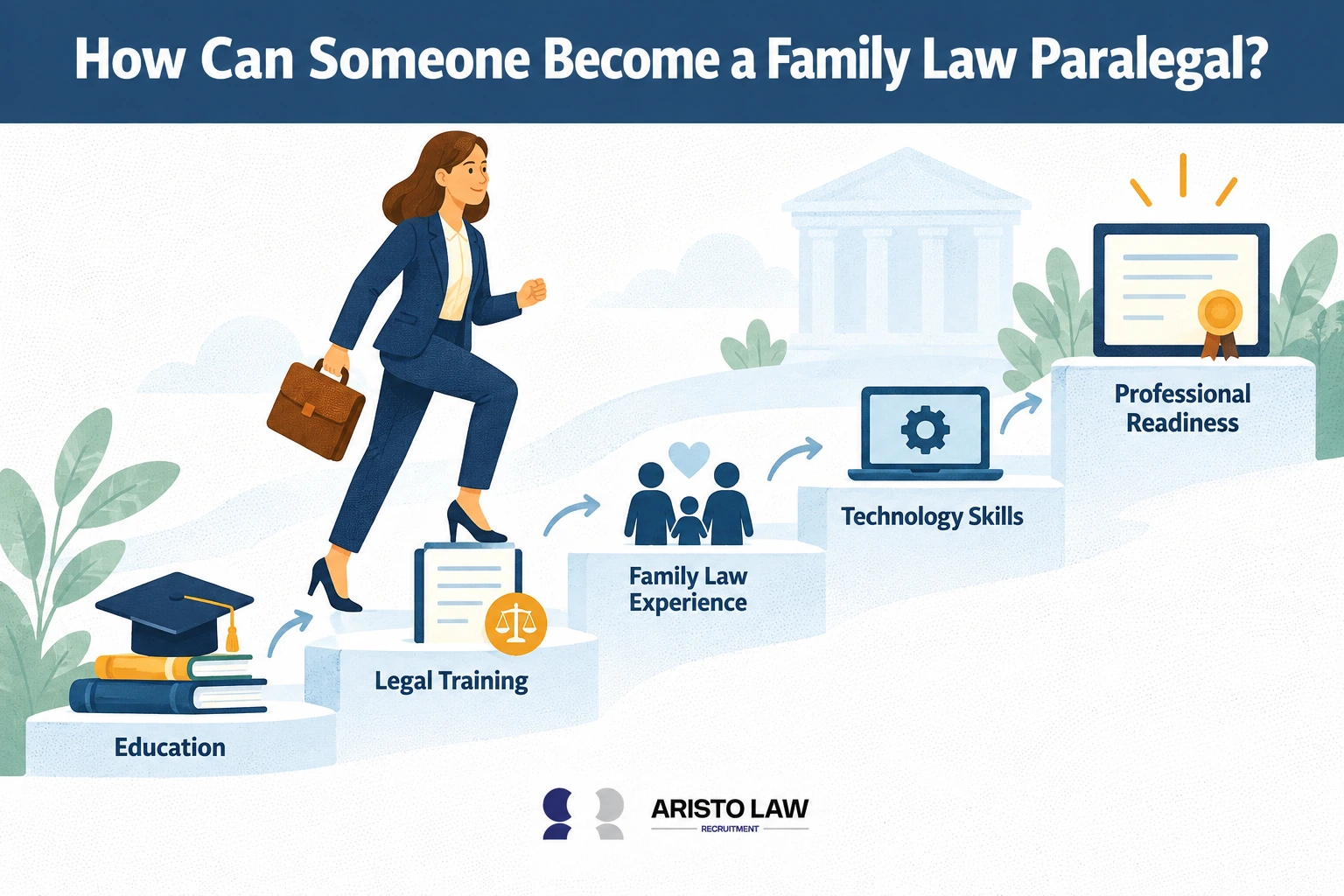
Family law specialization also requires familiarity with legal
software, case management systems, e-filing platforms, calendaring
systems, document management tools, and digital workflow coordination
used in modern legal environments. Procedural organization remains
important because family law practices involve high-volume
documentation, strict filing deadlines, discovery coordination, hearing
preparation, and continuous workflow tracking across active legal
matters.
Strong communication management skills are also necessary because
family law paralegals regularly work with emotionally stressed clients
during custody disputes, divorce proceedings, support matters, and
sensitive family-related legal conflicts. Effective family law
professionals combine legal workflow organization, confidentiality
awareness, document accuracy, and professional client communication to
support attorneys efficiently throughout family law operations.
Where can law firms
hire family law paralegals?
Law firms can hire family law paralegals through specialized
legal staffing agencies, legal outsourcing platforms, professional
associations, job boards, and law school networks. Remote legal
talent marketplaces also provide access to freelance, contract, virtual,
and outsourced family law paralegal support depending on operational
needs.
Legal staffing and outsourcing trends show that law firms
increasingly rely on specialized recruitment platforms and remote
staffing models to reduce hiring time, improve flexibility, and access
family-law-specific legal support talent for scalable legal operations.
Family law firms evaluate candidates based on drafting ability, family
law workflow experience, e-filing knowledge, case-management software
familiarity, confidentiality compliance, and experience handling
divorce, custody, support, and discovery workflows.
Many firms use drafting assessments, workflow simulations, paid trial
assignments, and reference checks before onboarding remote or in-house
legal support staff.
Listed below are 10 most common hiring sources for family law
paralegals.
-
Law firms hire family law paralegals through specialized legal
staffing platforms such as Hire an Esquire and Lawfecta -
Virtual legal staffing providers such as Aristolaw support outsourced
family law operations, drafting workflows, intake coordination, and
remote legal staffing needs -
Remote and freelance family law paralegals are commonly sourced
through HireParalegals.com and Litigo for flexible or outsourced legal
support -
Traditional recruitment channels include LinkedIn, legal job boards,
and legal staffing recruiters specializing in law firm hiring -
Law firms also recruit through bar associations, paralegal
associations, and legal networking groups -
Law schools and paralegal certification programs are common sources
for entry-level family law paralegals -
Outsourcing and nearshore staffing providers are increasingly used
for remote drafting, intake coordination, discovery organization, and
case-management support -
Firms evaluate candidates based on family law experience, drafting
skill, e-filing knowledge, and familiarity with legal software such as
Clio or MyCase -
Many firms use paid drafting tests, reference checks, and trial
assignments to evaluate workflow competency before hiring -
Remote family law staffing models improve flexibility, scalability,
and access to specialized legal support talent.
Build a legal support team that moves work forward.
Tell us what is slowing your practice down. We will help map the role, workflow, and support structure that fits.