
Real Estate Virtual Paralegal Assistant: Document Preparation, Real Estate Legal Support, and Remote Legal Workflows

Practical guidance for building efficient, accountable legal support operations.
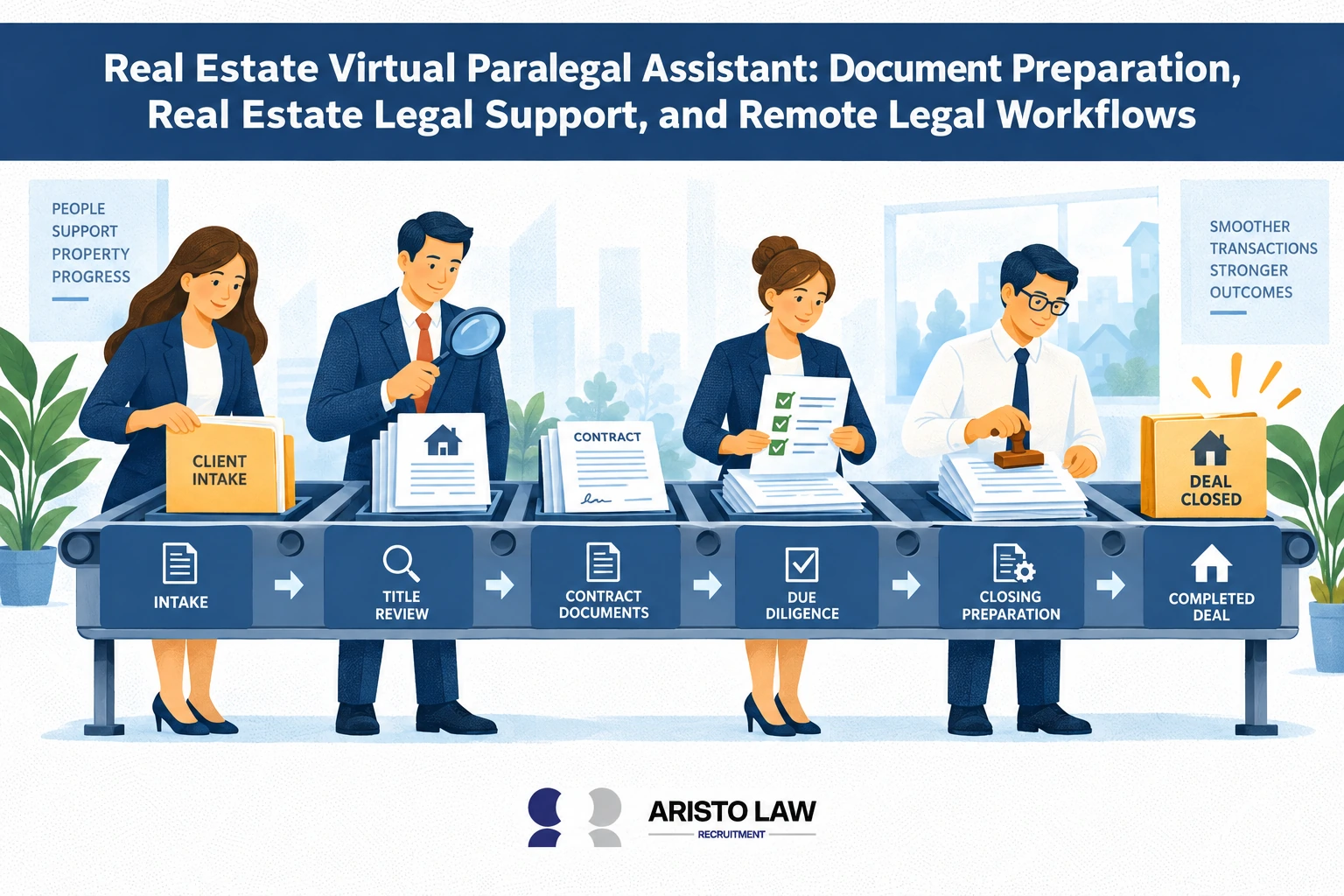
A real estate virtual paralegal assistant is a remote legal
support professional who helps attorneys, law firms, and title companies
manage real estate transactions, legal documentation, compliance
workflows, and transaction coordination through digital legal
systems.
A study by the Thomson Reuters Institute and the Georgetown
University Law Center Center on the Ethics and the Legal Profession,
titled “2024 Report on the State of the US Legal Market,” published in
2024, the researchers found that law firms increasingly use
technology-enabled legal support and workflow automation to improve
operational efficiency, reduce administrative burden, and manage rising
legal workloads through digital legal operations systems.
Virtual real estate paralegals support legal workflows by preparing
contracts, organizing closing documents, coordinating title support,
tracking deadlines, scheduling closings, maintaining transaction
records, and managing client communication throughout residential and
commercial real estate matters. Virtual legal assistants differ from
virtual real estate paralegals because paralegals handle more
substantive legal workflow support involving transaction documentation,
title coordination, compliance tracking, and procedural real estate
operations under attorney supervision.
A study by the American Bar Association Legal Technology
Resource Center, titled “Legal Technology Survey Report,” published in
2023, found that cloud-based legal systems, document-management
platforms, and remote workflow tools improved legal collaboration,
centralized document access, and operational flexibility across law firm
environments.
Virtual paralegal support improves real estate legal workflows
through centralized document management, faster transaction
coordination, reduced administrative workload, and improved workflow
visibility across active closings and property transactions. Common
outsourceable tasks include purchase agreement preparation,
title-document coordination, closing-package organization, escrow
communication, transaction tracking, scheduling, compliance monitoring,
and document management. Attorney-only responsibilities such as legal
advice, contract interpretation, negotiation strategy, and legal
representation remain non-delegable.
Solo attorneys and law firms use outsourced virtual support to
improve scalability, reduce staffing costs, and increase operational
efficiency without expanding permanent office infrastructure. Virtual
real estate paralegal pricing commonly uses hourly, retainer,
subscription, or project-based models that cost less than full in-house
staffing due to lower payroll and office overhead. Remote legal
workflows commonly operate through case-management platforms,
document-automation systems, transaction-tracking software, secure
file-sharing tools, e-signature systems, and encrypted communication
platforms protected through confidentiality controls, restricted-access
permissions, and secure document-handling policies. Effective hiring
decisions prioritize real estate transaction experience, software
proficiency, deadline management, confidentiality discipline, and
familiarity with title and closing workflows.
Aristolaw helps law firms manage real estate virtual
paralegal assistant work by providing outsourced support for document
preparation, title review coordination, closing file organization, due
diligence tasks, transaction tracking, and remote real estate legal
workflows. Hire
a Real Estate Virtual Paralegal Assistant with Aristolaw today.
Aristolaw connects law firms with outsourcing solutions that match
trained real estate paralegal support staff to each property document
task, transaction workflow need, closing support duty, title
coordination function, and remote legal operations
responsibility.
What is a
real estate virtual paralegal assistant?
A real estate virtual paralegal assistant is a remote legal
support professional who helps attorneys manage real estate documents,
transaction workflows, closing coordination, and administrative legal
tasks under attorney supervision. Many firms use virtual
real estate paralegal assistant support workflows to
improve transaction coordination, organize closing documentation, and
maintain workflow visibility across residential and commercial real
estate matters. Remote real estate paralegals support purchase
agreements, lease documentation, escrow coordination, title-document
organization, due diligence review, closing preparation, calendaring,
and client communication through cloud-based legal systems and remote
legal operations platforms.
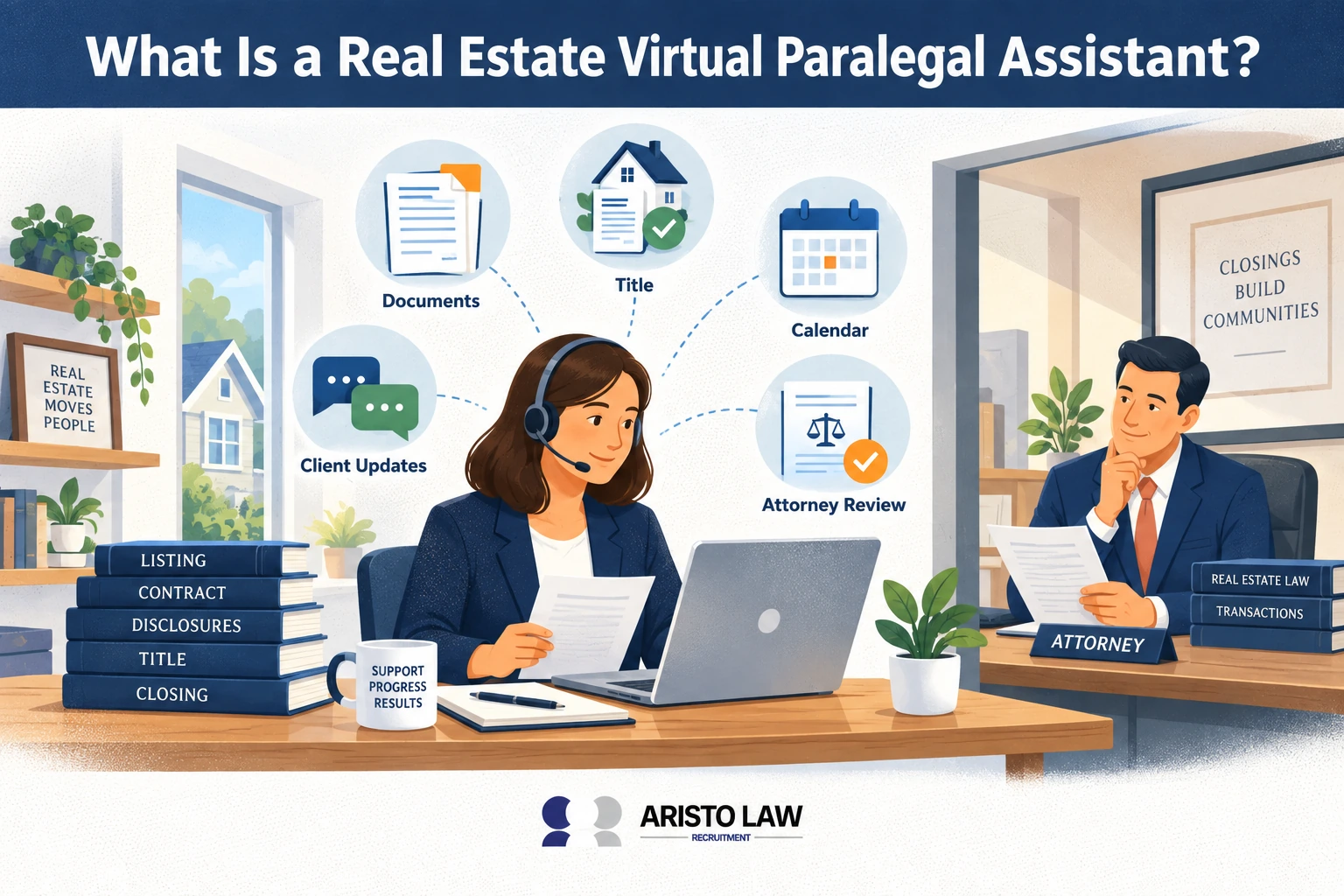
Real estate law creates operational pressure because transactions
involve deadline-heavy closings, constant document revisions,
multi-party coordination between lenders, buyers, sellers, title
companies, brokers, and attorneys, as well as repetitive procedural
workflows tied to contracts, disclosures, escrow timelines, and
compliance tracking. Virtual legal support reduces administrative
overload by organizing transaction files, tracking deadlines, managing
document versions, coordinating communication, preparing closing
packets, and maintaining centralized workflow systems that improve
efficiency and reduce delays during active real estate transactions.
What does a
virtual real estate paralegal do?
Tasks handled by a virtual real estate paralegal include
document preparation, contract review and support, due diligence
tracking, and transaction management throughout residential and
commercial real estate workflows under the supervision of an
attorney. Tasks handled by a virtual real estate paralegal
support transaction movement, reduce attorney administrative workload,
and improve closing coordination across active real estate matters.
Listed below are the 15 tasks handled by a virtual real estate
paralegal.
-
Client intake coordination: collecting transaction
details, organizing buyer and seller information, and preparing
transaction files -
Contract organization: managing purchase agreements,
amendments, disclosures, lease documents, and transaction records -
Document preparation support: drafting real estate
forms, closing documents, lease documentation, and procedural
transaction paperwork under attorney supervision -
Title coordination: reviewing title commitments,
tracking title issues, monitoring lien releases, and coordinating title
updates -
Lien and due diligence tracking: organizing due
diligence records, surveys, inspection reports, zoning documents, and
lien documentation -
Escrow coordination: tracking escrow requirements,
monitoring deadlines, and organizing transaction-related financial
records -
Communication with lenders and title companies:
coordinating updates, collecting transaction documents, and maintaining
workflow communication -
Closing scheduling: managing closing calendars,
coordinating signings, and tracking deadline-sensitive transaction
milestones -
Closing package preparation: organizing settlement
statements, closing disclosures, signatures, title records, and
transaction binders -
Lease administration support: managing lease
records, amendments, tenant documentation, and compliance tracking -
Transaction management: maintaining centralized
workflow visibility, tracking procedural progress, and updating
case-management systems -
Document version control: organizing revised
contracts and maintaining accurate transaction-document records -
Post-closing file management: archiving completed
transaction files, organizing final documents, and maintaining
compliance records -
Deadline monitoring: tracking inspection periods,
financing contingencies, escrow timelines, and closing requirements -
Remote workflow coordination: supporting cloud-based
legal operations, secure file sharing, and digital transaction
management systems
How
does a virtual legal assistant differ from a virtual real estate
paralegal?
The difference between a virtual legal assistant and a
virtual real estate paralegal is that virtual legal assistants mainly
handle administrative operations, while virtual real estate paralegals
support transaction-specific legal workflows under attorney
supervision.
The difference between a virtual legal assistant and a virtual real
estate paralegal
Area |
Virtual Legal
|
Virtual Real Estate
|
|---|---|---|
| Primary role | Administrative and operational support | Real estate transaction and legal workflow support |
| Scheduling management | Manages appointments, meetings, and calendars | Tracks closing schedules, escrow deadlines, and transaction milestones |
| Inbox management | Handles emails, follow-ups, and administrative communication | Coordinates transaction-related communication with lenders, title companies, and clients |
| Client updates | Provides administrative status updates | Provides transaction workflow and procedural updates under attorney supervision |
| Transaction tracking | Limited or administrative only | Tracks real estate transaction progress and due diligence workflows |
| Drafting support | Formats templates and administrative documents | Prepares contracts, closing documents, lease records, and transaction paperwork under supervision |
| Title organization | Minimal involvement | Reviews title records, tracks liens, and coordinates title documentation |
| Closing coordination | Supports scheduling logistics | Organizes closing packages, signatures, escrow records, and settlement documentation |
| Due diligence support | Administrative file management | Organizes surveys, inspection reports, zoning records, and due diligence documentation |
| Legal workflow involvement | Lower procedural involvement | Higher involvement in real estate transaction workflows |
| Document management | Organizes files and administrative records | Maintains transaction files, version control, and closing documentation |
| Escrow coordination | Rarely involved | Tracks escrow deadlines and transaction-related financial workflows |
| Attorney supervision level | Operational supervision | Direct attorney supervision for legal-support tasks |
| Specialized legal knowledge | General administrative knowledge | Real estate transaction, title, escrow, and closing workflow knowledge |
| Software usage | Calendaring, CRM, and communication systems | Case management, transaction tracking, title systems, and document-automation platforms |
How
do virtual real estate paralegals support document preparation
workflows?
Virtual real estate paralegals support document preparation
workflows by organizing, drafting, reviewing, and coordinating
transaction documents through remote legal systems and digital workflow
platforms. Many firms use real
estate virtual paralegal document preparation workflows
to improve transaction speed, reduce administrative delays, and maintain
organized real estate operations. Virtual real estate paralegals support
residential and commercial transactions by preparing purchase
agreements, organizing title records, coordinating escrow documentation,
drafting lease documents, preparing disclosure forms, reviewing
financing paperwork, and managing closing packages under attorney
supervision.
Remote legal workflows also involve coordinating document flow
between attorneys, lenders, title companies, escrow officers, brokers,
and clients through cloud-based legal software and secure communication
systems. Virtual paralegals track deadlines, maintain document version
control, organize workflow checklists, review records for missing
information, and support e-signature and e-closing systems. Legal
operations research consistently found that standardized digital
document workflows improve transaction speed, reduce repetitive
administrative work, and improve workflow accuracy through centralized
case-management systems.
A study by Clio, titled “2023 Legal Trends Report,” published
in 2023, reported that cloud-based legal workflow systems improved
operational efficiency and document coordination across legal
operations.
Listed below are the 10 ways virtual real estate paralegals support
document preparation workflows.
-
Purchase agreement preparation: contracts,
amendments, and disclosure forms -
Title and escrow coordination: title records, lien
tracking, and escrow documentation -
Lease-document support: lease agreements and
property-related legal forms under attorney supervision -
Financing-document organization: lender records and
financing disclosures -
Workflow tracking: deadlines, inspection periods,
and closing timelines -
Document review support: formatting checks and
missing information review -
E-signature workflows: digital signature
coordination and electronic document execution -
Cloud-based collaboration: centralized transaction
files and remote legal workflow systems -
Confidentiality protection: encrypted systems and
controlled-access document platforms -
E-closing support: digital closing packages and
remote transaction coordination
How
does virtual paralegal support improve real estate legal workflows?
Virtual paralegal support improves real estate legal
workflows by centralizing document handling, deadline tracking,
transaction updates, and communication across multiple parties involved
in a deal. Remote real estate support improves workflow
efficiency by coordinating communication and documentation between
attorneys, lenders, buyers, sellers, brokers, escrow officers, and title
companies through centralized legal systems and digital
transaction-management platforms. Virtual paralegals help reduce
repetitive workflow bottlenecks involving missing signatures, delayed
disclosures, incomplete title records, document revisions, escrow
delays, financing-document issues, and closing-calendar conflicts that
commonly slow residential and commercial real estate transactions.

Remote workflow support also improves process continuity across
high-volume transactions because virtual paralegals maintain organized
transaction files, track procedural deadlines, monitor checklist
completion, coordinate e-signature workflows, update transaction
records, and manage communication follow-ups consistently throughout the
transaction lifecycle. Centralized workflow management reduces
administrative overload for attorneys while improving document accuracy,
transaction visibility, and closing coordination across active real
estate matters.
Can
solo real estate attorneys use virtual paralegal support?
Yes, solo real estate attorneys can use virtual paralegal
support to manage transaction-heavy workloads without hiring full-time
in-office staff. Virtual staffing helps solo attorneys handle
overflow closings, intake coordination, lease tracking, title issue
follow-up, client communication, deadline monitoring, escrow
coordination, and document preparation support across multiple
simultaneous transactions. Remote paralegals also maintain organized
transaction files, track closing schedules, coordinate communication
with lenders and title companies, and manage repetitive workflow tasks
that commonly create administrative bottlenecks in real estate
practices.
Virtual support improves scalability because solo attorneys increase
transaction capacity without expanding permanent office staffing or
increasing fixed overhead costs tied to office space, payroll, and
employee benefits. Structured remote legal workflows also improve
responsiveness during high-volume closing periods by maintaining
centralized transaction tracking, faster document coordination,
organized follow-up systems, and consistent communication across active
real estate matters.
Which
real estate legal tasks can be outsourced to a virtual paralegal?
Real estate legal tasks that can be outsourced to a virtual
paralegal include contract preparation support, title review
organization, due diligence tracking, lease file management, closing
coordination, and document indexing under attorney supervision.
Outsourcing repetitive transaction-heavy workflows improves attorney
productivity because virtual paralegals manage document coordination,
transaction tracking, communication follow-ups, and procedural workflows
that would otherwise consume attorney time across high-volume real
estate practices. Attorney-only responsibilities such as legal advice,
contract interpretation, negotiation strategy, and legal representation
remain non-delegable.
Listed below are the 15 real estate legal tasks that are outsourced
to a virtual paralegal.
-
Purchase agreement support: organizing contracts,
amendments, addenda, and disclosure forms -
Lease-document management: preparing lease files,
amendments, renewals, and tenant documentation under attorney
supervision -
Disclosure-packet organization: coordinating seller
disclosures, property records, and transaction documentation -
Title-review organization: tracking title
commitments, organizing title records, and monitoring unresolved title
issues -
Lien tracking: reviewing lien documentation and
coordinating payoff or release records -
Due diligence tracking: organizing surveys,
inspections, zoning records, financing documents, and compliance
materials -
Closing coordination: preparing closing checklists,
managing scheduling workflows, and organizing settlement
documentation -
Escrow communication: coordinating updates between
escrow officers, lenders, attorneys, brokers, and clients -
Transaction timeline management: tracking
contingencies, inspection periods, financing deadlines, and closing
milestones -
HOA-document coordination: organizing association
disclosures, fees, bylaws, and property-related records -
Document indexing: maintaining organized digital
transaction files and searchable legal records -
E-signature workflow support: coordinating digital
signatures and electronic document execution -
Post-closing file management: organizing completed
transaction records and maintaining compliance archives -
Case-management updates: tracking workflow activity
and maintaining centralized transaction visibility -
Client communication support: handling procedural
updates, scheduling coordination, and missing-document follow-ups
What
legal workflows benefit most from remote real estate paralegal
support?
Real estate legal workflows that benefit most from remote
paralegal support include intake coordination, closing preparation, and
document management because these workflows involve repetitive
documentation, deadline tracking, and multi-party coordination.
Many firms apply litigation
case manager support for legal workflows principles to
real estate transaction management in order to improve workflow
visibility, reduce administrative delays, and standardize transaction
coordination across high-volume matters.
The table below shows real estate legal workflows that benefit most
from remote paralegal support.
Workflow Type |
Remote Support
|
Operational
|
|---|---|---|
| Client intake | Collects transaction details, organizes records, and prepares transaction files |
Faster onboarding and reduced attorney administrative workload |
| Contract drafting support | Prepares purchase agreements, amendments, disclosures, and lease documents under supervision |
Faster document turnaround and improved document consistency |
| Title review organization | Tracks title commitments, liens, and unresolved title issues | Improved title visibility and reduced closing delays |
| Escrow coordination | Manages escrow communication, deadlines, and transaction updates |
Better transaction coordination and reduced bottlenecks |
| Lease administration | Organizes lease records, renewals, amendments, and tenant documentation |
Improved lease tracking and centralized document control |
| Due diligence tracking | Organizes inspections, surveys, zoning records, and compliance documents |
Faster due diligence review and improved workflow organization |
| Closing preparation | Coordinates closing packages, signatures, and settlement documentation |
Reduced closing delays and improved transaction readiness |
| Post-closing tasks | Archives transaction files and organizes completed documentation |
Better compliance tracking and file accessibility |
| Document management | Maintains centralized transaction records and version control | Faster document retrieval and improved workflow visibility |
| Deadline monitoring | Tracks contingencies, inspection periods, and closing timelines | Reduced missed deadlines and scheduling conflicts |
| E-signature coordination | Manages electronic signatures and digital document execution | Faster document completion and remote transaction support |
| Client communication | Handles procedural updates and missing-document follow-ups | Improved responsiveness and fewer communication delays |
| Transaction management | Updates workflow systems and tracks transaction progression | Better operational oversight across active transactions |
| Lender and broker coordination | Coordinates document flow and transaction communication | Reduced workflow interruptions and improved collaboration |
What
tasks should not be delegated to a virtual real estate paralegal?
Tasks that should not be delegated to a virtual real estate
paralegal include giving legal advice, signing legal filings, and
independently representing clients because these responsibilities
involve legal judgment and attorney authority. Delegation
boundaries exist to prevent unauthorized practice of law and to maintain
attorney responsibility for legal decisions, transaction liability, and
client representation.
Listed below are the 12 tasks that must not be delegated to a virtual
real estate paralegal.
-
Giving legal advice: advising clients on legal
rights, risks, obligations, or transaction outcomes -
Negotiating legal strategy: determining negotiation
positions, contract strategy, or dispute-resolution tactics -
Issuing title opinions: interpreting title defects,
ownership risks, easements, liens, or legal property interests -
Signing legal filings: approving and signing legal
documents or filings as an attorney or counsel -
Independently representing clients: appearing as
legal counsel during disputes, hearings, or negotiations -
Interpreting contract liability: advising clients on
legal exposure, contractual obligations, or enforcement rights -
Resolving legal disputes: handling legal conflict
resolution or settlement negotiations independently -
Providing legal interpretation of zoning or compliance
issues: advising on legal consequences tied to regulations or
land-use restrictions -
Making final legal decisions: approving transaction
structure, legal remedies, or procedural legal actions -
Establishing attorney-client relationships: formally
accepting legal representation or responsibility for a matter -
Advising on title defects or encumbrances:
determining legal impact of liens, restrictions, or title issues -
Providing legal opinions on transaction risks:
advising buyers, sellers, lenders, or title companies on legal liability
or litigation exposure
Virtual real estate paralegals still support transactional workflows
by organizing documents, coordinating closings, tracking deadlines,
managing escrow communication, preparing draft documents under
supervision, and maintaining transaction-management systems without
engaging in independent legal judgment.
How
does outsourcing real estate paralegal support reduce costs?
Outsourcing real estate paralegal support reduces costs by
lowering payroll overhead, office expenses, training costs, and idle
staffing time while maintaining transaction workflow capacity.
Firms use flexible remote staffing to handle fluctuating closing
volumes, transaction spikes, lease-heavy periods, and project-based real
estate matters without committing to permanent in-house staffing costs.
Outsourced virtual paralegals also reduce attorney administrative
workload by handling document coordination, title tracking, escrow
communication, deadline monitoring, and closing support across
high-volume transactions.
A study by Clio, titled “2025 Legal Trends Report,” published
in 2025, the researchers found that solo and small law firms using
technology-enabled vertical growth systems and process automation
handled 25% to 37% more cases per lawyer, drastically improving
operational efficiency and driving revenue without expanding standard
headcount.
How
much does a virtual paralegal cost for real estate law firms?
Virtual paralegal cost for real estate law firms in the
United States commonly ranges from approximately $25 to $75 per hour
(€22–€66 / £19–£57) or from around $1,000 to $3,000+ monthly
(€880–€2,640+ / £760–£2,280+) depending on transaction complexity,
workflow volume, experience level, software proficiency, and the type of
support arrangement used. Real estate firms handling commercial
transactions, complex title issues, lease administration, multi-property
deals, or high-volume closings generally pay higher rates because these
workflows involve greater document complexity, tighter deadlines, and
more coordination between attorneys, lenders, title companies, brokers,
and escrow officers.
Hourly pricing is commonly used for overflow closings, title
coordination, escrow communication, lease-document preparation, and
temporary transaction support. Monthly retainers are used for ongoing
workflow management, deadline tracking, and continuous closing
coordination, while some firms use per-transaction billing or
project-based pricing for individual closings, due diligence reviews, or
post-closing document management. Dedicated remote staffing models
support firms managing consistent transaction volume throughout the
year.
A market report by Wyzer Staffing, titled “What Are The
Average Virtual Paralegal Rates?”, published in 2026, the researchers
reported that virtual paralegal pricing commonly ranges between $25 and
$75 per hour in the United States, depending on specialization and
workload complexity, with monthly retainers commonly ranging from $1,000
to $3,000 for ongoing legal support workflows.
What
should law firms look for when hiring a virtual real estate
paralegal?
Qualities to look for in a virtual real estate paralegal
include transaction experience, title workflow familiarity, and software
proficiency because real estate legal operations involve high-volume
documentation, strict closing timelines, and multi-party transaction
coordination. Qualities to look for in a virtual real estate
paralegal support include organized transaction management and efficient
remote legal workflows.
Listed below are the 17 qualities to look for in a virtual real
estate paralegal.
-
Real estate transaction experience: familiarity with
residential and commercial closings, purchase agreements, disclosures,
and transaction coordination -
Title workflow familiarity: experience reviewing
title commitments, tracking liens, resolving title issues, and
coordinating title documentation -
Document accuracy: ability to prepare and organize
closing packages, lease files, escrow documents, and transaction records
with minimal errors -
Deadline management: tracking contingencies,
inspection periods, financing deadlines, escrow timelines, and closing
schedules accurately -
Software proficiency: experience using case
management systems, transaction-tracking software, e-signature tools,
document repositories, and secure communication platforms -
Lease administration experience: managing lease
documentation, amendments, renewals, and tenant-related transaction
records -
Escrow coordination skills: maintaining
communication with escrow officers, lenders, brokers, title companies,
and clients throughout transactions -
Closing-package management: organizing settlement
statements, disclosures, signatures, title records, and post-closing
documentation -
Multi-party communication management: coordinating
updates across attorneys, buyers, sellers, lenders, brokers, and title
professionals -
Document version control: maintaining accurate
revisions and centralized transaction-document organization -
Due diligence workflow knowledge: organizing
inspections, surveys, financing records, zoning documentation, and
compliance materials -
Confidentiality discipline: protecting financial
records, property information, escrow data, and confidential transaction
documents -
Workflow organization: maintaining centralized
transaction tracking and operational visibility across active
matters -
Transaction simulations: testing workflow
coordination and transaction-management ability during the hiring
process -
Drafting tests: evaluating document preparation
accuracy, formatting consistency, and transaction-document
organization -
Workflow audits: reviewing organizational methods,
deadline tracking practices, and communication management systems -
Confidentiality verification: confirming secure
document-handling practices, access-control awareness, and remote
data-security compliance
How
does virtual real estate legal support help firms scale?
Virtual real estate legal support helps firms scale by
increasing transaction-handling capacity without requiring immediate
expansion of in-office staff and infrastructure. Remote support
allows firms to manage transaction overflow, coordinate multiple
simultaneous closings, support large lease portfolios, and maintain
standardized workflows across residential and commercial real estate
matters. Firms also improve operational flexibility during market
surges, refinancing periods, commercial development projects, seasonal
closing spikes, and high-volume transaction periods without increasing
permanent staffing costs.
Virtual real estate paralegals support scalability by organizing
closing workflows, tracking deadlines, coordinating escrow
communication, managing title documentation, maintaining centralized
transaction files, and handling repetitive document-heavy processes
through cloud-based legal systems and remote workflow platforms.
Standardized digital workflows improve responsiveness because firms
maintain consistent transaction tracking, faster document coordination,
organized follow-ups, and better workflow visibility across active real
estate matters. Remote legal support also improves attorney workload
control by shifting administrative and procedural transaction tasks away
from attorneys, allowing more focus on negotiations, legal review,
transaction strategy, and client representation during periods of
increased closing volume.
What
software tools do virtual real estate paralegals use?
Tools used by virtual real estate paralegals include case
management systems, document management platforms, e-signature tools,
transaction tracking software, and secure communication systems that
support transaction coordination and remote legal workflows.
Many firms evaluate legal
case management systems to improve workflow visibility,
transaction speed, deadline tracking, and centralized document
coordination across active real estate matters.
Listed below are the 12 tools used by virtual real estate
paralegals.
-
Case management systems: track transaction progress,
deadlines, closing milestones, tasks, and legal workflow activity across
multiple real estate matters -
Document management platforms: organize contracts,
title records, disclosures, lease files, escrow documents, and closing
packages in centralized repositories -
E-signature tools: manage digital signatures for
purchase agreements, disclosures, settlement documents, leases, and
transaction approvals -
Transaction tracking software: monitor
contingencies, inspection periods, financing deadlines, escrow
timelines, and closing schedules -
Title tracking systems: organize title commitments,
lien records, title updates, and unresolved title issues during
transactions -
Shared closing calendars: coordinate closing dates,
attorney schedules, escrow deadlines, lender communication, and signing
appointments -
Cloud storage platforms: maintain secure remote
access to transaction records and centralized legal files -
CRM systems: manage intake workflows, client
communication, transaction updates, and follow-up coordination -
Escrow communication platforms: coordinate
communication between attorneys, lenders, brokers, escrow officers, and
title companies -
Secure document exchange tools: transfer
confidential financial records, property documents, and transaction
materials securely -
Workflow automation tools: standardize repetitive
transaction processes, reminders, checklist tracking, and
document-routing workflows -
Remote collaboration platforms: support
communication, workflow coordination, and real-time transaction updates
across distributed legal teams
Software systems improve transaction speed by centralizing workflow
visibility, reducing document delays, improving communication
coordination, and maintaining organized real estate transaction
management across high-volume legal operations.
Can a virtual
assistant support title companies?
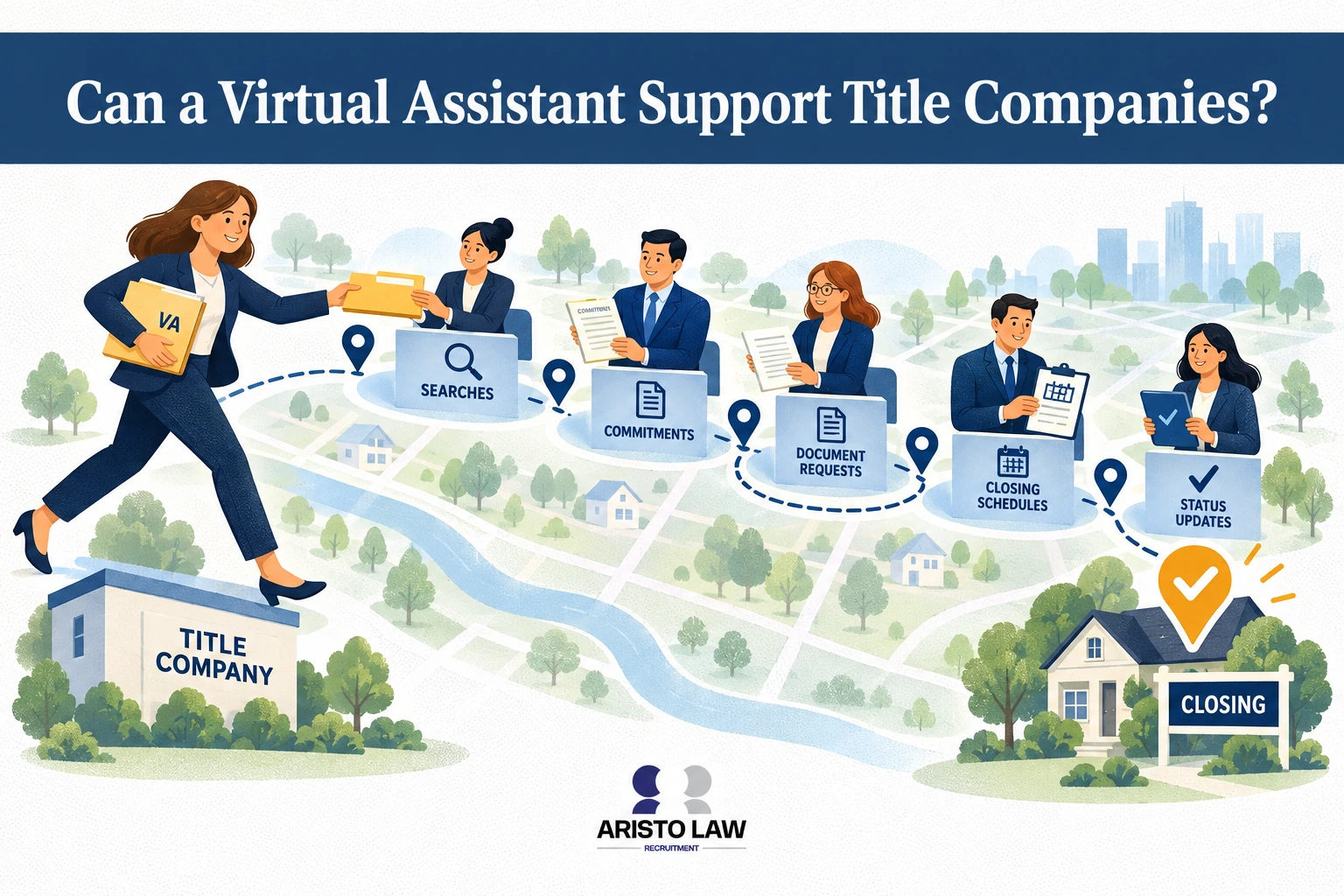
Yes, a virtual assistant can support title companies by
organizing transaction files, tracking documentation, coordinating
communication, and assisting with closing preparation
workflows. Virtual assistants commonly support title operations
through title-file intake, payoff tracking, scheduling coordination,
escrow communication, document routing, closing-calendar management,
lender follow-ups, and post-closing file organization. These workflows
help title companies manage high transaction volume more efficiently
while maintaining organized records and consistent communication across
active closings.
Title-company workflows closely connect with real estate legal
operations because attorneys, title officers, lenders, escrow
professionals, brokers, buyers, and sellers all rely on accurate
document coordination, title tracking, and deadline management
throughout the transaction lifecycle. Virtual support reduces
administrative bottlenecks by maintaining organized transaction files,
coordinating signatures, tracking missing records, routing closing
documents, updating workflow systems, and supporting communication
between all parties involved in residential and commercial real estate
transactions.
How
do virtual paralegals maintain confidentiality in real estate
transactions?
Virtual paralegals maintain confidentiality in real estate
transactions through secure communication systems, controlled document
access, encrypted storage, and attorney-managed workflow
permissions.
Confidentiality protections are critical because real estate
transactions involve sensitive financial records, wire instructions,
purchase contracts, ownership records, escrow information, lender
documentation, and personal client identities that create fraud and
data-exposure risks during remote transactional workflows. Virtual real
estate legal support systems commonly use encrypted cloud storage,
secure client portals, password-protected repositories, multi-factor
authentication, and restricted-access permissions to reduce unauthorized
access to transaction documents and financial information.
Role-based access controls limit visibility to only the files
necessary for assigned tasks, while attorney-managed workflow
permissions help maintain oversight across transaction operations. Many
firms also use secure document-routing systems, audit trails,
wire-verification procedures, device-security policies,
document-retention protocols, VPN access, and fraud-prevention workflows
designed to reduce wire fraud, phishing attacks, unauthorized downloads,
and transaction-security breaches during remote real estate
transactions.
Build a legal support team that moves work forward.
Tell us what is slowing your practice down. We will help map the role, workflow, and support structure that fits.